promoting access to White Rose research papers
White Rose Research Online
Universities of Leeds, Sheffield and York
http://eprints.whiterose.ac.uk/
This is an author produced version of a paper published in
Sustainable Cities
and Society.
White Rose Research Online URL for this paper:
http://eprints.whiterose.ac.uk/77120/
Paper:
Martin, CJ, Taylor, PG, Upham, P, Ghiasi, G, Bale, CSE, Gale, WF, Owen, A,
James, H, Slack, RJ and Helmer, S (2014) Energy in low carbon cities and social
learning: A process for defining priority research questions with UK stakeholders.
Sustainable Cities and Society, 10. 149 - 160.
1 2 3 4 5 6 7 8 9 10 11 12 13 14 15 16 17 18 19 20 21 22 23 24 25 26 27 28 29 30 31 32 33 34 35 36 37 38 39 40 41 42 43 44 45 46 47 48 49 50 51 52 53 54 55 56 57 58 59 60 61
Title:Energy in low carbon cities and social learning: a process for defining priority research questions with UK stakeholders
Authors: Chris J. Martin1, Peter G. Taylor ([email protected])1, 2, 3, Paul Upham ([email protected])1, 2, 3,
Golnoush Ghiasi1, Catherine S. E. Bale ([email protected])1, 2, Hannah James ([email protected])4, Alice Owen
([email protected])3, William F. Gale ([email protected])1, 2, Rebecca J. Slack ([email protected])5 and Simon
Helmer6
Corresponding author: Chris Martin, [email protected], Centre for Integrated Energy Research, Energy Building,
University of Leeds, Leeds LS2 9JT, +44 (0)113 3431950
Affiliations
1 Centre for Integrated Energy Research, Energy Building, University of Leeds, Leeds LS2 9JT
2 Energy Research Institute, Energy Building, University of Leeds, Leeds LS2 9JT
3 Sustainability Research Institute, School of Earth and Environment, University of Leeds, Leeds LS2 9JT
4 Doctoral Training Centre in Low Carbon Technologies, Energy Building, University of Leeds, Leeds LS2 9JT
5 water@leeds, School of Geography, University of Leeds, Leeds LS2 9JT
6 Briar Associates, York House, High Street, Amblecote, Stourbridge, DY8 4BT
1 2 3 4 5 6 7 8 9 10 11 12 13 14 15 16 17 18 19 20 21 22 23 24 25 26 27 28 29 30 31 32 33 34 35 36 37 38 39 40 41 42 43 44 45 46 47 48 49 50 51 52 53 54 55 56 57 58 59 60 61
Abstract
City-level decision-making requires timely access to a wide range of relevant and comprehensible data and information. Although a wide range of research on energy and cities is on-going across the social, engineering and natural sciences, it cannot be taken for granted that the questions being asked and the way questions are structured reflect practitioner perspectives and requirements. This paper discusses the ways in which research questions are formed and interpreted by actors in academic research and research user communities. We also report a set of research questions produced via an initial trial of a two stage, participative process consisting of (a) a survey targeted at city-focussed practitioners in the United Kingdom (UK) with an interest in lower carbon energy futures; and (b) a workshop integrating practitioner and academic perspectives. Comparing the set of research questions identified with themes in the academic literature, we find that research and practitioner communities concur on the importance of reducing energy demand and also on a number of cross-cutting issues. However, we also find that academic research places a greater emphasis on the interfaces between the energy system and other urban systems. We conclude that the two stage, participative process followed can serve to generate and legitimate city-related research questions through collaboration between stakeholders and academic researchers.
1. Introduction
The quantity of scientific information produced annually on cities is immense, in recent years averaging over 20,000
publications per year1. Perhaps surprisingly however, there seems relatively little work on the extent to which this scientific
information meets the needs of practitioners. In contrast, social learning theory suggests that meeting such needs and implementing integrated urban transitions of society and technology are important factors to consider. As van der Kerkhof and Wieczorek (2005) observe, learning in the context of interconnected social and technological change needs to include processes intended to foster social learning, particularly the development of shared understandings of problems (in terms of their nature, scope and impact). This in turn requires the participation of a wide range of actors, and indeed there is a growing, supportive literature that argues for societal engagement in the production of scientific knowledge. Often grouped together under the concept of post-normal science (Funtowicz & Ravetz, 1990; Ravetz, 1987) this literature emphasises through a variety of rationales that it is legitimate (and in some cases essential) to view the world in more than one way (Frame & Brown, 2008). One such rationale is that including a range of points of view when science is used to inform
1 Calculated as the mean of articles returned in a search of the Scopus database for the years 2009-12 inclusive, with the
1 2 3 4 5 6 7 8 9 10 11 12 13 14 15 16 17 18 19 20 21 22 23 24 25 26 27 28 29 30 31 32 33 34 35 36 37 38 39 40 41 42 43 44 45 46 47 48 49 50 51 52 53 54 55 56 57 58 59 60 61
policy is likely to lead to better decisions with wider political support and legitimacy, particularly when problems are
resistant to resolution, i.e. are ‘wicked’ (Rittel & Webber, 1973). Indeed, when Rittel and Webber (ibid), both urban
planners, defined what it means for a problem to be ‘wicked’, one of their ten defining characteristics of such problems is
that we can’t even be sure when a problem is solved, not least because there are differing perspectives on any given problem of this type.
For these and other reasons, it is increasingly common, even commonplace, to involve stakeholders in collaborative work with scientists, particularly where there is a significant governance-related element to phenomena under investigation - e.g. Pahl-Wostl (2007). Still, though, we would judge it somewhat less common within the research community to
collaboratively generate scientific research questions with practitioners and other stakeholders, such that stakeholder views on what is important are considered from the beginning of the scientific process. In the UK, examples include Brown et al (2010) in the case of fresh water resources and Sutherland et al (2006) in the case of ecology.
Moreover, disjunctions in approach between the research and policy and practitioner communities have been identified across a range of fields e.g. (Boaz & Gough, 2010; Pohl, 2008). Remedying this might either focus on researchers acquiring the understanding of practice required to frame questions; or practitioners and policy makers gaining access to the process by which research questions are shaped. This in turn requires time and resources, to identify needs and perspectives of the
diverse community of potential knowledge users (Holmes & Harris, 2010); and an ability on the part of users to “evolve
more effective mechanisms for identifying gaps in the evidence base for policy development” (House of Commons Science and Technology Committee, 2006). Of course, it also requires more than this: a willingness to collaborate, based in part, as identified above, on a shared view of a problem.
1 2 3 4 5 6 7 8 9 10 11 12 13 14 15 16 17 18 19 20 21 22 23 24 25 26 27 28 29 30 31 32 33 34 35 36 37 38 39 40 41 42 43 44 45 46 47 48 49 50 51 52 53 54 55 56 57 58 59 60 61
cities, not to assemble a definitive list of such questions at this stage. Thus, while the results will to some extent be applicable internationally, the work reported draws on data and insight provided by exemplar UK participants (based predominantly within the Yorkshire region).
2. Research scope — energy and a low carbon future for cities
A key priority for the UK Government is tackling climate change, through cutting greenhouse gas (GHG) emissions and decarbonising the economy (HM Government - The Coalition, 2010). In this regard the UK government has recognised explicitly the need for evidence-based policy-making in relation to energy and climate change. For instance, the first of the
responsibilities listed for the Chief Scientist of the Department for Energy and Climate Change is “ensuring key policy and
planning decisions in DECC are evidence-based” (DECC, 2012a). This commitment has been re-affirmed in a speech by
the Secretary of State for Energy and Climate Change in which he stated that energy policy will be directed by and founded upon evidence (DECC, 2012b). Evidence-based policy making, although increasingly desired in the UK, is becoming increasingly difficult as evidence becomes more diverse and datasets more extensive. At issue here is what constitutes evidence, whose evidence should shape decisions, how that evidence is generated and what types of questions, both general and specific, are answered (Nutley & Webb, 2000; Pawson, 2006). Involving stakeholders in the development of research questions, as considered below, also involves many similarly contested issues.
The crucial role of cities in helping to tackle climate change is recognised widely (OECD, 2010; UN Habitat and UNEP, 2009). Around 80% of the UK population now lives in urban environments and this proportion is likely to grow over the coming decades. Thus, local action by cities will be vital if the UK is to meet its national target of an 80% reduction in
GHG emissions, on 1990 levels, by 2050 (Dixon, 2012).The energy infrastructure on which every city depends needs to
adapt and be renewed to meet the increasing demands for energy services from city residents, in the context of making the transition to a low-carbon economy. UK central government has stated that it cannot deliver on its energy and climate change policy without the support and action of local government. A recent report (The Committee on Climate Change, 2012) by the body tasked with advising the UK government on climate change has likewise concluded that local authorities have a crucial role in contributing to emissions reductions and helping the UK meet its carbon targets, given that local authorities have significant influence over key emitting sectors including residential and commercial buildings, surface transport and waste. The body representing local governments in the UK has also reached similar conclusions (Local Government Association, 2007).
1 2 3 4 5 6 7 8 9 10 11 12 13 14 15 16 17 18 19 20 21 22 23 24 25 26 27 28 29 30 31 32 33 34 35 36 37 38 39 40 41 42 43 44 45 46 47 48 49 50 51 52 53 54 55 56 57 58 59 60 61
Reducing energy demand e.g. extensive retrofitting of the existing building stock, encouraging behavioural change and minimising any rebound effect;
Decarbonising energy supply e.g. integrating distributed renewables and energy storage in to the network; Achieving societal and economic benefits e.g. alleviating fuel poverty and improving energy affordability, and promoting economic development;
Managing interfaces between the energy system and other urban systems e.g. identifying synergies between managing demand for energy and demand for other utilities/services;
Crosscutting issues e.g. massively scaling up the financing available for urban energy system improvements and streamlining decision-making and governance amongst a complex network of actors and infrastructure ownership.
Given these challenges, this paper aims to assess the extent of, and facilitate, the congruence of practitioner and academic research agendas. In the next section we describe the approach we used.
3. Methods
3.1 Definitions
As the method used depends in part on literature searches and thematic analysis for comparative purposes, it is necessary to define the key terms that in turn help define the scope of low-carbon energy in cities.
3.1.1 Research on energy in cities
The focus is low-carbon energy in cities, encompassing both sustainable urban energy supply and reduced urban energy demand as integral components of a low carbon future for cities. The urban/city scope is defined as including activity, infrastructure and people lying within the geographical boundary of the city, and easily traceable flows in and out of the
city (electricity, water etc.) — i.e. a ‘geographic-plus’ definition (Keirstead, Jennings, & Sivakumar, 2012). To help our
research participants relate to this definition, we developed a taxonomy of five high-level categories of research and practice (aligned to the challenges faced by cities discussed in section 2): reducing energy demand in cities; reducing the greenhouse gas emissions of energy supply to, and in, cities; managing the interfaces between the city energy system and other interconnected systems; achieving societal and economic objectives whilst making the transition to low-carbon energy supply and low energy demand for cities; and crosscutting issues associated with making this transition.
1 2 3 4 5 6 7 8 9 10 11 12 13 14 15 16 17 18 19 20 21 22 23 24 25 26 27 28 29 30 31 32 33 34 35 36 37 38 39 40 41 42 43 44 45 46 47 48 49 50 51 52 53 54 55 56 57 58 59 60 61
We sought to engage with individuals with professional or actively-expressed personal interests in low-carbon energy and cities, and adopted the definitions below for the two types of participants involved in the study. Practitioners were defined as professionals engaged in work relating to energy supply and demand for cities from across the public and private sectors including, but not limited to, those working in: consultancies, policy making and delivery, local and central government, industry (or other major consumers of energy), finance and commerce, the energy sector (generation, distribution, supply etc.), the transport sector, development of infrastructure (planning, architecture, delivery etc.). Members of civil society were defined as those acting individually or with groups/community initiatives to contribute to the realisation of the low-carbon economy. Members of the research community were defined as those conducting research within the university sector seeking to address research questions related to low carbon energy and cities.
3.2 Systematic literature search
A systematic literature search was undertaken with the aim of understanding the types and scope of existing research on low-carbon energy and cities. In order to keep the review focused on the literature which was both recent and directly relevant, a search was conducted of the Scopus database for the query ((KEY(city) OR KEY(urban)) AND KEY(low
carbon energy)) AND PUBYEAR > 20092. This identified all literature in the database that had both “low-carbon energy”
and either “city” or “urban” as keywords and was published after 2009. An additional criterion was that the publications had to be in English. This search resulted in 120 publications (including both journal and conference publications), which were then subjected to manual analysis. We recognise the danger of selection bias in the use of the chosen search string
(e.g. not all work on energy demand would use the words “low carbon”), but for the purposes of the present methodological
evaluation, we strongly desired the use of detailed manual analysis, which implied working with a relatively compact dataset. If, however, the prioritisation methodology were to be instituted at full-scale in future, the use of a wide range of search strings would be desirable, combined with automated text analysis of the resulting publication dataset, supplemented by manual analysis of the subset of the dataset for quality control purposes.
The manual analysis excluded duplicates and publications unrelated to low-carbon energy in cities, leaving 102 publications. These 102 publications were then assigned to one or more classifications using the high-level taxonomy described in the section on definitions. Two authors independently classified the publications and their results were
2
Alternate queries were tested with broader search terms and longer periods of interest, however these returned many
1 2 3 4 5 6 7 8 9 10 11 12 13 14 15 16 17 18 19 20 21 22 23 24 25 26 27 28 29 30 31 32 33 34 35 36 37 38 39 40 41 42 43 44 45 46 47 48 49 50 51 52 53 54 55 56 57 58 59 60 61
compared. This showed agreement on 86% of the classifications, with the remaining differences resolved following discussion.
3.3 Demonstration of the development of priority research questions
The method used on a demonstration basis (see section 1) to identify a set of priority research questions was built upon similar work in the water and ecology domains (Brown et al., 2010; Sutherland et al., 2006) and involved collaboration between academics, practitioners and policy makers. The approach consists of four stages detailed below.
3.3.1 Stage 1 — Online survey
1 2 3 4 5 6 7 8 9 10 11 12 13 14 15 16 17 18 19 20 21 22 23 24 25 26 27 28 29 30 31 32 33 34 35 36 37 38 39 40 41 42 43 44 45 46 47 48 49 50 51 52 53 54 55 56 57 58 59 60 61
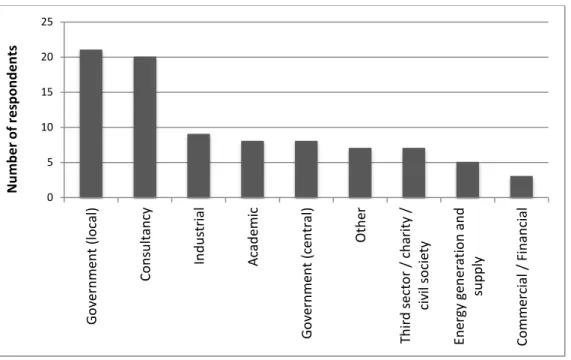
Figure 1: Survey participants by sector (of a total of 77 responses).
The survey participants were asked to respond, where they felt qualified to do so or where appropriate, under each of the top-level categories of the low-carbon energy and cities taxonomy, to the following questions:
Where do you foresee the greatest challenges in this area? (options, listed in Figure 5, were provided for participants to choose from)
More specifically, which areas, challenges or questions (related to the options under each top-level category) require further investigation by researchers?
Here we modified the approach used to identify priority research in the water domain (Brown et al., 2010), where survey participants were asked to submit research questions. The rationale for our approach was to avoid the potential problems of
(a) the term ‘research question’ not being meaningful or being misinterpreted by non-academics; and (b) a request to
generate research questions leading to a lower response rate due to the time to formulate research questions.
3.3.2 Stage 2 — Generating research questions
After eliciting 177 qualitative survey responses (from 77 survey participants) identifying areas, challenges or questions require further investigation by researchers, the core project team then generated a set of 130 research questions. Each survey response was reviewed using the approach outline in Table 1.
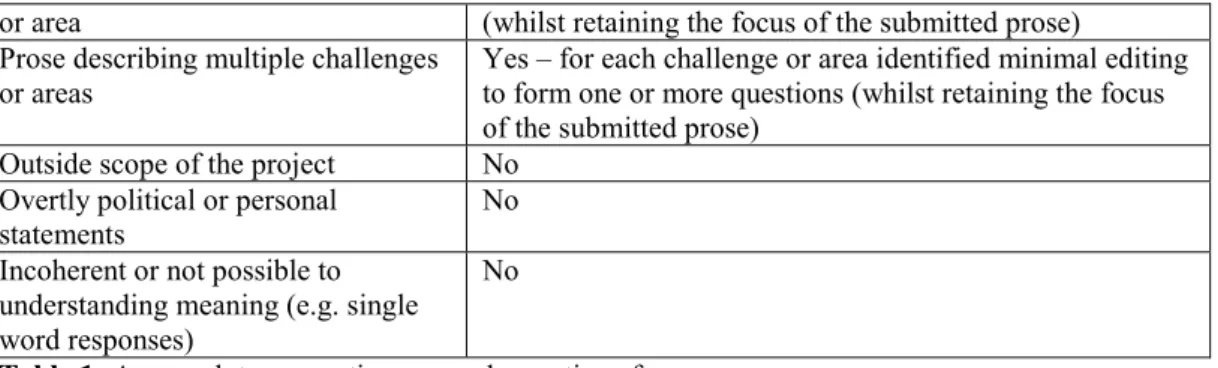
Submission Include for review at workshop3
A research question Yes - minor editing as appropriate to improve readability
Prose describing a single challenge Yes - minimal editing to form one or more questions
3 Since the present research is concerned with method development, whether the research question had been answered
1 2 3 4 5 6 7 8 9 10 11 12 13 14 15 16 17 18 19 20 21 22 23 24 25 26 27 28 29 30 31 32 33 34 35 36 37 38 39 40 41 42 43 44 45 46 47 48 49 50 51 52 53 54 55 56 57 58 59 60 61
or area (whilst retaining the focus of the submitted prose)
Prose describing multiple challenges or areas
Yes – for each challenge or area identified minimal editing
to form one or more questions (whilst retaining the focus of the submitted prose)
Outside scope of the project No
Overtly political or personal
statements No
Incoherent or not possible to understanding meaning (e.g. single word responses)
No
Table 1: Approach to generating research questions from survey responses.
3.3.3 Stage 3 — Workshop review and prioritisation of the research questions
The third stage was a workshop held at the University of Leeds on 17th April 2012, with the objective of reviewing and prioritising the research questions generated from survey responses. Our rationale for hosting the workshop within the University was to provide the opportunity for stakeholders to fully engage with the process in reflective and reasonably neutral environment, away from pressing concerns arising from day-to-day professional responsibilities, while also
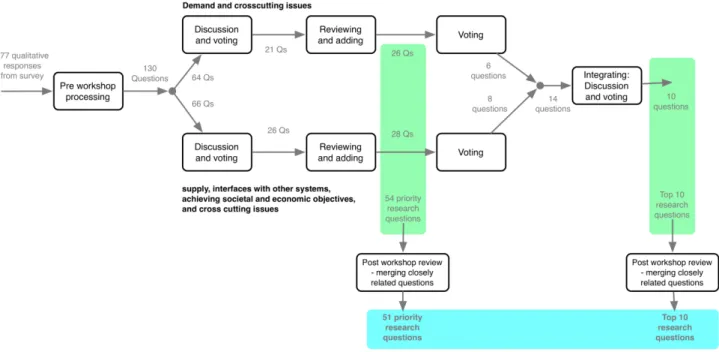
allowing extensive control over the configuration of the workshop environment. Table 2 lists the organisations represented. The workshop was attended by 8 practitioners, 3 members of civil society and 6 academics (of which 2 had extensive recent professional experience as practitioners in fields related to energy and cities). This list does not of course encompass the full cast of the key stakeholders/stakeholders in cities and hence the resulting priority research questions should not be taken as definitive. However, the participants did bring a diversity of experience and viewpoints, as needed to evaluate (on a pilot basis) the potential for applying our prioritisation process to energy in cities. In pre-workshop briefings, and during the workshop itself, the facilitators encouraged academic participants to contribute to but not lead discussions to ensure that stakeholder perceptions remained the driver of the process. Academic participants were also specifically asked to avoid consideration of current state of research, e.g. if a research question posed had been already answered. The workshop started with an introductory presentation and discussion of the objectives and process for the day (approx. 30 minutes). Two streams of activities then ran in parallel (see Figure 2 below), each reviewing distinct sets of questions, followed by a closing session integrating outputs from both streams (approx. 85 minutes).
Stream 1 considered 64 questions under the crosscutting issues and demand topics. Stream 2 considered 66 questions under
the supply, interfaces with other systems, crosscutting issues and achieving societal and economic objectives topics. Each workshop participant chose to join the stream that best fit with his or her expertise and interests. Using the process outlined as follows, a set of 54 priority questions and the top 10 questions were identified. In the parallel streams, the following process was used:
1. Through a combination of facilitated discussion (approx. 50 minutes) and voting (approx. 50 minutes), the groups
1 2 3 4 5 6 7 8 9 10 11 12 13 14 15 16 17 18 19 20 21 22 23 24 25 26 27 28 29 30 31 32 33 34 35 36 37 38 39 40 41 42 43 44 45 46 47 48 49 50 51 52 53 54 55 56 57 58 59 60 61
2. Reviewing these priority questions and aiming for a group consensus, the questions were merged, refined and
reworded (approx. 30 minutes), critical gaps in the coverage of the set of priority questions were identified and new questions to address these gaps generated (approx. 30 minutes);
3. Through a combination of facilitated discussion and voting (approx. 20 minutes), a set of top questions were
identified (6 questions in stream 1, and 8 questions in stream 2).
Figure 2: The process for identifying priority research questions.
Organisations represented at the workshop (number of participants attending)
Sector
CO2Sense (1) Private Sector
Department for Energy and Climate Change (1) Central Government
Leeds City Council (2) Local Government
Arup (1) Private Sector
SCI Partnership (1) Private Sector
Briar Associates (1) Private Sector
Yorkshire Ambulance Service (1) Public Sector – Healthcare
Roundhay Environmental Action Project (2) Civil Society
Bradford Environment Forum (1) Civil Society
University of Leeds (6) Higher education and research
Table 2: Organisations represented at the workshop
1 2 3 4 5 6 7 8 9 10 11 12 13 14 15 16 17 18 19 20 21 22 23 24 25 26 27 28 29 30 31 32 33 34 35 36 37 38 39 40 41 42 43 44 45 46 47 48 49 50 51 52 53 54 55 56 57 58 59 60 61
4. Bringing together the participants from both streams of activity and presenting the top questions identified by each
stream;
5. Voting on the top priority questions from each stream to identify the top 10 questions (across all topics).
3.3.4 Post workshop review of the research questions
Following the workshop the authors reviewed the priority research questions (54) and top questions (10), merging closely related questions and rewording for readability. The resulting 51 priority research questions and a top 10 research questions are presented in the results section below.
4. Results
4.1 Themes in the post-2009 low-carbon cities literature
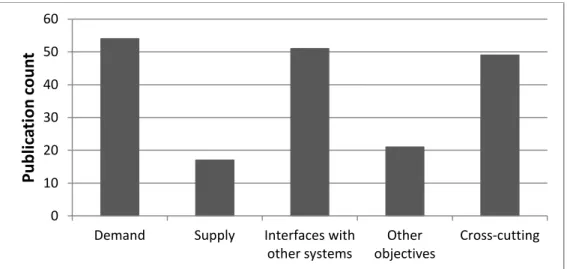
The results of the thematic classification Figure 3 show that most of the publications focused on one or more of three areas: reducing energy demand (54), interfaces with other systems (51) and cross-cutting issues (49). Many fewer publications examined reducing greenhouse gas emissions from energy supply (17) or achieving other societal and economic objectives (21). The count also revealed that 47 out of the 102 publications (46%) were concerned with low-carbon energy in Chinese cities.
More detailed analysis revealed that, of the 54 publications focusing on demand, 14 were exclusively classified under this area, with most of these 14 publications focusing on technical measures to improve the energy efficiency of buildings. A further 12 publications examined how reducing energy demand interfaced with other city energy systems, notably the planning system. Five publications examined demand and cross-cutting issues, such as low-carbon transition pathways. A further five publications combined research on demand with both cross-cutting issues and interfaces (e.g. analysing demand reduction and the role of planning in realising low-carbon pathways). There were relatively few publications that
considered the relationship between demand and achieving other economic or societal objectives, and where this was the case the topics were achieving national greenhouse gas emission reduction targets, improving the quality of life and improving city resilience (rather than reducing fuel poverty etc.).
Of the 17 publications with a focus on decarbonising energy supply, only one focused exclusively on this issue —
1 2 3 4 5 6 7 8 9 10 11 12 13 14 15 16 17 18 19 20 21 22 23 24 25 26 27 28 29 30 31 32 33 34 35 36 37 38 39 40 41 42 43 44 45 46 47 48 49 50 51 52 53 54 55 56 57 58 59 60 61
consider either demand reduction or decarbonising energy supply. 15 of these examined cross-cutting issues, with metrics and evaluation of low-carbon energy cities, governance and public attitudes being the most popular areas. A further ten publications addressed cross-cutting issues and interfaces with other systems, with financing, governance and urban planning being the most common themes. Six publications focused exclusively on interfaces with other systems, with the interfaces between the energy system and the transport and urban planning systems dominating as topics.
Figure 3: Publications classified by research area.
4.2 Survey responses
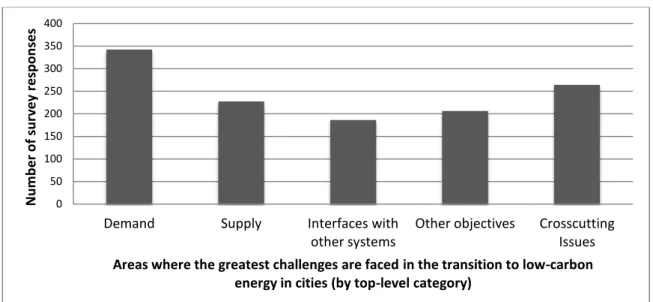
Figure 4 and Figure 5 show the survey responses to the questions regarding where the greatest challenges in the transition to low-carbon energy for cities are likely to be faced. Figure 4 shows the aggregated responses under the high-level categories and Figure 5 shows the breakdown of responses within each high-level category. Interestingly, through the process of prioritising and re-categorising the questions, the crosscutting issues category came to contain the largest number of final research questions. This may have come about due to a tendency to interpret the questions broadly, as we shall discuss in section 5.
4.3 Research questions
The 51 priority research questions that emerged are presented below, grouped under the low-carbon energy and cities taxonomy (outlined in section 3.1.1).
0 10 20 30 40 50 60
Demand Supply Interfaces with other systems
Other objectives
Cross-cutting
Pub
lic
ati
on
co
u
n
1 2 3 4 5 6 7 8 9 10 11 12 13 14 15 16 17 18 19 20 21 22 23 24 25 26 27 28 29 30 31 32 33 34 35 36 37 38 39 40 41 42 43 44 45 46 47 48 49 50 51 52 53 54 55 56 57 58 59 60 61
Figure 4: Areas where the greatest challenges are faced in the transition to low-carbon energy in cities (by top-level
category)
Figure 5: Areas where the greatest challenges are faced in the transition to low-carbon energy in cities (by 2nd-level
category). 0 50 100 150 200 250 300 350 400
Demand Supply Interfaces with other systems
Other objectives Crosscutting Issues N u m b e r o f su rv e y re sp o n ses
Areas where the greatest challenges are faced in the transition to low-carbon energy in cities (by top-level category)
0 10 20 30 40 50 60 70 B eh av io u ral c h an ge B u ild in gs ( h o m es , c o m m eri ca l, in d u st ri al ) Em b o id ed en erg y En erg y st o ra ge Fee d b ac k o n en erg y co n su m p ti o n In d u st ry La n d u se p la n n in g to r ed u ce d em an d M ea su ri n g an d u n d ers ta n d in g en erg y u se in c it ies N ew t ec h n o lo gi es Sh ar ed h ea t an d w as te h ea t n et o w rk s fo r d is tr ic t h ea ti n g Urb an Tra n sp o rt O th er (d em an d ) D is tr ib u ted en er gy g en er at io n En erg y St o ra ge En vi o rn m en ta l q u al it y w it h in c it y b o u n d ar ies Lo ca l en erg y an d h ea t n et w o rk s Lo ca lis at io n Pu b lic p ar ti ci p at io n i n en erg y sy st em s m an ag em en t an d … R en ew ab les a n d m ic ro -r en ew ab les U rb an is at io n , in fr as tr u ct u re an d s p at ia l p la n n in g O th er (s u p p ly ) Ec o sy st em s w it h in c it ies Lo ca l a n d n at io n al g o vern an ce sy st em s Th e p la n n in g sy st em Th e t ran sp o rt s ys tem Th e w as te m an ag em en t sy st em Th e w at er sy st em O th e r (i n te rf ac e s w it h o th e r sys te ms ) A ch ei vi n g n at io n al a n d g lo b al G HG em is si o n t ar get s … D el iv eri n g af fo rd ab le en erg y D el iv eri n g en erg y sec u ri ty Im p ro vi n g q u al it y o f l if e Im p ro vi n g u rb an r es ili en ce M axi m is in g ec o n o m ic b en ef it O th er (a ch ievi n g so ci et al a n d ec o n o m ic o b je ct iv es ) B u si n es s M o d el s D em o gr ap h y D e ve lo p in g vi si o n s fo r a lo w c arb o n e n e rgy s ys te m, a n d … Em p lo ym en t Fi n an ci n g G o vern an ce Id en ti ty a n d c u lt u re Pu b lic p erc ep ti o n s o f en erg y w it h in c it ies Sk ill s Th e r o le o f i n tel lig en t o r ICT en ab led in fr as tr u ct u re O th er (c ro ss cu tt in g is su es ) N u m b e r o f su rv e y re sp o n ses
1 2 3 4 5 6 7 8 9 10 11 12 13 14 15 16 17 18 19 20 21 22 23 24 25 26 27 28 29 30 31 32 33 34 35 36 37 38 39 40 41 42 43 44 45 46 47 48 49 50 51 52 53 54 55 56 57 58 59 60 61
4.3.1 Reducing energy demand in cities
To meet the legally binding UK commitments to reduce GHG emissions by at least 80% by 2050, DECC envisions a
dramatic reduction in energy demand (possibly 40% or more against 2005 levels) during the period 2030–50 (DECC,
2009 ). Accordingly, it was anticipated that demand reduction would be a strong focus in the questions prioritised at the workshop. This proved to be the case, with 15 of the 51 research question prioritised under the category of reducing energy demand within cities. The questions predominantly consider behavioural aspects of energy demand within cities, with limited direct reference to controlling energy demand by technical efficiency improvements (except question 1). There are no questions that focus on specific technologies for influencing behaviour (e.g. smart meters - planned to be rolled out to all UK households by 2019 (DECC, 2012d; European Union, 2012)) and no distinction is made between behaviour in
domestic or commercial buildings. The demand reduction research questions are as follows:
1. How can large-scale refurbishment of existing buildings to “passivhaus4” standards be achieved?
2. How can consumption based approaches to measuring emissions be used to influence the behaviour of consumers,
businesses and society as a whole?
3. How can growth best be controlled to minimise its effect on consumption?
4. How can the benefits of changes in behaviour (economic and other benefits) be made more visible?
5. To what extent does demand reduction require cultural change, rather than individual behavioural change?
6. What are the most effective projects for changing people’s behaviour with respect to energy use both in terms of
effect and longevity?
7. As cities tend to be more efficient in direct energy use (than non-urban areas), how can the rebound effect be
managed when seeking further efficiency improvements?
8. What is the most effective way to communicate messages on behaviour change to energy consumers?
9. How can an understanding of the embodied energy within products and services consumed in cities be developed?
10. How can an understanding of the flows of energy into a city (including embodied energy) be used to reduce
energy consumption?
11. What technologies are needed to capture data on energy consumption, and at what level of granularity?
12. What is the potential of dynamic tariff structures, within a smart home, to reduce energy demand?
13. How can barriers to investing in energy use reducing processes and practices be overcome?
14. How can energy efficiency and renewable energy be made attractive to households and businesses?
1 2 3 4 5 6 7 8 9 10 11 12 13 14 15 16 17 18 19 20 21 22 23 24 25 26 27 28 29 30 31 32 33 34 35 36 37 38 39 40 41 42 43 44 45 46 47 48 49 50 51 52 53 54 55 56 57 58 59 60 61
15. What is the best way to engage with people and motivate them to make lifestyle changes (that result in reduced
energy consumption)?
4.3.2 Reducing the greenhouse gas (GHG) emissions of energy supply to cities
Reducing the GHG intensity of fuel used to supply city energy demand will be required to meet the carbon budgets
mandates in the UK’s Climate Change Act (2008). In the survey and during facilitation of the workshop, participants were encouraged to consider the term energy supply as encompassing both electricity and heat. Three of the eight research questions listed below refer to heat (including generation and storage) specifically, rather than energy, potentially
suggesting a growing awareness of the challenges associated with decarbonising heating and implementation of communal heating systems throughout a city. None of the questions focuses on energy from waste, either its potential role in energy supply, or any other aspect such as concerns about other environmental or health impacts. This is surprising at first sight, given impending restrictions on waste disposal by landfill (Council Directive 99/31/EC) and the range of research into approaches to recovering energy from waste. However, influencing factors in the present study may include: the geographic distribution of participants, centred around the City of Leeds, where key decisions on the role of energy from waste in Leeds have already been taken; and, limited awareness of energy from waste technologies other than incineration (e.g. pyrolysis or anaerobic digestion). Again the questions relating to energy supply are generally high-level and would need to be refined in order to create questions sufficiently specific for researchers to address. The research questions on energy supply entailing GHG reduction are as follows:
16. What is the role for local generation in cities?
17. What are the market/economic barriers to localisation of energy supply (and energy-related decision making)?
18. What is the best way to get the public to engage with new (or even established) renewable energy technologies?
19. What are the challenges associated with ensuring the resilience of district heating networks?
20. How can the transmission and distribution of energy to cities, from remote renewable resources, be improved?
21. Which renewable energy resources (solar, wind, ocean, hydro) can be used by cities?
22. What are the ways to concentrate/store/utilise low grade heat?
23. Which regulatory and institutional actions are appropriate to enable the uptake of district heating?
24. How can the electricity distribution companies manage grid connections in a city where there is large-scale
adoption of distributed renewables?
4.3.3 Managing the interfaces between the city energy system and related urban systems
1 2 3 4 5 6 7 8 9 10 11 12 13 14 15 16 17 18 19 20 21 22 23 24 25 26 27 28 29 30 31 32 33 34 35 36 37 38 39 40 41 42 43 44 45 46 47 48 49 50 51 52 53 54 55 56 57 58 59 60 61
conceptual across multiple scales, will be critical to understanding the effects of one system on another (e.g. impacts of changes in the water system on energy consumption). This understanding is in turn critical to designing integrated solutions spanning multiple interconnected systems. Relatively few of the questions submitted and prioritised fall within this area,
possibly reflecting the challenges of eliciting responses outside or at the periphery of individuals’ domains of expertise. The
questions listed below focus largely on the interface between the urban energy system and the spatial planning system, with some consideration of connections between short-term and long term planning.
25. How can connections be made between exploiting small scale (immediate/short-term) opportunities, and the
bigger picture of planning the transition to low-carbon cities?
26. How can waste heat and water be minimised using new technologies in cities?
27. How can the planning system be modified to increase adoption of renewable energy technologies?
28. How can the planning process for energy infrastructure upgrades be improved?
29. What are the principal urban systems that impact energy supply and use and their inter-relationships?
4.3.4 Co-benefits: meeting low-carbon, societal and economic objectives together
Energy systems are generally considered in instrumental terms: within a societal context (e.g. meeting basic needs for warm, and quality of life) and economic context (e.g. growth and development). Many of the challenges of making the transition to low-carbon cities relate to balancing energy system objectives (e.g. reducing demand or greenhouse gas emissions) with broader societal and economic objectives. As with managing the interconnections between the energy system and other urban systems, relatively few questions were submitted and prioritised under this heading. Again it may be that this category was challenging for survey and workshop participants to relate or respond to. The five questions prioritised below focus on achieving economic objectives, with reference to societal objectives being indirect and still associated with economic or financial dimensions (e.g. fuel poverty, low cost). The research questions are:
30. How can the economic benefits of the transition to low-carbon cities be used to encourage change?
31. What are the real local economic and job creation opportunities associated with low-carbon energy systems and
which sub-sectors need to be developed?
32. How can low cost energy be delivered without increasing use of fossil fuels in the short term?
33. How could current/future energy efficiency policy (Green Deal and ECO) be improved to tackle fuel poverty?
34. How can low-carbon cities be delivered, whilst keeping energy prices affordable?
1 2 3 4 5 6 7 8 9 10 11 12 13 14 15 16 17 18 19 20 21 22 23 24 25 26 27 28 29 30 31 32 33 34 35 36 37 38 39 40 41 42 43 44 45 46 47 48 49 50 51 52 53 54 55 56 57 58 59 60 61
The final category under which participant responses were invited and organised is crosscutting issues associated with making the transition to low-carbon energy for cities. This category was intended to provide the opportunity for participants
to provide responses that spanned the other categories and which did not fit neatly – e.g. governance, financing, business
models, skills, public perceptions, smart or ICT enabled infrastructure, identity, culture and demography. Accordingly the questions prioritised under this heading span a broad range of topics and include questions focused on: governance, investment in low-carbon infrastructure, the design of systems, metrics and evaluation for low-carbon projects and the limits to incremental change. The research questions are:
35. How can business and ownership models for decentralised energy generation systems provide an incentive for
individuals to reduce energy consumption?
36. What is the role of governance in providing leadership to push forward measures that may not be attractive to
some stakeholders?
37. What is the long-term impact of missing current opportunities to invest in low-carbon projects?
38. How can the design of technical systems be optimised to allow energy consumers to confidently invest in
low-carbon measures from multiple suppliers?
39. How can the design of fiscal systems be optimised to allow energy consumers to confidently invest in low-carbon
measures from multiple suppliers?
40. How can the evaluation of energy related interventions be improved, including improving policy and promoting
best practice?
41. What new kinds of metrics do we need to track progress toward realising the low-carbon city vision?
42. How can the resilience of energy systems in cities be improved?
43. What are the impacts of densification (as an approach to climate change mitigation) on social and economic
structures in the city?
44. What governance and competency mechanisms are needed in place to deliver more sustainable cities?
45. How do the UK institutional, democratic and financial systems need to be adapted or amended to bring about large
scale investment in low-carbon energy infrastructure?
46. What is the role of culture change in the adoption of carbon reducing processes, systems, behaviours and
activities?
47. To what extent can targets for reducing carbon emissions (and increasing use of renewable sources) be delegated
to the lowest levels of government (e.g. the parish/community councils)?
48. What are the limits of incremental change in the transition to low-carbon cities, when will they become evident,
1 2 3 4 5 6 7 8 9 10 11 12 13 14 15 16 17 18 19 20 21 22 23 24 25 26 27 28 29 30 31 32 33 34 35 36 37 38 39 40 41 42 43 44 45 46 47 48 49 50 51 52 53 54 55 56 57 58 59 60 61
49. How can new forms of governance be developed to enable us to do things that we can’t do currently (e.g. bridge
the knowledge – action gap)?
50. How can low-carbon accessibility and mobility be delivered in an urban context?
51. How can individuals, communities, organisations and cities learn from low-carbon energy success stories? How
can transferable toolkits be created? Barriers be reduced? Preconditions for success be established?
4.4 The top ten research questions
Presented below are the top ten questions identified by participant voting during the concluding and integrating session of the workshop. The distribution of these questions across the categories is similar to that of the longer list of research questions, with the majority of questions in the reducing demand and crosscutting issues categories, with fewer questions under the other headings.
1. What is the best way to engage with people and motivate them to make lifestyle changes (that result in reduced
energy consumption)?
2. How can large-scale refurbishment of existing buildings to “passivhaus” standards be achieved?
3. To what extent does demand reduction require cultural change, rather than individual behavioural change?
4. How can barriers to investing in energy use reducing processes and practices be overcome?
5. What are the market/economic barriers to and drivers of localisation of energy supply (and energy-related decision
making)?
6. What is the role for local generation in cities?
7. How can low cost energy be delivered without increasing use of fossil fuels in the short term?
8. What governance and competency mechanisms are needed in place to deliver more sustainable cities?
9. How do the UK institutional, democratic and financial systems need to be adapted or amended to bring about
large-scale investment in low-carbon energy infrastructure?
10. What is the role of culture change in adoption of carbon reducing processes, systems, behaviours and activities?
5. Discussion
1 2 3 4 5 6 7 8 9 10 11 12 13 14 15 16 17 18 19 20 21 22 23 24 25 26 27 28 29 30 31 32 33 34 35 36 37 38 39 40 41 42 43 44 45 46 47 48 49 50 51 52 53 54 55 56 57 58 59 60 61
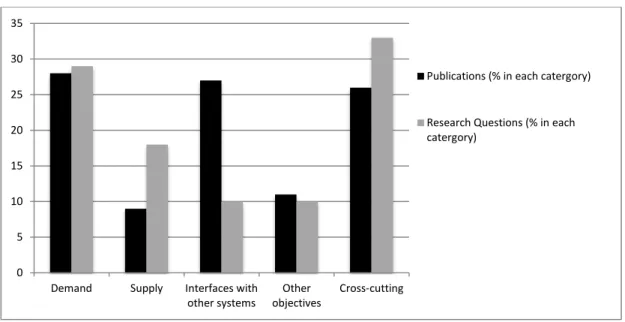
A first point of interest is how the research questions generated through our process compare to research questions in the academic literature on the low-carbon energy in cities. Figure 6 shows this by top-level category of the taxonomy,
indicating that the academic research and practitioner communities both emphasise energy demand and cross-cutting issues as research priorities. Nonetheless, the academic research community also appears to place a greater emphasis on the interfaces between the energy system and other urban systems (e.g. planning and transport).
Figure 6: Comparison of themes in the academic literature and the 51 research questions generated collaboratively.
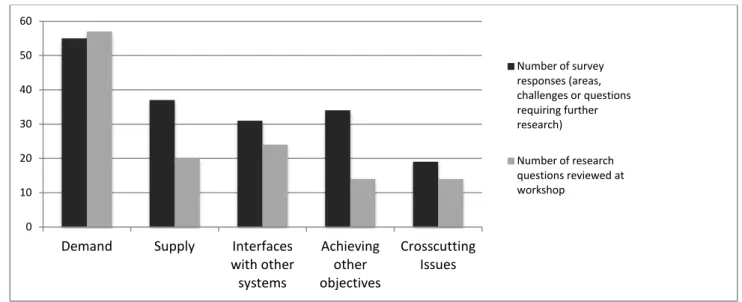
The differences illustrate the need for careful design of collaborative forums, rather than assuming congruent or identical perspective where diverse perspectives result from differences in geographies, experience, motivation or knowledge. This is further emphasised by Figure 7, which in effect shows the difficulty in converting the survey responses through to
research questions. The scale of discarded responses is considerable: for example, in the theme ‘achieving societal and
economic objectives’, questions were formed from fewer than half of the responses. The energy demand category involved
the highest rate of conversion, perhaps due to it being easiest for respondents to relate to in an urban context5. Many
responses were discarded due to their being normative (often political) or because they could not be understood without further interaction with the respondent. Undertaking further interaction on a systematic basis would have been relatively straightforward with the compact respondent cohort in the present study, but would become impracticable if the same approach were scaled-up, most likely focussing on a subset of respondents. Given our desire to investigate a process which can standardised, we did not to use such further interaction as part of our methodology.
5 In the demand category there are more questions than responses received, this resulted from two or more questions being
formed from some responses, and questions formed from responses under other categories being re-categorised. 0
5 10 15 20 25 30 35
Demand Supply Interfaces with other systems
Other objectives
Cross-cutting
Publications (% in each catergory)
1 2 3 4 5 6 7 8 9 10 11 12 13 14 15 16 17 18 19 20 21 22 23 24 25 26 27 28 29 30 31 32 33 34 35 36 37 38 39 40 41 42 43 44 45 46 47 48 49 50 51 52 53 54 55 56 57 58 59 60 61
Figure 7: Conversion of survey responses through to research questions
5.2 Attributes of the process
Turning to the process of question development, in section 1 we introduced two of the rationales for knowledge
co-production among academics and city stakeholders with differing degrees of positional authority — those with statutory
powers and those without them, but who have the legitimate roles in civil society. However, while there is an extensive
literature on what Frantzeskaki et al. (2010) describe as ‘adaptive co-management’ (broadly the development and use of
governance arrangements that support the active participation of stakeholders in environmental management decisions), there is less discussion of the participative generation of research questions pursued by academic actors. The dynamics of
such a process potentially parallel Jasanoff’s (1996) description of knowledge co-production between government
regulators and advisory scientists. Moreover, as Gulbrandsen (2008) observes, co-produced knowledge among scientific experts, practitioners and decision-makers is more likely to be used than independently generated scientific advice and information.
At issue then, is how such collaboration might be structured. Here we need forms of engagement that differ from the contracted partnerships of commercial-academic collaboration intended to facilitate technological innovation and control intellectual property rights over the outcomes. Rather, in the context of collaborative city management and city knowledge management (acknowledging that these are quite different), a collaborative academic role is more likely to take the form of participatory action research (Bale, Foxon, Hannon, & Gale, 2012; Participatory action research, 1991), in which
practitioners are involved throughout the research process without the objective of designing a material artefact. In this context, intellectual freedom in the sense of the right to publish, within negotiated constraints, is more important than
0 10 20 30 40 50 60
Demand Supply Interfaces with other systems
Achieving other objectives
Crosscutting Issues
Number of survey responses (areas, challenges or questions requiring further research)
1 2 3 4 5 6 7 8 9 10 11 12 13 14 15 16 17 18 19 20 21 22 23 24 25 26 27 28 29 30 31 32 33 34 35 36 37 38 39 40 41 42 43 44 45 46 47 48 49 50 51 52 53 54 55 56 57 58 59 60 61
material ownership. Note that this participation is usually conceived of as taking place on a project basis, rather than in an on-going institutionalised basis, and the two may have very different implications for the extent to which practice may change (Lundin & Soderholm, 1995). With the above in mind, we now reflect on the process of generating the research questions, paying particular attention to issues that we think merit more consideration.
We now reflect upon some key considerations for those conducting similar work in the future. First, approximately 10% of the participants in the survey identified themselves as working in the academic sector. We screened the responses from academic participants for responses overtly influenced by research agendas or perspectives, which on review were not evident. In retrospect it may have been beneficial to discard responses from the academic sector whilst providing an option in the survey for individuals with recent professional experience spanning academia and practice to participate. Such an approach would have the benefit of ensuring the inputs to the subsequent workshop represented practitioner and civil society perspectives. It would also avoid the potential for academic survey participants to misinterpret the survey as an internal research community priority setting exercise, and so seek to influence the process based on factors such as personal research interests, funding availability or theoretical importance.
Approximately two thirds of the workshop participants were drawn from practitioner communities and civil society, with the remainder drawn from the academic sector. Academics were included to meet the objective of developing a shared understanding of priority research questions across practitioner, civil society and academic communities. This does however raise the question of what the balance of participants should be in workshops intended to co-produce research questions with practitioners, civil society and academic communities.
Recording in situ observations of the workshop process has the potential to yield additional insight beyond that presented in
the current paper — such as tendencies for participants from a given sector to lead or withdraw from the discussions.
Although a very interesting option with benefit of hindsight, this level of ethnographic-type observation was not an initial objective of the study. However, we do suggest that similar future work makes use of observations to develop
understanding of the dynamics between individuals, groups and organisations collaboratively identifying and prioritising research questions. We conclude this section with a brief reflection on the dynamics of the workshop, which hints at the potential value of making the observations discussed above. Participants were asked for their reflections shortly after the workshop, with the comments providing a sense of the complexity of the group dynamics and including the following.
Some participants were highly active (occasionally dominant), while others remained fairly silent — therefore the
group dynamics may have ensured that some opinions/agendas took precedence.
1 2 3 4 5 6 7 8 9 10 11 12 13 14 15 16 17 18 19 20 21 22 23 24 25 26 27 28 29 30 31 32 33 34 35 36 37 38 39 40 41 42 43 44 45 46 47 48 49 50 51 52 53 54 55 56 57 58 59 60 61
Questions discussed that strongly divided opinion (e.g. with around 50% of the group for and 50% against the question) were generally dropped in favour of less contentious questions (e.g. with around 40% of the group for and the rest apathetic).
Being able to see the voting of other participants allowed for the possibility of influencing each other’s choices.
There seemed to be challenges using ‘local’ perspectives to generate internationally relevant research questions.
An academic participant commented that she was seeking to avoid leading the discussions and imposing an academic or research perspective on the discussions.
5.3 Attributes of question identified
In general, the research questions generated in the present study share some similarities with those generated in the ecology domain (Sutherland et al., 2006) and in the water policy domain (Brown et al., 2010). Firstly, many of the survey responses
to the initial survey are on closely related topics, indicating a consensus on areas where major challenges exist – for
example, in this work, a cluster of responses were received relating to energy demand and behaviour in cities. We might optimistically infer that this suggests a degree of epistemic community (Haas, 1992), in the sense of a set of people who
share a common view of the problems at hand. However this inference cannot be taken too far – there will inevitably be
differences in understanding and priority within such a group, even if there is a shared language and shared reference points (some of which may arise from the use of the taxonomy throughout the process to classify research questions).
Secondly, the process identified a set of questions that are predominantly broad and high-level with little recognition of
system interconnectedness or, conversely, reference to particular sectors (e.g. “How can barriers to investing in energy use
reducing processes and practices be overcome?”). There are few focussed, detailed questions (e.g. on specific technologies
for generating energy or reducing energy demand). Factors influencing this tendency toward broad and high-level considerations could include: the recognition that there is unlikely to be a single solution or set of solutions, hence
reluctance to be technologically deterministic; recent trends towards systems thinking in research and policy; the tendency, where a shared conceptual framework does not exist for collaborating parties, to take the problem framing to a higher level until shared ground is found. Specific reference to cities and urban systems occur in only about one third of the questions, suggesting that many are in fact more general questions that are relevant beyond urban/city settings. Such broad questions require interpretation in the form of specific inference before they can be addressed in an academic context.
1 2 3 4 5 6 7 8 9 10 11 12 13 14 15 16 17 18 19 20 21 22 23 24 25 26 27 28 29 30 31 32 33 34 35 36 37 38 39 40 41 42 43 44 45 46 47 48 49 50 51 52 53 54 55 56 57 58 59 60 61
approach to evidence, particularly the classic positivist/constructivist divide. For example, in the context of behavioural change, identified as a key research priority, there are typically substantive differences between the assumptions and approaches of empiricist psychologists and constructivist sociologists (Whitmarsh, 2011). While the former implicitly assumes that the research task is to uncover constants relating to behaviour and attitude, the latter views behaviour as thoroughly socially embedded and hence contingent on social arrangements, including institutions, organisations, technologies and so on. These lead to different explanations and different recommendations. For example, a key
implication of the sociological perspective is that changing behaviour requires changing an individual’s environment in the
broadest sense, while a key implication of the psychological perspective is that messaging needs to connect with existing norms and values. That there is value in both perspectives leads some towards an eclectic approach that ignore theoretical
contradictions — e.g. (Stephenson et al., 2010). Whatever choices are made, probably by the academic partner,
practitioners should ideally be informed of the implications of particular perspectives.
Thirdly, the research questions tend towards a focus on long-term thinking, planning or behavioural and cultural change
(e.g. “How can low-carbon cities be delivered, whilst keeping energy prices affordable?”), rather than on short-term
interventions. There is little reference to current or future policy, with the Green Deal (the UK’s flagship policy aimed at
enabling significant retrofit in the domestic sector (DECC, 2012c)) being an exception, and little reference to understanding current systems. This focus may indicate that the process used to identify and prioritise the questions encouraged
participants to think of issues arising over the medium to long term. Alternatively it may be that the issues of greatest concern to participants lie beyond the immediate term, or that participants have little confidence in the stability and longevity of current policy indicatives and so considered longer-term issues. While a long-term commitment is of course encouraging, arguably the long term will be built on a foundation of interventions in the short and medium term. In particular, there is a body of thought on policy path dependence (North, 1990) which emphasises that as policies and politics are integral parts of socio-technical regimes, they too are influenced by the increasing returns experienced by industries and technologies. As Levi (1997) and Pierson (2000) observe, the costs of reversing a policy path may become increasingly high as time goes on, despite the existence of choice points. In short, history matters, and expecting long-term change without near term action is questionable.
6. Conclusions
1 2 3 4 5 6 7 8 9 10 11 12 13 14 15 16 17 18 19 20 21 22 23 24 25 26 27 28 29 30 31 32 33 34 35 36 37 38 39 40 41 42 43 44 45 46 47 48 49 50 51 52 53 54 55 56 57 58 59 60 61
described a process adapted from precedents in ecology and water domains, applied to the case of city energy supply and consumption. Insights from literatures of participatory environmental management and the role of science in policy have helped to justify and characterise our approach. Given the encouraging results of our work, there is potential value in applying (and further refining) the process described in this paper and focussing on other geographical areas (e.g. cities in the UK, Europe and beyond). Such applications would create the exciting possibility of regional, national and international comparisons.
Using this process we established 51 plausible priority research questions and a smaller prioritised set. Within this set clusters of questions emerged relating to energy demand and behaviour in cities. The questions themselves tended to be broad and high-level with little recognition of system interconnectedness or, conversely, little reference to particular sectors. This provides an opportunity to further develop the process discussed above to bridge the gap between the questions
identified and projects addressing specific research questions. The research questions identified also tend towards a focus on long-term thinking, planning or behavioural and cultural change, rather than on short-term interventions. Demonstrating the engagement of the practitioners and members of civil society with the lengthy timescales for translating fundamental academic research into technological or social change in urban settings.
We have also highlighted the challenges and issues raised in pursuing a collaborative approach including: structuring the collaboration between practitioners, members of civil society and members of the research community to give appropriate weight to perspectives of each group; identifying the appropriate mix of participants for each of the process (and
understanding where issues of over-representation may emerge); and understanding and shaping the role of participants with experience spanning practice and academia. We also suggest that the process reported in this paper could be enhanced by making and analysing observations of the interactions of individuals working collaboratively to identify priority research questions.
Yet co-design is a logical end-point of the requirement for ‘impact’ under the UK’s Research Excellence Framework (REF)
1 2 3 4 5 6 7 8 9 10 11 12 13 14 15 16 17 18 19 20 21 22 23 24 25 26 27 28 29 30 31 32 33 34 35 36 37 38 39 40 41 42 43 44 45 46 47 48 49 50 51 52 53 54 55 56 57 58 59 60 61
design, then, has a political aspect as well as practical and academic dimensions. Here we aim to have taken the debate and the practice somewhat further, with the over-arching objective of tackling the hugely complex task of redesigning cities for a long-term future based on low-carbon and efficient energy use.
Acknowledgements
1 2 3 4 5 6 7 8 9 10 11 12 13 14 15 16 17 18 19 20 21 22 23 24 25 26 27 28 29 30 31 32 33 34 35 36 37 38 39 40 41 42 43 44 45 46 47 48 49 50 51 52 53 54 55 56 57 58 59 60 61
References
Bale, C. S. E., Foxon, T. J., Hannon, M. J., & Gale, W. F. (2012). Strategic energy planning within local authorities in the UK: A study of the city of Leeds. Energy Policy, 48, 242-251.
Boaz, A., & Gough, D. (2010). Closing the gap between evidence and policy. Evidence & Policy: A Journal of Research, Debate and Practice, 6(3), 289-290. doi: 10.1332/174426410x524794
Brown, L. E., Mitchell, G., Holden, J., Folkard, A., Wright, N., Beharry-Borg, N., . . . Woulds, C. (2010). Priority water research questions as determined by UK practitioners and policy makers. Science of The Total Environment, 409(2), 256-266. doi: 10.1016/j.scitotenv.2010.09.040
DECC. (2009 ). The UK Low Carbon Tranisiton Plan. Retrieved from
http://www.decc.gov.uk/en/content/cms/tackling/carbon_plan/lctp/lctp.aspx.
DECC. (2012a). David MacKay, Chief Scientific Advisor. Retrieved 17th December, 2012, from
http://www.decc.gov.uk/en/content/cms/about/who_we_are/management/csa/csa.aspx
DECC. (2012b). Ed Davey speech to the LGA Annual Conference. Retrieved 17th December, 2012, from
http://www.decc.gov.uk/en/content/cms/news/edd_ldaspch/edd_ldaspch.aspx
DECC. (2012c). Green Deal. Retrieved 17th December, 2012, from
http://www.decc.gov.uk/en/content/cms/tackling/green_deal/green_deal.aspx
DECC. (2012d). Key milestone for smart meters rollout. Retrieved 14th January 2013, from
http://www.decc.gov.uk/en/content/cms/news/pn12_163/pn12_163.aspx
Dixon, T. (2012). The role that cities must play in reducing UK carbon emissions. Retrieved 17th December,
2012, from http://www.guardian.co.uk/sustainable-business/low-carbon-city-plans
European Union. (2012). DIRECTIVE 2012/27/EU OF THE EUROPEAN PARLIAMENT AND OF THE COUNCIL
of 25 October 2012 on energy efficiency. Retrieved from
http://eur-lex.europa.eu/LexUriServ/LexUriServ.do?uri=OJ:L:2012:315:0001:0056:EN:PDF.
Frame, B., & Brown, J. (2008). Developing post-normal technologies for sustainability. Ecological Economics, 65(2), 225-241. doi: http://dx.doi.org/10.1016/j.ecolecon.2007.11.010
Frantzeskaki, N., Slinger, J., Vreugdenhil, H., & van Daalen, E. (2010). Social-Ecological Systems Governance: From Paradigm to Management Approach. Nature and Culture, 5(1), 84-98. doi:
10.3167/nc.2010.050106
Funtowicz, S. O., & Ravetz, J. R. (1990). Uncertainty and Quality in Science for Policy. Kluwer Dordrecht. Gulbrandsen, L. H. (2008). The Role of Science in Environmental Governance: Competing Knowledge
Producers in Swedish and Norwegian Forestry. Global Environmental Politics, 8(2), 99-122. doi: 10.1162/glep.2008.8.2.99
Haas, P. M. (1992). Introduction: Epistemic Communities and International Policy Coordination. International Organization, 46(1), 1-35. doi: 10.2307/2706951
Haldane, R. (1918). The Haldane Report. London: HMSO.
HEFCE. (2011). Decisions on assessing research impact. Retrieved 17th December, 2012, from
http://www.ref.ac.uk/pubs/2011-01/
HM Government - The Coalition. (2010). HM Government, The Coalition: our programme for government Retrieved from
http://www.direct.gov.uk/prod_consum_dg/groups/dg_digitalassets/@dg/@en/documents/digitalasset/d g_187876.pdf.
Holmes, J., & Harris, B. (2010). Enhancing the contribution of research councils to the generation of evidence to inform policy making. Evidence & Policy: A Journal of Research, Debate and Practice, 6(3), 391-409. doi: 10.1332/174426410x524848
House of Commons Science and Technology Committee. (2006). Scientific advice, risk and evidence based policy making, seventh report of session 2005–06, Volume I. London.
Jasanoff, S. (1996). Beyond Epistemology: Relativism and Engagement in the Politics of Science. Social Studies of Science, 26(2), 393-418. doi: 10.2307/285424
Keirstead, J., Jennings, M., & Sivakumar, A. (2012). A review of urban energy system models: Approaches, challenges and opportunities. Renewable and Sustainable Energy Reviews, 16(6), 3847-3866. doi: 10.1016/j.rser.2012.02.047
Levi, M. (1997). A model, a method and a map: rational choice in comparative and historical analysis. In M. Lichbach & A. Zuckerman (Eds.), Comparative Politics: rationality, culture and structure (pp. 19-41). New York: CUP.
Local Government Association. (2007). A Climate of Change: final report of the LGA climate change commission.
Lundin, R. A., & Soderholm, A. (1995). A theory of the temporary organization. Scandinavian Journal of
1 2 3 4 5 6 7 8 9 10 11 12 13 14 15 16 17 18 19 20 21 22 23 24 25 26 27 28 29 30 31 32 33 34 35 36 37 38 39 40 41 42 43 44 45 46 47 48 49 50 51 52 53 54 55 56 57 58 59 60 61
Newman, M. (2009). Abandon ‘out-of-date’ Haldane principle on research priorities. Retrieved 17th December,
2012, from http://www.timeshighereducation.co.uk/story.asp?storyCode=407520§ioncode=26
North, D. C. (1990). Institutions, Institutional Change and Economic Performance: Cambridge University Press. Nutley, S. M., & Webb, J. (2000). Evidence and the policy process. In H. T. O. Davies, S. M. Nutley & P. C.
Smith (Eds.), What Works? Evidence-Based Policy and Practice in Public Services (pp. 13-42): The Policy Press.
OECD. (2010). Cities and Climate Change. Paris: Organisation for Economic Co-operation and Development. Pahl-Wostl, C., Craps, M., Dewulf, A., Mostert, E., Tabara, D., & Taillieu, T. (2007). Social Learning and Water
Resources Management. Ecology and Society, 12(2).
Participatory action research. (1991). (Vol. Vol. 123). Thousand Oaks, CA, US: Sage Publications, Inc. Pawson, R. (2006). Evidence-Based Policy: A Realist Perspective SAGE Publications Ltd.
Pierson, P. (2000). Increasing Returns, Path Dependence, and the Study of Politics. The American Political Science Review, 94(2), 251-267. doi: 10.2307/2586011
Pohl, C. (2008). From science to policy through transdisciplinary research. Environmental Science & Policy, 11(1), 46-53. doi: 10.1016/j.envsci.2007.06.001
Ravetz, J. R. (1987). Usable knowledge, usable ignorance: incomplete science with policy implications. In W. C. Clark & R. E. Munn (Eds.), Sustainable Development of the Biosphere. Cambridge: Cambridge
University Press.
Rittel, H. J., & Webber, M. (1973). Dilemmas in a general theory of planning. Policy Sciences, 4(2), 155-169. doi: 10.1007/bf01405730
Stephenson, J., Barton, B., Carrington, G., Gnoth, D., Lawson, R., & Thorsnes, P. (2010). Energy cultures: A framework for understanding energy behaviours. Energy Policy, 38(10), 6120-6129. doi:
http://dx.doi.org/10.1016/j.enpol.2010.05.069
Sutherland, W. J., Armstrong-Brown, S., Armsworth, P. R., Tom, B., Brickland, J., Campbell, C. D., . . . Watkinson, A. R. (2006). The identification of 100 ecological questions of high policy relevance in the UK. Journal of Applied Ecology, 43(4), 617-627. doi: 10.1111/j.1365-2664.2006.01188.x
The Committee on Climate Change. (2012). How local authorities can reduce emissions and manage climate risks. Retrieved from http://www.theccc.org.uk/reports/local-authorities.
UN Habitat and UNEP. (2009). Climate Change: The Role of Cities. Involvement, influence, implementation.: UN Habitat and UNEP.
van de Kerkhof, M., & Wieczorek, A. (2005). Learning and stakeholder participation in transition processes towards sustainability: Methodological considerations. Technological Forecasting and Social Change, 72(6), 733-747. doi: http://dx.doi.org/10.1016/j.techfore.2004.10.002
Whitmarsh, L., Upham, P., Poortinga, W., McLachlan, C., Darnton, A., Devine-Wright, P., Demski, C. and Sherry-Brennan, F. (2011). Public Attitudes to and Engagement with Low-Carbon Energy: A selective review of academic and non-academic literatures. Retrieved 17th December, 2012, from