White Rose Research Online
[email protected]
Universities of Leeds, Sheffield and York
http://eprints.whiterose.ac.uk/
This is a copy of the final published version of a paper published via gold open access
in
BMC Medical Research Methodology
.
This open access article is distributed under the terms of the Creative Commons
Attribution Licence (http://creativecommons.org/licenses/by/3.0), which permits
unrestricted use, distribution, and reproduction in any medium, provided the
original work is properly cited.
White Rose Research Online URL for this paper:
http://eprints.whiterose.ac.uk/84284
Published paper
Carroll, C., Booth, A., Leaviss, J. and Rick, J. (2013) "Best fit" framework synthesis:
refining the method. BMC Medical Research Methodology, 13. 37. Doi:
C O R R E S P O N D E N C E
Open Access
“
Best fit
”
framework synthesis: refining the method
Christopher Carroll
1*, Andrew Booth
1, Joanna Leaviss
1and Jo Rick
2Abstract
Background:Following publication of the first worked example of the“best fit”method of evidence synthesis for the systematic review of qualitative evidence in this journal, the originators of the method identified a need to specify more fully some aspects of this particular derivative of framework synthesis.
Methods and Results:We therefore present a second such worked example in which all techniques are defined and explained, and their appropriateness is assessed. Specified features of the method include the development of new techniques to identify theories in a systematic manner; the creation of ana prioriframework for the synthesis; and the“testing”of the synthesis. An innovative combination of existing methods of quality assessment, analysis and synthesis is used to complete the process. This second worked example was a qualitative evidence synthesis of employees’views of workplace smoking cessation interventions, in which the“best fit”method was found to be practical and fit for purpose.
Conclusions:The method is suited to producing context-specific conceptual models for describing or explaining the decision-making and health behaviours of patients and other groups. It offers a pragmatic means of conducting rapid qualitative evidence synthesis and generating programme theories relating to intervention effectiveness, which might be of relevance both to researchers and policy-makers.
Keywords:Systematic review, Qualitative research, Methods, Framework synthesis, Thematic analysis, Sensitivity analysis, Smoking cessation, Critical appraisal, Theory
Background
The technique of "best fit" framework synthesis was de-scribed in a previous paper in this journal [1]. The "best fit" framework synthesis method offered a means to test, reinforce and build on an existing published model, con-ceived for a potentially different but relevant population. As with similar approaches, it involved an examination of existing relevant theories, “their testability, falsifiability, their internal logic and their fit with the evidence”[2].
“Best fit” framework synthesis begins by creating a framework ofa priorithemes and coding data from a re-view’s included studies against that thematic or conceptual framework. This approach produces a relatively rapid, transparent and pragmatic process [3] when compared to more exclusively interpretative forms of synthesis because a substantial amount of the data to be included in the re-view is often coded against the a prioriframework. Only data that cannot be accommodated within the framework
requires considered, iterative interpretation using induct-ive, thematic analysis techniques. The approaches to syn-thesis are therefore both positivist and interpretive [4]; it harnesses the recognised strengths of both framework and thematic synthesis [5].
This methodology is different from other approaches to qualitative evidence synthesis in part because it employs a systematic method for identifying published frameworks, models or theories in order to create the framework for the synthesis. It is also different because it combines both framework and thematic analysis techniques to complete the synthesis. The potential value of the“best fit” method was quickly recognised, especially for qualitative evidence synthesis to address“policy-urgent”questions [3,6,7]. This was because "both thematic synthesis and framework syn-thesis–while. . .involving some interpretation of data– share a. . .less problematized view of reality and a greater assumption that their synthetic products are reproducible and correspond to a shared reality . . .directly applicable to policy makers and designers of interventions", while ap-proaches such as meta-ethnography and critical interpret-ive synthesis are "generally more complex and conceptual,
* Correspondence:[email protected]
1Health Economics and Decision Science (HEDS), School of Health and Related Research (ScHARR), Regent Court, Regent Street, Sheffield S1 4DA, UK Full list of author information is available at the end of the article
sometimes operating on the symbolic or metaphorical level, and requiring a further process of interpretation by policy makers and practitioners in order for them to in-form practice”[5].
The previous paper described the first attempt at this form of framework synthesis. Subsequently its origina-tors identified a need to specify and extend, methodo-logically, some aspects of the process. These include the identification of the foundation theory, the thematic re-duction of this theory to create the a prioriframework, and the transition from the resultant framework (based on thea prioriframework plus new themes) to the final conceptual model. This paper therefore defines the pro-cesses for each of these stages, as well as providing a fur-ther opportunity to apply and evaluate the original data extraction, quality assessment and synthesis processes.
The aim is to provide complete transparency for all of these constituent stages and processes, a key characteristic of systematic review and evidence synthesis, but one fre-quently lacking for some qualitative synthesis methods. These methods often might fail to specify how to identify and select a relevant theory [8] or what method to apply to analyse data or evidence that do not fit into ana priori
framework [9-13]. Such omissions have been noted previ-ously, especially in relation to the conduct of meta-ethnography [9], which is the most frequently-conducted type of qualitative evidence synthesis [14].
The sample case study here is a qualitative evidence synthesis of the views and preferences of employees re-garding workplace strategies or interventions to reduce smoking or facilitate smoking cessation [15]. Opportun-ism dictated this choice of case study, i.e. a piece of work was commissioned from two of the authors (CC, JR) fo-cusing on an aspect of health behaviour change (smok-ing cessation) and this offered the opportunity to conduct a qualitative evidence synthesis.
Methods
“Best fit”framework synthesis requires identification of a relevant framework, theory or conceptual model for par-ticular health behaviours. This is then reduced to its key elements or variables, which form the themes of the a priori framework. Primary research studies for inclusion in the review are identified and selected by applying con-ventional systematic review methods. Evidence from these included studies is then coded against the themes of thea prioriframework and new themes are generated from evi-dence not captured by thisa prioriframework. These new themes are based on the reviewers’ interpretation of the evidence and constant comparison of such new themes across studies. The principles of the method correspond to those for the thematic analysis of primary research data, e.g. transcripts of interviews, as described by Miles and Huberman [16], but are applied to the findings or results
reported in published papers; hence, secondary thematic analysis. Relationships between the themes of the frame-work are then either recreated or generated based on the evidence from the primary research studies included in the review. A new model or theory of the particular health behaviour of interest in the population or setting of inter-est is thus created. The process is outlined in Figure 1. Once the question is determined, the creation of the a prioriframework for the synthesis is conducted simultan-eously with but independently from the search for and se-lection of the primary research studies to be included in the review and synthesis. These two“strands”then join to-gether at the framework synthesis stage. In the case study considered here, the resultant framework and model rep-resented employees’views about, and their experiences of work-based smoking cessation programmes.
The method requires two separate sets of inclusion criteria, searches and study selection: One for identifying the models and theories to generate the a priori frame-work, and one for populating the systematic review of primary qualitative research studies (Table 1).
Inclusion criteria
Searching and study selection
Identification of relevant models and theories Other forms of framework synthesis have developed an a priori
generated five equally relevant conceptual papers for use in creating thea prioriframework (see below); progress to the additional stages would have been undertaken if none or perhaps only one such publication was identified, poten-tially compromising the creation of the framework.
The search for models to inform the exemplar review in-cluded terms for workplace health promotion (WHP) as well as workplace smoking cessation, in order to be as sensitive as possible and to identify WHP research that
[image:4.595.61.537.86.504.2]included smoking cessation, but might not actually specify it in title or abstract (see Additional file 1). This broad ap-proach was adopted to anticipate a circumstance where no model specifically relating to workplace smoking cessa-tion can be identified from the literature. In accordance with emerging practice in the field of health services re-search, where core databases judiciously selected for the topic and study types of interest might be considered suffi-cient to retrieve a critical majority of the relevant literature
Figure 1Qualitative evidence synthesis using“Best-fit”framework synthesis.
Table 1 Inclusion criteria
Models and theories Primary research studies
Setting/Population Workplace or employees Workplace
Phenomenon of interest Smoking reduction, cessation or restriction Smoking reduction, cessation or restriction
Design, Evaluation, Research Publications exploring, testing or creating frameworks, models, theories
[image:4.595.58.538.670.732.2]when operating under time or resource constraints [18,19], the following three databases were interrogated by the lead author: PsycINFO, CINAHL and MEDLINE. More recent research suggests that the Social Sciences Citation Index represents either an additional potential source in this search or a potential substitute for CINAHL [20].
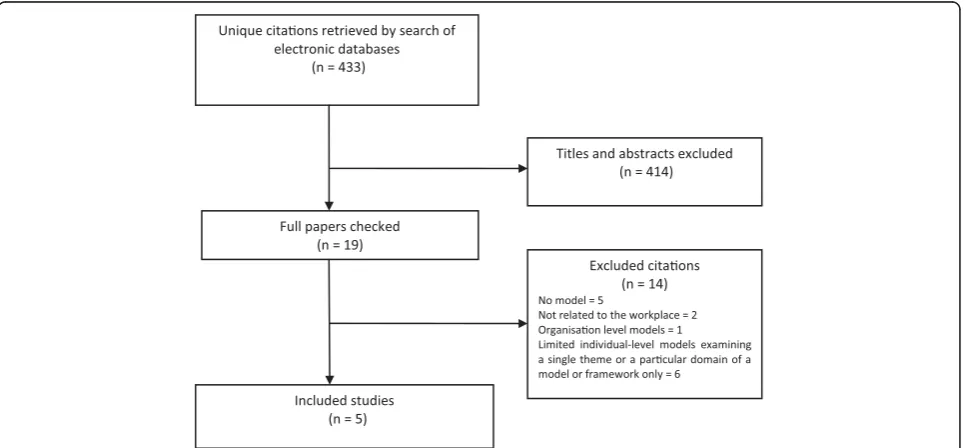
The first author screened all titles and abstracts of cita-tions retrieved by the search to identify models or theories appropriate to this review, as defined by the inclusion cri-teria. The search generated 433 unique citations from across the three databases. Full papers of potentially rele-vant citations were retrieved and checked for relevance. From these citations, the lead author identified five publi-cations with relevant models or theories that seemed to represent a good“fit”to the population, setting and health behaviour of interest (i.e. the inclusion criteria): Employee attitudes and responses regarding smoking cessation or re-duction in the workplace. For the PRISMA flowchart, see Figure 2. This provided corroboration that the BeHE-MoTh strategy is a feasible means of systematically
identifying relevant models and theories. Reference lists of all papers satisfying the inclusion criteria were also checked for additional relevant citations.
Primary research studies for the qualitative synthesis
An evaluated, published search strategy for identifying pri-mary qualitative research studies was used to identify studies for inclusion in the qualitative review: SPIDER (Sample, Phenomenon of Interest, Design, Evaluation and Research type) [21]. This strategy involved combining free text and database thesaurus terms for workplace or em-ployees with terms for smoking cessation or health pro-motion, and terms for qualitative research. As above, the search also included terms for workplace health promo-tion (WHP) (see Addipromo-tional file 1). The following data-bases were interrogated to identify relevant occupational health and social science literature, both published and unpublished: Social Science Citation Index, PsycINFO, CINAHL, ASSIA, IBSS, Emerald reviews, ERIC and MEDLINE. All searches were conducted by the first au-thor, a qualified information specialist. The choice of sources was determined by the potential “scatter” of the topic’s research literature across multiple fields and data-bases [20,22,23], i.e. the literature was likely to be found in resources for medicine, health, psychology, social science and even education, rather than a single field, such as medicine alone. Independent screening of all citations was conducted by two reviewers (JL, JR). Reference lists of all papers satisfying the inclusion criteria were also checked for additional relevant citations.
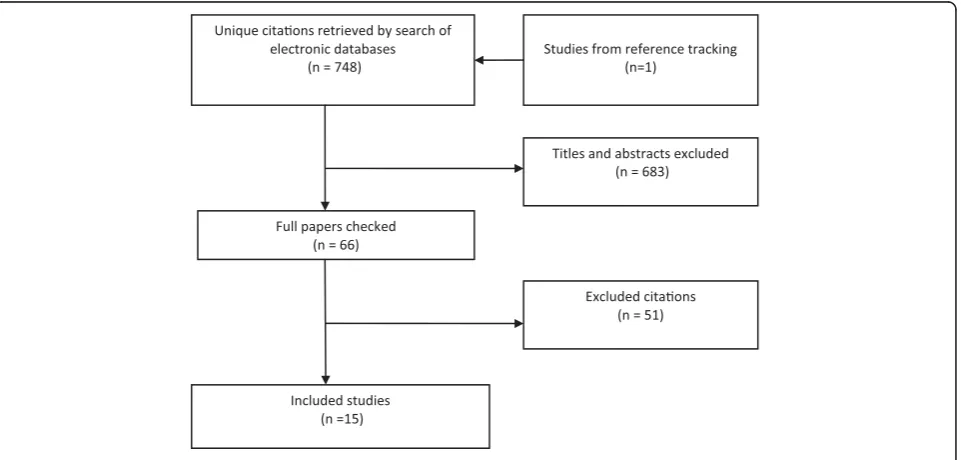
[image:5.595.57.291.101.204.2]The search generated 748 unique citations from across eight databases. Sixty-five full papers were retrieved as Table 2 Search strategy following BeHEMoTh approach
Strategy Terms
Be- Behaviour of Interest: Smoking cessation or health promotion
H- Health Context Workplace
E- Exclusions Regression or integrative model or integrative care model or economic or Markov or animal
MoTh- Models or Theories Model or theory or theories or framework or concept or conceptual
[image:5.595.58.541.490.714.2]Search strategy: (Be AND H AND MoTh) NOT E.
potentially relevant, of which 14 studies were found to satisfy the inclusion criteria. One additional relevant study was identified from reference lists [24]. For the PRISMA flowchart, see Figure 3. Six of the included studies examined people’s views about employer’s deci-sions to restrict smoking within or at the workplace [24-29]; five explored views relating to complex inter-ventions, i.e. involving a combination of at least two or more of the following: self-help or educational materials, smoking cessation resources or “props”such as nicotine patches or pencil cigarettes, support groups, peer sup-port, telephone counselling, and competitions or incen-tives [30-34]; one employed telephone counselling only [35] and one incentives only [36]. Two studies did not specify an intervention [37,38], but rather elicited peo-ple’s views on the principle of a workplace smoking ces-sation intervention.
Data extraction
Models and theories
Five papers satisfied the inclusion criteria (Table 1 above) for informing thea prioriframework. Each of the five pa-pers presented a relevant conceptual model adapted from, or using in part, modified versions of one of three princi-pal foundation models: The Transtheoretical Model (TTM) of Behaviour Change, including its related Stages and Processes of Change elements [39], the Theory of Planned Behaviour (TPB) [40] and the Health Belief Model (HBM) [41]. Three papers reported conceptual models based on the TTM [42-44], one on the TPB [45] and one on the HBM [46]. In the previous worked ex-ample, only a single conceptual model was identified for
developing thea prioriframework. In this new case study, however, the review team were faced with three equally relevant models with variants. The options were to privil-ege one of the models (i.e. to choose one particular model and reject the others, arbitrarily or usingpost hoccriteria), use two or more models in combination, or to produce an
a priori framework based on all five publications. The third option was selected. This was done because there was no empirical justification for the selection of one model over another in this review: All of the conceptual models were considered to be relevant, i.e. satisfying the inclusion criteria, and, in combination, potentially offered a more comprehensive foundation for the synthesis than might be possible with a single, arbitrarily-chosen model.
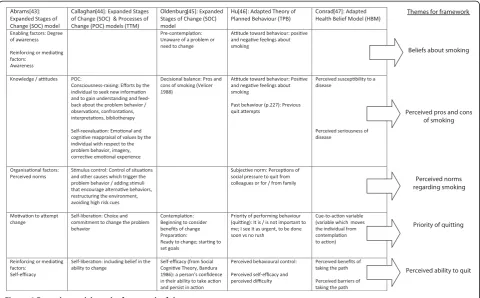
Thematic analysis was chosen for creating the a priori
[image:6.595.60.541.490.720.2]framework from the five publications as it is a widely-used form of inductive analysis and is consistent with the final synthesis process for the“best fit”method. This method of analysis works by identifying commonalities and differ-ences between the models or theories and naming them as themes [16]. These themes form the a priori framework for the synthesis. This process is represented in Figure 4. Each theme was then supported with a definition based on the elements in the original papers, thus creating“ con-cepts”[47], in order to facilitate the coding of data against this framework. This step was taken because experience from the original worked example suggested that clearly-defined concepts are required to enable independent re-viewers to code consistently, without interpreting the same named theme differently [1]. The resultant frame-work for coding data extracted from included primary studies, based on the results of this thematic analysis of
models is given in Table 3. The data extracted from stud-ies identified for the review were coded against these con-cepts in the data extraction form.
Primary research studies
The data extraction form for the primary research stud-ies derived its elements from three sources. First, it was based on the key data required for the synthesis and its interpretation, such as details of the population, setting and intervention. Second, it also included the framework concepts generated from thematic analysis of the models, as described above. The data for analysis were extracted from the Results sections of papers and consisted either of verbatim quotations from study par-ticipants or findings reported by authors that were clearly supported by study data. Three reviewers inde-pendently piloted the form on two studies, before a final, agreed form was achieved. After a check had been made for consistency of extraction across two included studies, two reviewers (JL, JR) each independently coded the re-sults data for all papers against thea prioriconcepts de-rived from the relevant conceptual model. They also independently generated new themes for evidence or findings that could not be accommodated by thea priori
framework, as described below.
Finally, the data extraction form also included quality
assessment criteria. The two reviewers conducted
independent quality assessments of the included studies using published criteria [48], which focused on how the de-sign and conduct of each study had been reported, rather than necessitating potentially more subjective judgements on less easily apprehended characteristics. These assess-ments were used to inform judgassess-ments on both the internal validity of the studies and, consequently, the validity of the findings of the synthesis.
Synthesis and the conceptual model
[image:7.595.58.539.89.387.2]The final list of concepts was synthesised, with reference to the extracted data from the included studies, to con-struct a new, evidence-based conceptual model regard-ing employees’ views of workplace smoking cessation programmes and policies. This was completed in two stages. First, a new conceptual framework is created composed of a simple list of defined themes consisting of any a priori themes supported by evidence from the included studies, plus any new themes generated by the-matic analysis of evidence falling outside of the framework (such as Tables 3 and 4). The relationships between these themes are neither apparent nor detailed in such a frame-work, rather the themes exist as discrete elements within it. The evidence underpinning the framework is then revisited and relationships between the framework’s themes are established and illustrated. These stages are de-tailed below.
Stage 1: The creation of a new conceptual framework
The process of data extraction and coding led to the slight revision of three existing concepts in the frame-work:Organisation supportwas re-specified asEmployer support, and Social Support as Co-worker interaction
(workplace) andSocial Context(non-workplace), and Al-ternatives as Alternatives and Cost, in order to capture more accurately the relationship or concept as described by participants in the studies. Data from the included studies were found to support all concepts in the a priori framework, i.e. none was dropped from the final synthesis because of an absence of evidence to support it. It is worth pointing out that this was the case even though none of the interview schedules or coding in the included primary research studies was structured explicitly around any of the models identified for the framework. All of the key concepts derived from the foundation models therefore resonated with the data of studies included in this review. These included employees’ awareness or
beliefs regarding problems with smoking, pros and cons and perceived norms regarding it, and the factors mediat-ing the relationship between any intervention and success-ful quitting: Dependence, priority of quitting and self-efficacy (perceived ability to quit), and some aspects of in-terventions, such as alternatives and incentives. As with the previous published example of “best fit” framework synthesis [1], thea prioriframework was found to accom-modate most of the qualitative evidence from the included studies, enabling much of the extraction and synthesis to be completed rapidly and consistently by reviewers be-cause the existence of the framework minimised the inter-pretive and iterative processes involved.
[image:8.595.303.538.101.388.2]This initial coding was then supplemented by second-ary thematic analysis of the remaining evidence that was not captured by the framework. This method applies the principles of standard thematic analysis [16] in the con-text of secondary research; it is distinct from thematic synthesis as there is no explicit line-by-line coding of the data [49]. The process involved the reduction of data into a small number of relevant themes which captured or reflected those data, and the exploration and descrip-tion of those themes and their reladescrip-tionships. Individual reviewers independently interpreted the extracted data, assigned them possible themes, and then revisited those themes following familiarisation with the data and Table 3 The coding framework
Concepts derived for coding Definitions
Beliefs about smoking Person considers there to be or not to be a problem
Perceived pros and cons of smoking
Person beginning to consider benefits of change;
Perceived susceptibility to disease (I don’t think anything will happen to mevsmy family has a history)
Perceived seriousness of disease (not botheredvsvery concerned)
Perceived norms regarding smoking
I am participating or not participating because it is expected of me
Priority of quitting It is/is not important to me; I see it as urgent, to be done soonvsno rush
Perceived ability to quit A person’s confidence in their ability to take action and persist in action: I feel able to quit or I feel the programme provides me the ability or motivation to quit; self-efficacy
Dependence I am addicted, nothing will work; or no programme works; I’ve tried quitting before but without success, it’s too hard
Social support It was very helpful to have the support of my: Friends; Family
Organisation support The work environment is/is not conducive to quitting smoking
Opportunity I am participating because the programme is available
Substitutes Substitution of alternatives to the problem behaviour
Incentives to quit Receiving a reward for making the change. The provision of items such as money, prizes and products, or some form of self-reward, which are intended to motivate smokers to reduce consumption or quit
Table 4 New concepts from the secondary thematic analysis
Concepts derived for coding Definitions
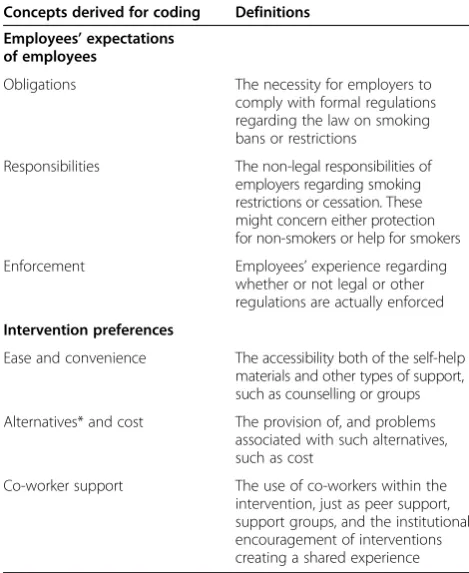
Employees’expectations of employees
Obligations The necessity for employers to comply with formal regulations regarding the law on smoking bans or restrictions
Responsibilities The non-legal responsibilities of employers regarding smoking restrictions or cessation. These might concern either protection for non-smokers or help for smokers
Enforcement Employees’experience regarding whether or not legal or other regulations are actually enforced
Intervention preferences
Ease and convenience The accessibility both of the self-help materials and other types of support, such as counselling or groups
Alternatives* and cost The provision of, and problems associated with such alternatives, such as cost
Co-worker support The use of co-workers within the intervention, just as peer support, support groups, and the institutional encouragement of interventions creating a shared experience
[image:8.595.59.290.101.497.2]increasing numbers of studies. Themes originally assigned by an individual reviewer might therefore change or be refined during this iterative process, both to reflect the data more accurately and to capture simi-larities and differences within the data. The process is inductive, grounded in the data, and interpretive. Each reviewer therefore produced a list of new themes for data considered to be outside of thea priori framework. These themes and the data supporting them were then considered and discussed by the entire review team. A final consolidated list of new themes, and the data supporting or illustrating each theme, was then agreed by the review team after discussion of each reviewer’s own thematic interpretations (see Table 4). In this process the themes were “conceptualised” by being de-fined with reference to their supporting data, much like the development of the concepts in thea prioriframework. The task of interpreting and conceptualising the “ un-accommodated”data was not onerous as it only consisted of reaching consensus on the thematic categorisation and definition of a relatively small amount of data, with which each reviewer was already familiar and to which they had already assignedtentative new themes.
The reviewers produced six new themes for the case study framework, all of which related either to the roles and responsibilities of the employer in this area (employer obligations, employer responsibilities, and enforcement) or elements of the interventions themselves (ease and con-venience; alternatives and cost; and co-worker support) (Table 4). The resulting new concepts, perhaps unsurpris-ingly, related to specifics of the setting (the workplace) and the interventions (components, delivery etc.), which were not well-represented in the more generic behavioural theories that formed the basis of the a prioriframework. Many theories relate to personal health behaviours, but few theories relate to intervention components [50,51].
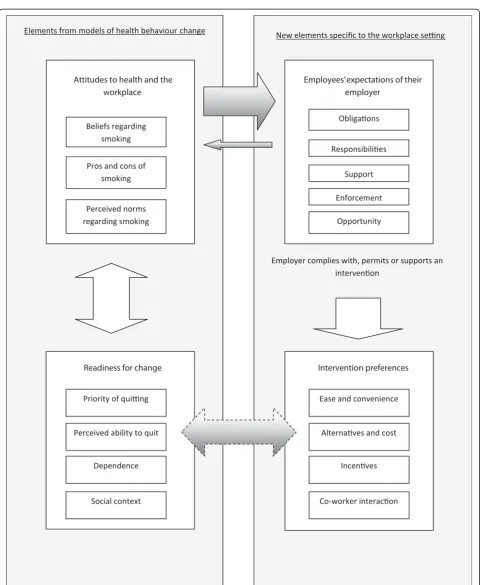
The revisions to thea prioriconcepts, and the creation of the new concepts, resulted from the reviewers’ inter-pretation of the data rather than thea prioriframework, underlining the respective contributions of deductive and inductive analysis techniques. The resultant synthesis therefore built on thea prioriframework, derived from all of the foundation models, but supplemented this frame-work with additional concepts reflecting the context, in-terventions and setting. The conceptual model resulting from the synthesis is depicted in Figure 5.
Stage 2: Creating the conceptual model or theory
The creation of the conceptual model or theory repre-sents probably the most difficult process within the method to describe and runs the risk of reducing the creative nature of synthesis to a“mechanistic” task [52]. However, in principle the process relies on two stages of further reduction and interpretation of the data. First,
concepts are clustered and subsumed as “internal attri-butes”within more abstract concepts [53]. In other words, where concepts shared commonalities, reviewer interpret-ation of the data reduced those characteristics to, in this case, four higher concepts relating to the behaviour of interest:Attitudes to health and the workplace; Readiness for change; Employees’expectations of their employer; and
Intervention preferences. So, for example, beliefs about smoking, pros and cons of smoking, and perceived norms regarding smoking were all clustered under the higher concept ofAttitudes to health and the workplace. Second, these higher concepts and their“internal attributes”were each contextualised with reference to the data to under-stand their internal relationships [53]. For example, the at-tributes of“beliefs about smoking”and “perceived norms regarding smoking in the workplace”were strongly linked. Some smokers and non-smokers felt that there was no problem with smoking either at work or elsewhere [28,37]. Some non-smokers believed that smokers thought that smoking in the workplace was not an issue at all [25]. Some informants, smokers and non-smokers, held the opinion that smoking was no worse than many other haz-ards to which people were exposed at work and elsewhere [25,28]. In a similar fashion, perceived norms ranged from employees’beliefs about their“rights”: The right to smoke in the face of bans or restrictions versus the right not to be exposed to others’smoke in the workplace [25,29]. As a result of such different beliefs and norms, smoking and non-smoking groups would be formed within a workplace, with opposing perspectives, identities and aspects of com-munity [25,28,29,38].
This two-stage process moved the analysis beyond lower–level interpretation or description of the data to a higher level of abstraction and theory creation, i.e. synthe-sis. The synthesis was then“expressed” through a simple diagram, as a conceptual model, reflecting the factors and relationships at work in the decision-making and behaviour of interest (e.g. Figure 5). This diagram was supplemented by a narrative referring to the actual studies and their data, to illustrate the complexities of the concepts and interac-tions within the model [15]. This enhanced the validity of the model by illustrating how the lower-level concepts or attributes had been derived from the data.
For example, the large left-to-right arrow between the concepts of Attitudes to health and the workplace and
their smoking was none of their employer’s business" [38]. However, it was also the case that some actions taken by employers, such as restrictions or bans, affected personal views about smoking and the workplace; this is represented by the smaller right-to-left arrow. One study reported the words of one smoker that, “I was a bit angry about it at the time, and I do think it was very much forced upon us. But having got used to it now, it’s actually not as bad as I thought it would be . . . I don’t feel as strongly now about it as I did then, because I can see the benefits” [28]; while in another study, participants commented about "management making it convenient to give up smok-ing" [30].
In the same way, the priority an individual smoker assigned to quitting was strongly related to views about specifics of the interventions. This is repre-sented by the bi-directional arrow between the concepts of Readiness for change and Intervention preferences. If employers provided incentives and op-portunity, this acted as additional motivation to those
who wanted to stop smoking: “It was win-win. I
wanted to quit anyways so you had the benefit of not smoking and getting paid not to smoke”, and, “It was the icing on the cake. It was a nice perk. I had been thinking about it (quitting) for a long time and it gave me a slight push” [36]. In other words, incentives and opportunity impacted on perceived ability to quit or likelihood of quitting. However, for those smokers without any such priority, incentives and opportunity made little or no difference: “I mean if you told me that I was going to make a million bucks if I quit in a year I guess I would be motivated to quit. But a few hundred bucks is not really a motivation” [36]. In other words, the priority an individual gave to quitting impacted on the likely effectiveness of any interven-tion and its components.
Thus, through the accompanying narrative the richness or “thickness” [54] of the data not only made it possible to demonstrate the origin of the various concepts and attributes, but also made it possible to articulate the relationships between them, and thus to create a new conceptual model. The re-sultant conceptual model can be used to generate a hypothesis or programme theory to develop inter-ventions and be tested in empirical research. In this case, a working hypothesis might be that the priority given by an employee to quitting smoking mediates the effectiveness of any relevant workplace interven-tion [15]. Thus, the method, which begins by testing relevant theory within a specific context, can gener-ate a refined, context-specific, intervention-based, programme theory that can itself by tested in empir-ical research.
Testing the synthesis: comparison with thea priori
models, dissonance and sensitivity
The conceptual framework or model resulting from the synthesis must now be explored to assess the potential for bias (e.g. the unexplained absence of themes of known relevance, such as from the a priori framework, or if there are no negative cases within the evidence) and to determine if the synthesis is sensitive to variables such as the ajudged reported quality, design or location of included studies. When the synthesis is complete, any differences between thea prioriframework and the new framework need to be explored. This would consist of explanations both for the absence of anya priorithemes from the new framework and the presence of new themes. This needs to be completed in order to under-stand and contextualise the findings in relation to the foundation theories or models. It is also a test of publi-cation bias within the sample of included primary re-search studies, i.e. is the absence of some a priori
themes a reflection of understandable and reasonable differences between the a priori and final model on ac-count of differences of setting, population etc. or does their absence need to be explored further by revisiting the literature. In this worked example alla priorithemes found resonance in the evidence from the included stud-ies. However, differences did exist in our previous pub-lished example of “best fit” and were explained by differences in the populations covered in the a priori
and review frameworks [1]. In the smoking cessation ex-ample, the new themes added to the framework could be explained by the foundation models’limited consider-ation of the variables of the intervention and setting, as noted above.
The authors also advocate that a qualitative sensitivity analysis be performed, following the synthesis stage, to examine the effect of variables, such as the quality of reporting of a study, within the qualitative evidence synthe-sis, i.e. how each individual study contributes to the final synthesis in terms of both“frequency”(the framework) and
“thickness”(the model) [48]. The value and utility of some form of sensitivity analysis for qualitative reviews has been acknowledged elsewhere, i.e. in testing whether a synthesis is affected by the omission of studies with methodological flaws [56] or from certain sources [20]. In the case study reported here, 12 of the 15 studies clearly satisfied two or more of the four possible“quality” criteria illustrating the methodological processes conducted within the studies. These studies were therefore categorised as “Adequately reported”. Only three studies were categorised as “ Inad-equately reported” [30,34,37]. The two reviewers (JL, JR) applied these brief quality assessment criteria consistently, each independently categorising every study in the same way, i.e. as either adequately or inadequately-reported. In sensitivity analysis, following principles outlined elsewhere [48], the contribution to the synthesis of the three “ Inad-equately reported” studies was found to be limited. Exclu-sion of these three studies would not have affected the presence of any of the themes in the framework, or their depth (“thickness” [57]), complexity and relationships (as represented in the conceptual model). Only one inadequately-reported study [34] contributed anything unique: The view of some participants that the usability of self-help materials might help smokers to engage and be successful with an intervention, an idea not reported else-where within included studies. It is therefore likely that the exclusion of these potentially“lower quality”studies would not have adversely affected either the synthesis or the
“thickness”of its detail. This echoes the findings of previous systematic reviews of people’s views that have undertaken such sensitivity analyses [49,58-60]. The same form of qualitative sensitivity analysis could be applied to explore whether a review’s findings were sensitive to other variables also, such as population, setting or location, study design or intervention. A sensitivity analysis based on quality, study design, setting and location was performed by the first au-thor in a previous review and, again, the synthesis was found not to be affected by any of these variables [58].
These process elements of the “best fit” method, i.e. testing of the synthesis with reference to any “gap” be-tween the findings and the original model(s), as well as an exploration of dissonance and a qualitative sensitivity analysis, were all conducted after completion of the syn-thesis and were undertaken with the express purpose of addressing concerns expressed elsewhere [61] that quali-tative approaches to synthesis do not typically assess ei-ther the contradictions or the shortcomings of individual studies (in terms of their quality or“thickness”).
Discussion
“Best fit”framework synthesis, as described and defined here, involves a series of distinct stages, each involving the application of a particular strategy or methodol. After the scoping of the question, common to all re-views, there follows two separate but simultaneous search and study selection processes. The BeHEMoTh strategy, described elsewhere (Booth A, Carroll C: To-wards a simple transparent method for identifying the-ory for use in systematic reviews of behaviour change interventions: the BeHEMoTh Procedure. Submitted.), was used to systematically identify relevant models or theories relating to the behaviour and context of interest. Secondary thematic analysis of the model or models was then undertaken as a means of creating the a priori
framework as the basis for the extraction and synthesis. In the previous worked example, this was based on a single published conceptual model, but in this present case study review there were five relevant models, which required reduction in order to produce the a priori
framework. This process required more time to
complete than for the single model, but was also worth-while because the selection of only one of the adapted theories or models in the publications would have pro-duced a more limited a priori framework. This can be deduced from the gaps in the matrix outlined in Figures 4. Indeed, this approach also enables an im-proved understanding of the ways in which existing the-ories might be lacking when it comes to answering certain review questions. Once the thematic framework was produced, the named themes were defined and conceptualised. A second search using the SPIDER strat-egy [21] was conducted to identify the primary research studies for the review. Like BeHEMoTH, this strategy was found to be fit for purpose for this exemplar review with the approach identifying 14 of the 15 included studies in the review.
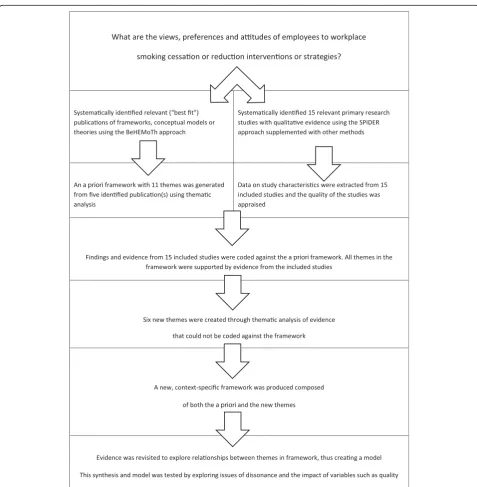
smoking cessation interventions. The resultant synthetic product was a model and, with further consideration and interpretation, a programme theory, whichcould be used to develop potentially more acceptable and effective workplace interventions for smoking cessation. The process, outlined in Figure 1, is described with reference to this particular review in Figure 6.
The quality assessment process, using the brief quality of reporting assessment criteria developed by the au-thors and used elsewhere [49], was also found to be fit for purpose for this review: The reviewers independently
and consistently categorised each included study in the same way, as either adequately or inadequately reported. The final process elements of the methodology; the“gap analysis” with reference to the foundation models; the qualitative sensitivity analysis based on the relative qual-ity of reporting of included studies; and the assessment of dissonance, all offer simple but important means of testing and evaluating the internal and external validity of the review and synthesis.
[image:13.595.58.536.225.713.2]The “best fit” method does not apply any “saturation” criteria [62] and thus involves examination of evidence
from all identified studies. It has been acknowledged that the threshold for saturation can be difficult to determine systematically [9,55] and may potentially ignore the contri-bution of later studies. This can prove a particular issue when conducting updates to pexisting systematic re-views, especially where more recent studies have been found to offer greater depth and contribute more to a syn-thesis [48,63]. The two worked examples of“best fit frame-work synthesis” also suggest that it is not necessarily true in all cases to say that qualitative research linked to a spe-cific intervention is of only “limited value” in generating conceptual models [62]: All of the included studies repre-sented such research. The“best fit” method can therefore be useful, as it can test and generate theory, and in so doing solve problems in policy-making and health care, and answer those questions left unanswered by the quanti-tative paradigm. These are roles that are increasingly being recognised for qualitative health research [64-66] and, by extension, qualitative evidence synthesis.
The “best fit” method for systematic review and evi-dence synthesis, with its inductive approach to the testing, revision and supplementation of a foundation theory, sat-isfies some stated objectives of qualitative synthesis: To develop a precise view of theoretical knowledge within an area, as well as the gaps in that knowledge, and to provide an evidence-base for the future development of interven-tions [56]. This is because the method not only tests the-ory but can generate it. In this case study, it led to the creation of a “testable” hypothesis that the priority given by an individual to quitting smoking mediates the effect-iveness of any relevant intervention [15].
Strengths and limitations of the“best-fit”method
“Best fit”framework synthesis is different from other ap-proaches in that it is a theory-based qualitative evidence synthesis (akin to realist synthesis) but can employ more than one systematically identified model or theory for conducting framework synthesis, which might thus over-come the limitations of any one particular theory. It also employs a unique combination of framework synthesis and secondary thematic analysis. It is highly suited to generating context-specific models or theories of patient or client-behaviour or experience by utilising existing published models and theories..This is because of the ex-istence of a large number of well-established theories and models explaining decision-making with regard to health and health care [67]. Consequently, even where there is not a “perfect fit” foundation model for a particular population and health behaviour, there will invariably be a generic model to act as a “best fit” and
form the basis of the a priori framework. Such a
framework will almost certainly accommodate a substan-tial amount of the evidence included in a review, given the universal traits of human behaviour and
decision-making that influence health behaviours and are reflected in such models. As demonstrated here, specific workplace smoking cessation models were found and used, but all were based on more generic health behav-iour models, such as the Health Belief Model (HBM) and the theory of planned behaviour (TPB). Generic models are likely to apply to most behaviours and are therefore likely to accommodate a large amount of the evidence from included qualitative studies, regardless of setting, population or intervention. The synthesis prod-uct should therefore be a conceptual model of value not only to researchers developing interventions, but also to policy and decision-makers. This is because it will not only be context specific and evidence-based, but also be-cause it will draw heavily, and transparently, on existing theoretical foundations and traditions.
Another potential strength of the method lies in the in-herent advantages of coding data by using both ana priori
framework and the creation of new themes by applying in-ductive methods, where data cannot be accommodated by the framework. The approach therefore uses a framework but is not limited to it. Even though the specifics of the set-ting, population or intervention might fall outside of the scope of foundation models or theories, and therefore out-side thea prioriframework also, these aspects will be cap-tured by the supplementary thematic analysis. This satisfies requirements of qualitative synthesis: “The researcher should. . .sort the data accordingly. . .be an active astute observer. . .so that. . . [they are] not forcing data. . .into prescribed categories . . . [but] rather . . . asking informed questions and checking the fit of established theory to see if it holds in a new situation”[68]. This dual role of qualita-tive researchers - to engage with theory but not be constrained by it –is acknowledged within the “best fit” methodology.
process can be conducted and, unlike other more inter-pretive methods, such as meta-ethnography [9], the pragmatic requirement for a systematic review team to be technically competent but not necessarily to contain multi-disciplinary expertise. Consequently, the interpret-ive process of“best fit”framework synthesis, while more
“mechanistic” than other forms of synthesis, is corres-pondingly more pragmatic and transparent.
However, the method is only appropriate for questions for which pre-existing frameworks or theories exist; the generation of completely new theory requires exclusively inductive methods, such as meta-ethnography or critical interpretive synthesis [5]. There is also the issue of the se-lection of relevant theory. A review team must make a de-cision on the relevance of any conceptual or theoretical papers identified based on the inclusion criteria and“best fit”. This case study identified five theoretical or concep-tual papers, all considered to be equally relevant to the question and synthesis. Indeed, no one paper could have generated all of the themes of thea prioriframework, thus demanding thematic analysis of a larger amount of evi-dence. Another review might identify even more poten-tially relevant model or theory papers. Unless a rationale was applied for selecting a small number of such papers, then the process of generating the framework could prove burdensome, when the intention behind the methodology and approach is actually to facilitate and simplify this stage. The best fit method makes use of a range of novel, published process elements for the systematic review and synthesis of qualitative evidence, namely: Systematic search strategies for models and theories, as well as for primary qualitative research studies; the assessment of study quality using simple, brief criteria; the application of framework synthesis methods to code much of the extracted data; the application of secondary thematic ana-lysis to create both the a priori framework and the new themes in the final framework; and the post-synthesis ap-plication of forms of sensitivity and dissonance analysis. The innovative nature of so many elements of the meth-odology will obviously require extensive testing and evalu-ation. This paper represents a second attempt to specify and to develop further each stage of the “best fit” framework synthesis process within a worked ex-ample. Although all of the techniques applied appear to be fit for purpose, the method needs further test-ing by different groups and for different questions and health behaviours. However, this paper also pro-vides a second, more developed “worked example” of the “best fit” method, and satisfies the call, made in this journal, for the publication of more worked ex-amples of novel methods of evidence synthesis [11]. As noted elsewhere, such case studies provide a spe-cificity and transparency often absent from original descriptions of methods [9].
Conclusion
The “best fit” method of framework synthesis offers a pragmatic means of conducting rapid qualitative evi-dence synthesis and generating models and, potentially, programme theories, and is of potential relevance both to researchers and policy-makers. The method is suited to producing new conceptual models for describing or explaining the decision-making and health behaviours of patients and other groups and if effectiveness evidence is at all equivocal, then this method offers a means of ex-ploring and explaining that ambiguity, and developing more appropriate interventions. The “best fit” approach applies new methods to identify theories in a systematic manner, and to create the a priori framework for the synthesis. Otherwise it uses an innovative combination of existing methods of quality assessment, analysis and synthesis to complete the process. The whole process was developed and tested within the context of a quali-tative evidence synthesis of employees’ views of work-place smoking cessation interventions and was found to be both practical and fit for purpose.
Additional file
Additional file 1:Search strategies.
Competing interests
The authors declare that they have no competing interests.
Authors’contribution
CC and AB conceived and developed the "best fit" method; CC conceived and designed the case study; CC, JL and JR extracted the data, appraised included studies and analysed and interpreted the data. CC drafted the paper, AB, JL and JR undertook critical revision of important content of the manuscript. All authors approved the final version of the manuscript.
Acknowledgements
The workplace smoking cessation case study was funded by the British Occupational Health Research Foundation (BOHRF).
Author details
1Health Economics and Decision Science (HEDS), School of Health and Related Research (ScHARR), Regent Court, Regent Street, Sheffield S1 4DA, UK.2Health Sciences Research Group - Primary Care, School of Community Based Medicine, University of Manchester, Williamson Building, Manchester M13 9PL, UK.
Received: 12 September 2012 Accepted: 4 March 2013 Published: 13 March 2013
Reference
1. Carroll C, Booth A, Cooper K:A worked example of "best-fit" framework synthesis: a systematic review of views concerning the taking of potential chemopreventive agents.BMC Med Res Methodol2011,11:29. 2. Kelly M, Morgan A, Ellis S, Younger T, Huntley J, Swann C:Evidence based
public health: a review of the experience of the National Institute of Health and Clinical Excellence (NICE) of developing public health guidance in England.Soc Sci Med2010,71:1056–1062.
3. Dixon-Woods M:Using framework-based synthesis for conducting reviews of qualitative studies.BMC Med2011,9:39.
4. Suri H:Epistemological pluralism in research synthesis methods.Int J Qual Stud Educ2012,1:1–23.
6. Lewin S, Bosch-Capblanch X, Lavis J:Guidance for evidence-informed policies about health systems: rationale for and challenges of guidance development.PLoS Med2012,9:e1001185.
7. Dixon-Woods M:Ten challenges in improving quality in healthcare: lessons from the Health Foundation's programme evaluations and relevant literature.BMJ Quality & Safety2012. Online first.
8. Wong G, Grenhalgh T, Westhorp G, Buckingham J, Pawson R:RAMESES publication standards: realist syntheses.BMC Med2013,11.
9. Atkins S, Lewin S, Smith H, Engel M, Fretheim A, Volmink J:Conducting a meta-ethnography of qualitative literature: lessons learnt.BMC Med Res Methodol2008,8:21.
10. Brunton G, Oliver S, Oliver K, Lorenc T:A Synthesis of Research Addressing Children's, Young People's and Parents' Views of Walking and Cycling for Transport London.London: EPPI-Centre, Social Science Research Unit, Institute of Education, University of London; 2006.
11. Candy B, King M, Jones L, Oliver S:Using qualitative synthesis to explore heterogeneity of complex interventions.BMC Med Res Methodol2011,11:124. 12. Garside R, Pearson M, Moxham T, Anderson R:Providing Public Information to
Prevent Skin Cancer. Review 2. Barriers and Facilitators to Conveying Information to Prevent First Occurrence of Skin Cancer: a Systematic Review of Qualitative Research.London: National Institute for Health and Clinical Excellence; 2009. 13. Oliver S, Rees R, Clarke-Jones L, Milne R, Oakley A, Gabbay J:A
multidimensional conceptual framework for analysing public involvement in health services research.Health Expect2008,11:72–84. 14. Hannes K, Macaitis K:A move to more systematic and transparent
approaches in qualitative evidence synthesis: update on a review of published papers.Qual Res2012,12:402–442.
15. Fishwick D, McGregor M, Drury M, Webster J, Rick J, Carroll C:BOHRF smoking cessation review. HuSU/12/17.Health & Safety Laboratory2012. Available at: http://www.bohrf.org.uk/downloads/
BOHRF_Smoking_Cessation_Review-April%202012.pdf.
16. Miles MB, Huberman AM:Qualitative Data Analysis: an Expanded Sourcebook. 2nd edition. Thousand Oaks, CA: Sage; 1994.
17. Lorenc T, Jamal F, Cooper C:Sun Protection Resources and Changes to the Environment to Prevent Skin Cancer: Qualitative Evidence Review.London: National Institute for Health and Clinical Excellence; 2010.
18. Cameron A:Rapid Versus Full Systematic Reviews: An Inventory of Current Methods and Practice in Health Technology Assessment.Australia: ASERNIPS; 2007:1–119. 19. Ganann R, Ciliska D, Thomas H:Expediting systematic reviews: methods
and implications of rapid reviews.Implementation Science2010,5:56. 20. Stansfield C, Kavanagh J, Rees R, Gomersall A, Thomas J:The selection of
search sources influences the findings of a systematic review of people's views: a case study in public health.BMC Med Res Methodol2012,12:55. 21. Cooke A, Smith D, Booth A:Beyond PICO: the SPIDER tool for qualitative
evidence synthesis.Qual Health Res2012,22:1435–1443.
22. Grayson L, Gomersall A:A Difficult Business: Finding the Evidence for Social Science Reviews. Working Paper 19.London: Economic and Social Research Council, UK Centre for Evidence Based Policy and Practice; 2003. 23. Hoffman T, Erueti C, Thorning S, Glasziou P:The scatter of research: cross
sectional comparison of randomised trials and systematic reviews across specialties.Br Med J2012,344:e3223.
24. Janke S, Haddock K, Poston W, Hoffman K, Hughey J, Lando H:A qualitative analysis of the tobacco control climate in the U.S. military.Nicotine Tob Res2010,12:88–95.
25. Bondy S, Bercovitz K:Non-smoking worksites in the residential construction sector: using an online forum to study perspectives and practices.Tob Control2011,20:189–195.
26. Borland R, Cappiello M, Owen N:Leaving work to smoke.Addiction1997,
92:1361–1368.
27. Croucher R, Choudhury S:Tobacco control policy initiatives and UK resident Bangladeshi male smokers: community-based, qualitative study.
Ethn Health2007,12:321–327.
28. Eadie D, MacAskill S, Heim D, Hastings G:Responding to change: how did bar workers adapt to the smoke-free legislation in Scotland?Int J Environ Health Res2010,20:13–26.
29. Styles G, Capewell S:No smoking at work: the effect of different types of workplace smoking restrictions on smokers' attitudes, behaviour and cessation intentions.Health Educ J1998,57:385–395.
30. Fisher E, Bishop D, Levitt-Gilmour T, Cappello M, Ashenberg Z, Newman E:
Social support in worksite smoking cessation: qualitative analysis of the EASE project.Am J Health Promot1994,9:39–47.
31. Glasgow R, Hollis J, Pettigrew L, Foster L, Givi M, Morrisette G:
Implementing a year-long, worksite-based incentive program for smoking cessation.Am J Health Promot1991,5:192–199.
32. Hunt M, Barbeau E, Lederman R, Stoddard A, Chetkovich C, Goldman R:
Process evaluation results from the healthy directions-small business study.Health Educ Behav2007,34:90–107.
33. Olsen G, Lacy S, Sprafka J, Arceneaux T, Potts T, Kravat B:A 5-year evaluation of a smoking cessation incentive program for chemical employees.Prev Med1991,20:774–784.
34. Powell D:A guided self-help smoking cessation intervention with white-collar and blue-white-collar employees.Am J Health Promot1993,7:325–326. 35. Harley A, Devine C, Beard B, Stoddard A, Hunt M, Sorensen G:Multiple
health behavior changes in a cancer prevention intervention for construction workers, 2001–2003.Prev Chronic Dis2010,7:A55. 36. Kim A, Kamyab K, Zhu J, Volpp K:Why are financial incentives not
effective at influencing some smokers to quit? Results of a process evaluation of a worksite trial assessing the efficacy of financial incentives for smoking cessation.J Occup Environ Med2011,53:62–67.
37. Osuchowski F, Penar-Zadarko B, Bukala-Siedlecka I, Binkowska-Bury M:The opinions of employees about smoking in the workplace. [Polish].Przegl Lek2009,66:801–804.
38. Tiede L, Hennrikus D, Cohen B, Hilgers D, Madsen R, Lando HA:Feasibility of promoting smoking cessation in small worksites: an exploratory study.Nicotine Tob Res2007,9:S83–S90.
39. Prochaska JO, Velicer WF:The transtheoretical model of health behavior change.Am J Health Promot1997,12:38–48.
40. Azjen I:The theory of planned behavior.Organ Behav Hum Decis Process 1991,50:179–211.
41. Rosenstock IM:Why people use health services.Milbank Mem Fund Q 1966,44:94–127.
42. Abrams D, Boutwell W, Grizzle J, Heimendinger J:Cancer control at the workplace: The Working Well Trial.Prev Med1994,23:15–27. 43. Callaghan R, Herzog T:The relation between processes-of-change and
stage-transition in smoking behavior: A two-year longitudinal test of the Transtheoretical Model.Addict Behav2006,31:1331–1345.
44. Oldenburg B, Glanz K, French M:The application of staging models to the understanding of health behaviour change and the promotion of health.
Psychol Health1999,14:503–516.
45. Hu SC, Lanese R:The applicability of the theory of planned behavior to the intention to quit smoking across workplaces in southern Taiwan.
Addict Behav1998,23:225–237.
46. Conrad K, Campbell R, Edington W, Faust H, Vilnius D:The worksite environment as a cue to smoking reduction.Res Nurs Health1996,19:21–31. 47. Morse JM:Constructing qualitatively derived theory: concept
construction and concept typologies.Qual Health Res2004,14:1395–1404. 48. Carroll C, Booth A, Lloyd-Jones M:Should we exclude
inadequately-reported studies from qualitative systematic reviews? an evaluation of sensitivity analyses in Two case study reviews.Qual Health Res2012,
22:1425–1434.
49. Thomas J, Harden A:Methods for the thematic synthesis of qualitative research in systematic reviews.BMC Med Res Methodol2008,8:45. 50. Michie S, Fixsen D, Grimshaw JM, Eccles MP:Specifying and reporting
complex behaviour change interventions: the need for a scientific method.Implementation Science2009,4:40.
51. Michie S, Webb TL, Sniehotta FF:The importance of making explicit links between theoretical constructs and behaviour change techniques.
Addiction2010,105:1897–1898.
52. Britten N, Campbell R, Pope C, Donovan J, Morgan M, Pill R:Using meta ethnography to synthesise qualitative research: a worked example.
J Health Serv Res Policy2002,7:209–215.
53. Morse JM:The politics of evidence.Qual Health Res2006,16:395–404. 54. Morse JM:The significance of saturation.Qual Health Res1995,5:147–149. 55. Booth A, Carroll C, Illott I:Desperately seeking dissonance: identifying the "Disconfirming Case" in qualitative evidence synthesis.Qual Health Res 2013,23:146–241.
56. Boeije H, van Wesel F, Alisic G:Making a difference: towards a method for weighing the evidence in a qualitative synthesis.J Eval Clin Pract2011,
17:657–663.
58. Carroll C, Lloyd-Jones M, Cooke J, Owen JM:Reasons for the use and non-use of school sexual health services: a systematic review of young people's views.J Public Health2012.
59. Carroll C, Booth A, Papaioannou D, Sutton A, Wong R:UK Healthcare professionals' experience of e-learning techniques: a systematic review of qualitative data.J Contin Educ Health Prof2009,29:2135–2141. 60. Noyes J, Popay J:Directly observed therapy and tuberculosis: how can a
systematic review of qualitative research contribute to improving services? A qualitative meta-synthesis.J Adv Nurs2007,57:227–243. 61. Lucas P, Baird J, Arai L, Law C, Roberts H:Worked examples of alternative
methods for the synthesis of qualitative and quantitative research in systematic reviews.BMC Med Res Methodol2007,7:4.
62. Lorenc T, Pearson M, Jamal F, Cooper C, Garside R:The role of systematic reviews of qualitative evidence in evaluating interventions: a case study.
Res Synth Meth2012,3:1–10.
63. Atkins S, Launiala A, Kagaha A, Smith H:Including mixed methods research in systematic reviews: examples from qualitative syntheses in TB and malaria control.BMC Med Res Methodol2012,12:62.
64. Morse JM:How different is qualitative health research from qualitative research? Do we have a subdiscipline?Qual Health Res2010,20:1459–1464. 65. Thorne S:Toward methodological emancipation in applied health
research.Qual Health Res2011,21:443–453.
66. Wuest J:Are We there Yet? positioning qualitative research differently.
Qual Health Res2010,21:883.
67. Glanz K, Rimer BK, Lewis FM:Health Behavior and Health Education.3rd edition. San Francisco: Wiley; 2002.
68. Morse JM:Going in "blind.".Qual Health Res1994,4:3–5.
69. Owen JM, Carroll C, Cooke J, Formby E, Hayter M, Hirst J,et al:School-Linked Sexual Health Services for Young People (SSHYP): a survey and systematic review concerning current models, effectiveness, cost-effectiveness and research opportunities.Health Technol Assess2010,14:30.
70. Thomas J, Harden A, Oliver S, Oakley A, Sutcliffe K, Rees R,et al:Integrating qualitative research with trials in systematic reviews: an example from public health.Br Med J2004,328:1010–1012.
71. Facey K:Patients' perspectives in health technology assessment: a route to robust evidence and fair deliberation.Int J Technol Assess Health Care 2010,26:334–340.
doi:10.1186/1471-2288-13-37
Cite this article as:Carrollet al.:“Best fit”framework synthesis: refining the method.BMC Medical Research Methodology201313:37.
Submit your next manuscript to BioMed Central and take full advantage of:
• Convenient online submission
• Thorough peer review
• No space constraints or color figure charges
• Immediate publication on acceptance
• Inclusion in PubMed, CAS, Scopus and Google Scholar
• Research which is freely available for redistribution