A solvent-resistant halogen bond
†
Craig C. Robertson,aRobin N. Perutz,*bLee Brammer*aand Christopher A. Hunter*a
The effect of solvent on the stabilities of complexes involving a single H-bond or halogen-bond (X-bond) has been quantified. Association constants for binary complexes of 4-(phenylazo)phenol, molecular iodine, tetramethylurea and tetramethylthiourea have been measured in fifteen different solvents by UV/vis absorption and1H NMR titration experiments. The stabilities of the H-bonded complexes decrease by more than three orders of magnitude with increasing solvent polarity. In contrast, the X-bonded complex of molecular iodine with tetramethylthiourea is remarkably insensitive to the nature of the solvent (association constants measured in alkanes and alcohols are similar). The results suggest that, in contrast to H-bonds, where electrostatics determine thermodynamic stability, charge-transfer interactions make a major contribution to the stability of these X-bonded complexes rendering them resistant to increases in solvent polarity.
Introduction
A halogen bond (X-bond) is an attractive interaction between an electron-decient halogen and a Lewis base or p-system.1–3 X-bonds wererst reported over a century ago by Guthrie4but have recently become a focus of attention in the elds of crystal engineering,5–10 protein–ligand interactions,11,12 catalysis13 and supramolecular and materials chemistry.14–20 Analysis of the geometries of X-bonds, D–X/A, in crystal structures reveal directional preferences that point to the role of the halogen“ s-hole”situatedtransto the covalent D–X bond (DX and A are the X-bond donor and acceptor respectively). However, it is not clear whether this observation is due to the fact that (a) thes-hole is the best site for an electrostatic interaction because thes-hole is the most positive region on the molecular electrostatic potential surface, or (b) due to the fact that thes-hole is the best site for a charge transfer interaction because the D–Xs*orbital is low in energy.21Here we resolve this issue by investigating the effect of solvent on the thermodynamic stabilities of X-bonded complexes. The thermodynamic properties of X-bonds have been char-acterized for a wide range of complexes in non-polar organic solvents.22–24 Laurence et al. used experimentally determined association constants for 1 : 1 complexes formed with molec-ular iodine in alkane solvents to develop a thermodynamic scale, pKBI2, to classify X-bond acceptor functional groups.22a
The pKBI2 scale shows some parallels with the corresponding
scale developed for H-bond interactions, pKBHX, which is based
on experimentally determined association constants for formation of 1 : 1 complexes with 4-uorophenol in carbon tetrachloride.25 However, there are some clear differences between the two scales, which suggests that there are funda-mental differences between the factors that govern the ther-modynamic properties of X-bonds and H-bonds. X-bonds are generally weaker than H-bonds, so experimental studies have focused on non-polar solvents, but here we show that it is possible to quantify X-bond interactions in much more polar solvent environments, providing some unique insight into the fundamental nature of the interaction.
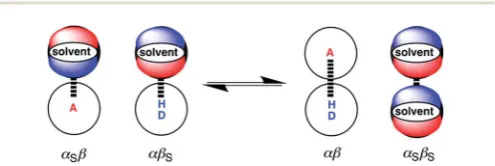
Fig. 1 illustrates the electrostatic solvent competition model that we have developed for H-bonding interactions.26 The energy of a pairwise intermolecular interaction is estimated using the H-bond parameters,aandb, and solution-phase free energy change for complexation is obtained by comparing stabilities of the four complexes in Fig. 1 (eqn (1)).
DG
calc¼ (aaS)(bbS) +c (1)
whereaandbare the H-bond donor and acceptor parameters of the solutes,aSandbSare the solvent H-bond parameters, and
Fig. 1 Formation of a complex between a H-bond donor (D–H) and a H-bond acceptor (A). The position of equilibrium is determined by the four interaction energies, which can be estimated using the H-bond parametersa,b,aSandbS(see eqn (1)).26
aDepartment of Chemistry, University of Sheffield, Brook Hill, Sheffield, S3 7HF, United Kingdom. E-mail: [email protected]
bDepartment of Chemistry, University of York, Heslington, York, YO10 5DD, United Kingdom
†Electronic Supplementary Information (ESI) available: Titration methods and data. See DOI: 10.1039/c4sc01746c
Cite this:Chem. Sci., 2014,5, 4179
Received 12th June 2014 Accepted 9th July 2014
DOI: 10.1039/c4sc01746c
www.rsc.org/chemicalscience
Science
EDGE ARTICLE
Open Access Article. Published on 30 July 2014. Downloaded on 27/10/2016 15:01:13.
This article is licensed under a
Creative Commons Attribution 3.0 Unported Licence.
View Article Online
[image:1.595.305.553.599.682.2]the constantcwas experimentally determined to be 6 kJ mol1 in carbon tetrachloride solution and is assumed to be unchanged for other solvents.
The parameters used in eqn (1) can be derived from molec-ular electrostatic potential surfaces calculated for the isolated molecules in the gas phase, so the thermodynamic properties of H-bonds can be estimated in a straightforward way from the chemical structures of the components.27The validity of eqn (1) was conrmed by comparison of DGcalc with experimental
measurements on a range of different complexes in different solvents.28eqn (1) implies that the solvent competes for inter-actions at specic sites on the solutes and that the bulk solvent properties do not play an important role. Studies of solvent effects therefore offer excellent opportunities to probe the nature of intermolecular interactions, and here we apply this approach to X-bonds.
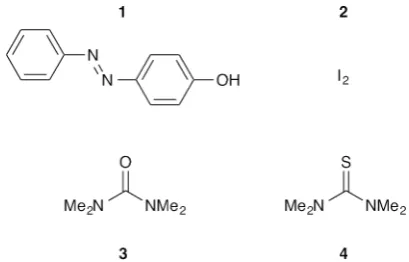
The compounds used are shown in Scheme 1. The1$3 H-bonded complex and the2$4X-bonded complex are both known to be very stable in non-polar solvents,26,29so these systems are promising candidates for quantifying binding interactions in more competitive solvents. In addition, the interaction of molecular iodine with thiocarbonyl compounds has been extensively studied by a variety of spectroscopic methods, and characteristic signatures have been identied for the different covalent and non-covalent adducts that can be formed.30
Results and discussion
UV/vis absorption titrations were carried out on the two H-bonded complexes, 1$3 and 1$4, and the two X-bonded complexes, 2$3 and2$4, ineen different solvents. Typical results are illustrated in Fig. 2 (see ESI†for full details). Thep– p*absorption band of1shis from 336–342 nm to 350–354 nm on formation of a H-bond (Fig. 2a). Fitting the titration data to a 1 : 1 binding isotherm gave the association constants recorded in Table 1. For some systems, absorption of the guest or the solvent obscured part of the UV/vis spectrum, so titrations were also carried out using1H NMR spectroscopy. For systems where both UV/vis and NMR titrations were carried out, the results were consistent.
The2$4complex has a charge-transfer absorption band with lmaxobserved in the range 330–340 nm, depending on solvent
(Fig. 2b; ESI Section 8†). In addition, thepg–suabsorption band
of2shis fromlmaxin the range 478–523 nm to 431–450 nm on
formation of a X-bond. The latter blue-shied band is more difficult to discern in the titration of2into4(Fig. 2b), but clearly evident in the titration of3into2(Fig. S37†). Fig. 3 shows the spectra for the fully bound X-bonded complexes2$3and2$4.31 The charge-transfer band at 330–340 nm dominates in the2$4 spectrum but is not present in the UV/vis spectrum of the2$3 complex. The blue-shied band for 2 at 431–450 nm is now clearly evident for both complexes. Thiocarbonyl compounds can react with molecular iodine to form a variety of different covalent adducts.30However, the charge-transfer band observed in the2$4titrations is characteristic of a complex where the I–I bond is intact.32 In polar solvents, the2$4complex did react slowly to give new signals in the1H NMR spectrum (see ESI†). Formation of these covalent adducts did not occur over the timescale of the titration experiments reported here.
Scheme 1 H-bond donor 4-(phenylazo)phenol1(a¼4.2), X-bond donor iodine2and acceptors3tetramethylurea (b¼8.8) and4 tet-ramethylthiourea (b¼6.4).26
Fig. 2 UV/vis spectra for titrations of (a)3into a 0.1 mM solution of1
[image:2.595.64.269.48.179.2]and (b)2into a 0.01 mM solution of4inn-octane at 298 K.
Table 1 Association constants (M1) measured by UV/vis or1H NMR titrations at 298 Ka
Solvent
H-bond X-bond
1$3 1$4 2$3 2$4
n-Octane 2400 370 12 8800 Carbon tetrachloride 410 24b 6 7300
Toluene 230 4 3 11 000 Diiodomethane 210b 6b <1 37 000
Dibromomethane 110 <1 <1 34 000 Dichloromethane 90 9 2 58 000b Chloroform 52 2b 1 20 000 1,1,2,2-Tetrachloroethane 35 6b <1 55 000 Di-n-octyl ether <1 <1 <1 1600 Acetone 2b <1 <1 1900b Acetonitrile 3b <1 <1 2800b Nitromethane 5b <1 <1 2100b i-Propanol <1 <1 <1 3600b Ethanol <1 <1 <1 3200b
Methanol <1 <1 <1 2700b
aSee ESI for errors. In all cases, greater than 50% saturation of the
binding isotherm was achieved.bMeasured by1H NMR titration.
Open Access Article. Published on 30 July 2014. Downloaded on 27/10/2016 15:01:13.
This article is licensed under a
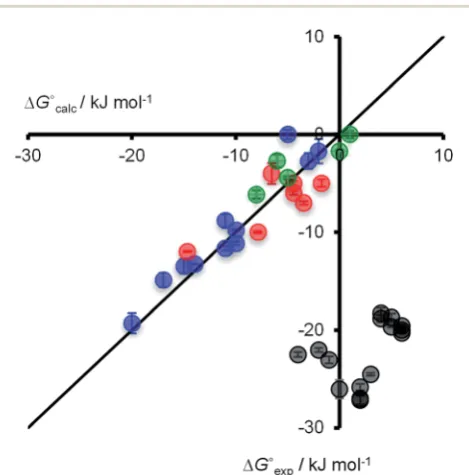
[image:2.595.317.539.50.177.2]The association constants measured for the H-bonded complexes,1$3and1$4, span three orders of magnitude, and the values agree well with the free energy changes predicted by eqn (1) (Fig. 4, data in blue and red respectively). This implies that the stabilities of the complexes are determined simply by the relative polarities of the solutes and solvents: the complexes formed with3are more stable than the complexes formed with4in all solvents, because3is a more polar H-bond acceptor; the complexes are most stable in the least polar solvent, n-octane, and the stability decreases with solvent polarity, so that binding is too weak to measure in the most polar solvent, methanol.
The 2$3 X-bonded complex is the least stable of all four complexes studied. This complex is most stable in the least polar solvent,n-octane, and the stability decreases with solvent polarity, so that binding is too weak to measure in most
solvents. In contrast, the 2$4 X-bonded complex is the most stable of the four complexes studied, and association constants could be measured in alleen solvents. The stability of this complex shows a remarkably different solvent-dependence from the other three complexes. The2$4association constant in the most polar solvent, methanol, decreases only 3-fold compared with the value determined in the least polar solvent,n-octane. This result was conrmed by measuring the stability of the2$4 complex in different alcohols, ethanol andi-propanol, which gave very similar results to methanol.
The association constants for the 2$3 X-bonded complex show a similar solvent-dependence to the H-bonded complexes, which suggests that an effective value ofafor molecular iodine can be estimated for2using eqn (1) (Fig. 4). At of the exper-imental data for the2$3complex to eqn (1) yieldsa¼2.8 (data in green). However, this value ofa(or any other) fails to predict the properties of the 2$4complex (Fig. 4, data in gray). The electrostatic solvent competition model illustrated in Fig. 1 is clearly not suitable for describing solvent effects on the stability of the2$4X-bonded complex.
An investigation of the interaction of solvent with 2 was carried out by measuring association constants for all2$solvent complexes in n-octane. The association constants in all cases are small (Ka#21 M1, Table S2†) and showed no correlation
with the stability of the 2$4 complex in these solvents. In addition, there is no correlation between the association constant for the2$4complex and bulk solvent properties (see Fig S78†). UV/vis absorption titrations carried out in mixtures of
n-octane and 1,1,2,2-tetrachloroethane (TCE) show thatDGexpt
[image:3.595.54.282.50.172.2]is a linear function of the concentration of TCE, and there is no evidence of preferential solvation of the2$4complex that would lead to stabilization of the complex in halogenated solvents (see Fig S77†).
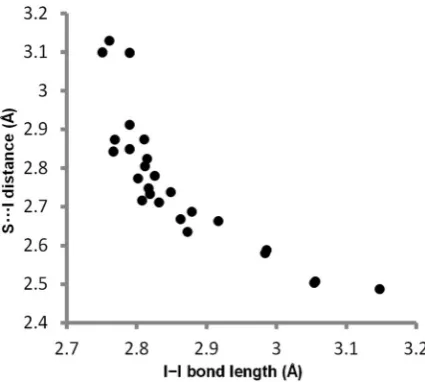
The results in Table 1 and Fig. 4 indicate that the factors that govern the stability of the2$4X-bond are quite different from the other three complexes. For example, the association constants for the1$4,1$3and2$3complexes are more than an order of magnitude lower in TCE than in n-octane, whereas the 2$4 complex is 6 times more stable in TCE than in n-octane. The UV/vis spectrum of the 2$4 complex is also different from the other three complexes in that there is a strong charge-transfer absorption band. The wavelength (330–340 nm) and extinction coefficient (30 000– 55 000 M1 cm1) of this band are similar in all solvents where values could be measured (see ESI†). Crystal structures of complexes between molecular iodine and thiocarbonyl compounds exhibit geometries with short S/I distances (2.49–3.13˚A,RSI0.66–0.83) and elongated I–I distances (2.75–
3.15˚A, compared with 2.70A in molecular iodine).˚ 33,34The S/I and I–I distances are inversely correlated (Fig. 5), indi-cating a signicant charge transfer component to these interactions. Laurence has suggested that the degree to which a base can transfer electrons into the I–Is*orbital is responsible for the extent of elongation of the I–I bond and has reported a correlation between the change in diiodine bond length in the solid state and solution-phase binding constants.34
Fig. 3 UV/vis spectra of (a) the2$3complex and (b) the2$4complex calculated from the UV/vis titration data inn-octane.31
Fig. 4 Comparison of experimental free energy changes on complexation (DGexp) with the values calculated using eqn (1) (DGcalc) for H-bonded complexes (1$3shown in blue and1$4in red) and X-bonded complexes (2$3shown in green and2$4in grey). Experimental errors at the 95% confidence limit. The line representsDGcalc¼DGexp.
Open Access Article. Published on 30 July 2014. Downloaded on 27/10/2016 15:01:13.
This article is licensed under a
[image:3.595.50.285.431.669.2]Conclusions
The X-bond formed between tetramethylthiourea (4) and molecular iodine (2) is stable in a wide range of different solvents. In contrast to H-bonds, which are very sensitive to solvent polarity, this X-bond is not disrupted even by polar alcohol solvents. The H-bonds formed by 4 to (4-phenylazo) phenol1and the X-bonds formed by molecular iodine to tet-ramethylurea 3 exhibited the expected sensitivity to solvent. These results indicate that the thermodynamic properties of X-bonds cannot be explained by simple electrostatic arguments or the solvent competition model in Fig. 1. We conclude that charge transfer interactions make a signicant contribution to the stability of the2$4complex and that these interactions are remarkably insensitive to the nature of the solvent.
The X-bonds formed by molecular iodine are signicantly stronger than X-bonds formed by organic iodine compounds.23,24 However, if the unusual stability the2$4complex in polar solvents were a general feature of X-bonded complexes, it should be possible to nd combinations of organic X-bond donor and acceptor that show high affinities in polar solvents. Indeed, thermodynamic studies of X-bonded complexes involving organic iodine compounds suggest that stability is not dictated by simple electrostatic considerations.23a,35–37Such effects have implications for the application of these non-covalent interactions in water and may provide the opportunity to exploit X-bonding in drug design.
Acknowledgements
The EPSRC (grants EP/J012998/1 and EP/J012955/1) provided support for this work.
Notes and references
1 For a provisional IUPAC denition, under review, see http://
www.iupac.org/home/publications/provisional-recommen-dations/published/published-container/de nition-of-the-halogen-bond.html.
2 P. Metrangolo, H. Neukirch, T. Pilati and G. Resnati,Acc. Chem. Res., 2005,38, 386.
3 A. C. Legon,Phys. Chem. Chem. Phys., 2010,12, 7736. 4 F. Guthrie,J. Chem. Soc., 1863,16, 239.
5 L. Brammer, G. M´ınguez Espallargas and S. Libri,
CrystEngComm, 2008,10, 1712.
6 K. Rissanen,CrystEngComm, 2008,10, 1107.
7 (a) G. M´ınguez Espallargas, L. Brammer and P. Sherwood,
Angew. Chem., Int. Ed., 2006, 45, 435; (b) G. M´ınguez Espallargas, F. Zordan, L. Arroyo Mar´ın, H. Adams, K. Shankland, J. van de Streek and L. Brammer,Chem.–Eur. J., 2009,15, 7554.
8 (a) C. B. Aaker¨oy, M. Fasulo, N. Schultheiss, J. Desper and C. Moore, J. Am. Chem. Soc., 2007, 129, 13772; (b) C. B. Aaker¨oy, M. Baldrighi, J. Desper, P. Metrangolo and G. Resnati,Chem.–Eur. J., 2013,19, 16240–16247.
9 (a) J.-Y. Questel, C. Laurence and J. Graton,CrystEngComm, 2013, 15, 3212; (b) C. Perkins, S. Libri, H. Adams and L. Brammer,CrystEngComm, 2012,14, 3033.
10 A. W. Sun, J. W. Lauher and N. S. Goroff,Science, 2006,312, 1030.
11 (a) P. Auffinger, F. A. Hays, E. Westhof and P. S. Ho,Proc. Nat. Acad. Sci., 2004, 101, 16789; (b) E. Parisini, P. Metrangolo, T. Pilati, G. Resnati and G. Terraneo,Chem. Soc. Rev., 2011, 40, 2267.
12 (a) Y. Lu, T. Shi, Y. Wang, H. Yang, X. Yan, X. Luo, H. Jiang and W. Zhu,J. Med. Chem., 2009,52, 2854; (b) R. Wilcken, X. Liu, M. O. Zimmermann, T. J. Rutherford, A. R. Fersht, A. C. Joerger and F. M. Boeckler, J. Am. Chem. Soc., 2012, 134, 6810.
13 (a) S. M. Walter, F. Kniep, E. Herdtweck and S. M. Huber,
Angew. Chem., Int. Ed., 2011, 50, 7187; (b) F. Kniep, S. H. Jungbauer, Q. Zhang, S. M. Walter, S. Schindler, I. Schnapperelle, E. Herdtweck and S. M. Huber, Angew. Chem., Int. Ed., 2013,52, 7028.
14 (a) N. L. Kilah, M. D. Wise, C. J. Serpell, A. L. Thompson, N. G. White, K. E. Christensen and P. D. Beer,J. Am. Chem. Soc., 2010, 132, 11893; (b) C. L. Gilday, T. Lang, A. Caballero, P. J. Costa, V. Felix and P. D. Beer, Angew. Chem., Int. Ed., 2013,52, 4356.
15 A. V. Jentzsch, A. Henning, J. Mareda and S. Matile, Acc. Chem. Res., 2013,46, 2791.
16 S. M. Walter, F. Kneip, L. Rout, F. P. Schmidtchen, E. Herdtweck and S. M. Huber, J. Am. Chem. Soc., 2012, 134, 8507.
17 (a) M. Fourmigu´e and P. Batail,Chem. Rev., 2004,104, 5379; (b) H. M. Yamamoto, Y. Kosaka, R. Maeda, J. Yamaura, A. Nakao, T. Nakamura and R. Kato,ACS Nano, 2008,2, 143. 18 T. Shirman, T. Arad and M. E. van der Boom,Angew. Chem.,
Int. Ed., 2010,49, 926.
19 L. Meazza, J. A. Foster, K. Fucke, P. Metrangolo, G. Resnati and J. W. Steed,Nat. Chem., 2012,5, 42.
20 D. W. Bruce, P. Metrangolo, F. Meyer, T. Pilati, C. Pr¨asang, G. Resnati, G. Terraneo, S. G. Wainwright and A. C. Whitwood,Chem.–Eur. J., 2010,16, 9511.
Fig. 5 Plot of S/I distanceversusI–I bond length in iodine– thio-carbonyl complexes in the Cambridge Structural Database (see Table S3 for details†).
Open Access Article. Published on 30 July 2014. Downloaded on 27/10/2016 15:01:13.
This article is licensed under a
[image:4.595.60.273.48.239.2]21 (a) T. Clark, M. Hennemann, J. Murray and P. Politzer,J. Mol. Model., 2007, 13, 291; (b) F. Zordan, L. Brammer and P. Sherwood,J. Am. Chem. Soc., 2005,127, 5979.
22 (a) C. Laurence, J. Graton, M. Berthelot and M. El Ghomari,
Chem.–Eur. J., 2011, 17, 10431; (b) W. J. McKinney and A. I. Popov,J. Am. Chem. Soc., 1969,91, 5215.
23 (a) R. Cabot and C. A. Hunter,Chem. Commun., 2009,15, 2005; (b) T. M. Beale, M. G. Chudzinski, M. G. Sarwar and M. S. Taylor,Chem. Soc. Rev., 2013,42, 1667.
24 (a) T. Beweries, L. Brammer, N. A. Jasim, J. E. McGrady, R. N. Perutz and A. C. Whitwood, J. Am. Chem. Soc., 2011, 133, 14338; (b) D. A. Smith, L. Brammer, C. A. Hunter and R. N. Perutz,J. Am. Chem. Soc., 2014,136, 1288.
25 C. Laurence and J. F. Gal,Lewis Basicity and Affinity Scales, John Wiley & Sons, 2010, pp. 111–227.
26 C. A. Hunter,Angew. Chem., Int. Ed., 2004,43, 5310. 27 C. S. Calero, J. Farwer, E. J. Gardiner, C. A. Hunter,
M. Mackey, S. Scuderi, S. Thompson and J. G. Vinter,Phys. Chem. Chem. Phys., 2013,15, 18262.
28 J. L. Cook, C. A. Hunter, C. M. R. Low, A. Perez-Velasco and J. G. Vinter,Angew. Chem., Int. Ed., 2007,46, 3706.
29 M. C. Aragoni, M. Arca, F. A. Devillanova, A. Garau, F. Isaia, V. Lippolis and G. Verani,Coord. Chem. Rev., 1999,184, 271. 30 (a) R. P. Lang, J. Am. Chem. Soc., 1962, 84, 1185; (b) C. C. Thompson and P. A. D. De Maine,J. Am. Chem. Soc., 1963, 85, 3096; (c) K. R. Bhaskar, R. K. Gosavi and C. N. R. Rao, Trans. Faraday Soc., 1966, 62, 29; (d)
A. Rogstad and E. Augdahl, Acta Chem. Scand., 1971, 25, 225; (e) A.-G. El-Kourashy,Spectrochim.Acta, Part A, 1981,6, 339; (f) A. Suszka,J. Chem. Soc., Perkin Trans. 2, 1985, 531; (g) F. Bigoli, P. Deplano, M. L. Mercuri, M. A. Pellinghelli, A. Sabatini, E. F. Trogu and A. Vacca,J. Chem. Soc., Dalton Trans., 1996, 3583; (h) P. Deplano, J. R. Ferraro, M. L. Mercuri and E. F. Trogu, Coord. Chem. Rev., 1999, 188, 71.
31 R. A. Binstead, A. D. Zuberb¨uhler and B. Jung,SpecFit/32 (V3.0.34), Spectrum Soware Associates, 2003.
32 F. Bigoli, P. Deplano, A. Ienco, C. Mealli, M. L. Mercuri, M. A. Pellinghelli, G. Pintus, G. Saba and E. F. Trogu,
Inorg. Chem., 1999,38, 4626.
33 (a) See ESI†for list of crystal structures.RSI¼d(S/I)/(rS+rI),
whererSandrIare the van der Waals radii33bof sulfur and
iodine, following the denition of Lommerse et al.33c; (b) A. Bondi, J. Phys. Chem., 1964, 68, 441; (c) J. P. M. Lommerse, A. J. Stone, R. Taylor and F. H. Allen,J. Am. Chem. Soc., 1996,118, 3108.
34 C. Ouvrard, J.-Y. Le Questel, M. Berthelot and C. Laurence,
Acta Crystallogr., Sect. B: Struct. Sci., 2003,B59, 512. 35 M. G. Chudzinski and M. S. Taylor,J. Org. Chem., 2012,77,
3483.
36 M. G. Sarwar, B. Dragisic, L. J. Salsberg, C. Gouliaras and M. S. Taylor,J. Am. Chem. Soc., 2010,132, 1646.
37 L. J. McAllister, D. W. Bruce and P. B. Karadakov,J. Phys. Chem. A, 2012,116, 10621.
Open Access Article. Published on 30 July 2014. Downloaded on 27/10/2016 15:01:13.
This article is licensed under a