This is a repository copy of
Creativity, innovation and engineering: mutually exclusive they
are not
.
White Rose Research Online URL for this paper:
http://eprints.whiterose.ac.uk/79986/
Proceedings Paper:
Giard, J, McKay, A and Trowsdale, DB (2013) Creativity, innovation and engineering:
mutually exclusive they are not. In: UNSPECIFIED 10th European Academy of Design
Conference - Crafting the Future, 17-19 Apr 2013, Gothenburg, Sweden. .
[email protected] https://eprints.whiterose.ac.uk/ Reuse
Unless indicated otherwise, fulltext items are protected by copyright with all rights reserved. The copyright exception in section 29 of the Copyright, Designs and Patents Act 1988 allows the making of a single copy solely for the purpose of non-commercial research or private study within the limits of fair dealing. The publisher or other rights-holder may allow further reproduction and re-use of this version - refer to the White Rose Research Online record for this item. Where records identify the publisher as the copyright holder, users can verify any specific terms of use on the publisher’s website.
Takedown
If you consider content in White Rose Research Online to be in breach of UK law, please notify us by
10th European Academy of Design Conference - Crafting the Future 1 | P a g e
Creativity, Innovation and
Engineering: Mutually Exclusive
They Are Not
Jacques Giard, PhD,
Arizona State University, Tempe, AZ, USA
Alison McKay, PhD,
University of Leeds, Leeds, UK
Dan Trowsdale,
University of Leeds, Leeds, UK
Abstract
Typically creativity and activities that surround creativity such as innovation are not found in
programs of product design engineering. The product design programme in the School of
Mechanical Engineering at the University of Leeds is different. From almost the first day that it
was launched it deliberately imbedded creativity and innovation as a part of its curriculum. That
was nearly ten years ago.
This paper describes the creativity and innovation components of the product design
programme, its development over the last nine years, and the lessons learned along the way. Five
of these lessons have proven to be particularly informative, important and relevant. These are:
¥ Variety of exercises: How does the choice and type of exercise in creativity and innovation
10th European Academy of Design Conference - Crafting the Future 2 | P a g e ¥ Duration of exercise: How does the duration of exercises in creativity and innovation Ð short,
medium, long Ð affect the quality of output and student involvement?
¥ Individual or team: What are the merits of individual exercises compared to team exercises?
¥ Cooperation or competition: How do cooperation and competition differ in creating
effective learning?
¥ Theory versus practice: What is the appropriate combination between theory and practice
when it comes to teaching creativity and innovation?
The paper concludes by connecting creativity and innovation to the needs in industry.
Introduction
Creativity and innovation are generally perceived as essential components of designing.
Consequently, programmes that teach design almost always place a special focus on creativity and
innovation. Moreover, both attributes appear to manifest themselves in one of two ways: they are
either an implicit expectation, i.e. students are expected to demonstrate creative and innovative
thinking without necessarily being introduced deliberately to creativity and innovation, or just the
opposite, i.e. creative and innovative thinking are recognized as essential components in design
and are therefore imbedded deliberately in the curriculum.
The Product Design programme in the School of Mechanical Engineering at the
University of Leeds belongs in the latter category. From the very beginning it acknowledged that
creativity and innovation were critical in the education of product designers and deliberately
imbedded creativity and innovation as a component in the curriculum. In part, this direction was
taken because creativity and innovation are recognized as important factors in business success
and are regarded as important aspects of employability (CBI, 2009). For the purposes of this
paper, and in line with the Oxford English Dictionary definition, creativity is the unconstrained
use of imagination or original ideas to create something new. In the context of architecture and
design, the results of creativity are typically design concepts and solution principles. Innovation,
on the other hand, is constrained; in this paper we regard innovation as creativity with constraints.
10th European Academy of Design Conference - Crafting the Future 3 | P a g e can be manufactured using specific resources and delivered to market on time and to cost.
The explicit inclusion of creativity and innovation in an art and design-based programme
is not at all unusual; it is, however, for an engineering-based programme in product design.
Consequently, what may appear to the common place for the former is not for the latter. It is this
aspect of the case Ð creativity and innovation Ð that makes the observations, findings and
recommendations particularly meaningful.
The paper traces the evolution of this one aspect of the curriculum by way of an annual
event called Innovation Week, which is an intensive five-day workshop for Level Two students
(second year) in the product design programme. The paper is divided into five sections. Section 1
provides the rationale for the inclusion of creativity and innovation; Section 2 describes the many
exercises and changes to these that have occurred over time; Section 3 is focuses on the
observations over eight years, which is followed by some important findings in Section 4. Lastly,
the authors make recommendations in Section 5.
Section 1: The Programme
The product design programme at the University of Leeds is situated in a school of mechanical
engineering and, as expected, has a strong engineering technology bias. Its students are expected
to approach product design and development from a technological perspective in a
multidisciplinary setting. Unlike many of the traditional industrial or product design programmes
in the UK there is no strong art-and-design foundation.
Despite its location in engineering the product design programme is not a typical
engineering programme. As expected, there are many theoretical courses, which are offered as
lectures; however, there are also design studio courses, which are more typical of art-and-design
programmes. Together, this mix of theory/lecture courses and design studio courses provide the
students with a multidisciplinary design education combining the best elements of both
engineering knowledge and design skills.
Creativity and innovation, as an explicit component of the programme, are introduced in
10th European Academy of Design Conference - Crafting the Future 4 | P a g e design. This is when creativity and innovation, as an intensive five-day workshop early in the
studentÕs education, is introduced. This intervention creates the synergy needed to convert
creativity and innovation theories into credible design exercises. It delivers the so-called creative
spark or synergy that is essential for effective product design.
Since its introduction, Innovation Week has become a staple of the product design
programme but not without regular modifications, principally as a reflection of the output of the
various exercises as well as feedback from students. Consequently, the version of Innovation
Week offered in 2011 was notably different from the first version offered in March 2005. It is
important to note that changes made to exercises were always justified by evidence of one kind
or another. This evidence became the basis for change in ways that would support and reinforce
those practices that were considered effective in teaching creativity and innovation including
principles that appear to reinforce good creative and innovative design practice.
Section 2: Innovation Week
As mentioned, Innovation Week is an intensive five-day exercise in creativity and innovation
offered to students in Level 2 of the Product Design programme. Innovation Week exposes
students to a variety of experiences in creativity and innovation by way of different exercises.
Each exercise has been designed and selected to familiarise the student with various aspects of
the creative process. All exercises emphasise learning by doing, although some theory about
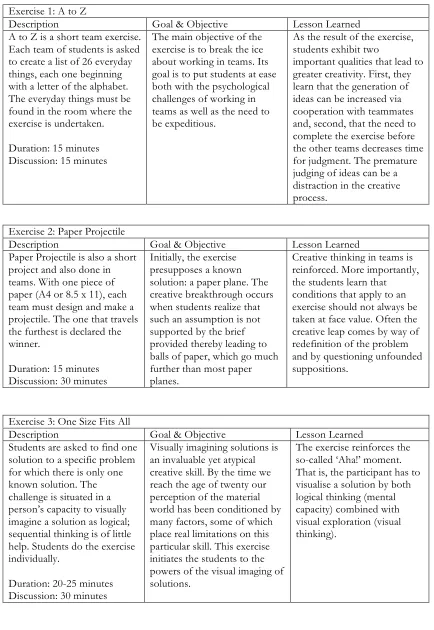
creativity is provided. The exercises are offered in the sequence noted in Table 1. Table 1
10th European Academy of Design Conference - Crafting the Future 5 | P a g e
Table 1: Projects Offered During Innovation Week
Exercise 1: A to Z
Description Goal & Objective Lesson Learned A to Z is a short team exercise.
Each team of students is asked to create a list of 26 everyday things, each one beginning with a letter of the alphabet. The everyday things must be found in the room where the exercise is undertaken.
Duration: 15 minutes Discussion: 15 minutes
The main objective of the exercise is to break the ice about working in teams. Its goal is to put students at ease both with the psychological challenges of working in teams as well as the need to be expeditious.
As the result of the exercise, students exhibit two
important qualities that lead to greater creativity. First, they learn that the generation of ideas can be increased via cooperation with teammates and, second, that the need to complete the exercise before the other teams decreases time for judgment. The premature judging of ideas can be a distraction in the creative process.
Exercise 2: Paper Projectile
Description Goal & Objective Lesson Learned Paper Projectile is also a short
project and also done in teams. With one piece of paper (A4 or 8.5 x 11), each team must design and make a projectile. The one that travels the furthest is declared the winner.
Duration: 15 minutes Discussion: 30 minutes
Initially, the exercise presupposes a known solution: a paper plane. The creative breakthrough occurs when students realize that such an assumption is not supported by the brief provided thereby leading to balls of paper, which go much further than most paper planes.
Creative thinking in teams is reinforced. More importantly, the students learn that conditions that apply to an exercise should not always be taken at face value. Often the creative leap comes by way of redefinition of the problem and by questioning unfounded suppositions.
Exercise 3: One Size Fits All
Description Goal & Objective Lesson Learned Students are asked to find one
solution to a specific problem for which there is only one known solution. The challenge is situated in a personÕs capacity to visually imagine a solution as logical; sequential thinking is of little help. Students do the exercise individually.
Duration: 20-25 minutes Discussion: 30 minutes
Visually imagining solutions is an invaluable yet atypical creative skill. By the time we reach the age of twenty our perception of the material world has been conditioned by many factors, some of which place real limitations on this particular skill. This exercise initiates the students to the powers of the visual imaging of solutions.
10th European Academy of Design Conference - Crafting the Future 6 | P a g e Exercise 4: View from the Top
Description Goal & Objective Lesson Learned This exercise continues the
visual imaging capacity introduced in Exercise 3 and is based on the logic of the orthographic view, on the one hand, and the numerous possibilities for interpretation if only the top view is provided, on the other. The exercise can be done either individually or in teams.
Duration: 2-3 hours
Review and discussion: 1 hour
The exercise raises and addresses the issue of predictability, which often comes from expectations based on stereotypes. Known expectations are challenged, resulting in images never imagined to be possible.
This exercise builds upon the Paper-Projectile exercise (above) by addressing the issue of predictability and how predictability is often
anathema to creativity. When first presented with the exercise the students are more often than not inclined to develop predictable ideas. Soon thereafter comes the inevitable removal of barriers and the inevitable creative leap.
Exercise 5: Mix ÔnÕ Match
Description Goal & Objective Lesson Learned Predictability is the bane of
creativity and innovation. To break the predictability pattern students are asked to design a known product but for a totally unfamiliar user. This is a team exercise.
Duration: 12-24 hours Review and discussion: 2 hours.
The exercise introduces constraints, thereby focusing on innovation rather than creativity per se. Students select a familiar everyday object from a list. This heightens their expectations about the exercise. However, their expectations are immediately deflated because the user of the everyday object is totally unexpected. This combination of familiar object and unexpected user places the teams in a design conundrum.
Students realise that
innovative solutions are more possible if criteria are
challenged in their entirety. The unexpected user introduced in the exercise achieves this end because it does not allow for
stereotypical design solutions.
Exercise 6: Dropping an Egg
Description Goal & Objective Lesson Learned There are many sources for
creative and innovative solutions. In this egg-dropping exercise, a classic one in design education, students are asked to look at how nature can be a source for creative and innovative thinking.
Duration: 2 days
Review and discussion: 4 hours
There is nothing new with the egg-drop exercise. It has been offered in many guises over many decades. What makes this version of the exercise different is that the solution must originate with nature in a way that is more commonly known as biomimicry.
10th European Academy of Design Conference - Crafting the Future 7 | P a g e
Section 3: Observations
Beginning in March 2005, the six aforementioned exercises (see Table 1) have been offered to
well over 400 students in Innovation Week. Our observations have been focussed on the
effectiveness of each exercise in addressing five specific issues that are integral to the teaching of
creativity and innovation in a design setting. These observations have led to several findings and
recommendations about these exercises (Sections 4 and 5):
¥ Variety of Challenges: Intuitively, no one should expect a positive response from product
design students doing the same exercises in creativity and innovation over a five-day period.
Therefore, and without evidence other than years of experience as educators, it was assumed
that a variety of exercises was preferable to a limited range. By way of observation as well as
student engagement, variety appeared to be appreciated. First, it created a change of pace for
the students; second, it allowed students who felt unprepared for one kind of exercise to be
better prepared for an exercise that was significantly different.
¥ Length of exercises: As noted above, the pacing of a five-day designing experience can be
achieved by way of variety; the same can also be achieved by the length of exercises. Again,
the decision to vary the time of the exercises was based more on past teaching experience
than anything else. That said, observations showed that students appreciated short exercises
as much as longer ones. It appeared that short exercises energized students with the need for
immediate results yet longer exercises allowed for greater contemplation of the challenge. As
a matter of fact and on a recurring basis, students would often spend more time (e.g.
working overnight) out of personal investment for the experience.
¥ Individual vs. team: Our observations provide justification for the merits for both
individual-based as well as team-individual-based exercises. Students came to the university accustomed to doing
individual assignments; they felt comfortable doing so. Team exercises proved more
challenging, but only at first. The exercises offered to the teams quickly created an air of
cooperation and collaboration as witnessed by students working closely together for the first
10th European Academy of Design Conference - Crafting the Future 8 | P a g e ¥ Co-operation vs. competition: As an overall design ethos, competition appears to be the
norm with students. After all, a great deal of the pedagogical experience in public education
is underpinned by competition in the form of grades and grade point averages (GPAs).
Therefore, competition is not an alien concept. Co-operation, that is, working as a group for
the benefit of the group, is not as easy for everyone. Some students take to the co-operation
mode with ease; others appear not to. This pattern has not changed over the eight years that
Innovation Week has been offered.
¥ Theory and/or practice: Because Innovation Week is offered in a university setting it was
assumed that the teaching of creativity and innovation should include theory as well as
practice. As logical as this combination appears to be, integrating theory proved to be
challenging. The first iterations on Innovation Week incorporated the typical lecture/lab
model; that is, a lecture was offered about some theoretical aspect of creativity or innovation,
which was followed by one of the aforementioned exercises. From feedback (verbal as well
as written) received from the students, the order was changed: the exercise was first given
then followed with a discussion of the theory that underpinned the exercise. Again based on
student comments this approach has proven more meaningful. Over the last two years each
exercise has asked the students to provide written feedback based on the model called
Triangle/Square/Circle1. Such feedback provides the instructor with a better sense of the
student learning and an indication of what is effective and what needs modification.
Section 4: Findings
It should be noted that the exercises in creativity and innovation were neither developed with
specific testing objectives in mind nor were they offered in a predetermined order other than the
fact that one exercise builds upon the previous one. In other words, the findings (Section 4) and
recommendations (Section 5) are the results of hundreds of observations over a period of eight
years; they are not the result of a test specifically designed and undertaken to measure
10th European Academy of Design Conference - Crafting the Future 9 | P a g e ¥ Variety of challenges: It is our observation that the exercises must provide a variety of
experiences. Some exercises can be more realistic such as Exercise 5: Mix Ôn Match whereas
others can be quite abstract such as Exercise 4: View from the Top. Some exercises can
challenge spatial thinking such as Exercise 3: One Size Fits All while others can be focused
more on logical thinking such as Exercise 6: Dropping an Egg. In our experience, variety
reduces predictability as well as the perception that creativity and innovation are conditioned
by a formulaic approach.
¥ Length of exercises: The length of time allowed for any exercise appears to be important.
Some exercises should be short with immediate results such as Exercise 1: A to Z, whereas
others should be longer where more time is given to explore solutions such as Exercise 6:
Dropping an Egg. Once again, there is a need to be unpredictable and prevent patterns from
setting in. In our opinion, there does not appear to be an ideal time for exercises in creativity
and innovation. Short exercises are as important as longer ones. Each has its place.
¥ Individual vs. team: There is merit in team exercises when considering creative and
innovative solutions. This is certainly the case with Exercises 1, 2, 5 and 6. When dynamics
are at their best, teams can be very effective. Team members can support and reinforce each
other. In our opinion and from observations, teams should have no more than five
members. As effective as teams are, there is also a need for exercises geared to the individual
in order to build self-confidence in the person, such as we find with Exercises 3 and 4. From
our observations and in our opinion, creative and innovative teams are the product of
creative and innovative individuals.
¥ Co-operation vs. competition: Co-operation can be effective in creative thinking as can
competition. In our experience this is not a question of either/or. Consequently, these two
approaches are intertwined in the various exercises, most often by encouraging co-operation
within a team in an exercise that is undertaken in a competitive setting.
¥ Theory and/or practice: There is no doubt that the students should gain an appreciable level
of theoretical understanding about creativity and innovation. For example, they should
10th European Academy of Design Conference - Crafting the Future 10 | P a g e assume because they see some of their colleagues more at ease doing creative thinking. That
said, our findings by way of observations and student feedback provide evidence to support
a process that moves away from the traditional theory/lab model so often found in
engineering towards a model based more on kinaesthetic learning, in other words, learning
by doing. Such an approach Ð doing first and theorizing later Ð is more conducive to the
introduction of theory in the area of creativity and innovation.
Section 5: Recommendations
There are several reasons why creativity and innovation are part of the curriculum in the product
design programme at the University of Leeds. For the university, however, the most important
reason is the need to graduate product designers who will be productive members of an industrial
society. Skills in innovative thinking are sought after by business, not only in the UK but in all
developed countries. Following extensive collaboration with business, the Confederation of
British Industry (CBI) defined a set of eight employability factors they believe are essential for
graduates to enter the work of work. One of these is problem solving (defined as Òanalyzing facts
and situations and applying creative thinking to develop appropriate solutionsÓ) and another is
entrepreneurship/enterprise (defined as Òan ability to demonstrate an innovative approach,
creativity, collaboration and risk taking.Ó) According to the CBI these two skills, based on
innovation and collaborative creative problem solving, make up a quarter of the prerequisite
attributes a graduate requires to make a Òhuge differenceÓ to any business (CBI, 2009).
This business context creates certain conditions albeit broad for the inclusion of
creativity and innovation in most product design programmes, and not only those in engineering.
Based on our experience of eights years, hundreds of observations, and a well-defined set of
findings, recommendations for exposure to principles and practices in creativity and innovation
follow the same set of five aspects discussed above with one additional overarching condition: an
explicit inclusion of creativity and innovation.
¥ Explicit instead of implicit: Creativity and innovation need to be an explicit part of a product
10th European Academy of Design Conference - Crafting the Future 11 | P a g e creative and innovative individuals (i.e. itÕs in their genes) or will become creative and
innovative by osmosis (i.e. they will learn to be creative and innovative over time). Both of
these assumptions are unfounded and should not be encouraged. Instead, creativity and
innovation need to be deliberately imbedded into the overall learning experience.
¥ Variety of challenges: There is no one-size-fits-all when it comes to learning exercises in
creativity and innovation. If nothing else, variety demonstrates that there are not only many
ways to teach creativity and innovation but also diverse ways to do so.
¥ Length of exercises: Similar to a variety of challenges (above), a case can also be made for the
length of exercise. Clear and different benefits can accrue from short exercises as well as
medium and long exercises.
¥ Individual vs. team: If one was to believe the popular design press it appears that all design is
the work of a gifted individual. In the context of the business world, nothing could be
further from the truth. Therefore, there is a need to reinforce the creative and innovation
skills at the level of the individual all the while realizing that most designers will be working
in teams.
¥ Co-operation vs. competition: In the business context, co-operation and competition appear
to be mutually exclusive. They are not. On the one hand, co-operation is necessary within
the internal work environment of the specific business; on the other hand, competition is the
external work environment of all businesses. Consequently, product design students need to
understand and appreciate both.
¥
Theory and/or practice: Exercises in creativity and innovation are means to an end. Studentslearn about creativity and innovation by doing, which is extremely effective. That said, the
student must retain something more than a kinaesthetic experience. There has to be a
theoretical construct that can be applied in the future. Theory must therefore be included but
must be integrated in a way that is most effective. For Innovation Week reflection after the
10th European Academy of Design Conference - Crafting the Future 12 | P a g e
Acknowledgements
Innovation Week has been offered nine times since its first delivery in March 2005. The students
and colleagues who have participated in the workshops have been instrumental in the way it has
developed.
References
CBI, (2009). Future Fit: Preparing graduates for the world of work, retrieved 01 14 2013, from
http://www.universitiesuk.ac.uk/Publications/Documents/FutureFit.PDF.
Currano, R., Steinert, M., Leifer, L. (2012). Design Loupes: A Bifocal Study to Improve the Management
of Engineering Design Innovation by Co-evaluation of the Design Process and Information Sharing Activity,
in Design Thinking Research: Studying Co-Creation in Practice. Berlin: Springer-Verlag.
1 Triangle/Square/Circle is a simple feedback instrument based on three questions: 1) What three