The Open University’s repository of research publications
and other research outputs
Skills for Creativity in Graphic Design: Testing the
relationship between visualisation, written
comprehension, and graphic design creativity
Thesis
How to cite:
Jeffries, Karl K. (2017). Skills for Creativity in Graphic Design: Testing the relationship between visualisation,
written comprehension, and graphic design creativity. PhD thesis The Open University.
For guidance on citations see FAQs.
c
2016 The Author
Version: Version of Record
Copyright and Moral Rights for the articles on this site are retained by the individual authors and/or other copyright owners. For more information on Open Research Online’s data policy on reuse of materials please consult the policies page.
Skills for Creativity in Graphic Design: Testing the relationship
between visualisation, written comprehension,
and graphic design creativity
A thesis presented for the degree of Doctor of Philosophy at The Open University
By Karl K. Jeffries
MA, Manchester Metropolitan University BA (Hons) Glasgow School of Art
Department of Engineering and Innovation
Faculty of Science, Technology, Engineering and Mathematics The Open University
Skills for Creativity in Graphic Design 1
Abstract
This thesis explores the relationship between skills, creativity and domain. It is situated within an evolving topic of design creativity; an emerging field that interfaces between
creativity research, which has often occurred in the field of psychology, and design research often associated with the fields of engineering, art and design.
Through five interconnected studies, and the domain of graphic design as the basis for experimentation, the research culminates in testing the relationship between creative output and skills considered important for competent performance in graphic design. How to assess graphic design creativity in a manner credible to both the creativity research and design research community has been a core challenge for this thesis. The method selected - the Consensual Assessment Technique (CAT) - before this thesis had yet to be used as a reliable measure of graphic design creativity in experimental research. For this reason, three of the studies were directed at establishing the reliability of the CAT.
One undertook the first systematic literature review of the CAT in design research;
a second tested the assumption that a graphic design CAT would show acceptable
levels of inter-rater reliability (as researchers had found in other domains of design);
a third focused on optimising the CAT to measure graphic design creativity.
Additionally, given the wide range of graphic design competencies available, a conceptual framework was developed to prioritise those most important, and suitable, for
experimental study. Two were identified (mental visualisation, and written comprehension) and each was tested for its relationship to graphic design creativity.
Where other researchers have suggested or found a relationship, in this study, no significant correlations could be evidenced for either mental visualisation or written
comprehension with creative output. Such a finding is likely counter-intuitive to many in art and design, thus, the implications of this study impact upon debates within design
Skills for Creativity in Graphic Design 2
Contents
Abstract ... 1 Contents ... 2 List of Figures ... 8 List of Tables ... 9 Acknowledgments ... 11 Chapter 1: Introduction ... 121.1 The Theoretical Context of this Research ... 13
1.2 The Educational Context of this Research... 15
1.2.1 Higher Education for the Creative Industries ... 17
1.3 The Economic Context of this Research ... 21
1.4 Outline of Thesis Structure and Chapters ... 24
Chapter 2: Definitions and Relationships Between Domain, Skills and Creativity ... 27
2.1 Introduction to Chapter 2... 27 2.2 Defining Domain ... 28 2.2.1 Definitions of Domain ... 29 2.2.2 Domains of Mind ... 29 2.2.3 Occupational Roles ... 29 2.2.4 Microdomains ... 30
2.2.5 Which Definition to Use? ... 30
2.2.6 Related Occupations ... 30
2.2.7 Single Occupations ... 31
2.2.8 Domain Identity of Participants: Designer or Artist ... 31
2.2.9 Definition of Domain in this Study ... 32
2.3 Defining Skills ... 34
2.3.1 Conflated Usage ... 34
2.3.2 Talent and Giftedness ... 36
2.3.3 Expertise ... 36 2.3.4 Competency ... 37 2.3.5 Abilities ... 37 2.3.6 Skills ... 38 2.3.7 Tasks ... 38 2.3.8 Knowledge ... 39
2.3.9 Definition of Skills in this Study ... 40
2.4 Define Creativity ... 42
2.4.1 Eastern and Western Definition of Creativity ... 42
Skills for Creativity in Graphic Design 3
2.4.3 Historical and Personal Creativity ... 43
2.4.4 Creative Output ... 44
2.4.5 Protocol Studies ... 45
2.4.6 Self-Report Measures ... 45
2.4.7 Divergent Thinking Tests and the Torrance Tests of Creative Thinking ... 45
2.4.8 Creativity Assessment by Domain Experts, and the Consensual Assessment Technique ... 46
2.4.9 Definition of Creativity used in this Study. ... 49
2.5 Key Relationship: Creative and Domain ... 50
2.5.1 Domain-General Theory... 50
2.5.2 Domain-Specific Theory ... 50
2.5.3 Hybrid Models ... 51
2.5.4 Conclusion ... 51
2.6 Key Relationship: Domain and Skill ... 52
2.6.1 O*NET Graphic Design ... 53
2.6.2 National Occupational Standards. ... 55
2.6.3 BTEC Specialist ... 57
2.6.4 BTEC Higher Nationals (Graphic Design) Level 4 & 5 ... 58
2.6.5 NASAD ... 60
2.6.6 Conclusion ... 61
2.7 Key Relationship: Skill and Creativity ... 61
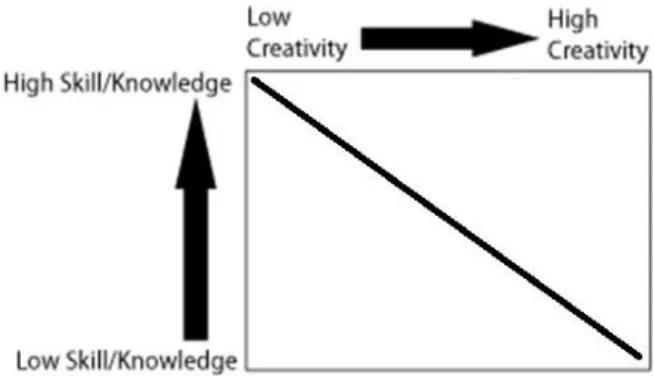
2.7.1 A Linear Negative Correlation ... 62
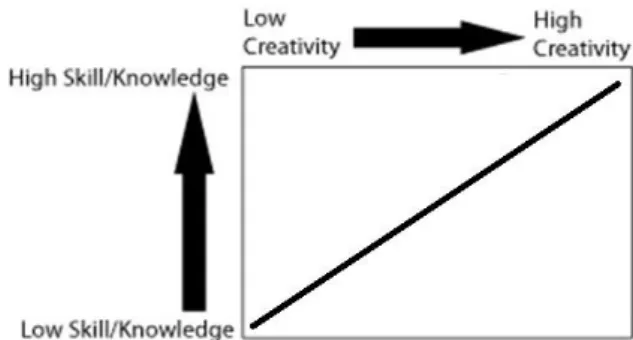
2.7.2 A Linear Positive Correlation ... 62
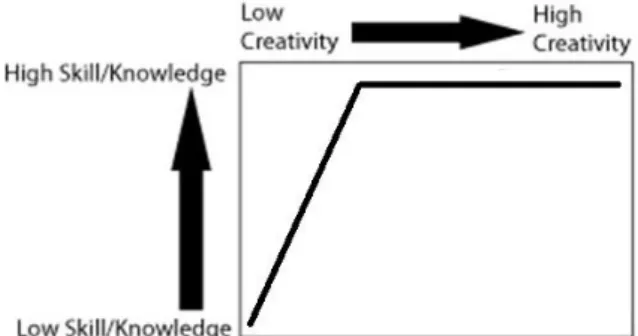
2.7.3 A Non-Linear Positive Correlation ... 63
2.7.4 A Non-Linear Negative Correlation ... 64
2.7.5 Comparable Shapes of Correlations ... 65
2.7.6 Influence of Domain on Skills/Creativity Relationship ... 65
2.8 Core Relationship: Skills, Creativity and Domain ... 66
2.8.1 Skills for Creativity in Graphic Design ... 68
Chapter 3, Study 1: A Systematic Review of the CAT in Design Research ... 72
3.1 Introduction to Study 1 ... 72
3.2 Systematic Review ... 73
3.3 Method ... 74
3.3.1 Why use Google Scholar Rather than Other Databases? ... 74
3.3.2 Downloading Multiple Citations from Google Scholar ... 75
3.3.3 Cleaning the Reference Manager Database... 75
3.3.4 PsycINFO ... 76
Skills for Creativity in Graphic Design 4
3.3.6 Design Research Journals ... 77
3.4 Results ... 77
3.4.1 CAT Citations ... 77
3.4.2 CAT Citations Within Design Journals ... 77
3.4.3 Key Journals Publishing CAT Studies ... 79
3.4.4 Key Authors Publishing CAT Studies ... 79
3.4.5 CAT Studies Related to Graphic Design ... 80
3.5 Discussion ... 80
3.5.1 Creative Process Versus Creative Product... 81
3.5.2 Method and Methodological Concerns with a Social Consensus View of Creativity ... 83
3.5.3 Criterion Versus Normative Assessment ... 86
3.5.4 Use of CAT in Graphic Design ... 90
3.6 Conclusion ... 92
Chapter 4, Study 2: A Conceptual Framework for Prioritising Graphic Design Competencies. ... 94
4.1 Introduction to Study 2 ... 94
4.2 Literature Specific to this Chapter ... 94
4.2.1 CHC Theory ... 96
4.3 Method ... 106
4.4 Results ... 109
4.4.1 Mapping ONET Graphic Design Abilities to CHC Theory ... 109
4.4.2 ONET/CHC Cross References with Graphic Design Competencies ... 111
4.4.3 Overall Ranking and Priorities. ... 114
4.5 Discussion ... 115
4.5.1 Operational Measures for Written Comprehension and Visualisation ... 117
4.5.2 Operational Measures for Written Comprehension ... 118
4.5.3 Operational Measures for Visualisation ... 122
4.5.4 Limitations of These Findings. ... 130
4.6 Conclusions ... 130
Chapter 5, Study 3: Is the CAT a Reliable Method of Assessing Graphic Design Creativity? ... 132
5.1 Introduction to Study 3 ... 132
5.1.1 A Task for a Graphic Design CAT ... 132
5.2 Watching Words Move Task ... 135
5.2.1. Method ... 136
5.2.2 Results ... 142
5.2.3 Discussion of WWM Task Results ... 144
5.3 T-shirt Design Task ... 146
5.3.1 Method ... 147
Skills for Creativity in Graphic Design 5
5.3.3 Discussion T-shirt Task Results ... 152
5.4 Broad Discussion ... 154 5.4.1 Technical Execution ... 155 5.4.2 Suitable Judges ... 156 5.4.3 Range of Artwork ... 157 5.4.4 T-shirt Task ... 158 5.5 Conclusions ... 160
Chapter 6, Study 4: Optimising the CAT to Measure Graphic Design Creativity ... 162
6.1 Introduction to Study 4 ... 162
6.2 Literature Specific to this Chapter ... 162
6.3 Method ... 164
6.3.1 Broad Research Design ... 164
6.3.2 Ethical Considerations ... 166 6.3.3 Tasks ... 168 6.3.4 Instruction to Judges ... 169 6.3.5 Judges ... 181 6.3.6 Procedures ... 184 6.4 Results ... 185 6.4.1 Type Task ... 185 6.4.2 Image Task ... 186 6.5 Discussion ... 188
6.5.1 Diversity of Creativity Within a CAT Grouping ... 189
6.5.2 Technical Ratings ... 191
6.5.3 Rankings, not Just Alpha ... 191
6.5.4 To Include a Caveat or not? ... 192
6.6 Conclusion ... 196
Chapter 7, Study 5: The Relationship Between Graphic Design Competencies and Creative Output ... 198
7.1 Introduction to Study 5 ... 198
7.2 Background to this Chapter ... 199
7.2.1 A Range of Graphic Design Experience ... 200
7.2.2 Graphic Design Creativity and Novice Participants ... 201
7.2.3 Visualisation and Written Comprehension ... 208
7.2.4 The Influence of General Intelligence ... 209
7.2.5 An Appropriate Size of Group ... 210
7.2.6 Main Research Question and Subordinates ... 211
7.3 Method ... 212
Skills for Creativity in Graphic Design 6
7.3.2 Identification of Experts, Novices and Intermediates ... 213
7.3.3 Participants ... 215
7.3.4 Measures... 217
7.3.5 Judges ... 220
7.3.6 Ethics, Data Protection, Location and Recompense ... 224
7.4 Results ... 226
7.4.1 Inter-Rater Reliability Scores for Image and Type Tasks Creativity ... 227
7.4.2 Normality of Distribution ... 228
7.4.3 Correlations Between Creativity, Aesthetic Appeal and Technical Execution ... 232
7.4.4 Correlations Between Type and Image Creativity ... 236
7.4.5 Correlations Between Creativity and Visualisation ... 237
7.4.6 Correlations Between Creativity and Written Comprehension ... 241
7.4.7 Correlation Between Creativity and General Intelligence ... 246
7.5 Discussion ... 248
7.5.1 Graphic Design Creativity and Visualisation ... 249
7.5.2 Graphic Design Creativity and Written Comprehension ... 250
7.5.3 A Graphic Design CAT Without Pre-Selection of Artwork ... 253
7.5.4 A Combined Creativity Score for Type and Image ... 254
7.5.5 Correlations Between Creativity, Technical Execution and Aesthetic Appeal ... 256
7.5.6 Emergent Considerations... 258
7.6 Conclusion ... 260
Chapter 8: General Discussion and Conclusion ... 262
8.1 Introduction ... 262
8.2 The Art and Science of Creativity Research ... 262
8.3 CHC Theory and Graphic Design Competencies ... 265
8.4 Growth of CAT Update ... 266
8.5 Novelty of CAT to Design Studies ... 268
8.6 Creativity Only Instruction ... 269
8.7 Correlations Between Creativity, Technical Executions and Aesthetic Appeal ... 270
8.8 Distinction Between Aesthetic and Technical in Other Design Domains ... 271
8.9 Not Meeting Assumptions ... 272
8.10 Is Creativity Domain Specific? ... 272
8.11 Ethics of Showing Creative Outputs ... 275
8.12 Limitations ... 280
8.13 Future Studies ... 281
8.14 Conclusion ... 283
References ... 286
Skills for Creativity in Graphic Design 7
Appendix B: Randomisation of Type Task Artwork for Study 4 ... 296
Appendix C: Randomisation of Image Task Artwork for Study 4 ... 297
Appendix D: Image Task Technical Instructions for Study 5 ... 298
Skills for Creativity in Graphic Design 8
List of Figures
Figure 1: Key relationships between skill, creativity and domain ... 27
Figure 2: A negative linear relationships for skills/knowledge relative to creativity ... 62
Figure 3: A positive linear relationships for skills/knowledge relative to creativity ... 63
Figure 4: A positive non-linear relationships for skills/knowledge relative to creativity... 64
Figure 5: A non-linear negative relationships for skills/knowledge relative to creativity ... 65
Figure 6: Number of CAT citation (per year) in design journals relative to other journals ... 77
Figure 7: Images of artworks selected for Dineen and Niu (2008) ... 91
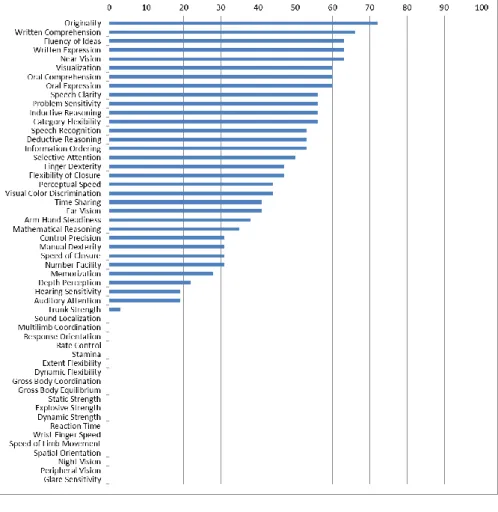
Figure 8: O*NET’s prioritisation of graphic design abilities ... 95
Figure 9: (Left) Form Board Test, (Right) Revised Minnesota Paper Form Board Test ... 124
Figure 10: The Paper Folding Test (VZ-2) ... 124
Figure 11: (top) PSVT:R, (Bottom) Vandenberg & Kuse’s Mental Rotation Test ... 126
Figure 12: Example from Watching Words Move ... 136
Figure 13: Artwork selected for the WWM task ... 138
Figure 14: Artwork selected for the WWM task (continued) ... 139
Figure 15: Comparison of expert scores with novice/intermediate scores for the WWM task ... 143
Figure 16: Example of restricted rating sheet ... 145
Figure 17: A PowerPoint drag and drop rating sheet was used for the T-shirt Task ... 151
Figure 18: Two examples of poster design used ... 163
Figure 19: Six examples of artwork (none of these examples were part of this study). ... 169
Figure 20: Option 1 ... 175
Figure 21: Option 2 ... 176
Figure 22: Option 3 ... 176
Figure 23: Rating sheet developed to graphically reinforce Kaufman’s et al. CAT protocol ... 185
Figure 24: Scatterplot for Type Task ... 186
Figure 25: Scatterplot for Image Task ... 187
Figure 26: Alpha and r in relation to task and instructions ... 188
Figure 27: Information on Technical Support for the Image Task... 205
Figure 28: Information on Technical Support for the Type Task ... 206
Figure 29: Screen Shot of G-Power analysis for a one-tailed correlational design ... 211
Figure 30: Request for information of level of experience in graphic design ... 215
Figure 31: Histogram of Nelson-Denny Reading Rate scores ... 231
Figure 32: Histogram of KBIT Non-Verbal scores... 232
Figure 33: Scree plot for Type Task ... 235
Figure 34: Scree Plot for Image Task ... 236
Figure 35: Scatter plot of Type Task in relation to ETS Advance Vocabulary Test ... 244
Figure 36: Scatter plot of Type Task to Image Task creativity scores ... 256
Skills for Creativity in Graphic Design 9
List of Tables
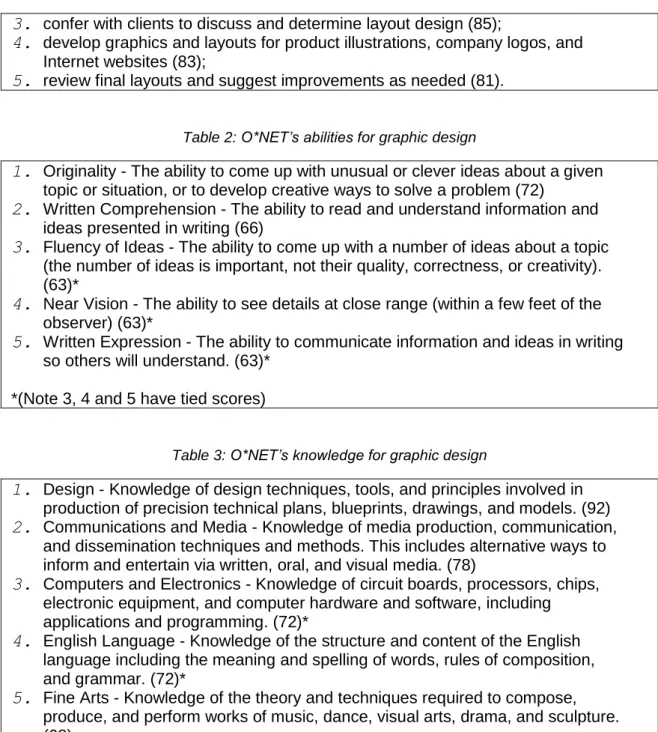
Table 1: O*NET’s occupation-specific tasks for graphic design ... 53
Table 2: O*NET’s abilities for graphic design ... 54
Table 3: O*NET’s knowledge for graphic design ... 54
Table 4: O*NET’s skills for graphic design ... 54
Table 5: CCS’s Create Visual Designs performance criteria ... 56
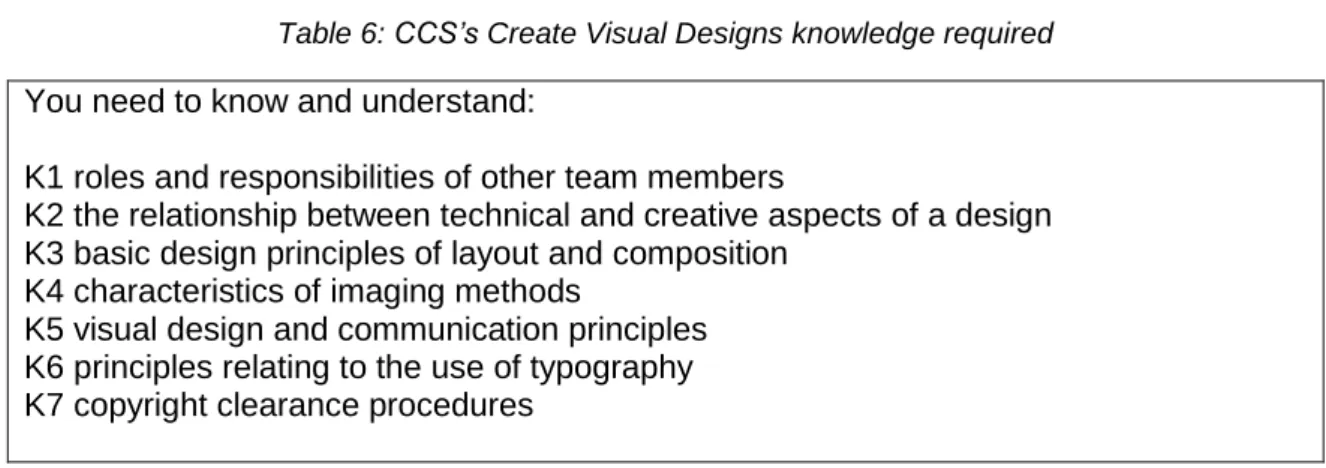
Table 6: CCS’s Create Visual Designs knowledge required ... 57
Table 7: BTEC Specialist, Graphic Design unit options ... 57
Table 8: BTEC Higher Nationals (Graphic Design) Core Units ... 58
Table 9: BTEC Higher Nationals (Graphic Design) learning outcomes ... 59
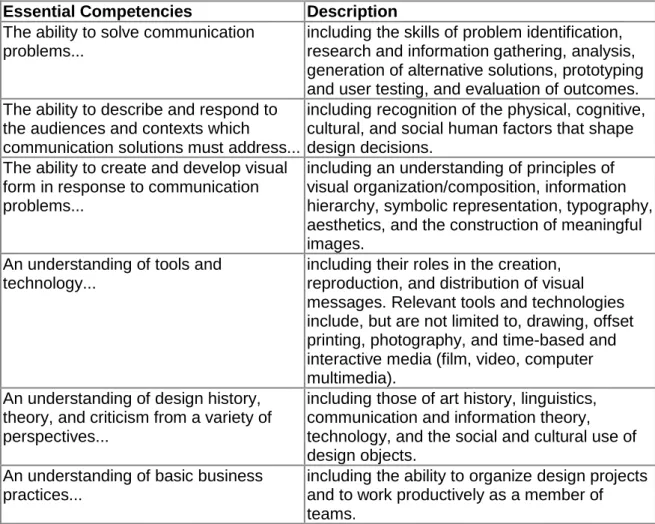
Table 10: NASAD essential competencies for graphic design ... 60
Table 11: CHC theory ... 98
Table 12: BTEC Specialist units not included in study 2 ... 108
Table 13: BTEC Specialist units, and learning outcomes, included in study 2 ... 108
Table 14: Mapping of CHC to O*NET ... 110
Table 15: O*NET Core Tasks cross-referenced to abilities ... 112
Table 16: NASAD essential competencies cross referenced to abilities ... 112
Table 17: BTEC Specialist cross-referenced to abilities ... 113
Table 18: BTEC HN’s cross-referenced to abilities ... 114
Table 19: Comparison of abilities across each model ... 115
Table 20: Wording of a CAT task given to participants ... 140
Table 21: Wording for WWM task given to participants ... 141
Table 22: Instructions give to judges ... 141
Table 23: Rating sheet provided to judges ... 142
Table 24: T-shirt instructions given to judges ... 149
Table 25: Instructions for judges ... 169
Table 26: Comparison of instructions with Kaufman et al. ... 170
Table 27: Comparison of instructions with Baer ... 171
Table 28: Counterbalanced tasks and instructions ... 182
Table 29: Randomisation of judges into groups ... 183
Table 30: Collation of judges rating for alpha calculations ... 183
Table 31: Random allocation of judges into counterbalanced conditions ... 224
Table 32: Descriptive statistics for calculating Z-skew of Image Task ... 228
Table 33: Descriptive statistics for calculating Z-skew of Type Task ... 229
Table 34: Descriptive statistics for calculating Z-skew for visualisation measures ... 229
Table 35: Descriptive statistics for calculating Z-skew of written comprehension measures ... 230
Table 36: Descriptive statistics for calculating Z-skew of general intelligence scores ... 232
Table 37: Guidance on the strength of relationship associated with Pearson's r. ... 232
Table 38: Correlations for the Image Task ... 233
Table 39: Correlations for the Type Task ... 234
Table 40: PCA of Type Task ... 234
Skills for Creativity in Graphic Design 10
Table 42: PCA of Image Task ... 236
Table 43: Image Task PCA component matrix ... 236
Table 44: Correlations between total creativity and visualisation measures ... 237
Table 45: Correlations controlled for general intelligence ... 238
Table 46: Correlations between Type Task and visualisation measures ... 239
Table 47: Correlations controlled for general intelligence ... 239
Table 48: Correlations between Image Task and visualisation measures ... 240
Table 49: Correlations controlled for general intelligence ... 241
Table 50: Correlations between total creativity and written comprehension measures ... 242
Table 51: Correlations controlled for general intelligence ... 242
Table 52: Correlations between Type Task and written comprehension measures ... 243
Table 53: Correlations controlled for general intelligence ... 245
Table 54: Correlations between Image Task and written comprehension measures ... 245
Table 55: Correlations controlled for general intelligence ... 246
Table 56: Total creativity correlations for KBIT... 247
Table 57: Type Task correlations for KBIT ... 247
Table 58: Image Task correlation for KBIT ... 248
Table 59: Increase in alpha across study 4 and 5 ... 270
Skills for Creativity in Graphic Design 11
Acknowledgments
This research has been supported by several academics at the Open University and the University of Central Lancashire, family and friends. Specifically, I would like to praise both of my supervisors, Dr Alison Green and Dr Theodore Zamenopoulous, who have been a constant source of encouragement, insight, and offered me everything I could have hoped for through a PhD, and so much more. At UCLan, my thanks to Andrew Bainbridge for access to his classes, and discussion of creative tasks for graphic design (both of which were essential to the development of this research). Prof. Lubaina Himid, for supporting all those practical needs (like funding for resources, and attendance at international conferences) and the many intangible aspects of research mentorship that have helped me grow. I am also indebted to Prof. Linden Ball, whose support for my research has been a constant source of encouragement. My thanks to all the participants of each study; for reasons of anonymity you remain unknown here, but you know who you are, and you have my heartfelt thanks; without your support, none of this research would have been possible. Lastly, all of my love to my wife Sue Jeffries, I would not be the person I am today, let alone have been capable of this research, without her by my side.
Skills for Creativity in Graphic Design 12
Chapter 1: Introduction
This thesis is about exploring further the relationship between skills, creativity and domain. It is about identifying those skills that a domain considers crucial for competent
performance, and testing their relationship (if any) to creative output within a domain. The
domain in question is graphic design. The aim is to test the core research question: To
what extent are domain competencies correlated with creative output in graphic design?
Such a purpose belies complexity and detail, but above this level of scrutiny are broader themes that establish why this question is important. For example, each generation of creativity researchers explores the nature of creativity. In recent decades a key theme has been creativity as a domain-specific or domain-general ability; this thesis contributes further evidence to this theoretical debate through empirical study. Additionally, the interaction between higher education and the development of professional competencies is a topical discussion within academia, industry and government. Creativity, for example, has been described as a core competency for industry (Berland, 2012), or in the context of design and design professions “a key aspect” (Cross, 2006, p12). For other
researchers, skills that underpin mental visualisation are important to professional competency and “a crucial part of creative problem solving in the design process” (Bennett, 2015, p321). In relation to competencies and creativity, likewise, this thesis contributes new evidence through empirical study.
In this chapter, to introduce these issues further, the theoretical, educational, and economic context are presented, followed by outlining the overall thesis structure and a summary of each chapter.
Skills for Creativity in Graphic Design 13
1.1 The Theoretical Context of this Research
This thesis is situated within an evolving topic of design creativity. It builds on an emerging
field that interfaces between creativity research, which has often occurred in the field of
psychology, and design research often associated with the fields of engineering, art and
design.
The development of the American Psychological Association's (APA) Division 10 (Society for the Psychology of Aesthetics, Creativity, and the Arts), for example, is of particular interest. Division 10 was specifically designed as an interdisciplinary section of the APA, focusing on the nexus between psychology and the creative arts. As an area of research, this has seen considerable academic growth in recent years. The Division's journal, Psychology of Aesthetics, Creativity, and the Arts (PACA), had substantial improvement in its impact factor rating in 2014 (3.054, an increase from 1.787). Its standing within general psychology/experimental journals ranked 17 out of 85 journals (up from 41) (P. P. L Tinio, personal communication to Division 10 members, June 19, 2015) highlighting the
increased attention and quality of scholarship that this area of research has attracted.
Equally, much like the history of APA's Division 10, many design researchers and eminent design journals have had a longstanding interest in creativity. The Creativity and Cognition Conference series founded by Ernest Edmonds and Linda Candy in 1993; John Gero’s organisation of the Computational and Cognitive Models of Creative Design Conferences from 1989 onwards; the Design Society’s first International Conference
on Design Creativity (ICDC) in Japan during 2010, with subsequent conferences in the UK, 2012, India, 2015, and the United States, 2016, are all examples.
One question frequently explored has been that of whether or not domain influences
Skills for Creativity in Graphic Design 14
2004). While this type of enquiry could appear purely theoretical, the implications have potential to be significant for creativity training and education.
For example, Baer’s 1991 study highlighted that creativity training that increased creativity in poetry did not enable participants to transfer this to short story writing (Baer, 1991, 1993); yet both of these areas would be categorised more broadly under creative writing. The evidence suggested that insights from creativity training did not transfer between domains, even for domains one might consider to be closely associated with each other. The inference was that if creativity is notably influenced by domain knowledge, this could explain why some training programs are more effective than others (Scott, Leritz, & Mumford, 2004); it might also see a theoretical basis for creativity training that exclusively focuses on generic content undermined (Baer, 1998). Such statements were clearly problematic due to much creativity training, historically, been based on domain free, generic content. Moreover, as will be discussed in section 2.3 (Defining Skills) the issue of what precisely constitutes a skill can be confused; especially when researchers and commentators blend their definition of skills with other constructs like knowledge, abilities, talents, and so forth.
Given this, theoretical underpinnings are not without controversy (Plucker, 1998; Han & Marvin, 2002; Plucker et al., 2004; Silvia, Kaufman, & Pretz, 2009; Reiter-Palmon, Illies, Cross, Buboltz, & Nimps, 2009, Baer, 2012) and, at the extremes, two schools of thought have evolved regarding the extent scholars consider creativity to be either domain-specific or domain-general (Han, 2003). In chapter 2, section 2.2, both schools of thought will be described in detail, in addition to the perspective that creativity requires both domain-specific and domain-general competencies (such as divergent thinking) at the same time.
Skills for Creativity in Graphic Design 15
This thesis, focused on domain, skills and creativity, partly stems from the debate on the domain-specificity or generality of creativity. Ivcevic (2009) made the case that next generation creativity theory needed to be established on a better understanding of domain-specificity, how it differs from domain-generality, and that more detailed research was necessary to achieve this. By focused empirical study on the relationship between graphic design creativity and graphic design competencies, the intention is to add to this debate, and the understanding of domain specificity.
Whilst one aspect of academia has been concerned with theoretical implications, debate over the domain-specificity versus domain-generality of creativity also mirrors a dichotomy seen in tensions between the needs of academia and the needs of industry; between those who advocate the need for graduates with more domain-specific skills versus those who highlight the importance of a broader set of conceptual abilities and knowledge. This tension is none the more present than in the example of higher education for the Creative Industries.
1.2 The Educational Context of this Research
The "Creative Industries", a term that began in the 1990's (Bendassolli, P. F., Wood, Kirschbaum & Cunha, 2009), and one closely aligned to the politics of New Labour (Guile, 2010) in the United Kingdom (UK), became a constant theme for government policy in the UK from 1997 (Crossick, 2006), with many initiatives undertaken to support this sector's
growth. For example, the Design Skills Advisory Panel’s 2007 report Higher Skills for
Higher Value for the Design Council and Creative & Cultural Skills (Design Skills Advisory
Panel, 2007), or Creativity and Culture: The next ten years from the Department of
Skills for Creativity in Graphic Design 16
While the precise definition is contested, creativity is one core characteristic described as an essential dimension of the Creative Industries, and central to its definition. In 2001 (based on earlier research) the Department for Culture, Media and Sport (DCMS) defined the Creative Industries as, “industries which have their origin in individual creativity, skill and talent and which have a potential for wealth and job creation through the generation and exploitation of intellectual property” (DCMS, 2001a, p.5).
Under this definition they identify 13 sectors to be included: “advertising, architecture, the art and antiques market, crafts, design, designer fashion, film and video, interactive leisure software, music, the performing arts, publishing, software and computer services, television and radio” (DCMS, 2001a, p.5).
Which sectors to include, and which to exclude, was acknowledged as a challenge from the outset, and indeed, eminent members of the scientific community, such as Harry Kroto, found the exclusion of fields like nanotechnology from being considered a creative industry to be conceptually flawed. Without negating the validity of this criticism, the DCMS mapping of the creative industries enabled a strategic focus to be placed on statistical data collection which was used to inform government policy.
In the intervening years from 1998, the DCMS has engaged stakeholders (from the Office for National Statistics (ONS) to the National Endowment for Science, Technology and the Arts (Nesta), and the sector skills councils, Creative Skillset and Creative and Cultural Skills), with the aim to revise the definition and how statistics are collected. Through doing so, the current DCMS definition of the Creative Industries has moved towards occupations considered to be creative. The proportion of those occupations within an industry (which they describe as creative intensity) above a specified threshold (30%) being the basis for
Skills for Creativity in Graphic Design 17
inclusion as a part of the Creative Industries (DCMS, 2016a). Currently, the Creative Industries are as follows:
Advertising and marketing
Architecture
Crafts
Design: product, graphic and fashion design
Film, TV, video, radio and photography
IT, software and computer services
Publishing
Museums, galleries and libraries
Music, performing and visual arts
1.2.1 Higher Education for the Creative Industries
Much of the education required to enter the Creative Industries in the UK has occurred via higher education. Around 73% of those employed in 2008 had achieved a minimum of an undergraduate degree qualification (Skillset, 2009), which was considerably more than the UK national average, and for specific sectors like computer games, and animation, this figure rose to 80%, and 92% respectively. Furthermore, this data suggests that over half of the undergraduate and postgraduate qualifications gained were in subjects related to the specific sector in which graduates found work. In this regard, graduates with
qualifications closely aligned to their job roles form a considerable part of the Creative Industries.
However, the suitability of these graduates for employment within the Creative Industries has been questioned and, to this end, the type of content covered by their academic qualifications suggested as a cause for concern. Perhaps the clearest example of this within the Creative Industries can be seen in computer games.
For example, Creative Skillset (previously known as Skillset: The Sector Skills Council for the Audio and Visual industries) followed this theme within their undergraduate course accreditation guidelines for computer games. They highlighted that the increased number
Skills for Creativity in Graphic Design 18
of higher education games related courses in the UK had resulted in "concern being voiced by employers in the computer games industry that graduates from these courses do not have the requisite skills to sufficient level to meet the needs of the industry"
(Skillset, 2008, p.3), and that accreditation of provision is seen as the best means to
rectify this situation. David Braben, the campaign spokesman for Games Up? (a campaign group, sponsored by some of the UK's largest games development studios and trade bodies, to raise the profile of the games industry in Parliament and the media), was quoted as saying "....95% of video gaming degrees are simply not fit for purpose. Without some sort of common standard, like Skillset accreditation, these degrees are a waste of time for all concerned", (Lipsett, 2008, ¶ 14).
To date, such concerns remain, have grown, and are not specific to computer games or the Creative Industries. A 2015 skills survey by the Institution for Engineering and Technology (IET) found that:
Some 53% employers say that a typical new recruit does not meet their 'reasonable expectations' – and year-on-year data shows that employers are growing more and more concerned that recruits do not meet their expectations. Nearly two-thirds report that graduates are the biggest challenge and a similar percentage is concerned that the education system will struggle to keep up with the skills required for
technological change. (p. 4).
In addition, HM Treasury's July 2015 report Fixing the Foundations predicted that the UK will fall into 28th place out of 33 OECD countries by 2020 (The Organization for Economic Co-operation and Development), behind countries such as France, Germany, United States, Canada and Australia, if it continues to "performs poorly on intermediate
Skills for Creativity in Graphic Design 19
same for some time: the need to put "employers in the driving seat" (p.23) with regard to technical and professional qualifications. Echoing the views of Dinah Caine (at the time, Chief Executive of Skillset, now Chair of Creative Skillset's Board of Directors) from over a decade earlier (2004a).
In contrast, for academics within Art, Design and Media, greater emphasis being placed on industry's opinion of curriculum content (for example, through Sector Skills Council advisory groups) was a significant concern (Wall et al., 2006). For some, industry led direction, was an attempt to standardise curriculums in Higher Education, and
symptomatic of a "mindset" (p.139) that believes UK Art, Design and Media education to be defective, and unable to meet the needs of employers (Macdonald, 2006).
Professor Geoffrey Crossick, (Warden of Goldsmiths, University of London), in his speech to the Royal Society of Arts, highlighted that it was "….important not to assume that employers automatically know best what education their future employees need" (p.12), and that a university education should be about "….developing people not just with the skills to meet today's needs but also the conceptual abilities and imagination to take risks that will generate what is needed in the future" (Crossick, 2006, p.12).
For other commentators, the debate had been less about who controls the curriculum and standards, and more about industry engaging with higher education. The Council for Industry and Higher Education (CIHE) for example published 'The Fuse: Igniting High Growth for Creative, Digital and Information Technology Industries (CDIT) in the UK' (CIHE, 2010). Through the report, it raised a number of the issues around business:
Skills for Creativity in Graphic Design 20
industries….(for) employers to collaborate closely with the universities that supply them...(and) that industry bodies....should promote volunteer schemes through which professionals can work with students and help them develop the employability skills they need for the CDIT jobs market. (Colman Getty, 2010, p.3).
What each of the different examples above suggest, as a generalization, are contrasting emphases on the relationship of creativity and skills with domain competency: where higher education has focused on creativity as a means to deal with an unpredictable future, industry has focused on the identifiable skill needs of today in order to maintain a competitive advantage now.
Yet, it is unclear whether taking a domain-specific, domain-general, or hybrid approach is most useful. Indeed, the acquisition of domain-specific "skills" may well be the best mechanism to enhance creativity. Equally, focusing on domain-general "conceptual abilities" could be the more fruitful. Alternatively, exploring a combination of these may the better direction to pursue. From a theoretical and an empirical perspective, organisations and individuals do not know, though strong opinions and convictions (as suggested above) are expressed on either side of this debate.
This thesis does not directly address how creativity can be taught, but it does aim to test (via empirical study) a number of perspectives which underpin the debates above: perspectives about the relationship between creativity and skills; perspectives that shape (knowingly or not) the type of pedagogy and curriculum within design higher education.
Skills for Creativity in Graphic Design 21
1.3 The Economic Context of this Research
Creativity has often been described, and prescribed, as a: means to economic growth; core attribute for employment; key goal of higher education (HM Treasury, 2005; DCMS, 2001b; Universities UK, 2010).
Though inherently linked, the value of theoretical perspectives on creativity and the practicalities of educating for creativity can be a means to an end, the goal being
economic. By its nature, such a perspective tends to be voiced by those who have a direct interest in economic matters (governments, business leaders, academics, commentators, and so forth) and at a variety of vantages: from global through to nation states.
For example, business leaders such as Edward de Bono and his book Serious Creativity (1992); Tom Peter's Re-imagine (2003); or Richard Florida's The Rise of the Creative Class (2002), and other best sellers, like Ridderstrale & Nordstrom's Karaoke Capitalism (2004), have each emphasized the value of creativity within a global economic context. DeBono sums up the argument:
Cost-cutting, downsizing and quality have run their course. The great need now is for new ideas....what happens when you have a lean and competent organization? What is this lean and competent organization going to do? What happens when your competitors are just as lean and competent as you and your cost-effectiveness is no longer a unique advantage? The more able senior executives know that creativity is now the main hope (de Bono, 1996, Introduction, para. 10).
Politicians too place emphasis on the value of turning bright ideas into businesses, which are "vital for our long-term growth" (Cable & Pickles, 2010, para. 7). Equally, many creativity research papers introduce the value of their research within the context of
Skills for Creativity in Graphic Design 22
economic growth, and in this respect, this part of the thesis follows a well-worn path. Unfortunately, such arguments to longstanding advocates of creativity risk being blasé, possibly rote. Despite 20 years later (a global financial crisis of 2008, and the ongoing exponential growth of digitisation) are de Bono's rhetorical questions to senior executives above any less valid today than back then?
For a new generation of commentators, creativity is a less well-worn buzz word: one positively associated with innovation and discussed alongside science and engineering (Climer, 2016). Yet, creativity can remain exotic or quirky, as expressed through the stereotyped student of Art and Design. Partly this is because the culture of Schools of Art and Design occupies a unique place in academia and university life; neither fitting easily within vocational training nor purely theoretical. It is an education to prepare students for professional creative practice, and at the same time create a space to question the directions and future of that creative practice, and its cultural value. It is for this reason that in the UK, higher education for creativity is esteemed throughout the world, and supports a creative industry that has continued to outgrow the UK economy year on year. Far from quirky, that is a remarkable economic success.
For example, the UK government’s 2016 report (DCMS, 2016b) on economic estimates for the Creative Industries highlighted that the Gross Value Added (GVA) by the Creative Industries increased by 6.0 percent each year between 1997 and 2014. A statistic that, compared to the UK a whole, was evidence of the Creative Industries consistently outperforming the UK economy. The report also identified the Creative Industries as accounting for £84bn of GVA -equivalent to around 5 percent of the UK economy. For particular areas of the Creative Industries, growth has been considerably stronger, for example, graphic design had the largest increase in GVA between 2013 and 2014, that of
Skills for Creativity in Graphic Design 23
nearly 17 percent.
Additionally, Nesta (prior to 2010, NESTA: the National Endowment for Science, Technology and the Arts) undertook a comparative analysis of employment within the Creative Industries across member states of the European Union (EU). The key findings (Nathan, Pratt & Rincon-Azner, 2015) highlighted that relative to the EU as a whole, the Creative Industries accounted for 7.58 per cent of employment in the UK compared to 5.21 per cent in the EU, during the period 2011-2013. Regarding the workforce within the Creative Industries, the UK was second only to Germany (3.14 million creative economy workers, compared to 2.94 in the UK). Such findings present higher figures than in previous studies, but the authors account for this through improvements in datasets and more precise classification of creative occupations and industries. The headline-grabbing statement is that the “UK accounts for a fifth of EU’s creative industry jobs" (Nesta, 2015). In this context, for economic reasons alone much is required of creativity in relation to academia and industry, and is at stake.
Skills for Creativity in Graphic Design 24
1.4 Outline of Thesis Structure and Chapters
Whether considered in isolation (regarding the development of creativity theory, design education, or economic productivity) or as a synergistic whole, the focus of this thesis on skill, creativity and domain have remained timely throughout its duration. Taking place over six years, the structure of this thesis is defined by five interconnected research studies, presented through nine chapters. Each study builds on the insights and findings
of its predecessors, towards the overarching purpose to test: To what extent are domain
competencies correlated with creative output in graphic design?
Chapter 2 considers literature on how skills, creativity and domain are defined, and in the ways each core term might interact with the others. With definitions and relationships established it considers what methods are appropriate to operationalise these constructs.
Chapter 3 refines the literature review focus with a detailed examination of the Consensual Assessment Technique (CAT). This is presented through the findings of
Study 1, and the first systematic literature review on the use of the CAT in design research.
Chapter 4: builds upon the challenges of how to prioritise, for research purposes, the
skills, knowledge and abilities suggested as important for graphic design. Through Study
2 it presents a conceptual framework for mapping previous models of graphic design
competencies.
Chapter 5: begins to explore the adaption of previous CAT practice, and test the assumptions that the CAT would be a reliable method of assessing graphic design
creativity. Study 3 considers what constitutes a valid and reliable task (or design brief) to
Skills for Creativity in Graphic Design 25
sensitive to research protocols than had been anticipated. This initial exploration in Study
3 set a key theme around CAT protocols and became a focus for Study 4 and Study 5.
Chapter 6: extends the findings of Study 3 through re-examining the challenges the CAT appears to have as a method of graphic design creativity assessment. Specifically, it explores how the CAT needs to be optimised for this purpose, and tests adjustments to
CAT protocol through Study 4.
Chapter 7: combines all the previous knowledge gained, and in Study 5, the final study, addresses the overarching research aim of testing the relationship between graphic design competencies and creativity.
Chapter 8: Is a critical discussion of all preceding chapters, and consider the novelty, merits and limitations of the thesis as a whole, and directions for future research.
Chapter 9: Concludes with a summary of the main findings. A summary of key empirical findings related to graphic design creativity assessment and outline of adjustments to CAT protocol throughout the thesis was as follows:
Skills for Creativity in Graphic Design 26
Study 3 Study 4 Study 5
Task Task 1 Task 2 Task 1 Task 3 Task 1 Task 3
Artwork Prior work Prior work: Pre-selected New/Live study
Participants Novices Intermediates Experts Intermediates Novices Intermediates Experts Judges 5 Novices (Task 1) 5 Experts (Task 1) 8 Experts (Task 2) 16 Experts 8 Experts Instructions to Judges Creativity Creativity Creativity Only Creativity Only (verbal re-emphasis) Technical Execution Aesthetic Appeal Rating Sheet Check List Paper Based4 PowerPoint4
Paper Based Paper Based
Consensus on Creativity Task 1: 81%: Creativity1,2 (Novices Judges) 69%: Creativity1,2 (Expert judges) Task 2: 56%: Creativity3 (Expert Judges) Task 1: 73%: Creativity5 82%: Creativity Only6 Task 3: 75%: Creativity5 80%: Creativity Only6 Task 1: 92%: Creativity Only7,8 88%: Technical9 88%: Aesthetic9 Task 3 81%: Creativity Only7,8 70%: Technical9 75%: Aesthetic9
1. Is Task 1 a reliable measure of graphic design creativity for both expert and novice judges? 2. For Task 1 how do novice judges’ ratings of creativity compare with expert judges’ ratings? 3. Is Task 2 a reliable measure of graphic design creativity for expert judges?
4. Can rating sheet design reinforce instructions to use the whole rating scale for Task 2? 5. Can expert judges achieve consensus at or above 70% for Task 1 and Task 3? 6. Do Creativity Only instructions increase consensus on Task 1 and Task 3
7. Without pre-selection of artwork are Task 1 and Task 3 reliable measures of graphic design creativity? 8. To what extent are Task 1 and Task 3 correlated with each other?
9. To what extent are technical execution and aesthetic appeal correlated with graphic design creativity?
Key empirical findings/paraphrased research questions and the interrelationship to CAT protocols during Study 3, 4 and 5
Skills for Creativity in Graphic Design 27
Chapter 2: Definitions and Relationships Between Domain, Skills
and Creativity
2.1 Introduction to Chapter 2
In this chapter, each of the key terms (domain, skill and creativity) will be explored. The first focus will be on defining these terms, and what methods are available to identify them: for example if creativity is defined as a creative output, then what methods are established on which to assess creative output?
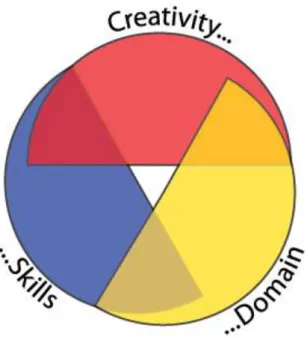
The second focus will be on the relationships between these key terms; for this purpose, a Venn-like diagram is proposed as a way to manage the complexity of these relationships and offer a means to map the research literature. The diagram (Figure 1) highlights that the key relationships to be explored will be as follows, between creativity and domain; domain and skill; skill & creativity.
Skills for Creativity in Graphic Design 28
At the core of this diagram is where research on skills, creativity and domain overlap. Through initially separating these relationships, it is hoped that the nuances and later analysis of works that fuse these three terms together will be clearer to understand for the reader. The purpose is to place the thesis within a broad research context and to give the background required for certain research designs and methods to be discussed
throughout the thesis. A useful point of departure is first to define, and identify, what is meant by domain.
2.2 Defining Domain
Creativity occurs when a person, using the symbols of a given domain such as
music, engineering, business, or mathematics, has a new idea or sees a new
pattern, and when this novelty is selected by the appropriate field for inclusion into
the relevant domain. (Csikszentmihalyi, 1996, p.28).
The quote above highlights that for some researchers, the notion of a domain is directly related to identifying creativity. Equally, other factors are inferred: knowledge, skill, expertise. For Csikszentmihalyi (1999) an individual's creative contribution is only one element within a system made up of the domain, the field, and the individual. Within each domain is a body of tacit and explicit knowledge, and it is this knowledge that becomes the reference point for the criteria of newness and originality. The field refers to people responsible for a domain: educators, practitioners, professional organisations, critics, researchers, historians, and so forth. Lastly, the individual: the actual person (or persons) who creates the output. Csikszentmihalyi (1996) considers the intersection of domain, field, and individual to profoundly influence identifying creativity. Indeed, in this systems view of creativity, it is the field that confers the title "creative." As shall be discussed, such theories are highly controversial (Runco, 1999; Nickerson, 1999). However, whether or
Skills for Creativity in Graphic Design 29
not researchers subscribe to social recognition being fundamental to identifying creative output, creative output often does occur within or aims to break away from established domains. Thus, it is important to understand more specifically what is meant by domain.
2.2.1 Definitions of Domain
In this regard, research offers a broad spectrum of what is meant by domain. This can extend from what has been described as domains of mind (Feist, 2004) through to specific occupational roles within established industries (Skillset, 2003), and for some researchers, this culminates at the level of microdomains: poetry writing, short story writing, etc. (Baer, 1998).
2.2.2 Domains of Mind
Theories based on domains of mind (Feist, 2004) propose that distinct conceptual domains exist which have evolved from our survival needs. Broadly, these domains map to core areas of the sciences (psychology, physics, biology), arts (linguistics, music, aesthetics), and mathematics (numerical). The inclusion of such domains is argued to be justified by, among other evidence, research from archaeological, genetic, and
psychological studies.
2.2.3 Occupational Roles
Other researchers consider the concept of a domain as shorthand for describing any craft, discipline, art, sport, or occupation (Gardner, 2006). This broad definition of domain is interesting as this closely aligns itself with a significant body of work related to National Occupation Standards and the work, in the UK, of the Sector Skills Councils. Creative Skillset, for example, in addition to developing National Occupational Standards, also offers job profiles for the audio-visual industries (Skillset, 2005; Skillset, 2004b), and these
Skills for Creativity in Graphic Design 30
give a framework within which to consider an occupational taxonomy for specific domains. Indeed, such documents clearly highlight the breadth and complexity of the audio-visual industry through an extensive A to Z of job roles from first assistant director to wardrobe master/mistress.
2.2.4 Microdomains
More detailed and highly specific definitions of domain are present in the concept of microdomains (Baer, 1998) and work where domain and specific task undertaking begin to merge (Baer, 1993). As mentioned earlier, this research considers creativity at the level, for example, of short story writing rather than the wider domain of creative writing.
2.2.5 Which Definition to Use?
The implication arising from this breadth of definitions of domain is which definitions of domain to use: domains of mind (the visual arts); broad occupational domains (audio-visual industry); related occupational domains (types of film directors); single occupation roles (director for corporate film); or, at the level of specific tasks (for example, when a film director develops initial ideas for a film). Baer (1998) would argue that in the absence of a conclusive answer to this question, it is wise to side with defining domain at a fairly
specific level. The rationale for this is interwoven with the debate regarding whether creativity is domain-specific or domain-general. However, if such an argument implies that domain is defined at the level of specific tasks, as aspects of Baer's (1993) research have previously, then this presents significant operational challenges for creativity research: these are studies at an extremely detailed level.
2.2.6 Related Occupations
Skills for Creativity in Graphic Design 31
specific a level and advocated defining domain at the level of related occupations (for example, directors for film, video, television), but proceeding with caution. It would seem prudent that those researching related occupational domains be aware that their findings may be biased towards generalisation. However, the benefits of such work could give further insight into the domain-generality/specificity of creativity. Indeed, this type of approach may be able to identify consistent themes across occupational domains or conversely, show that even within related occupational domains little consensus exists, implying the need for single occupation or task specific studies.
2.2.7 Single Occupations
A key finding from this study of the audio-visual industry (film, television, etc.) was that the inclusion of related occupations was problematic for some domains, and not for others (Jeffries, 2007b). The explanation given was that the occupational domains which formed the visualiser group were too diverse, particularly in comparison to the director and sound group. While participants in the visualiser group could identify themselves as an artist, art director, standby art director, or graphic designer, their involvement in specialist areas within these single occupational was possible. For example, art directors may specialise in one area or work across several: static, moving, two-dimensional, or three-dimensional image.
2.2.8 Domain Identity of Participants: Designer or Artist
As a result of this complexity, subsequent studies have defined domain as the level of a single occupation (such as a games designer). Even at this level, however, taxonomies emerge between participants who work as games designers but would consider
themselves games artists (Jeffries, 2011; Jeffries, 2009). Indeed, as previous research has highlighted (Gluck, Ernst, & Unger, 2002), such domain identities may be substantial,
Skills for Creativity in Graphic Design 32
and be suggestive of the distinction between free artists (e.g. painters) and artists in more constrained professions (e.g. designers); who have different perspectives on creativity. With games design, however, it appears that at this level of taxonomy (games designer relative to games artist) a mixed group can achieve consensus. (Though a caveat to consider is that while the group was mixed the focus of the research remained about a single occupation and domain: games designer and games design).
2.2.9 Definition of Domain in this Study
As such, sampling considerations are likely to be present in a study on graphic design. Some graphic designers may consider themselves graphic artists; others may prefer the term visual communicator; it is also possible that typographer could be a term some experts in graphic designers would prefer. Thus, the position taken in this study is to define domain at the level of a single occupation (graphic designer) and to control the sampling to include experts who identify themselves with this domain (but who may describe themselves as a graphic artist, visual communicator).
A further consideration in relation to domain is how much time a person spends in their occupation, for example, do they work part-time, or full-time; indeed, the self-employed nature of particular professions can mean full-time work is intermittent. As the previous study on the audio-visual industry highlighted, some freelancers use the time between film projects for employment within other areas of the audio-visual industry, and some use the time to pursue their personal artistic interests. How participants use this time between projects may influence their values about creative output. Whilst, it could be argued that intermittent full-time work is a particular feature of the film industry, the point of divided interests could equally apply to part-time work in many other professions. It is anecdotal, but not uncommon to find individuals with loyalties to a particular domain (be it acting or
Skills for Creativity in Graphic Design 33
music, as examples) working to "pay the bills" through work within another domain. To account for this, experts will be sampled from graphic designers working on a full-time basis.
A final point to consider is why choose graphic design, why not games design or film direction as the previous studies above?
Within the Creative Industries graphic design links across many sectors: be it the need for marketing material; a new logo for an organisation; the presentation of scientific
information, or the development of a new product. Graphic design will play a part: sometimes in the background, at other times centre stage.
Established within traditional print media alongside the development of the Digital Creative Industries, the roots of graphic design, arguably, do not first begin in the 20th century.
Visual communication: turning words into icons, or using images to say a thousand words
is ancient. Like many established professions its boundaries blur and change, and the line between graphic design, illustration, advertising or copywriting is debatable and in flux (we could add other domains to this list: typography, printing, web design, photography,
animation, packaging, let alone new technologies searching to establish an identity).
Yet, within this flux, graphic design exists and is global. Throughout the world, universities, colleges and private companies run graphic design courses; their students' gain
qualifications that enable them to work for design agencies or set up their own business, and they in turn work for clients who require graphic design to appeal to their audience and customers. In this context, creativity is an asset and gives clients, design agencies, and individual graphic designers an edge in a competitive market. Whilst not all clients
Skills for Creativity in Graphic Design 34
and educational opportunities give scope for graphic design creativity, many do.
Moreover, the type of creativity required for graphic design can, depending on the task, still be the achievement of a single designer. In terms of empirically testing the
relationship between skills and creativity, this has a number of advantages for research design. This is not to discount the role graphic designers play within multidisciplinary design team, nor to infer that graphic designers need to work as a silo, nor to underplay the value of research related to team creativity; it is to state that compared to the
complexity of domains involved in the production of a digital game or film, graphic design (at the outset of this research study) appears to offer the opportunity to control the social interactions involved in the creation of a final design without undermining the "real world" relevance of the creativity being studied.
2.3 Defining Skills
Within various literature, it can be fraught to isolate skills from domain when considering creativity. For example, building upon Amabile's componential model of creativity
(Amabile, 1983), domain relevant skills have been described as the skills, knowledge, or talents required for competent performance within a domain (Conti, Coon, & Amabile, 1996). Amabile, in other works, gives the example of when a composer creating a new musical composition is able to hear the sound of the instruments playing together in his or her imagination (Amabile, 1996); such a "talent" may be crucial to music composition or trivial, "...only future research can indicate...which elements are indeed essential" (p. 85).
2.3.1 Conflated Usage
What is immediate, in both these examples, is that the term "skills" is conflated with "knowledge" and "talents": such conflation is not an isolated occurrence. Indeed, as
Skills for Creativity in Graphic Design 35
competency is also interwoven within such discussions, it is fairly common to find knowledge, skills, abilities, beliefs, values and interests being presented as synonyms within other works in this area (Fleishman, Costanza, & Marshall-Mies, 1999).
Moreover, organisations, such as the Council for Industry and Higher Education, write about the need for "Hybrid skills", of which creativity, along with technical, business, and interpersonal are presented as clarifications for this term (CIHE, 2010). A similar theme can be found in other works. The Design Skills Advisory Panel (Design Skills Advisory Panel, 2007) discussed the crucial value of "High-level skills" in design, stating that:
If the UK is to increase its capacity for innovation, then it needs an education system that is able to develop foundation-level analytical and problem-solving skills, plus creativity, imagination, resourcefulness and flexibility. These are the skills that design education can provide for everyone. (p.31).
Levy and Hopkins (2010), continue with the focus on high-level skills (occasionally described as "Higher Level Skills") and define that: "….the notion of high level skills is a broad concept reflecting an individual's ability to use tacit knowledge to assimilate and interpret information" (p.32).
Clearly, nomenclature and taxonomy of terminology changes depending on which literature is cited: some describe skills along the lines of abilities; others with knowledge (either explicit or tacit knowledge), talents, or creativity itself. It is beyond the scope of this review to do justice to the breadth, complexities, and contradictions regarding the usage of the term skills. The purpose of this section is to define skills in a manner that is relevant to this study and, in doing so, explain the rationale for why some areas of research
Skills for Creativity in Graphic Design 36
literature have been favoured over others.
2.3.2 Talent and Giftedness
Talent, for example, has been defined as "a constellation of inherited skills that make a person especially suited to excel in a specific domain" (Weisberg, 2006, section
Scepticisms about Expertise and Creativity, para. 1). Of particular interest here is the notion of inherited skills, as a controversy with research on talent surrounds whether or not talent is innate. A similar issue needs to be considered for research within the area of giftedness. In addition, researchers have also highlighted that the field of giftedness still needs to form its own definitions of what it means by giftedness, and as such continues to be disparate and complex at the present time (Dai, Swanson, & Cheng, 2011). For these reasons, research on talent and giftedness has been limited in this review, though clearly, they have much to offer our understanding of creativity and domain.
2.3.3 Expertise
Research on expertise is a well-established field (Ericsson, Charness, Feltovich, & Hoffman, 2006), and has direct links with knowledge, skill and competency, in addition to creativity. Indeed, a number of seminal academics within creativity research also produce works on expertise. Such research has developed conceptual frameworks and definitions, and of particular interest to this study is work in the area of vocational psychology, and within this, job analysis.
In this respect, the work of Fleishman and colleagues(Fleishman, Costanza &
Marshall-Mies, 1999; Fleishman & Reilly, 1992) is of particular note, and specifically their development of the F-JAS (Fleishman Job Analysis Survey). It was the F-JAS that became the basis for aspects of the Occupational Information Network (O*NET) which
Skills for Creativity in Graphic Design 37
was developed to gather data on all jobs within the United States and to identify the types of competencies required for specific job roles (O*NET Online, 2016).
O*NET has been described as a comprehensive system that "incorporates the last 60 years of knowledge about the nature of jobs and work" (Peterson et al., 2001, p.451), and a key aspect of its development was to clarify common language on terms and a
hierarchical taxonomy with which to navigate from the broad to the specific. As a result, it draws a number of conceptual distinctions between, skill, knowledge, ability, tasks and competency.
2.3.4 Competency
As mentioned above, competency can be vague in usage, however, as a broad concept, it describes a level of performance in relation to a particular job: such performance ranging from effective to superior (Boyatzis, 2008). In this study, the term competency is used in its broadest usage; to denote an overarching concept under which skills, abilities and knowledge are related to effective performance in graphic design.
2.3.5 Abilities
Related to competency is ability. As a term, its precise conceptual definition has been debated in relation to whether it is a trait, something that can be applicable across a number of domains, or amenable to development (Fleishman, Costanza & Marshall-Mies, 1999). They would argue ability is a general trait, and as such remains present over time, whilst acknowledging that it is feasible to develop ability -though again this occurs over time. Furthermore, abilities tend to be underlying traits, and tend to form the basis on which skills can be developed. Thus, for this study, abilities are seen to mediate between
Skills for Creativity in Graphic Design 38
competency (at the broadest level) and skills (at more specific levels). However, abilities, like skills, can be categorised too broadly and therefore have little value for research purposes, or too narrowly and equally obscure the underlying abilities that are required. Via Fleishman's research on types of abilities, the O*NET content model identifies four core abilities: Cognitive, Psychomotor, Physical and Sensory, which cascade down to 52 lower-level abilities, such as written expression, finger dexterity, stamina and depth perception, for example.
2.3.6 Skills
Skills, in this respect, appear to be conceptually distinct from abilities (Peterson et al., 2001). Skills can be acquired quicker than abilities, and they are more amenable to improvement via direct training and education. How effective such skills training or education is, can be dependent on the type of abilities that may underpin a skill. As a general example, driving skills can be improved by training if requisite underpinning abilities are present: these may include abilities with spatial awareness, or hand to eye coordination, for example. O*NET's content model distinguishes between basic skills (that facilitate learning) cross-functional skills (that facilitate problem-solving across
occupations: for example, negotiation skills) and occupation-specific skills. In this respect, O*NET is similar to other areas of psychology which distinguish between
domain-dependent skills (for example, chess playing) and domain-indomain-dependent skills (for example, solving simple puzzle problems) (Green & Gilhooly, 1992; Gilhooly & Green, 1989).
2.3.7 Tasks
By highlighting the issue of domain-dependent skills and domain-independent skills, the terminology raises the issue of domain-specificity and domain-generality (as mentioned in the Introduction: theoretical controversies within creativity research, and pedagogic
Skills for Creativity in Graphic Design 39
concerns between academia and industry). Within O*NET's content model, tasks form a fundamental basis on which to consider the types of specific skills, abilities and knowledge required for a job, and by extension competency. It identifies occupational tasks via
subject experts' consensus on general work activities and essential tasks for their occupation. In this respect, O*NET's version 16.0 job analysis for a graphic designer highlights the top five core tasks of a graphic designer and does so in order of importance. These findings are discussed in detail in section 2.6.1 (O*NET Graphic Design) of this thesis.
2.3.8 Knowledge
Knowledge, in this model, is defined by (Costanza, Fleishman, & Marshall-Mies, 1999) as a "collection of discreet but related facts and information about a particular domain" with the caveat that how such information is "organised into some coherent structure is critical to the definition" (p71). Defining knowledge in this way appears to emphasise what could be termed explicit knowledge: facts and information that can be codified, written down, or put into words in some manner. In contrast, the discussion of tacit knowledge may appear absent from this perspective (Sternberg, 2006; Sternberg & Lubart, 1995). Indeed, from the work of Michael Polanyi (Polanyi, 1958) through to Harry Collins (Collins, 1985; Collins, 2010), discussion surrounding tacit knowledge is a complex area of philosophical debate; some philosophers argue that tacit knowledge is practical knowledge (know-how) but remains limited in how it can be transmitted through words (Thornton, 2012). For this study, knowledge can be explicit, tacit, and practical, it can also be specific to a domain, or apply more generally across domains. Moreover, the coherence of how this knowledge is structured is a consideration and may relate to links between creative output and whether knowledge is retained as conceptual abstractions and principles or coded as prescriptive facts and rules (Ward, Patterson, & Sifonis, 2004). As above, like tasks,