This is a repository copy of Changing behaviour: Increasing the effectiveness of workplace interventions in creating pro-environmental behaviour change.
White Rose Research Online URL for this paper: http://eprints.whiterose.ac.uk/92661/
Version: Accepted Version
Article:
Unsworth, KL, Dmitrieva, A and Adriasola, E (2013) Changing behaviour: Increasing the effectiveness of workplace interventions in creating pro-environmental behaviour change. Journal of Organizational Behavior, 34 (2). pp. 211-229. ISSN 0894-3796
https://doi.org/10.1002/job.1837
© 2012 John Wiley & Sons, Ltd. This is the peer reviewed version of the following article: Unsworth, K. L., Dmitrieva, A. and Adriasola, E. (2013), Changing behaviour: Increasing the effectiveness of workplace interventions in creating pro-environmental behaviour change. J. Organiz. Behav., 34: 211–229, which has been published in final form at
http://dx.doi.org/10.1002/job.1837. This article may be used for non-commercial purposes in accordance with Wiley Terms and Conditions for Self-Archiving. Uploaded in
accordance with the publisher's self-archiving policy.
[email protected] https://eprints.whiterose.ac.uk/
Reuse
Unless indicated otherwise, fulltext items are protected by copyright with all rights reserved. The copyright exception in section 29 of the Copyright, Designs and Patents Act 1988 allows the making of a single copy solely for the purpose of non-commercial research or private study within the limits of fair dealing. The publisher or other rights-holder may allow further reproduction and re-use of this version - refer to the White Rose Research Online record for this item. Where records identify the publisher as the copyright holder, users can verify any specific terms of use on the publisher’s website.
Takedown
If you consider content in White Rose Research Online to be in breach of UK law, please notify us by
Changing Behavior: Increasing the Effectiveness of Workplace Interventions in
Creating Pro-Environmental Behavior Change
Unsworth, K. L., Dmitrieva, A., & Adriasola, E. (2013). Changing behaviour: Increasing the effectiveness of workplace interventions in creating pro environmental behaviour change.
Journal of Organizational Behavior, 34(2), 211-229.
There is a great deal of research outlining interventions to increase pro-environmental behavior, many of which are aimed at employees. However, to date the results for these have not lived up to their initial promise. Instead of offering another intervention, we propose a model which identifies psychological conditions under which these interventions are most likely to succeed. Through the integration of previously separate literatures from experimental social psychology, organizational psychology, organizational behavior and environmental psychology we suggest that the degree to which the intervention-related goal is efficacious and attractive, self-concordant, in conflict with other goals, and perceived to be completed will affect the level and type of behavior change. Our model aims to provide actionable knowledge that extends our understanding of the effectiveness of workplace interventions designed to increase green organizational behavior.
Patrick thinks of himself as being
environmentally-friendly – he knows that driving a car is contributing to destructive greenhouse gases and his organization has recently increased the price of on-site parking to discourage employees from driving to work. Yet, every day when he thinks about the myriad of things he has to get done at work he hops into his car to drive to his office even though he lives on a bus route. How can we encourage
employees to engage in pro-environmental behaviors when we still don’t understand when, why and how interventions to change this behavior work?
The need to increase pro-environmental behaviors in employees is readily apparent and rapidly increasing (IPCC, 2007; KPMG, 2005). Although a number of interventions to increase these behaviors in the general population have been proposed
in the pro-environmental literature (Abrahamse, Steg, Vlek, & Rothengatter, 2005; Osbaldiston & Schott, 2012) research suggests that they are not working as well as theorising suggests they should. In this paper, we take a step back and, rather than proposing yet another intervention, we examine some of the psychological conditions that are likely to improve the effectiveness of the intervention,
particularly within the workplace. We develop new theory to build a model that highlights these conditions and produce “actionable knowledge” (Argyris, 1996) that extends theory in a way that allows us to understand the consequences of the actions we take within an organization.
behaviors. In particular, we build on current theories which focus on only the “green” goal or value, such as the Theory of Planned Behavior (TPB: Ajzen, 1985) and Value-Belief-Norm model (VBN: Stern, 2000), by considering this goal or value within the context of the employees’ other goals. To do this, we draw on theories of goal hierarchy, goal systems, multiple goals, self-concordance, and values. By taking this novel approach we are able to synthesise previous literature, identify new outcomes of interventions, and develop new
propositions around the factors influencing the effectiveness of workplace interventions; in essence we aim to build a model of actionable knowledge around when, why and how pro-environmental interventions are most likely to work.
We will first define pro-environmental behavior and our founding assumptions before providing an overview of the current understanding around pro-environmental interventions. We will then briefly outline our model, before discussing the elements of the model in more detail and their subsequent outcomes. Finally we will present the implications of the model for both theory and practice.
Defining Pro-Environmental Behavior
Pro-environmental behavior can be defined as behavior that intentionally pursues reduction of the negative impact of people’s actions on the natural world (Stern, 2000). Within an organization, Ones and Dilchert (2010; 2012) defined employee green behaviors as “scalable actions and behaviors that employees engage in or bring about that are linked with, and contribute to, environmental sustainability”. They categorise these behaviors as: working sustainably (e.g., creating sustainable product and processes); avoiding harm
(e.g., preventing pollution); conserving (e.g., reusing); influencing others (e.g., educating and training for sustainability); and taking initiative (e.g., lobbying and activism). While a number of studies have examined the promotion of green behaviors (e.g., Abrahamse et al., 2005; Dwyer, Leeming, Cobern, & Jackson, 1993; Lucas, Brooks, Darnton, & Elster Jones, 2008; Young & Middlemiss, 2011), we will focus on externally-driven interventions rather than internally-driven changes in behavior (see De Young, 1993) such as those that might be implemented across a workplace.
There are a vast number of such interventions that have already been proposed to improve engagement in broader pro-environmental behaviors and this work has significantly advanced our understanding in this area (see e.g., Osbaldiston & Schott, 2012). However, whilst it might be a controversial statement, we suggest that it is highly unlikely that there will be a “silver bullet” intervention or set of interventions which will suddenly be able to change employees’ behavior to incorporate more pro-environmental actions. Instead, we suggest that a more profitable approach is one that looks at the underlying conditions which might make a range of interventions more effective. This is particularly important for organizational green behaviors which, as we will discuss later, face distinctive challenges.
Unfortunately, there is little theoretical background to understanding these conditions. Thus, in this paper we draw upon theories from social psychology, cognitive psychology and organizational behavior to develop such a model.
Our model, contextualised to the
green behavior is only one of many behaviors or tasks that an employee can choose to engage in; and 2) that green goals are only one of many goals towards which employees will be working. Most previous research into understanding
pro-environmental behavior has generally focused on these green behaviors and goals in isolation (with some exceptions e.g., Barr, Gilg, & Shaw, 2011; Brown & Kasser, 2005). We take a different approach by explicitly recognising that green behaviors (e.g., getting the bus to work) and green goals (e.g., reducing one’s carbon footprint at work) are simply one of many behaviors and goals that employees must deal with at any given point in time. Employees may be deciding between working on a report or walking to the recycling bin; while at work they may be juggling their efficiency goals, their service and relationship goals, their family goals, their career ambition goals, and so forth (Klein, Austin, & Cooper, 2008), on top of any green goals they might have.
We recognise that a great deal of research and theorising has already examined changes in pro-environmental behavior, particularly work based on the VBN (Stern, 2000; Stern, Dietz, Abel, Guagnano, & Kalof, 1999) and the TPB (Ajzen, 1985, 1991) and we are not dismissing that work; instead, we will build upon that body of literature and integrate it with other literatures that can inform and extend this understanding. We will now outline this previous work before providing a brief overview of the model and discussing the elements of the model in more detail.
Current Understanding of Pro-Environmental Interventions
Two of the most commonly applied theories to understanding
pro-environmental behavior are Stern’s (2000) Value-Belief-Norm theory and the Theory of Planned Behavior (Ajzen, 1985, 1991). The VBN posits that values relate to an individual’s beliefs which then form intentions to act through norms. Although the model has been extensively used the average maximum amount of variance explained by the VBN model has been 35% (e.g., Stern et al., 1999). From an academic perspective this is quite a large amount of variance, however practically this means that we cannot explain individual engagement in green behaviors nearly two-thirds of the time.
The second model is the TPB which suggests that behavior is driven by an intention which is itself driven by a
combination of attitudes (whether you think it’s a good thing to do), subjective norms (whether others think you should do it), and perceived behavioral control (whether you think you can do it). The TPB has explained a significant amount of variance in pro-environmental behaviors such as recycling, water and energy conservation and farming practices amongst others (Cheung, Chan, & Wong, 1999; Fielding, McDonald, & Louis, 2008; Fielding, Terry, Masser, & Hogg, 2008; Ramus & Killmer, 2007; Taylor & Todd, 1995). Yet, similar to VBN research, whilst the model has found significant results, these results still leave a sizeable amount of variance to be
4 efficient ones to a maximum of 40% of the
variance in using environmentally-friendly transport – yet this was correlated with past behavior, not actual future behavior. At best, perceived behavioral control, attitudes and moral norms have been found in a meta-analysis to predict only 52% of the variance in intentions, and intentions translated into only 27% of the variance in actual behavior (Bamberg & Moser, 2007). These moderate relationships have been found in experiments using the TPB to explain behavior change across a wide range of behavior not just
pro-environmental behavior (Webb & Sheeran, 2006). In this paper we therefore aim to build on the VBN and TPB models to identify ways in which we could predict the successfulness of pro-environmental interventions on behavior change more effectively.
With regard to more specific intervention studies, most, either in the home or in the workplace, have focused on improving the content of the intervention. These have covered a vast range of both antecedents and consequences of pro-environmental behavior. For instance, Katzev and Johnson (1983) and Pallak and Cummings (1976) demonstrated that commitment had long-term effects for reducing household energy use, however, later research did not find any support for long-term effects (Katzev & Johnson, 1984). Research on goal setting (Becker, 1978; McCalley & Midden, 2002) has shown that goal setting combined with feedback led to significant reductions in energy use. Likewise, information has been shown to be more effective as part of a combination of interventions and its effects depended mostly on its specificity (e.g. Van Houwelingen & Van Raaij, 1989). Studies have also shown that modelling leads to increased knowledge and reductions in
energy use (Winett, Leckliter, Chinn, Stahl, & Love, 1985). Mass media campaigns were found to lead to more positive
attitudes (e.g. Staats, Wit, & Midden, 1996), but there was no indication of reduced energy use. Some research has found that home energy audits using tailored energy advice led to reductions in energy use (Winett, Love, & Kidd, 1982-1983) and increases in efficiency actions (Gonzales, Aronson, & Costanzo, 1988), but others failed to find any reductions as a result of tailoring (McDougall, Claxton, & Ritchie, 1982-1983).
When considering consequence-based interventions, studies have generally shown that feedback was an effective strategy for reducing household energy use (e.g. Seligman & Darley, 1977) whether used once only (Kantola, Syme, & Campbell, 1984), concerned with monetary or >(see Gioia & Poole, 1984)</Dis <EndNote><Cite><Author>Brandon</Aut hor><Year>1999</Year><RecNum>1288</ RecNum><Prefix>e.g.
</Prefix><DisplayText>(e.g. Bittle, Valesano, & Thaler, 1979-1980; Brandon & Lewis,
1999)</DisplayText><record><rec- number>1288</rec-number><foreign-keys><key app="EN"
db-id="0xw599d08tv9zyerw09xezaosaazpzxzrev 9">1288</key></foreign-keys><ref-type name="Journal
Article">17</ref-type><contributors><authors><author>Bra ndon, G.,</author><author>Lewis,
A.</author></authors></contributors><title s><title>Reducing household energy
consumption: A qualitative and quantitative field study.</title><secondary-title>Journal of Environmental Psychology</secondary-title></titles><periodical><full-title>Journal of Environmental
Psychology</full-
interventions (see also Osbaldiston & Schott, 2012) the long-term effects have either not been tested or have provided mixed findings. Similarly, rewards interventions appear to be effective, but there is some indication of this effect disappearing as soon as the reward is discontinued. It therefore seems apparent that, while helpful, these interventions are not achieving the expected returns either in the home or the workplace. However, instead of the traditional approach that looks at identifying new intervention content, we suggest that the mixed findings could indicate unidentified moderators which are influencing the effect of the interventions on the outcomes. We will now discuss our model which identifies some of these moderators.
Overview of the Model
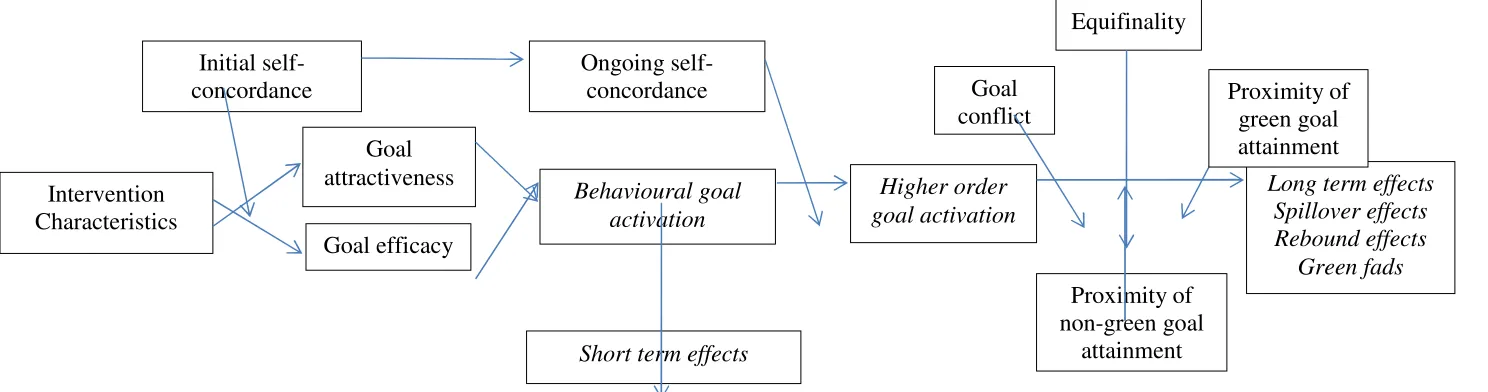
In sum, our model suggests that there are various stages betwixt the intervention and the outcome and that there are moderators for each of these stages. Our models rests on the assumption that workplace pro-environmental behavior is goal-directed (Austin & Vancouver, 1996) and as such, we focus on the goal-related elements that are likely to be involved in these stages.
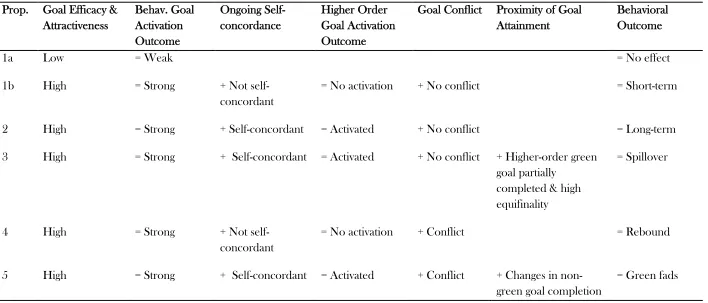
As shown in Figure 1 and Table 1, we suggest that the first stage “outcome” is one of goal activation: The pro-environmental goal must be chosen and activated before the employee can work on achieving that goal through behavior change. We suggest that an interaction between the
characteristics of the intervention and the employee will affect the strength of the goal activation. In particular, we use the concept of self-concordance to determine the extent to which an employee will take on the messages from the intervention and choose to engage in the behavior. We define
self-concordance as the degree to which the pro-environmental behavior expresses any of the employee’s stable interests and values (Sheldon & Elliot, 1999); for example, an employee might perceive commuting to work via public transport as expressing a green or biospheric value, or he or she might perceive it as expressing an egoistic value around saving money; in either case the behavior would be considered self-concordant.
Of course, the employee’s perception of self-concordance may be affected by the intervention so we must differentiate
between the initial self-concordance and the ongoing self-concordance following the intervention. This is particularly necessary in the second stage of the model which considers the wider activation of goals associated with the intervention-related goal. As we shall discuss, the degree to which this broader activation occurs will depend upon the ongoing level of self-concordance, and will result in longer-term behavioral change.
The final stage of the model looks at the movement from goal activation to
outcomes. First, if there are no other goals then spillover into other pro-environmental behaviors will likely occur when the higher-order goal highlighted by a broader
employee engages in the pro-environmental behavior but then engages in a behavior detrimental to the environment. When the behavior is self-concordant then we shall show how goal conflict will likely lead to “fads” of pro-environmental activity depending upon the completion of other goals. We will now explain our theoretical arguments in more detail.
Short-Term Effects: The Effect of Goal Efficacy & Attractiveness
Before green behavior change can occur, the employee must choose to engage in the behavior and thus activate the goal being promoted by the workplace intervention1
. The predominant view is that goal choice and goal activation depends upon expected utility as the key determinant – a
combination of the goal’s efficacy and attractiveness (Klein et al., 2008; Schmidt & DeShon, 2007; Vancouver, Weinhardt, & Schmidt, 2010).
Given that most behavior is goal-directed (Austin & Vancouver, 1996), we should therefore see that interventions are aimed at increasing the strength of the goal
activation, through increasing the ease with which the goal can be accomplished or its attractiveness. Although previous literature has not explicitly identified these
mechanisms, it can be seen that this is indeed where interventions are aimed. For instance, interventions such as providing knowledge and information (Staats, Leeuwen & Wit, 2000; Winett, Love & Kidd, 1982-1983), or modelling (McMakin, Malone & Lundgren, 2002; Winett,
Leckliter, Chinn, & Stahl, 1984) enable an employee to easily engage in the green behavior (Osbaldiston & Schott, 2012), thus
1This activation need not be conscious
(Aarts, Custers, & Marien, 2008).
increasing the expectancy that a behavioral goal can be achieved. Others which
implement rewards or punishments (Hayes & Cone, 1977) or increase commitment (Osbaldiston & Schott, 2012) are likely to affect the goal’s attractiveness. In this way, we can explain the mechanisms behind much of the previous intervention literature.
However, our model goes beyond this by realising that the employee who is engaged in an intervention does not come into it as a blank slate. Instead, most employees will already have an implicit perception of the self-concordance of the behavior for
themselves before they are even involved in the intervention. Previous research suggests that the extent to which a behavior
expresses stable interests and values, that is the self-concordance of the behavior to the individual, will influence the attractiveness of that behavior (Ford, 1992; Klein et al., 2008; Sheldon & Elliot, 1999). Thus, we argue that the degree to which the
intervention has an effect on the perceived attractiveness will depend not only on the intervention but also this initial self-concordance. An employee who already believes that the behavior is somewhat self-concordant is likely to be more strongly affected by an intervention than an employee who strongly believes that the behavior is most definitely not self-concordant.
will be affected by the characteristics of the intervention. The perception of
attractiveness will result from an interaction between the intervention and the
employee’s initial perception of the self-concordance of the pro-environmental behavior.
The underlying principle of what we are suggesting in this proposition is not radically different from ideas implicit within the extant pro-environmental behavior change literature: An intervention will affect an individual and that will affect his or her behavior. For example, de Groot and Steg (2009) proposed that for interventions to be most effective they should focus on an individual’s altruistic or biospheric values rather than their egoistic values (see also Schultz, 2000; Schultz et al., 2005)
presumably increasing the attractiveness of the pro-environmental goal to the
individual. Others have suggested that interventions should combine strategies that both increase knowledge and change attitudes (e.g., Staats et al., 1996), again thereby presumably increasing both the goal’s attractiveness and efficacy.
Furthermore, these two goal constructs can account for the variables associated with the TPB and VBN models: Efficacy
perceptions relate directly to the construct of perceived behavioral control within the TPB and attractiveness perceptions relate directly to the construct of attitudes, subjective and personal norms, and values within both the TPB and VBN models.
Nonetheless, this proposition significantly extends previous literature in two ways. First, rather than jumping straight from the intervention to the behavior, we identify the cognitive mechanisms through which the intervention results in behavior change. Rather than just looking at main effects, we
suggest that goal activation (via goal attractiveness and goal efficaciousness) mediates the relationship between the intervention and the ultimate behavior. Second, and perhaps most significantly, we recognise the importance of the employee’s initial self-concordance in moderating the effect of the intervention’s characteristics on perceptions of goal attractiveness.
Proposition 1: The strength of the pro-environmental goal activation will depend upon the goal’s efficacy and attractiveness. Perceptions of efficacy will be related to the characteristics of the intervention.
Perceptions of attractiveness will be related to an interaction between characteristics of the intervention and the employee’s initial self-concordance. Moreover, the stronger the pro-environmental goal activation, the greater the likelihood that the employee will engage in the behavior in the short-term.
Long-Term Effects: The Moderating Role of Self-Concordance
As noted above, we take a multi-level approach whereby we consider employees nested within interventions, allowing us to investigate the interaction between the two. Thus, when examining the longer-term effects of pro-environmental behavioral goal activation we suggest it is necessary to look at the context that surrounds this goal. We derive our propositions from an integration of the goal hierarchy, goal systems and self-concordance literatures. Goal hierarchies represent the well-accepted premise that goals operate within a system with higher-order, abstract, long-term goals (that is, values) at the top of the hierarchy and concrete day-to-day task goals at the bottom of the hierarchy, with
identities and long-term project goals in the middle (Austin & Vancouver, 1996;
1992). While little empirical research has been conducted in this area within organizations (with some exceptions: Bateman, O'Neill, & Kenworthy-U'Ren, 2002; Brett & VandeWalle, 1999; Sosik, Jung, & Dinger, 2009), a great deal of empirical work in experimental social psychology has verified the existence and effects of similar goal systems (e.g.,
Johnson, Chang, & Long, 2006; Kruglanski et al., 2002).
By taking this approach we recognise the potential multitude of motives behind each pro-environmental behavior. For instance, an employee pro-environmental behavior such as commuting via public transport might be linked not only to a green goal but also to a health goal and a budgeting goal and these goals might be linked to parent, employee and healthy-person identities. Indeed, De Young and Kaplan (1986) found a diverse range of motives for engaging in conservation behavior ranging from “green” values to more egoistic reasons such as money, convenience and lifestyle goals. In addition, our approach also recognises the multitude of goals that an employee will be juggling at any one time.
Following Hanges, Lord and Dickson (2000), we suggest that the goal hierarchy comprises a connectionist framework in which the pattern of connections between goals is more important than any one particular goal. The pattern is similar to a neural network in that there is a spreading activation of all relevant connections and goals – over time and repeated activations, each pattern becomes relatively stable (Collins & Loftus, 1975). These stable patterns become scripts (see Gioia & Poole, 1984) enabling particular patterns of
activation to occur subconsciously (see e.g.,
Aarts & Dijksterhuis, 2000). An analogy may be the paths worn by people between buildings – although many routes are possible, people begin to use the same ones and these routine “goat paths” then become the stable structure.
However given the limits of our attentional abilities individuals can focus only on a small portion of their overall self-schema at any one point in time (Markus & Wurf, 1987), therefore, the pattern that is
activated will change depending upon which goal is salient at the time (Cropanzano et al., 1993; Humphrey, Moon, Conlon, & Hofman, 2004; Klein, 1989). Furthermore, because of these resource constraints we need to differentiate between a person’s focal goal as the one that he or she is pursuing at a particular time, and their background goals which are goals that exist in their goal hierarchy but which they are not actively pursuing (Kruglanski et al., 2002)2
.
This more sophisticated understanding of an individual’s self-concept more accurately represents the motivational pursuits of an employee (Johnson et al., 2006; Kruglanski et al., 2002). However, this realisation of multiple goals creates the need to identify what happens when particular goals and patterns of goals are activated (compared to when they are not) and what happens when there is goal conflict between the
employee’s green goal and their other goals.
Proposition One outlined when the pro-environmental goal related to the
intervention would be activated. The
2A
activation of this behavioral goal will lead to the activation of the associated higher-order goals within the connectionist pattern (Shah & Kruglanski, 2003). However this higher-level activation can only occur if the
behavioral goal is self-concordant. As noted by Adriasola and Unsworth (2011), if a behavioral goal is not self-concordant and thus not expressing any higher-order value then it will not be connected to the higher-order goals in the employee’s goal
hierarchy. Therefore, when the
intervention-related behavior is not self-concordant there will be no connectionist pattern to activate. We propose, therefore, that the degree to which the intervention-related behavioral goal is currently self-concordant will moderate the relationship between goal activation and higher-order goal activation.
The activation of the higher-order goals is important as it results in greater motivation towards goal pursuit than the activation of just the behavioral goal (Kruglanski et al., 2002; Shah, Friedman, & Kruglanski, 2002; Shah & Kruglanski, 2003). In addition, engaging in a behavior that helps fulfil a personally important goal (that is, one connected to higher-order goals) generates positive affect (Fishbach, Shah, &
Kruglanski, 2004) leading to an approach orientation (Seo, Barrett, & Bartunek, 2004; Seo, Bartunek, & Feldman-Barrett, 2010) and further motivating potential (Louro, Pieters, & Zeelenberg, 2007). Again, if the green behavior that the employee is required to engage in is not currently self-concordant then there is no higher-order goal to be fulfilled and thus no additional motivation.
Moreover, when the pro-environmental goal is activated and the behavior is self-concordant then engagement in the
behavior will not require the long-term presence of the intervention. In the short-term behavior will be driven through the activation of the green behavioral goal by the intervention (see Proposition 1). Over time these behavior-goal links prompted by the intervention will become the “goat path” scripts in the overall activated goal hierarchy; these scripts will form stable links between the employee’s pro-environmental behavior and the higher-order goals. This means that activation of any related higher-order goal (not just the intervention-related behavior goal) will result in engagement in the new behavior. As such, the new pro-environmental behavior will be much more likely to continue in the long-term, long after the intervention has been removed.
Proposition 2: The effect of the strength of the green behavioral goal in activating an employee’s broader goal hierarchy will depend upon the degree to which it is self-concordant. A green behavioral goal that is self-concordant will result in activation of its related higher-order goals; however, a green behavioral goal that is not self-concordant will incur no activation of higher-order goals (as there are none related to that goal).
Spillover Effects: The Moderating role of Equifinality & Green Goal Progress
Related to this last argument is the
development of spillover behavior (Berger & Kanetkar, 1995; Muster, 2011). Although scant attention has been paid to it in the psychological or organizational literatures, a spillover outcome occurs when the
employee changes their behavior not only with regards to the specific, intervention-related behavior but other
2010). For example, a workplace
intervention designed to increase recycling of paper might be effective not only in the workplace but might also carry-over into the home; alternatively, a recycling intervention might lead the employee to engage in other workplace pro-environmental behaviors such as environmental citizenship (Barling & Robertson, 2010). We propose that this effect occurs due to equifinality and the perceived proximity of completing the green goal.
Following the bottom-up activation of the higher-order goals (Shah & Kruglanski, 2003) a need for consistency in other behaviors is created (Laran & Janiszewski, 2008). This becomes particularly pertinent when the higher-order goals are “green” goals, identities or values. This consistency could be met most simply when there are a number of behaviors that are already linked to the green goal, that is when the goal has high levels of equifinality (Kruglanski, Pierro, & Sheveland, 2011; Kruglanski et al., 2002). Research in experimental social psychology suggests that greater levels of equifinality mean that an employee will be more committed to the higher-order goal, but they may be less committed to sticking with any one means of achieving that goal (Kruglanski et al., 2011; Zhang, Fishbach, & Kruglanski, 2007). Nonetheless, the
multiple goals literature suggests that an employee will keep working towards a goal (presumably using whatever means
available) until they perceive it to be completed (Louro et al., 2007; Vancouver et al., 2010)3
.
3Research has shown that this effect
occurs regardless of whether goal progress is assessed against a specific goal (e.g., an ideal
Through the integration of these two literatures we are able to propose that employees with higher equifinality for their green goal but with moderate goal
attainment proximity (i.e., they do not perceive that the green goal will be
accomplished soon) will be more likely to spillover the behavior from the intervention to another behavior or context. The
employees are motivated to complete the unfinished goal and have a number of means available to them for doing so. For instance, an employee with a green goal might perceive that recycling at home, getting public transport to work and turning off the office coffee machine are all related to fulfilling their green goal. When this employee takes part in a workplace
intervention designed to increase recycling, their higher-order green goal is activated which then increases the motivation to engage in these other related behaviors until the green goal is perceived to be completed. On the other hand, the spillover effect will not occur for an employee who already perceives that their goal is completed or will be completed with the introduction of the intervention-related goal.
Current research into spillover supports this general proposition: Whitmarsh & O’Neill (2010) found that pro-environmental self-identity was related to consistency across some pro-environmental behaviors, and Thogersen and Olander (2003) found that spillover by consumers was more likely to occur when a person had universalism values. Our model provides the underlying mechanisms for these findings to occur.
Proposition 3: When a pro-environmental behavioral goal is activated and it is self-concordant it is more likely to result in spillover effects when the behavior only partially completes the employee’s higher order goal and there are other behaviors connected to the higher-order goal.
Rebound Effects: The Moderating Effect of Goal Conflict
However, as we noted earlier, yet another complication occurs when considering employee pro-environmental behavior in the context of goal hierarchies, and that is goal conflict. There are many competing goals that people may have in relation to pro-environmental behavioral goals, such as leisure goals (which might be accomplished through, for example, watching sports on a big-screen television), safety goals (which might be accomplished through, for example, driving a sports utility vehicle (SUV) to drop the children at school), and so forth. However we propose that goal conflict is particularly relevant for employee pro-environmental behavior as employees are likely to have many other goals that will not be associated with their intervention-related, pro-environmental goal. For example, for many employees spending time and/or resources in accomplishing pro-environmental goals (such as taking public transport to work, taking longer to walk up the office stairs rather than getting the quicker elevator, and so on) may be in conflict with performance efficiency goals such as getting to the meeting on time or spending every last available minute working on the computer. Moreover, for most employees, their performance goals will be much more commonly activated than their intervention-related goals.
When individuals perceive goal conflict they can either balance any competing goals
– in other words, they will work on the focal goal and then move to the other – or they can continue working on the focal goal and try not to succumb to the temptation arising out of the goal conflict (Finkelstein & Fishbach, 2010; Fishbach, Friedman, & Kruglanski, 2003; Fishbach & Zhang, 2008). One of the key determinants of whether an individual will balance or focus is the degree to which the behavior signals commitment to a higher-order goal (Fishbach, Zhang, & Koo, 2009; Koo & Fishbach, 2008), in other words, self-concordance. Thus, employees for whom the pro-environmental behavior is not self-concordant are likely to balance their competing goals, while those for whom the pro-environmental behavior is
self-concordant are likely to keep going with their key goal. We will first discuss the effect of competing goals when the
employee does not perceive the behavior to be self-concordant (and thus, there is no higher-order goal activated) before discussing the effect of competing goals when the behavior is self-concordant.
When trying to balance goals, individuals focus on the degree to which the goal is complete; when it is completed then the individual switches to working on other, more tempting, goals (Fishbach & Dhar, 2005; Koo & Fishbach, 2008; Louro et al., 2007). For instance, Fishbach and Dhar (2005) found that those who were
We extend this literature to propose that this balancing of goals is what causes the rebound effect (Greening, Greene, & Difiglio, 2000; Hertwich, 2005; Khazzoom, 1980). The rebound effect occurs when some pro-environmental activity results, directly or indirectly, in some
environmental harm, which partly or wholly cancels out the initial benefit. For example, an employee who uses double-sided printing (to reduce paper) may increase the number of documents they print (which increases paper use). We suggest that if the employee perceives the goal to be relatively easy to accomplish and/or highly attractive then a strong goal will be activated and the employee will work to achieve that goal (see Proposition 1). In doing so the employee will perform the pro-environmental
behavior in the short term. However, upon perceiving that the goal has been
completed, the employee will use the balancing tactic to cope with goal conflict; thus they will switch to their competing goals and engage in the inconsistent behavior indicative of the rebound effect (Fishbach & Dhar, 2005; Schmidt & DeShon, 2007; Schmidt & Dolis, 2009; Vancouver et al., 2010).
Since Khazzoom’s seminal paper (1980) a number of studies have focused on the theoretical logic and empirical evidence on the rebound effect especially in the context of developed countries (Schipper & Grubb, 1998) and global climate change (Kainuma, Matsuoka, Morita, & Hinimo, 1999). However, most of the research to date has focused on economic and technological issues (e.g., Berkout, Muskens, &
Velthuijsen, 2000; Greening et al., 2000). To our knowledge little work prior to our model has considered the rebound effect at the level of the individual, however we
believe our model provides a credible explanation for the existence of this effect.
Proposition 3: Interventions that result in a strong behavioral goal that is not self-concordant for an employee will likely result in the employee engaging in the pro-environmental behavior in the short-term but, under goal conflict, also engaging in rebound behaviors once the behavioral goal has been achieved.
Green Fads: The Moderating Effect of Competing Goal Progress
Instead of balancing goals, however, individuals can also focus just on one goal to the exclusion of the others (Kruglanski et al., 2002); this occurs when the behavior signals commitment to the higher-order goal (Fishbach et al., 2009), in other words, is self-concordant. As noted earlier, when the pro-environmental behavior goal is self-concordant, the activation of that goal will lead to the activation of the higher-order goals to which it is connected (see
However, many studies have found that just the presence of goal conflict reduces
resources and motivation towards the focal goal (e.g., Shah & Kruglanski, 2002). In many cases, goal conflict occurs simply by bringing the alternative goal into a person’s cognitive awareness - it does not even need to be conscious awareness - as studies have found that subliminal priming also induces goal conflict (Shah & Kruglanski, 2002). In these instances, when alternative goals which are either unrelated (Shah & Kruglanski, 2002) or opposing (Laran & Janiszewski, 2008; Legal, Meyer, &
Delouvee, 2007) are made accessible to the person (in other words, they are primed either consciously or subconsciously) then commitment to the focal goal reduces and resources are pulled away from it.
Furthermore, such instances of goal conflict produce negative affect within people (Emmons & Kind, 1988) which would also then hinder goal pursuit (Aarts, Custers, & Holland, 2007).
For example, if an employee is focused on achieving an intervention-related green goal – for instance he or she might be getting ready to climb the stairs rather than taking the elevator – but on the way there they run into a colleague who reminds them of a report due next week, it is likely that an efficiency performance goal will create conflict with the green goal, and he or she will take the elevator instead because it is quicker. This is a very clear example, however more subtle primes such as background pictures (Shantz & Latham, 2009) are also likely to create conflict, including the notices that may be on the noticeboard, the route the employee has to walk, and so on.
Unfortunately, for most employees in most organizations, the situation where the
pro-environmental goal is the focal goal (even for a short while) will occur rarely. Unless an employee is very passionate about the environment (i.e., they have strong and interconnected green values, identities and goals), it is much more likely in the
workplace that the green goal is a background goal and that some form of performance or work relationship goal is the focal goal. In these cases, the goals will be shielded from the employee’s attention while they concentrate on achieving their work goals (Shah et al., 2002; Vogt, De Houwer, & Crombez, 2011).
Yet, there are times when the employee will be aware of these intervention-related goals. People are more likely to allocate resources to accomplishing goals that are more likely to be achieved (Beck, Gregory, & Carr, 2009; Kernan & Lord, 1990; Schmidt & DeShon, 2007; Schmidt & Dolis, 2009; Vancouver et al., 2010); the flip-side of this is that background goals are more likely to come into awareness and be pursued when the focal goal is either very likely, or very unlikely, to be completed (Louro et al., 2007). Therefore, in our model, an employee is more likely to pursue intervention-related pro-environmental goals when their other important goals, such as their performance goals, are either very close or very far away from being achieved. For example, an employee may commute to work using public transport when they are feeling on top of their workload (i.e., their task performance goals are close to being achieved) but when they still have a lot of work to do then they are more likely to drive to work because the task performance goal remains focal.
resulting in “on and off” behaviors. When the intervention-related goal is focal and there are no conflicting cues then there will be a wave of pro-environmental activity following the intervention (assuming the behavior is self-concordant); when a conflicting goal is cued then the behavior will disappear; but, when the conflicting goal is almost completed or is deemed highly unlikely to be completed then there will be another wave of pro-environmental activity. For example, an employee may ardently recycle batteries or turn off all the lights in the vicinity or vehemently
encourage their co-workers to be more green- for a time; but this intensity of action will be interspersed with periods where the employee does not engage in any green behaviors. Such on-and-off behavior following an intervention has, to our knowledge, not been described in the pro-environmental literature, however this may be due to the difficulty in measuring such a dynamic process. We believe that the proposition rests on a strong body of different literatures and that, with
appropriate methodology, would be seen in organizations where employees perceive such goal conflict.
Proposition 5: Interventions promoting behavior that is self-concordant for employees, but which conflicts with alternative goals, will result in “fads” of employee pro-environmental behavior change, dependent upon the completion of non-green goals.
Implications
The model presented here has implications for theory, methods and practice. In
summary, we have taken a fresh approach to increasing employee pro-environmental behavior by considering some of the psychological moderators that affect the
likelihood of workplace intervention success.
Implications for Theory and Research
The literature on pro-environmental behavior change has tended to rely on social cognitive theories of behavior change, such as TPB (Ajzen,1985; 1991) and VBN (Stern, 2000; Stern et al., 1999). We have built on these theories and incorporated literatures from experimental social psychology as well as organizational behavior to develop greater levels of actionable knowledge.
Importantly, our model allows us to not only understand the extant literature on pro-environmental interventions, but to also bring to light new outcomes and new
1986; Stern, Dietz, & Guagnano, 1995, 1998) occur because it is more difficult to see how pro-environmental behaviors express egoistic values except in
circumstances when the costs associated with the alternative behavior are high (Lindenberg & Steg 2007; Moore & Loewenstein, 2004). We therefore extend previous thinking by proposing that those people who perceive the behavior as self-concordant will engage in it regardless of what values it expresses – as long as they perceive that it does express those values.
Second, the assessments of intervention outcomes in previous research were generally focused directly on the behavior at hand. Those who recognised the narrowness of these measures have
highlighted alternative criteria for evaluating the intervention, such as its replicability and generalisability (De Young, 2000). We believe that all of these are important. But we also believe that it is important to understand the wider effects that an intervention might have – the so-called “unforeseen consequences”. Our approach is one that takes into account the other goals and behaviors that an employee is engaged in, leading us to the extended list of behavioral outcomes outlines in Table 1. Our model helps to pinpoint the
psychological conditions under which an intervention might result in these
consequences, thereby helping them to be planned for and less “unforeseen”.
In particular, the identification of pro-environmental “fads” contributes both to theory and practice. In hindsight, the expectation that employees would either engage in the pro-environmental behavior (for a long time or a short time), or not, is perhaps a little simplistic. Given the number of conflicting demands that
employees face, and given the likelihood that green goals will be a low priority and not often activated in the workplace, it is unlikely that an employee will be able to consistently engage in pro-environmental behaviors following an intervention. Instead, we propose that it is much more likely that goal conflict will create episodes of high activity and episodes of low activity.
This then has obvious implications for research as simply taking aggregated levels of green behavior (or other measures such as energy consumption) will not capture the dynamic nature of the interaction. Instead, diary studies or experience sampling methods may be a better method for assessing the effectiveness of an
intervention. Diaries have been used to measure variables such as methods of travel (Fujii & Taniguchi, 2006), however to our knowledge these data have always been aggregated and the dynamic ebb-and-flow of engagement in pro-environmental behavior has not been analysed. We believe that this is an area that would prove highly fruitful, if effortful, in understanding the outcomes of workplace pro-environmental interventions.
interact with the characteristics of the intervention to affect perceptions of goal efficacy and attractiveness. Nonetheless, we do believe that our model represents some of the significant psychological conditions which are more likely to lead to a successful intervention. Given the complexity
incorporated within the model it is not surprising that many workplace
interventions designed to increase
employee pro-environmental behaviors do not have long-term success: such success comes predominantly for employees for whom the behavior is self-concordant and who do not experience goal conflict or whose alternative goals are either very close to completion or highly unlikely to be completed. We will discuss the practical implications of these conclusions later.
Finally, in developing our model we are able to contribute not only to the pro-environmental literature, but also to the goals literature. In the past, research
examining self-concordance, goal hierarchy, goal systems, and multiple goals have all taken place in silos with little to no overlap between them. We have shown how these constructs overlap (for example, the overlap between goal hierarchy and goal systems literatures), interact (for example, the interaction between self-concordance and activated goal hierarchy), and interrelate (for example, using insights from both goal systems and multiple goals literatures). This integration across the various bodies of literature should prove useful not only to scholars of pro-environmental behavior but also to scholars interested in goals more widely.
Implications for Practice
From a practical perspective, the model highlights the importance of both the intervention and the workplace. While our
aim was not to identify a silver-bullet intervention, our model nonetheless does have implications for making interventions more effective. As noted earlier,
interventions that target both efficacy and attractiveness should result in greater goal activation and thus, more behavior change. This can be seen in the types of
interventions that are now most popular such as those that address both knowledge and commitment (see Abrahamse et al., 2005). More interestingly, interventions that not only activate a key pro-environmental goal but also create equifinality through mentioning a number of related behaviors should result in greater spillover. For example, an intervention that focuses on recycling printer cartridges might also present cues for recycling paper and plastic. Finally, interventions could directly address the issue of goal conflict through the inclusion or provision of cues to re-focus the employee back on the
pro-environmental goal. For example, interventions that send occasional
reminders to participants may help to make the green goal focal again.
With regard to the workplace, our model suggests that there are things that can be done to improve the overall success of interventions. Changing the workplace environment to include more positive environmentally-related cues should help in activating employees’ green goals. For example, an intervention designed to increase stair-walking rather than elevator-use should provide cues in employees’ offices and cubicles as well as near the stairs and elevator. When these positive
In addition, our model highlighted the importance of self-concordance when attempting to gain more than short-term behavior change. Whilst self-concordance is an individual-level difference variable, transformational leadership has been shown to be related to increased self-concordance for work tasks (Bono & Judge, 2003). Thus, another implication arising out of our model is that to improve the likelihood of long-term success of pro-environmental interventions an organisation could engage its leaders rather than just focusing on employees; these leaders would then increase the employees’ perceptions of the self-concordance of the
pro-environmental behavior.
Conclusion
We started this manuscript by looking at an employee who had been engaged in a workplace intervention designed to increase pro-environmental behaviors. For Patrick, not driving into work was self-concordant as commuting on public transport expressed his values and beliefs; however when he experienced goal conflict the resources allocated to the pro-environmental behavior were reduced and he chose to pursue the alternative efficiency goal by driving in his car. It is likely, though, that he will catch the bus when he feels that his workload is under control.
We have taken a new approach to examining the effectiveness of
interventions. Our aim was to identify key psychological moderators of the
intervention-outcome relationship to better understand when, why and how
interventions are more likely to be successful. Following Kilduff (2006), our model addressed a real-life phenomenon rather than simply a gap in scholarship. Through the actionable knowledge
References
Aarts, H., Custers, R., & Holland, R. W. (2007). The nonconscious cessation og goal pursuit: when goals and negative affect are coactivated.Attitudes and Social Cognition, 92(2), 165-178. doi: 10.1037/0022-3514.92.2.165
Aarts, H., Custers, R., & Marien, H. (2008). Preparing and motivating behavior outside of awareness.Science, 319, 1639.
Aarts, H., & Dijksterhuis, A. (2000). Habits as knowledge structures: Automaticity in goal-directed behavior.Journal of Personality and Social Psychology, 78(1), 53-63.
Abrahamse, W., Steg, L., Vlek, C., & Rothengatter, T. (2005). A review of intervention studies aimed at household energy conservation.Journal of Environmental Psychology, 25(3). Adriasola, E., & Unsworth, K. L. (2011).Leadership's effect on motivation: The effect of
self-concordance and goal hierarchy. Paper presented at the Industrial Organisational Psychology Conference, Brisbane.
Ajzen, I. (1985). From intentions to actions: A theory of planned behavior. In J. Kuhl & J. Beckmann (Eds.),Action Control: From Cognition to Behavior (pp. 11-39). Berlin: Springer-Verlag.
Ajzen, I. (1991). The theory of planned behavior.Organizational Behavior and Human Decision Processes, 50(2), 179-211.
Argyris, C. (1996). Actionable knowledge: Design causality in the service of consequential theory.Journal of Applied Behavioral Science, 32(4), 390-406.
Austin, J. T., & Vancouver, J. B. (1996). Goal constructs in psychology: Structure, process and content.Psychological Bulletin, 120, 338-375.
Bamberg, S., & Moser, G. (2007). Twenty years after Hines, Hungerford and Tomera: A new meta-analysis of psycho-social determinants of pro-environmental behavior.Journal of Environmental Psychology, 27, 14-25.
Barr, S., Gilg, A., & Shaw, G. (2011). Helping people make better choices: Exploring he behaviour change agenda for environmental sustainability.Applied Geography, 31, 712-720.
Bateman, T. S., O'Neill, H., & Kenworthy-U'Ren, A. (2002). A hierarchical taxonomy of top managers' goals.Journal of Applied Psychology, 87(6), 1134-1148.
Beck, J. W., Gregory, J. B., & Carr, A. E. (2009). Balancing development with day-to-day task demands: A multiple-goal approach to executive coaching.Industrial and
Organizational Psychology, 2, 293-296.
Becker, L. J. (1978). Joint effect of feedback and goal setting on performance: A field study of residential energy conservation.Journal of Applied Psychology, 63(4), 428-433. Berger, I. E., & Kanetkar, V. (1995). Increasing environmental sensitivity via workplace
experiences.Journal of Public Policy and Marketing, 14(2), 204-215.
Berkout, P. H. G., Muskens, J. C., & Velthuijsen, J. W. (2000). Defining the rebound effect. Energy Policy, 28(6/7), 425-432.
Bittle, R. G., Valesano, R. M., & Thaler, G. M. (1979-1980). The effects of daily feedback on residential electricity usage as a function of usage level and type of feedback
Bono, J. E., & Judge, T. A. (2003). Self-concordance at work: Toward understanding the motivational effects of transformational leaders.Academy of Management Journal, 46(5), 554-571.
Brandon, G., & Lewis, A. (1999). Reducing household energy consumption: A qualitative and quantitative field study.Journal of Environmental Psychology, 19, 75-85.
Brett, J. F., & VandeWalle, D. (1999). Goal orientation and goal content as predictors of performance in a training program.Journal of Applied Psychology, 84(6), 863-873. Brown, K. W., & Kasser, T. (2005). Are psychological and ecological well-being compatible?
The rles of values, mindfulness and lifestyle.Social Indicators Research, 74(2), 349-368.
Cheung, S. F., Chan, D. K. S., & Wong, Z. S. Y. (1999). Reexamining the theory of planned behaviour in understanding wastepaper recycling.Environment and Behavior, 31, 587-612.
Collins, A. M., & Loftus, E. F. (1975). A spreading-activation theory of semantic processing. Psychological Review, 82(6), 407-428.
Cropanzano, R., James, K., & Citera, M. (1993). A goal hierarchy model of personality, motivation, and leadership.Research in Organizational Behavior, 15, 267-322. de Groot, J. I. M., & Steg, L. (2009). Mean or green: Which values can promote stable
pro-environmental behavior?Conservation Letters, 44, 1-6.
De Young, R. (1993). Changing behavior and making it stick: The conceptualization and management of conservation behavior.Environment and Behavior, 25(4), 485-505. De Young, R. (2000). Expanding and evaluating motives for environmentally responsible
behavior.Journal of Social Issues, 56(3), 509-526.
De Young, R., & Kaplan, S. (1986). Conservation behavior and the structure of satisfactions. Journal of Environmental Systems, 15(3), 233-242.
Dwyer, W. O., Leeming, F. C., Cobern, M. K., & Jackson, J. M. (1993). Critical Review of Behavioral Interventions to Preserve the Environment: Research Since 1980. Environment and Behavior, 25(5), 275-321
Emmons, R. A., & Kind, L. A. (1988). Conflict among personal strivings: Immediate and long-term implications for psychological and physical well-being.Journal of Personality and Social Psychology, 54(6), 1040-1048.
Fielding, K. S., McDonald, R., & Louis, W. R. (2008). Theory of planned behaviour, identity and intentions to engage in environmental activism.Journal of Environmental
Psychology, 28, 318-326.
Fielding, K. S., Terry, D. J., Masser, B., & Hogg, M. A. (2008). Integrating social identity theory and the theory of planned behaviour to explain decisions to engage in sustainable agricultural practices.British Journal of Social Psychology, 47, 23-48. Finkelstein, S. R., & Fishbach, A. (2010). When healthy food makes you hungry.Journal of
Consumer Research, 37(3), 357-367.
Fishbach, A., & Dhar, R. (2005). Goals as excuses or guides: The liberating effect of perceived goal progress on choice.Journal of Consumer Research, 32(3), 370-377.
Fishbach, A., Shah, J. Y., & Kruglanski, A. W. (2004). Emotional transfer in goal systems. Journal of Experimental Social Psychology, 40, 723-738.
Fishbach, A., & Zhang, Y. (2008). Together or apart: When goals and temptations
complement versus compete.Journal of Personality and Social Psychology, 94(4), 547-559.
Fishbach, A., Zhang, Y., & Koo, M. (2009). The dynamics of self-regulation.European Review of Social Psychology, 20, 315-344.
Ford, M. E. (1992).Motivating Humans: Goal, Emotions and Personal Agency Beliefs. Newbury Park, California: Sage.
Fujii, S., & Taniguchi, A. (2006). Determinants of the effectiveness of travel feedback programs: A review of communicative mobility management measures for changing travel behaviour in Japan.Transport Policy, 13, 339-348.
Gioia, D. A., & Poole, P. P. (1984). Scripts in organizational behavior.Academy of Management Review, 9, 449-459.
Gonzales, M. H., Aronson, E., & Costanzo, M. A. (1988). Uaing social cognition and
persuasion to promote energy conservation: A quasi-experiement. .Journal of Applied Social Psychology, 18(12), 1049-1066.
Greening, L. A., Greene, D. L., & Difiglio, C. (2000). Energy efficiency and consumption - the rebound effect - a survey.Energy Policy, 28(6), 389-401.
Hanges, P. j., Lord, R. G., & Dickson, M. W. (2000). An information processing perspective on leadership and culture: a case for connectionist architecture.Applied Psychology: An International Review, 49(1), 133-161.
Harland, P., Staats, H., & Wilke, H. A. M. (2006). Explaining proenvironmental intention and behavior by personal norms and the Theory of Planned Behavior.Journal of Applied Social Psychology, 29(12), 2505-2528.
Hertwich, E. G. (2005). Consumption and the rebound effect: An industrial ecology perspective.Journal of Industrial Ecology, 9(1), 85-98.
Humphrey, S. E., Moon, H., Conlon, D. E., & Hofman, D. A. (2004). Decision-making and behavior fluidity: How focus on completion and emphasis on safety changes over the course of projectsOrganizational Behavior and Human Decision Processes, 93, 14-27. IPCC. (2007). Climate change 2007: Synthesis report. Summary for policy makers.
Johnson, R. E., Chang, C. H., & Long, R. G. (2006). Moving from cognition to behavior: What the research says.Psychological Bulletin, 132(3), 381-415.
Kainuma, M., Matsuoka, Y., Morita, T., & Hinimo, G. (1999). Development of an end-use model for analysing policy options to reduce greenhouse gas emissions.IEEE Transactions on Systems, Man, and Cybernetics, Part C, Applications and Reviews, 29(3), 317–324.
Kantola, S. J., Syme, G. J., & Campbell, N. A. (1984). Cognitive dissonance and energy conservation.Journal of Applied Psychology, 69(3), 416-421.
Karp, D. G. (1996). Values and their effects on pro-environmental behavior.Environment and Behavior, 28, 111-133.
Katzev, R. D., & Johnson, T. R. (1984). Comparing the Effects of Monetary Incentives and Foot-in-the-Door Strategies in Promoting Residential Electricity Conservation.Applied Social Psychology, 14(1).
Kernan, M. C., & Lord, R. G. (1990). Effects of valence, expectancies and goal-performance discrepancies in single and multiple goal environments.Journal of Applied Psychology, 75, 194-203.
Khazzoom, J. D. (1980). Economic implications of mandated efficiency in standards for household appliances.Energy Journal, 1(4), 21-40.
Kilduff, M. (2006). Publishing theory.Academy of Management Review, 31(2), 252-255. Klein, H. J. (1989). An integrated control theory model of work motivation.Academy of
Management Review, 14(2), 150-172.
Klein, H. J., Austin, J. T., & Cooper, J. T. (2008). Goal choice and decision processes. In R. Kanfer (Ed.),Work Motivation: Past, Present and Future (pp. 101-150). Hoboken: Routledge.
Koo, M., & Fishbach, A. (2008). Dynamics of self-regulatio: How (un)accomplished goal actions affect motivation.Journal of Personality and Social Psychology, 94(2), 183-195. KPMG. (2005). KPMG International Survey of Corporate Responsibility Reporting 2005.
Amsterdam.
Kruglanski, A. W., Pierro, A., & Sheveland, A. (2011). How many roads lead to Rome? Equifinality set-size and commitment to goals and means.European Journal of Social Psychology, 41, 344-352.
Kruglanski, A. W., Shah, J. Y., Fishbach, A., Friedman, R., Chun, W. Y., & Sleeth-Keppler, D. (2002). A theory of goal systems.Advances in Experimental Social Psychology, 34, 331-378.
Laran, J., & Janiszewski, C. (2008). Behavioral consistency and inconsistency in the resolution of goal conflict.Journal of Consumer Research, 35, 967-984.
Legal, J. B., Meyer, T., & Delouvee, S. (2007). Effect of compatibility between conscious goal and nonconscious priming on performance.Current Research in Social Psychology, 12(6), 81-90.
Lindenberg, S., & Steg , L. (2007). Normative, gain and hedonic goal-frames guiding environmental behavior.Journal of Social Issues, 63(1), 117-137.
Louro, M. J., Pieters, R., & Zeelenberg, M. (2007). Dynamics of multiple-goal pursuit.Journal of Personality and Social Psychology, 93(2), 174-193.
Lucas, K., Brooks, M., Darnton, A., & Elster Jones, J. (2008). Promoting pro-environmental behaviour: existing evidence and policy implications.Environmental Science & Policy, 11(5), 456-466.
Markus, H., & Wurf, E. (1987). The dymanic self-concept: A social psychological perspective. Annual Review of Psychology, 38, 299-337.
McCalley, L. T., & Midden, C. J. H. (2002). Energy conservation through product-integrated feedback: The roles of goal-setting and social orientation.Journal of Economic Psychology, 23(5), 589-603.
McDougall, G. H. G., Claxton, J. D., & Ritchie, J. R. B. (1982-1983). Residential home audits: An empirical analysis of the ENEVERSAVE program. .Journal of Environmental Systems, 12(3), 265-278.
McLelland, L., & Cook, S. W. (1980). Promoting Energy Conservation in Master-Metered Apartments through Group Financial Incentives.Applied Social Psychology, 10(1). Merritt, A. C., Effron, D. A., & Monin, B. (2010). Moral self-licensing: When being good frees
us to be bad.Social and Personality Psychology Compass, 4/5, 344-357.
Midden, C. J. H., Meter, J. E., Weening, M. H., & Zieverink, H. J. A. (1983). Using feedback, reinforcement and information to reduce energy consumption in households: A field experiment.Journal of Economic Psychology, 3(1), 65-86.
Moore, D. A., & Loewenstein, G. (2004). Self-Interest, Automaticity, and the Psychology of Conflict of InterestSocial Justice Research, 17(2), 189-202.
Muster, V. (2011). Companies promoting sustainable consumption of employees.Journal of Consumer Policy, 34, forthcoming.
Ones , D. S., & Dilchert, S. (2010).A taxonomy of green behaviours among employees. Shades of green: Individual differences in environmentally responsible employee behaviours. . Paper presented at the Symposium conducted at the annual conference of the society for Industrial and Organizational Psychology, Atlanta, Georgia.
Ones, D. S., & Dilchert, S. (2012). Environmental sustainability at work: A call to action. Industrial and Organizational Psychology: Perspectives on Science and Practice, 5(4). Osbaldiston, R., & Schott, J. P. (2012). Environmental sustainability and behavioral science:
Meta-analysis of proenvironmental behavior experiments.Environment and Behavior, 44, 257-299.
Pallak, M. S., & Cummings, W. (1976). Commitment and Voluntary Energy Conservation. Personality and Social Psychology Bulletin, 2(1), 27-30.
Ramus, C. A., & Killmer, A. B. C. (2007). Corporate greening through prosocial extra role behaviours: A conceptual framework for employee motivation.Business Strategy and the Environment, 16(8), 554-570.
Schipper, L. J., & Grubb, M. (1998).On the Rebound: using energy indicators to measure the feedback between energy intensities and energy uses. Paper presented at the 1998 IAEE Quebec City Conference.
Schmidt, A. M., & DeShon, R. P. (2007). What to do? The effects of discrepancies, incentive and time on dynamic goal prioritization.Journal of Applied Psychology, 92(4), 928-941. Schmidt, A. M., & Dolis, C. M. (2009). Something's got to give: The effects of dual-goal
difficulty, goal progress, and expectancies on resource allocation.Journal of Applied Psychology, 94(3), 678-691.
Schultz, P. W. (2000). Empathizing with nature: The effects of perspective taking on concern for environmental issues.Journal of Social Issues, 56, 391-406.
Schultz, P. W., Gouveia, V. V., Cameron, L. D., Tankha, G., Schmuck, P., & Franek, M. (2005). Values and their Relationship to Environmental Concern and Conservation Behavior.Journal of Cross-Cultural Psychology, 36, 457-477.
Seligman, C., & Darley, J. M. (1977). Feedback as means of decreasing residential energy consumption.Journal of Applied Psychology, 62(4), 363-368.
Seo, M. G., Barrett, L. F., & Bartunek, J. M. (2004). The role of affective experience in work motivation.Academy of Management Review, 29(3), 423-439.
Seo, M. G., Bartunek, J. M., & Feldman-Barrett, L. (2010). The role of affective experience in work motivation: Test of a conceptual model.Journal of Organizational Behavior, 31(7), 951-968.
Shah, J. Y., Friedman, R., & Kruglanski, A. W. (2002). Forgetting all else: On the antecedents and consequences of goal shielding.Journal of Personality and Social Psychology, 83(6), 1261-1280.
Shah, J. Y., & Kruglanski, A. W. (2002). Priming against your will: How accessible alternatives affect goal pursuit.Journal of Experimental Social Psychology, 38, 368-383.
Shah, J. Y., & Kruglanski, A. W. (2003). When opportunity knocks: bottom-up priming of goals by means and its effects on self-regulation.Journal of Personality and Social Psychology, 84(6), 1109-1122.
Shantz, A., & Latham, G. P. (2009). An exploratory field experiment of the effect of
subconscious and conscious goals on employee performance.Organizational Behavior and Human Decision Processes, 109, 9-17.
Sheldon, K. M., & Elliot, A. J. (1999). Goal striving, need satisfaction, and longitudinal well-being: The self-concordance model.Journal of Personality and Social Psychology, 76(3), 482-497.
Slavin, R. E., Wodanski, J. S., & Blackburn, B. L. (1981). A group contingency for electricity conservation in master-metered apartments.Journal of Applied Behavior Analysis, 14(3), 357-363.
Sosik, J. J., Jung, D., & Dinger, S. L. (2009). Values in authentic action: Examining the roots and rewards of alturistic leadership.Group and Organization Management, 34, 395-433.
Staats, H. J., Wit, A. P., & Midden, C. Y. H. (1996). Communicating the greenhouse effect to the public: Evaluation of a mass media campaign from a social dilemma perspective. Journal of Environmental Management, 45, 189–203.
Stern, P. C. (2000). Toward a coherent theory of environmentally significant behavior.Journal of Social Issues, 56(3), 407-424.
Stern, P. C., & Dietz, T. (1994). The Value Basis of Environmental Concern.Journal of Social Issues, 50(3), 65-84.
Stern, P. C., Dietz, T., Abel, T., Guagnano, G. A., & Kalof, L. (1999). A value-belief-norm theory of support for social movements: The case of environmental concern.Human Ecology Review, 6(81-97).
Stern, P. C., Dietz, T., & Black, J. S. (1986). Support for environmental protection: The role of moral norms.Population and Environment, 8, 204-222.
Stern, P. C., Dietz, T., & Guagnano, G. A. (1995). The new environmental paradigm in social psychological perspective.Environment and Behavior, 27, 723-745.
Taylor, S., & Todd, P. (1995). An integrated model of waste management behaviour: A test of household recycling and composting intentions.Environment and Behavior, 27(5), 603-630.
Thogersen, J., & Moller, B. (2008). Breaking car use habits: The effectiveness of a free one-month travelcard.Transportation, 35, 329-345.
Thogersen, J., & Olander, F. (2003). Spillover of environment-friendly consumer behaviour. Journal of Environmental Psychology, 23(3), 225-236.
Vallacher, R. R., & Wegner, D. M. (1987). What do people think they're doing? Action identification and human behavior.Psychological Review, 94(1), 3-15.
Van Houwelingen, J. H., & Van Raaij, W. F. (1989). The Effect of Goal-Setting and Daily Electronic Feedback on In-Home Energy Use.Journal of Consumer Research, 16(1), 98-105.
Vancouver, J. B., Weinhardt, J. M., & Schmidt, A. M. (2010). A formal, computational theory of multiple-goal pursuit: Integrating goal choice and goal-striving processes.Journal of Applied Psychology, 95(6), 985-1008.
Vogt, J., De Houwer, J., & Crombez, G. (2011). Multiple goal management starts with attention: Goal prioritizing affects the allocation of spatial attention to goal-relevant events.Experimental Psychology, 58(1), 55-61.
Webb, T. L., & Sheeran, P. (2006). Does changing behavioral intentions engender behavior change? A meta-analysis of the experimental evidence.Psychological Bulletin, 132(2), 249-268.
Whitmarsh, L., & O'Neill, S. (2010). Green identity, green living? The role of
pro-environmental self-identity in determining consistency across diverse pro-pro-environmental behaviours.Journal of Environmental Psychology, 30(3), 305-314.
Winett, R. A., Kagel, J. H., Battalio, R. C., & Winkler, R. C. (1978). Effects of monetary rebates, feedback and information on residential electricity conservation.Journal of Applied Psychology, 63(1), 73-80.
Winett, R. A., Leckliter, I. N., Chinn, D. E., Stahl, B., & Love, S. Q. (1985). Effects of television modeling on residential energy conservation.Journal of Applied Behavior Analysis, 18(1), 33-44.
Winett, R. A., Love, S. Q., & Kidd, C. (1982-1983). The effectiveness of an energy specialist and extensions agents in promoting summer energy conservation by home visits. Journal of Environmental Systems, 12(1), 61-70.
Young, W., & Middlemiss, L. (2011). A rethink of how policy and social science approach changing individuals' actions on greenhouse gas emissions.Energy Policy,
doi:10.1016/j.enpol.2011.11.040.
Table 1. Behavioral outcomes following a workplace intervention. Prop. Goal Efficacy &
Attractiveness
Behav. Goal Activation Outcome
Ongoing Self-concordance
Higher Order Goal Activation Outcome
Goal Conflict Proximity of Goal Attainment
Behavioral Outcome
1a Low = Weak = No effect
1b High = Strong + Not
self-concordant
= No activation + No conflict = Short-term
2 High = Strong + Self-concordant = Activated + No conflict = Long-term
3 High = Strong + Self-concordant = Activated + No conflict + Higher-order green
goal partially completed & high equifinality
= Spillover
4 High = Strong + Not
self-concordant
= No activation + Conflict = Rebound
5 High = Strong + Self-concordant = Activated + Conflict + Changes in
non-green goal completion