Rochester Institute of Technology
RIT Scholar Works
Theses Thesis/Dissertation Collections
2007
DYNAMAC media distribution system
Luis A. Caceres ChongFollow this and additional works at:http://scholarworks.rit.edu/theses
This Thesis is brought to you for free and open access by the Thesis/Dissertation Collections at RIT Scholar Works. It has been accepted for inclusion in Theses by an authorized administrator of RIT Scholar Works. For more information, please [email protected].
Recommended Citation
DYNAMAC MEDIA DISTRIBUTION SYSTEM
BY
LUIS A. CACERES CHONG
A THESIS SUBMITTED IN PARTIAL FULFILLMENT OF THE
REQUIREMENTS FOR THE DEGREE OF
MASTER OF SCIENCE
IN
TELECOMMUNICATIONS ENGINEERING TECHNOLOGY
ROCHESTER INSTITUTE OF TECHNOLOGY
MASTER OF SCIENCE THESIS
OF
LUIS A. CACERES CHONG
APPROVED:
Thesis Committee
___________________________________________ Chair - Dr. Chance M. Glenn Sr.
___________________________________________ Dr. Warren L. G. Koontz
___________________________________________ Mark Indelicato
ROCHESTER INSTITUTE OF TECHNOLOGY
Library Rights Statement
In presenting the thesis DYNAMAC Media Distribution System in partial
fulfillment of the requirements for an advance degree at the Rochester Institute of
Technology, I agree that permission for copying as provided for by the Copyright
Law of the U.S. (Title 17, U.S. code) of this thesis for scholarly purposes may be
granted by the Librarian. It is understood that any copying or publication of this
thesis for financial gain shall not be allowed without my written permission. I
hereby grant permission to the RIT Library to copy my thesis for scholarly
purposes.
___________________________________________
Luis A. Cáceres Chong
_____________________________________
Abstract
This thesis describes the initial development of a multiplatform client-server
based system capable of distributing content derived from a new format over an
IP network. The system will also provide digital rights management and secure
transmission of video content utilizing the DYNAMAC video
compression/decompression algorithm. The work presented here is part of the
Digital Media Research Group, which is focused on the use of the DYNAMAC
algorithm for digital rights management and distribution of high definition media
content in real time, while achieving better efficiency on bandwidth usages.
Three components were created with this initial development: a player capable of
rendering video content compressed with the DYNAMAC algorithm, a server that
distributes the compress video content over an IP network, and a protocol
specially design to communicate and transfer the video content from the server
to the client. Since the development was based on the Java Media Framework,
the client and the server of the distribution system will be able to be installed and
run on any computer platform with a Java Runtime Environment. The fact that
the system is written in Java also means that any changes can be made to single
components without having to change the entire system. In this paper I intent to
describe the approach taken to develop the system and the results obtain, were
several videos are transmitted demonstrating the functionalities of the
DYNAMAC algorithm and the DYNAMAC media distribution system.
Keywords
video compression, IPTV, DYNAMAC algorithm, Java Media Framework,
Acknowledge
First of all I would like to thank God for allowing me to get this far in life and for
giving me the strength to do all the things I have done.
Secondly, I would like to thank my country Honduras for letting me grow up
surrounded by so much beauty and for allowing me to be a part of a great people
full of strength and hope. They taught me the value of a having to work hard for
what we want.
I would also like to thank my family and Sara. My mother and father for
always being there pushing me to be a better person everyday. Sara for never
losing hope on me and always telling me that no matter what happens everything
is going to be fine.
Thanks to Dr. Chance M. Glenn, for letting me be a part of his work and
having faith in me that I wouldn’t let him down.
Also, thanks to Dr. Warren Koontz, for always having his door open and for
always listening to me when I had a problem or a doubt.
Last, but not least, I would like to thank my friends, for believing that I’m better
Table of Contents
Library Rights Statement _________________________________________________ 1
Chapter 1 _____________________________________________________________ 7
1. Introduction _______________________________________________________ 7
1.1 DYNAMAC Algorithm ________________________________________________ 8
1.2 Objective __________________________________________________________ 10
1.3 Thesis Road Map ____________________________________________________ 10
Chapter 2 ____________________________________________________________ 12
Approach ____________________________________________________________ 12
2.1 DYNAMAC Video client _____________________________________________ 14
2.1.1 Accessing Video Content __________________________________________________ 14 2.1.2 Demultiplexing __________________________________________________________ 15 2.1.3 Decoding _______________________________________________________________ 17 2.1.4 Rendering ______________________________________________________________ 19
2.2 DYNAMAC Media Server ____________________________________________ 20
2.3 DYNAMAC Protocol ________________________________________________ 21
2.3.1 DYNAMAC Protocol Process _______________________________________________ 21 2.3.2 DYNAMAC Protocol Packet _______________________________________________ 24
Chapter 3 ____________________________________________________________ 26
Results_______________________________________________________________ 26
3.1 Digital Rights Management ___________________________________________ 26
3.2 Content Distribution _________________________________________________ 27
Chapter 4 ____________________________________________________________ 29
Future Work __________________________________________________________ 29
Chapter 5 ____________________________________________________________ 30
Chapter 1
1. Introduction
From its beginnings of providing telegraph services and plain old telephone
services (POTS), telecommunications have evolved into a whole new era, giving
the world services such as voice over internet protocol (VoIP), internet protocol
television (IPTV), video-on-demand, Internet access, mobility, and many other
applications.
Thanks to the convergence of voice, video, and data, the telecom industry
can now take advantage of the networks already in place and use them to help
people communicate with the rest of the globe. We now don’t just read about
current events happening on the other side of the planet, but we can also watch
and listen to these events as they unfold live. If you already have access to the
Internet, you can talk to your loved ones for free. Sitting in front of their
computers at home, people can search for movies or music videos from
anywhere on Earth and view them in a matter of seconds.
Services such as Video on Demand and IPTV are achieved thanks to
streaming. Streaming offers a whole new approach to media on the Internet1.
Instead of waiting for the whole file to download to a user's computer before
playback begins, streaming media playback occurs as the file is being
transferred. The data travels across the Internet, is played back and then
discarded. Streaming is also considered real-time because you may view an
event as it happens. The primary factor that makes a stream real-time is that
there is no intermediate storage of the data packets2. There may be some short
buffers, like frame stores in the decoder, but the signal essentially streams all the
Although the capacity of modern networks is very high, streaming puts more
demand on the network’s bandwidth. In order to be able to provide these
services, compression is required. Compression is the art and science of
squeezing out unneeded information in a picture, or a stream of pictures (a
movie) or sound before sending or storing it3. In transmission systems,
compression allows a reduction in bandwidth which will generally result in a
reduction in cost. This may make possible a service which would be
impracticable without it. If a given bandwidth is available to an uncompressed
signal, compression allows faster than real-time transmission in the same
bandwidth. If a given bandwidth is available, compression allows a better-quality
signal in the same bandwidth.
Also as new technologies appear, ill-intentioned persons try to find ways to
use those technologies to their advantage regardless of the laws they break or
the people they hurt. In this case it could be the piracy of digital entertainment:
music, movies, or games4. Some Internet piracy is in the domain of the lone
hacker, who treats unauthorized access as a challenge. A bigger problem is
piracy for commercial gain. Therefore, digital assets have to be wrapped
securely to prevent access to all but authorized users that have been properly
authenticated. File security and digital rights management becomes more of an
issue when content is delivered over the public Internet. Digital rights
management allows owners, distributors, and providers of content to deliver
content securely to consumers as part of an e-commerce system.
1.1 DYNAMAC Algorithm
For some of the reasons mention above, and others, the DYNAMAC
algorithm was created5. The DYNAMAC algorithm is based in nonlinear systems
theory. It is able to achieve significant compression of audio and image data
while maintaining good signal quality. Because of the way the
useful for digital rights management and secure transmission. The basic
foundation of the DYNAMAC process lies in the realizations that (a) chaotic
oscillators are dynamical systems that can be governed by mathematical
expressions, and (b) chaotic oscillators are capable of producing diverse
waveform shapes. The premise is this: a segment of a digital sequence, such as
that derived from image data, can be replaced by the initial conditions of a
chaotic oscillation that matches it within an acceptable error tolerance. If the size
of the data needed to specify the conditions needed to reproduce the chaotic
oscillation is smaller than the size of the digital sequence, compression is
achieved.
“Chaos is a name for any order that produces confusion in our minds.”
—G. Santayana, Philosopher, Poet, Humanist and Critic (1863-1952)
The concept behind the DYNAMAC algorithm is that the binary sequences
used by computers to store and represent images and sound can be represented
by waveforms generated by a chaotic oscillator.
To implement this concept we could sit around and wait an infinite amount of
time for a chaotic oscillator to randomly produce in just the right order the
waveforms needed to represent a specific image (somewhat like the Infinite
Monkey Theorem6), or we could work our way from the image and arrive to the
waveforms, just like the DYNAMAC algorithm does. It divides the image into sets
of digital sequence and searches inside a combined chaotic oscillation matrix to
find the closest match between a waveform and the digital sequence. The
waveforms inside the matrix are identified by a 40-bit sequence or d-bite. For
example, if the waveform selected represents a 256-bit sequence, the
DYNAMAC algorithm has compress the digital sequence from 256 bits to 40 bits.
To access a waveform inside the combined chaotic oscillation matrix, the
part of the 40-bit d-bite use to identify a waveform. That’s how the DYNAMAC
algorithm produces digital rights management. If the wrong key is used in the
decompression process, the result will be a scramble image.
1.2 Objective
The objective of this thesis is to design and develop a multiplatform
client-server based system capable of distributing content derived from a new format
over an IP network. The system will also provide digital rights management and
secure transmission of video content utilizing the DYNAMAC video
compression/decompression algorithm.
To accomplish this purpose, a new network protocol will be created with the
purpose of establishing the communication standard for the client and server.
The new protocol will be designed specifically to transfer streaming video
compressed by the DYNAMAC algorithm. The user interface will be designed in
the JAVA programming language.
An added bonus is that the system will prove to be a valuable tool for The
Laboratory of Advanced Communications Technology (LACT) and the Digital
Media Research Group (DMRG). This system will be a platform for further
technology development.
1.3 Thesis Road Map
This chapter explains the scope of the thesis. A small background and a
description of the DYNAMAC algorithm have been provided. The rest of the
thesis is organized as follows:
Chapter 3 discusses the results obtained by following the approach mention on
the previous chapter.
Chapter 4 proposes some future work that may be required to improve the
distribution system and the DYNAMAC Project.
Chapter 2
Approach
Although the DYNAMAC algorithm has been proven to achieve compression and
encrypt data to preserve digital rights7, still there isn’t a system capable of
demonstrating the algorithm’s potential to its fullest. The system should be
capable of streaming the compressed video content over an IP network to serve
several clients, as well as preventing a client without the proper authentication
mechanism viewing the video content.
The first step is to create a DYNAMAC video client interface capable of
decompressing the video content and displaying it on screen. The client should
be able to read DYNAMAC video files or dyv files as well as connect to a
DYNAMAC video server using TCP/IP and receive the compressed data. The
client is also required to read a combined chaotic oscillation matrix and the matrix
[image:13.612.93.530.422.608.2]ordering key, which are needed for the decompression process.
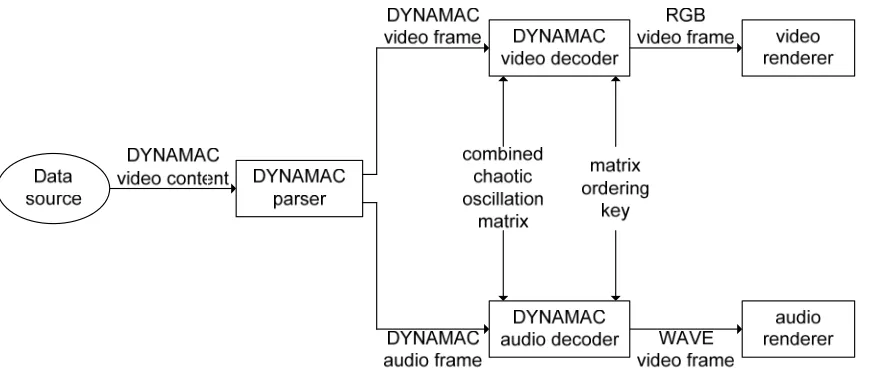
Figure 1: DYNAMAC video decompression and rendering process
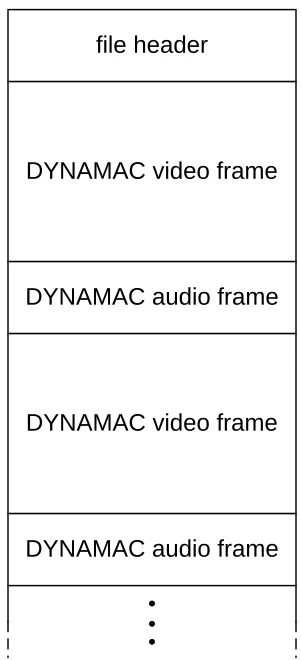
The essed
vid
dyv file consists of an interleaving between DYNAMAC compr
eo frames and DYNAMAC compressed audio frames. The first step is to split
the image and audio content of the file or incoming stream. The decoders
combined chaotic oscillation matrix and the ordering key. Finally the raw video
and audio streams are rendered through the screen and speakers respectively.
The next step is to create a DYNAMAC video server capable of handling
several TCP/IP request by the clients trying to connect to him. The server will
have a repository where dyv files are going to be stored. When a client requests
a specific file, the server reads the dyv file and starts streaming the compressed
video content back to the client.
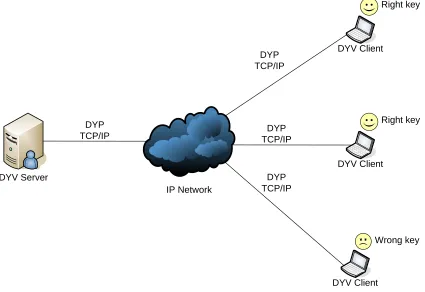
[image:14.612.97.522.262.554.2]DYV Server DYV Client DYV Client DYV Client IP Network Right key Wrong key DYP TCP/IP Right key DYP TCP/IP DYP TCP/IP DYP TCP/IP
Figure 2: DYNAMAC distribution system network topology
All the gh an IP
net
clients and the server are going to be connected throu
work. The clients are going to request the video from the server. The server
is going to stream the dyv video. The clients are going to start decoding and
rendering the video (as shown in Figure 1). If a client has a wrong matrix
The final step is to create the protocol, or DYNAMAC protocol (DYP), used by
the server and the client to communicate with each other. Besides specifying the
steps used to start video streaming, the protocol packet should indicate the
number of d-bites in its payload, as well as the type of d-bite (image or audio).
2.1 DYNAMAC Video client
The DYNAMAC video client or DYNAMAC player consists of several
components (see figure 1) required to process the video content. These
components are use in four processing stages: accessing the video content,
demultiplexing, decoding, and rendering. These four stages are executed every
time a video is played, whether the video source is a file located on the local disk,
or a media server located on the other side of the planet.
2.1.1 Accessing Video Content
The first stage of the DYNAMAC player is to access the video content. A
Datasource component is required for each protocol use to access the media. It
is the interface between the DYNAMAC player and the media repository.
The Datasource used depends on the protocol required to read the media
content. For example, if the video file is located on a computer’s local drive, the
Datasource associated with the FILE protocol is loaded. To access DYNAMAC
videos two Datasource were created: a Datasource for the FILE protocol, and a
Datasource for the DYP protocol.
A Datasource knows how to connect and how to read the media content. It
also knows the MIME type of the media content it can handle, but the Datasource
is unaware of the actual structure of the video content. In our case, our
Datasources know how to connect to the DYNAMAC videos depending on the
access protocol, and they know that they handle “dynamac/video” content type,
The FILE protocol Datasource opens a dyv file located on the computer’s
hard drive. No further work is required other than opening the file and reading
the bytes from the file. The DYP protocol Datasource is a little more
complicated. It needs to know the IP address and the TCP port number of the
DYNAMAC Media Server. It also needs to know the DYP policies that will allow
him to communicated and obtain the video content from the server.
2.1.2 Demultiplexing
As mention earlier, a DYNAMAC video file holds both audio and video
content. This interleaved media is access through the same Datasource, so a
demultiplexer is required to extract both video and audio tracks. For this reason,
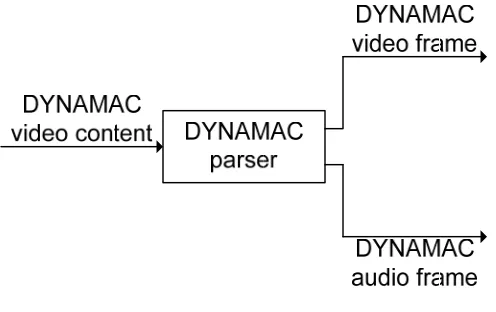
the DYNAMAC parser was created. The DYNAMAC parser takes the interleaved
media stream from the Datasource, extracts the tracks from the Datasource, and
provides methods so the player can read an entire DYNAMAC video or
[image:16.612.184.432.412.568.2]DYNAMAC audio frame depending on the track.
Figure 4: DYNAMAC parser data flow diagram
Unlike the Datasource, the DYNAMAC parser has to know the structure of the
file header
DYNAMAC video frame
DYNAMAC audio frame
DYNAMAC video frame
[image:17.612.230.381.69.399.2]DYNAMAC audio frame
Figure 3: DYNAMAC video file structure
The video file structure consists in three parts: the file header, a video frame,
and an audio frame.
2.1.2.1 File Header
Figure 4: File header structure
The file header consists of 16 bytes divided into 10 fields. The fields on the
file header are used to determine the amount of d-bites in a video frame and the
amount of d-bites in an audio frame. The first field is the byteorder which
indicates the byte order (big endian or little endian) used while writing the file.
The # frames field is the number of frames contain in the file or stream. The
sample per second field indicates the sampling rate of the audio frames. The #
image channels field indicates if the video frame is based on a 8 bit pixel or 24 bit
pixel. The # audio channels field indicates if the audio track is mono or stereo.
byteorder # frames framerate sample per second # image channels image Ns iX 1 byte 4 bytes 1 byte 2 byte 1 byte
# audio channels
1 byte 1 byte
audio Ns
The image Ns and audio Ns fields represent the DYNAMAC transform factor
used for compression. Finally the iX and iY fields are the number of width and
length pixels of the video frames.
[image:18.612.93.493.619.712.2]2.1.2.2 DYNAMAC video frame
Figure 5: d-bites inside a video frame
A usual video frame consists of 24-bit pixels, where every 8 bits represent a
color. The different combinations of red, green, and blue provide and wide range
of colors. A DYNAMAC video frame is no different. The DYNAMAC video frame
is build up of several d-bites representing the red, green, and blue components of
the original video frame. So the combination of blue, green, and red d-bites
represents a sequence of pixels in the frame.
2.1.2.3 DYNAMAC audio frame
Figure 5: d-bites inside an audio frame
A wave sound usually consists of one or two channels. When a wave sound
has only one channel it is call mono, and when a wave sound has two channels it
is call stereo. So a stereo song has a left channel and a right channel. And just
like a DYNAMAC video frame resembles a RGB video frame, the DYNAMAC
audio frame resembles a wave audio frame by compressing the left channel and
the right channel into d-bites. So each pair of d-bites represents the left channel
and the right channel of a sequence of stereo samples in the audio frame.
Figure 6: video and audio d-bite structure
As mention earlier, the information required by the DYNAMAC algorithm to
match specific waveforms on the chaotic matrix with the digital sequence that it
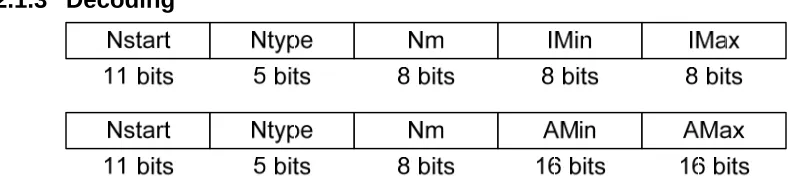
represents on a video or audio frame is call a d-bite. Regardless that the d-bite
may be an audio d-bite or a video d-bite, it is made up of five fields. The Nstart
field represents the X position in the chaotic matrix of the waveform that
resembles a bit sequence of the original frame. The Ntype field is used as the
index of the ordering key. The value of the ordering key represents the Y
position in the chaotic matrix of the waveform mention before. The length of the
waveform is determined by the Ns value in the file header and the Nm value of
the d-bite. After normalizing and processing the waveform in relation to the Min
and Max fields of the d-bite, the resulting bit sequence is used to recreate the
media frame.
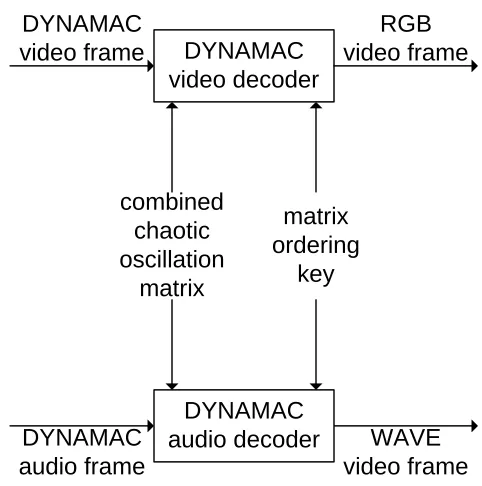
So after the player has demultiplexed the media stream into an audio track
and a video track, each track needs to be decoded. That’s exactly what the
DYNAMAC video decoder and DYNAMAC audio decoder do.
DYNAMAC video decoder combined chaotic oscillation matrix matrix ordering key DYNAMAC video frame DYNAMAC audio frame DYNAMAC audio decoder RGB video frame WAVE video frame
[image:19.612.184.425.420.663.2]Each decoder processes on a frame by frame basis. The DYNAMAC video
decoder starts by receiving the DYNAMAC video frame. Once the frame is ready
to be processed, the video decoder reads a red, green, and blue set of d-bites to
get the waveforms inside the chaotic oscillation matrix. These waveforms are
then normalized and combine to create the sequence of pixels compressed by
the DYNAMAC algorithm. The process is repeated until all the d-bites are read
and the RGB video frame is full.
The DYNAMAC audio decoder does a similar process. After receiving the
DYNAMAC audio frame, the audio decoder reads the left and right d-bites to get
the waveforms inside the chaotic oscillation matrix. The waveforms are then
normalized and combine to create the samples of wave sound compressed by
the DYNAMAC algorithm. This process is repeated until all the d-bites are read
and the WAVE audio frame is full.
2.1.4 Rendering
Figure 8: Final step of the DYNAMAC player
Rendering is the process of showing the media content in an output device.
Once the DYNAMAC frame is decompress, the final step is to render it. The
output of the DYNAMAC video decoder is render on screen, while the output of
2.2 DYNAMAC Media Server
Figure 9: DYNAMAC Media Server Component Diagram
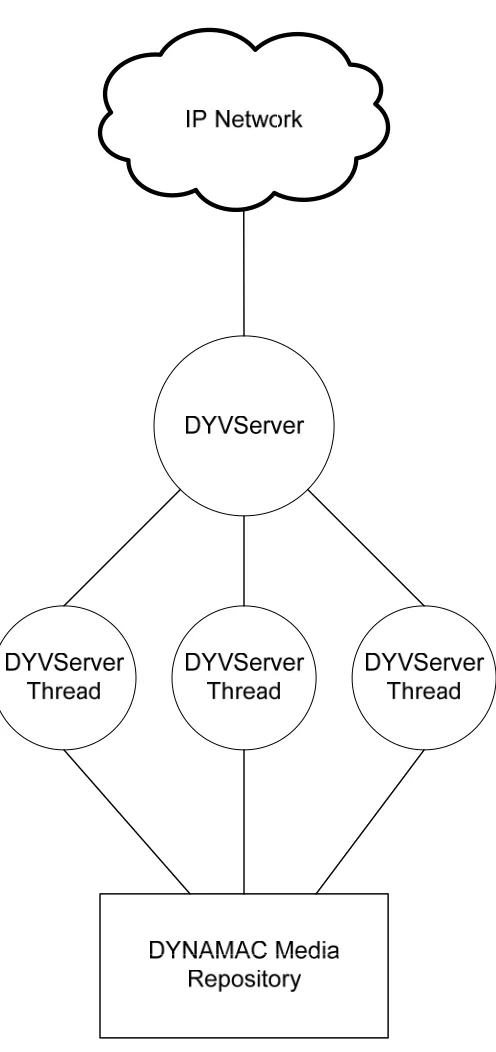
The DYNAMAC Media Server consists of three components required to
provide several clients with DYNAMAC media content at the same time. The
DYVServer is the main component in charge of accepting the request for
Once the connection has been established, the DYVServer creates a new
DYVServerThread to handle that new media request. The DYVServerThread
starts communicating with the client using the DYNAMAC protocol and access
the media content located on the DYNAMAC Media Repository.
The DYNAMAC Media Repository is made up of all the DYNAMAC media
files located on the server, and a list of these files.
2.3 DYNAMAC Protocol
As mention earlier, the DYNAMAC protocol is the standard followed by the
DYNAMAC client and the DYNAMAC media server to communicate with each
other. With the DYNAMAC protocol they are able to exchange the information
and d-bites required to play the media content.
Figure 10: DYNAMAC protocol process (part 1)
Figure 10: DYNAMAC protocol process (part 3)
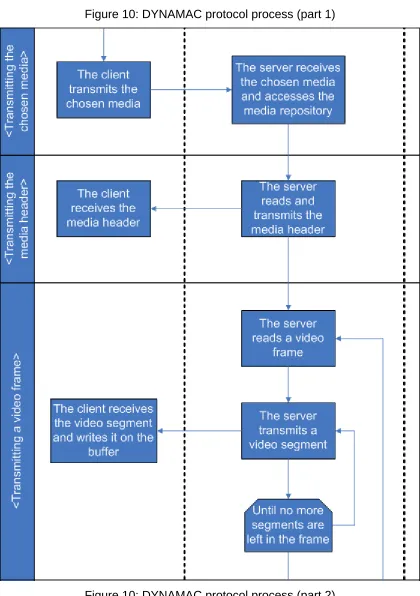
The protocol starts when the client attempts to make a TCP/IP connection
with the DYNAMAC media server. The media server is constantly listening for
any incoming connections, when the client tries to make the connection, the
media server accepts it. Once the connection has been established, the media
server transmits a list of all the media content residing in the DYNAMAC Media
Repository on the server’s side. Once the media list is on the client side, a
media is selected and transmitted to the media server. The server then opens
the media content and sends the header (see Figure #4) to the client. Both the
server and the client use the media header to calculate the amount of frames that
are going to be transmitted, the amount of segments inside a video frame, and
Since the media content is interleaved video and audio content, the same
thing happens in the transmission. First a video frame is sent and then an audio
frame is sent. Because of the size of a video frame, the frame is divided into
segments. Every segment is transmitted in a single packet, until the entire video
frame has been sent. Then an entire audio frame is transmitted. These steps
are repeated until the entire media content has been sent.
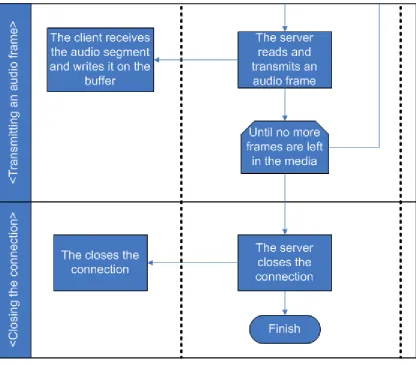
To finish the protocol process, the media server closes the connection with
the client.
[image:25.612.99.508.308.438.2]2.3.2 DYNAMAC Protocol Packet
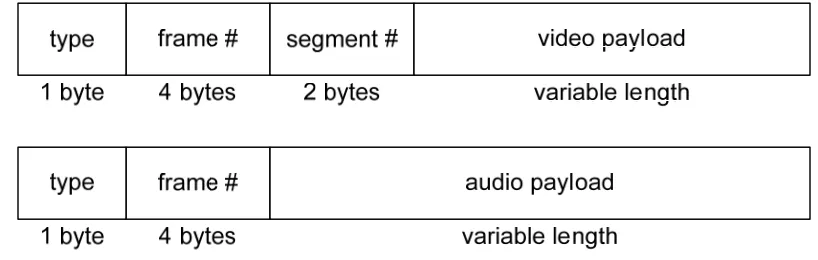
Figure 11: DYNAMAC protocol media packet structure
As mention in the protocol process, the size of the packets used to send the
actual media content are decided at run time by the media header. Using the
header, the DYNAMAC player and media server know the amount of d-bites in a
video and audio frame, and the width of a video frame used to divide the frame
into segments.
The packet also contains information required to reassemble the media
content on the other side. For instance, the video packet transmits the frame
number and the segment number of the video frame the d-bites in the payload
belong to. The same goes for the audio packets; they contain the frame number
identifies them. A type 1 indicates a video packet and a type 2 indicates an
audio packet.
The length of both video packets and audio packets is calculated in order to
determine the buffer size required by the client and the server. If the video
packet is larger than the audio packet, then the buffer size is equal to the video
Chapter 3
Results
By following the approach mention before and developing the system, several
video files are played to demonstrate the functionalities of the DYNAMAC
algorithm and the DYNAMAC media distribution system.
3.1 Digital Rights Management
[image:27.612.92.522.267.471.2]right key wrong key
Figure 12: Example of digital right management
As mention earlier, the decoding process requires a special key to determine
the specific waveform represented by a d-bite. This special key is the digital
rights management feature embedded in the DYNAMAC algorithm.
right key tV9E0WSoYb56NkqpvVaYeH8nOTg
wrong key tV9E0WSNkqpvVaYeH8nOTg4kfjh
In Figure 12 it can be seen what happens when the wrong key is used to play
extracted from the chaotic oscillation matrix. Even with similar keys as long as
the right key isn’t used, the video is going to look scramble.
3.2 Content Distribution
Content distribution is achieved by transferring videos from the server to the
client using the DYNAMAC protocol over TCP/IP. By examining the packet
format of the DYNAMAC protocol, we can calculate the maximum length of a
video, and the maximum size of a single frame to demonstrate the capabilities of
the protocol.
With a 32 bit number representing the frame number, we have that
232 – 1 = 4,294,967,295
meaning that we can transfer up to 4,294,967,295 frames in a single connection.
In other words a video being transfer may have up to 4,294,967,295 frames long.
To know how long this value means in time we calculated based on the following
premise: 30 frames represent a second of video content
4,294,967,295 frames x (1 second / 30 frames) = 143,165,576 seconds
= 2,386,092 minutes
= 39,768 hours
The protocol also has 16-bits that represents the sequence number inside the
frame. Since the sequence number is based on the width of the video frame,
216 – 1 = 65,535
it means that a video frame may have a width of 65,535 pixels. Currently a
Estimating that a movies like Lord of the Rings and Kingdom in Heaven are
approximately two and one half hours long, by our calculations we can state that
the DYNAMAC protocol is capable of handling any video content with HDTV
Chapter 4
Future Work
The first steps have been given in order to provide a system capable of
distributing high definition images anywhere in the world while having the ability
to manage digital rights of the media content being shared.
But still some work needs to be done. Normal video decoding on the player
side usually has a processing factor of 30 frames per second, but because of the
current decoding algorithm, the processing factor of the DYNAMAC player is 10
frames per second. This processing factor produces a slow motion effect when
rendering a video.
Since the DYNAMAC player was developed using the Java Media
Frameworks, there is an issue when it comes to sound rendering. The video and
sound rendering components describe on Chapter 2 are inherited from the Java
Media Frameworks. On a Windows computer these components rely on the
DirectX software that comes with the operating system. Because of the
DirectSound cooperative level used by the Java Media Frameworks,8 the sound
card buffer discards the sampling rate of the media and always renders it a 22.05
kHz. This causes audio sound to have a “chipmunk” effect because the sound is
sampled at 44.1 kHz and it is played at 22.05 kHz.
Currently the DYNAMAC media distribution system is develop to only support
video distribution, so a new DataSource that supports dynamac/audio content
type and a modification in the DYNAMAC protocol are needed to support audio
content.
Finally the DYNAMAC media distribution system is still in an developing stage
Chapter 5
Conclusion
By following the approach mention on this paper we have created a system
capable of distributing media content on an IP network. We have demonstrated
the features of the DYNAMAC algorithm when it comes to digital rights
management and data compression in a practical scenario. We demonstrated
the capability of the DYNAMAC protocol to handle any kind of video content wit
the highest quality that currently exists. We have concluded that more work
needs to be done on the compression/decompression algorithm in order to
achieve faster video processing time and therefore real time motion. We foresee
that the steps taken today will help create a better future were media content on
demand will be available for everyone, not just for entertainment but for
educational purposes like online learning and even in the enterprise world were
people won’t be limited to send email messages, but audio and even video
List of References
1 Mack, S., “Streaming Media Bible”, Hungry Minds, Inc., 2002
2
Austerberry, D., “The Technology of Audio and Video Streaming, Second Edition”, Focal Press, 2005.
3
Newton, H., Horak, R., “Newton’s Telecom Dictionary, 20th Edition”, CMP Books, 2004.
4
Austerberry, D., “Digital Asset Management: How to Realize the Value of Video and Image Libraries”, Focal Press, 2004.
5
Glenn, C, M., Eastman, M., and Paliwali, G., “A New Digital Image
Compression Algorithm Based on Nonlinear Dynamical Systems”, International Association for the Development of Advances in Technology, 2005.
6
http://en.wikipedia.org/wiki/Infinite_monkey_theorem, “Infinite Monkey Theorem”
7
Glenn, C, M., Eastman, M., and Curtis, N., “Digital Rights Management and Streaming of Audio, Video, and Image Data Using a New Dynamical Systems Based Compression Algorithm”, International Association for the Development of Advances in Technology, 2005.
8