7509
MODELING OF CRIME PREVENTION SYSTEM USING
LOCATION-BASED SERVICE
1SANG-HYOCK PARK, 2KOO-RARK PARK, 3JOON-YONG KIM
1School of Multimedia Engineering, Kongju National University, Korea
2
Key
Laboratory of Computer Science & Engineering, Kongju National University, Korea3School of Computer Engineering, Kongju National University, Korea
E-mail: 1[email protected], 2[email protected] , 3[email protected]
ABSTRACT
In modern society, smartphone has become one of the most important means that is not separable from our actual life. Nowadays, we are able to be easily introduced to people of the opposite sex through mobile social dating apps. Mobile social dating apps are advantageous in that they allow us to be easily introduced to people of the opposite sex whereas they are disadvantageous in that they are vulnerable to exposure to crime since they do not feature a function that would provide users with an opportunity to go on an actual date.
In this thesis, the major mobile social dating apps in Korea were analyzed, and a system that can be used to manage the actual dating phase serving as the vulnerability among these apps was designed and implemented. This system was implemented so that, once users use the GPS location-based service to confirm other users’ location and save their dating information, dating location and dating time, it saves such information to database, and, thereby, allows users to record and manage their dating phase. As a result of implementing and testing this system proposed in this thesis, it was found that users felt less insecure about their dating phase, and that this system may have an influence on crime prevention.
Keywords: Location Based Service, Social Dating, Couple Matching, Mobile Application, GPS
1. INTRODUCTION
Crimes have been occurring since the birth of mankind, and diverse legislations and methods have been studied and enforced for crime prevention. The Code of Hammurabi serving as the initial code established by ancient humans is also one of the crime prevention systems.
In our current society, crimes are shown in more diversified and severe forms due to the rapid growth of IT. In this thesis, in order to examine and resolve the problems particularly caused by the systems allowing us to develop relationship with people of the opposite sex in our modern society where diverse crimes occur, a crime prevention system using location-based service was modeled and implemented.
Meeting someone of the opposite sex is one of the important aspects in our lives. In the past, people used to be introduced to someone of the opposite sex through matchmaker, work, school
and club. Nowadays, due to the universalization of internet and smartphone, people are able to easily meet someone of the opposite sex through installing a mobile social dating app and uploading their profile. The global mobile social dating app market has been showing a rapid growth. In Korea, the market has been showing a rapid growth since 2010, and has reached a market size worth approximately 10 billion won in 2015.
7510 sexual assault, rape, prostitution, violence, threat and narcotic crime are committed in the actual dating phase by those abusing the vulnerability of such mobile social dating apps. Accordingly, it is necessary to come up with a measure that can be used to prevent crimes occurring through mobile social dating apps.
In this thesis, a system capable of enhancing the crime prevention effects was modeled and implemented so that it allows users to not only use the GPS location-based service to confirm other users’ location on a real-time basis and save their dating information, dating location and dating time, but also confirm the information saved to database.
This thesis is constructed as follows. In Chapter 2, the related researches for implementing the proposed system are discussed. In Chapter 3, how the crime prevention system using location-based service proposed in this thesis is structured is explained. In Chapter 4, the experimental result is explained. In Chapter 5, the conclusion is discussed.
2. RELATED RESEARCHES
2.1 GPS-based Electronic Monitoring Applied to Electronic Anklet
Electronic anklet is used to confirm the current location of the person wearing it on a real-time basis through the use of GPS and mobile communication network. In the early 1980’s, the GPS-based electronic monitoring using satellite communication information was initially applied in New Mexico and Florida. The application of GPS to the electronic monitoring of criminals went full scale in the United States when private security companies specializing in GPS-based electronic monitoring started combining the satellites dedicated to US Department of Defense with portable tracking devices.
In Korea, the GPS-based electronic monitoring system was triggered by the Yongsan Elementary School Sexual Assault and Murder Case which occurred in 2006, and was initially introduced in September 2008 to target particularly high-risk criminals such as sexual assault criminals. In 2010, the scope of electronic anklet included murder criminals, and in December 2012, it included robbery criminals.
Such GPS-based electronic monitoring can be divided into the “passive” type and “active” type. The “passive” type is an old GPS-based tracking method where the wearer’s location is monitored at intervals of a few hours to be reported to the probation office, and the “active” type is a new real-time monitoring method where the criminal’s location is monitored at intervals of a few seconds.
In Korea, the electronic anklet used for monitoring criminals consists of the followings: a GPS-based tracking device, an attachment device and a home monitoring device. The electronic anklet wearers are required to carry such tracking device at all times, and such tracking device not only continuously detects the electromagnetic waves transmitted from the attachment device worn on the ankle, but also sends the data to the home
monitoring device through the mobile
communication network. Then, it becomes possible for the central control center to immediately not only identify the current location and identity of the electronic anklet wearers, but also confirm whether or not the tracking device and attachment device are currently worn. In addition, in order to continuously monitor the electronic anklet wearers even in places where satellite signals cannot be received using a normal method, the GPS equipment are installed within the subway, so that external signals can be received for monitoring purpose.
2.2 Cases of Damage by Korean Mobile Social Dating Apps
Mobile social dating apps are
advantageous in that people are able to meet someone of the opposite sex, whereas they are disadvantages in that they are vulnerable to exposure to crime since they do not feature a function that would prevent users from falsifying their profile, nor a function that would provide users with an opportunity to go on an actual date. It can be frequently seen through the press that not only sexual crime cases such as sexual assault and rape, but also other crime cases such as robbery, assault and threat are committed among mobile social dating app users. In addition, the users of one mobile social dating app service are defenselessly exposed to sexual crimes such as string-attached date and prostitution.
7511 experienced the service-related damage from 2014 to May 2015.
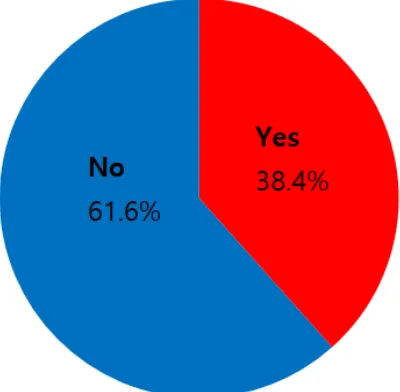
The following Figure 1 shows the results of a survey on experience of false profile information
[image:3.612.95.295.166.362.2]entry on mobile social dating app.
Figure 1. Experience of False Profile Information Entry on Mobile Social Dating App
[image:3.612.93.298.455.529.2]The following Table 1 shows a list of falsely entered profile information.
Table 1. List of Falsely Entered Profile Information (Multiple Response)
Appearance 19%
Occupation 15.4%
Personality(Preference) 15.4% Academic Background 12.4%
Region 11.2%
[image:3.612.316.522.545.608.2]The following Table 2 shows the cases and types of damage experienced by the mobile social dating app service users.
Table 2. Cases/Types of Damage Experienced by Mobile Social Dating App Users
Have experience of damage None
49.8% (249 persons)
Unwanted continuous contact 24.4%
50.2% (251 persons) Indecent conversation or
inducement of sexual contact 23.8%
Personal information extrusion 16.0%
Money request 10.2%
Etc 9.0%
2.3 Cases of GPS Location-based Service App
GPS originally developed to serve military purposes is currently mainly used as a navigation system for airplane, ship and automobile. In the fields of smartphone and tablet PC, GPS location-based service is used to develop and service apps that provide diverse contents. Companies that provide mobile app services through such GPS location-based service acquire their users’ consent as they install the app in order to utilize their current location for provision of services. Apps utilizing users’ current location are being developed and serviced in various fields, and the information provided by such apps are as follows: navigation information, famous restaurant information, close involved SNS app user information, suburban travel destination information, augmented reality and location-based public safety. Accordingly, the location-based service market has been indicating a great growth each year.
The following Table 3 shows the sales volume of the location-based service industry in Korea reported by KISA in May 2017, and Table 4 shows the percentage and sales per each significant service utilizing location information.
Table 3. Sales Volume of Location-based Service Industry in Korea
Year Amount(Unit: 1 Million Won)
2016 830,234
2017 976,988(Estimated) 2018 1,218,851(Estimated)
Table 4. Percentage & Sales of Each Significant Service Utilizing Location Information
Percentage(Unit: %) Sales(Unit: 100 Million Won) Control Service(23.1) O2OService(563)
Safety Service(12.3) Control Service(438) O2O Service(10.8) IoT Service(252)
[image:3.612.91.299.599.736.2]7512 of location-based service: analysis/provision of big data, O2O service, IoT Service, etc..
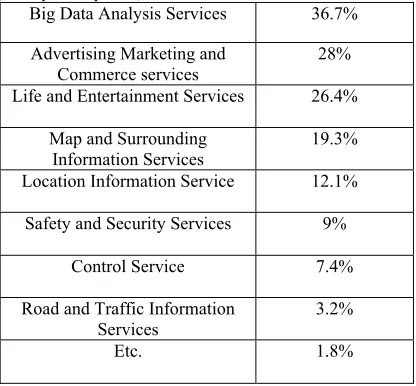
[image:4.612.91.299.190.383.2]The following Table 5 shows New business plan for service and contents in the future.
Table 5. New business plan for service and contents (Multiple Response)
Big Data Analysis Services 36.7%
Advertising Marketing and Commerce services
28%
Life and Entertainment Services 26.4%
Map and Surrounding Information Services
19.3%
Location Information Service 12.1%
Safety and Security Services 9%
Control Service 7.4%
Road and Traffic Information
Services 3.2%
Etc. 1.8%
Mobile social dating apps utilizing location-based services through GPS have been providing their users with not only the distance to the introduced opposite sex calculated into numerical values, but also the approximate regional information of the introduced opposite sex calculated into numerical values. Since the use of smartphone has been universalized, a number of location-based SNS apps have been developed based on the themes of making friends in vicinity, social dating and speed dating, and have been having a high market share in terms of market breadth.
2.4 Market Breadth of Mobile Social Dating App & Cause of Growth
Social dating apps are only second to game apps in terms of Google Play Store sales amount ranking. Therefore, a date category exists in the Play Store. Companies specializing in social dating apps already have been indicating a significant growth in the overseas markets.
The market in the U.S. serving as the world’s largest social dating app market is worth 4.5 trillion won. In the U.S., Tinder’s parent company known as Match Group was listed on the Nasdaq Stock Market in 2015 with its enterprise value at 4 trillion won, and more than 5 million
people from approximately 190 nations are currently using Tinder.
Japan’s social dating app market is estimated to be worth 1 trillion won, and China’s social dating app market is estimated to be worth 1.8 trillion won as of 2016. Momo, the most representative dating app used in China, has resulted in approximately 110 billion won as its net profit per quarter. It is currently used by approximately 450 million people, and was listed on the Nasdaq Stock Market in 2014.
Spotted, a location-based dating app used in Germany, received an investment of 14.5 million dollars in 2016, and Happn, a social dating app used in France, received an investment of 14 million dollars in 2016.
Korea’s social dating app market was estimated to be worth 50 billion won in 2015, and was estimated to be worth 70 billion won in 2016, which is a 40% increase in comparison to 2015. In addition, the number of social dating app users in Korea is currently estimated to be above 3 million people. Using the statistics measured in 2015 as the standard, the number of unmarried population aged from 25 to 44 was approximately 6 million people. Based on such number, it can be concluded that 50% of unmarried population are signed up users of a social dating app.
Table 6 shows a list of reasons collected by a marriage brokerage company based on a survey conducted among approximately 300 unmarried male/female social dating app users.
Table 6. Reason for Using Social Dating App
Male(%) Reason for Using Social Dating App
Female(%)
24 Because there is no
fine one to date 43 38 Because there is no
opportunity to meet people
39
35 Because of busy life including job
11
3 Because I lack
charms 7
7513
2.5 Major Mobile Social Dating Apps in Korea
In Korea, major mobile social dating apps share a similar phased process, but provide differentiated services in terms of detailed functions. Once any app is installed on your smartphone, the procedures required to be followed in order to be provided with the service are in a quite similar order as follows: profile registration, daily new date introduction, conversation request, conversation acceptance/refusal, conversation and texting. Most of the mobile social dating apps used in Korea introduce their users to the opposite sex based on the profile information and preferred opposite sex information entered by their users.
The difference per each phase is that the number of people of the opposite sex that users can be introduced to per day has a different limit, or that the approximate distance and location of those people of the opposite sex introduced to users are provided so that users can make more deliberate choices. Another difference is that some apps allow users to rate, evaluate and subscribe to the introduced people of the opposite sex, and also allow users to send item presents to other users as well.
In addition to most of the basic functions and information provided, in the case where users desire to see more information about other users or desire to share a conversation with another user, they are induced to make a certain In-App purchase.
In addition, mobile social dating apps feature a notification function where the notifications reported by users are used to sort out inadequate users and limit their access. Recently, the identity verification procedures have been reinforced to prevent users from illegally using someone else’s name. However, there are limits to preventing users from falsifying their profile information such as appearance, occupation and academic background.
3. Proposed System
The system proposed in this thesis is capable of making contributions to crime prevention through allowing users to use the GPS location-based service to confirm other users’ location on a real-time basis and save the actual dating information.
The following Figure 2 shows the proposed system structure.
The proposed system is structure as follows:
Initially, a database is constructed to save not only the user information, but also the data required by the main app functions.
Secondly, a web server is constructed to create a connection between the database and app.
[image:5.612.313.529.225.367.2]Thirdly, the GPS location-based service is used to confirm other users’ location on a real-time basis, and the information saved by users are immediately saved to database.
Figure 2. Proposed System Structure
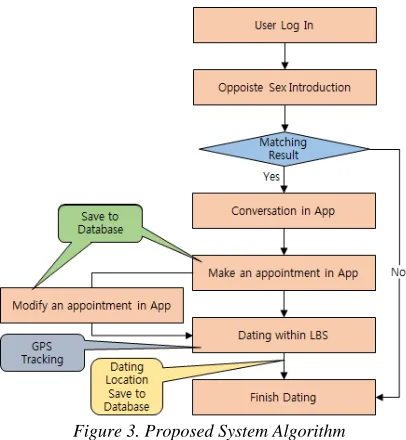
The following Figure 3 shows the proposed system algorithm.
Figure 3. Proposed System Algorithm
Initially, users will login to the app. Secondly, users will be introduced to a user of the opposite sex.
[image:5.612.313.516.426.646.2]7514 Fourthly, in the case where the both involved users are mutually accepted, they will be matched to chat and text in the app.
Fifthly, in the case where the both involved users make an appointment in the app, they will be able to register/modify their appointment time and location, and this appointment information will be saved to database.
Sixthly, by creating a connection with the set appointment information, the location of the other user will be confirmed on a real-time basis through the location-based service using GPS.
Seventhly, once the both involved users meet up at the appointment location and save the actual location, the dating time and location information will be saved to database.
4. EXPERIMENTAL RESULT
The system proposed in this thesis was implemented after constructing the database and web server so that it can be monitored in the app through using the GPS location-based service.
In order to implement the system proposed in this thesis, Maria DB was constructed as the database, and Tomcat and Apache were connected to construct the web server.
The procedures for implementing the proposed system are as follows. Initially, in the case where the GPS is turned off at the appointment time agreed between the involved users, a notice will pop up as shown in Figure 4.
Figure 4. Notice for Activation of GPS
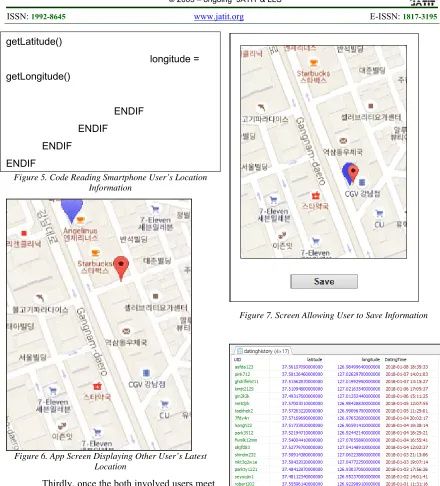
Secondly, once the GPS is turned on, the other user’s location information will be displayed in the app at certain intervals as shown in Figure 5, and the displayed location information will be saved and updated to database. To allow the involved user to monitor the latest location of the other involved user, a web page will appear in the app, and the latest location information of the other involved user updated to database will be applied to the Google Maps API displayed on the screen as shown in Figure 6.
IF (GPSEnable AND NetworkEnable) THEN IF (NetworkEnable) THEN
RequestLocationUpdates()
IF (LocationManager != NULL) THEN
Location = GetLastKnownLocation()
IF (Location != NULL) THEN
latitude = getLatitude()
longitude = getLongitude()
ENDIF ENDIF
ENDIF
IF (GPSEnable) THEN
IF (Location == NULL) THEN
RequestLocationUpdates()
IF
(LocationManager != NULL) THEN
Location = GetLastKnownLocation()
IF (Location != NULL) THEN
7515
getLatitude()
longitude = getLongitude()
ENDIF ENDIF
[image:7.612.84.524.62.548.2]ENDIF ENDIF
[image:7.612.252.519.68.368.2]Figure 5. Code Reading Smartphone User’s Location Information
Figure 6. App Screen Displaying Other User’s Latest Location
[image:7.612.90.280.154.525.2]Thirdly, once the both involved users meet up and click on the Save button shown in Figure 7, not only the actual dating time, latitude and longitude, but also the information of the other involved user will be saved to database as shown in Figure 8.
[image:7.612.315.526.407.554.2]Figure 7. Screen Allowing User to Save Information
Figure 8. Dating Information Data Saved to Database
A survey was conducted among 100 pre-existing app users to confirm the proposed system’s crime prevention effects, and the acquired results are shown in the following Table 7.
Table 7. Influence of Proposed System on Crime Prevention Effects
Survey Result(Persons) Effect
rate(%)
Effective Ineffective Abandon
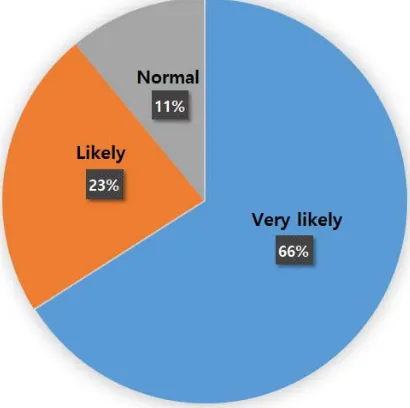
7516 The following Figure 9 shows the results acquired from a detailed survey conducted among the users who selected 'effective'.
Figure 9. Detailed Survey among Users Who Selected ‘Effective’
5. CONCLUSIONS
The system proposed in this thesis was modeled and implemented so that it not only allows users to use the GPS location-based service and Google Maps API to monitor the location of the other involved user in the app on a real-time basis, but also saves the actual dating information to database. As a result, it was able to enhance the probability of actual dating through allowing the users who made a mutual appointment to confirm each other’s location on a real-time basis. In addition, since the dating information can be saved to database, it was determined that the proposed system may not only psychologically stabilize users, but also contribute to crime prevention.
REFRENCES:
[1] Jin-Eung Choi, "Regulatory Issues and Improvement Tasks Due to Growth of Social Dating Market", "Report 1061", National Assembly Research Service (Korea), September 3, 2015.
[2] Jae-Won Kang, "A Study on Information Seeking Strategies in Social Network Dating Services : Focusing on the Relationships among
Information Seeking Strategies and
Communicator-related Factors", Korean Journal of Journalism & Communication Studies 56(5),
Korean journal of journalism & communication studies (Korea), October, 2012, pp. 65-87. [3] Sung-min Bang, Sung-su Hong, "Design and
Implementation of DGPS device-based on Smart Phone", KIISE Transactions on
Computing Practices 21(12), KIISE
Transactions on Computing Practices (Korea), December, 2015, pp. 798-803.
[4] Jae-pil Kim, Dong-cheol Lee, "Development of Mobile Location Based Service App Using Augmented Reality", Journal of the Korea Institute of Information and Communication Engineering 18(6), Journal of the Korea Institute of Information and Communication Engineering (Korea), June, 2014, pp. 1481-1487.
[5] Hyo-Jung Lee, Yoon-Ho Choi, Byoung Yup Lee, Jae-Won Lee, "Analysis and Design on Mobile Application Based Social Dating Contents", JOURNAL OF THE KOREA CONTENTS ASSOCIATION 14(4), The Korea Contents Association (Korea), April, 2014, pp. 336-345.
[6] Dae-Sik Choo, Eun-Gyeong Jang, "New dating trend 'social dating' suffered a lot", Korea Consumer Agency (Korea), May 26, 2015. [7] Youn-Oh Cho, "A Study on the Sex Offender
Perceptions of the GPS Electronic Monitoring", Korean Policy Sciences Review 17(2), Korean Policy Sciences Review (Korea), June, 2013, pp. 27-48.
[8] Tae-Myeong Kim, "Realities of Sexual Violence
and it's Countermeasures", KOREAN
CRIMINOLOGICAL REVIEW 87, KOREAN
CRIMINOLOGICAL REVIEW (Korea),
September, 2011, pp. 5-44.
[9] Bon-Woo Koo, Jae-Gil Lee, "Location tracing service based on Smart phone and GPS Module", Proceedings of the Korean Society of Computer Information Conference 20(1), The Korean Society Of Computer And Information (Korea), January, 2012, pp. 15-17.