City, University of London Institutional Repository
Citation
:
Zisman, A., Spanoudakis, G., Dooley, J. and Siveroni, I. (2013). Proactive andreactive runtime service discovery: a framework and its evaluation. IEEE Transactions on Software Engineering, 39(7), doi: 10.1109/TSE.2012.84
This is the unspecified version of the paper.
This version of the publication may differ from the final published
version.
Permanent repository link:
http://openaccess.city.ac.uk/2467/Link to published version
:
http://dx.doi.org/10.1109/TSE.2012.84Copyright and reuse:
City Research Online aims to make research
outputs of City, University of London available to a wider audience.
Copyright and Moral Rights remain with the author(s) and/or copyright
holders. URLs from City Research Online may be freely distributed and
linked to.
Proactive and Reactive Runtime Service
Discovery: A Framework and its Evaluation
A. Zisman, G. Spanoudakis, J. Dooley, I. Siveroni
Abstract — The identification of services during the execution of service-based applications to replace services in them that are no longer available and/or fail to satisfy certain requirements is an important issue. In this paper we present a framework to support runtime service discovery. This framework can execute service discovery queries in pull and push mode. In pull mode, it executes queries when a need for finding a replacement service arises. In push mode, queries are subscribed to the framework to be executed proactively, and in parallel with the operation of the application, in order to identify adequate services that could be used if the need for replacing a service arises. Hence, the proactive (push) mode of query execution makes it more likely to avoid interruptions in the operation of service-based applications when a service in them needs to be replaced at runtime. In both modes of query execution, the identification of services relies on distance-based matching of structural, behavioural, quality, and contextual characteristics of services and applications. A prototype implementation of the framework has been developed and an evaluation was carried out to assess the performance of the framework. This evaluation has shown positive results, which are discussed in the paper.
1 INTRODUCTION
Service-based applications are composed of loosely coupled autonomous computer-based entities owned by third parties known as services. These services are combined to realize applications and create dynamic business processes. Due to rapid changes in market conditions and regulations, the dynamic creation of business alliances and partner-ships, and the need to assist with changing user demands, it is necessary to provide ways of identi-fying services that can fulfill specific functional and quality characteristics of service-based applica-tions. The identification of such services is known in the literature as service discovery and has been an important topic of research over the last few years.
Several approaches have been developed to support service discovery, broadly classified as stat-ic [20][24][30][47] and dynamic [10][13][38][48]
approaches. In static service discovery, services are identified during the development of service-based applications and bound to these applications prior to execution. In dynamic (aka runtime) service dis-covery, services are identified and bound to service-based applications during the execution of the ap-plications. This may be necessary in order to re-place existing services in an application and allow the application to continue its execution.
The need to replace services during the execution of a service-based application may arise due to different cir-cumstances such as (a) the unavailability or malfunction-ing of a service used in the application; (b) changes in the structure (i.e., interface), functionality, quality properties, or the context of services used in the application that make them no longer appropriate or the best option for the role they fulfill; (c) changes in the context of an appli-cation that can also make used services no longer appro-priate or the best option for the role they fulfill; or (d) the emergence of new services that can fulfill the role of an existing service in an application in a better way than the current service. In the above cases, the term “context” signifies information about the operational environment of an application or a service that changes dynamically (e.g., location, workloads, network availability) and can affect the adequacy of a service for an application.
The above circumstances give rise to a basic research challenge, i.e., how to support service-based applications when the services that they use disappear or stop func-tioning as expected, as well as in the presence of continu-ously changing contexts of both the applications and their
————————————————
• A. Zisman is with School of Informatics, City University London, North-ampton Square, London EC1V 0HB, UK, E-mail: [email protected].
• G. Spanoudakis is with School of Informatics, City University London, Northampton Square, London, EC1V 0HB, UK, E-mail:
• J. Dooley is with School of Computer Science and Electronic Engineering, University of Essex, Colchester CO4 3SQ, UK, E-mail: [email protected].
services at runtime. Addressing this challenge requires a dynamic and flexible identification of services during the execution time of service-based applications.
Most of the current approaches for dynamic service discovery support a classic pull mode of query execution. This mode is often not effective. This is because the dis-covery process is triggered only after the need for a new service arises (as in case (a) above) and it may take con-siderable time to complete, affecting the performance of the application and its ability to produce acceptable “real time” response to the user. It should also be noted that pull mode discovery cannot identify better services (as in case (d) above) before a problem with an existing service that would trigger the execution of a query arises. Simi-larly, for cases (b) and (c) above, pull mode discovery would need to wait until the changes that made used ser-vices be inadequate arise at runtime as in case (a). Alter-natively, the pull mode of query execution would need to be enhanced with mechanisms for polling regularly ser-vice registries and/or context information resources to identify changes that can lead to subsequent problems. Such polling would consume significant computational resources, as it would need to be executed at regular in-tervals even if there is no need to do so (i.e., in the ab-sence of service context changes, application environment context changes, or emergence of new services).
Furthermore, existing approaches to service discovery (with the exception of [48]) do not consider different characteristics of the application such as structural, be-havioural, quality, and contextual aspects, at the same time when attempting to identify services.
To address the limitations of existing approaches, we present a service discovery framework that supports runtime service discovery based on complex queries that can express flexible combinations of structural, behav-ioural, quality, and contextual conditions. These queries are specified in an XML-based query language, called SerDiQueL. The framework assumes services that have multi-faceted descriptions including service interface, behaviour, quality, and context descriptions.
To support all cases (a) to (d) above and avoid the drawbacks of traditional polling mechanisms, our framework allows service discovery based on both reac-tive (pull) and proacreac-tive (push) query execution modes. Pull mode query execution is triggered in cases like (a) above. In push mode, query execution is performed in parallel to the execution of the application using pre-subscribed queries. These queries are associated with spe-cific services in an application and aim to maintain up-to-date sets of candiup-to-date replacement services for these ser-vices. In both modes, query execution is based on match-ing and the computation of distances between query and service specifications.
The work presented in this paper has been carried out as part of a European research project focusing on the develop-ment of service based grid applications (GREDIA [19]) and is based on scenarios identified in different industrial domains including media and banking. Previous work on our runtime discovery framework has been presented in
[14][32][49][61][62]. The new version of the runtime
framework presented in this paper incorporates two main extensions. The first of these extensions is the develop-ment of an XML-based query language to support the specification of service discovery queries of both push and pull types, including the specification of service be-havioural conditions in queries. The language for express-ing behavioural query conditions was introduced to re-place the specification of such conditions using BPEL in earlier versions of the framework [62]. The new language allows for the declarative specification of partial behav-ioural conditions for services rather than requiring the specification of complete procedural models of expected service behaviour, as in the original version of the frame-work, that that was cumbersome.
The second extension of the framework is the devel-opment of a new behavioural matching process and the use of a new behavioural distance for evaluating the be-havioural conditions expressed in the new query lan-guage. Furthermore, in this paper we give an integrated description of the framework covering all its parts and present the results of a thorough performance evaluation of it. We also provide a critical comparison of the frame-work in the context of related literature.
The remainder of this paper is structured as follows. Section 2 presents descriptions of discovery scenarios that will be used throughout the paper to illustrate the work and an overview of how our discovery framework sup-ports these scenarios. Section 3 describes the service dis-covery query language of the framework. Section 4 pre-sents the service discovery process supported by the framework. Section 5 presents an evaluation of the ap-proach. Section 6 discusses related work and, finally, Sec-tion 7 presents conclusions and plans for of future work.
2 OVERVIEW
In this section, we present scenarios for runtime service discovery and give an overall description of how our framework can be used to address these scenarios.
2.1 Runtime service discovery scenarios
Various scenarios regarding runtime service discovery can be identified in reference to a mobile service-based application, called on-the-go-News.
from; (ii) display news about a topic from various sources; (iii) create customized on-the-fly “magazines” or with information from several different news sites; (iv) flip through articles in a customized magazine from sev-eral sources; (v) obtain and pay for the non freely availa-ble information charging the amount in the user’s phone bill at the end of the month, and (vi) see the new balance of their phone bill after using the application for (v).
on-the-go-News uses an external service, called SSearch,
which searches different news sites to identify news about specific topics, and another service, called SCustMag,
enabling the amalgamation of news and their customized appearance in an on-the-fly magazine.
One runtime service discovery scenario can arise if af-ter receiving a request for news on a specific topic, on-the-go-News fails to contact SSearch due to the fact that the latter
service is unavailable (Case (a)). In this case, the applica-tion will need to identify a new service to replace SSearch.
After the new service is identified and bound to on-the-go-News, the user who issued the request will start receiving the requested information from various sites.
A second scenario, may arise if a user who is interested on having an on-the-fly magazine about climate change on his mobile phone and created such a magazine using SCustMag, starts getting a slow response from SCustMag as the
service is used by many different users simultaneously (Case (b)). In such cases, an alternative service for SCustMag
with acceptable response time will need to be identified and bound to on-the-go-News.
A third scenario arises when, whilst a user of on-the-go-News is travelling by train, he looses access to the service that displays and supports flipping through news, (i.e., a service called SDisFlip) since SDisFlip cannot be accessed at his
current location. This change in the location of on-the-go-News (Case c) requires searching for an alternative service that could be used in the user’s current location.
A fourth scenario arises when a new service that al-lows payments by debiting the user’s bank account and credit card payments, instead of charging the user’s phone bill becomes available (Case d). If flexibility in payment is desirable in on-the-go-News, the new service should be bound to the application.
2.2 Framework support
To support cases (a)-(d) above, on-the-go-News will need to perform different types of runtime service dis-covery. In case (a), there will be a need to discover a new service following an exception at the point where the ap-plication tries to call SSearch. In case (b), it will need to
dis-cover a new service to replace SCustMag when a
deteriora-tion of the performance of this service is detected. In case (c), it will need to identify services that can only be used when the device on which the application runs is at
spe-cific location(s). Finally, in case (d) it will need to identify that a new service that can be used in it has emerged and should be used, as it has a better fit with the service dis-covery criteria, to enhance the overall level of service to the user. The former three of these discovery scenarios could be undertaken re-actively (i.e., after the
event/problem that signals the discovery need occurs) or proactively in order to ensure minimal interruption of service when the problem occurs. The discovery action related to the fourth case (i.e., case (d)) needs to be taken proactively as the emergence of a new service is not asso-ciated with any problem in the operation of the service based application.
Our framework enables service-based applications, like on-the-go-News to address such runtime discovery scenarios both in a reactive and a proactive manner with-out having to incorporate code implementing the discov-ery functionality required in each case. To achieve this, an application must:
(i) register to the framework a list of service endpoints that it wishes to use (and potentially replace) along with one query for each such service that should be used for discovering alternatives to it; and
(ii)call operations of the registered services through the framework.
Actions (i) and (ii) are realized by an API that is avail-able through the discovery framework. Action (i) must take place at the start of each execution of the application but will have no new effect, if it has already been execut-ed previously.
At runtime when the application calls an operation of a registered service, the framework accepts the call and tries to call the relevant operation. If the service that pro-vides the operation is not available and the second call fails, the framework will attempt to respond to the appli-cation request by calling a corresponding operation of an alternative service. The operation to be called is deter-mined by the execution of the query. More specifically, if the query has been subscribed as a reactive (pull) mode query, the framework will execute the query immediately after the failed call to S and if it can find an alternative service with a suitable operation it will call this operation. If the query has been subscribed as a proactive (push) mode query, the framework will have proactively execut-ed the query and built a set of possible alternative ser-vices for S by the time of the failed call1. Thus, if S is
una-vailable and the call fails, the framework will select the best service in the already built alternative set of services (say service S’), make a call to a corresponding operation of S’, and respond back to the application when it receives
1 If a call is made so early that no proactive execution of the query has
a response from S’. Following this initial replacement, S’ will continue to be used in the place of S until an event that makes it necessary to replace S’ occurs.
[image:5.567.34.536.55.213.2]The query associated with a service S will be used to identify alternative candidate services for S that could be used anytime that a need to replace S within an applica-tion arises, regardless of the exact event that signaled the need for the replacement of S (e.g., failed call to an opera-tion of S, deterioraopera-tion of the performance of S, unavaila-bility of S due to location changes).
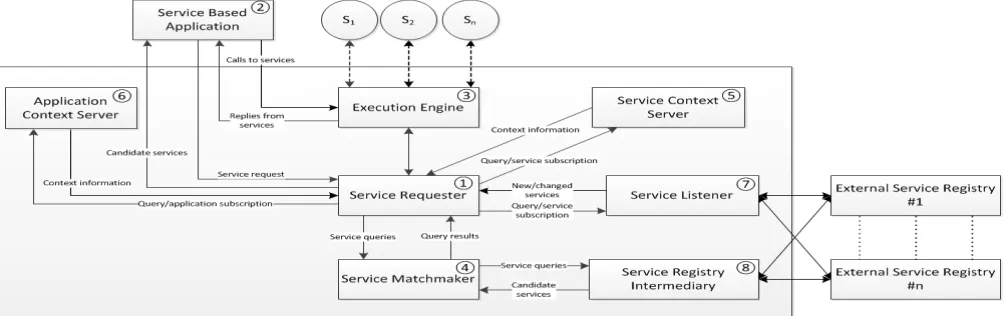
Figure 1 shows the overall architecture of the runtime service discovery framework, shortly referred to as RSDF in the following, and its main components. These
compo-nents are an execution engine, a service requester, a service matchmaker, a service listener, service and application context servers, and a service registry intermediary.
The service requester orchestrates the functionality of-fered by the other components in the framework. It re-ceives a service request from a client service-based applica-tion as well as context information about the services and application environment, (b) prepares service queries to be evaluated, (c) organises the results of a query into an ordered set of matching services, (d) manages push query execution mode subscriptions, (e) receives information from listeners about new services that become available or changes to existing services, and (f) invokes the other components to execute a query.
Fig 1: Framework Architecture
[image:5.567.32.534.471.754.2]Service-based applications make a call to a service through the execution engine. After receiving a request
for a service, the execution engine retrieves the actual service endpoint from the service requester and calls the service. When the service replies, the execution engine forwards the reply to the application.
The service matchmaker parses service
discov-ery queries and evaluates them against service specifications in the various service registries (see Sec. 4.1).
The service and application contextservers (
and respectively) support the acquisition of
con-text information about the services and the applica-tion environment, respectively. Both context serv-ers accept subscriptions for specific types of context information from the service requester and send updates when changes in the context of services and application occur. These two servers can be deployed in different machines from the ones where the application and services are deployed and even implemented as services.
The service listener sends to the service
re-quester notifications about new services that be-come available, or about changes in the descrip-tions of existing services. This information is ex-tracted from external service registries through polling. The notifications are based on subscrip-tions for specific types of information that the ser-vice requester has made to the serser-vice listener. Fol-lowing the notification of a new service, the service requester evaluates whether the new service matches with any of the queries and, if it does, the requester notifies the service context server so that the context conditions of the service can subse-quently be observed.
Finally, RSDF incorporates a service registry in-termediary supporting the use of different service
registries and the discovery of services stored in them by providing an interface for accessing the registries. The current implementation of RSDF supports registries that are based on the faceted service description scheme developed in the SeCSE project [44]. In this scheme, a service is specified by a set of XML facets representing different service aspects, including (i) structural facets describing the operations of services with their data types
us-ing WSDL [55], (ii) behavioural facets describus-ing behavioural models of services in BPEL [8], (iii) quality of service facets describing quality aspects of services represented in XML-based schemas, and (iv) context facets describing the types of context information that are available for a service and op-erations.
3 SERVICE DISCOVERY QUERY LANGUAGE
A runtime service discovery query may contain different criteria, namely: (i) structural criteria, describing the interface of the required service; (ii) behavioural criteria, describing the functionality of the required service; and (iii) constraints, specifying additional conditions for the service to be discovered. The latter conditions may refer to quality aspects of the required service or interface characteristics of services that cannot be represented by the standardised forms of structural descriptions used in the framework. Examples of constraints referring to quality characteristics of services may concern the maximum response time or cost to execute a certain operation in a service. Sec. 3.3 provides examples of additional structural constraints.
The constraints in a query can be contextual or non-contextual. A contextual constraint is concerned with information that changes dynamically during the operation of the service-based application or the services that the application deploys, while a non-contextual constraint is concerned with static information. The constraints can be hard or soft. A hard constraint must be satisfied by all discovered services for a query and is used to filter services that do not comply with them. Soft constraints do not need to be satisfied by all discovered services, but are used to rank candidate services.
To specify runtime service discovery queries, we have developed an XML-based language, called SerDiQueL. SerDiQueL allows the specification of all the structural, behavioural, quality and contextual characteristics required from the services to be discovered. An earlier version of SerDiQueL was presented in [49]. The new version of the language that we present in this paper enables the specification of the required behaviour of a service using behavioural conditions rather than a full BPEL model of service behaviour as in the original version.
Figure 2 gives an overall representation of SerDiQueL as a UML class diagram. As shown in the figure, a SerDiQueL query (ServiceQuery) has a unique identifier (queryID) and a name, and is composed of one or more elements describing different parameters for a query and three other elements representing the structural,
behavioural, and constraint sub-queries.
(c) mode of execution (push or pull), (d) author, and (e) distance threshold for selecting the set of candidate replacement services (see Sec. 4). Below, we describe the main constructs for specifying structural, behavioural, and constraint sub-queries in SerDiQueL. However, a detailed description of the XML schema of the language is beyond the scope of this paper and can be found in [16].
In order to illustrate the use of SerDiQueL, let us re-consider on-the-go-News, the service-based ap-plication described in Sec. 2.1, and a service SPayment
that is used by on-the-go-News to take payments for received news by transferring money from the us-er’s bank account, after checking for the account’s balance (SPayment is similar to PayPal [43]). If SPayment
becomes unavailable, a query would need to be ex-ecuted to find an adequate replacement service for SPayment. Let us assume that this query would need to
express the following discovery criteria:
(i) The service should authenticate its user before allowing access to its functionality.
(ii) The service should be provided by “Banca Pop-ulare di Sondrio” (POPSO).
(iii)The service should be available 24 hours a day, and all the necessary actions for taking a pay-ment should take no more than 5 seconds to be executed.
3.1 Structural Sub-query
The structural sub-query describes the interface of the required service. Structural sub-queries in SerDiQueL are specified using WSDL [55]. The use of WSDL in this case is due to its wide acceptance as a service interface de-scription language. In addition, during runtime service discovery, any replacement service that might be identi-fied for an existing service in a service-based application will need to conform to the interface of the existing ser-vice. A structural sub-query in SerDiQueL is specified as the WSDL specification of the service to be replaced.
Figure 3 shows an extract of a SerDiQueL query (i.e., query Q1) for identifying services that could replace service SPayment in “on-the-go-News”. As
spec-ified by the Parameter elements type, mode and
threshold in the query, Q1 is a dynamic type query (i.e., a query that is executed at runtime) of push mode, with a distance threshold of 0.8. For simplici-ty and due to space limitations, Figure 3 does not present the full structural sub-query that should be
used for finding a replacement for SPayment and
in-cludes only a part of it indicating the portType (i.e., the interface) required of adequate replacement services, the messages used to interact with the op-erations in this interface, and the structure of the data included in these messages. It should be noted, however, that the structural subquery in this case is the WSDL description of SPayment.
3.2 Behavioural Sub-query
Behavioural sub-queries in SerDiQueL support the specification of (a) the existence of required functionali-ties in a service specification; (b) the order in which the required functionalities should be executed by the ser-vice; (c) dependencies between functionalities (e.g. a func-tionality realized by an operation always requires the existence of a functionality of another operation); (d) pre-conditions; and (e) loops concerning execution of certain functionalities. Behavioural sub-queries are expressed by elements that are similar to temporal logic operators.
<?xml version="1.0" encoding="utf-8"?>
<tns:ServiceQuery …queryID="Q1" name="FindBankTransferService"> <tns:Parameter name="mode" value="PUSH" />
<tns:Parameter name="type" value="dynamic" /> <tns:Parameter name="threshold" value="0.8" /> <tns:StructuralQuery>
<definitions xmlns:tns="http://samples.otn.com"
xmlns:plnk="http://schemas.xmlsoap.org/ws/2003/05/partner-link/" … xmlns:format="http://schemas.xmlsoap.org/wsdl/formatbinding/" target Namespace="http://samples.otn.com">
<types>
<schema xmlns="http://www.w3.org/2001/XMLSchema" at
tributeFormDefault="qualified" elementFormDefault="qualified" target Namespace="http://samples.otn.com">
</schema> </types> <!-- message declns -->
<message name="LoginRequestMessage"> <part name="userID" type="xsd:string" />
<part name="password" type="xsd:string" /> </message> <message name="LoginResponseMessage">
<part name="success" type="xsd:boolean" /> </message> <message name="TransferAmountRequestMessage"> <part name="fromAccountID" type="xsd:string" /> <part name="toAccountID" type="xsd:string" /> <part name="amount" type="xsd:double" /> </message> <message name="TransferAmountResponseMessage"> <part name="success" type="xsd:boolean" /> </message> … <!-- port type declns -->
<portType name="PaymentService"> <operation name="login">
<input message="tns:LoginRequestMessage" name="LoginRequest" /> <output message="tns:LoginResponseMessage"
name="LoginResponse" /> </operation> <operation name="transferAmount">
<input message="tns:TransferAmountRequestMessage" name="TransferAmountRequest" />
<output message="tns:TransferAmountResponseMessage" name="TransferAmountResponse" /> </operation> </portType>
</definitions> </tns:StructuralQuery> . . .
Fig 3: Example of general and structural parts of SerDiQueL queries
As shown in Figure 2, a behavioural sub-query in Ser-DiQueL can be composed of: (a) a requires element; (b) a single condition, a negated condition, or a conjunction of conditions; or (c) a sequence of expressions separated by logical operators.
Requires elements are used to describe the ser-vice operations that need to exist in serser-vice specifi-cations. Every query must describe one or more required service operations, represented by Mem-berDescription elements in the query (
MemberDe-scription elements can be used in various conditions and expressions in a query). A member element has three attributes, namely (a) ID, indicating a unique identifier for the member within a query; (b)
opName, specifying the name of an operation de-scribed in the structural sub-query; and (c) syn-chronous, indicating if the service operation needs to be executed in a synchronous or asynchronous mode in the service.
The existence of requires elements in service specifications is verified as an initial step during the execution of a behavioural sub-query rather than during the evaluation of the conditions and expres-sions of the query that use these elements. This op-timizes the query execution process as there is no need to evaluate any condition or expression of a behavioural sub-query that refers to a non- existent
requires element.
Figure 4 shows the behavioural sub-query for query Q1. As shown in the figure, Q1 includes Re-quires elements expressing the requirement for the existence of the following operations, in any re-placement service, specified by MemberDescription
elements:
login(userID:string, password:string):boolean
credit(accountId:string, amount:double):balance
transferAmount(fromAccountID:string,
toAccou-tID:string,
amount:double):boolean
debit(accountId:string, amount:double):balance
getBalance(accountId:string):balance
logout((userID:string):Boolean
member elements (i.e., Member1 and Member2). Note that in some cases we may require OccursBefore(m1,m2) whilst in other cases we may require OccursAfter(m1,m2), or even need to differentiate an OccurBefore condition by attributes such as immediate. Hence both the OccursBefore and OccursAfter elements are needed. Furthermore, they have two boolean attributes, namely the attributes immediate and guaranteed. The first of these attributes specifies if two operations need to occur in direct sequence or if there can be other operations in between them. The second attribute specifies if the two operations need to occur in all possible execution traces of a service.
A Sequence element defines two or more members that must occur in a service in the order represented in the sequence. It has an identifier attribute that can be used by the GuaranteedMember, OccursBefore, OccursAfter, Sequence, and Loop elements. A Loop element specifies a sequence of operations that is executed several times. It has a unique identifier (attribute ID) and is defined as a statement that references other identified elements (see element Body).
<tnsb:BehaviourQuery> <tnsb:Requires>
<tnsb:MemberDescription ID="login" opName="login" … /> <tnsb:MemberDescription ID="credit" opName="credit" … /> <tnsb:MemberDescription ID="xfer" opName="transferAmount" … /> <tnsb:MemberDescription ID="debit" opName="debit" … /> <tnsb:MemberDescription ID="balance" opName="getBalance" …/> <tnsb:MemberDescription ID="logout" opName="logout" …/> </tnsb:Requires>
<tnsb:Expression>
<tnsb:Condition> <tnsb:GuaranteedMember IDREF="login" /> </tnsb:Condition></tnsb:Expression>
<tnsb:LogicalOperator operator="AND" />
<tnsb:Expression> <tnsb:Condition> <tnsb:Sequence ID="pay"> <tnsb:Member IDREF="credit" /> <tnsb:Member IDREF="xfer" /> <tnsb:Member IDREF="debit" /> <tnsb:Member IDREF="balance" /> </tnsb:Sequence> </tnsb:Condition>
<tnsb:Condition>
<tnsb:OccursBefore immediate="false" guaranteed="false"> <tnsb:Member1 IDREF="login" /><tnsb:Member2 IDREF="pay" />
</tnsb:OccursBefore> …</tnsb:BehaviourQuery>
Fig 4: Example of behavioural part SerDiQueL queries
Figure 4 shows examples of some condition types. In particular,
(a)The operation login is defined as a Guaran-teedMember element given that the user of the bank service needs to be authenticated (i.e., login
operation needs to occur in all possible paths of execution in the service).
(b) The operations credit, transferAmount, deb-it, and balance need to be executed in this order and, therefore, they are defined in a Sequence el-ement.
(c) The operation login should be executed before
the sequence of operations in (b) specified in el-ement OccursBefore.
In behavioural sub-queries, expressions are defined as sequences of requires elements, conjunctions or
disjunctions of conditions, or nested expressions connected by logical operators AND and OR (cf. Figure 2). The definition of requires elements within an
expression (E1) enables the specification of queries in which the non-existence of requires elements in a service should not invalidate its selection, if other expressions in the sub-query that are disjointed with expression E1 (i.e., expressions connected to E1 by logical operator OR) are satisfied by the service.
As we discussed previously, originally SerDiQueL
supported behavioural queries expressed in BPEL. However, expressing the behaviour needed by a service in BPEL turned out to be difficult, as it re-quired the specification of complete behavioural models of services, as opposed to, partial behav-ioural conditions that services need to satisfy. It is, for instance, easier to specify conditions requiring that a replacement for SPayment service should have a
“credit” and a “debit” operation (Condition-1) and that “credit” must always have been executed prior to any execution of “debit” (Condition-2) rather than specifying a full behavioural model of SPayment to
ex-press the same conditions. Also, in some instances, the specification of a full behavioural model might not be able to express the intended meaning of the required behavioural conditions. In our example of SPayment, for instance, specifying a BPEL process in
which there is a sequence of an invocation of the “credit” operation followed by the invocation of a “debit” operation in order to express Condition-2
disre-gard services satisfying the condition, if these ser-vices had behavioural models in which other tions could also be executed between the opera-tions “credit” and “debit”. Due to these reasons, BPEL is no longer used in the expression of behav-ioural subqueries in RSDF.
3.3 Constraint Sub-query
As shown in Figure 2, a constraint sub-query in SerDiQueL is defined as a single logical expression, or a conjunction/disjunction of two or more logical
expressions, combined by logical operators AND and OR, or a negated logical expression.
<tnsa:ConstraintQuery name="C1" type="HARD" contextual="false" …> <tnsa:LogicalExpression>
<tnsa:Condition relation="EQUAL-TO"> <tnsa:Operand1> <tnsa:NonContextOperand facetName="Qos" facetType="QoS"> //QoSCharacteristic[Name="Organisation"]/Constant … <tnsa:Operand2><tnsa:Constant type="STRING">POPSO </tnsa:Constant></tnsa:Operand2></tnsa:Condition>… </tnsa:ConstraintQuery>
<tnsa:ConstraintQuery name="C2" type="SOFT" contextual="false" …> <tnsa:LogicalExpression>
<tnsa:Condition relation="EQUAL-TO"> <tnsa:Operand1> <tnsa:NonContextOperand facetName="QoS" facetType="QoS"> //QoSCharacteristic[Name="Availability"]/Metrics/
Metric[Name="OpenTime"][Unit="Hours"]/MinValue </tnsa:NonContextOperand> </tnsa:Operand1> <tnsa:Operand2><tnsa:Constant type="NUMERIC">00:00 </tnsa:Constant></tnsa:Operand2> </tnsa:Condition> <tnsa:LogicalOperator>AND</tnsa:LogicalOperator>
<tnsa:LogicalExpression> <tnsa:Condition relation="EQUAL-TO"> <tnsa:Operand1><tnsa:NonContextOperand facetName="QOS" facetype="QOS">//QoSCharacteristic[Name="Availability"]/Metrics/ Metric[Name="OpenTime"][Unit="Hours"]/MaxValue
</tnsa:NonContextOperand> </tnsa:Operand1> <tnsa:Operand2> <tnsa:Constant type="NUMERIC">24:00</tnsa:Constant> </tnsa:Operand2> </tnsa:Condition> </tnsa:LogicalExpression> </tnsa:LogicalExpression></tnsa:ConstraintQuery>
Fig 5: Example of non-contextual constraints for query Q1
Query constraints have four attributes: (a) name, specifying the name of the constraint; (b) type, indicating whether the constraint is hard or soft; (c) weight,
specifying the significance of the constraint as a real number in the range [0.0, 1.0]; and (d) contextual,
indicating whether the constraint refers to a contextual or non-contextual feature of a service. The weight of a constraint is used to prioritise it against other soft constraints when inexact matches are found in query evaluation. A constraint sub-query whose contextual attribute is true contains ContextOperand elements. When this attribute is set to false, the query may only contain NonContextOperand elements.
A logical expression is defined as a condition, or logical combination of conditions, over elements or attributes of service specifications or context aspects of operations.
Conditions are defined as relational operations expressing comparisons between the values of two operands (operand1 and operand2). The supported comparisons are specified by elements expressing the relational operations equalTo, notEqualTo, lessThan, greaterThan, lessThanEqualTo, greaterThanEqualTo and notEqualTo (see [16]). These operations have the normal respective meanings for comparisons between their operands. The operands can be non-contextual operands, contextual operands, arithmetic expressions, or constants.
A non-contextual operand (i.e., an element of type NonContextOperand) has information about the name and the type of the service specification facet from which the operand’s value will be retrieved during the
constraint evaluation, and an XPath expression indicating elements and attributes in the service specification facet. The evaluation of this XPath expression will provide the value of the non-contextual operand during the
evaluation of the enclosing constraint. Hence, constraints can be specified against any element or attribute of any facet in the description of a service in a registry.
Figure 5 shows examples of non-contextual straint sub-queries for query Q1 above. The con-straint sub-query C1 in the figure, for example, is a hard non-contextual constraint expressing that the provider of the new service should be POPSO, as described in the element Organisation of facet QoS which describes information about the provider of the service.
This is specified by a conjunction of two
LogicalExpression elements with their respective XPath expression contents and constant sub-elements.
As shown in Figure 2, a contextual operand (i.e., an element of the type ContextOperand) indicates the operations that can be invoked to provide context information at runtime (aka context operations). A contextual operand describes the semantic category of a context operation instead of its exact signature. This category is represented by the sub-element
ContextCategory. The reference to operation categories rather than exact signatures is due to the fact that context operations may have different signatures across different services even if they exist to provide context information of the same type. Thus, when evaluating context
conditions it should be possible to invoke such
operations, despite their different signatures, in order to obtain the same type of context information for different services and evaluate the contextual constraints.
A ContextCategory element represents the se-mantic category of an operation, instead of its actu-al signature. A ContextCategory is defined as a con-dition about the description of the category of the operation. This description is included in a context facet associated with the operation. The context facet makes reference to an ontology document. To express the condition, the ContextCategory in a que-ry contains an XPath expression referencing an el-ement in the ontology document. The condition is a relational condition between the value of this ele-ment and a constant. The language can support dif-ferent ontologies for describing context operation categories since it does not make any assumption of the structure and meaning of the ontologies used, apart from the fact that the ontologies need to be described in XML. The evaluation of the query veri-fies if a candidate service has a context operation with a semantic category that satisfies the condi-tion.
A contextual operand is further defined by: (a) an attribute specifying the name of the service opera-tion associated with the operand ( serviceOpera-tionName), and (b) an attribute specifying the iden-tifier of a service that provides this operation ( ser-viceID). The value of the latter attribute is specified when the context operand provides the
specification of a context operation of a known service. This is normally the case when the context operation is associated with a service-based application for which the value of a context aspect of the application needs to be dynamically
identified during the evaluation of a query (e.g., location of a mobile device application). In this case,
attribute serviceID refers to the service-based application. Otherwise, the value of serviceID is “any”.
<tnsa:ConstraintQuery name="C3" contextual="true" type="SOFT" …> <tnsa:LogicalExpression>
<tnsa:Condition relation="LESS-THAN-EQUAL-TO"><tnsa:Operand1> <tnsa:ContextOperand serviceOperatioName="transferAmount"> <tnsa:ContextCategory relation="EQUAL-TO"><tnsa:Category1> <tnsa:Document location="http://eg.org/CoDAMoS_Extended.xml" type="ONTOLOGY" /> </tnsa:Category1>
<tnsa:Category2> <tnsa:Constant type="STRING">
GREDIA_RELATIVE_TIME</tnsa:Constant> </tnsa:Category2> ...<tnsa:Operand2><tnsa:Constant type="STRING">
SECONDS-5</tnsa:Constant></tnsa:Operand2></tnsa:Condition> </tnsa:LogicalExpression></tnsa:ConstraintQuery
Fig 6: Example of contextual constraint for query Q1
Figure 6 shows an example of a soft contextual constraint (C3) for query Q1 about the payment processing time. This constraint specifies that any candidate payment service, i.e., services that match operation transferAmount, needs to have a context operation classified in the category
GRE-DIA_RELATIVE_TIME in the ontology
http://eg.org/CoDAMoS_Extended.xml, and the re-sult of executing this operation has to be less or equal to SECONDS-5 for the service to be consid-ered.
Arithmetic expressions define computations over the values of elements or attributes in service speci-fications or context information. They are defined as a sequence of arithmetic operands or other nest-ed arithmetic expressions connectnest-ed by arithmetic operators (plus, minus, multiply, and divide opera-tors). The operands can be contextual,
non-contextual, constants, or functions.
of these computations are numerical values that can be used as an operand in an arithmetic expression. The schema for arithmetic expressions and func-tions is available at [16].
4 SERVICE DISCOVERY PROCESS
The service discovery process realized in RSDF can execute queries in pull or push mode. The pull mode of query execution is performed to identify services (i) that are initially bound to a service-based application and their replacement candidate services, (ii) as a first step in the push mode of que-ry execution, (iii) due to changes in the context of an application environment, or (iv) when a client application requests a service to be discovered. The push mode is performed when a service in an appli-cation needs to be replaced due to any of cases (a)-(d) described in Sec. 1. The matching process fol-lowed in the pull and push mode of query execution is described below.
4.1 Query Matching Process
Matching between queries and services is executed in two stages: the filtering stage and the ranking
stage.
In filtering stage, only the hard non-contextual constraints of a query are evaluated against service specifications and the candidate services that com-ply with these constraints are identified. The reason for filtering out all the services that do not satisfy hard non-contextual constraints is to optimise sub-sequent computations.
The ranking stage and has three substages. In the first of these substages, the structural and behav-ioural parts of a query are evaluated against the services maintained by the filtering stage and a
structural-behavioural partial distance between each of these services and the query is computed. In the second substage, the soft non-contextual con-straints of the query are evaluated against each candidate service and a soft non-contextual partial distance is computed for each such service. Finally, in the third substage, the contextual constraints of the query are evaluated against the candidate
ser-vices and a contextual partial distance is computed for each candidate service. At the end of the ranking stage, the partial distances computed for each ser-vice are aggregated into an overall distance and on-ly services whose distance to the query is below a certain threshold are maintained. The distance threshold is specified in the query as the value of the query element Parameter and a default thresh-old of 0.5 is used if the query does not specify a threshold.
It should be noted that a query is executed by the framework only if it contains a structural sub-query. This is necessary, as services cannot be iden-tified for a running application unless their inter-face is known. All other parts of a query, however, can be omitted and if they are, the respective stages in matching are not executed.
The overall distance between a service S and a query Q is computed according to the following formula:
OD(Q,S) =
(wi*DStr_Beh(Q,S)+wj*DNCC(Q,S)+wk*DCC
(Q,S))/ (wi+wj+wk)
In this formula,
DStr_Beh(Q,S) is the structural_behavioural partial
distance between a query and a service;
DNCC(Q,S) is the soft non-contextual constraint partial
distance between a query and a service;
DCC(Q,S) is the contextual constraint partial distance
between a query and a service; and
wi, wj, wkare weights with values between [0, 1]
representing different priorities for the various partial distances.
Structural and Behavioural Matching
same name as Qop, input parameters whose data types are supertypes of the types of the input pa-rameters of Qop, an output parameter whose type is a subtype of Qop’s output. This is because when these conditions hold, the input information as-sumed for invoking Qop will cover the input infor-mation needed by Sop and the output inforinfor-mation produced by Sop will cover the output information expected by Qop. Furthermore, the service must have a behavioural model satisfying all the behav-ioural conditions of the query. Given that the above conditions are satisfied by a service S, a structur-al_behavioural distance between it and the query Q (DStr_Beh (Q,S)) is also computed to enable the
rank-ing of S with respect to other services that satisfy the same conditions. This distance is computed by the formula:
DStr_Beh (Q,S) = MIN(∑ ≤
≤
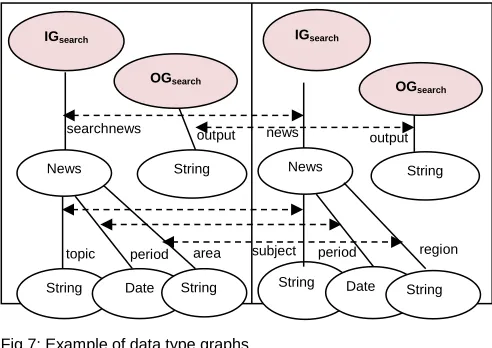
To illustrate the computation of the structural distance, consider a query operation Qop’: Search(news:News):string. The input parameter
news of this operation has a composite data type
News consisting of the attributes topic:string, peri-od:date, and area:string. Consider also a service op-eration Sop’:Search(searchnews:News):string with an input parameter, called searchnews, of a compo-site type News consisting of the attributes sub-ject:string, period:date, region:string, and
size:integer. Figure 7 shows the data type graphs for the input and output parameters of the query and service operations and the mapping that the match-ing process of RSDF has detected between these graphs. The structural distance between Qop’ and Sop’ is dS(Qop’,Sop’) = (0.5+0.25+0)/3 = 0.25, since
dLing(Qop’,Sop’) = 0.5 (i.e., the aggregate distance
between strings “Search” and “Search”; and be-tween strings “news” and “searchnews”)
din(Qop’,Sop’) = ¼ = 0.25 (the edge size in the graph of Sop’ has no matching edge in the graph of Qop’)
dout(Qop’,Sop’) = 0 (the output parameters in Qop’
and Sop’ are both of type string).
In RSDF, structural distances are computed for each possible pair of an operation in a query Q and an operation in a service S.
After computing the structural distance for each pair of query and service operations, RSDF identi-fies all the possible mappings between the tions in Q and operations in S in which each opera-tion in Q (Qopi) is mapped onto a single operation
in S (Sopj). For example, given two query operations
(QopA, QopB) and two service operations (SopA, SopB),
the following combinations of mappings would be examined:
{QopA:SopA, QopB:SopA}, {QopA:SopA, QopB:SopB}, {QopA:SopB, QopB:SopA}, {QopA:SopB, QopB:SopB}
For each of these mappings, RSDF computes the behavioural distance between the mapped service and query operations (dB(Qopi, Sopj)). This distance
is calculated based on comparisons of paths repre-senting the behavioural sub-query and behavioural service specification. The behavioural distance be-tween Qop and Sop is computed as:
dS(Qop,Sop)=0, when the path of the behavioural sub-query that contains Qop can be matched with a path in the state machine of a service;
dS(Qop,Sop)=1, otherwise.
[image:14.567.292.538.352.526.2]More specifically, the behaviour matching is exe-cuted by transforming the BPEL behavioural speci-fications of each service into a state machine SSM and the behavioural sub-query into another state machine QSM, and verifying if each path in QSM can be matched with a path in SSM. The transformation of BPEL specifications into state machines is de-scribed below.
Fig 7: Example of data type graphs
When a path representing the behavioural sub-query can be matched with a path in the state machine of a ser-vice, the behavioural distance for each pair of mappings of query and service operations in these paths is set to zero (i.e., dB(Qopi, Sopj) = 0). Otherwise, the behavioural
distance for each pair of mappings of query and service operations in these paths is set to one (dB(Qopi, Sopj) = 1).
As an example, consider an operation Qop1 defined as a GuaranteedMember condition in the behavioural sub-query of Q and mapped to a service operation Sop1 in one of the possible operation mappings. This condition is satisfied by the state machine of S, if Sop1 exists in all possible paths of this state machine. In this case, dB(Qop1, Sop1) = 0.
Otherwise, dB(Qop1, Sop1) = 1.
As another example, consider a Sequence condition in the behavioural sub-query Q with operations Qop2, Qop3
String Date String
String News String
String Date String searchnews
topic period area
output news output
subject period region
IGsearch IGsearch
OGsearch
News
and Qop4. Suppose that Qop2, Qop3, and Qop4 are mapped to service operations Sop2, Sop3, and Sop4, re-spectively in one of the operation mappings. The above Sequence condition is satisfied by the state machine of ser-vice S, if Sop2, Sop3, and Sop4 exist in this order in a path of the state machine. In this case,
dB(Qop2,Sop2)=dB(Qop3,Sop3)=dB(Qop4,Sop4)=0. If there is no
path with Sop2, Sop3, and Sop4 appearing in this order, dB(Qop2,Sop2)=dB(Qop3,Sop3)=dB(Qop4,Sop4)=1.
After computing the structural and behavioural dis-tances for all pairs of query and service operations in all possible operation mappings and calculating
dSB(Qopi,Sopj) for each pair of operations, the framework
selects the mapping that has the minimal value for the sum of dSB(Qopi,Sopj) for all the pairs of query and service
operations, divided by the number of operations in the query, as specified by the formula for DStr_Beh(Q,S) above.
In order to illustrate these computations, consider a simple query Q2 with two required operations:
credit(accountId:string, amount:double):balance
debit(accountId:string, amount:double):balance
and a behavioural condition stating that the operation credit needs to be executed before the operation debit.
Consider also a service SBankNew having the three
opera-tions below and the state machine shown in Figure 8.
Op1 = credit(accountId:string, amount:double):balance
Op2 = debit(accountId:string, amount:double):balance
[image:15.567.294.513.56.281.2]Op3 = getBalance(acountId:string, date-time:double)
Fig 8: State Machine of service SBankNew
For this example there are 49 possible combina-tions of mappings of operacombina-tions in Q2 and transi-tions in the state machine of SBankNew. Figure 9
shows some of these combinations of mappings. In the figure, combinations C1 to C8 have structur-al_behavioural distance (DSB) equal to zero, and
combinations C9 and C10 of mappings have struc-tural_behavioural distance not equal to zero. The other combinations are not shown here due to space limitations.
C1={credit:(S1→S2), debit:(S3→S4), DSB =0.0};
C2={credit:(S1→S2), debit:(S4→S4), DSB =0.0};
C3={credit:(S1→S2), debit:(S4→S2), DSB =0.0};
C4={credit:(S1→S2), debit:(S4→S1), DSB =0.0};
C5={credit:(S1→S1), debit:(S3→S4), DSB =0.0};
C6={credit:(S1→S1), debit:(S4→S4), DSB =0.0};
C7={credit:(S1→S1), debit:(S4→S2), DSB =0.0};
C8={credit:(S1→S1), debit:(S4→S1), DSB =0.0};
C9={credit:(S1→S2), debit:(S2→S3),
DSB=0.0834};
C10={credit:(S3→S4),debit:(S2→S3), DSB
[image:15.567.34.274.486.528.2]=0.67};
Fig 9: Structural_behavioural distances for all combinations
The behavioural distances for the mappings in C1 to C9 are zero, since in these combinations the mapping of the query operation onto state transi-tions guarantee the order specified by the behav-ioural condition in the query. More specifically, in C1, the query operation credit is mapped to service operation labelling the transition S1→S2, the query operation debit is mapped to service operation la-belling the transition S3→S4, and S1→S2 occurs be-fore S3→S4. Similar situations occur in combina-tions C2-C8, and C9 (in them credit is mapped to S1→S2, debit is mapped to S2→S3, and S1→S2 oc-curs before S3→S4). In C10, however, the behav-ioural distance is set to 1 since the transitions mapped to credit and debit query operations do not preserve the order specified by the behavioural condition of the query. For example, in C10 credit is mapped to transition S3→S4 that is labeled by a service operation that occurs after the transition S2→S3 which is labeled by the service operation to which query operation debit is mapped.
The calculation of the structural_behavioural dis-tance for each mapping is computed by the formula dSB = (dS + dB)/2. The structural_behavioural
dis-tance (DSB) for each combination is taken as the
to-tal of all the dSB values in the mappings in that
Soft Non-Contextual Constraint Matching
The evaluation of soft non-contextual constraints is executed by evaluating constraint expressions in the constraint sub-queries against service specifica-tion facets (see Sec. 3). This evaluaspecifica-tion takes place by retrieving the values of the XPath expressions from service specification facets and evaluating the arithmetic, relational and logical expressions that define the constraint using these values. The result of this evaluation is a binary value indicating whether the constraint is satisfied (1) or not (0). Based on the evaluation of individual constraints, a soft non-contextual constraint partial distance
(DNCC(Q,S)) is also calculated between a query Q and
each service S. The calculation of this distance is based on the function:
DNCC(Q,S) = ∑i wi *D(Ci)/ ∑ wi
where
Ci is a soft non-contextual constraint in Q (1 ≤ i ≤ n; n is
the number of soft non-contextual constraints in Q);
wi is the weight in [0,1] indicating the significance
of the constraint Ci in Q; and
D(Ci) equals 0 when Ci is satisfied by service S and
1 when Ci is not satisfied by service S
Contextual Constraint Matching
The evaluation of contextual constraints is based on the approach described in [49]. This approach as-sumes that a service or the individual operations of it may have one or more context operations associ-ated with them that can be invoked at runtime to provide information that changes dynamically and frequently. Following this approach, the contextual constraints in SerDiQueL are specified as logical combinations of conditions over the return values of context operations of services. Then, during the evaluation of contextual constraints, RSDF identi-fies the relevant context operations, invokes them, and uses their return values to check if the condi-tions of the context constraint are satisfied or not.
The context operations associated with a service are specified by context facets. More specifically, a
context facet specifies the context operations of a service by listing the operation and its semantic category. This category is defined in reference to some context ontology. Whilst the description of categories in RSDF can be based on different types of ontologies (as long as they are specified in XML), in the current implementation of RSDF, we have used an extended version of the CODAMOS ontology [9].
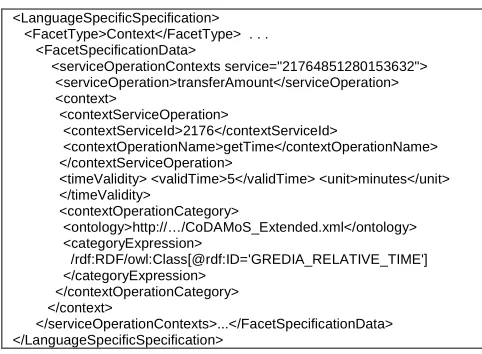
An example of a context facet is shown in Figure 10. As shown in the facet, the service operation
transferAmount is associated with the context oper-ation getTime whose semantic category is GRE-DIA_RELATIVE_TIME in the CODAMOS ontology. This facet will be used whilst evaluating the contex-tual constraint C3 of query Q1 (see Figure 6). In particular, RSDF will check the facet of service “21764851280153632” to see if it has a context op-eration with the same semantic category as the one specified in the constraint sub-query (i.e., GRE-DIA_RELATIVE_TIME). In this case, the context op-eration getTime has this category. Thus, RSDF will invoke it and use its return value to evaluate the condition of C3.
<LanguageSpecificSpecification> <FacetType>Context</FacetType> . . . <FacetSpecificationData>
<serviceOperationContexts service="21764851280153632"> <serviceOperation>transferAmount</serviceOperation> <context>
<contextServiceOperation>
<contextServiceId>2176</contextServiceId>
<contextOperationName>getTime</contextOperationName> </contextServiceOperation>
<timeValidity> <validTime>5</validTime> <unit>minutes</unit> </timeValidity>
<contextOperationCategory>
<ontology>http://…/CoDAMoS_Extended.xml</ontology> <categoryExpression>
/rdf:RDF/owl:Class[@rdf:ID='GREDIA_RELATIVE_TIME'] </categoryExpression>
</contextOperationCategory> </context>
[image:16.567.286.527.343.520.2]</serviceOperationContexts>...</FacetSpecificationData> </LanguageSpecificSpecification>
Fig 10: Example of context facet
The evaluation of each contextual constraint re-sults in a binary value indicating whether the con-straint is satisfied or not and the computation of the
contextual constraint partial distance between a query Q and a service S (DCC(Q,S)) is evaluated
us-ing the same formula as in the case of non-context constraints (see formula for DNCC).
The state machine that is used by the RSDF frame-work is based on transition tuples (t-tuples) speci-fied as
t(service, initial-state, action, destination-state)
where
service is the logical name of the service whose
behaviour is specified by the state machine;
initial-state is the state from which the transition originates;
action is the action that triggers the transition; destination-state is the state to which the
transi-tion will result.
The above representation denotes that if in the initial-state the service becomes aware of an event requesting the execution of the action associated with the transition, it will execute the action and move to the destination-state. The action associated with a transition may be of one of the following types:
receive action: a communication action signifying that the service has received a message requesting the execution of an operation.
send action: a communication action signifying
that the service sends a message notifying the re-sults of the execution of an operation.
τ action: an internal action undertaken by the
vice that cannot be interpreted by an external ser-vice partner (e.g., an automatic transition which is not triggered by any event or a call to a third party operation).
assign action: an action that assigns a value to a
service variable.
cond action: an action which checks if a condition associated with a transition is satisfied in order to allow the transition to take place.
after action: an action that forces the service to undertake a transition after a specific time period following the time at which it arrived at the initial-state.
Based on the above representation, the main ele-ments of a BPEL specification are transformed into state machines as discussed below.
Invoke/receive: Invoke and receive are BPEL activ-ities which invoke an operation in a partner link (service) of a BPEL process and receive a message requesting the execution of an operation, respec-tively. These constructs are mapped to transitions triggered by send and receive actions, respectively.
Pick/onMessage/onAlarm: This activity contains
an ordered list of one or more event and activity pair. Pick makes a BPEL process wait for the occur-rence of one of these events and then perform the activity associated with it as soon as it occurs. A pick may define two types of events: (i) message events, which signify the arrival of a message; and (ii) alarm events that set a timer. This activity is translated into a path of a state machine that has one state s immediately before pick and multiple transitions triggered by event receive actions origi-nating from s. Each of these transitions represents the different message that they may receive and is followed by a transition representing the activity that follows the receipt of the event. The timeout onAlarm is mapped to a transition triggered by an after action.
Flow: This activity in BPEL specifies a set of paths
in the process that should be executed concurrent-ly. The state machine that is generated for flow ac-tivities contains concurrent transition paths repre-senting the full graph of possible sequences of tran-sitions when the BPEL process takes a new step in one parallel partition.
Switch: This activity in BPEL specifies an ordered
While: This BPEL activity is used to specify that a group of other activities will be executed iteratively for as long a condition associated with the activity remains true. A while activity is translated into a fragment in a state machine that has a choice state s0 preceding the while test and two outgoing tran-sitions triggered by cond actions. The first of these transitions corresponds to the case where the con-dition c of the loop is satisfied and has the form < _, s0,cond(c), b0> where b0 is the state from which the first activity of the loop can be executed. The second transition has the form < _, s0, !cond(c), sn> where sn signifies the state of the process after the execu-tion of the loop. The body of the loop is a sub-machine that has one initial state b0 and one final state sn-1 that is the origin of transition t to the original state of the loop, which is automatically triggered after sn-1 is reached (we call t an "auto-matic" transition). This transition signifies the move to the state where the satisfiability of the condition of the While activity has to be checked again.
The transformation approach used in the framework has some limitations. These include the inability to create state machine representations for
faultHandlers and link constructs in BPEL process-es. There are also limitations in processing WSDL specifications accompanying a BPEL process. In particular, XSD Schema import statements are cur-rently not supported and prefix names for
namespaces have to be unique across the WSDL specification.
Discussion
The matching process implemented by RSDF ac-commodates a certain degree of flexibility whilst ensuring that any returned service operation can replace, at least at an interface level, the service op-eration for which it was discovered. This is because the matching process guarantees that the types of the input and output parameters of the new opera-tion are subtypes and supertypes of the types of the
input and output parameters of the operation that will be replaced, respectively. Furthermore, all the returned service operations are guaranteed to satis-fy the behavioural conditions and the hard con-straints set in the query. Hence it is guaranteed that the service-based application that will use the new operation will be able to provide the data required for its invocation (as it was already able to use the previous operation). It will also be able to accept the data produced by the new operation that corre-sponded to the structure of the output types of the old operation. The framework also produces a mapping between the types of the parameters of the old and new operations to enable developers understand (offline) the structure of the new opera-tion.
Currently, RSDF assumes that the behaviour of services is described in BPEL within service regis-tries and, hence, when a SerDiQueL query is evalu-ated, it retrieves and translates such descriptions into a state machine and then checks if the behav-ioural conditions in a SerDiQueL query are satisfied by this state machine. It should be noted, however, that other languages for describing service behav-iour in service registries could be supported (e.g., UML), as long as the descriptions of service behav-iour that are expressible in these languages could be translated into a state machine.