RMCC: A RESTful Mobile Cloud Computing
Framework for Exploiting Adjacent Service-based
Mobile Cloudlets
Saeid Abolfazli
∗, Zohreh Sanaei
∗, Abdullah Gani
∗, Feng Xia
†, and Wei-Ming Lin
‡ ∗Center for Mobile Cloud Computing Research,University of Malaya, Malaysia†School of Software, Dalian University of Technology, China
‡Dept. Electrical and Computer Engineering, University of Texas at San Antonio, USA Email: abolfazli, sanaei, abdullahgani, [email protected], [email protected]
Abstract—Mobile devices, especially smartphones are increas-ingly gaining ground in several domains, particularly healthcare, tele-monitoring, and education to perform Resource-intensive Mobile Applications (RiMA). However, constrained resources, especially CPU and battery hinder their successful adoption. Mobile Cloud Computing (MCC) aims to augment computational capabilities of resource-constraint mobile devices and conserve their native resources by remotely performing intensive tasks. In typical MCC solutions, intensive tasks are offloaded to distant VM-based cloud datacenters or cloudlets whose exploitation originates long WAN latency and/or virtualization overhead degrading RiMA execution efficiency. In this paper, a lightweight Resource-oriented MCC (RMCC) architecture is proposed that exploits resources of plethora of Adjacent Service-based Mobile Cloudlets (ASMobiC) as fine-grained mobile service providers. In RMCC, ASMobiCs host prefabricated RESTful services to be asynchronously called by mobile service consumers at runtime. RMCC is a RESTful cross-platform architecture functional on major mobile OSs (e.g., Android and iOS) and realizes utilization of the computing resources of off-the-shelve outdated or damaged-yet-functioning mobile devices towards green MCC. Results of benchmarking advocate significant mean time- and
energy-saving of 87% and 71.45%, respectively when intensive
tasks are executed in ASMobiCs.
Index Terms—Mobile Cloud Computing, Cloud-based Mobile Augmentation, Computing Offloading, Distributed and Parallel Mobile Computing
I. INTRODUCTION
Mobile devices are increasingly gaining ground in several domains specially healthcare, education, and gaming [1], [2]. Mobile users are insatiably demanding to perform RiMAs on the go with identical experience of desktop computers. However, technological and commercial restraints and intrinsic limitations of mobile devices encumber deployment of power-ful long-lasting resources, especially battery. Hence, execution of RiMAs is either impossible or quickly drains the native resources leading to user experience degradation [3]. As a remedy, MCC is rapidly gaining ground aiming to augment mobile devices by increasing, enhancing, and optimizing their computing capabilities while performing compute-intensive components in the cloud-based resources [3].
In typical augmentation approaches [4], [5], VM-based distant immobile clouds are leveraged as remote resources. However, virtualization overhead, long WAN latency due to
manifold intermediate hops, and data transmission overhead to distant resources originate noticeable time and energy costs leading to RiMA execution deficiency [6], [7]. Cloudlet [8] leverages VM-based proximate desktops to reduce latency by performing intensive computations in vicinity. it creates a partial VM of mobile run-time environment (VM of all mobile OSs assumably exist in cloudlet), compress it, and transfer it to the cloudlet, decompress it and run it in the cloudlet to perform intensive computations. However, creation, de/compression, and transmission of VM beside virtualization overhead inside cloudlet degrade augmentation yields. Hyrax [9] as another augmentation solution utilizes nearby smartphones to reduce network latency for big data analysis. Hyrax is different from our work since it is designed to perform distributed big data processing rather than compute-intensive processing. However, issues such as platform-dependency (works only for Android), mobility dismissal, and Hadoop overhead for scheduling tightly coupled RiMAs encumber Hyrax adoption. VMCC [10] augments mobile devices using an ad-hoc cluster of smartphones. Augmentation overhead in VMCC is high due to partitioning and transmission costs beside continuous tracing of mobile devices to establish a peer-to-peer network beside necessity to modify applications’ source codes.
remote execution of prefabricated RESTful web services in ASMobiCs without need to transfer full/partial VM of mobile device to the ASMobiCs (unlike cloudlet). RMCC is also an extrapolation of Hyrax and VMCC to compute-intensive mobile applications that omits augmentation management overheads by employing loosely-coupled web services that can be called for remote execution without partitioning and code transmission overheads. We surrender as much managerial tasks as possible to a centralized entity named Trusted Service Governor (TSG) to mitigate client-side management overhead. TSG also opens opportunities to enhance security and privacy of users and ASMobiC owners. To the best of our knowledge, RMCC is the first RESTful service-oriented solution that offers platform-independent RiMA execution in MCC with time-energy saving. MNOs play key role in RMCC security and mobility management considering their reputation-trust among mobile users and also ability to bridge nomadic mobile users with ASMobiCs through cellular communication.
The remainder of the paper is as follows. Section II describes proposed framework followed by its performance evaluation and validation in Section III. Results are discussed in Section IV and paper is concluded in Section V.
II. RMCC FRAMEWORK
RMCC’s aim is to leverage computing capabilities of AS-MobiCs for augmenting resource-constraint mobile devices.
A. Key Features
• Service-Oriented Architecture (SOA): RMCC inherits cross-platform and lightweight characteristics from SOA fea-turing loosely coupling of services that significantly miti-gates complexity and overhead, enhances elasticity of mobile applications, and realizes platform-independence. Moreover, Representational State Transfer (REST) [11] mitigates com-munication cost compared to SOAP (Simple Object Access Protocol) used in majority of augmentation approaches. • Separation of Responsibilities: In traditional service-based systems, service providers have both roles of service development and provisioning. However, performing these tasks demands skills that majority of ASMobiC owners lack. To mitigate the problem and enhance RMCC adaptability, feasibility, and complexity, we separate the responsibilities and introduce ‘service developer’ and ‘mobile service provider’ roles. The former is responsible to build, describe, and main-tain the service, while the latter hosts and executes the service. Thus, RMCC can easily be used by individual owners without IT skills prerequisite. Developers build services and negotiate with TSG to describe and publish them.
•Asynchronous Communications:Employing asynchronous communications using Ajax enables light background mobile-cloud communications so that users can continue interacting with their devices when remote execution is taking place on ASMobiCs enhancing user experience and improving RMCC adoption.
• ASMobiCs: ASMobiC aims to alleviate the latency and heterogeneity overhead in mobile augmentation. The key dif-ferences between ASMobiC and other cloud-based resources
TABLE I
CLOUD, CLOUDLET, MOBICLOUDLET, ASMOBIC: KEYDIFFERENCES
Characteristic Cloud Cloudlet MobiCloudlet ASMobiC
Mobility NA Yes
Elastic Scalability High Medium Low
Locality Distant Proximate Adjacent
Multiplicity Low Medium High
LAN Latency High Medium Low
Operation Time 24/7 Limited to business hours 24/7
Connectivity Wired Wireless
Execution Platform VM (Virtual Machine) VM/HTTP over Physical HTTP over Physical
Operating Platform Server, Desktop Desktop Mobile
Context-awareness Low High
Heterogeneity Horizontal (High) Vertical (Low)
are summarized in Table I. One key difference is heterogene-ity; heterogeneity between mobile devices and cloud/cloudlets is horizontal due to fundamental differences in architectures (e.g., ARM vs x86) and OSs (e.g., Android vs Windows). However, heterogeneity between mobile devices and Mobi-Cloudlets/ASMobiCs is vertical due to architectural similarity (mobiles are dominantly ARM-based) [12]. Handling and addressing vertical heterogeneity is relatively less complex than horizontal. Utilizing ASMobiCs as less heterogeneous remote resources that feature one-hop communication latency with high multiplicity enhances augmentation performance.
B. Building Blocks
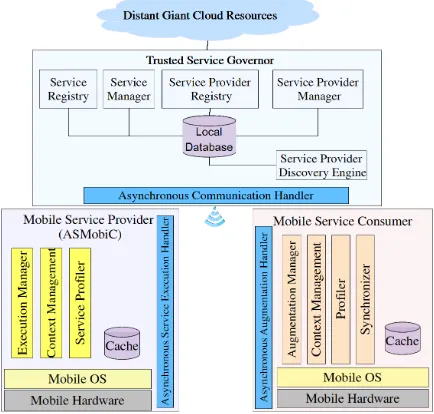
Main blocks presented in Figure 1 and explained as follows.
1) Mobile Service Provider (MSP): is predominately the ASMobiC though giant clouds are also provisioned for highly resource-intensive services whose executions need rich com-puting resources. The terms MSP and ASMobiCs are used interchangeably with the same meaning. ASMobiCs need to register with the central supervisory entity (i.e., TSG) and upon approval install natively the MSP components. The ASMobiCs and TSG negotiate to identify the suitable services for execution on ASMobiCs. Upon conclusion, the service code is installed in ASMobiCs for future execution requests.
‘Asynchronous service execution handler’ listens to incom-ing requests and transmits the response to the destination via push mechanism. The MSC’s request along with context information are sent to ‘execution manager’ to initiate and monitor service execution and once the results are ready, the response is forwarded to MSC. QoS metrics like reliability and availability of services are monitored by ‘service profiler’ for ranking purpose (detailed description is omitted for brevity).
Context information, including location collected by AS-MobiCs are used by ‘context management’ to tailor services according location and environment changes to enhance QoS and QoE. Using the location, the MNO identifies mobile owner’s geographical location. This component performance is vital in identifying the closest ASMobiC to the MSC to tackle communication latency.
aug-Fig. 1. The Schematic Representation of The RMCC Framework
mentation handler’ in MSC asynchronously initiates remote connection with TSG or ASMobiCs.
‘Augmentation manager’ ensures seamless RiMA execution over MSPs via managing and monitoring the entire augmen-tation procedure. The RiMA execution starts from MSC and augmentation is initiated when the local execution reaches a resource-intensive service(s) that is/are not executable on the mobile device (or its local execution is not preferred). So, ‘augmentation manager’ fetches context information from ‘context management’ and initiates an asynchronous call to the TSG looking for an appropriate ASMobiCs. Considering the user preferences, input data for service execution can either be sent at discovery call or later when calling the MSP. In the former, the TSG forwards the request along with the input data to the nominated ASMobiCs for execution. Upon successful execution, the results can be either returned to the TSG for security verification, if the security is preferred, or directly forwarded to the MSC (required IP is sent by the TSG). In the latter case, upon successful MSP discovery, the TSG pushes back the binding information of all the corresponding nodes (when more than one service are searched) to the MSC. The retrieved information is used by ‘augmentation manager’ to contact the MSP(s). So, the services are called for execution and results are re-integrated to the local RiMA. The latter case is deployed for our evaluation purpose.
Moreover, ‘augmentation manager’ monitors the communi-cation link of the MSC to maintain/reestablish the connection if the MSC loses the communication. In case of disconnection, results are cached to be used when connection restored. Thus, energy efficiency and responsiveness is improved and system robustness is enhanced. Throughout augmentation, data integrity is maintained via ‘synchronizer’. During ASMobiC execution, synchronization runs in background without dis-tracting user. Throughout augmentation, context data includ-ing nodes’ location is continuously monitored by ‘context
management’ to be used by ‘augmentation manager’ to more accurately identify the ASMobiC. ‘Profiler’ logs QoS metrics, like execution time and MSP’s reliability upon every success-ful/failed execution. To mitigate WAN latency, dual caching is used in MSC and MSP to cache data on disconnection.
3) Trusted Service Governor (TSG): is a trusted supervi-sory entity replicated on multiple servers to supervise and monitor augmentation entities, including MSP, MSC, and service developers. TSG is the main governing entity with several crucial responsibilities. To avoid overcrowded servers and mitigate the WAN latency, MNOs are identified as TSG and can be replicated on MNOs in varied geographical ar-eas to effectively balance load and seamlessly serve mobile subscribers. MNOs have been serving mobile end-users from the beginning and could establish reputation and historical trust [13]. MNOs scattered in urban/rural areas near to mobile nodes to significantly reduce WAN latency. MNOs have started providing cloud services to their clients and, hence, will be able to scale and adapt to the highly oscillating computation and storage of end-users. Most importantly, MNO provides a private Intranet between MSC, TSG, and MSP to perform augmentation without entering the risky channel of Internet.
‘Service Registry’ acts as a public repository to maintain a local database and store description of registered services. At service registry, developer negotiates with TSG, provides service information, and uploads the service package including core and dependent libraries to the TSG. ‘Service manager’ analyzes historical QoS data for periodic efficiency assessment to rank services based on functionality and performance. Po-tential ASMobiCs communicate with the ‘service registry’ to select the most appropriate services whose required resources are available in the mobile device. This component validates the hosting demands and refuses inappropriate allocation re-quests (e.g., RAM-intensive service on RAM-poor ASMobiC). Upon successful registry, a unique URI is assigned to services for each ASMobiC. ‘Service provider manager’ analyzes and synthesizes historical QoS data of ASMobiCs and rank them based on observed performance, availability, and reliability. These ranks are considered when ‘service provider discov-ery engine’ searches for MSPs. At selection time, the TSG chooses the MSP with highest rank. Communications are asynchronously performed via ‘asynchronous communication handler‘. ‘Service Provider Discovery Engine (SPDE)’ deter-mines the most appropriate ASMobiC capable of performing MSC’s requested service(s) with desired preferences. Initially, MSC forwards service name(s) and preferences along with the request to SPDE to acquire address of the best ASMobiC. Considering the user location and current location of MSPs, SPDE identifies the most appropriate MSP that can efficiently meet MSC requirements and preferences. Service discovery overhead is imposed on TSG to achieve higher efficiency.
C. Significance
[image:3.612.66.283.58.265.2]run-time code offloading beside low-hop communication remark-ably reduce WLAN latency. Thirdly, no Internet is required considering the MNOs’ role to utilize the augmentation ben-efits. Fourthly, it defines a new role in SOA-based systems called MSP; ASMobiCs can turn into a MSP using a low footprint application. This property of RMCC remarkably contributes to reusing the off-the-shelves and damaged-yet-functioning (damaged speaker, touch-pad, or screen) or old mobile devices. Lastly, it is widely elastic and scalable. Though RMCC is designed and evaluated using mobile de-vices as MSC and MSP, any wirelessly accessible comput-ing device, such as cloud data centers, desktop PCs, and car mounted computers can be used as MSPs. Considering RMCC features, it can be used in several domains, particularly education, healthcare, entertainment and gaming, vehicular networks, crowdsourcing, and remote monitoring. It also pro-visions node mobility under coverage of the MNO.
III. EVALUATION
RMCC is implemented using jQuery and evaluated via series of benchmarking experiments using three heterogeneous android-based smartphones and a desktop. We devise and validate mathematical models to validate the evaluation results.
A. System-Level Metrics
Application execution time in millisecond (ms) and con-sumed energy in millijoule (mJ) collected using PowerTutor 1.4 are selected as performance evaluation metrics. Energy consumption of components like LCD are disregarded.
B. Benchmarking Model
A RiMA including three different resource-intensive ser-vices (prime, matrix multiply, and matrix covariance) are executed in two execution modes (local and ASMobiC). To prepare the experimentation environment, we use a resource-rich desktop computer with 3.3 GHz Intel CPU, 4GB RAM, and 32-bit Windows 7 accessible via wireless connection to run TSG components. The MSC is an HTC Nexus One that hosts and runs the RiMA. Our MSC features a 32-bit Qual-comm Snapdragon S1 QSD8250 chipset with 1 GHz CPU. A Samsung Galaxy S2, HTC One X smartphone with Android OSs, and a DELL Laptop XPS14z with Intel 2.5 GHz CPU, 4GB RAM, and 64-bit Windows 7 are utilized as ASMobiCs. We turn off the MSC’s cellular radio, unplug its USB cable, set display brightness to 50%, keep battery level between 60 to 70%, and closed other applications to avoid interruption at data collection stage. To avoid heat impacts in device, we stop data collection on regular intervals. The wireless network was isolated to avoid inference and fluctuations caused by other wireless network consumers. In local execution mode, the Wi-Fi is also off. We evaluate QoS of each RiMA for 30 workloads selected in three intensity levels of low, medium, and high (see Table II). To enhance data collection reliability and mitigate the wireless intermittency impact, each reported data is mean value of 30 executions with 99% confidence interval.
TABLE II EVALUATIONWORKLOADS
Workload Intensity Workload Selection
Prime
Low 220063≤x≤330017, step≈10000
Medium 600011≤x≤690037, step≈10000
High 900007≤x≤990001, step≈10000
Matrix Low [30×mi].[mi×60],mi=mi−1+x, x=10,m0=50,1≤i≤10
Product Medium [65×mj].[mj×120],mj=mj−1+x,x=10,m0=85,1≤j≤10
High [130×mt].[mt×180],mt=mt−1+x, x=10,m0=50,1≤t≤10
Low [45×45]to[65×65], step≈2
Matrix Medium [72×72]to[90×90], step≈2
Covariance High [100×100]to[145×145], step≈5
C. Mathematical Model
Several mathematical and statistical analyses are carried out to validate evaluation results. To devise mathematical models of time and energy, linear regression is used as the predomi-nant observation-based prediction approach [14]. Independent replication technique is used to produce a dataset of workload, time, and energy related to independently selected work-loads (no correlation between mathematical and benchmarking workloads). Partial dataset is used to train the regression models to derive time and energy models by identifying the correlations between the workloads and execution time as well as execution time and consumed energy. Split-sample approach and calibration-validation exercise are performed to validate the devised models. For models validation, dataset is randomly split into two different size datasets and correlations between the dependent and independent variables is identified using statistical tests. Moreover, for all models we performed graphical residual analysis to ensure the validity of the models. However, illustrations are omitted due to space limit.
1) Execution Time (ms): Complexity of RiMA calculated using Big-oh O(f(n))notation for building linear regression model of time reported below.
a) Local Execution: The complexities of prime, multiply and covariance areO(p), O(m3), O(c3), respectively that are
used as independent variables for the regression model. For the sake of clarity and accuracy and to avoid complex calculations, we consider mi = Ti×Si×Ki and Ci = Ni×Ni×Ni.
Thus, regression model of T LRM A(i) as the total time for
executing the ith workloads of p, m, and c is found to be: T LRM A(i) = (0.007×pi+ 34.512) + (0.016×mi −
43.560)+(0.017×ci−1.193). The regression model summary
is presented in Table III. Insignificantly different adjustedR2
in varied samples shown in Table IV advocates that data are well fitted into our model as an evidence of model validation. Degree of Freedom (DF) in figures indicates number of train-ing sets used in buildtrain-ing regression models and is dissimilar in different models due to random size of training set.
TABLE III
REGRESSIONMODELSUMMARIES OFLOCAL/ASMOBIC TIME AND
ENERGY
Model Regressor R2 AdjusterR2 Sigma
Local Time
Prime 0.99 0.99 0
Matrix Multiply 1 1 0 Matrix Covariance 1 1 0
ASMobiC Time Computing TimeCommunication Delay 0.990.99 0.990.99 00
Local Energy Execution Time 1 1 0
ASMobiC Energy CPUWi-Fi 0.920.94 0.920.94 00
this mode, the entire intensive executions take place outside the MSC, and consequently noticeable amount of mobile battery is conserved.T RRM A(i)is the time thatithworkload takes for
execution and is: T RRM A(i)=TDis+T WRemote(RM A(i))+
TCom(RM A(i)) whereTDisis the communication and
compu-tation time that the TSG takes to identify ASMobiCs, regard-less of the workloads. T WRemote(RM A(i)) is the computing
time to perform execution of the heaviest service in ASMobiCs andTCom(RM A(i))is the communication delay. Thus, we have
T RRM A(i)= (0.0000425×mi) + (1.3×TDis(i)) + (0.98×
T CM ultiply(mi)) + (15.785−47.28). The model summary is reported in Table III.
We validate the model using split-sample method whose re-sults are commonly presented in Table IV. Since the difference between adjustedR2 is less than 0.05, the model is valid.
2) Consumed Energy: The mathematical model of energy in local and ASMobiC modes are as follows.
a) Local Execution: Energy consumption of MSC com-prises of the total energy used by the CPU, LCD, and Wi-Fi (if any). However, LCD energy is not profiled since it has no impact on processing power of MSC. Also, Wi-Fi energy is not profiled in local mode. Hence, the only power con-suming component is CPU. If ELRM A(i) is the total energy
consumed for the local execution of theithworkload, we have
ELRM A(i) = EL(CP Ui) where EL(CP Ui) is the energy
consumed to locally execute the entire ith workload. CPU
power consumption for each computational component highly depends on the execution time of that particular component, and execution time itself is a direct function of the workloads. So, the more intense is the workload, the higher would be the execution time, and the more will be CPU power consumption. Prediction model of CPU energy is formulated via linear regression which is summarized in Table III. The model is EL(CP Ui) = (0.281×T LRM A(i)) + 119.587
Validation results of energy model in local mode are sum-marized in Table IV. Identical adjusted R2 values in varied
samples evidently validate the model.
b) ASMobiC Execution: Similar to the local execution, we disregard energy consumption of the LCD for remote execution. However, in ASMobiC execution CPU and Wi-Fi are two major energy consumers which will be consid-ered for devising the energy model. In remote execution mode, the resource discovery service is consuming some amount of energy. Hence, if ERRM A(i) is the total
en-TABLE IV
REGRESSIONMODELVALIDATIONRESULT: TIME ANDENERGY
Model R2 Adjuster R2 DF
Local/ASMobiC Split = 1.0 1 1 18 Time/Energy Split = 0.0 1 1 10 Full Sample 1 1 29
ergy for ASMobiC execution of the ith workload,
there-fore ER(RM A(i)) = ER(Dis(i)) +ER(T WRemote(i)) +
ER(W iF i(i)) where ER(Dis(i)) is the energy to perform
MSP discovery which includes energy consumed while wait-ing for the MSP information from TSG.ER(T WRemote(i))is
the energy consumed while device is waiting for the results to come from the ASMobiC. ER(W iF i(i)) is the energy
con-sumed to communicate with external entities, including TSG and MSP(s). Hence, model of consumed energy in ASMobiC mode depends on three components of T WRemote(i) (matrix
multiply running time), Discovery(i)(discovery delay), and
Di (communication delay).
For any component, except discovery delay, the linear regression can be performed to produce a mathematical model. Discovery delay has no regressor such as workload size or data volume. It only depends on the wireless communication quality between the MSC and TSG. Therefore, the total energy model for the remote execution mode is ER(RM A(i)) =
(3.117 × Dis(i)) + (0.0938 × T WRemote(i)) − (0.002 ×
W iF i(i))−2666.364. The energy model and its validation
results are summarized in Table III and IV, respectively.
IV. RESULTS& DISCUSSIONS
The results are reported in two parts of evaluation and val-idation for time and energy followed by synthesis of findings.
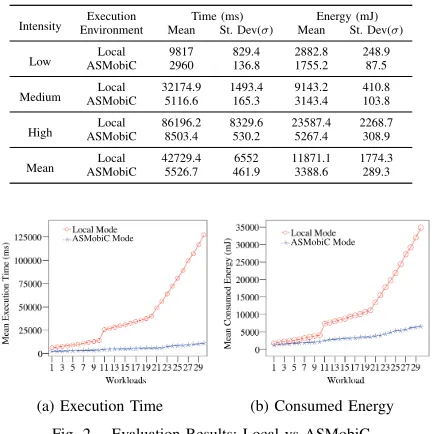
A. Evaluation Results:Descriptive analysis of benchmarking results are summarized in Table V and plotted in Figure 2. As results unveil, time and energy savings increase as the workloads intensify. The saving in low intensity is least and gradually reaches its peak in high workloads. In average, using RMCC conserves time and energy as high as 87% and 71.45%, respectively. The results illustrated in line charts present the comparison of mean time and energy results for 30 different workloads in local and ASMobiC execution modes. Each value is the mean of 30 iterations of each workload. Red circles represent local execution results and blue asterisks show AS-MobiC results. In local mode, increase in workload intensities has significant impacts, whereas the impacts are remarkably lower in ASMobiC mode. Such substantial achievements are due to parallel distribution of intensive tasks on multiple ASMobiCs. Instead of executing all the tasks locally on a single CPU, RMCC leverages extensive computing power of multitudes of ASMobiCs whose access latency do not jeopardize achievements.
TABLE V
DESCRIPTIVESTATISTICS OFEVALUATIONRESULTS: TIME& ENERGY Intensity EnvironmentExecution MeanTime (ms)St. Dev(σ) MeanEnergy (mJ)St. Dev(σ)
Low ASMobiCLocal 98172960 829.4136.8 2882.81755.2 248.987.5 Medium ASMobiCLocal 32174.95116.6 1493.4165.3 9143.23143.4 410.8103.8 High ASMobiCLocal 86196.28503.4 8329.6530.2 23587.45267.4 2268.7308.9 Mean ASMobiCLocal 42729.45526.7 461.96552 11871.13388.6 1774.3289.3
[image:6.612.314.566.62.319.2](a) Execution Time (b) Consumed Energy
Fig. 2. Evaluation Results: Local vs ASMobiC
computations take place in ASMobiCs. Performance gains increases as the workload intensities hike.
Figure 4 depicts synthesis of evaluation and validation results for energy and time. The differences in evaluation and validation results are shown insignificant which advocates reliability and validity of RMCC.
V. CONCLUSIONS
In this research, we proposed a lightweight framework, called RMCC that harnesses computational resources of plethora of ASMobiCs instead of distant clouds to efficiently execute compute-intensive tasks. Lightweight feature of the RMCC is realized by employing SOA and REST architectural style in design and development. The performance of the RMCC is evaluated and validated via benchmarking and mathematical modeling, respectively. The evaluation results advocate mean time and energy saving as significant as 87% and 71.45%, respectively when RMCC administrates execu-tion of intensive services in ASMobiCs. Our findings advocate feasibility and benefit of leveraging computational capabilities of increasingly empowering and dominating smartphones as servers. In future, a lightweight hybrid resource scheduling algorithm like [15] to optimally allocate resources to intensive tasks is essential. We also need to enhance RMCC adaptability to varied wireless communication technologies like Bluetooth, 3G, and 4G to efficiently perform a throughput-energy trade-off in CMA communications. A billing system also is needed to manage financial issues and ASMobiC incentive handling matter in this framework.
REFERENCES
[1] S. Abolfazli, Z. Sanaei, A. Gani, F. Xia, and L. T. Yang, “Rich Mobile Application: Genesis, Taxonomy, and Open Issues,”Journal of Network and Computer Applications, vol. 40, pp. 345–362, 2014.
[2] W. Cai, V. C. M. Leung, and M. Chen, “Next Generation Mobile Cloud Gaming,” in IEEE CCNC ’05 International Symposium on Service-Oriented System Engineering, 2013, pp. 551–560.
(a) Execution Time (b) Consumed Energy
Fig. 3. Validation Results: Local vs ASMobiC
(a) Execution Time Synthesis (b) Consumed Energy Synthesis
Fig. 4. Synthesis of Evaluation and Validation Results
[3] S. Abolfazli, Z. Sanaei, E. Ahmed, A. Gani, and R. Buyya, “Cloud-Based Augmentation for Mobile Devices: Motivation, Taxonomies, and Open Challenges,”IEEE Communications Surveys & Tutorials, vol. 16, no. 1, pp. 337–368, Jan. 2014.
[4] M. Shiraz and A. Gani, “A lightweight active service migration frame-work for computational offloading in mobile cloud computing,” The Journal of Supercomputing, vol. 68, no. 2, pp. 978–995, Jan. 2014. [5] F. Xia, F. Ding, J. Li, X. Kong, L. T. Yang, and J. Ma, “Phone2Cloud:
Exploiting computation offloading for energy saving on smartphones in mobile cloud computing,”Information Systems Frontiers, vol. 16, no. 1, pp. 95–111, Oct. 2013.
[6] E. Ahmed, A. Akhunzada, M. Whaiduzzaman, A. Gani, S. H. Ab Hamid, and R. Buyya, “Network-centric performance analysis of runtime appli-cation migration in mobile cloud computing,” p. In Press, 2014. [7] S. Abolfazli, Z. Sanaei, M. Alizadeh, A. Gani, and F. Xia, “An
Experi-mental Analysis on Cloud-based Mobile Augmentation in Mobile Cloud Computing,”IEEE Transactions on Consumer Electronics, vol. 99, no. 1, pp. 1–9, 2014.
[8] M. Satyanarayanan, P. Bahl, R. Caceres, and N. Davies, “The Case for VM-Based Cloudlets in Mobile Computing,”IEEE Pervasive Comput-ing, vol. 8, no. 4, pp. 14–23, 2009.
[9] E. E. Marinelli, “Hyrax: cloud computing on mobile devices using MapReduce,” Master Thesis, Computer Science Department, Carnegie Mellon University, 2009.
[10] G. Huerta-Canepa and D. Lee, “A Virtual Cloud Computing Provider for Mobile Devices,” inProc. ACM MCS’10: Social Networks and Beyond, San Francisco, USA, 2010, pp. 1–5.
[11] R. T. Fielding, “Architectural styles and the design of network-based software architectures,” PhD Thesis, University California, Irvin, 2000. [12] Z. Sanaei, S. Abolfazli, A. Gani, and R. Buyya, “Heterogeneity in Mobile Cloud Computing: Taxonomy and Open Challenges,” IEEE Communications Surveys & Tutorials, vol. 16, no. 1, pp. 369–392, 2014. [13] Z. Sanaei, S. Abolfazli, T. Khodadadi, and F. Xia, “Hybrid Pervasive Mobile Cloud Computing: Toward Enhancing Invisibility,” Information-An International Interdisciplinary Journal, vol. 16, no. 11, 2013. [14] R. Jain,The art of computer systems performance analysis. Wiley,
2008.
[image:6.612.69.286.78.295.2]