City, University of London Institutional Repository
Citation
:
Pezzulo, G., Cartoni, E., Rigoli, F., Pio-Lopez, L. & Friston, K. J. (2016). Active
Inference, epistemic value, and vicarious trial and error. Learning & Memory, 23(7), pp.
322-338. doi: 10.1101/lm.041780.116
This is the published version of the paper.
This version of the publication may differ from the final published
version.
Permanent repository link:
http://openaccess.city.ac.uk/16677/
Link to published version
:
http://dx.doi.org/10.1101/lm.041780.116
Copyright and reuse:
City Research Online aims to make research
outputs of City, University of London available to a wider audience.
Copyright and Moral Rights remain with the author(s) and/or copyright
holders. URLs from City Research Online may be freely distributed and
linked to.
Active Inference, epistemic value, and vicarious
trial and error
Giovanni Pezzulo,
1Emilio Cartoni,
1,4Francesco Rigoli,
2Le´o Pio-Lopez,
3and Karl Friston
21
Institute of Cognitive Sciences and Technologies, National Research Council, 00185 Rome, Italy;
2The Wellcome Trust Centre for
Neuroimaging, UCL, London WC1N 3BG, United Kingdom;
3Pascal Institute, Clermont University, 63000 Clermont-Ferrand, France;
4
La Sapienza University of Rome, Rome, 00185 Italy
Balancing habitual and deliberate forms of choice entails a comparison of their respective merits—the former being faster
but inflexible, and the latter slower but more versatile. Here, we show that arbitration between these two forms of control
can be derived from first principles within an Active Inference scheme. We illustrate our arguments with simulations that
reproduce rodent spatial decisions in T-mazes. In this context, deliberation has been associated with vicarious trial and error
(VTE) behavior (i.e., the fact that rodents sometimes stop at decision points as if deliberating between choice alternatives),
whose neurophysiological correlates are “forward sweeps” of hippocampal place cells in the arms of the maze under
con-sideration. Crucially, forward sweeps arise early in learning and disappear shortly after, marking a transition from
delib-erative to habitual choice. Our simulations show that this transition emerges as the optimal solution to the trade-off
between policies that maximize reward or extrinsic value (habitual policies) and those that also consider the epistemic
value of exploratory behavior (deliberative or epistemic policies)—the latter requiring VTE and the retrieval of episodic
information via forward sweeps. We thus offer a novel perspective on the optimality principles that engender forward
sweeps and VTE, and on their role on deliberate choice.
Substantial evidence indicates that animal behavior is determined both by deliberative processes (i.e., based on predictions of future outcomes and rewards) and by habitual reflexes (i.e., based on stimulus–response associations; Balleine and Dickinson 1998). The former are more resource intensive and sensitive to changes in task contingencies, while the latter are cheaper but inflexible; hence whether it is optimal to call on deliberative or habitual choice depends on the trade-off between the advantage of flexi-bility and computational costs (Balleine and Dickinson 1998; Dolan and Dayan 2013; Lee et al. 2014). In this paper, we try to un-derstand the contextualization of behavior and the trade-off between deliberative and habitual choice from first principles, us-ing Active Inference and Markov decision process models of exploitation and exploration (Friston et al. 2013, 2014, 2015; Pezzulo et al. 2015).
We focus specifically on vicarious trial and error (VTE) behav-ior, which is considered a hallmark of deliberation (Muenzinger 1938; Tolman 1938, 1939). This is based on the observation that, when rodents have to remember or search the correct route to a re-ward in a maze (e.g., a T-maze), they sometimes stop at choice points, to look left and right before choosing which direction to go. This has been interpreted as a signature of cognitive search and deliberation between the two choices (i.e., going right or left). In keeping with a role of VTE behavior for deliberation, it oc-curs early in learning and decreases or disappears after significant experience (Tolman 1939; van der Meer and Redish 2010; van der Meer et al. 2012) but it can increase again when task contingencies change (Blumenthal et al. 2011; Schmidt et al. 2013; Regier et al. 2015). VTE behavior has been consistently linked to hippocampal function (Hu and Amsel 1995; Voss et al. 2011; Regier et al. 2015). During deliberative choice and VTE, electrophysiological mea-surements of the hippocampus show that activation in place cells,
which usually code for the current position of the animal, sweeps forward by recruiting first cells that code for one branch of the maze, and then cells coding for the other, thus transiently (and serially) coding for possible future routes. Simultaneously, covert expectations of rewards can be measured in the ventral striatum (Johnson et al. 2007; Johnson and Redish 2007; van der Meer et al. 2012). The hippocampus– ventral striatum pathway might represent a neurophysiological mechanism for VTE-based spatial deliberation and search processes, where memories of past experi-ences, associated with each choice, are recalled—or future events are simulated based on episodic memories—and used off-line to update the subjective value of the subsequent choice and select among plans (Lansink et al. 2009; van der Meer and Redish 2010; Pennartz et al. 2011; Pezzulo et al. 2013, 2014).
In sum, VTE behavior and associated hippocampal forward sweeps have been linked to deliberation and the (covert) evalua-tion of choice alternatives. They are an ideal paradigm for study-ing the various trade-offs between habitual and deliberate forms of choice. Indeed, their disappearance after a few trials, when the animals become familiar with the task contingencies, poten-tially marks a transition from deliberative to habitual forms of choice; and their reappearance when task contingencies change potentially marks the opposite transition from habitual to deliber-ative strategies. Most current models link VTE behavior to a form of model-based search among alternatives, but diverge in the spe-cific mechanisms. For example, if VTE is involved in the calcula-tion of value of the alternatives (“value-of-alternatives” theory) it should increase when the options are more difficult to differen-tiate. Alternatively, if VTE is responsible for flexible changes of strategies (“flexibility” theory), it should increase when behavior needs to be more flexible to achieve outcomes, see Pezzulo et al. (2013) and Regier et al. (2015) for discussions of these and related theoretical proposals. Here we advance a novel view that implies
Corresponding author: [email protected]
# 2016 Pezzulo et al. This article, published inLearning & Memory, is avail-able under a Creative Commons License (Attribution 4.0 International), as de-scribed at http://creativecommons.org/licenses/by/4.0/.
Article is online at http://www.learnmem.org/cgi/doi/10.1101/lm.041780. 116. Freely available online through theLearning & Memory Open Access option.
VTE behavior and associated forward sweeps in the (optimal) sol-ution of the trade-offs between deliberate and habitual choice, which arise under various levels of extrinsic value, epistemic val-ue, and uncertainty.
In a series of previous papers, we have described a Bayesian formulation of foraging behavior, known as Active Inference (Friston et al. 2015), in which agents maximize simultaneously “extrinsic value” (e.g., expected reward) and “epistemic value” (e.g., information gain or the resolution of uncertainty implicit in exploration or curiosity).4 In this paper, we use this Active Inference scheme to consider an important empirical phenome-non underlying VTE behavior; namely, the interruption of ongo-ing behavior to perform an epistemic action—the retrieval (or construction) of episodic memories through internal rehearsal (or simulation). Within this framework, we illustrate why this VTE processing disappears as the agent (e.g., rat) becomes more fa-miliar with the task contingencies. Our formulation enables us to reduce VTE and its properties to the normative principles Active Inference, thus formalizing the computational mechanisms and functions of VTE.
We start from the idea that behavior can be controlled in dif-ferent “modes,” habitual or deliberate, which we associate here to policies that follow stereotyped patterns to maximize reward or extrinsic value (habitual policies) versus those that also consid-er the epistemic value of exploratory behavior and thus pconsid-erform epistemic actions (deliberative or epistemic policies)—the latter requiring VTE and the retrieval of episodic information via for-ward sweeps. More specifically, here forfor-ward sweeps constitute an “internalized (epistemic) action” that retrieves episodic memories, and uses them in a constructive manner to mentally simulate future (expected) episodes, analogous to constructive ep-isodic memory processes in humans (Schacter et al. 2007; Hassabis and Maguire 2009; Buckner 2010). In keeping, here we model for-ward sweeps as covert (mnemonic/constructive) actions that are treated in exactly the same way as overt epistemic actions (e.g., ex-ploratory actions), except that they sample cues or outcomes from memory and not the external environment. Importantly, in this formulation forward sweeps can become an explicit component of a policy or sequence of behaviors—hence the term “epistemic policies” for those policies that include forward sweeps. This means the agent has to evaluate policies that are mixtures of actions, some of which are covert (episodic retrieval) and others that are expressed overtly through moving to a new location. This formulation creates the interesting problem of balancing the epistemic value of covert mnemonic retrieval of construction, against the pragmatic value of securing a reward in the shortest possible time, that is, a subtle form of the exploration–exploita-tion dilemma (see the Discussion for a clarificaexploration–exploita-tion of the links between “internal or covert” and “external or overt” exploration processes).
We will discuss how the (Bayes-optimal) scheme used here can be adopted to interpret two different forms of memory classi-cally separated in the literature; namely, procedural and episodic memories. These two forms of memory correspond to different mechanisms within the proposed framework. Indeed, in the infer-ential scheme used below, “posterior beliefs” about the context or current environment (e.g., reward locations in a maze) become “prior beliefs” for the next round of exploration—or in other words, an agent can accumulate knowledge about its environ-ment (e.g., reward location) in a series of trials and use this knowl-edge in the next trials. This form of (Bayesian) belief updating
(between trials or sequences of behavior) can be conceived as an implicit or “procedural” form of memory—in terms of the evi-dence accumulated for one particular context relative to another, which in animal behavior links to (slowly) accumulated neocorti-cal changes (McClelland et al. 1995) and to the gradual formation of action chains and habits in dorsolateral striatal areas (Graybiel 2008). With repeated exposure to the same environment, agents become increasingly confident about the best policies and—based on their acquired procedural knowledge—are able to engage in exploitative behaviors more efficiently and can “transfer” control to habitual processes. This contrasts with the initial exposure to the environment, when confidence about contingencies is low. It is in this case that search processes and episodic memo-ries—associated with hippocampal functioning (Tulving 1972; Eichenbaum 2000)—may play an essential role, see Lengyel and Dayan (2008) for a discussion of the advantages of episodic con-trol over other forms of concon-trol when an agent only has limited experience. We assume here that episodic memories concern the outcome experienced on the previous trial(s) and are used to construct or simulate future episodes on the fly (Hassabis and Maguire 2009), that is, when the agent is deliberating “within” tri-als—although experiences can also be “replayed” “between” trials for learning purposes and beyond (Sutton 1990; Diba and Buzsa´ki 2007; Pezzulo et al. 2014).
At the neurobiological level, we associate this process with hippocampal forward sweeps (Johnson and Redish 2007; van der Meer and Redish 2010; Pezzulo et al. 2014). Our primary ques-tion was whether the interplay between implicit (procedural) and explicit (episodic) memory could explain the disappearance of simulated forward sweeps that is seen empirically when rats become more confident with the contingencies of their environ-ment. Heuristically, one can imagine that retrieving past out-comes (episodic memories) has epistemic value, which more than compensates for the delay in reward delivery (due to VTE and deliberation time) and the (putative) cognitive cost of episod-ic constructions. However, this will only be the case when there is a relatively high degree of uncertainty about reward locations or the current context. As experience with a particular environment is accumulated (through implicit or procedural memory) the epi-stemic value of episodic retrieval will decline. This would suggest a subsequent decrease of “covert” epistemic actions (associated with episodic memory retrieval and VTE behavior) and a gradual passage from a deliberate to a habitual mode of behavior.
To sum up, the novelty of this proposal is that we associate VTE behavior and hippocampal sweeps to (internalized) epistemic actions that can be part of the animal’s behavioral plan. At deci-sion points, candidate plans (policies) are evaluated and those that include VTE behavior (epistemic policies) are preferred when epistemic value prevails over extrinsic value. In this perspec-tive, a transition from deliberate to habitual choice emerges as the optimal solution to the trade-off between policies that maximize reward or extrinsic value (habitual policies) and those that also consider the epistemic value of exploratory behavior (deliberative or epistemic policies)—the latter requiring VTE and the retrieval of episodic information via forward sweeps.
The proposed theory makes the prediction that VTE behavior depends on balance between epistemic and extrinsic value during a choice. In turn, epistemic value has a multidimensional sensitiv-ity to uncertainty about the choice context (e.g., the reward con-tingencies) and the demands of behavioral flexibility (e.g., the need to track context changes to secure a reward). Thus, forward sweeps at decision points should be curtailed as an agent becomes more confident about the task contingencies (as in these occa-sions a stereotyped, habitual policy is sufficient), and be reinstated (for example) when task contingencies change and behavior needs to be flexible to adapt to the novel contingencies. 5Formally, this process corresponds to the minimization of (expected) free
This aligns our proposal with flexibility theory of VTE (Regier et al. 2015) but links the proximal mechanisms of flexibility to episte-mic policies, which in turn depends on the (increased) episteepiste-mic value of a choice situation. By highlighting a role of epistemic value in engendering VTE, our novel proposal can generate addi-tional predictions. For example, epistemic value is key in so-called “costly” choices, when an accurate estimation of the context is necessary to secure a reward and a wrong choice implies a “cost” such as long delay in reward consumption (van der Meer et al. 2010; Gupta et al. 2012), less so in conditions in which ex-trinsic value is plentiful and exploration redundant—and it is in the former, not the latter situations that VTE behavior should be observed.
To test this set of hypotheses, we performed simulations in a T-maze and a multiarm radial maze in which one arm was baited. We equipped agents with the prior belief that they were in a mild-ly volatile environment in which the maze (reward location) could change—and then allowed it to explore the maze over mul-tiple trials (with occasional changes in the reward location). This prior belief is implemented by including in the agent’s internal model a (small) expected probability that the context will change after each trial, see Table 1. Because the agent expects a degree of volatility a priori, its implicit (procedural) memory, due to Bayesian belief updating between trials, has residual uncertainty, especially in the early trials. By endowing agents with policies that include covert actions (episodic retrieval), we hypothesized a re-solution of this uncertainty during early exploratory behavior that called upon forward sweeps to retrieve episodic memories. Furthermore, we hypothesized a resurgence of VTE behavior and forward sweeps in situations that require more flexibility, such as when contingencies change. Crucially, these are all emergent behaviors under ideal Bayesian assumptions—or in other words they emerge as optimal solution when an agent tries to maximize extrinsic and epistemic value and needs to rationally arbitrate be-tween them.
Results: VTE simulations using Active Inference
This section describes four simulations of VTE behavior using a Bayesian (Active Inference) formulation of choice and foraging (Friston et al. 2013, 2014, 2015). Our hope was to reproduce VTE behavior (and its neurophysiological underpinnings)—and then test the hypothesis that VTE-like processing would disappear as the simulated agents became familiar with the contingencies of the task at hand.
The mathematical methods used for the simulations are provided in the Materials and Methods section. Here, it is sufficient to say that the task of the agent is to select among a series of sequential policies (p), comprising ac-tion sequences such as: “go right, then go right,” “go left, then go left,” “per-form VTE, then go right,” and so on. To this aim, the (Q) values of these policies are calculated, by summing their “extrin-sic value” (i.e., the expected reward they deliver) and “epistemic value” (i.e., the information gain associated to its ac-tions) over time points in the future. Formally, this (Q) value corresponds to the expected (negative) free energy of a policy, at any point in the future, as given by the following equation (for a full der-ivation of the equation, please see Friston et al. (2015):
Qt(p) =EQ(ot,st|p)[lnP(ot,st|p) −lnQ(st|p)] =EQ(ot,st|p)[lnQ(st|ot,p) +lnP(ot|m) −lnQ(st|p)] =EQ(ot|p)[lnP(ot|m)]
Extrinsic value
+EQ(ot|p)[D[Q(st|ot,p)||Q(st|p)]]
Epistemic value
. (1)
Intuitively, theQvalue of a policy sums up the value of all the observations that the agent (should) gather by following the policy from start to end—including most prominently reward observations (note that, in our simulations, all the policies have the same length). Mechanistically, it is calculated by starting from the agent’s belief about its present state (which can be uncer-tain), by propagating predictions about future states that are expected to be visited given the policy, and by considering the value of the outcomes that can be (probabilistically) obtained in these states.
This evaluation, in turn, requires equipping the agent with three types of a priori knowledge: a generative model (m) of the task, which essentially encodes the contingencies between the ac-tions prescribed by the policies and the resulting states (s) and ob-servations (o); beliefs about the agent’s current state; and beliefs about the extrinsic value of the goal (rewarding) state(s).
The evaluation assigns policies a value depending on two components that—as we will see—need to be balanced: extrinsic value and epistemic value. The extrinsic value corresponds to delivering rewarding outcomes, e.g., a rewarded branch of a T-maze. In this Bayesian formulation, the animal’s goals and needs are expressed in terms of prior probabilities or preferences for particular (rewarded) outcomes, and policies that minimize (in probabilistic terms) the distance5between the current state and the goal states (i.e., states in which the preferred outcomes can be obtained) have thus high extrinsic value.
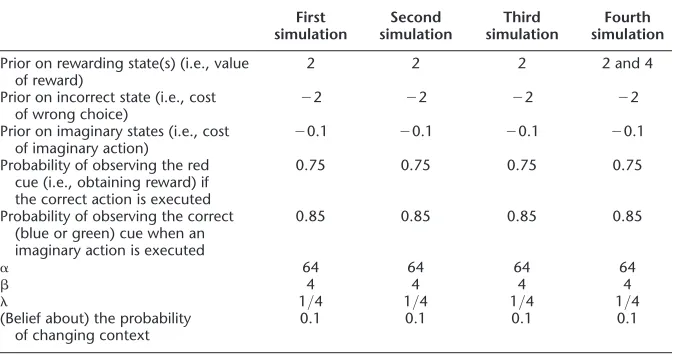
[image:4.612.60.400.80.258.2]However, the evaluation also considers the epistemic value or information gain furnished by new information that disam-biguates among hidden states (e.g., the location of an unseen reward). In this perspective, a policy that permits an agent to Table 1. Parameters used in the simulations
First simulation
Second simulation
Third simulation
Fourth simulation
Prior on rewarding state(s) (i.e., value of reward)
2 2 2 2 and 4 Prior on incorrect state (i.e., cost
of wrong choice)
22 22 22 22
Prior on imaginary states (i.e., cost of imaginary action)
20.1 20.1 20.1 20.1
Probability of observing the red cue (i.e., obtaining reward) if the correct action is executed
0.75 0.75 0.75 0.75 Probability of observing the correct
(blue or green) cue when an imaginary action is executed
0.85 0.85 0.85 0.85
a 64 64 64 64
b 4 4 4 4
l 1/4 1/4 1/4 1/4
(Belief about) the probability of changing context
0.1 0.1 0.1 0.1
estimate in which choice context it is (i.e., what are the task contingencies) has high epistemic value. Of note, all the policies that we will use in the simulations have some epistemic value, because obtaining (or not obtaining) a reward is per se informative about choice context. However, some policies also include epi-stemic actions that correspond here to a covert retrieval of episod-ic memory and VTE behavior. Selecting polepisod-icies that include epistemic actions and VTE has short-term costs (e.g., might delay reward acquisition) but can also have long-term advantages. Our simulations will show in which cases policies that include, or not include, epistemic actions are preferred.
Once the agent has calculated the (Q) value of the policies ac-cording to Equation 1, it selects one using a precision-controlled
softmaxrule (i.e., a choice rule that assigns policies a probability to be selected proportional to theirQvalue, and includes a param-eter that regulates exploration depending on the estimated reli-ability or precision of the policies, see later). The agent then executes the current action prescribed by the sequential policy, does a transition to a new state, samples probabilistically the ob-servation available in this state (e.g., a reward obob-servation), and based on this observation updates its belief on its current state and context. At this point, the evaluation starts again, in order to select the second action to take, and so on; this implies that an agent can start acting based on a given policy, and then select a new policy along the way based on the new observations it ob-tains. See Materials and Methods for further details.
Summary of the four simulations
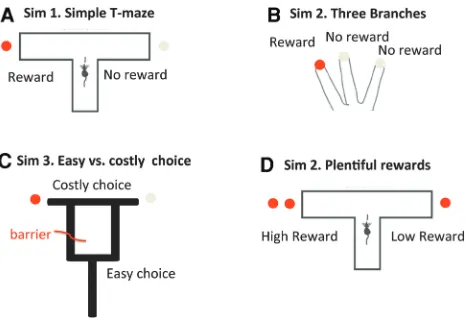
The setups (T-mazes and radial mazes) used in the four simula-tions are shown in Figure 1. In the first stimulation, we address the choice between two branches of a T-maze, one of which is re-warded, of the kind where evidence on vicarious trial and error (VTE) and forward sweeps has been recently reported (Johnson and Redish 2007; van der Meer and Redish 2010; Pezzulo et al. 2014). In this simulation, the rat is uncertain about two possible contingencies (i.e., whether the reward location is to the right or left), which—in terms of the agent’s model—correspond to two hidden contexts. In this setting, we will see that the rat per-forms VTE behavior—but only in the initial trials, until uncertain-ty about the context resolves with experience, thus making a
transition from a deliberate (VTE) to a more habitual form of choice. We will also see that, when the task contingency (aka con-text) changes, VTE behavior is reinstated, suggesting that it (only) plays a role when the animal’s behavior needs to be flexible.
In the second simulation, we use a maze with three branches. Here, there are three possible contingencies (or contexts), corre-sponding to finding rewards to the left, central, or right branch of the maze. While in the first simulation sampling either branch is equally informative about the current context, in the radial maze the rat has to “probe” each branch individually—or more precisely, all but one branch—to infer the context it is in.
In the third simulation, we model a more complex decision situation: a double T-maze, with two consecutive decision points (this is similar to the setup of van der Meer et al. 2010; Gupta et al. 2012, but includes two rather than four decision points). The first decision point is often referred to as “easy choice,” while the last choice is considered to be a “costly choice”—and it is only in these “costly” decision points that VTEs are observed (van der Meer et al. 2010; Gupta et al. 2012). What makes the early decision points “easy” is the fact that the animal can easily and quickly re-cover from a wrong choice; in our simulations, these decision points do not lead to absorbing states and so even if the animal se-lects the wrong branch, it can successively select a policy that leads to reward. What makes the last decision point “costly” is the fact that a wrong choice in this point would significantly delay reward consumption, because basically the animal has to come back to the home location of the maze and do all the choices again before having the chance of obtaining a reward. In our simula-tions, (only) costly decision points mark transitions to absorbing states, and so if an animal selects the wrong branch it cannot ob-tain reward in this trial.
In the fourth simulation, we return to the maze with two branches of the first simulation, but expand the number of task contingencies (or contexts) by introducing scenarios in which the reward can be in both locations, but one branch de-livers more reward (or with a higher probability)—thus introduc-ing a choice between a high versus low-reward choice. This simulation highlights the context-sensitivity of VTE behavior and its alleged dependence on the relative extrinsic and epistemic reward.
In summary, these simulations are intended to illustrate the role of VTE and epistemic actions in a normative model of forag-ing, and the ways they change depending on the task contingen-cies and experience.
First simulation: a simple T-maze simulation
Setup
The scenario that we consider in our first simulation is a T-maze with two branches; see Figure 1A. The goal of the agent is to find a reward site, which can be to the left or right, depending on the context (which is initially set to “reward to the left,” but changes during the simulation). The agent has to select among multiple policies, some of which go directly to the right or left (which are absorbing states), whereas others include some forward sweeps, followed by overt movement to the right or left.
[image:5.612.61.295.501.660.2]The agent is initially uncertain about the context: after each choice, procedural knowledge (of the task contingencies) is updat-ed in a Bayesian manner (Friston et al. 2013, 2014, 2015), so that the rat becomes increasingly confident about its choices. At the same time, we endowed the agent with the prior belief that the en-vironment is volatile and can change (with a small, fixed probabil-ity); this is essential for the agent to update its belief about the context (reward location) when, as we will see below, we change it during the experiment.
The generative model
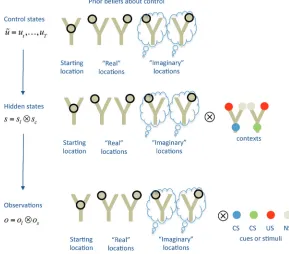
The agent’s generative model is shown in Figure 2. It includes 10 “hidden states” (5 locations×2 contexts) and 20 “observations” (5 locations×4 cues or stimuli). The two contexts correspond to the two reward contingencies: “reward is on the left” or “reward is on the right.” The five location states correspond to three loca-tions of the maze (center or start location, left arm, and right arm) plus two additional “imaginary” or mnemonic locations that cor-respond to episodic memories of the right or left arm. Visiting these “imaginary” locations does not correspond to an overt phys-ical action but to a covert and deliberative VTE event; i.e., a for-ward sweep to the right or to the left, respectively. Here, we treat these imaginary locations as hidden states (by analogy with real spatial locations) because, technically, the animal can decide whether or not to “visit” them covertly. The transitions along the hidden states are controlled by five control states, which effectively move the rat to each of the five locations, within each context. Finally, the model includes four outcomes or cues: red (reward), white (neutral), blue and green (contextual cues which correspond to the episodic recall of a reward outcome on visiting a given branch of the maze); see also Friston et al. (2015). As in many animal experiments, all these cues are deliv-ered probabilistically. The reward cue is delivdeliv-ered 75% of the time in the correct branch of the maze (otherwise, the mutual cue is delivered). Similarly, the correct contextual (blue or green) cue is delivered 85% of the times in the corresponding context (otherwise the alternative contextual cue is provided). In other words, even if the rat is certain about the reward location, its re-trieval is imperfect.
It is important to note that, by visiting a state, the agent col-lects cues or observations that can help disambiguate the context it is in. For example, if it visits a “left” control state and collects a
red cue (reward), it can infer that it is in a context where “reward is delivered to the left.” By accumulating this information, the agent can successively choose “left” with higher confidence. This marks an important difference with associative learning theories, because—in Active Inference—behavior is not selected based on (learned) stimulus–response or action–outcome associations, but rather through a (Bayesian) inference that selects policies based on beliefs about context (see Equation 1).
A second important point to note is that, in this scenario, vis-iting an “imaginary” state corresponds to performing VTE (and implicit forward sweeps) to a given branch. During this covert behavior the agent remembers or simulates a previous reinforcing (or neutral) episode; i.e., it covertly retrieves from memory (or simulates) experiencing one of the two contextual cues (blue or green). This form of episodic memory or simulation is not consid-ered here to be a rewarding experience per se—on the contrary, we associate states that are “visited” during VTE with a small prior cost (e.g., the cost of forward sweeps in terms of time and cogni-tive resources). In the Accogni-tive Inference framework, costs (e.g., cog-nitive and metabolic costs) are absorbed into the probability model (Friston et al. 2012b); this means that costly states (here, imaginary states) have an a priori low probability in the generative model and thus—all other things being equal—are less likely to be visited. However, there are circumstances when this prior cost is more than offset by the value of reaffirming the current context, before committing to a choice. In other words, here VTE and for-ward sweeps have a cost in terms of extrinsic value, but have epi-stemic value as they afford new information (blue or green cues) that can inform state (context) estimation and future choices. This formulation thus allows us to compare policies that lead the animal directly to rewards (which we associate with habitual forms of choice) and policies that firstly exploit epistemic actions and “imaginary” states (which we associ-ate with deliberative forms of choice and covert exploration).
Simulation
The simulation was integrated over 20 trials. The agent starts from the center (home) location. Initially (in trial 1) the agent has a flat (uninformative) prior be-lief about the context or reward location; this belief is updated as described in Friston et al. (2015). On each trial, the agent has to select one of its policies based on its beliefs about context, knowl-edge of the task contingencies (as en-coded in the generative model that links hidden states to observations). This selection is effectively an inference about sequential policies that maximize (the path integral of) value that is based upon prior preferences or utility.
[image:6.612.79.368.444.698.2]In Active Inference, utilities are en-coded in terms of Bayesian “priors” over future outcomes, and the agent believes that the most likely policies minimize the divergence between expected and preferred states, encoded in these priors. These priors are usually specified in terms of log probabilities or utility. Intuitively, positive utility corresponds to reward, while negative values correspond to cost. In this simulation, the correct (re-warding) arm of the maze is assigned a Figure 2. Generative model used in the first simulation, which includes control states, hidden states,
high utility, the wrong (unrewarding) arm of the maze is assigned an equivalent negative utility, and the imaginary states are as-signed small negative values, so that there is a cost for performing forward sweeps. See Table 1 for the value of the parameters used in this and subsequent simulations.
The policies selected by the agent comprise sequences of three control states, and can include either “real” control states (e.g., go to the left arm), which lead the agent to absorbing hidden states (i.e., once the animal has reached the left arm, it can only select another “left arm” control state) or “imaginary” control states (i.e., remember going to the left arm), which lead the agent to hidden states that are not absorbing. Here, for simplicity, we consider 14 possible policies. These include one “imaginary” con-trol state (e.g., simulate going left, then go left), two “imaginary” control states (e.g., simulate going left, simulate going right, then go right), or no imaginary control states (e.g., go left).
Selecting one or two “imaginary” actions or control states (i.e., performing one or two forward sweeps) enables the agent to recall one or two episodes, and thus garner more (mnemonic) cues for committing to a choice. At the same time, performing forward sweeps has a cost for the animal, because it implies a delay in reward consumption and/or the expenditure of metabolic or cogni-tive resources. In the model, this cost is encoded as a (small) negative utility asso-ciated to the imaginary hidden states (which translates into a lower probability in the generative model). The interesting comparison here is between the policies that do and do not include, “imaginary” actions, as the former correspond to VTE and the execution of forward sweeps.
Results
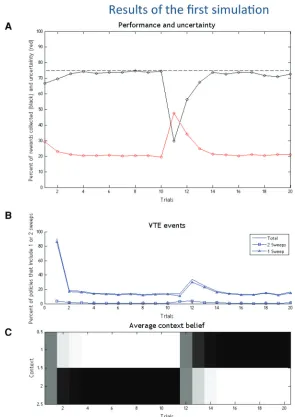
The results of the first simulation are shown in Figure 3. Here, we show the per-formance of the rat (black), its uncertain-ty (red) and the number of VTE forward sweeps, over 20 trials. The results shown here and in the following simulations are an average over 1000 runs of the same model. Note that, although the model is always initialized in the same way, policy selection and the sampling of outcomes are stochastic processes.
Figure 3A shows the performance (i.e., rewards collected) and uncertainty of the agent over the 20 trials. Figure 3B shows the number of times that the agent uses a policy with one or more imaginary actions or forward sweeps. The agent only uses VTE in the first trials, and stops doing so after few trials, marking a transi-tion from deliberative VTE to a more ha-bitual form of choice. Here, the preferred policies are those that include a single forward sweep (compare with the sec-ond simulation below). During trial 11, we inverted the context (i.e., the reward contingencies), from “reward to the left” to “reward to the right.” It is at this point that the agent’s performance
sud-denly decreases, because it acts on the basis of a false belief. In turn, this failure causes a second transition, from habitual to deliberative choice, as at the next trial, the agent starts using VTE again.
This behavior can be further analyzed by considering the be-lief about the reward context, which is shown in a black-to-white (low-to-high) scale in Figure 3C. After just one trial, the agent be-comes very confident about its context. The belief bebe-comes more uncertain after the tenth trial, but only transiently, when the agent realizes that the context has changed.
Discussion
[image:7.612.237.532.251.668.2]In this first simulation, we replicated the experimental finding that rodents engaged in T-mazes use VTE/forward sweeps in the first few trials only, and then exhibit a more habitual form of
behavior. Furthermore, VTE/forward sweeps can be reinstantiated by changing the reward contingencies (Johnson and Redish 2007; van der Meer et al. 2012; Schmidt et al. 2013; Pezzulo et al. 2014). In our simulations, changing the model parameters makes these transitions faster or slower in terms of number of trials that in-volve or do not inin-volve VTE, but not the overall pattern of results (results not shown).
Crucially, we have replicated these results by appealing only to Bayesian inference, not a set of stimulus– response or action– reward associations. This Bayesian perspective provides a norma-tive explanation for the balance of information gain and utility maximization—that is, exploration–exploitation (Friston et al. 2015). It suggests that the balance of different choice strategies, deliberative or habitual, can be explained in terms of normative principles; specifically, as the utility of extrinsic rewards relative to epistemic value provided by covert action or deliberation. Only when there is no more epistemic value (e.g., because the an-imal has resolved its uncertainty about the current context) can forward sweeps be suppressed.
By the same token, we show that the balance between delib-erative and habitual choice strategies can be cast within a single Active Inference scheme, which supports epistemic actions. This view can be compared with alternative schemes based on multiple controllers that operate using different (model free and model based) reinforcement learning principles and require an external arbitrator (Daw et al. 2005; O’Doherty et al. 2015). Here, the key point is that Active Inference simultaneously considers two forms of value: extrinsic value and epistemic value. It is when the former surpasses the latter that behavior can be habitized. Policies that try to maximize directly extrinsic value using stereo-typed responses and without performing epistemic (or explorato-ry) actions can be considered more habitual. These are indeed successful when the environment is unambiguous—or, in other words, familiar environmental cues or the animal’s current belief state unambiguously specify the best policy. When this is not the case, epistemic actions (here, covert samples of episodic infor-mation from memory) must be performed before committing to a course of action. Empirically, it is only in these latter con-ditions—which we associate to deliberative choice—that VTE behavior and forward sweeps are observed. This simulation illus-trates that forward sweeps are indeed executed in the initial trials, or when contingencies change; that is, when the agent is uncer-tain about its current context and behavior needs to be flexible to secure a reward.
In short, all the behavior simulated under active inference is quintessentially model based. The key distinction between delib-erative and habitual responses can then be reduced to a distinc-tion between policies that entail epistemic acdistinc-tions and policies that do not. Here we link epistemic actions to a form of “mental” exploration, in which episodic content is retrieved from memory (Eichenbaum 2000; Tulving 1972) or simulated/recombined in a constructive way to construct novel episodes (Hassabis and Maguire 2009; Schacter and Addis 2007), thus leaving open the possibility that VTE-based declarative control engages a mixture of model based and episodic components. In turn, the episodic component can include a mixture of contextual, spatial, and re-ward information (e.g., through reactivations of hippocampus and ventral striatum, Lansink et al. 2009). The engagement of ep-istemic behavior does not require any special arbitration; it is a natural consequence of casting the utility of a reward in terms of a prior belief, which enables it to be compared directly with the epistemic value of (overt and covert) exploratory behavior. This is a key simplification afforded by Active Inference, enabling habitual and deliberative planning to be treated within the same normative framework and, potentially, implemented within the same distributed neuronal systems.
Finally, it is also worth noting that the reason the agent changes its belief (rapidly), when contingencies change, is that we endowed it with the prior belief that the reward contingencies are volatile—and can change from one trial to another, although with a small probability. By removing the volatility prior, a trained agent would be less sensitive to changing contingencies. This idea resonates with related Bayesian theories of foraging and learning, in which animals make their choices based on the (learned) statis-tics of the environment, including higher order statisstatis-tics such as volatility (Gallistel 2012). In this perspective, animals learn and track the statistics of the environment, at multiple levels, to adapt their behavior and learning rates in efficient ways (Gershman and Niv 2012; Gallistel and Matzel 2013; Pezzulo et al. 2013).
Second simulation: radial mazes and resolution
of uncertainty
Setup
One limitation of the simulations above is that there are only two possible contexts, and so collecting the cue of (say) “no reward to the left” automatically implies “reward to the right.” This is also why the agent only performs one sweep (Figure 3B), when delib-erating. To make things more realistic, we now describe a second simulation, where the agent navigates a maze with three arms (see Fig. 1B). The possibility of three mutually exclusive contexts (re-ward to the right, center or left arm) means that probing each branch of the maze will necessarily increase epistemic value.
The generative model
The generative model used in this second simulation was the same as in the first, except that there are three rather than two contexts, and two additional control states: one additional true location, which corresponds to the third arm of the maze, and the associat-ed imaginary location. The ensuing model thus comprises 21 hid-den states (7 locations×3 contexts). As in the first simulation, there are 4 cues, but now the number of possible observations is 28 (7 locations×4 outcomes). As in the first simulation, the red cue (reward) can be (probabilistically) collected in only one of the arms, while the other two arms deliver white (neutral) cues. The “imaginary visit” of the three branches delivers a blue or a green cue, which correspond to the episodic recall of a rewarding or a neutral outcome.
In this simulation, we considered 48 policies, comprising se-quences of four control states. As in the first simulation, here the interesting comparison is between policies that lead the agent directly to one of the three arms of the maze (which are absorbing states), and those in which the agent engages in one or more imag-inary actions.
Simulation
The simulations covered 30 trials, where we changed the reward contingencies (and context) at trials 11 and 21. As in the first sim-ulation, the agent always starts from the center (home) location with uninformative prior belief about the context (reward loca-tion), which is successively updated over successive trials.
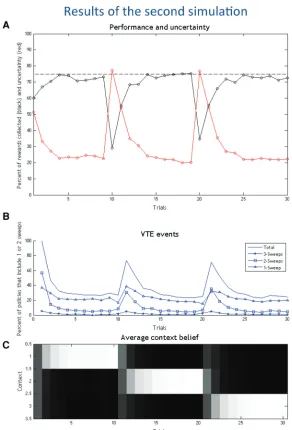
Results
Discussion
The analysis of context belief updating (Fig. 4C) confirms that the agent infers the right choice context correctly and rapidly, and then stops performing forward sweeps. A fine-grained analysis of the policies implying forward sweeps (Fig. 4B) shows that VTE is never completely extinguished, but declines rapidly. Further-more, this analysis shows a preference for policies with one, or at most two, imaginary actions.
The same overall pattern of results can be obtained with dif-ferent parameterizations of the model (results not shown). In par-ticular, the partial or complete extinction of forward sweeps depends on the relative balance between extrinsic and epistemic value in each setup—this is a point that we consider in more detail in the next two simulations.
Third simulation: easy versus costly choice
Setup
The scenario that we consider is a double T-maze, with two consecutive decision points; see Figure 1C. In principle, there are four possible paths (left– left, left– right, right– left, right–right); however, a barrier located after the first decision point blocks two of them. Importantly, a wrong decision in the first (easy) but not the second (costly) decision point can be undone, by selecting an appropri-ate policy. This is because only the stappropri-ates accessible from the second decision point are absorbing.
A similar setup (but with up to four decision points) has been adopted in a se-ries of rodent studies (van der Meer et al. 2010; Gupta et al. 2012). Using the termi-nology of these studies, here we consider the first decision point to be an “easy choice” and the second decision point a “costly choice”—because a wrong choice at this latter point would significantly de-lay reward consumption (i.e., the animal has to traverse all the maze, come back to the home location, and start a new trial in order to get the chance again to obtain a reward).
The generative model
The generative model used in this third simulation was similar to the first, but there are four rather than two contexts, corresponding to the four choice possibil-ities (left–left, left– right, right–left, right– right) to be executed. Furthermore, there are 11 control states: one for each of the three possible decision points (in-deed, a first, easy decision point is fol-lowed by one of two costly decision points, one on the left or one on the right), six imaginary states (two for each decision point, the former imaging the consequences of going left and the latter the consequences of going right) and two final states (the left return arm and the right return arm). The ensuing model thus comprises 44 hidden states (11
locations×4 contexts). We introduced six contextual cues. As in the first simulation, the reward cue can be (probabilistically) collected in only one of the arms, while the other arm delivers (probabilistically) a neutral cue. The “imaginary visit” of the two branches of the costly choice delivers a blue or a green cue, which correspond to the episodic recall of a rewarding or a neutral out-come. The “imaginary visit” of the two branches of the easy choice delivers two distinct cues, yellow and black, which signal that the agent is in one of two contexts (yellow: left –left, left –right; black: right–left, right–right), thus partially reducing its uncertainty.
[image:9.612.241.533.253.683.2]As we have mentioned, a first difference between the former (easy) and the latter (costly) decision is that states accessed from the latter (but not the former) decision point are absorbing. A sec-ond difference between the former (easy) and the latter (costly) decision is that, in our setup, performing imaginary actions in the former does not provide contextual cues that uniquely pre-scribe the correct behavioral policy. This is because the contextual
cues that can be obtained (via epistemic actions) in the former de-cision point inform on the validity of the left versus right actions at this “easy” decision point, but not on the choice to be made at the “costly” decision point. This aspect of the model represents the fact that forward sweeps have limited span. Rather, the con-textual cues that can be obtained (via epistemic actions) in the lat-ter decision point function exactly as in the previous simulations. The convergence of these two factors would improve the util-ity of performing forward sweeps in the presence of “costly” deci-sion points, but it remains to be established if this prediction holds when one simulates the specific experimental details.
Simulation
The simulations covered 40 trials, where we changed the context (and reward contingencies) at trials 11, 21, and 31. As in the first two simulations, the agent always starts from the center (home) location with uninformative prior belief about the context (re-ward location), which is successively updated over successive trials. The context is changed every 10
trials using this sequence of contexts: left– left, left –right, right–left, right– right. As in the previous simulations, a critical comparison is between policies that include or not include VTE events. Here, however, another critical compari-son is between policies that include VTE events at easy versus costly decision points. Note that for the sake of simplic-ity we only consider policies that allow one single VTE event per decision point (thus, we do not perform a comparison between policies that include one versus two VTE events).
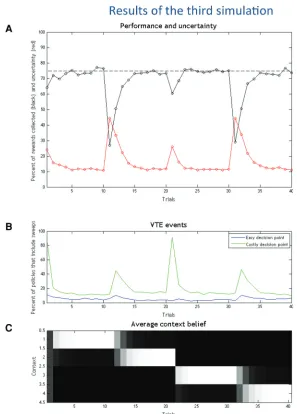
Results
The results of the third simulation are shown in Figure 5. Here, like in the first two simulations, one can see marked increases and decreases of the VTE be-havior/forward sweeps observed at the beginning of the experiment and when reward contingencies change. Impor-tantly, the VTE/forward sweeps are al-most exclusively present in the “costly” decision points, see Figure 5B.
Discussion
Coherent with the previous simulations, here VTE behavior and forward sweeps mark a transition from deliberate to ha-bitual forms of choice—and associated habitual policies—which become avail-able when the correct choice context has been estimated. The fact that VTE events are mostly limited to “costly” de-cision points is coherent with the litera-ture (van der Meer et al. 2010; Gupta et al. 2012) and illustrates that it is at this point that epistemic actions are more efficacious to inform the correct choice and prevent a significant delay in reward consumption.
The higher peak after trial 21 marks an important transition between policies
[image:10.612.240.537.270.684.2]that differ in both the required actions (from left –right to right– left). Although this situation does not induce higher contextual uncertainty than the previous transition (from right to left-left), it requires a more flexible change of strategy—as one cannot keep executing the first (left) action as in the previous case. It is this case that demands more forward sweeps, in keeping with a recognized role of VTE behavior in promoting behavioral flexibil-ity (Papale et al. 2012). Here, the increased number of VTE events is plausibly due to the fact that, after the first (left) choice, the an-imal faces the impossibility to pursue its policy—as the path is blocked. Hence, it is already at this point (after the first decision point of trial 21) that it knows that context has changed and needs to invoke a VTE event to flexibly change policy. This situation can be contrasted with all the other simulations, in which the agent cannot infer a change of context midway in a trial (here, trial 21), but only at the end of it, if it fails to collect an expected re-ward. Supporting this analysis is the fact that, in this simulation, context changes in trial 21 and VTE events occur mostly in the same trial; whereas in the other simulations, VTE events occur
mostly one trial after context has changed (e.g., context changes in trial 11 and VTE events occur mostly in trial 12).
The fact that epistemic actions (which in our simulations have an associated cost) are rarely executed at the first (easy) deci-sion point indicates that—besides being less informative—they are not necessarily required whenever uncertainty exists between alternatives. Rather, they are only demanded when the epistemic value they afford exceeds the extrinsic value of the overt behavio-ral policies—or, in other words, when a wrong choice would imply a significant cost or delay in reward consumption. In the latter simulation we study in more detail this latter phenomenon: the suppression of VTE behavior and forward sweeps when the value of the alternative behavioral policies is increased, thus exceeding any epistemic value.
Fourth simulation: plentiful rewards
Setup and generative model
The fourth simulation introduces a choice scenario in which one or both arms of the T-maze are associated to re-wards. Here, we compare explicitly two different situations. In the former situa-tion, analogous to the first simulasitua-tion, one branch is baited with reward and the other corresponds to a nonpreferred alternative (i.e., the baited arm has a “value” of 2 and the nonbaited arm of 22). As we have seen, this corresponds to a “costly” choice situation, in which making the wrong choice has an asso-ciated cost that surpasses the costs of epistemic actions. In the latter case, we associate rewards to both arms and make the value of one arm (called “high reward”) twice the value of the other (called “usual reward”); see Figure 1C. We are interested in the comparison be-tween the former (costly) and the latter (plentiful) choice situations.
In this simulations, the 5 control states and the 14 policies are the same as in the first simulation. However, there are now four contexts or reward contin-gencies. The first two are the same as in the first simulation, when either the right or the left arm of the maze is re-warded. The last two correspond to the context when one arm of the maze (left or right) delivers the usual reward, while the other (right or left, respectively) af-fords a high reward (i.e., double reward). As we will see, when these two latter con-texts are in place, any policy that goes directly to a rewarded branch (including the less-rewarded arm of the maze) can overcome the value of policies that in-clude VTE and implicit forward sweeps. Finally, there are six cues. The first four are the same as in the first simulation, while the latter two (dark red and dark blue) correspond to the presence and the episodic retrieval of the high reward, respectively, analogous to the red and blue cues in the first simulation.
Simulations
The simulations covered 40 trials, where we changed the reward contingencies at trials 10, 20, and 30. The first two contexts intro-duced in trials 1 and 10 are the same as those used in the first sim-ulation; however, at trials 20 and 30, we introduced the two new reward contingencies, in which the two arms of the maze deliver a normal reward and a high reward. As in the first simulation, the agent always starts from the starting (center) location with unin-formative priors.
Results
[image:11.612.241.530.248.668.2]The results of the fourth simulation are shown in Figure 6. In the first half of the simulation (trials 1 –19), the pattern of behavior is similar to that of the first simulation, with an initial use of epistemic policies based on forward sweeps, which are
rapidly suppressed. Although the choice situation looks identical to the first simulation, there is an important difference: while in the first simulation the agent resolved uncertainty over two con-texts, here it has to consider four concon-texts, two of which include rewards in both arms of the maze. Clearly, in this situation the val-ue of taking overt action soon (versus covert action) is much high-er, and this explains why the agent uses fewer forward sweeps, relative to the first simulation.
In the second half of the simulation (trials 20–40), in which reward is delivered in both arms of the maze, the forward sweeps are almost completely extinguished. Here, the key insight is that this pattern does not depend on a resolution of uncertainty (on the contrary, uncertainty is quite high around trials 30 –31). Rather, the scarce use of forward sweeps is due to the fact that in-troducing abundant reward lowers the (relative) value of episte-mic actions, because even an apparently “suboptimal” choice is more valuable than a forward sweep.
Discussion
The results of this simulation (especially the second half) illustrate that even if performing a forward sweep would reduce uncertainty about the context, the policies that entail forward sweeps have lower overall value (extrinsic plus epistemic value), even com-pared with policies that secure a low reward. This is because they include costly imaginary states, and delay reward delivery. To better understand this point, and the prevalence of extrinsic value in this simulation, note that all the policies have a higher value compared with the simulations above. This is evident in Figure 5A, which shows that the performance increases in the sec-ond half of the simulation. The reason is, of course, that both arms are rewarded. The situation here is markedly different from the first simulation, where the “wrong” arm of the maze is more costly than imaginary actions.
It is also worth reminding that all policies—including those that do not include epistemic actions—have some epistemic val-ue, because visiting any branch of the maze is informative of the choice context (because the animal collects red or white cues). Here, again, the choice is between policies that use imagi-nary actions to retrieve episodic content and policies that try to maximize extrinsic value directly—and which gain information only with overt actions. In situations where reward is plentiful, following a habitual policy that is insensitive to the current con-text is sufficient; however, despite the fact that the animal does not explicitly select epistemic or exploratory actions, its habitual behavior has nevertheless some epistemic or exploratory conse-quence, permitting the animal to estimate its current context at least to some extent.
This simulation highlights the fact that the choice of a delib-erative strategy depends on the balance between extrinsic value (of the rewards to be collected) and epistemic value (of the possi-ble states to be visited). In other words, in Active Inference, episte-mic actions are not mandatory under residual uncertainty or when the precise value of alternatives remains to be estimated (as would be the case according to the “value-of-alternatives” the-ory) but they are preferred when the epistemic value is higher than the extrinsic value, because both are considered together— on a level playing field that, as shown in Equation 1, is provided by expected free energy.
With some simplifications, one can conclude that VTE behavior/forward sweeps are preferred when the cost of perform-ing “imaginary” actions is intermediate between the values of the two branches of the maze. This is consistent with the operational definition of “costly” choices adopted in many studies of VTE (Gupta et al. 2010; van der Meer et al. 2010), where choice situa-tions are costly if selecting the wrong option is significantly worse
(i.e., in terms of delay in reward consumption) than spending time to decide. Conversely, easy choice situations are those in which one can undo or quickly recover from a wrong choice. In addition, our results suggest that the most natural way to frame in-teresting choice situations is in terms of relative (not absolute) utility, and more precisely as the choice between a (potential) “gain” versus a (potential) “loss,” where the cost of epistemic ac-tion is intermediate. Not only does this relative value-coding seems to apply when only one arm of the maze is baited, but also when both are baited with rewards that are significantly dif-ferent—say with a smaller versus a greater reward. In this latter case, the acquisition of the smaller reward might be cast as a cost, not a gain, and hence encoded as a negative value—for ex-ample, the difference between the small reward actually acquired and the greater reward that might have been (counterfactually) se-cured. The fact that rodents show sophisticated forms of regret (Steiner and Redish 2014) speaks in favor of such a (counterfactu-ally based) relative value coding. In terms of our simulations, this would imply that it is appropriate to model both “reward versus no-reward” and “high- versus low-reward” situations in terms of a gain and a loss (e.g., 2 versus22). Rather, a value-coding that in-cludes too many gains (e.g., 2 versus 4) might instead represent a choice situation in which reward is plentiful and exploration is not necessary (see Discussion).
More generally, the emergence of VTE in the context of dif-ferentially rewarded outcomes depends sensitively on the relative utility (i.e., prior preferences). The key thing to note here is that, in active inference, the utilities of all outcomes are relative—and utility has a quantitative meaning in terms of relative (log) prob-abilities of preferred states (Friston et al. 2015). In other words, because the prior preference is a probability distribution it has to sum to one, which means there is no absolute utility, only dif-ferential utilities. This is an important point, and suggests that it is the differential utility (prior preference) that determines choice behavior: this is becoming increasingly evident in neurophysio-logical and fMRI studies (Rushworth and Behrens 2008). In our context, the relative nature of utility spans all options—including VTE. This means that the cost of a VTE could be less than either reward, in which rewards would usually supervene. Conversely, the VTE could have a prior preference that was intermediate be-tween the high and low reward outcomes. In this instance, one would expect qualitatively different behavior—in the sense that the cost of VTE makes it viable in relation to a potentially less pref-erable reward. This highlights the importance of differential util-ities in determining behavior, which renders them important variables in modeling observed behavior and characterizing indi-viduals on the basis of their choices.
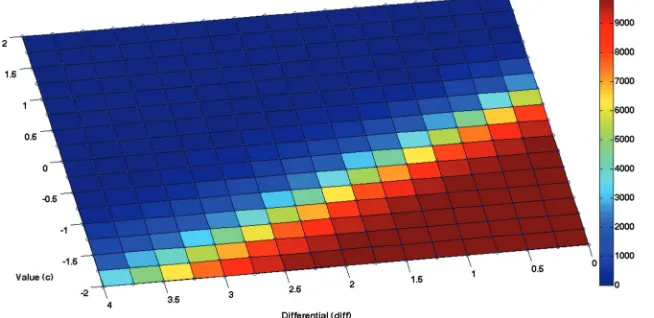
Variants of the fourth simulation, with varying levels of extrinsic value
to any of the two arms is more valuable than all policies that in-clude imaginary actions. However, with lower values of the “usu-al” reward, the agent uses imaginary actions—but only if the epistemic value (and information gain) associated with context estimation surpasses the value of the actions that lead to any re-ward. Specifically, the agent uses imaginary actions only if the total extrinsic value available is lower than a given value (that varies depending on c; for example, it is 2 whencis 0). Finally, the fact that epistemic actions are not always performed when the differential is zero shows that VTE behavior is not associated with a putative difficulty in distinguishing amongst similarly val-ued alternatives, as would be predicted by “value-of-alternatives” theory.
Another point that is worth noting is that the number of for-ward sweeps does not necessarily depend on the number of con-texts to be disambiguated or (the difficulty to disambiguate) their value. Indeed, in Equation 1 epistemic value depends on the possible contexts irrespective of their specific extrinsic value. This illustrates the fact that epistemic and extrinsic value can be varied independently. Technically, expected free energy is a linear mixture of epistemic and extrinsic value, meaning that both sorts of value can be compared directly, see Equation 1. This explains the switch from deliberative to habitual behavior when the epistemic value of a deliberative behavior falls below the extrinsic value of a competing (habitual) policy. Despite so, the choice to perform or not perform epistemic actions to disam-biguate context is not insensitive to extrinsic value, as ultimately in our simulations it is an increased possibility to obtain a high(er) reward that favors the selection of epistemic (or deliberative) over habitual policies. This speaks to the importance of epistemic ac-tion and exploraac-tion in the maximizaac-tion of extrinsic value on a different timescale.
Discussion
We have simulated various choice scenarios, with varying levels of extrinsic value and epistemic value afforded by uncertainty. Taken together, these simulations show that both habitual and deliberate forms of control can be accommodated under the same Active Inference scheme, where extrinsic and epistemic val-ues are optimized together. Specifically, the balance between ha-bitual and deliberate forms of control depends on the relative
extrinsic and epistemic value that is af-forded to a policy, and do not necessarily require two separate “controllers,” one for habitual choice and one for delib-erate choice (the latter possibly using hippocampal sweeps) and an external arbitration mechanism as commonly as-sumed in reinforcement learning theo-ries (Daw et al. 2005; Lee et al. 2014; O’Doherty et al. 2015). One problem with most “multi-controller” schemes is that they require the separate controllers to be always activated in parallel; how-ever, in this case we would observe for-ward sweeps (and VTE) in all trials. One alternative view is that the controllers can be recruited serially. In this perspec-tive, the (more demanding) deliberate processes are only recruited when neces-sary, for example, depending on the “val-ue of information” (VoI) (Keramati et al. 2011; Pezzulo et al. 2013). However, to address the notoriously challenging VoI computations, one has either to assume that the deliberate system has “perfect information” about the value of choices at each state (Keramati et al. 2011) or use approximations (Pezzulo et al. 2013). In this Active Inference formulation, instead, the epistemic value of actions (which links directly to VoI computations) is automat-ically considered by the policy selection mechanism, which arbi-trates between those that yield, or do not yield, information gain. By the same token, in the model presented here the distinc-tion between deliberate to habitual choice does not map one-to-one to distinct, model-based versus model-free computations. Here, both can be implemented under the same inferential scheme, by considering policies that include, or not include, epi-stemic actions. In other words, VTE behavior is part of a search process that—importantly—includes epistemic actions and the recall (or construction) of episodic memories. In keeping with the idea that deliberate and habitual forms of choice can recruit partially different brain networks (Balleine and Dickinson 1998; Yin and Knowlton 2006; Redish 2013), it is only in the former (deliberate) forms of choice that VTE behavior and hippocampal forward sweeps are necessary. This is coherent with previous for-mulations that highlight their importance in deliberative choice (van der Meer and Redish 2010; van der Meer et al. 2012; Pezzulo et al. 2014) and with empirical evidence that hippocam-pal processing is linked to deliberate forms of choice but not— or not necessarily—habitual forms (Redish 2013; Schmidt et al. 2013) as well as to novel information (Lisman and Otmakhova 2001; Vinogradova 2001).
[image:13.612.61.388.74.233.2]Our simulations provide a normative perspective on why this is the case. The first and second simulations suggest that deliber-ate behavior and assocideliber-ated VTE and forward sweeps arise when (contextual) uncertainty has to be resolved before a choice, and it is suppressed when information gain is no longer possible (after uncertainty has been resolved). The third simulation shows that VTE behavior is key in “costly” choices, whenever a wrong choice would prevent reward consumption or delay it significantly, but is not necessarily demanded in the presence of residual uncertainty. Taken together, the results of the first three simulations link VTE behavior to behavioral flexibility, and show that while diminish-ing uncertainty is an important imperative in some cases (first and second simulation) it is not the primary determinant of epistemic action. Rather, it is the relative value of extrinsic versus epistemic value that regulate VTE dynamics. We further investigate this as-pect in the fourth simulation, which shows that epistemic actions Figure 7. Number of policies that include forward sweeps during the fourth simulation, trial 31, as a
are suppressed when the extrinsic value that can be obtained by acting overtly (rather than covertly simulating) exceeds informa-tion gain. This latter result highlights the important role of prior preferences that, in Active Inference, are a softmax function over utilities (which determines the relative log probability of each out-come). In other words, every outcome is associated with an extrin-sic value that is inherently relative to all other available outcomes. To model a preference for the greater reward, one would simply in-crease the differential between the two options until the lesser re-ward no longer predominated over epistemic value—leading to the behavior illustrated in the first simulation. Although of course there are multiple ways to set prior preferences, it is this latter value-coding, in which (with some simplifications) the value of epistemic actions is intermediate between the highest and lowest option, which we consider to be the most appropriate way to mod-el various meaningful choice situations, including choices be-tween a higher versus a lower reward—where, basically, the value-coding is relative, not absolute, and the low reward would be encoded as a loss compared with the other potentially (coun-terfactually) available reward.
The dependence of epistemic action and exploration on the overall available (extrinsic) value shows the relations between our formulation and other normative principles in foraging theo-ry and exploration-exploitation—and especially the Marginal Value Theorem. According to the latter, an animal should stay in (exploit) its patch as long as the current reward rate—the mar-ginal value of the patch—exceeds the average reward rate of the environment; when this is not the case, it should leave the current patch (explore) (Charnov 1976). The formal framework presented here extends these normative principles from foraging domains to VTE behavior and hippocampal forward sweeps—where the latter are assimilated to a form of “mental” exploration. In this perspec-tive, if a habitual policy—or a policy that is insensitive to the con-text—provides a high reward rate, the probability of exploring should lower, unless the agent expects a change of context. This analogy remains to be fully assessed empirically.
Taken together, our results illustrate that changing environ-mental properties, such as the balance of extrinsic and epistemic value, demand different behavioral strategies, which—in the ani-mal learning literature—correspond to deliberate versus habitual forms of choice (Balleine and Dickinson 1998; Dolan and Dayan 2013). In the scheme presented here, deliberative mechanisms are required when behavior needs to remain flexible and alterna-tives need to be explored, and it is in these conditions that VTE behavior is present. Habitual strategies emerge instead when the environment unambiguously specifies the (best) options. Finally, VTE behavior is also suppressed when the extrinsic value of any choice exceeds the information gain afforded by epistemic actions. These results provide a normative account of VTE behav-ior and forward sweeps that is coherent with existing evidence, and generate novel empirical predictions that can guide future research.
The theory presented here is alternative to the idea that VTE behavior stems from conditioned orienting (Bower 1959; Spence 1960) or discrimination learning (Schrier and Povar 1979). Our proposal is instead compatible with views that see hippocampal sweeps (and ventral striatal activations) as part of a model-based evaluation process (Johnson et al. 2007; van der Meer et al. 2012; Pezzulo et al. 2013; Steiner and Redish 2014), with the idea of Tolman (1948) that VTE behavior permits learning the structure of a task and flexibility theory of VTE (Regier et al. 2015). Furthermore, our proposal resonates well with the view of Johnson et al. (2012) that VTE affords “information foraging” in memory and, by engaging a model of task contingencies, per-mits to simulate or imagine potential observations (or informa-tion that can be sampled). These theories highlight that VTE
plays several roles—in deliberation, behavioral flexibility, struc-ture learning, information foraging—that in our proposal all stem from the fact that they afford (covert) epistemic actions. We offer a formal scheme to calculate the value of epistemic (or information foraging) actions and compare it with the extrinsic value afforded by overtly executed actions, thus selecting policies that include (deliberate) or not include (habitual) epistemic com-ponents. In this perspective, the distinguishing element of VTE behavior is the epistemic component that is not mandatory in model-based search. Furthermore, here we stress the importance of episodic components, often associated with hippocampal pro-cessing (Tulving 1972; Eichenbaum 2000), within a model-based inference scheme.
The formal model we have adopted here can, in principle, be extended in several ways. For example, we have assumed that the agent’s generative model includes all the information about task contingencies, the reliability of the cues, and the number of al-lowable contexts, which animals must learn. Our assumptions mimic the situation faced by rodents in T-maze studies, in which the animals have already learned these probabilistic contingen-cies (Johnson and Redish 2007; Gupta et al. 2012). However, the computational model presented here can be easily extended to in-corporate learning, as part of the Bayesian estimation scheme (Friston et al. 2015). This extension would permit to model, for example, the fact that hippocampal theta sequences, which we consider here as part of the agent’s generative model, are learned through experience, albeit very rapidly (Feng et al. 2015) and be-fore that cannot be plausibly used for episodic retrieval or simulations.
Another limitation of the current model is that we adopt a simplified method to discount the value of delayed rewards. In the model, all policies have the same length (say, three actions) and—for the sake of simplicity—we allow agents that arrive sooner to a reward site (say, after just two actions) to consume the reward more than once (say, twice, one plus the number of maining actions in the policy). This stems from the fact that re-ward sites are absorbing and an agent reaching one of them cannot leave it until the end of the trial. This method permits im-plicitly discounting the value of a reward for the agents who arrive at the reward site later, but can be refined to obtain a better (quan-titative) fit to behavioral data on temporal discounting.