Factors Affecting the Development & Implementation of
The Structural Aspects of the Nigeria Building Code
among the Stakeholder’s within the House Building
Construction sector in the Lokoja Municipality
Sunday Ukwe-nya Yakubu,
University of Strathclyde, Department of Architecture Email: [email protected]
Andrew Agapiou
University of Strathclyde, Department of Architecture
Abstract
The failure of the Nigeria Building Code (BC) development and implementation for the structural house building construction process in the Lokoja Municipality to protect the buildings, occupants and the environment as a result of vested stakeholder interests reverberates with significant impacts on house building failures leading to fatalities. There have been 742 recorded deaths, 96 injuries and 63 building failures: three cases from 1976–1978, 19 cases from 1982–1995, and 42 cases from 2000 to 16 September 2014 in Nigeria. These cause investors to lose confidence and allow the entry of non-professionals into the industry. This paper identifies and examines the key factors that affect the development and implementation of structural aspects of house BCs, drawing on contextual analysis and international experience. This paper represents part of a large Ph.D. research project, focusing on the key internal and external factors affecting the development and implementation of structural aspects of a BC. This paper has identified a multitude of inter-locking key factors that affect BC implementation in Lokoja including legislation, absence of approved standards, lack of good leadership, lack of political interest or will, inadequate implementation processes, lack of code awareness, high poverty level, high professional fees and insufficient public dialogue. There are also causal factors involved, which impact risks associated with the non-implementation of the code on consumers and the development of industry and professional practice. These include corruption, professional rivalry, professional vested interest, inadequate capacity building, absence of professional involvement in decision making, lack of respect for the poor and public opinion, abuse of human rights and unemployment
1. Introduction
Building codes (BCs), which stipulate minimum standards for building health, safety and the wellbeing of the occupants and their environments, have been in existence from the time humans began manipulating their own environment. The first recorded case that set a minimum standard for building practises was the Code of Hammurabi in ca. 3000 BC (Trombly, 2006). The non-implementation of Nigeria BCs, which set minimum standards for building practises, has caused severe consequences regarding structural building collapse in the house building construction industry in Nigeria (Olusola et al, 2011). Codes are designed to protect buildings from structural failure, and the people and property inside them from death and extreme adverse effects on health and safety. BC development laid a solid foundation on which professionals boast of their work meeting minimum standards in a particular jurisdiction (Ghosh, 2002). All houses and their construction and management stages are regulated by BCs, which seek to harmonise best practises, materials, methods and processes to achieve a building that is habitable (Ayedun et al, 2012).
The building process, from planning and design to construction and management, is very complex; therefore, it requires a very strong regulatory regime and compliance mechanisms to sustain expected standards. The emphasis on building construction with very little attention to planning, implementation and enforcement among the stakeholders can be regarded as tantamount to impropriety (Davidson et al, 2003). The responsibility for building plan approval rests with the department of urban planning at the Federal, State and Municipal levels in Nigeria, while the execution, supervision and management of the operational process for implementation rests within the development control department; who enforce the implementation and ensure that the professionals and owner comply with building code provisions (NBC, 2006). However, the enforcement; once it is adopted provides an opportunity for training regarding the required skills and new technology for enforcement, implementation and compliance encompassing all stakeholders in the house building construction process (Olusola et al, 2011).
development processes, insufficient public dialogue and lack of innovative technology (Olagunju et al, 2013; Olusola et al, 2011). These studies have concluded that in order to overcome the challenges affecting the implementation of BC, the casual factors must be identified and uprooted to reduce the risks associated with poor house building construction practices. The aim of this paper is to identify and examine key factors that affect the structural aspects of BCs with respect to the causal factors and the subsequent risks to the consumer, professional practice and the house building industry in support of prior research findings.
2. BC features and their regulatory problems
The BCs have different components that work together to ensure a building’s safety, benefits, welfare
convenience to all persons involved in building processes (CASA, 2012). Al-Fahad (2012) stated that the Productivity Commission (2004) presented the four aspects of BCs (see also NBC, 2006; Act, 2013: p.21; ICC, 2006; 2009): legislative (legal aspects of building rules and regulations), social (deals with the relationship of the people with respect to the code and the building environment), administrative (deals with BC administration and the discharge of its functions in any country) and technical (deals with technical requirements for pre-design, design, construction and post
construction). With these features, clarifying any part of a problem that might arise can easily be achieved. These features are inter-connected; relating different features of the BC with associated problems that must be collectively resolved for improved implementation.
The Building Control requirements within Nigeria lie at the centre of an idea or discussion surrounded by a multitude of problems. The individual legal, administrative, technical and social problems affect the functionality of the BC. All problems are in a circle, indicating that all problems affect each other. To eradicate the BC problems, the legal, technical, social and administrative problems must be solved simultaneously, to not pollute the central idea of its basic objectives through their correspondences.
3. Structural Aspects of house Building Construction Process
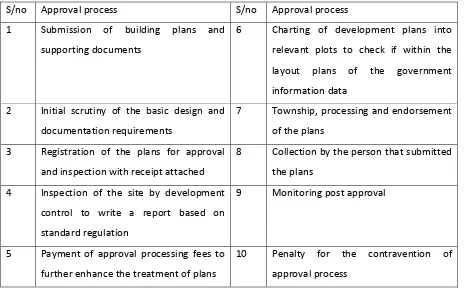
Table 1: A summary of the building approval process within Nigeria
S/no Approval process S/no Approval process 1 Submission of building plans and
supporting documents
6 Charting of development plans into relevant plots to check if within the layout plans of the government information data
2 Initial scrutiny of the basic design and documentation requirements
7 Township, processing and endorsement of the plans
3 Registration of the plans for approval and inspection with receipt attached
8 Collection by the person that submitted the plans
4 Inspection of the site by development control to write a report based on standard regulation
9 Monitoring post approval
5 Payment of approval processing fees to further enhance the treatment of plans
10 Penalty for the contravention of approval process
Source: Building development control offices, December (2014)
The supporting documents to be attached to the complete set of building plans include: Environmental Impact Assessment report (for factory or industrial buildings), Site Analysis Report for all building plans, and Letter of Attestation1. The letter must include the name; professional qualification (must be member of Council of Registered Builder of Nigeria (CORBON) or Council for the Regulation of Engineering in Nigeria (COREN), a photocopy of the certificates, residential address and functional telephone numbers of the builders.
3.1 Regulatory Enforcement Monitoring in the Current House Building
Construction Process
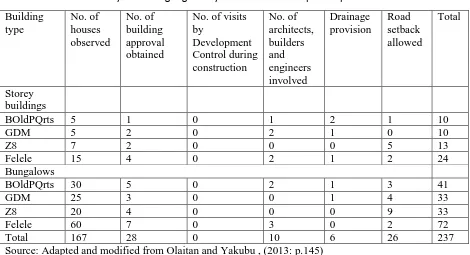
Olaitan and Yakubu (2013) reported a field survey for developing areas of Lokoja. They presented a damming report on the regulatory failure and non-compliance practises of the building code
provision. The survey is summarised as in table 2 below.
1 Implementation policy started in 2011 by the Development Control Abuja and Lagos State for builders and engineers involved in the
Table 2: A summary of Building regulatory failure & non- compliance practices Building type No. of houses observed No. of building approval obtained
No. of visits by Development Control during construction No. of architects, builders and engineers involved Drainage provision Road setback allowed Total Storey buildings
BOldPQrts 5 1 0 1 2 1 10
GDM 5 2 0 2 1 0 10
Z8 7 2 0 0 0 5 13
Felele 15 4 0 2 1 2 24
Bungalows
BOldPQrts 30 5 0 2 1 3 41
GDM 25 3 0 0 1 4 33
Z8 20 4 0 0 0 9 33
Felele 60 7 0 3 0 2 72
Total 167 28 0 10 6 26 237
Source: Adapted and modified from Olaitan and Yakubu , (2013: p.145) .Where: BOldPQrts=Back of old poly quarters, GDM=Gadumo, Z8=Zone 8
The study presented in Table 2 observed 167 buildings, of which, 28 buildings obtained approval, representing 16%. Ten had at least one professional, amounting 0.59%, and 0.0% of site visits were recoded for enforcement indicating a total regulatory failure of enforcement
3.2 Recorded Cases of Structural Building Failure
4. Key Factors Affecting the Implementation of BC Structural
Element Provisions
The body of literature reviewed presented various factors that impede the implementation of the structural aspects of the building code provision. These factors include a lack of awareness of the NBC and a lack of legal framework. Dauda et al (2012) argued that the lack of awareness among the populace reduces the degree of compliance with the required regulations. The more people are awareof the existence of these regulations within their municipality the better; their awareness partly determines the extent to which people will comply with the regulations. Further, Dauda et al
(2012) stressed that lack of legal framework makes legislative support difficult. Another key factor is uncontrolled urban growth. Abubakari and Romanus (2011) observed that urban growth was not adequately controlled due to the rapid, chaotic growth of cities during a rapid period of industrial development as witnessed in counties such as Nigeria. There was a massive exodus of migration to the cities in search of greener pastures, which created squatter settlements and informal sector activities that continued to grow because of implementation problems (Wafula, 2012). The increased urban pressure on buildings and facilities is due to a lack of government unplanned urbanisation in line with urban growth.
The majority of urban centres in developing countries are not planned, and where plans exist, enforcement is absent (Kimani & Musungu, 2010). An inadequate implementation process and manpower for enforcement is another key factor identified in reviews. Berrisford (2010) showed that unclear implementation procedures for structural aspects of buildings and inadequate technical manpower within the local authority to enforce implementation of building development were a serious challenge in African cities (Berrisford, 2010). The study observed that the local council had neither clear standards for implementing each of the structural aspects of the code provisions nor the technical expertise in the areas of building health inspectors. Absence of approved standards and laxity in the approval process also discourage developers to submit their drawings for approval and start development immediately without worrying about consequences of their actions. If the approval process can be hastened, barriers to the implementation of building regulations will be eliminated (Berrisford, 2010).
Lack of government directive and promotion is also identified as key factor hindering the development and implementation of the structural aspects of the BCs provisions in Lokoja
staff, lack of institutional framework for development planning and the lack of or inadequate participation by the beneficiary population, as cited in many African countries − Botswana, Kenya, Zambia, Zimbabwe, Tanzania and Nigeria Berrisford, 2010). The federal government’s concentration
of power has left local governments with no experts to drive policy formulation and implementation in an effective direction (Berrisford, 2010). Political Interference or lack of political will at all levels is also cited as another factor hindering the further development and implementation of building code provisions. Obiegbu confirmed that the government, both central and local council, lack commitment to building regulations, which has clearly been seen in the case of Nigeria’s BCs, which have come
before the national assembly for decades without legal backing. In the opinion of Nyangweso, (2007), a high professional fee is also identified as a constraint to implementation. On average, each
professional charges 3–15% of the total cost of house construction as professional fees. Land within a developing area (like Lokoja) costs N800, 000 (£2,858.01) for 450.00 m2 of land. Such high costs may discourage developers to involve professional in the development of house building construction, thereby increasing the risk of building collapse much further (Berrisford, 2010).
Other factors that impede the development and implementation of BCs in developing countries are as follows; absence of a national building safety strategy, out-dated and incomplete building legislation, lack of data regarding the country’s building market and legislation requirements in both the public
and private sectors, weak private-sector technological capability due to a shortage of adequately trained staff, out-dated bylaws, quality control and safety systems, inability to enforce building control and development Initiatives and underfunded regulatory agencies lacking skilled staff and other necessary resources, resulting in inadequate inspection, monitoring and certification capabilities (Fundi et al, 2011; Kimani & Musungu, 2010).
4.1 Causal Factors/Impact Risk of Non-Implementation of BC Provisions
A number of studies have identified causal factors associated with the poor implementation of building code provisions within Nigeria as a whole. For instance, Ayedun et al (2012) and Oyinola (2011) agreed that corruption at different levels of political leadership and amongst stakeholders impedes the implementation of standards in Nigeria. Corruption in Nigeria, as presented by the authors, comes in different dimensions: lack of quality education for children, election manipulation by money and bribery, and backdoor business decided in one man’s sitting room to steal public
8 Weak government corruption
fighting institutions. Lack of access to public
information.
Pre-bargaining and negotiation. A low record of punitive
punishment for corrupt officials.
Insincerity of government. Insecurity of informants. Systemic disorder. Poverty.
Nepotism
Lack of professional involvement in house building construction is another causal factor that impedes implementation. Omeife and Windapo (2013) argued that a lack of professional participation in house building construction affects the implementation of standards, thereby causing building collapse. Hence, Agapiou et al (1998), therefore, called for greater efforts to enhance the collaboration and coordination of all stakeholders working towards better housing for all. Professional rivalry and mutual suspicious are also causal factors. Agapiou et al (1998) upheld that stakeholders should develop cordial relationships for the interest of clients and projects, and denounce the current practices of opponent attacks, which exist in the construction industry. The study suggested that there should be an interest in making the relationships work to achieve the desired goals among stakeholders, recognizing that cordial working relationships may not be free from constraints, but closer ties among stakeholders in closing the existing gaps and wastages will go a long way in overcoming the obstacles to create trust and to reduce the cost of construction. The study highlighted some key factors for
‘effective partnership relationships’, such as “Compatibility among stakeholder, each
stakeholder norms of practices, High degree of internal trust, Robust team building, Genuine openness towards those outside the partnership” Agapiou et al (1998: p.359). Another causal factor that impedes the implementation of structural aspects of house building is
inadequate capacity building. Dixit (2008) stated that implementing BCs could be easy through capacity building by training all management, professionals, and artisans/tradesmen (etc.) to develop control. The risks associated with non-implementation of the BCs due to causal factors were incessant collapse of structural aspects of buildings, loss of investors in the sector,
9
4.2 Strategies to Improve the Implementation of BC Provisions
within Nigeria
Many authors have supported different models that could ease the implementation process among various stakeholders, including; Pinder et al (2013) who stated that, if more adaptable buildings were constructed in terms of standard regulations, cost considerations and cultural considerations, the change in the mind set of stakeholders would help resolve a key issue through his model, the Virtuous Circle to Curb the Circle of Blame (Pinder et al, 2013). The model posits that government policies and regulations have a greater influence on the mind-sets of the people concerning choices of buildings. However, few studies have modelled how the regulatory enforcement design can be complied with effectively to balance the interests of all stakeholders. Compliance to Building Code requirements is fraught with difficulties if construction firms, Central and Local Government lack effective expertiseto comply with regulatory requirements. The lack of expertise necessitates the need for a top-down approach to raise awareness amongst the multitude of professionals involved in the house building process, as well as artisans/tradesmen, house owners and the general public (Surya 2008), coupled with strengthening of the role & capacity of local government officials, academic institutions and NGOs in the implementation process. Agapiou (1998) highlighted the
significance of capacity building through training and development of personnel, which would invariably enhance the implementation process of the structural aspects of BCs in the house building construction industry (see also Dixit, 2008). Agapiou (1998) stated that more
emphasis should be on performance criteria for training instead of merely showing the syllabus to be covered and assessing the trainer. The trainer must design qualifications in line with the statement of competence via valid assessment of work performance. They must also monitor the inspectors, evaluate and verify the system for a successful implementation of the training programme that has recently began in the house building construction industry in Nigeria.
5. Conclusions
10
that significantly increased building risks over time. It can be stated that the administrative features of BC policies are critically important to the development and implementation of BCs, and impact significantly government enforcement agencies (town planning boards, development control, etc.), professionals implementing technical features into their practices and others complying with the standards. If the key factors that affect the development and implementation of BCs must be eliminated, an effective policy design framework must be put into place to uproot and break the causal factor’s shark-like teeth that grip the key factors. This paper
suggested strongly that, taking into account the identified key and causal factors, an effective policy development and detailed implementation framework design showing what to do, who will do it, when it has to be done, how it should be done and time taken amongst the stakeholders would drastically reduce the impact risks on the industry and help solve the problem of non-implementation of the BC and incessant collapse of buildings. This paper has clearly presented a solution involving stakeholders’ mind set change, partnership and
collaborative working relationships, and mutual trust building to ease the implementation process and capacity building of stakeholders. The findings of this paper has identified that; systemic disorder including; high level of national corruption, professional rivalry/vested interest, inadequate capacity building amongst the stakeholder’s through bureaucratic process impede the development and implementation of structural aspects of BC within the house construction sector in Lokoja Municipality, Nigeria.
References
Abubakari A, and Dinye, R D (2011) “Urbanisation and the Challenges of Development Controls in Ghana: A case study of WA Township”. Journal of Sustainable Development in Africa, 13 (7), ISSN 1520-5509.
Agapiou A (1998) “A Review of Recent Developments in Construction Operative Training in the UK”. Construction Management and Economics, 16 (5), 511-520
Agapiou A, Flanagan R., Norman G and Notman, D (1998) “The Changing Role of Builders Merchants in the Construction Supply Chain”. Construction Management and Economics, 16 (3), 351-361
Al-Fahad J Y (2012) Reform of Building Codes, Regulations, Administration and Enforcement in Kuwait: Within the Legal, Administrative, Technical, & Social Framework. A doctoral thesis submitted in partial fulfilment of the requirements for the award of Doctor of Philosophy of Loughborough University, April 2012.
11
Berrisford S (2010) “Why it’s difficult to change planning laws in African countries?” Research Journal in Organizational Psychology & Educational Studies, 2 (3), 132-138.
Casa. (2012) Review of Ghana Building Code-Integrating Climate Change and Disaster Risk Reduction in Physical Development. Africa Adaptation Programme on Climate Change, UNDP and EPA. Available at: ( https://www.undp-aap.org/sites/undp- aap.org/files/Ghana_Study_Integrating-CC-DRR-Physical-Dev-Review-Ghana-Building-Code_2012.pdf [Accessed 24th July,2014])
Civil Society Organisations (2008) Involved in the fight against corruption. Zero Corruption Coalition, 11-12 December 2008, Lagos, Nigeria.
Dahiru D, Abdulazeez, A D, and Abubakar M (2012) “An evaluation of the adequacy of the national building code for achieving a sustainable built environment in Nigeria”. Environmental and Earth Sciences, 4 (10), 857-865.
Demian P and Walters D (2013) “The advantages of information management through building information modelling”. Construction Management and Economics, 32 (12), pp1153-1165
Dixit A M (2008) “ Challenges of Building Code implemental in Nepal”. Paper for UNCRD
International Expert Symposium, 28-29th November, Tokyo, Japan.
Fagbenle O I and Oluwunmi A O (2010) “Building failure and collapse in Nigeria: The influence of the informal sector". Journal of Sustainable Development, 3 (4), 268-276.
Fundi I S, Maritim N K, and Mutuku R N (2011) “Shortcomings of Building Code and its Impact in Kenya’s Construction Industry at County Level”. Proceedings and Conference Papers IEK Engineers Int’l Conference, 11th
-13th May 2011.
Ghosh, S. K. (2002) “The building code process: An introduction”. PCI Journal. 134-137
Tanko J A, Ilesanmi F A, and Balla S K (2013) “ Building failure in Nigeria and mitigating roles by engineering regulation and monitoring”. Engineering Journal, 5, 184-190.
Kimani M and Musungu T (2010) “Reforming and Restructuring the Planning and Building Laws and Regulations in Kenya for Sustainable Development”. 46th ISOCARP Congress.19-23 September 2010, Nairobi Kenya.
Obiegbu M E (2008) “The Builder’s Guide to the National Building Code”, The national building code and nation building. Proceedings of the 38th Annual General
Meeting/Conference. Wednesday 15th-19th October, pp.11-19; 2008 Oshogbo, Osun State,
Nigeria.
Olagunju R E, Aremu S C and Ogundele, J (2013) “Incessant Collapse of Buildings in Nigeria: An architect’s view”. Civil & Environmental Research 3 (4), 49-55.
12
Olusola K O, Ojambati T S & Lawal, A F (2011) “Technological and non-technological factors for the occurrence of collapse buildings in south western Nigeria”, Journal of Emerging Trends in Engineering and Applied Sciences, 2 (3), 462-469.
Omeife C A and & Windapo A O (2013) “Impact of the national building code on professionalism”. Proceedings of the 43rd Builders Conference/AGM, 26-30 August 2013, Abuja, Nigeria.
Oyinola O A (2011) “ Corruption Eradication in Nigeria: An Appraisal”. Library Philosophy and Practice. ISSN 1522-0222.
Pinder J, Schmidt R. and Saker J (2013) “Stakeholder perspectives on developing more adaptable buildings”. Construction Management and Economics, 31 (5), 440-459.
Razak A R and Michael A O (2013) “The Study of Claims Arising From Building Collapses: Case Studies from Malaysia, Nigeria, Singapore and Thailand”. Journal of Civil and Environmental Research, 3 (11), 113-129.
Surya A S (2008) “ Earthquake and non-engineered buildings: Role of governments, experts and guidelines in India”. Paper for UNCRD International Expert Symposium, 28th-29th November, Tokyo, Japan.
Transparency International. (2013) Corruption Perception Index. (TICPI). Available at: (
http://www.transparency.org ISBN: 978-3-943497-49-6 © 2013 Transparency International.
[Accessed 10th November 2014])
Trombly, B. (2006). The international building code (IBC). CMGT 564-Term Paper. Available at: (http://strategicsstandards.com/files/internationalbuildingcode.pdf [Accessed 15th July 2014])
Wafula J E and Talukhaba A A (2011) “Re-Writing Local Authorities Building Control Regulations to Foster Energy Efficiency in The Built Environment In South Africa: The Case Of Ekurhuleni Metropolitan Municipality”. Proceedings of RICS-COBRA Research Conference, 12-13 September 2011, University of Salford, UK. pp. 390-408.