City, University of London Institutional Repository
Citation
:
McSharry, J., Olander, E. K. & French, D. P. (2015). Do Single and Multiple Behavior Change Interventions Contain Different Behavior Change Techniques? A Comparison of Interventions Targeting Physical Activity in Obese Populations. Health Psychology, 34(9), pp. 960-965. doi: 10.1037/hea0000185This is the accepted version of the paper.
This version of the publication may differ from the final published
version.
Permanent repository link:
http://openaccess.city.ac.uk/7219/Link to published version
:
http://dx.doi.org/10.1037/hea0000185Copyright and reuse:
City Research Online aims to make research
outputs of City, University of London available to a wider audience.
Copyright and Moral Rights remain with the author(s) and/or copyright
holders. URLs from City Research Online may be freely distributed and
linked to.
City Research Online: http://openaccess.city.ac.uk/ [email protected]
2 Brief Report: Do single and multiple behavior interventions contain different behavior
change techniques? A comparison of interventions targeting physical activity in obese populations.
3 Abstract
Objective: Interventions to increase physical activity can target this behavior alone or as part
of multiple health behavior change (MHBC) interventions. To date little is known about the content of MHBC interventions as compared to single health behavior change (SHBC) interventions. This study aims to compare the number and type of behavior change
techniques (BCTs) used in SHBC versus MHBC interventions via a secondary analysis of studies included in a systematic review of physical activity interventions in obese
populations.
Methods: BCTs used to increase physical activity (PA BCTs) in intervention descriptions of
included studies were double coded using a standardized BCT taxonomy. Interventions were categorised as SHBC (targeting physical activity) or MHBC (targeting physical activity and diet) interventions. The mean number of PA BCTs for SHBC and MHBC interventions was compared using an independent samples t-test. Chi square analyses for each BCT assessed differences in proportions of SHBC and MHBC interventions that contained that BCT.
Results: The MHBC obesity interventions contained a greater number of PA BCTs (Mean =
11.68) than the SHBC obesity interventions (Mean = 8.71). Six PA BCTs were more common in MHBC interventions. Two PA BCTs were more common in the SHBC interventions.
Conclusions: SHBC and MHBC interventions may systematically differ not only in the
4 Introduction
Mortality, premature morbidity and disability are influenced by multiple health behaviors including physical activity, diet, smoking, and excessive alcohol use (Kvaavik, Batty, Ursin, Huxley, & Gale, 2010). The clustering of unhealthy behaviors, and the potential to reduce healthcare costs by targeting multiple behaviors at once, has led to the development of multiple health behavior change (MHBC) interventions designed to change two or more health behaviors (Poortinga, 2007; Prochaska, Spring, & Nigg, 2008). A key focus has been the energy-balance domain and on MHBC interventions targeting both physical activity and diet (Prochaska & Prochaska, 2011).
Sweet and Fortier (2010) conducted a meta-review of existing reviews of single health behavior change (SHBC) interventions targeting physical activity or diet and MHBC interventions targeting physical activity and diet. They concluded that SHBC interventions were more effective at increasing target behaviors, while MHBC interventions resulted in greater weight loss. The methodology used in the meta-review, however, should be noted; Sweet and Fortier compared the results of existing reviews of SHBC interventions with the results of existing reviews of MHBC interventions but did not synthesize papers which included comparisons of single versus multiple behavior change interventions within the same study. In addition, very few studies have compared SHBC and MHBC directly with most studies calculating MHBC effectiveness in comparison to no contact control groups (Prochaska & Prochaska, 2011).
5 the possibility remains that the two categories of intervention vary on more than simply the number of behaviors targeted.
Standardized lists of behavior change techniques (BCTs) have been developed to
systematically describe and compare the content of interventions (Abraham & Michie, 2008). Currently there is no evidence as to whether the BCTs used to increase physical activity differ when presented as part of SHBC interventions targeting physical activity alone or when part of MHBC interventions targeting physical activity and other behaviors. The present research will begin to fill this evidence gap by comparing intervention content between SHBC and MHBC interventions using a standardized BCT Taxonomy (Michie et al., 2011).
The aim of the current study is to compare the number and type of BCTs used to target physical activity (PA BCTs) in SHBC versus MHBC interventions via a secondary analysis of studies included in a recent review of physical activity interventions in obese populations (Olander et al., 2013). A review of interventions with obese populations was chosen as most MHBC interventions in the energy-balance domain have been carried out with overweight or obese samples (Prochaska & Prochaska, 2011).
Methods Original Review
The previous review by Olander et al. (2013) aimed to identify BCTs associated with changes in physical activity self-efficacy and physical activity behavior in obese adults. Studies were included if they reported interventions that aimed to increase physical activity of adults with a mean BMI of ≥30, and which reported an experimentally induced change in physical activity
6 Electronic database searches identified 4485 potential publications; following title and
abstract review 641 were retrieved for full text examination. Forty five of these publications were deemed eligible for inclusion. Forward and backward searches identified a further 13 eligible publications resulting in a total of 58 publications. A number of publications reported more than one comparison resulting in 61 comparisons being included in the analyses. Full details of the inclusion criteria, search strategy, and screening process are described
elsewhere (Olander et al., 2013).
PA BCTs included in intervention descriptions were double coded by two raters using the Coventry Aberdeen LOndon REfined (CALO-RE) taxonomy, a standardised list of 40 BCTs used in physical activity and healthy eating interventions (Michie et al., 2011). Inter-rater reliability for coding of PA BCTs assessed by chance-corrected kappa was k=0.68. For the MHBC interventions only intervention content targeted at changing physical activity was examined, intervention content targeting changes in diet only was not coded. An overall effect size for physical activity was calculated and moderator analyses were used to compare effect size estimates for groups of studies characterised by the presence or absence of each BCT. Pairwise Z tests were conducted to assess whether interventions with and without each BCT had significantly different physical activity effect size estimates.
Current Study
7 To assess if any differences between SHBC and MHBC interventions could be due to
differential use of theory, theory use was coded using the framework of Michie and Prestwich (2010) as a guide. Interventions were categorised as theory-based (explicitly mentioning theory) or non-theory-based (no explicit mention of theory) and, for the theory-based interventions, the specific theory used was recorded. Inter-rater reliability for coding of theory use assessed by chance-corrected kappa was k=0.69. Chi square analyses were conducted to assess if there were differences in the proportion of SHBC and MHBC
interventions that explicitly mentioned theory, or that mentioned different specific theories. Chi square analyses were also conducted for each BCT to assess if there were differences in the frequency of PA BCT use according to which specific theories were mentioned.
Results
Thirty seven (60.7%) of the interventions included in the review were MHBC interventions targeting physical activity and diet in obese populations. The MHBC interventions contained a greater number of BCTs targeting physical activity (Mean = 11.68) than the SHBC
interventions (Mean = 8.71) (t (58.93) = -1.99, p < 0.01).
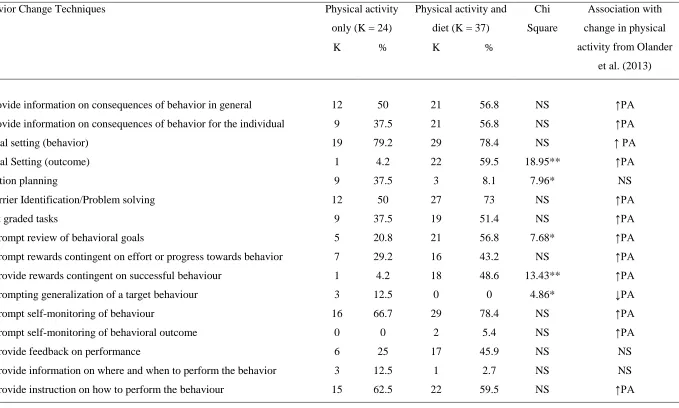
Twenty eight of the 40 BCTs listed in the CALO-RE taxonomy were identified in two or more interventions and were included in the analysis (See Table 1). Six PA BCTs were more common in MHBC interventions than in SHBC interventions targeting physical activity alone: “goal setting (outcome)”, “prompt review of behavioral goals”, “provide rewards contingent on successful behavior”, “agree behavioral contract”, “relapse prevention/coping planning” and “stress management/emotional control training” All six of these PA BCTs had
been associated with an increase in physical activity in the original systematic review
8 “prompting generalization of a target behavior”, which had been associated with lower
physical activity in the original review. Definitions of the eight BCTs that differed in
frequency between SHBC and MHBC interventions are shown in Appendix 1. The remaining 20 BCTs did not significantly differ in frequency.
There were no significant differences in the proportions of SHBC versus MHBC
interventions that were theory-based. Of those interventions that were theory-based, there were no significant differences in the type of theory used between SHBC and MHBC interventions. The PA BCT use across interventions that differed in theoretical basis did not appear to be similar to the PA BCTs that differed in frequency of use between SHBC and MHBC interventions (Appendix 2). Thus, the use of theory alone does not appear to explain observed differences in PA BCT use between SHBC and MHBC interventions in the present analysis.
Discussion
The current study represents the first attempt to compare the intervention content of SHBC versus MHBC interventions targeting physical activity. The MHBC interventions targeting physical activity and diet in obese populations contained a greater number of PA BCTs than those targeting physical activity alone, and those PA BCTs had previously been shown to be associated with increases in physical activity in this population. These findings suggest that SHBC and MHBC interventions may systematically differ not only in the number of behaviors targeted but also in the numbers and type of BCTs used.
The SHBC and MHBC interventions included in this study were limited to those targeting physical activity in obese populations where self-efficacy was reported post-intervention. It is possible the results are applicable only to the specific population included and that
9 the lack of published MHBC interventions; a recent review focusing on interventions among older adults, concluded that too few MHBC interventions have been conducted to allow useful comparison of SHBC and MHBC interventions (Nigg & Long, 2012). In addition, the observed differences may reflect artifactual effects or differences in reporting between SHBC and MHBC intervention studies. It is well recognized that the details provided in intervention descriptions are often limited resulting in difficulties in establishing with confidence which BCTs were used or not used to target physical activity (Dombrowski et al., 2012).
Despite these limitations, the findings reported here highlight the need to exercise caution in ascribing differences in the effects of SHBC and MHBC interventions solely to the targeting of single versus multiple behaviors. Discussion of the efficacy of MHBC interventions to date has focused on processes specific to targeting one or more behaviors at a time. For example, positive changes following MHBC interventions have been attributed to action taken on one behavior increasing the odds of taking effective action on other behaviors; less successful MHBC interventions have been hypothesized to reflect the excessive burden placed on participants when multiple behaviors are targeted (Prochaska, 2008; Sweet & Fortier, 2010).
The current study demonstrates that the inclusion of specific BCTs may also need to be considered. The six PA BCTs more common in the MHBC interventions had previously been shown to be associated with increases in physical activity in this population using moderator analyses comparing interventions where these BCTs were included with interventions where these BCTs were not included (Olander et al., 2013). Further, these six BCTs that were more common in the MHBC interventions in the present analysis included self-regulatory BCTs congruent with Control Theory which have shown to be effective in previous reviews in the energy-balance domain (Dombrowski et al., 2012; Michie et al., 2009). Only two BCTs, “action planning” and “prompting generalization of a target behavior” were more common in
10 established behavior in a novel situation seems an appropriate technique for inclusion in interventions targeting multiple rather than single behaviors. However this BCT was not used in any of the MHBC interventions included in the review. The existence of other systematic differences between SHBC versus MHBC interventions, for example in study design or intervention delivery, remains a possibility (Peters, de Bruin, & Crutzen, 2013).
The reasons for the differences in the number and type of PA BCTs between the SHBC and MHBC interventions in obese populations observed in the current study remain uncertain. It may be that SHBC and MHBC interventions tend to vary in their theoretical basis. However, in the present study, there were no differences in whether interventions mentioned theory, or in the specific theories used, between SHBC and MHBC interventions. In line with this, the PA BCTs that differed in frequency across interventions using different theories did not appear to be similar to the PA BCTS that differed in frequency between SHBC and MHBC interventions (compare Table 1 and Appendix 2). Thus the use of theory alone does not explain observed differences in PA BCT use between SHBC and MHBC interventions in the present analysis.
Other possible reasons for the greater number of BCTs targeting physical activity in MHBC interventions include the broader scope of such interventions and the inclusion of more intervention content when targeting multiple behaviors. Alternatively, as MHBC studies have been conducted more recently, differences may reflect a shift in intervention content over time although these hypotheses require testing in future studies. These possibilities should be explored in future research, which could usefully consider MHBC interventions and
populations other than those considered in the present review.
11 BCT content and other intervention features.This brief report also demonstrates the potential to expand the literature by combining knowledge and methods from two disparate areas of health psychology, multiple behavior change and the specification of intervention content using standardized BCT lists. The novel application of a BCT taxonomy to the MHBC area in this study also suggests future avenues of research. Certain BCTs, for example those
12 References
Abraham, C., & Michie, S. (2008). A taxonomy of behavior change techniques used in interventions. Health Psychology, 27(3), 379-387. http://dx.doi.org/10.1037/0278-6133.27.3.379
Dombrowski, S. U., Sniehotta, F. F., Avenell, A., Johnston, M., MacLennan, G., & Araújo-Soares, V. (2012). Identifying active ingredients in complex behavioural interventions for obese adults with obesity-related morbidities or additional risk factors for co-morbidities: a systematic review. Health Psychology Review, 6(1), 7-32.
http://dx.doi.org/10.1080/17437199.2010.513298
Kvaavik, E., Batty, G. D., Ursin, G., Huxley, R., & Gale, C. R. (2010). Influence of
individual and combined health behaviors on total and cause-specific mortality in men and women: the United Kingdom health and lifestyle survey. Archives of Internal Medicine, 170(8), 711-718. http://dx.doi.org/10.1001/archinternmed.2010.76
Michie, S., Abraham, C., Whittington, C., McAteer, J., & Gupta, S. (2009). Effective techniques in healthy eating and physical activity interventions: A meta-regression. Health Psychology, 28(6), 690. http://dx.doi.org/10.1037/a0016136
Michie, S., Ashford, S., Sniehotta, F. F., Dombrowski, S. U., Bishop, A., & French, D. P. (2011). A refined taxonomy of behaviour change techniques to help people change their physical activity and healthy eating behaviours: The CALO-RE taxonomy. Psychology & Health, 26(11), 1479-1498. http://dx.doi.org/10.1080/08870446.2010.
540664
Michie, S., & Prestwich, A. (2010). Are interventions theory-based? Development of a theory coding scheme. Health Psychology, 29(1), 1-8. http://dx.doi.org/10.1037/a0016939 Nigg, C. R., & Long, C. R. (2012). A systematic review of single health behavior change
13 Translational Behavioral Medicine, 2(2), 163-179.
http://dx.doi.org/10.1007/s13142-012-0130-y
Olander, E. K., Fletcher, H., Williams, S., Atkinson, L., Turner, A., & French, D. P. (2013). What are the most effective techniques in changing obese individuals’ physical activity self-efficacy and behaviour: A systematic review and meta-analysis. International Journal of Behavioral Nutrition and Physical Activity 10(29).
http://dx.doi.org/10.1186/1479-5868-10-29
Peters, G.-J. Y., de Bruin, M., & Crutzen, R. (2013). Everything should be as simple as possible, but no simpler: towards a protocol for accumulating evidence regarding the active content of health behaviour change interventions. Health Psychology Review, 1-14. http://dx.doi.org/10.1080/17437199.2013.848409
Prochaska, J. J., & Prochaska, J. O. (2011). A review of multiple health behavior change interventions for primary prevention. American Journal of Lifestyle Medicine, 5(3), 208-221. http://dx.doi.org/10.1177/1559827610391883
Prochaska, J. J., Spring, B., & Nigg, C. R. (2008). Multiple health behavior change research: an introduction and overview. Preventive Medicine, 46(3), 181-188.
http://dx.doi.org/10.1016/j.ypmed.2008.02.001
Sweet, S. N., & Fortier, M. S. (2010). Improving physical activity and dietary behaviours with single or multiple health behaviour interventions? A synthesis of meta-analyses and reviews. International Journal of Environmental Research and Public Health, 7(4), 1720-1743. http://dx.doi.org/10.3390/ijerph7041720
Abraham, C., & Michie, S. (2008). A taxonomy of behavior change techniques used in interventions. Health psychology, 27(3), 379.
14 for obese adults with obesity-related morbidities or additional risk factors for co-morbidities: a systematic review. Health Psychology Review, 6(1), 7-32.
Kvaavik, E., Batty, G. D., Ursin, G., Huxley, R., & Gale, C. R. (2010). Influence of
individual and combined health behaviors on total and cause-specific mortality in men and women: the United Kingdom health and lifestyle survey. Archives of internal medicine, 170(8), 711-718.
Michie, S., Ashford, S., Sniehotta, F. F., Dombrowski, S. U., Bishop, A., & French, D. P. (2011). A refined taxonomy of behaviour change techniques to help people change their physical activity and healthy eating behaviours: the CALO-RE taxonomy. Psychology & Health, 26(11), 1479-1498.
Olander, E. K., Fletcher, H., Williams, S., Atkinson, L., Turner, A., & French, D. P. (2013). What are the most effective techniques in changing obese individuals’ physical
activity self-efficacy and behaviour: a systematic review and meta-analysis. Int J Behav Nutr Phys Act, 10, 29.
Peters, G.-J. Y., de Bruin, M., & Crutzen, R. (2013). Everything should be as simple as possible, but no simpler: towards a protocol for accumulating evidence regarding the active content of health behaviour change interventions. Health Psychology Review, 1-14. doi: 10.1080/17437199.2013.848409
Prochaska, J. J., & Prochaska, J. O. (2011). A review of multiple health behavior change interventions for primary prevention. American Journal of Lifestyle Medicine, 5(3), 208-221.
Prochaska, J. J., Spring, B., & Nigg, C. R. (2008). Multiple health behavior change research: an introduction and overview. Preventive medicine, 46(3), 181-188.
16 Table 1: Frequency of BCTs targeting physical activity in SHBC and MHBC interventions, tests of differences in BCT frequency and BCT associations with changes in physical activity from Olander et al. (2013)
Behavior Change Techniques Physical activity
only (K = 24)
Physical activity and
diet (K = 37)
Chi
Square
Association with
change in physical
activity from Olander
et al. (2013)
K % K %
1. Provide information on consequences of behavior in general 12 50 21 56.8 NS ↑PA
2. Provide information on consequences of behavior for the individual 9 37.5 21 56.8 NS ↑PA
5. Goal setting (behavior) 19 79.2 29 78.4 NS ↑ PA
6. Goal Setting (outcome) 1 4.2 22 59.5 18.95** ↑PA
7. Action planning 9 37.5 3 8.1 7.96* NS
8. Barrier Identification/Problem solving 12 50 27 73 NS ↑PA
9. Set graded tasks 9 37.5 19 51.4 NS ↑PA
10. Prompt review of behavioral goals 5 20.8 21 56.8 7.68* ↑PA
12. Prompt rewards contingent on effort or progress towards behavior 7 29.2 16 43.2 NS ↑PA
13. Provide rewards contingent on successful behaviour 1 4.2 18 48.6 13.43** ↑PA
15. Prompting generalization of a target behaviour 3 12.5 0 0 4.86* ↓PA
16. Prompt self-monitoring of behaviour 16 66.7 29 78.4 NS ↑PA
17. Prompt self-monitoring of behavioral outcome 0 0 2 5.4 NS ↑PA
19. Provide feedback on performance 6 25 17 45.9 NS NS
20. Provide information on where and when to perform the behavior 3 12.5 1 2.7 NS NS
17
22. Model/demonstrate the behaviour 9 37.5 1 2.7 NS ↑PA
23. Teach to use prompts/cues 4 16.7 14 37.8 NS ↑PA
25. Agree behavioral contract 2 8.3 15 40.5 7.51* ↑PA
26. Prompt practice 16 66.7 26 70.3 NS ↑PA
27. Use of follow up prompts 0 0 2 5.4 NS NS
28. Facilitate social comparison 3 12.5 4 10.8 NS ↑PA
29. Plan social support/social change 11 45.8 23 62.2 NS ↑PA
33. Prompt self-talk 6 25 16 43.2 NS ↑PA
35. Relapse prevention/coping planning 11 45.8 27 73 4.57* ↑PA
36. Stress Management/emotional control training 5 20.8 17 45.9 3.98* ↑PA
37. Motivational interviewing 2 8.3 2 5.4 NS NS
38. Time management 10 41.7 16 43.2 NS NS
Note. Technique numbers relate to the corresponding numbers in the CALO-RE taxonomy; BCTs were not included in the analyses if they were not coded as present in two