City, University of London Institutional Repository
Citation:
Knott, L., Threadgold, E. and Howe, M. L. (2014). Negative mood state impairs false memory priming when problem-solving. Journal of Cognitive Psychology, 26(5), pp. 580-587. doi: 10.1080/20445911.2014.922091This is the accepted version of the paper.
This version of the publication may differ from the final published
version.
Permanent repository link:
http://openaccess.city.ac.uk/4185/Link to published version:
http://dx.doi.org/10.1080/20445911.2014.922091Copyright and reuse: City Research Online aims to make research
outputs of City, University of London available to a wider audience.
Copyright and Moral Rights remain with the author(s) and/or copyright
holders. URLs from City Research Online may be freely distributed and
linked to.
Running Head: MOOD AND FALSE MEMORY PRIMING
Negative mood state impairs false memory priming when problem-solving
Lauren M. Knott, Emma Threadgold, and Mark L. Howe
City University London
Address correspondence to: Dr Lauren Knott
Department of Psychology
City University London
London, EC1V 0HB
Phone: +44 (0)20 7040 3354
E-mail: [email protected]
Abstract
The aim of this study was to investigate the effect of emotional mood states on the
ability to create effective primes using the recently developed false memory priming
paradigm. A negative or positive mood state was induced before
Deese/Roediger-McDermott (DRM) list presentation. A further control group experienced no mood
induction. Participants were then presented with Compound Remote Associate Task
(CRAT) problems, half of which had been primed by the previous DRM lists whose
critical lure was the solution to the CRAT problem. The results of this study showed
that induction of a negative mood state not only impaired recall of critical lures but
also diminished their effectiveness as primes for solving CRAT problems. In contrast,
for both positive mood and control conditions, the false memory priming advantage
was evident, with a higher proportion of primed problems solved in comparison to
those not primed. Findings are discussed in relation to the role of affect on semantic
activation and the adaptive consequences of false memories.
Key words: False memory, problem solving, affective mood state, DRM paradigm,
Negative mood state impairs false memory priming when problem-solving
Negative mood states have been linked to poor decision-making and
problem-solving abilities (Arkes, Herren, & Isen, 1998), deficits in attention (Joormann &
Gotlib, 2007), and memory impairments (Blaney, 1986). Concerning the latter, studies
have previously examined the effect of mood on true memories, but research on the
effects of negative mood on false memories has just begun. A robust method used to
examine false memories in this line of research is the Deese/Roediger-McDermott
(DRM) paradigm (Deese 1959; Roediger & McDermott, 1995). Here, participants are
presented with list items (e.g., table, sit, couch, desk) that are all highly associated with
a non-presented critical lure item (e.g., chair). After presentation, participants are
asked to recall or recognize the list items in subsequent memory tests. A false memory
is recorded if the participant reports the thematically related but non-presented critical
lure. These false memories are considered to be spontaneous, occurring automatically
and without conscious awareness (Howe, Wimmer, Gagnon, & Plumpton, 2009).
According to the associative activation theory (Howe et al., 2009) they occur due to
automatic spreading activation through associative networks. Activation from concepts
contained within the lists spreads to related but unpresented concepts in memory.
Related words are then activated at encoding and falsely recalled at retrieval.
Storbeck and Clore (2005) conducted two experiments using the DRM
paradigm. Temporary mood states were induced prior to encoding the DRM lists.
Results showed that negative affect reduced false memories, while positive affect
produced similar levels of false memories as control conditions. Storbeck and Clore
hypothesised that affective mood states could influence the production of false
processing of information leaving relational processing somewhat impaired, something
that has been found to increase rates of true recollection and reduce false memories
(Howe, 2008). In comparison, the positive affect provided feelings of efficacy, which
validates the use of relational processing styles. Such processing coupled with a
reduced item-specific approach leads to increases in false recollection (Howe, 2008).
As mentioned earlier, for adults at least, associative activation occurs automatically
and without conscious awareness (Howe et al., 2009). Relational processing allows for
this automatic and unconscious activation, while item-specific processing is more
controlled, thus, inhibiting the automatic spreading activation, necessary for false
memory production in the DRM paradigm.
The influence of emotions and mood on cognitive processing also extends to
problem solving. For instance, research has shown that individuals in a positive mood
produce more unusual associations in a word association task (Isen, Johnson, Mertz, &
Robinson, 1985), are able to form more inclusive categories in a sorting task (Isen &
Daubman, 1984), and can facilitate creativity on Duncker’s (1945) candle task and
Mednick, Mednick, and Mednick’s (1964) Compound Remote Associate Task
(CRAT). A study by Bolte, Goschke, and Kuhl (2003) examined the influence of
affective mood state on the ability to make intuitive judgments about the coherence of
a word triad. Bolte et al. (2003) presented participants with word triads (e.g., playing,
credit, report), and asked participants to decide whether they were coherent (shared a
common solution word- card), or whether they were incoherent, with no common
solution word. In Experiment 2, a positively induced mood improved intuitive
coherence judgments, whereas a negative mood impaired performance to chance level.
The theoretical framework that underlies these findings follows a similar
referred to as the affect-modulation hypothesis, positive affect promotes global
processing and results in the automatic spreading activation to weak associates.
Spreading activation improves the ability to solve word triads and make intuitive
coherence judgements. In contrast, the more item-specific processing associated with
negative affect, restricts the automatic spread of activation to close associates and
impairs the ability to solve word triads and make intuitive coherence judgements.
CRAT problems require the process of spreading activation through semantic
networks until the target concept (word) has been activated (Bowden, Jung-Beeman,
Fleck, & Koumios, 2005). Aiding the associative activation and “priming” the target
concept has been the recent interest of research by Howe and colleagues (e.g., Howe,
Garner, Charlesworth, & Knott, 2011; Howe, Garner, Dewhurst, & Ball, 2010; Howe,
Garner, & Patel, 2013). These studies have shown that false recall of critical lures can
prime solutions to CRAT problems when the solution word is also the critical lure.
Typically, participants are presented with DRM lists whose critical lures are primes for
half of the to be solved CRATs. Results have shown that when participants recall the
critical lure, they are more likely to solve the corresponding CRAT and do so more
quickly than those that were not primed. Importantly, previous research has also shown
that the priming effect is not just an artifact of increased activation of a critical lure at
test. Even in the absence of the recall task, participants still performed better on
CRATs that were primed by a critical lure belonging to the presentation of a prior
DRM list (Howe et al., 2010, 2011, 2013). Thus, the priming advantage is likely due to
participants having generated the critical lure during list encoding and it is the false
memory generation that is the source of these priming effects.
Howe and colleagues situated these findings in the emerging adaptive view of
memory benefit for survival information and survival processing (Nairne, 2010) that
has now been extended to the false memory literature. Howe and Derbish (2010, 2014)
argued that because false memories are formed by the same reconstructive memory
system, survival-related processing of information that primes highly interconnected
concepts and promotes relational processing will inevitably lead to more false
memories for survival related information. The recent false memory priming effect
seen with CRATs could be an example of this adaptive function of memory (both true
and false) as it serves to prime complex problem solving. Indeed Klein, Cosmides,
Tooby and Chance (2002) proposed that implicit priming serves as an adaptive
function in that memory serves to support future problem solving. This is evidenced in
recent research by Howe and colleagues, where false memories function to prime and
aid problem solving (Howe et al., 2010, 2011, 2013).
Here we see that the byproduct of memory activation can provide significant
advantages to more complex cognitive processes such as insight-based problem
solving. However, if processing of information were more controlled and item-specific
in nature, unlike what we see with survival processing, would the inhibited associative
activation not only impair false recall but also impair the subsequent ability to solve
CRAT problems? We know that affective mood states influence processing conditions.
Positive affect promotes relational processing and automatic spreading activation,
whereas negative affect inhibits relational processing and leads to more controlled,
item-specific processing that impairs semantic association and spreading activation. A
mood state that impairs relational processing will ultimately inhibit survival processing
and hinder the adaptive memory consequence for future problem solving. Thus, the
question is whether the use of a mood induction technique during DRM study-recall
but also the ability to use false memories to aid problem solving on subsequent
CRATs?
In order to investigate this question, participants completed DRM study-test
trials while in a positive or negative mood state. A control condition was also used to
aid comparison with previous research. All participants completed a series of CRAT
problems, half of which had their solution primed by the associated critical lure of the
DRM lists, and half of which had not been primed. As previous research has shown, a
negative mood state should be associated with more item specific processing which
could hinder automatic associative activation, thus not only reduce false recall, but also
reduce the chance that the critical lure can be accessed and used to prime the CRAT
problem. This will lessen the priming advantage and lead to similar levels of problem
solving across both primed and unprimed CRATs. As positive mood states typically
enhance relational processing and thus automatic spreading activation, the priming
effect should occur, and problems will be solved more readily and more quickly when
primed than not primed.
Method
Participants.
Seventy-two undergraduate students (47 females) aged 18-45 (M =19.85, SD =
4.09) participated in this study for course credit.
Design and Stimuli.
The experiment followed a 3(mood condition: Positive, Negative, and Control)
x 2(Prime type: false memory prime vs. unprimed) design with repeated measures on
the second factor. During the DRM study-recall stage participants were randomly
assigned to one of 3 mood conditions, Positive, (n = 22) Negative, (n = 26) and
Mood induction. Mood was induced using two five-minute video clips. Film
clips were chosen as they are considered to produce more complex emotional states
(Aldao, 2013). The negative mood group watched the final scene of the movie The
Champ, while the positive mood group watched a comedy sketch from Live at the
Apollo (see Rottenberg, Ray, & Gross, 2007, for films that elicit emotion). The control
group began the study in their natural mood state. Participant’s mood was assessed
using the Self-Assessment Manikin scale (SAM; Bradley & Lang, 1994). The SAM is
a non-verbal pictorial assessment technique that uses a 9-point Likert scale to directly
measure a person’s affective state. Low values represent a negative mood, while high
values represent a positive mood. Mood measures were taken before and after the
initial film clip to ensure successful mood induction. Participants in the control
condition completed this before beginning the study phase for a base line measure of
their natural mood state. For comparative purposes, it should be noted that neutral
moods are generally slightly higher than the midpoint of the scale (e.g., 6.20).
DRM and CRAT stimuli. Eight CRAT problems were taken from Bowden and
Jung-Beeman (2003) and considered to be of medium difficulty according to normed
solution rates (average normed solution rate = 60.63%). Each CRAT consisted of three
words, all of which required a single word to create a compound word or phrase. For
example, rocking, wheel, high, could all be solved by the word chair (DRM lists and
associated CRAT problems can be found in the Appendix). The eight chosen DRM
lists consisted of 12 associates to the critical lure that also acted as the solution word
for the selected CRAT problems. DRM lists were taken from Roediger & McDermott
(1995) and randomly divided into two sets of four. Each participant was shown one set
of lists. This allowed for 4 CRAT solutions to be primed by the critical lures and four
strength (BAS) were equated across sets. To avoid any mood congruency effects that
may have inflated critical lures in the negative and positive mood conditions (see Ruci
et al., 2009), DRM lists with neutral valance were chosen (M = 5.85). Valence ratings
were taken from Affective Norms for English Words (ANEW: Bradley & Lang, 1999).
Procedure
After mood induction and assessment were complete, participants were
presented with four DRM lists in randomised order. Each list was recorded and
presented to the participant verbally. At the end of each list participants completed a
distractor task (complete basic sums for 30s) and then recalled as many words as they
could remember from the list. On completion of the study-test trials participants were
provided with verbal instructions on how to solve the CRATs followed by two practice
CRAT problems and the 8 test CRATs. Each CRAT was presented on the computer
screen, in a random order. When participants knew the solution they were instructed to
press ENTER and input their word. Participants were allowed multiple attempts at
solving the CRAT, but if they were unable to solve the problem after 60s, the computer
programme would provide feedback on the correct answer and move on to the next
problem.
Results
Mood-manipulation Check
For the mood manipulation check mood assessment scores taken pre and post
video presentation were compared for negative and positive mood groups using a
2(Mood Condition: Positive vs. Negative) x 2(Valence score: Before vs. After video
presentation) mixed factor ANOVA with repeated measures on the second factor. A
significant interaction, F(1,46) = 57.35, p < .001, ηp2 = .56 was further analysed using
decreased pre (M = 6.31, SD =1.93) and post (M = 3.73, SD =1.63) video (p < .001),
and increased for the positive mood group (M = 6.86, SD = 1.49 vs. M = 7.77, SD =
1.02, p < .05). A mood check to include all three mood conditions (the control group
did not see a video presentation thus a valence score was only recorded before the
onset of the study-test DRM phase) showed a significant effect, F(2,69) = 59.93, p <
.001, ηp2 = .64 whereby mood assessment was higher for positive compared to
negative, (M = 7.77, SD = 1.02 vs. M = 3.73, SD =1.63, p < .001), and control
compared to negative (M = 7.08, SD = 1.38, p < .001), but no difference between
positive and control (p =.22).
False and True Recall
False recall of critical lures. A one-way analysis of variance (ANOVA) was
conducted to examine the effect of mood-group (positive, negative, and control) on
recall of critical lures (CLs). The main effect of mood was significant, F(2,69) = 6.91,
p < .05, ηp2 = .17. Further analysis of pairwise comparisons revealed that both positive
(M = .33, SD = .16) and control (M = .40, SD = .23) mood groups recalled significantly
more critical lures than the negative mood group (M = .19, SD = .19, p < .05 for both).
True recall. A second one-way ANOVA showed no significant difference in
correct recall between positive (M =.56, SD = .08) negative (M =.61, SD = .13) and
control (M =.59, SD = .10) mood groups, F(2,69) = 1.11, p = .34, ηp2 = .03. An effect
not unexpected given that item-specific processing is available for veridical recall in
the negative mood condition (Storbeck & Clore, 2005).
CRAT Problem Solving
Both CRAT solution rates (proportion correctly solved) and mean CRAT
solution times (in seconds) were analysed using a 3(Mood Condition: Positive,
mixed factor ANOVA with repeated measures on the second factor. Here, primed
CRAT problems were conditionalised on whether participants had produced the critical
lure during recall (i.e., Primed CL = critical lure produced and Primed/no CL = no
critical lure produced). Due to the conditionalization of the Prime Type for analysis,
data was only included if a CL was produced at the DRM study-test trials (Positive n =
21, Negative n = 18 and Control n = 21).
Solution rates for CRATs. There was a significant main effect of Prime type,
F(2, 114) = 7.18, p < .001, ηp2 = .11, but no significant main effect of mood, F(2,57) =
1.73, p = .19, ηp2 = .06. However, there was a significant Mood x Prime Type
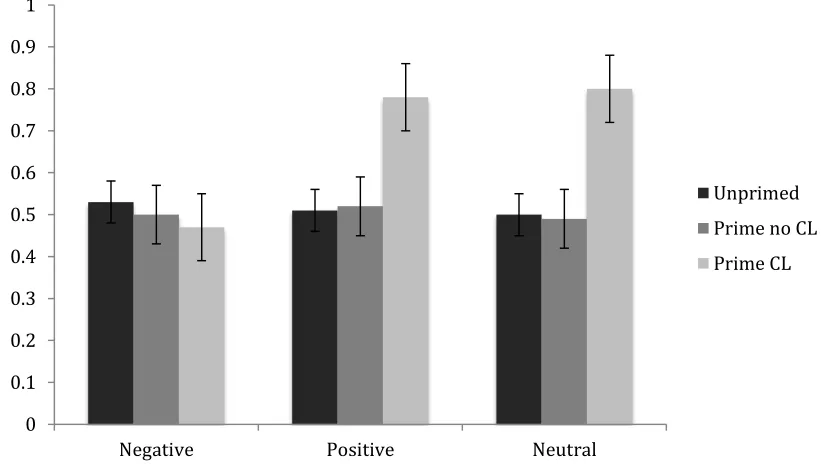
interaction, F(4,114) = 2.59, p < .05, ηp2 = .08. Further analysis of the simple main
effects (SMEs) revealed a significant prime effect for positive mood, F(2,40) = 6.30, p
< .05, ηp2 = .24 and control groups, F(2,40) = 6.27, p < .05, ηp2 = .24, whereby more
CRATs were correctly solved in the primed CL compared to primed no CL and
unprimed conditions for both groups. However, there was no effect of priming for the
negative mood condition, F(2,34) = .18, p = .84, ηp2 = .01 (see Figure 1). Solution
rates for both positive mood and control conditions show a similar pattern to that found
in previous research, whereby, more CRATs were solved when the CL prime was
produced during the study-test DRM phase. For the negative mood group, not only
were fewer critical lures produced during the study-test trails, but when they were
produced, they led to fewer primed solutions compared to the positive mood and
control conditions.
Solution times for CRATs. Solution times were calculated and analysed where
CRATs were solved in all three priming conditions. Analysis of solution times (in
seconds) for CRATs revealed a significant main effect of prime type, F(2,74) = 4.07, p
compared to unprimed (M = 13.80, SD = 10.18 p < .05) and primed no CL (M =
12.62, SD = 9.69, although this was marginal, p = .06) conditions. There was no main
effect of mood condition, F(2,37) = .22, p = .80, ηp2 = .01, and no Mood x Prime Type
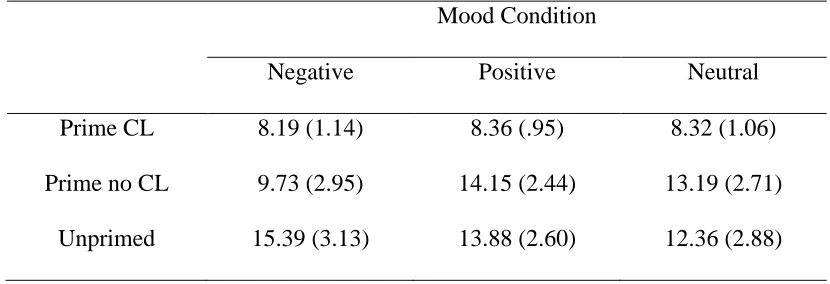
interaction, F(4,70) = .51 p = .73, ηp2 = .03 (see Table 1). Faster solution times for
CRATs primed by a critical lure supports findings from previous research (e.g., Howe
et al., 2010, 2011, 2013). There was no significant Mood x Prime Type interaction,
however this is expected, as solution times were analysed only where CRATs were
solved in all three priming conditions.
Discussion
The aim of this study was to examine the influence of mood state on false
memories and the subsequent effect this may have on the recently discovered priming
advantage for insight-based problem solving. First, the results from this experiment
support previous findings that claim affect can influence false memory production in
the DRM paradigm (e.g., Storbeck & Clore, 2005). Participants in the negative mood
group produced fewer critical lures at recall in comparison to the positive mood and
control groups. These results are in line with current theories that claim negative affect
triggers item-specific processing. Encoding under such conditions inhibits automatic
and unconscious spreading activation to related associates reducing the activation of
the critical lure. In comparison, positive affect triggers relational processing, which
enhances automaticity and the unconscious spreading activation to related critical lures
increasing false memory production. Akin to previous findings (e.g., Storbeck & Clore,
2005) there was no difference in false recall between the positive affect and control
groups. Typically, control groups display quite a positive affective state that may not
be the default processing style for any nonnegative emotional state (see Storbeck &
Clore, 2005).
With a negatively induced mood, impaired automatic associative activation not
only reduces the production of critical lures but also prevents those critical lures from
coming to mind in subsequent problem solving. That is, the critical lure, when
produced in the negative mood condition, did not act as a successful prime as negative
affect induced prior to learning promotes item-specific processing that inhibits
automatic associative activation. This reduction in activation of related concepts in
memory also impairs access to the critical lure during subsequent problem solving.
This led to solution rates that were identical to conditions in which there was no
priming. For both positive mood and control conditions, the priming advantage was
evident and significantly more primed problems were solved than those that were not
primed. These conditions promote the use of relational processing that leads to the
automatic and unconscious activation of semantic associates. This heightened
activation of the critical lure primes the subsequent solution to the CRAT problem.
These findings support and extend the recent research by Howe and colleagues that
false memories facilitate problem solving in CRATs due to spreading activation in
semantic networks (e.g., Howe et al., 2010, 2013).
Speed of problem solving was also faster when primed than when not primed.
However our solution time data showed no interaction with mood state. This is not
unexpected, as solution times for participants were only analysed where CRATs were
solved in all three priming conditions. Coupled with typically large variances in
response times (see Standard Error values in Table 1), this may require further
investigation. However it is unclear what the effect of mood state on priming will be.
evaluation or category selection task) in the positive compared to negative mood
groups when primes are affectively and semantically congruent compared to
incongruent. Note however, this is a comparison of the priming effect (congruent
words allow for faster responses then incongruent words) and not just the effect of
mood state per se (Storbeck & Clore, 2008).
In relation to previous research, it appears that a negative mood state can impair
priming due to item-specific processing that inhibits automatic activation of associative
networks. In comparison, situations that promote more relational processing further
facilitate the false memory priming effect. For example, Howe et al. (2013) found that
false memories for survival-related information made better primes for problem
solving than neutral false memory primes. We know that survival related processing of
information primes networks of highly interconnected concepts that results in high
false memory rates for survival information. This in turn allows for better access to
false memories during later problem solving, highlighting the adaptive, functional
nature of memory. From a spreading activation perspective, survival processing makes
for better priming due to the promotion of relational processing and strongly
interrelated concepts. In contrast, the present findings demonstrate that processing
(neutral) information in a negative mood leads to a reduction in priming due to
impaired relational processing and automatic, associative activation.
It is perhaps key to note here that even though survival relevant material can be
negative in valence (Howe et al., 2013), it can still enhance the automatic activation of
associative networks, increasing critical lure production and access to these critical
lures during later problem solving. In comparison, a negative mood hinders the
priming effect due to the reliance on item specific processing that impairs associative
survival processing the stimuli are highly interrelated and by their nature, relevant to
the self and congruent to a survival processing encoding state. This heightens the
activation of the survival congruent stimuli through excitation of the related semantic
network. This increases the likelihood that related but non-presented information
becomes activated and subsequently falsely remembered at test, a finding consistent
with Semantic Network Theory (Bower, 1981). What we have yet to examine is a
mood congruent effect in the false memory priming advantage. Based on these findings
and those from previous studies (Ruci et al., 2009), negative mood may be linked to an
increase in activation level for negatively relevant concepts that could in turn lead to
enhanced accessibility of this information in memory (Howe & Malone, 2011). This
will require further investigation.
These findings, along with others (e.g., Storbeck & Clore, 2005, 2008) support
assumptions that affect influences the accessibility of semantic associations in
memory. More specifically negative mood can hinder the relational processing that
usually facilitates the automatic unconscious spreading activation to relevant semantic
concepts and reduce access to relevant primes for later problem solving. This reduction
in accessibility to semantic associations provides further support for the theoretical
explanation of false memory priming effects. That is, relational processing enhances
automatic spreading activation to related semantic networks and heightens accessibility
to related, but not presented words. The end result being that a false memory can aid
problem solving and prime the solution to an insight-based problem. To conclude, this
research adds to the literature on the more positive consequences of false memory
production, in that we can use them to aid and prime the solution to complex insight
based problems. Not only does this research demonstrate the powerful nature of our
typically refers to false memory production as a negative consequence of human
References
Aldao, A. (2013) The future of emotion regulation research: Capturing context.
Perspectives on Psychological Science, 8, 155-172.
Arkes, H. R., Herren, L. T., & Isen, A. M. (1998). The role of potential loss in the
influence of affect on risk taking behavior. Organizational Behavior and Human
Decision Processes, 42, 181-193.
Blaney, P. H. (1986).Affect and memory: A review. Psychological Bulletin, 99,
229-246.
Bolte, A., Goschke, T., & Kuhl, J. (2003). Emotion and intuition: Effects of positive
and negative mood on implicit judgments of semantic coherence. Psychological
Science, 14, 416–421.
Bowden, E. M., & Jung-Beeman, M. J. (2003). Normative data for 144 compound
remote associate problems. Behavior Research Methods, Instruments, &
Computers, 35, 634–639.
Bowden, E. M., Jung-Beeman, M. J., Fleck, J., & Kounios, J. (2005). New approaches
to demystifying insight. Trends in Cognitive Sciences, 9, 322–328.
Bower, G. H. (1981). Mood and memory. American Psychologist, 36, 129-148.
Bradley, M. M., & Lang, P. J. (1999). Affective norms for English words (ANEW):
Instruction manual and affective ratings. Technical Report C-1, The Center for
Research in Psychophysiology, University of Florida.
Deese, J. (1959). On the prediction of occurrence of certain verbal intrusions in free recall. Journal of Experimental Psychology, 58, 17-22.
Howe, M. L. (2008). Visual distinctiveness and the development of children's false memories. Child Development, 79, 65-79.
Howe, M. L. (2011). The adaptive nature of memory and its illusions. Current
Directions in Psychological Science, 20, 312-315.
Howe, M. L., & Derbish, M. H. (2010). On the susceptibility of adaptive memory to false memory illusions. Cognition, 115, 252–267.
Howe, M. L., & Derbish, M. H. (2014). Adaptive memory: Survival processing, ancestral relevance, and the role of elaboration. In B. L. Schwartz, M. L. Howe, M. P. Toglia, & H. Otgaar (Eds.), What is adaptive about adaptive memory? (pp. 77-109). New York: Oxford University Press.
Howe, M. L., Garner, S. R., Dewhurst, S. A., & Ball, L. J. (2010). Can false memories prime problem solutions? Cognition, 117, 176-181.
Howe, M. L., Garner, S. R., Charlesworth, M., & Knott, L. M. (2011). A brighter side to memory illusions: False memories prime children’s and adults’ insight-based problem solving. Journal of Experimental Child Psychology, 108, 383-393.
Howe, M. L., Garner, S. R., & Patel, M. (2013). The positive consequences of false memories. Behavioural Sciences and the Law, 31, 652-665.
Howe, M. L., & Malone, C. (2011). Mood-congruent true and false memory: Effects of
depression. Memory, 19, 192-201.
Howe, M. L., Wimmer, M. C., Gagnon, N., & Plumpton, S. (2009). An
and Language, 60, 229–251.
Isen, A.M., & Daubman, K.A. (1984). The influence of affect on categorization.
Journal ofPersonality and Social Psychology, 47, 1206–1217.
Isen, A.M., Johnson, M.M.S., Mertz, E., & Robinson, G.F. (1985). The influence of
positive affect on the unusualness of word associations. Journal of Personality and
Social Psychology, 48, 1413–1426.
Joormann, J., & Gotlib, I. H. (2007). Selective attention to emotional faces recovering
from depression. Journal of Abnormal Psychology, 116, 80-85.
Klein, S., Cosmides, L., Tooby, J., & Chance, S. (2002). Decisions and the evolution
of memory: Multiple systems, multiple functions. Psychological Review, 109,
306-329.
Mednick, M. T, Mednick, S. A., & Mednick, E. V. (1964) Incubation of creative
performance and specific associative priming. Journal of Abnormal and Social
Psychology, 69, 84-88.
Nairne, J. S. (2010). Adaptive memory: Evolutionary constraints on remembering.
Psychology of Learning and Motivation, 53, 1-32.
Otgaar, H., & Smeets, T. (2010). Adaptive memory: Survival processing increases both
true and false memory in adults and children. Journal of Experimental
Psychology: Learning, Memory, and Cognition, 36, 1010-1016.
Roediger, H. L., III, & McDermott, K. B. (1995). Creating false memories:
Remembering words not presented in lists. Journal of Experimental Psychology:
Rottenberg, J., Ray, R. D., & Gross, J. J. (2007). Emotion elicitation using films. In J.
A. Coan & J. J. B. Allen (Eds.), The handbook of emotion elicitation and
assessment. London: Oxford University Press.
Ruci, L., Tomes, J. L., & Zelenski, J. M. (2009). Mood-congruent false memories in the DRM paradigm. Cognition & Emotion, 23, 1153–1165
Storbeck, J., & Clore, G. L. (2005). With sadness come accuracy, with happiness, false
memory: Mood and the false memory effect. Psychological Science, 16, 785–791.
Storbeck, J., & Clore, G. L. (2008). The affective regulation of cognitive priming.
Table 1. Mean solution times as a function of mood condition and prime type (primed
vs. unprimed).
Mood Condition
Negative Positive Neutral
Prime CL
Prime no CL
8.19 (1.14)
9.73 (2.95)
8.36 (.95)
14.15 (2.44)
8.32 (1.06)
13.19 (2.71)
Unprimed 15.39 (3.13) 13.88 (2.60) 12.36 (2.88)
Figure 1. Mean solution rates as a function of mood condition and prime type. Error
bars represent standard error (SE).
0 0.1 0.2 0.3 0.4 0.5 0.6 0.7 0.8 0.9 1
Negative Positive Neutral
APPENDIX
DRM lists and associated CRAT problems (critical lure/CRAT solution in CAPS)
CRAT Problem DRM list
chase/police/toy CAR - truck, bus, automobile, vehicle, drive, jeep, Ford, keys, garage, highway, van, taxi
salad/bowl/juice FRUIT - apple, vegetable, orange, kiwi, citrus, ripe, pear, banana, berry, cherry, basket, cocktail
shop/washer/frame WINDOW - door, glass, pane, shade, ledge, sill, house, curtain, view, breeze, screen, shutter
leg/wheel/high CHAIR - table, sit, seat, couch, desk, recliner, sofa, cushion, swivel, stool, rocking, bench
knife/tip/pal PEN - pencil, write, fountain, leak, quill, Bic, scribble, crayon, cross, marker, cap, letter
drinking/tea/cake CUP - mug, saucer, measuring, coaster, lid, handle, coffee, soup, drink, plastic, sip
football/flannel/vest SHIRT - blouse, sleeves, pants, tie, button, shorts, polo, collar, pocket, belt, linen, cuffs