The Modified Stroop Effect and Eating Disorders
Belinda Read (B. A. Hons)
School of Psychology
University of Tasmania
December 1999
I declare that this report is my own original work and that contributions
I would like to thank my supervisors Elaine Hart and Peter Ball for their
continual assistance, advice and support. I would also like to thank Vlasti
Broucek for writing the Stroop program and James Alexander and John
Davidson for their statistical advice
Thank you also to my fellow students for their guidance, encouragement
and humour
I would also like to express my gratitude to my participants, and all those
who helped in the seemingly never ending search for participants, without
whom this research would not have been possible
TABLE OF CONTENTS
LITERATURE REVIEW
Abstract 1
Introduction 2
Investigation of psychopathology using an information processing approach 4
Methodological Issues - 14
The influence of participant characterstics on Stroop effects 19
Attentional bias and the concept of schema 24
Conclusion 26
References 29
EMPIRICAL STUDY
Abstract 1
Introduction 3
Method 14
Results 15
Discussion 49
Conclusion 61
References 65
APPENDIX
Questionnaires 1
The Modified Stroop Task and Eating Disorders: A Review
TABLE OF CONTENTS
Abstract 1
Introduction 3
Investigation of psychopathology using an information processing approach. 4 , . The Stroop effect in psychological disorders 5 The modified Stroop effect in eating disordered individuals 8 The modified Stroop effect in non-eating disordered individuals 10 Changes in the Stroop effect with treatment and recovery from eating
disorders 12
Methodological Issues 14
Varying approaches to statistical analyses 14
Variations in stimulus word choice 15
Variations in control words 18
The influence of participant charactersitics on Stroop effects 19 Variations in eating disorder symptoms and Stroop effects 19 The effect of general psychopathology on Stroop responses 21 The influence of hunger state on Stroop effects 23
Attentional bias and the concept of schema 24
Conclusion 26
Abstract
The use of the Modified Stroop task in assessing attentional bias and cognitive processing underlying psychopathology is reviewed, with particular focus on eating disorders. It is argued that the modified Stroop effect obtained with food or body related stimuli is not specific to individuals with eating disorders but also occurs in individuals high on dietary restraint. The relationship between the Stroop effect and recovery from eating disorders is examined addressing the issue of whether the Stroop effect is concomitant with current symptomatology or reflects an underlying vulnerability trait that remains after recovery. Methodological issues such as varying approaches to statistical analyses, stimuli word choice and control words are
considered. The influences of participant characteristics such as eating disordered symptomatology and general psychopathology as well as hunger state on the Stroop
_
2
In recent years principles of cognitive psychology have increasingly been applied to research on psychopathology. Cognitive accounts have pointed out that many
psychological disorders share the common feature of sensitivity to and preoccupation with stimuli in the environment that represent the focus of their concern. Central to these cognitive theories is the notion that this preoccupation arises from biases in attention (Williams, Mathews, & MacLeod, 1996). Cognitive models assume that such attentional biases are important factors in the aetiology and maintenance of psychological disorders. One of the most frequently used measures for attentional bias in psychological disorders is the modified Stroop task. The focus of this
literature review is the application of the Stroop methodology to the understanding of attentional bias and cognitive processing underlying eating disorders.
The first section outlines the information processing approach and Stroop
methodology. The second section discusses research on the Stroop effect and eating disorders and is followed by a discussion of the specificity of the effect and the role of dietary restraint, arguing that the effect is not specific to individuals with eating
• disorders. The issue of the Stroop effect and recovery from eating disorders is then
discussed.
Investigation of Psychopathology using an Information Processing Approach
The information processing approach proposes that human behaviour can be
explained in terms of the operation of fundamental cognitive processing mechanisms that act upon the flow of information (Williams, Watts, Macleod, & Mathews, 1097). These mechanisms include attention, encoding, rehearsal and transformation of
information and forgetting (Solso, 1995). As argued by Williams et al. (1997) within the framework of this approach the development and maintenance of certain
-psychological disorders may be due to idiosyncrasies in the operation of these cognitive processes. Thus, the identification of idiosyncrasies in the information processing of individuals with psychological disorders may provide insight into the cognitive processing underlying their psychopathology.
Individuals with psychological disorders have been shown to have a preoccupation with stimuli in the environment that represent the focus of their concern. For example, clinical observations of depressed individuals might suggest that they are particularly likely to notice things that are consistent with their depressed mood (Kovacs & Beck, 1978). Although these individuals have often had more negative experiences than non-depressed individuals, their preoccupation seems to exceed what is explicable on such a basis. Several explanations for thi excessive
preoccupation have been proposed; an increase in the extent to which people notice stressful events, an increase in the effect of these events on cognitive functioning, or an increase in the frequency with which these events are recalled (Williams et al.,
1997). These authors also point out that from a clinical point of view:all these explanations are plausible.
The modified StrooP effect in psychological disorders
This literature review focuses on one of the explanations for this preoccupation, attentional bias. An attentional bias for certain stimuli can impair or facilitate
performance on certain tasks (Williams et al., 1997). One of the most frequently, used tests of attentional bias is the modified Stroop task. The original S troop task
developed by J. R. Stroop (1935), presents a list of colour names or a string of Xs and requires the respondent to name the colour of the ink in which the colour name is written. It is commonly found that an individual requires longer to name the ink colours when the items are colour names than when they are rows of meaningless stimuli (Lezak, 1995). Furthermore, when the colour of the ink and the colour name are inconsistent the participant takes longer to name the colour than when they are consistent. The difference between the time taken to respond to the meaningless stimuli and the time taken to colour name the colour words is referred to as the `Stroop effect' (Ben-Tovim, Walker, Fok, & Yap, 1989).
strength of activation to produce the colour naming response than the word reading response.
In the modified Stroop task, also known as the emotional Stroop task, respondents are required to name the ink colour of different sorts of words. These words are usually varied in their relation to the individual's psychopathology (or have particular salience for them) and response latencies for these words are compared with the response latencies for neutral words. Dalgleish (1995) found that keen ornithologists show colour naming interference for the names of rare birds,
indicating that the effect is not restricted to emotionally provoking stimuli but also occurs to salient 'stimuli. Findings consistently show that individuals with a
psychological disorder exhibit longer latencies for colour naming of disorder salient words than for matched words um-elated in meaning to their psychopathology. This has been illustrated in relation to a range of problems including; spider phobia (Watts, McKenna, Sharrock, & Trezise, 1986), generalised anxiety disorder (Mathews & Macleod, 1985), depression (Gotlib & McCann, 1984) and eating disorders (Cooper & Fairbum, 1992).
interference with colour naming at the response level (Williams et al., 1997).
Another important conceptual model explaining the preoccupation with stimuli in
certain psychological disorders and of relevance to performance on the emotional
Stroop task is the concept of the self-schema. Individuals are said to have organised
cognitive structures or schemas around emotionally salient issues (Williams et al.,
1996). A self-schema comprises self descriptive traits or attributes which are
represented in an organised way in semantic memory such that activation or
exposure to one attribute will automatically lead to activation of the others (Segal &
Vella, 1990). This stored body of knowledge or schema is known to interact with
incoming information by shaping selective attention and memory search (Williams et
al., 1997). Research has shown that individuals are more likely to direct their
attention to information that is consistent with an established self-schema, process
information more quickly and have greater recall for schema congruent than
incongruent information (Bargh, 1982; Markus, 1977). Thus the individual with a
self-schema for a particular stimulus is likely to selectively attend to information
consistent with that schema. In the case of the emotional Stroop task, if stimuli are
presented that activate a schema, then information processing resources are absorbed
by processing the meaning of the stimuli and there is greater interference with colour
naming.
The schematic processing explanation is consistent with the Cohen et al. (1990)
model. If an individual has highly elaborated self-schema for a particular domain
8
Thus when a word is presented that activates self-schemas there would be greater
interference with colour naming at the response level.
-
The modified Stroop task has been used to measure attentional bias in the processing
of information in several psychological disorders such as; obsessive compulsive
disorder (Lavy, Van Oppen, & Van den Hout, 1994), generalised anxiety disorder
(Mathews & MacLeod, 1985; Mathews, Mogg, Kentish, & Eysenck, 1995),
depression (Gotlib & McCann, 1984), post traumatic stress disorder (Cassiday,
McNally, & Zeitlan, 1992) specific phobias (Watts, McKenna, Sharrock, & Trezise,
1986), social phobia (Mattia, Heimberg, & Hope, 1993), panic disorder (McNally,
Amir, Louro, Lukach, Riemann, & Calamari, 1994) and eating disorders (Cooper &
Fairburn, 1992).
The modified Stroop effect in eating disordered individuals
The Modified Stroop effect in relation to food and/or body shape related words has
been demonstrated in individuals with eating disorders. The rationale given for this
effect is that overvalued ideas relating to food, body, weight and shape in these
individuals manifest themselves as an attentional bias. Several researchers have
found an attentional bias in bulimic individuals towards the combined presentation of
food and body shape related words (Cooper, Anastasiades, & Fairburn, 1992; Cooper
& Fairburn, 1992; Cooper & Fairburn, 1993; Cooper & Fairbum, 1994; Fairburn,
Cooper, Cooper, McKenna, & Anastiades, 1991) and in anorexics (Cooper &
'
Fairburn, 1992; Cooper & Todd, 1997; Green, McKenna, & DeSilva 1994).
However, combined presentation confounds possible differences in response to the
The picture becomes more complex when the modified Stroop effect to separate
presentation of food and body shape related words is examined. Cooper and Todd
(1997) found that bulimics demonstrated an interference effect greater than that
observed in control participants on weight and eating related words but not on shape
related words. Moreover, other research has found bulimics show greater
interference to both shape and food related words (Ben-Tovim, Walker, Fok, & Yap
1989). However, Black, Wilson, Labouvie, and Heffernan (1997) failed to find a
greater interference effect to body or food related words in bulimics relative to
control participants.
Similarly, research investigating anorexics has reported the Stroops effect for food
and body shaperelated words (Cooper & Todd, 1997; Green, McKenna, & DeSilva
1994). However, some studies have failed to find delayed colour naming of body
shape words, finding'the effect only for food related words (Ben-Tovim, Walker,
Fok, & Yap, 1989; Channon, Henisley, & Desilva 1988; Perpitia, Hemsley, Treasure
& Desilva, 1993) and some research has found the effect for body shape but not food
related words (Green, Wakeling, Elliman, 8z, Rogers, 1998). Furthermore, Cooper _
and Todd (1997) found retarded colour naming for the separate presentation of
weight related as well as food and body shape related words.
It is hard to compare differences between the attentional bias to various
word categories from published studies of anorexics or bulimics because the
studies themselves have used a range of stimulus words and word types.
Some investigators have conducted within-study comparisons comparing attentional
10
been inconsistent. While some researchers such as Perpilia et al. (1993) have
reported impaired colour naming of food words in anorexics and body related words
in bulimics, others, such as Ben-Tovim et al. (1989) and Cooper and Todd (1997)
report impaired naming of food words in both anorexics and bulimics. Ben-Tovim et
al. found impaired colour naming of shape words in bulimics, whereas Cooper and •
Todd demonstrated impaired naming of shape related words in anorexics.
Jones-Chesters, Monsell, and Cooper (1998) found that both patients with bulimia nervosa
and patients with anorexia nervosa showed increased reaction time for colour naming
words related to eating, food, weight and shape. Overall, however, it appears that
impaired colour naming to food words may be a more robust finding in both bulimia
and anorexia.
The modified Stroop effect in non-eating disordered individuals
Early enthusiasm for the Stroop as a diagnostic tool for eating disorders has been
moderated somewhat by findings of the same effect in non-clinical individuals high
on dietary restraint, however these findings lack consistency. Restrained eaters are
those individuals who resist food in order to control weight gain or encourage weight
loss (Pirke & Laessle, 1993; Ruderman, 1986). A number of researchers have
demonstrated a colour naming impairment in highly restrained individuals to
food-related words as compared to low or unrestrained eaters (Green & Rogers, 1993;
Overduin, Jansen, & Louwerse, 1995; Stewart & Samoluk, 1997). Conversely, many
investigations have failed to find colour naming differences between individuals high
and low on dietary restraint (Mahemedi & Heatherington, 1993; Ogden & Greville,
1993). Findings for body related 'words are also unclear. Most investigations have
restrained eaters (Ben-Tovim & Walker, 1991; Channon et al., 1988; Cooper &
Fairburn, 1992; Huon & Brown, 1996; Jansen, Huygens, & Tenney, 1998;
Mahemedi & Heatherington, 1993; Overduin, Jansen, & Louwerse, 1995; Perpifia et -
al., 1993). However Green and Rogers (1993) found a difference between restrained
and unrestrained eaters on colour naming body related words. Furthermore, research
by Mahemedi and Heatherington, (1993), Overduin et al. (1995) and Ogden and
Greville, (1993) found differential resprmding on the Stroop task has emerged after
exposure to a food preload.
Findings relating to the colour naming performance of normal unrestrained eaters at
certain stages of development further raise questions regarding the specificity of the
attentional bias. Green and McKenna (1993) found that the Stroop effect to body
and/or food related words was demonstrated in 14-year-old females, but not in 14-
year-old males and that there was a small effect in 11-year-old girls but not
9-year-old males or females.
At least one investigation by Black, Wilson, Labouvie and Heffernan (1997) has
found a Stroop effect for food and body shape related words that did not differ
significantly between bulimic, restrained eater and non-restrained eating groups.
Furthermore, several studies have found the effect in normal participants (Fairburn,
Cooper, Cooper, McKenna, & Anastasiades, 1991; Jones-Chesters et al., 1998)
12
Changes in the Stroop effect with treatment and recovery from eating disorders
The link between the Stroop effect and psychopathology has also been supported by researchers- examining the Stroop effect over the course of treatment. Cooper and Fairburn (1994) found that the Stroop interference effect to the combined
presentation of food and body related words diminished as symptomatology improved in a bulimic group after 19 weeks of psychotherapy. Colour naming impairment to food and body related words has also been examined in anorexics, on initial admission, after one week of therapy and after 12 weeks of therapy (Green et al., 1998). Anorexics demonstrated an interference effect for both food and body words on initial hospital admission, an interference effect for only body words one week after admission, and on final testing there was no interference effect for either word type. Furthermore, body dissatisfaction scores on the Eating Disorder Inventory (Garner, Olmstead, & Polivy, 1983), both at initial testing and after 12 weeks of therapy, correlated significantly with body colour naming at each of these times. Green et al. (1998) concluded that colour naming performance for body shape rather than food words provides a clearer indication of improvement in psychopathological , status in anorexia nervosa.
to food words or words related to adolescent concerns. Lovell et al. (1997)
speculated that for bulimia nervosa sufferers who have never suffered from anorexia, shape concern may be a state effect, being high while the individual is suffering from bulimia but dissipating with recovery. For women with anorexia who engage in extreme self starvation and for whom recovery involves weight gain, the Stroop effect may indicate thepresence of an enduring cognitive characteristic which functions relatively automatically. This finding is consistent with Green et al. (1998) finding that the Stroop effect to body words disappears more slowly than to food words.
In summary it seems that the emotional Stroop effect is a more robust finding in eating disordered participants than in non-eating disordered individuals with varying levels of dietary restraint. However, the effect is not restricted to individuals with eating disorders. Furthermore, the effect seems to diminish with treatment.
Importantly, there is a lack of consistency between findings that requires clarification before the meaning and utility of the Stroop effect in eating disorders can be
understood.
14
of hunger in the production of the Stroop effect has yet to be understood. These
methodological and sampling issues will be discussed in the following sections.
Methodological Issues
Varying approaches to statistical analysis
Comparison between studies is made difficult by the wide range of approaches to
statistical analysis of the data. Some studies conservatively check for overall main
effects and interactions and follow these by post hoc tests (Cooper & Fairbum,
1992). Other studies only report one-way and post hoc analyses making it impossible
to determine whether the highly relevant interaction between word type and group is
statistically significant (Ben-Tovim et al., 1989; Long, Hinton, & Gillespie, 1994). In
these analyses a significant interaction between control/threat word type and subject
group would be used as overarching evidence for the existence of a Stroop effect.
Other research employs as the dependent variable an interference index calculated
from the reaction time to threat words minus the reaction time to control words, with
participant group allocation as the between-subjects factor. Due to findings of
differences between threat and control words in non-clinical groups it is crucially
important that the analyses detennine whether the difference between responses to
threat and control words is significantly greater in the experimental than the control
groups, in addition to whether there is a significant difference in response to control
and threat words in the control group. Jones-Chesters et al. (1998) provided an
example of a more appropriate analyses. They conducted a preliminary one-way
and control words, followed by an analysis of variance of the interference index of
all the data, allowing for a more thorough examination of the Stroop effect.
Variations in stimulus word choice
Some inconsistencies in findings, most particularly noted in relation to body shape
related words, may be attributable to the choice of words. Most researchers have
used a mixture of trait adjectives with negative emotional valence already attached
(eg 'fat' or 'flabby') and nouns referring to parts of the body, (eg 'hips'). Analyses
have masked any differences between response latencies to nouns and adjectives that
may exist (for example Channon et al., 1988; Perpifia et al., 1993).
Words with negative valence already attached may be more likely to be perceived as
negative for most of the population whereas the body parts may have a
positive/negative/neutral valence and may be perceived as negative only for
particular types of individuals, such as those with eating disorders. Thus, the
adjectives may be more likely to produce interference: nouns require an
interpretation, but adjectives are already negative. It is conceivable that most
individuals have schemas around words connoting negative body image such as 'fat,
flabby, podgy so adjectives may activate a schema inmost women. On the other
' hand, schemas may be less likely to be activated using words such as hips, thighs,
unless these concepts have particularly elaborated knowledge structures or are
important elements of their self-schema around body image. Furthermore, the
adjectives may activate anxiety which has been shown to increase colour naming
interference (Mathews & Macleod, 1985). Accordingly, research into the possible
16
adjectives may be a factor that effects the strength of activation of eating disordered related cognitions.
Similar issues exist with food words, where there has been little discussion of word choice. Most researchers have combined different types of food words (Channon et al., 1988; Fairbum et al., 1991) or used words with a presumed negative affective valence for individuals with eating disorders or those on diets, for example high fat foods, 'forbidden foods', or words typically associated with bulimic binges (Formea & Burns, 1996; Green, McKenna, & Desilva, 1994). Some authors have included words related to meals eg 'dinner' diet' (Channon et al., 1988). Most of these studies have found colour naming impairments for food related words in clinical participants but the findings from non-clinical groups have been inconsistent. Some of the research that finds a Stroop effect for food words in restrained eaters uses forbidden food words (Green & Rogers, 1993; Overduin et al., 1995; Stewart & Samoluk, 1997). Similarly, researchers such as Mahemedi and Heatherington, (1993) who have failed to find differences between those high and low on dietary restraint, used more neutral or more general selections of food words, including such words as
'baker', 'dinner', 'sandwich'. Thus the activation of schemas related to food may be more strongly associated with those foods to which we are more likely to have attributed an affective valence or which are more salient to the individual.
may be an important feature in eating disorders (Rieger, Schotte, Touyz, Griffiths, Russell, & Beumont, 1998). Individuals with eating disorders, restrained eaters and unrestrained eaters may respond differently to positively and negatively valenced stimuli. Francis, Stewart and Hounsell (1997) investigated colour naming of restrained and unrestrained eaters to forbidden and non forbidden food types and found that restrained eaters demonstrated impaired colour naming to both types of words, despite rating only the forbidden words as more forbidden than control participants.
18
Variations in control words
Difficulties are also evident in the choice of control words. While many researchers have controlled for important factors such as frequency of use, grammatical category and word length, many have failed to use control words that for sets that are
homogenous. It is well established that greater interference with colour naming is observed for a word semantically related to the previous word (Green, Corr, & DeSilva, unpublished). Delayed colour naming therefore may simply be a result of differences in processing times due to differences in word homogeneity and all of the interference in colour naming to a block of food words could be due to the semantic relation between each word and the prior context, not to the disorder related salience of the words (Jones-Chester et al., 1998). Many studies have failed to control for _ homogeneity of control words (Channon et al., 1988; Cooper & Fairborn, 1992;
Cooper & Fairbum, 1993; Cooper & Fairbum, 1994; Cooper & Todd, 1997; Fairbum et al., 1991; Huon & Brown, 1996; Mahemedi & Heatherington, 1993; Ogden & Greville, 1993; Perpiiia et al., 1993,). However some more recent research has found modified Stroop effect after controlling for homogeneity (Jones-Chester et al., 1998; Green et al., 1996; Lovell et al., 1997; Overduin et al., 1998; Stewart & Somoluk, 1997) supporting the notion that the Stroop effect is more than a mere product of the priming effects of a homogeneous category of words.
strength of the words within each category. Anorexics colour named body shape related words as slowly as the highly inter-associated neutral words. This finding was interpreted as reflecting the highly interconnected nature of body related schemas in anorexia rather than affective valence. However, one criticism that Green
acknowledged is that his choice of control word sets, the use of groups of animals 'cows, slugs;' and clothes 'skirt' shorts"outfir may have primed schema related to food and body image. Nevertheless, whilst using such words as control words, the interference effect was still greater in body shape and food related words.
The Influence of Participant Characteristics on Stroop Effects
Variations in eating disorder symptoms and Stroop effects
It is conceivable that some inconsistencies between studies may be due to
quantitative differences in the symptomatology of the groups tested. Researchers have therefore examined correlations between colour naming indices and measures of symptomatology, attempting to determine the aspects of eating disordered psychopathology that relate to the attentional bias.
Cooper, Anastasiades, and Fairbum (1992), found a correlation between bulimics' colour naming of food and body related words and symptom severity as measured by the Eating Attitudes Test (EAT) (Garner & Garfinkel, 1979)- a self-report measure of the specific psychopathology of eating disorders. Individuals with more severe
20
unclear whether the relationship between the colour naming and symptom severity
was merely mediated by depression. In an attempt to clarify this finding Cooper and
Fairbum (1992) investigated the contribution of general psychopathology and the
specific features of eating disorders in a much larger sample of 75 patients with
Bulimia Nervosa. They found that colour naming to mixed presentation of food and
body shape. related words was related to the overall level of psychiatric symptoms
and frequency of purging. Using multiple regression analysis, frequency of purging
was found to be the best predictor of interference, so interference with colour naming
appeared to be more closely related to the severity of symptoms specific to the
disorder than to general psychopathology.
Further evidence of the relationship between the Stroop effect and specific
psychopathology comes from Formea and Burns (1996) who investigated colour
naming of food, body, and weight in a group of non-patients with a score on the
Bulimia Test Revised (BULIT-R) (Thelen, Farmer, Wonderlich, & Smith, 1991)- a
self report measure of bulimic behaviors, consistent with those of bulimia nervosa.
- These authors found.a correlation between scores on the BULIT and colour naming
in both their bulimic and non bulimic groups. Green et al. (1998), also found that the
'Stroop effect to body related words correlates with body dissatisfaction as measured
by the Eating Disorder Inventory (EDT) (Gamer et al., 1983) in anorexics at initial_
testing and again after 12 weeks of therapy.
There is also research to suggest that the Stroop effect may be related to the
dimensions of dietary restraint and drive for thinness as measured by the EDT.
not to differ significantly from eating disordered individuals in colour naming for food and body related words (Perpina et al., 1993). High drive for thinness was associated with a slower processing of body related but not food related terms
whereas high restraint was associated with slower colour naming of both terms. This finding suggests that drive for thinness and dietary restraint may be the factors that are related to attentional bias. Further support for this suggestion comes from Long et al.'s (1994) findings on obese restrained eaters who exhibit colour naming
impairments compared with unrestrained controls on colour naming of food and body size words.
Thus, there is evidence to suggest that specific features of eating disordered
psychopathology such as severity of symptoms, or underlying dimensions of eating 0
disordered psychopathology that exist on a continuum from restrained eating to eating disorders may be related to the Stroop effect. More research is required to clarify the specific aspects of eating disordered psychopathology tapped by the Stroop task.
The effect of general psychopathology on Stroop responses
22
increased in those who have depressive features (Gotlib & McCann, 1984), and in depressed psychiatric patients (Gotlib & Cane, 1987). Jones-Chester et al. (1998) failed to find any correlation between colour naming and the specific
psychopathology of eating disordered individuals (body dissatisfaction, restraint and disordered eating patterns) in anorexics, bulimics and non-patients. They combined anorexic and bulimic groups and found colour naming correlated significantly with HAD-D (Hospital anxiety and depression scale-depression) and DEBQ (Dutch eating behaviour questionnaire) scores. However multiple regression analysis revealed that only HAD-D accounted for significant variance in colour naming interference.
Other researchers have also found
a
relationship between depression and colour naming impairment in individuals with eating disorders. Lovell et al. (1997) collapsed across groups of bulimics, anorexics, recovered bulimics, recovered anorexics and controls and found that scores on the BDI correlated significantly (r = .29) with colour naming. Cooper, Anastasiades, and Fairburn (1992) also found a correlation between the Beck Depression Inventory and colour naming (r = .34) in their bulimic group. Formea and Burns (1996) suggest that an investigation is needed which uses a non-bulimic control group with depression scores that equate with the bulimic group to further clarify these issues.qualitative difference in cognitive processing between eating disordered individuals and non-eating disordered individuals. Moreover, the utility of the Stroop test as a measure of the specific psychopathology of eating disorders is questioned by research suggesting a role for depression in mediating Stroop effects.
The influence of hunger state on Stroop effects
Another variable whose role in mediating the Stroop effect requires clarification is hunger. Several studies have demonstrated that unrestrained eaters who are deprived of food also exhibit colour naming impairment to food words (Channon & Hayward,
1990; Green, Elliman, & Rogers, 1996) and that the colour naming impairment •increases as food deprivation increases in highly restrained individuals. This raises
the question of whether the Stroop effect is merely a function of food deprivation. Food deprivation has been shown to increase preoccupation with food in normal weight individuals without any history of eating disorders (Channon & Hayward, 1990). Thus the Stroop effect may be activated by increasing food preoccupation and activating food related schemas in non-clinical participants who are food deprived.
24
reported hunger level with the most hungry subjects displaying the smallest Stroop effect for colour naming food words. The finding was interpreted as indicating that it is subjective feeling of hunger that is the mediating variable between anorexia and colour naming. However, these findings are in the opposite direction to what would. be expected.
Notwithstanding the methodological and participant related problems reviewed research to date generally supports the notion that the modified Stroop effect exists in individuals with eating disorders, but the effect is less clear in individuals with varying levels of dietary restraint. The food-related word colour naming effect seems to be a more robust finding than the effect for body related words in eating
disordered individuals. Importantly the effect for food related words is also seen in non-clinical participants and thus it does not differentiate individuals with clinical eating disorders and normals.
Attentional Bias and the Concept of Schema
the self, that influence their perceptions, thoughts, affect and behaviour. This
schematic processing has been thought to play a role in supporting the maladaptive behaviours associated with bulimia and anorexia in a relatively automatic way (Vitousek & Hollon, 1990).
It has been argued that all individuals develop some organisation of knowledge pertaining to body weight or body image, comprising thoughts and feelings about their bodies (universalistic schema) (Markus, Hamill, & Sentis, 1987). However, there is individual variation in the degree of activation of their knowledge structures in this domain. Individuals range from extremely concerned with their body weight and everything connected with it, to completely unconcerned. Those actively concerned are said to have a particularistic schema and be schematic, while those who possess only a universalistic schema are said to be aschematic (Markus et al.,
1987). Markus et al. posit that due to a lack of an integrated knowledge structure for body weight and shape aschematic individuals do not differentially attend to these stimuli. Thus it would be expected that only schematic individuals would
demonstrate attentional bias on the Stroop task. This distinction may help to explain the findings that individuals with clinical eating disorders demonstrate the Stroop effect to body related words whereas there are only a limited number of studies reporting a Stroop effect for body related words in individuals without a clinical eating disorder.
26
task is providing a measure of the degree to which an individual is schematic for a particular stimulus then this suggests individuals across the continuom of eating behaviour and especially those high on dietary restraint have particularistic schemas around food. Thus, it is suggested that the degree to which an individual is schematic for a particular domain of stimuli exists on a continuum and the extent to which an individual displays an attentional bias towards this domain of stimuli is closely related to this schematic processing.
. This schematic processing explanation for the emotional Stroop effect in eating disorders is consistent with Cohen et al.'s (1990) model. Differences in colour naming interference for salient stimuli can be explained by the premise that individuals with a self-schema for a particular domain have more integrated knowledge structures and thus higher resting levels of activation.
Conclusion
While caution must be adopted in developing conclusions, due to methodological problems in the research and inconsistent findings, some general conclusions can be made. There appears to be a colour naming decrement for food words across the continuum of eating behaviour. The colour naming impairment is sometimes
observed in normal eaters but this is a less robust finding than in individuals high on dietary restraint. Individuals with eating disorders demonstrate a greater Stroop effect to food related words than restrained eaters and the effect is demonstrated more consistently. Whether this is related to underlying dimensions of restraint, drive for thinness or the specific psychopathology of eating disorders requires further
exploration. As symptomatology improves, the Stroop effect diminishes suggesting that it is not merely increased exposure to food related information and concern that results in the attentional bias. The research supports the notion that food is a
universalistic schema and that the degree to which individuals are schematic towards food varies between the groups covered in this review.
Most research reveals impaired colour naming to body shape related stimuli in individuals with eating disorders. This is taken to be evidence for an attentional bias towards body shape related information in eating disorders and self-schema related to body shape. Decreases in the Stroop effect to body shape related words have been shown to be related to improvements in symptomatology, and the Stroop technique provides a potentially useful measure of clinical change, especially if research can further clarify the specific features of eating disordered symptomatology that are most closely associated with the attentional bias. Information about the specific symptomatology and participant characteristics such as treatment status needs to be collected and examined in relation to colour naming times.
28
The choice of stimuli words is also an important factor that needs further
consideration, with future research examining colour naming to more specific types of words to further clarify the nature of schematic processing underlying disordered eating behaviour. Factors such as the time since the participants have eaten and hunger state also need to be considered.
References
Bargh, J. A. (1982). Attention and automaticity in the processing of self relevant
information. Journal of Personality and Social Psychology, 43, 425-436.
Ben-Tovim, D. I., & Walker, M. K. (1991). Further evidence for the Stroop test as a
measure of psychopathology in eating disorders. International Journal of
Eating Disorders, 10, 609-613.
Ben-Tovim, D. I., Walker, M. K., Fok, D., & Yap, E. (1989). An adaptation of the
Stroop test for measuring shape and food concerns in eating disorders: A
quantitative measure of psychopathology? International Journal of Eating
Disorders, 8, 681-687.
Black, C. M. D., Wilson, G. T., Labouvie, E., & Heffernan, K. (1997). Selective
processing of eating disorder relevant stimuli: Does the Stroop test provide an
objective measure of bulimia nervosa? International Journal of Eating
Disorders, 22, 329-333.
Cassiday, K. L., McNally, R. J., & Zeitlan, S. B. (1992). Cognitive processing of
trauma cues in rape victims using post traumatic stress disorder. Cognitive
Therapy and Research, 16, 283-295.
Channon, S., & Hayward, A. (1990). The effects of short-term fasting on processing
of food cues in normal subjects. International Journal of Eating Disorders, 9,
447-452.
Channon, S., Hemsley, D., & De Silva, P. (1988). Selective processing of food cues
30
Cohen, J. D., Dunbar, K. & McClelland, J. L. (1990). On the control of automatic
processes: a parallel distributed processing account of the Stroop effect.
Psychological Review, 97, 332-361.
Cooper, P. J., & Fairbum, C. G. (1992). Selective processing of eating-, weight and
shape related words in persons with eating disorders and dieters. British
Journal of Clinical Psychology, 33, 353-356.
Cooper, P. J., & Fairbum, C. G. (1993). Demographic and clinical correlates of
selective information processing in patients with bulimia nervosa.
International Journal of Eating Disorders, 13, 109-16.
Cooper, P. J., & Fairbum, C. G. (1994). Changes in selective information processing
with three psychological treatments for bulimia nervosa. British Journal of
Clinical Psychology, 33, 353-356.
Cooper, P. J., & Todd, G. (1997). Selective processing of three types of stimuli in
eating disorders. British Journal of Clinical Psychology, 36, 279-281.
Cooper, P. J., Anastasiades, P., & Fairbum, C. G. (1992). Selective processing of
eating-, shape-, and weight-related words in persons with bulimia nervosa.
Journal of Abnormal Psychology, 101, 352-355.
Dalgleish, T. (1995). Performance on the emotional Stroop task in groups of anxious,
experts and control subjects: a comparison of computer and card presentation
formats. Cognition and Emotion, 9, 341-362.
Fairbum, C. G., Cooper, P. J., Cooper, M. J., McKenna, F. P., & Anastasiades, P.
(1991). Selective information processing in bulimia nervosa. International
Formea, G. M., & Bums, G. L. (1996). Selective processing of food, weight, and
body-shape words in non-patient women with bulimia nervosa: Interference
on the Stroop task. Journal of Psychopathology and Behavioral Assessment,
18, 105-118.
Francis, J. A., Stewart, S. H., & Hounsell, S. (1997). Dietary restraint and the
selective processing of forbidden and non forbidden food words. Cognitive
Therapy and Research, 21, 633-646.
Garner, D. M., & Garfinkel, P. E. (1979). The Eating Attitudes Test: An index of the
symptoms of anorexia nervosa. Psychological Medicine. 9, 273-279
Garner, D. M., Olmstead, M. P., & Polivy, J. (1983). Development and validation of
a multidimensional eating disorder inventory for anorexia nervosa and
bulimia. International Journal of Eating Disorders, 2, 15-34.
Gotlib, I. H., & Cane, D. B. (1987). Construct accessibility and clinical depression: A
longitudinal investigation. Journal of Abnormal Psychology, 96, 308-319.
Gotlib, I. H., & McCann, C. D. (1984). Construct accessibility and depression: An
examination of cognitive and affective factors. Journal of Personality and
Social Psychology, 47, 427-439.
Green, M. W., & McKenna, F. P. (1993). Developmental onset of eating related
colour-naming interference. International Journal of Eating Disorders, 13,
391-397.
Green, M. W., & Rogers, P. J. (1993). Selective attention to food and body shape
words in dieters and restrained non-dieters. International Journal of Eating
32
Green, M. W., Elliman, N. A., & Rogers, P. J. (1996). Hunger, caloric preloading
and the selective processing of food and body shape words. British Journal of
Clinical Psychology, 35, 143-151.
Green, M. W., McKenna, F. P., & De Silva, M. S. L. (1994). Habituation patterns to
colour-naming of eating-related stimuli in anorexics and non-clinical
controls. British Journal of Clinical Psychology, 33, 499-508.
Green, M. W., Wakeling, A., Elliman. N. A., & Rogers, P. J., (1998). Impaired
colour naming of clinically salient words as a measure of recovery in
anorexia nervosa. Behavioural and Cognitive Psychotherapy, 26, 53-62.
Green. M. W., Corr, P., & DeSilva, L. (1998). Impaired colour naming of
body-shape related words in anorexia nervosa: Affective valance or associative
priming? Unpublished manuscript.
Huon, G. F., & Brown, L. B. (1996). Task dependence in colour-naming latency
among dieters. International Journal of Eating Disorders, 19, 405-410.
Jansen, A., Huygens, K., & Tenney, N. (1998). No evidence for a selective
processing of subliminally presented body words in restrained eaters.
International Journal of Eating Disorders, 24, 435-438.
Jones-Chester, M. H. Monsell, S., & Cooper, P. J. (1998). The disorder salient Stroop
effect as a measure of psychopathology in eating disorders. International
Journal of Eating Disorders, 24, 65-82.
Kovacs, M., & Beck, A. T. (1978). Maladaptive cognitive structures in depression.
American Journal of Psychiatry, 135, 525-533.
Lavy, E. H., Van Oppen, P., &Van den Hout, M. A. (1994). Selective processing of
emotional information in obsessive compulsive disorder. Behaviour Research
Lezak, M. D. (1995). Neuropsychological Assessment. 3rd edition. New York:
Oxford University-Press.
Long, C. G., Hinton, C., & Gillespie, N. K. (1994). Selective processing of food and
body size words: Application of the Stroop test with obese restrained eaters,
anorexics and normals. International Journal of Eating Disorders, 15, 279-
283.
Lovell, D. M., Williams, J. M. G., & Hill, A. B. (1997). Selective processing of
shape-related words in women with eating disorders, and those who have
recovered. International Journal of Eating Disorders. 21, 129-135.
Mahamedi, F., & Heatherton, T. F. (1993). Effects of high calorie preloads on
selective processing of food and body shape stimuli among dieters and
non-dieters. International Journal of Eating Disorders, 13, 305-314.
Markus, H., Hamill, R., & Sentis, K. P. (1987). Thinking fat: self-schemas for body
weight and the processing of weight relevant information. Journal of Applied
Social Psychology, 17, 50-71.
Markus. H. (1977). Self-schemata and processing information about the self. Journal
of Personality and Social Psychology, 35, 63-76.
Mathews, A., Mogg, K., Kentish, J., & Eysenck, M. (1995). Effect of psychological
treatment on cognitive bias in generalised anxiety disorder. Behavior
Research and Therapy, 33, 293-303.
Matthews, A. M., & MacLeod, C. (1985). Selective processing of threat cues in
anxiety states. Behaviour Research and Therapy, 23, 563-569.
Mattia, J. L., Heimberg, R. G., & Hope, D. A. (1993). The Revised Stroop color
naming task in social phobics. Behaviour Research and Therapy, 31, 305-
"•••-•
34
McNally, R. J., Amir, N., Louro, C. E., Lukach, B. M., Riemann, B. C., & Calamari,
J. E. (1994). Cognitive processing of ideographic emotional information in
panic disorder. Behaviour Research and Therapy, 32, 199-122.
Ogden, J., & Greville, L. (1993). Cognitive changes to preloading in restrained and
unrestrained eaters as measured by the Stroop task. International Journal of
Eating Disorders, 14, 185-195.
Overduin, J., Jansen, A., & Louwerse. E. (1995). Stroop interference and food intake.
International Journal of Eating Disorders, 18, 277-285.
Perpitia, C., Hemsley, D., Treasure, J., & De Silva, P. (1993). Is the selective
processing of food and body words specific to patients with eating disorders?
International Journal of Eating Disorders, 14, 359-366.
Pirke, K. M., & Laessle, R. G. (1993). Restrained eating. In A. J. Stunkard & T. A.
Wadden (Eds.). Obesity: Theory and therapy (2nd ed.) (pp. 151-162). New
York: Raven Press.
Rieger, E., Schotte, D. E., Touyz, S. W., Griffiths., Beumont, P., & Russell, J.
(1998). Attentional bias in eating disorders: A visual probe detection
procedure. International Journal of Eating Disorders, 23, 199-205.
Ruderman, A. J. (1986). Dietary Restraint: A theoretical and empirical review.
Psychological Bulletin, 99, 247-262.
Sackville, T. S., Schotte, D. E., Touyz, S. W., Griffiths, R., Beumont, P.J.V. (1998)
Conscious and preconscious processing of food, body weight and shape, and
emotion-related words in women with anorexia nervosa. International
Segal, Z. V., & Vella, D. D. (1990). Self-Schema in major depression. Replication
and extension of a priming methodology. Cognitive Therapy and Research,
14, 161-176.
Solso, R. S. (1995). Cognitive Psychology (4th edition). USA: Allyn & Bacon.
Stewart, S. H., & Samoluk, S. B. (1997) Effects of short-term food deprivation and
chronic dietary restraint on the selective processing of appetitive-related cues.
International Journal of Eating Disorders. 21, 119-135
Stroop, J. R. (1935). Studies of interference in serial verbal reactions. Journal of
Experimental Psychology, 18, 643-662
Thelen, M. H., Farmer, J., Wonderlich, S.,'& Smith, M. (1991). A revision of the
Bulimia Test: The BULIT-R. Psychological Assessment, 3, 119-124
Vitousek, K. B., & Hollon, S. D. (1990). The investigation of schematic content and
processing in eating disorders. Cognitive Therapy and Research, 14, 191-214.
Watts, F. N., McKenna, F. P., Sharrock, R., & Trezise, L. (1986). Colour naming of
phobia-related words. British Journal of Psychology, 77, 97-108.
Williams, J. M. G., Matthews, A. & MacLeod, C. (1996). The emotional Stroop task
and psychopathology. Psychological Bulletin, 120, 3-24.
Williams, J. M. G., Watts, F. N., MacLeod, C., & Matthews, A. (1997). Cognitive
Empirical Study
The Modified Stroop Task and Eating Disorders:
An Investigation of the Cognitive processing of Body, Food
and Self-threat related information in Bulimics, Recovered
The Modified Stroop Effect and Eating Disorders: An Investigation of the
Cognitive Processing of Food, Body shape and Self-threat related words in
Bulimics, Recovered Bulimics, Restrained Eaters and Unrestrained Eaters
Abstract
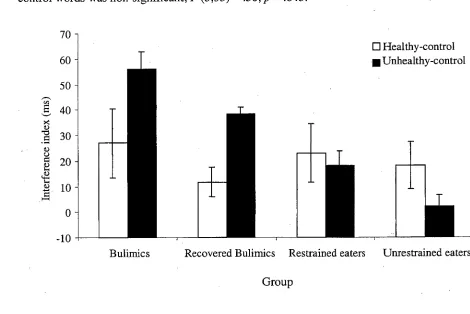
Schematic processing underlying eating disordered symptomatology was examined using the modified Stroop task. In three separate experiments 16 women with bulimia, 13 recovered bulimics, 15 restrained eaters and 15 unrestrained eaters completed the modified Stroop task for food, body shape and self-threat related words. It was expected that bulimics would demonstrate a Stroop effect to food, body shape and self-threat related words greater than restrained eaters and unrestrained eaters. Consistent with the notion that the Stroop effect is concomitant with current symptomatology rather than a measure of an underlying trait vulnerability factor it was hypothesised that the recovered bulimics would not demonstrate the Stroop effect. Individuals with bulimia and recovered bulimics showed greater Stroop interference to food related words than restrained eaters and unrestrained eaters. Further, bulimics and recovered bulimics showed delayed colour naming to unhealthy food words whereas restrained eaters' colour naming was delayed for healthy food words. These results suggest that the Stroop effect to food related information is not unique to individuals with eating disorders, but exists across the
Ir•
2
Neither was evidence found that uncontrolled mixing of nouns and adjectives in
previous research has generated inconsistent findings. Recovered bulimics, restrained
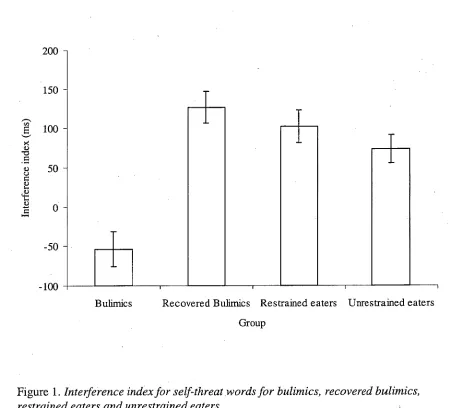
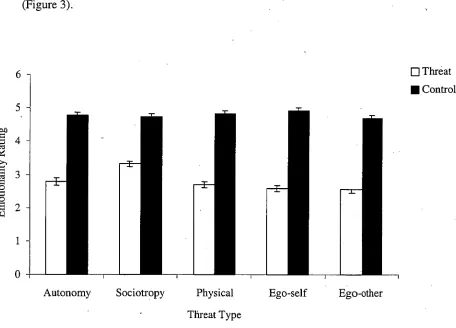
eaters and unrestrained eaters all demonstrated delayed colour naming to self-threat
words, specifically to autonomy and sociotropy related self-threat words whereas the
bulimics failed to demonstrate any such effect, which may have been due to their
high anxiety. The implications of these findings in clarifying previous research and
Dysfunctional cognitions or attitudes about the meaning of body, weight and shape,
body fat, food and eating behaviour have been implicated in the development and
maintenance of eating disorders (Fairbum, 1985). The influential cognitive
behavioural model (Fairbum, 1985) posits that bulimic individuals ascribe extreme
significance to body shape and weight and attempt to compensate for deficits in self- •
esteem by defining and evaluating themselves exclusively in terms of body shape and
weight. Accordingly, pursuit of thinness becomes the central organising principle for
the eating disordered individual, whose sense of self is dominated by attitudes,
beliefs and assumptions that overvalue the meaning of appearance. These beliefs,
organised as schemas, simplify the individual's world, influencing thoughts, affect
and behaviour. The operation of these schema can help to account for the persistence
of eating disordered symptomatology. According to the cognitive-behavioural model,
these attitudes and beliefs trigger dietary restraint. However dietary restraint is not
sustainable either physiologically or psychologically and triggers binge eating. In an
attempt to compensate for bingeing the individual employs compensatory
mechanisms such as purging, laxative use and excessive exercise.
There is growing evidence that factors other than dietary restraint can also trigger
binge eating. Negative affect has been shown to do so (Agras &Teich, 1998), and
dsyphoric mood has been found to precede food craving (Cooper & Bowskill, 1986)
and binge eating in bulimics (Davis, Freeman, & Solyom, 1985). Researchers have
postulated that binge eating is associated with a reduction of awareness of negative
emotions and many models have been proposed to explain the link between emotions
4
function of moderating affective states, while Heatherington and Baumeister (1991)
propose that bingeing is a consequence of cognitive narrowing used to escape from
awareness of negative emotional states.
The importance of emotional precipitants emphasised in these models has led to the
proposition that individuals with bulimia also have highly developed schemas for
threatening material (Waller & Meyer, 1997). Thus it could be argued binge eating
may be precipitated by both dietary restraint and/or negative affect and individuals
with bulimia nervosa have schemas around issues of threat as well as body shape and
food.
Investigation of cognitions underlying eating disorders historically has focussed on
the use of self-report instruments, subjective self-report, thought sampling and
monitoring techniques. These methods are limited by their subjective nature, relying
on accurate reports by participants. However, the last decade has brought methods
from the field of cognitive psychology to the investigation of psychopathology
allowing for the study of information processing and cognitive structures underlying
psychological disorders.
One of the most frequently employed methods is the emotional Stroop task. In this
task, participants are required to name the ink colour in which each of a series of
words is printed. Individuals are slower to colour name familiar words than a string
name and/or meaning competes with retrieval or production of the colour name, so
the interference effect can be used as a measure of this word activation. Individuals
with psychological disorders consistently show impaired colour naming of words that
are salient to the disorder as compared with matched words semantically unrelated to
the disorder. This interference effect has been interpreted as indicating an attentional
bias towards stimuli that are salienf(Williams, Watts, MacLeod, Mathews, 1997).
This effect has been illustrated in a range of psychopathologies including spider
phobia (Watts, McKenna, Sharrock, & Trezise, 1986), generalised anxiety disorder
(Mathews & Macleod, 1985), depression (Gotlib & McCann, 1984) and eating
disorders (Cooper & Fairbum, 1992). This attentional bias has been hypothesised as
evidence for the existence of disorder-related schemas.
Using the emotional Stroop task several researchers have demonstrated an attentional
bias towards the combined presentation of food and body shape related words in
bulimic individuals (Cooper, Anastasiades, & Fairbum, 1992; Cooper & Fairbum,
1992; Cooper & Fairbum, 1993; Cooper & Fairbum, 1994; Fairbum, Cooper,
Cooper, McKenna, & Anastiades, 1991) and also in anorexic individuals (Cooper &
Fairbum, 1992; Cooper & Todd, 1997; Green, McKenna, Sz. DeSilva, 1994).
Colour naming effects for separate presentation of these word types have been less
clear. Some researchers have reported a Stroop effect for the separate presentation of
both food and body shape related words in anorexia (Cooper & Todd, 1997; Green,
McKenna, & DeSilva, 1994) and/or bulimia (Ben-Tovim, Walker, Fok, & Yap,
6
related words, in anorexia (Ben-Tovim, Walker, Fok, & Yap, 1989; Channon,
Hemsley, & Desilva, 1988; Perpiiia, Hemsley, Treasure, & Desilva, 1993) and/or
bulimia, (Cooper & Todd, 1997) and yet others for body words, and not food related
words, in anorexia (Green et al., 1998).
Some evidence suggests that the interference effect is related to specific aspects of
bulimic psychopathology. Positive correlations have been demonstrated between the
interference effect and the frequency of purging (Cooper & Fairbum, 1993) and
severity of symptoms as measured by the Eating Attitudes Test (EAT) (Cooper &
Fairbum, 1992; Cooper & Fairbum, 1993).
• The specificity of the effect has been questioned by findings in individuals not
diagnosed with eating disorders such as restrained eaters. Restrained eaters are those
individuals who resist food in order to control weight gain or encourage weight loss
(Pirke & Laessle, 1993; Ruderman, 1986). Some researchers report a colour naming
impairment for food related words (Green & Rogers, 1993; Overduin, Jansen, &
Louwerse, 1995; Stewart & Samoluk, 1997) and body shape related words (Green &
Rogers, 1993) in high dietary restrained individuals. However, most investigations
have failed to find colour naming impairment for body shape and weight related
words (Ben-Tovim Sz. Walker, 1991; Cooper & Fairbum, 1992; Huon & Brown,
1995; Jansen, Huygens, & Tenney, 1998; Mahemedi & Heatherington, 1993;
Overduin et al., 1995; Perpiiia et al., 1993). In some investigations, a Stoop effect
has emerged in restrained eaters after exposure to a food preload (Mahemedi &
normal individuals, but the effect is smaller than that observed in individuals with eating disorders. Unfortunately differences in statistical analyses make comparison between studies difficult.
Understanding of the specificity of the emotional Stroop effect has been limited by the tendency to use words with a presumed negative valence. Typically word lists have comprised food words associated with binges or of high caloric value that eating disordered individuals consider 'forbidden'. Such research fails to consider possible attentional biases to positively valenced healthy/low caloric foods. For example, Sackville, Schotte, Touyz, Griffiths, & Beumont (1998) found that anorexics demonstrated delayed colour naming for names of high caloric density foods but not for names of foods of low caloric density, though this difference was not found in unrestrained or restrained eaters. Restrained and unrestrained eaters have been shown to demonstrate a Stroop effect for both 'forbidden' and 'non-forbidden' food words (Francis, Stewart, & Hounsell, 1997). Some further exploration of responses of bulimic individuals to negative and positively valenced food words is indicated.
them positive or negative valence. No study to date has examined the differential effects of nouns and adjectives on colour naming in bulimics to determine whether these word type differences contribute to any of the inconsistencies in findings.
Many investigations also have failed to control for the semantic homogeneity of disorder salient and comparison word types, possibly confounding the emotional Stroop effect with priming effects (Green, Corr, & De Silva, unpublished). Despite such failures to control for homogeneity in some investigations and difficulties reconciling findings due to the differences between studies such as the use of different words, Stroop methodology provides potentially useful information about food and body shape preoccupation and about the underlying schemas related to body-shape and food in eating disorders.
Stroop interference for many psychological disorders, including spider phobia (Watts et al., 1986), generalised anxiety disorder (Mathews, Mogg, Kentish, & Eysenck, 1995) and depression (Segal & Vella, 1990) has been shown to decrease with
improvement in symptomatology. Individuals with depressive disorders, have shown the Stroop effect to depressive words while clinically depressed, only for it to
disappear on recovery, despite the underlying increased chance of further depressive episodes (Segal et al., 1990). Similarly, in individuals with generalised anxiety disorder, there is correlational evidence that attentional bias decreases as anxious thoughts decrease (Mathews et al., 1995). This evidence suggests that the Stroop effect is related to current symptomatology rather than an enduring vulnerability schema.
In eating disorders a similar picture is apparent. Reduction of the emotional Stroop effect with the elimination of eating disordered behaviour suggests that the effect is linked to symptomatology and in not underpinned by an enduring cognitive schema. A limited number of studies have in fact, investigated the Stroop effect and recovery from eating disorders. Cooper and Fairborn (1994) found that 25 bulimic patients showed the Stroop effect to food and body shape related words, but significantly less so after 19 sessions of treatment. In a group of anorexics, Green et al. (1998) found a colour naming interference for food and body shape related words on initial
10
than food words, provides a clearer indication of improvement in psychopathological status in anorexia nervosa.
In a study which attempts to address longer term effects Lovell, Williams and Hill (1997) compared anorexics, recovered anorexics (two years after anorexia), bulimics and recovered bulimics (two years after bulimia) with non-eating disordered women, both dieters and non-dieters, on colour naming for food and body shape related words. Current bulimics and recovered anorexics showed a greater Stroop effect to shape words than recovered bulimics and women who had never suffered eating disorders. There was no difference between dieters and non-dieters. All groups demonstrated longer colour naming latencies to food words than control words. Lovell et al. (1997) suggested that for bulimics, shape concern may be a state effect that is high while the woman is suffering from bulimia, but dissipates with recovery. Recovery from anorexia on the other hand involves substantial weight gain and the Stroop task may indicate the presence of an enduring cognitive characteristic which functions relatively automatically. Individuals with anorexia may make an effort to overcome eating disorders and change their attitudes but at an automatic level continue to selectively process shape related information. To date, Lovell et al.'s study is the sole study using a between-subjects design investigating the Stroop effect in recovered bulimics and these important findings require replication.
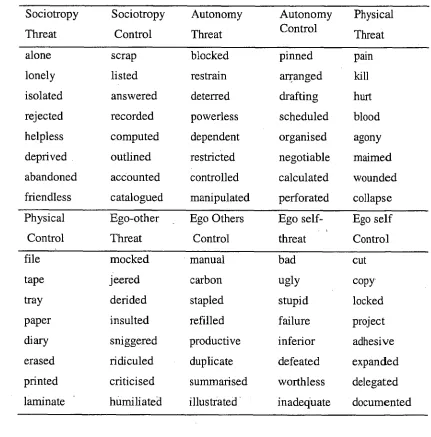
control (autonomy), threats to physical integrity and to directed threats to self-esteem than do non-eating disordered controls (McManus, Waller, & Chadwick,
1996). However no reliable differences have been observed for words involving a perceived danger of social isolation and rejection (sociotropy threat words) although colour naming for self-esteem threat words perceived to come from others (ego-other threats) approached significance. Colour naming for autonomy related words was also positively correlated with frequency of bingeing, and ego-self-threat words was correlated with frequency of both bingeing and purging.
Waller, Watkins, Shuck, and McManus, (1996) demonstrated that bulimic attitudes in non-bulimic individuals are associated with an attentional bias towards self-esteem threat words, specifically to ego-self-threats words rather than ego-other threat words.
• Thus bulimic attitudes and behaviours are associated with highly developed schemas for ego threats. However, Waller and Meyer (1997) have suggested that the Stroop effect may be related to other features of the bulimic individuals such as anxiety and depression which were not measured in either of these investigations.
■••
12
eaters. Restrained eating often precedes the development of an eating disorder and
restrained eaters are highly concerned with body shape and food but do not engage in
eating disordered behaviour.
The first experiment investigated colour naming of self-threat related words while
controlling for semantic homogeneity, an omission in existing studies on this issue. It
was expected that individuals with bulimia would demonstrate an interference effect
to self-threat words related to autonomy, physical integrity and self-esteem
(ego-other) greater than that observed in restrained eaters, unrestrained eaters or recovered
bulimics.
The second experiment investigated colour naming of healthy and unhealthy food
words. It was expected that individuals with bulimia nervosa would demonstrate a
greater interference index to both types of food words than recovered bulimics,
restrained eaters and unrestrained eaters.
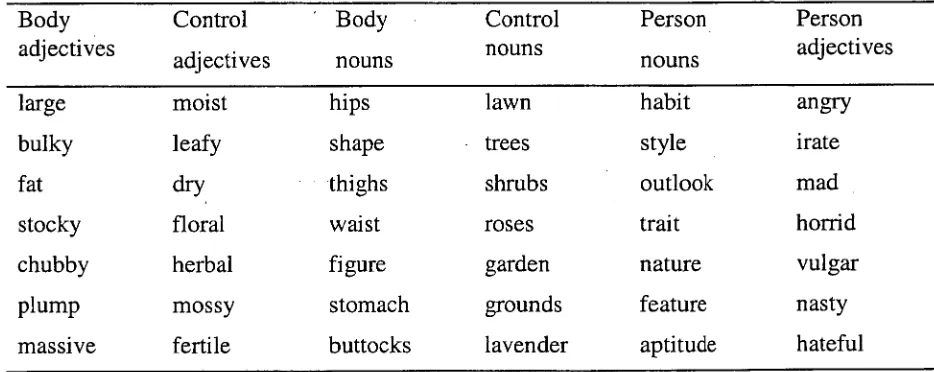
The third experiment investigated colour naming for body shape related words. It
aimed to clarify inconsistencies in findings between different types of words by
investigating colour naming for body adjectives separately from body nouns and
comparing colour naming with person nouns and person adjectives as well as control
nouns and control adjectives. It was expected that individuals with bulimia would
demonstrate an interference index to both body adjectives and nouns that was greater
14
Method
Participants
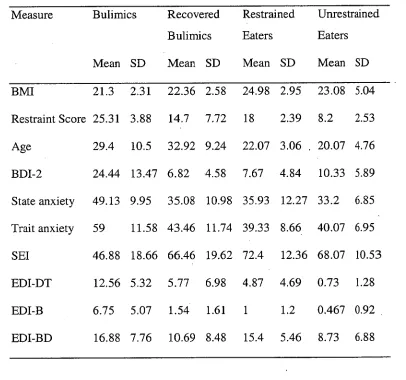
The participants were 16 females with Bulimia Nervosa, 13 females who had previously had bulimia nervosa and recovered, 15 females without a history of an eating disorder who were low on dietary restraint and 15 females without a history of an eating disorder who were high on dietary restraint.
Current and recovered bulimic individuals were recruited through public notices, advertisements in local newspapers and contact with community mental health services. In classifying the clinical participants, the Diagnostic and Statistical Manual for Mental Disorders Edition 4 (DSM-IV) (American Psychiatric Association, 1994) criteria for bulimia were applied. Individuals who had met the criteria for bulimia nervosa and still engaged in binge eating were included in the bulimic group.
Recovery was operationally defined as no longer engaging in binge eating or purging behaviours and having not done so for at least three months.
University undergraduate students were screened using the Revised Restraint Scale (Herman & Polivy, 1980). Suitable individuals were invited to participate in a study on the effects of food on mental functioning. Participants with scores of 15 and above were selected as restrained eaters; those with 12 and below were selected as