NON-THERMAL GALACTIC
BACKGROUND RADIATION
by
H.V. Cane, B.Sc. (Hons.)
submitted in fulfilment of the requirements for the degree of
Doctor of Philosophy
UNIVERSITY OF TASMANIA HOBART
This thesis contains no material which has been submitted or accepted for the award of any other degree or diploma in any university.
To the best of my knowledge and belief, the thesis contains no copy or paraphrase of material previously published or written by another person, except where due acknowledgement is made in the text.
ABSTRACT
This thesis presents the results and analysis of data obtained using the Llanherne low-frequency array. Surveys of the Galaxy at five frequencies in the range 2 to 20 MHz have been made and the data have been assembled into maps covering the area
3200 < k < 30° and -25° < b < 22°. The data from these maps are
combined with data from seven earlier continuum surveys to produce galactic radio spectra in various directions.
A summary is made of most of the measurements, at frequencies less than approximately 400 MHz, 'of the galactic background radiation and their interpretation. Two new composite maps, at 10 and 30 MHz, are presented. These, combined with the 85 MHz all-sky map, are
used to illustrate the variation of the galactic non-thermal radiation across the sky, and with frequency.
The galactic spectra are interpreted in terms of a model of the Galaxy in which synchrotron emission, and absorption in HII regions predominate in spiral arms. However, it is proposed that the synchrotron emission arms and the arms defined by HII regions are not coincident. In addition to the HII absorbing gas the model incorporates a much broader uniform absorbing HI gas which is
responsible for high latitude absorption, pulsar signal dispersion and Faraday rotation.
For the HI gas it is found that
f
ne2 Te-1 . 35 dl = 1.1 x 10
-7 cm-6 K-1.35 pc
For the HII gas the above quantity varies for different arms. An
average value is
f
n e 2CONTENTS
CHAPTER 1 - INTRODUCTION
Preface 1
Acknowledgements
CHAPTER 2 - EMISSION AND ABSORPTION MECHANISMS
Introduction 5
Synchrotron Emission 6
Thermal Absorption 9
Low Energy Electron Cut-off 14
The Razin Effect 17
References 20
CHAPTER 3 - LIMITATIONS TO LOW FREQUENCY RADIO ASTRONOMY
Introduction 21
Ionospheric Limitations 24
Transmitting Station Interference 28
Limitations on Absolute Calibrations 28
References 30
CHAPTER 4 - THE INTERSTELLAR MEDIUM
Introduction 31
HII Regions 31
The HI Distribution 35
Diffuse Ionized Hydrogen 36
The Galactic Magnetic Field 46
CHAPTER 5
Introduction 57
PART I - GALACTIC BACKGROUND RADIATION
Sky Surveys 58
The 10 MHz Composite Map 64
The 30 MHz Composite Map 67
The Distribution of the Non-Thermal Background Radiation 70
PART II - GALACTIC SPECTRA
The Spectra of the Galactic Polar Regions 85
Discussion 99
Galactic Spectra in Other Directions 102
PART III - SPECTRAL INDEX VARIATIONS
Introduction 107
The Measurements 108
Variations of the Total Background Temperature
Spectral Index 110
PART IV - NON-THERMAL EMISSIVITY
Introduction 118
The Measurements 118
Cosmic Ray Electron Spectrum 129
References 133
CHAPTER 6 - THE RESULTS
Introduction 137
Data Preparation 137
Scans 139
Maps 139
CHAPTER 6 - continued
Galactic Background Spectra 169
Discussion 180
References 18.2
CHAPTER 7 - THE LOW FREQUENCY ANALYSIS
Introduction 183
Previous Investigations 183
The Model 186
Results 194
Discussion - Emission Properties 200
- Absorption Properties 203
Summary 205
References 206
CHAPTER 8 - FUTURE OBSERVATIONS 208
APPENDIX I - THE GUM NEBULA
Discussion 212
References 216
APPENDIX II - INSTRUMENTATION
Introduction 217
The Array 217
The Phasing 220
Receiving Equipment 223
Observing Procedure 227
1.
CHAPTER I
INTRODUCTION
Preface
This thesis is a description of the features of the
galactic background radiation at frequencies below about 400 MHz.
The first four chapters present review material. In Chapter 2
we discuss the emission and absorption processes relevant to the
work. Chapter 3 covers the problems peculiar to low frequency
astronomy. In Chapter 4 we review the observations of the interstellar
medium. In this the major objective is to determine the properties
and distribution of free electrons in the Galaxy.
Chapter 5, which contains some original work, is relatively
long and has been divided into four parts. In Part I we present a
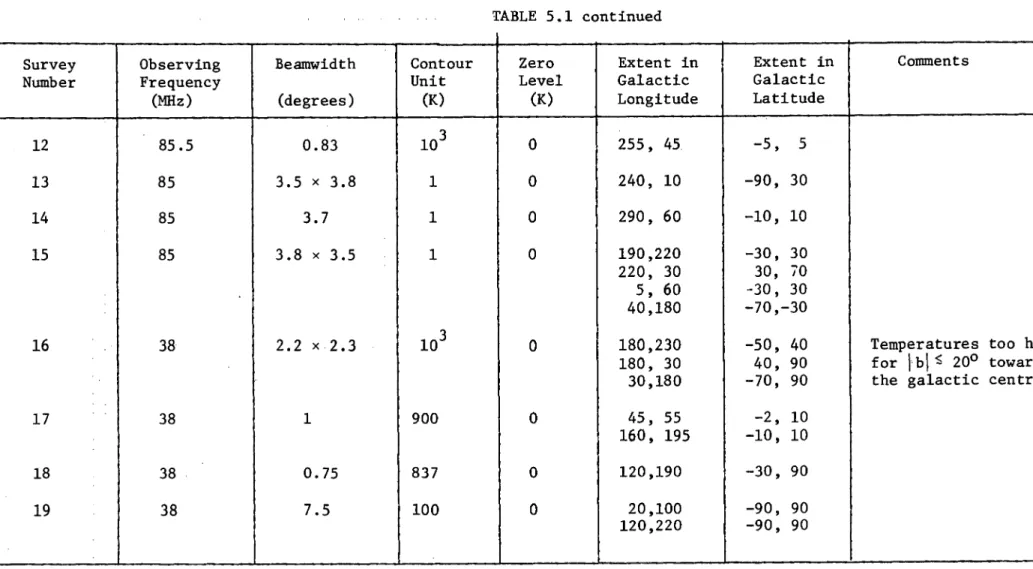
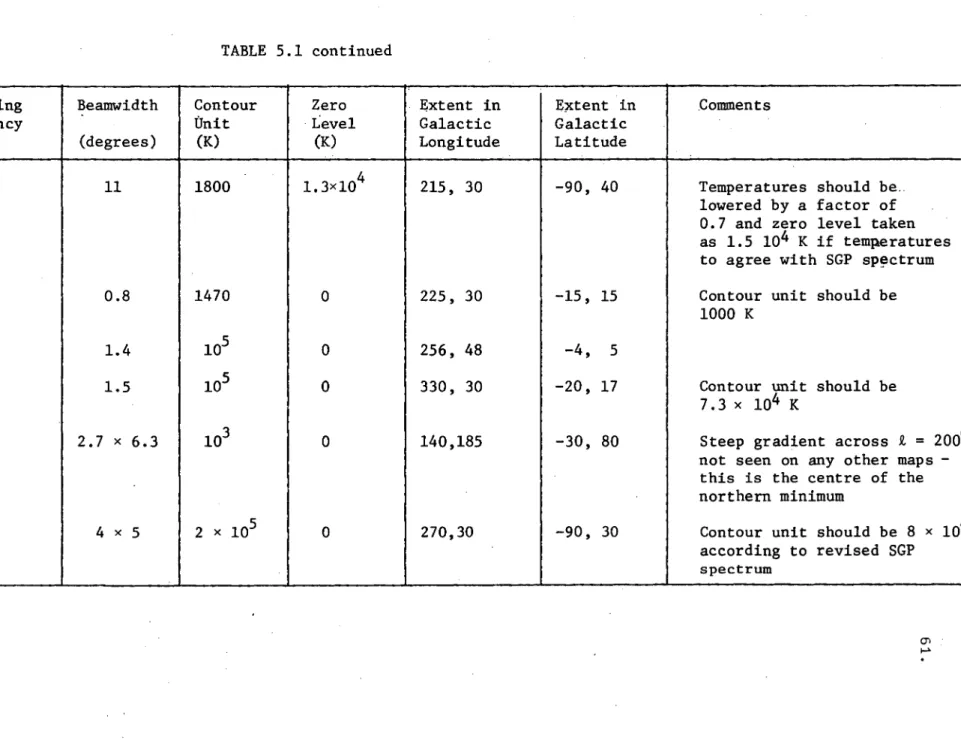
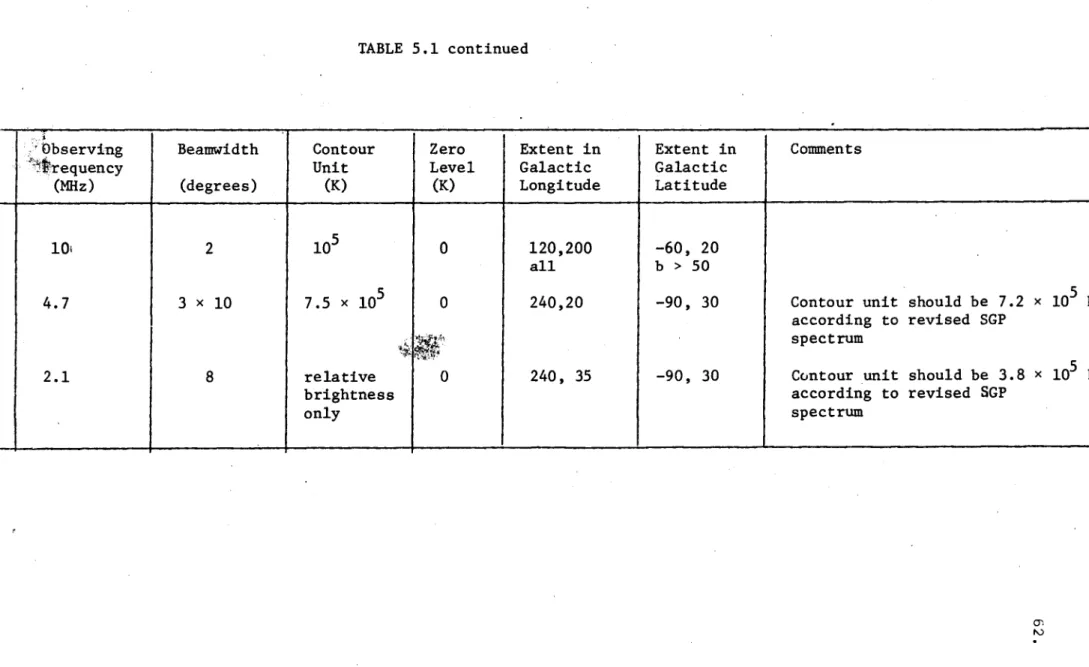
catalogue of sky surveys at frequencies less than about 400 MHz
and two new composite maps at 10 and 30 MHz. These data are used to
discuss the properties of the background radiation. In Part II all
the polar spectral points of both polar regions are presented and
new polar spectra defined. In addition, spectra for the
anti-centre and northern minimum directions are defined. In Part III
spectral index variations are discussed. This includes a review of
previous investigations and some new work using three composite
maps. Part IV is a discussion of the results from emissivity
estimates. Measurements are tabled, and plotted in several forms.
Chapters 6 and 7 present the major original contribution
of this thesis. Chapter 6 comprises the experimental part and
presents the data obtained using the Llanherne array in the form
of declination scans and maps. Spectra are then compiled using
seven earlier continuum surveys. These spectra exhibit unusual
these spectra which is also compatible with the conclusions of
Chapter 5.
In Chapter 8 the uncertain areas in galactic background
radiation studies are discussed and measurements suggested to
clarify some of the uncertainties.
The thesis concludes with two appendices. The first is a
brief summary of the recent work on the Gum Nebula and includes
some comments on an early publication by the author.
The second appendix deals with the instrumentation used
to obtain the sky surveys. This is included as an appendix
because the author was not connected with the majority of the
design of the array or receiving equipment. The description of
the phasing is included in some detail as the author was responsible
for part of the design and because it has not been documented
elsewhere.
3.
Acknowledgements
This project was initiated by Professor G.R.A. Ellis
and his assistance as supervisor is acknowledged.
During the first four years financial support was provided
by a Commonwealth Postgraduate Scholarship. Afterwards support
was provided by the A.F.U.W. and Zonta International.
Technical assistance was provided by a number of people
but in particular by Mr. G. Gowland and Mr. P. Button.
The project would not have been as successful without the
introduction and utilization of the PDP-8 computer. The interfacing
and installation was performed by Mr. G. Gowland and the software
written by Mr. P.S.Whitham. Mr. P.S. Whitham also wrote the
software for the sky observing program and willingly provided
assistance with its implementation.
The contour plotting program used to draw the maps was an
adaption of a program written by Dr. P.A. Hamilton. Assistance with
programming problems was readily supplied by Mr. R.K. Allen and
Mr. L.C. Botten. Computer operaters Mrs. D. Fleury and Mrs. S. McQuaid
were very helpful in running the long programs required to extract
the raw data off the magnetic tapes.
In the final stages of this work the enthusiasm of Professor
W.R. Webber during his stay at the University of Tasmania provided
the impetus to complete this thesis. His interest and guidance were
invaluable.
The assistance provided by Dr. P.A. Hamilton in the final
stages of the thesis is acknowledged. His comments and interest
Ll.
The typing of this thesis was performed by a number of people. The assistance of Mrs. A. Williams and Mrs S. McQuaid is acknowledged.
5.
CHAPTER 2
EMISSION AND ABSORPTION MECHANISMS
Introduction
The Galaxy emits both continuum and line radio emissions.
Line emissions are emitted during a change in energy state of an
atom or molecule and are monochromatic. Radial velocity measurements
give information on the distance of the emitting gas and thus line
emissions may be used to investigate radial and spiral features.
The most important line emission is the X21 cm line from
neutral hydrogen and maps obtained from this emission provided
the first insight into the spiral structure of the Galaxy.
Information on the large scale distribution of ionized hydrogen may
be obtained from hydrogen radio recombination lines. These, and
other line emissions provide information on properties of the
interstellar gas.
In recent years many molecular lines have been found with
a new field in astronomy resulting - molecular astronomy. Nowever,
line emissions are important only at frequencies greater than a few
hundred megahertz so that we will not discuss these mechanisms but
will discuss the results of such observations in Chapter 4.
The background radiation from the Galaxy consists of
thermal emission from ionized hydrogen and synchrotron emission
from cosmic ray electrons. These are continuum emissions which
extend over essentially all frequencies with varying intensity.
In Chapter 4 we assess how much of the background is thermal but
let it suffice at this stage to say that at frequencies of
interest to this work 400 MHz) the background is predominately
6.
At low frequencies ( MHz) it is found that the galactic background spectra turn over and this is attributed to free-free absorption in ionized hydrogen. However, it is important to discuss the other processes which can contribute to this low frequency cut-off, namely a low energy electron cut-off and the Razin effect.
Synchrotron Emission
Synchrotron radiation is emitted by relativistic electrons accelerated in a magnetic field, and was first observed in synchrotrons from which visible radiation was emitted. In 1950 Kiepenheuer suggested that this mechanism could account for galactic radio emission and
that the electrons responsible were the electron component of cosmic rays which radiated as they moved in the interstellar magnetic
field.
The theory of the synchrotron emission process is complex; for details see, for example, Westfold (1958). The basic principles are not and most text books on radio astronomy deal with the topic
(e.g. Kraus, 1966; Shklovsky, 1960). It is included here to provide completeness and because the results will be applied in Chapter 5.
The energy radiated by a non-relativistic electron gyrating in a magnetic field has a wide angular distribution. For a
7.
The frequency of the maximum intensity is about a third the
characteristic frequency vc where
vc = 16.1 B1E2 MHz (2.1)
where B, is the component of the magnetic field B, perpendicular
to the particle velocity (in p Gauss) and E is the electron energy
(in Gev).
The spectral distribution of power radiated by a single
electron is given by
P(v) = 2.34 x 10⁻²⁹ B1 F(v/vc) watts MHz-1
where F(x) is a function which varies approximately as x for 03
small x and x°5 e for large x. Thus the function has a long -x
low frequency tail. It is tabulated and graphed by Westf old (1959).
In astrophysical applications of synchrotron theory assemblages
of electrons need to be considered. In this case the total power
radiated is given by
Pa(v) = fn(E) P(v) dE
where n(E)dE is the particle density for electrons within the
energy range E to E + dE. To obtain the emissivity this quantity
should be divided by 47r , assuming the radiation field is isotropic.
It is observed that the cosmic ray electron spectrum has a
power law distribution so that
n(E)dE = noE - YdE where E < E <E
2.
8.
In equation (2.1) a change of variables can be made from E to v/v c
and then the emissivity is given by
c(v) = 9.3 x 10-37 n
o B/ 1)/2(6.26 x 10-20/v ) 1) /2
x G(v/v i , v/v 2 ,y) watts m-3 Hz-1 ster -1 (2.2)
y-1
with v in MHz, B in p Gauss and n
o in electrons m
-3
Gev. . vi
and v 2 are the critical frequencies corresponding to E l and E 2 and
v/v
l x (y-3)/2 F(
G(v/v l ,
v/v 2 , y)= Jx; /v2 x) dx.The behaviour of G is discussed in Westfold (1959).
Now provided v l % v v 2 , G will be independent of
frequency and thus
-(y-1)/2 E()cc v
where a is the emission spectral index. Observations of the
galactic background radiation indicate that a varies across the
sky and with frequency but lies in the range 0.4 - 0.9. The corresponding
variation for y is 1.8 - 2.8.
Although G cannot be evaluated except by numerical
integration the limiting case of G(03, 0,y)=g(y) can be epxressed as
a product of gamma functions. The difference between G(v/v l , v/v 2 , y)
and g(y) is a measure of how much the emission is reduced because of
the 'missing' electrons having energies above or below the cut-off
energies E l and E 2 . If the frequency of observation is the same
as one of the critical frequencies then the value of G will be
9.
The emission described by equation (2.2) is highly polarized
and to remove the polarization this emissivity should be averaged
over all values of the inclination of the Magnetic field. The
resulting expression for the mean emissivity is
c(v) = 9.3 x 10-37n
0B
( 1)/2
(6.26 x 10²⁰/v)(y-1)/2
x g i (y) watts m-3 Hz-1 ster -1 (2.3)
where the values of g' (y) (obtained from Moffet, '1969) are given
in Table 2.1.
Thermal Absorption
Ionized hydrogen in the interstellar medium absorbs low
frequency radio waves as the result of acceleration of electrons
by the Coulomb field of the ions.. The same mechanism is responsible
for the thermal emission at high frequencies.
A derivation of the absorption co-efficient K is given in
Shklovsky (1960) and another in Ginzburg (1961).
From Ginzburg,
K = 10-2n
e
2 /T
e
3/2
v2117.7 + in (Te3/2/v)] neper cm
where
n
e = free electron number density, el. cm
-3
Te = electron kinetic temperature, K
TABLE 2.1
0.5 1.0 1.5 2.0 2.5 3.0 3.5
19.8 9.12 2.16 1.50 1.21 1.07 1.03
11.
The term in brackets is a slowly varying function of frequency
and temperature, as may be seen in Table 2.2, taken from Hamilton
(1969).
If the path length through a region of ionized hydrogen is L,
the optical depth is given by,
T = K dl neper
A useful approximation has been given by Mezger and Henderson (1967)
T = 8.235 x 10⁻²T -1.35v -2'1E
where T
e is in K, v in GHz, and emission measure
E = of
L n
e 2
dl
has dimensions cm-6 pc.
For v in MHz the equation becomes
-..1
T = 1.64 105T 135v-2 e
(2.4)
(2.5)
If radiation passes through a region of ionized hydrogen
the intensity is reduced by a factor of e -T due to absorption
and the spectrum takes the form v -c( e -T .
If emission and absorption takes place uniformly in the
same region then Hamilton shows that the intensity is reduced
by a factor of -(1 - e-T)/T.
In figure 2.1 we illustrate the difference in spectral shape
for these two types of low frequency turn-over where in both cases
TABLE 2.2
Te(K)
1
VALUES OF c = 10-2 [17.7 + ln(T
e 3/2
/v)]
v (MHz)
3 5 10 20 50 100
500 0.13 0.13 0.12 0.11 0.1 0.09 0.09
1000 0.14 0.15 0.13 0.12 0.11 0.10 0.10
2000 0.15 0.15 0.14 0.13 0.12 0.11 0.11
5000 0.17 0.16 0.15 0.14 0.14 0.13 0.13
(a) v
-0.6e -T -0.6--C
(b)
(1-e
)/T( b)
a)
T=1
R
E
LA
TI
VE B
RIGH
TNE
SS
10
10
100
13.
FREQUENCY (MHz)
14.
The effect of the combination of an emitting region A behind a region B of emission and absorption is such that the resulting spectrum is narrower than the spectrum of region B alone when they are normalized at the high frequency end. This is
illustrated in figure 2.2. The height of the spectrum of B alone above the spectrum of A+B at the low frequency end is a measure of the magnitude of the brightness of A relative to that of B.
Low Energy Electron Cut-off
If a low energy cut-off exists at some energy E l then for observing frequencies much less than v i the intensity of emission is proportional to vC 1 . 3 independent of the value of y. This is the sharpest low frequency cut-off that can be obtained in a
'pure' synchrotron spectrum not affected by absorption or other processes.
Early interpretations of the galactic background spectral turn over as being due solely to an electron spectral change (Turtle, 1962) were invalidated by lower frequency observations which showed that at frequencies near 1 MHz the north pole spectrum
falls off as v1.6. Nevertheless, an electron cut-off might well exist in addition to absorption by ionized hydrogen. If this was the case then derived optical depths would be over estimates. Figure 2.3 illustrates this. Consider a region of emission and absorption where the emission has a spectral index of 0.4. For
15.
FREQUENCY (MHz)
1 6.
I
0.1
1
10
FREQUENCY (MHz)
17.
The Razin Effect
The Razin (or Razin-Tsytovitch) effect was first investigated
in 1951 by Tsytovitch and later by Ginzburg (1953) and Razin (1960).
These papers are not readily available but more recently the topic
has been dealt with by Ginzburg and Syrovatskii (1964, 1965)
and Ramaty (1972). The latter paper is specifically concerned
with low frequency background radiation.
The Razin Effect is the suppression of low frequency synchrotron
radiation in an ionized medium. It is the result of electromagnetic
radiation having a phase velocity in the plasma greater than the
speed of light when the plasma has a refractive index less than
one. The synchrotron radiation is reduced because the electrons
can not keep in phase with the radiation they generate. This is
in contrast to the production of synchrotron radiation in a
vacuum where the relativistic electrons moving with a velocity
near the velocity of light almost keep up with, and strongly
reinforce, radiation moving parallel to their path.
One can define a Razin cut-off frequency v R which determines
the frequency at which the effect of the medium becomes important.
For frequencies greater than v R the refractive index of the medium
is sufficiently close to unity that the emission can be considered
to take place in a vacuum.
With this definition of v
R we have
v
R = 30ne/Bsin0 MHz
n
e = density of electrons, el. m -3
B = magnetic field, pGauss
18.
From this equation it is seen that for low frequencies where the emission is suppressed, the strength of the emission will depend on the observation angle with respect to the magnetic field. Thus, except if the component perpendicular to the line of sight of the interstellar magnetic field is small synchrotron emission is only moderately reduced.
Figure 2.4 illustrates that if the Razin effect does cccur and is not accounted for then derived optical depths would be over estimates. Consider a region of emission and absorption where the emission has a spectral index of 0.4. For spectrum
(a)T = 7/v 2 whereas for spectrum (b)T = 4/v 2 but the Razin effect is occurring, under the conditions B = 2pG, n
e = 0.03 cm -3
and 8 = 90 ° . Curve (c) is taken from Ramaty (1972).
19.
10 -
0.1
0.1
1
10
FREQUENCY (MHz)
REFERENCES FOR CHAPTER 2
GINZBURG, V.L. 1953 Usp. Fiz. N auk. 51 343.
GINZBURG, V.L. 1960 'Propagation of Electromagnetic Waves in
Plasmas' (Gordon and Breach, N.Y.)
GINZBURG, V.L. and SYROVATSKII, S.I. 1964 'The Origin of Cosmic
Rays' (Pergamon, Oxford).
GINZBURG, V.L. and SYROVATSKII, S.I. 1965 Ann. Rev. of Ast. Astro. 3
297.
HAMILTON, P.A. 1969 Ph.D. Thesis (University of Tasmania).
KIEPENHEUER, K.O. 1950 Phys. Rev. 79 738.
MEZGER, P.G. and HENDERSON, A.P. 1967 Astrophys. J. 147 471.
MOFFET, A.T. 1969 'Astrophysics and General Relativity' Vol. 1
(Gordon and Breach, N.Y.).
RAMATY, R. 1972 Astrophys. J. 174 157.
RAZIN, V.A. 1960 Radiofizika 3 584.
SHKLOVSKY, I.S. 1960 'Cosmic Radio Waves' (Univ. Press, Harvard,
Cambridge).
TURTLE, A.J. 1963 Mon. Not. R. astr. Soc. 126 31.
TSYTOVICH, V.N. 1951 Vestn. Mosk. Univ. 11 27.
WESTFOLD, K.C. 1959 Astrophys. J. 130 241.
21. CHAPTER 3
LIMITATIONS TO LOW FREQUENCY ASTRONOMY
Introduction
The great activity in background radiation studies in
the 1960's seems to have faded with the discovery of pulsars and
molecular lines; measurements that are made are usually at
high frequencies where very high resolutions are now attainable.
However, at low frequencies certain important measurements can
be made and several phenomena manifest themselves. For example,
comparisons between the cosmic ray electron spectrum and
non-thermal background spectra must be made at low frequencies where
the contribution of a thermal background may be neglected. The
distribution of ionized hydrogen in the Galaxy may be investigated
by low frequency observations since at these frequencies free-free
absorption takes place. At low frequencies emission mechanisms other
than the synchrotron process may become dominant under certain
conditions. Yet,because of the difficulties involved many
observations have not been made.
For ground-based observations there are three main
difficulties:
"(1) Antennas of several kilometres extent are required
for resolution better than 1 degree. Dashed lines
in Figure I illustrate the resolution attainable with
apertures of 3, 10 and 30 km width.
(2) Conditions in the Earth's ionosphere vary with time
of day, time of year, and solar activity. Observing
is possible only when the electron density in the
F-region is sufficiently low and relatively free of
22.
(3) There are no frequency allocations for radio astronomy
below 20 MHz. World radio communications make
extensive use of these frequencies for propagation via
ionospheric reflections. For this reason it is
extremely difficult to find sites on the Earth sufficiently
remote from interfering signals. It is significant
that the few ground-based measurements below 10 MHz
have been made from Tasmania which from an interference
point of view can be regarded as relatively remote".
The above is extracted from a C.C.I.R. document (1975) on
ground-based radio astronomy below 20 MHz. Figure 3.1 (from this
document) shows the angular resolution of telescopes which have
been used or are in use below 100 MHz.
Observations are also made from above the Earth's ionosphere
from satellites and rockets. In recent years the NASA programme
has contributed greatly to our knowledge of the low resolution,
low frequency spectra. However, there are also limitations to
this type of observation, in addition to the obvious short comings
of rocket observations viz, the limited observing period. These
are:-
(1) The lack of resolution -aerial beams are typically 100°. (2) The problem of determining the direction in which the
aerial is pointing.
(3) In addition to man-made interference the aerial picks
up exospheric emissions.
1
' 7 , - - I
Rti'ber ---\\--
Th
0
. - F--
• --71ri.i.a
N.,Hobart c. L
c;? Hobart e> .
40 I
i\
%'-)
°Cambridge111-1 c) ss„s t .'• /):,)
•(>
20 .?
23.
8°
,Fleurs
Pentic ton vz.N.
1 0 '‘ ()Cross .‘/›. Fleur s 0 Cambridc-%::'
Clark -
c-1 Cro -;s -1
Lake:D" OCOCOE.1
C r9 5 5
,o 1 ‘ 1 T.)ent- ictenx2; O - 20 ' -4 0 10 5
Cu
1T5bra
L\ CU-1- oorel°
2
1
100.
Freciu,ency (pniz)
2 14.
Ionospheric Limitations
Ground-based observations are only possible when the
cosmic radio emissions can propagate through the ionosphere and
this occurs when the critical penetration frequency of the ionosphere
f
oF2 is less than the observing frequency. Such observing
conditions can be realized at very low frequencies 1.5 MHz) but
only under strict limitations.
Firstly, observations must be made at night time during
the 4-5 years around sunspot minimum.
Secondly, the world contours of f0F2 illustrate that there are geographic limitations and that a minimum in the F-region
electron density exists at geomagnetic latitudes 400 -50o . Figure 3.2 (taken from Ellis and Hamilton, 1965) shows the variation of
f
oF2 with geographic latitude observed by the Alouette I satellite
(Muldrew, 1965).
In the winter months at mid-latitude stations up to 9 hours
of available observing time at 3 MHz can occur. But at the same
time there are probably no hours when interfering signals can not
propagate by reflection. Figure 3.3 shows the average number of
hours per night that f0F2 was less than 4 MHz for the years 1973-1976 at Hobart. Figure 3.4 shows the same information for
the years 1961-1964 (taken from Ellis, 1965) illustrating the
variation of conditions from one solar cycle to the next.
Even when the critical frequencies are low ionospheric
absorption can occur. Ellis (1965) discusses fully the effect
of ionospheric absorption and screening due to ionospheric refraction.
Figure 3.5 (taken from Ellis, 1965) shows the total calculated
attenuation as a function of f
10 15
LONGITUDES 13?-155°
- 20 JUNE 1963
14 AUG 1963 ,0014 EST •0547
19 AUG 1953 .0524 .• 1963 .0415 20 AUG
28 AUG 1953 .0355
' I
20 25 30 35 40 4. ' 5 50
a
60
25.
GEOGRAPHIC LATITUDE (DEGREES)
Sample curves showing the variation of ionospheric critical frequency f0F2 with geographic
latitude observed by Alouette satellite.
FIGURE 3.2
26.
FMAMJ J AS ON DI
j
FMAMJ J ASON D J FMAMJ J ASO. N D1973
1974
1975
FIGURE 3.3
D'J FMAMJJASONDJFMAMJJASONDJFMAMJJASON D
1961
1962
1963
7 10
A
TTEN
UA
T
ION
db
0
0 405 I
0.6
o.A
1!54
FREQUENCY (M c/s)27.
Variation of total attenuation with foF2.
FIGURE 3.5
28.
Transmitting Station Interference
Unless the critical frequency is less than 0.3 of the
transmitting frequency, reflection of transmitting station
signals takes place and given the signals have sufficient
radiating power they may reach a radio telescope after multiple
hops from almost anywhere on the Earth's - surface.
Because the above condition is not often realized at low
frequencies a technique has been developed to reduce the effects
of this interference. This is the minimum reading technique
discussed in Appendix I. By careful selection of the observing
frequency the problem can be minimized and in addition, for sky
surveys at least, during observations the frequency can be
altered slightly to avoid transmitting stations. However, the only
way to obtain reliable information is by the duplication of
records.
Limitations on Absolute Calibrations
Calibration Sources
At frequencies less than 20 MHz no suitable primary
standard exists and a secondary standard must be used. This standard
must provide equivalent temperatures in the range 10 5 - 106 K.
Above 100 MHz thermal loads are used but they do not
provide large enough signals at lower frequencies. Between - 20
and 100 MHz the accepted standard is the temperature saturated
noise diode (described by Van der Ziel, 1955) which can give
equivalent temperatures up to 105 K. These must be calibrated
The secondary standard used in the present work was a
Zener diode calibrated against a temperature saturated noise
diode. This noise generator could provide temperatures greater
than 107K.
Antenna Gain
The calibration of a radio telescope involves replacing
the aerial with a calibration source of the same impedance.
However, this only gives the relative calibration of receiver
gains and to obtain sky temperatures one needs to know the antenna
gain as a function of zenith angle.
The antenna gain is mainly determined by the losses in
the aerial feeder cables. In addition, account must be taken
of the ground radiation, if significant, and the power loss from
imperfectly reflecting ground screens.
At low frequencies with large arrays these calculations
are not simple and usually a semi—empirical derivation is performed.
This is achieved by using 'expected' values of point source
intensities obtained from extrapolation of higher frequency data.
There are a limited number of sources observable at low frequencies
so that as an alternative the 'expected' response to background
emissions in regions of minimal variation is used. This can involve
extrapolating higher frequency data which necessitates the
assumption of a spectral index. But in Tasmania it has become
practice to use low resolution measurements of the south galactic
30.
REFERENCES FOR CHAPTER 3
C.C.I.R. 1975 Proposed New Report Doc. 2/9-E
ELLIS, G.R.A. 1965 Mon. Not. R. astr. Soc. 130
429.
ELLIS, G.R.A. and HAMILTON, P.A. 1966 Astrophys. J. 143 227.
MULDREW, D.B. 1965 J. Geophys. Res. 70 2635.
31.
CHAPTER 4
THE INTERSTELLAR MEDIUM
Introduction
In Chapter 7 we derive a model of the Galaxy in which
synchrotron emission and thermal absorption take place in Spiral
arms. Prior to this it is important to summarize the currently
acceptable values for properties of the interstellar gas and the
magnetic fields. We are reasonably certain about some of these
values but for others we can only place limits. One of the
greatest problems is that the observations measure different
combinations of parameters. In many cases the measurement
gives an integral along the line of sight and path lengths are
uncertain.
The basic component of the interstellar gas is hydrogen
and interstellar space is often divided into two regions depending
on the state of the hydrogen. In HII regions the gas is ionized
whereas it is predominately neutral in the HI region. The latter
is further divided into cool dense clouds and a tenuous hot
intercloud medium. Theories predict that both components are partially
ionized.
In this chapter we will discuss the distribution of the
interstellar gas and magnetic fields with particular emphasis on
spiral and radial features. In addition, we summarize the
observations' of free electrons in the Galaxy, with particular
reference to electron temperatures and densities.
HII Regions
If a hot star is surrounded by a cloud of interstellar gas
the far ultra—violet radiation from the star ionizes the hydrogen.
32.
distance before it is completely absorbed so that there exists
a zone of radius S
o beyond which the hydrogen remains neutral.
The region of ionized hydrogen is called a Stfbmgren sphere.
S, the Strbmgren radius, can be shown to be dependent on the
star's spectral class and inversely proportional to the gas
density. Only 0 and B stars have Strbmgren spheres of significant
size.
HII regions can be observed in many. ways. Their
distribution is of considerable interest as they are excellent
spiral arm tracers. A comprehensive review of the properties
of HII regions is presented by Nezger (1972) and, in particular,
he summarizes the interpretation of the radio observations.
Below we summarize the basic results of the optical and radio
observations.
(a) Optical Observations
HII regions emit all the hydrogen series lines but only
the Balmer series are easily observed. A number of photographic Ha
surveys have been made, of which the most recent and most
extensive is that of Sivan (1974), which covers the whole galactic
plane. The longitude distribution shows a clustering of regions
in directions towards the galactic centre corresponding to the
Sagittarius arm, and in the longitude range 98 ° - 273° corresponding
to the Perseus and Orion arms.
Kinematic distances derived from interferometric studies
of Ha emission, combined with photometric distances of the
exciting stars have been plotted to give the radial distribution
of HII regions (Courtes, 1973). The local spiral arms are well
• •
t i.
I 180
• • •
o • . •
A •
ss •
P.:' •
• I.. • 44( .• %
ID
• 9, • • er"" le%
1 • af ..-4
S. •• • • -t. i • • o •:!-• f• ... .. .... , 6 • • ..•
v.+ • gh -.IA t. ..•;" 4- - • - • 4.
—270 • • a 90 —
0 1 kpc
• 0
X X
■
• • 1).•• .
• • •
•
4'4.4: •• •
• Iry, •
- .
%
•
• •
•••■■
33.
Distribution of H II-regions according, to Coutes (1973). Kinematic distances of the H II-regions are
indi-cated by dots, spectrophototnetric distances of the exciting stars by squares
314.
are limited to HII regions within about 3 kpc of the Sun awing
to extinction by interstellar dust.
(b) Radio Observations
(i) Free-free transitions
In the GHz range many HII regions are seen as discrete
sources on a background of radiation. The longitude distribution
of thermal sources exhibits peaks in various directions which are
interpreted to be directions in which we look tangentially along
spiral arms. For northern=hemispheres surveys the main peaks
occur at
R. =
250 andR. =
50° . The latitude distribution isnarrow and has a half-power width of less than 2 0 . A comparison
of optical HII regions with thermal sources indicates that they
pertain to different evolutionary stages. Strong thermal sources
are usually young, compact HII regions. Most of the optically
observed HII regions are only weak thermal sources.
At low radio frequencies HII regions absorb non-thermal
radiation. It is found that there is a close correlation between
optically observed HII regions and regions of discrete absorption
on low frequency maps (see, for example, figure 6.16).
(ii) Radio recombination lines
This is the most useful measurement for observing the large
scale distribution of HII regions. Several surveys of the H109a
line have been made.
The basic results of such work are that the distribution
of giant HII regions exhibits 'a maximum between 5 and 6 kpc from
the galactic centre, a secondary maximum between 7 and 8 kpc and a
The HI Distribution
Most of the interstellar matter is neutral hydrogen. The
prediction and subsequent observation of the X21 cm hyperfine
transition opened up the way to studying the gas throughout the
Galaxy. The first 'picture' of the large scale distribution of
HI was the Leiden-Sydney map (Oort et al., 1958) which showed
that the gas was concentrated into spiral arm features. The
map displayed contours of the volume-density of the hydrogen
in spatial co-ordinates with the density derivation based on
the assumption of circular symmetry. This assumption is not really
valid as there exist irregularities in velocity, density and
temperature so that a direct transformation from velocity to
distance is not possible. Nevertheless, certain features can be
distinguished and these are discussed by Kerr (1969),(1970).
A later review of the large scale HI distribution is given by
Burton (1974).
Apart from the spiral structure of the HI distribution
there are several other aspects which need to be considered.
The accepted value for the average volume density of emitting H
atoms is about 0.4 cm-3 with the density contrast between arm
and interarm regions being between 3:1 and 7:1. The thickness of
the layer increases in the outer regions of the Galaxy with the
scale height between 4 and 9 kpc radius being about 200 pc.
Prior to 1965, models of the hydrogen distribution assumed
a uniform temperature T s = 125 K throughout the Galaxy. However
absorption studies indicated that the temperature of the gas
clouds was much lower than this and it was proposed by Clark (1965)
that the gas was distributed into cold clouds (T s < 100 K) embedded
36.
in a hot medium with T
s > 1000 K. Since Clark's proposal there
have been many theoretical discussions on the conditions in the
two phases. An extensive review paper has been presented by
Dalgarno and McRay (1972). The two models which have received
the most attention are those of Field, Goldsmith and Habing (1969)
and Hjellming, Gordon and Gordon (1969). Both models are based
on heating by low energy cosmic rays and the main difference
between them is the temperature of the intercloud medium. Field
et al. predict a temperature greater than 8000 K in contrast
to the 1000 K predicted by Hjellming et al.
Among the other heating sources that have been suggested •
are soft X-rays and bursts of hard ultraviolet radiation from
supernovae. A comprehensive review of the heating and cooling
of the HI gas is presented in the Dalgarno and McRay paper including
the energy source problems raised by the observations. Various
methods are presented for distinguishing between cosmic ray and
X-ray heat sources.
Diffuse Ionized Hydrogen
Theories which predict heating of the interstellar gas
also predict partial ionization. The predicted ionizations are
ne /nH < 0.2 for the interlcoud and n e /nH S 0.03 for the clouds
(Dalgarno and McRay, 1972). Electron densities in the range
0.01 cm-3 to 0.1 an-3 are obtained. There are several effects
which indicate the presence of free electrons. These are:-
1. Pulsar signal dispersion
2. The presence of a thermal radio background
3. The presence of background radio
37.
4. Ha emissions away from known HII
regions
5. Free-free absorption of the radiation
from sources and of the galactic
background radiation
6. Faraday rotation of sources
7. Interstellar absorption lines
Although most of these effects have been attributed to
free electrons in the HI gas, particularly at the time when
the partial ionization of the HI gas was predicted, in latter
years many authors have suggested that certain effects could
take place in low density HII regions (e.g. Mezger, 1972; Walmsley
and Grewing, 1971). Certainly this is likely for lines of sight
close to the galactic plane but the presence of free electrons
at heights much greater than 100 pc as indicated by pulsar
measurements probably rules out HII regions as their source.
The uncertainty arises because of the difficulty in
determining the properties of the ionized gas. There are three
major problems associated with the derivation of electron
densities from the above measurements.
(1) An all cases there is confusion as to the contribution
of HII regions. In particular the properties of HII regions
around B stars are not well known.
(2) For many of the observations the quantity determined
is a function of temperature and electron density and - the two
38.
(3) Different measurements pertain to different regions of
the Galaxy. For example, Ha emission measurements can only give
information about the gas within a few kpc of the Sun whereas
radio recombination line data is from the inner regions of the Galaxy.
Below we summarize the information obtained from each type
of measurement.
1. Pulsar Observations
The dispersion of pulsar signals gives a measure of
I
L
n e di owhere L is the distance to the pulsar and n e the electron density.
A measure of <n e > can be obtained if the distance to the pulsar
is known. However distances can only be estimated except for
those pulsars which are associated with supernova remnants. Limits
can be placed on the distances of several pulsars from measurements
of their 21 cm line absorption (eg. Manchester et al., 1969; Guelin
and Gomez-Gonzalez, 1974) and the results indicate mean electron
densities ranging from ‹n e > = 0.03 to 0.12 cm-3. The contribution
of HIT regions to the dispersion is uncertain. Rees and Sciama
(1969) maintain that pulsars with DM 10 cm -3 pc probably lie
behind at least one HIT region.
Assuming that the dispersion does take place in the HI gas
two useful properties can be derived. Firstly, n
e = 0.03 cm -3
and is constant within a factor of two within a few kpc of the Sun.
39.
2. Thermal Background
For two reasons we believe the thermal background is not
produced in HI regions but rather in low density HII regions.
Nevertheless, it is convenient to discuss the thermal background
at this stage. The reasons for our conclusions are:-
(1) The longitude distribution indicates that the gas is
confined to the central regions of the Galaxy where there is a
high formation rate for HIT regions.
(2) Electron temperatures can be obtained from radio
recombination line data and these combined with the thermal
brightness temperatures (assuming they are accurately evaluated)
give electron densities at least 10 times those to be expected in
the HI gas. Such a calculation has been made by Mathews et al.
(1973) who maintain they can justify the assumption that the emitting
gas is in the local thermodynamic equilibrium condition.
The actual proportion of the background radiation which is
contributed by thermal emission is a very important quantity,
particularly for the estimation of electron temperatures and
emission measures from radio recombination line observations.
The original continuum observed at 1.4 GHz by Westerhout (1958)
was later resolved almost completely into individual sources.
Separations of the background into its thermal and
non-thermal components by virtue of their differing spectral indices
have been made by a number of observers eg. Westerhout (1958),
Mathewson et al., (1962) and Komesaroff (1961), using data in
the range 1420-20 MHz. They found a ridge of thermal emission
of half-power width - 1o and extending - + 40 from the galactic o
40.
beam-widths of 0.50 to 1.4° were used.
High resolution observations at 15 GHz (resolution of 11' arc)
by Hirabayashi et al. (1972) indicated that at this frequency
about 80% of the brightness is from thermal emission.
The observations of GHz radiation which are most frequently
quoted are those of Altenhoff et al. (1970) and Altenhoff (1968)
at 1.4, 2.7 and 5.0 GHz made with 11' arc beamwidths. Altenhoff
(1968) states that the observations "show that the unresolved
background is non-thermal". The statement by Mathews et al. (1973)
that Altenhoff was referring to the radiation "in the lowest
temperature saddles" and not to all the galactic ridge is confusing
and seems unfounded. However, Mathews et al. have analyzed the
data and determined the thermal component of the 1.4 GHz continuum
emission. It appears that at some longitudes considered by them
the thermal contribution has been over estimated -they obtain values
greater than 75%. An average of values for the other longitudes
is 25%. This is in reasonable agreement with the Hirabayashi et
al. estimation and the value obtained by Jackson and Kerr (1971),
the latter estimate being derived from the Altenhoff data. We
conclude that at 5 GHz 50% of the background radiation is thermal.
As the emitting gas has an electron temperature of 6000 K and an
emission measure of - 2700 cm-6 pc we conclude that the emission comes from low density HII regions.
3. Radio Recombination Lines
Deductions from radio recombination line measurements
depend on the determination of the thermal contribution T c to the
background radiation. The electron temperature T e of the emitting
gas can be calculated from T
41.
measure E = fn e
2
dl can be calculated.
Gottesman and Gordon (1970) attribute the emission to the
intercloud medium as they obtain T
e < 10 3
K and <E> 610 cm-6pc
under the assumption that at 1.6 GHz T c contributes less than 10%
to the background. However, Mathews et al.(1973) estimate T c
to be about 25% at 1.4 GHz which gives T
e = 6000 K and <E> 2700 cm -6
pc.
These parameters are typical of low density HIT regions (Pedlar
and Davies, 1972).
Cesarky and Cesarky (1971) and Gottesman and Gordon (1972)
have argued that the recombination line emission comes from the
cool clouds and that free-free emission comes from the hot gas.
However a strong correlation between recombination line emission
and thermal brightness is shown to exist by Mathews et al. and
this correlation has also been noted by Mezger (1972).. The fact
that the recombination line emission and the thermal background
are confined to galactic radii less than about 7 kpc supports
the idea that they arise in low density HIT regions.
4. Diffuse Ha Emission
Diffuse Ha emission has been observed between known
bright HIT regions (Reynolds et al., 1973; Meaburn, 1972; Sivan,
1974). The detection of [NIT] emission by Reynolds et al. means
that the electron temperature must be greater than 3000 K and the
intensity ratio [NII]/Ho suggests that the gas may be nearly
totally ionized. They assume an electron temperature of 6000 K
and calculate a mean square electron density <n e
2
> = 0.05 cm-6
in the Orion arm and <n e
2
> = 0.1 and 0.9 cm-6 in the Perseus
42.
emission comes from law density HII regions.
5. Free-free Absorption
Free-free absorption causes the spectra of discrete
sources and of the background radiation to turn over at low frequencies.
The frequency at which the spectra turn over gives a measure of
I
n2-e1.35
e T dl. We will summarize the observations and the properties
derived for the two types of emmision separately and then present
an overall summary. Since the optical depth is a function of ne
and T - we can only place limits on certain properties of the
'absorbing gas.
(i) Discrete Sources
80 MHz observations of 20 supernova remnants have been
made by Dulk and Slee (1972). Assuming a range of electron
temperatures they obtain electron densities in excess of those
predicted for the HI gas. However several of the absorbed sources
lie behind visible HII regions and the line of sight to nearly
every source passes through the region indicated by radio recombination
line data to contain many HII regions. In fact it seems surprising
that some sources have straight spectra.
The source observations at 10 MHz by Bridle (1969) can
not be dismissed so easily. Firstly, the sources are not in the
galactic plane (as were those observed by Dulk and Slee) and
secondly, they lie in the anti-centre direction away from the
concentration of HII regions in the inner regions of the Galaxy.
Nevertheless, the two sources with optical depths >1 would appear
to lie behind optically visible HII regions. For the remainder
43. that fn e 2 T e -1.35
dl = 3.8 x 10- cm-6K-1.35pc.
(ii) Non-Thermal Background Radiation
Later in this thesis we present galactic spectra for
the longitude range 3200 -400 but prior to this work the only directions in which spectra could be drawn with any certainty for
frequencies less than 20 MHz were the galactic polar, the northern
minimum and the anti-centre directions. These are illustrated
in Chapter 5 where it is shown that the north and south polar
spectra turn over at 2 and 5 MHz respectively, whereas the
anti-centre spectrum turns over at about 10 MHz. These values
imply that
fn
e
2
T e
-1.35
dl 2.6 x 10⁻⁵ cm-6K-1.35pc for the polar directions, neglecting.for the moment the differences between
spectra of the different hemispheres, and In e
2 Te-1.35
. dl = 1.8
-4 -6 -1.35
x 10 cm K pc for the anti-centre direction. These values
assume the emission and absorption are uniformly mixed. If, however,
the majority of the emission comes from behind the absorbing medium
these values would be high by a factor of approximately 2.
(iii) Discussion
The absorption could be due to (a) low density HIT regions
presumably confined to spiral arms with T e = 6000 K (b) the
inter-cloud medium with <n
e> = 0.03 cm
-3
, assumed to be uniform,
or (c) cold dense clouds with <n
e>=0.03 cm
-3
.
We deal with case (c) first as it is believed this can
be excluded. Although the original models of the two phase interstellar
medium predicted that the absorption would occur overwhelmingly
in the clouds many authors have considered that the uniformity of
44.
Hamilton (1969) discusses this topic more fully.
Case (a) -Several authors have suggested the presence
of low density HII regions to explain several types of observation
of free electrons. Probably the presence of Ha emission away from
HII regions combined with INII] observations is the most convincing
evidence. The half width of the medium would be - 100 pc and the
temperature 6000 K. Putting these values in our estimates of
2-1.35 fn
e Te dl they imply mean square electron densities of about
0.09 cm-6 in the polar directions.
Case (b) -Pulsar observations indicate that the electron
layer causing the dispersion is thicker than 0.8 kpc (Guelin, 1974;
Falgarone and Lequeux, 1973; Lyne, 1974). If we assume <ne > = 0.03 cm-3
we obtain T
e = 750 K in the polar direction.
It can be seen that it is not possible to differentiate
between case (a) and case (b) as they both have properties consistent
with other data. Probably the answer is a compromise with both
types of medium contributing to the absorption.
6. Faraday Rotation
Faraday rotation of polarized radiation from radio sources
gives a measure of fn
eBLdl where BL is the line of sight component
of the magnetic field.
The latitude distribution of the rotation measures of
extragalactic sources has been shown to be consistent with the
presence of a uniform disk of electrons (Berge and Seilestad, 1967;
Falgarone and Lequeux, 1973). Electron densities can be obtained
by assuming a value for the galactic field strength and for the
145.
will be discussed in the next section. They indicate that the
field strength is approximately 2 pG.
-3 The results of Berge and Seilestad give in
eBLdl = 20 cm pG pc
in the galactic pole direction. Taking a half thickness of 400 pc
we obtain <n
e> = 0.02 cm -3
. A similar model of Falgarone and
Lequeux gives <n
e> = 0.025 cm -3
.
Although these analyses ignore the possible rotation
intrinsic to the source or taking place in the intergalactic
medium and the possible complexity of the magnetic field they
indicate that the rotation occurs in the same gas which causes
the dispersion of pulsar signals.
7. Interstellar Absorption Lines
Information about free electrons within a few kpc of the
Sun can be obtained from interstellar absorption lines in front
of hot stars. The relative distribution of the stages of ionization
can be used to estimate the electron density and to determine the
possible sources of ionization.
From an analysis of the Cal to Can ratio White (1973)
derived electron densities in clouds of n
e = 0.03 cm -3
. The main
problem with this type of observation is the difficulty in separating
out the contribution of the star's own HII region.
Summary
The observations indicate that there exists a uniform
intercloud medium of mean electron density - <n
e>:= 0.03 cm -3
which
extends to at least 400 pc above the galactic plane and is responsible
for the observed effects of pulsar dispersion, Faraday rotation
46.
of sight near the galactic plane classical HII regions contribute
greatly to the effects attributed to the intercloud medium. It
is probable that within the spiral arms there exist low density
HIT regions which form an essentially continuous medium with mean
square electron density of approximately 0.1 am-6 and electron
temperature 6000 K.
The Galactic Magnetic Field
The types of observation which enable estimates of the
galactic magnetic fields are as follows:-
(i) Zeeman splitting of spectral lines,
(ii) Polarization of starlight,
(iii) Faraday rotation of linearly polarized radiation of
radio sources,
and (iv) Polarization and magnitude of the galactic synchrotron
radiation.
Although there exist inconsistencies when comparing data
from the different observations a picture of the magnetic field
emerges. This is that the field lies parallel to the galactic
plane, has a field strength of approximately 2 11G and is directed
towards longitudes k = 500 -90 ° (Whiteoak, 1974).
(i) Zeeman Splitting
This is the least useful measurement at this stage as
the uncertainties in the measurements are too large. The values
derived for the field are much higher than those yielded by other
techniques and it is thought that they pertain to localized
regions of compressed fields. A summary of the observations is
47 •
(ii) Polarization of Starlight
This type of measurement does not allow an estimate of the field but gives the direction of the transverse field component. Measurements on thousands of stars have been made by Mathewson
and Ford (1970) and the results plotted for stars in different distance groups. For most of the stars at distances greater than 2 kpc the radiation is strongly polarized and the results are consistent with a field parallel to the galactic plane and
directed towards t = 50° -80°. For stars Fithin about 500 pc of the Sun the polarization is weaker and in addition to the field parallel to the plane there exist magnetic loops at high galactic latitudes. The most prominent loop, which cuts the equator at t = 40°, is probably associated with the North Polar Spur. Figure
4.2 shows the distribution of polarization vectors (taken from Whiteoak, 1974) that was analyzed by Mathewson (1968).
(iii) Faraday Rotation
Faraday rotation measurements on extragalactic sources and pulsars delineate a field parallel to the plane and directed towards lt = 94°. For positive latitudes anomalies in the field are indicated and these are caused by loops of magnetic field. The distribution of rotation measures of sources is shown in figure 4.3 (taken from Whiteoak, 1974).
Pulsar observations are the most useful of all tools in determining the magnetic field. By dividing the rotation measure RN by the dispersion measure DM a direct estimate of the line of sight component of the magnetic field is obtained, without
:•11
• r-7-4-•:-- •
300 270 2.
Longittsde
,. , •
-; • • • •
•I I • •
17•1
, ..oc••••'="••-••;-, • : In •
s • • • • • • . .
' • • ••
•
.1, • t • -47;•: • • . . . •
• • • • • 4.-c "
-±-:" .
• • ••••r-C.•: .
/ — .
- — 4/, • 4
I/
• ,
oic• 0 320
• ,. • • ..• . •••... • 7 ;;.•=;;•• — _• .• • .
• • •". .,.1.;„4.17e1--•••••;
. /./ --- • 4 '7--
L8. ■12 20
1°
-23 .20The distribution with galactic coordinates of the vectors of polarization of starlight (Mathewson
and Ford, 1970a). The length of each vector is proportional to the percentage polarization P. Small
circles are drawn about stars with P <0 .08%.