www.elsevier.com/locate/dam
Random backtracking in backtrack search algorithms for
satisfiability
I. Lynce, J. Marques-Silva
Technical University of Lisbon, IST/INESC-ID/CEL, Rua Alves Redol, 9, 1000-029 Lisboa, Portugal
Received 15 March 2001; received in revised form 25 August 2003; accepted 19 October 2005 Available online 8 December 2006
Abstract
This paper proposes the utilization of randomized backtracking within complete backtrack search algorithms for propositional satisfiability (SAT). In recent years, randomization has become pervasive in SAT algorithms. Incomplete algorithms for SAT, for example the ones based on local search, often resort to randomization. Complete algorithms also resort to randomization. These include state-of-the-art backtrack search SAT algorithms that often randomize variable selection heuristics. Moreover, it is plain that the introduction of randomization in other components of backtrack search SAT algorithms can potentially yield new competitive search strategies. As a result, we propose a stochastic backtrack search algorithm for SAT, that randomizes both the variable selection and the backtrack steps of the algorithm. In addition, we relate randomized backtracking with a more general form of backtracking, referred to as unrestricted backtracking. Finally, experimental results for different organizations of randomized backtracking are described and compared, providing empirical evidence that the new search algorithm for SAT is a very competitive approach for solving hard real-world instances.
© 2006 Elsevier B.V. All rights reserved.
Keywords:Propositional satisfiability; Backtrack search algorithms; Randomization
1. Introduction
Propositional satisfiability (SAT) is a well-known NP-complete problem, with extensive applications in Artificial Intelligence, Electronic Design Automation, and many other fields of Computer Science and Engineering.
In recent years, several competitive solution strategies for SAT have been proposed and thoroughly investigated
[9,13,14]. Advanced techniques applied to backtrack search algorithms for SAT have achieved remarkable improve-ments[9,3,10,13–15,21], having been shown to be crucial for solving large instances of SAT derived from real-world applications. Current state-of-the-art SAT solvers incorporate advanced pruning techniques as well as new strategies on how to organize the search. Effective search pruning techniques include, among others, clause recording and non-chronological backtracking[3,9,13,14], whereas recent effective strategies include restarts[10]and (more recently) randomized backtracking[15].
Intrinsic to several of these improvements is randomization. Randomization has found application in different SAT algorithms, including local search[17]and backtrack search algorithms[3]. In backtrack search, most sophisticated
E-mail addresses:[email protected](I. Lynce),[email protected](J. Marques-Silva).
URLS:http://sat.inesc.pt/∼ines(I. Lynce),http://sat.inesc.pt/∼jpms(J. Marques-Silva). 0166-218X/$ - see front matter © 2006 Elsevier B.V. All rights reserved.
SAT solvers extensively resort to randomization, most often for selecting variable assignments but (and as a result) also within search restart strategies[10]. Moreover, recent work by Prestwich[15](inspired by the previous work of others
[8,16,19]) has motivated the utilization of randomly picked backtrack points in incomplete SAT algorithms.
1.1. Objectives
This paper has three main objectives. First, to motivate the generalized utilization of randomization in a complete search strategy, and propose a stochastic backtrack search algorithm for SAT, that involves randomizing both the variable selection heuristic and the backtrack step of the algorithm. Second, to relate randomized backtracking with unrestricted backtracking (UB)[11], a generic framework that captures the organization of different state-of-the-art backtrack search strategies. Third, and finally, to provide empirical evidence that specific formulations of stochastic backtrack search can lead to very significant savings in the amount of search and time effort when solving hard real-world instances of SAT.
1.2. Organization of the paper
The remainder of this paper is organized as follows. Section 2 presents definitions used throughout the paper. Section 3 briefly surveys SAT algorithms and the utilization of randomization in SAT. Afterwards, Section 4 introduces a stochastic backtrack search SAT algorithm. The next section introduces UB. Experimental results are presented and analyzed in Section 6. Finally, we describe related work in Section 7, and conclude in Section 8.
2. Definitions
This section introduces the notational framework used throughout the paper. Propositional variables are denoted x1, . . . , xn, and can be assigned truth values 0 (orF) or 1 (orT). The truth value assigned to a variablexis denoted by(x). A literallis either a variablexi or its negation¬xi. A clauseis a disjunction of literals and a CNF formula
is a conjunction of clauses. A clause is said to besatisfiedif at least one of its literals assumes value 1,unsatisfied
if all of its literals assume value 0,unitif all but one literal assume value 0, andunresolvedotherwise. Literals with no assigned truth value are said to befree literals. A formula is said to be satisfied if all its clauses are satisfied, and is unsatisfied if at least one clause is unsatisfied. The SAT problem consists of deciding whether there exists a truth assignment to the variables such that the formula becomes satisfied.
It will often be simpler to refer to clauses as sets of literals, and to the CNF formula as a set of clauses. Hence, the notationl ∈ indicates that a literall is one of the literals of clause, whereas the notation ∈ indicates that clauseis one of the clauses of the CNF formula.
In the following sections we shall address backtrack search algorithms for SAT. A backtrack search algorithm is implemented by a search processthat implicitly enumerates the space of 2n possible binary assignments to the n problem variables. Each different truth assignment defines asearch pathwithin the search space. Adecision levelis associated with each variable selection and assignment. The first variable selection corresponds to decision level 1, and the decision level is incremented by 1 for each new decision assignment.1 In addition, and for each decision level, theunit clause rule[5]is applied. If a clause is unit, then the sole free literal must be assigned value 1 for the formula to be satisfied. In this case, the value of the literal and of the associated variable are said to beimplied. The iterated application of the unit clause rule is often referred to as Boolean constraint propagation (BCP)[20].
For implementing some of the techniques common to some of the most competitive backtrack search algorithms for SAT, it is necessary to properlyexplainthe truth assignments to the propositional variables that are implied by the clauses of the CNF formula. For example, letx=vxbe a truth assignment implied by applying the unit clause rule to a unit clause. Then the explanation for this assignment is the set of assignments associated with the remaining literals of, which are assigned value 0. As an example, let=(x1∨ ¬x2∨x3)be a clause of a CNF formula, and assume the truth assignments{x1=0, x3=0}. Then, for the clause to be satisfied we must necessarily havex2=0. We say that the implied assignmentx2=0 has the explanation{x1=0, x3=0}. A more formal description of explanations for
implied variable assignments, as well as a description of mechanisms for their identification, can be found for example in[13].
3. SAT algorithms
Over the years a large number of algorithms have been proposed for SAT, from the original Davis-Putnam procedure
[5], to recent backtrack search algorithms[1,3,9,13,14,21], to local search algorithms[17], among many others. SAT algorithms can be characterized as being eithercompleteor incomplete. Complete algorithms can establish unsatisfiability if given enough CPU time; incomplete algorithms cannot. In a search context complete algorithms are often referred to assystematic, whereas incomplete algorithms are referred to asnon-systematic.
Among the different algorithms, we believe backtrack search to be the most robust approach for solving hard, structured, real-world instances of SAT. (Observe that many of these instances are unsatisfiable, and that non-systematic algorithms cannot prove unsatisfiability.) This belief has been amply supported by extensive experimental evidence obtained in recent years[2,3,9,13,14].
In the next subsection we describe backtrack search algorithms for SAT. Moreover, we will also explain how randomization has been utilized in SAT algorithms. These two issues will motivate the stochastic systematic search algorithm, to be described in Section 4.
3.1. Backtrack search
The vast majority of backtrack search SAT algorithms build upon the original backtrack search algorithm of Davis, et al.[4]. A generic organization of backtrack search for SAT is composed of three main engines:
• Thedecision enginewhich selects a variable assignment each time it is called.
• The deduction enginewhich applies BCP, given the current variable assignments and the most recent decision assignment.
• Thediagnosis enginewhich identifies the causes of a given conflicting partial assignment.
Basically, there are three main approaches for improving backtrack search SAT algorithms. The first approach consists of fine-tuning the implementation details, being generally accepted that fast implementations of SAT algorithms can yield important performance improvements[6,9,14]. The second approach for improving a SAT algorithm is the procedure for selecting decision assignments, which in most cases has a very significant impact on the overall efficiency of the algorithm[9,14], and as a result a large number of decision making heuristics for SAT has been proposed over the years. Finally, the third approach for improving backtrack search algorithms consists of reducing the space that must actually be searched, by utilizing different search pruning techniques. Experimental results[13,3]strongly suggest that pruning the search can be extremely effective for many classes of instances of SAT.
Recent state-of-the-art backtrack search SAT solvers[3,9,13,14,21]utilize sophisticated variable selection heuristics, implement fast BCP procedures, and incorporate techniques for diagnosing conflicting conditions, thus being able to backtrack non-chronologically and record clauses that explain and prevent identified conflicting conditions. Clauses that are recorded due to diagnosing conflicting conditions are referred to asconflict-induced clauses(or simplyconflict clauses).
3.2. Randomization
The utilization of different forms of randomization in SAT algorithms has seen increasing acceptance in recent years. Randomization is essential in many local search algorithms[17]. Indeed, most local search algorithms repeatedly restart the (local) search by randomly generating complete assignments. Moreover, randomization can also be used for deciding among different (local) search strategies[12].
Randomization has also been successfully included in variable selection heuristics of backtrack search algorithms
Although intimately related with randomizing variable selection heuristics, randomization is also a key aspect of search restart strategies[10]. Search restarts are a well-known strategy for coping with hard real-world satisfiable (and often unsatisfiable) instances, that have been integrated in recent SAT solvers[2,9,13,14]. In search restarts, randomization ensures with high probability that different sub-trees are searched each time the search algorithm is restarted.
Current state-of-the-art SAT solvers already incorporate the above forms of randomization[2,9,14]. In these solvers, variable selection heuristics are randomized and search restart strategies are utilized.
4. Stochastic systematic search
In this section we describe how randomization can be used within backtrack search algorithms to yield astochastic systematic searchSAT algorithm.
As previously described in Section 3.1, a backtrack search algorithm can be organized according to three main engines: the decision engine, the deduction engine and the diagnosis engine. Given this organization, we define a backtrack search (and so systematic) SAT algorithm to befully stochasticprovided all three engines are subject to randomization.
The introduction of randomization in each of the three main engines is illustrated inFig. 1.
(1) Randomization can be (and has actually been[2,3,9,14]) applied to the decision engine by randomizing the variable selection heuristic.
(2) Randomization can be applied to the deduction engine by randomly picking the order in which implied variable assignments are handled during BCP.
(3) The diagnosis engine can be randomized by randomly selecting the point to backtrack to.
Regarding the deduction engine, observe that the number of implied variable assignments does not depend on the introduction of randomization (assuming that no conflicts are identified). For this engine, randomization only affects the order in which assignments are implied, and hence can only affect which conflict clause is identified first. Even though randomizing the deduction engine allows randomizing which conflicting clause is analyzed each time a conflict is identified, the number of conflicting clauses is in general not large, and so it is not clear whether randomization of the deduction engine can play a significant role. As a result, we chose to randomize only the two other engines of the backtrack search SAT algorithm.
Algorithm 1. RANDOMIZED_BACKTRACKING(c) =Record_conflict_clause(c);
Randomly select decision assignment variablevxin; Apply_Backtrack_Step(vx,);
[image:4.544.84.453.595.665.2]Since the randomization of the decision engine is simply obtained by randomizing the variable selection heuristic [2,3,9,14], we focus on the randomization of the diagnosis engine. Moreover, by noting that the diagnosis engine defines where to backtrack to each time a conflict is identified, randomization of this engine can be achieved by randomly selecting the backtrack point. In the next paragraphs, we describe how this can actually be done.
SAT Solver Randomized SAT Solver
R
R! Decide
Diagnose
Deduce 1
3
Deduce
Diagnose
Decide 2 R?
As mentioned above, the most simple form of backtracking is chronological backtracking, for which each backtrack step is always taken to the most recent yet untoggled decision assignment. Moreover, state-of-the-art SAT solvers currently utilize different forms of non-chronological backtracking, for which each identified conflict is analyzed, its causes identified, and a new clause created and added to the CNF formula. Created clauses are then used to compute the backtrack point as themost recentdecision assignment from all the decision assignments represented in the recorded clause. Backtracking to thismost recentdecision assignment ensures completeness even when recorded clauses are eventually deleted[13].
Alternatively, we can randomly pick the backtrack point from the set of literals in each recorded conflict clause. This form of backtracking is referred to asrandom backtracking. The randomized backtracking procedure is outlined in Algorithm 1. After a conflict (i.e. an unsatisfied clauseC) is identified, aconflict clauseis created. The conflict clause is then used forrandomlydeciding which decision assignment variablevxis to be toggled. This contrasts with the usual non-chronological backtracking approach, in which the most recent decision assignment variable is selected as the backtrack point.
5. Unrestricted backtracking
In recent years, different backtrack search algorithms for SAT have proposed backtracking relaxations, that entail relaxing the identification of the backtrack point in the search tree. Examples of backtracking relaxations include search restarts[10]and random backtracking. Observe that these kinds of strategies are currently used in some of the most effective state-of-the-art SAT solvers[9,14]. As a result, a new backtrack search strategy, UB, that naturally captures existing backtracking relaxations, has recently been proposed[11].
Even though backtracking relaxations can be significant in solving hard instances of SAT, it is also true that the resulting algorithms may no longer becomplete. Nevertheless, as has also been shown in[11], it is possible to establish simple completeness conditions.
5.1. The UB algorithm
UB relaxes the condition that backtracking must be taken to themost recentdecision assignment in a recorded clause. In other words, whenever a search conflict is reached, the search algorithm is allowed tounrestrictedlybacktrack to
anypoint (i.e. decision level) in the current search path. Clearly, this unrestricted backtrack step can also be the usual chronological or non-chronological backtrack steps. Besides the freedom for selecting the backtrack point in the decision tree, UB entails apolicyfor applying different backtrack steps in sequence. Each backtrack step can be selected among chronological backtracking (CB), non-chronological backtracking (NCB) or incomplete forms of backtracking (IFB) (e.g. search restarts[10], weak-commitment search[19], random backtracking, among many others). More formally, UB consists of defining a sequence of backtrack steps{BSt1,BSt2,BSt3, . . .}such that each backtrack step BSti can either be a chronological, a non-chronological or an IFB, i.e. BSti ∈ {CB,NCB,IFB}.
The definition of UB allows capturing the backtracking search strategies used by current state-of-the-art SAT solvers
[3,9,13,14]. Clearly, if the UB strategy specifies always applying the CB step or always applying the NCB step, then we respectively capture the chronological and non-chronological backtracking search strategies. It is straight-forward to capture other backtracking search strategies. For example, consider a UB strategy consisting of apply-ing an IFB step after every K chronological backtrack steps, and where the IFB step is a search restart. Then this UB strategy corresponds to search restarts in (chronological) backtrack search [10],2 hence being an incom-plete algorithm. If instead of chronological backtracking, non-chronological backtracking with clause recording is applied in between IFB steps, and if the number of conflicts in between IFB stepsincreases by a constant value iK, then the resulting UB strategy corresponds to search restarts with non-chronological backtrack search (and with clause recording) [2]. Finally, if instead of a search restart, the IFB step in the previous strategies consists of a random backtrack step, then the resulting algorithm corresponds to stochastic systematic search (described in Section 4).
One can envision new, though more elaborate, UB strategies, that involve different forms of IFB. An example of such a UB strategy could be applying an IFB corresponding to random backtracking after everyKconflicts (whereK
can be strictly increasing), and applying an IFB step corresponding to a search restart after everyMconflicts (where Mcan also be strictly increasing).
5.2. Completeness conditions
Clearly, for each new UB strategy one needs to ensure the completeness of the resulting algorithm. Given the generality of the UB strategy, this at first seems to be a challenging task. Nevertheless, as has been shown in[11], it is possible to establish simple completeness conditions:
(1) An UB algorithm is complete if it records (and keeps) aconflict-clausefor each identified conflict for which an IFB step is taken.
(2) Given an integer constantM, an UB algorithm is complete if it records (and keeps) aconflict-clauseafter everyM identified conflicts for which an IFB step is taken.
(3) Suppose an UB strategy that applies a sequence of backtrack steps. If for this sequence the number of conflicts in between IFB steps strictly increases after each IFB step, then the resulting algorithm is complete.
(4) Suppose an UB strategy that applies a specific sequence of backtrack steps. If for this sequence, either the size of the largest recorded clause kept[13]or the size of the relevance-based learning threshold[3]is strictly increased after each IFB step is taken, then the resulting algorithm is complete.
Observe that these conditions are valid forallorganizations of UB, independently of the actual organization of each UB strategy. Indeed, these conditions are valid for search restarts and randomized backtracking, and consequently for configurations combining both of them.
6. Experimental results
This section presents and analyzes experimental results that evaluate the effectiveness of the techniques proposed in this paper in solving hard real-world problem instances. Recent examples of such instances are the superscalar processor verification problem instances developed by M. Velev and R. Bryant[18]. We consider three sets of instances:sss1.0a
with nine satisfiable instances,sss1.0with 40 selected satisfiable instances, andsss-sat-1.0with 100 satisfiable instances. For all the experimental results presented in this section a PIII @ 866 MHz Linux machine with 512 MByte of RAM was used. The CPU time limit for each instance was set to 1000 s. Since randomization was used, the number of runs was set to 100. Moreover, the results shown correspond to the median values for all the runs.
In order to analyze the different techniques, a new SAT solver—Quest0.5—has been implemented. Quest0.5 is built on top of the GRASP SAT solver[13], but incorporates search restarts as well asrandom backtracking.
Moreover, for the experimental results shown below, the following configurations were selected:
• Ncb indicates that only non-chronological backtracking is applied.
• Rst1000 indicates that restarts are applied after every 1000 conflicts. (Ncb is applied in the remaining steps.) • RB1 indicates that random backtracking is taken at every backtrack step.
• RB10 applies random backtracking after every 10 conflicts.
• Rst1000+RB1 means that random backtracking is taken at every step, except when search restarts are applied (after every 1000 conflicts).
• Rst1000+RB10 means that random backtracking is taken after every 10 conflicts and also that restarts are applied after every 1000 conflicts.
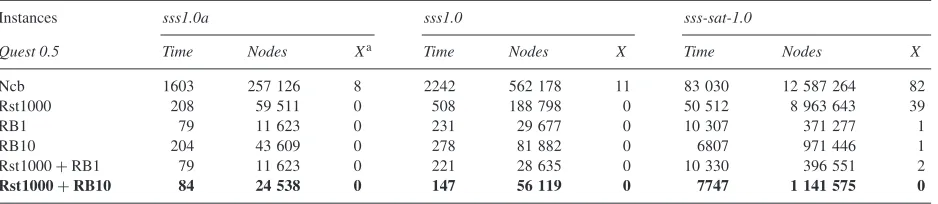
The results for Quest0.5 on the SSS instances are shown inTable 1. In this table,Timedenotes the CPU time,Nodes
the number of decision nodes, andXthe average number of aborted problem instances. As can be observed, the results for Quest0.5 reveal interesting trends:
Table 1
Results for the SSS instances
Instances sss1.0a sss1.0 sss-sat-1.0
Quest 0.5 Time Nodes Xa Time Nodes X Time Nodes X
Ncb 1603 257 126 8 2242 562 178 11 83 030 12 587 264 82
Rst1000 208 59 511 0 508 188 798 0 50 512 8 963 643 39
RB1 79 11 623 0 231 29 677 0 10 307 371 277 1
RB10 204 43 609 0 278 81 882 0 6807 971 446 1
Rst1000+RB1 79 11 623 0 221 28 635 0 10 330 396 551 2
Rst1000+RB10 84 24 538 0 147 56 119 0 7747 1 141 575 0
aCorresponds to the number of aborted instances.
• The best results are always obtained when random backtracking is used, independently of being or not being used together with restarts.
• Rst1000+RB10is the only configuration able to solve all the instances in the allowed CPU time forallthe runs.
The experimental results reveal additional interesting trends. When compared with the results where only non-chronological backtracking is applied, the remaining configurations (which apply search restarts and/or randomized backtracking) yield dramatic improvements. (This is confirmed by evaluating either the CPU Time, the number of nodes or the number of aborted instances.) Furthermore, even though the utilization of restarts reduces the amount of search, it is also clear that more significant reductions can be achieved with randomized backtracking. In addition, the integrated utilization of search restarts and randomized backtracking allows obtaining the best results, and therefore clearly illustrate the practical effectiveness of the proposed techniques.
7. Related work
The introduction of relaxations in the backtrack step is related to dynamic backtracking[7]. Dynamic backtracking establishes a method by which backtrack points can be moved deeper in the search tree. This allows avoiding the unneeded erasing of the amount of search that has been done thus far. The objective is to find a way to directly “erase” the value assigned to a variable as opposed to backtracking to it, moving the backjump variable to the end of the partial solution in order to replace its value without modifying the values of the variables that currently follow it. More recently, Ginsberg and McAllester combined local search and dynamic backtracking in an algorithm which enables arbitrary search movement[8], starting withany complete assignmentand evolving by flipping values of variables obtained from the conflicts.
In weak-commitment search[19], the algorithm constructs a consistent partial solution, but commits to the partial solutionweakly. In weak-commitment search, whenever a conflict is reached, thewholepartial solution is abandoned, in explicit contrast to standard backtracking algorithms where the most recently added variable is removed from the partial solution.
Moreover, search restarts have been proposed and shown effective for hard instances of SAT[10]. The search is repeatedly restarted whenever a cutoff value is reached. The algorithm is not complete, since the restart cutoff point is kept constant. In[2], search restarts were jointly used with learning for solving hard real-world instances of SAT. This latter algorithm is complete, since the backtrack cutoff value increases after each restart. One additional example of backtracking relaxation is described in[16], which is based on attempting to construct a complete solution, that restarts each time a conflict is identified.
8. Conclusions
This paper proposes and analyzes the application of randomization in the different components of backtrack search SAT algorithms. A new, stochastic but complete, backtrack search algorithm for SAT is proposed.
In conclusion, the main contributions of this paper can be summarized as follows:
(1) A new backtrack search SAT algorithm is proposed, that randomizes the variable selection and the backtrack steps. (2) Randomized backtracking is naturally captured by unrestricted backtracking, a generic framework for combining different strategies for backtrack search [11]. As a result, it is possible to obtain an algorithm which applies randomized backtracking and other strategies, namely search restarts and non-chronological backtracking.
(3) The proposed SAT algorithm is shown to be complete, and different approaches for ensuring completeness are described.
(4) Experimental results clearly indicate that significant savings in the search effort can be obtained for different organizations of the proposed algorithm.
It is generally accepted that restarts are useful when the run time distribution exhibits a high variance. A question that might be interesting to address in future research is: how does adding random backtracking affect the variance (of the run time)? Understanding this relationship may allow one to identify the optimal mix of restarts and random backtracking.
Future research work will also consider other variations of this new algorithm. We can envision using the unrestricted backtracking framework for implementing backtracking strategies, allowing the implementation of different hybrids, all guaranteed to be complete and so capable of proving unsatisfiability. In this generic framework, the actual backtrack point can be defined using either randomization, constant-depth backtracking or search restarts, among other possible approaches.
Acknowledgments
This work is partially supported by Fundação para a Ciência e Tecnologia under research projects POSI/EEI/11249/ 1998 and POSI/34504/CHS/2000.
References
[1]F. Bacchus, Exploiting the computational tradeoff of more reasoning and less searching, in: Fifth International Symposium on Theory and Applications of Satisfiability Testing, 2002, pp. 7–16.
[2]L. Baptista, J.P. Marques-Silva, Using randomization and learning to solve hard real-world instances of satisfiability, in: R. Dechter (Ed.), International Conference on Principles and Practice of Constraint Programming, Lecture Notes in Computer Science, vol. 1894, Springer, Berlin, 2000, pp. 489–494.
[3]R. Bayardo Jr., R. Schrag, Using CSP look-back techniques to solve real-world SAT instances, in: Proceedings of the National Conference on Artificial Intelligence, 1997, pp. 203–208.
[4]M. Davis, G. Logemann, D. Loveland, A machine program for theorem-proving, Commun. Assoc. Comput. Mach. 5 (1962) 394–397.
[5]M. Davis, H. Putnam, A computing procedure for quantification theory, J. Assoc. Comput. Mach. 7 (1960) 201–215.
[6]J.W. Freeman, Improvements to propositional satisfiability search algorithms, Ph.D. Thesis, University of Pennsylvania, Philadelphia, PA, May 1995.
[7]M. Ginsberg, Dynamic backtracking, J. Artif. Intell. Res. 1 (1993) 25–46.
[8]M. Ginsberg, D. McAllester, GSAT and dynamic backtracking, in: Proceedings of the International Conference on Principles of Knowledge and Reasoning, 1994, pp. 226–237.
[9]E. Goldberg,Y. Novikov, BerkMin: a fast and robust sat-solver, in: Proceedings of the Design and Test in Europe Conference, 2002, pp. 142–149.
[10]C.P. Gomes, B. Selman, H. Kautz, Boosting combinatorial search through randomization, in: Proceedings of the National Conference on Artificial Intelligence, 1998, pp. 431–437.
[11]I. Lynce, J. Marques-Silva, Complete unrestricted backtracking algorithms for satisfiability, in: Fifth International Symposium on the Theory and Applications of Satisfiability Testing, 2002, pp. 214–221.
[12]D. McAllester, B. Selman, H. Kautz, Evidence of invariants in local search, in: Proceedings of the National Conference on Artificial Intelligence, 1997, pp. 321–326.
[13]J.P. Marques-Silva, K.A. Sakallah, GRASP—A search algorithm for propositional satisfiability, IEEE Trans. Comput. 48 (5) (1999) 506–521.
[15]S. Prestwich, A hybrid search architecture applied to hard random 3-SAT and low-autocorrelation binary sequences, in: Proceedings of the International Conference on Principles and Practice of Constraint Programming, 2000, pp. 337–352.
[16]E.T. Richards, B. Richards, Non-systematic search and no-good learning, J. Automat. Reason. 24 (4) (2000) 483–533.
[17]B. Selman, H. Kautz, Domain-independent extensions to GSAT: Solving large structured satisfiability problems, in: Proceedings of the International Joint Conference on Artificial Intelligence, 1993, pp. 290–295.
[18]M.N. Velev, R.E. Bryant, Superscalar processor verification using efficient reductions from the logic of equality with uninterpreted functions to propositional logic, in: Proceedings of Correct Hardware Design and Verification Methods, Lecture Notes in Computer Science, vol. 1703, 1999, pp. 37–53.
[19]M. Yokoo, Weak-commitment search for solving satisfaction problems, in: Proceedings of the National Conference on Artificial Intelligence, 1994, pp. 313–318.
[20]R. Zabih, D.A. McAllester, A rearrangement search strategy for determining propositional satisfiability, in: Proceedings of the National Conference on Artificial Intelligence, 1988, pp. 155–160.