JHEP06(2016)081
Published for SISSA by SpringerReceived:May 25, 2016 Accepted: June 6, 2016
Published: June 14, 2016
Measurement of the relative width difference of the
B
0-
B
¯
0system with the ATLAS detector
The ATLAS collaboration
E-mail: [email protected]
Abstract:This paper presents the measurement of the relative width difference ∆Γd/Γd of theB0- ¯B0 system using the data collected by the ATLAS experiment at the LHC inpp
collisions at√s= 7 TeV and√s= 8 TeV and corresponding to an integrated luminosity of 25.2 fb−1. The value of ∆Γd/Γd is obtained by comparing the decay-time distributions of
B0 →J/ψKSandB0→J/ψK∗0(892) decays. The result is ∆Γd/Γd= (−0.1±1.1 (stat.)± 0.9 (syst.))×10−2. Currently, this is the most precise single measurement of ∆Γd/Γd. It agrees with the Standard Model prediction and the measurements by other experiments.
Keywords: B physics, Hadron-Hadron scattering (experiments)
JHEP06(2016)081
Contents
1 Introduction 1
2 Measurement method 2
3 The ATLAS detector 5
4 Data sample and event selection 6
5 Proper decay length of the B0 meson 8
6 Production asymmetry of the B0 meson 11
7 Ratio of efficiencies 13
8 Fit of ∆Γd 15
9 Systematic uncertainties 16
10 Results 19
11 Conclusions 19
The ATLAS collaboration 22
1 Introduction
The width difference ∆Γq, where q = d, s, is one of the parameters describing the time evolution of the Bq0- ¯Bq0 system. It is defined as ∆Γq≡ΓLq −ΓHq, where ΓLq and ΓHq are the decay widths of the light and heavy Bq states, respectively. The relative value of ∆Γd/Γd is predicted in the Standard Model (SM) [1]:
∆Γd/Γd (SM) = (0.42±0.08)×10−2.
Here Γd is the total width of the B0 meson defined as Γd= 12(ΓLd+ ΓHd).
Measurements of ∆Γd have been performed by the BaBar [2], Belle [3], and LHCb [4] collaborations. The current world average value [5] is:
∆Γd/Γd (World average) = (0.1±1.0)×10−2.
JHEP06(2016)081
the value of ∆Γd. It has been shown [6] that a relatively large variation of ∆Γd due to apossible new physics contribution would not contradict other existing SM tests. Therefore, an experimental measurement of ∆Γd with improved precision and its comparison to the SM prediction can provide an independent test of the underlying theory [7], complementary to other searches for new physics.
This paper presents the measurement of ∆Γdby the ATLAS experiment using Run 1 data collected inpp collisions at√s= 7 TeV in 2011 and at√s= 8 TeV in 2012. The total integrated luminosity used in this analysis is 4.9 fb−1 collected in 2011 and 20.3 fb−1 col-lected in 2012. The value of ∆Γd/Γdis obtained by comparing the decay time distributions of B0 →J/ψKS and B0 →J/ψK∗0(892) decays.
2 Measurement method
The time evolution of the neutral Bq0- ¯Bq0 system is described by the Schr¨odinger equation with HamiltonianMq:
id dt
Bq0(t) ¯
Bq0(t)
!
= Mq
Bq0(t) ¯
Bq0(t)
!
,
Mq =
mq m12q
(m12q )∗ mq
!
− i 2
Γq Γ12q
(Γ12q )∗ Γq
!
. (2.1)
The non-diagonal elements of Mq result from the transition B0q ↔ B¯q0 mediated by box diagrams and depend on the parameters of the CKM quark mixing matrix. Due to these non-diagonal elements, theBq0 meson propagates as a mixture of two physical mass eigen-states BqL and BqH:
|BqLi=p|Bq0i+q|B¯q0i, |BqHi=p|Bq0i −q|B¯q0i. (2.2)
Here p and q are complex numbers satisfying |q|2 +|p|2 = 1. BL
q and BqH have distinct massesmLq,mHq and widths ΓLq, ΓHq. Assuming that Γ12q m12q , the following relations hold:
∆mq ≡mHq −mLq = 2|m12q |, (2.3)
∆Γq ≡ΓLq −ΓHq = 2|Γ12q |cos(φ12q ), (2.4)
mq ≡
1 2(m
L
q +mHq), (2.5)
Γq ≡ 1 2(Γ
L
q + ΓHq), (2.6)
φ12q ≡arg −m
12
q Γ12
q
!
. (2.7)
JHEP06(2016)081
The decay rates of the BLq and BqH mesons to a given final state f may be different.Therefore, the time dependence of the decay rate Bq0 → f is sensitive to f. The time-dependent decay rate Γ(Bq0(t)→f) is [8]:
Γ(Bq0(t)→f)∝e−Γqt
cosh∆Γqt 2 +A
dir
CPcos(∆mqt) +A∆Γsinh
∆Γqt 2 +A
mix
CP sin(∆mqt)
.
(2.8) Here t is the proper decay time of the B0
q meson. The parameters AdirCP, A∆Γ and AmixCP
depend on the final state f. The abbreviations “dir” and “mix” stand for “direct” and “mixing”. By definition:
|AdirCP|2+|A∆Γ|2+|AmixCP|2 ≡1. (2.9)
Assuming that the CP-violating phase φ12
q is small, which is experimentally confirmed for both the B0 andBs0 mesons [9], the time-dependent decay rate Γ( ¯Bq0(t)→f) is:
Γ( ¯Bq0(t)→f)∝e−Γqt
cosh∆Γqt 2 −A
dir
CPcos(∆mqt) +A∆Γsinh
∆Γqt 2 −A
mix
CP sin(∆mqt)
.
(2.10) The parameters AdirCP, A∆Γ and AmixCP are theoretically well defined for flavour-specific
final states and CP eigenstates [8]. For a flavour-specific final state ffs, such that only the
decayBq0→ffs is allowed while ¯Af =hffs|B¯q0i= 0, the parameters are:
AdirCP= 1, A∆Γ= 0, AmixCP = 0. (2.11)
For a flavour-specific final state ¯ffs, such that Af = hf¯fs|B0qi = 0, i.e. only the decay ¯
Bq0 →f¯fs is allowed, the parameters are:
AdirCP=−1, A∆Γ= 0, AmixCP = 0. (2.12)
For the B0 decay to the CP eigenstate J/ψKS the parameters are:
AdirCP = 0, A∆Γ= cos(2β), AmixCP =−sin(2β). (2.13)
Here β is the angle of the unitarity triangle of the CKM matrix:
β = arg
−VcdV
∗
cb
VtdVtb∗
. (2.14)
If the initial flavour of the Bq0 meson is not tagged, the decay rates given by eqs. (2.8) and (2.10) are added together. In this case, the production asymmetryAPof theBq0meson inpp collisions should be taken into account. This asymmetry is defined as:
AP=
σ(B0q)−σ( ¯B0q)
σ(B0
q) +σ( ¯B0q)
, (2.15)
where σ denotes the production cross-section of the corresponding particle. Although b
JHEP06(2016)081
mesons (quark content ¯bu) over B− mesons (bu¯) [10,11]. Similarly, there is an excess ofB0(¯bd) mesons over ¯B0(bd¯) mesons due to the presence of a valence d quark. The larger number of B mesons than ¯B mesons is compensated for by the excess of b baryons over their corresponding anti-particles. In each case the excess is expected to be of the order of 1%. Only the LHCb experiment has measured AP in pp collisions so far [12]. Their
result is not directly applicable to the conditions of the ATLAS experiment because of the different ranges of pseudorapiditiesηand transverse momentapTof the detectedBmesons.
Therefore, a dedicated measurement ofAP is necessary. This measurement is presented in
section 6.
Taking into account the production asymmetryAPand using eqs. (2.8) and (2.10), the
untagged time-dependent decay rate Γ[t, f] to a final statef is:
Γ[t, f] ≡ σ(Bq0)Γ(B0q(t)→f) +σ( ¯Bq0)Γ( ¯Bq0(t)→f) (2.16)
∝ e−Γqt
cosh∆Γqt
2 +APA
dir
CPcos(∆mqt) +A∆Γsinh
∆Γqt
2 +APA
mix
CP sin(∆mqt)
.
The width difference ∆Γq can be extracted from the decay time distribution of the decay Bq0( ¯Bq0)→f using eqs. (2.11)–(2.16). Such a measurement employing a single final statef, although possible, would give poor precision for ∆Γq. This is because ∆Γq Γq and therefore the term e−Γqt dominates the decay time distribution. A more promising method [2] consists in obtaining ∆Γq from the ratio of the decay time distributions of two different decay modes of Bq, one of them being a CP eigenstate and the other a flavour-specific state. Using this ratio eliminates the dominant factor e−Γqtand leads to improved precision for ∆Γq.
The measurement of ∆Γdpresented in this paper employs the ratio of the CP eigenstate
J/ψKS and the flavour-specific states J/ψK∗0(892) and J/ψK¯∗0(892). The J/ψK∗0 and
J/ψK¯∗0 states are added together and are denoted by J/ψK∗0 throughout this paper, unless otherwise specified.
The decay rate Γ[t, J/ψKS] is obtained from eqs. (2.13)–(2.16):
Γ[t, J/ψKS]∝e−Γdt
cosh∆Γdt
2 + cos(2β) sinh ∆Γdt
2 −APsin(2β) sin(∆mdt)
. (2.17)
The expression for Γ[t, J/ψK∗0] is obtained from eqs. (2.11), (2.12), and (2.16) by summing over theJ/ψK∗0 and J/ψK¯∗0 final states:
Γ[t, J/ψK∗0]∝e−Γdtcosh∆Γdt
2 . (2.18)
If the detection efficiencies of K∗0 and ¯K∗0 are different, the term proportional to AP in
eq. (2.16) also contributes to eq. (2.18). This contribution is multiplied by the relative difference in the detection efficiencies of K∗0 and ¯K∗0 mesons. Both of these factors are of the order of 10−2, which is shown in section 6. Therefore, the contribution of the term proportional to AP is of the order of 10−4 and is neglected. Another contribution
JHEP06(2016)081
The world average values of Γd, ∆mdand β are [5]:1/Γd = (1.520±0.004)×10−12 s, (2.19)
∆md = (0.510±0.003)×1012 s−1, (2.20)
sin 2β = 0.682±0.019. (2.21)
Their uncertainties produce a negligible impact on the measured value of ∆Γd.
In this analysis, the proper decay length of the B0 meson, LBprop =ct, is used in place of the proper decay time t. The procedure to measureLBprop is described in section 5. The decay rates Γ[LB
prop, J/ψKS] and Γ[LBprop, J/ψK∗0] expressed as functions of LBprop are:
Γ[LBprop, J/ψKS] =
Z ∞
0
G(LBprop−ct, J/ψKS)Γ[t, J/ψKS]dt, (2.22)
Γ[LBprop, J/ψK∗0] =
Z ∞
0
G(LBprop−ct, J/ψK∗0)Γ[t, J/ψK∗0]dt. (2.23)
Here G(LB
prop −ct, J/ψKS) and G(LpropB −ct, J/ψK∗0) are the LBprop detector resolution
functions for theB0 →J/ψKS and B0 →J/ψK∗0 channels, respectively. These functions are discussed in section5.
The width difference ∆Γd is obtained from the fit to the ratio R(LBprop) of the
distri-butions of the number of reconstructed B0 →J/ψKS and B0 → J/ψK∗0 candidates as a function of LBprop. The expected form of R(LBprop) is obtained using eqs. (2.22) and (2.23). The details of the fitting procedure are given in section 8. Many experimental systematic uncertainties cancel in the ratio of the LBprop distributions, which improves the precision of the ∆Γdmeasurement. This is an important advantage of the method used in this analysis. A similar method is used by the LHCb Collaboration [4], except that the value of ∆Γd is obtained from the difference of the partial decay widths of the B0 →J/ψKS and B0 →
J/ψK∗0 decay modes and the production asymmetry AP(B0) is not taken into account.
The J/ψmeson is reconstructed using the decayJ/ψ→µ+µ−, which exploits a clean selection of J/ψ mesons and a highly efficient online trigger. The trigger efficiencies in the two B0 decay channels are equal, apart from minor effects related to differences in the decay kinematics, as only the properties of the J/ψ meson are used to trigger the events. The KS and K∗0 mesons are reconstructed using the KS → π+π− and K∗0 → K+π− ( ¯K∗0→K−π+) decay modes. The details of this reconstruction are given in section4.
3 The ATLAS detector
The ATLAS experiment [13] uses a general-purpose detector consisting of an inner tracker, a calorimeter and a muon spectrometer. A brief outline of the components that are most relevant for this analysis is given below.
JHEP06(2016)081
detector (Pixel), a silicon microstrip detector (SCT) and a transition radiation tracker(TRT). The ID is immersed in an axial 2 T magnetic field. The ID covers the pseudorapidity range |η| < 2.5. The pseudorapidity is defined in terms of the polar angle θ as η = −ln tan(θ/2). The ID is enclosed by a calorimeter system containing electromagnetic and hadronic sections. The calorimeter is surrounded by a large muon spectrometer (MS) in an air-core toroidal magnet system. The MS contains a combination of monitored drift tubes (MDTs) and cathode strip chambers (CSCs), designed to provide precise position measurements in the bending plane in the range |η| < 2.7. In addition, resistive plate chambers (RPCs) and thin gap chambers (TGCs) with a coarse position resolution but a fast response time are used primarily to trigger muons in the ranges |η|<1.05 and 1.05<
|η| <2.4, respectively. RPCs and TGCs are also used to provide position measurements in the non-bending plane and to improve the pattern recognition and track reconstruction. Momentum measurements in the MS are based on track segments formed in at least two of the three stations of the MDTs and the CSCs.
The ATLAS trigger system had three levels during Run 1: the hardware-based Level-1 trigger and the two-stage High Level Trigger (HLT), which comprises the Level-2 trigger and the Event Filter. At Level-1, the muon trigger searched for patterns of hits satisfying dif-ferent transverse momentum thresholds using the RPCs and TGCs. The region-of-interest around these Level-1 hit patterns then served as a seed for the HLT muon reconstruction, in which dedicated algorithms were used to incorporate information from both the MS and the ID, achieving a position and momentum resolution close to that provided by the offline muon reconstruction.
4 Data sample and event selection
This analysis uses the full sample of pp collision data collected by the ATLAS detector in 2011 at √s= 7 TeV and in 2012 at √s= 8 TeV. After applying strict data quality criteria the integrated luminosity is 4.9 fb−1 for the 2011 sample and 20.3 fb−1 for the 2012 sample. A set of dimuon trigger chains designed to selectJ/ψ→µ+µ− decays is used [14,15]. It includes numerous triggers with different muon pT thresholds and additional topological
and invariant mass requirements. Any dependence of the triggers on the proper decay time cancels to a good approximation in the ratioR(LBprop) introduced in section2because both theB0 →J/ψKS andB0→J/ψK∗0 decays are selected with the same set of triggers.
JHEP06(2016)081
The J/ψ candidates are reconstructed from pairs of oppositely charged muons withpT >2.5 GeV and|η|<2.4. Their ID tracks are fitted to a common vertex. Theχ2 of the
vertex fit must satisfy χ2(J/ψ)/NDF <16, where NDF stands for the number of degrees of freedom and is equal to one in this case. The mass of the J/ψ candidate is required to be between 2.86 and 3.34 GeV.
The KS candidates are reconstructed from pairs of oppositely charged particle tracks not used in the primary or pile-up vertex reconstruction. Each track is required to have at least one hit in either of the two silicon detectors. The transverse momenta of the tracks must be greater than 400 MeV and have |η| < 2.5. The pairs are fitted to a common vertex and kept if the χ2(KS)/NDF <15 (NDF = 1), and the projection of the distance between the J/ψand KS vertices along theKS momentum in the transverse plane is less than 44 cm. The ratio of this projection to its uncertainty must be greater than 2. Two additional requirements are related to the point of closest approach of the KS trajectory to the J/ψ vertex in the xy plane. The distance between this point and the position of theJ/ψ decay vertex in the xy plane is required to be less than 2 mm. The difference in the z coordinates of these two points must be less than 10 mm. These requirements help to reduce the combinatorial background. The mass of the KS candidate is required to be between 450 and 550 MeV.
The B0 → J/ψ(µ+µ−) KS(π+π−) candidates are constructed by refitting the four tracks of the J/ψ and KS candidates. The muon tracks are constrained to intersect in a secondary vertex and their invariant mass is constrained to the nominal J/ψ mass [5]. The two pions from the KS decay are constrained to originate from a tertiary vertex and their invariant mass is constrained to the nominal mass of theKS meson [5]. The combined momentum of the refittedKSdecay tracks is required to point to the dimuon vertex. The fit has NDF = 6. The quality of the cascade vertex fit is ensured by the requirementχ2(B0)−
χ2(J/ψ)<25. Finally, the transverse momentum of the B0 is required to exceed 10 GeV. For the selection of B0 → J/ψK∗0 candidates, a J/ψ candidate and two additional oppositely charged particles are combined together. One particle is assigned the mass of the charged kaon and the other the mass of the charged pion. The transverse momentum of the kaon is required to exceed 800 MeV and the transverse momentum of the pion must be greater than 400 MeV. Both tracks must have |η|<2.5. A vertex fit of the four selected tracks is performed where the invariant mass of the two muon tracks is constrained to the nominal J/ψ mass. All four tracks are constrained to originate from the same vertex. The fit has NDF = 6. The quality of the vertex fit is ensured by the requirement
χ2(B0)−χ2(J/ψ) <16. The invariant mass of the Kπ system is required to be between
850 and 950 MeV. This range is slightly shifted with respect to the world average value of theK∗0mass (895.81±0.18 MeV) [5] to provide a better suppression of reflections from the
JHEP06(2016)081
such events. In this analysis the final states J/ψK∗0 and J/ψK¯∗0 are not distinguishedand the definition of the B0 proper decay length discussed in section 5 is not sensitive to the assignment of masses. Therefore, the misidentification between pion and kaon has a limited impact on the result of this analysis.
None of the presented selection criteria for the J/ψKS and J/ψK∗0 final states are applied relative to the primary interaction point, thus avoiding a bias in the decay time distribution of the B0 candidates. Different groups of particles from the same event can
be included in the J/ψKS and J/ψK∗0 samples. In such cases, the additional candidates contribute to the combinatorial background and do not impact the signal yields.
For the measurement of ∆Γd, the ratio R(LBprop) built from the number of the
recon-structed B0 → J/ψKS and B0 → J/ψK∗0 decays is used. In this ratio the dependence of the reconstruction efficiencies of the two final states on LBprop should be taken into ac-count. A large part of this dependence, together with the associated uncertainties, cancels in R(LBprop) because the number of final particles in both decay modes is the same and the procedure to measure LBprop described in section 5 is similar in the two cases. Having similar selection criteria in the two channels also minimises the decay-time bias. Thus, the correction to the ratioR(LBprop) is expected to be small. Still, it cannot be eliminated completely because the hadronic tracks in theB0 →J/ψKS decay originate in a displaced
KS → π+π− vertex, whereas all four tracks in the B0 → J/ψK∗0 decay originate in a single vertex. This difference between the two channels is the main source of the exper-imental bias in the ratio R(LB
prop), which can be evaluated only with Monte Carlo (MC)
simulation. Using simulated events, the ratio of efficiencies to reconstruct B0 → J/ψKS and B0 →J/ψK∗0 decays,Reff(LBprop), is obtained as a function of LBprop.
The Monte Carlo samples are produced by simulating the production and decays of B0
mesons usingPYTHIA 6.1[16] for the 7 TeV MC samples and withPYTHIA 8.1[17] for the 8 TeV MC samples. In both cases, the underlying event, parton shower and hadronisation in the PYTHIA simulation are tuned with ATLAS data [18]. In all cases, the events are filtered at generator level by requiring two muons with |η|<2.5 and transverse momenta exceeding 2.5 GeV for the 7 TeV samples and 3.5 GeV for the 8 TeV samples. The events are passed through a full simulation of the detector using the ATLAS simulation [19] based on Geant4[20,21] and processed with the same reconstruction algorithms as used for the data. All samples are produced with Monte Carlo configurations adjusted to properly account for different conditions during the two years of data-taking.
5 Proper decay length of the B0 meson
The procedure adopted in this analysis to measure the proper decay length of theB0meson is explicitly designed to use the same input information for both the B0 → J/ψKS and
B0 → J/ψK∗0 channels. The aim of this approach is to reduce the experimental bias in the ratio R(LBprop). The origin of the B0 meson coincides with the primary vertex of the
JHEP06(2016)081
Bin number 1 2 3 4 5 6 7 8 9 10
Lower edge [mm] −0.3 0.0 0.3 0.6 0.9 1.2 1.5 1.8 2.1 3.0
[image:10.595.123.479.85.138.2]Upper edge [mm] 0.0 0.3 0.6 0.9 1.2 1.5 1.8 2.1 3.0 6.0
Table 1. Definition of theLB
prop bins.
from the vertex fit of the two muons. The residual impact of the additional particles from theB0 decays is evaluated using MC simulation and is found to be small.
The proper decay length of the B0 meson, LBprop, is determined in the xy plane of the detector because of the better precision compared to the measurement in three dimensions, strengthened by the small transverse size of the beam spot. A further advantage of mea-suring LBprop in the xy plane is the reduced dependence on pile-up interactions. The PV corresponding to theB0 production point is selected from all reconstructed PVs as follows. For each PV candidate, the point of closest approach of the B0 trajectory to the PV in thexy plane is determined and the differenceδz of thez coordinates of these two points is measured. The candidate with the minimum absolute value ofδz is selected as theB0 pro-duction vertex. As with any other procedure of PV selection, this method is not ideal and occasionally a wrong PV is selected due to the resolution for theB0 momentum direction. However, any selected PV should be close enough to the trueB0production vertex because numericallyδz ∼ O(1 mm) and both vertices are located on the beam line, which has a slope of about 10−3in both thexzandyzplanes. The transverse size of the beam spot is about 15
µm in both thexandydirections. Therefore, the distance between the true vertex and the selected vertex in the xy plane is expected to be much less than the precision of the decay length measurement, which is about 100 µm. Thus, the measurement of LBprop performed in thexy plane is not affected by a wrong selection of the PV in a small fraction of events. For each reconstructed B0 → J/ψKS orB0 →J/ψK∗0 candidate, LBprop is measured
using the projection of theB0decay length along theB0momentum in the plane transverse to the beam axis:
LBprop = (x
J/ψ−xPV)pB
x + (yJ/ψ−yPV)pBy
(pBT)2 mB0. (5.1)
HerexJ/ψ, yJ/ψ are the coordinates of theJ/ψ vertex;xPV, yPV are the coordinates of the primary vertex;pBx, pBy are thexandy components of the momentum of theB0meson and
mB0 = 5279.61 MeV is its mass [5]. The resolution of LBprop is obtained from simulation and is parameterised by a double Gaussian function. It is found to be similar for the two decay modes due to the applied procedure for theLBprop measurement. The uncertainty in this resolution is propagated into the systematic uncertainty of the ∆Γd measurement as discussed in section 9. To obtain the proper decay length distribution, the range of LBprop
between −0.3 and 6 mm is divided into ten bins defined in table 1. The selected bin size is much larger than the expected LBprop resolution, which is about 34 µm. In each bin of
JHEP06(2016)081
In this fit, the mass distributions are modelled by a sum of functions describing thesignal and background components. For the B0 → J/ψK∗0 channel, the signal function
fsJ/ψK∗0 is defined as the sum of two Gaussian functions. The Gaussian functions are constrained to have the same mean. The background function fbJ/ψK∗0 is defined using an exponential function with a second-order polynomial as the exponent. The fit is first applied to the total sample to determine the mean and standard deviations of the two Gaussian functions and their relative fractions. For the fit in eachLBprop bin, all parameters
describing the signal, except the normalisation offsJ/ψK∗0, are fixed to the values obtained in the fit of the total sample. It was verified in this analysis that fixing the parameters of the signal does not produce any bias in the result. The parameters offJ/ψK
∗0
b remain free. The signal function for the B0 → J/ψKS channel fsJ/ψKS is defined as the sum of two Gaussian functions. The background is modelled by the sum of two functions:
fJ/ψKS
b =fbc+f Bs
b . The combinatorial background function fbc is defined using an expo-nential function with a second-order polynomial as the exponent. The second function,
fBs
b , accounts for the contribution from Bs0→J/ψKS decays and is defined as the sum of two Gaussian functions. The B0
s →J/ψKS contribution is visible in the mass distribution as a shoulder in the signal peak. Its fraction relative to the B0 →J/ψKS signal is∼1%. The signal Gaussian functions are constrained to have the same mean. The relative frac-tions and standard deviafrac-tions of the Bs0 background Gaussian functions are parameterised to be the same as those of the signal Gaussian functions. The B0s background Gaussian functions are also constrained to have the same mean. The mean of the Bs0 background Gaussian functions is shifted relative to the mean of the signal Gaussian functions by the difference between the nominal masses of the Bs0 and B0 mesons (87.34 MeV) [5]. The fit is first applied to the total sample to determine the mean and standard deviations of the signal Gaussian functions and their relative fractions. For the fit in each LBprop bin,
all parameters describing the signal, except the normalisation of fJ/ψKS
s , are fixed to the values obtained in the fit of the total sample. It was verified in this analysis that fixing the parameters of the signal does not produce any bias in the result. The parameters of fBs b are also fixed, except for the normalisation. All parameters of fbc remain free.
The separation of the B0 → J/ψKS and Bs0 → J/ψKS contributions is important for the ∆Γd measurement because the mean lifetimes of the B0 and Bs0 mesons decaying to this CP eigenstate are different. On the contrary, the separation of B0 → J/ψK∗0
and Bs0→J/ψK∗0 decays is not necessary because the lifetimes of the B0 andB0s mesons decaying to this final state are equal to within 1% [5,9]. Thus, the small (∼1%) contribution of the Bs0 →J/ψK∗0 decay does not have an impact on the ∆Γd measurement.
JHEP06(2016)081
[image:12.595.83.515.97.263.2](a) (b)
Figure 1. The invariant mass distributions for (a)B0→J/ψKS candidates and (b)B0→J/ψK∗0
candidates for the 2012 data sample for 0.0 < LB
prop <0.3 mm. The full line shows the result of
the fit to the function described in the text. The dashed line shows the combinatorial background contribution. The filled area in figure (a) shows the peaking background contribution from the
Bs0→J/ψKS decay. The lower frame of each figure shows the difference between each data point
and the fit at that point divided by the statistical uncertainty of the data point.
The total number of signal B0 →J/ψKS decays obtained from the fit is 28 170 ±250 in the 2011 data set and 110 830 ± 520 in the 2012 data set. For B0 → J/ψK∗0 decays the corresponding numbers are 129 200 ± 900 in the 2011 data set and 555 800 ± 1 900 in the 2012 data set. Figure1shows the fitted mass distribution ofB0 →J/ψKS candidates and B0 →J/ψK∗0 candidates for 0.0< LBprop<0.3 mm.
The ratio of the numbers ofB0 candidates in the two channels computed in each LB
prop
binigives the experimental ratioRi,uncor defined as:
Ri,uncor =
Ni(J/ψKS)
Ni(J/ψK∗0)
. (5.2)
Here Ni(J/ψKS) andNi(J/ψK∗0) are the numbers of events in a given bin i. This ratio has to be corrected by the ratio of the reconstruction efficiencies in the two channels as discussed in section 7.
6 Production asymmetry of the B0 meson
The production asymmetryAP of theB0 meson can be obtained from the time-dependent
charge asymmetry of the flavour-specific B0 → J/ψK∗0 decay. If the initial flavour of the B0 meson is not determined, it follows from eqs. (2.11), (2.12), and (2.16) that the time-dependent rate of the decayB0→J/ψK∗0 is equal to:
Γ[t, J/ψK∗0]∝e−Γdt
cosh∆Γdt
2 +APcos(∆mdt)
JHEP06(2016)081
while the time-dependent rate of the decay ¯B0 →J/ψK¯∗0 is equal to:Γ[t, J/ψK¯∗0]∝e−Γdt
cosh∆Γdt
2 −APcos(∆mdt)
, (6.2)
CP violation in mixing is predicted to be small in the SM and is omitted from these expressions.
The terms proportional to AP in eqs. (6.1) and (6.2) reflect the oscillating component
of the B0 → J/ψK∗0 decay. The corresponding charge asymmetry due to B0 oscillations in biniof LBprop,Ai,osc, is defined as:
Ai,osc≡
RLmaxi
Lmin i
R∞
0 G(LBprop−ct, J/ψK∗0)(Γ[t, J/ψK∗0]−Γ[t, J/ψK¯∗0])dt
dLBprop
RLmaxi
Lmin i
R∞
0 G(LBprop−ct, J/ψK∗0)(Γ[t, J/ψK∗0] + Γ[t, J/ψK¯∗0])dt
dLB
prop . (6.3)
Here G(LBprop −ct, J/ψK∗0) is the detector resolution of LBprop for the B0 → J/ψK∗0
channel. The values of the lower and upper edges of bin i, Lmini and Lmaxi , are given in table 1. Using eqs. (6.1) and (6.2), Ai,osc can be presented as:
Ai,osc=AP
RLmaxi
Lmin i
R∞
0 G(L
B
prop−ct, J/ψK∗0)e−Γdtcos(∆mdt)dt
dLBprop
RLmaxi
Lmin i
R∞
0 G(LBprop−ct, J/ψK∗0)e−Γdtcosh∆Γ2dtdt
dLB
prop
. (6.4)
In addition to B0 oscillations, the asymmetry in the number of J/ψK∗0 and J/ψK¯∗0
events is also caused by a detector-related asymmetry Adetdue to differences in the
recon-struction of positive and negative particles. The main source ofAdetis the difference in the
interaction cross-section of charged kaons with the detector material, which for momenta below 10 GeV is significantly larger for negative kaons [5]. Therefore, the observed number of K∗0 →K+π− decays is larger than that of ¯K∗0 →K−π+, resulting in a positive value of the detector asymmetryAdet. This effect is independent of theB0 decay time.
The values of Ai,osc and Adet are diluted by misidentification of the kaon and pion in
the B0 → J/ψK∗0 decay. The observed number of J/ψK¯∗0 events, N(J/ψK¯∗0), includes genuine ¯B0 → J/ψK¯∗0 and some B0 → J/ψK∗0 decays. The latter decay contributes because of a wrong assignment of the kaon and pion masses to the two reconstructed charged particles, so that the decay K∗0 → K+π− is identified as a ¯K∗0 → K−π+. The mistag fractionW quantifies this wrong contribution to theJ/ψK¯∗0 sample. It is defined as the fraction of true B0→J/ψK∗0 decays in N(J/ψK¯∗0). The mistag fraction does not
depend on the B0 decay time and is determined in simulation. The obtained value is:
W = 0.12±0.02. (6.5)
JHEP06(2016)081
decays cancels to large extent. Therefore, the same value of W applies to candidatesclassified asJ/ψK∗0.
Using the above information, the expected charge asymmetry in bin iofLBprop,Ai,exp,
can be expressed as:
Ai,exp = (Adet+Ai,osc) (1−2W). (6.6)
Here the factor 1−2W takes into account the contribution of wrongly identifiedB0 decays, which is the same for bothAdetandAi,osc. The second-order terms proportional toAdetAP
are of the order of 10−4 and are neglected in this expression. The observed charge asymmetry, Ai,obs, is defined as:
Ai,obs ≡
Ni(J/ψK∗0)−Ni(J/ψK¯∗0)
Ni(J/ψK∗0) +Ni(J/ψK¯∗0)
. (6.7)
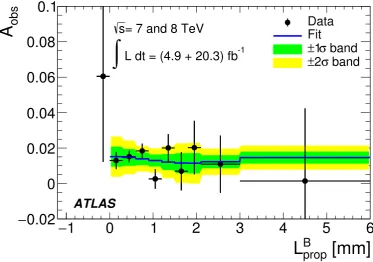
Figure2shows the asymmetryAobsas a function ofLBpropfor the 2011 and 2012 samples
combined together. The result of the fit to eq. (6.6) is superimposed. The asymmetryAP
is obtained from a χ2 minimisation:
χ2[Adet, AP] = 10
X
i=2
(Ai,obs−Ai,exp)2 σ2
i
. (6.8)
The free parameters in the fit areAdetandAP. The valuesσiare the statistical uncertainties of Ai,obs. The fit has a χ2 of 6.50 per seven degrees of freedom. The first bin of LBprop
corresponds to a negative decay length due to the detector resolution. It is not included in this sum as it is affected more than the other data points by systematic uncertainties. Ignoring it has a negligible impact on the uncertainty of this measurement. The fit yields the following values for the asymmetries:
Adet = (+1.33±0.24±0.30)×10−2. (6.9)
AP = (+0.25±0.48±0.05)×10−2. (6.10)
In these values the first uncertainty of AP and Adet is statistical and the second is due to
the uncertainties in the mistag fraction and in the deviations of |q/p| from unity [5] (see eq. (2.2)). The systematic uncertainty ofAdetalso contains a contribution from the possible
difference between the mistag fractions of the B0 → J/ψK∗0 and ¯B0 → J/ψK¯∗0 decays. The value ofAdetis consistent with results from simulation of interactions in the detector.
This measurement of theB0production asymmetryAPforpT(B0)>10 GeV and|η(B0)|<
2.5 is consistent with zero. It is also consistent with the LHCb resultAP= (−0.36±0.76±
0.28)×10−2 [12] obtained for 4< pT(B0)<30 GeV and 2.5< η(B0)<4.0. The measured
value of AP given in eq. (6.10) is used for the extraction of the width difference ∆Γd.
7 Ratio of efficiencies
The ratioRi,uncor given by eq. (5.2) is corrected by the ratio of efficiencies Ri,eff computed
in each LBprop bini. It is defined as
Ri,eff ≡
εi(B0 →J/ψKS)
εi(B0 →J/ψK∗0)
JHEP06(2016)081
[mm]
B prop
L
1
−
0
1
2
3
4
5
6
obs
A
0.02
−
0
0.02
0.04
0.06
0.08
0.1
= 7 and 8 TeV
s
-1
L dt = (4.9 + 20.3) fb
∫
ATLAS
Data
Fit
band
σ
1
±
band
σ
2
[image:15.595.105.479.91.353.2]±
Figure 2. Observed charge asymmetry Aobs in B0 →J/ψK∗0 decays measured as a function of
the proper decay length of the B0 meson (LBprop). The line shows the asymmetry Aexp obtained
from fitting eq. (6.6) to the data. The first point corresponding to negative proper decay length is not used in the fit. The error bands correspond to the combination of uncertainties obtained by the fit for the production asymmetryAP and the detector asymmetryAdet.
Here εi(B0 → J/ψKS) and εi(B0 → J/ψK∗0) are the efficiencies to reconstruct B0 →
J/ψKS and B0 → J/ψK∗0 decays, respectively, in LBprop bin i. This ratio is determined
using MC simulation. To obtain reliable values for this efficiency ratio, the kinematic properties of the simulated B0 meson and the accompanying particles must be consistent with those in data. The comparison of several such properties, which can produce a sizeable impact on Ri,eff, reveal some differences between data and simulation. Those differences
are corrected for by an appropriate re-weighting of the simulated events.
The properties taken into account include the transverse momentum and pseudorapid-ity of theB0 meson and the average number of pile-up events. The ratio of the distributions of each specified variable in data and in simulation defines the corresponding weight. The resulting weight applied to the MC events is defined as the product of these three weights.
The normalisation of Ri,eff after the re-weighting procedure is arbitrary since only the
deviation of Ri,eff from their average value can impact the measurement of ∆Γd. This deviation is found to not exceed 5% for proper decay lengths up to 2 mm. Such a stability of Ri,eff is a consequence of the chosen measurement procedure. This stability helps to
JHEP06(2016)081
8 Fit of ∆Γd
The obtained values ofRi,effare used to correct the observed ratioRi,uncorgiven by eq. (5.2).
The resulting ratioRi,cor is defined as:
Ri,cor=
Ri,uncor Ri,eff
. (8.1)
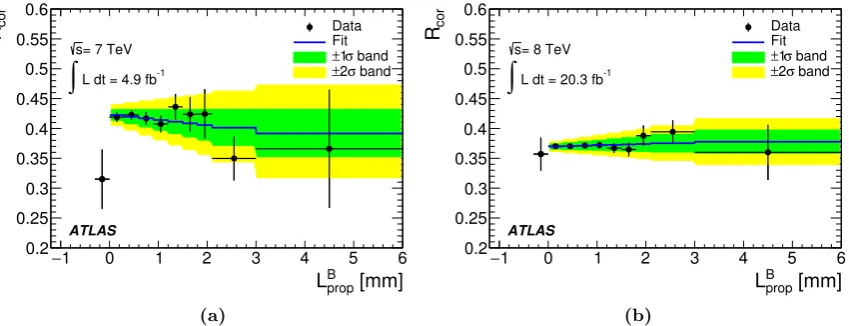
This ratio is shown in figure 3. It is used to obtain ∆Γd/Γd by the following procedure. For eachLBprop binidefined in table1, the expected numbers of events in the J/ψKS and
J/ψK∗0 channels are computed as:
Ni[∆Γd/Γd, J/ψKS] = C1
Z Lmaxi
Lmini
Γ[LBprop, J/ψKS]dLBprop, (8.2)
Ni[∆Γd/Γd, J/ψK∗0] = C2
Z Lmaxi
Lmin i
Γ[LBprop, J/ψK∗0]dLBprop. (8.3)
The integration limits Lmini and Lmaxi for each bin i are given by the lower and upper bin edges in table 1. C1 and C2 are arbitrary normalisation coefficients. The expressions
for Γ[LBprop, J/ψKS] and Γ[LBprop, J/ψK∗0] are given by eqs. (2.22) and (2.23), respectively.
The sensitivity to ∆Γdcomes from Γ[LBprop, J/ψKS] (see eq. (2.17)) while Γ[LBprop, J/ψK∗0]
provides the normalisation, which helps to reduce the systematic uncertainties. The expected ratio of the decay rates in the two channels in each LB
prop bin is:
Ri,exp[∆Γd/Γd] =
Ni[∆Γd/Γd, J/ψKS]
Ni[∆Γd/Γd, J/ψK∗0]
. (8.4)
The relative width difference ∆Γd/Γd is obtained from a χ2 minimisation:
χ2[∆Γd/Γd] =
10
X
i=2
(Ri,cor−Ri,exp[∆Γd/Γd])2
σ2i . (8.5)
The valuesσi are the statistical uncertainties ofRi,cor. In the sum, the first bin ofLBprop is
not included as it corresponds to a negative decay length.
The free parameters in this minimisation are the overall normalisation and ∆Γd/Γd. All other parameters describing the B0 meson are fixed to their world average values. The fit
is performed separately for the 2011 and 2012 samples because the systematic uncertainties for the two data samples are different. The result of the fit is shown in figure 3. Theχ2 of the fit is 4.34 (NDF = 7) in the 2011 data set and 2.81 (NDF = 7) in the 2012 data set.
The fit yields
∆Γd/Γd = (−2.8±2.2 (stat.)±1.5 (MC stat.))×10−2 (2011), (8.6)
∆Γd/Γd = (+0.8±1.3 (stat.)±0.5 (MC stat.))×10−2 (2012). (8.7)
JHEP06(2016)081
[mm] B prop L 1− 0 1 2 3 4 5 6
cor R 0.2 0.25 0.3 0.35 0.4 0.45 0.5 0.55 0.6 Data Fit band σ 1 ± band σ 2 ± = 7 TeV
s
-1 L dt = 4.9 fb
∫
ATLAS (a) [mm] B prop L 1− 0 1 2 3 4 5 6
cor R 0.2 0.25 0.3 0.35 0.4 0.45 0.5 0.55 0.6 Data Fit band σ 1 ± band σ 2 ± ATLAS
= 8 TeV s
-1
L dt = 20.3 fb
∫
[image:17.595.88.513.97.260.2](b)
Figure 3. Efficiency-corrected ratio of the observed decay length distributions,Rcor(LBprop) for (a)
√
s = 7 TeV and (b) √s = 8 TeV data sets. The normalisation of the two data sets is arbitrary. The full line shows the fit ofRcor(LBprop) toRexp given by eq. (8.4). The error bands correspond to
uncertainties in ∆Γd/Γd determined by the fit.
9 Systematic uncertainties
The relative B0 width difference is extracted from the ratio of the LBprop distributions in the two B0 decay modes, which are obtained using a similar procedure, the same type of information and in the same production environment. Therefore, the impact of many systematic uncertainties, such as the trigger selection, decay-time resolution or B0 produc-tion properties, is negligible. However, some differences between the B0 → J/ψKS and
B0 →J/ψK∗0 channels cannot be eliminated and the inaccuracy of their simulation results in systematic uncertainties, which are estimated in this section.
The mean proper decay length of the KS meson is 26.8 mm. Since the pT of the KS meson can be high, some Ks mesons decay outside the inner detector and are lost. The probability of losing a KS meson is higher for large B0 decay time due to the reduction of the fiducial volume of the KS decay. Thus, the displaced vertex of the KS decay and the absence of such a vertex in the K∗0 → K+π− decay results in a decay-time dependence of Reff defined in eq. (7.1). Applying the correction given by eq. (8.1) to Runcor takes into
account this dependence.
The test of the simulatedKSreconstruction is performed by comparing the distribution of theKS decay length and theKS pseudorapidity in data and simulation. This dedicated study shows that there is a residual difference between data and MC simulation in the distributions of the laboratory decay length of reconstructedKSmesons projected along the
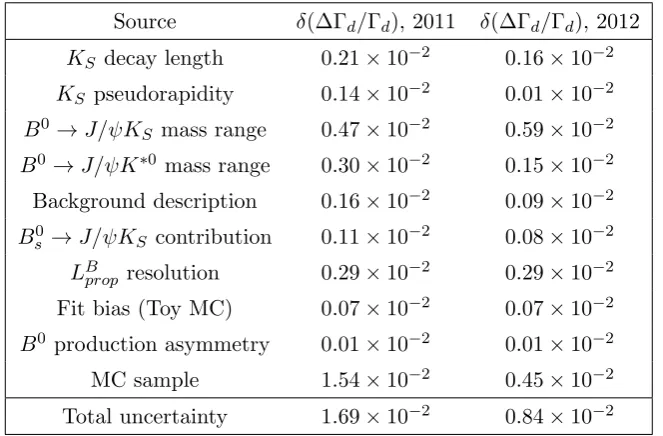
KS momentum in the transverse plane,Lxy(KS). It is caused by the remaining difference between the KS momentum distributions in data and MC simulation. After applying an additional weight to the Monte Carlo events to correct for this difference a change in the value of ∆Γd/Γd of δ(∆Γd/Γd) = −0.21×10⁻² is obtained for the 2011 data set and
JHEP06(2016)081
The same procedure is applied for the pseudorapidity distribution of the KS meson,η(KS). The systematic uncertainty due to modelling of the |η(KS)|dependence of the KS reconstruction is estimated by re-weighting the MC events to make the|η(KS)|distribution the same as in data. The observed changes are δ(∆Γd/Γd) = +0.14×10⁻² for the 2011 data set and δ(∆Γd/Γd) =−0.01×10⁻² for the 2012 data set.
The systematic uncertainty due to the choices made in the model used to fit the mass distributions can be estimated by considering different variations of the fit model. The range over which the B0 →J/ψKS and B0 →J/ψK∗0 mass fits are applied is varied and the measurement of ∆Γd/Γd is repeated for each variation. The systematic uncertainty is estimated by taking the difference between the values of ∆Γd/Γdobtained from the default fit and each of the varied fits. Variations δ(∆Γd/Γd) = −0.47×10⁻² and −0.30×10⁻² are obtained for the 2011 data set in the J/ψKS andJ/ψK∗0 channels, respectively. The changes for the 2012 data set are δ(∆Γd/Γd) = −0.59×10⁻² and −0.15×10⁻² in the
J/ψKS and J/ψK∗0 channels, respectively. These values are included as the systematic uncertainty from this source.
Additionally, the background function is changed from an exponential to a fourth-order polynomial and the systematic uncertainty due to the choice of background function is estimated from the difference between the value of ∆Γd/Γd from the default fit and the value from the fit using the polynomial background function. A change δ(∆Γd/Γd) = −0.16 ×10⁻² is obtained for the 2011 data set. The change for the 2012 data set is
δ(∆Γd/Γd) = +0.09×10⁻².
In the fit of the number of B0 → J/ψKS decays the contribution from the Bs0 →
J/ψKS is a free parameter of the fit. As a systematic uncertainty cross-check, the ratio of the yields of these two decays is fixed to be the same as that measured by the LHCb Collaboration [22]. The resulting change in the ∆Γd/Γdvalue isδ(∆Γd/Γd) =−0.11×10⁻² for the 2011 data set andδ(∆Γd/Γd) = +0.08×10⁻² for the 2012 data set and is included as an additional source of systematic uncertainty.
The systematic uncertainty due to the resolution of LBprop is also considered. The average decay length resolution is 35 µm for Bs0 →J/ψKS and 33µm for B0 →J/ψK∗0. In this analysis, separate resolution functions are used for the two channels. To test the sensitivity to the resolution, the measurement of ∆Γd/Γdis repeated by using the resolution of J/ψK∗0 for both channels. A change in the value of ∆Γ
d/Γd of δ(∆Γd/Γd) =−0.29× 10⁻² is obtained and is used as the systematic uncertainty from this source. It is found to be the same for the 2011 and 2012 data sets.
JHEP06(2016)081
Source δ(∆Γd/Γd), 2011 δ(∆Γd/Γd), 2012KS decay length 0.21×10⁻² 0.16×10⁻²
KS pseudorapidity 0.14×10⁻² 0.01×10⁻²
B0 →J/ψK
S mass range 0.47×10⁻² 0.59×10⁻²
B0 →J/ψK∗0 mass range 0.30×10⁻² 0.15×10⁻²
Background description 0.16×10⁻² 0.09×10⁻²
Bs0 →J/ψKS contribution 0.11×10⁻² 0.08×10⁻²
LBprop resolution 0.29×10⁻² 0.29×10⁻²
Fit bias (Toy MC) 0.07×10⁻² 0.07×10⁻²
B0 production asymmetry 0.01×10⁻² 0.01×10⁻²
MC sample 1.54×10⁻² 0.45×10⁻²
[image:19.595.133.465.83.301.2]Total uncertainty 1.69×10⁻² 0.84×10⁻²
Table 2. Sources of systematic uncertainty in the ∆Γd/Γd measurement and their values for the
2011 and 2012 data sets.
uncertainty due to the fitting procedure and it is taken to be the same for the 2011 and 2012 data sets.
The impact of the uncertainty of theB0 production asymmetry isδ(∆Γd/Γd) = 0.01× 10⁻² for both the 2011 and 2012 data sets.
The systematic uncertainty from the number of events in the MC samples corresponds to an uncertainty of δ(∆Γd/Γd) = 1.54×10⁻² for the 2011 data set and δ(∆Γd/Γd) = 0.45×10⁻² for the 2012 data set.
Table2gives a summary of the estimated systematic uncertainties. All of the quantified systematic uncertainties are symmetrized.
In addition to the estimate of the systematic uncertainty, several cross-checks are per-formed. Some of the selection cuts described in section 6 are modified and the corresponding changes in the ∆Γd/Γd value are assessed. In particular, the transverse momenta of the charged pions from the KS decay and the charged pion from the K∗0 decay are required to be greater than 500 MeV, rather than 400 MeV. Also, the transverse momentum of the charged kaon from theK∗0 is required to be greater than 1 GeV, rather than 800 MeV. Ad-ditionally, the transverse momentum of the B0 meson is required to be less than 60 GeV. In all cases, the change of the measured value of ∆Γd is consistent with fluctuations due to the reduced number of events.
JHEP06(2016)081
10 Results
Using the measurements of ∆Γd/Γdgiven in eqs. (8.6) and (8.7) and the study of systematic uncertainties presented in section 9, the following measurements are obtained:
∆Γd/Γd = (−2.8±2.2 (stat.)±1.7 (syst.))×10−2 (2011),
∆Γd/Γd = (+0.8±1.3 (stat.)±0.8 (syst.))×10−2 (2012).
In the combination of these measurements, the correlations of different sources of systematic uncertainty between the two years are taken into account. The systematic uncertainties due to the background description and the size of the MC samples are assumed to be uncorrelated. All other sources of systematic uncertainty are taken to be fully correlated. The combination is done using the χ2 method. The χ2 function includes the correlation terms of the different components of the uncertainty as specified above. The combined result for the data collected by the ATLAS experiment in Run 1 is:
∆Γd/Γd= (−0.1±1.1 (stat.)±0.9 (syst.))×10−2.
It is currently the most precise single measurement of this quantity. It agrees well with the SM prediction [1] and is consistent with other measurements of this quantity [2–4]. It also agrees with the indirect measurement by the D0 Collaboration [23].
11 Conclusions
The measurement of the relative width difference ∆Γd/Γdof theB0- ¯B0system is performed using the data collected by the ATLAS experiment at the LHC in pp collisions at √s = 7 TeV and √s = 8 TeV and corresponding to an integrated luminosity of 25.2 fb−1. The value of ∆Γd/Γd is obtained by comparing the decay time distributions of B0 → J/ψKS and B0 →J/ψK∗0(892) decays. The result is
∆Γd/Γd= (−0.1±1.1 (stat.)±0.9 (syst.))×10−2.
Currently, this is the most precise single measurement of ∆Γd/Γd. It agrees with the Standard Model prediction and the measurements by other experiments.
The production asymmetry of the B0 meson withpT(B0)>10 GeV and|η(B0)|<2.5
is found to be
AP(B0) = (+0.25±0.48±0.05)×10−2.
The value of AP(B0) is consistent with the measurement of the LHCb Collaboration
per-formed in the 2.5< η(B0)<4.0 and 4< pT(B0)<30 GeV range.
Acknowledgments
JHEP06(2016)081
We acknowledge the support of ANPCyT, Argentina; YerPhI, Armenia; ARC,Aus-tralia; BMWFW and FWF, Austria; ANAS, Azerbaijan; SSTC, Belarus; CNPq and FAPESP, Brazil; NSERC, NRC and CFI, Canada; CERN; CONICYT, Chile; CAS, MOST and NSFC, China; COLCIENCIAS, Colombia; MSMT CR, MPO CR and VSC CR, Czech Republic; DNRF and DNSRC, Denmark; IN2P3-CNRS, CEA-DSM/IRFU, France; GNSF, Georgia; BMBF, HGF, and MPG, Germany; GSRT, Greece; RGC, Hong Kong SAR, China; ISF, I-CORE and Benoziyo Center, Israel; INFN, Italy; MEXT and JSPS, Japan; CNRST, Morocco; FOM and NWO, Netherlands; RCN, Norway; MNiSW and NCN, Poland; FCT, Portugal; MNE/IFA, Romania; MES of Russia and NRC KI, Russian Fed-eration; JINR; MESTD, Serbia; MSSR, Slovakia; ARRS and MIZˇS, Slovenia; DST/NRF, South Africa; MINECO, Spain; SRC and Wallenberg Foundation, Sweden; SERI, SNSF and Cantons of Bern and Geneva, Switzerland; MOST, Taiwan; TAEK, Turkey; STFC, United Kingdom; DOE and NSF, United States of America. In addition, individual groups and members have received support from BCKDF, the Canada Council, CANARIE, CRC, Compute Canada, FQRNT, and the Ontario Innovation Trust, Canada; EPLANET, ERC, FP7, Horizon 2020 and Marie Sk lodowska-Curie Actions, European Union; Investissements d’Avenir Labex and Idex, ANR, R´egion Auvergne and Fondation Partager le Savoir, France; DFG and AvH Foundation, Germany; Herakleitos, Thales and Aristeia programmes co-financed by EU-ESF and the Greek NSRF; BSF, GIF and Minerva, Israel; BRF, Norway; Generalitat de Catalunya, Generalitat Valenciana, Spain; the Royal Society and Lever-hulme Trust, United Kingdom.
The crucial computing support from all WLCG partners is acknowledged gratefully, in particular from CERN and the ATLAS Tier-1 facilities at TRIUMF (Canada), NDGF (Denmark, Norway, Sweden), CC-IN2P3 (France), KIT/GridKA (Germany), INFN-CNAF (Italy), NL-T1 (Netherlands), PIC (Spain), ASGC (Taiwan), RAL (U.K.) and BNL (U.S.A.) and in the Tier-2 facilities worldwide.
Open Access. This article is distributed under the terms of the Creative Commons Attribution License (CC-BY 4.0), which permits any use, distribution and reproduction in any medium, provided the original author(s) and source are credited.
References
[1] A. Lenz and U. Nierste,Numerical updates of lifetimes and mixing parameters of B mesons,
inCKM unitarity triangle. Proceedings, 6th International Workshop, CKM2010, Warwick
U.K. September 6–10 2010 [arXiv:1102.4274] [INSPIRE].
[2] BaBarcollaboration, B. Aubert et al.,Limits on the decay rate difference of neutralB
mesons and on CP, T and CPT violation inB0B0 oscillations,Phys. Rev. D 70(2004)
012007[hep-ex/0403002] [INSPIRE].
[3] T. Higuchi et al.,Search for time-dependent CPT violation in hadronic and semileptonicB
decays,Phys. Rev.D 85(2012) 071105 [arXiv:1203.0930] [INSPIRE].
JHEP06(2016)081
[5] Particle Data Groupcollaboration, K.A. Olive et al.,Review of particle physics,Chin.
Phys.C 38 (2014) 090001[INSPIRE].
[6] C. Bobeth, U. Haisch, A. Lenz, B. Pecjak and G. Tetlalmatzi-Xolocotzi,On new physics in
∆Γd, JHEP 06(2014) 040[arXiv:1404.2531] [INSPIRE].
[7] T. Gershon, ∆Γd: a forgotten null test of the Standard Model,J. Phys.G 38 (2011) 015007
[arXiv:1007.5135] [INSPIRE].
[8] I. Dunietz, R. Fleischer and U. Nierste,In pursuit of new physics with Bs decays,Phys. Rev.
D 63(2001) 114015[hep-ph/0012219] [INSPIRE].
[9] Heavy Flavor Averaging Group (HFAG)collaboration, Y. Amhis et al.,Averages of
b-hadron, c-hadron andτ-lepton properties as of summer2014,arXiv:1412.7515[INSPIRE].
[10] E. Norrbin and R. Vogt,Bottom production asymmetries at the LHC, inProceedings of the
fifth workshop on electronics for LHC experiments, Snowmass CO U.S.A. September 20–24
1999 [hep-ph/0003056] [INSPIRE].
[11] E. Norrbin and T. Sj¨ostrand,Production and hadronization of heavy quarks,Eur. Phys. J.C 17(2000) 137[hep-ph/0005110] [INSPIRE].
[12] LHCb collaboration, Measurement of theB¯0-B0 andB¯s0-Bs0 production asymmetries inpp
collisions at √s= 7TeV, Phys. Lett.B 739(2014) 218[arXiv:1408.0275] [INSPIRE].
[13] ATLAScollaboration,The ATLAS experiment at the CERN Large Hadron Collider,2008
JINST 3S08003[INSPIRE].
[14] ATLAScollaboration,Performance of the ATLAS trigger system in2010,Eur. Phys. J.C 72(2012) 1849[arXiv:1110.1530] [INSPIRE].
[15] ATLAScollaboration,Performance of the ATLAS muon trigger in ppcollisions at
√
s= 8TeV,Eur. Phys. J.C 75(2015) 120[arXiv:1408.3179] [INSPIRE].
[16] T. Sj¨ostrand, S. Mrenna and P.Z. Skands,PYTHIA6.4 physics and manual,JHEP 05
(2006) 026[hep-ph/0603175] [INSPIRE].
[17] T. Sj¨ostrand, S. Mrenna and P.Z. Skands,A brief introduction to PYTHIA8.1,Comput.
Phys. Commun.178(2008) 852[arXiv:0710.3820] [INSPIRE].
[18] ATLAScollaboration,ATLAS tunes of PYTHIA6 and PYTHIA 8for MC11,
ATL-PHYS-PUB-2011-009, CERN, Geneva Switzerland (2011).
[19] ATLAScollaboration,The ATLAS simulation infrastructure,Eur. Phys. J.C 70(2010) 823
[arXiv:1005.4568] [INSPIRE].
[20] GEANT4collaboration, S. Agostinelli et al.,GEANT4: a simulation toolkit,Nucl. Instrum.
Meth.A 506 (2003) 250[INSPIRE].
[21] J. Allison et al.,GEANT4 developments and applications,IEEE Trans. Nucl. Sci.53(2006) 270[INSPIRE].
[22] LHCb collaboration, Measurement of the effectiveBs0→J/ψKS0 lifetime,Nucl. Phys. B 873
(2013) 275[arXiv:1304.4500] [INSPIRE].
[23] D0collaboration, V.M. Abazov et al., Study of CP-violating charge asymmetries of single
muons and like-sign dimuons in pp¯collisions, Phys. Rev.D 89(2014) 012002
JHEP06(2016)081
The ATLAS collaboration
M. Aaboud136d, G. Aad87, B. Abbott114, J. Abdallah65, O. Abdinov12, B. Abeloos118,
R. Aben108, O.S. AbouZeid138, N.L. Abraham150, H. Abramowicz154, H. Abreu153, R. Abreu117, Y. Abulaiti147a,147b, B.S. Acharya164a,164b,a, L. Adamczyk40a, D.L. Adams27, J. Adelman109, S. Adomeit101, T. Adye132, A.A. Affolder76, T. Agatonovic-Jovin14, J. Agricola56,
J.A. Aguilar-Saavedra127a,127f, S.P. Ahlen24, F. Ahmadov67,b, G. Aielli134a,134b,
H. Akerstedt147a,147b, T.P.A. ˚Akesson83, A.V. Akimov97, G.L. Alberghi22a,22b, J. Albert169, S. Albrand57, M.J. Alconada Verzini73, M. Aleksa32, I.N. Aleksandrov67, C. Alexa28b,
G. Alexander154, T. Alexopoulos10, M. Alhroob114, M. Aliev75a,75b, G. Alimonti93a, J. Alison33, S.P. Alkire37, B.M.M. Allbrooke150, B.W. Allen117, P.P. Allport19, A. Aloisio105a,105b,
A. Alonso38, F. Alonso73, C. Alpigiani139, M. Alstaty87, B. Alvarez Gonzalez32, D. ´Alvarez Piqueras167, M.G. Alviggi105a,105b, B.T. Amadio16, K. Amako68,
Y. Amaral Coutinho26a, C. Amelung25, D. Amidei91, S.P. Amor Dos Santos127a,127c, A. Amorim127a,127b, S. Amoroso32, G. Amundsen25, C. Anastopoulos140, L.S. Ancu51, N. Andari109, T. Andeen11, C.F. Anders60b, G. Anders32, J.K. Anders76, K.J. Anderson33, A. Andreazza93a,93b, V. Andrei60a, S. Angelidakis9, I. Angelozzi108, P. Anger46, A. Angerami37, F. Anghinolfi32, A.V. Anisenkov110,c, N. Anjos13, A. Annovi125a,125b, M. Antonelli49,
A. Antonov99, F. Anulli133a, M. Aoki68, L. Aperio Bella19, G. Arabidze92, Y. Arai68,
J.P. Araque127a, A.T.H. Arce47, F.A. Arduh73, J-F. Arguin96, S. Argyropoulos65, M. Arik20a, A.J. Armbruster144, L.J. Armitage78, O. Arnaez32, H. Arnold50, M. Arratia30, O. Arslan23, A. Artamonov98, G. Artoni121, S. Artz85, S. Asai156, N. Asbah44, A. Ashkenazi154,
B. ˚Asman147a,147b, L. Asquith150, K. Assamagan27, R. Astalos145a, M. Atkinson166, N.B. Atlay142, K. Augsten129, G. Avolio32, B. Axen16, M.K. Ayoub118, G. Azuelos96,d,
M.A. Baak32, A.E. Baas60a, M.J. Baca19, H. Bachacou137, K. Bachas75a,75b, M. Backes32, M. Backhaus32, P. Bagiacchi133a,133b, P. Bagnaia133a,133b, Y. Bai35a, J.T. Baines132, O.K. Baker176, E.M. Baldin110,c, P. Balek130, T. Balestri149, F. Balli137, W.K. Balunas123, E. Banas41, Sw. Banerjee173,e, A.A.E. Bannoura175, L. Barak32, E.L. Barberio90,
D. Barberis52a,52b, M. Barbero87, T. Barillari102, T. Barklow144, N. Barlow30, S.L. Barnes86, B.M. Barnett132, R.M. Barnett16, Z. Barnovska5, A. Baroncelli135a, G. Barone25, A.J. Barr121, L. Barranco Navarro167, F. Barreiro84, J. Barreiro Guimar˜aes da Costa35a, R. Bartoldus144, A.E. Barton74, P. Bartos145a, A. Basalaev124, A. Bassalat118, R.L. Bates55, S.J. Batista159, J.R. Batley30, M. Battaglia138, M. Bauce133a,133b, F. Bauer137, H.S. Bawa144,f,
J.B. Beacham112, M.D. Beattie74, T. Beau82, P.H. Beauchemin162, P. Bechtle23, H.P. Beck18,g,
K. Becker121, M. Becker85, M. Beckingham170, C. Becot111, A.J. Beddall20e, A. Beddall20b, V.A. Bednyakov67, M. Bedognetti108, C.P. Bee149, L.J. Beemster108, T.A. Beermann32,
M. Begel27, J.K. Behr44, C. Belanger-Champagne89, A.S. Bell80, G. Bella154, L. Bellagamba22a, A. Bellerive31, M. Bellomo88, K. Belotskiy99, O. Beltramello32, N.L. Belyaev99, O. Benary154, D. Benchekroun136a, M. Bender101, K. Bendtz147a,147b, N. Benekos10, Y. Benhammou154, E. Benhar Noccioli176, J. Benitez65, D.P. Benjamin47, J.R. Bensinger25, S. Bentvelsen108,
JHEP06(2016)081
D. Blackburn139, R.E. Blair6, J.-B. Blanchard137, J.E. Blanco79, T. Blazek145a, I. Bloch44, C. Blocker25, W. Blum85,∗, U. Blumenschein56, S. Blunier34a, G.J. Bobbink108,
V.S. Bobrovnikov110,c, S.S. Bocchetta83, A. Bocci47, C. Bock101, M. Boehler50, D. Boerner175, J.A. Bogaerts32, D. Bogavac14, A.G. Bogdanchikov110, C. Bohm147a, V. Boisvert79, P. Bokan14, T. Bold40a, A.S. Boldyrev164a,164c, M. Bomben82, M. Bona78, M. Boonekamp137, A. Borisov131, G. Borissov74, J. Bortfeldt101, D. Bortoletto121, V. Bortolotto62a,62b,62c, K. Bos108,
D. Boscherini22a, M. Bosman13, J.D. Bossio Sola29, J. Boudreau126, J. Bouffard2,
E.V. Bouhova-Thacker74, D. Boumediene36, C. Bourdarios118, S.K. Boutle55, A. Boveia32, J. Boyd32, I.R. Boyko67, J. Bracinik19, A. Brandt8, G. Brandt56, O. Brandt60a, U. Bratzler157, B. Brau88, J.E. Brau117, H.M. Braun175,∗, W.D. Breaden Madden55, K. Brendlinger123, A.J. Brennan90, L. Brenner108, R. Brenner165, S. Bressler172, T.M. Bristow48, D. Britton55, D. Britzger44, F.M. Brochu30, I. Brock23, R. Brock92, G. Brooijmans37, T. Brooks79,
W.K. Brooks34b, J. Brosamer16, E. Brost117, J.H Broughton19, P.A. Bruckman de Renstrom41, D. Bruncko145b, R. Bruneliere50, A. Bruni22a, G. Bruni22a, L.S. Bruni108, BH Brunt30,
M. Bruschi22a, N. Bruscino23, P. Bryant33, L. Bryngemark83, T. Buanes15, Q. Buat143, P. Buchholz142, A.G. Buckley55, I.A. Budagov67, F. Buehrer50, M.K. Bugge120, O. Bulekov99, D. Bullock8, H. Burckhart32, S. Burdin76, C.D. Burgard50, B. Burghgrave109, K. Burka41, S. Burke132, I. Burmeister45, E. Busato36, D. B¨uscher50, V. B¨uscher85, P. Bussey55,
J.M. Butler24, C.M. Buttar55, J.M. Butterworth80, P. Butti108, W. Buttinger27, A. Buzatu55, A.R. Buzykaev110,c, S. Cabrera Urb´an167, D. Caforio129, V.M. Cairo39a,39b, O. Cakir4a, N. Calace51, P. Calafiura16, A. Calandri87, G. Calderini82, P. Calfayan101, L.P. Caloba26a, D. Calvet36, S. Calvet36, T.P. Calvet87, R. Camacho Toro33, S. Camarda32, P. Camarri134a,134b, D. Cameron120, R. Caminal Armadans166, C. Camincher57, S. Campana32, M. Campanelli80, A. Camplani93a,93b, A. Campoverde142, V. Canale105a,105b, A. Canepa160a, M. Cano Bret35e, J. Cantero115, R. Cantrill127a, T. Cao42, M.D.M. Capeans Garrido32, I. Caprini28b,
M. Caprini28b, M. Capua39a,39b, R. Caputo85, R.M. Carbone37, R. Cardarelli134a, F. Cardillo50, I. Carli130, T. Carli32, G. Carlino105a, L. Carminati93a,93b, S. Caron107, E. Carquin34b,
G.D. Carrillo-Montoya32, J.R. Carter30, J. Carvalho127a,127c, D. Casadei19, M.P. Casado13,h,
M. Casolino13, D.W. Casper163, E. Castaneda-Miranda146a, R. Castelijn108, A. Castelli108, V. Castillo Gimenez167, N.F. Castro127a,i, A. Catinaccio32, J.R. Catmore120, A. Cattai32, J. Caudron85, V. Cavaliere166, E. Cavallaro13, D. Cavalli93a, M. Cavalli-Sforza13,
V. Cavasinni125a,125b, F. Ceradini135a,135b, L. Cerda Alberich167, B.C. Cerio47,
A.S. Cerqueira26b, A. Cerri150, L. Cerrito78, F. Cerutti16, M. Cerv32, A. Cervelli18, S.A. Cetin20d, A. Chafaq136a, D. Chakraborty109, S.K. Chan59, Y.L. Chan62a, P. Chang166, J.D. Chapman30, D.G. Charlton19, A. Chatterjee51, C.C. Chau159, C.A. Chavez Barajas150, S. Che112,
S. Cheatham74, A. Chegwidden92, S. Chekanov6, S.V. Chekulaev160a, G.A. Chelkov67,j, M.A. Chelstowska91, C. Chen66, H. Chen27, K. Chen149, S. Chen35c, S. Chen156, X. Chen35f, Y. Chen69, H.C. Cheng91, H.J Cheng35a, Y. Cheng33, A. Cheplakov67, E. Cheremushkina131, R. Cherkaoui El Moursli136e, V. Chernyatin27,∗, E. Cheu7, L. Chevalier137, V. Chiarella49, G. Chiarelli125a,125b, G. Chiodini75a, A.S. Chisholm19, A. Chitan28b, M.V. Chizhov67, K. Choi63, A.R. Chomont36, S. Chouridou9, B.K.B. Chow101, V. Christodoulou80, D. Chromek-Burckhart32, J. Chudoba128, A.J. Chuinard89, J.J. Chwastowski41, L. Chytka116, G. Ciapetti133a,133b,
JHEP06(2016)081
A.M. Cooper-Sarkar121, K.J.R. Cormier159, T. Cornelissen175, M. Corradi133a,133b, F. Corriveau89,l, A. Corso-Radu163, A. Cortes-Gonzalez13, G. Cortiana102, G. Costa93a, M.J. Costa167, D. Costanzo140, G. Cottin30, G. Cowan79, B.E. Cox86, K. Cranmer111, S.J. Crawley55, G. Cree31, S. Cr´ep´e-Renaudin57, F. Crescioli82, W.A. Cribbs147a,147b, M. Crispin Ortuzar121, M. Cristinziani23, V. Croft107, G. Crosetti39a,39b,
T. Cuhadar Donszelmann140, J. Cummings176, M. Curatolo49, J. C´uth85, C. Cuthbert151, H. Czirr142, P. Czodrowski3, G. D’amen22a,22b, S. D’Auria55, M. D’Onofrio76,
M.J. Da Cunha Sargedas De Sousa127a,127b, C. Da Via86, W. Dabrowski40a, T. Dado145a, T. Dai91, O. Dale15, F. Dallaire96, C. Dallapiccola88, M. Dam38, J.R. Dandoy33, N.P. Dang50, A.C. Daniells19, N.S. Dann86, M. Danninger168, M. Dano Hoffmann137, V. Dao50, G. Darbo52a, S. Darmora8, J. Dassoulas3, A. Dattagupta63, W. Davey23, C. David169, T. Davidek130,
M. Davies154, P. Davison80, E. Dawe90, I. Dawson140, R.K. Daya-Ishmukhametova88, K. De8, R. de Asmundis105a, A. De Benedetti114, S. De Castro22a,22b, S. De Cecco82, N. De Groot107, P. de Jong108, H. De la Torre84, F. De Lorenzi66, A. De Maria56, D. De Pedis133a,
A. De Salvo133a, U. De Sanctis150, A. De Santo150, J.B. De Vivie De Regie118, W.J. Dearnaley74, R. Debbe27, C. Debenedetti138, D.V. Dedovich67, N. Dehghanian3, I. Deigaard108,
M. Del Gaudio39a,39b, J. Del Peso84, T. Del Prete125a,125b, D. Delgove118, F. Deliot137, C.M. Delitzsch51, M. Deliyergiyev77, A. Dell’Acqua32, L. Dell’Asta24, M. Dell’Orso125a,125b, M. Della Pietra105a,k, D. della Volpe51, M. Delmastro5, P.A. Delsart57, C. Deluca108,
D.A. DeMarco159, S. Demers176, M. Demichev67, A. Demilly82, S.P. Denisov131, D. Denysiuk137, D. Derendarz41, J.E. Derkaoui136d, F. Derue82, P. Dervan76, K. Desch23, C. Deterre44,
K. Dette45, P.O. Deviveiros32, A. Dewhurst132, S. Dhaliwal25, A. Di Ciaccio134a,134b, L. Di Ciaccio5, W.K. Di Clemente123, C. Di Donato133a,133b, A. Di Girolamo32,
B. Di Girolamo32, B. Di Micco135a,135b, R. Di Nardo32, A. Di Simone50, R. Di Sipio159, D. Di Valentino31, C. Diaconu87, M. Diamond159, F.A. Dias48, M.A. Diaz34a, E.B. Diehl91, J. Dietrich17, S. Diglio87, A. Dimitrievska14, J. Dingfelder23, P. Dita28b, S. Dita28b, F. Dittus32, F. Djama87, T. Djobava53b, J.I. Djuvsland60a, M.A.B. do Vale26c, D. Dobos32, M. Dobre28b, C. Doglioni83, T. Dohmae156, J. Dolejsi130, Z. Dolezal130, B.A. Dolgoshein99,∗, M. Donadelli26d, S. Donati125a,125b, P. Dondero122a,122b, J. Donini36, J. Dopke132, A. Doria105a, M.T. Dova73, A.T. Doyle55, E. Drechsler56, M. Dris10, Y. Du35d, J. Duarte-Campderros154, E. Duchovni172, G. Duckeck101, O.A. Ducu96,m, D. Duda108, A. Dudarev32, E.M. Duffield16, L. Duflot118, L. Duguid79, M. D¨uhrssen32, M. Dumancic172, M. Dunford60a, H. Duran Yildiz4a, M. D¨uren54, A. Durglishvili53b, D. Duschinger46, B. Dutta44, M. Dyndal44, C. Eckardt44, K.M. Ecker102, R.C. Edgar91, N.C. Edwards48, T. Eifert32, G. Eigen15, K. Einsweiler16, T. Ekelof165, M. El Kacimi136c, V. Ellajosyula87, M. Ellert165, S. Elles5, F. Ellinghaus175, A.A. Elliot169, N. Ellis32, J. Elmsheuser27, M. Elsing32, D. Emeliyanov132, Y. Enari156, O.C. Endner85, M. Endo119, J.S. Ennis170, J. Erdmann45, A. Ereditato18, G. Ernis175, J. Ernst2, M. Ernst27, S. Errede166, E. Ertel85, M. Escalier118, H. Esch45, C. Escobar126, B. Esposito49,
A.I. Etienvre137, E. Etzion154, H. Evans63, A. Ezhilov124, F. Fabbri22a,22b, L. Fabbri22a,22b, G. Facini33, R.M. Fakhrutdinov131, S. Falciano133a, R.J. Falla80, J. Faltova130, Y. Fang35a, M. Fanti93a,93b, A. Farbin8, A. Farilla135a, C. Farina126, T. Farooque13, S. Farrell16, S.M. Farrington170, P. Farthouat32, F. Fassi136e, P. Fassnacht32, D. Fassouliotis9,
M. Faucci Giannelli79, A. Favareto52a,52b, W.J. Fawcett121, L. Fayard118, O.L. Fedin124,n,
W. Fedorko168, S. Feigl120, L. Feligioni87, C. Feng35d, E.J. Feng32, H. Feng91, A.B. Fenyuk131, L. Feremenga8, P. Fernandez Martinez167, S. Fernandez Perez13, J. Ferrando55, A. Ferrari165, P. Ferrari108, R. Ferrari122a, D.E. Ferreira de Lima60b, A. Ferrer167, D. Ferrere51, C. Ferretti91, A. Ferretto Parodi52a,52b, F. Fiedler85, A. Filipˇciˇc77, M. Filipuzzi44, F. Filthaut107,
JHEP06(2016)081
A. Fischer2, C. Fischer13, J. Fischer175, W.C. Fisher92, N. Flaschel44, I. Fleck142, P. Fleischmann91, G.T. Fletcher140, R.R.M. Fletcher123, T. Flick175, A. Floderus83, L.R. Flores Castillo62a, M.J. Flowerdew102, G.T. Forcolin86, A. Formica137, A. Forti86, A.G. Foster19, D. Fournier118, H. Fox74, S. Fracchia13, P. Francavilla82, M. Franchini22a,22b, D. Francis32, L. Franconi120, M. Franklin59, M. Frate163, M. Fraternali122a,122b, D. Freeborn80, S.M. Fressard-Batraneanu32, F. Friedrich46, D. Froidevaux32, J.A. Frost121, C. Fukunaga157, E. Fullana Torregrosa85, T. Fusayasu103, J. Fuster167, C. Gabaldon57, O. Gabizon175, A. Gabrielli22a,22b, A. Gabrielli16, G.P. Gach40a, S. Gadatsch32, S. Gadomski51, G. Gagliardi52a,52b, L.G. Gagnon96, P. Gagnon63, C. Galea107, B. Galhardo127a,127c,
E.J. Gallas121, B.J. Gallop132, P. Gallus129, G. Galster38, K.K. Gan112, J. Gao35b,87, Y. Gao48, Y.S. Gao144,f, F.M. Garay Walls48, C. Garc´ıa167, J.E. Garc´ıa Navarro167, M. Garcia-Sciveres16, R.W. Gardner33, N. Garelli144, V. Garonne120, A. Gascon Bravo44, C. Gatti49,
A. Gaudiello52a,52b, G. Gaudio122a, B. Gaur142, L. Gauthier96, I.L. Gavrilenko97, C. Gay168, G. Gaycken23, E.N. Gazis10, Z. Gecse168, C.N.P. Gee132, Ch. Geich-Gimbel23, M. Geisen85, M.P. Geisler60a, C. Gemme52a, M.H. Genest57, C. Geng35b,o, S. Gentile133a,133b, S. George79, D. Gerbaudo13, A. Gershon154, S. Ghasemi142, H. Ghazlane136b, M. Ghneimat23,
B. Giacobbe22a, S. Giagu133a,133b, P. Giannetti125a,125b, B. Gibbard27, S.M. Gibson79, M. Gignac168, M. Gilchriese16, T.P.S. Gillam30, D. Gillberg31, G. Gilles175, D.M. Gingrich3,d, N. Giokaris9, M.P. Giordani164a,164c, F.M. Giorgi22a, F.M. Giorgi17, P.F. Giraud137,
P. Giromini59, D. Giugni93a, F. Giuli121, C. Giuliani102, M. Giulini60b, B.K. Gjelsten120, S. Gkaitatzis155, I. Gkialas155, E.L. Gkougkousis118, L.K. Gladilin100, C. Glasman84, J. Glatzer32, P.C.F. Glaysher48, A. Glazov44, M. Goblirsch-Kolb102, J. Godlewski41, S. Goldfarb91, T. Golling51, D. Golubkov131, A. Gomes127a,127b,127d, R. Gon¸calo127a, J. Goncalves Pinto Firmino Da Costa137, G. Gonella50, L. Gonella19, A. Gongadze67, S. Gonz´alez de la Hoz167, G. Gonzalez Parra13, S. Gonzalez-Sevilla51, L. Goossens32,
P.A. Gorbounov98, H.A. Gordon27, I. Gorelov106, B. Gorini32, E. Gorini75a,75b, A. Goriˇsek77, E. Gornicki41, A.T. Goshaw47, C. G¨ossling45, M.I. Gostkin67, C.R. Goudet118, D. Goujdami136c, A.G. Goussiou139, N. Govender146b,p, E. Gozani153, L. Graber56, I. Grabowska-Bold40a,
P.O.J. Gradin57, P. Grafstr¨om22a,22b, J. Gramling51, E. Gramstad120, S. Grancagnolo17,
V. Gratchev124, P.M. Gravila28e, H.M. Gray32, E. Graziani135a, Z.D. Greenwood81,q, C. Grefe23, K. Gregersen80, I.M. Gregor44, P. Grenier144, K. Grevtsov5, J. Griffiths8, A.A. Grillo138,
K. Grimm74, S. Grinstein13,r, Ph. Gris36, J.-F. Grivaz118, S. Groh85, J.P. Grohs46, E. Gross172, J. Grosse-Knetter56, G.C. Grossi81, Z.J. Grout150, L. Guan91, W. Guan173, J. Guenther129, F. Guescini51, D. Guest163, O. Gueta154, E. Guido52a,52b, T. Guillemin5, S. Guindon2, U. Gul55, C. Gumpert32, J. Guo35e, Y. Guo35b,o, S. Gupta121, G. Gustavino133a,133b, P. Gutierrez114, N.G. Gutierrez Ortiz80, C. Gutschow46, C. Guyot137, C. Gwenlan121, C.B. Gwilliam76, A. Haas111, C. Haber16, H.K. Hadavand8, N. Haddad136e, A. Hadef87, P. Haefner23, S. Hageb¨ock23, Z. Hajduk41, H. Hakobyan177,∗, M. Haleem44, J. Haley115, G. Halladjian92, G.D. Hallewell87, K. Hamacher175, P. Hamal116, K. Hamano169, A. Hamilton146a,
G.N. Hamity140, P.G. Hamnett44, L. Han35b, K. Hanagaki68,s, K. Hanawa156, M. Hance138, B. Haney123, P. Hanke60a, R. Hanna137, J.B. Hansen38, J.D. Hansen38, M.C. Hansen23, P.H. Hansen38, K. Hara161, A.S. Hard173, T. Harenberg175, F. Hariri118, S. Harkusha94, R.D. Harrington48, P.F. Harrison170, F. Hartjes108, N.M. Hartmann101, M. Hasegawa69, Y. Hasegawa141, A. Hasib114, S. Hassani137, S. Haug18, R. Hauser92, L. Hauswald46,
M. Havranek128, C.M. Hawkes19, R.J. Hawkings32, D. Hayden92, C.P. Hays121, J.M. Hays78, H.S. Hayward76, S.J. Haywood132, S.J. Head19, T. Heck85, V. Hedberg83, L. Heelan8, S. Heim123, T. Heim16, B. Heinemann16, J.J. Heinrich101, L. Heinrich111, C. Heinz54, J. Hejbal128,