Abstract: The study focused on the development and validation of modules in Basic Mathematics. This was initiated as a response to the need to improve students’ performance which would help develop students’ mathematical ability in comprehending the subject. The study determined the difference between the pre-achievement and post-achievement tests of the students holding constant their attitude towards Mathematics and English 11 grade and how some experts evaluated the module according to its qualitative features. Structured in a quasi-experimental design, the study involved 18 first year college students who got a failing mark in Basic Mathematics. Five Mathematics professors validated the modules. The instruments developed in the study were the achievement test, the 20-item questionnaire for the experts and the 20-item attitudinal test. The statistical tools used were the analysis of covariance, t-test for correlated scores, and the KR20. The pre-test mean score of the students was much lower than the posttest mean score. The students manifested favorable attitude towards Mathematics. Correlation analysis showed that English is not related to posttest achievement of students and the posttest achievement score was significantly influenced by their attitude. On the qualitative features of the prepared modules, they were evaluated to be good and acceptable to the Mathematics teachers. The modules are valid and reliable and could supplement on the learning of concepts. The teaching of Basic Mathematics using the modular approach is an effective approach in enhancing the learning of Mathematics.
Keywords: achievement, mathematics performance, modules, validation.
I. INTRODUCTION
Module is a self-instructional package dealing with one specific subject in convenient form. Modular approach as a form of instruction can be employed so that the students could learn at their own pace and they also assume responsibility for their own learning, since the modular approach in teaching is structured so that students can go over and over the topics they less understand. The production of instructional materials is time consuming but quite rewarding since its goal is to enable the students learn the subject easier. Salandanan (2009) pointed that self-instructional materials are those which are described to be self-contained and the manner of presentation is such that the learning activities can be undertaken individually or in small groups. These materials are most effectively used in individualized instruction programs.
Revised Manuscript Received on October 10, 2019 * Correspondence Author
Mia Q. Columbano*, College of Teacher Education, Cagayan State
University, Lal-lo, Cagayan, Philippines, [email protected]
The act of teaching is so complex that it cannot be said that a specific way of teaching is superior to other ways for all purposes, with all students for all times and circumstances. Certain procedures, teaching styles and techniques that are generally not recommended seem to work well for a specific teacher. There is no fast rule in the choice of the best strategy to be used in teaching. The teacher should adapt different strategies of teaching to suit the needs of the students (Abad, 2006). There are various possible grounds for low Mathematics achievement which includes standards and curriculum for Mathematics, they have changed many times with countless innovative reforms wanting to increase Mathematics performance. In the K-12 Curriculum, Mathematics has been restricted to be more meaningful and useful to students as well as teachers because the subjects offered are well-prepared and relevant to suit the ability level of students and to the present demands of society (DepED, 2012) According to Gregorio (1983), successful classroom instruction depends upon the technique of teaching, through it, the learning activity of the pupils is guided. Pupil activity without the organization of effort and material to achieve a definite goal would be a waste of time and effort and would not achieve satisfactory results in content learned or study habits. It is the teaching technique that provides this guidance for the pupils. Modular approach is very effective in optimizing learning in Mathematics and other Applied Sciences, and to enhance achievement of slow learners. This approach allows the students to understand problems, principles and processes by actual performance of activities, observing and gathering results, analyzing them and making generalizations (Dooley and Swanberg, 1989; Brown, 1994) Paspasan (2015) generalized in his study that Self-Paced Modular Approach (SPMA) made the students learning styles more independent because they prefer to work at their own pace. Hence, SPMA help them also to improve their level of performance in relation to Plane Trigonometry regardless of their mathematical abilities compared to structured approach. Along these lines, the subsequent recommendations are presented for consideration: The teachers should use collective learning style inventories so that students remain interested throughout their Mathematics course. And should use SPMA in teaching Plane Trigonometry and other disciplines in the field of Mathematics. On the other hand, Lim (2016) concluded in his study entitled Effectiveness of Modular Instruction in Word Problem Solving of BEED Students that modular instruction in teaching Mathematics specifically word problem solving, is an effective teaching approach.
Development and Validation of Modules in
Basic Mathematics to Enhance Students’
Mathematics Performance
Though the results of this study showed that learning took place in both groups using the two methods of teaching, the subjects who were taught by modular instruction performed significantly better than the subjects exposed to traditional lecture method. The researcher was inspired to develop an instructional material because of the different advantages of the use of module in teaching Mathematics and the importance of developing more similar problems in Mathematics. This approach was initiated as a response to the need to improve students’ performance which would help develop students’ mathematical ability in comprehending Basic Mathematics and establishing its effectiveness for first year college students.
A. Statement of the Problem
The main concern of this study is focused on the development and validation of modules in Basic Mathematics. The basis in constructing the instructional material is the syllabus in Mathematics 11 (Basic Mathematics) which was designed by the Mathematics Department of Cagayan State University. The study endeavored to answer the following questions: 1) Is there a difference between the pre-achievement and post-achievement tests of the students?
2) Is there a difference in the pre-achievement and post-achievement scores of the students, holding constant their:
a) attitude towards Mathematics b) English 11 grade
3) How do some experts and the students who are exposed to modular instruction evaluate the module according to its:
a) format
b) objectives and content c) examples and illustrations and d) self-assessment questions.
II. METHODOLOGY A. Study Design
The quasi-experimental design specifically the non-equivalent one- group pretest-posttest design was utilized. The achievement of the students who are exposed to the module was compared before and after the study through the use of the pretest and posttest. The increase in the difference between post and pre scores reflected the effectiveness of the modules.
B. Subjects of the Study
The subjects of the study were the 18 first year college students who got a failing mark in their Basic Mathematics who were presently enrolled in Cagayan State University for the second semester.
C. Development of the Modules
Content evaluation of the modules. During the
validation of the module, the expertise of the five Mathematics professors was sought to evaluate the materials. After which, their suggestions were incorporated in the module before it was finally used by the student-respondents.
Instructional validation of the modules. There were three evaluation instruments developed in the study, one of which was the achievement test which consisted of 40 items intended to measure the respondents’ entry knowledge on
Basic Mathematics. The 40-item constructed achievement test was pre tested on the other section of first year BEE students for its reliability and was subjected for item analysis. After the item analysis, 6 items were found out to be very difficult, 27 items were found to be moderately difficult items and 7 of which were classified as very easy items. The 27 items were retained and the researcher reconstructed 3 items from the very easy and very difficult items to come up with a 30-item achievement test. The final form of the test was used also as a posttest to assess the respondents’ achievement after using the module in Basic Mathematics.
The other research instrument used in this study was the 20–item questionnaire for the experienced Mathematics professors. The instrument was based on the study of Lozada (1998) on the Validation and Development of Modules on Basic Statistics. It gathered information about the five experts’ judgment on the different parts of the modules. A module was composed of four types: the format, the content, the examples and illustrations, and the self-assessment questions. The 20-item questions were equally distributed among the four parts of the module.
The third research instrument used in the study was the 20-item attitudinal test to determine the student-respondents attitudes toward Mathematics. The instrument used was based on the study conducted by Taguba (1992).
Topics in Basic Mathematics were based from the syllabus which was prescribed by the Mathematics Department of Cagayan State University. The module was comprised of general objectives: the pre-test, which is also used as posttest, the instructional objectives of each topic, the content of the subject matter, the self-assessment questions and the key to self-assessment questions for each module. A final draft was made based from the comments and suggestions obtained for the trial with experimental group.
D. Analysis of Data
The data gathered were tallied, analyzed and interpreted. The statistical tools used in the study were the analysis of covariance was used to determine the difference in the achievement of students holding constant their English 11 grade and their attitudes toward Mathematics. The t-test for correlated scores was used to compare the pretest and post test scores of the respondents. The Kuder-Richardson Formula 20 (KR20) was used to determine the reliability of the test. The Five-Point Likert Scale was used to determine the effectiveness of the module to the subjects.
III. RESULTS AND DISCUSSION A. Effectiveness of the Prepared Module
provide the teacher an efficient way of assessing the students’ progress in learning by themselves through summative test. The designer of the modular instruction had the goal of minimizing chances for frustration and eliminating punishment and fear. Whenever a student fails to pass a readiness test, the proctor or tutor is always ready to explain whatever is his/her difficulty (Keller, 1974).
The above mentioned studies of the module were the basis of the researcher in formulating the purposes of the developed modules in Basic Mathematics.
The effectiveness of the prepared modules was tested in an experiment. Subjects consisting of 18 first year students were pre-tested before using the modules. The same test was given to them after using the modules. The pre-test mean score of 9.389 as indicated in Table I is much lower than the posttest mean score of 12.889. The t-test yielded a t-value of 4.63, which has an associated probability of 0.000.
The modules were effective in enhancing learning of the concepts and skills covered. The objectives sought by the modules were attained. Thus, the use of modules can significantly increase learning of Mathematics. This trend could be attributed to the fact that the students can go over and over again on the module in cases wherein they need to study the concepts not adequately learned. The findings agreed to the result of the study of Reyes (1994) on “Cooperative Effectiveness of Modular Instruction and Traditional Type of Instruction on Students’ Performance in Solving Problems about Conic Sections”. She found out that the level of performance of the experimental group is higher and concluded that there is an advantage of learning modules towards better performance thus, module provide reinforcement, enrichment, and source materials. Hence, Reyes recommended that students should be exposed to modular instruction in teaching-learning wherein this type of instruction the student is permitted to precede through the work as rapidly as his/her ability and level of motivation thus, developing in them self-confidence and independence. As aforementioned by the studies and related literature, modules could be of great help to both the students and the teachers in carrying out the teaching – learning process. This is one of the many ways that learning is of convenience to the clientele and could easily retain the knowledge on the students’ mind.
[image:3.595.304.555.414.512.2]To find out if the use of the prepared modules has influenced the attitude of the students towards Mathematics, the attitudinaire was used. The students have a favorable attitude towards Mathematics with an overall weighted mean of 3.25. The students like Mathematics after their exposure to modular instruction. It implies that they could learn Mathematics with great interest, thus, the use of modules as a teaching tool can be successfully implemented.
Table I Comparison between the achievement of the students in the pretest and posttest
Experimental Group
Mean SD Standard Error of Difference
Comput ed t-value
Pretest 9.389 3.64
4
0.755 4.63*
Posttest 12.88
9
2.66 0 **- significant at 0.01 level
B. Relationship between Posttest Achievement and English Grade and Attitude of Students
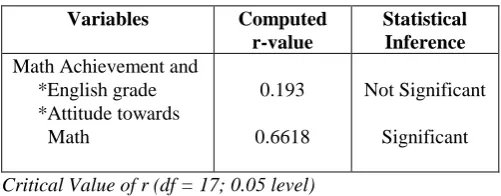
The study hypothesized that the English grade and attitude score of students do not significantly influence their posttest achievement score in Mathematics. Correlation analysis shows that English is not related to posttest achievement of students. It means that regardless of the students’ English grade, their achievement in Mathematics gained through the use of modules is almost the same.
This agrees to the statement of Salandanan (2009) that the self-instructional module helps in providing remedial instruction for slow learners and enrichment materials for fast learners. Topics can be best presented through these self-instructional materials. With the use of one, the student is allowed ample time and assistance to finish the prescribed learning activity at his/her own pace. The lesson will surely be enjoyed and the experience gained will be satisfying. The correlation coefficient between posttest Mathematics achievement and attitude toward Mathematics is 0.6618 as shown in Table II, which is greater than the tabular value. This implies that the posttest achievement score of the students is significantly influenced by their attitudes. Thus, if a student has a favorable attitude toward Mathematics, it is likely that he/she performs better in his/her achievement test. Speaking about the students’ attitude, Turaray (1998) pointed out in her study on Development and Validation of Module in Physics 221 that the module caused a change in the students’ attitude but the lecture method did not.
Table II Comparison between the achievement of the students in the pretest and posttest
Variables Computed
r-value
Statistical Inference Math Achievement and
*English grade *Attitude towards Math
0.193
0.6618
Not Significant
Significant
Critical Value of r (df = 17; 0.05 level)
C. Qualitative Assessment of the Prepared Modules Mathematics teachers were requested to assess the qualitative features of the prepared modules. These are on the format, objectives and content, examples and illustrations, and self-assessment questions.
Results of the study indicate that the prepared modules are good and acceptable to the teachers of Mathematics. On format, the teachers strongly agree that the titles and subtitles are distinguished, the layout of the pages is attractive, and the font size used for the text is easy to read. The lowest item in these criteria is given an overall weighted mean of 4.36, as indicated in Table III. The SAQs guide students to know whether they have attained the objectives of the module. Likewise, the questions enable students to learn by themselves and the problems were very useful in attaining mastery of the lesson.
Generally, the examples and illustrations were assessed very good with an overall weighted mean of 4.32. The illustrative examples and problem appropriately apply to the concepts presented, the examples are included in all necessary parts of the module. Moreover, the examples were considered sufficient for attaining mastery of the subject matter. Examples are also practical and they are very useful in attaining and understanding the concepts.
On objectives and content, the experts strongly agreed that the contents are directly relevant to the objectives of the lesson, and that the contents were arranged in a logical learning sequel. Besides, the explanation of the lessons was written in simple language. The instructional objectives are simple and attainable. An overall weighted mean of 4.34 was computed for the criterion.
To facilitate learning of Mathematics better, Aquino-Danganan (2001) proposed instructional modules in developing computational skills in College Algebra. She mentioned that the proposed instructional modules had titles, instruction to the learners, rationale, objectives, pretest with answer keys, worksheet assignment, progress check with answer key and posttest with answer key. The format and language of each were properly organized, clear and simple. The objectives of each module were specific and were based on the course syllabus. The topics were properly developed and explained and the activities and exercises facilitated student learning in College Algebra.
Those components suggested by Aquino-Danganan were adopted in this research and the Mathematics experts have a positive response with regards to the modules’ qualitative components.
Table III Assessment of the Mathematics teachers on the quality of the prepared modules
Quality Element Overall Weighted
Mean
Descriptive Value
1. Format 4.36 Strongly Agree
2. Objectives and Content
4.24 Strongly Agree
3. Examples and Illustrations
4.32 Strongly Agree
4. Self-Assessment Questions
4.44 Strongly Agree
OVER-ALL WEIGHTED MEAN = 4.34
IV. CONCLUSIONS AND RECOMMENDATIONS Conclusions
The modules are valid and reliable and could supplement the teaching and learning of concepts. The teaching of Basic Mathematics using the modular approach is an effective approach in enhancing the learning of Mathematics. Any desired performance set can be achieved by students of varying levels of ability on condition that the developed and validated modules are well constructed and the topics are sequenced logically, the constructed modules are written in simple language; examples and problems appropriately apply to the concepts presented, and they are sufficient for attaining mastery of the subject matter; the self-assessment questions motivate students in studying the lesson actively; and the students are likely to benefit much in this approach of
teaching because they are given more chance to study the topics less understood.
Recommendations
Based on the foregoing findings and conclusions of the study, the following recommendations were made. To attain the objectives of the college freshmen Mathematics instruction, University administrators concerned should provide necessary assistance for the modules to be reproduced and be made accessible to libraries. The developed and validated modules could serve as enrichment materials for the fast learners. Mathematics professors teaching Basic Mathematics could make use of the module as supplementary materials for those students who are often absent from their mathematics class. The modular approach in teaching is just one of the many ways to introduce the lessons; it is further recommended that the university through the mathematics department should establish linkages with other agencies to be updated with the latest trends in Mathematics teaching. Since the study dealt only on college freshmen Mathematics students who failed in the subject, the researcher recommends that the module should also be used by the regular freshmen students who will take their Mathematics 11 subject in the university. It is also recommended that modules be developed on higher Mathematics courses for the use of the University.
REFERENCES
1. Ma. Leah I. Abad, Training needs and performance of engineering math teacher in the state colleges of region VIII: inputs to a proposed in-service training program, Unpublished MAIS Math Thesis, Leyte Institute of Technology, Tacloban City, Philippines. 2006.
2. Gloria D. Benigno, Basic mathematics for college students. Rex Printing Company, Inc. Quezon City. 1994.
3. Isidro D. Cariňo, et. al. Algebra for college students. Quezon City, Philippines: Manlapaz Publishing Co. 1970.
4. DepED. K to 12 curriculum guide. 2012
5. J. Dooley & T. Swanberg, PVC’s mathematics module. SEDP Handout. 1989.
6. Herman C. Gregorio, Principles and methods of teaching., Metro Manila, Philippines: Garotech Publishing, 1983.
7. Fred S. Keller, Personalized system of instruction: the Keller Plan Handbook. W. A. Benjamin Inc. 1974.
8. Edgar Julius A. Lim,Effectiveness of Modular Instruction in Word Problem Solving of BEED Students. IOSR Journal of Mathematics (IOSR-JM) Volume 12, Issue 5 Ver VII (September – October 2016) pp 59 – 65, 2016.
9. Estrella C. Lozada, Development and validation of modules in basic statistics. Dissertation, Cagayan State University, Tuguegarao, Cagayan. 1998.
10. Rodin M. Paspasan, Structured approach vs self – paced modular approach in teaching trigonometry. Asia Pacific Journal of Multidisciplinary Research Volume 3 No. 5, pp 51 - -58 (December 2015 Part II), 2015.
11. Theresita L. Reyes, Comparative effectiveness of modular instruction and traditional type of instruction on students’ performance in solving problems about conic section. Master’s Thesis, St. Mary’s University. 1994.
12. Gloria G. Salandanan, Teacher education. Quezon City, KATHA Publishing Co., Inc. 2009.
13. Murray R. Spiegel, Probability and statistics. Singapore: McGraw-Hill International Book Co. 1982.
14. Nora F. Taguba, Attitude of secondary and college students towards mathematics. Action Research, Cagayan State University. 1992.
15. Janet C. Turaray,Development and validation of module in Physics 221. Master’s Thesis, Cagayan State University, Tuguegarao,
AUTHORSPROFILE
Dr. Mia Q. Columbano earned her Bachelor of