Iranian Evolutionary and Educational Psychology Journal
September 2019: 144-150
© University of Hormozgan Publication 2019 DOI: 10.29252/ieepj.1.3.144
http://ieepj.hormozgan.ac.ir
Psychometric Evaluation of the Academic
Resilience Scale (ARS-30) in Iran
Alireza Ramezanpour1, Maryam Kouroshnia2*, Amirhoushang Mehryar3, Hojatalah Javidi4
1. PHD Student, Department of psychology, Marvdasht Branch, Islamic Azad University, Marvdasht, Iran. Email: [email protected]
2. Assistant Professor, Department of psychology, Marvdasht Branch, Islamic Azad University, Marvdasht, Iran *Corresponding author email: [email protected]
3. Professor, Department of psychology, Marvdasht Branch, Islamic Azad University, Marvdasht, Iran
4. Assistant Professor, Department of psychology, Marvdasht Branch, Islamic Azad University, Marvdasht, Iran Introduction
Improving the quality of education and empowering students is paramount in any educational system, as it is
one of the most important developmental factors in society. Researchers in this field are increasingly trying to identify the factors that influence their role in quality and empowerment of students. One of the most important
individual, yet non-educational factors that can affect students’ academic quality is resilience. Resilience is
de-fined by patterns of positive adjustment in the face of adversity (Riley & Masten, 2005). Several studies have
investigated the relationship between resiliency with various academic factors including academic support and
academic vitality (Fathi & Jamalabadi, 2017), academic burnout (Taheri Kharameh, Sharififard, Asayesh, & Sepahvandi, 2017), Perception of Learning Environment (Bahrami, Amiri, & Abdollahi, 2017), Competency Perception (Mirzaee, Kiamanesh, Hejazi, & Banijamali, 2016), Academic Self-Handicapping (Laki, Shokri, Sepahmansuor, & Ebrahimi, 2018) and Academic Achievement (Sandoval-Hernandez & Cortes, 2012) has
been addressed.
Typically, students in the classroom and school are faced with a variety of educational challenges, sometimes
due to lack of knowledge of how to deal with these challenges, and sometimes lead to a decline in educational status and even their dropout; on the contrary, some students are able to coping with problems, and ultimately
achieve an academic status despite numerous obstacles, problems, and academic challenges. They believe Abstract: Over the past two decades, academic resilience has encouraged a great deal of research. However, there is a clear shortage
of suitable standard tools for assessing academic resilience in Iran. The purpose of this study was to investigate the validity and
reliability of the Academic Resilience Scale (ARS-30) in Iran. For this aim, 409 high school students (202 girls and 207 boys) com -pleted the Academic Resilience Scale and self-regulation scale. Criterion validity analysis showed that there is a correlation between
academic resilience scale and academic self-regulation. The results of factor analysis of the content of the scale in terms of principal components revealed there are three factors i.e. Represents Perseverance, Reflecting and Adaptive Help-seeking, and Negative Af -fect and Emotional Response. Internal consistency analysis showed that items related to each factor had the most significant correla
-tion with the total score of that factor. There was also a significant correla-tion between the scores for each factor and the total score. The reliability of this scale was calculated by Cronbach’s alpha coefficient and test-retest method. Generally, the results showed
that the academic resiliency scale has good psychometric properties and can be used as a valid and reliable tool for Iranian students.
Keywords: Academic Resilience Scale, Validity, Reliability.
(Khalaf, 2014). Some researchers, such as Hartley (2011) and (Li, Martin, & Yeung, 2015), address the ques -tion of why some students show stress so much against academic challenges, while others not, have used the
term academic resilience. Academic resilience has been defined as the capacity to overcome acute or chronic distress that poses a serious threat to the educational development of a student (Martin, 2013). Academic resil
-ience is one’s ability in the academic field to cope empowered with stress, pressure, and challenges in academ
-ic activities (Mall-ick & Kaur, 2016; Martin, 2013; Martin & Marsh, 2009). A number of studies have shown
that there are groups of students who, despite challenging backgrounds, have successful student performance
in school (Sandoval-Hernandez & Cortes, 2012).
The concept of academic resilience is not limited to particular students, and all students experience it some
-how, as they are always likely to experience challenges, stress, and pressure and experience poor academic performance (Martin & Marsh, 2009), and this has encouraged researchers to research academic resiliency.
Despite interest in studying academic resilience, research in this area has been limited, and little progress has been made on this construct, its components, and its standard measurement tools. Currently in Iran, researchers
use the academic resilience inventory (Samuels, 2004) and the academic resilience scale (Martin & Marsh, 2009) to measure academic resilience. In recent years, Cassidy (2016) has criticized the attitudinal aspects
of the items of these questionnaires, providing a questionnaire that emphasizes one’s observable behaviors in
situations of experiencing stress and evaluating the process of returning to normal functioning. This
process-based questionnaire focuses on cognitive-affective responses and adaptive and non-adaptive behaviors and
is presented as a 30 item Resilience Scale. These items are adapted from existing literature on resilience and academic resilience. Therefore, this scale benefits from content validity. Cassidy (2016) introduces three components for academic resilience: represents perseverance, reflecting and adaptive help-seeking and
negative affect and emotional response. Represents perseverance are those traits, characters, and reactions of students that include hard work and effort, failure to adhere, adherence to plans and goals, acceptance and
use of feedback, innovative problem solving, and hardship as opportunities. Reflecting and adaptive help-seeking reflects a set of traits, characters, and reactions of students that reveal strengths and weaknesses,
changing study methods, seeking help, support and encouragement, monitoring efforts and achievements, and
rewarding and punishment emphasizes. The component of negative affect and emotional response refer to traits, characters, and reactions such as anxiety, being catastrophic, and avoiding negative responses.
Although the Cassidy Academic Resilience Scale has received much attention in recent studies outside of
Iran, it has not been used in Iran and its psychometric properties have not been studied. Therefore, the present study investigates its psychometric properties. Since academic resilience is an important and significant vari -able in academic achievement, study of it is important to enhance students’ performance and improve their
performance. The purpose of this study was to investigate the validity and reliability of the Cassidy Academic Resilience Scale (2016) among an Iranian sample of high school students.
Material and Methods
The type of research was descriptive-correlational. The statistical population of the study consisted of all secondary school students of Darab city, in Iran, who were studying in the high schools of Darab city in 2018-2019 academic years. The sample consisted of 409 students (202 girls and 207 boys) who were selected by multistage cluster random sampling. First, eight schools were randomly selected from each school, then two
classes from each school were randomly selected and all students in the selected classes participated in the study.
Research tools
Academic Resilience Scale (Cassidy, 2016): The scale was developed in 2016 by Cassidy to measure
students’ academic resilience. He studied 532 students with a mean age of 22.4 years and a standard deviation
of 6.2 years. The scale has 30 items and three components of represents perseverance (14 items), reflecting and adaptive help-seeking (9 items), and negative affect and emotional response (7 items). In order to perform this scale, first, student reads a short text that illustrates an example of a difficult academic situation which shows a significant academic challenge and effort. Then, on the academic resilience scale, he chooses the options
closest to his opinion. The student is told: “Imagine you have received a score for your recent exam that will not pass the lesson. The other two exams you have just taken are lower than the good score you were trying to
get. But while you have clear educational and career goals in mind, you don’t want to disappoint your family.
Your teacher’s reaction to this score is that you do not understand the exam topic and are poor in that topic. Of course, teacher feedback also includes ways in which you can improve on this lesson. Your other two teachers have made similar comments about their exams. “The student is asked to imagine him/her experiencing this difficult educational situation and then complete the scale. The items are scored along a 5-point Likert scale from likely (1) to unlikely (5). Positive items are reversed, so a high score on this scale indicates greater academic resilience. Based on content, items 1, 3, 6, 7, 12, 14, 15, 19 and 28 are negative and the others are positive. According to the Cassidy scale, the items 1, 2, 3, 4, 5, 8, 9, 10, 11, 13, 15, 16, 17 and 30 related to represents perseverance, items 18, 20, 21, 22, 24, 25, 26, 27, and 29 related to the reflecting and adaptive help-seeking and items 6, 7, 12, 14, 19, 23 and 28 related to the negative affect and emotional response. The total
score of the scale is obtained from the sum of the scores of the items, ranging from 30 to 150.
In addition to construct validity, its criterion validity has been reported by calculating the correlation coefficient with the General Academic Self-Efficacy Scale (Cassidy & Eachus, 2002), 0.49. The Cronbach’s alpha of the scale was 0.90 (Cassidy, 2016).
Academic Self-Regulation Scale (Sevari & Arabzade, 2013): The Academic Self-Regulation Scale was developed by Sevari & Arabzade (2013) to measure the variable of academic self-regulation. This scale has 30 questions and six sub-scales as a memory strategy (5 Article 3) Objectives (3 articles), self-evaluation (6 articles), help (6 articles), responsiveness (4 articles) and organization (6 articles). All items have direct scor -ing and are never equal to 1, rarely equal to 2, sometimes equal to 3, usually equal to 4, often equal to 5, and
always equal to 6. To calculate the score of each sub-scale, the score of items related to that sub-scale is added together. To calculate the total score of the scale, the scores of all subscales are added together. The scale score ranges from 30 to 180. The higher the score indicates the greater the degree of self-regulation and vice versa. Validity of the scale has been verified through confirmatory factor analysis. Cronbach’s alpha reliability for the total scale was 0.87, and for memory strategy, was 0.74, for Objectives was 0.75, for self-evaluation was 0.83, for help was 0.83, for responsiveness was 0.71, for and for organization was 0.76 (Sevari & Arabzade, 2013). Procedure: To investigate the psychometric properties of the academic resilience scale, following a back-trans
-lation method, all items were translated into Persian by two English translators. Then, two other translators translated all items back into English. Finally, the authors confirmed the final version of the questionnaire. Next, the scale was given to a number of students and, if they had any questions that were unclear, the nec
-essary corrections were made and the final Persian version was prepared for use. After completing the scales
by the students and removing the confounded questionnaires, the criterion validity of the academic resilience scale was evaluated by calculating its correlation with the academic self-regulation scale and its construct validity using factor analysis and internal consistency methods. Reliability of the scale also was calculated by Cronbach’s alpha and test-retest methods.
Results
Validity of Academic Resilience Scale: In examining the construct validity (factor analysis) of the academic
resilience scale, the correlation between the items was analyzed by principal components, which aimed to
determine the existing factor structure. The size of the Kaiser-Meyer-Olkin (KMO) (sampling adequacy index) and Bartlett’s test of sphericity (correlation matrix adequacy index) indicated sufficient evidence for factor analysis. The coefficient of KMO was 0.914, indicating the adequacy of content sampling of correlation data matrix. Bartlett’s test was also significant at 9490.076 at a level less than 0.001. Three factors were extracted on the basis of the scree plot. The three extracted factors explain 54.82 percent of the variance in academic resilience. The extracted factors were then rotated by the Promax oblique rotation method and factor loadings greater than 0.30 were considered as acceptable factor loadings.
Table 1. Statistical Indicators of Three Factors ARS_30 after Promax Rotation
Factors Eigenvalues Variance explained Cumulative variance explained
1 10.51 34.78 34.78
2 5.05 12.13 46.92
3 4.47 7.89 54.82
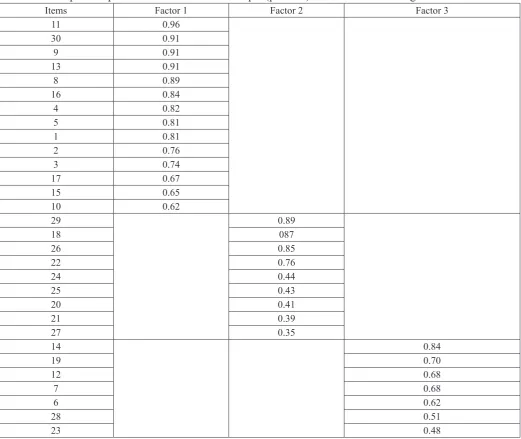
Factor analysis of data obtained its best factor structure after five rotations. After determining the content of each factor, based on the nature of the items and the scale designer recommendation, the first factor was named as Represents Perseverance, the second factor was names as Reflecting and Adaptive Help-seeking, and the third factor was named as Negative Affect and Emotional Response. The subscales of the academic resilience scale along with their factor loadings are presented in Table 2.
Table 2. Principal components estimates of the oblique (promax) rotated factor loadings for the ARS-30
Items Factor 1 Factor 2 Factor 3
11 0.96
30 0.91
9 0.91
13 0.91
8 0.89
16 0.84
4 0.82
5 0.81
1 0.81
2 0.76
3 0.74
17 0.67
15 0.65
10 0.62
29 0.89
18 087
26 0.85
22 0.76
24 0.44
25 0.43
20 0.41
21 0.39
27 0.35
14 0.84
19 0.70
12 0.68
7 0.68
6 0.62
28 0.51
23 0.48
Also, the analysis of questions for all questions showed the all items have a correlation higher than 0.3 with the total scale, indicating the optimal reliability of the scale. In order to investigate the internal consistency,
the correlation coefficients of items of each subscale with the total score of it were calculated. All of these
coefficients were significant and each item was highly correlated with its scale. These coefficients were also calculated for the scores of the three factors and the total scale score, which results are presented in Table 3.
Table 3. Results of the Correlation Matrix of Academic Resilience Scale Subscales
Factors Reflecting and adaptive help-seeking Negative affect and emotional response - Perseverance Total score Reflecting and adap
-tive help-seeking 1
Negative affect and
emotional response 0.33** 1
Perseverance 0.35** 0.27** 1
Total score 0.67** 0.63** 0.86** 1
** sig < 0.01
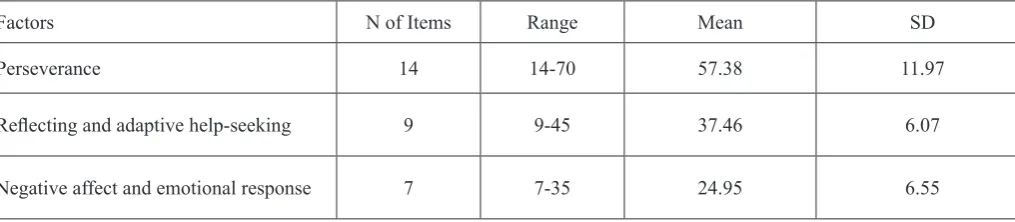
Table 3 shows that the correlation of factors with each other and with the total scale is positive and significant. The mean and standard deviation of the test scores for the three factors are presented in Table 4.
Table 4. The mean and standard deviation of the test scores for the three factors
Factors N of Items Range Mean SD
Perseverance 14 14-70 57.38 11.97
Reflecting and adaptive help-seeking 9 9-45 37.46 6.07
Negative affect and emotional response 7 7-35 24.95 6.55
Academic self-regulation scale was used to assess the criterion validity of the academic resiliency scale. The results showed that the correlation coefficient between the scores on the academic resilience scale and the total score on the academic self-regulation scale was 0.75, which was significant (0.001). These coefficients can be used as an indicator for the criterion validity of the academic resilience scale. Also, the correlation coefficient of the total score of academic self-regulation was 0.69 with perseverance subscale, 0.44 with reflecting and
adaptive help-seeking subscale, and 0.43 with negative affect and emotional response subscale, which all were
significant (0.001).
Reliability of Educational Resilience Scale
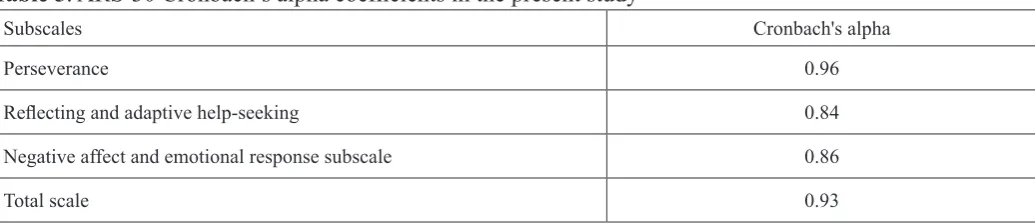
Cronbach’s alpha coefficient and test-retest coefficient were used to evaluate the reliability of the scale. Table 5 presents the Cronbach’s alpha for all subscales and the total scale score. The results show that the calculated Cronbach’s alpha coefficients are desirable and acceptable for all subscales and the total scale. Thirty students were selected to ecaluate test-retest coefficient within 21 days. The test-retest coefficient was 0.85 for per
-severance subscale, 0.83 for reflecting and adaptive help-seeking subscale, and 0.80 for negative affect and
emotional response subscale.
Subscales Cronbach's alpha
Perseverance 0.96
Reflecting and adaptive help-seeking 0.84
Negative affect and emotional response subscale 0.86
Total scale 0.93
Discussion
The purpose of the present study was to investigate the psychometric properties of the Academic Resilience Scale (Cassidy, 2016). Based on the results, this scale is an valid and reliable tool for measuring academic
resilience and can be used as a valid and reliable tool for Iranian students.
In the case of evaluating the validity of this tool, the results of factor analysis showed the extracted factors in
this study are fully consistent with the factors in the original study. In the case of internal consistency method,
the correlation coefficients of factors with each other and with the total scale were positive and significant. Also, the correlation coefficients of items of each factor with the total score of it and the correlation coeffi
-cients of items with the total scale score were also calculated, which all were significant. The results showed
that there is a correlation between the academic resilience scale and its subscales with the academic
self-reg-ulation scale. This finding confirmes the criterion validity of the scale.
For the reliability of the questionnaire, Cronbach’s alpha was 0.96 for perseverance, 0.86 for reflecting and adaptive seeking, and 0.84 for negative affect and emotional response subscale. However, Cronbach’s alpha in Cassidy’s study for perseverance subscale was 0.83, for reflecting and adaptive seeking was 0.80, and for negative affect and emotional response was 0.78 (Cassidy, 2016). Test-retest coefficients for perseverance subscale was 0.85, for reflecting and adaptive seeking was 0.83, and for negative affect and emotional re
-sponse was 0.80. Overall, considering Cronbach’s alpha coefficients, item analysis and test-retest coefficients
of academic resiliency scale are suitable for Iranian students.
Based on the findings of this study, it was found that the Cassidy Academic Resilience Scale is approved as a
valid and reliable scale and can be used to measure students’ academic resilience, especially in high school.
This scale offers a novel approach to measuring academic resilience, since it exemplifies behavioral and cog
-nitive-affective responses to the academic difficulties. Also, this scale express positive empowering factors,
such as a sense of domination. Students with high academic resilancy believe in their efforts to make a differ-ence and effective approaches to learning.
Generally, the results showed that the Cassidy Academic Resilience Scale has the necessary indicators as a valid and reliable instrument and can be used in both research and practice fields as a diagnostic criterion for identifying incompatible responses to distress and academic difficulty.
Declaration of Conflicting Interests
The author(s) declared no potential conflicts of interest with respect to the research, authorship, and/or
publication of this article.
Funding
The author(s) received no financial support for the research, authorship, and/or publication of this article.
References
Bahrami, F., Amiri, M., & Abdollahi, Z. (2017). The Perception of Learning Environment and Academic
Burnout: Mediate role of Academic Resilience. Journal of Sabzevar University of Medical Sciences, 24(4), 217-223.
Cassidy, S. (2016). The Academic Resilience Scale (ARS-30): A new multidimensional construct measure. Frontiers in psychology, 7, 1787.
Cassidy, S., & Eachus, P. (2002). The development of the General academic self-efficacy (GASE) scale. Paper presented at the British Psychological Society Annual Conference, Blackpool.
Fathi, D., & Jamalabadi, M. (2017). The Study of Examined Mediating Role of Resiliency in The Perception
of Academic Support and Academic Buoyancy. Bimonthly of Education Strategies in Medical Sciences, 10(4), 263-269.
Hartley, M. T. (2011). Examining the relationships between resilience, mental health, and academic persistence
in undergraduate college students. Journal of American College Health, 59(7), 596-604.
Khalaf, M. A. (2014). Validity and reliability of the academic resilience scale in egyptian context. US China Educ. Rev. B, 4, 202-210.
Laki, D., Shokri, O., Sepahmansuor, M., & Ebrahimi, S. (2018). The Relations of Academic Resiliency and Cognitive Appraisal to Academic Self-Handicapping: The Mediating Role of Achievement Emotions. De-velopmental Psychology: Iranian Psychologists, 14(55), 328-341.
Li, H., Martin, A. J., & Yeung, W.-J. J. (2015). Academic risk and academic resilience: individual, contextual and cultural influences on the educational development of Asian children. Educational Psychology: An International Journal of Experimental Educational Psychology, 35(8), 1025– 1026.
Mallick, M. K., & Kaur, S. (2016). Academic Resilience among Senior Secondary School Students: Influence of Learning Environment. Rupkatha Journal on Interdisciplinary Studies in Humanities, 8(2), 20-27. Martin, A. J. (2013). Academic buoyancy and academic resilience: Exploring ‘everyday’and ‘classic’resil
-ience in the face of academic adversity. School Psychology International, 34(5), 488-500.
Martin, A. J., & Marsh, H. W. (2009). Academic resilience and academic buoyancy: Multidimensional and
hierarchical conceptual framing of causes, correlates and cognate constructs. Oxford Review of Education, 35(3), 353-370.
Mirzaee, S., Kiamanesh, A. R., Hejazi, E., & Banijamali, S. (2016). The Effect of Perceived Competence on
Academic Resiliency with Mediation of Autonomous Motivation. Journal of Psychological Models and Methods, 7(25), 67-82.
Riley, J. R., & Masten, A. S. (2005). Resilience in context Resilience in children, families, and communities (pp. 13-25): Springer.
Samuels, W. E. (2004). Development of a non-intellective measure of academic success: Towards the quanti-fication of resilience: The University of Texas at Arlington.
Sandoval-Hernandez, A., & Cortes, D. (2012). Factors and conditions that promote academic resilience: A
cross-country perspective. Journal of American Psychologist, 90, 130-144.
Sevari, K., & Arabzade, S. (2013). Construction and measurement of the psychometric properties of academic
self- regulation questionnaire. Journal of School Psychology, 2(2), 75-92. doi:d-2-2-92-4-5
Taheri Kharameh, Z., Sharififard, F., Asayesh, H., & Sepahvandi, M. R. (2017). Academic Resilience and Burnout Relationship of The Student of Qom University of Medical Sciences. Bimonthly of Education Strategies in Medical Sciences, 10(5), 375-383.