Abstract: Titanium dioxide (TiO2) is a widely studied material and exists in three major crystal structures: rutile, brookite and anatase. Due to its advantages in high chemical and thermal stability, non-toxicity, high catalytic activity, resistance to corrosion, and high reactivity under ultraviolet light (<387 nm),it can be used in many applications such as photo catalysis, photovoltaics, sensors, hydrogen generators batteries, self-cleaning, electrochromic devices and also used in some biomedical application for site specific drug delivery . These applications in various fields depends not only on the properties of the TiO2 material but also it involves in modifying TiO2 structure and doping of other element on it which will show adverse impact in application of TiO2 with the surrounding environment. In this review, we are discussing about the synthesis, properties, and applications of titanium dioxide nanoparticle (TiO2 NP) in various fields.
Keywords: TiO2 Synthesis, Properties, Photocatalyst, Photo Electrochemical detection.
I. INTRODUCTION
Titanium dioxide (TiO2) is a well-known semiconductor
nanomaterial has been proved to be an excellent basic material in many other applications. Nowadays, its application has been considerably increased in the field of nanoscience and nanotechnology, because of its enhanced chemical and physical properties in the nanoscale level. Based on its synthesis and properties, many other reviews and reports have been done. Those researches has been done with the promising chemical and physical properties which includes photoelectric activity, large surface area, high stability[1], adsorption edge energy, efficient separation of the charge carriers, crystallite size[2], high sensitivity, selectivity in the field of photo electrochemistry detection[3], high reactivity under ultraviolet light (<387 nm)[4], biological inert nature and high electronic mobility [5].
Here, in this review we are mainly concentrating in synthesis, properties, modification and applications of titanium dioxide (TiO2) nanomaterials. At nanometre scale,
the synthesis of titanium dioxide (TiO2) could be in the form
of nanoparticles, Nano rods, nanowires, nanocomposites and nanotubes which are well categorized with the appropriate preparation method and also the synthesis of mesoporous/nanoporous TiO2, and photonic materials are
well defined. Those preparatory methods are discussed in this review with proper procedures and prepared respective
Revised Manuscript Received on August 05, 2019.
Ragavi Priyadharshani Raja, M.Tech, Dept. of Nanotechnology, Periyar Maniammai Institute of Science & Technology, Thanjavur, Tamilnadu.
Geetha Kathiresan*, Assistant Professor, Dept. of Nanotechnology, Periyar Maniammai Institute of Science & Technology, 613403, Tamilnadu. R. Ilavarasi, Assistant Professor, Dept. of Nanotechnology, Periyar Maniammai Institute of Science & Technology, 613403, Tamilnadu.
materials are in a nanoscale, could be properly characterized with some major techniques which are transmission electron microscopy (TEM) or scanning electron microscopy (SEM). The crystallographic structure of TiO2, can be identified with
the help of X-ray diffraction(XRD) techniques and the X-ray Photoelectron Spectroscope (XPS) techniques gives the information about chemical compositions and oxidation states of the surface species of the respective materials in the research fields [6]. To reveal the elemental composition on some nanocomposites based researches, Energy-dispersive X-ray spectroscopy EDS was carried out. The major properties of titanium dioxide such as thermal, structural, electronic and optical are discussed in this review. Of which above mentioned properties, titanium dioxide has wide application with its optical properties. As it is transparent in visible light region, it should be doped or sensitized with some other materials for enhancing optical property and activities of TiO2 nanomaterials, thereby increasing its
application as a photocatalyst and sensing, photovoltaics, water splitting, photo-/electrochromic, and hydrogen storage and hydrogen generated batteries. As a promising photo catalyst, TiO2 nanoparticles playing an important role in toxic
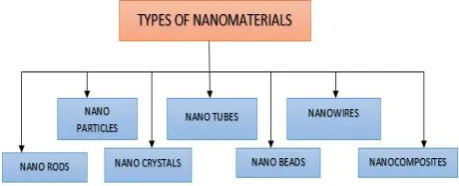
[image:1.595.312.542.492.585.2]molecule detection based researches in the environmental pollution challenges. Also the preparation and the properties of titanium dioxide nanomaterials based researches are discussed in this review. The flow chart for the types of nanomaterials as shown in the Figure.1.
Fig. 1: The flow chart for the types of nanomaterials.
II. SYNTHESIS METHODS
The synthesis of nanomaterials, nanotubes, nanorods, nano composites by sol-gel method is explained here. In this process, a sol (colloidal substance) is obtained from the hydrolysis and polymerization reaction of the precursors. At the end of polymerization state, conversion of liquid phase to solid gel phase occur. There are numerous method available for synthesizing nanomaterials like emulsion techniques, spray pyrolysis, precipitations, wet chemical synthesis[7,8], and production of thin films based on nanomaterials were produced by spin coating or
dip coating. Some of those
Nano Titanium Dioxide -An Effective
Photocatalyst for Emerging Applications
synthesis method are explained here as follows.
A. Nano Powders
For the synthesis TiO2 nanomaterial, Titanium tetra iso
propoxide [Ti(OCH(CH3)2)]4, SigmaAldrich, 97%],
iso-propanol [(CH3)2CHOH, Sigma-Aldrich, 99.7%] and nitric acid [HNO3] were used. Here, they have added
Titanium tetra iso propoxide into the solution containing iso-propanol and deionized water under constant stirring at 80º C into the round bottom beaker. After 1 h, concentrated HNO3 mixed with deionized water was added into the TTIP solution and keep it under constant stirring at 60 ºC for 6 h highly viscous sol gel was obtained. These prepared sol gel, undergone annealing process to form a powdered form of TiO2 nanocrystalline. Further preparation of TiO2 film, the
prepared powder was added to the solution of iso-propanol in the ratio of 1:10. The TiO2 nanoparticles deposited on
titanium substrate using the dip coating method. Further optical studies, The TiO2 film were prepared on the two glass
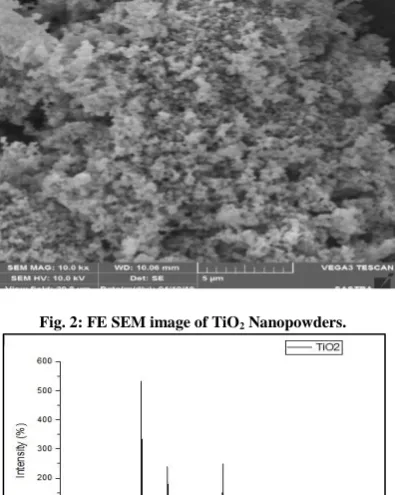
substrates. Its crystalline nature is observed by XRD techniques and it was found to be rutile and anatase [9]. The FE SEM image of the TiO2 nano powder as shown in the Fig.
2, which reveals that they are spherical in shape and clustered on the glass substrate and Fig. 3 represents the XRD image of TiO2 nanoparticles. By dissolving the titanium tetrachloride
in the mixture of solutions containing ethanol and acetic acid. Final mixture was kept under autoclave at 180oC, after this process it was cool down to room temperature. A fine powder of TiO2 was obtained after drying the rinsed product for 2h
[image:2.595.72.270.414.662.2][10].
Fig. 2: FE SEM image of TiO2 Nanopowders.
Fig.3: XRD image of TiO2 Nanopowders.
B. Nano Tubes
For the preparation of TiO2 nanotubes and nanorods, the
preparatory methods were almost same. Titanium isopropoxide (TI) was used as a precursor which was dissolved in ethanol to synthesize TI solution. This TI solution should be added with the mixture of ethanol, acetylacetone and water to yield TiO2 sol with different molar
concentrations at room temperature. After that anodic alumina template membrane having pores with the uniform diagram ranging from 200-250 nm, is dipped frequently in to this tio2 sol. After drying this template for 1 day and allowed to heated in air at 400 oC, it could give nanorods and nanotubes in the pores of AA template membrane [11].
C. Nano Wires
TiO2 nanowires have been prepared by electrophoretic
deposition of TiO2 sol in to the pores of an AA membrane
template maintaining at 500 °C for 24 h. To isolate TiO2 nano
wires , AAM template is dissolved in a 5 wt %NaOH solution [12]. TiO2 nanorod array could be synthesized by dropwise
adding the mixture of ethanol and deionized water in to the solution of tetrabutylorthotitanate under magnetic stirring. Finally it was deposited on the ZnO Nano rod and allow it to dry (100 ◦C for 10 min) and heated in air (550◦C for 1 h) to obtain TiO2 nanorod array [13].
D. Other Form Of TiO2
Potassium titanium oxide oxalate dehydrate (PTO) was used as an precursor element in the synthesis of anatase hierarchically cactus like TiO2 array. This element was added
to a ultrapure water followed by adding diethylene glycol. This mixture was kept in an autoclave where the cleaned FTO substrate was introduced and the entire setup was maintained at a temperature of 160o C for 3-12h. At the end of the reaction, FTO substrate was taken out, rinsed well with ultrapure water and dried with ambient air at 80 ◦ C, annealing at 450 ◦ C for 2 hr [14] .Hydrothermal synthesis of nano particles were developed nowadays because it could yield nanocrystals directly as compared to other processes such as sol gel and co precipitation methods because it would need calcination and milling, it could leads agglomeration and degradation of the particle surface. For the synthesis of TiO2 nanoparticles, titanium isopropoxide (Ti(OC3H7)4, was
hydrolyzed with deionized water under vigorous stirring at room temperature. The resulting suspension was filtered and purified. Remaining sediment was again added to distilled water and the mixture was kept in a closed container under sonification for few mins. The aqueous solution of erbium nitrate pentahydrate (Er(NO3)3‚5H2O, Acros) was added
dropwise to that mixture. The final mixture was allowed to centrifugation process, two types of samples, a wet sediment, and a nanoparticle suspension were obtained. The process of centrifugation and sonication was repeated three times. Finally, films were formed by casting the suspension on glass substrates [15]. The hierarchical yolk shell TiO2 beads were
synthesized from the solution containing the mixture of NH4
F, urea, titanium tetrachloride, H2O and water under
hydrothermal synthesis method at varying temperatures of 100 o C, 120 o C, 140 o C, 160
o C and 180 o C for 12 h
product was rinsed, dried and annealed for 500 o C for 3 h [16].
E. Modification Process
By modifying the surface structure of anatase TiO2
particles, the photocatalytic property could be greatly improved which is explained as follows: this process undergone irradiation reaction in a aqueous solution of NaOH and TBAOH solution. With the help of sona assisted exfoliation process the highly reactive exposed anatase 001 facets became delaminated from the outer surface of the mother TiO2. This delaminated layer could be stabilized by
the formation of Ti-O-TBA [17]. Also, the MIP(molecularly imprinted polymer) modification on the branched titanium dioxide nanorods was prepared to detect some molecules. Hereby, hydrothermal method was also used to prepare branched TiO2 NRs on fluorine doped tin oxide substrate.
Here the mixture of ultrapure water and hydrochloric acid was prepared after that titanium butoxide solution was added to that mixture. After stirring, an ultrasonically cleaned FTO (fluorine doped tin oxide) was placed in a sealed Teflon lined stainless steel autoclave containing mixed solution at an angle against the wall of the container. The hydrothermal synthesis was performed at 150 °C for 4 h in an electric oven. Finally an TiO2 NRs modified FTO was then purified and it
were rinsed with the mixture containing ultra pure water and concentrated HCl then the FTO substrate was removed and rinsed well with ultrapure water. Titanium dioxide nanorods modification with molecularly imprinted polymer (MIP) was synthesized by surface molecular self assembly strategy[3]. Another method for improving the photocatalytic property of TiO2 was doping or adding an element to the TiO2 particles.
In such cases, Tungsten-doped TiO2 (W- TiO2) has a better
photo catalytic activity and it could be prepared via the sol-gel method. Titanium butoxide was used as a precursor and tungstic acid as a dopant material. The procedure to synthesis W- TiO2 was adding tungstic acid dissolved in
H2O2 to the mixture of Titanium butoxide and deionized
water under vigorous stirring at a particular temperature. Finally an orange viscous solution was obtained which was kept at room temperature to turn into a gel. It should be dried and grinded in to a fine powder [18,19]. Cr3+ was also used as dopant material as it improves the surface activity of the Tio2
material. Cr3+-doped TiO2 nanoparticles (Ti-Cr) was also
prepared by the same sol gel method. Titanium isopropoxide as a source element for the synthesis o16f TiO2 and
chromium (III) nitrate nonahydrate and the prepared TiO2
were used for the synthesis of (Ti-Cr) NCs [4]. With the source element of titanium butoxide and uncalcined ceria we could prepare TiO2/CeO2 nanocomposites were prepared and
it was prepared with common method of wet chemical synthesis [20]. Graphene/ TiO2 nanocomposites were
prepared by the hydrothermal process. Here graphene was reduced from graphene oxide [21,5], later TiO2 nanoparticles
were deposited on the graphene sheet with glucose as the facet controlling agent [21]. For the synthesis of TiO2
nanofiber, it should be added with some specific polymer. Here, polyacrylonitrile (PAN) and polyurethane (PU) were dissolved in DMAc (dimethylacetamide), to that mixture TiO2 nanoparticle was added. Finally, PAN/ PU/ TiO2
nanofibrous membrane was obtained using the electrospinning process [22].
III. PROPERTIES OF TIO2
On reviewing about the properties of titanium dioxide, we should know about the structural, thermodynamic, optical, electronic and photon induced electron- hole properties.
A. Thermodynamic Properties
On discussing about the thermodynamic property of TiO2,
each polymorphs have different surface enthalpies at different thermodynamic stability. On applying temperatures the transformation of phases occurs as, anatase to brookite to rutile, brookite to anatase to rutile, anatase to rutile and brookite to rutile and all are based on energetic strategies of TiO2 particles [12]. In isothermal reaction, At 723K,
transformation of anatase to brookite occur, further it can be transferred to rutile phase. However , it implies that there was no direct transformation to rutile phase at that temperature. At 853K, formation of rutile phase occur. The transformation rate depends upon the amount of rutile, if the amount of rutile decreases, the transformation of brookite from anatase could be readily observed. With the lower amount of anatase and at 973K, the transformation of anatase to both brookite and rutile could be possible at longer reaction time. In isochronal reaction, at 598K there should be increase in brookite concentration when transformation occurring from anatase to brookite. Above 850K, there would be rutile concentration increases which implies rutile transformation. On this thermos dynamic and kinetic analyses at isothermal and isochronal condition, there will be reverse transformation occurs below 623K and at higher temperature above 623K, anatase could be transformed to brookite or rutile and then brookite transforms to rutile [23].
B. Structural Properties
In the case of discussing the structural properties of TiO2,
we should discuss about the different polymorphic phases such as anatase, rutile and brookite. Of which the rutile phase is common and anatase, brookite and newly discovered TiO2
B were all synthesized by the wet chemical synthesis. Consider an tetrahedral rutile structure of TiO2, the two TiO2
atoms are located at the primitive cell. Each Ti atom is surrounded by slightly twisted octahedron of O atoms. All those polymorphic phases have been analyzed with the same octahedral TiO2 as a primitive structural unit. The only
difference among all the structures are the edge sharing octahedra. There could be two in rutile phase, three in brookite and four in anatase[24].
C. Electronic Properties
If we discuss about the electronic properties Of TiO2 we
should probably know the band structure, density of studies and electron density. The direct way of studying the conduction band structure has been done through optical experiments by exciting across the optical gap. Hence, in the study of band structure analyses with absorption and
wavelength modulated
is a direct forbidden gap semiconductor which means that it possess direct transition is so called dipole forbidden. The density of states (DOS) of rutile TiO2 has been evaluated/
characterized by the linear analytic tetrahedron method because its offering the constant energy surfaces. The prominent features of the valence band have been determined to be comparatively insensitive to the surface effects and the calculations has been done through tight binding calculations where we could found the differences between the bulk and surface DOSs were found to be negligible. On accounting the electronic properties of TiO2, the participation of d-orbitals in
the e-properties of transition metal oxides gives a better covalent character and a deformation of the atomic like charge density surrounding the transition metal ion and it reveals positive deformation along and perpendicular to the Ti-O bonds in 110 plane of the tetragonal units. The negative deformation along the 001 direction. Ti-O bonds shows prominent covalent bonding character which could be predicted by differencing the electro negativities of the Ti-O bonds. By using the pseudo charge density analyses we could analyze the charge densities in the band level. Its shown that in TiO2 structure significant quantity of charge occupying on
the O atoms in the conduction band states as well as the Ti charge in the valence band [24]. The electronic structure of brookite is almost similar to the anatase because there is a slight differences between the local crystal structure of two phases and the brookite phase also have direct band gap which is comparatively larger than both the rutile and anatase. [25].
D. Optical Properties
To know the optical properties of TiO2, we should
characterize it for the three polymorphic phases (rutile, brookite, anatase) by using reflectance spectroscopic techniques. For rutile and anatase phase, consider the imaginary part of dielectric functions possess tetragonal unit cells and for brookite which is orthorhombic. From the study, it is known that anatase and brookite possess similar properties compared to the rutile. As declared in previous researches and studies, the threshold energies of anatase and brookite were 2.27 and 2.22 eV respectively which are related to the direct band gap values. We should predict the values of the respective phases by comparing the imaginary values and the experimental values. Here, approximately concluded that the reflectance value of anatase(6.33), anatase(5.62) and brookite(7.89) [25] and those fundamental theoretical calculations based on the LDA theory [24,25]. The optical transitions property of TiO2 have been investigated by applying at higher photon energy. Those plasmonic peak obtained at 12.7 and 19.5 eV for anatase and brookite respectively in comparison to the rutile obtained within the 20eV range, as confirmed in previous studies [25]. There are so many interesting and wide application arise with the photon induced activity of the TiO2 nanomaterials(i.e, could be in the form of nanotube, nanoparticles, nanocomposites, nanorods etc,.). All those principles are mainly based on the redox reaction. The process involving in this photon derived techniques were named as photovoltaic cell, photocatalysis and photon induced hydrophilicity. The photon which is induced to excite the electron to produce electricity gives application in the field of photovoltaic cell or
it can be derived to a chemical reaction in the case of photocatalytic reaction and also holding the holes on the TiO2
surface causes a high wettability which provides application in photo induced super hydrophilicity (PSH) [26].
IV. APPLICATION OF TIO2
As we known that the application of TiO2 is strongly based
on its peculiar properties, with that we can review those applications of titanium dioxide in the field of energy and environment. of those properties, the photocatalytic and sensing properties of TiO2 has been used in many
applications which include degradation of toxic/ harmful dye molecule such as reactive black 5(RB5) dye from aqueous solution by coating (TiO2) titanium dioxide with (Fe0) zero
valent iron (Fe0/TiO2 NCs) [6] and (010) plane of anatase
TiO2 provides high photocatalytic activity in the adsorption of N719 dye [27] .The photocatalytic degradation of toluene was optimized by tungsten doped nanoparticles (W- TiO2
NPs) under visible light irradiation. The photocatalytic activity of TiO2 was greatly improved by the addition of
tungsten element thereby it reduces the electron hole recombination rate [18]. Similarly, for the degradation of (4-chloro-2-methylphenoxy) acid acetic (MCPA) was done by the photocatalytic degradation of Cr3+-doped TiO2
nanoparticles (Ti-Cr)[4]. With the properties of hydrophilicity, photocatalytic, antibacterial activity and also the coating stability of TiO2/graphene oxide modified
polyacrylic coating, having application in photo decolourization efficiency of organic dye contaminants [28]. By using UV/ TiO2NP/H2O2 as a photocatalyst, the
breakdown of gemifloxacin was done as this residuals in hospital waste water and in industries could cause genetoxicity and antibiotic resistance [29]. Similarly, with the TiO2 thin film as a electrode in a photo electrochemical
method, which offers a photocatalytic degradation of oxalic acid and 4-chlrrophenol(4-CP) under UV light (monochromatic, 365nm) irradiation[30]. Also, the enhanced catalytic activity of TiO2/ CeO2 nanocomposites for the
oxidation of benzene under Xe irradiation was due to the synergetic effects between photocatalysis of TiO2 and
thermocatalysis of CeO2[20]. Compared to TiO2
photocatalytic colloids, the enhanced photocatalytic degradation of organic pollutants such as methyl orange (MO) have been obtained by using CeO2/ TiO2 nanobelt
heterojunctions under the same UV/ visible light irradiation [31]. Similarly hydrothermally synthesized TiO2
nanoparticles assisted on the nanofibers of poly(methyl methacrylate) has showed efficient degradation of methyl orange[32]. The phototcatalytic degradation of 2,4-dichlorophenol (2,4-DCP) and bisphenol A (BPA) has been done by using the nanocomposites TiO2/g-C3N4(CN)
decorated by Au assisted under visible light irradiation[33]. In the field of sensing hazardous elements with TiO2 as a
photocatalyst, the photoelectrochemistry detection of ochratoxin A was done with the nano composites TiO2/S-BiVo4@Ag2S as it provide high photocurrent
intensity under visible light irradiation as TiO2 posses
photoelectric activity. Since Bismuth vendate (BiVo4)
adsorption of TiO2 on to the pores and it also provides the
insitu growth of Ag2S[1], With branched TiO2 nanorods(B-
TiO2 NRs) modified with imprinted polymer (MIP), the
detection of chlropyris (CPF) was done efficiently based on photo electrochemistry detection and sensing strategy. The reactive sites of MIP was highly increased by branched TiO2
NRs as its offers high surface area than TiO2 NRs [3].
Similarly with the same hierarchically branched TiO2
nanorods, the maximum photocurrent density was attained under Xenon lamp illumination [19]. For the photocatalytic reduction of CO2 and N2O, TiO2 as it is being possess the
synergetic properties of high surface area, crystallite size of rutile, absorption band energy and mainly the separation of charge carriers, was used as a dopant element to the pure g-C3N4 for improving its photocatalytic property[2]. The
molecularly imprinted polymer modified anatase hierarchically cactus like TiO2 arrays have been used in a photo electrochemical detection and visualized sensing platform. However, this AHCT arrays were synthesized with RNase B layer which acts as an insulator for the reaction and it is connected to the electrode. For the de-colourization of RNase B layer which could be connected to the PB electrode. Under light illumination, there could be de-colourization occur from PB to Prussian white which implies the de-colourization of RNase B [14]. In the application of assaying galic acid (GA) in red wine by using photo electrochemistry method with polyaniline reduced graphene oxide titanium dioxide. As TiO2 is a good photocatalyst and
graphene is considered as an electron acceptor and transporter in photocatalysis and reduces the rate of charge recombination further polyaniline gave a better stability, corrosion protection and high mobility of charge carriers. These combination of TiO2/PANI/graphene gave a good
photocatalytic activity in a novel photo electrochemistry platform [5] .Also, developing a non-enzymatic glucose sensor was done by fabricating Ag & Pt hollow nanoparticles supported on TiO2 nanotubes which was used as an electrode
in that reaction[34]. On discussing about the application of TiO2 in a photovoltaic cell or solar cell and in batteries is
mainly based on the excellent optoelectronic properties, photocurrent conversion efficiency and readily manufacturing process. In the case of dye sensitized solar cells (DSC), TiO2 anatase posess optoelectronic properties,
shows a better photocurrent conversion efficiency and used as a photoanodic material in a DSC. Of these TiO2
nanoparticles are having decreased surface area which could affect the DSCs efficiency, hence hierarchically TiO2
structures with large surface area consisting of TiO2
nanoparticles and hierarchical yolk shell anatase TiO2 beads
[16] have been used because it holds a maximum dye loading and efficient scattering [2,35,36], similarly with mesoporous anatase TiO2 microspheres showed an enhanced scattering
and photoelectrical conversion efficiency[36]. Also, perovskite solar cell have been also made by fabricating it with Au@TiO2 core shell nanoparticles in to a porous TiO2 or
with perovskite (calcium titanate) semiconductor capping layers[37] and in graphene quantum dots solar cell, TiO2/CdS/GQDs was used as a photoanode [38]. In the case
of increasing the electrochemical performance efficiency of lithium ion batteries and sodium ion batteries(LIBs and SIBs), the mixed phase of both TiO2 anatase and TiO2-B
(TiO2 nanobelt) on Co9S8 composites has been employed as
an anode material and its provides better specific capacity of batteries and greater stability [ 39]. A nano crystallites anatase TiO2 has also been used as a buffering element which
covers the crystallite Si nanoparticles in lithium ion batteries, improving the specific capacity of a battery thereby increase the ion polarization of the battery [40]. Non porous TiO2
nanoparticle has been using as an supporting element to synthesize cobalt catalyst for enhance the oxidation of (MgSO3) magnesium sulphite (desulphurization) thereby
lowering the effect of secondary pollution [41]. In the field of marketing, for the need of waterproof, UV resistance, thermal moisture controllability and breathability, an super hydrophobic electrospun polyacrylonitrile (PAN)/ polyurethane (PU)/titanium dioxide (TiO2) nano fibrous
membranes has been fabricated by coating with
2-hydroxy-4-n-octoxybenzophenone (UV531) and
fluorinated acrylic copolymer (FAC). Here, TiO2 employed
as an organic blocker and UV531 act as an organic absorber to provide better UV protection for the modified Nano fibrous membranes [42]. For improving the functional sustainability of periphytic biofilms, its surface was exposed to titanium dioxide nanoparticles, hence it provides greater removal of organic matter and Cu 2+ [43]. In the field of biomedical field, TiO2 have wide application because of its
property of good biocompatibility, low toxicity and employed as an efficient photosensitizers. With that, the black TiO2 nanoparticle synthesized through a facile
calcination method combined with an in situ controllable solid state reaction approach shows narrow bandgap of ~2.32 eV which enhance the photo response to visible light and near infrared region. At 808 nm, more reactive oxygen species were induced to provide phototherapy to kill the bladder cancer cells [44]. In the case of site specific drug delivery, TiO2 has been employed to increase the effectiveness of the
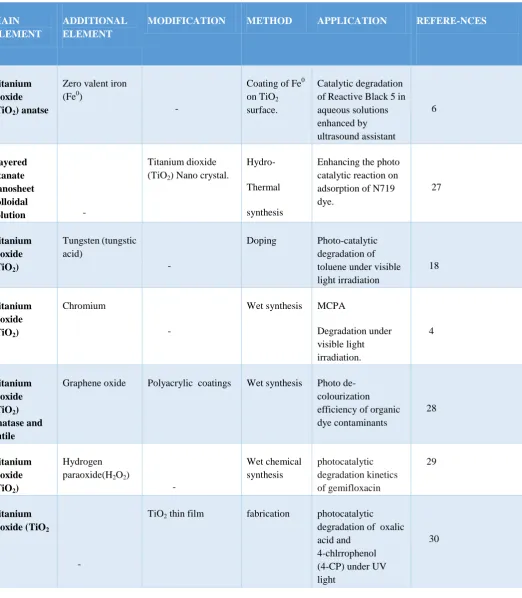
drugs. Here curcumin incorporated titanium dioxide nanoparticles (CTNPs) has showed efficient cell viability, improved stability and less toxicity at maximum exposure [45].An overall outline of titanium dioxide (TiO2) application
and its preparatory method are aligned in a tabular way as given in the Table 1 below.
V. CONCLUSION
In this overall review of Titanium dioxide, we can probably know the synthesis of TiO2 nanomaterials as in the form nanoparticles, nanocomposites, nano rods, nanotubes and nanoarrays by sol-gel and hydrothermal synthesis methods and also we can slightly know the modifications done so far, either on the TiO2 surface or doping some
elements to improve its properties for better availability in the energy and environmental applications. Also the properties of titanium dioxide such as structural, thermodynamic, optical, electronic and photon induced activities have been said theoretically. Most of the applications of TiO2 was
mainly employed in the field of photocatalytic degradation of organic pollutants, dye molecules and some hazardous elements and also it was significantly used in photo electrochemical detection
excellent photoanode, it has been widely enrolled in the application of photovoltaic solar cells and in lithium ion batteries. Furthermore, it has found application in CO2
reduction, site specific drug delivery and in some commercial
[image:6.595.55.578.128.727.2]markets to attain product stability. The above mentioned all applications have been discussed. Based on this review, we can get an overall idea about the entire titanium dioxide (TiO2) nanostructures.
Table 1: Overall outline of titanium dioxide (TiO2) application and its preparatory method.
MAIN ELEMENT
ADDITIONAL ELEMENT
MODIFICATION METHOD APPLICATION REFERE-NCES
Titanium dioxide (TiO2) anatse
Zero valent iron (Fe0)
-
Coating of Fe0 on TiO2
surface.
Catalytic degradation of Reactive Black 5 in aqueous solutions enhanced by ultrasound assistant
6
Layered titanate nanosheet colloidal
solution -
Titanium dioxide (TiO2) Nano crystal.
Hydro-
Thermal
synthesis
Enhancing the photo catalytic reaction on adsorption of N719 dye.
27
Titanium dioxide (TiO2)
Tungsten (tungstic acid)
-
Doping Photo-catalytic
degradation of toluene under visible light irradiation
18
Titanium dioxide (TiO2)
Chromium
-
Wet synthesis MCPA
Degradation under visible light irradiation.
4
Titanium dioxide (TiO2) anatase and rutile
Graphene oxide Polyacrylic coatings Wet synthesis Photo de- colourization efficiency of organic dye contaminants
28
Titanium dioxide (TiO2)
Hydrogen paraoxide(H2O2)
-
Wet chemical synthesis
photocatalytic degradation kinetics of gemifloxacin
29
Titanium dioxide (TiO2
-
TiO2 thin film fabrication photocatalytic
degradation of oxalic acid and
4-chlrrophenol (4-CP) under UV light
Titanium dioxide (TiO2) anatase
CeO2
(TiO2/ CeO2
nanocomposites) -
Hydrothermal synthesis
oxidation of benzene under Xe irradiation
20
Titanium dioxide (TiO2)
CeO2 (CeO2/ TiO2
nanobelt)
-
Hydrothermal method
photocatalytic degradation of methyl orange (MO) UV/ visible light irradiation
31
Titanium dioxide (TiO2)
poly(methyl methacrylate)
-
Hydrothermal method
degradation of methyl orange
32
Titanium dioxide (TiO2)
g-C3N4(CN) & Au
-
Hydrothermal method
phototcatalytic degradation of 2,4-dichlorophenol (2,4-DCP) and bisphenol A (BPA) under visible light irradiation
33
Titanium dioxide (TiO2)
S-Bivo4@Ag2S
-
Hydrothermal method
photoelectrochemistr y detection of ochratoxin A under visible light irradiation
1
Branched TiO2
nanorods(B- TiO2 NRs)
-
Imprinted polymer Hydrothermal method
Photoelectrochemistr y detection of chlropyris (CPF)
3
Titanium dioxide (TiO2)
- Hierarchically
branched TiO2
nanorods
Hydrothermal method
Photoelectrochemical Hydrogen
Production
19
g-C3N4 Titanium dioxide (TiO2)
-
simple mechanical mixing
photocatalytic reduction of CO2 and
N2O
2
Titanium dioxide
(TiO2) -
anatase hierarchically cactus like TiO2 arrays
molecular imprinting technique,
decolourization of RNase B Under light illumination
Titanium dioxide (TiO2)
Graphene oxide Polyaniline TiO2/PANI/gr
aphene by one-step method.
Assaying galic acid (GA) in red wine by using
photoelectrochemistr y method
5
Titanium dioxide (TiO2)
Ag & Pt hollow nanoparticles
Titanium dioxide (TiO2) nanotubes
Fabrication Nonenzymatic glucose sensor
35
Titanium dioxide (TiO2)
Mesoporous anatase TiO2 microspheres
Hydrothermal method
Dye sensitized solar cells (DSC)
36
Titanium dioxide (TiO2)
Gold nanoparticle Au @ Titanium dioxide (TiO2) core
shell
Fabrication method
Perovskite solar cell 37
Titanium dioxide (TiO2)
CdS GQDs chemical
oxidation and an acidic treatment
Quantum dots solar cell
38
Titanium dioxide (TiO2)
Cobalt
pentlandite(Co9S8
)
TiO2 anatase and
TiO2-B (TiO2
nanobelt)
solvothermal reaction
An anode material in lithium ion batteries and sodium ion batteries(LIBs and SIBs)
39
REFRENCES
1. F. Jinhui, L. Yueyun. G. Zengqiang, L. Hui, Z. Xiaobo, F. Dawei, W. Qin, “Visible –light driven label-free photoelectrochemical immunosensor based on TiO2/S-BiVO4@Ag2S nanocomposites for
sensitive detection OTA,” Biosensors and Bioelectronics, 17, S0956-5663,2017. http://dx.doi.org/10.1016/j.bios.2017.07.029 2. R. Martin, H. Pengwai, S. Marcel, A. Nela, T. Ivana, M. Lenka, L.
Jaroslav, S. ladislav, K. Piotr, R. Michel, P. Petr, K. Kamila, “Novel TiO2/C3N4 Photocatalysts for Photocatalytic Reduction of CO2 and for
Photocatalytic Decomposition of N2O” The Journal of Physical
Chemistry, 2016. 10.1021/acs.jpca.6b07236
3. S. Xiaolu, G. Chaomin, Z. Lina, Y. Mei, Y. Jinghua, G. Shenguang, “Photoelectrochemical sensor based on molecularly imprinted film modified hierarchical branched titanium dioxide nanorods for chlorpyrifos detection,” Sensors and Actuators B, 17, S0925-4005, 2017. http://dx.doi.org/doi:10.1016/j.snb.2017.04.130
4. S. Y. Mendiola-Alvarez, J. L.Quzman-Mar, G. Turnes-Palomino, F. Maya-Alejandro, A.Calallero-Quintero, A. Hernandez Ramirez., L. Hinojosa-Reyes, “Synthesis of Cr3+-doped TiO2 nanoparticles:
characterization and evaluation of their visible photocatalytic performance and stability,” Environ Technol, 1-10, 2017. 10.1080/09593330.2017.1380715
5. M. Weiguang, H. DongXue, G. Shiyu, N. Zhang, L. Shiwei, W. Tongsun, Z. Qixian, D. XIandui, L. Niua, “Rapid and specific sensing of gallic acid with a photoelectrochemical platform based on polyaniline–reduced graphene oxide–TiO2” Chem. Commun, 49,
7842-7844, 2013. 10.1039/c3cc43540g
6. B. Madhumita, M. Arjun, G. Vinod Kumar, “ Synthesis and characterization of Fe0/TiO2nanocomposites for ultrasound assisted
enhanced catalytic degradation of reactive black 5 in aqueous solutons” Journal of Colloid and Interface Science, 17, S0021-9797, 2017. http://dx.doi.org/10.1016/j.jcis.2017.07.016,2017
7. V. Kavithayeni, K. Geetha, S. Akash Prabhu, “ A review on dye reduction mechanisms using nano absorbents in waste water,” IJRET,7, 2019.
8. K. Geetha, Kanimozhi, N. Arulnathan, “ Silver Nanoparticle : A bacterial agent for pathogenic poultry bacteria,” IJRET, 7, 2019.
9. S. Ajay, R.K. Karn, S.K. Pandian, “Synthesis of TiO2 Nanoparticles by Sol-gel Method and Their Characterization,” Journal of Basic and Applied Engineered Research, 1, 2350-0255, 2014. http://www.krishisanskriti.org/jbaer.html
10. Z. Xiaoguang, G. Xin, W. Cheng, “Synthesis of Titania in Ethanol/Acetic Acid Mixture Solvents: Phase and Morphology Variations,” Crystal Growth & Design, 9, 4301 – 4307, 2009. 10.1021/cg801015b
11. Z. Ming, Y. Bando, K. Wada, “Sol-gel template preparation of TiO2 nanotubes and nanorods,” Journal Of Materials Science Letters. 20, 167– 170, 2001.
12. C. Xiaobo, S.M. Samuel, “Titanium Dioxide Nanomaterials: Synthesis, Properties, Modifications, and Applications,” Chem. Rev, 107, 2891-2959, 2007. 10.1021/cr0500535
13. Q. Jijun, Y. Weidong, G. Xiangdong, L. Xiaomin, “Sol–gel assisted ZnO nanorod array template to synthesize TiO2 nanotube arrays,” Nanotechnology, 17, 4695-4698, 2006. 10.1088/0957-4484/17/18/028 14. G. Chaomin, W. Yanhu, U. shuai, X. Jie, C. Binqiang, Y. Jinghua, “Engineering anatase hierarchically cactus-like TiO2 arrays for photoelectrochemical and visualized sensing platform,” Biosemsors and Bioelectronics, 90, 336-342, 2017. http://dx.doi.org/10.1016/j.bios.2016.12.002
15. J. Seokwoo, P.V. Braun, “Hydrothermal Synthesis of Er-Doped Luminescent TiO2 Nanoparticles,” Chem.Mater, 15, 1256-1263, 2003. 10.1021/cm0207402
16. Y. L. Jin, L. Hai-Peng, C. Homg-Yan, K. Dai-Bin, S. Cheng-Yong, “High-performance dye-sensitized solar cells based on hierarchical yolk–shell anatase TiO2 beads” J.Mater.Chem, 22, 1627, 2012. 10.1039/c1jm14489h
17. T. Eakkasit, V. Naratio, S. Panpailin, “Surface modification of TiO2 particles with the sono-assisted exfoliation method,” Ultrasonics
Sonochemistry, 17, S1350-4177, 2017.
18. A. Poorkarimi, A. Karimi-Jashni, S. Javadpour, “Optimization of toluene removal over W-doped TiO2 nano-photocatalyst under visible light irradiation,” Environ Technol, 1-14, 2017. 10.1080/09593330.2017.1375021
19. C. InSun, C. Zhebo, J. F. Arnold, R. K. Dong, M.R. Pratap, F. J. Thomas, Z. Xialin, “Branched TiO2 Nanorods for Photoelectrochemical Hydrogen Production” Nano let, 11, 4978-4984, 2011. 10.1021/nl2029392
20. Z. Min, L. Yuanzhi, M. Mingyang, B. Jilin, L. Ren, Z. Xiu jian, “Synergetic Effect between Photocatalysis on TiO2 and Thermocatalysis on CeO2 for Gas-Phase Oxidation of Benzene on TiO2/CeO2 Nanocomposites,” ACS Catal, 5, 3278-3286, 2015. 10.1021/acscatal.5b00292
21. A. Anila, M. Imran, N.M. Riffet, I. Hicham, A.N. Muhammad, “Principles and mechanisms of photocatalytic dye degradation on TiO2 based photocatalysts: a comparative overview,” RSC Adv, 4, 37003-37026, 2014. 10.1039/c4ra06658h
22. X. Yue, S. Junli, Y. Xia, Y. JianYong, D. Bin, “Functional modification of breathable polyacrylonitrile/polyurethane/TiO2 nanofibrous membranes with robust ultraviolet resistant and waterproof performance,” Journal of Colloid and Interface Science, 17, S0021-9797, 2017. http://dx.doi.org/10.1016/j.jcis.2017.08.055 23. Z. Heng Zhong, F. B. Jillian, “Understanding Polymorphic Phase
Transformation Behavior during Growth of Nanocrystalline Aggregates: Insights from TiO2,” J.Phys, Chem. B, 104, 3481-3487, 2000. 10.1021/jp000499j
24. M.G. Keith, R.C. James, “Structural and electronic properties of titanium dioxide,” Physical Review B, 46, 1992.
25. M. Shang-Di, W.Y. Ching, “Electronic and optical properties of three phases of titanium dioxide: Rutile, anatase, and brookite,” Physical Review B, 51, 1995.
26. O. Crap, C.L. Huisman, A. Rellar, “Photoinduced reactivity of titanium dioxide, Progress in Solid State Chemistry,” Progress in Solid State Chemistry, 32, 33-177, 2004.
27. W. Puhong, I. Hiroshi, T. Weiping, F. Qi, “Single Nanocrystals of Anatase-Type TiO2 Prepared from Layered Titanate Nanosheets: Formation Mechanism and Characterization of Surface Properties,” Langmuir, 23, 11782-11790, 2007. 10.1021/la701632t
28. N. Rahimeh, O. Ali, S. Sahar, “Preparation of an antibacterial , hydrophilic and photocatalytically active polyacrylic coating using TiO2 nanoparticles sensitized by graphene oxide,” Materials Science and Engineering C, 80, 642-651, 2017.
29. A. I . Fawzia, A.A. Medhat, K. A. Mohamed, F.A. Ibrahim, “Optimization and in line potentiometric monitoring of enhanced photocatalytic degradation kinetics of gemifloxacin using TiO2 nanoparticles/H2O2,” Environ Sci Pollut Res, 24, 23880-23892, 2017. 10.1007/s11356-017-0045-8
30. G. Waldner, M. Pourmodjib, R. Bauera, S.M. Neumann, “Photoelectrocatalytic degradation of 4-chlorophenol and oxalic acid on titanium dioxide electrodes,” Chemosphere, 50, 989-998, 2003. 31. T. Jian, S. Yuanhua, Z. Zhenhuan, Z. Weijia, W. Dongzhou, K.
Xueliang, L. Hong, W. Jiyang, C. Shaowei, C. Huaqiang, H. Hui, “Enhanced photocatalytic performances of CeO2/ TiO2 nanobelt heterostructures,” Photocatalysis, 2013. 10.1002/smll.201202346 32. L. Yang, Z. Huijie, Y. Mujie, “TiO2 nanoparticles supported on
PMMA nanofibers for photocatalytic degradation of methyl orange,” Journal of Colloid and Interface Science, 17, S0021-9797, 2017. http://dx.doi.org/10.1016/j.jcis.2017.08.076
33. Z. Amir, Q. Yang, A. Sharafat, S. Ning, L. Hongwei, Y. Rui, Z. Xiliang, J. Liqiang, “Improved visible-light activities for degrading pollutants on TiO2/g-C3N4 nanocomposites by decorating SPR Au nanoparticles and 2,4-dichlorophenol decomposition path,” Journal of Hazardous
Materials, 17, S0304-3894, 2017.
http://dx.doi.org/10.1016/j.jhazmat.2017.09.005
34. W. Xiaojun, X. Xiaoan, Z. Xiaogang, M. Weijia, Y. Chen, G. Meiqing, “Nonenzymatic glucose sensor based on Ag&Pt hollow nanoparticles supported on TiO2 nanotubes,” Materials Science & Engineering C, 16, S0928-4931, 2017. 10.1016/j.msec.2017.05.137
35. C. T. L. Stephanie, D. Jedol, S.S. Coswald, F. M. Rachel, “Development in Photoanode Materials for High Efficiency Dye Sensitized Solar Cells,” International Journal of Renewable Energy Research, 3, 2014.
36. M. Xiaohuan, P. Kai, L. Yongping, Z. Wei, P. Oingjiang, T. Guohui, W. Guofeng, “Controlled synthesis of mesoporous anatase TiO2microspheres as a scattering layer to enhance the photoelectrical conversion efficiency,” J.Mater.Chem.A, 1, 9853, 2013. 10.1039/c3ta11625e
37. L. Qi, Z. Chenxi, D. Xueshuang, Z. Hongbing, L. Zhiqiang, W. Zengbo, C. Xiaohong, H. Sumei, “Plasmonic Effects of Metallic Nanoparticles
on Enhancing Performance of Perovskite Solar Cells,” ACS Paragon Plus Environment, 40, 34821-34832,2017. 10.1021/acsami.7b08489 38. K. Ankita, K. K. Ramesh, K. Ankarao, M. Issac, K.P. Prabir, G. Partha,
D. Melepurath, “New Antimony Selenide / Nickel Oxide Photocathode Boosts the Efficiency of Graphene Quantum Dots Co-sensitized Solar Cell,” ACS. Appl. Mater. Interfaces, 9, 34915-34926, 2017. 10.1021/acsami.7b09754
39. Z. Yanli, Z. Qian, T. Jian, J. Fuyi, “TiO2 Nanobelt@Co9S8 Composites as Promising Anode Materials for Lithium and Sodium Ion Batteries,” Nanomaterials, 7,252, 2017. 10.3390/nano7090252 40. M. Fabio, C. Gilberto, C. Fausto, T. Roberto, N. Francesco,
“Anatase-TiO2 as low-cost and sustainable buffering filler for nanosize Silicon anodes in Lithium-ion batteries,” Chem Sus Chem, 23, 4771-4777, 2017. 10.1002/cssc.201701431
41. W. Liding, Q. Tieyua, W. Juan, Z. Shihan, X. Huining, M. Yongliang, “Uniform dispersion of cobalt nanoparticles over nonporous TiO2 with low activation energy for magnesium sulfate recovery in a novel magnesia based desulfurization process,” Journal of Hazardous Materials, 342, 579-588, 2018.
42. X. Yue, S. Junlu, Y. Xia, Y. Jianyong, D. Bin, “Functional modification of breathable polyacrylonitrile/polyurethane/TiO2 nanofibrous membranes with robust ultraviolet resistant and waterproof performance,” Journal of Colloid and Interface Science, 17, S0021-9797, 2017. http://dx.doi.org/10.1016/j.jcis.2017.08.055 43. L. Junzhou, T. Jun, W. Juanjuan, W. Chenxi, G. Bruce, G.K. Philip, W.
Yonghong, “Functional sustainability of periphytic biofilms in organic matter and Cu2+ removal during prolonged exposure to TiO2 nanoparticles,” Journal of Hazardous Materials, 17, S0304-3894, 2017. http://dx.doi.org/10.1016/j.jhazmat.2017.08.068
44. N. C. Wenjun, L. Meng, C. Jiayi, X. Zipeng, L. Zhenzi, W. Xiaoyan, S. Erlin, G. Mencheng, Z. Wei, “808 nm light triggered black TiO2 nanoparticles for killing of bladder cancer cells,” Materials Science &
Engineering C, 81, 252-260, 2017.
http://dx.doi.org/10.1016/j.msec.2017.08.020