International Journal of Innovative Technology and Exploring Engineering (IJITEE) ISSN: 2278-3075,Volume-8 Issue-8S2, June 2019
Abstract: With the transition to a rapidly aging society, the number of elderly drivers suffering from chronic diseases has also increased. Because of this, the sudden health deterioration of elderly people has caused a great increase in traffic accident rate, which is becoming a social problem. Therefore, in this paper, we propose a Smart Emergency Call System that automatically detects sudden health deterioration and collision situations considering the characteristics of elderly drivers, notifies emergency situations to nearby vehicles according to their severity. In order to judge the effectiveness of the proposed system, we implemented a prototype in which a crash sensor and a warning reaction device were installed on the Arduino-based RC-car, and the wearable biosensor and smartphone application(App.) for the driver which interacts with each other. Through the prototype of the emergency response system, we show that a low-cost practical emergency call system can be implemented efficiently by performing emergency report and warning in accordance with the severity of the injury of an aged driver in a traffic accident. In addition, through the proposed pattern of the flashing for the emergency light, it is possible to induce emergency relief by effectively informing the surrounding vehicles of the emergency situation of the aged driver.In the future, if the proposed Smart Emergency Call System is widely distributed to older drivers, rapid and effective emergency relief will be provided to prevent secondary traffic accidents, thereby protecting the lives of others as well as their own.
Index Terms: Car Accident, Emergency Rescue Service, Emergency Call, Elderly-oriented Service, Smart-phone Application, Test Prototype.
I. INTRODUCTION
In Korea, the proportion of the population aged 65 or older in the total population reached 7.2% in 2000 and entered the aging society. It is expected to reach an aged society in 2018 and a super-aged society in 2026[1].
As the aging society and aging of population are rapidly progressing, traffic accident rates of elderly drivers are also increasing, and countermeasures for this are required[2]. Traffic accidents of aged drivers are a serious problem because the number of deaths in aged 65 and under has decreased by 11.9% in the last three years, while that of elderly drivers with physical weakness has increased by 28.4%[3]. This is because the cognitive ability and reflexes slow down the reaction due to aging, and it increases the chance of a car accident as well as the mortality rate[4].
Feature of traffic accidents from the elderly driver is that sudden health problems of older drivers such as cardiac anomalies and diabetes shock are a major cause of them[5,6].
Revised Manuscript Received on May 23, 2019.
Myeon-gyun Cho, School of Information and Communication, Semyung University, Jecheon, Republic of Korea
E-mail : [email protected]
In particular, if a sudden abnormality occurs in the health of an elderly driver, it can cause a secondary traffic accident if it is not notified to the surrounding vehicles. In addition, in case of a serious traffic accident, the victim needs to be transferred to the medical institution in Golden Time to minimize the loss of life[7,8].
To solve these problems, a healthcare monitoring system is designed to monitor a driver's physiological parameters such as, pulse rate, body temperature, EEG etc. using bionic sensors and to transfer the symptoms to a Smartphone using Bluetooth communication periodically[9,10]. If there is any significant difference with normal value, considered as emergency situations, details are transmitted to both healthcare service providers and transport office via cellular networks[11].
In addition, the rescue Golden Time refers to the time when an emergency patient can expect maximum medical care effect. Receiving treatment in the emergency room within this time is crucial to save the patients’ lives and to minimize the aftermath of an accident[12]. An e-Call (Emergency Call) system has been introduced to help emergency rescue in Golden Time by directly recognizing the accident and transmitting the relevant information to the PSAP (Public Safety Answering Point) by the built-in shock sensor and the built-in terminal[13,14]. Finally, the most common and widely used method of emergency response is that the drivers operate the emergency flasher for oneself.
However, existing technologies are not only equipped with expensive equipment and dedicated terminals, but also provided with rescue service only when the driver subscribes for a fee. In addition, it is expected that it will take more time for e-Call to be legalized around the world because the interests of departments are different. Since the universal emergency flashing method is used not only in emergency situations but also in various meanings such as gratitude, sorry, there are limitations in coping with emergency situations. Most importantly, the existing system was intended for the general public, but far from the elderly-oriented service.
In this paper, we propose a reasonable and cost effective method to detect the sudden health abnormality of the elderly driver with the wearable biosensor and to inform the emergency center and surrounding vehicles of traffic accidents through collision sensors and smartphone. In addition, we developed a prototype using Arduino-based RC-car and smartphone application to evaluate the practical applicability of the proposed smart emergency call system for the elderly.
A Design of Smart Emergency Call System for
Elderly Drivers
II. CONVENTIONAL METHODS FOR TRAFFIC ACCIDENT
EMERGENCY
In this chapter, we introduce the existing health monitoring system and emergency call system to cope with emergency situations from traffic accidents.
A. e-Healthcare Monitoring System for Drivers
Some road accidents may happen due to driver's poor health condition such as heart stroke, diabetic shock from chronic disease and overstress. Therefore, several studies have been conducted to monitor the driver's health remotely.
[image:2.595.104.504.207.393.2]As shown in figure 1, in this architecture a healthcare monitoring unit is constructed as wearable one, such as wristband where physiological sensors and transmitter are integrated in it. The physiological parameters such as pulse rate, breathing rate, temperature and blood pressure sensors are measured and transmitted to smartphone using Bluetooth[9,10]. If an abnormality is found in the driver's health, the application sends the driver's health information to both transport offices for notification and healthcare providers for updating health records via cellular networks[11].
Figure 1.Communication and Network Architecture of the Driver’s e-Healthcare Monitoring System[11]
B. e-Call (Emergency call) System
In the case of car accidents in advanced countries, especially in the EU, some studies have been carried out to provide an emergency rescue system in order to rescue precious life within Golden Time[12,13]. The system automatically detects the occurrence of a vehicle accident and sends a minimum short message containing information such as the location of the accident to the emergency rescue center.
Figure 2.Flow Diagram of ICT based e-Call System for Car Accident[14]
Figure 2 illustrates the flow diagram of ICT-based e-Call system established throughout EU widely. The main services of an e-Call system are autonomous detection of accidents
and the rapid transmission of information necessary for accidents and rescue operations to the PSAP (public safety answering point)[14]. To do this, sensors for accident detection and e-Call dedicated terminals should be installed in the vehicle, and drivers must subscribe to a paid service to make their wireless networks available at all times. However, in order for such an emergency response system to be practiced, standardization of minimum short message and operational procedures through consultation between related departments must be preceded.
C. Hazard Light for Indicating Emergency Situations
[image:2.595.47.293.548.713.2]International Journal of Innovative Technology and Exploring Engineering (IJITEE) ISSN: 2278-3075,Volume-8 Issue-8S2, June 2019
Figure 3.Hazard Light for Indicating Emergency Situations (Car accident or health problems of driver)
As we mentioned above, the existing technology provides a limited service when the subscription is paid, and monitors the health status of the driver by using complicated and expensive equipment. Also, it can inform the emergency rescue center of the emergency according to the procedure which is not standardized yet. The most fatal is that the existing technology is designed for the general public, not the elderly-oriented service considering the characteristics of the elderly.
III. THE PROPOSED SYSTEM FOR TRAFFIC ACCIDENT
EMERGENCY
In this chapter, we describe the operation algorithm of smart emergency call system to cope with traffic accidents that may arise in aged driver.
A. Smart Emergency Call System for Elderly Drivers
[image:3.595.56.282.50.165.2]The characteristic of the elderly, unlike ordinary drivers, is that they can have serious health problems at any time during driving because most of them have chronic disease. In addition, elderly people often become unable to report basic emergency situations when they are over excited or embarrassed by traffic accidents[15,16]. Therefore, this section explains how to operate the smart emergency call system that copes with emergency situations caused by sudden health deterioration that may occur in older drivers and automatically reports them to the emergency center in the event of a traffic accident.
Figure 4.Flow Diagram of the Proposed Smart Emergency Call System for Elderly Drivers
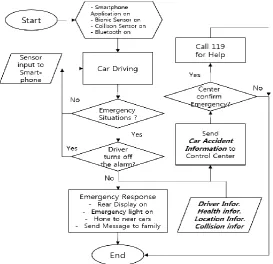
As shown in Figure 4, the proposal App. (application) is pre-installed on the driver's smartphone and runs a Bluetooth connection. The smartphone continuously reads the values of the shock sensor in a car and the bionic sensors (pulse/temperature) mounted on the watch in the background-work through Bluetooth. If the sensor value exceeds the preset shock threshold or below the reference pulse value / body temperature during monitoring process, the alarm window will be displayed on the screen of the smartphone together with a warning sound. If an emergency alarm rings and the user does not turn off the alarm for a certain period of time, it can be judged as a big emergency
situation. On the other hand, if the alarm is turned off in time, it can be disregarded or determined as a minor accident.
[image:3.595.166.440.323.587.2]Table 1:Emergency Response Service
No Name Contents
1 2 3 4
Hazard light Emergency car horn Vehicle rear display Emergency message
Notify emergency to nearby cars with hazard light Notify emergency to nearby cars with car hone Notify emergency to nearby cars with rear display Send emergency message to pre-stored telephone numbers
If the driver is not able to turn off the alarm even though the alarm has sounded inside the vehicle due to a car accident, it can be judged that the driver is injured greatly or is stunned. At this time, the car accident messages automatically sent to the control center for effective emergency relief are shown in Table 2. In particular, driver’s health information, location information, and impact intensity information will help speedy and efficient relief efforts.
In order to prevent unnecessary contact with the 119 (emergency rescue team), the central control center confirms in advance based on the received emergency car accident information (Table 2), and calls 119 when it is judged to be an urgent accident. If it is not an urgent accident, it will be enough to contact the local police station to give help with the accident.
Table 2:Emergency Car Accident Information
No Name Contents
1 2 3 4 Driver Information Health Information Location Information Accident Information
Individual information of driver (age, sex, phone num. etc.) Health information of driver (chronic disease or heart stroke etc.)
GPS information of car accident
Severity information of car accident (collision strength)
B. New Flashing Pattern of Hazard Light for the Proposed System
In this section, we propose hazard lights with new blink patterns that are different from existing emergency blinkers used for various semantics, so as to quickly inform nearby vehicles that the serious health problem of driver occur.
[image:4.595.70.526.425.515.2]Table 3 shows a flashing pattern that operates differently from a normal emergency flashing pattern (repeatedly execute). Through this, it becomes possible to notify the rear vehicles that there is a serious problem in the health of the driver ahead.
Table 3:Proposed Flashing Pattern of Hazard Light
Proposed system Conventional system
Left Light Right Light Duration [sec.]
(On/Off) Left Light Right Light
Duration [sec.] (On/Off) O X O O X O O O 0.6/0.4 0.6/0.4 0.6/0.4 0.6/0.4 O O O O O O O O 0.6/0.4 0.6/0.4 0.6/0.4 0.6/0.4
Unlike the existing e-Call system, the proposed emergency call system can be economically implemented with smart phones and simple wearable biosensors and collision sensors already possessed by most drivers, so it can be applied to elderly drivers who have difficulties responding economically in a short time.
IV. IMPLEMENTATION OF SMART EMERGENCY CALL
SYSTEM FOR ELDERLY DRIVERS
In this chapter, Smart Emergency Call System was actually implemented using Arduino-based sensor, RC-car and smartphone, and we confirm the feasibility of the proposed system through the result.
A. H/W Implementation of Smart Emergency Call System as a Prototype
In this section, we completed the prototype for testing the proposed system using wearable biosensor and RC-car.
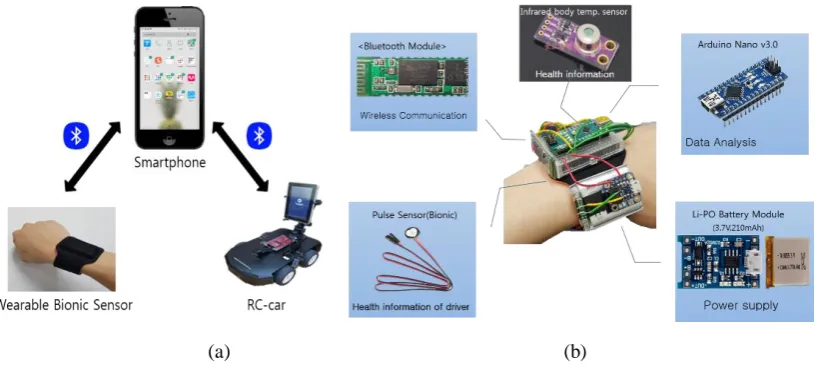
First, as shown in figure 5 (a), the RC-car which includes a
shock sensor and other reaction devices, a wearable wristwatch including a biosensor, are wirelessly connected to the smartphone through Bluetooth.
Figure 5 (b) shows a wearable wristwatch including a pulse sensor and a temperature sensor for measuring sudden health problems in the elderly. To make the device small enough, Arduino Nano is introduced to receive input from pulse sensor and body temperature sensor, and transmits biometric sensor value to smart phone through Bluetooth module. Especially, when the heart rate measurement value (𝑉𝑎𝑙𝑝𝑢𝑙𝑠𝑒)
is less than 60 bpm (70 ~ 100 bpm for normal person) and body temperature value (𝑉𝑎𝑙𝑡𝑒𝑚𝑝𝑒𝑟𝑎𝑡𝑢𝑟𝑒) is less than 35 ℃ (36
~ 37 ℃ for normal person), it is judged that the driver's health is abnormal. The criterion for determining the health problem of older drivers is shown in Equation 1.
International Journal of Innovative Technology and Exploring Engineering (IJITEE) ISSN: 2278-3075,Volume-8 Issue-8S2, June 2019
(a) (b)
Figure 5.H/W implementation for smart emergency call system (a) Configuration of the proposed system and connection method, (b) Wearable bionic sensor device for driver and its components
Figure 6 shows the Arduino-based RC-car which includes impact sensors to detect accident and response sensors to alert emergency situations. The RC-car, which replaces the elderly driver's car, can determine the impact and strength of the vehicle through infrared shock sensor (infrared non-contact type) and physical impact sensors. In order to respond to emergency call notifications from the smartphone,
[image:5.595.112.520.54.237.2]a LCD display, a buzzer, and a flashing emergency light were attached to the back of the vehicle. Through this prototype, the impact information can be transmitted to the smartphone via Bluetooth. In response to the emergency response request of the smartphone, the character display can be posted on the rear LCD display, blinking emergency light, and beeping sound.
Figure 6.HW component of the prototype (RC-car) for Smart Emergency Call System
B. S/W Implementation of Smart Emergency Call System as a Smartphone App.
In this section, we developed a smartphone App. that communicates with the wearable bionic sensor and RC-car to gather health information of the driver and collision information of the vehicle, and to automatically contact the family and emergency service center (119) in an emergency. Figure 7 is a Semyung Emergency Call (SEC) program developed as a smart phone application. First, Figure 7 (a) shows the start screen, and personal information, vehicle information, emergency contact, etc. which are registered in the three icons below. If a strong shock is applied to the outside of the RC-car or if the measured value of the wearable biosensor is lower than the threshold value, it is judged that the driver is in an emergency situation, so that the alarm sounds for a specified time (10 seconds in the example).
Figure 7 (b) shows the situation where the alarm sounds on the smartphone.
[image:5.595.159.451.382.561.2](a) (b) (c) (d) Figure 7.Screenshot of the Smart-phone Application for the Proposed System (a) Initial Screen of the Proposed App. including Registration Icon, (b) Screenshot of Alarm ringing due to Emergency Situation, (c) How to Turn-off Alarm,
(d) Emergency Relief Letter to family or friends (Pre-registered phone number) V. CONCLUSION
Unlike ordinary people, elderly drivers may experience sudden health deterioration, and such consequence may be dangerous to life as well as secondary car accident if not taken care of quickly in the event of a traffic accident. Therefore, in this paper, we propose a Smart Emergency Call System that automatically detects sudden health deterioration and collision situations considering the characteristics of older drivers, notifies emergency situations to nearby vehicles and sends emergency letter to emergency control center according to their severity. In order to prevent the dispatch of unnecessary 119 rescue team, the emergency situation is judged to be handled only when the driver could not turn off the alarm inside the vehicle. Also, we proposed pattern of the flashing for the emergency light by which it is possible to induce emergency relief by effectively informing the surrounding vehicles of the emergency situation of the aged driver.
In addition, by developing the Arduino-based RC-car prototype and the smartphone App. for emergency relief, we have proven that the proposed system is available to the general public at an affordable price. If the proposed system is applied as a Korean e-Call service in the future, we believe that it will contribute to minimizing human injury and reducing the cost of social loss through rapid relief in case of traffic accident and prevention of second traffic accident.
ACKNOWLEDGMENT
This work was supported by the 2018 National Research Foundation of Korea (NRF) grant funded by the Korea
government (Ministry of Education) (NRF-
2016R1D1A1B03930282).
REFERENCES
1. J. W. Son and J. Y. Suh, “Design considerations for the older population: A human-vehicle interface perspective,” 2011
International Symposium on Humanities, Science and Engineering Research, 2011, pp. 8–12.
2. D. W. Koh and H. B. Kang, “Smartphone-based modeling and detection of aggressiveness reactions in senior drivers,” 2015 IEEE Intelligent Vehicles Symposium (IV), 2015, pp. 12-17.
3. Z. H. Roslan and M. G. Cho, “A Study on the Traffic Light Identification and Guidance System for the Elderly Drivers,” 2018 Tenth International
Conference on Ubiquitous and Future Networks (ICUFN), 2018, pp. 763–764.
4. S. H. Hong, S. Y. Min, B. S. Kim, Y. K. Min, J. K. Kang and B. C. Min, “Difference of driving performance according to turn types at the intersection and age,” 2009 International Conference on Mechatronics and Automation, 2009, pp. 16-19.
5. L. H. Chen and P. Wang, “Risk factor analysis of traffic accident for different age group based on adaptive boosting,” 2017 4th International Conference on Transportation Information and Safety (ICTIS), 2017, pp. 812-817.
6. Y. Nakano, S. Sano, Y. Yamakage, T. Kojima, C. Kishi, C. Rakahasi, et al, “Assessment and prediction of older drivers' driving performance,” 2014 IEEE Intelligent Vehicles Symposium Proceedings, 2014, pp. 164-169.
7. S. H. Sankar, K. Jayadev, B. Suraj and P. Aparna, “A comprehensive solution to road traffic accident detection and ambulance management,” 2016 International Conference on Advances in Electrical, Electronic and Systems Engineering (ICAEES), 2016, pp. 43-47.
8. S. Wadhwa, P, Wadhwa, S. Mirchandani and R Joseph, “Optimized rescue system for accidents and emergencies,” 2017 2nd International Conference on Communication and Electronics Systems (ICCES), 2017, pp. 555-559.
9. X. A. Fan, L. Bi and Z. Wang, “Detecting Emergency Situations by Monitoring Drivers' States from EEG,” 2012 ICME International Conference on Complex Medical Engineering (CME), 2012, pp. 245-248.
10. J. F. Coughlin, B. Reimer and B. Mehler, “Monitoring, managing, and motivating driver safety and well-being,” IEEE Pervasive Computing , 2011, pp. 14-21.
11. K. C. Kavitha and R. Perumalraja, “Smart Wireless Healthcare Monitoring for Drivers Community,” 2014 International Conference on Communication and Signal Processing, 2014, pp. 1105-1108. 12. R. Oorni and A. Goulart, “In-Vehicle Emergency Call Services: eCall
and Beyond,” IEEE Communications Magazine, 2017, pp. 159-165. 13. C. Pinart, J. C. Calvo, L. Nichoison, J. A. Villaverde, “ECall-compliant
early crash notification service for portable and nomadic devices,” VTC Spring 2009 - IEEE 69th Vehicular Technology Conference, 2017, pp. 1-5.
14. S. Bonyar, A. Bonyár, A. Géczy, O. Krammer, H. Sántha, B. C. Illés, et al, “A Review on Current eCall Systems for Autonomous Car Accident Detection,” 2017 40th International Spring Seminar on Electronics Technology (ISSE), 2017, pp. 1-8.
15. J. Howcroft, B. Wallace, R. Goubran, S. Marshall, M. M. Porter and F. Knoefel, “Driving Destination Measures in Older Adult Drivers with Differing Health Statuses,” 2018 IEEE International Symposium on Medical Measurements and Applications (MeMeA), 2018, pp. 1-5. 16. V. Trieu, S. Park and J. Mcfadden, “Exploring older driver crash trend -
Please Enter Title Name of Your Paper
AUTHORSPROFILE
![Figure 1.Communication and Network Architecture of the Driver’s e-Healthcare Monitoring System[11]](https://thumb-us.123doks.com/thumbv2/123dok_us/8198044.259963/2.595.47.293.548.713/figure-communication-network-architecture-driver-s-healthcare-monitoring.webp)