Abstract:. Vitality effectiveness is the most testing theme in Wireless Sensor Networks (WSN). As a result of the expanding requests of different applications, and the requirements of vitality, memory and computational intensity of the WSN hubs, numerous thinks about have concentrated on these territories as of late. Specialists have proposed an assortment of conventions, for example, LEACH, PEGASIS and so forth.
In this Manuscript, we will talk about how vitality proficiency is influenced by scaling, for example distinctive system sizes, and by various steering calculations. With the expanding utilizations of substantial scale WSNs, for example, savvy framework and ecological observing. This manuscript proposes another steering calculation to enhance the vitality proficiency by decreasing the number and absolute transmissions remove so as to spare vitality. Reproductions propose that the proposed calculation will be more vitality proficient in medium to vast scale remote sensor systems. Kinds of sensors which are utilized to send and get information through the remote system. Since sensors might be conveyed haphazardly, WSNs don't have a fixed framework and there is no very much characterized brought together sorting out system.
Index Terms: About four key words or phrases in alphabetical order, separated by commas.
I. INTRODUCTION
WSNs are likewise unique in relation to conventional wired information correspondence systems in light of the fact that the sensors are thickly conveyed, and hubs might be effectively harmed in some dangerous conditions. The sensor topology may change from time to time, hubs may fall flat or be moved, and therefore the connections between hubs are liable to change. In this manner, keeping up a stable remote sensor systems is a difficult errand and it requires a develop checking and control technique.
Remote sensor organize applications are very board running from brilliant matrix, military, medicinal services, following, common, modern parts, natural observing and control. In most applications, a remote sensor system may comprise of hundreds or even a great many sensor hubs. In view of their expanding use, and imperatives of constrained vitality source, memory and computational intensity of WSN hubs, there are numerous examinations in these related regions in ongoing years. Vitality productivity is the most testing subject in remote sensor arrange. This is on the grounds that sensors are fueled by battery and are required to run remotely for an extensive stretch of time without human physical connection. In this way, it is hard to supplant or energize batteries particularly when they are broadly sent in remote areas.
Revised Manuscript Received on August 05, 2019.
Manish Bhardwaj, Computer Science and Engineering, KIET Group of Institutions, Ghaziabad, India.
Prof. Anil Ahlawat, Computer Science and Engineering, KIET Group of Institutions, Ghaziabad, India.
Each hub utilizes battery control for its sensors, correspondence with different hubs and microchip calculations. These hubs have constrained vitality control, low capacity size, and restricted transfer speed for correspondence. Before, there are dependably thinks about concentrating on vitality productivity of remote sensor organize. Numerous scientists are buckling down on sparing the vitality utilizations on remote sensor organize so as to augment the lifetime of the system.
In this paper, we will propose another steering calculation for remote sensor systems with vitality proficiency as the essential thought. The new proposed calculation will be thought about with existing calculations as for system quality and vigor of the remote sensor arrange. Distinctive system sizes will be considered. It is normal that the plan of the steering calculation and convention systems will feature significant choice focuses in dealing with the confused remote sensor arrange condition by adjusting the influencing components to improve the strength of a system. In this way, numerous expansive scale WSNs would require effective calculation to tackle the lack of quality issues of the remote sensor organizes in a viable manner. Subsequently, vitality proficiency is a noteworthy concern.
II. FOUNDATIONS OF WSNS
A. Progressive Routing Algorithms
Progressive steering calculations in WSNs have been considered from an assortment of edges. A typical strategy is grouping, for example separating sensor hubs into gatherings. This is a ordinarily utilized information correspondence method to decrease the vitality utilization by sending information from sensors to a base station. In various leveled bunching, the entire sensor organize is partitioned into various bunches or different layers. Transmission inside a bunch is facilitated by each group head which is additionally mindful of directing between bunches or base stations. Information heads out starting with one dimension then onto the next empowering it to travel longer separations. This can make the information correspondence happen quicker and more vitality effective. Along these lines, grouping gives information total points of interest among group heads at distinctive dimensions so as to improve the execution of the entire remote sensor arrange.
Single Hop Transmission - Cluster head will send information to the base station straightforwardly without going through other group heads. It is the least complex
Prolong Lifetime of Wireless Sensor Network
Using Reliable Power Grouping Algorithm
transmission strategy without the need to think about other data. Notwithstanding, it may not be appropriate for expansive scale organize in light of the fact that there is a transmission separate restriction with sensors, and they are not permitted to transmit information outside a specific range. Regardless of whether the information can be transmitted, it might lead an overwhelming weight on the group head in light of the fact that the vitality utilization is legitimately corresponding to the separation, what's more, it is more regrettable for long separation transmissions.
Various Hop Transmissions: Cluster heads will send information to the following bunch head(s) until the base station is come to. This technique can separate a solitary long separation into different shorter separations for transmissions. This can share the loadings among group heads, and it is progressively reasonable for expansive scale systems. Notwithstanding, a reasonable directing strategy is required on the grounds that vitality will be squandered for superfluous transmissions.
B. Common Progressive Routing Algorithms
LEACH- Every hub has an equivalent opportunity to go about as a group head. Be that as it may, because of single-jump steering, the group heads will devour a ton of vitality when they are situated far from the base station and it isn't appropriate for extensive scale applications. In addition, LEACH may not ensure a reasonable and uniform bunch head circulation since group heads is chosen haphazardly.
PEGASIS - This calculation limits the quantity of information exchanges by utilizing the information collection technique through a chain. Notwithstanding, vitality is required to gather the area of sensors so as to locate the following jump. Additionally, a period deferral may happen because of information going through numerous hubs.
TEEN - It lessens the quantity of transmissions dependent on degrees of intrigue and level of changes so as to spare vitality. This calculation can control the exchange off between vitality productivity and information exactness, and in this way it is reasonable for substantial scale systems. Notwithstanding, the system will back off in the event that the limit estimations of intrigue and change are not gotten.
In this manner, if the information necessities are excessively high, a postpone will happen particularly when intermittent information is required.
HEED - It can adjust the vitality stacking among various sensor hubs by using and following leftover vitality. Anyway some vitality will be required to convey the data about the measure of leftover vitality and the hubs' areas.
C. Acceptance Issues of WSN
There are a few criteria to decide a hearty remote sensor organize as expressed, the level of significance of the criteria might be changed because of various applications:
Proficient power use - Reduce the vitality utilizations of each sensor hubs and expand the lifetime of the entirety organize.
Adaptability - Since the utilizations of remote sensor systems go crosswise over various controls, the quantity of
sensor hubs sent in a remote sensor system can fluctuate from tens, hundreds, or even thousands. Hence, when structuring steering calculations, they ought to be versatile crosswise over various arrange sizes.
Unwavering quality - This is additionally a basic factor for assessing the achievement of a remote sensor organize. Essentially, dependability is likewise identified with the power utilization in such a case that the sensors hubs bite the dust in all respects immediately, at that point the sensor hub can't transmit information. Furthermore, if the dead hub is a bunch head, the entirety bunch's execution will be influenced. Unwavering quality endures, since the effective conveyance proportion will decrease. Moreover, unwavering quality is influenced by the blockage control system of the steering calculation.
Self-association - After the sensor hubs are conveyed in the system, they ought to have the capacity to re-arrange themselves in instance of hub disappointment or changes inside the system.
Flexibility - In sensor systems, sensor hubs can join or leave a group in various emphasess, which will change the hub thickness and system topology of the recently framed bunch. Along these lines, organize directing calculations utilized for sensor systems should be sufficiently adaptable to provide food for the continuous changes in group enrollment.
III. PROPOSED REALIABLE POWER
GROUPING ALGORITHM
In this manuscript, we will propose an Reliable Power Grouping Algorithm to advance the vitality proficiency of the entire system. As the remote sensor systems are connected to extensive scale remote sensor organizes quickly these days, the plan of our calculation will put more accentuation on it and limit the vitality utilization of long separation transmission.
We will attempt to decide whether our steering calculation is appropriate for little, medium and substantial scale organizes by looking at it with different calculations i.e.: single jump and various bounce with most brief separation to next bounce transmission calculations.
A. Suppositions of our WSN Model
• There is a base station (BS) in the WSN, and its stockpiling, correspondence and calculation assets are boundless.
• The sensors hubs are haphazardly appropriated. • The vitality of each sensor hub is introduced to the
same consistent esteem
• The sensors are arbitrarily dispersed and static. • The sensor hubs are assembled into bunches, and
B. Cluster Formation Algorithm
Cluster development depends on the rest of the vitality and hub thickness, separates among hubs and separations to the base station. The rest of the vitality will be utilized in the choice of the bunch head. The bunch head's job will pivot if its vitality falls underneath an edge. Coming up next is the flowchart for our proposed bunch development calculation:
1. Start
2. Initialized Value 3. If (CH Power is low)
4. Check Hub Power> Threshold Power 5. Otherwise go to step 10
6. If (Hub power> Threshold power) 7. Hub is CH otherwise Cluster member 8. All Hubs Checked otherwise go to step 10 9. goto step 6
10. END
In the first place, the normal least required vitality of a bunch head and group individuals and the all out number of sensor hubs are gone into the framework. While it is the first round of Cluster Head choice or the bunch head's outstanding vitality not exactly the required esteem. The base station will compute the normal vitality, E-normal, of the present system.
In the event that the vitality of the hub is more prominent than E-normal, at that point that specific hub gets the opportunity to be chosen as a group head also, will be put into the Cluster Head hopeful rundown. Something else, it will be considered as an ordinary hub.
1. Start
2. Count Hubs within Cluster area
3. Calculate Distance from Cluster Members 4. Calculate Distance to Base Station 5. Highest Power Level will be CH Head 6. Hubs Joined the CH with Shortest Distance 7. If Cluster Size Exceed otherwise go to step 9 8. Add one more Cluster go to step 5
9. END
Next, the framework extricates the sensor hubs from the bunch head hopeful rundown, and figures the quantity of hubs inside the ideal bunch region. It will at that point update the group heads applicant list.
Moreover, it gauges the centrality by figuring the aggregate separations from the applicant individuals and the group head, it additionally measure the nearness to the information sink by computing the combined separation from the group head to the base station. The competitor with most astounding qualification esteem will be the group heads.
To join a Cluster, each sensor hub ascertains its separation between all bunch heads and the base station. In the event that the separation to the Base Station is the most limited, at that point the sensor hub does NOT join any group. Something else, the sensor hub will join the group with the most brief separation, and the framework will refresh the participation of the groups. The joining bunch procedure will proceed until all sensor hubs are considered. On the off chance that the quantity of sensors inside a group
surpasses the most extreme part estimate, at that point allot one more bunch head for the gathering dependent on the applicant list.
[image:3.595.317.538.227.365.2]Multi-Hop reliable Power Distance Routing Algorithm To spare vitality, we partition the system into different bunches where the group head hub gathers and totals data from its neighbors and conveys the synopsis through least number of bounces to the base station to stay away from excess transmissions and spare correspondence costs. Nonetheless, if a sensor hub is near the base station, it can send information to the base station straightforwardly and in this way additionally spare vitality. The following is the outline for our proposed directing calculation:
Figure 1: Multiple Hop Transmission with Reliable Power Disatnce
Group heads will sit tight for a fixed timeframe or for a certain message size to collect before beginning a transmission. In the event that the separation to the base station is shorter than other group heads, information will be sent to base station legitimately.
Else, it will separate the group heads data from the database. It chooses the following focused on group heads inside its vitality effective transmission go and furthermore nearest to the base station. It at that point appraises the vitality utilized for information transmission of both group heads. On the off chance that the rest of the vitality is sufficient for both bunch heads, it will send the information, and update the remaining vitality of the group heads The vitality expended for a sensor to transmit N-bits information over M meters depends on the First Order Radio Model:
Etrans(N,M)=Es * N+ Eeo * N * M2, M<=M0 (1)
Etrans(N,M)= Es * N + Eem * N * M4, M>M0 (2)
M0= √(Eeo/Eem) (3)
Eeo= required vitality for enhancement of transmitted signs to transmit a one piece in open space.
Eem= required vitality for enhancement of transmitted signs to transmit a one piece in multi way models
The vitality is expended for a sensor to get N-bits information
Erec(N)= Eem * N (4)
IV. RESULTS AND ANALYSIS
[image:4.595.44.296.171.304.2]The underlying settings of the parameters are depicted in Table 1, and the conditions of the WSN are referenced above.
Table 1: Simulations Parameters
Network Size
100 *100 m (small) 250 * 250 m (Medium) 400 * 400 m (Large)
No. of Hubs 80
Initial Vitality of nodes 0.5 J
Eem 0.0013pJ/bit/m
Eeo 10pJ/bit/m
Es 50nJ/bit
In our reproductions, we have broke down the three directing calculations in three distinct sizes of network sizes (100 x 100 m, 250 x 250 m, and 400 x 400 m).
• Single jump
• Multiple jumps with most brief separation to next bounce
[image:4.595.305.548.193.386.2]• Multiple bounces with vitality proficient separation
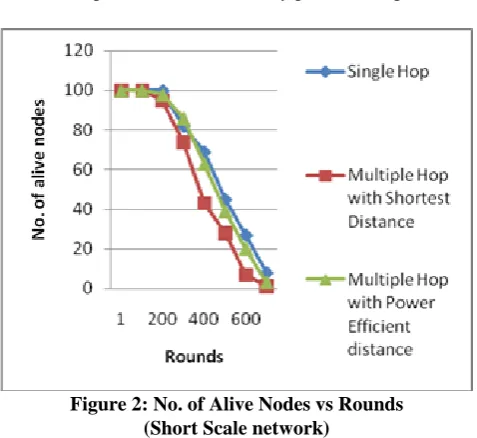
Figure 2: No. of Alive Nodes vs Rounds (Short Scale network)
We have discovered that solitary jump transmission is better in a little scale arrange (100 x 100 m). This is on the grounds that the separation between the base station and hubs is short, and direct transmission to the base station is as of now adequate to spare vitality. Despite what might be
expected, if numerous jump transmission is utilized in a little scale arrange, vitality will be squandered as a result of something else transmissions than should be expected between the group heads.
This squandered vitality picks up conspicuousness when performing directing dependent on 'most limited separation to the following jump' on the grounds that short separation to the following jump does not generally result in the most brief by and large transmission remove. In this manner, vitality might be squandered for pointless transmissions.
Figure 3: No.of Alive Hubs vs Rounds (Medium Scale Network)
For medium scale systems (250 x 250 m), single jump transmission is the most pessimistic scenario in light of the fact that the separation between the base station and hubs are longer, and more vitality is expended. In this manner, the hubs are drained all the more rapidly right off the bat in the reenactment contrasted with different jump transmissions.
Then again, for numerous bounces transmission, the transmission with vitality productive separation is superior to most brief separation to the following bounce. They performed comparatively in the beginning period, yet the hubs in transmission with most limited separate terminated rapidly a while later. This is on the grounds that a higher number of transmissions will result while steering transmissions in light of the 'most limited separation to the following bounce' criteria for example vitality will be squandered for superfluous transmissions.
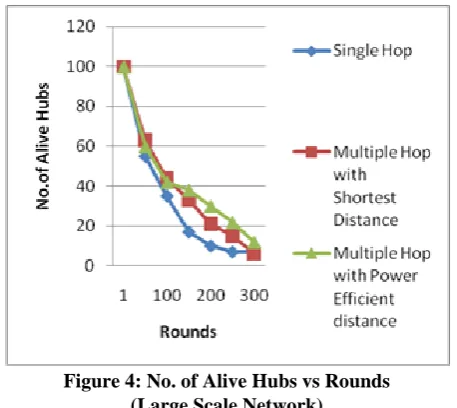
[image:4.595.50.289.398.617.2]Figure 4: No. of Alive Hubs vs Rounds (Large Scale Network)
Besides, transmissions with vitality productive separation is superior to anything most limited next bounce remove since it can decrease the number of transmissions between group heads and with the thought of vitality utilized dependent on the vitality effective separate.
V. CONCLUSION AND FUTURE WORK
In view of manuscript discoveries, we can presume that solitary jump is useful for little scale systems in light of the fact that immediate transmissions by singular hubs should be possible without superfluous transmissions. Be that as it may, for medium and substantial scale organizes, various jump transmission is progressively appropriate in light of the fact that a solitary long remove transmission can be separated into pieces and the vitality utilization can be shared among all group heads.
This manuscript discovered that directing with 'vitality effective separation' way is superior to the 'most brief separation to the following bounce' calculation. This is on the grounds that some vitality will be squandered for pointless transmissions when utilizing the most brief next jump remove strategy. In the 'most brief separation to the following bounce' framework, the separation the following group head is limited however this may even now result in a more drawn out in general way and require more vitality than the option 'vitality proficient separation' way.
This manuscript propose a vitality effective transmission separate calculation in which the group head will locate the following jump which is nearest to the base station and furthermore inside the vitality effective transmission extend. It is proposed this will lessen the vitality utilizations and the quantity of transmissions also. From starting reenactments, the proposed directing calculation performs better in medium and huge scale remote sensor systems.
REFERENCES
1. I.F. Akyilidiz, W. Su, Y. Sankarasubramaniam, and E.Cayirci,
“Wireless sensor networks: A survey,” Computer Networks, vol.38, no. 4, pp. 393-422, March 2002.
2. M. Xiaofeng, Y. Min, M. Dilin, “Application overview of
wireless sensor networks,” Computer application and software, vol. 25, no. 3, pp. 179-181, March 2008.
3. M. Bhardwaj, Prof. A. Ahlawat, Nidhi Bansal," International
Journal of Engineering & Technology", Vol 3, pp 380-383, 2018.
4. M. Bhardwaj, A. Ahalawat (2019) Improvement of Lifespan
of Ad hoc Network with Congestion Control and Magnetic Resonance Concept. In: Bhattacharyya S., Hassanien A., Gupta D., Khanna A., Pan I. (eds) International Conference on Innovative Computing and Communications. Lecture Notes in Networks and Systems, vol 55. Springer, Singapore.
5. Mehra, Manoj, and Poonam Dabas. "Energy Efficient Secure
Routing Protocol (EESRP) in Wireless Sensor Network." International Journal for Innovative Research in Science and Technology 2.3 (2015): 29-33.
6. N. Geetha, A. Sankar, and P. B. Pankajavalli. "Energy
Efficient Routing Protocol for Wireless Sensor Networks-An Eco-Friendly Approach." Proceedings of the 2014 3rd International Conference on Eco-friendly Computing and Communication Systems. IEEE Computer Society, 2014.
7. M. Bhardwaj, Prof. A. Ahlawat, " Prolong Lifespan of
Wireless Sensor Network with Optimized Information Compression Algorithm and Magnetic Resonant Concept", Advances in Computer Science Research, Volume 80, China, 2018.
8. M. Bhardwaj, A. Ahlawat, “Reduce Energy Consumption in
Ad hoc Network with Wireless Power Transfer Concept “, International Journal of Control Theory and Applications, Vol. 10, Issue 13, 2017.
9. Pantazis, Nikolaos, Stefanos A. Nikolidakis, and Dimitrios D.
Vergados. "Energy-efficient routing protocols in wireless sensor networks: A survey." Communications Surveys & Tutorials, IEEE 15.2 (2013): 551-591.
10. Singh, Shio Kumar, M. P. Singh, and D. K. Singh. "Routing
protocols in wireless sensor networks–A survey."
International Journal of Computer Science & Engineering Survey (IJCSES) Vol 1 (2010): 63-83.
11. M. Bhardwaj, Prof. A. Ahlawat," Optimization of Network
Lifetime with Extreme Lifetime Control Proficient Steering Algorithm and Remote Power Transfer", International Conference on Mathematics, Modelling and Simulation Technologies and Applications (MMSTA 2017), ISBN: 978-1-60595-530-8, China, 2017.
12. M. Bhardwaj, Prof. A. Ahlawat, "Enhance Lifespan of WSN
Using Power Proficient Data Gathering Algorithm and WPT", 2nd International Conference of Wireless Communication and Network Engineering (WCNE 2017)", ISBN: 978-1-60595-531-5, China, 2017.
13. Biradar, Rajashree V., et al. "Classification and comparison of
routing protocols in wireless sensor networks." Ubicc journal 4 (2009): 704-711.
14. Liu, Xuxun. "A survey on clustering routing protocols in
wireless sensor networks." Sensors 12.8 (2012): 11113-11153.
15. Younis, Ossama, and Sonia Fahmy. “HEED: a hybrid,
energy-efficient, distributed clustering approach for ad hoc sensor networks”, Mobile Computing, IEEE Transactions on 3.4 (2004): 366-379.
AUTHORS PROFILE
contributing his enormous research works in the area of Computer Science, Simulations, Mobile Ad hoc network protocols, Wireless Sensor Networks. He has published nearly 40 Research papers in various International Journals/Conferences. He is also contributing in Various International Conferences and Journals as General Chair/Guest Editors, International Scientific Committee members and Editorial Board Member/Reviewers in reputed Journals like IEEE, Springer.