• No results found

Atomic data for astrophysics : Fe IX

N/A
N/A
Protected

Academic year: 2019

Share "Atomic data for astrophysics : Fe IX"

Copied!
11
0
0

Loading.... (view fulltext now)

Full text

(1)

Astronomy & Astrophysicsmanuscript no. paper˙rev2 c ESO 2014 February 18, 2014

Atomic Data for Astrophysics: Fe

ix

G. Del Zanna

1

, P. J. Storey

2

, N. R. Badnell

3

, and H. E. Mason

1

1 DAMTP, Centre for Mathematical Sciences, Wilberforce Road, Cambridge, CB3 0WA, UK

2 Department of Physics and Astronomy, University College London, Gower Street, London, WC1E 6BT, UK 3 Department of Physics, University of Strathclyde, Glasgow, G4 0NG, UK

Received ; accepted

ABSTRACT

We present the results of a new large-scale intermediate-coupling frame transformation R-matrix scattering calculation for electron collisional excitation of Feix. The target includes all the main configurations up to n = 5, to improve our earlier R-matrix and

distorted-wave (DW) calculations for the n=3,4 levels. Unlike similar calculations which we carried out for the other coronal iron ions, in this case the larger target does not significantly affect the collision strengths of the strongest transitions to the n=3,4 levels. Some differences are however present for a few transitions, in particular for the 3d–4p line at 197.86 Å. For the weaker transitions, significant enhancements due to extra resonances resulting from this much bigger target are found. Several new line identifications are suggested. We find excellent agreement between predicted and observed line intensities in the EUV (Hinode EIS) showing that Feixlines provide a reliable temperature diagnostic. We also show that the visible forbidden lines are a good diagnostic to measure

electron densities.

Key words.Atomic data – Line: identification – Sun: corona – Techniques: spectroscopic

1. Introduction

Feixproduces several strong EUV transitions important for so-lar physics applications. The main resonance line from the 3s2 3p5 3d configuration is the strongest coronal EUV line in the

quiet Sun, at 171 Å. A few EUV transitions from the 3s23p43d2

and 3s23p54p configurations were recently identified by Young (2009) using data from the Hinode EUV Imaging Spectrometer (EIS, see Culhane et al. 2007), although several of them appear to be blended (Del Zanna 2012b, 2013). Decays from the other n =4 and the n=5 configurations fall in the soft X-ray wave-length range (50–170 Å). The soft X-ray spectrum of the quiet and active Sun is rich in n=4→n=3 transitions from highly ionised iron ions, from Feviito Fexvi(see, e.g. Fawcett et al. 1968). Atomic data currently available for this spectral range is still lacking and a large number of spectral lines still await firm identification.

Within the APAP network (www.apap-network.org), we are carrying out a long-term project to calculate accurate atomic data for the soft X-rays. The main problems related to calculating ac-curate atomic data for the n=4 levels are discussed in Del Zanna et al. (2012b), where new large-scale intermediate-coupling frame transformation (ICFT) R-matrix atomic calculations for Fexare presented. Similar work on Fexi, Fexii, and Fexiiihas been presented in Del Zanna & Storey (2013a); Del Zanna et al. (2012a); Del Zanna & Storey (2013b). These new large-scale scattering calculations have shown, for Fex, Fexi, and Fexii, that cascading and resonance excitation due to the larger tar-gets can affect both high- and low-energy levels, by changing the populations (hence the line intensities) by typically 30–40%.

The full dataset (energies, transition probabilities and rates)

are available in electronic form at our APAP website (www.apap-network.org)

There is now interest in various communities in estimates on the accuracy of atomic data (see, e.g. Guennou et al. (2013)). There are clearly various approaches, but carrying out a large-scale calculation and comparing the resulted line intensities with those obtained from smaller targets, as we normally do, provides an indication on the uncertainty in the line intensities. Another indication on the accuracy of the atomic data comes from di-rect comparisons between predicted and observed line intensi-ties. We have carried out this benchmarking process on an ion-by-ion basis for most of the iron ions (see the first paper in the series, Del Zanna et al. 2004), however some comparisons are also included here.

Our previous (jajom+ term coupling) R-matrix scattering calculation for Feix (Storey et al. 2002) focused on the main n=3 levels, but also included the 3s23p54s and 3s23p54p

con-figurations. Later, we also presented distorted wave (DW) scat-tering calculations which included up to n=6 levels (O’Dwyer et al. 2012). These data have been made available via CHIANTI v.7.1 (Landi et al. 2013). A comparison between the DW and the R-matrix results showed that a significant enhancement due to resonances is present in the collision strengths to the 3s2 3p5 4s levels. The 3s23p54p levels were the highest in the previous

R-matrix scattering target for Feix, hence we could not assess if resonances also affected these levels.

The Storey et al. (2002) and O’Dwyer et al. (2012) atomic data for Feixhave been benchmarked against EUV and X-ray observations in Del Zanna (2009a); Young (2009); Del Zanna (2012b); O’Dwyer et al. (2012); Del Zanna (2012a, 2013). Good overall agreement was found, suggesting that these atomic data are reasonably accurate. However, problems in the calibration of soft X-ray spectra (Del Zanna 2012a) and the EUV ones of Hinode EIS (Del Zanna 2013) have been found, hence some pre-vious comparisons are in need of revision.

(2)

an R-matrix scattering calculation for Feixwhich improves on our previous R-matrix calculations for the n=3 and the 3s23p5

4l (l=s,p), by adding the 3s23p54l (l=d,f) levels, as well as the main n=5 configurations.

The paper is organised as follows. In Sect. 2 we outline the methods we adopted for the scattering calculations. In Sect. 3 we present our results and in Sect. 4 we reach our conclusions.

2. Methods

The atomic structure calculations were carried out using theau -tostructureprogram (Badnell 2011), which originated from

thesuperstructureprogram (Eissner et al. 1974), and which constructs target wavefunctions using radial wavefunctions cal-culated in a scaled Thomas-Fermi-Dirac statistical model poten-tial with a set of scaling parameters. The program also provides radiative rates and infinite energy Born limits. These limits are particularly important from two aspects. First, they allow a con-sistency check of the collision strengths in the scaled Burgess & Tully (1992) domain (see also Burgess et al. 1997). Second, they are used in the interpolation of the collision strengths at high en-ergies.

The R-matrix method used in the scattering calculation is described in Hummer et al. (1993) and Berrington et al. (1995). Like the previous work on Fe ix by Storey et al. (2002), a

full Breit-Pauli R-matrix (BPRM) calculation of the size we need to address the issues discussed in the introduction is impractical. Thus, we performed the calculation in the inner region in LS coupling and included mass and Darwin relativistic energy corrections. The main drawback of the (jajom+term

coupling) approach is that only the open–open part of the (physical) reactance (K-) matrix is transformed to take ac-count of spin–orbit mixing in the target. The ICFT method introduced by Griffin et al. (1998) overcomes this drawback by transforming (term-coupling) the entire unphysical K-matrix utilizing multi-channel quantum defect theory for the complete closed-channel description. We note that there is an extended literature where the results of the ICFT and BPRM methods are compared. For example, the original works by Griffin et al. (1998) for Mg-like ions, and Badnell & Griffin (1999) for Niv. More recently, Liang & Badnell (2010)

car-ried out extensive comparisons between ICFT and DARC for Fexviiand Krxxvii, while Liang et al. (2009) made extensive

comparisons between ICFT and DARC (and some BPRM) for Fexvi. No significant differences between the results of

the two methods have been found. The small differences that were found are within the typical spread seen in R-matrix calculations that use different configuration interaction (CI) and/or close-coupling (CC) expansions, and resonance reso-lution.

Dipole-allowed transitions were topped-up to infinite partial wave using an intermediate coupling version of the Coulomb-Bethe method as described by Burgess (1974) while non-dipole allowed transitions were topped-up assuming that the collision strengths form a geometric progression in J (see Badnell & Griffin 2001).

The collision strengths were extended to high energies by interpolation using the appropriate high-energy limits in the Burgess & Tully (1992) scaled domain. The high-energy limits were calculated withautostructurefor both optically-allowed (see Burgess et al. 1997) and non-dipole allowed transitions (see Chidichimo et al. 2003).

We have also carried out Breit-Pauli distorted wave calcula-tions using the recent development of theautostructurecode, described in detail in Badnell (2011).

The temperature-dependent effective collisions strength

Υ(ij) were calculated by assuming a Maxwellian electron dis-tribution and linear integration with the final energy of the col-liding electron.

3. Results

3.1. The target

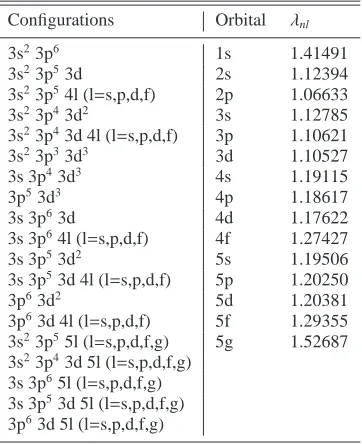
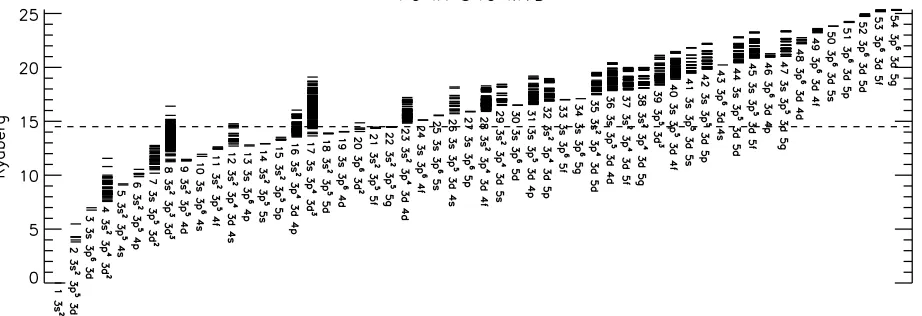
For our configuration basis set we chose the complete set of 54 configurations shown in Fig. 1 and listed in Table 1. They give rise to 1921 LS terms and 4631 fine-structure levels. The scaling parametersλnl for the potentials in which the orbital functions

[image:2.595.311.492.402.624.2]

are calculated are also given in Table 1. The 865 fine-structure levels arising from the (energetically) lowest 358 LS terms were retained for the scattering calculation. They include all the spec-troscopically important n = 4,5 levels. We note that the exci-tations to the last few levels may not be very accurate due to the lack of configuration interaction with absent higher config-urations. We have performed both an ICFT R-matrix and a DW calculation using the same basis. They are both large-scale culations. For example, the target of the previous R-matrix cal-culations (Storey et al. 2002) included only 64 LS terms from the (energetically) lowest six configurations.

Table 1. The target electron configuration basis and orbital scaling

pa-rametersλnlfor the R-matrix and DW runs.

Configurations Orbital λnl

3s23p6 1s 1.41491

3s23p53d 2s 1.12394

3s23p54l (l=s,p,d,f) 2p 1.06633

3s23p43d2 3s 1.12785

3s23p43d 4l (l=s,p,d,f) 3p 1.10621

3s23p33d3 3d 1.10527

3s 3p43d3 4s 1.19115

3p53d3 4p 1.18617

3s 3p63d 4d 1.17622

3s 3p64l (l=s,p,d,f) 4f 1.27427

3s 3p53d2 5s 1.19506

3s 3p53d 4l (l=s,p,d,f) 5p 1.20250

3p63d2 5d 1.20381

3p63d 4l (l=s,p,d,f) 5f 1.29355

3s23p55l (l=s,p,d,f,g) 5g 1.52687

3s23p43d 5l (l=s,p,d,f,g)

3s 3p65l (l=s,p,d,f,g)

3s 3p53d 5l (l=s,p,d,f,g)

3p63d 5l (l=s,p,d,f,g)

Table 2 presents a selection of fine-structure target level ener-gies Et, compared to experimental energies Eexp. A set of ‘best’

energies Eb was obtained with a quadratic fit between the Eexp

and Et values. For the observed levels, most Eb values were

within 0.02 Ryd of the Eexp ones. The Eb values were used

(together with the Eexpones whenever available) within the

(3)
[image:3.595.76.537.55.213.2]

Fig. 1. The term energies of the target levels (54 configurations). The lowest 358 terms which produce levels having energies below the dashed

line have been retained for the close-coupling expansion.

Table 2. Level energies (cm−1) for Feix.

i Conf. Mixing Lev. Eexp Et

1 3s23p6 (96%) 1S

0 0.0 0.0

2 3s23p53d (96%) 3P

0 405772.0 411763.0 (-5991)

3 3s23p53d (95%) 3P

1 408315.1 414513.0 (-6198)

4 3s23p53d (94%) 3P

2 413669.2 420142.0 (-6473)

5 3s23p53d (96%) 3F

4 425809.8 434291.0 (-8481)

6 3s23p53d (91%) 3F

3 429310.9 437720.0 (-8409)

7 3s23p53d (89%) 3F

2 433818.8 442233.0 (-8414)

8 3s23p53d (67%)+12(29%) 3D

3 455612.2 465046.0 (-9434)

9 3s23p53d (60%)+11(28%) 1D

2 456752.7 466514.0 (-9761)

10 3s23p53d (95%) 3D

1 460616.0 469832.0 (-9216)

11 3s23p53d (62%)+9(31%) 3D

2 462616.6 472208.0 (-9591)

12 3s23p53d (64%)+8(27%) 1F

3 465828.4 475387.0 (-9559)

13 3s23p53d (95%) 1P

1 584546.0 601580.0 (-17034)

14 3s 3p63d (77%)+127(c4 13%) 3D

1 726734.0 740251.0 (-13517)

15 3s 3p63d (77%)+129(c4 13%) 3D

2 727560.0 741190.0 (-13630)

16 3s 3p63d (77%)+124(c4 13%) 3D

3 728935.0 742727.0 (-13792)

17 3s 3p63d (71%)+117(c4 14%) 1D

2 749871.0 766202.0 (-16331)

85 3s23p43d2 (45%)+124(29%) 3D

3 927058 968359.0 (-41300) TN

94 3s23p54s (69%)+101(28%) 3P

1 950498.0 998404.0 (-47906)

95 3s23p43d2 (40%)+69(25%)+41(23%) 3G

4 955806.0 1001613.0 (-45807) R

96 3s23p43d2 (23%)+73(27%)+40(44%) 3G

5 956333.0 1001993.0 (-45660) R

97 3s23p43d2 (16%)+67(17%)+42(25%)+99(27%) 3G

3 956814 1002361.0 (-45547) R

101 3s23p54s (69%)+94(28%) 1P

1 965568.0 1013667.0 (-48099)

105 3s23p43d2 (22%)+113(27%)+80(27%)+39(10%) 3F

4 974742 1019230.0 (-44488) TN

110 3s23p43d2 (40%)+85(26%) 3D

3 990957 1037237.0 (-46280) R

111 3s23p43d2 (37%)+83(24%) 3D

2 992399 1038354.0 (-45955) R

118 3s23p43d2 (49%)+45(11%)+39(18%) 3F

4 1020759. 1067893.0 (-47134) TN

148 3s23p54p (91%) 1S

0 1089969.0 1157636.0 (-67667) R

166 3s23p43d2 (54%)+117(22%) 1D

2 1136727 1185857.0 (-49130) TN

207 3s23p54d (70%)+224(24%) 1P

1 1198222.0 1250291.0 (-52069)

224 3s23p54d (67%)+207(23%) 3D

1 1213150.0 1264615.0 (-51465)

256 3s 3p64s (69%)+830(c12 25%) 1S

0 1263552 1310368.0 (-46815) TN

293 3s23p54f (97%) 3D

1 1300923.0 1356738.0 (-55815)

296 3s23p54f (92%) 3D

2 1302841.0 1358711.0 (-55870)

301 3s23p54f (97%) 3G

5 1304598.0 1361221.0 (-56623)

303 3s23p54f (81%) 3D

3 1305762.0 1361814.0 (-56052)

308 3s23p54f (72%)+324(22%) 3G

4 1306319.0 1363201.0 (-56882)

318 3s23p54f (61%)+342(15%)+340(20%) 3G

3 1310158.0 1367121.0 (-56963)

324 3s23p54f (46%)+343(45%) 1G

4 1311755.0 1369566.0 (-57811)

335 3s23p54f (71%)+353(23%) 3F

2 1316758.0 1375707.0 (-58949)

340 3s23p54f (38%)+318(36%)+342(22%) 1F

3 1323657.0 1380225.0 (-56568)

342 3s23p54f (50%)+340(31%)+303(15%) 3F

3 1324715.0 1381539.0 (-56824)

343 3s23p54f (49%)+308(19%)+324(28%) 3F

4 1324876.0 1381731.0 (-56855)

353 3s23p54f (69%)+335(21%) 1D

2 1331244.0 1390132.0 (-58888)

395 3s23p55s (50%)+415(39%) 1P

1 1358363.0 1413670.0 (-55307)

415 3s23p55s (53%)+395(40%) 3P

1 1372683.0 1427126.0 (-54443)

775 3s23p55f (98%) 3G

5 1513000.0 1571754.0 (-58754)

786 3s23p55f (58%)+826(35%) 3F

4 1518650.0 1576087.0 (-57437)

820 3s23p55f (41%)+784(24%)+778(32%) 3F

3 1531107.0 1588550.0 (-57443)

Notes. The experimental level energies Eexpare shown, together with those obtained from our scattering target Et. Values in parentheses

indicate differences with Eexp. Only a selection of levels that have experimental energies is shown. TN indicates a new tentative observed

[image:3.595.136.473.274.706.2]
(4)

We have compared the oscillator strengths of the dipole-allowed transitions with those of the previous R-matrix calcula-tions (Storey et al. 2002). The overview is shown in Fig. 2. Good agreement (to within±30%) is found for transitions within the n=3 complex (black boxes in the figure). Significant disagree-ments (over 100% in some cases) are found for the transi-tions to the n = 4 levels (red stars in the figure). The main differences, considering only the lines with the strongest os-cillator strengths, occur for transitions from several levels which have the highest energies in the previous target, within the 3s23p4 3d2 and 3s23p5 4p configurations. We note that

the previous target was optimized for the n = 3 levels and not the n = 4 ones, so it is not surprising to see such large discrepancies.

Of these transitions, only one is of relevance to astrophys-ical plasmas, since it is the only one with significant inten-sity. It involves the highest level in the previous target (Storey et al. 2002), the 13–148 3s23p53d1P1o–3s23p54p1S0

tran-sition. Note that the upper level is mainly populated via a direct excitation from the ground state, then decays with this dipole-allowed transition to the lower 3s23p53d1P

1level, which,

inter-estingly, then decays to the ground state 3s23p6 1S0giving rise

to the resonance transition at 171 Å. The gf value for the 13–148 transition in length form is 0.19, while in velocity form is 0.10. With our previous target (Storey et al. 2002), the gf value for the same transition was 0.38 (in length; 0.14 in velocity form), i.e. almost a factor of two higher. This difference is mainly due to in-teraction effects among the n =4 configurations, not taken into account in our previous target. We also note that the differences in the targets not only affect the branching ratios of the decays from the the 3s23p54p1S

0level, but also the population of this

level, as discussed below.

Similar discrepancies in the A values for the decays from the 4p1S

0level were also noted by Landi & Young (2009), who

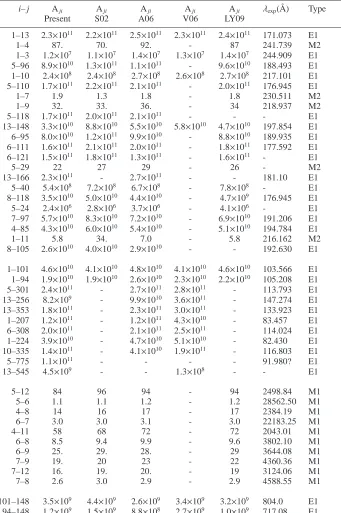
car-ried out a series of structure calculations. Their most extended target, FAC 7, is somewhat different to our present one, but produces A values in close agreement with ours, as shown in Table 3. The same Table shows for comparison other A-values previously calculated. The most complete calculation of radiative rates for this ions was carried out by Aggarwal et al. (2006) with the General purpose Relativistic Atomic Structure Package (grasp). We can see that there is generally

good agreement between the present values and those previ-ously calculated by Aggarwal et al. (2006) with GRASP and by Storey et al. (2002) withsuperstructure.

Verma et al. (2006) produced a large-scale structure cal-culation (including some n = 3,4,5 configurations) using Hibbert’s CIV3 Program and semi-empirical corrections to obtain a good match in level energies for the few that were known at the time. As pointed out by Aggarwal et al. (2006), the A-values calculated by Verma et al. (2006) are sometimes at odds with theirs and the Storey et al. (2002) ones, the dif-ference likely attributable to the omission of the 3s23p33d3, which is important for configuration interaction.

3.2. The scattering calculation

[image:4.595.315.556.58.223.2]

The expansion of each scattered electron partial wave was done over a large basis of 35 functions within the R-matrix boundary and the partial wave expansion extended to a maximum total orbital angular momentum quantum number of L = 16. This produced accurate collision strengths up to 70 Ryd.

Fig. 2. Oscillator strengths compared to those of the (Storey et al. 2002)

target. Boxes: to n = 3 levels. Stars: to n = 4 levels. Dashed lines indicate±30% differences.

The outer region calculation includes exchange up to a to-tal angular momentum quantum number J = 25/2. We have supplemented the exchange contributions with a non-exchange calculation extending from J=27/2 to J=73/2. The outer re-gion exchange calculation was performed in a number of stages. The resonance region itself was calculated with an increasing number of energies, as was done for the Iron Project Fexi cal-culation (Del Zanna et al. 2010). The number of energy points was increased from 800 up to 7200 (equivalent to a uniform step length of 0.00205 Ryd). A coarse energy mesh (0.57 Ryd) was chosen above all resonances, up to 70 Ryd.

We inspected all the collision strengths and their thermal av-erages from the ground configuration in the Burgess & Tully (1992) scaled domain. Excellent agreement between the back-ground R-matrix and the DW collision strengths is found in all cases, as expected. Very good agreement is also found for all the strongest transitions included in the previous R-matrix calcula-tions (Storey et al. 2002), with the exception of the 13–148 3s2 3p5 3d1P

1–3s23p54p1S0transition. This discrepancy was

ex-pected, considering the large differences in the gf values that we have discussed previously.

Fig. 3. Thermally-averaged collision strengthsΥ(Storey et al. 2002 vs. the present ones) for transitions from the lowest 12 levels. Boxes: to n=

[image:4.595.328.544.551.716.2]
(5)
[image:5.595.132.473.81.594.2]

Table 3. Transition probabilities for the main lines.

i– j Aji Aji Aji Aji Aji λexp(Å) Type

Present S02 A06 V06 LY09

1–13 2.3×10¹¹ 2.2×10¹¹ 2.5×10¹¹ 2.3×10¹¹ 2.4×10¹¹ 171.073 E1

1–4 87. 70. 92. - 87 241.739 M2

1–3 1.2×10⁷ 1.1×10⁷ 1.4×10⁷ 1.3×10⁷ 1.4×10⁷ 244.909 E1

5–96 8.9×10¹⁰ 1.3×10¹¹ 1.1×10¹¹ - 9.6×10¹⁰ 188.493 E1

1–10 2.4×10⁸ 2.4×10⁸ 2.7×10⁸ 2.6×10⁸ 2.7×10⁸ 217.101 E1

5–110 1.7×10¹¹ 2.2×10¹¹ 2.1×10¹¹ - 2.0×10¹¹ 176.945 E1

1–7 1.9 1.3 1.8 - 1.8 230.511 M2

1–9 32. 33. 36. - 34 218.937 M2

5–118 1.7×10¹¹ 2.0×10¹¹ 2.1×10¹¹ - - - E1

13–148 3.3×10¹⁰ 8.8×10¹⁰ 5.5×10¹⁰ 5.8×10¹⁰ 4.7×10¹⁰ 197.854 E1

6–95 8.0×10¹⁰ 1.2×10¹¹ 9.9×10¹⁰ - 8.8×10¹⁰ 189.935 E1

6–111 1.6×10¹¹ 2.1×10¹¹ 2.0×10¹¹ - 1.8×10¹¹ 177.592 E1

6–121 1.5×10¹¹ 1.8×10¹¹ 1.3×10¹¹ - 1.6×10¹¹ - E1

5–29 22 27 29 - 26 - M2

13–166 2.3×10¹¹ - 2.7×10¹¹ - - 181.10 E1

5–40 5.4×10⁸ 7.2×10⁸ 6.7×10⁸ - 7.8×10⁸ - E1

8–118 3.5×10¹⁰ 5.0×10¹⁰ 4.4×10¹⁰ - 4.7×10⁹ 176.945 E1

5–24 2.4×10⁶ 2.8×10⁶ 3.7×10⁶ - 4.1×10⁶ - E1

7–97 5.7×10¹⁰ 8.3×10¹⁰ 7.2×10¹⁰ - 6.9×10¹⁰ 191.206 E1

4–85 4.3×10¹⁰ 6.0×10¹⁰ 5.4×10¹⁰ - 5.1×10¹⁰ 194.784 E1

1–11 5.8 34. 7.0 - 5.8 216.162 M2

8–105 2.6×10¹⁰ 4.0×10¹⁰ 2.9×10¹⁰ - - 192.630 E1

1–101 4.6×10¹⁰ 4.1×10¹⁰ 4.8×10¹⁰ 4.1×10¹⁰ 4.6×10¹⁰ 103.566 E1

1–94 1.9×10¹⁰ 1.9×10¹⁰ 2.6×10¹⁰ 2.3×10¹⁰ 2.2×10¹⁰ 105.208 E1

5–301 2.4×10¹¹ - 2.7×10¹¹ 2.8×10¹¹ - 113.793 E1

13–256 8.2×10⁹ - 9.9×10¹⁰ 3.6×10¹¹ - 147.274 E1

13–353 1.8×10¹¹ - 2.3×10¹¹ 3.0×10¹¹ - 133.923 E1

1–207 1.2×10¹¹ - 1.2×10¹¹ 4.3×10¹⁰ - 83.457 E1

6–308 2.0×10¹¹ - 2.1×10¹¹ 2.5×10¹¹ - 114.024 E1

1–224 3.9×10¹⁰ - 4.7×10¹⁰ 5.1×10¹⁰ - 82.430 E1

10–335 1.4×10¹¹ - 4.1×10¹⁰ 1.9×10¹¹ - 116.803 E1

5–775 1.1×10¹¹ - - - - 91.980? E1

13–545 4.5×10⁹ - - 1.3×10⁸ - - E1

5–12 84 96 94 - 94 2498.84 M1

5–6 1.1 1.1 1.2 - 1.2 28562.50 M1

4–8 14 16 17 - 17 2384.19 M1

6–7 3.0 3.0 3.1 - 3.0 22183.25 M1

4–11 58 68 72 - 72 2043.01 M1

6–8 8.5 9.4 9.9 - 9.6 3802.10 M1

6–9 25. 29. 28. - 29 3644.08 M1

7–9 19. 20 23 - 22 4360.36 M1

7–12 16. 19. 20. - 19 3124.06 M1

7–8 2.6 3.0 2.9 - 2.9 4588.55 M1

101–148 3.5×10⁹ 4.4×10⁹ 2.6×10⁹ 3.4×10⁹ 3.2×10⁹ 804.0 E1

94–148 1.2×10⁹ 1.5×10⁹ 8.8×10⁸ 2.7×10⁹ 1.0×10⁹ 717.08 E1

Notes. A values (s−1) are from S02: Storey et al. (2002); A06: Aggarwal et al. (2006); V06: Verma et al. (2006); LY09 Landi & Young (2009),

FAC 7 calculation.

We calculated the thermally-averaged (effective) collision strengths,Υ, and compared them with the previous R-matrix re-sults (Storey et al. 2002). Fig. 3 shows a comparison at log Te

[K]=5.85, the temperature of peak ion abundance in ionization equilibrium, for all transitions from the lowest 12 levels. Most of these are metastable levels, hence these collisions are important in populating the higher levels. As expected, there is an overall scatter for the weaker transitions, and a marked tendency toward

(6)
[image:6.595.349.539.57.210.2]

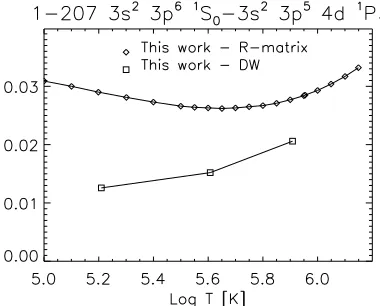
Very good agreement between the two R-matrix results is present, while the DW result is much lower, because is lack-ing the resonance enhancement. The followlack-ing Figures (5,6,7, and 8) show similar comparisons, for a sample of transitions that are of particular importance for populating levels which produce observable lines, as discussed below.

Fig. 4. Thermally-averaged collision strengths for the 1–3 transition

(see text).

[image:6.595.82.270.142.297.2]

3.3. Line intensities

Fig. 5. Thermally-averaged collision strengths for the 1–10 transition

(see text).

We used theautostructure code to calculate all the tran-sition probabilities among all the levels, for the dipole-allowed and forbidden transitions, up to third order multipoles. The ex-perimental energies Eexp, and the best energies Eb were used

when calculating the radiative rates. This is important especially for the forbidden transitions.

[image:6.595.362.537.258.412.2]

We then built two ion population models. The first one con-tained all the R-matrix excitation rates (865 fine-structure lev-els). The second one added excitation rates to all the extra levels that were part of the CI expansion shown in Fig. 1 and Table 1. The collision strengths to these extra levels were calculated with the DW approximation. We then solved for the level population and compared the line intensities of the two models. This was done to see if the extra configurations had any significant effect

Fig. 6. Thermally-averaged collision strengths for the 1–207 transition

(see text). Boxes indicate the DW values.

Fig. 7. Thermally-averaged collision strengths for the 1–13 resonance

transition (see text).

Fig. 8. Thermally-averaged collision strengths for the 1–148 transition

(see text).

(via cascading) to the lower levels included in the CC expansion. We found no significant differences, as expected given that the extra configurations have very small collision strengths, hence have very low populations.

[image:6.595.83.270.399.554.2] [image:6.595.357.540.460.614.2]
(7)

correspond-Table 4. List of the brightest Feixlines.

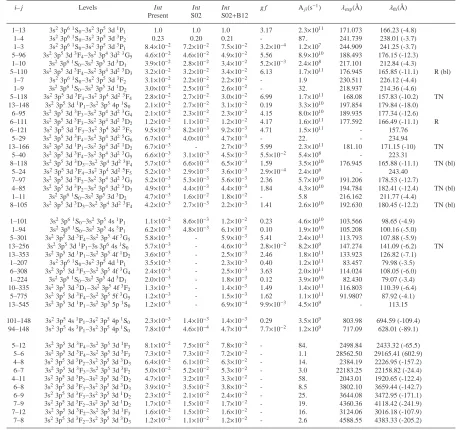
i– j Levels Int Int Int g f Aji(s−1) λexp(Å) λth(Å)

Present S02 S02+B12

1–13 3s23p6 1S

0–3s23p53d1P1 1.0 1.0 1.0 3.17 2.3×10¹¹ 171.073 166.23 (-4.8)

1–4 3s23p6 1S

0–3s23p53d3P2 0.23 0.20 0.21 - 87. 241.739 238.01 (-3.7)

1–3 3s23p6 1S

0–3s23p53d3P1 8.4×10⁻² 7.2×10⁻² 7.5×10⁻² 3.2×10⁻⁴ 1.2×10⁷ 244.909 241.25 (-3.7)

5–96 3s23p53d3F

4–3s23p43d2 3G5 4.6×10⁻² 4.6×10⁻² 4.9×10⁻² 5.56 8.9×10¹⁰ 188.493 176.15 (-12.3)

1–10 3s23p6 1S

0–3s23p53d3D1 3.9×10⁻² 2.8×10⁻² 3.4×10⁻² 5.2×10⁻³ 2.4×10⁸ 217.101 212.84 (-4.3)

5–110 3s23p53d3F

4–3s23p43d2 3D3 3.2×10⁻² 3.2×10⁻² 3.4×10⁻² 6.13 1.7×10¹¹ 176.945 165.85 (-11.1) R (bl)

1–7 3s23p6 1S

0–3s23p53d3F2 3.1×10⁻² 2.2×10⁻² 2.2×10⁻² - 1.9 230.511 226.12 (-4.4)

1–9 3s23p6 1S

0–3s23p53d1D2 3.0×10⁻² 2.5×10⁻² 2.6×10⁻² - 32. 218.937 214.36 (-4.6)

5–118 3s23p53d3F

4–3s23p43d2 3F4 2.8×10⁻² 2.7×10⁻² 3.0×10⁻² 6.99 1.7×10¹¹ 168.08 157.83 (-10.2) TN

13–148 3s23p53d1P

1–3s23p54p1S0 2.1×10⁻² 2.7×10⁻² 3.1×10⁻² 0.19 3.3×10¹⁰ 197.854 179.84 (-18.0)

6–95 3s23p53d3F

3–3s23p43d2 3G4 2.1×10⁻² 2.3×10⁻² 2.3×10⁻² 4.15 8.0×10¹⁰ 189.935 177.34 (-12.6)

6–111 3s23p53d3F

3–3s23p43d2 3D2 1.2×10⁻² 1.1×10⁻² 1.2×10⁻² 4.17 1.6×10¹¹ 177.592 166.49 (-11.1) R

6–121 3s23p53d3F

3–3s23p43d2 3F3 9.5×10⁻³ 8.2×10⁻³ 9.2×10⁻³ 4.71 1.5×10¹¹ - 157.76

5–29 3s23p53d3F

4–3s23p43d2 5G6 6.7×10⁻³ 4.0×10⁻³ 4.7×10⁻³ - 22. - 234.94

13–166 3s23p53d1P

1–3s23p43d2 1D2 6.7×10⁻³ - 2.7×10⁻³ 5.99 2.3×10¹¹ 181.10 171.15 (-10) TN

5–40 3s23p53d3F

4–3s23p43d2 3G5 6.6×10⁻³ 3.1×10⁻³ 4.5×10⁻³ 5.5×10⁻² 5.4×10⁸ - 223.31

8–118 3s23p53d3D

3–3s23p43d2 3F4 5.7×10⁻³ 6.6×10⁻³ 6.5×10⁻³ 1.59 3.5×10¹⁰ 176.945 165.88 (-11.1) TN (bl)

5–24 3s23p53d3F

4–3s23p43d2 5F5 5.2×10⁻³ 2.9×10⁻³ 3.6×10⁻³ 2.9×10⁻⁴ 2.4×10⁶ - 243.40

7–97 3s23p53d3F

2–3s23p43d2 3G3 5.2×10⁻³ 5.3×10⁻³ 5.6×10⁻³ 2.36 5.7×10¹⁰ 191.206 178.53 (-12.7)

4–85 3s23p53d3P

2–3s23p43d2 3D3 4.9×10⁻³ 4.4×10⁻³ 4.4×10⁻³ 1.84 4.3×10¹⁰ 194.784 182.41 (-12.4) TN (bl)

1–11 3s23p6 1S

0–3s23p53d3D2 4.7×10⁻³ 1.6×10⁻² 1.8×10⁻² - 5.8 216.162 211.77 (-4.4)

8–105 3s23p53d3D

3–3s23p43d2 3F4 4.2×10⁻³ 2.7×10⁻³ 2.2×10⁻³ 1.41 2.6×10¹⁰ 192.630 180.45 (-12.2) TN (bl)

1–101 3s23p6 1S

0–3s23p54s1P1 1.1×10⁻² 8.6×10⁻³ 1.2×10⁻² 0.23 4.6×10¹⁰ 103.566 98.65 (-4.9)

1–94 3s23p6 1S

0–3s23p54s3P1 6.2×10⁻³ 4.8×10⁻³ 6.1×10⁻² 0.10 1.9×10¹⁰ 105.208 100.16 (-5.0)

5–301 3s23p53d3F

4–3s23p54f3G5 5.8×10⁻³ - 5.9×10⁻³ 5.41 2.4×10¹¹ 113.793 107.88 (-5.9)

13–256 3s23p53d1P

1–3s 3p64s1S0 5.7×10⁻³ - 4.6×10⁻³ 2.8×10⁻² 8.2×10⁹ 147.274 141.09 (-6.2) TN

13–353 3s23p53d1P

1–3s23p54f1D2 3.6×10⁻³ - 2.5×10⁻³ 2.46 1.8×10¹¹ 133.923 126.82 (-7.1)

1–207 3s23p6 1S

0–3s23p54d1P1 3.5×10⁻³ - 2.3×10⁻³ 0.40 1.2×10¹¹ 83.457 79.98 (-3.5)

6–308 3s23p53d3F

3–3s23p54f3G4 2.4×10⁻³ - 2.5×10⁻³ 3.63 2.0×10¹¹ 114.024 108.05 (-6.0)

1–224 3s23p6 1S

0–3s23p54d3D1 2.0×10⁻³ - 1.8×10⁻³ 0.12 3.9×10¹⁰ 82.430 79.07 (-3.4)

10–335 3s23p53d3D

1–3s23p54f3F2 1.3×10⁻³ - 1.4×10⁻³ 1.49 1.4×10¹¹ 116.803 110.39 (-6.4)

5–775 3s23p53d3F

4–3s23p55f3G5 1.2×10⁻³ - 1.5×10⁻³ 1.62 1.1×10¹¹ 91.980? 87.92 (-4.1)

13–545 3s23p53d1P

1–3s23p55p1S0 1.2×10⁻³ - 6.9×10⁻⁴ 9.9×10⁻³ 4.5×10⁹ - 113.15

101–148 3s23p54s1P

1–3s23p54p1S0 2.3×10⁻³ 1.4×10⁻³ 1.4×10⁻³ 0.29 3.5×10⁹ 803.98 694.59 (-109.4)

94–148 3s23p54s3P

1–3s23p54p1S0 7.8×10⁻⁴ 4.6×10⁻⁴ 4.7×10⁻⁴ 7.7×10⁻² 1.2×10⁹ 717.09 628.01 (-89.1)

5–12 3s23p53d3F

4–3s23p53d1F3 8.1×10⁻² 7.5×10⁻² 7.8×10⁻² - 84. 2498.84 2433.32 (-65.5)

5–6 3s23p53d3F

4–3s23p53d3F3 7.3×10⁻² 7.3×10⁻² 7.2×10⁻² - 1.1 28562.50 29165.41 (602.9)

4–8 3s23p53d3P

2–3s23p53d3D3 6.4×10⁻² 6.1×10⁻² 6.3×10⁻² - 14. 2384.19 2226.95 (-157.2)

6–7 3s23p53d3F

3–3s23p53d3F2 5.0×10⁻² 5.2×10⁻² 5.3×10⁻² - 3.0 22183.25 22158.82 (-24.4)

4–11 3s23p53d3P

2–3s23p53d3D2 4.7×10⁻² 3.2×10⁻² 3.3×10⁻² - 58. 2043.01 1920.65 (-122.4)

6–8 3s23p53d3F

3–3s23p53d3D3 3.9×10⁻² 3.5×10⁻² 3.8×10⁻² - 8.5 3802.10 3659.44 (-142.7)

6–9 3s23p53d3F

3–3s23p53d1D2 2.3×10⁻² 2.1×10⁻² 2.4×10⁻² - 25. 3644.08 3472.95 (-171.1)

7–9 3s23p53d3F

2–3s23p53d1D2 1.7×10⁻² 1.5×10⁻² 1.7×10⁻² - 19. 4360.36 4118.42 (-241.9)

7–12 3s23p53d3F

2–3s23p53d1F3 1.6×10⁻² 1.5×10⁻² 1.6×10⁻² - 16. 3124.06 3016.18 (-107.9)

7–8 3s23p53d3F

2–3s23p53d3D3 1.2×10⁻² 1.1×10⁻² 1.2×10⁻² - 2.6 4588.55 4383.33 (-205.2)

Notes. olumns 3, 4, 5 show the intensities (photons) of the strongest lines, relative to the resonance transition at 171 Å. The intensities were calculated at log Te[K]=5.85, the temperature of peak ion abundance in ionization equilibrium, and at log Ne[cm−3]=8. Column 3 shows

the present values, while columns 4,5 those with the previous R-matrix calculation (Storey et al. 2002, S02) and the combined R-matrix+

DW data (O’Dwyer et al. 2012), S02+B12. Columns 6,7 show the g f and A values calculated in this work. The last two columns show the wavelengths corresponding to the experimental and target energies. Values in parenthesis list the corresponding wavelength difference. TN is a new tentative identification. R indicates a revised wavelength and bl indicates that the line is blended.

ing intensities calculated with the Storey et al. (2002) model and with the model built by adding the n=4,5,6 transitions as cal-culated in O’Dwyer et al. (2012) with the DW approximation.

There is overall good agreement between the three models, with most differences of the order of 10% or so. However, a few differences with the Storey et al. (2002) model are worth com-menting. To establish the reasons for the differences, we have looked at which processes populate the upper levels.

The increased intensity of the decay from the 3s2 3p5 3d

3F

2level (no. 7) is mainly due to an increased A-value in the

present calculation (1.9 instead of 1.3, see Table 3). We note that this level is mainly populated by cascading from higher levels. The increased intensity of the decay from the 3s2 3p5

3d3D

1level (no. 10) is partly due to increased excitation from

the ground state (see Fig. 5), partly from increased cascad-ing. We note, in fact, that almost half of the population of level 10 is due to cascading from higher levels. We also note that the DW approximation significantly underestimates the collision strength to the 3s23p53d3D

1level.

[image:7.595.72.532.81.511.2]
(8)

reso-nances for these levels are due to the 3s23p54p levels, which

were included in the previous R-matrix calculation.

The intensity of the decay from the 3s2 3p5 4d1P1 level

(207) is increased, compared to the previous DW model of O’Dwyer et al. (2012). The population of this level is partly (30%) due to cascading from the 3s2 3p5 5p1S

0 level, and

mostly (60%) by direct excitation from the ground state, which is significantly increased with the present R-matrix calculation, as shown in Fig. 6. The increase is due to the effect of the resonances.

3.4. Temperature diagnostics

The main decay form the 3s23p54p1S

0level was identified by

Young (2009) with an Hinode EIS line at 197.862 Å and our previous R-matrix calculations (Storey et al. 2002). As shown in Young (2009), the ratio of this line with the resonance line (171 Å) is in principle a good temperature diagnostic for Hinode EIS (although there is some density sensitivity). The predicted intensity of the 197.862 Å line, with the present model, is signif-icantly (50%) lower.

The differences in the 13–148 3s2 3p5 3d 1P1–3s2 3p5 4p 1S

0 transition are due to the differences in the gf value for this

transition (discussed previously) and the collision strength to the 3s23p54p1S

0from the ground state, as shown in Fig. 8.

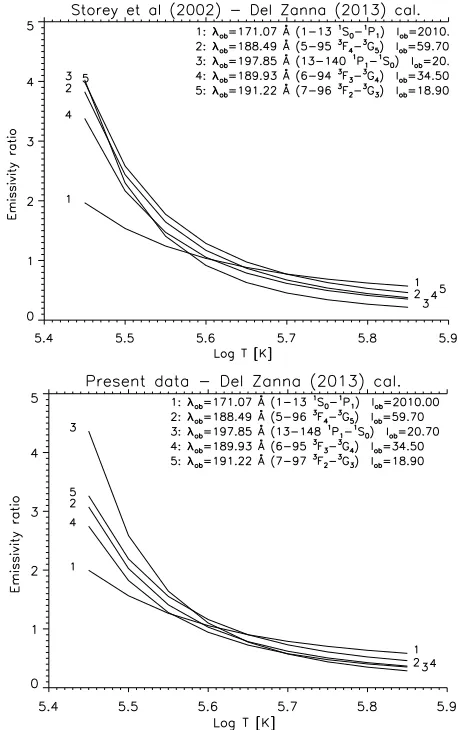
It is interesting then to reassess the comparison with Hinode EIS observations. There are, however, further complications. One is that the resonance line is barely visible, since the EIS sen-sitivity at 171 Å is about three orders of magnitude lower than at the peak (that is around 195 Å). Another one is that the EIS ground calibration was found to be in need of significant revi-sions. A new radiometric calibration was obtained by Del Zanna (2013). This calibration is very uncertain near the resonance line, however excellent agreement between predicted and observed intensities is found, as shown in Fig. 9. This figure shows the ’emissivity ratio’ curves

Fji=

IobNe

Nj(Ne,Te) Aji

C (1)

for each line as a function of the electron temperature Te. Iobis

the observed intensity of the line, Nj(Ne,Te) is the population

of the upper level j relative to the total number density of the ion, calculated at a fixed density Ne=109cm−3, A

jiis the

spon-taneous radiative transition probability, and C is a scaling con-stant chosen so the emissivity ratio is near unity. If agreement between experimental and theoretical intensities is present, all lines should be closely spaced. If the plasma is nearly isother-mal, all curves should cross at the isothermal temperature.

The observed intensities refer to an observation of an ac-tive region loop leg near a sunspot, where the overlying (weak) coronal emission was subtracted, leaving a very clean low-temperature spectrum (Del Zanna 2009a) with strong Feixlines. Some of the Feixlines are in fact normally blended with higher-temperature lines (see, e.g. Del Zanna 2013).

Fig. 9 shows that there is better agreement between ob-served and predicted intensities using the new atomic data, providing a temperature of about log T [K]=5.6, close to the temperature obtained from emission measure modelling (Del Zanna 2009b). The scaling constant for the two plots in Fig. 9 is the same, 4.5×10¹¹, and indeed the emissivity ratio curve

[image:8.595.326.555.57.422.2]

for the resonance transition (No. 1, at 171 Å) is basically the same. This is because the collision strengths of the two cal-culations are very similar, as shown in Fig. 7. The emissivity

Fig. 9. The emissivity ratio curves relative to the

’foreground-subtracted’ sunspot loop leg observed by Hinode EIS (Del Zanna 2009a), using the previous (Storey et al. 2002, above) and present (be-low) atomic data, and the new radiometric calibration (Del Zanna 2013). The intensities Iobare in phot cm−2s−1arcsec−2.

of the 188.49 Å line (No. 2 in the figure) is also very similar in the two models. The emissivity of the 197.85 Å line (No. 3 in the figure) is instead quite different, because of the much lower A-value (see Table 3) and collision strength from the ground state (see Fig. 8), which populates the upper level. The emissivity of the 189.93 Å line (No. 4 in the figure) is slightly different, mainly because of slightly lower A-value (see Table 3). The same occurs for the 191.22 Å line (No. 5 in the figure).

3.5. Line identifications

The good agreement in the line intensity of the 13–148 tran-sition suggests that the Young (2009) identification is correct. This level decays to the 3s23p54s1P1,3P1with two UV lines

that should be observable. The energy of the 4p1S

0 level is

known, once the 13–148 transition is identified. The energies of the 4s1P

1,3P1levels are also known, because the decays

(9)

the laboratory (Kruger et al. 1937; Fawcett et al. 1972), and should have an accuracy better than 10 mÅ.

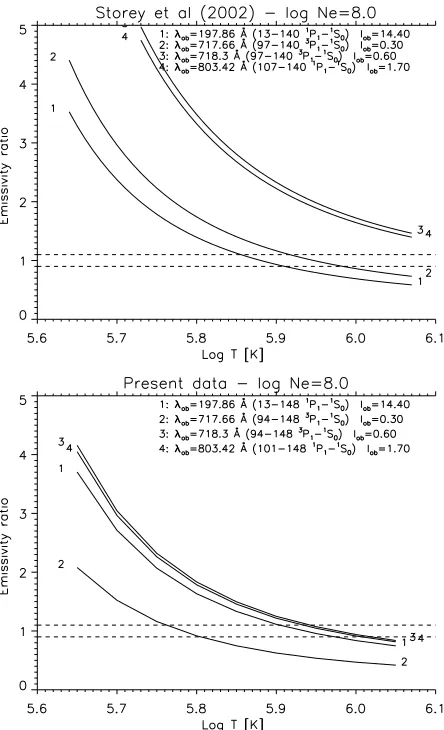
Using the X-ray wavelengths and the Hinode EIS wave-length for the 13–148 transition measured by Young (2009) (197.862 Å), one obtains that the two main UV decays to the 4s levels should be at 804.20 and 717.13 Å. Using the Hinode EIS wavelength measured by Del Zanna (2009a) (197.854 Å) provides similar wavelengths (804.01 and 716.98 Å).

[image:9.595.65.287.305.670.2]

Landi & Young (2009) identified the two UV decays in SOHO SUMER spectra with lines observed at 803.42 and 717.66 Å. Using the previous atomic data, the intensity of the second line was in good agreement with the intensity of the 13–148 transition, observed by Hinode EIS. However, the 803.42 Å line was almost a factor of two too bright. With the present atomic data, the intensity of the 803.42 Å line be-comes instead in excellent agreement with theory, as shown in Fig. 10, while the observed intensity of the 717.66 Å line becomes a factor of two too weak. The discrepancy in the wavelength and intensity of this weaker line is puzzling and deserves further investigations.

Fig. 10. The emissivity ratio curves for a quiet Sun Hinode/EIS and SOHO/SUMER observation described by Landi & Young (2009), using the previous (Storey et al. 2002, above) and present (below) atomic data.

As we have discovered in the other coronal irons, the core-excited transition 3s23p6 1S

0–3s 3p64s1S0is relatively strong,

and the upper level decays via a strong dipole-allowed transition

(3s23p53d1P

1–3s 3p64s1S0, 13–256). The same type of

tran-sitions for Fex, Fexi, Fexii, and Fexiiihave all been identified in Del Zanna (2012a). The differences between the target and observed wavelengths for the transitions from the n = 4 levels are about 5–6 Å, as shown in Table 4. We can therefore predict that this spectral line should fall around 146–147 Å. To iden-tify this line, we have considered the high-resolution spectrum of Behring et al. (1972), but also that of Malinovsky & Heroux (1973), which we have scanned and recalibrated in Del Zanna (2012a).

There are several potential candidate lines in that spectral re-gion, however most of them are due to Nixtransitions. Behring et al. (1972) lists a strong line at 146.937 Å, which could be the 13–256 Feix transition. However, this line is weak in the Malinovsky & Heroux (1973) spectrum. Behring et al. (1972) also lists a line at 147.274 Å, which they identify with the 2s2

2p5 2P1/2–2s 2p6 2S1/2of Caxii. Behring et al. (1972) identified the 141.032 Å with the 2s22p5 2P

3/2–2s 2p6 2S1/2of Caxii. The theoretical branching ratio of these two Caxiilines is 0.4, while the 147.274 Å line has about the same intensity as the 141.032 Å line. Therefore, only a fraction of the 147.274 Å line can at most be due to Caxii, assuming that the stronger 141.032 Å line is

all due to Caxii, something that is dubious. In fact, Caxii

[image:9.595.328.556.410.589.2]

is formed around 3 MK, and the 141.032 Å line is expected to be very weak during moderate solar activity, as in the Malinovsky & Heroux (1973) spectrum. We therefore iden-tify the Feix3s23p5 3d1P1–3s 3p64s1S0(13–256) transition with the 147.274 Å line, since it has about the predicted intensity and wavelength.

Fig. 11. The emissivity ratio curves relative to a few newly identified

lines in the Hinode EIS spectra (as in Fig. 9).

According to our ion model, several transitions from the 3s2

3p4 3d2 configuration should produce spectral lines of similar intensities as those identified by Young (2009) and therefore well visible in the Hinode EIS spectra. We have searched the Del Zanna (2009a) EIS spectrum for wavelength and intensity coincidences. Our results agree with the Young (2009) iden-tifications, providing good agreement between predicted and observed intensities, shown in Fig. 9. The identifications of the strongest lines are summarised in Table 4 and shown in Fig. 11. The main decay from the 3D

3 (5–110 transition) is

(10)

Young & Landi (2009), we identify this transition with a line observed with Hinode EIS at 176.945 Å by Del Zanna (2009a) and at 176.959 Å by Young & Landi (2009).

According to the discussion in Del Zanna (2009a), only about half of the intensity of the 176.945 Å line is due to Fevii. About 30% could be due to the 5–110 transition. The

main decay from the3D

2(6–111 transition) is predicted to be

at 177.6 Å and indeed there is a line with the right intensity, which was identified in Young & Landi (2009).

The spectrum obtained in Del Zanna (2009a) is a pure low-temperature one, with many unidentified cool lines emit-ted at similar temperatures as Feix. We have compared

pre-dicted wavelengths and intensities for the weaker Feixlines

with the observed ones, and suggest a few other identifica-tions, which should be regarded as tentative. The 13–166 is a weak line, possibly blending with the Fexi181.10 Å line.

The 8–118 is also a weak line, possibly also blended with the 176.945 Å line. The 4–85 should be well observed by EIS, with a predicted wavelength around 195 Å. There is a cool line in the spectrum at 194.784 Å, which we tentatively iden-tify as the 4–85 transition, although it is slightly brighter than predicted, as shown in Fig. 11.

Finally, the 8-105 transition should be around 192 Å. There are two options, an unidentified cool line at 192.094 Å, or a line blending with Fexi(see the identifications of this ion

discussed in Del Zanna (2010)) at 192.630 Å. We choose the second option, because it has a difference with the predicted wavelength closer to the differences of the other lines of the same transition array.

3.6. Electron density diagnostics

There are several excellent line ratios in Feixthat can be used to measure electron densities. The best is the ratio of the strong and nearby lines at 241.7 and 244.9 Å. This ratio, as well as the ratios involving the 217. Å line, were discussed in Storey et al. (2002) and are not further considered here.

We would instead like to point out here the usefulness of the visible forbidden lines to measure electron densities. Feix produces several strong forbidden lines, which, after several at-tempts, were finally identified by Edlen & Smitt (1978). Earlier literature estimated the intensities of these lines, and found sev-eral large inconsistencies (up to factors of two) with the observed values (see, e.g. Haug 1979). It is therefore interesting to revisit this issue with the present data. We consider one of the very few observations of these lines, a ground-based one obtained in 1965 May 30 during a total solar eclipse by Jefferies et al. (1971). We selected the calibrated intensities of the lines observed close to the solar limb above a so-called coronal condensation, and plot in Fig. 12 the emissivity ratio curves for all the measured lines.

We can see that the curves for the 3800.8 and 4585.3 Å lines (No. 1 and 4 in the plot) are very close, hence there is very good agreement between predicted and observed inten-sities for these lines, which form a branching ratio. The curve for the 4359.4 Å line, which was incorrectly identified as due to Nixiiiby Jefferies et al. (1971), intersects the previous two

lines around 108 cm−3, while the 3642.7 Å would provide a

higher electron density, around 108.8 cm−3. The 3642.7 and 4359.4 Å lines also form a branching ratio, which we expect to be quite accurate. Therefore, either the observed intensity

of the 3642.7 Å line was overestimated, or the intensity of the 4359.4 Å line underestimated by about 40%. In any case, all the intensities are, within±20%, in agreement.

We thought at first that a density of 108cm−3was perhaps

too low, being closer to a quiet Sun rather than a coronal con-densation (which is normally associated with active regions), so we revisited other density diagnostics from the same ob-servation. The only other reliable density diagnostics at sim-ilar temperatures is given by the forbidden lines of Fex. Our

earlier R-matrix calculations showed significant discrepan-cies with observations (Del Zanna et al. 2004), as Fig. 13 (top plot) shows. However, our recent large-scale R-matrix calcu-lations for Fex(Del Zanna et al. 2012b) show quite a diff

er-ent picture. As Fig. 13 (bottom plot) shows, good agreemer-ent (to within ±20%) is found, indicating electron densities of about 108 cm−3 (or less), i.e. similar to what obtained from the Feix4359.4 Å line.

A quick comparison of the two plots in Fig. 13 (obtained with the same scaling constant) shows that the red forbidden line (No. 1) has a very similar emissivity, using the old and the new atomic data. Indeed, as shown in Del Zanna et al. (2012b), the collision strength for this important transition is very close that what was previously calculated. On the other hand, the emissivities of all the other forbidden lines are in-creased by a factor of two or more with the last calculation. This ultimately is due to the combined effect of increased col-lision strengths and cascading, an important issue that was not highlighted in the Fexpaper, but was discussed in detail

for Fexi(Del Zanna et al. 2010) and Fexii(Del Zanna et al.

[image:10.595.327.556.404.585.2]

2012a).

Fig. 12. The emissivity ratio curves of the coronal forbidden lines observed by Jefferies et al. (1971), for Feixusing the present atomic

data. The dashed lines indicate±20%.

4. Summary and conclusions

In many respects, the present large-scale calculations have pro-duced results similar to those of the other coronal iron ions that we have carried out. For most of the strongest lines, agreement within a few percent in the line intensities calculated at peak ion abundance in equilibrium is found. This confirms the accuracy of the calculations for strong transitions.

(11)
[image:11.595.63.289.57.420.2]

Fig. 13. The emissivity ratio curves of the coronal forbidden lines

ob-served by Jefferies et al. (1971), for Fexusing the earlier data (Del

Zanna et al. 2004), above, and the most recent ones (Del Zanna et al. 2012b) below. The dashed lines indicate±20%.

means that the present large-scale target is not necessary, if one is only interested in n=3 transitions.

Notable enhancements in the weaker transitions are how-ever present, due to the extra resonances in the larger target. Compared to the previous ion model, which included R-matrix (Storey et al. 2002) and DW (O’Dwyer et al. 2012) calculations, significant increases are only found for transitions to the 4d lev-els, because of the resonance enhancement, compared to the DW calculations. Resonance excitation to the 4s levels is also impor-tant, but was already included in our previous R-matrix calcula-tions.

As for the other coronal iron ions, we have found that transi-tions from levels populated via a core-excited transition are quite strong, and provided a new identification for Feixas a soft X-ray line at 147.274 Å.

The predicted intensities of some among the strongest Feix EUV lines, observed by Hinode EIS, are now in much bet-ter agreement with observations, providing a reliable way to measure electron temperatures for the solar corona. We have provided a few further identifications (some will need to be confirmed with laboratory spectroscopy) of lines observed by Hinode EIS. Some identifications, in particular those of the lines observed by SUMER, need further investigation.

Feixlines can also be reliably used to measure electron den-sities. Very good diagnostics are provided by EUV and visible lines.

Acknowledgements. The present work was funded by STFC (UK) through the University of Cambridge DAMTP astrophysics grant, and the University of Strathclyde UK APAP network grant ST/J000892/1. We thank the anonymous referee for useful suggestions, and E. Landi for providing unpublished A-values.

References

Aggarwal, K. M., Keenan, F. P., Kato, T., & Murakami, I. 2006, A&A, 460, 331 Badnell, N. R. 2011, Computer Physics Communications, 182, 1528

Badnell, N. R. & Griffin, D. C. 1999, Journal of Physics B Atomic Molecular Physics, 32, 2267

Badnell, N. R. & Griffin, D. C. 2001, Journal of Physics B Atomic Molecular Physics, 34, 681

Behring, W. E., Cohen, L., & Feldman, U. 1972, ApJ, 175, 493

Berrington, K. A., Eissner, W. B., & Norrington, P. H. 1995, Computer Physics Communications, 92, 290

Burgess, A. 1974, Journal of Physics B Atomic Molecular Physics, 7, L364 Burgess, A., Chidichimo, M. C., & Tully, J. A. 1997, Journal of Physics B

Atomic Molecular Physics, 30, 33

Burgess, A. & Tully, J. A. 1992, A&A, 254, 436

Chidichimo, M. C., Badnell, N. R., & Tully, J. A. 2003, A&A, 401, 1177 Culhane, J. L., Harra, L. K., James, A. M., et al. 2007, Sol. Phys., 60 Del Zanna, G. 2009a, A&A, 508, 501

Del Zanna, G. 2009b, A&A, 508, 513 Del Zanna, G. 2010, A&A, 514, A41+

Del Zanna, G. 2012a, A&A, 546, A97 Del Zanna, G. 2012b, A&A, 537, A38 Del Zanna, G. 2013, A&A, 555, A47

Del Zanna, G., Berrington, K. A., & Mason, H. E. 2004, A&A, 422, 731 Del Zanna, G. & Storey, P. J. 2013a, A&A, 549, A42

Del Zanna, G. & Storey, P. J. 2013b, A&A, 549, A42

Del Zanna, G., Storey, P. J., Badnell, N. R., & Mason, H. E. 2012a, A&A, 543, A139

Del Zanna, G., Storey, P. J., Badnell, N. R., & Mason, H. E. 2012b, A&A, 541, A90

Del Zanna, G., Storey, P. J., & Mason, H. E. 2010, A&A, 514, A40+

Edlen, B. & Smitt, R. 1978, Sol. Phys., 57, 329

Eissner, W., Jones, M., & Nussbaumer, H. 1974, Computer Physics Communications, 8, 270

Fawcett, B. C., Kononov, E. Y., Hayes, R. W., & Cowan, R. D. 1972, Journal of Physics B Atomic Molecular Physics, 5, 1255

Fawcett, B. C., Peacock, N. J., & Cowan, R. D. 1968, Journal of Physics B Atomic Molecular Physics, 1, 295

Griffin, D. C., Badnell, N. R., & Pindzola, M. S. 1998, Journal of Physics B Atomic Molecular Physics, 31, 3713

Guennou, C., Auch`ere, F., Klimchuk, J. A., Bocchialini, K., & Parenti, S. 2013, ApJ, 774, 31

Haug, E. 1979, Sol. Phys., 61, 311

Hummer, D. G., Berrington, K. A., Eissner, W., et al. 1993, A&A, 279, 298 Jefferies, J. T., Orrall, F. Q., & Zirker, J. B. 1971, Sol. Phys., 16, 103

Kruger, P. G., Weissberg, S. G., & Phillips, L. W. 1937, Physical Review, 51, 1090

Landi, E. & Young, P. R. 2009, ApJ, 707, 1191

Landi, E., Young, P. R., Dere, K. P., Del Zanna, G., & Mason, H. E. 2013, ApJ, 763, 86

Liang, G. Y. & Badnell, N. R. 2010, A&A, 518, A64+

Liang, G. Y., Whiteford, A. D., & Badnell, N. R. 2009, A&A, 500, 1263 Malinovsky, L. & Heroux, M. 1973, ApJ, 181, 1009

O’Dwyer, B., Del Zanna, G., Badnell, N. R., Mason, H. E., & Storey, P. J. 2012, A&A, 537, A22

Storey, P. J., Zeippen, C. J., & Le Dourneuf, M. 2002, A&A, 394, 753 Verma, N., Jha, A. K. S., & Mohan, M. 2006, ApJS, 164, 297 Young, P. R. 2009, ApJ, 691, L77

Figure

Table 1. The target electron configuration basis and orbital scaling pa-rameters λnl for the R-matrix and DW runs.
Table 2. Level energies (cm−1) for Fe ix.
Fig. 2. Oscillator strengths compared to those of the (Storey et al. 2002)indicatetarget
Table 3. Transition probabilities for the main lines.
+7

References

Related documents

4.1 The Select Committee is asked to consider the proposed development of the Customer Service Function, the recommended service delivery option and the investment required8. It

○ If BP elevated, think primary aldosteronism, Cushing’s, renal artery stenosis, ○ If BP normal, think hypomagnesemia, severe hypoK, Bartter’s, NaHCO3,

National Conference on Technical Vocational Education, Training and Skills Development: A Roadmap for Empowerment (Dec. 2008): Ministry of Human Resource Development, Department

Minors who do not have a valid driver’s license which allows them to operate a motorized vehicle in the state in which they reside will not be permitted to operate a motorized

Results suggest that the probability of under-educated employment is higher among low skilled recent migrants and that the over-education risk is higher among high skilled

Using text mining of first-opinion electronic medical records from seven veterinary practices around the UK, Kaplan-Meier and Cox proportional hazard modelling, we were able to

• Follow up with your employer each reporting period to ensure your hours are reported on a regular basis?. • Discuss your progress with

Proprietary Schools are referred to as those classified nonpublic, which sell or offer for sale mostly post- secondary instruction which leads to an occupation..