City, University of London Institutional Repository
Citation
:
Maiden, N. and Robertson, S. (2005). Integrating creativity into requirements
processes: experiences with an air traffic management system. Paper presented at the 13th
IEEE International Conference on Requirements Engineering, 29-08-2005 - 02-09-2005, La
Sorbonne, France.
This is the accepted version of the paper.
This version of the publication may differ from the final published
version.
Permanent repository link:
http://openaccess.city.ac.uk/4027/
Link to published version
:
http://dx.doi.org/10.1109/RE.2005.34
Copyright and reuse:
City Research Online aims to make research
outputs of City, University of London available to a wider audience.
Copyright and Moral Rights remain with the author(s) and/or copyright
holders. URLs from City Research Online may be freely distributed and
linked to.
City Research Online: http://openaccess.city.ac.uk/ [email protected]
Integrating Creativity into Requirements Processes:
Experiences with an Air Traffic Management System
Neil Maiden
Centre HCI Design, City University
Suzanne Robertson
Atlantic Systems Guild, London
Abstract
Requirements engineering is a creative process in which stakeholders and designers work together to create ideas for new systems that are eventually expressed as requirements. This paper describes RESCUE, a scenario-driven requirements engineering process that includes workshops that integrate creativity techniques with different types of use case and system context modeling. It reports action research in which RESCUE creativity workshops were used to discover stakeholder and system requirements for MSP, a future air traffic management system to enable the more effective, longer-term planning of European airspace use. The workshops were successful in that they provided new and important outputs for subsequent requirements processes. The paper describes the workshops structures and results, and answers 3 important research questions.
1.
More Creative Requirements Processes
Requirements engineering is a creative process in which stakeholders and engineers work together to create ideas for new systems that are eventually expressed as requirements. The importance of creative system and product design is expected to increase over the next decade. Creativity is indispensable for more innovative product development [Hargadon & Sutton 2000], and requirements are the key abstraction that encapsulates the results of creative thinking about the vision of a system.
Most current requirements processes and research activities support problem analysis and system specification. In contrast, invention is often perceived as part of the design process that follows requirements engineering [Heitmeyer 2005]. For example, research-driven methods such as i* and KAOS and commercial processes such as the RUP encourage requirements elicitation, analysis and modelling but not requirements invention. One assumption behind many of these approaches is that requirements are generated using the domain expertise of stakeholders. However, this is increasingly flawed because of the breadth of expertise required to specify complex socio-technical systems and the need for stakeholders with different areas of expertise to work together to generate requirements.
However, if we are to encourage more invention in requirements processes, we cannot jettison existing processes still needed to model, analyze, specify and sign-off stakeholder requirements discovered and invented using creative techniques. One challenge was
to build on previous successes and integrate creative thinking techniques into mainstream requirements processes, rather than encourage creative thinking that does not inform structured requirements processes.
This paper reports action research – the design and running of 3 creativity workshops within our RESCUE requirements process [Maiden et al. 2003] to discover new requirements and ideas for MSP, a new socio-technical system for the Multi-Sector Planning (MSP) of aircraft movement within Europe. As air traffic volumes in Europe increase, Eurocontrol is seeking new technology-based solutions to enable these volume growths while maintaining safety levels. It aims to introduce new computerized systems that will redesign the work of planner, tactical and other controller roles to manage traffic complexity levels across multiple sectors over a prolonged period.
Two systems engineers, the core MSP team, worked with air traffic management experts (including former and current controllers from all parts of Europe) to determine the MSP concepts and requirements that would be expressed in an Operational Concept of Use (OCU) document – a high-level requirements specification. The MSP team applied RESCUE. Three creativity workshops took place 3 months into the MSP requirements process, once the initial scope and goals of MSP had been established.
The uniqueness of both the MSP workshops and project meant that controlled studies could not be used to investigate the effectiveness of the workshop. Instead we applied an action research approach to explore 3 research questions arising from previous RESCUE workshops. Section 2 of this paper describes RESCUE. Section 3 describes MSP’s 3 creativity workshops and the techniques implemented in them. The fourth section reports the results and demonstrates them with MSP examples. Section 5 reviews results against research questions. The paper ends with a statement of contribution and outline of future work.
2.
RESCUE and its Creativity Workshops
Each stream has a unique and specific purpose in the specification of a socio-technical system:
• Human activity modelling provides an understanding of how people work, in order to baseline possible changes to it;
• System goal modelling enables the team to model the future system boundaries, actor dependencies and most important system goals;
• Use case modelling and scenario-driven walkthroughs enable the team to communicate more effectively with stakeholders and acquire complete, precise and testable requirements from them;
• Requirements management enables the team to handle the outcomes of the other 3 streams effectively as well as impose quality checks on all aspects of the requirements document.
Creativity workshops normally take place after the system boundaries are specified, to discover and surface requirements and design ideas that are essential for system modelling and use case specification Inputs to the workshops include the system context model from the system goal modelling stream and use case diagrams from the use case modelling stream.
We designed RESCUE to separate the creativity workshops from other more practical requirements activities such as use case specification, requirements acquisition and requirements management. Therefore, in the MSP project, the core team undertook regular but challenging requirements activities before and after the workshops. Whilst also providing valuable data, the results from these other processes are reported elsewhere and are beyond the scope of this paper.
2.1.
Previous Creativity Work
Little requirements engineering research has addressed creative thinking directly. Brainstorming techniques and RAD/JAD workshops [Floyd et al. 1989] make tangential reference to creative thinking. Most current brainstorming work refers back to Osborn’s text [1953] on principles and procedures of creative problem solving (CPS). The CPS method describes six stages of problem solving: mess finding, data finding, problem finding, idea finding, solution finding and acceptance finding. It was originally intended to help people understand and use their creative talent more effectively [Isaksen & Dorval 1993]. The six stages were arranged into three groups – understanding the problem, idea generation, and planning for action. A recent CPS manual [Daupert 2002] describes activities for supporting each model stage. Examples include the matrix, which involves making lists then selecting items from each list at random and combining them to generate new ideas, and parallel worlds, which uses analogical reasoning to generate new ideas. However, there are no reported applications of the CPS model to requirements processes.
In the requirements domain, Robertson [2002] argues that requirements analysts need to be inventors to bring about the innovative change in a product or business that gives competitive advantage. Such requirements are often not properties that a stakeholder would ask for directly.Nguyen et al. [2000] observed that teams restructured requirements models at critical points when they re-conceptualize and solve sub-problems, triggered by moments of sudden insight. Mich et al. [2004] report the successful use of the elementary pragmatic model from communication theory in a controlled environment to trigger combinatorial creativity during requirements acquisition. However, none of these approaches exploit creativity theories or models directly, and there are few other references to creativity in mainstream requirements and software engineering journals and conferences. Requirements practitioners lack processes and models that be applied to guide their creative processes.
2.2.
Creativity Workshops in RESCUE
RESCUE incorporates creativity workshops to encourage creative thinking with which to discover and invent system requirements. The workshop activities were designed using 3 established models of creativity from cognitive and social psychology. The models were used for three purposes. Firstly, in order to encourage creative thinking, it was essential to define creativity and creative thinking. The models provided us with important definitions of creativity. Secondly, it was important to structure the workshops into different creative processes. The models provided us with important taxonomies of creative thinking with which to structure creative processes in workshops. Thirdly, one of the models provided procedural guidance for creative problem solving that we applied directly to the workshop’s design.
In RESCUE we chose to adopt Sternberg’s [1999] definition as prototypical of those available in the literature. Creativity is defined as “the ability to produce work that is both novel (i.e. original, unexpected) and appropriate (i.e. useful, adaptive concerning task constraints)”. Based on this definition, we designed the MSP creativity workshops to produce requirements that were novel in the MSP domain, novel to the stakeholders involved in the reported requirements process, and appropriate for the MSP system according to these stakeholders.
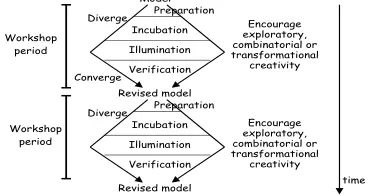
encourage one of 3 basic types of creativity identified by Boden [1990] – exploratory, combinatorial and transformational creativity. Boden explored computational approaches to creativity that define a space and map, explore and transform it, and the types are derived from different computational approaches. Thirdly, we design each period to encourage 4 essential creative processes reported in Poincare [1982]: preparation, incubation, illumination and verification. Poincare’s philosophical model was based on personal reflections about his own scientific processes. The incubation and illumination activities are determined by the type of creativity that we seek to encourage.
In RESCUE, we do not integrate these 3 creativity models directly in a single, consistent model of requirements creativity. Rather these 3 models contribute separately to the design of the creative requirements processes at different levels of granularity. The CPS model processes provide a coarse-grain structure of repeating ideas divergence and convergence during workshop periods. Poincare’s model provides finer-grain processes – incubation and illumination – with which to achieve this divergence and convergence. Boden’s types of creativity are used to select different creativity techniques for achieving incubation and illumination during convergence and divergence. Figure 1 depicts the processes and techniques proposed by the models in a creativity workshop.
Workshop period
Workshop period
time Diverge
Converge
Preparation Incubation Illumination Verification
Diverge Preparation
Incubation Illumination Verification
Encourage exploratory, combinatorial or transformational
creativity
Encourage exploratory, combinatorial or transformational
creativity Model
Revised model
[image:4.595.68.255.410.508.2]Revised model
Figure 1. The basic structure of creative periods during a RESCUE creativity workshop.
Prior to the MSP workshops the RESCUE team had facilitated 6 creativity workshops in the air traffic and policing domains. Three one-day workshops had been held at Eurocontrol in 2001 to discover new requirements for CORA-2, a socio-technical system to support the resolution of conflicts between aircraft on collision courses [Maiden & Gizikis 2001]. The workshops were successful and led to over 200 new CORA-2 ideas and requirements and numerous lessons learned about the effectiveness of creativity techniques and workshop organisation. In 2002, two half-day workshops were ran with the UK’s Police IT Organisation to discover new requirements and opportunities to exploit biometric technologies in policing [Pennell & Maiden 2003]. Again, the workshops were successful and generated new uses of
biometric opportunities as well as more lessons for running creativity workshops. In 2003, one two-day creativity workshop was ran with Eurocontrol to discover new requirements and ideas for DMAN, the departure management system for major European airports such as Heathrow and Charles de Gaulle [Maiden et al. 2004a]. The workshop succeeded, in that it established a core set of requirements and ideas for DMAN that were integrated with structured models used in RESCUE.
The authors chose the DMAN creativity workshop structure to be the baseline for design of the 3 MSP creativity workshops. Workshops would run for 2 days to allow for creative ideas to emerge during the second day. Use cases would provide both a structure and a context for new ideas that emerge. The facilitators would encourage exploratory creativity through guided use of analogies, combinatorial creativity using storyboards, and transformational creativity through the introduction of solution space knowledge [Maiden et al. 2004b].
However, areas for improvement still remained, and a better understanding of the utility of different creativity processes and techniques was needed.
3.
The MSP Creativity Workshops
The first workshop took place in September 2003, the next three weeks later in October 2003, and the third 4 weeks after that in November 2003. The 2 facilitators, a scribe and different external experts were present at all 3 workshops. Eleven, nine and nine stakeholders attended the 3 workshops respectively. Each was an employee of either Eurocontrol or its national partners. Not all of the stakeholders were able to attend all 3 workshops.
Each workshop was held in a large meeting room. The system context and use case models and use case précis provided the structure for the workshop room itself. At the beginning of the workshop each model and précis was posted on separate 1m2 pin boards placed around the workshop room that became the physical and logical structure of ideas and requirements that were associated with that model and use case during the workshop.
Each workshop was facilitated to encourage a fun atmosphere so that the participants were relaxed and prepared to generate and voice ideas without fear of criticism. For example, day-2 of the second workshop began with a balloon animal making competition, with a prize for the participant who created the best animal. During creativity periods, standard RAD/JAD facilitation techniques and rules [Andrews 1991] such as avoiding criticism of other people’s ideas and time-boxing each topic under discussion were applied.
workshop. Everything captured on the pin boards was subsequently documented electronically in workshop reports that were sent to all participants.
3.1.
The First Creativity Workshop
Inputs to the first workshop included a system context diagram, use case diagram and use case précis for the MSP system described by 2 software engineers based on existing MSP reports. First day activities included system-wide and use case-specific brainstorming, constraint identification and removal, and group brainstorming assuming the removal of selected constraints. On day-2 stakeholders listened to an expert presentation on intelligent highway systems, then generated MSP ideas using analogical mappings between air traffic and highway management. These ideas were then integrated into storyboards that elaborated the priority MSP use cases identified by the stakeholders. Workshop outputs included use case précis that were elaborated with storyboards.
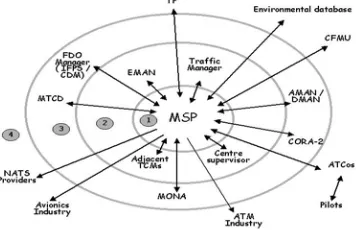
[image:5.595.74.252.384.499.2]Figure 2 shows the context diagram for the MSP system that was a deliverable at the end of the first workshop, to provide an understanding of the MSP system. Other systems such as EMAN (En-route Manager) and human roles such as the traffic manager were to be redesigned to interact with the new MSP software system.
Figure 2. The MSP context model after the first workshop, showing the MSP software system (level-1), actors and work redesigned within the MSP concept (2), other systems influenced by MSP (3), and other external systems (4).
3.2.
The Second Creativity Workshop
Inputs to the second workshop were use case diagrams and précis that had been updated from the first workshop by the 2 MSP systems engineers. Stakeholders listened to 2 expert presentations, one on contract negotiation as a basis for generating new MSP ideas about airspace using analogical mappings, the other on fusion cooking to demonstrate combinatorial creativity. Workshop outputs included use case précis that were again revised and elaborated with storyboards and a significantly revised system context diagram.
3.3.
The Third Creativity Workshop
The use case diagram and précis were again revised by the 2 system engineers to provide inputs to the third workshop, along with all concrete outputs from the second workshop. On day-1 one of the facilitators gave an expert presentation on information visualisations to generate candidate MSP representations of the scheduling space. On day-2 a professional scriptwriter presented the process for writing film scripts as a basis for developing rich MSP storyboards that integrated results from the first 2 workshops and day-1 of the third workshop. The principal outputs of the third workshop were two 5m-long storyboards that structured ideas generated during the 3 workshops.
3.4.
Exploratory Creativity with Analogies
To support exploratory creative thinking with the 2 analogies we drew on experiences from previous workshops in which stakeholders generated new ideas by transferring ideas from analogical domains. The MSP analogies were carefully selected based on domain analyses, undertaken by the facilitators using existing MSP documents and specifications, to form domain abstractions. To do this the facilitators drew on the NATURE domain theory [Sutcliffe & Maiden 1998] that defines a large set of domain categorisations. The analogies were selected to focus on different but key elements of the MSP domain. Once an abstraction of the relevant part of the MSP domain had been formed, the facilitators searched for other business or transport domains that both shared this abstraction and, more importantly, introduced new computerized solutions to the other domain. Experts from these domains were then requested to take part as consultants in the relevant creativity workshop. The first analogy was with intelligent highways, which shared surface similarities with ATM as both are in the transport domain. Evidence from cognitive psychology suggests that similarity-based reasoning is difficult [Gick & Holyoak 1983], and that people often needs syntactic similarities between domains to recognize analogical mappings [Ross 1987].
In the first MSP workshop the expert gave a 45-minute presentation on intelligent highway systems (a period of incubation). The facilitators then guided a group process to externalise analogical mappings before stakeholders worked in 3 groups of 3 or 4 to discover new ideas using the mappings (illumination). The aim of the expert presentation was to encourage the participants to unconsciously and consciously form analogical mappings such as those listed in Table 1. Some mappings were obvious – the aircraft maps to the automobile – whereas others are less so – the radio instruction given to the pilot maps to the road sign. In this way the workshops refined the parallel worlds technique from the CPS process [Daupert 2002].
Aircraft Automobile An object transporting human passengers in a space
Air space Highway The constrained space in which the objects move
Pilot Driver Human in the moving
object who controls it Controller Controller Human who directs
moving objects by issuing instructions Instruction Road sign The communication to
direct the moving object
Table 1. Some analogical mappings between the ATM and intelligent highways domains
The second workshop explored an analogy with software contract negotiation using an expert presentation from a software contract litigator. Results from the first workshop indicated that MSP should support negotiation between supervisors responsible for different sectors. Again, the facilitators produced an abstraction of this part of the MSP domain, then sought and selected experts from other business domains that share the abstraction.
Therefore, in the second workshop, the expert gave a 45-minute presentation on software contract litigation processes (incubation) before the facilitators guided group discovery and externalisation of analogical mappings, then stakeholders worked in 3 groups of 3 to discover new ideas using the mappings (illumination).
3.5.
Combinatorial Creativity
Combinational creativity is the creation of new ideas from combination and synthesis of existing ideas. It is the creative act resulting from an unusual combination of existing concepts [Boden 1990].
Storyboarding was used to elaborate and combine creative ideas in the last period of the first 2 workshops. Participants worked in 3 groups of 3. Each group was asked to produce a storyboard that described the possible combination of requirements and ideas associated with one use case during the first 3 periods of the workshop. To structure the storyboarding process, each group was given A1-size pieces of paper that were annotated with 16 boxes to contain a graphical depiction of each scene of the storyboard and lines upon which to describe that scene.
On day-2 of the third workshop we extended the use of storyboards for combining MSP ideas by exploiting techniques from film scriptwriting. A professional film scriptwriter presented techniques for constructing film scripts that were demonstrated using the script and clips from Ridley Scott’s ‘Alien’. Participants were then divided into 2 groups of 4 and worked using all of the outputs from the previous 3 workshops to construct two 5-metre long rich storyboards that describe the complete MSP system. The storyboards were both flexible and tactile, with ideas written on physical cards attached to the storyboard and linked with string, tape, written links and ideas containers.
3.6.
Transformational Creativity
During transformational creativity, people change the solution space in a way that things that were considered impossible are now possible. Examples include challenging pre-conceived constraints and exploring new solutions to existing problems [Boden 1990].
On day-1 of the first workshop we encouraged transformational creativity by explicitly guiding stakeholders to discover and remove constraints on the MSP design. One facilitator led a group brainstorming session to discover as many constraints as possible. Stakeholders then worked in 3 groups of 3 or 4 to select constraints in turn until none remained, then challenged each constraint and generated new MSP ideas based on their removal. The session ended with the groups reporting new MSP ideas and posting them on the ideas boards, which in turn led to a final period of group brainstorming using the new ideas.
On day-1 of the third workshop we encouraged transformational creativity by introducing knowledge about possible solutions in the DMAN solution space in the form of candidate visualizations for presenting information to human controllers and supervisors. The knowledge was delivered to the workshop participants via a presentation on information visualization and access to copies of the originating expert’s book on the same subject. Participants then worked in 3 groups of 3 with information about possible information visualizations to explore new solutions to MSP, sometimes changing the possible solution space along the way. Ideas resulting from the illumination activity were verified when each group reported back its visualizations to the other workshop participants.
3.7.
Research Questions
As well as investigating the effectiveness of these workshops on the requirements process, we used data gathered from the workshops to investigate 3 research questions about the utility of different creativity techniques. Previous workshops provided inconclusive data about the relative effectiveness of different techniques. The MSP workshops provided a valuable opportunity to ask the following 3 research questions: 1. During exploratory creativity, will brainstorming or
analogical reasoning generate more creative ideas? 2. During combinatorial creativity, will direct idea
combination techniques or storyboarding generate more creative ideas?
3. During transformational creativity, will constraint removal or presentation of solution space knowledge generate more creative ideas?
inter-dependencies between the different workshop sessions and their results.
4.
Workshop Results
All 3 workshops took place and ran to schedule. Most of the planned activities were followed without major participant disruption. We sought to handle conflicts about requirements and ideas during facilitated discussion during report-back presentations and verification activities.
The main outcomes are summarized in Table 2. The first workshop produced 48 new MSP ideas from the initial brainstorming session, another 18 by removing constraints on the MSP system, eleven ideas from analogical reasoning with intelligent highways systems, and 2 storyboards that embodied some of these ideas for 2 use cases. In contrast, the second workshop produced 13 new MSP ideas from the brainstorming session, seven ideas from analogical reasoning with the software contract litigation, four new ideas that combined existing ideas, and 6 storyboards for 6 use cases. The third workshop produced 11 information visualisations for MSP and one rich storyboard of the MSP system.
Workshop Deliverable type Number
system-wide case-specificNumber use 1 General new ideas from
workshop1 24 24
1 General new ideas from
workshop2 13 0
1 MSP constraints 26 0
1 Ideas from MSP
constraints 17 1
1 Ideas from analogical reasoning with intelligent highway systems
3 8
2 Ideas from analogical reasoning with software contract negotiation
7 0
2 Ideas from combinatorial creativity with fusion cooking analogy
4 0
3 Ideas from MSP
visualisations 0 11
[image:7.595.56.287.355.522.2]1 Workshop1 storyboards 0 2 story-boards 2 Workshop2 storyboards 0 6 story-boards 3 Workshop3 storyboards 1 story-board 0
Table 2. Overview of results from the 3 MSP workshops showing the numbers of outcomes per use case and for the wider MSP system.
Stakeholder participation was an influence on the results. The second workshop included 2 stakeholders from a new organisation who had not attended the first workshop. This led to misunderstandings between the stakeholders that were only resolved with additional presentations that slowed the workshop. Furthermore, on day-2 of the last workshop during the production of the rich storyboards, one group was slowed by individual differences over concepts and ideas that inhibited progress.
4.1.
Open Brainstorming
The brainstorming on day-1 of the first workshop generated 48 ideas. A post-workshop analysis revealed that 20 of these ideas described abstract goals of MSP,
such as the MSP should anticipate sector problems and MSP should not overload controllers, whilst another 20 described more detailed MSP requirements and design features, such as dynamic resectorisation and exploit thegeese-in-formationmodel. Of the remaining 8, seven specified the scope of MSP, and one stated the required ambition of MSP. The majority of these ideas were captured during this 50-minute brainstorm on day-1.
On day-1 of the second workshop, a shorter brainstorm generated 13 new ideas, four of which described abstract goals of MSP, five described MSP requirements and design features, two described statements of ambition and two specified MSP’s scope. Overall, these 2 sessions accounted for 44% of all results documented on ideas cards over the 6 days of the 3 workshops.
4.2.
Analogical Reasoning
After the expert presentation on intelligent highways, the stakeholders generated analogical mappings between actors, objects, actions, goals and constraints in the intelligent highway and MSP domains. The mappings generated by the facilitators during domain analysis and listed in Table 3 warrant comparison with the expected mappings in Table 1. Whilst some of the expected mappings were externalised, stakeholders did not externalise all of the obvious mappings, such as instruction to road sign.
Intelligent highways domain MSP domain
Disseminate information to drivers Disseminate information to pilots and controllers
Flexible routes Flexible airspace
Speed controls Use of AMAN for slower
aircraft to depart earlier Traffic models – to generate scenarios,
with plans to operate, smoother throughput leading to more relaxed drivers
Predictive planning
Ramp control Flow control
[image:7.595.314.545.407.517.2]Opposite traffic speeds separated laterally Opposite traffic speeds separated vertically
Table 3. Analogical mappings between the intelligent highways and MSP domains, generated by participants in the first workshop.
The facilitators then divided the stakeholders into 3 groups of 3 or 4 to generate new MSP ideas using these mappings. Each group worked for 40 minutes to illuminate 3 ideas each and document them using the yellow analogical idea cards. Overall the 3 groups generated 11 ideas. Three ideas were:
• Delegating aircraft separation assurance to pilots and airborne systems through the MSP’s traffic complexity manager tool box, based on the development of “close-following” car systems that enable trains of cars to drive safely along highways; • Disseminate more information to pilots who can
systems offer more information to drivers to make their own navigation decisions;
• The increased use of pattern matching to determine levels of traffic complexity and potential resolutions to these complex situations.
The other 8 ideas are summarised in Table 4.
Establish the full business case and costs based on a lack of capacity Move MSP problems outside of MSP scope – analogous to ramp metering in highways systems
Group aircraft closer together – analogous to road trains in highway systems Single skies solution with reduce interoperability problems – analogous to the more efficient of road space
ACAS active control of aircraft in the air space
The TCC and TCM manager multiple traffic events – analogous to traffic handling in highway systems
The TCM toolbox
[image:8.595.57.287.149.239.2]Aircraft exchange trajectories, and solutions are verified with flight management systems for possibilities of implementation
Table 4. Other MSP ideas generated from the intelligent highways analogy.
In the second workshop, after the expert presentation on software contract litigation, the 3 groups generated a total of 7 ideas. However the stakeholders reported, contrary to statements made in the first workshop, that controllers and planners would not negotiate directly over air spaces. As a result of MSP’s changing assumptions and scope, the facilitators had selected an inappropriate analogy and the session was not as successful as expected.
4.3.
Removing Constraints
Investigating MSP constraints to remove and new ideas that emerge took place in several stages. Firstly the stakeholders worked together to discover 26 constraints on the design of the MSP system. These constraints were then divided between 3 groups, each containing 3 or 4 stakeholders. The groups worked in parallel to brainstorm 19 new MSP ideas that became possible if a selected constraint was removed. A final report back sessions provided more opportunities for sharing and brainstorming across the 3 groups.
Removing constraints led to the generation of new MSP ideas and opportunities. For example, removing constraint [C15] aircraft trajectories are uncertain, led to the generation of idea W62 the design of a closed loop system, with extended look ahead times, so that parts of the CFMU no longer needed for MSP because conflict resolution takes place in advance, with other systems for departure and arrival management and conflict resolution taking precedence. Indeed the stakeholders realised that the removal of the constraint C15 might remove the need for much of the planned MSP function, which was a more innovative solution than originally expected.
Removing other constraints often led stakeholders to consider the possible advantages and disadvantages of ideas. For example, removing constraint [C22] human acceptance of individual commands and solutions led to advantages such as generation of solutions that humans might not generate and reduced workload if no solution re-evaluation is needed, but also
disadvantages such as higher data integrity that is difficult to achieve, theinability of humans to detect system errors, and deskilling of the human. In other cases, groups considered the advantages of removing MSP constraints but did not generate new MSP ideas from this constraint removal. One example was [C4] aircraft loses time in a sector, which had advantages including increasing MSP’s solution space, and increases the quality of MSP’s trajectory predictions, but no new ideas were generated from the constraint.
In spite of occasions in which new MSP ideas were not generated, removing constraints revealed new opportunities previously unforeseen by stakeholders. Most began the group sessions believing that the 26 constraints could not be removed or that new ideas and opportunities would not emerge.
4.4.
Presenting Solution Space Knowledge
During the third workshop one of the facilitators gave an expert presentation on information visualisation techniques. After this incubation period the stakeholders worked in groups and generated 11 new information visualisations that described how the MSP might present air space information to human actors. Not only did each visualisation describe the presentation of the information, but it described possible interactions with it and the human actor’s goals and tasks in the context of the related use case description.4.5.
Combining Ideas Directly
During the second workshop stakeholders were encouraged to combine existing ideas documented on the ideas card directly using some simple rules. They were motivated to do so by listening to a short presentation on fusion cooking by one of the facilitators. In the subsequent group work the 3 groups only generated 4 new ideas.
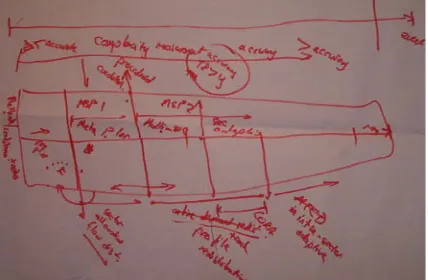
Figure 2. A timeline model of the MSP developed to combine existing MSP ideas.
[image:8.595.321.535.508.648.2]identified 2 important dimensions of the MSP system: (1) the different time horizons for planning the use of air space, along the x-axis; and (2) the role of different stakeholders at these different horizons, along the y-axis.
4.6.
Use Cases and Rich Storyboarding
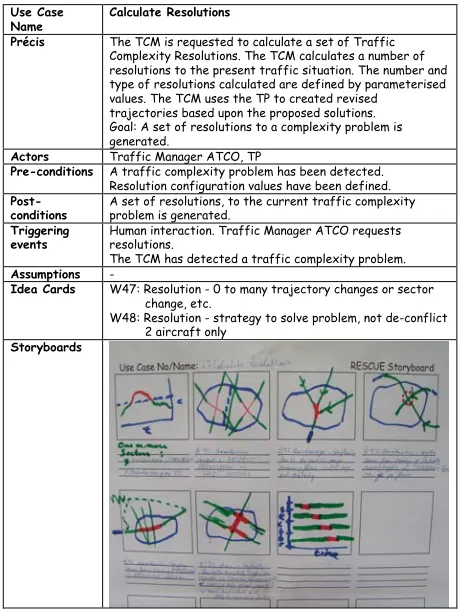
The use of the physical ideas boards generated more structured outputs that align with use case descriptions to be developed later in the RESCUE process. See the example use case Calculate Resolutions in Figure 3. The original input to the workshop was a simple précis. Figure 3 describes the state of the use case at the end of the first workshop, including a revised précis, related new ideas, and a storyboard all placed on the ideas board for the use case. It was developed further during the second workshop. These outputs provide direct inputs into RESCUE stage 2 processes. The engineer charged with development of detailed use case descriptions would have been able to use them to determine allocation of work to different actors, action ordering, and the nature of interaction between systems and people. Ten such use cases were described in this form by the end of the second workshop.
Use Case
Name Calculate Resolutions
Précis The TCM is requested to calculate a set of Traffic Complexity Resolutions. The TCM calculates a number of resolutions to the present traffic situation. The number and type of resolutions calculated are defined by parameterised values. The TCM uses the TP to created revised
trajectories based upon the proposed solutions. Goal: A set of resolutions to a complexity problem is generated.
Actors Traffic Manager ATCO, TP
Pre-conditions A traffic complexity problem has been detected. Resolution configuration values have been defined.
Post-conditions A set of resolutions, to the current traffic complexityproblem is generated.
Triggering
events Human interaction. Traffic Manager ATCO requestsresolutions. The TCM has detected a traffic complexity problem.
Assumptions
-Idea Cards W47: Resolution - 0 to many trajectory changes or sector change, etc.
W48: Resolution - strategy to solve problem, not de-conflict 2 aircraft only
Storyboards
Figure 3. The description of the Calculate Resolution use case at the end of the first workshop.
In spite of these structured descriptions, use case syntax and semantic, such as USES and EXTENDS [Jacobson et al. 2000] were insufficient to provide the
MSP team with the structure of the MSP concepts and requirements. The result was the development of rich storyboards guided by the film scriptwriter presentation and demonstration. In the third workshop 2 groups attempted to develop rich storyboards on 5 metre-long boards. One group was more successful and developed a complex storyboard.
All outputs from the first 2 workshops – use cases, use case actions, requirements, ideas, constraints and storyboards – were colour-coded and combined with outputs from day-1 of the third workshop – information visualisations – to produce the storyboard. Use cases were positioned on a timeline from left to right, and connected using string, arrows and drawn annotations to indicate data flows between them. Ideas were linked to these actions to describe how they might be implemented in MSP. Stakeholders wrote further new ideas that emerged during the period directly onto the storyboard or on blank snow cards. Each storyboard took about 4 hours to produce.
[image:9.595.55.286.350.658.2]A close-up of part of one storyboard, shown in Figure 4, demonstrates its richness. It shows, on the right-hand side, actions as part of a use case for negotiating air space use outside of MSP areas and the actor who will undertake these actions – the traffic complexity manager controller (TCM ATCO). The left-hand side shows 2 visualisations of traffic flow complexity that the controller will use to undertake these actions. Strings annotated with direction arrows indicate temporal and information flow dependencies on use cases and actions elsewhere in the storyboard, and other actors such as the flow manager supervisor. After the workshop, the MSP team revised the structured use case descriptions in light of the third workshop results.
Figure 9. A section of the rich storyboard for the MSP system.
[image:9.595.316.532.486.631.2]during these sessions was one reason for the failure of the group to produce the storyboard.
5.
The Research Questions Revisited
All 3 workshops delivered use case descriptions, information visualisations and a rich storyboard with which the MSP team was able to generate deliverable operational concept of use document. The results enable us to answer the 3 research questions, at least in the context of the MSP workshops.
5.1.
Exploratory Creativity
Results from the first 2 workshops revealed that general brainstorming produced 61 ideas documented on ideas cards, in contrast to the 18 from analogical reasoning. Although 24 of the 61 ideas described MSP system goals that would also be discovered and modelled using other RESCUE techniques, another 25 described concrete MSP requirements and design features that we expected to discover from the workshops. The 18 ideas from analogical reasoning were described in more detail than the brainstormed ideas, but there were no perceived differences in the novelty or usefulness of the ideas, and some ideas, such as the application of pattern matching algorithm to air traffic data, were discovered using both the brainstorming and analogical reasoning techniques.
In the first workshop the stakeholders did not externalise all of the analogical mappings identified by the facilitators – an obvious limitation to the transfer of knowledge from the highways domain. There are several possible explanations for this. Firstly, in spite of step-by-step guidance and syntactic similarities, analogical reasoning remained difficult [Gick & Holyoak 1983], and stakeholders failed to generate the mappings. Secondly, stakeholders might have lacked motivation because they did perceive useful solution knowledge in the intelligent highways domain. However, we have no evidence of such problems, which might suggest that similarity-based reasoning even with syntactic similarities is difficult, especially during other types of problem solving task. Thirdly, of course, changes to the scope of the MSP system rendered the software contract analogy redundant.
To answer the question, brainstorming generated more creative ideas than analogical reasoning. It was also more cost-effective and easier to use.
5.2.
Combinatorial Creativity
Results revealed marked differences between the two combinatorial creativity techniques. Stakeholders generated 8 storyboards and 1 rich storyboard that they perceived to be both novel and useful. In contrast, the direct combination of ideas generated only 4 new ideas that were not perceived as particularly novel, and one groups deviated from the task to develop a timeline model that combined ideas more effectively. In short,
combining ideas during storyboard development was more effective for combinatorial creativity. But why?
One explanation is motivation. Storyboards were, in essence, a depiction of a use case, and this made results more accessible after a workshop. Another explanation is that stakeholders using storyboards did not combine ideas directly. Rather, they first used the temporal, logical and physical dimensions that are depicted in storyboards to link otherwise unconnected ideas. Then, the stakeholders combined a smaller number of ideas locally in the context of a particular storyboard event or timeline. As such, we hypothesise that storyboards provided important artefacts for managing cognitive effort during complex combinatorial tasks.
More generally, we observed that stakeholders used informal models such as storyboards to describe and communicate ideas that, once agreed, drove updates to the more formal context and use case diagrams.
5.3.
Transformational Creativity
Results revealed that removing constraints and presenting solution space knowledge both transformed the problem space to led stakeholders to generate new ideas, but in different ways. Presentation of solution knowledge led to 11 simple information visualisation sketches. However there is evidence that these sketches also carried important tacit knowledge about goals and tasks that informed development of the rich storyboard.
In contrast, removing constraints to discover new ideas often led the stakeholders to consider potential advantages and disadvantages of the ideas as well as or instead of the ideas themselves, and this was useful in the first workshop when stakeholders were investigating the scope of the MSP system. Results do suggest one weakness – that people could not envisage the consequences of a constraint being removed on the MSP system, so we shall explore since scenario techniques tailored to analyse and document constraint removal.
6.
Contributions and Future Work
This paper contributes to requirements engineering knowledge in several ways. Firstly, it reports what happened when creativity techniques were used to discover requirements for a major European air traffic management system. Although not all of the workshop sessions were a success, the overall process was – the MSP core team is working with the outputs to produce the operational concept of use document – and this paper reports rare empirical evidence.
Secondly we believe that the paper’s descriptions of the workshops structure, inputs, outputs and techniques can provide practitioners with information and inspiration as well as some justification for designing and running creativity workshops.
Poincare 1982, Boden 1990]. Firstly the results provide support for the CPS process model [Osborn 1953]. At the end of each workshop session the facilitators were able to converge on models (context and use case diagrams) and descriptions (use cases) that could be agreed by the stakeholders before progressing. Over the 12 workshop sessions the workshops shifted from divergence – the generation of almost 50 brainstormed ideas during the first session – to convergence on one integrated storyboard in the last session. Likewise, the results provide support for Boden’s [1990] categories of creativity techniques. We used the categories to design for more exploratory creativity at the start of each workshop (brainstorming) and combinatorial and transformational creativity (storyboarding) at the end.
However, evidence the separation of incubation from illumination [Poincare 1982] was weaker. The small number of externalised analogical mappings and ideas after the fusion cooking presentation suggests that unguided incubation of ideas is less effective that more directed knowledge. The presentation of information visualisation solutions provides a good counter-example. Perhaps we should not be so surprised at this outcome given the source and nature of the model.
Based on these results we implemented the following 4 changes to RESCUE creativity workshop structures: 1. Adoption of the CPS problem solving stages – mess
finding, data finding, problem finding, idea finding, solution finding and acceptance finding [Daupert 2002] to provide finer-grain process guidance with which to structure each workshop session;
2. Wider use of storyboards and scenarios to support combinatorial creativity throughout a workshop; 3. More hands-on facilitation of working groups to
resolve conflicts using established techniques; 4. Explanation of analogical mappings to stakeholders
to inform idea finding.
On this last change, we explained the complete set of analogical mappings between TV program and air traffic scheduling domains, and evidence suggests that this can lead to more effective analogical reasoning. Finally we are researching technologies to implement new storyboarding technologies that exploit electronic whiteboards and RFID to support creative thinking with rich storyboarding.
Acknowledgements
The authors wish to thank all involved in MSP project for their involvement in the work reported.
References
1. Andrews D.C., 1991, 'JAD: A Crucial Dimension for Rapid Applications Development', Journal of Systems Management, March 1991, 23-31.
2. Boden M.A., 1990, The Creative Mind, Abacus, London 3. Daupert, D. (2002) The Osborn-Parnes Creative Problem
Solving manual. Available from www.ideastream.com/create.
4. Floyd, C., Mehl, W.-M., Reisin, F.-M., Schmidt, G., & Wolf, G. (1989). Out of Scandinavia: Alternative Approaches to Software Design and System
Development. Human-Computer Interaction, 4(4), 253-350.
5. Gick M.L. & Holyoak K.J., 1983, 'Schema Induction & Analogical Transfer', Cognitive Psychology 15, 1-38. 6. Hargadon A. & Sutton R.I., 2000, Building an Innovation
Factory, Harvard Business Review, May-June 2000. 7. Heitmeyer C., 2005,
8. Isaksen, G. & Dorval, K. (1993) Changing views of creative problem solving: Over 40 years of continuous improvement. ICN Newsletter. 3 (1).
9. Maiden N. & Gizikis A., 2001, ‘Where Do Requirements Come From?”, IEEE Software September/October 2001 18(4), 10-12.
10. Maiden N.A.M., Jones S.V. & Flynn M., 2003, 'Integrating RE Methods to Support Use Case Based Requirements Specification', Poster paper, Proceedings 11th International Conference on Requirements Engineering, IEEE Computer Society Press, 369-370. 11. Maiden N.A.M., Manning S., Robertson S. & Greenwood
J., 2004a, ‘Integrating Creativity Workshops into Structured Requirements Processes’, Proceedings DIS’2004, Cambridge Mass, ACM Press, 113-122. 12. Maiden N., Robertson S. & Gizikis A., 2004b,
‘Provoking Creativity: Imagine What Your Requirements Could be Like’, IEEE Software 21(5), 68-75.
13. Mich L., Anesi C & Berry D.M., 2004, ‘Requirements Engineering and Creativity: An Innovative Approach Based on a Model of the Pragmatics of Communication’, Proceedings REFSQQ’2004 Workshop, Riga 2004. 14. Nguyen L., Carroll J.M. & Swatman P.A., 2000,
“Supporting and Monitoring the Creativity of IS Personnel During the Requirements Engineering Process,” Proc. Hawaii Int’l Conf. Systems Sciences (HICSS-33), IEEE Computer Society.
15. Obsorn A.F., 1953, ‘Applied Imagination: Principles and Procedures of Creative Problem Solving’, Charles Scribener’s Sons, New York.
16. Pennell L. & Maiden N.A.M., 2003, ‘Creating Requirements – Techniques and Experiences in the Policing Domain’, Proceedings REFSQ’2003 Workshop, June 2003, Velden Austria.
17. Poincare H., 1982, The Foundations of Science: Science and Hypothesis, The Value of Science, Science and Method, Univ. Press of America, Washington 1982 18. Robertson J., 2002, ‘Eureka! Why Analysts Should
Invent Requirements’, IEEE Software July/August 2002, 20-22.
19. Ross B.H., 1987, 'This is Like That: The Use of Earlier Problems and the Separation of Similarity Effects', Journal of Experimental Psychology: Learning, Memory and Cognition 13(4), 629-639.
20. Sutcliffe A.G. & Maiden N.A.M., 1998, 'The Domain Theory for Requirements Engineering, IEEE
Transactions on Software Engineering, 24(3), 174-196. 21. Sternberg, R. J. (Ed.), 1999, ‘Handbook of creativity.