City, University of London Institutional Repository
Citation
:
Schlosser, C., Jones, S. and Maiden, N. (2008). Using a Creativity Workshop to
Generate Requirements for an Event Database Application. Lecture Notes in Computer
Science: Requirements Engineering: Foundation for Software Quality, 5025, pp. 109-122.
doi: 10.1007/978-3-540-69062-7_10
This is the unspecified version of the paper.
This version of the publication may differ from the final published
version.
Permanent repository link:
http://openaccess.city.ac.uk/2810/
Link to published version
:
http://dx.doi.org/10.1007/978-3-540-69062-7_10
Copyright and reuse:
City Research Online aims to make research
outputs of City, University of London available to a wider audience.
Copyright and Moral Rights remain with the author(s) and/or copyright
holders. URLs from City Research Online may be freely distributed and
linked to.
City Research Online:
http://openaccess.city.ac.uk/
[email protected]
Using a Creativity Workshop to Generate
Requirements for an Event Database Application
Claudia Schlosser, Sara Jones, Neil Maiden
ComNetMedia AG, Emil-Figge-Str.86, D-44227 Dortmund, Germany Centre for HCI Design, City University, London, EC1V 0HB, UK
Contact e-mail: [email protected]
Abstract. This paper describes one experience of using a creativity workshop to generate requirements for an event database application for a network of German Chambers of Commerce (CCI’s). The workshop described was the first to be run by the host organization. Techniques used during the workshop in-cluded discussion of system boundaries and use of creativity triggers. We dis-cuss the results from the workshop in terms of the number and importance to stakeholders of the requirements generated. We end with a presentation of les-sons learnt for improved creative practices in requirements engineering.
Key words:requirements acquisition, creativity workshop
1
Introduction
The role of creative thinking in requirements engineering has been recognized as important [1], [2], but creativity techniques have yet to be employed widely in re-quirements projects. In this paper we report the application of published rere-quirements creativity techniques during a workshop in a project developing an event database application for German Chambers of Commerce. Both the project and the organiza-tion co-ordinating it were smaller than in other reported applicaorganiza-tions of similar tech-niques (see, for example, [1], [2] and [6]). Results reveal the positive impact of the workshop on participants in the requirements process, and the relative effectiveness of some of the creativity techniques.
2
Requirements Engineering at ComNetMedia
ComNetMedia (CNM) is an IT solution provider, which was founded in 2000 as a spin-off of the CCI Gesellschaft für Informationsverarbeitung mbH. It is responsible for about 200 different applications used by German Chambers of Commerce (CCIs), including databases, enterprise content management systems, archive solutions and email. In most cases the applications have an interface to the database of the majority of the German CCI organisation (integrated systems), and need to conform to e-government standards, which has a significant impact on IT architectures and busi-ness processes.
CNM has two main branches – development and consulting. The consulting branch consists of 10 project managers / consultants and is responsible for the RE process as interface between customers and developers. The senior consultants and team leaders have nearly 10 years experience in requirements engineering. CNM often carries out requirements work on behalf of the chamber organization, with development being carried out by CNM or another company. RE is therefore one of CNM’s core business areas.
Depending on the project type and size, the RE process is adapted as described in the internal CNM project handbook. For projects of all sizes, the handbook contains models and examples of requirements descriptions, and a description of the internal CNM process for requirements management. For medium and large size projects, CNM uses Quickplace, a LotusNotes based Groupware tool to give transparency and management of RE functions such as change requests, description of work as use cases, and incorporation of RE into project plans. Other tools are available for RE description and management, including style guides relating to GUI design, tools for ER diagrams, use case and process modelling tools.
A new project, to build a new application, starts in most cases with some fuzzy ideas and requirements from the customer or CNM. Analysts at CNM then start to identify additional requirements. After meetings with customer representatives, or further partners, and CNM developers, CNM starts to write the technical concept (use cases, uml etc.) and discuss the results with customers, CNM developers and man-agement. These steps are performed iteratively. However, representatives are often high-level people from the customer organisations, and access to the real target group, which will use the application in their workplace, can be difficult. This problem is reflected in the meetings with customers, when the selected group of representatives is not involved in the daily business process and has no detailed experience with the real issues for users. It means that many requirements are often detected relatively late in the project, when a prototype is in place and more users have access to it. In most cases the new requirements are not “cost neutral”. In these cases, change requests are collected and evaluated by CNM in terms of feasibility, budget, and delivery (re-lease). Then the customer can decide whether the importance/use of the new “func-tionality” is at least equal to the additional budget/effort.
process. This author had first encountered creativity workshops in the context of the APOSDLE project [3], first by participating as a stakeholder in one such workshop, and then learning more about them from the APOSDLE work-based learning proto-type [4]. The idea of running creativity workshops as part of the requirements process was initially developed in the context of the RESCUE requirements process [5]. RESCUE creativity workshops have much in common with other participatory design workshops, but are designed specifically to stimulate creativity, using established models of creativity from artificial intelligence and social and cognitive psychology, as described in, for example [6], Creativity workshops sit between the four streams of the RESCUE process, drawing input from early models of actors and use cases for the future system, and providing output which is used in particular to help specify use cases and identify requirements for the future system. Outputs from such workshops include requirements, creative design ideas, and storyboards embodying the creative ideas inspired by the workshop. These are used by those who write use cases and requirements as part of the future system specification. Workshops are designed based on models of creativity from cognitive and social psychology, as described in [6] and normally run for two days, incorporating a number of different activities designed to stimulate creativity. The RESCUE team has so far facilitated 14 creativity workshops in the air traffic management, policing and self-directed learning domains (see, for example, [1], [2]). However, RESCUE-style creativity workshops have not previously been run by facilitators from outside of the RESCUE team. This paper describes the first occasion on which this has been attempted.
3
The Event Database Application (EDA) Project
The project in which CNM decided to trial the use of a creativity was to develop an event database application for German CCIs. The first version of the application was built using a content management system. Further development was then transferred into an internal knowledge management project of the DCCI: the association of the German CCIs. As part of this project, “event publication and management” was de-fined as a sub-system and realised as a database application. Several requirements, such as interfaces to other systems, XML-import/export functions, event management etc. were realised. This version of the application is currently used by German CCIs for offering and “booking” events and training sessions. There are several types of events, such as free-of-charge information events; expensive long term training courses, including examinations, that can lead to degree level qualifications; one day basic training courses about, for example, “how to use MS Word”; or workshops on how to set up a new company.
together with developers and the EDA project leader decided to start from scratch and build a new application, which would be appealing to users, with additional features and modules in a new architecture. It was decided that input from users and customers should be an important source of information for the new concept. Since, as described above, staff at CNM had access to information about the RESCUE user-centred re-quirements process, due to their participation in the APOSDLE project [3], it was decided to use one of the techniques described within the RESCUE process – a crea-tivity workshop -- to obtain inputs from the CCI user group.
Several target groups were identified, including external customers interested in CCI training courses, and CCI staff involved in training and event management, mar-keting, administration, and overall management and control. Holding the creativity workshop as a “live event”, rather than simply consulting experts or writing down concepts, seemed to be a good start to get a wide range of the different target groups from different CCIs together. The aim was to collect ideas from the different target groups in a “democratic” way and not only to ask some experts or write the concept without asking users. The techniques chosen were intended to support the creative invention of requirements from heterogeneous, non-technical user groups, and the structuring of those requirements around key use cases.
4
The EDA Project Creativity Workshop
18 CCI representatives responded to the invitation to the workshop, including project leaders responsible for CCI web sites and training and course management. Partici-pants came from 12 different CCI’s within the CCI24 group, which consists of nearly 30 chambers of commerce [7]. All of these chambers have the old system in place. In addition, to add some more technical expertise on systems and tools running in differ-ent CCI’s, 2 senior consultants, the CCI24 project leader and a trainee from within CNM were also invited.
The representatives from CCI’s were well prepared. As part of the invitation to at-tend the workshop, they were asked to be prepared with detailed knowledge of CCI internal processes (e.g. how to proceed with the application process for a training course, editing of events in the application, types of events etc.) and experience with the existing application. In most cases CCI representatives collected some feedback from their colleagues and brought lists of ideas (problems) to the workshop. The fa-cilitator spent one day preparing for the workshop, and 4 hours, with the help of some technical support, preparing the space in which the workshop was to be held.
allowing them to exploit possible synergies with other applications. The workshop was facilitated to encourage a fun atmosphere so that the stakeholders were relaxed to generate and voice ideas without fear of criticism. During creativity periods, standard RAD/JAD facilitation techniques and rules [1] such as avoiding criticism of other people’s ideas and time-boxing each topic under discussion were applied. Stakeholders were supplied with Volere requirement shells [9], print-outs from the current application, A3/4 paper, color pens, pencils etc. with which to record the re-sults from each period.
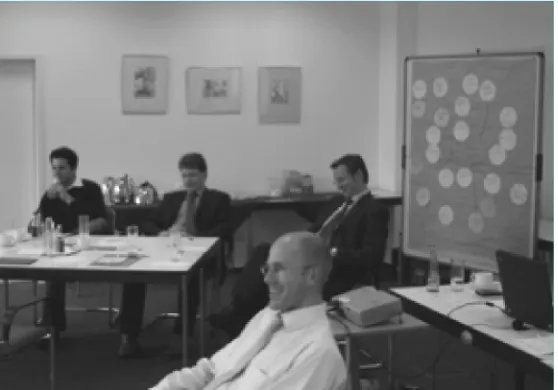
Fig. 1. Scene from the creativity workshop
4.1 Pros and Cons of the Current Situation
4.2 Definition of System Boundaries
The morning period activities continued with system-wide brainstorming and the identification of system boundaries, considering other systems used within different CCIs where different direct connections for import and export of data are in place. This led to constraint and boundary identification and cleared up the focus and scope of the future development, and of course of the expectations of the workshop day.
The session began with a prepared flip chart showing the first draft system context model, where the system was in the centre and two “rings” around it defined the dif-ferent layers: the user front-end and GUI; any co-operative adjacent systems [9]; and autonomous adjacent systems. To get the discussion and idea flow started, partici-pants reviewed the “general story” of the application from the point of view of differ-ent target groups including the customer, the CCI, the system itself, and external sys-tems. To drive the session forward, the facilitator then asked open questions e.g. “who or what is part of the application process”. Questions focussed on connections to other systems or actors, connections to different departments in the CCIs (different actors / roles within the CCI organsastion), connections between the customer and the system, relation(s) between actors, and relations between use cases or functions and external actors (systems, humans, regulations etc.).
For each activity, actor or system mentioned, assistants added different coloured and shaped post-it notes onto the chart. In addition the group started to create connec-tions between them. The session finished by considering the main use case precis. The aim of this session was to generate a common understanding of what was in and out of scope. This was essential as a lot of the participants’ initial concerns had been to do with external systems.
4.3 Using Creativity Triggers to Generate New Requirements
Two sessions during the workshop were dedicated to generating new requirements using exploratory creativity stimulated by the use of creativity triggers. In each of these sessions, participants were divided into four groups with four or five representa-tives from CCIs and one from CNM. The moderator created the groups in a way that people from different CCIs and departments, and with different experience (as mar-keting experts, technical experts or event managers) worked in groups together. The aim was to have groups which brought individuals with different expertise and focus together to prevent “specialisation”. Groups worked in parallel, using different crea-tivity triggers.
requirements. After each round, the participants were re-grouped and chose a new trigger for the next round.
Table 1. Creativity triggers and EDA-specific examples used for explanation in the workshop
Creativity triggers Context-specific explanations and examples used in the EDA workshop Service Target group: customer
Target group: CCI event/course management Target group: CCI training
Target group: CCI public relation and others
Information Which kind of information is interesting for customers? Which kind of information could a CCI offer?
Which kind of information is useful for the customer? Which kind of information is useful for the CCI? Participation How can customers actively participate?
How can CCI training course representatives actively participate? How can CCI event management people actively participate? How can CCI PR people actively participate?
Connections Media for customers Connection to ECMS
Connection/ Interfaces to other CCI systems
Connection of further media (information) channels/systems Trust Customer point of view - System
Customer point of view - CCI CCI
System
Convenience Customers
CCI course/event management CCI training department CCI PR, communication
After the workshop, all the identified requirements were recorded in an MS Excel spreadsheet. The CNM project manager structured the list of requirements by relating them to a rough cluster of basic use cases and identifying those requirements which could be used within different use cases (e.g. print, e-mail reminder) as system-level requirements. The spreadsheet was then placed on the CCI24 partner server. This allowed responsible CCI stakeholders, who were not able to participate in the work-shop, to be informed and provide additional ideas to CNM. Several new requirements were identified in this way. Finally, all CCI24 project leader participants were asked to rank the requirements, using the Volere satisfaction and dissatisfaction rating scales [9], on behalf of their CCI. This feedback was then collected and used for our internal ranking.
5
Results and Discussion
section, we analyse data relating to the 148 requirements generated during the course of the workshop to answer a number of research questions of interest. The main out-comes are shown in Table 2.
Table 2. Numbers of requirements generated from the initial round robin session and the use of different creativity triggers during idea generation sessions
Technique/Creativity trigger No. reqts
Round robin pros & cons 41
Service 33
Information 25
Participation 0
Connections 4
Trust 9
Convenience 36
Total 148
5.1 What Triggers Did Groups Choose to Work With?
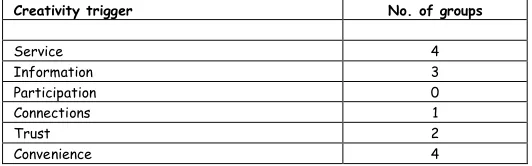
During the idea generation sessions, groups were free to choose which creativity triggers to work with. Table 3 shows how many times a group chose to work with each of the available triggers.
It is interesting to note the differences in the numbers of groups opting to work with the different creativity triggers. Triggers are shown in the table in the order in which they were explained during the workshop. Therefore, the differences may be due to a combination of recency and primacy effects, whereby participants remem-bered better the earlier and later triggers from the list. However, the impression of the facilitator was that some triggers did not seem as relevant as others, and were not so easy to understand for the participants in this workshop. For example, the ‘Connec-tions’ trigger was explained as quite a technical concept, relating to interfaces with other CCI systems, and may therefore not have seemed very relevant to the stakeholders’ perceptions of the system in terms of its user interface. Further investi-gation of this issue is needed.
Table 3. Numbers of groups who chose to work with different creativity triggers
Creativity trigger No. of groups
Service 4
Information 3
Participation 0
Connections 1
Trust 2
[image:9.595.166.432.591.674.2]5.2 How Productive Were the Different Techniques Used during the Workshop?
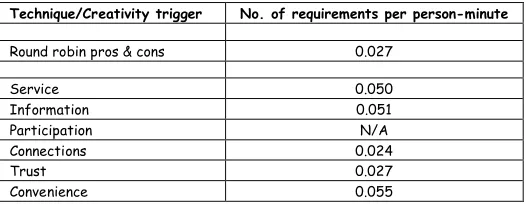
In Table 4, we present a measure of the relative productivity of the different tech-niques and triggers used during the idea generation sessions. The data shown was generated according to the formula:
number of requirements generated during the session / (total number of min-utes in the session x number of repetitions of session x total number of people
involved in the session) .
(1)
[image:10.595.168.431.360.462.2]This measure is intended to give an approximate representation of the number of requirements generated per person-minute. Note that this is only an approximate measure, since sessions lengths are approximate (correct to within + or – 5 minutes), and group sizes for the idea generation sessions were sometimes 5 and sometimes 6 (an average of 5.5 was used for the calculations).
Table 4. Productivity of different techniques and triggers
Technique/Creativity trigger No. of requirements per person-minute
Round robin pros & cons 0.027
Service 0.050
Information 0.051
Participation N/A
Connections 0.024
Trust 0.027
Convenience 0.055
It is interesting that the round robin session, involving all participants, appears less productive than the work with some of the creativity triggers, which was done by smaller groups working in parallel, although it should be remembered that this session served other important purposes in terms of allowing participants to share ideas and build a common sense of purpose.
5.3 Does the Use of Creativity Techniques Lead to Good Quality Requirements?
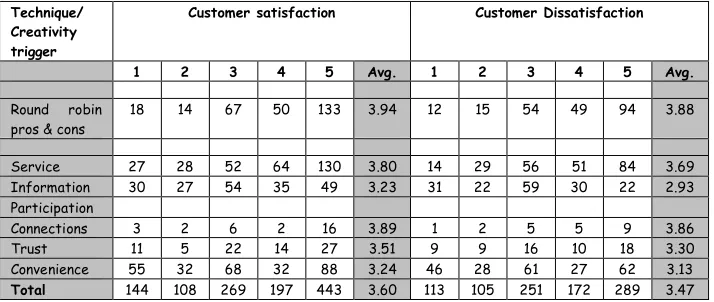
[image:11.595.125.482.302.453.2]Following the workshop, all CCI’s which had sent representatives to the workshop were asked to rate the requirements generated using the Volere measures of customer satisfaction and dissatisfaction [9]. In other words, CCIs were asked to rate, on a scale of 1 – 5, how satisfied they would be if a requirement was met in the final system (where 5 is most satisfied), and also on a scale of 1 – 5, how dissatisfied they would be if the requirement were not met (where 5 is most dissatisfied).
Table 5. Total numbers of CCI ratings of a requirement from the creativity technique or trigger shown at the level of satisfaction or dissatisfaction shown
Technique/ Creativity trigger
Customer satisfaction Customer Dissatisfaction
1 2 3 4 5 Avg. 1 2 3 4 5 Avg.
Round robin
pros & cons 18 14 67 50 133 3.94 12 15 54 49 94 3.88
Service 27 28 52 64 130 3.80 14 29 56 51 84 3.69 Information 30 27 54 35 49 3.23 31 22 59 30 22 2.93 Participation
Connections 3 2 6 2 16 3.89 1 2 5 5 9 3.86
Trust 11 5 22 14 27 3.51 9 9 16 10 18 3.30
Convenience 55 32 68 32 88 3.24 46 28 61 27 62 3.13
Total 144 108 269 197 443 3.60 113 105 251 172 289 3.47
Data from this exercise is collated in Table 5. The table shows the numbers of times an CCI rated a requirement generated from the creativity technique or trigger shown at levels 1 – 5 for satisfaction and dissatisfaction. Since each CCI was asked to give two different ratings to each of around 200 requirements, it is perhaps not sur-prising that some of the requirements were not rated by some participants. In our table, we simply count and average the ratings given.
The overall averages for both satisfaction and dissatisfaction are greater than 3, suggesting that requirements generated during the creativity workshop are seen by the participants to be important in relation to the future system.
It is interesting to note that for both satisfaction and dissatisfaction, the highest av-erage rating is for requirements generated during the round robin pros and cons ses-sion held at the beginning of the workshop. This is perhaps not surprising, as people came prepared to share their ‘big ideas’ about the future system, and did so during that session. So, although this session could be seen as less productive than some according to the measure shown in Table 4, it delivered, on average, the most highly rated requirements.
gener-ated using that trigger had the lowest average satisfaction and dissatisfaction ratings of those from any trigger. ‘Connections’, on the other hand, appeared to be the least productive trigger according to Table 4, but to stimulate the requirements with the highest satisfaction and dissatisfaction ratings of any trigger. Once again these find-ings may be quite specific to this group of participants working in this domain. It is the impression of the facilitator that the ‘Connections’ and ‘Trust’ triggers were inter-preted in quite a technical way (as relating to networking and security, for example), and were in this sense outside of the expertise of most of the stakeholders present. This may have accounted both for the apparently low productivity (i.e. the low num-ber of requirements generated) and the high importance attached to the requirements generated. Further research is needed before we can generalize about the effectiveness of different creativity triggers and techniques.
5.4 Is there any Association between the Creativity Technique or Trigger Used and the Part of the System for which Requirements Are Derived?
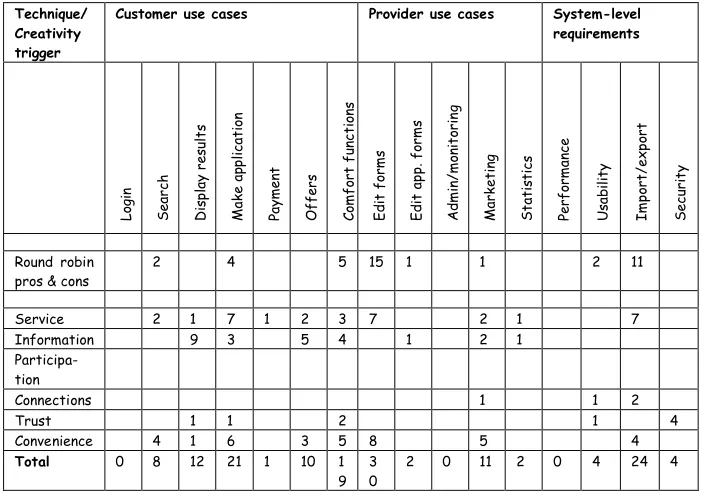
There is a wide variation in the numbers of requirements identified for the different use cases, from 0 to 30, as shown in Table 6. The main foci for attention were the editing of forms on the provider side (‘Edit forms’), and making applications to attend training courses on the customer side (‘Make application’). 19 requirements were also identified in relation to customer ‘Comfort functions’ – features of the system which would make it easier and more pleasant for customers to use – and 24 requirements were identified in relation to interfaces, import/export functionalities and xml formats for linking with external systems (‘Import/export’).
Requirements from the round robin pros and cons session are particularly focused on the ‘Edit forms’ use case (which accounted for 15 out of the 41 requirements gen-erated during this session) and ‘Import/export’ connections with external systems (11 out of 41). This reflects the areas of concern which the participants brought to the workshop. However, it is noticeable that requirements related to other areas of func-tionality were identified later in the workshop, during idea generation sessions using the creativity triggers. For example, while no requirements for the ‘Display results’ use case were identified during the pros and cons session, a total of 12 had been iden-tified by the end of the idea generation sessions using creativity triggers. No require-ments were identified in relation to ‘Offers’ in the pros and cons session, but creativ-ity triggers lead to 10 new requirements in this area, and finally only 1 requirement relating to ‘Marketing’ was raised during the pros and cons session, but 10 new re-quirements were added during idea generation. This suggests that the work with crea-tivity triggers in general gave participants the opportunity to consider broader issues and other parts of the system than those on which they might initially have focused.
requirements were identified using the Connections, Trust and Participation triggers to be able to identify any trends of this kind.
Table 6. Association of requirements from different sources with use cases or system-level aspects of functionality
Technique/ Creativity trigger
Customer use cases Provider use cases System-level
requirements Lo gi n S ea rc h D is pl ay r es ul ts M ak e ap pl ic at io n Pa ym en t O ff er s Co m fo rt f un ct io ns Ed it f or m s Ed it a pp . f or m s A dm in /m on it or in g M ar ke ti ng S ta ti st ic s Pe rf or m an ce U sa bi lit y Im po rt /e xp or t S ec ur it y
Round robin
pros & cons 2 4 5 15 1 1 2 11
Service 2 1 7 1 2 3 7 2 1 7
Information 9 3 5 4 1 2 1
Participa-tion
Connections 1 1 2
Trust 1 1 2 1 4
Convenience 4 1 6 3 5 8 5 4
Total 0 8 12 21 1 10 1
9 3 0
2 0 11 2 0 4 24 4
6
Lessons Learnt
[image:13.595.123.475.221.470.2]workshop and the quality of the resulting use cases and requirements was also very positive.
Based on this experience, CNM will use creativity workshops again to collect re-quirements for projects similar to the EDA project, where there is a need for a user-oriented requirements process to define requirements for a sizeable product or appli-cation, where requirements are initially unclear and there are heterogeneous user groups with different requirements and backgrounds (technical, organisational, con-tent).
One important lesson concerned the management of stakeholder expectations about the requirements activities in and around a workshop. People were surprised and even resentful in the beginning as their expectations differed completely from what actually happened. They expected a meeting where they could place some ideas or just follow a presentation and then start a discussion – the way they usually define applications. Some participants initially criticised the definition of system boundaries as “useless” or a “waste of time”. This was the most important, and most difficult part of the workshop. As the event progressed, the participants’ understanding of why bounda-ries and the identification of actors are important developed. The most important lesson is to ensure that a good explanation is given as to why this kind of work is important. In future use of creativity workshops, especially with non-technical target groups who have little or no experience of the requirements process, there is a need for some easy to understand arguments and explanations of, for example, why system boundaries are important, and how actors or functionality groups will have influence.
Another lesson, based on our experience, is the need to incorporate some modifica-tions of the creativity process in the case of projects with a clearly fixed budget limit, in order to reduce or prevent dissatisfaction. A workshop can generate many ideas, but there may not be the budget to realise them. In such cases creativity should, if possible, be channelled to focus on areas of functionality within the range of the pro-ject budget. One possibility would be to identify extra costs in parallel with require-ments so that the customer can decide whether s/he wants the relevant features or not. In the case of product development, the normal practice of CNM is to work first with a pilot customer, before developing a product for general release. In this case, the pilot customer would have the opportunity to be creative, but CNM would ultimately decide whether a particular feature should be “in” or “out of scope”.
Acknowledgements. The work reported in this paper began as part of the APOSDLE project, which is partially funded under the FP6 of the European Community withn the IST work programme (project number IST-027023).
References
1. Maiden, N.A.M., Robertson, S.: Integrating Creativity into Requirements Processes: Experi-ences with an Air Traffic Management System. In: Proceedings of the 13th IEEE Interna-tional Requirements Engineering Conference (RE05). IEEE CS Press (2005)
2. Maiden, N.A.M., Ncube, C., Robertson, S.: Can Requirements be Creative? Experiences with an Enhanced Air Space Management System. In: Proceedings of the 29th International Conference on Software Engineering (ICSE07). IEEE CS Press (2007)
3. The APOSDLE project web site (2007) http://www.aposdle.org
4. Ley, T., Kump, B., Lindstaedt, S. N., Albert, D., Maiden, N.A.M. and Jones, S.: Competence and Performance in Requirements Engineering: Bringing Learning to the Workplace, In: Proceedings of the 2nd Workshop on Learner-Oriented Knowledge Management & KM-Oriented E-Learning (LOKMOL) (2006)
5. Jones, S., Maiden, N.A.M.: RESCUE: An Integrated Method for Specifying Requirements for Complex Socio-Technical Systems. In: Mate, J.L., Silva, A. (eds.): Requirements Engi-neering for Sociotechnical Systems. Idea Group Inc. (2005)
6. Jones, S., Maiden N.A.M., and Karlsen K.: Creativity in the Specification of Large-Scale Socio-Technical Systems In: Proceedings of CREATE 2007, the Conference on Creative In-ventions, Innovations and Everyday Designs in HCI, 13-14 June 2007, London, UK, Go-lightly, D., Rose, T., Wong, B.L.W. and Light, A. (eds), pp 41 – 46, Ergonomics Society (2007)
7. IHK24 Partner homepage (2007) http://www.ihk24.de
8. Andrews, D. C., JAD: A Crucial Dimension for Rapid Applications Development, Journal of Systems Management, March, 23-31 (1991)
9. Robertson, S., and Robertson, J.: Mastering the Requirements Process, ACM Press (1999) 10.Maiden N.A.M. & Robertson J.: Creative Requirements - Invention and its Role in