! ! ! ! !
Attention to distraction: a visual investigation of temporal
experience through time-based media
! ! ! ! ! !
By Raef Sawford
Bachelor of Fine Arts, Tasmanian School of Art, University of Tasmania
Bachelor of Fine Arts (Honours), Tasmanian School of Art, University of Tasmania
Submitted in fulfilment of the requirements for the Degree of Doctor of Philosophy University of Tasmania, April 2013
!
! "!
Statement of originality:
This thesis contains no material that has been accepted for a degree or diploma by the University or any other institution. To the best of my knowledge and belief, it incorporates no material previously published or written by another person except where due acknowledgment is made in the text.
Raef Sawford
! #!
Statement of authority of access to copying:
This thesis may be made available for loan and limited copying in accordance with the Copyright Act 1968.
Raef Sawford
! $!
Abstract
This project has explored the relationship between the moving image and temporal experience. Acknowledging the constructed temporality of narrative cinema, in conjunction with what Peter Osborne has described as distracted perception, I have examined the potential for the moving image to direct attention to the here-and-now. What began as an attempt to provide an antidote to the condition of distraction through contemplative immersion evolved as a reflection on the temporal dialectic of contemporary experience.
The project’s concern with temporal experience is based on my response to working with narrative forms of the moving image in a commercial context. Drawing on anti-illusionist strategies of the film-artists of the 1960s as well as representational aspects of commercial production has resulted in work that embodies the inherent tension between these conditions of spectatorship, simultaneously heightening and dissolving temporal perception.
The visual context for the project is defined by the work of contemporary artists who also deal with the potential for the moving image to both absorb and distance viewers. This has been explored through a selection of specific works by Andy Warhol, David Hockney, Chantal Akerman, Christian Marclay, Douglas Gordon, Tacita Dean, Daniel Crooks and David Claerbout. These works challenge viewing habits and expectation through strategies of duration, re-contextualisation and re-examining the configuration of normative cinema.
In developing a theoretical understanding of the relationship between temporal experience and conditions of spectatorship, the project has been informed by Walter Benjamin, Tom Gunning and Sean Cubitt, writing on the relationship between narrative and non-narrative forms of cinema. These concepts have been further developed through Michael Fried’s theory of absorption and theatricality and Peter Osborne’s writing on attention and distraction. A philosophical
understanding of temporal experience has been explored through the existentialist thought of Jean-Paul Sartre and Albert Camus.
! %!
!
The work developed as a combination of gallery-based and site-specific artworks that include single channel projections, multichannel installation, panoramic photography, live-feed cinema/installation and augmented reality. This broad, experimental approach is the result of exploring the moving image beyond the confines of linear cinematic structures. These diverse outcomes have been refined in the context of the Plimsoll Gallery for the submission exhibition.
By developing strategies that examine the relationship between time and the moving image the project has concluded that to offer a contemporary experience of the here-and-now, the work must fluctuate between states of immersion and awareness; between attention and distraction. Here, the inherent tension activated by the intersection of these temporal states directs audience attention toward the potential of a moment.
! &!
Acknowledgments
This thesis is dedicated to my two beautiful children Stella and Jude, who have shown great patience, and who thankfully continue to direct my attention to the here-and-now.
I would like to graciously thank a number of people, without whom this project would not have reached this point.
To my supervisors: Leigh Hobba, for his implicit understanding of what the project needed and for showing me what it means to be an artist; Dr David Stephenson for his rigour and insight; Professor Jonathan Holmes for his belief and guidance and Dr Martin Walch for asking the hard questions.
Special thanks to my Dad, Gil Sawford, for his unconditional support and wisdom, and to my Mum, Irene, who gave me the tools to embark on this journey. I also wish to thank Claire Krouzeckey for her insight, intellect and calming influence. Special thanks also to Leah Barker, who gave me the support and encouragement that allowed me to begin the project, and the patience that allowed me to finish it.
To my colleagues and associates Aaron Horsley, Lucy Bleach, John Vella, Leigh Carmichael, Paul Zika, Dr Meg Keating, Dr Bill Hart, Dr Brigita Ozolins, Dr Yvette Watt, Dr Ruth Frost, Dr Peter Waller, Professor Noel Frankham, Michael Edwards, Dr Matt Warren, Jack Robins, Anthony Johnson, Dr James Newitt, Terence Munday, Stuart Haughton, Gerrard Dixon, Phil Blacklow, Laura Hindmarsh, and Craig Walsh. Thank you all for your support and advice.
Thanks also to Kath Symmons and Craig Dow Sainter, who had the confidence and generosity to give me my start. And to my mentor Steve Thomas, without whom I would never have been able to develop my passion.
Finally I would like to thank my brothers Adam & Bryn, and my close friends Richard Angus, Nick Bell and Sam & Nell Nettlefold, for their love and support throughout this journey.
! '!
Contents
!CHAPTER ONE: Introduction to the Project
!
Project Description ... 9
!
Background and Motivation ... 11
!
In Search of Presence ... 13
!
The Cinema Effect ... 16
!
An Absurd Existence ... 19
!
Toward the Real ... 20
! CHAPTER TWO: Context for the Project
!
Introduction ... 22!
An Expanded Cinema ... 23
!
Anti-Illusion ... 25
!
Duration ... 26
!
A Legacy ... 28
!
Here and There ... 29
!
Selected Works ... 30
!
Chelsea Girls (1966): Andy Warhol 31
!
24hr Psycho (1993): Douglas Gordon 34
!
Merce Cunningham Performs Stillness (2007): Tacita Dean 38
!
Bordeaux Piece (2004): David Claerbout 42
!
Jeanne Dielman, 23, Quai du Commerce, 1080 Bruxelles (1975): Chantal Akerman 45
!
The Clock (2010): Christian Marclay 48
!
Joiners: David Hockney 51
!
Timeslice: Daniel Crooks 55
! (!
CHAPTER THREE: Development of the Project
!
Introduction ... 63
!
Stage One ... 63
!
Breaking the Narrative 64
!
Space in the Mode of Time 68!
Relationscape 70!
Case study: MONA FOMA 74!
Stage Two ... 78!
Anticipation 79
!
Time as Duration 84!
Still Moving 91!
Stage Three ... 95!
Site Specific 96
!
Open to the Possibility 98!
Full Circle 108 ! CHAPTER FOUR: Conclusion 111!
Appendix A: List of Submitted Work ... 117
!
Appendix B: Bibliography ... 118
!
Appendix C: List of Illustrations ... 122
!
Appendix D: Curriculum Vitae ... 127
!
!
! )!
CHAPTER ONE: Introduction to the Project
Tomorrow, he was longing for tomorrow, whereas everything in him ought to reject it.1 !
!
Project Description
This project has explored the relationship between the moving image and temporal experience. Here I have identified the capacity for the moving image to
simultaneously heighten and dissolve the experience of time. This investigation has aimed to bring awareness to this tension through the development of artworks that attempt to situate the viewer between temporal states of absorption and awareness;2 between the illusory and the real.
Using the rejection of narrative cinema’s goal of ‘closure and fixity’3 as a starting point, the central concerns of the project have emerged through a series of research propositions, experimentation and personal experience. An exploration of
alternative structures to normative cinema’s traditional linear form raised questions surrounding notions of intent and led to the development of work that aimed to return focus to the here-and-now. These works sought to challenge habitual modes of viewing reliant on resolution, instead placing emphasis on each moment as it unfolds.
These initial strategies of contemplative immersion, developed through various forms of representation, raised further questions relating to the illusory nature of time inherent in the moving image. Responding to this informed the development of the project’s central concern: how can the moving image direct audience attention to a moment in time – toward the real – while engaging them outside of time – through illusion?
!!!!!!!!!!!!!!!!!!!!!!!!!!!!!!!!!!!!!!!!!!!!!!!!!!!!!!!!!!!!!
1 Camus, Albert. The Myth of Sisyphus. London: Penguin, 2000, p 20
2 The term absorption is used by Michael Fried to describe an engagement with the work itself. It is used throughout this exegesis to suggest ! a state of immersion, at the exclusion of awareness of one’s own experience. It is also interchangeable with the term distraction; first used by ! Walter Benjamin and later Peter Osborne to also describe identification with anything outside of time’s existence.
! *+!
In addressing this question the project shifted focus from strategies of pure
immersion and representation, toward strategies that also aimed to direct audience attention toward the experience of time.
Central to defining the aims of the project is Michael Fried’s theory of absorption and theatricality, Peter Osborne’s writing on attention and distraction, and an engagement with the existential thought of Jean Paul Sartre and Albert Camus. Engaging with these philosophers offered an insight into my personal experience that had formed the impetus for the project, by introducing the existential paradox of being both in time and outside of it. Fried’s theory provided a representational framework through which to view this paradox by examining the relationship between the temporal experience of the spectator and the moving image.
To further understand these ‘conditions of spectatorship’ I have examined both narrative and pre-narrative forms of cinema and drawn on the legacy of the avant-garde, in particular the Expanded Cinema movement from the 1960s and 1970s, which sought to return the experience of time to the viewer. The project then examines specific works by contemporary artists using the moving image to both absorb and distance viewers.
The gallery-based artworks that have been chosen for the project exhibition have evolved from an emergent and experimental process and represent a distillation of the research concerns. During the course of the project the selected works have been exhibited in various forms, including group and solo gallery exhibitions, public artworks and research symposia. Experiencing the work beyond the confines of the studio has allowed a reflexive process and facilitated dialogue, encouraging further development and refinement prior to the project exhibition.
This exegesis supports the artworks presented in the project exhibition, offering a theoretical and contextual basis from which to assess the research outcomes.
! **!
Background and Motivation
As a child I would often spend my time exploring land surrounding our property south of Hobart. I recall wandering through the bush seeking out places beyond my previous reach in an attempt to expand my knowledge of the area, and to perhaps discover some secret place: a utopian valley or some expansive view. I can also recall a tension between the anticipation of discovering this yet unknown goal, and an acute awareness of my distance from home and the time until dark. Both of these sensations highlight the effect of an external force; a distraction from my lived experience.
In his book Ancient and Modern,4 Stephen Muecke relays a section of Donald Stuart’s 1962 novel Yaralie, a coming-of-age story of a young aboriginal girl. The passage describes Yaralie’s discovery of a gold nugget, which she is led to by a procession of ants whilst wandering in country. Yaralie’s discovery is accidental: a pleasant surprise made through an engagement with place, rather than one driven by intent. When she realises what she has found she is content, happy in the knowledge that it will please her mother. Rather than search for more, she returns home with great excitement:
It had been heavy that slug of gold, as she took it to her mother, holding it in her dress pulled up by its front to make a pocket, and when she had stopped in front of her mother and sat down, to roll the slug out at her feet, all the midday air, the shade, the sunshine the high clear pale sky, the silent world of flat and well and camp and waiting secret hills had suddenly become golden and hazed with the smile in her mother’s eyes, and yes, her mother had said it, softly … with warmth, ‘Just walking about, you found gold. Good.’
And her mother had hefted it in her fine slim strong hand, and had put her head on one side, and clicked her tongue, and they had both drunk from the black billycan of cold tea till it was all gone, and had walked up the slope in the heat of noon to the camp, and had sat waiting for the day to wear away.5
From this passage Muecke highlights the unity between ‘body and place’, a hallmark of Aboriginal philosophy exemplified by the fact that the country and !!!!!!!!!!!!!!!!!!!!!!!!!!!!!!!!!!!!!!!!!!!!!!!!!!!!!!!!!!!!!
! *"!
the mother’s smile share the same golden shine. He also draws attention to the fact that ‘mother and daughter persist there in that place while time disappears’ observing that ‘the hours do not pass, the day wears away, like the dissipation of energy from a labouring body’, suggesting a unity between body and time as well.
This unison with time and place experienced by Yaralie contrasts with the recollection of my own experience. Hers was one of engagement, observing her surroundings, content to simply be as the day ‘wears away’. Mine was one of seeking further; searching for fulfilment in an unknown future, pitted against the clock.
…
Prior to beginning this project I was working as an editor and director of documentary film and other forms of commercial media production. Over the seven years I was involved in this industry I worked on a number of significant television projects and countless smaller productions. During this process I don’t ever recall consciously considering the temporal experience of the viewer. Instead, my primary concern was to create a compelling story that could retain their attention for twenty-six minutes.
Within this standardised and unquestioned format of the ‘television half-hour’, the finer temporal details of how long each shot should remain on screen were crucial. It demanded a fine balance between feeling ‘cheated’ – a colloquialism for a shot ending too abruptly thereby drawing attention to itself – or conversely lingering too long, creating boredom and inattention.
The mechanics of this would be initially deduced by an intuitive feel, followed by a process of continual refinement; crafting the rhythm and pace of the work, always with the aim of minimising awareness and maximising engagement.
This meant that although frames and seconds were consciously counted, trimmed, extended, and shots slowed down or sped up, it was all done within a framework of fixed duration, intended to be consumed from beginning to end.
! *#!
Coupled with this unconscious temporal manipulation was an underlying sense of pressure to complete the work within a specific time, a factor that manifested as a felt experience in the form of stress and heightened attention. And although this sensation registered as one induced by a lack of time, it was not recognised as a felt experience in the present, only as a point of potential relief in the future.
So although the entire production process, the medium and consumption of the product were essentially temporal, with time playing a critical factor throughout, it was, on reflection, only ever considered as an obstacle to overcome: an external force to be manipulated and mastered to achieve the desired outcome of immersive engagement; obliterating time’s existence.6
This comparison serves as a point of reference and communicates the underlying impetus for the project. The first reflection alludes to the condition of the modern subject as one that is essentially alienated from the time in which they exist; the second highlights how narrative forms of the moving image further distance their subject from their existence in time.
This project set out to explore temporal structures of the moving image beyond its narrative form, in an attempt to return to the viewer an awareness of time as present, not a constructed illusion with a focus on the future.
In Search of Presence
In existential thought the inability to feel whole, to be fulfilled as a conscious being, is known as futurising intention.7 In Being and Nothingness, Sartre states that because we are conscious beings aware of both our past and our future we can never exist in the present, suggesting that reality, or being-for-itself, ‘is what it is not and is not what it is.’8
This statement can be interpreted by understanding that consciousness is essentially temporalised, meaning that rather than existing in time, it exists in relation to time as a continual flow into the future. So while we are present as beings in the world, our consciousness is moving away from our past – what we are – and toward our
!!!!!!!!!!!!!!!!!!!!!!!!!!!!!!!!!!!!!!!!!!!!!!!!!!!!!!!!!!!!!
6 !Gidal, Peter. Andy Warhol: Blow Job. London: Afterall, 2008, p 12
! *$!
future – what we are not. This is felt as ‘lack’; a desire for unity that can only be found in a future one cannot reach.
This innately fragmented sense of self was further alienated following a dramatic shift in experience through the inception of modernity. As the world sped up and the future came rushing toward late 19th century society, it brought with it equal measures of anxiety and optimism, marking the rise of an accelerated existence that defines contemporary experience.
In the introduction to River of Shadows: Eadweard Muybridge and the Technological Wild West, Rebecca Solnit highlights the effect of new technologies during this period by recounting a common phrase of the day: ‘the annihilation of time and space.’9 This sentiment characterised the sensation induced by the introduction of infrastructure such as the railway and the telegraph, as they served to highlight the relativity of time and distance.
Although these technologies brought great economic benefits through
opportunities for trade and increased productivity, Solnit describes an equally significant effect upon the individual:
People were being drawn out of their small familiar worlds into one more free, less personal, in which associations that once attached to each person, place and object came undone. It was a leap forward of extraordinary liberation and alienation.10
This change in experience engendered through systems of industrialised
production is described by Phillip Zimbardo and John Boyd in The Time Paradox, who suggest that ‘time was no longer measured against the rhythms of the natural world’11 but instead governed by the clock. For the worker this move from ‘event time’ to ‘clock-time’ resulted in a new relationship with time. No longer integrated into the fabric of life, work was now delineated; marked by the whistle of the factory that signalled the start and end of each shift.
!!!!!!!!!!!!!!!!!!!!!!!!!!!!!!!!!!!!!!!!!!!!!!!!!!!!!!!!!!!!!
9 !Solnit, Rebecca. River of Shadows: Eadweard Muybridge and the Technological Wild West. London: Penguin, 2004, p 10 10 !Ibid, p 11
! *%!
Walter Benjamin, writing in the 1930s about the effect of modernity, also observes this sense of disconnection:
A generation that had gone to school in horse-drawn streetcars now stood under the open sky in a landscape where nothing remained unchanged but the clouds and, beneath those clouds in a force field of destructive torrents and explosions, was the tiny fragile human body.12
This is an image of man no longer in unison with the world. In the pre-modern past, experience was felt as an accumulation of continuous and gradual immersion in a time governed by cycles. Here we are presented with a ‘fragile human body’ at the mercy of forces outside of nature.
This new environment, characterised by Georg Simmel in 1903 as ‘the rapid crowding of changing images, the sharp discontinuity in the grasp of the single glance, and the unexpectedness of onrushing impressions’,13 was seen by philosophers such as Benjamin and Martin Heidegger to effect an ‘evacuation of the present’,14 which they were impelled to locate.
In an essay titled In a Moment: Film and the Philosophy of Modernity, Leo Charney describes this search for ‘a moment of sensuous presence’ and details the difficulty of such a task. Interpreting Being and Time, in which Heidegger claims that ‘nothing can occur in the moment of vision’, Charney explains that rationally we can only recognise a moment after the moment has occurred. But if this ‘moment of vision’ is experienced in a non-rational way, as bodily sensation, then the present can be understood as an ‘encounter ... in time’.15
Benjamin also recognised this and saw the potential for felt experience in his concept of shock that he saw as defining the discontinuity of modern life; an experience he saw replicated in the new medium of film.
! !
!!!!!!!!!!!!!!!!!!!!!!!!!!!!!!!!!!!!!!!!!!!!!!!!!!!!!!!!!!!!!
12 Benjamin, Walter, cited in: Moore, Rachel. Hollis Frampton (Nostalgia). London: Afterall, 2006, p 9
13 Simmel, George, cited in Charney, Leo. "In a Moment: Film and the Philosophy of Modernity." Cinema and the Invention of Modern Life. Eds. Charney, Leo and Vanessa R. Schwartz. Berkeley: UCP, 1995, p 279
! *&!
The Cinema Effect
Early forms of cinema were developed in parallel to this shift in experience and came to perform a dual role in the evolution of this temporal change. On one hand this new form of entertainment offered a refuge and distraction. On the other, the cinema provided an opportunity to feel the presence of a moment in light of its evacuation by re-presenting the distraction and sensation of modern life; by framing it and bringing awareness to it.
The first moments of cinema began in 1895 with the Lumiere Brothers first public screening of La Sortie de l’Usine Lumiere a Lyon (Workers Leaving the Lumiere Factory),16a 17-metre long film that equated to approximately 50 seconds.
[image:16.595.156.503.378.639.2]These first simple films, known as ‘actualities’, were an eclectic mix of quotidian scenes, exotic locations and bizarre action. Film scholars Andre Gaudreault and Tom Gunning later termed them TheCinema of Attractions.17
Figure 1: Lumiere Brothers, Workers Leaving the Lumiere Factory, 1895, DVD still
Gunning delineates this form of cinema from its narrative future by equating it to the type of ‘curiosity-arousing device’18 of the fairground. And while he clarifies !!!!!!!!!!!!!!!!!!!!!!!!!!!!!!!!!!!!!!!!!!!!!!!!!!!!!!!!!!!!!
16 !Muir, Gregor. "Chronochromie." Time Zones: Recent Film and Video. Eds. Morgan, J and G Muir. London: Tate, 2004, p 36
! *'!
that there are narrative elements within these simple representations of events, the key difference between early and later cinematic forms was the way in which each addressed the viewer.
Early forms of cinema spoke directly to the spectator with a primacy of presentation, and an ‘immediacy of “Here it is! Look at it!”’19 The narrative
structure that followed sets out with the opposite intention: to evoke viewer interest by creating what Gunning describes as an enigma that then requires a solution:
the art of narrative consists in delaying the resolution of that enigma, so that its final unfolding can be delivered as a pleasure long anticipated and well earned. Further, in classical narrative cinema this pursuit of an enigma takes place within a detailed diegesis, a fictional world of places and characters in which the action of the narrative dwells. From a spectatorial point of view, the classical diegesis depends not only on certain basic elements of coherence and stability but also on the lack of acknowledgement of the spectator.20
Gunning reinforces his position by referring to film theorist Christian Metz, who claims that ‘this is a world that allows itself to be seen but that also refuses to acknowledge its complicity with a spectator … [whom] watches in secret, without the scene he watches acknowledging his presence.’21 This mode of viewing, where the spectator is situated outside the autonomous world that is being observed, invites one into that world, to be absorbed by the illusion.
This difference in the way in which spectators engage with these varying forms creates two types of temporal experience. While narrative generates a trajectory that builds toward an ending, attractions alternate between presence and absence. Gunning describes this difference, explaining that, ‘Rather than a development that links the past with the present in such a way as to define a specific anticipation of the future (as an unfolding narrative does), the attraction seems limited
to a sudden burst of presence.’22
!!!!!!!!!!!!!!!!!!!!!!!!!!!!!!!!!!!!!!!!!!!!!!!!!!!!!!!!!!!!!!!!!!!!!!!!!!!!!!!!!!!!!!!!!!!!!!!!!!!!!!!!!!!!!!!!!!!!!!!!!!!!!!!!!!!!!!!!!!!!!!!!!!!!!!!!!!!!!!!!!!!!!! 18! Ibid, p 73
19 !Ibid, p 76 20 Ibid, p 74
! *(!
Both of these forms of cinema were a continuation of the evolution of
entertainment during a period in which middle-class society continually sought new novelty and distraction.23 But non-narrative forms of cinema created
awareness in the viewer; what they were watching was a continuation of the social fabric in which they existed. In The Cinema Effect, Sean Cubitt describes ‘cinema events’24 as tending toward incompleteness, whereas narrative cinema ‘tends toward a gestalt’. He continues,
The goal of narration’s subject is its own completion in the contemplation of the completed narrative, a goal of closure and fixity. The cinematic event tends toward incompleteness. Its subject is constituted in the ephemeral movement from frame to frame, mobile and unfixed.25
Cubitt is suggesting that this sense of incompleteness defines pre-narrative cinema, and makes it ‘profoundly human.’ It does this by reflecting back our own
incompleteness that he describes as the ‘unstable lack of totality and equilibrium that makes it impossible to be at home with oneself alone, and makes us social.’
This echoes Sartre’s theory of being, when he says ‘before itself, behind itself: never itself.’26 The self can never be present.
This suggests that the incomplete structure of the pre-narrative cinema, its lack of resolution, retains a link with the external world it is re-presenting. This allows spectators to be at once absorbed and distracted by the magic of its movement, while maintaining or perhaps even heightening awareness of their relationship with and in the world.
By comparison, cinema in its narrative form offers a refuge from the fragmentation and discontinuity of the external environment by offering not only (another) distraction, but also another world to enter. In the case of narrative this is a world that is whole, and in Cubitt’s words ‘complete’, but ultimately it is a world of timeless illusion.
!!!!!!!!!!!!!!!!!!!!!!!!!!!!!!!!!!!!!!!!!!!!!!!!!!!!!!!!!!!!!
23 !Schwartz, Vanessa R. "Cinematic Spectatorship before the Apparatus: The Public Taste for Reality in Fin-De-Siècle Paris." Cinema and the Invention of Modern Life. Eds. Charney, Leo and Vanessa R. Schwartz. Berkeley: UCP, 1995, p 297!
24 !The ‘cinematic event’ is Cubitt’s term for pre-narrative cinema. 25 !Cubitt, Sean. The Cinema Effect. Cambridge: MIT Press, 2005, p 40
! *)!
An Absurd Existence
Albert Camus’ essay The Myth of Sisyphus also deals with this notion of existence as incomplete, and like pre-narrative cinema, embraces a lack of resolution through immersion in its own existence. Camus summarises existence as ‘a divorce between the mind that desires and the world that disappoints,’27 describing an awareness of this as ‘absurd.’ He argues that acceptance of this ‘absurd existence’ is the key to fulfilment.
As a framework for his argument Camus uses the metaphor of the Greek mythological figure, Sisyphus, condemned by the gods to the meaningless task of eternally pushing a boulder up a mountain, only for it to roll back down before repeating. Camus relates this Sisyphean task to the absurd repetition of existence: to the daily tasks of a life without meaning. But rather than face defeat by
succumbing to nihilism or suicide, he suggests an acceptance of our fate; for it is only in the knowledge that the desire for fulfilment is futile, that we are able to find fulfilment.
In concluding his essay, Camus imagines Sisyphus walking back down the mountain to repeat his labour, and in this image envisages a man filled with silent joy. Here in this moment of respite he has accepted his fate. Rather than look toward his hollow goal, he embraces this moment, and accepts it.
And through this acceptance he feels whole.
The themes presented in the first part of this introduction offer an entry-point by expanding upon the basic drive behind the project. Through these ideas the relationship between a desire to break from the restrictions of narrative forms of moving image, and the human desire for unity are brought together, revealing a common thread that binds and guides the research.
This has manifested throughout the development of the body of work that forms this submission, with Camus’ notion of the ‘absurd’ revealed through the subversion of narrative’s demand for resolution.
!!!!!!!!!!!!!!!!!!!!!!!!!!!!!!!!!!!!!!!!!!!!!!!!!!!!!!!!!!!!!
! "+!
Through strategies of duration and seamless repetition, anticipation and expectation are replaced by endlessness and futility. But just as Camus’ hero overcomes the horror of his existence, so too can the endlessness of the work be defeated. Not through suicide28 (or in this case the much less destructive option of moving on to the next work in the gallery), but through acceptance.
By accepting an absurd existence the weight of anticipation is lifted and possibilities are opened up beyond the inevitable, creating a space to be.
This can be seen in the pre-narrative forms of cinema, unencumbered by the expectation of narrative. Without the weight of expectation, the spectator is free to engage with the ‘event’ as it unfolds, drawing focus onto the here-and-now. Narrative denies the here-and-now, replacing it with its own temporality and drawing viewers into an alternate, illusory reality; thus returning focus to Sisyphus’ rock, waiting expectantly at the bottom of the mountain.
Toward the Real
As technology improved, cinema began its trajectory toward a narrative medium. In 1929 the sound film was developed, sealing cinema’s fate as essentially a story-telling device. The distraction that the passive and easily consumed product cinema now offered meant it quickly developed a mass-audience. Described by Christian Metz as the ‘super-genre’ of the 20th century, narrative cinema became a dominant cultural force.
Theodore Adorno and Max Horkheimer, both ardent critics of mass-culture, highlight the shift from early cinema to its narrative form describing its effect upon the spectator. According to Adorno, what was once an actual extension of reality was now manipulated, blurring the distinction between illusion and reality:
Real life is becoming indistinguishable from the movies. The sound film, far surpassing the theatre of illusion, leaves no room for imagination or reflection on the part of the audience, who is unable to respond within the structure of the film, yet deviate from its precise detail without losing the thread of the story; hence the film forces its victims to equate it directly with reality.29
!!!!!!!!!!!!!!!!!!!!!!!!!!!!!!!!!!!!!!!!!!!!!!!!!!!!!!!!!!!!!
28 !Camus thesis is that suicide is an admittance that a meaningless life is not worth living.
! "*!
The avant-garde film artists of the 1960s were impelled to address this passive relationship between the film and the audience, regarding the ideology being presented as reality as oppressive. Malcolm Le Grice, a key figure in the British collective of film-artists30 responding to the dominance of narrative cinema, summarises their concerns. Echoing Adorno’s observations, Le Grice cites the mainstream film as presenting an idealised and highly constructed illusion that is indistinguishable from reality:
I have given a great deal of thought to the kind of condition, role and behaviour which is available to the audience, to the credibility of what is presented as some form of, or relation to reality. I have considered the situation of the audience politically and ethically, and have reacted strongly against the passive subjectivity to a pre-structured substitute and illusory reality, which is the normal situation for the audience of the commercial film.31
Chapter Two:Contextfor the Project begins by examining in detail the field of Expanded Cinema that developed in the 1960s as artists and filmmakers responded to these concerns.
This exploration analyses their rejection of narrative forms of cinema and provides an understanding of the effect of these alternate temporal structures upon the spectator. The chapter then examines specific works by contemporary artists that have continued to explore the relationship between the moving image and the experience of the viewer.
This leads into Chapter Three: Development of the Project, which describes the development of my own work. This chapter tracks the evolution of the project concerns, which through their exploration of temporal experience via the moving image seeks to direct attention toward this tension.
Chapter Four: Conclusion, discusses the outcomes of the project, and looks at the contribution it has made to the field.
! !
!!!!!!!!!!!!!!!!!!!!!!!!!!!!!!!!!!!!!!!!!!!!!!!!!!!!!!!!!!!!!
30 !The British artists working with these concerns were termed Structuralists or Materialists based on their reflexive strategies using the medium as content, rejecting all forms of representation and illusion.
! ""!
CHAPTER TWO: Context for the Project
! ! ! !
Introduction
This chapter begins by examining the development of what became known collectively as Expanded Cinema, a movement in the 1960s that saw the work of a collection of film-artists enter into the critical discourse of contemporary art. Through a broad examination of a complex history, the chapter provides an historical context for the project that offers an understanding of the motivations of these artists to explore alternative modes of production and consumption of the moving image.
Through this examination the chapter describes the trajectory of moving image practice as it responded to the dominant narrative form that had evolved. This saw a shift from an emphasis on the representationof time and space to experiencein time and space, and from a transparency of process to a foregrounding of process.
I then look to a number of contemporary artists that have built upon this legacy, and describe a number of specific works that also seek to foreground the spectator’s experience of time.
The chapter concludes with an examination of Michael Fried’s revised theory of absorption and theatricality, in which he identifies certain examples of video art that have a capacity to be absorptive; a claim he had previously refuted, suggesting that video art creates a condition of self-awareness in the spectator. Responding to this, Ken Wilder furthers Fried’s renewed position, by suggesting that there exists a tension between these alternate conditions of spectatorship: a fluctuation between absorption and awareness.
! "#!
An Expanded Cinema
The collection of artists and filmmakers who began working under the banner of Expanded Cinema in the 1960s were certainly not the first to experiment with the film medium beyond the narrative form. Nor was the experimental urge to push up against the dominant reality offered by cinema isolated to those working with anti-narrative concerns. But in the context of this project, it is the film-artists responding directly to the narrative structures of mainstream cinema that not only inform this inquiry, but pioneer the development of gallery-based film and video.
Prior to the highjacking of cinema by narrative structures, early filmmaking was essentially an exercise in recording subject matter; thrilling audiences with simple representations of everyday life.32 It wasn’t until filmmakers began to understand the cinematic potential of the new technology, through various techniques such as editing, framing, lighting and narrative, that the illusion of cinema was complete.
As with any mainstream activity there is always a cultural fringe and this was certainly true of cinema, with the pioneering spirit of early cinema remaining amongst filmmakers working both within and outside of a narrative approach. This desire for innovation amongst the mainstream and the avant-garde is cause for confusion surrounding the notion of what actually defines the avant-garde in a cinematic context. A.L. Rees, in A History of Experimental Film and Video attempts to unravel these complexities and delineates the two by defining it as such:
The avant-garde rejects and critiques both the mainstream entertainment cinema and the audience responses which flow from it. It has sought ways of seeing outside the conventions of cinema’s dominant tradition in the drama film and its industrial mode of production.33
Within this broad definition are a number of key movements and figures active in their rejection of the mainstream. The surrealist and abstract films of the 1920s are well documented and demonstrate the first example of the use of film by artists. These include Man Ray, Dali, Brunel and Maya Deren, whose dream-like film Meshes of the Afternoon breaks temporal and spatial conventions to portray an
!!!!!!!!!!!!!!!!!!!!!!!!!!!!!!!!!!!!!!!!!!!!!!!!!!!!!!!!!!!!! 32 Arnheim, Rudolf. Film as Art. Berkeley: UCP, 1957, p 35
! "$!
[image:24.595.156.356.142.292.2]interior psychological state. The films of these artists are well known, and have influenced the development of avant-garde film through their inclusion in art schools and film studies programs.
Figure 2: Maya Deren, Meshes of the Afternoon, 1943, film still
It wasn’t until the heightened political climate of the 1960s that film artists working outside the mainstream began to develop enough critical traction to be considered as a discrete avant-garde movement.
Expanded Cinema,34 a manifesto-like book written by Gene Youngblood in 1970, aimed to provide an overview of what was a critical approach amongst the variety of practices that went beyond merely challenging the traditional conventions of cinema with new ways of seeing; instead concerned with the temporal, spatial and social experience of the viewer:
Expanded cinema isn't a movie at all: like life it's a process of becoming, man's ongoing historical drive to manifest his consciousness outside of his mind, in front of his eyes. One no longer can specialise in a single discipline and hope truthfully to express a clear picture of its relationships in the environment. This is especially true in the case of the intermedia network of cinema and television, which now functions as nothing less than the nervous system of mankind.35
Youngblood seems to suggest that the concerns of these film artists were no longer forged by a desire to simply find alternate methods of expression outside of the structures of commercial film.
!!!!!!!!!!!!!!!!!!!!!!!!!!!!!!!!!!!!!!!!!!!!!!!!!!!!!!!!!!!!!
! "%!
Instead this iteration of the avant-garde saw the possibility of the moving image as a radical means of generating a political and ideological shift. Narrative cinema was viewed as reinforcing the oppressive and passive nature of consumption.
Anti-Illusion
Peter Gidal,36 one of the key British artists working and writing on experimental film in London at this time, published an edited volume of essays titled Structural Film Anthology. Similar to Youngblood’s survey of the American avant-garde in Expanded Cinema, Gidal attempts to describe the concerns of the British filmmakers in an equally visionary introduction to the book, in which he defines Structural film as ‘anti-illusionist’.37
This is a key premise for the film artists working at this time and is at the heart of their attack of narrative cinema. They saw through the illusion of seamless reality; a reality that was in fact the product of a series of recorded, fragmented moments, combined through a fragmented process, and governed by a very specific set of rules. By deliberately masking this process the producers of mainstream cinema were creating an illusory environment that allowed their audiences to identify with whatever dominant ideology was presented. Introducing the book, Gidal writes:
In dominant cinema, a film sets up characters… and through identification and various reversals, climaxes, complications (usually in the same order) one aligns oneself unconsciously with one or more characters. These internal connections between viewer and viewed are based on systems of identification which demand primarily a passive audience, a passive viewer, one who is involved in the meaning that word has taken on within film-journalese, i.e. to be not involved, to get swept along through persuasive emotive devices employed by the film director. This system of cinematic functioning
categorically rules out any dialectic.38
Gidal’s view (shared by other film artists writing critically about these films) was that an active and analytical engagement with film – one where the materiality of !!!!!!!!!!!!!!!!!!!!!!!!!!!!!!!!!!!!!!!!!!!!!!!!!!!!!!!!!!!!!
36 Peter Gidal was the voice of the British film avant-garde at the same time as Youngblood was writing in America. Gidal named the British collection of artists the Structural/Materialists, thus expanding on P.Adams Sitney’s categorisation as Structural Film. Because of these variations in names across continents, Expanded Cinema is considered the catchall term.
! "&!
the film itself was foregrounded – would enable within the viewer a spatial and temporal awareness. This awareness could then occur through the experience of viewing, rather than entering into an illusory reality where lived experience is exchanged for identification with the author’s point of view. Gidal saw this identification with the illusory ideology of the film as oppressive:
Narrative is an illusionistic procedure, manipulatory, mystificatory, repressive. The repression is that of space, the distance between the viewer and the object, a repression of real space in favour of the illusionist space… The repression is also that of time. The implied lengths of time suffer compressions formed by certain technical devices, which operate in a codified manner, under specific laws, to repress (material) film time.39
Malcolm Le Grice was also active as both a writer and artist amongst the Structuralists during this period in London, and like Gidal his work was also strongly opposed to narrative cinema, particularly in relation to Gidal’s view of film’s relationship with time. In a recent essay Le Grice asks ‘If there are ways of understanding our experience that are not confined to the processes and forms of narrative. Can we define time structures for cinema and particularly expanded cinema that go beyond narrative?’40 The issue of one’s temporal experience in relation to cinema (and particularly celluloid film) is at the core of the concerns of the Structuralists and this is based on the simple premise of the illusion of time inherent in narrative cinema.
Duration
For a narrative film to work – meaning that the audience becomes involved in the story by identifying with the characters and following the action through to its logical conclusion – time has to be compressed so that the action can flow in a logical sequence. This creates a sense within the viewer of being present in the diegetic world of the film – unaware of their lived experience. If the viewer were to become aware of the discontinuity of the production process i.e. the temporal and spatial distance between shots, then the narrative illusion would be broken.
!!!!!!!!!!!!!!!!!!!!!!!!!!!!!!!!!!!!!!!!!!!!!!!!!!!!!!!!!!!!! 39 Gidal, Peter. Op. Cit., p 4
! "'!
By foregrounding the process of production, and by denying identification with representation, the structural materialists sought to increase the level of awareness within the viewer. Malcolm Le Grice explains the importance of this concept:
Crucial to the understanding of time in expanded cinema is the notion of ‘duration’, a term that implies a subjective awareness of time’s passage, a continuity of attention that ‘belongs’ to the spectator - the experience of time’s passage within a condition of actual, not illusory presence.41
So where narrative cinema constructs an illusory world that leads the viewer through a preconceived, highly compressed structure of cause and effect to an inevitable conclusion, structural film allowed this construction to occur within the viewer’s lived experience. Through this process of exchange between the viewer and producer we can see a shift from the passivenature of mainstream cinema to the dialectic and self-reflexive42 experience of structural film.
Of course time and space are intrinsically linked, so the strategies devised to foreground temporal awareness, such as duration and repetition also incorporated a spatial element. In Expanded Cinema this was often achieved through multi-screen installations that offered the viewer a choice of focus and therefore of structure. Through the strategy of installation the choice of where to be in the space creates
an awareness of the space. This is in contrast to the traditional cinema environment that places the viewer in a fixed relationship with the screen. This disconnects them further from their surroundings and invites greater immersion into the diegetic world of the film:
Reconfiguring the cinema space simultaneously breaks the singularity of the experience - but more particularly breaks any assumption that there is a singular (authorised) interpretation based on matching spectator experience to artistic intention.43
This notion of denying any authorial control over the viewing experience returns us to the drive behind the revision of temporal and spatial structures by the film artists !!!!!!!!!!!!!!!!!!!!!!!!!!!!!!!!!!!!!!!!!!!!!!!!!!!!!!!!!!!!!
! "(!
as being essentially a political one. At a time when mass media was disseminating information through television at levels previously unprecedented, and the issues surrounding global digital networks were being raised by Marshall McLuhan, these artists sought ways of using screen-based media that denied the use of narrative and representation to reinforce dominant ideologies. Instead they developed strategies that returned the power to the viewer, allowing them to experience reality as duration. This created a space for awareness and for the development of unique concepts outside of those derived from mainstream representation.
A Legacy
Nicky Hamlyn, in discussing the lack of importance placed on the effects of ideologies posited through the media, by ‘a younger generation of so called gallery artists’44 summarises the intent of Gidal’s work, and essentially that of Expanded Cinema in general:
In the work of Peter Gidal, representation, explicitly theorised as a political process, is withheld on the grounds that it is necessarily conservative, since it reproduces what is already there and hence is complicit in the maintenance of an ideological status quo. The political effect in these films comes through the stimulation in the viewer of self-conscious sensations of boredom, frustration, engagement. This subject may be surprised by him/herself, and put into a position of not-knowing. This is in contrast to, for example, suspense films, where ‘surprises’ are expected and anticipated – unsurprising.45
Concerns relating to the dissemination of dominant ideologies through
mainstream forms of media amongst those working under the banner of Expanded Cinema are not, as Hamlyn suggests, consciously shared amongst contemporary artists working with the moving image. Yet concerns around temporal and spatial structure are still at the forefront for many of these artists. In fact Hamlyn
concludes his book by acknowledging that there is a continuing tradition of filmmakers and artists responding to the need for alternate forms of moving image, stating that:
!!!!!!!!!!!!!!!!!!!!!!!!!!!!!!!!!!!!!!!!!!!!!!!!!!!!!!!!!!!!!
! ")!
their work stands against both the dominant media and the trivialising convergence of MTV, fashion, art and media that is evidenced in the work of artists like Mariko Mori, Wolfgang Tillmans and others, and whose ideology is disseminated in magazines like Res, Wallpaper and Dazed and Confused.46
Although the practices of the earlier film-artists were developed during a time of significant political and technological change that almost demanded an alternative to the mainstream, Hamlyn suggests that there is still a responsibility amongst contemporary artists working with the moving image outside of mainstream channels to uphold the basic tenet of this legacy; to offer the viewer of the work an experience of which he/she is the author and where he/she becomes simultaneously activated and engaged.
Here and There
Of course the ground has shifted significantly since the height of Expanded Cinema in the 1970s when these artists paved the way for the gallery based moving image works that now form a major part of contemporary museum and gallery collections and exhibitions. The work of the Expanded Cinema artists was shown outside the fine art gallery in specific spaces dedicated to experimental forms, where the emphasis was placed on the materiality of the film and its spatial and temporal structures and effects. Works that used multiple screens had an important spatial aspect in terms of the mobility of the viewer, heightening awareness of their presence in relation to the work, but the actual space the work inhabited was usually not considered.
The gradual acceptance and move of these works into the gallery, where the screens and monitors were likened to the fine art objects in minimalist work of the same period, now offered a new reading of these works; one in which the space and the work operated in tandem, blurring the line between the virtual and the actual. Kate Mondloch describes the effect of this experience as one that can ‘productively destabilise our conventional relationships to screen spaces’.47
!!!!!!!!!!!!!!!!!!!!!!!!!!!!!!!!!!!!!!!!!!!!!!!!!!!!!!!!!!!!! 46 Ibid, p 186
! #+!
In Mondloch’s examination of screen based work in a fine art gallery context she proposes a kind of doubling effect where the virtual space of the work and the actual space that the work inhabits, coupled with the materiality of the screen (as object) and the immaterially of the work, create a ‘disorientating’ viewing experience:
By foregrounding an active relationship between the spectator, media objects, exhibition space, and screen spaces, these media art installations generate a self-conscious and troubled spectatorship explicitly contingent upon the articulated tension between actual and virtual times and spaces. We are simultaneously both here and there, both now and then.48
To draw these conclusions Mondloch has focused on specific works by two artists working in the field of Expanded Cinema in the 1960s and 70s: Ping Pong (1968), by Valie Export and Interface (1972)byPeter Campus. Both of these works support Mondloch’s observation that certain gallery-based media art can simultaneously fulfil and contradict the aims of Expanded Cinema by creating both a self-reflexive viewing experience that locates the spectator in the ‘here and now’ but that also asks them ‘to engage with virtual screen space’.49
Selected Works
The following works have been chosen from a selection of artists and filmmakers who demonstrate a concern with the viewer’s experience of time. The diversity of these works reflects the breadth of experimentation that I undertook in the development of my own work. And while the works by these and other artists often became apparent once I had ‘developed’ a well-established strategy, the
engagement that emerged allowed a greater understanding of the field I was now immersed in. This folded back into my work, merging narrative and non-narrative influences into my practice.
$
!!!!!!!!!!!!!!!!!!!!!!!!!!!!!!!!!!!!!!!!!!!!!!!!!!!!!!!!!!!!! 48 Ibid, p 75/76
! #*!
Chelsea Girls
(1966): Andy Warhol
An early example of fusion (or confusion), between the typically illusionistic world of mainstream cinema and the actual lived experience of the spectator can be further explored through Andy Warhol’s film Chelsea Girls (1966). Unlike Warhol’s earlier films, such as Sleep (1963), Empire (1964) and Blow Job (1964) that challenged their audience through extreme duration and a distinct lack of action, Chelsea Girls contains a mix of experimental and mainstream characteristics. This resulted in favourable reviews from sections of the mainstream media that lead to Warhol’s first commercial film release in 1967. Placing it in this cinematic context allows an examination of the potential for perceptual shifts in the viewing experience.
Figure 3: Andy Warhol, Chelsea Girls, 1966, film still from DVD
The film’s content is loaded with cultural references, and offers a voyeuristic snapshot into the lives of some of Warhol’s most famous associates. This ‘insider’ view of the seedy underground of the New York scene in the 1960s was largely responsible for the film’s popular appeal; yet it is the experimental and formal aspects of the work that are of most interest to the context of this project.
The basic premise of the film, which is known as a Warhol work but was in fact co-directed by Paul Morrissey,50 was to film a number of Warhol’s Factory ‘collaborators’ going about their lives in various rooms of the Chelsea Hotel, New York.
!!!!!!!!!!!!!!!!!!!!!!!!!!!!!!!!!!!!!!!!!!!!!!!!!!!!!!!!!!!!!
! #"!
This resulted in twelve 35-minute 16mm films, using black & white and colour film stock. Each film was shot in a single take using a mostly fixed frame, with
[image:32.595.144.522.162.411.2]occasional zooms and other minimal camera movement. Natural sound was also recorded onto the film.
Figure 4: Andy Warhol, Chelsea Girls, 1966, production still
Like his previous films, Warhol allows the action to unfold in front of the camera without an authorial intervention. But in Chelsea Girls the scenario is constructed in such a way as to invite potential drama through both the nature of the characters and their interactions with each other. So while the methodology of the film is still located within his oeuvre of previous film work, it is the ‘installation’ or the final presentation of the work that defines the film’s place in moving image history.
! ##!
Figure 5: Original promotional advertisement for Chelsea Girls, Cinema Theatre CA.
The effect of this on the ‘mainstream’ audience – who presumably came to watch the likely explicit nature of the content – would have been profound and confusing as they were forced to make sense of the film’s random juxtapositions. Not only were they invited to create meaning from these pairings where no meaning was intended, it was also necessary to piece this together with only one of the films audible. This required the audience to in effect edit their own film as it unfolded, bringing to it their own meaning and subjectivity.
This is in stark contrast with traditional narrative works, which maintain a fixity and closure in terms of both structure and resolution. Chelsea Girls denies this resolution and is open to both interpretation and outcome. This active viewing experience again serves to create in the viewer a continual fluctuation between a passive immersion in the unfolding drama and a heightened awareness as they construct their own film.
! #$!
24hr Psycho
(1993): Douglas Gordon
Building on Warhol’s legacy of challenging normative modes of cinematic spectatorship is Scottish artist Douglas Gordon. And while Gordon’s
interdisciplinary practice spans text, painting and sculpture, he is widely regarded as a contemporary video artist. This is due, in part, to his rise to art fame after first showing his work 24hr Psycho at Tramways in Glasgow in 1993. The work then went on to win the Turner prize in 1996.
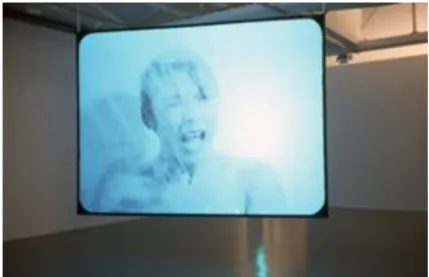
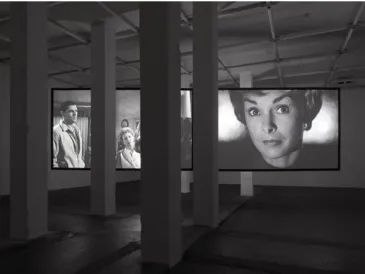
[image:34.595.125.554.345.622.2]Much has been written about 24hr Psycho, still seen as Douglas’ seminal piece, which has the simple premise of slowing down Alfred Hitchcock’s masterpiece Psycho (1960), from its original 109 minutes to an effectively unwatchable 24 hours. This equates to approximately 1 frame every 2 seconds, as opposed to standard film speed of 24 frames per second.
Figure 6: Douglas Gordon, 24hr Psycho, 1993, installation view
! #%!
of which he found ‘interesting’.51 Regardless of how the work came to be, it has acquired a great deal of interest and critical writing that essentially locates it within the anti-narrative category of work described above.
Because of the work’s extreme duration, the narrative element of the work is stripped away, thereby shifting the focus onto the structural elements of the film. As Douglas himself explains:
While the viewer remembers the original film, he is drawn into the past, but on the other hand also into the future, for he becomes aware that the story, which he already knows, never appears fast enough. In between, there exists a slowly changing present.52
[image:35.595.141.525.394.681.2]This slowly unfolding present allows the viewer of 24hr Psycho to become immersed in each moment, but unlike the immersion that might occur as we are swept up in the narrative of the original film, here we also experience the actual passage of time and not the illusory present of the narrative.
Figure 7: Alfred Hitchcock, Psycho, 1960, film still
!!!!!!!!!!!!!!!!!!!!!!!!!!!!!!!!!!!!!!!!!!!!!!!!!!!!!!!!!!!!!
! #&!
Following this first video work Gordon went on to create other works using strategies of what Nicolas Bourriaud came to term postproduction:53 pre-existing cultural material that has been re-purposed to create new meaning and new cultural forms. And although 24hr Psycho was created prior to the implementation of the World Wide Web that Bourriaud suggests is the catalyst for postproduction as a form of art production, Jorg Heiser points out that it is the domestic
technology of the VHS video player that facilitates the work’s existence and makes it conceptually relevant.54
[image:36.595.159.522.371.612.2]By foregrounding the fragmentation of the film made possible by available technology, 24hr Psycho re-activates the hypnotic and absorptive quality of the original film, as experienced in its original cinema setting. Simultaneously, the work highlights the shift in the consumption of media through these available technologies by using a feature of this domestic machine that was once only available to industry specialists.
Figure 8: Douglas Gordon, 24hr Psycho, 1993, installation view
This sets up an ambiguous mode of spectatorship, blurring the divide between an absorptive, cinematic experience, and a fragmented and self-aware relationship with the work. What was traditionally transparent to an audience viewing a film in a theatre (the ‘cinematic apparatus’, such as the screen, the space and the audience, !!!!!!!!!!!!!!!!!!!!!!!!!!!!!!!!!!!!!!!!!!!!!!!!!!!!!!!!!!!!!
53 Bourriaud, Nicolas. Postproduction. New York: Lukas & Sternberg, 2002.
! #'!
as well as the acting, editing and camera movement) is now exposed by the gallery that the work is situated within: by the screen that the work is shown on and by the extreme slow-motion of the film itself. This mode of viewing is also representative of a domestic viewing of film, where interruptions and awareness of the conditions of spectatorship also form part of the viewing experience.
[image:37.595.156.521.267.541.2]By creating a situation in which the audience is now able to analyse each frame as they move through and around the space, Gordon has opened up the inner-workings of the film, drawing attention to the illusion by denying us the action of the narrative.
Figure 9: Douglas Gordon, 24hr psycho back and forth and to and fro, 2008
! #(!
[image:38.595.157.512.104.349.2]Merce Cunningham Performs Stillness
(2007): Tacita Dean
Figure 10: Tacita Dean, Merce Cunningham Performs Stillness, 2007, film still
These fluctuations, between self-awareness and absorption in the kind of timeless present of the gallery, are also evoked through the work of British artist Tacita Dean. Like Gordon, Dean works across disciplines: drawing, painting and film. But in contrast to Gordon, whose process of postproduction requires he work with digital reproductions of the celluloid originals he manipulates, Dean’s work is exclusively shot on 16mm film, preferring the ’softness’ and analogue materiality of celluloid to the hard precision of digital:
... for me, it just does not have the means to create poetry; it neither breathes nor wobbles, but tidies up our society, correcting it and then leaves no trace. I wonder if this is because it is not born of the physical world, but is
impenetrable and intangible.55
Dean’s sense of the analogue nature of film as one of ‘proportion and likeness’ gives an insight into Dean’s films as meditations on the world: a transmission of stillness; an analogue of time itself. Yet the immersive quality of many of these works is both enhanced and disrupted by the presence of the film projector that inhabits the space alongside the screen-based image.
!!!!!!!!!!!!!!!!!!!!!!!!!!!!!!!!!!!!!!!!!!!!!!!!!!!!!!!!!!!!!
! #)!
This is particularly evident in her work Merce Cunningham Performs Stillness (in three movements) to John Cage’s composition 4’33” with Trevor Carlson, New York City, 28 April 2007 (Six Performances, Six Films).
[image:39.595.156.513.232.477.2]I experienced this work in a major survey of Dean’s work at the Australian Centre for Contemporary Art (ACCA), in 2009, which for me at this time was the standout of the show; although it wasn’t until I began to understand this project more fully that I understood its relevance and appeal.
Figure 11: Tacita Dean, Merce Cunningham Performs Stillness, 2007, installation view
The catalogue56 describes the work being realised as the result of a request from Dean to Merce Cunningham57 to improvise a performance to John Cage’s seminal work, 4’33’’(1952) – a composition constructed in three parts, constituting a total of four minutes and thirty-three seconds of silence. This work by Cage is itself contextually relevant to this project, in the sense that it invites an audience to become both immersed and aware of their presentness in an environment as they engage in an atmosphere heightened by a constructed silence. Dean’s work encapsulates this original intent through the medium of film, re-presenting and extending Cage’s piece formally in a gallery context, making it a more relevant work to describe.
!!!!!!!!!!!!!!!!!!!!!!!!!!!!!!!!!!!!!!!!!!!!!!!!!!!!!!!!!!!!! 56 Ibid, p 18
! $+!
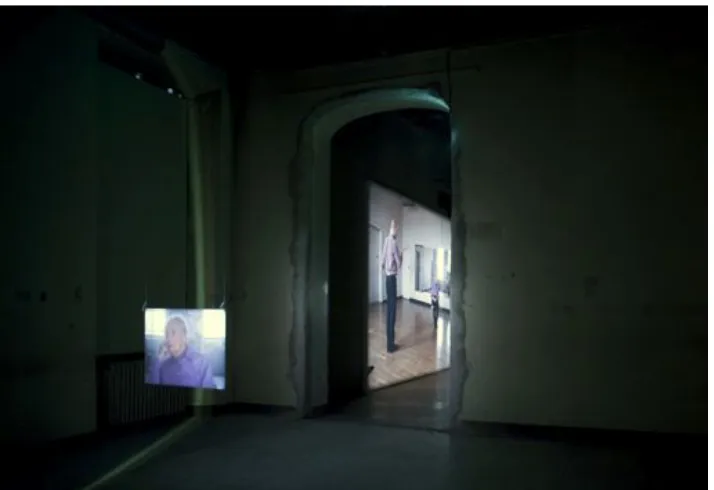
The work is, as alluded to in the title, six films, but what the title doesn’t convey is that the six films are presented simultaneously in the gallery space, with each projected life-size onto free-standing screens.
The six performances that are described in the title relate to the six takes of Cunningham responding to the silent composition, with each take eventually resolved as a film. During each ‘performance’ we are witness to Cunningham sitting on a chair in a mirrored dance studio. In the space is another ‘performer’, Trevor Carlson,58 who is present in all of the films, but only visible in some of them.
Figure 12: Tacita Dean, Merce Cunningham Performs Stillness, 2007, installation view
Dean’s direction to Cunningham was simply to respond to Cage’s silent piece. Carlson’s role was to silently indicate to Cunningham the moment that each of the three parts of the composition begins, by counting down on his fingers. This is visible in one of the films. At these points of transition, Cunningham re-adjusts his position in his seat, shifting from one static pose to another as he immerses himself in the stillness of the moment. This is repeated six times from six different camera positions. After the performance Cunningham titled the work Stillness.
When I experienced the work at ACCA I was unaware of any of this background information. I don’t even recall reading the title of the work prior to entering the space, and as such I had no idea who the performer was, or that they were
‘performing’ to a silent composition. Irrespective of my ignorance to these details, I was fascinated by the work. This response was primarily due to the formal !!!!!!!!!!!!!!!!!!!!!!!!!!!!!!!!!!!!!!!!!!!!!!!!!!!!!!!!!!!!!
! $*!
elements of the work. The large dark space filled with freestanding and floating screens, flickering light and whirring projectors, was instantly engaging due to the materiality of these formal elements.
The image also was compelling in terms of its filmic quality; the soft edges of the frame, the grainy, flickering picture, and the striking and luminous image of the noble figure of Cunningham, emerging from the darkness. Despite the seduction of the image I wasn’t held by any one of the six separate films for any length of time. Instead I found myself continually exploring the space, trying to understand the relationship between camera and subject, viewer and screen. Where was the point where my position in the space aligned with the camera’s position? Was the position of each screen representative of the camera/subject relationship? I also spent time with the projectors themselves, fascinated by a technology that I understood very little about.
Figure 13: Tacita Dean, Merce Cunningham Performs Stillness, 2007, installation view
So rather than being immersed in the stillness and silence of the performance, I found myself distracted by what I came to understand later as the ‘apparatus’ of the film; and by the space itself as I explored the work. By acknowledging this awareness as my experience, the original intent of Cage’s composition is actualised. Here, the silence and stillness generated by his and Dean’s framework result in a heightened sense of real time and real space, in contrast to the illusory time and space of the film itself. This is akin to the sentiment expressed by Cage in his 1957 lecture ‘Experimental Music’, where he suggested that the experience of exploration or ‘play’ is ‘simply a way of waking up to the very life we are living.’ 59
!!!!!!!!!!!!!!!!!!!!!!!!!!!!!!!!!!!!!!!!!!!!!!!!!!!!!!!!!!!!!
! $"!
Bordeaux Piece
(2004): David Claerbout
The tension that exists between the formal and material aspects of Dean’s work, and the immersive stasis of her imagery, between the illusory and the real, is also generated in the work of Belgian artist David Claerbout. Claerbout’s video
installation practice is also concerned with temporal experience, creating work that exists somewhere between photography and film. Using strategies of repetition and duration, fusing stasis with motion, Claerbout creates work that acknowledges time by subtly manipulating the relationship between the spectator and the work, subverting their habitual perceptions of viewing both moving and still imagery.
Yet it is only through spending time with, or perhaps returning to the work, that viewers are able to observe the background events and processes that Claerbout is interested in: shifting perception from what he describes as the foreground, or narrative element of the work, to experience the reality that lies beyond the illusion. In an interview with Christine Van Assche, curator of a major survey of his work at the Pompidou Centre (2007), he confirms his understanding of the habitual spectatorial conditioning of audiences of the moving image:
The scenography of the exhibition at the Pompidou Centre as it has been conceived with its transparent screens and its projections of varied dimensions, authorises the spectator to stroll through the space without ever being obliged to sit in order to grasp something.
The first view of the exhibition embraces the ensemble of the five installations without having anything specific to see, except formal resemblances between the works. Only after 15 minutes can something be triggered. But probably 95% of spectators will miss the meaning of the works.60
These comments seem to reaffirm his desire to create works that challenge modes of viewing that simply offer a passive distraction from reality, instead focusing attention and awareness on the discomfort and inattention often induced by the experience of lived time. Bordeaux Piece (2004), beautifully illuminates the temporal ambiguities at play in Claerbout’s work, and by implementing strategies of foreground and background, offers the viewer an opportunity to shift the focus of their attention.
!!!!!!!!!!!!!!!!!!!!!!!!!!!!!!!!!!!!!!!!!!!!!!!!!!!!!!!!!!!!!