BOSNIAN JOURNAL OF BASIC MEDICAL SCIENCES 2006; 6 (2): 25-31
&
Abstract
In this study we looked into the cells and histological organization of leaves (Saturejae folium) as well as a phyto-chemical composition of overground parts (Saturejae herba) of endemic species Satureja subspicata Bartl. ex Vis. (Lamiaceae) collected during year on south slopes of mountain Velez in Herzegovina. Microscopic organization was analyzed in wet slides using light microscope. Estimation of stomata index was done according to Ph. Yug. IV. Chemical composition of overground material extracts was determined by thin layer chro-matography (TLC) using thymol as a reference. In our research we found the following: Leaf structure of the analyzed species Satureja subspicata points at numerous specifi cities in ana-tomical and histological sense. In histological sense, leaf is of ventral type, with diff erentiated upper and lower epidermis and palisade and spongy tissue in between. Stoma index assigned according to Ph. Yug. IV leads to a conclusion that it is the case of diastitic stomata, which is common feature of most species from Lamiaceae family. Comparative qualitative analysis of essential oils in species Satureja subspicata showed similarities with other species from La-miaceae family such as Th ymus L. (thymol). In fact, we found more common substances that are part of the species Satureja montana L. extract, but in diff erent concentrations.
KEY WORDS: plant anatomy, essential oil, thin layer chromatography (TLC), Bosnia and Herzegovina, endemic plant, stomata index, thymol.
NOMENCLATURE: Flora Europea ()
PROOF MATERIAL: Herbaria specimens of the studied plant material are deposited into Herbarium Centre for ecology and natural resources (HCEPRES) at Faculty of Science Uni-versity of Sarajevo.
Research into
Microscopic Structure
and Essential Oils of
Endemic Medicinal
Plant Species Satureja
Subspicata Bartl. Ex
Vis. (lamiaceae)
Sulejman Redžić¹,³, Mijat Tuka², Anisa Pajević³
. Lab. of Natural Products, Faculty of Science, University of Sarajevo, Zmaja od Bosne -, Sarajevo, Bosnia and Herzegovina
. Private Pharmacy „Kiseljak“ Kraljice mira , Kiseljak, Bosnia and Herzegovina
. Faculty of Pharmacy, University of Sarajevo, Čekaluša , Sarajevo, Bosnia and Herzegovina
BOSNIAN JOURNAL OF BASIC MEDICAL SCIENCES 2006; 6 (2): 25-31
Introduction
Th e application of medicinal plants with essential oils is continuously rising. Aromatic plants and essential oils are used in pharmaceutical and chemical industries but also in pharmacies for mixing of various sanative prepa-rations. One of the advantages of essential oils therapy is the simplicity of their application. It can be part of regular care (bath, face care etc.) without changes in everyday routine (, , , ). Identifi cation of pharma-co-dynamic characteristics and antimicrobial activity of isolated plant components are set up as main tasks, which imply successful phytochemical research. To-day, those are undertaken in order to fi nd new cures from nature, especially from chemically low examined or unknown plants (, , , , , ). Essential oils are mixtures of aliphatic, aromatic and hydro-aromatic sub-stances as well as various carbohydrates, alcohols, alde-hydes, ketones, esters, phenols, acids etc. (, ) (Figure ). Two very important phenols, thymol and carvacrol,
are known to possess antiseptic properties for a long time. Th ey can be found in Th ymus serpyllum L. s. lat.,
Origanum vulgare L., Ocimum basilicum L. and Satureja hortensis L (, , , , , ). Certain extent of an-timicrobial activity is experimentally demonstrated for citral, citronellal, cinnamon and oil-aldehyde, cineole,
some gumerzines and other ingredients. Genus
Sat-ureja L. is represented with several species in the fl ora of B&H. Many of those are endemic and relic elements. Th ey are widely applied in medicine and ethno-botany of old. Signifi cant proportion are offi cinal plants that have important role in the contemporary phar-maceutical industry. Due to their content of various essential oils and antimicrobial eff ects they are widely
used in various types of phyto-therapies and cosmetics. However, many species are not thoroughly stud-ied. One of them is Satureja subspicata. It is an en-demic Balkan species, which, in our country, is found in the area of sub-Mediterranean rocks (). There-fore, we designed this study in order to conduct basic biological and phytochemical research using appli-cable methods. The amount of reference data in this area demonstrates an increasing interest in explo-ration of biological, phyto-chemical, pharmaceuti-cal and pharmaceutipharmaceuti-cal/technologipharmaceuti-cal properties of the most common species of this type (, , ).
Material and Methods
BOTANICAL AND SYSTEMATIC CHARAC-TERISTICS OF THE STUDIED PLANT SPECIES
Description of plant: Vertical, laid or risen half-bush - cm high (Figure ). Th e plant is four-partite, smooth, and almost completely bare. The leaves are thick, leathery, with glands at the edges or very rough. Th e fl owers are composed into levels and make a false ear. The calyx is wide, bell-like, dark green or dirty pink, containing numerous oil glands and distin-guishable nerves. It blooms from August till October.
THE FIELD STUDY
Th e process of collecting and drying herbs
Plant material of species Satureja subspicata was col-lected at two locations in sub-Mediterranean area of mountains Prenj and Velez, where this species grows on geological foundation and lower grounds, mostly of neutral or alkali reaction. Th e material was collected from several populations in various pheno-logical phases. Part of the material was deposited in her-barium, and part preserved for microscopic analysis. Af-ter the drug was dried an extract was made, which was used for other chemical and microbiological analysis.
LABORATORY RESEARCH
Methods of microscopy
Standard light microscopy was used for the analysis of leaf cross section (Saturejae folium) as well as for the analysis of leaf vertical section (Saturejae folium), which was necessary for the purpose of stoma index determination in accordance with Ph. Yug. IV ().
PRODUCTION OF HERBAL EXTRACT
Procedure of hydro-distillation:
g of chopped up overground part of drug (Satureja subspicata) was mixed with ml of water in a
BOSNIAN JOURNAL OF BASIC MEDICAL SCIENCES 2006; 6 (2): 25-31
tion fl ask. Th e fl ask was heated over asbestos net to the boiling point and distilled. Th e distillate was collected in Erlenmeyer flask during that time. Before distilla-tion, apparatus was washed with water, followed with dichrome-sulfuric acid and again with water. Th e har-vested distillate was transferred into separation funnel. Th en, this solution was extracted with dichloromethane
four times. Th e layer of etheric oil was collected in the glass until there was no layer between oil and watery phase. Anhydrous NaSO was added to etheric oil ex-tract in order to remove residual water. Subsequently it was removed by filtration. Extracted and purified oil was then left to absorb steam (Figures , and ).
THIN-LAYER CHROMATOGRAPHY OF ESSENTIAL OILS (TLC)
Procedure:
On a fi ctitious start line drawn on previously activated chromatography panel (absorbance: silica gel F; Merck, Germany; minutes at °C) we applied etheric oil extract of over ground part of herb Satureja subspicata in two different concentrations, solution of thymol in ethanol (standard ) (Thymol, CHO, Kemika Zagreb) and essential oil extract of herb Sa-tureja montana (standard ). After the stains were dried, the panel was placed vertically in a chroma-tography chamber coated with filter paper and satu-rated with solvent (eluant) vapor (rising chromatog-raphy). Nevertheless, we ensured that the eluant level was - cm below the start line. Developing solution (eluant) was a mixture of toluene-ethyl-acetate (:). When the analyzed solution reached the desired level,
the panel was removed from the chamber and dried.
ex-
BOSNIAN JOURNAL OF BASIC MEDICAL SCIENCES 2006; 6 (2): 25-31icer and as a result, characteristic brown stains appeared. Reagents specifi c for components of essential oils are: a) solution of vanillin in ethanol (solution )
b) solution of sulfuric acid in ethanol (solution ) The panel was sprayed first with solution , then with solution and first, he board was sprayed with solution , and then with solution and
sub-sequently heated at oC for about minutes
in a dryer. The result was characteristic coloring.
Results
PLANT MICROSCOPIC ANALYSIS
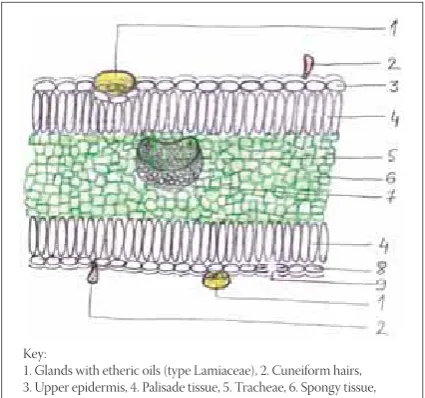
Th e leaf of analyzed species Satureja subspicata has dif-ferentiated upper and lower epidermis with palisade and spongy tissue between them (Figure ). Mesophyll consists of two series of palisade at both upper and lower side, with regularly lined cells. Central part con-sists of spongy tissue with isodiametrically shaped cells (there is no stressed intercellular area). Collateral vascu-lar bundles with approximately balanced proportion of phloem and xylem cells are also located in the central part. Epidermis is built of thick compressed cells with no intercellular area and chloroplasts and with stressed
external inner side. Th e lower epidermis contains sto-mas of Helleborus type. Epidermis also contains numer-ous glands with etheric oils and many multicellular hairs. Vertical section of leaf of the studied plant
spe-cies (Saturejae folium) was analyzed under
micro-scope in order to estimate stoma index, which was defined on the basis of the number of stomas and number of epidermis cells according to formula (): Stoma index=xS/E+S
S−number of stomas per leaf area unit =
E−number of epidermis cells per leaf area unit = Stoma index (SI) =,
ESSENTIAL OILS
Figure shows chromatogram where a mixture of tolu-ene ethyl-acetate (:) was used a developing agent. For the purpose of detection it was exposed to iodine vapor. In every sample yellow zones (stains) appeared or, to be more precise, one stain for thymol standard and four stains in Satureja montana etheric oil standard. For the purpose of detection, chromatogram was, before being exposed to iodine vapor, examined under UV lamp and extinguishing of fl uorescence appeared at nm in some zones. Four zones, where extinguishing of fl uorescence appeared, were detected for sample. One zone was detected for thymol standard, and eight zones, where extinguishing of fl uorescence appeared, for stan-dard of essential oil of species Satureja montana. Later, chromatogram was sprayed with specifi c reagents vanil-lin-sulfuric acid (solution +solution ) for the purpose of visualization. Th en, the panel was heated at oC
BOSNIAN JOURNAL OF BASIC MEDICAL SCIENCES 2006; 6 (2): 25-31
x is violet, x is pink), and x showed extinguishing of fl uorescence at nm, too. Th ymol standard showed one pink stain, and extinguishing of fluorescence ap-peared at the same place, too. The second standard containing essential oil of species Satureja montana re-sulted in fi ve colored stains (x is brown, x is light green, x is blue, x is dark green, x is violet), and extinguish-ing of fl uorescence appeared in all of them, except x. Rf values (Table ) were counted for all zones vis-ible in chromatogram according to the formula (): Rf=d/d
d−distance of chromatographic substance in cm d−distance of eluant in cm
d=, cm
Discussion
PLANT MICROSCOPY
Anatomical-histological picture of leaf species Satureja subspicata points at numerous specifi cities in compari-son with other dicotyledonous plants, even the species from the same family, Lamiaceae. According to its
cy-tological diff erentiation, it would be a form of dorsal-ventral equalfacial leaf. Th e existence of two layers of palisade tissue (epipalisade and hypo-palisade tissue), which is a result of plant adaptation to sunlight utiliza-tion leads us to that conclusion. Namely, increase in palisade tissue compensates for a quite small leaf area. Such palisade tissue organization is an important fea-ture of this plant’s microscopic organization and can be successfully used for identifi cation. Also, the leaf has some elements of sclerophilly. Not only palisade, but also spongy tissue illustrate that. Namely, there is no in-tercellular space, and that is clear characteristic of this histological product inside of spongy tissue. Structure of epidermis hairs and cytological organization of gland apparatus can be used as important characteristics for this plant’s microscopic identifi cation. In comparison with histological diff erentiation of close species Rosma-rini folium and Salviae folium () numerous diff erences were noticed. Primarily, the organization of the tested leaves is more sclerophyllic. Th e analysis of stoma in-dex according to Ph. Yug. IV () Satureja subspicata
La-
BOSNIAN JOURNAL OF BASIC MEDICAL SCIENCES 2006; 6 (2): 25-31miaceae family. Stomas are surrounded by two accom-panist cells that make right angle with adductor cells.
ESSENTIAL OILS
Similarities with other species from Lamiaceae family are underlined through our study of qualitative structure of essential oils of species Satureja subspicata (, , ). Th at was enabled by comparison between Rf values of etheric oil of Satureja subspicata and Rf values of thymol and etheric oil of species Satureja montana, which were used as standards. Based on the results we can ascertain that the sample was not heterogeneous. Component with the highest contents was thymol, and that was verifi ed by comparing thymol as a standard on the basis of Rf value and characteristic stains. Comparison with etheric oils of species Satureja montana revealed - shared components, but their concentrations are diff er-ent (, , , , , ). Th e latest study () describes phytochemical profi le and antimicrobial activity of Sat-ureja subspicata Vis. essential oils, collected in Dalmatia (Croatia). Th ree samples of essential oils were obtained from the aerial parts of the plant by hydrodistillation and analyzed by GC–MS. From the compounds rep-resenting . of the oils, carvacrol (.), α-pinene (.), p-cymene (.), γ-terpinene (.) and
thymol methyl ether (.) appear as the main com-ponents. Th e oils also contained smaller percentages of myrcene, linalool, β-caryophyllene, limonene, geranyl acetate, -Octen--ol, nerol, thymol and borneol (). Etheric oils of related species Satureja and Satureja mon-tana are very complex. Very complex structure of essen-tial oil was determined by gas chromatography – spec-trometric analysis in the samples of Satureja montana
from diff erent regions of Serbia, B&H and Macedonia. Th ere are more than diff erent components () in its structure. Among those are thymol and carvacrol and their quantity varies depending on the region (, , , , ). Evaluation of antimicrobial activity of Satureja subspicata oil was evaluated using agar diffusion and broth microdillution methods. Testing of antimicrobial activity showed that the oils had a great potential against all bacterial and fungal strains. Gram-positive bac-teria are more sensitive to the examined oil, with a range of . to . μl/ml comparing to a signifi cantly higher range of . to . μl/ml for Gram-negative bacteria. Results presented here suggest that the essential oil of
S. subspicata possesses antimicrobial properties, and is therefore a potential source of antimicrobial ingre-dients for the food and pharmaceutical industry ().
Conclusion
Based on the fi ndings of microscopic study and the analysis of essential oils of endemic Dinaric medicinal plant Satureja subspicata it is possible to reach the following conclusions:
- Th e leaf of the analyzed species in anatomical-histological sense pints at numerous specifi cities. In histological sense, leaf is of ventral type, with diff erentiated upper and lower epidermis and palisade and spongy tissue in between. It is unique type of sclerophillic leaf and important for microscopic identifi cation of this species;
- Stoma index assigned according to Ph. Yug. IV. leads to the conclusion that the stoma is diactitic, which is common feature of most species from family Lamiaceae;
- Comparative qualitative analysis of essential oils in species Satureja subspicata showed similarities with other species from Lamiaceae family such as Th ymus L. (thymol). In fact, we found more common substances that are part of the species Satureja montana L. extract, but in diff erent concentrations.
BOSNIAN JOURNAL OF BASIC MEDICAL SCIENCES 2006; 6 (2): 25-31
References
() Tutin T.G., Heywood H.V., Burges A.N., Moore D.M., Valentine
H.D., Walters M.S., Webb A.D. (eds.) Flora Europea. Vol. , Cam-bridge University Press, CamCam-bridge, .
() Uslu C., Karasen R.M., Sahin F., Taysi S., Akcay F. Eff ects of
aque-ous extracts of Satureja hortensis L.on rhinosinusitis treatment in rabbit. J. Ethnopharmacol. ; (-): -.
() Hnatyszyn O., Moscatelli V., Garcia J., Rondina R., Costa M.,
Ar-ranz C., Balaszczuk A. Ferraro G., Coussio J.D. Argentinean plant extracts with relaxant eff ect on the smooth muscle of the corpus cavernosum of Guinea pig. Phytomedicine ; (): -.
() Hajhashemi V., Ghannadi A., Pezeshkian S.K. Antinociceptive
and anti-infl ammatory eff ects of Satureja hortensis L. extracts and essential oil. J. Ethnopharmac. ; (-): -.
() Hajhashemi V., Sadraei H., Ghannadi A.R.,Mohseni M.
Antispas-modic and anti- diarrhoeal eff ect of Satureja hortensis L. essen-tial oil. J. Ethnopharmacology ; (-): -.
() Koşar M., Dorman H.J.D., Hiltunen R. Eff ect of an acid treatment on
the phytochemical and antioxidant characteristics of extracts from selected Lamiaceae species. Food Chemistry ; (): -.
() Abad M.J., Bermejo P., Gonzales E., Iglesias I., Irurzun A.,
Carras-co L. Antiviral activity of Bolivian plant extracts. General Phar-macology ; (): -.
() Madsen H.L., Sørensen B., Skibsted L.H. Bertelsen G. Th e
anti-oxidative activity of summer savory (Satureja hortemis L.) and
rosemary (Rosmarinus offi cinalis L.) in dressing stored exposed
to light or in darkness. Food Chemistry : (): -.
() Amanlou M., Fazeli M.R., Arvin A., Amin H.G., Farsam H.
Anti-microbial activity of crude methanolic extract of Satureja khuzis-tanica. Fitoterapia ; (-): -.
() Baydar H., Sadiç O., Özkan G., Karadoan T. Antibacterial activity
and composition of essential oils from Origanum, Th ymbra and
Satureja species with commercial importance in Turkey. Food Control ; (): -.
() Arnal-Schnebelen B., Hadji-Minaglou F., Peroteau J-F., Ribeyre F., de Billerbeck V.G. Essential oils in infectious gynecological disease: a statistical study of cases. Int. J. Aromatherapy (): -. () Schulz H., Gülcan Özkan G., Malgorzata Baranska B., Hans
Krüger H., Özcan M. Characterization of essential oil plants from Turkey by IR and Raman spectroscopy. Vibrational Spectrosco-py, (In press).
() Skočibušić M., Bezić N., Dunkić V. Phytochemical composition and antimicrobial activities of the essential oils from Satureja sub-spicata Vis. growing in Croatia. Food Chemistry (In Press). () Sefi dkon F., Jamzad Z. Chemical composition of the essential oil
of three Iranian Satureja species (S. mutica, S. macrantha and S. intermedia). Food Chemistry, ; (): -.
() Vincenzi M.D., Stammati A., Vincenzi A.D., Silano M. Constituents of aromatic plants: carvacrol. Fitoterapia ; (-): -. () Mastelić J., Jerković I.. Gas chromatography–mass spectrometry
analysis of free and glycoconjugated aroma compounds of seasonally collected Satureja montana L. Food Chemistry ; (): -. () Slavkovska V., Jančić R., Bojović S., Milosavljević S., Djoković D.
Variability of essential oils of Satureja montana L. and Satureja kitaibelii Wierzb. ex Heuff . from the central part of the Balkan peninsula. Phytochemistry ; (): -.
() Capone W., Mascia C., Melis M., Spanedda L. Determination of terpenic compounds in the essential oil from Satureja thymbra L. growing in Sardinia. J. Chromatography A, ; : -. () Capone W., Mascia C., Melis M., Spanedda L. Determination of
terpenic compounds in the essential oil from Satureja thymbra L. growing in Sardinia. J. Chromatography A, ; : -. () Šilić C. Monografi ja rodova Satureja L., Calamintha Miller,
Mi-cromeria Bentham, Acinos Miller i Clinopodium L. u fl ori Jugo-slavije, Zemaljski muzej BiH, Sarajevo (posebno izdanje), . () Tucakov J. Farmakognozija. Farmaceutski fakultet, Beograd, . () Capone W., Mascia C., Melis M., Spanedda L. Determination of
terpenic compounds in the essential oil from Satureja thymbra L. growing in Sardinia. J. Chromatography A, ; : -. () Labbe C., Castillo M., Fainia F., Coll J., Cannolly J.D. Rearranged
isopimarenes and other diterpenoids from Satureja gilliesii. Phy-tochemistry, ; (): -.
() Šilić C. Endemične biljke. Svjetlost, Sarajevo, : . () Pharmacopea Yugoslavica IV. . edition. Beograd, . () Todorović B., Stevanović B. Adaptive characteristics of the
en-demic species Satureja horvatii Silic (Lamiaceae) in mountain-mediterranean and mountain-mediterranean habitats. Botanical Journal of the Linnean Society, ; (): -.
() Svoboda K.P., Greenaway R.I. Investigation of volatile oil glands of Satureja hortensis L. (summer savory) and phytochemical compara-sion of diff erent varieties. Int.J. Aromatherapy ; (): -. () Mastelić J., Jerković I. Gas chromatography – mass
spectrom-etry analysis of free and glycoconjugated aroma compounds of seasonally collected Satureja montana L. Food Chemistry, ; (): -.
() Sefi dkon F., Jamzad Z., Mirza M. Chemical variation in the
es-sential oil of Satureja sahendica from Iran. Food Chemistry ; (): -.
() Skoula M., Grayer R.J., Kite G.C. Surface fl avonoids in Satureja
thymbra and Satureja spinosa (Lamiaceae). Biochemical System-atics and Ecology, ; (): -.
() Sahin F., Karaman I., Güllüce M., Ögütçü H., Sengulf M., Adıgüzel A., Öztürk S., Kotan R. Evaluation of antimicrobial ac-tivities of Satureja hortensis L. J. Ethnopharmacology ; (): -.
() Kubátová A., Jansen B., Vaudoisot J.F., Hawthorne S.B. Th
ermo-dynamic and kinetic models for the extraction of essential oil from savory and polycyclic aromatic hydrocarbons from soil with hot (subcritical) water and supercritical CO. Journal of Chromatography A ; (): -.
() Arrebola M.L., Concepción Navarro M., Jiménez J., Ocaña F.A. Variations in yield and composition of the essential oil of Satureja obovat. Phytochemistry ; (): -.
() Esquível M.M., Ribeiro M.A., Bernardo-Gil M.G. Supercritical extraction of savory oil: study of antioxidant activity and extract characterization. J. Supercrit. Fluids ; (): -. () Peer W.A., Langenheim J.H. Infl uence of phytochrome on leaf
monoterpene variation in Satureja douglasii. Biochemical Sys-tematics and Ecology ; (): -.
() Labbé C., Castillo M., Fainia F., Coll J., Connolly J.D. Rearranged isopimarenes and other diterpenoids from Satureja gilliesii.Phy-tochemistry ; (): -.
() Tomás-Barberán F.A., Husain S.Z., Gil M. I. Th e distribution of
methylated fl avones in the Lamiaceae. Biochemical Systematics and Ecology ; (): -.
() Panizzi L., Flamini G., Cioni P.L., Morelli I. Composition and antimicrobial properties of essential oils of four Mediterranean Lamiaceae. Journal of Ethnopharmacology ; (): -. () Labbe C., Castillo M., Connolly J.D. Mono and sesquiterenoidis
from Satureja gilliesii. Phytochemistry ; (): -. () Ciani M., Menghini L., Mariani F., Pagiotti R., Menghini A.,