Strategic Voting with Incomplete Information
Ulle Endriss
University of Amsterdam
The Netherlands
Svetlana Obraztsova
Hebrew University
Jerusalem, Israel
Maria Polukarov
University of Southampton
United Kingdon
Jeffrey S. Rosenschein
Hebrew University
Jerusalem, Israel
Abstract
Classical results in social choice theory on the sus-ceptibility of voting rules to strategic manipulation make the assumption that the manipulator has com-plete information regarding the preferences of the other voters. In reality, however, voters only have incomplete information, which limits their ability to manipulate. We explore how these limitations af-fect both the manipulability of voting rules and the dynamics of systems in which voters may repeat-edly update their own vote in reaction to the moves made by others. We focus on the Plurality, Veto,
k-approval, Borda, Copeland, and Maximin voting rules, and consider several types of information that are natural in the context of these rules, namely in-formation on the current front-runner, on the scores obtained by each alternative, and on the majority graph induced by the individual preferences.
1
Introduction
Most existing models of collective decision making adopt simplifying assumptions regarding the information available to individual decision makers about the preferences and in-tentions of their peers. For instance, the standard model em-ployed for the analysis of strategic behaviour in elections pre-supposes that each voter has access to the full preferences of the other voters and is able to optimise their own ballot ac-cordingly. This assumption is central to the classical Gibbard-Satterthwaite Theorem [Gibbard, 1973; Gibbard-Satterthwaite, 1975], which shows that essentially all reasonable voting rules are subject to strategic manipulation. In practice, however, vot-ers cannot be assumed to possess all of this information, and they cannot be assumed to hold with certainty the information to which they do have access. Exploring the consequences of such richer models of decision making is of particular interest in the domain of multiagent systems, where we can model the information available to agents in precise terms.
In this paper, to represent the incomplete information avail-able to agents, we employ a model developed by Conitzeret al.[2011] and Reijngoud and Endriss [2012], in which each agent is endowed with aninformation setdescribing the range of profiles of preferences of the other agents he considers pos-sible. We focus on information sets that arise naturally in the
context of voting, such as the range of all profiles that are consistent with a given candidate winning the election.
Our contributions are twofold. In the first part of the paper, we establish results on the manipulability of voting rules un-der incomplete information, complementing previous results by Reijngoud and Endriss [2012]. We focus on the Plurality, Veto,k-approval, Borda, Copeland, and Maximin rules (all defined in Section 2). While the Gibbard-Satterthwaite The-orem shows that all of these rules are susceptible to strate-gic manipulation when the manipulator has full information, this may—in principle—cease to be the case when we re-strict their access to information. We show that, nevertheless, for several natural restrictions to a manipulator’s information, manipulation can still occur for certain rules. At the same time, we are able to identify some combinations of voting rules and information sets where manipulation can be ruled out, thereby providing positive results of practical interest.
In the second part of the paper, we connect strategic vot-ing under incomplete information with the growvot-ing litera-ture on iterative voting [Meiret al., 2010; Lev and Rosen-schein, 2012; Reijngoud and Endriss, 2012; Reyhani and Wil-son, 2012; Grandiet al., 2013; Obraztsovaet al., 2015]. We consider scenarios where voters are permitted to update their ballot any number of times, in response to the limited infor-mation they have regarding the other votes. The question then arises whether such a process will converge to a state where the election winner does not change anymore. As is well known, under complete information, convergence can only be guaranteed in very specific circumstances. Arbitrary im-provement moves are not guaranteed to converge under any voting rule, best-response dynamics lead to equilibria only for Plurality and Veto, and other rules require more restric-tions on allowed manipularestric-tions to guarantee convergence. In contrast to these largely negative results, we are able to show that, when the only information voters have access to is the identity of the candidate currently leading the polls, we obtain convergence results for all the voting rules considered here.
2
Preliminaries
In this section, we recall relevant concepts from voting theory [Taylor, 2005] and define voting scenarios with incomplete information as introduced by Reijngoud and Endriss [2012].
2.1
Voting Rules
LetV ={1, . . . , n}denote a set ofnvoters(oragents) elect-ing a winner from a setC ={c1, . . . , cm}ofmcandidates (oralternatives). LetL(C)be the set of all strict linear or-ders onC. Each voterisubmits avote(orballot)bi∈ L(C), which may or may not coincide with his realpreference order
i∈ L(C). Aprofileb= (b1, . . . , bn)∈ L(C)nis a vector of votes, one for each agent. We denote byb−ithe profile of all votes except that of agenti, and we write(b0i,b−i)for the profile we obtain when we replacebiinbbyb0i.
Avoting ruleF :L(C)n →2C\ {∅}takes a profile and returns a nonempty subset of candidates, calledthe winners of the election. In this paper, we focus onresolute voting rulesF : L(C)n → C, which always return a single win-ner. Specifically, we assume ties are brokenlexicographically (i.e., in favour of the candidate with the lowest index). Here are some of the most common voting rules [Taylor, 2005]:
• Positional scoring rules. Each PSR is associated with a scoring vector(s1, ..., sm)of integers withs1> smand
s1 > s2 > . . . > sm. If a voter ranks a candidate at thejth position, that candidate receivessj points. The score of a candidate is the sum of her points over all ballots. This family of rules includesPluralitywith the scoring vector (1,0, . . . ,0), Veto with (1,1, . . . ,1,0), Bordawith(m−1, m−2, ...,0)andk-approvalwith
(1, ...,1,0, ...,0), i.e.,k1’s, followed by 0’s.
• Maximin. The score of candidatecis the minimum num-ber, across all otherc0∈C, of voters who preferctoc0.
• Copeland. The score of candidatecis the number of di-rect majority contests she wins (i.e., the number of other
c0 ∈ Cfor which the majority of voters preferctoc0), minus the number of majority contests he loses.
The election winner is always the candidate with the highest score. A Condorcet winner is a candidate that wins every majority contest, and a weak Condorcet winneris one that does not lose any such contest, although she may tie some.
2.2
Information Functions
Even after a profile of ballots has been elicited by the election chair, this information typically will not be communicated to the electorate, at least not in its entirety, e.g., due to privacy concerns. LetIdenote the set of all possible pieces of infor-mation that might be communicated to the electorate in view of a given profile. Following Reijngoud and Endriss [2012], aninformation function(IF) is a functionπ : L(C)n → I
that maps profiles to elements ofI. We focus on the follow-ing natural choices forIand the corresponding IFπ:
• Winner(W). Given voting ruleF, the corresponding W-IF returns the winning candidate for the input profile ac-cording toF:π(b) =F(b).
• Score(S). Given voting ruleF, the corresponding S-IF returns for eachc ∈ Cher scoresF(c,b)for profileb underF(we omitFwhen clear from the context).
• Majority Graph. A majority graph is a directed graph with the nodes being the candidates: there is an edge
(c, c0)fromctoc0 if a majority of voters preferctoc0. The MG-IF returns the majority graph of the profile. Given the signalπ(b), and assuming each voteriknows how the IFπis defined, his information setWiπ(b) is the set of (partial) profiles he must consider possible in view of the in-formation he holds after receivingπ(b):
Wiπ(b) =
b0−i∈ L(C)n−1|π(bi,b0−i) =π(b)
Conitzeret al.[2011] work with a similar model, but explic-itly list the profiles a voter considers possible. Here we follow Reijngoud and Endriss [2012] and restrict attention to infor-mation sets that can be represented compactly viaπ.
We say that π1 isat least as informative as π2, denoted
π1⊆π2, ifW π1(b)
i ⊆ W
π2(b)
i for allb∈ L(C)nandi∈V.
3
π
-Manipulability
In this section, we analyse the susceptibility of different vot-ing rules to strategic manipulation by voters with incomplete information, encoded in the form of information sets. Along with a number ofsusceptibility resultsregarding the manip-ulability of certain rules given certain information, we also obtain two newimmunity results, demonstrating the role of information in preventing strategic behaviour.
Suppose that before the election we conduct an opinion poll to elicit truthful preferences = (i)i∈V, and then communicate the result to the voters using IFπ. In the sub-sequent election, voter i then has an incentive to manipu-late if there is a scenario in his information set for which some new ballot would result in a better election outcome for him, and there is no scenario where the same new ballot would result in a worse outcome than the truthful outcome. Thus, manipulation is “safe”.1 Formally, given profileb, we
say that voteri can use π-manipulation bi i
→ b∗i for pro-fileb, if there exists a partial profileb∗−i ∈ Wiπ(b)such that
F(b∗i,b∗−i)i F(b), and for allb0−i ∈ W π(b)
i it is the case thatF(b∗i,b0−i)iF(b)orF(b∗i,b
0
−i) =F(b).2Now, a res-olute voting ruleF issusceptible toπ-manipulation(or sim-ply, π-manipulable) if there is a voter who canπ-manipulate the truthful profile= (i)i∈V. If a rule is not susceptible toπ-manipulation, then it isimmune toπ-manipulation.
If π returns the full profile, then π-manipulability re-duces to the standard notion of manipulability. In this case, the Gibbard-Satterthwaite Theorem [Gibbard, 1973; Satterthwaite, 1975] says that any resolute voting rule for three or more candidates that is surjective and nondictatorial is susceptible to manipulation. Reijngoud and Endriss [2012]
1
Note that, just as in the classical setting [Taylor, 2005], we only address the case of one voter at a time considering to manipulate.
2
prove a simple generalisation of this theorem, stating that for any IFπany resolute voting rule for three or more candidates that is surjective, nondictatorial, and strongly computable fromπ-images, is susceptible toπ-manipulation. Here, a vot-ing rule isstrongly computable fromπ-imagesif upon learn-ingπ(b)for any profileb, a voterican compute the winners for any way of voting himself (i.e., not just forbi). Thus, for example, all PSRs are strongly computable from S-images.
In the sequel, we explore theπ-manipulability of Plurality, Veto,k-approval, Borda, Copeland, and Maximin, under IFs
π =W, S, MG. We start with the case of W-IF, intuitively providing the least amount of information.3 Note that S-IF is more informative than W-IF for all our voting rules. For Copeland, MG-IF is more informative than S-IF. For other rules, some pairs of IFs cannot be ranked in terms of their in-formativeness. For example, under Plurality we cannot com-pute the winner from the majority graph, norvice versa. For a given profile, if we increase the information available to a voter, manipulability could either increase (as the voter might be able to rule out some profiles where he would do worse when manipulating) or decrease (as he might also be able to exclude some profiles where he would benefit from manipu-lating). However, as we will see next, manipulabilityacross all profilesincreases as information increases.4 This useful
result applies to pairs of IFs that are both at least as informa-tive as the W-IF (so they allow the voter to infer the winner). Lemma 1. Letπ1andπ2be two information functions such
that π1 ⊆ π2 ⊆ W-IF. Then any voting rule that is π2
-manipulable is alsoπ1-manipulable.
Proof. SupposeF isπ2-manipulable, i.e., there exist a
pro-fileb, a voteri, and a ballotb∗i such thatF(bi∗,b∗−i)iF(b) for someb∗−i ∈ W
π2(b)
i , whileF(b) i F(b∗i,b 0
−i)for no
b0−i ∈ Wπ2(b)
i . We will show that thenF can also be ma-nipulated byiusing the same ballotb∗i under IFπ1 in case
the truthful profile is (bi,b∗−i). First, as b ∗
−i ∈ W π2(b)
i , we have Wπ2(b)
i = W
π2(bi,b∗−i)
i and thus, as π2 ⊆ W-IF,
we know that F(b) = F(bi,b∗−i). As the actual profile is always consistent with the information received, we have
(bi,b∗−i)∈ Wπ1(bi,b
∗
−i). Thus, the first condition is satisfied: there exists a b∗−i ∈ Wπ1(bi,b
∗
−i) such thatF(b∗ i,b
∗ −i) i
F(b) =F(bi,b∗−i). As for the second condition, asπ1⊆π2
we haveWπ1(bi,b∗−i)
i ⊆ W
π2(bi,b∗−i)
i and thusW
π1(bi,b∗−i)
i ⊆
Wπ2(b)
i , meaning there is nob 0 −i ∈ W
π1(bi,b∗−i)
i for which
F(bi,b∗−i) =F(b)iF(b∗i,b 0 −i).
In the remainder of this section we prove several results on the
π-manipulability of specific voting rules for specific choices of π, thereby complementing the partial picture drawn by Reijngoud and Endriss [2012]. Most of our results are nega-tive, but for the case of the MG-IF we are able to identify two sets of sufficient conditions for immunity to manipulation.
3
As an aside, note that even whenπproduces no information at all, there exist examples for voting rules, albeit not natural rules, that are susceptible toπ-manipulation [Reijngoud and Endriss, 2012].
4
We are grateful to an anonymous reviewer for pointing this out.
3.1
Winner Information Function
Reijngoud and Endriss [2012] proved that Plurality and Borda are manipulable, while Veto is immune to W-manipulation. We complement these results by showing that alsok-approval, Copeland, and Maximin are W-manipulable. Theorem 2. Thek-approval (fork6m−2), Copeland, and Maximin voting rules are all susceptible to W-manipulation.
Proof. First, letF bek-approval and assume that there is a voterisuch that the winner in the truthful profile,F(), is ranked below the(k+ 1)stposition in his preference order.5
We now show that such a voter can W-manipulate by swap-ping thekthand(k+ 1)st highest choices in his ballot.
In-deed, since the current winner is less preferable toithan any candidate in the firstk+ 1positions, this manipulation is safe for any profile inWiW(), and there exists a profile in this set in which the(k+ 1)st preferred candidate of voter ineeds
only one additional point to win.
We similarly prove W-manipulability of Copeland and Maximin. Let voteribe such that the winner in the truthful profile is ranked below the second position in his preference order. Letiswap his first and second best choices. This ma-nipulation does not affect the Copeland/Maximin score of the truthful winner and does not harmiin any profile inWiW(), but there exists a profile in this set where i’s second best choice wins the election after the manipulation.
3.2
Score Information Function
Since all PSRs are strongly computable from images un-der S-IF, it follows from the generalisation of the Gibbard-Satterthwaite Theorem [Reijngoud and Endriss, 2012] that these rules are S-manipulable. By Theorem 2 and Lemma 1, Maximin and Copeland are S-manipulable as well.
Corollary 3. The Maximin and Copeland voting rules are
susceptible to S-manipulation.
3.3
Majority Graphs
We now turn to the case where the information made available to voters consists of the majority graph.
Theorem 4. The Copeland and Borda voting rules are sus-ceptible to MG-manipulation.
Proof. For Copeland, as the winner can be computed given the majority graph, the result follows immediately from The-orem 2 together with Lemma 1.
For Borda, consider the following majority graph. Assume candidatesc1, c2, . . . , cm−1have the same number of
incom-ing and outgoincom-ing edges between them, and candidatecmis a Condorcet loser—i.e., it loses all pairwise majority contests. It follows then thatcmcannot be the winner, as Borda never elects a Condorcet loser [Fishburn and Gehrlein, 1976].
Let voteribe such thatcm i cm−1 i c2 i c1. Since
his top choice is not winning, swapping it with the second best choice is a safe manipulation for voteri. We now show that there is a profile in the information set of voteriwhere this manipulation is beneficial for him. Let the division of
5
Block-2 Block-3
w . . . w w0 . . . w0 w0 bcm−2. . . w 0
b cm−2
b
c1 . . . bc1 bcm−2. . .bcm−2 bc1 bcm−3. . . bc1 bcm−3
. . .
. . .
. . .
. . .
. . .
. . .
. . .
. . .
b
cm−2. . .bcm−2 bc1 . . . bc1 bcm−3 bc1 . . .bcm−3 bc1 w0 . . . w0 w . . . w bcm−2 w . . .bcm−2 w w w0 . . . w w0 Table 1: Plurality under MG-IF. Preferences for cases>s0.
votes on the edges in the graph induced byc1, c2, . . . , cm−1
bebn
2c+ 1againstb n
2c −1(for oddn), and let it ben−1
against1on the edges betweenc1, c2, . . . , cm−1andcm. This implies that all the candidates c1, c2, . . . , cm−1 have equal
Borda scores, andc1 wins by the tie-breaking. Now, after
the manipulation by voteri, the score of candidatecm−1
in-creases, and she wins the election.
We now turn to positive results. For sufficiently large values ofn, Plurality is known to be immune to MG-manipulation [Reijngoud and Endriss, 2012]. Here we extend this result to allk-approval rules withk6m−2(i.e., excluding Veto). Theorem 5. For sufficiently large numbers of votersn, k -approval withk6m−2is immune to MG-manipulation.
Proof sketch. We give an alternative proof for Plurality that can be extended tok-approval, except for the Veto case. The idea is to show that, for any given majority graph, for any voteriand associated manipulation, there is a profile in his information set in which that manipulation may be harmful to
i. To this end, we construct a profile with these properties:
• the majority graph is identical to the given MG;
• wis a top choice alternative of any fixed voteri, and it wins the election in the constructed profile;
• w0 is the least favourite alternative of voter i, and by construction it either has the same score aswbut loses towby the tie-breaking, or has one point less thanwif it is prioritised overwby the tie-breaking order. Our construction consists of three blocks. Block-1 includes ballots that induce the given majority graph. We know, due to the McGarvey Theorem [Moon, 1968], that, for any given majority graph, such a profile exists. Now, letsbe the score ofwinduced by voters in Block-1,s0the score ofw0induced by voters in Block-1, and, finally,smax the maximum score
of any candidate induced by the profile of Block-1. Also, letCb = {bc1, . . . ,bcm−2} = C\ {w, w0} be the set of
can-didates enumerated according to the tie-breaking order, and
b
C0the same set enumerated in reverse order. Then, Block-2 and Block-3 (also depicted in Tables 1 and 2), will consist of
4·smax+ 8 + 2|s−s0|voters arranged as follows.
Block-2 consists of two sub-blocks, each containing 2· smax+ 4voters, with profilew
b
C w0 repeated in the first sub-block, andw0Cb0wrepeated in the second.
Block-3 contains2·(s−s0)voters and comes in two vari-ants, depending on the relation betweensands0. Specifically, ifs > s0 then Block-3 consists of(s−s0)pairs of voters, where the first voter has preference w0 Cb wand the
second voter has preferenceCb0 w w0. If, on the other
hand,s0 > s, then Block-3 consists of(s0−s)pairs of voters,
Block-2 Block-3
w . . . w w0 . . . w0 w cbm−2. . . w bcm−2 b
c1 . . . bc1 bcm−2. . .bcm−2 bc1 bcm−3. . . bc1 bcm−3
. . .
. . .
. . .
. . .
. . .
. . .
. . .
. . .
bcm−2. . .bcm−2 bc1 . . . bc1 bcm−3 bc1 . . .bcm−3 bc1 w0 . . . w0 w . . . w bcm−2 w0 . . .bcm−2 w 0
w0 w . . . w0 w Table 2: Plurality under MG-IF. Preferences for cases0> s.
where the first voter has the preferencewCbw0and the
second has the preference orderCb0 w0 w.
Now, any manipulation by voteriwill take a point from al-ternativewand make his least favourite candidatew0win the election in the constructed profile. So at least in this profile the manipulation is harmful fori.
The above idea extends to the case ofk-approval; however, it requires a more complicated construction, which we omit from this paper for the sake of brevity. We do need to point out, though, that this construction requires at least two zero-score positions in the scoring rule—that is,k < m−1.
The Maximin rule is known to be susceptible to MG-manipulation, at least for the case of an even number of voters [Reijngoud and Endriss, 2012]. We now show that this neg-ative result can be circumvented for profiles without a weak Condorcet winner (when interpreting this result, note that ev-ery Condorcet winner is also a weak Condorcet winner). Theorem 6. For profiles without a weak Condorcet winner, the Maximin voting rule is immune to MG-manipulation.
Proof. Take any majority graph without weak Condorcet winners, and assume there exists a voteri that has an im-proving MG-manipulation. Thus, for some profile in voteri’s information set it is profitable to change the order between some alternativescjandck(w.l.o.g., assume that in the truth-ful ballot of voterialternativecjis ranked aboveck).
Letcibe the top alternative of voteri. We now show that there exists a profile ini’s information set such that the above manipulation is harmful to him. Again, we use the McGarvey Theorem [Moon, 1968] to construct a preference profile (with
neven) that corresponds to the given majority graph such that the votes in each pairwise majority contest are as follows:
• The division of votes on the edge betweencjandck is n
2 + 2against n
2 −2ifckloses to the top alternativeci
due to tie-breaking, and it is n2 + 3against n2 −3ifckis prioritised overciby the tie-breaking order.
• The edge betweenckandcihas the ratio of votesn2 + 2 against n2−2if it is directed fromcktoci, and otherwise it has the ratio n2 −1againstn2 + 1.
• All other directed edges incoming tocihave the ratio of votes n2 + 2against n2 −2.
• All other directed edges incoming tockhave the ratio of votes n2 + 1against n2 −1.
the division of votes on the edge betweencjandckbecomes n
2+1against n
2−1, thus increasing the score ofckand making
her the winner, which is not beneficial fori. Similarly, ifck wins against ci due to tie-breaking, then the score of ci is
n
2 −2, the score of ck is n
2 −3, and ci wins the election.
However, after the manipulation byi, the division of votes on the edge betweencjandckbecomes n2+2against
n
2−2, thus
increasing the score ofckand making her the winner after tie-breaking withci, which again is not beneficial fori.
4
Iterative Voting
As the results in the previous section demonstrate, although limiting the information that is communicated to voters may have a positive effect on the manipulability of a rule, there are still only very few cases in which we can fully rule out ma-nipulation. Nevertheless, we now demonstrate that strategic behaviour under incomplete information converges to a stable outcome more often than in the case of complete information. We focus on the case of W-IF, providing only winner infor-mation, which is the most realistic IF we have considered, in the sense of requiring the least amount of information.
Apathis a sequence (b0 → b1 → · · ·)of profiles such that, for everyk > 1, there exists a unique voter, sayi, for which bk = (b0
i,b k−1
−i )for some b0i 6= b k−1
i inL(C). It is a π-improvement pathif, for allk > 1, the move made by the unique deviator at step k is a π-manipulation. The set of allowed paths may be further restricted by a suitable improvement dynamics. For example, some previous work has assumed that voters always choose thebestmanipulation available to them. Iterative voting is based on such myopic improvement dynamics: the voters start by announcing an initial vote, and then repeatedly change their ballots in turn, one at a time. As in most previous work, we make the natural assumption that the initial profile is thetruthfulone—that is,
b0 = (1, . . . ,n). We do not impose any restrictions on the order in which the voters apply their updates.
Following Obraztsovaet al.[2015], we define aniterative voting system with incomplete information(F, π, D)as the process based on the improvement dynamicsDunder the vot-ing ruleFwith IFπ. We say that such a systemconverges to a stable outcome(though not necessarily a stable profile) if everyπ-improvement path that contains only moves allowed byD returns a stable winner after a finite number of steps, i.e., it either terminates or moves back and forth between sev-eral profiles that all produce the same winner.
We now generalise a condition for convergence, termed function monotonicity (FM), introduced by Obraztsova et al.[2015]. FM is based on the idea of exploiting a potential argument [Monderer and Shapley, 1996]. It uses a real-valued functionG : L(C)n → Rover the set of profiles that is
re-quired to (weakly) increase along any allowed improvement path. Formally, given system(F, π, D)and profileb, let
G(b) = sF(F(b),b) +
m−index(F(b))
m+ 1 ,
where, for any candidate c, the number index(c)indicates her position in the tie-breaking order. Thus,G(b)is the score of the winner for profilebunderF, increased by a number
between 0 and 1 that reflects the “bonus” score each candidate receives due to her position in the tie-breaking order. Then, FM holds if and only if, for any allowed improvement path
(b0→b1→ · · ·), we haveG(bk)6G(bk+1)for allk>0. The following result generalises the corresponding result of Obraztsovaet al.[2015] to the case of incomplete informa-tion. Its proof is routine and omitted for the sake of brevity. Lemma 7. Every iterative voting system(F, π, D)that sat-isfies FM converges to a stable outcome.
Thus, to prove convergence it suffices to show that a given system satisfies FM. We first apply this technique to Copeland and Maximin under the unrestricted improvement dynamics allowing the full range of W-manipulations.
Theorem 8. Under the winner information function W-IF, the Copeland and Maximin voting rules converge to a stable out-come for any kind of improvement dynamics.
Proof. We will show that both Copeland and Maximin satisfy FM. The claim then follows from Lemma 7. LetFstand for either one of them (we can use the same proof for both).
CallsF(c,b) + (m−index(c))/(m+ 1) theG-scoreof candidatec in profile b. Thus, G defines a resolute voting rule that is equivalent toF with lexicographic tie-breaking, so we can reason aboutGrather thanF. We will show that theG-score of the winner in a given profile does not decrease as we move to the next profile. Thus, in case the identity of the winner does not change when we move frombktobk+1, we haveG(bk)6G(bk+1). Furthermore, in case the identity of the winner does change, we getG(bk)< G(bk+1), as the
G-score of the old winner cannot decrease and theG-score of the new winner must be high enough to beat the old one.
What remains to be shown is that, indeed, for both Copeland and Maximin theG-score of the current winner does not decrease during a manipulation. First, observe that, under W-IF, for these rules no voter will ever change the ranking of his least-preferred alternative. The reason is that, knowing only the identity of the winner, any kind of upgrade of the worst candidate risks increasing that candidate’s score and beating the former winner. So every voter will always rank his worst candidate at the bottom of his ballot6and thus
have no opportunity to demote her even further. But this means that no manipulator can afford to allow theG-score of the current winner to decrease, as his worst candidate could currently be runner-up, so any kind of demotion of the current winner could cause his least-preferred candidate to win.
We stress that we can only guarantee convergence to a sta-bleoutcome, not to a stableprofile, i.e., it is possible that the voters will update their ballots indefinitely, although eventu-ally these updates will not affect the identity of the winner anymore. For example, in an election in which candidatecis winning by a large margin, a (memory-less) voteriwith true preferencesa i b i cwho only knows thatcis winning but is unaware of her margin of victory will keep attempting to manipulate by swappingaandbin her ballot, not realising that he has no chance of affecting the outcome.
6
a1b1c
b2c2a
c3a3b
a1b1c
c2a2b
c3a3b
b1c1a
c2a2b
c3a3b
b1c1a
b2c2a
c3a3b
2
2
[image:6.612.83.265.56.128.2]1 1
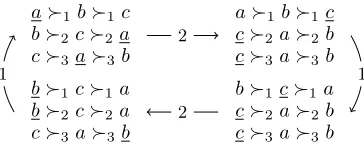
Figure 1: Cycle of safe W-manipulations from the truthful profile (top, left) for the PSR with scoring vector(3,2,0).
Theorem 8 cannot be extended to the PSRs, as the exam-ple in Figure 1 shows. Winners are underlined. In the initial truthful profile, a wins by tie-breaking. Then voter 2 (for whom a is worst) can safely manipulate and make c win. Then voter 1 manipulates, but unsuccessfully (c still wins). Now voter 2 manipulates again, makingbwin. Note that his manipulation is safe: there is no risk in demotingc, as ais demoted as well (losing more points thanc). Finally, voter 1 manipulates analogously, and we are back at the first profile.
Closer inspection of Figure 1 shows that the first two ma-nipulation moves, while safe, arguably are not the most nat-ural choices for our voters. For instance, in the initial profile voter 2 could have also manipulated by votingc 2 b 2 a,
which would have achieved the same goal and which, intu-itively, seems the more natural choice. This intuition can be formalised in a number of ways, e.g., by defining a suit-able notion of “best” response. Here, instead, we opt for a much simpler solution. Under theconservative improve-ment dynamics, when choosing which of the available safe
π-manipulations to play, a voter will always choose one that minimises the Kendall tau distance to his current ballot.
Theorem 9. Under the winner information function W-IF
and the conservative improvement dynamics, every positional scoring rule converges to a stable outcome.
Proof. We use the same technique as for Theorem 8, i.e., we are done if we can show that no manipulator will ever remove his least preferred candidate from the bottom spot in his bal-lot. But this is clearly the case under W-IF and conservative improvements: if voteri’s least preferred candidatecis cur-rently winning, no manipulation can make things worse, soi
can choose one that keepscat the bottom of his ballot. And if some other candidate is currently winning, it is not safe to put
cin a position where she would get more than the minimum number of points, soimust keepcat a minimum-score spot and he can choose the bottom spot (the latter distinction only matters in casesm−1=sm, e.g., for Plurality).
To put Theorems 8 and 9 into perspective, let us recall what other convergence results are known to date. We restrict at-tention to results that apply when agents initially vote truth-fully and when ties are broken lexicographically (without these assumptions, results often are significantly weaker). Under complete information and best-response dynamics, Plurality converges [Meir et al., 2010]. Lev and Rosen-schein [2012] extended this result to the case of Veto, but also demonstrated that many other rules do not converge under these conditions [see also Reyhani and Wilson, 2012]. Sev-eral other authors introduced more restricted types of
manipu-lation moves, e.g., with voters attempting to manipulate only by swapping the first two candidates in their ballot [Grandi et al., 2013] or by promoting their most preferred candidate amongst the currentkfront-runners [Reijngoud and Endriss, 2012], and were able to establish convergence results under those assumptions for a wider range of voting rules [see also Obraztsova et al., 2015]. However, for the game-theoretical setting considered here, the only known positive results for the full information case concern Plurality and Veto.
The early work of Chopraet al.[2004] already hinted at the fact that the information each voter has access to will impact convergence, but these authors did not establish any concrete convergence results for specific voting rules. Reijngoud and Endriss [2012] used the same model of incomplete informa-tion as we do, but their convergence results concern heavily restricted forms of manipulation only. Meiret al.[2014] used a similar model of information, but focused only on Plurality. Thus, Theorems 8 and 9 significantly broaden the range of positive results regarding convergence in iterative voting.
5
Conclusion
We have studied the impact of incomplete information effects on the susceptibility of voting rules to strategic manipulation, and closed a number of gaps in existing research in this field. For one, although in many cases strategic behaviour by vot-ers cannot be ruled out, even under heavy restrictions on the information they have access to, we have been able to obtain positive results on the immunity of certain voting rules when voters only have access to the majority graph, rather than to the full profile of individual preferences.
Our most important results concern the scenario of iterative voting, where we have been able to demonstrate that a process of repeated manipulations will converge for a number of vot-ing rules when voters only have access to the information of which candidate is winning the election. This convincingly demonstrates the significance of the assumptions regarding information access we are willing to make, as similarly pos-itive results so far have only been available for the very sim-plest of voting rules, namely Plurality and Veto.
Acknowledgments
This work has been partly supported by COST Action IC1205 on Computational Social Choice, by Israel Science Founda-tion grant number #1227/12, and by the Israeli Center of Re-search Excellence in Algorithms (I-CORE-ALGO).
References
[Chopraet al., 2004] S. Chopra, E. Pacuit, and R. Parikh. Knowledge-theoretic properties of strategic voting. In Pro-ceedings of the 9th European Conference on Logics in Ar-tificial Intelligence (JELIA-2004), 2004.
[Conitzeret al., 2011] V. Conitzer, T. Walsh, and L. Xia. Dominating manipulations in voting with partial informa-tion. InProceedings of the 25th AAAI Conference on Arti-ficial Intelligence (AAAI-2011), 2011.
[van Ditmarschet al., 2013] H. van Ditmarsch, J. Lang, and A. Saffidine. Strategic voting and the logic of knowledge. InProceedings of the 14th Conference on Theoretical As-pects of Rationality and Knowledge (TARK-2013), 2013. [Fishburn and Gehrlein, 1976] P. C. Fishburn and W. V.
Gehrlein. Borda’s rule, positional voting, and Condorcet’s simple majority principle. Public Choice, 28(1):79–88, 1976.
[Gibbard, 1973] A. Gibbard. Manipulation of voting schemes: A general result. Econometrica, 41(4):587–601, 1973.
[Grandiet al., 2013] U. Grandi, A. Loreggia, F. Rossi, K. B. Venable, and T. Walsh. Restricted manipulation in iterative voting: Condorcet efficiency and Borda score. In Proceed-ings of the 3rd International Conference on Algorithmic Decision Theory (ADT-2013), 2013.
[Lev and Rosenschein, 2012] O. Lev and J. S. Rosenschein. Convergence of iterative voting. InProceedings of the 11th International Conference on Autonomous Agents and Mul-tiagent Systems (AAMAS-2012), 2012.
[Meiret al., 2010] R. Meir, M. Polukarov, J. S. Rosenschein, and N. R. Jennings. Convergence to equilibria in plurality voting. InProceedings of the 24th AAAI Conference on Artificial Intelligence (AAAI-2010), 2010.
[Meiret al., 2014] R. Meir, O. Lev, and J. S. Rosenschein. A local-dominance theory of voting equilibria. In Pro-ceedings of the 15th ACM Conference on Economics and Computation (EC-2014). ACM, 2014.
[Monderer and Shapley, 1996] D. Monderer and L. Shap-ley. Potential games. Games and Economic Behavior, 14(1):124–143, 1996.
[Moon, 1968] J. W. Moon. Topics on Tournaments. Holt, Rinehart and Winston, 1968.
[Obraztsovaet al., 2015] S. Obraztsova, E. Markakis, M. Polukarov, Z. Rabinovich, and N. R. Jennings. On the convergence of iterative voting: How restrictive should restricted dynamics be? InProceedings of the 29th AAAI Conference on Artificial Intelligence (AAAI-2015), 2015. [Reijngoud and Endriss, 2012] A. Reijngoud and U. Endriss.
Voter response to iterated poll information. In Proceed-ings of the 11th International Conference on Autonomous Agents and Multiagent Systems (AAMAS-2012), 2012. [Reyhani and Wilson, 2012] R. Reyhani and M. Wilson.
Best reply dynamics for scoring rules. In Proceedings of the 20th European Conference on Artificial Intelligence (ECAI-2012), 2012.
[Satterthwaite, 1975] M. A. Satterthwaite. Strategy-proofness and Arrow’s conditions: Existence and corre-spondence theorems for voting procedures and social wel-fare functions. Journal of Economic Theory, 10(2):187– 217, 1975.