Int. J. Electrochem. Sci., 12 (2017) 8295 – 8305, doi: 10.20964/2017.09.21
International Journal of
ELECTROCHEMICAL
SCIENCE
www.electrochemsci.orgEffects of ZnO Sintering Additive on the Sintering Behavior and
Conductivity of YSZ Solid Electrolyte
Fang Yang1, Hao Fang1, Qian Hu1, Chunjun Zhao1, Xiuzhen Qian1, Chunhua Zhao1,⃰
1
Key Laboratory for Ultrafine Materials of Ministry of Education, School of Materials Science and Engineering, East China University of Science and Technology, Shanghai 200237, China
*
E-mail: [email protected]
Received: 8 June 2017 / Accepted: 4 July 2017 / Published: 13 August 2017
The effects of ZnO sintering additive on the sintering behavior and electrochemical properties of YSZ-based solid electrolyte were investigated. With the addition of 3 mol% ZnO, the linear shrinkages of YSZ at 1200 °C increased from 7.1% to 15%, and the relative density at 1200°C increased from 82% to 94.6%. XRD confirmed that a small amount of Zn can be incorporated into the fluorite lattice, and EDX result showed that ZnO mainly distributed at the grain boundary. ZnO modified YSZ had denser structure and fewer pores than YSZ. The increased densification of YSZ by ZnO addition can significantly increase the grain and total conductivities. Compared with YSZ, the total conductivity of 2 mol% ZnO modified YSZ increased from 0.013 to 0.021 S·cm-1 at 800 °C.
Keywords: ZnO modified YSZ; Sintering property; Electrochemical property; Solid oxide electrolyte
1. INTRODUCTION
The sintering behavior can be improved by two ways: using nano-scaled powders and adding sintering additives. Relative density higher than 99% can be got at 1450 °C by using nano-sized YSZ powders prepared by polyethylene glycol (PEG) assisted coprecipitation coupling with azeotropic distillation drying process [6]. But nano-sized YSZ showed lower stability than micro-sized YSZ at high temperature [7]. At the same time, the fabrication of nano-sized powder requires a flexible process, which increases the cost and limits their commercial application. Adding appropriate sintering additives can decrease the sintering temperature of ceramics effectively. ZnO has been proven to be an ideal sintering additive [8-10]. The solution of ZnO in YSZ and the effects of ZnO on the sintering behavior and electrical properties were studied by some researchers.
But contradictory conclusions about the solubility of Zn in fluorite structure or Zn content on electrical properties were drawn in previous research work. Marcomini et al. showed that ZnO solubility in 8YSZ (8 mol% Yttria doped zirconia) is of the order of 3 mol% at the sintering temperature of 1300 °C [8]. Based on the Electron probe micro-analyzer (EPMA) and X-ray diffractometer (XRD) measurement of Y-TZP (Y2O3-doped tetragonal zirconia polycrystals)-x wt.%ZnO, NAKAYAMA et al. suggested that ZnO didn’t dissolve into Y-TZP [9]. According to the XRD results, Liu et al. proved that ZnO and 8YSZ can form a solid solution when less than 10wt.% ZnO was added into 8YSZ [10]. Marcomini et al. suggested that the conductivity of 8YSZ at 350 °C decreased with the increase of ZnO when ZnO content is less than 20 vol.% [8]. By using impedance spectra, Liu et al. analyzed the effects of ZnO addition on grain and grain boundary conductivities at 300 °C. Overall, the grain conductivity decreased and the grain boundary conductivity increased with the addition of ZnO [10]. However, these authors didn’t measure the electrical behaviors at higher temperature. At the same time, few YSZs can be sintered below 1300 °C.
In this work, the effect of ZnO addition on the sintering behavior of YSZ was studied. The structure, microstructure, and electrical properties of the ZnO-added samples sinter at 1200 °C were given.
2. EXPERIMENTAL
(Y2O3)0.08(ZrO2)0.92 (YSZ, 99.9% purity, Ningbo SOFCMAN Energy Technology Co., Ltd, China) with the average particle size of 0.5 µm and Zn(CH3COO)2ˑ2H2O (AR) (Sinopharm Chemical Reagent Co.,Ltd, China) were used as raw materials. Zn(CH3COO)2ˑ2H2O were thoroughly mixed with YSZ in an agate mortar. At high temperature Zn(CH3COO)2ˑ2H2O will be decomposed into ZnO. The samples without ZnO, and with x mol% ZnO (relative to 1mol YSZ) were labeled as YSZ and xZYSZ. Then the precursors were calcined at 800 °C for 4 h. The calcined powders were milled in ethanol, dried, and blended with an organic binder. Disk-shaped powder compacts of diameter 5 mm were formed by uniaxial pressing at 200 MPa. The green disks were then sintered at 1150 and 1200 °C for 10 h in air and furnace-cooled to room temperature.
10 °C/min using a cylindrical powder compact of length 1.5 cm and diameter 0.5 cm. The density ρ was measured using Archimedes method. The relative density ρrel was determined according to the formula ρrel=ρ/ρth, where ρth is the theoretical density calculated from the lattice parameter as obtained from the XRD results. The microstructures of the sintered ceramics were observed by scanning electron microscope (SEM, Hitachi X-600, Japan); prior to the examination, samples were polished, and thermally etched at 1150 °C in air for 30 min. Zn distribution was measured by SEM (Hitachi S-4800, Japan) coupled with INCA energy-dispersive X-ray spectroscopy (EDX). For measuring the electrical conductivity, the two opposite sides of the sintered disks were polished and coated with silver paste, heated at 600 °C for metallization and quenched to room temperature. Gold wires were attached as electrode leads. Three samples for each component were used to measure the conductivities. For the AC impedance measurement, we used an AC impedance analyzer (Chenhua CHI604E, China) over the frequency range of 1 Hz to 105 Hz. All the impedance diagrams were normalized by the pellet geometrical factor.
[image:3.596.156.478.361.580.2]3. RESULTS AND DISCUSSION
Figure 1. The X-ray patterns of YSZ, 1ZYSZ and 3ZYSZ sintered at 1200 ºC.
are 5.1402 and 5.1361 Å, respectively. When ZnO is dissolved in the lattice, the reaction (using Kroeger-Vink notation) can be expressed as:
'' .. x
Zr O O
ZnOZn +V +O
. The effective ionic coordination number (8) radius for Zn2+, Y3+, and Zr4+ are 90, 101.9, and 84 pm, respectively [12]. The substitute of Zr4+ by Zn2+ should cause the increase of a because Zn2+ has a larger ionic radius than Zr4+. Here, the decrease of a by Zn doping can be attributed to the production of oxygen vacancy.
The densification behavior of the green compacts of YSZ and 3ZYSZ were performed in an air flow at a heating rate of 10C min-1, as shown in Fig. 2. It can be seen that ZnO added YSZ has higher shrinkage rate than YSZ. With 3 mol% ZnO addition, the maximum shrinkage temperature decreased by 50 °C, and the linear shrinkages at 1200 °C increased from 7.1% to 15%. Clearly, 3 mol% ZnO addition can effectively improve the sintering activity of YSZ.
Figure 2. Dilatometric curves of (a) YSZ and (b) 3ZYSZ measured at a heating rate of 10 ºC/min in air.
Fig.3 shows the relative densities of YSZ and ZnO added YSZ sintered at 1150 and 1200 °C. In total, ZnO addition can effectively improve the relative densities, especially at 1150 °C. At 1200 °C, the relative densities of 2ZYSZ and 3ZYSZ are higher than 94%, which is high enough for the application as SOFC electrolyte. On the contrary, the relative density of YSZ sintered at 1200 °C is only 82%.
[image:4.596.142.487.263.501.2]
Figure 3. The relative densities of YSZ with and without ZnO addition sintered at 1150 and 1200 ºC.
Figure 4. The cross-section SEM images of (a)YSZ, (b) 2ZYSZ, and (c) 3ZYSZ sintered at 1200 °C.
[image:6.596.197.436.557.737.2]
Theoretically, pores can be removed effectively. But the binder burnout is a complex process involving the polymer decomposition, transport and diffusion of decomposed products, and removal of them. A number of parameters: ceramic body compact size, shrinkage rate, heating rate, organic polymer content affect burnout process. In fact, it is very difficult to remove the pores completely. [18]
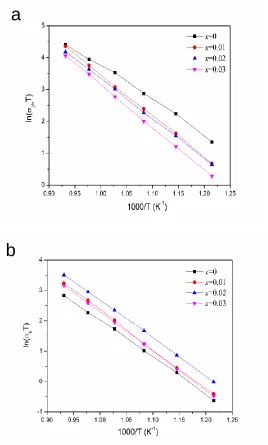
The contributions of grain and grain boundary resistivity to the total ceramic resistance were estimated using impedance spectroscopy. Fig. 6 gives the results of YSZ, 1ZYSZ, 2ZYSZ, and 3ZYSZ sintered at 1200 °C measured at 700 °C. One semicircle is observed for each impedance curve. The high frequency intercept (the left intercept of the semicircle) with the real axis represents the grain interior resistivity, the low frequency intercept (the right intercept of the semicircle) corresponds to the total resistivity, and the difference between the high frequency and low frequency intercepts represents the apparent grain boundary resistivity [16]. The shape of the impedance spectra measured from 550 to 800 °C for each component are the same. The grain, grain boundary, and total resistivity can be extracted from the AC impedance spectra. And the conductivities can be calculated. Fig. 7 gives the apparent grain boundary, grain, and total conductivities of YSZ with different ZnO content measured from 550 to 800 °C. The grain boundary conductivity at 800 °C decreased from 0.077 to 0.044 S·cm-1 with x increasing from 0 to 3. The grain and total conductivities first increased with ZnO content, then decreased with further increase in ZnO content. Compared with YSZ, the total conductivity of 2ZYSZ increased from 0.013 to 0.021 S·cm-1. All grain, grain boundary, and total conductivities are in accordance with the Arrhenius relationship, as shown in Fig. 8. The activation energies can be calculate, as shown in table 1. Compared with YSZ, ZnO modified YSZ have higher activation energy. From Fig.5 we know that ZnO exists mainly at the grain boundary region. With the increase of ZnO addition, the layer of ZnO film increased. The insulation of ZnO leads to the increase of grain boundary conductivity with the increase of ZnO. Under low ZnO content, the grain conductivity is mainly affected by the relative density. The denser the electrolyte is, fewer pores will exist. For the ceramics with poor densification, the pores at the grain or grain boundary weaken the conductive channel, and the migration of oxygen ions is blocked by the pores. ZnO addition caused the increase of densification which led to the obvious increase of grain conductivity. But with further increase in ZnO addition, the ZnO second phase can also lead to the decrease of grain conductivity.
Table 1. The activation energies (Ea) of YSZ and ZnO modified YSZ
Ea(eV)
grain boundary grain total
x=0 0.92 1.04 1.03
x=0.01 1.11 1.12 1.12
x=0.02 1.07 1.07 1.07
[image:7.596.79.517.604.724.2][image:8.596.126.471.74.328.2]
Figure 7. Apparent (a)grain boundary, (b)grain, and(c) total conductivities of YSZ with different ZnO content sintered at 1200 °C measured from 550 to 800 °C.
Figure 8. Relationship between ln(σT) and the reciprocal of the absolute temperature (1000/T): (a) apparent grain boundary, (b) grain, and (c) total.
4. CONCLUSIONS
ZnO modified YSZ can achieve a relative density of 94% at 1200 °C. ZnO existed mainly as the glass film at the grain boundary. ZnO addition can lead to the decrease of grain boundary conductivity. But the grain and total conductivities increased with appropriate ZnO addition. The total conductivity of 2 mol% Zn modified YSZ is 0.021 S·cm-1. ZnO is an ideal sintering additive of YSZ which can effectively decrease the sintering temperature to 1200 °C.
ACKNOWLEDGEMENTS
This work is supported by National Natural Science Foundation of China (Grant no. 51102094), Shanghai Leading Academic Discipline Project (Grant no. B502), Shanghai Key Laboratory Project (Grant no. 08DZ2230500).
References
1. B. C. H. Steele, J. Nature., 400 (1999) 619.
2. T. Baquero, J. Escobar, J. Frade, D. Hotza,J. Ceram. Int., 39 (2013) 8279. 3. J. W. Fergus, J. Power Sources., 162 (2006) 30.
4. S. Hao, C. Wang, T. Liu, J. Wang, Z. Mao, J. Ceram. Int., 42 (2016) 9323. 5. C. Zhao, R. Liu, S. Wang, T. Wen,J. Electrochem. Commun., 11(2009) 842. 6. H. Yao, X. Wang, R. Pei, J. Wang, Z. Li,J. Ceram. Int., 37 (2011) 3153. 7. H. Zhao, X. Li, F. Ju, U. Pal, J. Mater. Process. Technol., 200 (2008) 199.
8. R. F. Marcomini, D. P. F. Souza, M. Kleitz, L. Dessemond, M. C. Steil, J. solid State Sci. Technol., 1 (2012) N127.
[image:10.596.164.442.86.298.2]
10. Y. Liu, L. E. Lao,J. Solid State Ionics., 177 (2006) 159.
11. J. Kimpton, T.H. Randle, J.J. Solid State Ionics., 149 (2002) 89.
12. J. A. Dean, Lange’s Handbook of Chemistry, 15th ed., McGraw-Hill, INC., New York, 1999. 13. M. N., Rahaman, Ceramic Processing and Sintering, 2nd ed., CRC Press, Boca Raton, 2003. 14. Q. Lv, X. Dong, Z. Zhu, Y. Dong,J. Ceram. Int., 40 (2014) 11545.
15. D. P. Fagg, J. C. C. Abrantes, D. Pérez-Coll, P. Núňez, V. V. Kharton, J. R. Frade, J. Electrochim. Acta., 48 (2003) 1023.
16. H. Yao, X. Zhao, X. Chen, J. Wang, Q. Ge, J. Wang, Z. Li, J. Power Sources., 205 (2012) 180. 17. C. Tseng, P. Chen, P. Lin, J. Alloys Compd., 632 (2015) 810.
18. T. Ertugrul, S. Celik, M. Mat, J. Power Sources., 242(2013) 775.