Inferring Human Pose and Motion
from Images
Yifan Lu
Research School of Engineering
The College of Computer Sciences and Engineering
The Australian National University
Acknowledgements
I am very grateful to be a member of the computer vision group at Australian National University. I would like to thank my supervisors Dr. Lei Wang, Professor Richard Hartley and Dr. Hongdong Li for invaluable direction and assistance in the develop-ment of this work. Thanks especially to Leslay Goldburg, Elspeth Davies and Marie Katselas for helping with conference travel and other issues in PhD life. Thank you also to Professor Henry Gardener for the encouragement and help to international students. Thank you to fellow students, Novi Quadrianto, Yuhang Zhang, Peter Carr, Tamir Yedidya, Luping Zhou and Cong Phuoc Huynh for their accompany. Last but not least, thanks to my parents for their continuous support.
Abstract
As optical gesture recognition technology advances, touchless human computer inter-faces of the future will soon become a reality. One particular technology, markerless motion capture, has gained a large amount of attention, with widespread application in diverse disciplines, including medical science, sports analysis, advanced user inter-faces, and virtual arts. However, the complexity of human anatomy makes markerless motion capture a non-trivial problem: I) parameterised pose configuration exhibits high dimensionality, and II) there is considerable ambiguity in surjective inverse map-ping from observation to pose configuration spaces with a limited number of camera views. These factors together lead to multimodality in high dimensional space, mak-ing markerless motion capture an ill-posed problem. This study challenges these diffi-culties by introducing a new framework. It begins with automatically modelling spe-cific subject template models and calibrating posture at the initial stage. Subsequent tracking is accomplished by embedding naturally-inspired global optimisation into the sequential Bayesian filtering framework. Tracking is enhanced by several robust evaluation improvements. Sparsity of images is managed by compressive evaluation, further accelerating computational efficiency in high dimensional space.
Contents
Acknowledgements iii
Abstract v
1 Introduction 1
1.1 Problem Formalisation . . . 2
1.2 Challenges . . . 3
1.2.1 Ambiguity and Multimodality . . . 3
1.2.2 High Dimensionality . . . 5
1.2.3 Subject Specific Modelling . . . 6
1.2.4 Computational Performance . . . 6
1.3 Thesis Outline . . . 6
2 Literature review 9 2.1 Global Optimisation and Template based Generative Approach . . . 9
2.1.1 Global Optimisation . . . 10
2.1.1.1 Annealed Particle Filter . . . 10
2.1.1.2 Covariance Scaled Sampling . . . 11
2.1.1.3 Interacting Simulated Annealing and Hybrid Approach 12 2.1.2 Template Model Generation . . . 15
2.1.2.1 Articulated ICP and Subject Specific Model Generation 15 2.1.2.2 Performance Capture . . . 17
2.1.3 Object Localisation and Pose Estimation using a Graphic Model . 21 2.2 Learning Based Approach . . . 22
2.2.1 Tracking by Regression . . . 22
2.2.2 Gaussian Process Dynamical Model . . . 24
2.2.3 Dimensionality Reduction and Manifold Learning on Visual Track-ing . . . 26
2.3 Graph Based Image Segmentation and Tracking . . . 29
2.3.1 Simultaneous Segmentation and Pose Estimation . . . 31
2.3.2 Transductive Image Segmentation . . . 32
2.3.3 Laplacian Matrix and Tracking . . . 36
3 Architecture Overview and Sequential Tracking Pipeline 39 3.1 Architecture of Human Motion Capture . . . 39
3.2 Sequential Bayesian Filtering Framework . . . 43
3.3 Particle Filter on Visual Tracking . . . 46
3.3.1 Recursive Bayesian Filtering . . . 46
4 Subject Specific Body Shape Modelling and Automatic Initialisation 51 4.1 Related Works . . . 52
4.2 Generic Human Body Skeleton . . . 55
4.3 Human body shape . . . 58
4.3.1 Needle based Body Shape Parameterisation . . . 59
4.3.1.1 Contour from Needle Projection . . . 66
4.3.2 Data-Driven Body Shape Parameterisation . . . 69
4.3.2.1 Dynamic Bone Length and Collision Bounding Box Ad-justment . . . 71
4.4 Automatic Initialisation . . . 74
4.4.1 Using Needle based Body Parameterisation . . . 75
4.4.2 Using Data-Driven Shape Parameterisation . . . 77
5 Nature Inspired Global Optimisation 81 5.1 Simulated Annealing . . . 82
5.1.1 Simulated Annealing Particle Filter . . . 85
5.2 Particle Swarm Optimisation . . . 88
5.2.1 Algorithm Description . . . 91
5.3 Covariance Matrix Adaptation Evolution Strategy . . . 92
5.3.1 Evolution Strategy . . . 93
5.3.2 Covariance Matrix Adaptation . . . 95
5.3.2.1 Selection and Recombination . . . 95
5.3.2.2 Adapting the Covariance Matrix . . . 96
5.3.2.3 Step-Size Control . . . 102
5.4 Covariance Matrix Adaptation Annealing . . . 104
5.4.1 Problems in Dynamic Settings . . . 104
5.4.2 Covariance Matrix Adaptation Annealing Algorithm . . . 105
5.4.2.1 Perturbation Matrix and Particle Velocity Update . . . . 107
5.4.3 Experiments with Benchmark Optimisation Problems . . . 110
5.4.3.1 Ackley Problem . . . 110
5.4.3.2 Rastrigin Problem . . . 111
5.4.3.3 Griewank Problem . . . 114
5.4.3.4 Rosenbrock Problem . . . 116
6 Robust Evaluation Model 119 6.1 Incremental Relaxation by Fast March Method . . . 120
6.1.1 Fast March Method . . . 123
6.1.2 Experiments . . . 126
6.2 Colour and Texture Incorporation . . . 128
6.2.1 Illumination Invariant Colour Difference . . . 133
6.2.2 Experiments . . . 136
Contents ix
6.4 Gradual Sampling for Annealed Particle Filter . . . 143
6.4.1 Connection between Gradual Sampling and Annealing Variable . 147 6.4.2 Experiments and Discussion . . . 149
7 Compressive Evaluation 155 7.1 Compressive Sensing . . . 156
7.1.1 Signal Sparse Representation . . . 157
7.1.2 L1 Minimisation and Reconstruction . . . 158
7.1.3 Incoherence Sampling . . . 159
7.1.4 Restricted Isometry Property . . . 161
7.1.5 RIP Random Sensing . . . 162
7.2 Discrete Wavelet Transform . . . 163
7.3 Compressive Annealed Particle Filter . . . 166
7.3.1 Restricted Isometry Property and Pairwise Distance Preservation 168 7.3.2 Multilevel Wavelet Likelihood Evaluation on Compressive Mea-surements . . . 170
7.3.2.1 Construct Increasing Wavelet Coefficient Image . . . 171
7.4 Experiments . . . 172
8 Conclusion 177 A Appendix 181 A.1 Perspective Projection . . . 181
A.2 Importance Resampling . . . 183
A.3 Human Body Segments and Joint Angle Ranges . . . 185
A.4 Parameterisations of Three DOF Rotations . . . 185
A.4.1 Rotation Matrices . . . 185
A.4.2 Euler Angles . . . 191
A.4.3 Axis Angle . . . 192
A.4.4 Optimisation on Axis Angle . . . 193
Chapter 1
Introduction
Human motion capture can be considered an evolution in human computer interac-tion that imparts understandability of human movement to computers. The tradi-tional human interaction devices – keyboards, mice and game controllers – confine movements of human beings to limited and specific ranges so that the movements are simple enough to be detected. By contrast, human motion capture offers a powerful and flexible way to detect and recognise diverse movements in various circumstances of daily life. The development of such flexible techniques leads to an evolution of hu-man computer interaction towards something much closer to the natural behaviour of human beings, enabling the next generation of human computer interfaces.
In the 1970s and 1980s, human motion capture was already used in biomechan-ics, and later expanded into education, training and sports. For instance, Calvert et al. [Calvert et al. 1982] at Simon Fraser University, attached potentiometers to a body and used the output to animate a computer character for choreographic studies and clinical assessment of movement abnormalities. The studies were limited to use attachable-sensor enhanced techniques. After the 1980s, optical capture technology advanced, and an increasing number of optical motion capture emerged in various fields, including computer animation, clinical medicine, virtual reality and the film industries. Such techniques require that the performer wears reflective markers that are captured by multiple cameras over time. The positions, angles, velocities and tra-jectories of the markers are then computed. The goal of this motion capture is to detect and record the motion and expression of moving subjects, which can be represented as poses of the subjects at any time, and then converted to abstract digital format.
Provided adequate computational power and number of cameras, recent marker based commercial systems are already matured enough to capture complex move-ments in real time. However, dedicated hardware and multiple expensive cameras are not suitable for deployment in an everyday environment. Markers may also re-strict performer spontaneity, affecting realistic motion capture. Recent efforts [Hou et al. 2007; Vlasic et al. 2007; Sminchisescu et al. 2007; Rosenhahn et al. 2007; Agarwal and Triggs 2006; Balan and Black 2006; Lee and Elgammal 2006; Wang et al. 2008] in computer vision therefore have been focused on markerless human motion capture in order to realise a cost-effective and easily deployed motion capture system. Marker-less motion capture has several desirable characteristics compared with marker-based
motion capture:
1. Absence of markers: This is the most desirable difference from the marker based system. The obvious imposed condition is that computers should recognise nat-ural human actions, and this implicitly opens a very broad range of recognition applications in real life.
2. Basic hardware requirements: The common personal computer should be qualified for use as markerless motion capture system. In other words, markerless motion capture should be usable wherever a common personal computer is available.
3. A distributed camera system: This is the only requirement that needs some effort to setup and calibrate. However, with the availability of new Time-of-Flight camera technology, the number of cameras will be dramatically reduced. It is possible that a stereo camera will be sufficient for markerless motion capture in the near future.
1.1
Problem Formalisation
In this research, most attention is focused on optical and markerless motion cap-ture using computer vision techniques. In particular, in an indoor setting with a
few distributed cameras, the performer wears common clothes1and performs in the
space visible from all cameras. While the performer is acting, his/her performance is recorded and stored as digital images or videos from different angles. Later, these digital images or videos are processed by computer vision techniques to reconstruct the original motion and convert it into abstract digital form.
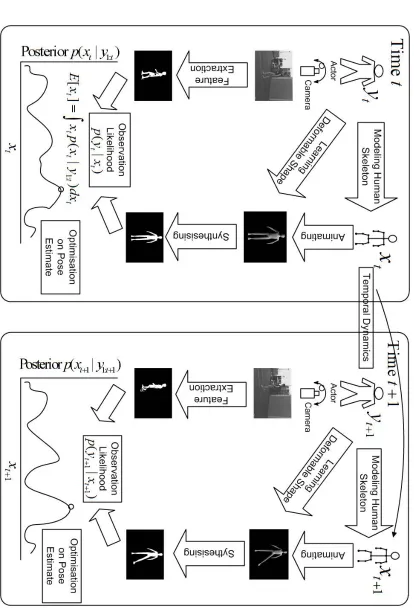
The original motion is reconstructed by analysing each observed image and video frame in the sequence, in order to extract gesture features, estimate the best pose of the performer at a particular time, and eventually recover successive motion frame by frame. This essentially describes markerless human motion capture as an infer-ence process that infers human pose and motion according to available observations through time. Within the context of this work, there are several key terms in mark-erless motion capture that should be clarified: 1) human motion, pose, and parame-terisation; 2) temporal dependency; 3) the observation and its representation; and 4) markerless human motion capture with respect to the other definitions.
1. Human Motion, Pose and Parameterisation: Human motion itself is a complex pro-cess involving interactions of muscles, bones, external forces and other factors. To simplify it, we assume it only consists of a sequence of poses, each of which refers to certain time. Therefore, a description of human motion only requires us to be able to describe human pose. Naturally, the anatomy of the human
1But clothes should be a reasonable fit to his/her body shape and their colour should have a
§1.2 Challenges 3
body allows a definition of human pose using an articulated skeleton and its joint angles. The articulated skeleton is modelled based on anthropometric mea-surements of the real performer. Given this articulated skeleton, human pose is determined by a pose vector that includes a position, an orientation and joint angles. Human motion can then be described by a sequence of successive pose vectors over time.
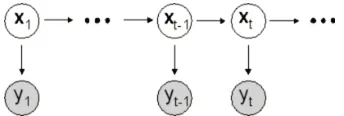
2. Temporal Dependency: If human pose can be considered a description of the spa-tial structure of the human body, human motion naturally can be considered a description of both the spatial and the temporal structure of the human body. Over time, poses are not independent of each other, but each pose somehow de-pends on previous poses. In other words, a pose is a function of previous poses. This is so-called temporal dynamics or the dynamic function.
3. Observation: The observation is often regarded as the observable measurement or emitted signal that reflects the underlying pose. It may contain redundant and noisy information, and have various formats depending on the specific sit-uation. In the context of this work, the observation often refers to the observed image or features extracted from the image.
4. Markerless Human Motion: The essential problem is finding the best poses that fit observations at each time, while maintaining consistency with previous poses.
1.2
Challenges
Generic image-based object detection and tracking techniques have been widely stud-ied in the past several decades. Significant achievements in computer vision have al-ready been seen as a consequence. Since such techniques inherit advantages of gener-alisations for coping with the characteristics of regular objects, they are able to handle various objects and situations. However, this appears not very fruitful and less ef-fective when problems require more precise information and domain-specific knowl-edge. For example, markerless motion capture requires that each joint position and rotation of a skeleton be tracked. This type of problem has specialised characteris-tics and structures which cause difficulties for the generic techniques. Furthermore, markerless motion capture requires dealing with the irregular articulated structure, high dimensionality of human motion, variations of body shape among different peo-ple and interactions with the environment. These complications suggest the problem of human motion capture has to be modelled separately and attacked differently. This section outlines the four specific challenges in human motion capture.
1.2.1 Ambiguity and Multimodality
marker based motion capture has relatively better behaviour that tracks well-specified illuminative marker points as targets. Conversely, markerless motion capture does not have a well specified but rather poorly defined tracking target – the entire performer’s body – which has an irregular and deformable shape, and usually does not have the visual significance from the image processing point of the view. Moreover, the joint lo-cation and orientation must be inferred from indirect observation of clothes and body shape. Therefore, detecting and identifying the tracking target in markerless motion capture is much more challenging than marker-based approaches.
Common approaches in markerless motion capture rely on the shape-from-silhouette [Laurentini 1994] concept to detect the tracking target. A bounding geometry of the original 3D shape, the so called visual hull, can be determined by intersecting gener-alised cones that are formed by back-projecting each multi-view performer silhouette
with its camera parameters. However, without a special setup2, silhouette
segmen-tation may misclassify some background pixels with some foreground pixels. Even when accurate silhouettes can be acquired, with a small number of camera view sil-houettes, multiple distinctive postures may still correspond to the same visual hull or same set of silhouettes. This is because the visual hull does not uniquely determine one posture, but rather it encompasses the maximum volume of the underlying ob-ject. As a result, there is considerable difficulty in determining a unique posture from a given observation. Another consequence of using a small number of cameras is that self-occlusions are likely to occur, resulting in gesture ambiguities. These together cause multimodality in the evaluation between the observations and a hypothetical pose. When multimodality (e.g. Figure 1.1) is present in the optimisation of the eval-uation function, the local landscape of the evaleval-uation function does not always have shape consistent with the landscape of the global optimum, like the convex function does. This makes markerless motion capture an ill-conditioned problem. Many meth-ods, for example the gradient-based method, utilise the shape of the local landscape and would be easily trapped into local optimums. Hence, stochastic optimisation is often chosen to avoid local optimums.
Generally speaking, ambiguities occur because inadequate constraints and infor-mation are utilised. Considering an underdetermined system of linear equations, where the number of equations is smaller than the number of the unknowns, the unknowns have multiple solutions. Multiple solutions for each unknown can be re-garded as ambiguous. If extra linearly independent equations can be introduced so that the number of equations is equal to the number of unknowns, then unknowns will have a unique solution, and ambiguity will be resolved. Similarly, if additional camera views can be introduced in markerless motion capture, multimodality can be resolved.
2For example, chroma keying lighting and background can be used to distinguish the foreground
§1.2 Challenges 5
Figure 1.1: Multimodality in the two dimensional Ackley function [Ackley 1987]
1.2.2 High Dimensionality
Because the complexity of the anatomical structure of the human body, the pose vector usually resides in high dimensional space which often has more than 20 dimensions. This makes markerless motion capture suffer from the “curse of dimensionality” in the size of the search space, in which finding the solution increases exponentially with respect to dimensionality. As the relationship between the observed image and the pose is entangled with skin deformation, clothing colour, light reflection and other factors, the complete mapping function between them is hard to unfold using current representation techniques (e.g. manifold learning). The common solution in the lit-erature is stochastic optimisation, for example using Markov chain Monte Carlo sam-pling to estimate maximum a posteriori (MAP) the observation likelihood. This re-quires dense sampling to cover a relatively small area [Sminchisescu and Triggs 2003] in which the global optimum has high probability of occurring. Both of the terms “small area” and “dense” are meant relative to the size of the search space. When the search space is high dimensional, the “small area” becomes massive, and “dense sam-pling” becomes infeasible. As a consequence, common sampling techniques become very sensitive and vulnerable to the coverage and number of samples, and they are not well scalable especially when the tracking subject has fast movement.
1.2.3 Subject Specific Modelling
When the precision required by human tracking reaches the level of joint angles and joint positions, it becomes necessary to consider subject specific modelling and an-thropometric measurements. Although 3D laser scanning is able to provide accurate full body modelling, there are practical difficulties with using it on multiple people and with frequent clothing changes, and it is an additional equipment requirement. Moreover, the limb lengths of the tracking subject are also necessary for markerless motion capture, and 3D laser scanning cannot provide them. All in all, we require human body specific modelling which is suitable for markerless motion capture.
Additionally, interactions between external forces and the human body are often ignored to simplify the complex process. Hence human body movement can be for-mulated as rigid-body kinematics of articulated segments with joint angles. Since 3D joint rotation parameterisation involves mapping between a flat Euclidean space and a spherical space – Special Orthogonal Group (SO(3)) – there always exists singulari-ties and double cover in such a parameterisation. A suitable optimisation procedure has to handle these two special cases appropriately so that continuous exploration can be maintained everywhere.
1.2.4 Computational Performance
Most human computer interaction applications require instant responses and real time feedback, otherwise users could easily fail to engage with the immersive en-vironment. Human motion capture as a human computer interfacing technique often needs to respond in excess of 25 times per second. This is a crucial requirement for all human computer interfacing applications. However, stochastic optimisation methods used in markerless motion capture suffer from issues associated with convergence rate and computational time. Many of them are practically infeasible when the di-mensionality of problems is very high, since they have an exponential or higher order polynomial time complexity. The execution time of current algorithms for each frame on an average personal computer may take several seconds or even several minutes, several orders of magnitude slower than the real time requirement. Thus, designing an optimisation process specialised to human motion capture and improved compu-tational performance is a very challenging task.
1.3
Thesis Outline
In this section, an overview is outlined for each chapter which proposes different ap-proaches to challenge difficulties presented in the previous section.
§1.3 Thesis Outline 7
and give formal explanations of markerless motion capture. Then, the ma-jor challenging issues in markerless motion capture are addressed. Finally, an overview of the thesis structure is presented.
2. Chapter 2Literature Review: Recent state of the art studies in markerless motion capture are reviewed. The strengths and weaknesses of diverse approaches are analysed in depth, including generative, learning based approaches, and track-ing by graphical image segmentation. Finally, we motivate our approach from the analysis of existing studies.
3. Chapter 3 Architecture Overview: An overview of the proposed framework is
depicted, and the major components’ characteristics and functionality are de-scribed related to overcoming the challenging issues. Major contributions to the architecture will be highlighted by referring to particular chapters.
4. Chapter 4Subject Specific Body Shape Modelling and Automatic Initialisation: We begin with describing the generic articulated skeleton and standard skin de-formation method used in the computer graphics community. Then, based on the skin deformation technique, we introduce two methods, Needle based and Data-Driven Body Shape Parameterisation to realise subject specific modelling. Finally, we describe how to automatically estimate the subject shape parameters, anthropometric measurements and the initial posture simultaneously by using our CMA-Annealing method.
5. Chapter 5Nature Inspired Global Optimisation: To deal with multimodality and high dimensionality, global optimisation, Simulated Annealing, Particle Swarm Optimisation and Covariance Matrix Adaptation Evolution Strategy are described. Considering the characteristics and properties of these methods, we propose a novel hybrid optimisation method–Covariance Matrix Adaptation Annealing. It takes advantages of both fast convergence and robustness to multimodality to attack one specific class of problems. At the end of the chapter, four meth-ods’ behaviour and performance are validated by experiments with a series of benchmark multimodal functions.
6. Chapter 6 Robust Evaluation Model: We propose several improvements to the
evaluations of annealing-based optimisation in this chapter. These include de-tails of Incremental Relaxation by the Fast March Method, Colour and Tex-ture Incorporation, Maximisation of Mutual Information and Gradual Sampling. These techniques improve the original algorithm from three perspectives–precision, robustness and computational performance.
Chapter 2
Literature review
Many different methods have been used to perform markerless motion capture. These can be classified into two major approaches: 1) methods modelling image features (eg. silhouettes and edges) as a generative process from pose, and 2) methods based on learning regression from image observations of pose. The generative methods model image feature space as a function of pose, and inferring pose from a limited number of view based image features often involves solving a hard multimodal optimisation problem. Learning based techniques try to model the pose configuration as a func-tion of image observafunc-tions. However because of the problem’s multimodality, such functional is very difficult to learn. The methods reviewed in this chapter will present diverse approaches to overcoming these issues. Apart from these two approaches, many works integrate image segmentation into the pose estimation process. This al-lows image segmentation and pose estimation to be improved iteratively, as the image is segmented with the current best pose estimate and the pose is then estimated based on the improved segmentation results.
2.1
Global Optimisation and Template based Generative
Ap-proach
Here we review recent template based methods that handle markerless motion cap-ture in multi-view settings. This category of methods combines different basic com-ponents into the tracking pipeline. These methods implement different ideas to over-come challenges in markerless motion capture, which include interactive simulated annealing, covariance scale sampling, loose-limb using graphical models and articu-lated ICP.
2.1.1 Global Optimisation
2.1.1.1 Annealed Particle Filter
Deutscher et al’s studies [Deutscher et al. 1999; Deutscher et al. 2000; Deutscher et al. 2001; Deutscher and Reid 2005] have developed a stochastic scheme, annealed parti-cle filtering (APF), that incorporates partiparti-cle filtering [Doucet et al. 2000] with simu-lated annealing to effectively search high dimensional space. Unlike the Kalman filter which can be provably optimal for sequential propagation of Gaussian probability densities (though it fails catastrophically in non-linear settings), particle filtering is able to approximate arbitrary densities and propagate multiple hypotheses, leading to much better behaviour in non-linear settings. Its robustness was demonstrated by the Condensation algorithms [Isard and Blake 1998a] in the context of visual track-ing. However, in high dimensional space occurring in markerless motion capture and other disciplines, particle filtering experiences serious scalability problems, both in populating space and representing an arbitrary density using a manageably sized par-ticle set. In fact it has been shown by MacCormick [MacCormick and Isard 2000] that the number of particlesN has to satisfyN > Dmin/αd, where Dmin ∈ [1,N]denotes the minimum acceptable survival diagnostic andα << 1 is a survive rate powered by the number of the dimensionsd. Clearly, whendis large, the number of particles becomes infeasible. This is essentially caused by the fact that importance sampling scales badly with dimension [MacKay 1998]. Moreover, the evaluation on the entire multimodal posterior distribution in high dimensional space is also computationally prohibitive. Therefore, Deutscher et al proposed a Simulated Annealing procedure to only approximate the global mode of the posterior distribution by estimating a Maxi-mum A Posteriori of the observation likelihood.
The Simulated Annealing algorithm was proposed by Kirkpatrick et al [Kirkpatrick et al. 1983] to solve multivariate and combinatorial optimisation. Its process is anal-ogous to iteratively attaining thermal equilibrium in statistical mechanics. Initially at high temperature, the particles with energyE0 are free to move into the new state
with the energy E. New states are accepted if δE = E−E0 < 0 otherwise the
ac-ceptance probability is equal to exp{−δE/(kbT)} where, kb denotes the Boltzmann constant and Tdenotes temperature. This is the so called Metropolis criterion. With the temperature gradually decreasing, the range of particles gradually concentrates on the states with the lowest energy, as high energy states become increasingly un-likely. Eventually,Tbecomes so low that the system ”freezes”, and if the temperature is lowered sufficiently slowly this frozen state will have minimum energy.
§2.1 Global Optimisation and Template based Generative Approach 11
covariance of the current particle set{xit,m}Ni=1. Pm ∝
1
N
N
∑
i=1
(xit,m−xt,m)(xit,m−xt,m)T
Inspired by genetic algorithms, they also incorporate a cross operation to APF, result-ing in further improvement.
2.1.1.2 Covariance Scaled Sampling
Theoretically, sufficiently dense sampling can approximate arbitrary distributions in high dimensions, but it is computationally prohibitive in practice. Therefore, reason-ably dense coverage of the entire probability distribution may not be feasible, espe-cially in high dimensional space. Methods like the particle filter are able to demon-strate a certain effectiveness in approximating the probability distribution in low di-mensional space, but are very likely to miss the global mode during the iterative pro-cedure over time [Sminchisescu and Triggs 2003]. Sminchisescu et al believed that random perturbation in the stochastic approach is an effective search strategy only for relatively low dimensional problems, where samples can cover the surrounding neighbourhood fairly densely. In high dimensions, volume increases very rapidly with radius, so random samples must be extremely sparse to cover the global mode (since any two modes far from each other). Hence, samples are very unlikely to hit the small core of the mode surrounding the local optimum, and are more likely to remain in the non-mode area. This is fatal for approaches of the importance resampling class: samples in non-mode areas are very unlikely to be resampled, so the new mode is almost certain to be missed.
Sminchisescu et al [Sminchisescu and Triggs 2003] proposed an approach using a combination of local optimisation and global controlled search to address the above issues by 1) wide tail sampling to gain large coverage, 2) adaptive local covariance scaling to focus on the important sample space, 3) and local optimisation in order to guarantee samples fall into the modes. For local optimisation, a second order New-ton’s method with a trust region (whose descent direction is chosen by solving a reg-ularised subproblem) is used to accelerate sample convergence to the local optimums. At each iteration, the log-likelihood gradients and Hessians of the posterior are calcu-lated to build proposed quadratic modelq(x)imposed constraints.
directions usually point out the potential locations of modes, so covariance scaled sampling always scales the sampling space (illustrated in Figure 2.1) with respect to the shape of local distribution such that it has better chance to sample the locations having modes.
Figure 2.1: Sampling space (courtesy of [Sminchisescu and Triggs 2003])
In their study, they assume that the importance distribution and the posterior dis-tribution are constructed by Gaussian mixtures. In this case Gaussian mixtures are fit to multimodality in high dimensional space. The particle is generalised as the Gaus-sian distributionxi
t = N(µit,Σit), and then the Particle Filter with covariance scaled sampling is outlined in Algorithm 1:
2.1.1.3 Interacting Simulated Annealing and Hybrid Approach
In Gall et al’s work[Gall et al. 2007], an Interacting Simulated Annealing (ISA) algo-rithm was proposed based on the FeynmanKac model [Kac 1949], which is a more general form of the APF paradigm. They also showed APF is a special case of ISA where the “Updating” and “Resampling” steps are replaced by the Interacting Simu-lated Annealing algorithm (shown in Algorithm 2) withϵt=0.ϵtsatisfiesϵt >0 and ϵt∥πt∥∞ 6 1,where functions πt are often unnormalised BoltzmannGibbs measures πt(x) = exp(−λE(x)). It is interesting to note that the parametersϵt are allowed to depend on the current distribution. Their ISA algorithm is another special case that sets the parameters:
ϵt =ϵ′t/⟨ηt,πt⟩ 0<ϵ′t 61/g
g=sup t∈N0
(
sup x,y∈[0,1]
(
πt(x) πt(y)
§2.1 Global Optimisation and Template based Generative Approach 13
Algorithm 1Covariance Scale Sampling fori=1 toNdo
Construct covariance matrixΣdit−1, eigen-decomposeΣit−1, select itskmost uncer-tain eigenvectorsvj. ThenΣdit−1=∑kj=1λjvjvTj.
Calculate importance distribution π(xit|xit−1,yit) = ∑i=M1wit−1N(µit−1,sΣdit−1),
wheresis a scale factor from 4 to 14 end for
repeat
Choose single Gaussianxbi
tfromπ()according to the weightwit−1,
Sample from xbit to obtainsj, with respect to the observation likelihood at timet, perform local optimisation beginning withsj. At its convergence, µti andΣit = H(µit)−1are found if they haven’t been already. xit =N(µit,Σit).
ifthe number of modes<Nthen
ReduceN
end if
untilN samples are generated fromπ(xi
t|xit−1,yit) fori=1 to Ndo
Calculate normalised weights bywit = p(µti|yt)
∑N
j=1p(µ
j
t|yt)
end for
Select theK most importantxit according to their weights wit, re-normalise the se-lected weightswit
fori=1 toKdo
Find the closestxclosestt−1 toxitaccording to a Bhattacharyya distance.
Modify the weightwit =wit×wclosestt−1 discardxclosestt−1 from further consideration
end for
as proposed in [Moral and Doucet 2003]. It turns out when the number of particles
N is greater thang,ϵ′t can then be set to 1/N. This leads toϵt = 1/∑Nk=1wkt where the sequence of posterior distribution approximations has strictly smaller variances thanϵt =0. In their experiments, ISA has better convergence results with the particle approximation ifN>gis guaranteed.
Algorithm 2Interacting Simulated Annealing Algorithm
Require: : parameters ϵt, number of particles N, initial distribution η0, weighting
functionsπt, transition kernelsKtand observationsyt. 1. Initialisation: DrawNsamplesxi
0fromη0
2. Selection: Calculate all particle weights usingwit= πt(xit,yt) fori=1 to Ndo
Sampleκuniformly from[0, 1]
ifκ<ϵtwitthen ˆ
xit =xit
else ˆ
xit =x j
twith probability wtj
∑N
k=1wkt
end if end for
3. Perturbation: Obtain new particles byxi
t+1=Kt(xˆit)and go to 2
A continued work in [Gall et al. 2008] proposes an analysis-by-synthesis frame-work for tracking rigid and articulated models by using region-based and patch-based matching. In region-based matching, the difference between the projected surface of the model and the real object region extracted in the image is minimised through the correspondences of the model and real object contours. The contour of the real object is extracted by level-set segmentation in which the contour is given by the zero-line of a level-set functionΦ. As shown in [Rosenhahn et al. 2007], the contour, zero-line ofΦ, can be obtained by minimising the energy function:
E(Φ, ˆx) =−
∫
ΩH
(Φ)lnp1+ (1−H(Φ))lnp2dx+v ∫
Ω|∇H
(Φ)|dx+λ
∫
Ω
(Φ−Φ0(xˆ))2dx
where H is a regularised version of the step function, and p1 and p2 are the
densi-ties of the fore- and background modelled by local Gaussian densidensi-ties. While the first
term maximises the likelihood, the second term regulates the smoothness of the
con-tour with the parameterv = 2. The last term penalises deviations from the projected surface of the predicted pose Φ0(xˆ) with λ = 0.06. In patch-based matching,
cor-respondences between two successive frames for prediction, and between the current
§2.1 Global Optimisation and Template based Generative Approach 15
2004] as a local descriptor. The local descriptor is trained for the object by building the
patch eigenspace from the object’s texture. Therefore pose estimation can be
accom-plished by solving a simple least squares problem with respect to correspondences.
Since the accurate correspondences can be extracted, their experimental results with
both rigid and articulated models are very robust to the accumulation of estimation
errors and the tracking drift.
More recent works [Gall et al. 2009; Gall et al. 2010] focused on a hybrid approach
combining local and global optimisation. Global optimisation usually is more robust
to fast motions and ambiguities, but the price is that the computational effort is very
high. On the other hand, local optimisation has advantages in convergence speed.
If the initial pose is close to the global optimum, local optimisation is able to find a
reasonable solution using much fewer evaluations. [Gall et al. 2009] finds the contour
and SIFT texture correspondences, transforms 2D-2D to 3D-2D correspondences, and
solves local optimisation as a weighted least squares problem. If the errors of local
optimisation exceed a predefined threshold, global optimisation ISA is executed to
improve results. This usually happens when the top branch of the skeleton hierarchy
(torso) is not well estimated by local optimisation. In [Gall et al. 2010], ISA global
opti-misation is adopted at first to locate a good initial position for local optiopti-misation, then
the contour correspondences are found by an iterated closest point (ICP) approach.
Finally pose estimation is refined by the least squares solution using these
correspon-dences. These hybrid approaches show very encouraging results in diverse activity
tracking and performance capture tests.
2.1.2 Template Model Generation
2.1.2.1 Articulated ICP and Subject Specific Model Generation
The works [Corazza et al. 2010; Corazza et al. 2009; Mundermann et al. 2007] by
registering a subject specific model to the sequence of visual hulls. The subject specific
model is built by following this procedure (also shown in Figure 2.2):
1. Rigid segments of the articulated model obtained from the SCAPE method [Anguelov
et al. 2005a] are registered into the laser scanned subject mesh. The global
trans-formation registering every body segment is estimated;
2. The scanned mesh is divided according to the different body parts with a
prox-imity criteria check. For any point in the scanned mesh, if the closest point in
the model belongs to the parti, then it is labelled as belonging to that part;
3. For every body part in the scanned mesh, the inverse of the global
transforma-tion calculated in 1 is applied. This registers the scanned mesh to the reference
pose of the articulated model;
4. The above steps are repeated until convergence.
Figure 2.2: Subject specific modelling using iterative shape registration (courtesy of [Corazza et al. 2009])
The Articulated ICP presented in [Corazza et al. 2010] extends the ICP algorithm
to articulated objects. Each segment with a 6 DOF joint is hierarchically connected
§2.1 Global Optimisation and Template based Generative Approach 17
work [Mundermann et al. 2007] that treats each rigid segment independently. The
im-proved algorithm allows extraction from the tracker of anatomically meaningful and
rigourous data. Each point on the model surface is expressed as a function of joint
pa-rameters in the articulated model. This function is linearised so that the registration
problem can be attacked by minimising a series of least correspondence residuals in
the ICP paradigm:
H=
N
∑
i=1
∥Pi−CPi∥2
where, N denotes the number of correspondences, and CPi denotes a point on the
scanned data which corresponds to pointPion the model. At each iterationCPipoints are estimated through a closest point criterion with respect to points Pi. The normal on the visual hull surface in proximity ofCPiis compared to the model surface normal in proximity ofPi. If these norms differ excessively (typically more than 90 degrees), the pair of corresponding points are excluded from the minimisation problem. When
provided with more than 8 camera views, their method is able to track very fast
move-ments, including a cricket bowl, handball throw, and gymnastic flip. However when
the number of cameras is less than 8, for example HumanEvaII four colour camera
views, it can not track very well.
2.1.2.2 Performance Capture
Detailed appearances are difficult to capture but they are visually compelling and
have a great impact on visual quality. Several works [Starck and Hilton 2007b; de Aguiar
et al. 2008; Vlasic et al. 2009; Vlasic et al. 2008] have focused on high quality and
small scale details capture, and their impressive quality proves that the accuracy of
markerless motion capture is competitive with marker-based systems, and therefore
adequate for studio performance capture.
In [Starck and Hilton 2007b], Starck et al proposed a fully automated surface
video cameras to create highly realistic animated content from an actor’s performance
in full wardrobe. Their method has seven distinctive steps:
1. A multiple-view video sequence of an actor’s performance is recorded.
2. Chroma-key matting is performed to extract foreground silhouettes from the
camera images, separating the image’s foreground pixels from the known
back-ground colour.
3. An alpha matte for each image is extracted, which defines the foreground
opac-ity at each pixel and the foreground colour where pixels in the original image
are mixed between foreground and background.
4. The shape-from-silhouette technique is used to define the visual hull of the
rough (maximal) volume in the scene.
5. The visual-hull defines an upper-bound on the scene’s true volume and so
con-strains the feasible space.
6. Canny edge detection is used to find local discontinuities which correspond to
surface edge features. Then, the correspondence is found between each surface
feature in an image with that of an adjacent camera view. The correspondences
are constrained to be located inside of the visual hull and satisfy the camera
epipolar geometry defining the relationship between observations in pairs of
cameras. Finally, the connected set of pixel correspondences with the adjacent
view is maximised in terms of the image correlation.
7. Appearance consistencies (features, silhouettes) and temporal consistencies
(be-tween successive frames) are maximised together using a global optimisation
technique-graph cut.
8. The scene is represented by a texture spherical remeshing technique,
§2.1 Global Optimisation and Template based Generative Approach 19
spherical surface continuity is used to construct a single seamless texture. This
ensures that the extent of texture blending corresponds to the spatial frequency
of the image’s features, preserving the higher frequency detail that can become
blurred with simple linear texture-blending techniques.
The work in [de Aguiar et al. 2008] uses a detailed static laser scan of the subject
as the template model. Performances are captured in a coarse-to-fine way. First, a
global model pose is inferred using a lower-detail tetrahedral model. Subsequently,
smaller-scale shape and motion detail is estimated based on a high-quality tetrahedral
model. Global pose capture employs a new analysis-through-synthesis scheme based
on image and silhouette cues. It estimates the global pose of an actor at each frame on
the basis of the lower-detail tetrahedral model. From the input footage, this scheme
robustly extracts a set of positions and constraints of physically plausible shape
de-formations in order to make the scan mimic the motion of its real-world counterpart.
After global pose recovery in each frame, a model-guided multi-view stereo and
con-tour alignment method reconstructs finer surface details at each time step. Their
re-sults show very reliable reconstructions of very complex motion exhibiting speed and
dynamics that would even challenge the limits of traditional marker-based optical
capturing approaches.
Vlasic et al [Vlasic et al. 2008] use a multi-view studio to acquire a set of
syn-chronised high-definition silhouette videos by recording a performance from multiple
distributed calibrated cameras. The silhouette from each viewpoint corresponds to a
cone of rays from the camera origin through all points of the subject. The intersection
of these cones reconstructs the subject’s visual hull. They also used a template mesh
rigged with a skeleton that matches the physical dimensions of the performer: the
skeleton is positioned within the template mesh and each vertex is assigned a weight
that is used to deform the template with linear blend skinning (LBS). Initially their
positions bones deeply into the visual hull and maintains temporal smoothness.
Dur-ing the iteration over frames, it provides visual feedback of the frame progress to the
user and allows user corrections for especially difficult frames. The user can specify
constraints for joint positions, allowing for more robust tracking than is possible with
fully automatic methods. The method deforms a template mesh of the performer to fit
the recovered pose and silhouettes at each frame. Then an iterative algorithm is used
for non-rigid shape matching using Laplacian coordinates [Alexa 2003]. It begins with
a smoothed version of the LBS mesh as the initial guess. At each iteration, it
reintro-duces part of the original template detail and vertex position constraints to bring the
shape closer to the contours in each camera. To enhance temporal consistency, their
method interleaves a bilateral filter on the meshes for each iteration. The resulting
shapes match the silhouettes while still resembling the undeformed template. This
allows the preservation of detail in the template and capture of secondary
deforma-tion, such as flapping clothing, that makes the motion appear natural. The quality of
their output is suitable for video editing because the template ensures frame-to-frame
correspondence.
The study [Vlasic et al. 2009] describes a novel hardware system by Charles-Felix
et al [Chabert et al. 2006] which creates active illumination. The lighting hardware
consists of the top two-thirds of an 8-metre, 6th-frequency geodesic sphere with 1,200
regularly-spaced and individually controllable light sources, of which 901 are on the
sphere and the rest are placed on the floor. A central area is reserved for the subject.
Eight Vision Research V5.1 cameras are placed on the sphere around the subject, at an
approximate height of 1.7 metres relative to the central performance area. Then image
processing algorithms are used to obtain high-quality normal maps and silhouettes
from multiple viewpoints at video rates. The surface reconstruction algorithms
pro-cess this data to derive high-quality mesh sequences. The resulting mesh sequences
can be used in biomechanics to analyse complex motions, in computer games to create
§2.1 Global Optimisation and Template based Generative Approach 21
2.1.3 Object Localisation and Pose Estimation using a Graphic Model
In the work by [Sigal et al. 2004; Sigal and Black 2006b], a loose-limbed representation
for the human body similar to a graphical model was presented, in which limbs are
connected via learned probabilistic constraints, facilitating initialisation and failure
re-covery. The tracking and pose estimation problem is formulated as one of inference in
the graphical model, and belief propagation is used to estimate the pose of the body
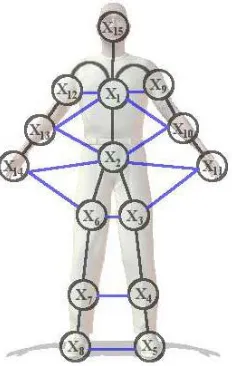
at each image frame. Each node in the graphical model represents the 3D position
and orientation of a limb in Figure 2.3. Undirected edges between nodes represent
statistical dependencies and these constraints between limbs are used to form
mes-sages that are sent to neighbouring nodes in space and time. Additionally, each node
has an associated likelihood defined over a set of image features. The combination of
highly non-Gaussian likelihoods and a six-dimensional continuous parameter space
(3D position and orientation) for each limb makes standard belief propagation
algo-rithms infeasible. Conditional probabilities relating the 3D pose of connected limbs
are learned from motion captured training data. Similarly, probabilistic models for
the temporal evolution of each limb (forward and backward in time) are also learned.
The human pose and motion estimation are then solved with non-parametric belief
propagation [Isard 2003; Sudderth et al. 2003] using a variation of the Particle Filter
that can be applied over a general loopy graph.
The main advantages in this approach are that the complexity of the search task is
linear rather than exponential in the number of body parts, and bottom-up limb and
head detection are integrated at every frame allowing automatic initialisation and
re-covery from transient tracking failures. However, the loose-limbed representation has
difficulty in handling poses where one limb penetrates another. When self-occlusions
appear, multiple limbs may fit the same image region resulting in incorrect pose
esti-mations that poorly explain the overall image observations. Occlusion-sensitive local
global likelihood by accounting for occlusions and competing explanations of image
observations by multiple limbs. Since occlusion reasoning involves interactions
be-tween non-adjacent body parts which create loops in the graphical model structure
representing the body, a variant of approximate belief propagation (BP) that is able to
[image:32.612.221.337.231.414.2]infer the real-valued pose of the person in 2D was introduced.
Figure 2.3: Graphic model of the articulated human structure: Nodes represent limbs and arrows represent statistical dependencies between limbs. Black and blue edges correspond to kinematic and interpenetration constraints, respectively. (courtesy of [Sigal 2008])
2.2
Learning Based Approach
In this section, we review several learning based methods in markerless motion
cap-ture, including the relevance vector machine, Gaussian process dynamical models and
dimensionality reduction techniques to identify low dimensional representations.
2.2.1 Tracking by Regression
[Agarwal and Triggs 2006; Agarwal and Triggs 2004a; Agarwal and Triggs 2004b]
take a learning-based approach to attack markerless motion capture in the
§2.2 Learning Based Approach 23
3D poses and corresponding images into a compact model that has good
generalisa-tion to unseen examples. They use a bottom-up approach in which the underlying
pose is predicted directly from a feature-based image representation, without directly
modelling the generative process of image formation from the body configuration.
The method is purely data-driven and does not make use of any explicit human body
model or prior labelling of body parts in the image. The pose and observed image
are represented by the vectors y andx, respectively. Given the high dimensionality
and intrinsic ambiguity of the monocular pose estimation problem, the active
selec-tion of appropriate image features is critical for success. They use the training images
to learn suitable image representations specific to capturing human body shape and
appearance. Two kinds of representation have been employed. 1) When the
silhou-ette is available, the silhousilhou-ette is encoded in terms of the distribution of its softly
vector quantised local shape context descriptors [Belongie et al. 2002], with the vector
quantisation centres being learned from a representative set of human body shapes.
This transforms each silhouette to a point in a 100D space of characteristic
silhou-ette shapes. Such an encoding allows 3D body pose to be recovered by using direct
regression on the descriptors. 2) When the silhouette is not available, the observed
im-age is used to directly compute histograms of gradient orientations on local patches
densely over the entire image (using the SIFT and HOG descriptors). These are then
re-encoded to suppress the contributions of background clutter using a basis learned
using Non-negative Matrix Factorisation [Lee and Seung 1999] on training data.
The pose recovery problem reduces to estimating the pose from the vectorial
im-age representation. Given a set of labelledntraining examples(x,y), the Relevance
Vector Machine [Tipping 2001] is used to learn a smooth reconstruction functiony=
r(ˇy,x), valid over the region spanned by the training points. This function directly encodes the inverse mapping from image to body pose. The forward mapping from
body pose to image observations can be more easily explained by projecting a human
combina-tionr(x) = ∑kαkϕk(ˇy,x)of a presanctified set of scalar basis functions{ϕk(ˇy,x)|k =
1...p}, where,αkdenotes the weight vectors. They are damped to control over-fitting, and sparse in the sense that many of them are zero. Sparsity is ensured by the use of
the Relevance Vector Machine that actively selects the most “relevant” basis functions.
At each time stept, a state estimate ˇyis obtained from the previous two pose vectors using an autoregressive dynamical model. Incorporating this preliminary pose
esti-mate ˇyto the regression model helps to maintain temporal continuity and to
disam-biguate pose in cases where there are several possible reconstructions.
2.2.2 Gaussian Process Dynamical Model
The prior dynamic model of pose and motion plays a central role in 3D monocular
hu-man tracking. It can resolve problems caused by ambiguities, occlusions, and image
measurement noise. Effective models for human tracking can be learned using the
Gaussian Process Dynamical Model (GPDM) [Wang et al. 2006], even when modest
amounts of training data are available. The GPDM is a latent variable model with a
nonlinear probabilistic mapping from latent positionsxto human posesy, and a
non-linear dynamic mapping on the latent space. It provides a continuous density function
over poses and motions that is generally non-Gaussian and multimodal. Given
train-ing sequences, one simultaneously learns the latent embeddtrain-ing, the latent dynamics,
and the pose reconstruction mapping. With Bayesian model averaging a GPDM can
be learned from relatively small amounts of data, and it generalises gracefully to
mo-tions outside the training set. [Urtasun et al. 2006a] proposed a balanced GPDM for
learning smooth models from training motions with stylistic diversity, and showed
that they are effective for monocular human tracking. Therefore, the tracking problem
is formulated as a MAP estimator on short pose sequences in a sliding temporal
win-dow. Estimates are obtained with deterministic optimisation, and look remarkably
§2.2 Learning Based Approach 25
In the line of GPDM, [Ek et al. 2008] takes a learning based approach where it
models both silhouette observations, joint angles and their dynamics as generative
models from shared low dimensional latent representations using the Gaussian
Pro-cess Latent Variable Model [Lawrence 2005]. Each image is background subtracted to
get its silhouette. As in [Agarwal and Triggs 2006] each silhouette is represented using
shape context histograms [Belongie et al. 2002]. Each contour is subsampled with one
pixel spacing, acquiring about 100 - 150 histograms for each image. To reduce
dimen-sionality of the descriptor and remove the effects of ordering, they vector-quantise the
histograms using K-means clustering, resulting in a 100D silhouette descriptor.
Gen-erative methods model the space of silhouettes as a function of pose. This correctly
reflects the structure of the problem as each silhouette could have been generated by
several different poses but each pose can only generate one single silhouette.
Learn-ing a low-dimensional representation of the pose is not required, so it is not necessary
to fall-back on approximative methods for solving the inverse of this generative
map-ping. Therefore the latent representation reflects the dynamics of the data and can
predict poses over time in a simple manner. The model requires no manual
initialisa-tion when predicting sequential data but automatically initialises from training data.
Wang et al’s approach [Wang et al. 2008] is also inspired by the Gaussian process
latent variable model [Lawrence 2005]. The GPLVM models the joint distribution of
the observed data and their corresponding representation in a low-dimensional latent
space. It is not, however, a dynamical model; rather, it assumes that data are
gen-erated independently, ignoring temporal structure of the input. Here the GPLVM is
augmented with a latent dynamical model, which gives a closed-form expression for
the joint distribution of the observed sequences and their latent space representations.
The incorporation of dynamics not only enables predictions to be made about future
data, but also helps to regularise the latent space for modelling temporal data in
gen-eral. The unknowns in the GPDM consist of latent trajectories and hyperparameters.
the models tend to make good predictions. Initially a maximum a posteriori (MAP)
algorithm is introduced for estimating all unknowns. To learn smoother models, three
alternative learning algorithms are used, namely, the balanced GPDM [Urtasun et al.
2006a], manually specifying hyperparameters, and a two-stage MAP approach. These
algorithms present trade-offs in efficiency, synthesis quality, and generalisability.
2.2.3 Dimensionality Reduction and Manifold Learning on Visual Track-ing
Human motion capture involves searching in high dimensional space (often more
than 30 dimensions). Unavoidably, it suffers from the “curse of dimensionality”. That
is, the computational complexity of searching the entire space increases exponentially
as a function of dimensionality. One possible way to deal with the “curse of
dimen-sionality” is to carefully design algorithms to explore the solution in a sensible and
efficient way. An alternative way is by decreasing the dimensionality of the original
problem and solving the problem in a lower dimension space. The class of these
ap-proaches is often referred to as dimensionality reduction. Dimensionality reduction is
constructed on the premise that many high dimensional problems have a considerable
amount of redundancy and irrelevance to the solution, with only a portion of
infor-mation crucial for the solution. In fact, lower dimensional variables are often most
necessary to present and describe the intrinsic information of problems. These lower
dimensional variables are usually called latent or hidden variables. Latent variables
usually can be figured out by mapping original data from high dimensional space to
low dimensional space via some function. Mathematically, wherexi ∈ Rddenotes la-tent variables,yi ∈ RD (i= 1...N)denotes the original data in the observation space, there is some function f such that:
§2.2 Learning Based Approach 27
where,σi is random noise, and Θ are parameters of the function f. The objective is
to estimate the appropriate parameters Θ. This resembles the canonical parametric
regression framework.
Despite the high dimensionality of pose configuration space, many human
activi-ties lie intrinsically on low dimensional manifolds. Exploiting this property is
essen-tial to reveal the high degree of correlation in human motion and constrain the
solu-tion space for tracking and posture estimasolu-tion. There are many studies [Tangkuampien
and Suter 2006; Lee 2007; Elgammal and Lee 2009] that show interest in learning low
dimensional representations of the pose configuration manifolds.
[Tangkuampien and Suter 2006] proposed an efficient technique based on kernel
principal component analysis (KPCA) [Bernhard et al. 1999], which is defined for
out-of-sample points. KPCA is used to learn two feature space representations, which are
derived from the synthetic silhouettes and relative skeleton joint positions of a single
generic human mesh model. After training, novel silhouettes of previously unseen
actors (and of unseen poses) are projected through the two manifolds using Locally
Linear Embedding [Roweis and Saul 2000] reconstruction. The captured pose is then
determined by calculating the pre-image [Scholkopf et al. 1998] of the projected
sil-houettes. An inherent advantage of KPCA is its ability to de-noise input images
be-fore processing, as shown in [Bernhard et al. 1999] with images of handwritten
char-acters. There is, however, no previous work on the de-noising of human silhouettes
for human motion capture using the KPCA projection. This novel concept allows the
inference of relatively accurate poses from noisy unseen silhouettes by using only one
synthetic human training model. A limitation of this approach is that silhouette data
will be projected onto the subspace spanned by the training pose, hence restricting the
output to within this subspace.
Lee et al [Lee 2007] proposed an approach to model the visual manifold of an
generative. However, it generates observations for a certain motion as observed from
different view points without any explicit 3D body model. Rather, this is achieved
through modelling the visual manifold corresponding to different postures and views.
An embedding of the kinematics and the motion manifold invariant to the view are
acquired by using joint angles data. Then a parameterisation of the motion manifold
in the embedding space and the dynamics are obtained through learning a flow field.
Given view-based observations, view-based nonlinear mapping functions from the
kinematic manifold embedding space to the observations in each of the views are
con-structed. The view factor can then be factorised using high order singular value
de-composition [Lathauwer et al. 2000] according to the coefficients of view based
func-tions, arranged as a tensor. With the view factor, the view manifold can be explicitly
modelled in coefficient space, which leads to a representation of the view manifold
invariant to pose configuration. Meanwhile individuals’ shape variabilities are
fac-torised within the same model. This results in two low-dimensional embeddings for
the pose configuration and the view, as well as a generative model that can generate
observations given the two manifolds’ parameterisations. This fits perfectly into the
Bayesian tracking framework as it provides: 1) a low dimensional state representation
for each of the view and pose configurations, 2) a constrained dynamic model since
the manifolds are modelled explicitly, and 3) an observation model, which comes
di-rectly from the generative model used.
Elgammal et al [Elgammal and Lee 2009] considered motion observed from a
cam-era (stationary or moving), with motion representation as a kinematic sequence
com-ing from a sequence of observations. With an accurate 3D body model, camera
cali-bration, and geometric transformation information, they can explainYas a projection of an articulated model. The dynamic kinematic sequence lies on a manifold called
the kinematic manifold, and the observations lie on a manifold labelled the visual
manifold. In fact, observations lie on a product of the body configuration and view
mani-§2.3 Graph Based Image Segmentation and Tracking 29
fold can be regarded as a graphical model connecting the two manifolds through two
latent variables: a body configuration variable and a view point variable. The body
configuration variable is shared between both the kinematic manifold and the visual
manifold. The view point variable represents the relative camera location to a human
centred coordinate system. Another variable affecting the observation is the shape
variability among different subjects, i.e. the human shape space, or the shape style.
Their method is able to relate the kinematic manifold with the visual input manifold
in order to infer configuration from input, while also modelling the visual manifold
with all its variabilities due to motion, view point, and shape style. In particular, it can
deal with both body configuration and view points as continuous variables. This
fa-cilitates tracking subjects with varying view points due to camera motion or changing
subject view with respect to the camera.
This view variant human motion tracking is formulated as tracking on a torus
sur-face. The torus is used as a state space for both pose configuration and view. The torus
is deformed to the actual visual manifold and to the kinematic manifold through two
nonlinear mapping functions. The torus model is suitable for one dimensional
man-ifold motions, whether periodic, such as walking and running, or non periodic, for
example golf swings or jumping. The experimental results showed that this model
is superior to other representations for the task of tracking and pose/view recovery
since it provides a low dimensional, continuous, uniformly spaced state
representa-tion.
2.3
Graph Based Image Segmentation and Tracking
The performance of silhouette-based human motion capture is heavily affected by
the results of image segmentation. When low colour contrast between the
back-ground and foreback-ground is present, the backback-ground and foreback-ground colour histograms
conse-quence, noticeable artifacts appear in the image segmentation. This often causes a
multimodal landscape and corrupted global optimum in the observation likelihood
function. Thus, many wrong poses may be considered equally likely to be the good
pose. Ultimately, inaccurate image segmentation can lead to a high chance of
mis-tracking or even complete failure of mis-tracking. Fortunately, human motion capture has
a strong temporal correlation, i.e., that activity is continuous over time. It is therefore
wise to analyse human motion capture by accounting for temporal information. A
natural research direction would utilise historical information to help with image
seg-mentation. These kinds of methods would be beneficial at least from two standpoints.
Firstly, the previous pose estimation suggests a reasonably good initial human body
position and human body shape. This means current image segmentation should be
temporally consistent with the previous pose estimation. If the sampling rate (the
frame rate) is high, the temporal correlation is very strong and useful. Furthermore,
more accurate image segmentation, and therefore improved pose estimation, results
in better image segmentation for the next frame. These kinds of recursively
temporal-dependent relationships have been addressed by Bray et al [Bray et al. 2006; Kohli
et al. 2008]. Their method incorporates the historical pose as a prior in the dynamic
graph cut [Kohli and Torr 2007] to improve image segmentation, and uses improved
image segmentation to help the current pose estimation.
There are various ways to segment the image. The graph based approach has
shown to be a powerful framework which provides a general formalisation based
on graph theory, and a probabilistic construction based on Markov Random Field.
This allows many discrete combinatorial optimisation schemes to be used for solving
![Figure 1.1: Multimodality in the two dimensional Ackley function [Ackley 1987]](https://thumb-us.123doks.com/thumbv2/123dok_us/8116317.238287/15.612.217.428.137.339/figure-multimodality-dimensional-ackley-function-ackley.webp)
![Figure 2.1: Sampling space (courtesy of [Sminchisescu and Triggs 2003])](https://thumb-us.123doks.com/thumbv2/123dok_us/8116317.238287/22.612.186.365.186.353/figure-sampling-space-courtesy-sminchisescu-triggs.webp)