Information
Paul Wong
A thesis submitted for the degree of
Doctor of Philosophy at
The Australian National University
My undying gratitude goes to all those who helped me along the way – members of my committee, Dr. John Slaney, Dr. Rajeev Gore, Professor John Lloyd, and Pro-fessor Robert Meyer for their wise advice and for providing me with the intellectual freedom to explore my own ideas, Dr. Philippe Besnard for his patience and willing-ness to listen to my absurd ideas and co-authorship of papers (and thereby assisting me in acquiring my first Erd ¨os number). I am also indebted to Professor Ray Jen-nings and Professor Peter Schotch for their inspiration, and to Professor Peter Appos-toli and Professor Bryson Brown for their elegant proof of the completeness ofKn. I have also benefited from conversations with Professor Graham Priest, Professor Chris Mortensen, Professor Dov Gabbay and Professor John Wood about all things inconsis-tent. My examiners, Dr. Anthony Hunter, Professor Greg Restall and Dr. Edwin Mares also deserve special thanks for their careful and generous comments.
My thanks also go to Dr. Timothy Surendonk and Dr. Glenn Moy for their friend-ship and assistance in settling into Canberra initially. I am also thankful to my logic siblings David Low and Dr. Ng Ping Wong from ‘up above’ and Nicolette Bonnette, Kalhil Hodgson, and Dr. Andrew Slater from ‘down under’. Nicholas and Chwee Chwee von Sanden offered their generous friendship while I was an apprentice lec-turer at the University of Wollongong during the academic year of 2002-2003. Thanks also go to other CSL suspects especially Dr. Jen Davoren for her encouragement and cool hair parties, Dr. Matthias Fuchs for being the impeccable lunch police and for his great passes during soccer, Dr. Doug Aberdeen for starting the construction of the Coke Castle (and thereby provided the motivation for the exponential consumption of cokes in the lab), Dr. Arthur Gretton for starting the Star Wars collectors’ card com-petition. I thank all the CSL students who provided endless hours of amusement, laughter, and excuses for procrastination – Evan, Edward, Kee Siong, Cheng, Agnes, Phil, Dave, Kerry, Vaughan, Pietro, Charles, Greg, David, Jemma and Tatiana.
I would like to thank the Commonwealth of Australia for providing an IPRS Schol-arship and the Australian National University for providing an ANU scholSchol-arship.
that the class of all such propositions is empty. The Eastern point of view is that this class is empty if and only if it isn’t.
In this thesis we are concerned with developing formal and representational mech-anisms for reasoning with inconsistent information. Strictly speaking there are two conceptually distinct senses in which we are interested in reasoning with inconsis-tent information. In one sense, we are interested in using logical deduction to draw inferences in a symbolic system. More specifically, we are interested in mechanisms that can continue to perform deduction in a reasonable manner despite the threat of inconsistencies as a direct result of errors or misrepresentations. So in this sense we are interested in inconsistency-tolerant or paraconsistent deduction.
However, not every case of inconsistent description is a case of misrepresentation. In many practical situations, logically inconsistent descriptions may be deployed as representations for problems that are inherently conflicting. The issue of error or mis-representation is irrelevant in these cases. Rather the main concern in these cases is to provide meaningful analyses of the underlying structure and properties of our logi-cal representation which in turn informs us about the salient features of the problem under consideration. So in this second sense, we are interested in deploying logic as a
representationto model situations involving conflict.
In this thesis we adopt a novel framework to unify both logic-as-deduction and logic-as-representation approaches to reasoning with inconsistent information. From apreservationalview point, we take deduction as a process by which metalogical prop-erties are preserved from premises to conclusions. Thus methodologically we may be-gin by identifying inconsistency-tolerant deduction mechanisms and then investigate what additional properties of inconsistent premises are preserved by these mecha-nisms; or alternatively we may begin by identifying properties of inconsistent logical descriptions and investigate which deductive mechanisms can preserve these proper-ties. We view these as two aspects of the same investigation. A key assumption in this work is that adequate analyses of inconsistencies require provisions to quantitatively measure and compare inconsistent logical representations. While paraconsistent log-ics have enjoyed considerable success in recent years, proper quantitative analysis of inconsistencies seems to have lapsed behind to some extent. In this thesis we’ll ex-plore different ways in which we can compare and measure inconsistencies. We hope
Acknowledgements vii
Abstract xi
1 Introduction 1
1.1 Motivation . . . 1
1.2 Two Approaches to Inconsistencies . . . 3
1.3 Symbolic and Numeric Approaches to Uncertainty . . . 6
1.4 Preservation and Measuring Inconsistent Information . . . 7
1.5 Representation of Inconsistent Information . . . 12
1.6 Overview . . . 13
1.7 Notation . . . 14
2 Paraconsistent Inference and Preservation 17 2.1 Introduction . . . 17
2.2 Paraconsistent Inferences . . . 18
2.3 Some Structural Properties . . . 26
2.4 Properties of Sets . . . 28
2.4.1 Level of Incoherence . . . 28
2.4.2 Quantity of Empirical Information . . . 29
2.5 Σ-Forced Consequence . . . 32
2.6 Preservation . . . 33
2.6.1 Maximality . . . 39
2.6.2 Special Conditions . . . 39
2.6.3 Combining Inference Mechanisms . . . 40
2.7 Conclusion . . . 41
3 Rescher-Mechanism 43 3.1 Introduction . . . 43
3.2 Connection With Default Reasoning . . . 44
3.3 Belnap’s Conjunctive Containment . . . 52
3.3.1 Maximal Equivalent Extension . . . 61
3.4 An Improvement to Belnap’s Strategy . . . 62
3.4.1 Logic Minimisation . . . 66
3.4.2 Algorithmic Considerations . . . 75
3.4.2.1 PRIvia ClassicalPIGeneration . . . 76
3.4.2.2 Semantic Graphs . . . 78
3.5 Conclusion . . . 85
4 Uncertainties and Inconsistencies 87 4.1 Introduction . . . 87
4.2 Probabilities over Possible Worlds . . . 88
4.3 BoundedUSATand Inconsistencies . . . 90
4.4 Geometric Rendering of Inconsistencies . . . 93
4.5 Multiple Inconsistencies . . . 97
4.6 Uncertain Inference . . . 104
4.7 Bounded Reasoning in Natural Deduction . . . 111
4.8 Conclusion . . . 119
5 QCLogic 121 5.1 Introduction . . . 121
5.2 Paraconsistent Logics . . . 121
5.3 Information Measurement . . . 129
5.3.1 Inconsistent Information . . . 130
5.4 QC Logic and Information Measure . . . 132
5.5 The Number of Q-Models . . . 134
5.6 Application . . . 138
5.6.1 Constraint Satisfaction Problems . . . 138
5.6.2 Over-constrained Problems . . . 139
5.7 Conclusion . . . 140
6 Modalized Inconsistencies 141 6.1 Introduction . . . 141
6.2 Logical Preliminaries . . . 146
6.2.1 Syntax . . . 146
6.2.2 Models . . . 146
6.4 Completeness ofn-Forcing . . . 154
6.5 Completeness ofKmn . . . 154
6.6 Further Work . . . 157
7 Hypergraph Satisfiability 159 7.1 Introduction . . . 159
7.2 n-satisfiability on Hypergraphs . . . 162
7.3 Resolution andn-satisfiability . . . 166
7.4 n-Consequence Relations . . . 168
7.5 BPIand Complexity Theory . . . 172
8 Conclusion 175
A Dunn’s Ambi-Valuation Semantics 181
B The Pair Extension Lemma in Analytic Implicational Logics 185
C List of Publications 191
Introduction
1.1
Motivation
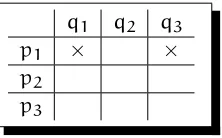
It is customary nowadays to begin a thesis with some remarks about the motivation behind the work. This is typically done with the aid of an example. This thesis is no exception. We shall begin with the following imaginary scenario which we shall call the information fusion problem. Consider a situation in which an objectOmay be located in one out of nine distinct possible locations represented by a3×3 grid. Information about the location of O is encoded in a simple propositional language with p’s representing the rows and q’s representing the columns (see figure (1.1)). Furthermore, complex expressions are generated using the usual Boolean connectives {¬,∧,∨}with their usual truth conditions. We are interested in locatingO, and infor-mation is gathered from various sensors or sources about the location ofO.
q1 q2 q3
p1 × ×
[image:17.612.263.374.521.590.2]p2 p3
Figure 1.1: A simple logical representation of an object’s location.
Suppose we receive two messages:
A:p1 B:¬q2
From the received messages we conclude that the possible location ofOis:
C: (p1∧q1)∨(p1∧q3)
Our example highlights several important methodological points. The first is the obvious point that information about the state of the world can be encapsulated in a formal language. The practical corollary of this is that more expressive formal lan-guages are required for more demanding representational tasks. But more impor-tantly, since a more expressive language may involve a greater computational cost, the choice of language should be gauged in terms of the representational task at is-sue. In our example it is clear that a simple propositional language suffices for the representational task.
The second point is that contextual information is often crucial to a reasoning task. In our example, the background information is that the objectOis located in exactly one and no more then one location, and that there are exactly nine possible locations of O. It is only in the context of this background information that we can deduceC from A andB. More importantly, background information is not always explicitly stated in a given situation.
Thirdly, our example illustrates how the process of reasoning can be viewed as exploration in the space of possibilities – eliminating some and further exploring oth-ers. Our symbolic representationsAandBimpose certain restrictions on the space of possibilities. These expressions havetruth conditionswhich inform us that the world is one way but not another. Furthermore, this information is compositional in the sense that the aggregate ofAandBis simply the aggregate of their restrictions on the space of possibilities. The conclusionCis simply what is possible relative to the restrictions imposed byAandBtogether with the background information.
Finally, our example also illustrates the role and importance ofuncertaintiesin rea-soning. If we want to know whetherOis located atp1∧q1, the information given is
insufficientto answer our question. In this sense, the given information is incomplete with respect to our query. Now just as it is possible that we may have incomplete information, it is equally possible that we may havetoo muchinformation – we may receive a third message:
D:p3
1.2
Two Approaches to Inconsistencies
As the title suggests, the purpose of this thesis is to examine and develop formal and representational mechanisms for reasoning with inconsistent information. Strictly speaking there are at least two conceptually distinct senses in which we are interested in reasoning with inconsistent information. In one sense, we are interested in using logical deduction to draw inferences in a symbolic system. This is the traditional ap-proach to AI where a logic is used to perform deduction over a logical description or aknowledge baserepresenting various states of the environment external to the sys-tem. But we are interested in more then that. As we have illustrated with the problem of information fusion, we are interested in mechanisms that can continue to perform deduction in areasonablemanner despite the threat of inconsistencies. In these cases, our logical descriptions are inconsistent essentially because they have misrepresented the external environment. So in this sense our deduction must be fault tolerant – it must operate under the explicit assumption that the input data may be erroneous or unreliable. However, not every case of inconsistent description is a case of misrepre-sentation. Consider for instance,
• negotiation amongst agents with conflicting goals, e.g. selling at the highest price vs buying at the lowest price
• constitutions or legal documents in which incompatible rules apply to the same situation, e.g. you must obey the speed limit vs you must maintain a speed that is consistent with the other traffic
• software requirements engineering process in which different stake-holders have different and incompatible requirements, e.g. ease of use vs advanced fea-tures
• faulty artifacts and systems in which expected behaviours diverge from their observed behaviours, e.g. brake lights should be on when braking occurs vs no brake lights when braking
• constraint satisfaction problems that are over-determined, e.g. no one should work more then 8 hours in any given work day vs there is a shortage of staff to cover all work days
need not be any misrepresentation involved. The main issue in these cases is not fault tolerant deduction per se but an analysis of the structure and the underlying prop-erties of our logical representation which in turn informs us about the nature of the situation or problem under consideration. Of course to provide such an analysis, our logical description must capture the salient features of the problemat some appropriate level of abstraction. But this is very much a question of the representational efficacy of the formal language and not so much a question about deduction. So in another sense, we are interested in deploying logic as arepresentationto model situations and problems involving conflict.
In terms of using a formal language to model real world problems, there is a subtle question as to whether inconsistency in the strictly logical (proof theoretic or model theoretic) sense is the right formalism for modelling conflicts. Conceivably, we can deploy a very different formalism to represent these problems so that the resulting representation is no longer inconsistent in the strictly logical sense. But to do so is to miss an important point. What makes an over-constrained scheduling problem interesting and difficult is precisely that the real world cannot meet its demands. A change in formalism may allow us to find hidden structures of the problem more easily or to perform computation over the representation more efficiently, but this by itself would not resolve the underlying conflict. There is a genuine sense in which the salient feature of conflict is captured in terms of logical inconsistency.
So a map of our conceptual space should include at least two distinct senses of ‘reasoning with inconsistent information’:
Inconsistency Inconsistency as error as conflict Logical deduction as inference √
Logical description as representation √
Figure 1.2: Reasoning with inconsistent information: a conceptual map
should provide support for drawing inferences from inconsistent and erroneous data. But viewed as a modeller of problems our analyst should provide support for ex-tracting useful information and patterns from data that represent situations involving conflicts. The overall architecture of such a hybrid system is depicted in figure (1.3).
[image:21.612.132.503.192.351.2]analyst inconsistent description conclusions queries prover -? ? 6 *
Figure 1.3: A hybrid symbolic system for handling inconsistent information
Indeed, the idea of such a hybrid system is not new. In [172; 173], Slaney and co-workers have proposed and implemented the systemSCOTT(Semantically Con-strainedOTTER) and more recentlyMSCOTT(Multi-SCOTT) which combines the first-order resolution prover OTTER with the finite model generator FINDER (Fi-nite Domain Enumerator). For our purposes here, we need not be concerned about the detailed workings ofSCOTT. Figure (1.3) doesn’t in fact capture the structure of SCOTT– for instance,FINDERandOTTERdo not communicate directly with each other. The main point is that SCOTTis a system that combines both reasoning and modelling to accomplish its task. The overall philosophy behindSCOTT is to inject some intelligence into a prover by providing semantic information to assist in proof search.
the system may includeempiricalinformation of various sorts. Secondly, our hybrid system is also practical in the sense that it is goal directed. The goal of the system may be specified by its immediate user, or alternatively the system may operate as a component of a larger complex system. In either case, what our hybrid system does with its knowledge base depends on what the user or the rest of the system wants. This view of our hybrid system is of course more open-ended. But it does capture both senses of reasoning with inconsistent information within the framework of a sin-gle system. As a fault tolerant reasoning system for handling information fusion, the emphasis is perhaps on deduction where the role of the analyst is to assist the prover. But as a modelling system for representing problems or situations, the emphasis is perhaps on analysis where the role of the prover is to assist the analyst. In this thesis, our aim is to explore the theoretical foundation for such a system. In particular we would like to offer a novel theoretical underpinning of the interaction between the analyst and the prover. We would like to consider how inference and analysis can fruitfully be brought to bear on the issue of inconsistency handling under one and the same conceptual scheme.
1.3
Symbolic and Numeric Approaches to Uncertainty
that are based on complete ordering, e.g. fuzzy set theory and its offspring possibility theory, as well as approaches that are based on counting, e.g. statistical or probabilis-tic methods (for a review see chapter 1 and 2 of [95]). In this thesis we would like to consider the symbolic and numeric approaches to inconsistency within the gen-eral framework of our hybrid symbolic system. Indeed, a main assumption behind this thesis is that these two approaches should not be viewed as competing strate-gies for managing inconsistency. On the one hand, there is no doubt that we need to develop inference mechanisms that can perform deduction in a principled way in an environment in which inconsistencies may arise. The underlying assumption is that on occasions it may be desirable totoleratethe presence of inconsistencies rather than
revising one’s data. This is especially important in situations in which the turn-over rate of information is much higher than the rate at which consistency checks can be made. On the other hand, there is also a need to develop theoretical and conceptual tools to analyse inconsistencies. In some situations, it may be more desirable for a user to clearly identify data that are in conflict before any decision or action is taken. Perhaps the inconsistencies have no bearing on the overall objective of the user, e.g. it is unlikely that an inconsistent description of the colour of the seats in an aircraft is relevant to the overall safety of the aircraft. Even in cases where corrective measures must be taken toward inconsistencies, it is unclear that a single action would suffice. In some cases, corrections must be performed gradually over time and there may be a need to provide a more quantitative way to monitor the progress of the repair.
1.4
Preservation and Measuring Inconsistent Information
Our main strategy for integrating the symbolic and numeric approaches, the logic as deduction and logic as representation views of knowledge representation, is to develop a very general methodology for comparing different inconsistency tolerant inference mechanisms quantitatively. This is a departure from standard methods for comparing inference mechanisms. Typically, comparisons between different inference mechanisms are drawn along the lines of
1. set theoretic relations (inclusion): we ask whether conclusions of one mechanism can be deduced by another mechanism for a given set of premises.
3. computational complexity: we ask whether one mechanism is computationally more expensive (space and time) than another mechanism.
Our strategy here is rather different. We would like to provide a novel and useful way to compare inference mechanisms in terms of various quantitative properties or measurements that can be preserved from a given set of premises to conclusions. We envision that a key role of the analyst in our hybrid system is to provide such quantitative analyses of the input data. The key issue here is the notion ofpreservation. In the standard account of inference, the validity of an inference is defined in terms of the preservation of truth relative to the class of standard two-valued models – in a valid inference it is not possible for the premises to be true while the conclusion is false. Truths are transmitted from premises to conclusions in valid inferences. But this account is unhelpful for inconsistent premises since, according the standard two-valued semantics, inconsistent premises cannot be true together. So for inconsistent premises, there is simply no truth to be preserved. For information that is uncertain, we need a more pragmatic approach to the notion of preservation. The general idea is that, apart from the standard semantic or model theoretic properties, there may well be other metalogical properties that are transmitted from premises to conclusions in an inference. Presumably some of these properties would be of interest to a user of the system, depending of course on the user’s overall objective. And on occasions, it may even be desirable to preserve these properties in an inference. So the role of the analyst here, at least in part, is to keep the user (and the prover) informed about the hidden structure and properties of the input data and perhaps to serve as an adviser for selecting the appropriate inference mechanism to preserve the properties of choice. Of course the requirement that an inference mechanism preserves more then truth in the standard models also implies that the mechanism, though sound, would not be complete with respect to standard valid inferences. Such a mechanism would in general preserve truth in the standard models but not all truth preserving inferences would be provable. The use of sound but incomplete as well as unsound but complete reasoning has already been investigated by Levesque in [119] from the point of view of computational complexity and Schaerf and Cadoli [162] from the point of view of approximate reasoning. But for us, the use of incomplete reasoning is an interesting
mechanisms would preserve different properties of different inconsistent premises. In this respect we have at least two options within which to proceed.
1. we can identify sound but incomplete provers and investigate which additional properties they can preserve (or fail to preserve).
2. we can identify properties of inconsistent logical descriptions and investigate which prover can preserve (or fail to preserve) these properties.
These two options are really two aspects of the same picture. Viewed more ab-stractly (see figure (1.4)), the preservational approach takes deduction to be an opera-tion,C, defined over a formal languageΦ, i.e. C:℘(Φ) −→ ℘(Φ). Given a (partially or totally) ordered set(S,≤), a metalogical property is simply a function from℘(Φ)to S, i.e. f: ℘(Φ) −→ S. From the preservational point of view, the crucial question is: given an arbitraryΓ ⊆Φ, what is the relation betweenf(C(Γ))andf(Γ)in terms of the ordering≤?
r ℘(Φ)
Γ r ℘(Φ)
C(Γ) r
S
f(C(Γ))
f(Γ)
-f
6
C
*
[image:25.612.150.484.390.576.2]f
Figure 1.4: An abstract view of Preservation
soundness ofLis captured by the inclusionf(Γ)⊆f(C(Γ)), whereas the completeness ofLis captured by the inclusion,f(C(Γ))⊆f(Γ).
This abstract view of preservation is extremely minimal. In figure (1.4), we make no assumption about the nature of the set S or the function f. But different f and S would in fact give us different ways to partition ℘(Φ). For each x ∈ S, the set f−1[x] = {Γ ⊆ Φ : f(Γ) = x} obviously forms an equivalence class. Similarly, this is true with respect to the deductive closureC. Since we are interested in both inference and analysis, we are interested in both deductive closuresCand functionsfthat can distinguish between different inconsistent sets. Moreover, since we want to provide quantitative ways to distinguish inconsistent sets, our interest is in those functionsf that range over different numerical setsS, e.g.Smay simply beN,[0, 1]or even[0, 1]n. To take one particular example from probabilistic inference, the uncertaintyof a propositionAis defined as by
U(A) = 1−P(A) (1.1)
In (1.1),P(A)is the probability thatAis true. It is a straightforward consequence of the Kolmogorov Axioms for probability that ifBis deducible fromAin classical propo-sitional or first order logics, thenU(B) ≤U(A), i.e. U(B) 6> U(A)given that≤is the usual total ordering on[0, 1]. In particular, this means that for any classical inference if we begin with a single premise with small uncertainty (high certainty), then any one of its conclusions can only have small uncertainty (high certainty). Conversely, the uncertainty of a conclusion is large only if the uncertainty of its (single) premise is large (see [3; 4] for more details). Accordingly, in the limiting case in which the uncertainty of a premiseAis zero,U(A) =0, then the uncertainty of its conclusionB must be zero,U(B) =0. Not surprisingly, this just is the classical notion of deductive validity.
the agents’ positions are represented by
Γ0 ={p1∧p2∧p3, ¬p1∧p2∧ ¬p3, p1∧ ¬p2∧ ¬p3}
In the second round the agents’ positions are represented by
Γ1 ={p1∧p2∧p3, ¬p1∧p2∧p3, p1∧ ¬p2∧p3}
Are there significant differences betweenΓ0 andΓ1? The answer is ‘no’ if we takeC to be the closure under deduction of classical logic andfto be the standard mapping of sets of formulae to their classical models. As far as classicalCand standardfare concerned,Γ0 andΓ1belong to the same equivalence class. But if we are interested in monitoring the progress of the negotiation, then the answer is a definite ‘yes’. Clearly in the second round of the negotiation the agents reach an agreement aboutp3 even though there is no general agreement aboutp1 orp2. The take home message of our example is this: even at a very simple propositional level different inconsistent logical descriptions are endowed with very different combinatorial structures and properties. An inference mechanism that fails to differentiate betweenΓ0 andΓ1 also fails to rec-ognize potentially important and useful information for the user. Thus in the design of an inference mechanism that can handle and tolerate inconsistencies, we need to pay attention to these underlying combinatorial structures and properties.
1.5
Representation of Inconsistent Information
What makes one quantitative analysis more fruitful and meaningful then another? There is no fast and easy answer to this question. The answer to the question is largely dependent on the underlying objective of the user in possession of the logical descrip-tion. But minimally, it would be desirable if the analysis can be reused across different representational formalisms. This would show that the properties so specified are in-variant under different formalisms, and hence that they are not just incidental features of a particular formalism. One way in which we can demonstrate this is to actually apply the concepts and analyses developed for one formalism to another. In this re-spect, there are two natural ways to proceed. Since inconsistencies often occur within
intensionallinguistic contexts involving various form of modalities, a natural way to extend the expressive power of a propositional language to introduce modal opera-tors for the corresponding doxastic, epistemic or deontic contexts.1 This gives us a
direct way to study inconsistency within a modal context. But doing so also raises an interesting issue about the choice of modal logics. The weakest modal logic adequate for Kripkean binary relational semantics is the logicK. Although inKwe can provide a binary relational model for{A, ¬A}, the following rule is derivable inKand any of its extension:
[ECQ] A ¬A
B
So in any binary relational model adequate for the logicK, any world which ver-ifies{A,¬A}would be a world which also verifiesBfor anyB. For the purpose of modelling intensionalized inconsistencies then, the standard modal logics and their corresponding Kripkean semantics seem to be out of place. How can we avoid the rule
[ECQ]? One possible option is to adopt modal logics that are strictly weaker thenK and to develop alternative semantics for these logics. In particular, we need a provide semantics for modeling{A,¬A}without also modellingBfor anyB. This is the approach taken by Fagin and Halpern [67], Jaspars [98], Massacci [127] and Rantala [148]. In this thesis, we’ll be looking at weaker modal logics for the representation of intensionalised inconsistencies.
While extending propositional language with modalities is one direction which we may take to explore representational issues of inconsistency, another direction is dia-grammatic reasoning systems where information is encoded not as a linear sequence of symbols but as two dimensional figures or diagrams. Indeed many forms of
sitional reasoning can be represented as graphs or hypergraphs. So it is natural for us to explore these formalisms for representing inconsistent information.
1.6
Overview
In chapter two, we’ll carry out the preservational approach to analyse various stan-dard inference mechanisms based on reasoning from consistent subsets. We’ll intro-duce various quantitative measurements for inconsistency and investigate the preser-vational properties of these mechanisms in light of these measurements.
In chapter three, we’ll highlight the well known connection between reasoning from maximal consistent subsets and the standard default reasoning developed by Reiter. The implication is that the kind of preservational analyses offered in chapter three have direct counterparts in default reasoning. We’ll also address a criticism offered by Belnap against reasoning based on maximal consistent subsets (and hence, indirectly against default reasoning). We’ll point out that Belnap’s own amendment does not in fact resolve the very difficulty he raised. We’ll propose an amendment to Belnap’s’ amendment.
In chapter four, we’ll look at the issue of preservation from the point of view of un-certaintiesthat are transmitted from premises to conclusions. As we have already seen in the single premise case the uncertainty of a classical conclusion is always bound by the uncertainty of the premise. But for a set of premises this is no longer true for classical logic. Although the uncertainty of each premise in a set may be small, the uncertainty of a conclusion may turn out to be prohibitively high. In this chapter, we’ll investigate uncertainty phenomena in light of inconsistency. This leads to some surprising results and conjectures.
In chapter five, we’ll introduce the paraconsistent logicQCdeveloped originally by Besnard and Hunter in [34; 91; 92]. We outline a particular strategy to use (half of) QC logic as an assistant to analyse inconsistent data. We’ll also consider using this strategy to study over-constrained problems.
10].
In chapter seven, we’ll look at a hypergraph representation of a covering theoretic measurement of inconsistency. We’ll develop a general notion ofn-satisfiability on hypergraphs and show that the compactness statement of n-satisfiability on hyper-graphs is equivalent toBPIin ZFset theory. We give a syntactic characterization of n-satisfiability on hypergraphs in terms of a resolution style proof procedure. A gen-eral notion of consequence relations based on hypergraphs will also be introduced. We’ll conclude with a discussion of a conjecture of Cowen relatingBPIand complex-ity theory.
Finally in chapter eight, we present the conclusions and directions for future work. For completeness, we have also included several appendices at the end.
1.7
Notation
In subsequent discussions we’ll assume the simplest logical language – propositional language – and examine various inconsistent tolerant formal mechanisms therein. We assume thatΦis a set of propositional formulae generated from propositional atoms or variables, {p1, q1, p2, q2, . . .}, with the usual boolean connectives, ¬,∧,∨,⊃. We use A, B, C, . . . , to denote formulae, >for any tautology, ⊥ for any contradiction, Γ, Σ, ∆, . . . , to denote sets of formulae, and A, B, . . . , to denote subsets of a set of formulae. From time to time we’ll use ‘Γ, ∆’ and ‘Γ ∪∆’ interchangeably especially if ∆is a singleton. We assume the equivalence betweenA⊃Band¬A∨B.
There are many extensionally equivalent ways to characterize classical logic. We give the standard Hilbert style axiomatic definition here. By adeductionofAfrom a (possibly infinite) setΓ, we mean a finite sequencehA1, . . . , Anisuch thatAn=Aand for eachi ≤ n, Ai is either an axiom, a member of the setΓ, or obtained by modus ponens from two previous formulaeAjandAk wherej < k < i. We use`to denote the classical deducibility relation and Cn(Γ) to denote{A ∈ Φ : Γ ` A}. A set of formulaeΓ is inconsistent ifΓ ` ⊥, otherwiseΓ is consistent. A theory T is a set of formulae that is closed under`, i.e.A∈ T iffT `A.
From time to time we’ll also make use of the fact thatCn is a compact Tarskian closure operator overΦ, i.e.Cnhas the following properties:
Inclusion Γ ⊆Cn(Γ)
Idempotence Cn(Cn(Γ)) =Cn(Γ)
Compactness Cn(Γ) =Φ =⇒ Cn(Γ0) =Φfor someΓ0 ⊆finΓ
As usual we’ll use the standard set theoretic abstraction notation{x|P(x)}for the set of objects that has the propertyP. Notations of operations and functions defined on sets are given in the usual way. Wherefandgare functions defined over the same sets, we usef−1 to denote the inverse of f, i.e. f−1 = {hy, xi : hx, yi ∈ f}. f◦g is the composition of g andf, i.e. for each x, f◦g(x) = g(f(x)). fA is the restriction
of fto A, i.e. fA = {hx, f(x)i : x ∈ A}. f[A]is the imageof A underf, i.e. f[A] =
{f(x) : x ∈A}. Note that inverse, composition, restriction and image need not apply only to functions, they can be defined for relations as well. We take aninjectionto be a1−1function, a surjectionto be an onto function, and abijectionto be an injective and surjective function. Acartesian productof AandB, denoted byA×B, is defined by settingA×B = {hx, yi|x ∈ A∧y ∈ B}. A binary relationRdefined onAis any subset of the cartesian productA×A(orA2). For readability we writexRyorRxyto denote hx, yi ∈ R. A binary relationRdefined onA isreflexiveif for all x ∈ A, xRx. R issymmetric if for all x, y ∈ A, xRy → yRx. R isantisymmetric if for allx, y ∈ A,
(xRy∧yRx) → x = y. Risconnectedif for allx, y ∈ A,x 6= y → (xRy∨yRx). Ris
transitiveif for allx, y, z∈ A,(xRy∧yRz) → xRz. A binary relation is anequivalence relationif it is reflexive, symmetric and transitive. A binary relation is apartial ordering
if it is reflexive, antisymmetric and transitive. A binary relation is atotal ordering or
linear orderingif it is connected partial ordering relation. Apartial ordering setorposet
is a pair hA,≤i where ≤is a partial ordering defined on A. A poset hA,≤i is well foundedif every nonempty subset ofAhas a≤-minimal element (equivalently there is no infinitely descending≤-chain). Atotal ordering setortosetis a pairhA,≤iwhere≤
Paraconsistent Inference and
Preservation
2.1
Introduction
Correct reasoning is usually characterised as patterns of inference which preserve truth. According to the standard view an inference is valid if it is impossible for its premises to be true but its conclusion false. While not incorrect, the standard view is unhelpful when we are confronted with inconsistent data. Since all inconsistent sets are unsatisfiable in the standard two-valued semantics, inferences licensed by classical logics become unprincipled in the presence of inconsistencies.
Many proposals and remedies are available to achieve inconsistency tolerant rea-soning. They include both semantic and syntactic approaches:
1. introduce additional truth values to alter the semantics [12; 21; 37; 138]
2. introduce additional semantic parameters such as nonstandard possible worlds, setups or situations to evaluate formulae [68; 155; 157]
3. introduce labels or annotations into the object language, typically attached to formulae, to represent inconsistencies [41; 108; 124]
Undoubtedly, many semantic and syntactic innovations are involved in these ap-proaches. In [99], Jenningset alhave proposed a more pragmatic account of reasoning according to which the aim of logic is to provide a theory of reasoning which speci-fies the procedures for preserving important metalinguistic properties of premise sets. Accordingly, a practical reasoning system provides procedures by which a set of sen-tences having some metalinguistic properties can be unfailingly extended to a larger set with the same properties.
From this preservation-theoretic framework we can articulate two strategies for studying reasoning: the first is the identification of important metalinguistic proper-ties of premises, and the second is the discovery of mechanisms that preserve these properties. Provisionally, no restriction is imposed on the kind of properties to be studied, except the properties in question must be strictly non-monotonic, i.e. not closed under supersets. Our main objective in this chapter is to carry out a program of research which takes the notion of preservation seriously and to give an analysis of various inconsistency tolerant reasoning strategies therein. Note that in stating our objective, we have implicitly endorsed a set theoretic presentation of premises and conclusions. But this assumption is inessential to the underlying methodologi-cal point. If premises and conclusions are modelled as different abstract data types, e.g. as multisets or lists, we can rephrase all our definitions accordingly. In any case, we are interested in inconsistency-tolerant inferences, whatever ways premises and conclusions are presented, and their preservational properties.
2.2
Paraconsistent Inferences
One common approach to handling inconsistencies resulting from information fusion from multiple sources is to fragment an inconsistent set into maximal consistent sub-sets and then extract conclusions by applying classical inference to these subsub-sets. This approach was first introduced by Rescher and Manor [152; 153; 154; 156] and more recently extended by Benferhatet al[25; 27; 26; 28; 29; 32; 33; 31; 30].
In this section we present similar but slightly more general inference mechanisms to extract conclusions from an inconsistent set. As we shall see in the next chapter, the inference strategies presented here are expressively equivalent to reasoning from maximal consistent subsets. In our framework, an inference is a ternary relation be-tween a premiss setΓ, a consistentconstraintsetΣand a conclusionA.
Definition 2.2.1
LetΓ be a premiss set andΣbe an arbitrary but fixed consistent set which we call a constraint set onΓ. Then a subsetAofΓisΣ-inconsistent iffA ∪Σis inconsistent, else AisΣ-consistent. A maximalΣ-consistent subset ofΓ is a subset ofΓ which has no properΣ-consistent extension.
some information may have higher priority than others or it may provide us with spe-cific knowledge of a domain. The role ofΣin definition (2.2.1) is to rule out data inΓ that isbadrelative toΣ. Intuitively, we may think ofΣas a set of secured or prioritized data, or even just a set of background beliefs of an agent at a given time. But more concretely, it is similar to the idea of integrity constraints in database theory where the known relationships between various data elements are specified. To illustrate, consider the following example:
Example 2.2.1
The following information about a particular individual is obtained through a ques-tionnaire:
marital status = married age = 1
In countries in which the legal age for marriage is 18, the above information is in-consistent.1 In such cases, we need to check our data against the following integrity
constraint:
marital status = married⊃age > 17
So the idea to view an inference as a ternary relation makes sense both theoretically and practically from the point of view of information processing. In many knowledge base and knowledge representation systems there are additional restrictions imposed on theknowledge base languageused to express information available inΓ, the integrity constraint Σ and the query language for expressing the inferred conclusion A. In a relational database for instance, Γ is a set ofnegation freepositive facts and integrity constraints inΣare negated closed formulae. In a deductive database,Γ can contain either positive facts or rules whose heads are atoms and bodies are literals. These restrictions not only provide a greater degree of control over inference in terms of what can be derived from what, but in some cases they are indispensable to reducing the complexity of inferences (see Wagner [179] for more discussion).
For our purpose, we’ll assume thatΣis an arbitrary but fixed constraint set. The set of all maximalΣ-consistent subsets ofΓ is denoted byMΣ(Γ). Given aΣ-inconsistent premiss set Γ, an elementA ∈ Γ is a Σ-witness if{A} isΣ-consistent, otherwiseAis a Σ-villain. We define the safe part ofΓ as, SΣ(Γ) = T
MΣ(Γ). We say that a subset
1In different counteries the integrity contraint may be different. As far as we know, no country
A ⊂ Γ is large iffA ∈ MΣ(Γ) and for eachB ∈ MΣ(Γ), |B| ≤ |A|. We useLΣ(Γ) to denote the set of all large subsets ofΓ. A subsetAofΓ is a minimallyΣ-inconsistent subset if it isΣ-inconsistent and no proper subset ofAisΣ-inconsistent. The set of all minimallyΣ-inconsistent subset ofΓis denoted byMIΣ(Γ). TheΣ-inconsistent part of Γ is defined by:
InΣ(Γ) =[MIΣ(Γ)
A set His ahitting set of a collection of sets,C = {Si : i ∈ I}, if for everyi ∈ I,
Si∩ H 6=∅. His aminimal hitting setif none of its proper subsets are hitting sets ofC. Given the notion of minimal hitting set,MΣ(Γ)andMIΣ(Γ)are interdefinable.
Proposition 2.2.1
LetΣbe an arbitrary but fixed constraint set andΓ be any premise set.
1. A ∈MΣ(Γ) ⇐⇒ Γ\Ais a minimal hitting set ofMIΣ(Γ).
2. B ∈MIΣ(Γ) ⇐⇒ Bis a minimal hitting set of{Γ \A: A ∈MΣ(Γ)}.
3. |MΣ(Γ)|≥max{|B| : B ∈MIΣ(Γ)}, moreover equality holds if|MIΣ(Γ)|=1.
4. |MIΣ(Γ)|≥max{|Γ\A|: A ∈MΣ(Γ)}, moreover equality holds if|MΣ(Γ)|=1.
Proof:
(1. ⇒) SupposeA ∈ MΣ(Γ)but Γ \Ais not a hitting set ofMIΣ(Γ). Then for some
B ∈MIΣ(Γ),(Γ \A)∩ B =∅. This implies thatB ⊆ Awhich is impossible given the Σ-consistency ofA. Hence,Γ \A must be a hitting set. Suppose thatΓ \A is not a minimal hitting set ofMIΣ(Γ), then there must be a proper supersetA0 ⊃ Asuch that Γ\A0is a hitting set ofMIΣ(Γ). SinceΓ\A0andA0 are disjoint,A0cannot contain any
B ∈MIΣ(Γ). This implies thatA0isΣ-consistent which contradicts the maximality of
A.
(1. ⇐) LetAbe an arbitrary but fixed subset ofΓ such thatΓ \Ais a minimal hitting set ofMIΣ(Γ). Then by the disjointness ofΓ andΓ\Afor noB ∈MIΣ(Γ)do we have
B ⊆ A. HenceAisΣ-consistent. Since every proper subset ofΓ\Ais not a hitting set ofMIΣ(Γ), every proper superset ofAmust contain someB ∈MIΣ(Γ). HenceAmust be maximallyΣ-consistent.
(2.⇒) Consider an arbitraryB ∈MIΣ(Γ). From (1) above, for everyA ∈MΣ(Γ),Γ\A
subsetB0 ⊂ Bsuch thatB0 is a hitting set of{Γ \A : A ∈MΣ(Γ)}. SinceΓ \AandA
are disjoint for everyA ∈ MΣ(Γ), for noA ∈ MΣ(Γ)do we haveB0 ⊆ A. But this is impossible sinceB ∈ MIΣ(Γ),B0 must beΣ-consistent. Hence,B must be a minimal hitting set.
(2. ⇐) LetB be a minimal hitting set of {Γ \ A : A ∈ MΣ(Γ)}. Suppose thatB is Σ-consistent. Then for someA0 ∈MΣ(Γ),B ⊆ A0. This implies thatB ∩(Γ\A0) =∅
which is impossible sinceBis a hitting set of{Γ \A: A ∈MΣ(Γ)}. Hence,Bmust be Σ-inconsistent. Suppose thatBis not minimallyΣ-inconsistent. Then there must be a proper subsetB0 ⊂ Bwhich is minimallyΣ-inconsistent. From (2. ⇒) above,B0 is a minimal hitting set of{Γ \A: A ∈MΣ(Γ)}. This contradicts the assumption thatBis a minimal hitting set.
(3)IfBis the largest minimalΣ-inconsistent subset ofΓ, then for eachB ∈ B,B\ {B} isΣ-consistent. There are exactly|B|many such sets. Hence there are at least|B|many maximal Σ-consistent subsets of Γ. Clearly |MΣ(Γ)| = |B| if B is the only minimal Σ-inconsistent subset.
(4)From (1) ifA ∈MΣ(Γ), thenΓ \Ais a minimal hitting set ofMIΣ(Γ). So ifΓ\Ais the largest such set, then there are at least|Γ\A|many minimalΣ-inconsistent subsets ofΓ since(Γ \A)∩ B 6= ∅for each distinctB ∈ MIΣ(Γ). Clearly in the event thatAis the only maximalΣ-consistent subset ofΓ, we have|MIΣ(Γ)|=|Γ \A|.
We now define the following notions of consequence in terms of MΣ(Γ). Given proposition (2.2.1), each of the following consequences can be defined in terms of MIΣ(Γ)as well.
Definition 2.2.2
Σ-universal-consequence A∈CUΣ(Γ)iff for eachA ∈MΣ(Γ),A `A
Σ-existential-consequence A∈CEΣ(Γ)iff for someA ∈MΣ(Γ),A `A
Σ-argued-consequence A ∈ CAΣ(Γ)iff there exists someAi ∈ MΣ(Γ) with Ai ` A
and for everyAj ∈MΣ(Γ),Aj 6`¬A.
Σ-safe-consequence A∈CSΣ(Γ)iffSΣ(Γ)`A
Σ-large-consequence A∈CLΣ(Γ)iffA `Afor eachA ∈LΣ(Γ).
consequence of our definitions. Proposition 2.2.2
LetΣbe an arbitrary but fixed constraint set onΓwhereMΣ(Γ)6=∅,
1. SΣ(Γ) =Γ \InΣ(Γ)
2. CSΣ(Γ)⊆CUΣ(Γ)⊆CAΣ(Γ)⊆CEΣ(Γ)
3. CSΣ(Γ)⊆CUΣ(Γ)⊆CLΣ(Γ)⊆CEΣ(Γ)
Proof:
(1)SΣ(Γ) ⊆Γ \InΣ(Γ): LetA∈ SΣ(Γ). ThenA ∈ T
MΣ(Γ). Suppose to the contrary thatA∈InΣ(Γ). Then there must be someB0 ∈MIΣ(Γ)such thatA∈ B0. But by the minimality,B0\{A}must beΣ-consistent. So there must be someA ∈MΣ(Γ)such that
(B0\ {A}) ⊆ A. But by the initial assumptionA∈ TMΣ(Γ)and soA ∈ A. But then
(B0 \ {A}) ⊆ Aand{A} ⊆ A. HenceB0 ⊆ Awhich contradicts the assumption that
B0∈MIΣ(Γ). Hence we must reject the assumption thatA∈InΣ(Γ).
Γ\InΣ(Γ)⊆SΣ(Γ): LetA∈Γ butA6∈TMΣ(Γ). Then there must be someA ∈MΣ(Γ) such that A ∪{A} is Σ-inconsistent, for otherwise A ∪{A} is Σ-consistent for every
A ∈ MΣ(Γ)and thusA∈TMΣ(Γ)contradicting the initial assumption. Hence there must be someB0∈MIΣ(Γ)such thatB0 ⊆ A ∪{A}andA∈ B0. HenceA6∈Γ\InΣ(Γ)
as required.
(2)CSΣ(Γ)⊆CUΣ(Γ): Clearly the containment holds since
Cn(\MΣ(Γ))⊆
\
A∈MΣ(Γ) Cn(A)
CUΣ(Γ) ⊆ CAΣ(Γ): we assume that A 6∈ CAΣ(Γ) and show that A 6∈ CUΣ(Γ). By the definition ofCAΣ, A 6∈ CAΣ(Γ) implies that A ∈ CEΣ(Γ) and¬A ∈ CEΣ(Γ). Let
A0 ∈ MΣ(Γ) be such that ¬A ∈ Cn(A0). Towards a contradiction we assume that A∈ T{
Cn(A) : A ∈MΣ(Γ)}. Thus in particularA∈ Cn(A0). But this is impossible sinceA0isΣ-consistent and thusA0must be consistent. This contradicts our previous claims.
CAΣ(Γ)⊆CEΣ(Γ): the containment follows directly from the definitions.
(3)CUΣ(Γ)⊆CLΣ(Γ): sinceLΣ(Γ)⊆MΣ(Γ),
\
A∈MΣ(Γ)
Cn(A) ⊆ \
HenceCUΣ(Γ)⊆CLΣ(Γ)as required.
We note that for particular Σ and Γ, CAΣ(Γ) and CLΣ(Γ) may be incomparable, i.e. CAΣ(Γ) 6⊆ CLΣ(Γ) and CLΣ(Γ) 6⊆ CAΣ(Γ). To take an example Σ = ∅ and Γ =
{p, ¬p, ¬p∨q}. Clearlyq∈CAΣ(Γ)butq6∈CLΣ(Γ).
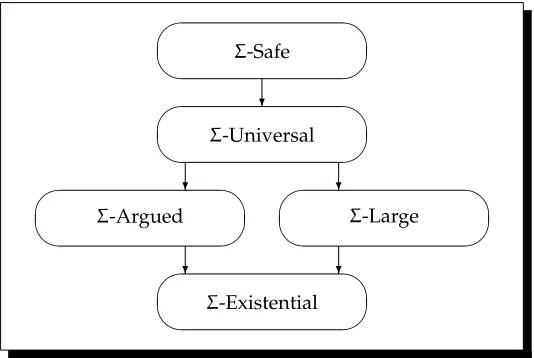
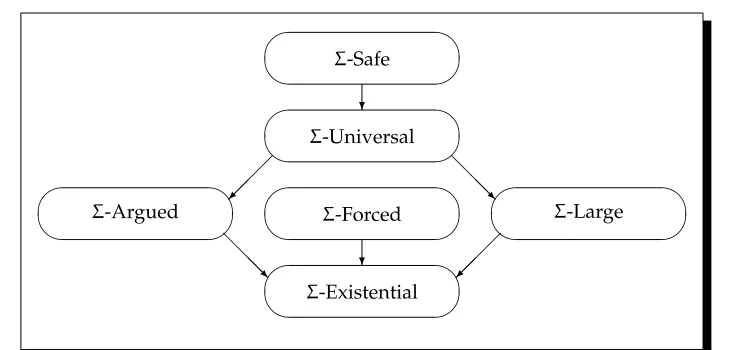
The relative (set inclusion) ordering of Σ-consequences is summarised in fig-ure (2.1). Downward arrows indicate proper set inclusions.
? ? ? ? ? Σ-Safe Σ-Universal
Σ-Argued Σ-Large
[image:39.612.184.451.239.418.2]Σ-Existential
Figure 2.1: Inclusion ordering ofΣ-consequences
game-theoretic flavour which makes them particularly suitable for modelling a vari-ety of multi-agent systems ([160; 161; 177]).
One of the most peculiar features ofΣ-argued consequence is captured in propo-sition (2.2.3). It highlights the fact that although an argued consequence has no direct refutation, each may still be rebutted when evidence is pooled together in some sense.
Proposition 2.2.3
1. For eachA∈CAΣ(Γ),AisΣ-consistent butCAΣ(Γ)is notΣ-consistent in general.
2. IfΣ=∅, thenCAΣ(Γ)is pairwiseΣ-consistent.
Proof:
(1) If A ∈ CAΣ(Γ) isΣ-inconsistent, thenΣ ` ¬Aand for someA ∈ MΣ(Γ) A ` A. HenceΣ∪ A ` ⊥, a contradiction.
To see thatCAΣ(Γ)is notΣ-consistent in general, the following example suffices:
Σ = {r∧s}
Γ = {p∧q, ¬p∧q}
∆ = {p∨ ¬r,¬p∨ ¬s}
We can easily verify that every member of∆is aΣ-argued consequence ofΓ but∆is notΣ-consistent.
(2) To see that CA∅(Γ) is pairwise ∅-consistent, it suffices to observe that if A, B ∈
CE∅(Γ)are such that{A, B}is∅-inconsistent, then there must be distinctA,B ∈M∅(Γ) such that A ` A and B ` B but A ` ¬B and B ` ¬A. Hence A, B 6∈ CAΣ(Γ), a contradiction.
Finally forCLΣ(Γ), the main idea is to accept only the intersection of the classical consequences of allΣ-large subsets ofΓ, i.e.
CLΣ(Γ) =
\
A∈LΣ(Γ) Cn(A)
Note that the notion of largeness naturally induces a total ordering onMΣ(Γ). This gives us a method to combine different strategies to obtain different consequences. For instance, we can define a new consequenceCSLΣby setting
Similarly,CELΣandCALΣcan be defined accordingly. More generally, given a total or partial ordering≤onMΣ(Γ)we can apply any one ofCSΣ,CUΣ,CAΣ, andCEΣto the
≤-maximal (or the≤-minimal) elements ofMΣ(Γ)to obtain a variety of consequences. The introduction of orderings forms the basis for a variety ofpreferentialsystems and semantics. Priest’sLPmfor instance is a paraconsistent logic whose consequence re-lation is defined in terms of the selection ofLPmodels that are minimal with respect to the usual⊆ordering (see [138] for more details).
We note that by setting Σ = ∅, we recover the paraconsistent consequences de-fined in [29]. We also note that in our definitionsΣonly provides side constraints on premises. We can in fact allowΣto be used directly to derive conclusions. We have the following stronger notions of consequence:
Definition 2.2.3
Σ-universal-consequence* A∈C∗UΣ(Γ)iff for eachA ∈MΣ(Γ),A ∪Σ`A
Σ-existential-consequence* A∈C∗EΣ(Γ)iff for someA ∈MΣ(Γ),A ∪Σ`A
Σ-argued-consequence* A∈C∗AΣ(Γ)iff for everyAj ∈MΣ(Γ),Aj∪Σ6`¬Aand there exists someAi∈MΣ(Γ)such thatAi∪Σ`A.
Σ-safe-consequence* A∈C∗SΣ(Γ)iffSΣ(Γ)∪Σ`A
Σ-large-consequence* A∈C∗LΣ(Γ)iffA ∪Σ`Afor eachA ∈LΣ(Γ).
It is easy to verify the following proposition:
Proposition 2.2.4
1. Forx∈{UΣ, EΣ, SΣ, LΣ},Cx(Γ)⊆C∗x(Γ).
2. For someΓ andΣ,CAΣ(Γ)andC∗AΣ(Γ)are incomparable.
3. C∗AΣ(Γ)is pairwiseΣ-consistent, but notΣ-consistent in general.
Proof:
(1) Follows from the fact thatCnis monotonic.
(2) The following example suffices:
It is straightforward to verify that
(¬q∨s)∧r∈C∗AΣ(Γ) ¬q∨ ¬r6∈C∗AΣ(Γ) (¬q∨s)∧r6∈CAΣ(Γ) ¬q∨ ¬r∈CAΣ(Γ)
(3) To see that C∗AΣ(Γ) is pairwise Σ-consistent, it suffices to observe that if A, B ∈
C∗EΣ(Γ)are such that{A, B}isΣ-inconsistent, then there must be distinctA,B ∈MΣ(Γ)
such thatΣ∪A `AandΣ∪B `BbutΣ∪A `¬BandΣ∪B `¬A. HenceA, B6∈CAΣ(Γ), a contradiction.
To see thatC∗AΣ(Γ)is notΣ-consistent in general, the following example suffices:
Σ = {t}
Γ = {p∧r, ¬p∧r,¬r}
∆ = {(p∧r)∨(q∧s), (¬q∧r)∨(¬q∧s), (¬r∨ ¬s)}
We can verify that every member of∆is a Σ-argued consequence* of Γ but ∆is in-consistent and hence alsoΣ-inconsistent. Note that our example also shows that the structural rules known as monotonicity and transitivity fail for bothCAΣandC∗AΣ.
Moreover, the relative set inclusion ordering of theΣ-consequences* is analogous to figure (2.1).
2.3
Some Structural Properties
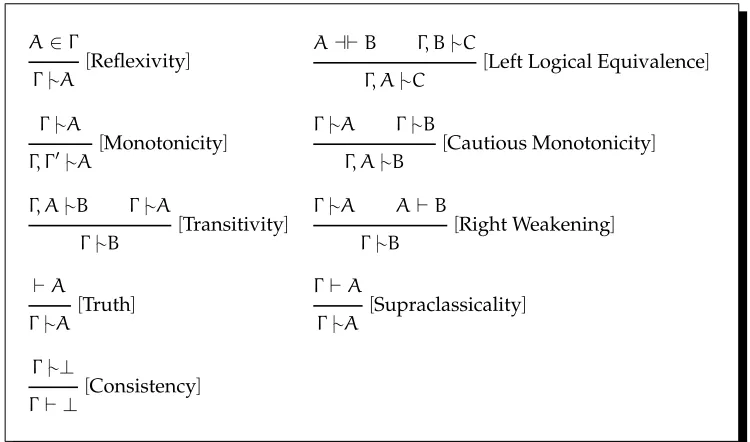
that classically equivalent assumptions can be interchanged in deductions. Cautious monotonicity says that assumptions can be safely accumulated if they are each de-ducible. Right weakening says that classical consequences of deducible conclusions are also deducible. Finally supraclassicality says that deducibility is an extension of classical inference.
A∈Γ
[Reflexivity] Γ|∼A
Aa`B Γ, B|∼C
[Left Logical Equivalence] Γ, A|∼C
Γ|∼A
[Monotonicity] Γ, Γ0|∼A
Γ |∼A Γ |∼B
[Cautious Monotonicity] Γ, A|∼B
Γ, A|∼B Γ |∼A
[Transitivity] Γ |∼B
Γ |∼A A`B
[Right Weakening] Γ|∼B
`A
[Truth] Γ|∼A
Γ `A
[Supraclassicality] Γ |∼A
Γ |∼⊥
[image:43.612.129.504.207.428.2][Consistency] Γ ` ⊥
Table 2.1: Some structural properties of inference.
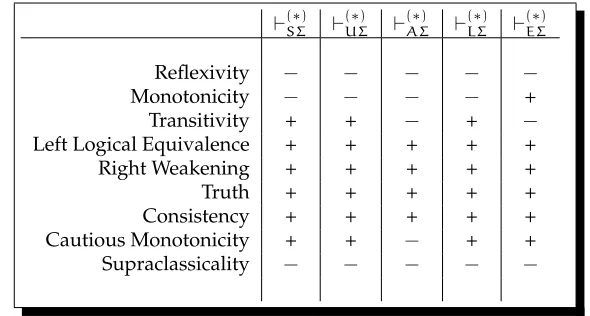
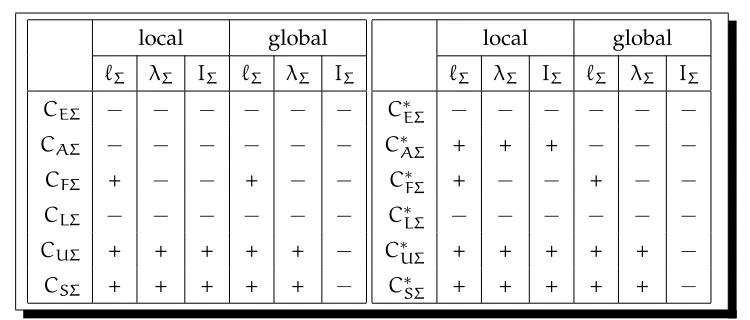
Relative to a fixed consistent constraint setΣand a premise setΓ withMΣ(Γ) 6=∅, we can summarise the structural properties of our inference relations with table (2.2). The properties of the corresponding∗versions are completely similar. We use ‘(∗)’ to denote both versions of an inference relation, ‘+’ and ‘−’ to indicate that a structural rule holds or fails to hold respectively. The proof is routine calculation; we leave it to the reader.
ag-`SΣ(∗) `(UΣ∗) `AΣ(∗) `(LΣ∗) `(EΣ∗)
Reflexivity − − − − −
Monotonicity − − − − +
Transitivity + + − + −
Left Logical Equivalence + + + + +
Right Weakening + + + + +
Truth + + + + +
Consistency + + + + +
[image:44.612.126.421.112.270.2]Cautious Monotonicity + + − + + Supraclassicality − − − − −
Table 2.2: Some structural properties ofΣ-consequences.
gregate of the assumptions used are always a subset of the set ofΣ-consistent avail-able assumptions. So transitivity holds for`SΣ, `UΣ and`LΣ. This is however not the case for`EΣand`AΣ. The set of available assumptions in these two cases are not Σ-consistent even though assumptions used in any given permissible deduction form a Σ-consistent subset. Cutting and pasting of permissible deductions may result in impermissible deduction since the aggregate of the assumptions used may turn out to beΣ-inconsistent. Hence transitivity fails for both`EΣand`AΣ.
2.4
Properties of Sets
In this section, we introduce two different properties of inconsistent sets. The first allows us to measure the relative level of incoherence of a premise set. The second provides a measurement of the relativequantity of empirical information of a premise set.
2.4.1 Level of Incoherence
Some inconsistent sets are clearly more unstable or incoherent then others. Consider, for instance,
Example 2.4.1
Γ ={p∧q, ¬p∧q, ¬q} ∆={p, ¬p, q}
subsets ofΓ such thatΓ = S
C(wheren ≤ ω). Elements of ann-covering are called
clusters. Ann-covering isΣ-consistent iff each of its clusters isΣ-consistent. Definition 2.4.1
The`Σ-value of a setΓ is defined as:
`Σ(Γ) =
0 ifΓ =∅orΓ ⊆{A:`A}
the cardinality of the least
Σ-consistent covering ofΓ
up to and includingω
if such a covering exists
∞ otherwise
We useC`Σ(Γ)to denote the set of all`Σ(Γ)-fold coverings ofΓ. The sentence ‘`Σ(Γ) = ∞’ does not say that Γ has infiniteΣ-level; rather it says that Γ has no Σ-level at all. So we must distinguish between `Σ(Γ) = ∞ and`Σ(Γ) = ω. More specifically ifΓ contains aΣ-villain, then`Σ(Γ) = ∞. Also observe that if`Σ(Γ) = n6= ∞, then there
must be aΣ-consistentn-covering ofΓ.
Though the `Σ function offers us a natural way to classify inconsistent sets, it is sensitive to the syntax of the premises. Consider for instance,
Example 2.4.2
Σ={q} Γ ={p∧ ¬p} ∆={p,¬p}
According to our definition, the Σ-level of Γ and the Σ-level of ∆are distinct – `Σ(Γ) = ∞ but `Σ(∆) = 2. However, other less syntax-sensitive means to classify inconsistent sets are available. In [80], Grant proposes three model theoretic means to classify inconsistent first order theories. To our knowledge, Grant is the first to offer such systematic classifications of inconsistent theories.
2.4.2 Quantity of Empirical Information
may also be useful in cases where they are deployed as directives to guide learning or as indicators for faulty components in a complex system. Hence we need to develop a theoretical framework to distinguish different sorts of inconsistent data. In [123], a definition for measuring the amount ofsemantic information of an inconsistent set is given. In this section we give a definition for measuring the amount of empirical informationin an inconsistent set.
By a quasi-model ofΓ, we mean any two-valued model of anyA ∈MΣ(Γ). Taking Γto be a set of empirical data, i.e. data about the state of the world, we may intuitively interpret each quasi-model as representing a possible state of the world according to Γ. To define the relative quantity of empirical information of an inconsistent set, we first define the following function:
Definition 2.4.2
TheλΣ-value of a setΓ is defined as:
λΣ(Γ) =
0 ifΓ =∅orΓ ⊆{A: `A}
|MΣ(Γ)| ifMΣ(Γ)6=∅
∞ otherwise
In effect, theλΣ-value is just the number of maximalΣ-consistent subsets ofΓ. In terms of the relation between`Σ andλΣ, it is straightforward to show the following:
Proposition 2.4.1
For anyΓ ⊆Φ,`Σ(Γ) =n =⇒ λΣ(Γ)≥n, for1≤n < ω
Proof:
If`Σ(Γ) = n, then there must be aΣ-consistent covering of Γ. Each cluster of such a covering of Γ isΣ-consistent and thus can be extended to a maximallyΣ-consistent subset ofΓ. There arendistinct and pairwise inconsistent clusters and thus there are ndistinct and pairwise inconsistent extensions. Hencen≤λΣ(Γ)as required.
SinceΣ-villains areΣ-inconsistent and tautologies do not contribute any informa-tion about the world, we may disregard them when we are considering the amount of empirical information of a set. We let the root ofΓ,R(Γ), be the set of propositional atoms occurring in the setS
of quasi-models ofΓ, we are only concerned with the number ofequivalence classesof quasi-models with respect toR(Γ). So the maximum possible number of such equiv-alence classes is2|R(Γ)|. We useQR(Γ)(Γ) to denote the collection of such equivalence classes of quasi-models. We note that|QR(Γ)(Γ)|≤2|R(Γ)|.
Definition 2.4.3
The quantity of empirical information ofΓ is given by:
IΣ(Γ) =
|R(Γ)|−log2|QR(Γ)(Γ)| ifλΣ(Γ) =1
|R(Γ)|−log2λΣ(Γ) ifλΣ(Γ)> 1
0 otherwise
When λΣ(Γ) = 1, IΣ(Γ) is based on the ratio between 2|R(Γ)| and |QR(Γ)(Γ)|. When λΣ(Γ) > 1, IΣ(Γ) is defined by a decreasing function of the λΣ-value of Γ. Intu-itively, theλΣ-value ofΓ provides one possible way to measure the amount of conflict amongst theΣ-witnesses. WhenλΣ(Γ) = 1, there is no conflict and whenλΣ(Γ) > 1 it means that there are conflicts amongst the Σ-witnesses. Moreover, the higher the λΣ-value of Γ, the more Σ-inconsistent subsets reside amongst the Σ-witnesses. If λΣ(Γ) =k > 1, then by taking the union of each distinct pairA,B ∈MΣ(Γ)there are at least k(k−1)2 many ways to generateΣ-inconsistent subsets amongst theΣ-witnesses. Consider the following example:
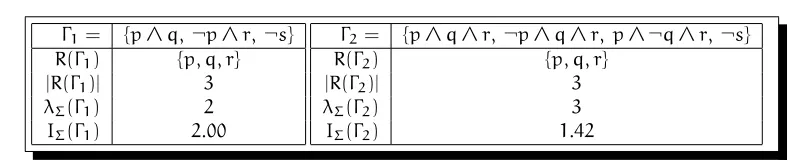
Example 2.4.3 LetΣ={s}.
Γ1= {p∧q, ¬p∧r,¬s}
R(Γ1) {p, q, r}
|R(Γ1)| 3
λΣ(Γ1) 2
IΣ(Γ1) 2.00
Γ2= {p∧q∧r, ¬p∧q∧r, p∧ ¬q∧r, ¬s}
R(Γ2) {p, q, r}
|R(Γ2)| 3
λΣ(Γ2) 3
[image:47.612.114.511.558.639.2]IΣ(Γ2) 1.42
Table 2.3: A comparison of two sets.
2.5
Σ
-Forced Consequence
In this section we introduce a new paraconsistent consequence, calledΣ-forced con-sequence, based on the notion ofΣ-level. Σ-forced consequence is a generalization of a paraconsistent consequence operator introduced in [164; 167].
Definition 2.5.1
Σ-forced consequence:A∈CFΣ(Γ)iff for eachC ∈C`Σ(Γ),A `Afor someA ∈ C
Σ-forced consequence*:A∈C∗FΣ(Γ)iff for eachC ∈C`Σ(Γ),A ∪Σ`Afor someA ∈ C
whereC`Σ(Γ)is the set of all`Σ(Γ)-fold coverings ofΓ.
In other words,Ais aΣ-forced consequence ofΓ iff for every`Σ(Γ)-fold covering of Γ, there is a cluster which classically impliesA. Again, the main difference between CFΣ and C∗FΣ is the role Σplays in deriving conclusions. Similarly to the previous results, any Σ-forced consequence is a Σ-forced consequence*, i.e. for any Γ ⊆ Φ, CFΣ(Γ)⊆C∗FΣ(Γ).
We also note that CFΣ andC∗FΣ are defined relative to the Σ-level of a set. Since the Σ-level of a set is not closed under supersets in general, CFΣ and C∗FΣ are both non-monotonic with respect toΓ. However, if we define Σ-forced consequence and consequence* relative to a fixedn, forn∈N, (i.e., replace ‘every`Σ(Γ)-fold covering’ with ‘everyn-covering’ in the definition), then the resulting notions of consequence are monotonic with respect toΓ. Nonetheless, these consequences are unprincipled when`Σ(Γ) > n. From a nonmonotonic reasoning perspective, it would be of some theoretical interest to study a varying-Σapproach toΣ-consequence. For instance, it is easy to see that for a fixed premise setΓ, ifΣ0 ⊇ Σ, thenCxΣ(Γ) ⊆ CxΣ0(Γ), where x∈{E, A, F, L, U, S}. In effect, we need to distinguish between two kinds of nonmono-tonicity – those with respect to the premise set and those with respect to the constraint set. This is particularly interesting in modelling agents who are endowed with meta-beliefs that govern and provide constraints on lower level meta-beliefs. Intriguing as it may be, however, we will not work out the details of the varying-Σapproach here.
@ @@R @
@@R ? ? Σ-Safe Σ-Universal
Σ-Argued Σ-Forced Σ-Large
[image:49.612.134.512.107.282.2]Σ-Existential
Figure 2.2: Inclusion ordering ofΣ-consequences.
2.6
Preservation
In this section we will focus on the preservational properties of our inference mech-anisms in terms of the `Σ,λΣ andIΣ values of premise sets. We can characterise the preservational property of a consequence operatorCboth locally and globally. The local characterisation specifies the effect of extending the premise set by a single con-sequence; whereas the global characterization specifies the effect of extending the premise set by the entire consequence set. These notions are given formally in the following definitions:
Definition 2.6.1
LetCbe a consequence operator defined over the languageΦ, i.e.,C:℘(Φ)−→℘(Φ). We say thatCis
locally`Σ-preserving iff for anyΓ ⊆ΦandA∈C(Γ),`Σ(Γ) =nonly if`Σ(Γ, A) =n
globally`Σ-preserving iff for anyΓ ⊆Φ,`Σ(Γ) =nonly if`Σ(Γ, C(Γ)) =n
locallyλΣ-preserving iff for anyΓ ⊆ΦandA∈C(Γ),λΣ(Γ) =nonly ifλΣ(Γ, A) =n
globallyλΣ-preserving iff for anyΓ ⊆Φ,λΣ(Γ) =nonly ifλΣ(Γ, C(Γ)) =n
locallyIΣ-preserving iff for any Γ ⊆ ΦandA ∈ C(Γ) withR(A) ⊆ R(Γ), IΣ(Γ) = n
only ifIΣ(Γ, A) =n
globallyIΣ-preserving iff for anyΓ ⊆Φ,
2. λΣ(Γ) =1only ifλΣ(Γ, C(Γ)) =1
3. IΣ(Γ) =nonly ifIΣ(Γ, C(Γ)) =n
We note that to show that a consequence operator is not globallyx-preserving, it suf-fices to show that it is not locallyx-preserving.
Proposition 2.6.1
1. For x ∈ {`Σ, λΣ, IΣ}, any globally x-preserving consequence operator is also
locallyx-preserving.
2. LetC1andC2be consequence operators such that for anyΓ ⊆Φ,C1(Γ)⊆C2(Γ). IfC2(Γ)is locally (or globally)x-preserving, thenC1(Γ)is locally (or globally)x
-preserving forx∈{`Σ, λΣ, IΣ}.
Proof:
(1) We’ll assume thatCis globallyx-preserving and consider each case in turn:
(`Σ): We note that `Σ is a monotonically increasing function over ⊆-ordering of Φ. Hence given thatΓ ⊆(Γ ∪{A})⊆(Γ∪C(Γ))holds for anyA∈C(Γ), we have
`Σ(Γ)≤`Σ(Γ, A)≤`Σ(Γ, C(Γ))
By the initial assumptionCis globally`Σ-preserving and thus`Σ(Γ) =nimplies that `Σ(Γ, C(Γ)) =nand hence`Σ(Γ, A) =nas required.
(λΣ): Similar to`Σ.λΣis also monotonically increasing. (IΣ): There are two cases to consider:
(λΣ(Γ) = 1): Then by (1) and (2) of definition (2.6.1), we have λΣ(Γ, C(Γ)) = 1 and R(Γ) =R(Γ, A) =R(Γ, C(Γ)). It follows thatλΣ(Γ, A)) = 1for everyA∈C(Γ). Hence it follows that
|R(Γ)|−log2|QR(Γ)(Γ)| = |R(Γ, C(Γ))|−log2|QR(Γ,C(Γ))(Γ, C(Γ))| = |R(Γ, A)|−log2|QR(Γ,A)(Γ, A)|
i.e.IΣ(Γ) =IΣ(Γ, A)as required.
(λΣ(Γ) > 1): Then by the previous result, λΣ(Γ) = λΣ(Γ, A) for each A ∈ C(Γ) and R(Γ) =R(Γ, A) =R(Γ, C(Γ)). Hence,