Article
Comparative Structural Design for Pressure- and
Temperature- Resistant Buildings with Loads
Affecting Externally on Structures of Different
Heights
Boonchai Sonthirongnachai
aand Arthit Petchsasithon
b,*Department of Civil Engineering, Faculty of Engineering, King Mongkut's Institute of Technology Ladkrabang, Bangkok 10520, Thailand
E-mail: a[email protected], b[email protected] (Corresponding author)
Abstract. Loads from explosions can be classified as internal blast load and external blast load and these
loads have great severity, continuity and rapidity. That is, explosions cause massive structural damage by exposing surrounding structures to extremely high pressure and temperature. Thus, structures at risk of explosive damage must be stronger than typical buildings in withstanding both ordinary loads and the additional pressure and temperature loads caused. Explosion-resistant structures are required in the petrochemical industry, explosive armories, power stations, and gas storage facilities, among others. This study aims to examine and compare the structural performance of two building of different heights, which are 5-floor and 2-floor, subject to three types of loads: (1) the pressure of 300 bars, (2) the temperature of 300 C, and (3) the pressure of 300 bars combined with the temperature of 300 C. The research analyzes three primary reinforced structures, namely columns, beams, and slabs, in terms of the parameters resulting from each scenario to determine a set of criteria for designing the structural components of the buildings to resist the external blasts.
Keywords: External pressure load, external temperature load, pressure- and temperature-resistant buildings.
ENGINEERING JOURNAL Volume 23 Issue 3
Received 16 November 2018 Accepted 19 March 2019 Published 31 May 2019
1.
Introduction
Designing residential buildings in Thailand generally involves the utilization of space and aesthetics as well as fulfilment of the standards and requirements stipulated in the 2522 B.E. Building Control Act. However, some structures at risk of explosions, such as buildings in the petrochemical industry [1], explosive armories[2], power stations[3-4], gas storage facilities[1, 5], and energy research centres[6], must also be designed to resist the additional loads resulting from explosive pressure[7] and temperature[8], to prevent collapse, and ultimately to safeguard life and property. To this end, their design must account for not only dead loads (DLs) [9-12] and live loads (LLs) [9-12], but also blast load (BLs) [13]. Since BLs [13] consist of pressure loads, temperature loads, and combined pressure and temperature loads, they are more severe and occur in exponentially smaller time-windows than either seismic or seasonal wind loads.
[14-15].
This study focuses on designing explosion-resistant buildings [1] that can ensure the safety of life and property. Its results will provide guidelines for designing constructions susceptible to explosions. The three primary structures under study, namely columns, beams, and slabs, form the structural components of a building prototype designed for the petrochemical industry where the mixing of gases, such as N2, H2, H2S,
CO2, O2, LPG, LNG, and He, takes place. The building houses the common processes and equipment shown
in Fig. 1.1.
Fig. 1.1. Gas mixing cylinder.
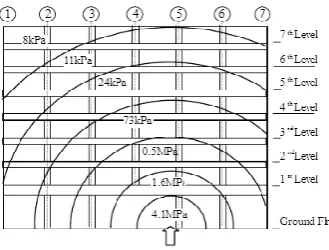
[image:2.595.215.380.502.627.2]With regards to the characteristics of potential explosions in the building, the pressure travels from the bottom to the top and decreases gradually. In addition, the radius of explosions becomes larger, as shown in Fig. 1.2.
Fig. 1.2. Internal blasts [16].
Fig. 1.3. Effects of ventilators on internal blasts [1].
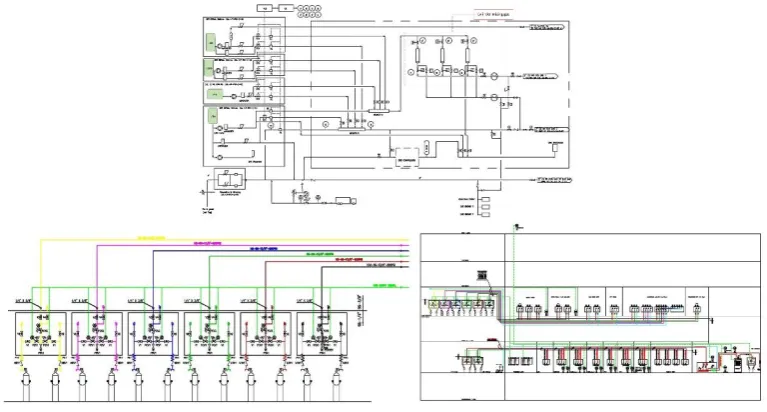
[image:3.595.105.489.259.465.2]Outside of the building sits the equipment used for gas storage and high-pressure control, as shown in Fig. 1.4. This area is designated as a hazardous or safety alert zone [18].
Fig. 1.4. Equipment installed outside the building.
Explosive severity depends on the distance from the sources of blasts, as shown in Fig. 1.5 [5, 19].
Fig. 1.5. Externals blasts [5].
Figure 1.5 shows the characteristics of external blasts and pressure wave expansion. To determine the scaled distance (𝑍), the following equation is used [16]:
𝑍 = 𝑅 𝑊⁄ 1⁄3 (1)
3 < 𝑍 < 10 𝑁𝑒𝑎𝑟 𝐹𝑖𝑒𝑙𝑑 𝐵𝑙𝑎𝑠𝑡
𝑍 < 3 𝐶𝑙𝑜𝑠𝑒 − 𝑖𝑛 𝐵𝑙𝑎𝑠𝑡
𝑊 = 𝑀𝑎𝑠𝑠 𝑜𝑓 𝑡ℎ𝑒 𝑒𝑥𝑝𝑙𝑜𝑠𝑖𝑜𝑛
[image:4.595.209.387.373.501.2]𝑅 = 𝐷𝑖𝑠𝑡𝑎𝑛𝑐𝑒 𝑓𝑟𝑜𝑚 𝑡ℎ𝑒 𝑑𝑒𝑡𝑜𝑛𝑎𝑡𝑖𝑜𝑛 𝑠𝑜𝑢𝑟𝑐𝑒
Table 1.1. Ratio of explosive mass to distance from the detonation source [16].
100 kg
TNT 500 kg TNT 1000 kg TNT 2000 kg TNT
1m 165.8 354.5 464.5 602.9
2.5m 34.2 89.4 130.8 188.4
5 m 6.65 24.8 39.5 60.19
10m 0.85 4.25 8.15 14.7
15m 0.27 1.25 2.53 5.01
20m 0.14 0.54 1.06 2.13
25m 0.09 0.29 0.55 1.08
30m 0.06 0.19 0.33 0.63
The pressure caused by explosions will flow up through the atmosphere until reaching a peak , referred to as the positive phase, and will then flow back through the atmosphere to the point underneath it , referred to as the negative phase, as shown in Fig. 1.6 [1]. This cycle will repeat until there is no pressure left.
Fig. 1.6. Relationships between explosive duration and pressure [1, 20].
𝐼0= ∫ 𝑃(𝑡)𝑑𝑡0𝑡𝑑 (2)
= 0.5𝑃𝑠𝑜𝑡𝑑, 𝑓𝑜𝑟 𝑎 𝑡𝑟𝑖𝑎𝑛𝑔𝑢𝑙𝑎𝑟 𝑤𝑎𝑣𝑒
= 0.64𝑃𝑠𝑜𝑡𝑑, 𝑓𝑜𝑟 𝑎 ℎ𝑎𝑙𝑓 − 𝑠𝑖𝑛𝑒 𝑤𝑎𝑣𝑒
= 𝑐𝑃𝑠𝑜𝑡𝑑, 𝑓𝑜𝑟 𝑎𝑛 𝑒𝑥𝑝𝑜𝑛𝑒𝑛𝑡𝑖𝑎𝑙𝑙𝑦 𝑑𝑒𝑐𝑎𝑦𝑖𝑛𝑔 𝑠ℎ𝑜𝑐𝑘 𝑤𝑎𝑣𝑒
Where:
𝐼0 = 𝑃ℎ𝑎𝑠𝑒 𝐼𝑚𝑝𝑢𝑙𝑠𝑒
𝑃(𝑡) = 𝑂𝑣𝑒𝑟𝑝𝑟𝑒𝑠𝑠𝑢𝑟𝑒 𝑓𝑢𝑛𝑐𝑡𝑖𝑜𝑛 𝑤𝑖𝑡ℎ 𝑟𝑒𝑠𝑝𝑒𝑐𝑡 𝑡𝑜 𝑡𝑖𝑚𝑒
𝑃𝑠𝑜= 𝑃𝑒𝑎𝑘, 𝑜𝑟 𝑖𝑛𝑐𝑖𝑑𝑒𝑛𝑡, 𝑠𝑖𝑑𝑒 − 𝑜𝑛 𝑜𝑣𝑒𝑟𝑝𝑟𝑒𝑠𝑠𝑢𝑟𝑒
𝑡𝑑 = 𝐷𝑢𝑟𝑎𝑡𝑖𝑜𝑛 𝑜𝑓 𝑡ℎ𝑒 𝑝𝑜𝑠𝑖𝑡𝑖𝑣𝑒 𝑝ℎ𝑎𝑠𝑒
𝑐 = 𝐴 𝑣𝑎𝑙𝑢𝑒 𝑏𝑒𝑡𝑤𝑒𝑒𝑛 0.2 𝑎𝑛𝑑 0.5 𝑑𝑒𝑝𝑒𝑛𝑑𝑖𝑛𝑔 𝑜𝑛 𝑃𝑠𝑜
so P
so P
R
Fig. 1.7. Relationships between the negative phase and vibration waves [1, 20].
Before the negative phase, the pressure increases, and the compressed air causes a shockwave. During this period, the pressure is a dynamic waveform expanding in a circular pattern. The wave characterizing an explosion is referred to as a shock load, which is a vibration wave [20].
Since fuel is a high-temperature hydrocarbon affecting the strength requirements of a building, the structural components of the construction need to be considered in conjunction with the temperature generated from the combustion of a blast. The thermal resistance characteristics of steel and concrete are shown in Table 1.2
.
Table 1.2. Comparison of the strength of concrete and steel.
Properties Mild Steel Concrete
Mass per unitkg (m3) 7850 2400
Elastic modulus (ksc) 2100000 200000
Thermal resistance (C) 250-550 300-600
Lifespan (y) 10-20 30-50
Compressive strength (ksc) 3500-5000 200-500
Tensile strength (ksc) 3500-5000 0-50
Table 1.2 shows that steel is less resistant to heat than concrete, whereas concrete is less resistant to strain than steel. The relationships between temperature and steel strength are shown in Fig. 1.8 [21].
Fig. 1.8. Relationships between temperature and steel strength [21].
Fig. 1.9. Relationships between temperature and strain percentage [21].
2.
Comparative Design for 5-floor and 2-floor Buildings Which Can Resist the External
Pressure Load of 300 Bars
Figure 2.1 shows the models of two test buildings, whose heights are 5 floors and 2 floors with dimensions of 40.00 m x 30.00 m x 22.00 m. and 40.00 m x 30.00 m x 8.00 m., respectively.
Fig. 2.1. Models of the pressure-resistant buildings.
The buildings were designed to resist the external pressure load of 300 bars, as shown in Fig. 2.2.
Fig. 2.2. Pressure load of 300 bars affecting the buildings externally.
Table 2.1. Maximum reaction force and moment caused to the columns on the 5-floor and 2-floor buildings.
Column pressure load of 300 bars
5-floor 2-floor
Reaction force (kgs) 18533129 15632659
Reaction moment (kgs-m) 3110703 1978084
Fig. 2.3.Pressure load of 300 bars on the columns.
The columns’ cross-sectional areas and the reinforced steel bars used in the buildings are shown in Fig. 2.4.
Fig. 2.4. Design of the columns’ cross-sectional areas and the reinforced steel bars.
The requirements for designing the pressure-resistant columns on both buildings are shown in Table 2.2.
Table 2.2. Column design requirements for the pressure load of 300 bars on both buildings.
No. Column details Property consumption 5-floor building 2-floor building
1 Column dimensions (m) 2.40 x 2.40 2.00 x 2.00
2 Column length, H (m) 22.00 8.00
3 Main bars (mm) 184-DB28 108-DB28
4 Stirrup (cm) 1-DB16@10 1-DB16@10
5 Concrete covering (m) 0.05 0.05
6 Yield stress, 𝑓𝑦(ksc) 5000 5000
7 Elastic modulus of steel, 𝐸𝑠(ksc) 2040000 2040000
8 Compressive stress of concrete, 𝑓
𝑐′(ksc) 800 1000
9 Elastic modulus of concrete, 𝐸𝑐 (ksc) 294353.18 294353.18
Table 2.3. Maximum reaction force and moment caused to the beams on the 5-floor and 2-floor buildings.
Beam pressure load of 300 bars
5-floor 2-floor
Reaction force (kgs) 36966608 28484569
Reaction moment (kgs-m) 3111132 2357696
Fig. 2.5. Pressure load of 300 bars on the beams.
The beams’ cross-sectional areas and the reinforced steel bars used in the buildings are shown in Fig. 2.6.
Fig. 2.6. Designs of the beams’ cross-sectional areas and the reinforced steel bars.
[image:8.595.71.527.499.770.2]The requirements for designing the pressure-resistant beams on both buildings are shown in Table 2.4.
Table 2.4. Beam design requirements for the pressure load of 300 bars on both buildings.
No. Beam details Property consumption 5-floor building 2-floor building
1 Beam dimensions (m) 2.00 x 2.20 1.80 x 2.00
2 Beam length, H (m) 8.00 8.00
3 Main bars (mm)
Mid span : 15-DB32, 30-DB25, 32-DB40, 28-DB32 Beam con : 38-DB28, 40-DB28, 15-DB25, 10-DB25
Mid span : 10-DB25, 10-DB25, 35-DB28, 45-DB32 Beam con : 26-DB40, 28-DB32, 10-DB25, 10-DB25
4 Stirrup (cm) 8-DB40@3 [email protected]
5 Concrete covering (m) 0.025 0.025
6 Yield stress, 𝑓𝑦(ksc) 5000 5000
7 Elastic modulus of steel, 𝐸𝑠(ksc) 2040000 2040000
8 Compressive stress of concrete, 𝑓
𝑐′(ksc) 320 320
The pressure load of 300 bars affecting the buildings externally, as shown in Fig. 2.7, caused the maximum reaction force and moment to the slabs, as shown in Table 2.5.
Table 2.5. Maximum reaction force and moment caused to the slabs on the 5-floor and 2-floor buildings.
Slab pressure load of 300 bars
5-floor 2-floor
Reaction force (kgs) 376361 121338
Reaction moment (kgs-m) 1574108 753934
Fig. 2.7.Pressure load of 300 bars on the slabs.
The slabs’ cross-sectional areas and the reinforced steel bars used in the buildings are shown in Fig. 2.8.
Fig. 2.8. Designs of the slabs’ cross-sectional areas and the reinforced steel bars.
The requirements for designing the pressure-resistant slabs on both buildings are shown in Table 2.6.
Table 2.6. Slab design requirements for the pressure load of 300 bars on both buildings.
No. Slab details Property consumption 5-floor building 2-floor building
1 Slab dimensions (m) 8.00 x 6.00 8.00 x 6.00
2 Slab thickness (cm) 40.00 35.00
3 Main bars (cm) DB28@6 DB28@6
4 Concrete covering (cm) 2.50 2.50
5 Yield stress, 𝑓𝑦(ksc) 5000 5000
6 Elastic modulus of steel, 𝐸𝑠(ksc) 2040000 2040000
7 Compressive stress of concrete, 𝑓
𝑐′(ksc) 280 280
3.
Comparative Design for 5-floor and 2-floor Buildings Which Can Resist the External
Temperature Load of 300
C
Figure 3.1 shows the models of 2 temperature-resistant buildings. The heights of these buildings are 5 floors and 2 floors with dimensions of 40.00 m x 30.00 m x 22.00 m. and 40.00 m x 30.00 m x 8.00 m., respectively.
Fig. 3.1.Models of the temperature-resistant buildings.
The buildings were used to test the external temperature load of 300
C, as shown in Fig. 3.2.Fig. 3.2.Temperature load of 300 C affecting the buildings externally.
The temperature load of 300
C affecting the buildings externally, as shown in Fig. 3.3, caused the maximum reaction force and moment to the columns, as shown in Table 3.1.Table 3.1. Maximum reaction force and moment caused to the columns on the 5-floor and 2-floor buildings.
Column temperature load of 300
C5-floor 2-floor
Reaction force (kgs) 25448 21183
Reaction moment (kgs-m) 1488 1061
The columns’ cross-sectional areas and the reinforced steel bars used in the buildings are shown in Fig. 3.4.
Fig. 3.4. Design of the columns’ cross-sectional areas and the reinforced steel bars.
The requirements for designing the temperature-resistant columns on both buildings are shown in Table 3.2.
Table 3.2. Column design requirements for the temperature load of 300 C on both buildings.
No. Column details Property consumption 5-floor building 2-floor building
1 Column dimensions (m) 0.45 x 0.45 0.30 x 0.30
2 Column length, H (m) 22.00 8.00
3 Main bars (mm) 8-DB12 8-DB12
4 Stirrup (m) [email protected] [email protected]
5 Concrete covering (m) 0.05 0.05
6 Yield stress, 𝑓𝑦(ksc) 3000 3000
7 Elastic modulus of steel, 𝐸𝑠(ksc) 2040000 2040000
8 Compressive stress of concrete, 𝑓
𝑐′(ksc) 280 240
9 Elastic modulus of concrete, 𝐸𝑐 (ksc) 252671.32 233928.19
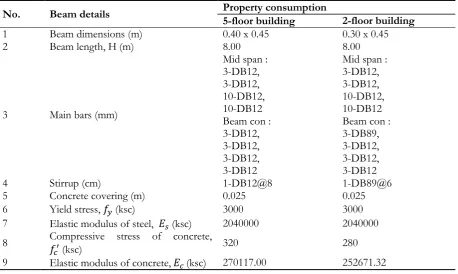
[image:11.595.93.492.570.748.2]The temperature load of 300
C affecting the buildings externally, as shown in Fig. 3.5, caused the maximum reaction force and moment to the beams, as shown in Table 3.3.Table 3.3. Maximum reaction force and moment caused to the beams on the 5-floor and 2-floor buildings.
Beam temperature load of 300
C5-floor 2-floor
Reaction force (kgs) 36435 26284
Reaction moment (kgs-m) 1842 743
The beams’ cross-sectional areas and the reinforced steel bars used in the buildings are shown in Fig. 3.6.
Fig. 3.6. Designs of the beams’ cross-sectional areas and the reinforced steel bars.
[image:12.595.71.530.314.588.2]The requirements for designing the temperature-resistant beams on both buildings are shown in Table 3.4.
Table 3.4. Beam design requirements for the temperature load of 300 C on both buildings.
No. Beam details Property consumption 5-floor building 2-floor building
1 Beam dimensions (m) 0.40 x 0.45 0.30 x 0.45
2 Beam length, H (m) 8.00 8.00
3 Main bars (mm)
Mid span : 3-DB12, 3-DB12, 10-DB12, 10-DB12 Beam con : 3-DB12, 3-DB12, 3-DB12, 3-DB12
Mid span : 3-DB12, 3-DB12, 10-DB12, 10-DB12 Beam con : 3-DB89, 3-DB12, 3-DB12, 3-DB12
4 Stirrup (cm) 1-DB12@8 1-DB89@6
5 Concrete covering (m) 0.025 0.025
6 Yield stress, 𝑓𝑦(ksc) 3000 3000
7 Elastic modulus of steel, 𝐸𝑠(ksc) 2040000 2040000
8 Compressive stress of concrete, 𝑓
𝑐′(ksc) 320 280
9 Elastic modulus of concrete, 𝐸𝑐 (ksc) 270117.00 252671.32
[image:12.595.96.498.663.717.2]The temperature load of 300
C affecting the buildings externally, as shown in Fig. 3.7, caused the maximum reaction force and moment to the slabs, as shown in Table 3.5.Table 3.5. Maximum reaction force and moment caused to the slabs on the 5-floor and 2-floor buildings.
Slab pressure load of 300
C5-floor 2-floor
Reaction force (kgs) 36435.27 7602.45
Fig. 3.7. Temperature load of 300 C on the slabs.
[image:13.595.96.500.253.350.2]The slabs’ cross-sectional areas and the reinforced steel bars used in the buildings are shown in Fig. 3.8.
Fig. 3.8. Designs of the slabs’ cross-sectional areas and the reinforced steel bars.
[image:13.595.70.529.435.583.2]The requirements for designing the temperature-resistant slabs on both buildings are shown in Table 3.6.
Table 3.6. Slab design requirements for the temperature load of 300 C on both buildings.
No. Slab details Property consumption 5-floor building 2-floor building
1 Slab dimensions (m) 8.00 x 6.00 8.00 x 6.00
2 Slab thickness (cm) 35.00 30.00
3 Main bars (cm) DB40@8 DB28@7
4 Concrete covering (cm) 2.50 2.50
5 Yield stress, 𝑓𝑦(ksc) 3000 3000
6 Elastic modulus of steel, 𝐸𝑠(ksc) 2040000 2040000
7 Compressive stress of concrete, 𝑓
𝑐′(ksc) 280 280
8 Elastic modulus of concrete, 𝐸𝑐 (ksc) 252671.32 252671.32
4.
Comparative Design for 5-floor and 2-floor Buildings Which Can Resist the External
Pressure Load of 300 Bars and the External Temperature Load of 300
C
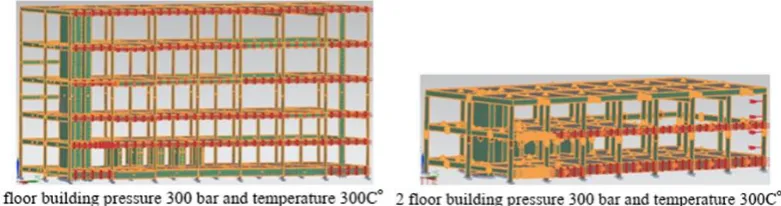
Fig. 4.1. Models of the pressure- and temperature-resistant buildings.
[image:14.595.105.496.261.364.2]The buildings were used to test the external pressure load of 300 bars and the temperature load of 300
C, as shown in Fig. 4.2.Fig. 4.2. Pressure load of 300 bars and temperature load of 300 C affecting the buildings externally.
[image:14.595.93.495.473.638.2]The pressure load of 300 bars and the temperature load of 300
C affecting the buildings externally, as shown in Fig. 4.3, caused the maximum reaction force and moment to the columns, as shown in Table 4.1.Table 4.1. Maximum reaction force and moment caused to the columns on the 5-floor and 2-floor buildings.
Combined column pressure load of 300 bars and temperature load of 300 C
5-floor 2-floor
Reaction force (kgs) 18558577 15653842
Reaction moment (kgs-m) 3112192 1979144
Fig. 4.3. Combined pressure load of 300 bars and temperature load of 300 C on the columns.
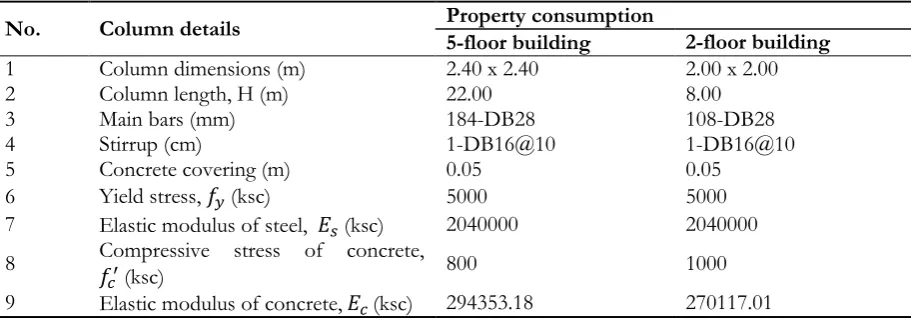
Fig. 4.4. Design of the columns’ cross-sectional areas and the reinforced steel bars.
[image:15.595.71.527.320.480.2]The requirements for designing the pressure- and temperature-resistant columns on both buildings are shown in Table 4.2.
Table 4.2. Column design requirements for the pressure load of 300 bars and temperature load of 300 C on both buildings.
No. Column details Property consumption
5-floor building 2-floor building
1 Column dimensions (m) 2.40 x 2.40 2.00 x 2.00
2 Column length, H (m) 22.00 8.00
3 Main bars (mm) 184-DB28 108-DB28
4 Stirrup (cm) 1-DB16@10 1-DB16@10
5 Concrete covering (m) 0.05 0.05
6 Yield stress, 𝑓𝑦(ksc) 5000 5000
7 Elastic modulus of steel, 𝐸𝑠(ksc) 2040000 2040000
8 Compressive stress of concrete, 𝑓
𝑐′(ksc) 800 1000
9 Elastic modulus of concrete, 𝐸𝑐 (ksc) 294353.18 270117.01
[image:15.595.94.495.557.727.2]The pressure load of 300 bars and the temperature load of 300
C affecting the buildings externally, as shown in Fig. 4.5, caused the maximum reaction force and moment to the beams, as shown in Table 4.3.Table 4.3. Maximum reaction force and moment caused to the beams on the 5-floor and 2-floor buildings.
Combined beam pressure load of 300 bars and temperature load of 300 C
5-floor 2-floor
Reaction force (kgs) 37003043 28510853
Reaction moment (kgs-m) 3112974 2358439
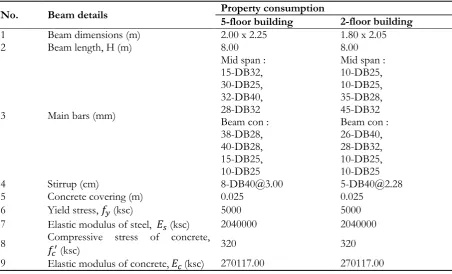
The beams’ cross-sectional areas and the reinforced steel bars used in the buildings are shown in Fig. 4.6.
Fig. 4.6. Designs of the beams’ cross-sectional areas and the reinforced steel bar.
[image:16.595.73.526.310.584.2]The requirements for designing the pressure- and temperature-resistant beams on both buildings are shown in Table 4.4.
Table 4.4. Beam design requirements for the pressure load of 300 bars and temperature load of 300 C on both buildings.
No. Beam details Property consumption 5-floor building 2-floor building
1 Beam dimensions (m) 2.00 x 2.25 1.80 x 2.05
2 Beam length, H (m) 8.00 8.00
3 Main bars (mm)
Mid span : 15-DB32, 30-DB25, 32-DB40, 28-DB32 Beam con : 38-DB28, 40-DB28, 15-DB25, 10-DB25
Mid span : 10-DB25, 10-DB25, 35-DB28, 45-DB32 Beam con : 26-DB40, 28-DB32, 10-DB25, 10-DB25
4 Stirrup (cm) [email protected] [email protected]
5 Concrete covering (m) 0.025 0.025
6 Yield stress, 𝑓𝑦(ksc) 5000 5000
7 Elastic modulus of steel, 𝐸𝑠(ksc) 2040000 2040000
8 Compressive stress of concrete, 𝑓
𝑐′(ksc) 320 320
9 Elastic modulus of concrete, 𝐸𝑐 (ksc) 270117.00 270117.00
The pressure load of 300 bars and the temperature load of 300
C affecting the buildings externally, as shown in Fig. 4.7, caused the maximum reaction force and moment to the slabs, as shown in Table 4.5.Table 4.5. Maximum reaction force and moment caused to the slabs on the 5-floor and 2-floor buildings.
Combined slab pressure load of 300 bars and temperature load of 300 C
5-floor 2-floor
Reaction force (kgs) 412796 128940
[image:16.595.97.501.660.714.2]Fig. 4.7. Combined pressure load of 300 bars and temperature load of 300 C on the slabs.
[image:17.595.99.498.250.334.2]The slabs’ cross-sectional areas and the reinforced steel bars used in the buildings are shown in Fig. 4.8.
Fig. 4.8. Designs of the slabs’ cross-sectional areas and the reinforced steel bars.
The requirements for designing the pressure- and temperature-resistant slabs on both buildings are shown in Table 4.6.
Table 4.6. Slab design requirements for the pressure load of 300 bars and temperature load of 300 C on both buildings.
No. Slab details Property consumption 5-floor building 2-floor building
1 Slab dimensions (m) 8.00 x 6.00 8.00 x 6.00
2 Slab thickness (cm) 40.00 35.00
3 Main bars (cm) DB28@6 DB28@6
4 Concrete covering (cm) 2.50 2.50
5 Yield stress, 𝑓𝑦(ksc) 5000 5000
6 Elastic modulus of steel, 𝐸𝑠(ksc) 2040000 2040000
7 Compressive stress of concrete, 𝑓
𝑐′(ksc) 320 320
8 Elastic modulus of concrete, 𝐸𝑐 (ksc) 270117 270117
5.
Summary
[image:17.595.68.531.448.595.2]Fig. 5.1. Designs of the columns’ cross-sectional areas and the reinforced steel bars on both buildings.
The columns’ cross-sectional areas and reinforced steel barsfor the 5-floor and 2-floor buildings are different due to variation in the reaction force and moment used to design structural components, as shown in Table 5.1.
Table 5.1. Comparison of the columns’ reaction force, reaction moment, and cross-sectional areas on both buildings.
Column Reaction force (kgs) Reaction moment (kgs) Cross-sectional dimensions (m)
HP test (5-floor building) 18533129 3110703 2.40 x 2.40
HP test (2-floor building) 15632659 1978084 2.00 x 2.00
HT test (5-floor building)
HT test (2-floor building) 25448 21183 1488.28 1060.65 0.45 x 0.45 0.35 x 0.30
HP/HT test (5-floor building) 18558577 3112192 2.40 x 2.40
HP/HT test (2-floor building) 15653842 1979144 2.00 x 2.00
From Table 5.1, the reaction force and moment on the 5-floor building are greater than those on the 2-floor building. Also, the reaction force and moment from the pressure loads are greater than those from the temperature loads, resulting in larger columns’ cross-sectional areas and the reinforced steel bars.
[image:18.595.67.529.567.671.2]Fig. 5.2. Designs of the beams’ cross-sectional areas and the reinforced steel bars on both buildings.
The beams’ cross-sectional areas and reinforced steel barsfor the 5-floor and 2-floor buildings are different due to variation in the reaction force and moment used to design structural components, as shown in Table 5.2.
Table 5.2. Comparison of the beams’ reaction force, reaction moment, and cross-sectional areas on both buildings.
Beam Reaction force (kgs) Reaction moment (kgs) Cross-sectional dimensions (m)
HP test (5-floor building) 36966603 3111132 2.00 x 2.20
HP test (2-floor building) 28484569 237696 1.80 x 2.00
HT test (5-floor building)
HT test (2-floor building) 36435 26284 1842 742 0.40 x 0.45 0.35 x 0.45
HP/HT test (5-floor building) 37003043 3112974 2.00 x 2.20
HP/HT test (2-floor building) 28510853 2358439 1.80 x 2.00
From Table 5.2, the reaction force and moment on the 5-floor building are greater than those on the 2-floor building. Also, the reaction force and moment from the pressure loads are greater than those from the temperature loads, resulting in larger beams’ cross-sectional areas and the reinforced steel bars.
[image:19.595.66.529.551.654.2]Fig. 5.3. Designs of the slabs’ cross-sectional areas and the reinforced steel bars on both buildings.
The slabs’ cross-sectional areas and reinforced steel barsfor the 5-floor and 2-floor buildings are different due to variation in the reaction force and moment used to design structural components, as shown in Table 5.3.
Table 5.3. Comparison of the slabs’ reaction force, reaction moment, and cross-sectional areas on both buildings.
Slab Reaction force (kgs) Reaction moment (kgs) Cross-sectional dimensions (m)
HP test (5-floor building) 376361 1574108 8.00 x 6.00 x 0.40
HP test (2-floor building) 121338 753934 8.00 x 6.00 x 0.35
HT test (5-floor building)
HT test (2-floor building) 36435 7602.45 1888.28 2103 8.00 x 6.00 x 0.35 8.00 x 6.00 x 0.30 HP/HT test (5-floor building) 421796 1575966.33 8.00 x 6.00 x 0.40
HP/HT test (2-floor building) 128940 756037 8.00 x 6.00 x 0.35
From Table 5.3, the reaction force and moment on the 5-floor building are greater than those on the 2-floor building. Also, the reaction force and moment from the pressure loads are greater than those from the temperature loads, resulting in larger slabs’ cross-sectional areas and the reinforced steel bars.
6.
Conclusions
[image:20.595.65.530.493.596.2]References
[1] W. L. Bounds, Design of Blast Resistant Buildings in Petrochemical Facilities. ASCE Publications, 2010. [2] Design of Structures to Resist the Effects of Accidental Explosions, US Department of the Army Technical
Manual, TM5-1300, 1990.
[3] Design Guide 26 Design of Blast Resistant Structures, AISC, 2013.
[4] Design of Structures to Resist Nuclear Weapons Effects, ASCE, 1985.
[5] C. J. Oswald, “Blast design considerations for structural engineers,” 2007.
[6] J. A. Clarke, Energy Simulation Building Design, 2nd ed. Environmental Engineering, University of Strathclyde, Glasgow, Scotland, 2001.
[7] J. E. Shepherd, “Structural response to explosions,” presented at 1st European School on Hydrogen Safety, Olster, California Institute of Technology, 2007.
[8] D. N. Bilow and M. E. Kamara, “Fire and concrete structures,” in Proc. Conf. Structures: Crossing Borders, ASCE, 2008.
[9] International Building Code Section 1602.1., 2006.
[10] Euro code, EN 1990 – Basis of structural design section 4.1.1, 1990.
[11] Euro code, EN 1991-1-1, 1: Actions on Structures – Part 1-1: General actions – densities, self-weight, imposed loads for buildings section 3.2, 1991.
[12] Building code Requirement for Structural Commentary, American Concrete Institute, ACI318, 1941.
[13] H. Draganić and V. Sigmund, “Blast loading on structures,” Technical Gazette, vol. 19, no. 3, pp. 643-652, 2012.
[14] Minimum Design Loads for Buildings and Other Structures, American Society of Civil Engineers, ASCE/SEI
7-05, 2006, p. 1.
[15] Eurocode, EN 1990. 0: Basis of structural design “1.5.3.1”, Bruxelles, European Committee for
Standardization, 2002.
[16] T. Ngo, P. Mendis, A. Gupta, and J. Ramsay, “Blast loading and blast effects on structures–An overview,” Electronic Journal of Structural Engineering, vol. 7, no. S1, pp. 76-91, 2007.
[17] G. F. Kinney and K. J. Graham, “Internal blast,” in Explosive Shocks in Air. 1985, ch. 9. [18] Hazardous Areas Classification - European Standard.
[19] G. Le Blanc, M. Adoum, and V. Lapoujade, “External blast load on structures–Empirical approach,” in
5th European LS Dyna Users Conference, France, May 2005.
[20] NATO Handbook on the Medical Aspects of NBC Defensive Operations A Med P-6(B) Chapter 3. Effects of Nuclear Explosions, Feb. 1996.
![Table 1.1. Ratio of explosive mass to distance from the detonation source [16].](https://thumb-us.123doks.com/thumbv2/123dok_us/8106513.235253/4.595.209.387.373.501/table-ratio-explosive-mass-distance-detonation-source.webp)