promoting access to White Rose research papers
White Rose Research Online
Universities of Leeds, Sheffield and York
http://eprints.whiterose.ac.uk/
White Rose Research Online URL for this paper:
http://eprints.whiterose.ac.uk/4507/
Conference paper
Al-Maskari, A and Sanderson, M. (2006)
An analysis of machine translation
errors on the effectiveness of an Arabic-English QA system.
In: Proceedings of
the EACL Workshop on Multilingual Question Answering (MLQA06). Workshop
on Multilingual Question Answering - MLQA'06, April 4, 2006, Trento, Italy
Dutch 1.90% Arabic, 1.70%
English, 39.6%
Chinses, 14.7% Spanish,
9.6% Japanese
9% German
7.4% French 4.5%
Italian, 4.1% Korean 4.2% Portuegese
3.3%
The Affect of Machine Translation on the Performance of
Arabic-English QA System
Azzah Al-Maskari
Dept. of Information Studies,
University of Sheffield,
Sheffield, S10 2TN, UK
[email protected]
Mark Sanderson
Dept. of Information Studies,
University of Sheffield,
Sheffield, S10 2TN, UK
[email protected]
Abstract
The aim of this paper is to investigate how much the effectiveness of a Ques-tion Answering (QA) system was af-fected by the performance of Machine Translation (MT) based question transla-tion. Nearly 200 questions were selected from TREC QA tracks and ran through a question answering system. It was able to answer 42.6% of the questions correctly in a monolingual run. These questions were then translated manually from Eng-lish into Arabic and back into EngEng-lish us-ing an MT system, and then re-applied to the QA system. The system was able to answer 10.2% of the translated questions. An analysis of what sort of translation er-ror affected which questions was con-ducted, concluding that factoid type questions are less prone to translation er-ror than others.
1
Introduction
Increased availability of on-line text in languages other than English and increased multi-national collaboration have motivated research in Cross-Language Information Retrieval (CLIR). The goal of CLIR is to help searchers find relevant documents when their query terms are chosen from a language different from the language in which the documents are written. Multilinguality has been recognized as an important issue for the future of QA (Burger et al. 2001). The multilin-gual QA task was introduced for the first time in the Cross-Language Evaluation Forum CLEF-2003.
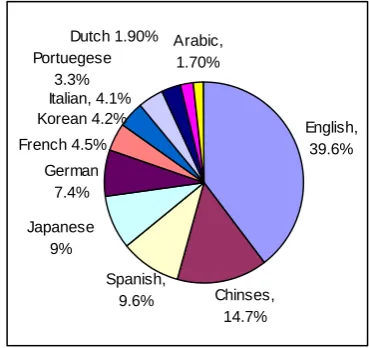
[image:2.595.319.504.374.548.2]According to the Global Reach web site (2004), shown in Figure 1, it could be estimated that an English speaker has access to around 23 times more digital documents than an Arabic speaker. One can conclude from the given infor-mation shown in the Figure that cross-language is potentially very useful when the required in-formation is not available in the users’ language.
Figure 1: Online language Population (March, 2004)
This paper investigates the extent to which MT error affects QA accuracy. It is divided as follows: in section 2 relevant previous work on cross-language retrieval is described, section 3 explains the experimental approach which in-cludes the procedure and systems employed, it also discuss the results obtained, section 4 draws conclusions and future research on what im-provements need to be done for MT systems.
2
Related Research
CLIR is an active area, extensive research on CLIR and the effects of MT on QA systems’ re-trieval effectiveness has been conducted. Lin and Mitamua (2004) point out that the quality of translation is fully dependent upon the MT sys-tem employed.
Perret (2004) proposed a question answering system designed to search French documents in response to French queries. He used automatic translation resources to translate the original que-ries from (Dutch, German, Italian, Portuguese, Spanish, English and Bulgarian) and reports the performance level in the monolingual task was 24.5% dropping to 17% in the bilingual task. A similar experiment was conducted by Plamondon and Foster (2003) on TREC questions and meas-ured a drop of 44%, and in another experiment using Babelfish, the performance dropped even more, 53%. They believe that CLEF questions were easier to process because they did not in-clude definition questions, which are harder to translate. Furthermore, Plamondon and Foster (2004) compare the cross language version of their Quantum QA system with the monolingual English version on CLEF questions and note the performance of a cross-language system (French questions and English documents) was 28% lower than the monolingual system using IBM1 translation.
Tanev et al. (2004) note that DIOGENE sys-tem, which relies on the Multi-WordNet, per-forms 15% better in the monolingual Italian) than cross-language task (Italian-English). In Magnini et al.’s (2004) report for the year 2003, the average performance of correct answers on monolingual tasks was 41% and 25% in the bilingual tasks. In addition in the year 2004, the average accuracy in the monolingual tasks was 23.7% and 14.7% in bilingual tasks.
As elucidated above, much research has been conducted to evaluate the effectiveness of QA systems in a cross language platform by employ-ing MT systems to translate the queries from the
source language to the target language. How-ever, most of them are focused on European lan-guage pairs. To our knowledge, only one past example of research has investigated the per-formance of a cross-language Arabic-English QA system Rosso et al (2005). The QA system used by Rosso et al (2005) is based on a system reported in Del Castillo (2004). Their experiment was carried out using the question corpus of the CLEF-2003 competition. They used questions in English and compared the answers with those obtained after the translation back into English from an Arabic question corpus which was manually translated. For the Arabic-English translation process, an automatic machine trans-lator, the TARJIM Arabic-English machine translation system, was used. Rosso el al re-ported a decrease of QA accuracy by more than 30% which was caused by the translation proc-ess.
Work in the Rosso paper was limited to a sin-gle QA and MT system and also did not analyze types of errors or how those errors affected dif-ferent types of QA questions. Therefore, it was decided to conduct further research on MT sys-tems and its affect on the performance in QA systems. This paper presents an extension on the previous mentioned study, but with more diverse ranges of TREC data set using different QA sys-tem and different MT syssys-tem.
3
Experimental Approach
To run this experiment, 199 questions were ran-domly compiled from the TREC QA track, namely from TREC-8, TREC-9, TREC-11, TREC-2003 and TREC-2004, to be run through AnswerFinder, the results of which are discussed in section 3.1. The selected 199 English TREC questions were translated into Arabic by one of the authors (who is an Arabic speaker), and then fed into Systran to translate them into English. The analysis of translation is discussed in detail in section 3.2.
3.1 Performance of AnswerFinder
The 199 questions were run over AnswerFinder; divided as follows: 92 factoid questions, 51 defi-nition questions and 56 list questions. The an-swers were manually assessed following an as-sessment scheme similar to the answer categories in iCLEF 2004:
• Correct: if the answer string is valid and
• Non-exact: if the answer string is
miss-ing some information, but the full answer is found in the snippets.
• Wrong: if the answer string and the
snippets are missing important informa-tion or both the answer string and the snippets are wrong compared with the an-swer key.
• No answer: if the system does not return
[image:4.595.108.239.326.387.2]any answer at all.
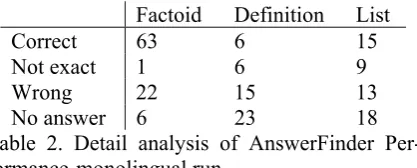
Table 1 provides an overall view, the system cor-rectly answered 42.6% of these questions, whereas 25.8% wrongly, 23.9% no answer and 8.1% non-exactly. Table 2 illustrates Answer-Finder’ abilities to answer each type of these questions separately.
Table 1. Overall view of AnswerFinder Mono-lingual Accuracy
Factoid Definition List
Correct 63 6 15
Not exact 1 6 9
Wrong 22 15 13
[image:4.595.78.287.431.515.2]No answer 6 23 18 Table 2. Detail analysis of AnswerFinder Per-formance-monolingual run
To measure the performance of Answer-Finder, recall (ratio of relevant items retrieved to all relevant items in a collection) and precision (the ratio of relevant items retrieved to all re-trieved items) were calculated. Thus, recall and precision and F-measure for AnswerFinder are, 0.51 and 0.76, 0.6 respectively.
3.2 Systran Translation
Most of the errors noticed during the transla-tion process were of the following types: wrong transliteration, wrong word sense, wrong word order, and wrong pronoun translations. Table 3 lists Systran’s translation errors to provide cor-rect transliteration 45.7%, wrong word senses (key word) 31%, wrong word order 25%, and wrong translation of pronoun 13.5%.
Below is a discussion of Systran’ translation accuracy and the problems that occurred during translation of the TREC QA track questions.
Table 3. Types of Translation Errors
Wrong Transliteration
Wrong transliteration is the most common error that encountered during translation. Translitera-tion is the process of replacing words in the source language with their phonetic equivalent in the target language. Al-Onaizan and Knight (2002) state that transliterating names from Ara-bic into English is a non-trivial task due to the differences in their sound and writing system. Also, there is no one-to-one correspondence be-tween Arabic sounds and English sounds. For example P and B are both mapped to the single Arabic letter “ب”; Arabic “ح” and “ﻩ “are mapped into English H.
Table 4. Incorrect use of translation when trans-literation should have been used
Table 5. Wrong translation of person’s name Transliteration mainly deals with proper names errors when MT doesn’t recognize them as a proper name and translates them instead of transliterating them. Systran produced 91 ques-tions (45.7%) with wrong transliteration. It trans-lated some names literally, especially those with a descriptive meaning. Table 4 provides an ex-ample of such cases where “Aga” was wrongly transliterated; and “khan” was translated to “be-tray” where it should have been transliterated. This can also be seen in table 5; “Hassan Ro-hani” was translated literally as “Spiritual good-ness”.
Answer Type
Correct 42.6% Non exact 8.1%
Wrong 25.8% No Answer 23.9%
Type of Translation Error Percentage Wrong Transliteration 45.7%
Wrong Sense 31%
Wrong Word Order 25% Wrong Pronoun 13.5%
Original text Who is Aga1 Khan2?
Arabic version ؟نﺎﺧ2ﺎﺟا1نﻮﻜﻳﻦﻣ
Translation (wrong)
From [EEjaa] 1
be-trayed2?
Original text Who is Hasan1 Rohani2
Arabic version ؟ﻲﻧﺎﺣور2ﻦﺴﺣ1نﻮﻜﻳﻦﻣ
Translation (wrong)
From spiritual2 goodness1
Wrong Word Sense
Wrong translation of words can occur when a single word can have different senses according to the context in which the word is used. Word sense problems are commoner in Arabic than in a language like English as Arabic vowels (written as diacritics) are largely unwritten in most texts.
Systran translated 63 questions (31.2%) with at least one wrong word sense, 25% of them could have been resolved by adding diacritics. Table 6 illustrates an error resulting from Systran’s failure to translate words correctly even after diacritics have been added; the term “ﺲﻔٌﻨﻟا ﻢﻠِﻋ” (psychology) was wrongly translated as “flag of breath”. The Arabic form is a com-pound phrase; however Systran translated each word individually even after diacritics were added.
Original text Who was the father of psy-chology?
Arabic ver-sion
ﺲﻔٌﻨﻟاﻢﻠِﻋبأﻦَﻣ
Translation (wrong)
[image:5.595.306.540.75.154.2]From father flag of the breath?
Table 6. Example of incorrect translation due to incorrect sense choice
These errors can occur when a single word can have different senses according to the con-text in which the word is used. They also occur due to the diacritization in Arabic language. Arabic writing involves diacritization (vowel), which is largely ignored in modern texts. Ali (2003) gives a good example that can make an English speaker grasp the complexity caused by dropping Arabic diacritization. Suppose that vowels are dropped from an English word and the result is ‘sm’. The possibilities of the original word are: some, same, sum, and semi.
Systran translated 63 questions out of 199 (31.2%) with wrong word sense, 25% of them can be resolved by adding diacritization.
Wrong Word Order
Word order errors occurred when the translated words were in order that made no sense and this problem produced grammatically ill formed sen-tences that the QA system was unable to process. Systran translated 25% of the questions with wrong word orders which lead to the construc-tion of ungrammatical quesconstruc-tions. Table 7 shows an example of wrong word order.
Table 7. Wrong word order
Wrong Pronoun
Systran frequently translated the pronoun “ﻩو” to “air” in place of “him” or “it” as shown in table 8. Table 9 shows an example pronoun problems; the pronoun “ﻩا” is translated into “her”, instead of “it”, which refers to “building” in this case.
Original text Who is Colin Powell? Arabic version ؟لوﺎﺑﻦﻟﻮآﻮُه ﻦَﻣ Translation
(wrong)
From Collin Powell air? Table 8. Wrong translation of “who”
Table 9. wrong pro-drop of translation of “it” It has been observed that Systran translation errors exhibited some clear regularities for cer-tain questions as might be expected from a rule-based system. As shown in tables 2,3,4,7 the term “ُﻦَﻣ” was translated to “from” instead of “who”. This problem is related to the recognition of diacritization.
English Translation Arabic
Word Returned Expected
ﻢﺠﺣ Big size
لﻮﻃأ Tall, big long
ضرﻷا Ground earth
ﺪﺟﻮﻳ Create locate
لود Nation country
ﺪﻌﺑأ Far distance
أ
[image:5.595.73.290.312.419.2]ﺮﺜآ Many most, much Table 10. List of wrong key word returned by Systran
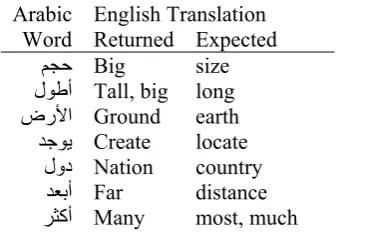
The evaluator observed that Systran’ propen-sity to produce some common wrong sense trans-lations which lead to change the meaning of the questions, table 10 shows some of these common sense translation.
Original text What are the names of the space shuttles?
Arabic version ؟ﻲﺋﺎﻀﻔﻟاكﻮﻜﻤﻟاءﺎﻤﺳأﺎﻣ
Translation (wrong)
What space name of the shuttle?
Original text What buildings had Frank de-signed?
Arabic version ؟ﻚﻧاﺮﻓﺎﻬﻤﻤﺻﻲﺘﻟاﻲﻧﺎﺒﻤﻟاﺎﻣ
Translation (wrong)
[image:5.595.331.514.524.641.2]3.3 The Effectiveness of AnswerFinder combined with Systran’ Translation
After translating the 199 questions using Systran, they were passed to AnswerFinder. Figure 2 il-lustrates the system’s abilities to answer the original and the translated questions; Answer-Finder was initially able to answer 42.6% of the questions while after translation, its accuracy to return correct answers dropped to 10.2%. Its failure to return any answer increased by 35.5% (from 23.9% to 59.4%); in addition, non-exact answers decreased by 6.6% while wrong answers increased by 3.6% (from 25.4% to 28.9%).
42.6
8.1 1.5
28.9
59.4
25.4 23.9
10.2
correct not exact wrong no answer
O
ri
g
inal
/T
ra
n
s
la
ted S
u
c
c
es
s
(%
original translated
Figure 2. Answering Original/Translated Ques-tions (%)
AnswerFinder was able to answer 23 trans-lated questions out of 199. Out of these 23 ques-tions, 12 were correctly translated and 11 exhib-ited some translation errors. Looking closely at the 12 corrected translated question (shown in table 11), 9 of them are of the factoid type, one of definition type and two of the list type. And by investigating the other 11 questions that ex-hibited some translation errors (shown in table 12), it can be noticed that 9 of them are factoid and 2 are list types. Our assumption for Systran’ ability to translate factoid questions more than definition and list questions is that they exhibited less pronouns, in contrast to definition and list questions where many proper names were in-cluded.
In total, Systran has significantly reduced An-swerFinder’s ability to return correct answers by 32.4%. Table 13 shows recall, precision and F-measure before and after translation, the value of recall before translation is 0.51 and after transla-tion has dropped down to 0.12. Similarly, the precision value has gone down from 0.76 to 0.41, accordingly the F-measure also dropped down
from 0.6 to 0.2. Altogether, in multilingual re-trieval task precision and recall are 40.6% and 30%, respectively, below the monolingual re-trieval task.
Question Type
Correctly translated
Correctly answered after translation Factoid (9/92) (19/92) Defn. (1/51) (0/51) List (2/56) (3/56)
[image:6.595.78.297.254.422.2]Total 12 13
Table 11. Types of questions translated and an-swered correctly in the bilingual run
Translation Error Type Question Type Word Sense 4 factoid Word Order 2 factoid, 2 list
Diacritics 2 factoid
Transliteration 1 factoid
Total 11 questions
Table 12. Classification of wrongly translated questions but correctly answered
Effectiveness measure
Before Trans-lation
After Trans-lation
Recall 0.51 0.12 Precision 0.76 0.41 F-measure 0.6 0.2 Table 13. Effectiveness measures of Answer-Finder
4
Conclusions
Systran was used to translate 199 TREC ques-tions from Arabic into English. We have scruti-nized the quality of Systran’s translation through out this paper. Several translation errors ap-peared during translations which are of the type: wrong transliteration, wrong word sense, wrong word order and wrong pronoun. The translated questions were fed into AnswerFinder, which had a big impact on its accuracy in returning cor-rect answers. AnswerFinder was seriously af-fected by the relatively poor output of Systran; its effectiveness was degraded by 32.4%. This conclusion confirms Rosso et al (2005) findings using different QA system, different test sets and different machine translation system. Our results validate their results which they concluded that translation of the queries from Arabic into Eng-lish has reduced the accuracy of QA system by more than 30%.
multiple MT systems than in a single MT sys-tem. However, it is essential to note that in some cases MT systems may all disagree with one an-other in providing correct translation or they may agree on the wrong translation.
It should also be borne in mind that some keywords are naturally more important than oth-ers, so in a question-answering setting it is more important to translate them correctly. Some words may not be as important, and some key-words due to the incorrect analysis of the English question sentence by the Question Analysis module, may even degrade the translation and question-answering performance.
We believe there are ways to avoid the MT er-rors that discussed previously (i.e. wrong trans-literation, wrong word senses, wrong word order, and wrong translation of pronoun). Below are some suggestions to overcome such problems:
• One solution is to make some adjust-ments (Pre or Post- processing) to the question translation process to minimize the effects of translation by automatically correcting some regular errors using a regular written expression.
• Another possible solution is to try build-ing an interactive MT system by providbuild-ing users more than one translation to pick the most accurate one, we believe this will of-fer a great help in resolving word sense problem. This is more suit-able for expert users of a language.
In this paper, we have presented the errors as-sociated with machine translation which indi-cates that the current state of MT is not very reli-able for cross language QA. Much work has been done in the area of machine translation for CLIR; however, the evaluation often focuses on re-trieval effectiveness rather than translation cor-rectness.
Acknowledgement
We would like to thank EU FP6 project BRICKS (IST-2002-2.3.1.12) and Ministry of Manpower, Oman, for partly funding this study. Thanks are also due to Mark Greenwood for helping us with access to his AnswerFinder system.
References
Burger, J., Cardie, C., Chaudhri, V., Gaizauskas, R., Harabagiu, S., Israel, D., Jacquemin, C., Lin,C., Maiorano, S., Miller, G., Moldovan, D., Ogden, B., Prager, J., Riloff, E., Singhal, A., Shrihari, R.,
Strzalkowski, T., Voorhees, E., Weishedel, R., (2001) Issues, Tasks and Program Structures to Roadmap Research in Question & Answering (Q&A). Technical report, National Institute of Standards and Technology (NIST)
Del Castillo, M., Montes y Gómez, M., and Vil-laseñor, L. (2004) QA on the web: A preliminary study for Spanish language. Proceedings of the 5th Mexican International Conference on Computer Science (ENC04), Colima, Mexico.
Hull, D. A., and Grefenstette, G. (1996) Querying across languages: a dictionary-based approach to multilingual information retrieval. Research and Development in Information Retrieval, pp46-57.
Lin, F., & Mitamura, T. (2004) Keyword Translation from English to Chinese for Multilingual QA. In:
The 6th Conference of the Association for Machine Translation in the Americas (AMTA-2004)
Magnini, B., Vallin, A., Ayache C., Erbach, G., Peñas, A., Rijke, M. Rocha, P., Simov, K., Sut-cliffe, R. (2004) Overview of the CLEF 2004 Multi-lingual Question Answering Track. In: Pro-ceedings of CLEF 2004
Perrot, L. (2004). Question Answering system for the French Language. In: Proceedings of CLEF 2004
Plamondon, L. and Foster, G. (2003) Quantum, a French/English Cross-Language Question Answer-ing System. Proceedings of CLEF 2003
Tanev, H., Negri, M., Magnini, B., Kouylekov, M. (2004) The Diogenes Question Answering System at CLEF-2004. Proceedings of CLEF 2004