GE-International Journal of Management Research
Vol. 5, Issue 4, April 2017 Impact Factor- 5.779 ISSN(O): 2321-1709, ISSN(P): 2394-4226
© Associated Asia Research Foundation (AARF)
Website: www.aarf.asia Email : [email protected] , [email protected]A STUDY OF NEW GEN WORKFORCEFOR EFFECTIVE LEARNING
TRANSFER FOR BUSINESS IMPACT IN INDIAN SERVICE
INDUSTRY, WITH SPECIFIC REFERENCE TO
INFORMATION TECHNOLOGY SECTOR
Prasad G. Akerkar
Research Scholar, Sydenham Institute of Management Studies, Research and Enterprise Education (SIMSREE), Mumbai
Under the Guidance of
Dr. R.K. Srivastava
Professor and Head
Sydenham Institute of Management Studies, Research and Enterprise Education (SIMSREE), Mumbai
ABSTRACT
Service Sectors in India is undergoing major transformation phase in today’s time. In order
to achieve sustainable profitable growth, this sector is facing key competitive challenges such
as operational efficiency, delivery productivity, global customer satisfaction and talent
development & retention across their delivery centers. Training, Learning & Development
(L&D) plays a significant role in these organizations by providing cutting edge leadership in
technology & business management. It’s therefore very important to accomplish and measure
the effectiveness and efficiency of L&D for real life business application and building
learning assets for such organizations. Interestingly, India has one of the largest young
workforce in the world, with over 65 % of its population under the age of 35. Today, Indian
service sector employ about 3-4 generations at a time with generation Y alias millennials
constituting about 70% of the total workforce. They have varied social demographic, have
changing interests in diverse fields, and are innovative, creative & restless in nature. There
are however, lots of myths about them and their behavioral styles and patterns which needs
proper elaboration and reconciliation. It’s therefore necessary to examine the impact of this
important variable in determining the learning maturity of the organization and
and co-excellence and hence a better win-win for individuals and organizations. The purpose
of this paper, therefore, is to study this significant variable of L&D ecosystem constituting to
its effectiveness for business results and various ways of formal and informal learning
strategies & business interfaces that resonate most with these new generation employees,
being an emerging part of a multi-generation workforce of India Inc.
Keywords: Training effectiveness, Learnability, Business Results, Service Sector, IT
Organizations, India
Introduction
India today is gaining favorite status as cost-effective, quality service provider among the
various other developing countries across globe. According to IMF study (2016) on
anchoring growth in emerging markets and developing economies, technology plays a
significant role in resource capitalization, productivity gains and sustainable economic
growth. Despite the slowdown that had engulfed technology spending worldwide, this sector
continued to grow at a robust rate with CAGR of around 13-15 % during last decade. Indian
Information Technology-Business Process Management (IT-BPM) sector revenue recorded
an impressive growth of 13% from USD 130 billion in FY2014 to USD 160 billion in
FY2016 with IT services revenue share alone at USD 75 billion. Interestingly, today while
the export segment share account for about 68% of total revenue, the domestic segment is
also growing steadily on account of central government‟s programs on “Digital India”, “Make in India” and “Start-up India”. However, currency volatility, macroeconomic
headwinds and obstacles for quick adaption to changing technologies are likely to pull down
growth of Indian IT & BPM services exports to around 10-11 % for FY17 & FY18 (Source:
Nasscom Strategic Review Report, February 2016). It‟s therefore necessary to examine the
ways and means that can rapidly elevate this sector from productivity and operational
efficiency perspective and help achieve its revenue, profit and growth targets on sustainable
basis. Researchers, practitioners and industry experts believe that Learning and Development
(L&D) is one such field that can play a significant role in this sector in order to provide
required impetus for sustainable growth. Therefore, continuous training & learning is an
absolute essential dimension of this industry alongwith its effectiveness and impact on
business results. It‟s thus highly imperative to study the factors contributing the training &
learning effectiveness, how and to what extent they can enhance performing abilities of
potential impact due to such enhanced ability to perform. Zaciewski (2001) examined
employee' individual characteristics and stated that, alongwith the work environment,
motivation, attitude, and learners basic ability affect a training program and its potential
success. In today‟s changing times, it‟s essential to study and analyze the background and
profiles of learners, who are primarily new generation employees, assess their cognitive
behavior, diverse needs & wants, varied learning styles and how business can function
successfully with multiple generations, coexisting simultaneously. This paper, therefore,
focuses on these important factors and discusses a collaborative model that can help
corporates, governments, trade & commerce equally well, to leverage the same for higher
business efficacy.
Statement of Opportunity
The current major challenge in front of Indian service sector today is low operational
efficiency and gaps in desired competencies to achieve business success consistently. This
sector is often entangled with challenges like how to respond to the changing situation
quickly and effectively? How to develop flexible competencies on continuous basis?How to
carry out fulfilment efficiently & optimally and earn customer confidence and trust? How to
grow business by increasing revenue, controlling cost and managing operating profits? etc.
The new generation employees, being on the front end, are expected to respond to ever
changing customer needs and business pressures alongside. While they have some perceived
competency gaps in learnability and delivery orientation (which are becoming roadblocks),
these new generation employees expect right recognition and reward, growth opportunities,
better user experience & convenience, sense of achievement, moderate responsibilities,
collaboration & teamwork, and availability of open culture, commitment, low stress etc.
Their skills are also varied in terms of creativity, innovation, tech-orientation and leadership
skills. However they lack in experience, maturity, solution building approach, patience for
achievement, and value for money & time. Hence there is a need to develop a combination
approach at workplaces where multi-generations coexist alongwith their strengths and
challenges. This will lead to real effectiveness of learning and training, including
supplementary benefits such as helping employees to build their own development plans &
career progression, thus reducing attrition, enhancing motivation and improving productivity
etc. Importantly, there is also a growing need to look at training and development function,
not as a cost driver but more so as a value provider. The purpose of this paper therefore is to
examine the characteristics of this new generation workforce, their inherent traits and
various ways to build a stronger learning ecosystem to make the desired learning impact on
ground.
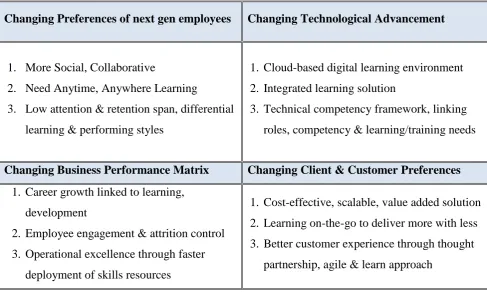
Following Table 1 depicts the four quadrants of today‟s Indian IT scenario indicating the
[image:4.595.68.556.127.419.2]changing times and changing preferences.
Table 1: Changing Preferences with Changing Time
Thus, it‟s realised that with changing times, preferences of employees, management,
customers are rapidly changing, with apt support of next gen science and technology.
Employees at the workplaces today are millennials with distinct preferences of likes and
dislikes, learning styles, span of attention and retention, needs and wants, digital acumen, and
social collaborations. They alongwith current generation need to work in cohesion and hence
a combination approach is needed to make learning effective and impactful. On the other
hand, due to such tech-savvy workforce in Indian IT organisations, the learning ecosystem
and network also need to be next gen learner friendly with features like flexibility,
cloud-based digital learning environment, end-to-end learning management system with appropriate
mapping of roles and required competencies and hence learning interventions needed thereof
etc. Indian IT management also have changed preferences for profitability, growth, employee
engagement and retention, operational efficiency etc. and global IT customers also need a
seamless customer experience with learning on-the-fly approach from their vendor partners,
dynamic solution alignment and thought partnership with value orientation. All these
Changing Preferences of next gen employees Changing Technological Advancement
1. More Social, Collaborative
2. Need Anytime, Anywhere Learning
3. Low attention & retention span, differential
learning & performing styles
1. Cloud-based digital learning environment
2. Integrated learning solution
3. Technical competency framework, linking
roles, competency & learning/training needs
Changing Business Performance Matrix Changing Client & Customer Preferences
1. Career growth linked to learning,
development
2. Employee engagement & attrition control
3. Operational excellence through faster
deployment of skills resources
1. Cost-effective, scalable, value added solution
2. Learning on-the-go to deliver more with less
3. Better customer experience through thought
changing aspects have varying impact on training and learning effectiveness, thus needing a
detailed study thereof.
Literature Review
A successful learning program is one which has higher effectiveness & efficiency and is
designed based on the expected business outcome. Donald L. Kirkpatrick postulated a
pioneering model for measuring training effectiveness and classifies the learning evaluation
in four levels. The first level (called Reaction) addresses learner‟s perceived reaction or
feedback while second level (called Learning) addresses the additional knowledge or skill
acquisition post learning. Third level (called Behavior) addresses the Observed/ demonstrated
change in work behavior of the learner through enhanced knowledge, skill or attitude while
the last level (called Results) addresses the tangibleimprovements in individual and/or
organization outcomes. This model, however, does not state the factor responsible for each of
these levels and ways to improve the same accordingly. Fischer and Ronald (2011) explained
that open-mindedness is a significant variable of training effectiveness and stated that training
become more successful if the participants and trainer work with open-mindedness.
Zaciewski (2001) examined employee' individual characteristics such as motivation, attitude,
and basic ability, which affect a training program and its potential success. Saks and Haccoun
(2007) consider learning transfer as the generalization of knowledge and skills learned in
training on the job and the maintenance of acquired knowledge and skills over time.
Larivie`re et al. (2013) highlights how value fusion emerges from consumers and firms
participating in mobile networks. Van Riel et al. (2013) consider how a service constellation
i.e. multiple interdependent services contributes to value creation, enabling innovative ways
of creating value.While learning transfer on the job is important, it‟s equally important to
consider the primary and secondary pressure points within delivery organizations of the
industry. The performance evaluation of business functions is typically done using balanced
KRAs/KPIs such as financial and customer related indicators e.g. profitability and customer
satisfaction index and also the operational indicators such as process compliance index, risk
& quality index, schedule & effort variance etc. For most of these factors, training &
development play an important role in terms of improving the skills and competencies
required to perform various roles in the diverse functions. Sa´nchez, et al. (2003) concluded
For the industry, training & learning being an integral part of talent supply chain, it‟s all the
more important to evaluate and measure learning effectiveness for higher resource utilization
of Gen Y & their delivery efficiency. Learnability and improved learning value of
multi-generation employees towards talent development, grooming and nurturing will eventually
help in shaping an organization as a learning & performing organization with lots of learning
assets for business efficacy. Some of the prominent learning effectiveness models are
Kirkpatrick„s four level model, Philips ROI model, Balanced Score Card model, Hamblin„s five level model, Warr„s framework of evaluation, Virmani and Premila‟s model of evaluation, Peter Bramely„s model of evaluation and David Reay„s approach to evaluation.
Learning Effectiveness for growth of IT Organization – a Theoretical Construct
As indicated earlier, effectiveness of any training & learning program should be rightly
measured based on how it impacts business results, at strategic as well as operational level.
These business resultscan be analyzed in terms of hard and soft data, both from employee
perspective as well as business, management perspective. For a full-blown conceptual
framework, the construct is defined in terms of multiple variables that are simultaneously
acting on each other as well as on ultimate outcome. Such variables are typically
independent, dependent, moderating or intervening in nature with a degree of correlation
among them. The conceptual model analyses the impact of the independent variables such as
profile of learners, relevancy of learning ecosystem and support from organization and
managers, on intervening variable, learnability and eventually on dependent variables, like
productivity, revenue growth & profitability, employee attrition and engagement etc.
A cognitive analysis of new generation workforce - a reality check
As stated above, profile of learner plays a very important role in this model such as the
background of learner, level of his/her motivation and ability to deliver successfully.
Generation gaps have taken on a whole new meaning today. Gen Y (those born between 1980
and 1995), Gen X (born between 1965 and 1980), Baby boomer (born between 1945 and
1965), Traditional (born before 1945) and the latest one, Gen Z (born after 1995) are the new
categories of generation today. The figures show that by the year 2020, India will have the
highest percentage of employable workforce in the world with over 500 million trained work
force by 2020. The generation-mix in the organizations would also vary as time moves, with
higher percentage coming from these newer groups. This necessitates the need for analyzing
Generation Ys now and their expectations & aspirations. Gen Ys population in India today is
skills and potentials crucial for value added economic growth. With more than 60 percent of
the GDP being fueled by the services sector today and an under-35 age group, Gen X and the
baby boomers want to analyze the way Gen Ys plan, think, act and behave. Today‟s youth
brings with them a set of distinct values, assumptions, and behavior to the workplace. This
generation has developed a widespread professional anxiety, ambitions and newer ways of
work-life balance. The arrival of Gen Y, has forced the organizations (who were mainly of
Gen X and baby boomers) to re-strategies the talent value chain including talent planning &
acquisition, talent development & deployment and talent performance management.
Gen Y, the Millennials, is the digital and internet generation which is tech-savvy, virtually
networked, and socially active generation. They love freedom, enjoy flexibility and are
confidently ambitious. GenX, on the contrary, mostly came from the culture wherein asking
questions to elders, teachers, and seniors was considered as taboo and there were defined set
expectations from everyone while choices were limited. Gen Y, on the other hand is bold to
challenge the authority and environment friendly. They look for societal change, they want
meaningful work in business & profession. It‟s opined that “these millennial don‟t live to work, but work to live” and while Gen X is thinking about how to prepare them for
leadership role, they‟re already thinking about buying the companies.
These young generation workforce are thus making their presence felt, compelling
organizations and corporates to re-think their business practices and rebuild their working
environment aligning to these breed of employees and managers. Generation Y is also
perceived as overrunning the workplaces, arriving as newcomers but wanting to overpower
the environment, challenging the presence of Gen X and baby boomers. They bring
alongwith them, the distinct digital technologies & their applications, their social contacts &
networks, their tech-savvy culture and new ways of business & people practices.
Though these millennials have different exposure & education, have creative mind and are
overwhelmed by technologies, they lack deep experience & envisioning for business focus to
showcase their abilities and wisdom. They are little lethargic, lack required discipline, get
bored fast, and are considered as “jumping jacks” for their lower degree of fortitude and
ability to adjust with given environment. Some of these observations are myths too.
According to a research carried out by Academy of HRD, Ahmedabad, corporate entities are
interested to know the career aspirations of Gen Y and the factors that motivates them. A
What are the Career Aspirations of Indian Gen Y professionals?
The Indian Gen Y professionals have higher thirst to climb the corporate ladder quickly and
have burning desire to get associated with a strong brands which visibly enhance their
self-definition. These big brand names thus attract Gen Ys, as their dream career choices.
Interestingly, highly focused Gen Ys are driven by distinctive aspiration to build, invent and
propagate something of their own. The study shows that Gen Ys are loyal to their jobs &
careers but may not be so to their organizations. This generation looks for competitive
learning & nurturing environment with a fast track career progression and a pre-determined
retirement age at around 45 years. With ever dynamic pressure from their ecosystem,
particularly from peers, they believe in proving and establishing everything right then &
there. This is a completely different story vis-a-vis that of Gen X and baby boomers.
What do they look for @ business workplaces?
This generation is very questioning, appreciate transparency & unambiguity at the
workplaces and hence look for sound company policies, considerate superior, flexible
working hours, responsibility and independence, fair compensation and direct appreciation
for their achievements at their workplaces. For them, the extrinsic factors of motivation are
equally important alongwith intrinsic motivation. Gen Ys love to express and socially
collaborate at the work and like to have a fun-filled, cheerful and open work culture. Their
orientation to accomplishment is much higher than their orientation to compensation &
benefits. They want to participate in most of the learning & development programs alongwith
hands-on experience in the field of their interest.
Some myths about Gen Y
While there are positive vibes about Gen Ys, there are also negative, non-encouraging
perceptions about these millennials. But the reality is Gen Y is here to stay and making their
space for them, on their own terms. According to a monsterTRAK® survey, the perceived
enigma is:
Gen Y is lazy, spoiled - As per the survey, one of the top goals of Generation Y was to “work faster and better than their coworkers.” This shows Generation Y‟s desire to
excel and make a contribution at work; they ask lots of questions to ascertain that they
are aware about the problems and challenges and try finding different and better ways
of doing the same, they are not lazy nor spoiled. They grew up knowing they were
valued and have high self-esteem.
and periodic feedback, acknowledgement of what and how they are doing. As they like
to voice their opinion and views boldly and do not compromise, it‟s perceived that
their attention and retention span is short.
Gen Y is disloyal, selfish - Generation Y makes workforce leaders face the fact that
loyalty is not given; it has to be earned. Managers should give them interesting work,
lots of feedback, chances to advance and rewards for good performance etc. In doing
so, they can become company‟s best and most loyal employees.
Gen Y lacks depth, has limited knowledge, does not believe in hard work - They do not use their brains as “large memory storage” but more as “faster processor” for primary
information and has ability to search for secondary, tertiary information based on need,
they know how to find and where to find this information quickly and accurately.
Some other myths about Gen Y are - they are indifferent about their future, they believe in
short term relationship, they do not want to connect with older generations, do not have work
ethics, ethos, prefers only digital conversations & communications, they believe careers as
purpose of their lives, are loners, believe in linear careers only and so on. These are not the
true observations.
Generation Y has been unfairly stereotyped. It is crucial that these myths, stereotypes do not
exist in the organizations or in the hearts and minds of employees. Leaders must fully
understand the implications of this new paradigm and provide support for both new and
current employees. Leaders must mentor and guide new employees using wisdom gained
throughout the years and make certain that new Gen Y talent is not dismissed or overlooked.
Furthermore, they must find ways to spread Generation Y‟s skills to older employees using
reverse mentoring process. For an emerging India Inc. therefore, Gen X and baby boomers
need to have a greater synergy & collaboration with Gen Y.
What are the Challenges & Opportunities for the Organizations?
As per the recent study, the key challenges in front of senior management today is to leverage
diverse generational talents, integrate multiple outlooks and deploy diversity & inclusion at
global workplaces in seamless manner. Identifying each generation‟s generic and specific
traits & personalities and weaving them into a cohesive culture for building & sustaining an
exciting & conducive environment is very challenging. The Generation Y is an extraordinary
force which is ambitious, cheerful, likes to embrace change and has a good intellect and
abilities. The organizations of today and tomorrow should therefore reconcile these facts
Gen XY – need for a synchronized approach
It‟s observed that each of these generations possesses different characteristics & traits as
required in the business and social world. Their strengths & challenges are different in
diverse competency areas, such as creativity & innovation, energy & enthusiasm, experience
& maturity, visioning & thinking-beyond ability, solution building & problem solving
approach, tech-savviness, and value for time & money etc. While typical baby boomers today
are at senior to top level of management in an organization, Gen X are at middle level and
Gen Y at foundation level, forming the bottom of the organization pyramid. Gen X as well as
Gen Y therefore are experiencing challenges to deal with each other and eventually align well
with organization goals and objectives. Hence, it‟s proposed that a combination workforce of
Gen X and Gen Y, termed as Gen XY, can follow a best of both world‟s approach through an
end-to-end Talent Supply Chain (TSC) process as well as Project Lifecycle Management
(PDLC) process. This means making a transformative change about the way contemporary
corporates managers think, strategies, and execute the policies & guidelines towards a
stronger employee value proposition. Some of the points that should be on top priority for
Gen XY model include resilient brand positioning, clear & concise communicationstrategies
leveraging social networking media, higher collaboration & participation of team members in
decision making and implementation of ideas, selection of their careers & roles, talent
development programs, a 360 degree appraisal & employee dialogues model using stronger
mentor-mentee networks etc.
Designing and implementing a new learning landscape for Gen Y
As these millennials choose to learn in newer and different ways, traditional training models
does not work. They need much more informal and just-in-time learning models to acquire
and assimilate varied knowledge and skills, as context is more important for them rather than
content. A blended learning model, thus embedded with formal as well as informal learning,
classroom as well as virtual, self-learning, micro as well as macro learning and autonomous
as well as mentor-based learning has become more successful in achieving its implicit as well
as explicit goals. Some of such new gen learning models include Collaborative Learning
(such as Facebook, Twitter, WhatsApp, Instagram etc.) to share, express, discuss and connect
real time, Micro Learning (such as bite-sized, easily digestible, video-based learning to suit
their attention & retention abilities), Gamified Learning (such as hackathon, high engagement
oriented simulated learning to create a real-life scenarios etc.), Experiential learning (such as
creation for a disruptive business model etc.) and Mentoring, Coaching (such as hand-holding
by gurus in respective areas, providing help in decision making, exploration and
self-discovery, building intrapreneurship for self-ownership, alignment with business, risk taking
abilities with result orientation etc.). It needs to be remembered that different employees of
same or different generations have different learning needs and styles, they have different
profiles, personas and expectations from self and organizations and hence the learning
professionals cannot have “one size fit for all” model, but a more customized learning
solution to suite different learners or a group of homogeneous learners.
Benefits of the SynchronizedModel
The benefits of collaboration for corporates are manifold, including better employee
engagement and retention, higher productivity and operational efficiency though detailed
breakdown of job-role structures, enhanced employee participation for a sustainable delivery
excellence, higher customer satisfaction and profitable organizational growth. Indian service
sector organization needs higher focus on Learnability, leading to higher business outcome
such as better service efficiency (Time to respond, analyze, resolve, escalate, fulfillment
index, total throughput time, customer satisfaction index, quality index, cost of service etc.).
On the other hand, from employee perspective the benefits are also exciting such as flexi
hours and working from home options, better work-life integration, motivation & incentive
for higher education, skill enhancement, sabbatical leave, multi-career options & aspirations,
experiential and fun-filled learning & development leading to self-progress, structured career
paths through value synchronization, better relationships with boss and senior management,
life beyond work such as sports and cultural activities within the organization and more such
beyond the traditions benefits.
Research Methodology
A robust research methodology was deployed as part of the research. This is in light of the
fact that the study revolved mainly around next gen employees, their specific needs & wants
and learning support that is required to enhance the learning effectiveness, to make positive
impact on business results of Indian Information Technology organisations. Research was
conducted across major metropolis in India, with specific focus on cities with IT
concentration. Respondents were selected across varied age and experience groups,
background, roles & responsibilities in order to avoid any bias thereof. Sample size was
across sector. Reliability and Validity tests were conducted for appropriateness of the
instrument, with required content, construct and criterion validity.
Result and Discussions
A detailed descriptive and statistical analysis suggested that there is a significant correlation
between the learners profile (in terms of his/her background, level of motivation, new gen
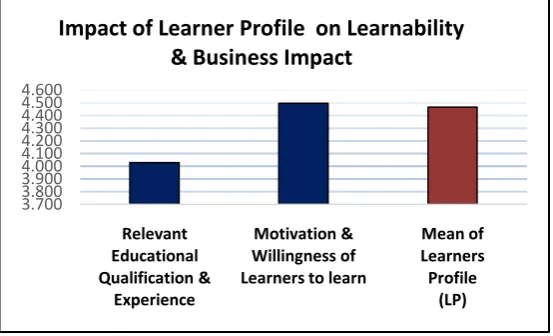
characteristics etc.), learnability and business impact. Following fig indicates the impact of
background of learners, as above on Business Impact. The scale used for analysis was
[image:12.595.163.440.278.446.2]Likert‟s 5 point scale.
Fig 1 - Impact of Learners Profile on Learnability and Business Impact
It‟s observed that 80.3% of the respondents opined that background of the learners in terms of
his/her new generation traits is an important determinant in deciding the business impact
whereas 95.4% respondents expressed that motivation and willingness to learn play an
important role determining learnability and eventually business impact thereof. About 94.5%
respondents on overall basis perceived that this independent variable is critical as part of
business impact learning model.As part of research, null & alternative hypothesis were
developed, either to accept or reject the same, post statistical tests. Non-parametric statistical
tests (such as Kruskal Wallis, Spearman‟s coefficient of correlation etc.) were carried out at
5% level of significance (95% confidence interval) which suggested a significant correlation
among the variables, indicating that the addressing new gen learners characteristics for
building subsequent learning ecosystem and other learning models play a significant role
during learning effectiveness for business impact in service sector organisations, with specific
reference to IT sector. 3.700 3.800 3.900 4.000 4.100 4.200 4.300 4.400 4.500 4.600
Relevant Educational Qualification &
Experience
Motivation & Willingness of Learners to learn
Mean of Learners Profile
(LP)
Conclusion and Recommendations
As majority of the workforce in Indian service sector is of generation Y i.e. between age
group of about 21 to 35, it‟s pertinent to understand and appreciate their characteristics
alongwith the root-cause thereof and then design, develop and implement the learning
interventions, build relevant learning environment & ecosystem, build a supportive mentoring
model of seniors alongside the needed support from senior managers and organization. This
workforce have attitude to learn on-the-go whether formal or informal, keep interest in
multiple happenings and events, learn by doing and anticipate quick returns therefrom. They
are here to stay and make their space at every corner of the organizations. The proposed Gen
XY model could therefore address the key challenges such as how to leverage these diverse
generational talents, integrate multiple outlooks and deploy diversity & inclusion at global
workplaces in seamless manner. Identifying each generation‟s generic and specific traits &
personalities and weaving them into a cohesive culture for building & sustaining an exciting
& conducive environment is really a big ticket item. The Generation Y in India is an
extraordinary force which is ambitious, cheerful, likes to embrace change and has good
intellectual abilities. The organizations can therefore leverage Gen Y‟s socio-techno skills
and smart decision making abilities while building organizations of next generations. A
rightly blended learning model addressing this collaborative ecosystem can thus lead to a
stronger learning value proposition.
Managing change effectively is one of the most important objectives of today‟s business
corporates and nations at large. With new gen employees joining the organizations, it‟s
important to study their changing patterns really well, and get them into mainstream of
decision making, learning & delivery initiatives and overall operational excellence. A good
understanding of psychometric analysis of such multi-generation workforce for enhancing
learning transfer efficacy for business impact, will help researchers, practitioners, business
leaders and industry experts to achieve a comprehensive win-win, individually and
collectively.
References
Aguinis, Herman and Kraiger, K. (2009). “Benefits of Training and Development for
Individuals, Teams, Organizations and Society”, Annual Review of Psychology
Antonio Arago´n-Sa´nchez, Isabel Barba-Arago´n and Raquel Sanz-Valle (2003), “Effects of
B.K. Punia, Saurabh Kant (2013), “A review of factors affecting training effectiveness
vis-à-vis managerial implications and future research directions”
Beigi, Mina and Shirmohammadi, Melika (2011). "Effects of an Emotional Intelligence
Training Program on Service Quality of Bank Branches", Managing Service Quality
Birdi, Kamal S. (2005). "No Idea- Evaluating the Effectiveness of Creativity Training",
Journal of European Industrial Training
Fischer, R. (2011). “Cross-Cultural Training Effects on Cultural Essentialism Beliefs and Cultural Intelligence”, International Journal of Intercultural Relations
John W. “Buddy” Hobart. „Understanding Gen Y – What you need to know about millennials”
Kalemci, P. (2005). “General Overview of Training Effectiveness and Measurement
Models”, Journal of Commerce and Tourism Education Faculty
Kirkpatrick, D. L. (1976). “Evaluation of Training, Training and development handbook: A guide to human resource development”, New York; McGraw-Hill Company
Michael F. Gorman (2011). “A Case Study in Effectively Bridging the Business Skills Gap for the Information Technology Professional”, Journal of Education for Business
NASSCOM – The IT-BPM Sector in India, Strategic Review 2016 (2016), 1-184
Ronaldo Pilati and Jairo Eduardo Borges-Andrade (2008) Affective predictors of the
effectiveness of training moderated by the cognitive complexity of expected competencies”,
International Journal of Training and Development
Ruth N. Bolton et al (2013), Understanding Generation Y and their use of social media: a
review and research agenda, Journal of Service Management, 24(3), 245-267
Saks, A. and Haccoun, R. (2007). Managing Performance through Training and
Development, Toronto, Nelson and Thompson Ltd.
Tassanee Homklin, Yoshi Takahashi & Kriengkrai Techakanont (2013), Effects of Individual
and Work Environment Characteristics on Training Effectiveness: Evidence from Skill
Certification System for Automotive Industry in Thailand, International Business Research,
6(12), 1-16