The interwar immigrants, 1916-1945
Context
The rising prosperity New Zealand enjoyed during and immediately after the Great War ended in a sharp recession in 1921-1922, the first of a number of economic fluctuations which culminated in the Depression of the 1930s. The Depression, in particular, saw a sharp fall in export prices and in New Zealand terms of trade, a fall of some 30 per cent in gross domestic product, and a decline in per capita incomes of between ten and 20 per cent.1 The rate of growth of the non-Maori population fell from an average of 2.2 per cent per annum from 1916 to 1926 to 1.1 per cent, during the period 1926-1936, and then to 0.8 per cent in the years from 1936 to 1945. That decline reflected a fall in the number of births, a continuing contraction in completed family size, postponement of marriage and child-bearing with depression and then war, and fluctuations in net immigration. It also stimulated a great deal of debate about ‘race suicide,’ optimum population size, defence, the role of women, and the need for immigration.
Graph 1: Sources of increase of non-Maori population, 1916-45
-5000 0 5000 10000 15000 20000 25000 30000 35000
1916191 7
1918 191 9
1920 1921192 2
1923 192 4
1925 19261927 1928 192 9
1930 19311932 1933193 4
1935 19361937 1938193 9
1940 194 1
1942 19431944 1945
Natural increase Net migration Total increase
Graph 1 sets out, for the non-Maori population, the components of change and it is clear that natural increase accounted for most of the interwar growth of New Zealand’s European population.
1
Immigration numbers
Graph 2: Immigration to New Zealand, 1916-45
-10000 0 10000 20000 30000 40000 50000
191619171918191919201921192219231924192519261927192819291930193119321933193419351936193719381939194019411942194319441945
Gross Net
Graph 3: Immigration from the United Kingdom, 1916-46 -10000 -5000 0 5000 10000 15000 20000 191 6 191 7
1918191 9
192 0
192 1
1922192 3 192 4 192 5 192 6
1927192 8 192 9 193 0 193 1 193 2 193
3/41935193619371938 193 9 194 0 194 1 194 2 1943194
4 194 5 194 6 Gross Net
Graph 3 tells the story of immigration from the United Kingdom. Again this points up the importance for British and Northern Irish immigration of the early years of the 1920s until 1927. From that year until World War 2 there was actually a net loss to the United Kingdom.
From 1 April 1921, New Zealand adopted a new system of classifying arrivals and the analysis which follows thus focuses on the period 1921-1945.2
2
Graph 4: Immigrants intending permanent residence, 1921-46 0 2000 4000 6000 8000 10000 12000 14000 16000 18000 20000
1921192 2
19231924 192 5
1926 192 7
1928 192 9
1930193 1 1932 193 3/4 193 5 1936 193 7 1938 193 9 1940 194 1
19421943 19441945 194 6
United Kingdom last residence Total
Graph 4 sets out the total number of persons intending to reside permanently (that is, for more than one year) in New Zealand and for whom the United Kingdom was the last country of permanent residence.3 While those for whom the United Kingdom was the last country of permanent residence generally tracked the total number of arrivals intending to reside permanently in New Zealand, it is also apparent that they declined as a proportion of total arrivals intending permanent residence. In each of the years from 1921 to 1927 those from the United Kingdom made up over 70 per cent of total arrivals intending permanent residence, reaching a peak of 80.8 per cent in 1926. From 1928 the proportion declined rapidly, reaching just 31.1 per cent in the year ending 31 March 1935, before recovering to reach 43.3 per cent in the year ending 31 March 1946. From about the end of the 1920s, therefore, New Zealand drew an increasing proportion of those intending to reside permanently in the country from countries other than the United Kingdom.
The years of growth from Britain and Ireland were in considerable part a reflection of the revival of assisted immigration. During the whole period 1916-45 almost 74,000 assisted migrants, all from the United Kingdom, reached New Zealand. During the years of peak
3
inflow, that is, 1919-1930, assisted arrivals, who numbered almost 72,000, made up 59.3 per cent of gross arrivals from the United Kingdom. Assisted arrivals fell to very low levels during World War 1, but accelerated sharply in 1919 and reached, after a slight check in 1923, a peak in 1926. Thereafter the number of assisted arrivals fell sharply as assistance was reduced and finally suspended for all but a few categories.
Sources:
In order to establish a profile of all arrivals born in Great Britain and Ireland, both assisted and self-paying, a random sample of 2 571 individuals was drawnfrom the registers of deaths, and that sample forms the basis of the discussion which follows. With respect to year of arrival, a comparison between, on the one hand, the official statistics for arrivals for whom the United Kingdom was the last country of permanent residence and who intended to reside permanently in New Zealand, and, on the other for the sample – that is, persons born in the United Kingdom and who remained in New Zealand - reveals a close correlation. In both series arrivals were concentrated into the period 1921-1926, numbers then declining and contracting sharply from 1928 to reach and remaining at low levels from 1932 onwards, with a modest recovery in the late 1930s and again in 1945 after low levels during the war years.
[image:5.612.84.491.550.679.2]National Origins
Table 1: National composition of the immigrant inflow from the United Kingdom (including Ireland), 1840-1945 (percentages)
Born in 1840-1852 1853-1870 1871-1890 1891-1915 1916-1945
England 64.3 46.6 54.6 65.0 60.1 Wales 1.1 1.1 0.8 1.1 2.1 Scotland 20.6 30.2 21.5 22.2 28.7 Ireland 13.5 21.4 21.7 10.9 8.6 Off-shore
islands1
0.5 0.7 1.3 0.9 0.5
100.0 100.0 100.0 100.0 100.0 n= 1 061 2 464 3 446 2 109 2 571
1 Channel Islands and the Isle of Man.
Table 1 shows that during this period the English were an important part of the flow; but the interesting story is to be found among the two other nationalities. The Scots were represented in numbers not seen since the 1860s, while the Irish decline, first noted in the 1890s, became more pronounced. A comparison with the results of the British census in 1921 indicates that the English- and Welsh-born formed 79.5 per cent of the total native-born population of Great Britain and Ireland, so that the English-native-born were significantly under-represented in theimmigrant flow. The Scots-born formed 10.5 per cent of the totalnative-born population in 1921 and were thus markedly over-represented. The corresponding proportion for the Irish was 10.0 per cent, so that the Irish were slightly under-represented in the flow to New Zealand.
The size of the Scots migration to New Zealand echoed the scale of their emigration generally which reached major proportions during the interwar years. The 392 000 who left Scotland during the 1920s exceeded the entire natural increase of the country’s population, so that Scotland’s population actually declined by 0.8 per cent.4 All regions with the sole exception of the Western Lowlands sustained an absolute decline in
numbers. It was only with the onset of the worldwide depression and rising
unemployment in the destination countries that emigration declined sharply and return migration began to increase. Harper linked the exodus directly with the United
Kingdom’s postwar depression, the effects of which were acutely felt in Scotland. ‘Even before the war,’ she noted, ‘cracks had started to appear in Scotland’s narrowly based, export-dependent economy and, after the artificial wartime boom and misplaced optimism of 1918-19, Scottish industries relapsed into deep-seated and long-term structural decline, plagued by foreign competition, unfavourable exchange rates, the growth of economic nationalism overseas, and obsolescence of products.’5
4
This section is based on Marjory Harper, Emigration from Scotland between the wars: opportunity or exile? Manchester, 1998.
5
The relatively low level of Irish migration to New Zealand was affected by the
establishment of the Irish Free State and the partition of Ireland in 1921. The population of the area which became the Irish Free State fell by five per cent between 1911 and 1926, reflecting an exodus of Protestants, but by a much smaller 0.1 per cent between 1926 and 1936 as the Irish economy improved.6 Indeed, the population of Ireland stabilised for the first time since the Famine.7 Females aged 15 to 19, in particular, did continue to leave Ireland, but after 1919 most went to England and Scotland. Behind that outflow lay not only a search for work but also a low rate and lateage of marriage, especially in rural areas, the latter experiencing high rates of emigration of farmers’ daughters and, in fact, non-inheriting sons.8 Such details as are available with respect to emigration from Northern Ireland indicate that the numbers leaving rose sharply from an estimated 4 500 in 1922 to a peak of 11 557 in 1926. During the last five years of the decade of the 1920s, Northern Ireland lost over 48 000 through emigration, although in each year from 1930 to 1938 (the last for which data are available) it experienced a small net inflow.9 Northern Ireland was particularly hard hit by the economic difficulties of the interwar years, so much so that in the 20 years after 1921, unemployment rarely fell below 20 per cent per annum.10
Through the period quite marked changes occurred in the composition of the inflow, and this can be seen in two ways.
6
Cormac O Grada, Ireland: a new economic history 1780-1939. Oxford, 1994, p.214.
7
Patrick J.Blessing, ‘Irish,’ in Stephan Thernstrom, editor, Harvard encyclopaedia of American ethnic groups. Cambridge, Mass., 1980, pp. 524-545.
8
Pauric Travers, ‘There was nothing for me there;’ Irish female emigration, 1922-71,’ in Patrick O’Sullivan, editor, The Irish world wide: history, heritage, identity, Volume 4, Irish women and Irish migration. London, 1995, pp.146-167.
9
See W.E.Vaughan and A.J.Fitzpatrick, editors, Irish historical statistics: population, 1821-1971. Dublin, 1978, p.57.
10
Graph 5: Country of Origin of UK immigrants, 1921-46
Source: Immigration records
0 10 20 30 40 50 60 70 80 90 100
1921 1922 1923 1924 1925 1926 1927 1928 1929 1930 1931 1932 193
3/4
1935 1936 1937 1938 1939 1940 1941 1942 1943 1944 1945 1946
P
e
rcentag
e
England/Wales Scotland Ireland
Graph 5 is derived from official records based on arrivals and country of last residence.
Graph 6: Country of origin Immigrants from UK, 1916-39 (Death registers)
0 10 20 30 40 50 60 70 80 90
1916 1917 1918 1919 1920 1921 1922 1923 1924 1925 1926 1927 1928 1929 1930 1931 1932 1933 1934 1935 1936 1937 1938 1939
Per
cen
tage English/Welsh
Irish Scots
then recovered somewhat during the 1930s, although the small total numbers arriving meant that the composition fluctuated considerably from year to year. Most of the Welsh-born arrived during the 1920s. Although Wales had the smallest population of any part of the United Kingdom, so that the number of Welsh emigrating overseas was
correspondingly small, the Welsh were still under-represented in the flow to New
Zealand.11 A different picture emerges with respect to the Scots. From less than a quarter of the flow until 1921, the proportion of the Scots-born rose sharply to 30 per cent in 1922 and (with the sole exception of 1930) remained above that level until 1932.The Irish-born formed a small and fluctuating proportion of all arrivals.
A comparison, for the period 1928-1941, between country of birth and the country of last permanent residence of immigrants intending to reside permanently in New Zealand indicates that a number of those born in England, Wales, Scotland, and Ireland, arrived in New Zealand from other than the United Kingdom. In general, although the numbers involved were comparatively small, comparatively more of those born in Scotland and Ireland arrived in New Zealand from countries other than those of their birth, continuing a trend which was apparent in the previous period 1891-1915. Of course, it is likely that some had been living in England prior to deciding to emigrate, thus accounting for the higher proportion who gave England as their country of last permanent residence.
Gender
The interwar influx was remarkably well balanced, females making up 47.6 per cent and males 52.4 per cent which is a sex ratio of 110.1. There were some variations among the national groups, so that while the large English/Welsh influx was almost perfectly balanced with sex ratio of 104.7 males for every 100 females, and the Scots were also well balanced with a ratio of 110.3, the small Irish inflow was dominated by males with a ratio of 165.8 males for very 100 females. (This was in striking in contrast to the outflow from Ireland as a whole in which single females predominated). There were also some regional variations within the four contributing countries, with the flow from Lancashire,
11
Alan Conway, ‘Welsh emigration to the United States,’ in Donald Fleming and Bernard Bailyn, editors,
Warwickshire and Staffordshire, and the four counties of the South-east of England being dominated by females, and that from London by males. In Scotland, the small flow from the Far North was also dominated by males.
Table 2: Men and Women by nationality, 1916-45 (percentages)
Born in Women Men
England 62.1 58.3
Wales 2.1 2.1
Scotland 28.8 28.6
Ireland 6.5 10.4
Off-shore Isles 0.4 0.6
100.0 100.0
Source: Death registers
Table 2 reinforces these findings. The unbalanced sex ratio among the Irish being reflected in the much higher proportion of Irish among the total male inflow.
While the general sex ratio for the entire period was well balanced, there were some significant variations: during the three years from 1919 to 1921, females were dominant with the ratio falling to 56.3 males per 100 females in 1919. This reflected the arrival of the wives, and children, and fiancées of New Zealand servicemen.12 In the succeeding years to 1927 (with the exception of 1925), a balanced ratio was associated with the family migration which appears to have been encouraged and supported by the British Parliament’s enactment of the Empire Settlement Act, 1922. As the number of arrivals contracted from 1928 onwards, males outnumbered females, although the numbers were relatively evenly balanced during the early 1930s, in all probability a reflection of the fact that assistance continued to be extended to domestic servants until 1932.
When gender ratios of immigrants aged 20 or over are considered, the number of women is even more marked among all but the Irish, and indeed among the English and Welsh there was in fact a surplus of women with a sex ratio of 95.6. The Scots figure was 102.5. This probably followed from both the family character of immigration under the
Empire Settlement Act, 1922 and the efforts to recruit single female domestics. By
12
contrast the Irish adults had a strong male dominance (162.0), but this figure was still lower than when all ages are included. Interestingly the strong representation of women among the adults from England, Scotland and Wales was counter-balanced in part by a marked predominance of males in the age group 15-19 (181.9 males per 100 females) which probably reflected the recruitment of (especially English) juvenile males. Another interesting finding was a predominance of females from the age of 50 upwards (76.2 males per 100 females). This is less easy to explain, but may indicate the presence of a significant number of war widows in the inflow of the English.
[image:11.612.82.531.278.626.2]Age
Table 3: Ages of Immigrants 1916-45 (percentages)
Ages Eng/Welsh
males
Eng/Welsh
females
Scots
males
Scots
females
Irish
males
Irish
females
0-4 2.8 2.8 2.8 2.6 1.3 2.5
5-9 3.6 1.7 3.6 4.0 1.3 1.3
10-14 4.9 4.4 8.0 5.1 2.0 1.3
15-19 10.0 4.1 10.3 7.4 5.9 5.1
20-24 13.0 13.5 15.5 15.7 27.0 20.3
25-29 16.7 18.3 17.3 15.4 19.1 22.8
30-34 15.5 15.3 11.6 15.4 16.4 13.9
35-39 11.6 13.3 8.8 11.7 7.2 8.9
40-44 9.5 8.8 7.0 7.1 5.9 8.9
45-49 5.2 6.9 7.2 5.1 7.9 6.3
50+ 7.3 10.9 7.8 10.5 5.9 8.9
n 822 777 387 351 152 79
Ages Eng/Welsh
males
Eng/Welsh
females
Scots
males
Scots
females
Irish
males
Irish
females
15-24 23.0 17.6 25.8 23.1 32.9 25.3
25-34 32.1 33.6 28.9 30.8 35.5 36.7
35-44 21.0 22.0 15.8 18.8 13.2 17.7
45+ 12.5 17.9 15.0 15.7 13.8 15.2
Ave. 30.0 32.0 29.0 30.6 29.7 31.8
n 822 777 387 351 152 79
Ages All males All females All
0-14 11.5 9.4 10.5
15-24 24.9 19.7 22.5
25-34 31.6 33.0 32.2
35-44 18.7 20.8 19.7
45+ 13.4 17.1 15.1
average 29.7 31.6 30.6
n 1361 1207 2568
[image:12.612.83.530.72.348.2]Source: Death registers
Table 4: Ages of immigrants on arrival in New Zealand, 1840-1852, 1853-1870, 1871-1890, 1891-1915, 1916-45
Ages 1840-52 1853-70 1871-90 1891-1915 1916-45
0-14 32.2 18.8 24.8 11.1 10.5
15-24 25.3 34.0 29.3 26.3 22.5
25-34 26.3 28.7 25.4 33.8 32.2
35-44 12.7 12.5 12.7 17.6 19.7
45+ 3.6 6.1 7.8 11.2 15.1
average 21.6 24.6 24.1 29.0 30.6
n 1057 2461 3446 2106 2568
Source: Death registers
Carrier and Jeffery suggested that a clear discontinuity emerged between the age structures of emigrants before and after the war. After 1918, they indicate, smaller proportions of both male and female emigrants were in the 18-30 age group, and much larger proportions were in the post-30s cohorts.13 In their view, the Great War ‘halted for four years the normal march of migration. It is therefore not surprising to find in the immediate post-war period an increase in the average age of migrants as those whose intentions to migrate had been thwarted took up the threads of the interrupted pattern of
13
their lives.’14 Tables 3 and 4 to some extent confirm this finding with a considerably higher proportion over 35 after 1915 than before. Indeed now over a third of the immigrants fell into this age group, while under a third were younger than 25. The average age of all immigrants was over thirty. This was a remarkable change from the predominantly young migration of the 19th century. But as table 4 shows, the trend towards older immigrants merely reinforced a development which had been underway before the war. Indeed the change from the first decades of the century to the 1920s was nothing like as great as the increase from the 1870s and 80s to the new century.
There was also an interesting change in age within the period. Whereas 18.7 per cent of all arrivals during the five years from 1926 to 1930 were aged up to 19 years, that proportion shrank to 8.1 per cent during the following five years and remained at about that level for the remainder of the period. On the other hand, the proportion over 50 years rose from 7.8 per cent to 20.8 per cent. Even within the age range 20 to 49 years there was a clear shift from the younger to older age groups. That marked change in age composition coincided with the decline in the number of arrivals (and especially assisted immigrants) from 1928 onwards. This pattern, based on the sample drawn from the registers of deaths, compares well with that revealed by British data relating to the ages of all emigrants departing from the United Kingdom for New Zealand over the period 1921-1938.
Looking at the ages within different nationalities one is struck by the large number of older women amongst Scots and even more among the English among whom almost two in five were 35 or over – these were presumably the war widows whom we have already noted. Among the Irish one notes the very low numbers of children, reflective in part of the unbalanced sex ratio, and also the clustering of men in the early twenties.
As in the previous period it is also worth noting the fact that women were almost two years older on average than men, and this was true of all nationalities.
14
Marital Status
Table 5: Percentage married on arrival of UK Immigrants 1916-45 (with 1891-1915
in brackets) Eng/ Wales males Scots males Irish males All males Eng/ Wales females Scots females Irish females All females All
All 45.2 (36.3) 40.1 (38.0) 29.8 (30.6) 42.1 (36.0) 58.6 (52.4) 49.3 (54.5) 40.5 (45.7) 54.7 (52.4) 48.1 (42.6) Aged 20+ 57.2 (45.5) 53.3 (47.0) 33.6 (37.8) 53.4 (44.9) 67.3 (64.9) 60.2 (61.1) 45.1 (56.1) 63.9 (63.1) 58.5 (52.4)
Source: Death registers
The distinctive character of the inter-war migration is reflected in the table of marital status. The relatively low number of children in the immigrants was not a result of few married people coming to New Zealand. Rather the reverse. The inter-war migrants were much more likely to be married than earlier flows – almost half of the total and close to 60 per cent of those over 20. The fact that few children came despite the high level of marriage is in part the result of the demographic revolution – that is the reduction in the number of children which women in Britain were bearing by comparison with fifty years previously.
There were some marked variations through the period, notably in the case of those born in England: from 1916 to 1918, single persons dominated the inflow of the English-born, but a sharp reversal followed in 1919 and continued until 1926 during which period married persons predominated in every year and especially in 1919 and 1920. From 1927 onwards, single persons again dominated in most years until 1945. The years 1919 to 1926 coincided, of course, with the inflow of the wives and children of New Zealand servicemen and the inflow under the Empire Settlement Act, 1922. In the case of the Scots the ratio was generally evenly balanced over the years from 1919 to 1926, while in the case of the Irish-born single persons dominated throughout the interwar period. The termination of assistance in 1928 and the marked contraction in the size of the flow during the 1930s revealed a migrant stream with rather different age and marital characteristics.
Table 6: Country of marriage of immigrants married prior to arrival in New
Zealand, 1891-1915 and 1916-45 (percentages)
Country of marriage English/Welsh Scots Irish All
1891-1915
Australia 11.5 8.9 16.0 11.3 England 85.4 8.0 18.5 60.9 Wales - - - 0.5 Scotland 1.2 79.8 6.2 20.3 Ireland 0.3 0.5 59.3 5.7 Others 1.7 2.8 - 1.8
n= 602 213 81 896
1916-45 English Welsh Scots Irish All
Australia 3.1 3.8 1.2 2.7 2.6
England 90.5 26.9 7.6 26.0 63.3
Wales 1.2 65.4 0.0 1.4 2.3
Scotland 1.9 0.0 87.8 6.8 25.0 Ireland 0.2 0.0 0.9 61.6 4.1
Others 3.0 3.8 2.4 1.4 2.8
n= 804 26 327 73 1230
Table 6 shows that most of those who had married prior to arrival in New Zealand had done so in their country of birth, and this was especially for the Scots and English by comparison with the earlier period. However that proportion was considerably lower in the case of the Welsh and the Irish. It is worthwhile noting that after the creation of the Irish Free State, the major stream of Irish emigration shifted to England and Scotland, while unemployment in Wales resulted in a substantial movement from that country to the midlands and to south-east England. For the Welsh and, in particular, the Irish, migration to New Zealand appears to have been at least a two-step process involving an earlier movement to England. The striking difference from the pre-war period was the clear decline in the number of migrants who had first married in Australia before coming across the Tasman. The total dropped from 11.3 per cent to 2.6 per cent, and the decline was even greater among the Irish. This in large part was a consequence of a general decline in the flow from Australia of all people, including Australians in the post-war years. Such data as are available relating to the year of marriage of those who married prior to arrival in New Zealand indicate that over half had been married for over ten years. In the case of the Scots-born, the proportion reached a very high 68.5 per cent. Further, in each case the proportion who had embarked upon family formation reached almost 70 per cent. The data suggest that the family component of the interwar inflow included well-established families, those in the middle stages of the family life-cycle, thus differentiating it from previous influxes which tended to be dominated by married couples without children or in the early stages of the family life cycle.
[image:16.612.86.573.633.719.2]Occupational backgrounds
Table 7: Occupational backgrounds of all arrivals aged 20 and over, 1840-1852, 1853-1870, 1871-1890, 1891-1915, and 1916-1945 (per cent)
Occupations 1840-1852 1853-1870 1871-1890 1891-1915 1916-1945
Agriculture
Farmers 28.4 34.1 29.2 19.0 12.4 Agricultural labourers 4.6 5.0 5.4 5.3 5.3 Total agriculture 33.0 39.1 34.7 24.4 17.6
Servants 0.9 0.2 0.1 0.4 0.3
Occupations with relatively little technical change
Building 6.8 7.4 8.3 10.1 9.6 Mining 1.5 2.6 3.4 4.8 7.4 Transport (traditional) 1.8 1.1 1.6 1.9 2.5 Other pre-industrial 16.9 19.2 17.3 21.8 19.6 Total pre-industrial 27.0 30.4 30.5 38.6 39.0
Occupations with relatively great technical change
Total industrial 6.8 5.1 6.6 11.0 15.4
White collar 19.6 13.0 11.2 14.3 14.1
Other occupations
Soldiers 2.0 1.4 1.4 0.9 1.9
Seamen 2.2 3.8 4.0 3.5 3.7
Other occupations 1.1 1.3 1.2 1.2 2.1 100.0 100.0 100.0 100.0 100.0 Not stated (number) 149 360 427 216 229
n= 604 1 691 2 157 1 702 2 095
[image:17.612.84.568.71.341.2]Source: Death registers
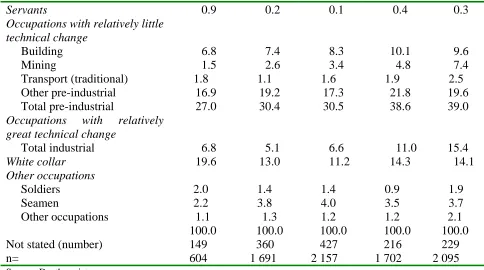
[image:17.612.84.574.518.717.2]Table 7 sets out the occupational backgrounds of all those born in Great Britain and Ireland and who arrived in New Zealand during the period 1916-1945 and in all previous periods. During the interwar period, the decline in the proportion drawn from agricultural backgrounds continued, just 17.6 per cent compared to 24.4 per cent in 1891-1915.
Table 8: Occupational backgrounds of immigrants aged 20 and over, 1916-45 (per cent)
Occupations English/ Welsh
Scots Irish Total
Agriculture
Farmers 7.4 10.1 52.0 12.4 Agricultural labourers 5.1 7.2 0.6 5.3 Total agriculture 12.5 17.3 52.5 17.6
Labourers (N.O.S.) 5.8 6.1 5.6 5.8
Servants 0.3 0.2 0.0 0.3
Occupations with relatively little technical change
Building 9.9 9.9 6.8 9.6 Miners 6.7 11.2 0.6 7.4
Transport (traditional) 2.6 2.9 0.6 2.5
Total pre-industrial 41.7 40.5 16.9 39.0
Occupations with relatively great technical change
Total industrial 16.0 16.5 7.9 15.4
White collar 16.9 9.1 10.7 14.1
Other occupations
Soldiers 2.3 0.8 2.3 1.9
Seamen 2.5 7.0 1.7 3.7
Others 2.0 2.5 2.3 2.1
100.0 100.0 100.0 100.0 Not stated (number) 162 49 18 229
n= 1 325 575 195 2 095
[image:18.612.86.571.74.240.2]Source: Death registers
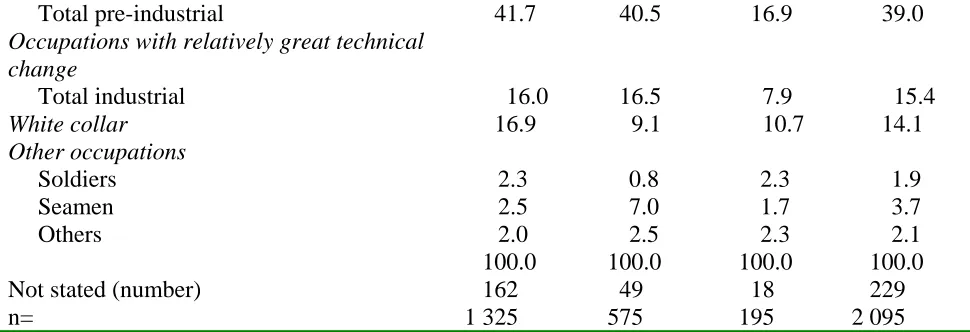
Table 8 shows that the decline was across all nationalities with a 10 per cent drop among the Scots from the previous period. The Irish remained overwhelmingly drawn from families with a farming background. Those whose fathers had been engaged in pre-industrial occupations remained steady overall, although among the English/Welsh and Scots those drawn from mining backgrounds increased substantially. Those drawn from industrial backgrounds also increased substantially, and this was true of all three
nationalities.
Some information on the occupations of the immigrants (as distinct from that of their fathers which the death registers provide) can be extracted from other sources, both New Zealand and British. The annual Statistical Reports on the External Migration of New Zealand published between 1922 and 1932 offer for all arrivals intending to reside permanently in New Zealand, a detailed classification, for the calendar year, by age and gender, but not by country of birth. On the other hand, for the years ended 31 March from 1 April 1922 to 31 March 1932, the annual reports of the Department of
[image:19.612.85.590.362.546.2]Immigration offer a list of occupations ‘by boat.’ A comparison between the two latter sets of data suggests that the category ‘by boat’ included all immigrants arriving from the United Kingdom. Unfortunately, they do not explicitly and consistently separate males and females. Despite their limitations, the data are presented in Table 9, and relate very largely to males.
Table 9: Occupations of all arrivals from the United Kingdom, 1922-1932 (percentages)
Year to 31 March
Agric---ulture
Labs Building Miners Skilled trades
Comm/ Prof
Miscell-aneous
n =
1923 21.6 5.2 4.4 16.1 20.7 3.7 28.3 2 460 1924 23.7 5.4 7.1 11.3 26.1 3.5 22.9 2 459 1925 29.7 6.0 7.0 8.1 26.0 5.1 18.2 3 334 1926 31.2 5.3 4.8 10.3 24.8 6.3 17.3 2 873 1927 24.6 5.6 4.6 12.6 24.1 5.4 23.2 4 286 1928 21.2 3.6 2.7 9.4 29.0 9.4 24.8 1 083 1929 17.7 4.4 3.3 7.4 27.7 15.7 23.8 458 1930 12.1 5.9 2.5 9.8 34.8 9.4 25.6 489 1931 26.2 2.3 1.2 7.8 33.2 8.2 21.1 256 1932 20.0 3.8 5.0 10.0 25.0 12.5 23.8 80
Source: AJHR, D9, 1924-1933. ‘Miscellaneous’ as given.
It is interesting to compare these figures with those of the immigrants father’s
still high, and this in part reflected the preferences of the assistance schemes. The figures also reveal the significant number of miners who came out from Britain.
British data, on the other hand, published in the British Board of Trade Journal offered details for all persons of British nationality over 18 years emigrating from the United Kingdom and intending to reside permanently in New Zealand by gender and by country of last permanent residence, that is, England/Wales, Scotland, and Northern Ireland. Female occupations were classified into six groups, including wives. For English/Welsh and Scots females, those engaged in domestic service formed a consistently high
proportion during the 1920s, their share contracting sharply from 1932 onwards, coinciding with the ending of assistance for domestic servants. Those engaged in commerce/finance/insurance and the clothing trades consistently made up small
proportions. On the other hand, the data suggest that those engaged in the professions, in all other occupations, and as housewives increased from about 1932 onwards. The occupational character of the female flow thus changed quite sharply as the volume contracted and as assistance was terminated.
The British data relating to males confirms the continuing significance of farm workers and also marked changes through the period. Among the males, the proportion of those for whom England and Wales were the last countries of permanent residence and who were engaged in agriculture rose, during the 1920s, to reach 26.1 per cent in 1928, thereafter declining to reach just 10.8 per cent in 1935. The proportion engaged in
mining/quarrying rose to a peak of 10.3 per cent in 1926, then contracted sharply to form less than two per cent per annum during the 1930s. The proportion engaged in
proportions engaged in commerce/finance/insurance, in the professions, and ‘all other occupations’ rose from 1928 onwards. The data thus indicate that the composition began to change once the volume of migration to New Zealand contracted, a contraction in turn associated with the termination of assistance. That change involved a movement away from those engaged in agriculture and the skilled trades towards those engaged in commerce/finance/insurance, the professions, and all other occupations.
Among those males for whom Scotland was their last country of permanent residence, those engaged in agriculture, other skilled, transport/communications, and labouring generally formed a slightly higher proportion than in the case of English/Welsh males, while those engaged in mining/quarrying formed a significantly higher proportion, their share reaching as high as 21.6 per cent in 1922 and 19.9 per cent in 1926. English and Scots miners were, of course, engaged in a protracted strike in 1926. Those engaged in commerce/finance/insurance, in the professions, and in all other occupations formed generally lower proportions. Otherwise, the distribution of Scottish male occupations underwent changes similar to those of their English /Welsh counterparts, with a shift from 1928 away from agriculture and mining/quarrying towards
commerce/finance/insurance, the professions, and all other occupations.
[image:21.612.90.529.514.715.2]Regional origins: the English/Welsh
Table 10: Regions of Birth, English and Welsh Immigrants, 1871-90, 1891-1915, 1916-45 (per cent)
Born in 1871-90 1891-1915 1916-45 UK Census
1911
Represent-tation Index
London-Middlesex
16.8 19.5 21.3 15.1 141
South-east 13.8 11.2 11.8 8.4 141
East 7.0 6.1 7.0 8.9 79
South-west 17.8 10.2 6.3 6.6 95
Midlands
East 3.4 4.6 4.4 6.0 73
Central 6.2 5.5 5.0 7.1 70
West 6.3 4.1 2.8 5.1 55
South 6.0 3.0 2.2 3.7 59
Lancs-Cheshire 7.3 14.6 16.8 14.8 114
North-east 4.0 4.9 7.7 5.5 140
North-west 1.2 1.9 1.5 1.1 136
Off-shore Islands 2.4 1.4 0.8 0.1 800
North Wales 0.5 1.1 0.6 2.3 26
South Wales 0.7 0.7 2.3 4.1 56
100.0 100.0 100.0 100.0
Not stated 76 73 54
N= 1956 1411 1612
[image:22.612.85.529.71.206.2]Source: Death registers
Table 10 shows that two traditional sources of migrants to New Zealand, London and the home counties of the South-east remained important during the interwar period.
close-knit working class communities and strong family connections.15 The impact of unemployment and strike action in the mining industry is perhaps reflected in the considerable numbers from the North-east, especially Durham, which were noticeably high in 1926-30 following the coal strike.
Table 11: County of origin, Immigrants from England and Wales, 1891-1915, and 1916-1945 (per cent), and representation indices for 1916-1945
Regions and Counties 1891-1915 1916-1945 Representation
Indices, 1931 London-Middlesex
London 17.6 19.6 179
Middlesex 2.0 1.7 41
South East
Hampshire 2.0 3.3 121
Kent 4.6 4.1 133
Surrey 2.6 2.6 87
Sussex 2.2 1.9 97
East
Cambridgeshire 0.7 0.9 163
Essex 1.9 2.4 56
Huntingdonshire 0.1 0.2 136
Lincolnshire 1.8 1.5 99
Norfolk 0.7 1.4 107
Rutlandshire 0.1 0.1 306
Suffolk 1.0 0.5 45
South West
Cornwall 3.1 1.5 193
Devonshire 2.8 1.6 88
Dorsetshire 0.6 0.5 85
Somersetshire 2.2 2.1 175
Wiltshire 1.2 0.6 76
Midlands East
Derbyshire 1.3 1.4 72
Leicestershire 1.4 0.9 66
Northamptonshire 0.7 0.6 64
Nottinghamshire 1.2 1.6 90
Midlands Centre
Staffordshire 1.9 2.1 59
Warwickshire 3.7 2.9 75
Midlands West
Gloucestershire 2.0 1.0 48
Herefordshire 0.6 0.3 93
Shropshire 0.7 0.6 105
Worcestershire 0.7 1.0 91
Midlands South
Bedfordshire 0.7 0.1 11
Berkshire 0.7 0.8 107
Buckinghamshire 0.4 0.3 38
Hertfordshire 0.3 0.6 58
Oxfordshire 0.7 0.5 86
Lancashire/Cheshire
Cheshire 2.5 2.0 73
Lancashire 12.1 14.8 118
Yorkshire 11.2 9.4 85
North East
Durham 3.1 4.4 117
Northumberland 1.9 3.3 162
North West
Cumberland 1.4 1.2 185
Westmorland 0.4 0.5 160
Offshore Islands
Channel Islands 0.7 0.4 -
Isle of Man 0.6 0.4 -
North Wales
Anglesey 0.1 0.0 -
Carnarvonshire 0.1 0.1 43
Denbighshire 0.3 0.3 81
Flintshire 0.1 0.1 21
Merionethshire 0.1 0.0 -
Montgomeryshire 0.1 0.1 50
Pembrokeshire 0.1 0.0 -
Radnorshire 0.1 0.0 -
South Wales
Brecknockshire 0.1 0.1 41
Carmathenshire 0.1 0.1 29
Glamorganshire 0.4 1.4 44
Monmouthshire 0.1 0.8 71
Sources: Death registers, and Census of England and Wales, 1931
Table 11 is consistent with the regional findings, but the continued significance of Kent and the new importance of the mining counties of Durham and Northumberland are worth noting.
[image:25.612.87.555.289.441.2]Regional origins : Scottish immigrants
Table 12: Regional origins of Scots immigrants, 1871-1890, 1891-1915, and 1916-1945 (per cent)
Born in 1871-90 1891-1915 1916-45 Representation
index 1916-45
Far North 10.6 3.8 5.2 226
Highlands 9.9 8.7 7.1 101
North-east 11.4 8.7 10.4 90
Eastern Lowlands 26.9 34.3 33.2 99
Western Lowlands 33.2 38.3 39.4 101
Borders 7.9 6.3 4.8 74
100.0 100.0 100.0
Not stated 47 43 45
N= 742 469 738
Source: Registers of deaths, census of Scotland 1911
Table 12 indicates that the patterns of regional origin of the Scots did not change
dramatically over this period. With the exception of the strong over-representation of the Far North and the slight under-representation of Borders, the distribution of those who migrated from Scotland approximated very closely the distribution of the Scots
population as a whole. Consequently the Lowlands continued to provide almost three-quarters (72.5 per cent) of New Zealand’s Scots.
Table 13: Counties of origin, Scottish immigrants, 1891-1915, and 1916-1945 (per cent), and representation indices for 1916-1945
Regions and Counties 1891-1915 1916-1945 Representation
Indices, 1931 Far North
Orkney 1.2 0.9 192
Shetland 1.4 3.0 699
Highlands
Argyll 2.1 1.4 111
Bute 1.6 1.2 293
Inverness 0.9 2.0 119
Ross 3.5 2.0 115
Sutherland 0.5 0.4 130
North-east
Aberdeen 6.8 8.4 135
Banff 0.5 1.4 127
Moray 0.9 0.6 69
Nairn 0.5 0.0 -
Eastern Lowlands
Angus 7.0 6.6 119
Clackmannan 0.0 0.3 44
Dunbarton 2.6 1.7 57
East Lothian 0.5 0.4 44
Fife 4.9 6.3 111
Kincardine 1.9 0.6 69
Kinross 0.2 0.1 97
Midlothian 10.6 10.2 94
Perth 1.9 1.9 75
Stirling 3.3 2.9 84
West Lothian 1.4 2.0 121
Western Lowlands
Ayr 4.5 5.9 100
Lanark 29.3 30.2 92
Renfrew 4.5 3.3 56
Borders
Berwick 1.4 0.3 52
Dumfries 2.6 1.3 84
Kirkcudbright 1.2 0.7 94
Peebles 0.5 0.7 232
Roxburgh 0.7 0.3 31
Selkirk 0.0 1.0 213
Wigtown 0.0 0.4 72
Total Scotland 100.0 100.0
Two-thirds of all Scots arrivals of the interwar period had been born in just six counties, although in no case were they markedly over-represented (Table 13). Those six counties were also the most consistent contributors throughout the period 1916-1945. The native-born of six other counties – Shetland, Orkney, Caithness, Bute, Peebles and Selkirk – were also strongly over-represented, but while Shetland contributed 3.0 per cent, that contributed by each of the remaining counties was substantially less. Table 13 also includes the principal county contributors in the previous period, and it will be seen that the same six – Aberdeen, Angus, Fife, Midlothian, Ayr, and Lanark – were consistently principal contributors.
[image:27.612.84.530.353.480.2]Regional origins: Irish Immigrants
Table 14: Provincial origins of New Zealand’s Irish immigrants, 1871-1890, 1891-1915, and 1916-1945
Born in 1871-90 1891-1915 1916-45 Representation
index 1916-45 Connacht 6.4 6.8 6.3 43
Leinster 14.9 16.0 12.7 49 Munster 35.2 26.2 19.0 74 Ulster 43.5 51.0 62.0 185
100.0 100.0 100.0 Not stated 42 23 15
N= 748 229 220
Source: Death registers; United Kingdom census 1911
The emigration statistics for Ireland published annually in the British Parliamentary Papers indicate that, over the period 1916 -1920, just over 91 per cent of the small number of emigrants who departed from Ireland for New Zealand were drawn from Ulster, notably Counties Antrim, Down and Londonderry. Analysis of the sample data drawn from the registers of deaths presented in Table 14 indicates that, for the inter-war period as a whole, the pattern apparent for the period 1916 -1920 did not persist.16 Although a majority of all of New Zealand’s Irish-born immigrants who arrived during the period 1916-1945 – that is, including those who proceeded from other countries as
16 It is worth noting that after the establishment of the Irish Free State in 1921 the United
well as Ireland itself – had been born in Ulster, almost a fifth had been born in Munster, and over a tenth in Leinster.Connacht continued to make only a small contribution, on the same level, in fact, as it had done so through the previous four periods. Most of those born in Connacht, Leinster, and Munster arrived in the first half of the 1920s, while the Ulster-born continued to arrive in substantial numbers during the latter half of the 1920s and to trickle in during the 1930s. The postwar revival of immigration from the three southern provinces of Ireland was thus modest and short-lived, and that from Ulster larger and more sustained. In part, the Ulster migration appears to have originated in unease over continuing political turmoil in Ireland.17The small flows from Leinster and Connacht weredominated by single persons, while those from Munster and Ulster included larger proportions of married persons. The inter-war Irish flow originated largely in Ulster and was dominated by those of Protestant allegiance of both English and Scottish ancestry.
Table 15: Counties of origin, Irish immigrants,1891-1915, and 1916-1945 (per cent),
and representation indices for 1916-1945
Regions and Counties 1891-1915 1916-1945 Representation
Indices, 1936 Connacht
Galway 3.4 4.0 91
Leitrim 0.0 0.5 38
Mayo 1.9 0.5 12
Roscommon 0.5 1.0 49
Sligo 1.0 0.5 28
Leinster
Carlow 0.0 0.5 56
Dublin 6.8 4.5 29
Kildare 1.0 1.0 66
Kilkenny 1.5 2.5 138
King's Country 0.5 0.5 37
Longford 0.0 0.5 50
17
Louth 0.0 1.0 60
Meath 0.0 0.5 31
Queen's Country 1.5 0.0 -
Westmeath 0.5 0.5 35
Wexford 2.5 0.0 -
Wicklow 2.5 1.5 97
Munster
Clare 3.9 3.0 127
Cork 9.2 8.5 91
Kerry 4.4 4.0 109
Limerick 2.4 2.0 54
Tipperary 2.9 1.5 41
Waterford 2.9 0.5 24
Ulster
Antrim 21.4 27.5 532
Armagh 3.4 6.0 210
Cavan 1.5 1.0 49
Donegal 1.9 1.5 40
Down 6.3 9.5 172
Fermanagh 0.5 0.5 35
Londonderry 8.7 7.5 200
Monaghan 1.0 2.0 125
Tyrone 4.4 5.5 164
Not stated 23 19
Total 229 219
Total Ireland 100.0 100.0
Sources: Death registers, and Census of Ireland, 1936, Census of Northern Ireland 1936.
Two points should be noted about Table 15. First within the Irish Free State Kerry and Cork, the two areas of traditional migration to New Zealand, remained well represented, probably an indication of the importance of family-based chain migration. Second, in Ulster the counties around Belfast and Antrim in particular became increasingly dominant as a source of migrants to New Zealand.
[image:29.612.92.460.83.473.2]Place of death
Table 16: Place of death of immigrants 1916-45 (percentages of place of birth)
Region England/Wales Scotland Ireland All
Northland 2.2 1.8 1.8 2.1
Waikato/Coro. 8.1 6.6 8.3 7.7
Bay of Plenty 4.1 2.3 6.0 3.8
Gisborne 1.7 0.8 0.9 1.4
Taranaki 2.5 3.0 4.6 2.8
Hawkes Bay 4.6 3.9 4.6 4.4
Manawatu/Wang 6.5 3.9 8.3 5.9
Wairarapa 0.5 1.1 1.8 0.8
Wellington 14.4 15.9 12.8 14.7
Nelson 1.6 1.5 0.5 1.5
Marlborough 0.5 0.7 0.9 0.6
Canterbury 14.7 16.4 12.8 15.0
West Coast 1.8 2.8 0.5 2.0
Otago 3.7 12.9 4.6 6.4
Southland 1.3 4.1 0.5 2.0
100.0 100.0 100.0 100.0
unknown 0 0 0 0
Number 1622 738 218 2578
[image:30.612.84.530.71.335.2] [image:30.612.87.529.357.658.2]Source: Death registers
Table 17 : Place of death of immigrants 1916-45 (percentages of place of death)
Region England/Wales Scotland Ireland Number
Northland 67.9 24.5 7.5 53
Auckland 68.8 22.1 9.1 746
Waikato/Coro. 66.3 24.6 9.0 199
Bay of Plenty 69.1 17.5 13.4 199
Gisborne 77.8 16.7 5.6 36
Taranaki 56.2 30.1 13.7 73
Hawkes Bay 65.5 25.7 8.8 113
Manawatu/Wang 69.1 19.1 11.8 152
Wairarapa 42.9 38.1 19.0 27
Wellington 61.6 31.0 7.4 378
Nelson 68.4 28.9 2.6 38
Marlborough 56.3 31.3 12.5 16
Canterbury 61.5 31.3 7.2 387
West Coast 57.7 40.4 1.9 52
Otago 36.4 57.6 6.1 165
Southland 40.4 57.7 1.9 52
ALL 62.9 28.6 8.5
unknown 0 0 0 0
Number 1622 738 218 2578
Tables 16 and 17 suggest that many of the trends first obvious at the turn of the century continued in the interwar years. Not surprisingly Auckland and indeed the Waikato and Bay of Plenty increasingly attracted the immigrants and the three areas together were the death-place of over two fifths of all the UK immigrants. As previously the English were disproportionately attracted to the north, while Canterbury and Wellington, once very ‘English’ Wakefield colonies, both attracted a lower proportion of English than New Zealand as a whole (Table 17). Over half the Scots continued to come to the growing cities – Auckland, Wellington and Christchurch, and in both Wellington and Canterbury provinces they were over-represented among all UK immigrants. Of those UK
immigrants dying in Otago and Southland the Scots were still well-represented, but they constituted only 17 per cent of the total flow. The Irish followed the general flow to Auckland, but interestingly in the southern provinces, especially Wellington, Canterbury and the West Coast they were comparatively under-represented. The West Coast figure – of under 2 per cent of UK immigrants to the region coming from Ireland – is especially remarkable given the Irish flows there of the 1860s and 70s.
The assisted immigrants, 1916-1935
Numbers
The inter-war period saw a major revival of assisted immigration to New Zealand. This followed both renewed support from the New Zealand Government, and even more important a new interest in assisting emigration by the British Government. Throughout the nineteenth century, the imperial government had left the ebb and flow of emigration very largely to ‘market forces,’ although private emigration societies assisted many to emigrate, but the postwar period saw a major change in policy, beginning with a free passage scheme for British ex-service personnel and their dependants and culminating in the empire development and emigration schemes initiated under the Empire Settlement Act, 1922.
Kingdom. Assisted arrivals fell to very low levels during World War 1, but accelerated sharply in 1919 and reached, after a slight check in 1923, a peak in 1926. Thereafter the number of assisted arrivals fell sharply as assistance was reduced and finally suspended for all but domestic and single women, boys and girls under the Flock House, Church of England, and Salvation Army schemes, and the wives and families of immigrants already in New Zealand.
Different flows of assisted immigrants
The assisted inflow fell into four reasonably distinct periods: the first from 1916 to 1920, the second was centred on 1921, the third embraced the years from 1922 to 1927, and the fourth extended from 1928 to 1935. Each phase was marked by the arrival of distinct groups of assisted immigrants.
Servicemen’s wives and families,1916-1920: Most of the assisted arrivals of this first
phase were the wives, families, and fiancees of New Zealand servicemen. The inflow was thus dominated by females, while the child: adult female ratio reached low levels.
In August 1916 the New Zealand Cabinet decided that assisted passages would not be granted to the wives of New Zealand soldiers who proceeded abroad. On the other hand, free passages to New Zealand were available for the wives and families of deceased soldiers, and subsidised passages in the case of those who married abroad provided the wife was not resident in the Dominion after the outbreak of the war. The assistance was furnished through the War Expenses Account and the Immigration Vote. As the war came to an end, the issue raised considerable debate, and it was eventually decided that New Zealand women, that is, wives who had proceeded abroad during the war and women who had proceeded abroad and married New Zealand soldiers after the war had begun, would be offered assistance through the Immigration Vote. A similar subsidy was offered through the War Expenses Account to those ‘non-New Zealand’ women who had married New Zealand soldiers in the United Kingdom. Unfortunately the lists of those servicemen who had wives and dependants and who required repatriation do not
those of British birth who had married New Zealand servicemen and were seeking assistance to emigrate to this country.
Before the Great War ended, the New Zealand Government was thus granting assistance to the wives and children of New Zealand soldiers, while in 1918 the same arrangements were extended to the fiancees of returning servicemen.18 These special concessions to members of the New Zealand Expeditionary Force remained in force for some time and provided a large number of nominations and, indeed, until 1920, as Table 16 indicates, practically the only assisted immigrants arriving in New Zealand were the wives and families of members of the armed forces. The SS Mahana, on its voyage to New Zealand in 1920, was known as the ‘Brides’ Boat,’ the ship carrying many English girls on their way to New Zealand to marry New Zealand soldiers or to rejoin husbands whom they had married during the Great War.19 Data published in the annual reports of the
[image:33.612.86.586.455.569.2]Department of Immigration from 1922/23 onwards indicate that ‘fiancees’ continued to arrive in New Zealand, 61 in the year ended 31 March 1923, and 62 in the following three years.
Table 18: New Zealand, separated relatives among assisted arrivals, 1916-1920 (numbers)
Year to 31 March
Men Women Children Total Total
assisted
Males per 100 females
Children per 100 females
1916 85 325 402 812 1 103 26.2 123.7 1917 33 276 199 508 638 12.0 72.1 1918 4 128 39 171 171 3.1 30.5 1919 2 729 175 906 906 0.3 24.0 1920 130 2 922 758 3 810 3 811 4.4 25.9 Source: AJHR, D9, 1916-1920.
18
AJHR B6, 1919, p.xx, and D9, 1919, p.1.
19
See Susan Price and Robin Allardyce, Charles and Annie Aller and their six daughters. Wellington, 2000, p.22.The Aller family lived in Hornchurch, the site of a New Zealand convalescent hospital from 1916. Three of the Aller daughters married New Zealand soldiers. Payne noted that Norman and Richard Carne, whose family had originally emigrated from Newlyn, Cornwall, and who saw action at
Two Archives New Zealand files offer lists of New Zealand servicemen who, on behalf of wives and children and, occasionally, other relatives, sought assistance.20 The lists often include the ‘address of wife.’ While for some it seems clear that the address offered is that of parents and may be interpreted as last place of residence if not place of birth, for many the address offered is at best last place of residence. Of 788 wives, 87.8 per cent gave an address in England, 1.5 per cent in Wales, 8.3 per cent in Scotland, and 1.6 per cent in Ireland, with the balance of 0.6 per cent giving an address in France. Of those who gave an address in England, a very large proportion (36.0 per cent) nominated south-east England – London (23.5 per cent), Essex (12.0 per cent), Hampshire (12.4 per cent), and Surrey (8.6 per cent), while smaller numbers nominated Sussex (1.1 per cent) and Kent (1.7 per cent). A significant proportion cited addresses in the south-west of England, notably Wiltshire (10.0 per cent), with smaller proportions citing Devon (1.7 per cent) and Cornwall (1.4 per cent). Within these counties, a small number of towns and villages stood pre-eminent, among them, Romford in Essex; Codford and Durrington in Wiltshire; Brockenhurst, Bournemouth, Hornchurch, and Christchurch in Hampshire; and Walton-on-Thames in Surrey. Grantham in Lincolnshire and Brocton and Stafford in
Staffordshire were two other quite important centres. All reflected the location of the main New Zealand military hospitals, at Brockenhurst (Hampshire), Walton-on-Thames (Surrey), and Codford (Wiltshire), and supply and training camps, at Sling, (Wiltshire), Ewshot (Hampshire), Brocton (Staffordshire), Belton Park (Lincolnshire), and Boscombe (Dorset). After marriage many wives sought accommodation close to their husbands.
At the time these lists were prepared (November 1918), 217 of these military families had children, 179 (82.4 per cent) having just one child and the balance two or more. Further, half (50.5 per cent) of these children were under 12 months of age, but 14.9 per cent were aged from one to two years, 9.7 per cent from two to five years, and the balance (24.7 per cent) five years and over. That distribution of ages suggests that some wives and families had followed husbands and fathers (in particular, medical staff) to the United Kingdom, some soldiers appear to have married widows with children, while at least one proposed returning to New Zealand with his widowed sister-in-law and four children aged four,
20
five, seven, and nine (then living in Edinburgh), her husband (of the 5th Royal Scots) having been killed at Gallipoli. It should also be noted that a small number of soldiers proposed returning with dependent relatives other than wives and children, usually mothers, an indication of emigration to New Zealand as young men from about 1900 onwards.
British ex-service personnel, 1920-1922:
An abrupt change occurred in the character of the assisted inflow in 1921. The number of arrivals increased sharply, while both the number of males per 100 females and the number of children per 100 adult females also increased markedly. Most of the new arrivals were in fact British ex-service personnel and their families, known as the ‘overseas settlement immigrants.’
Although the uncertain prospects which confronted the 1.5 million women who had been drawn into the wartime labour force and the 180 000 recruited into the various women’s auxiliary services raised concern in postwar Britain,21 it was the capacity of the British labour market to absorb some four million demobilised men which generated much greater alarm. Amid predictions of widespread unemployment as industry adjusted to peacetime conditions, the imperial government sought to cooperate with dominion governments in schemes of land settlement for ex-service personnel. As the numbers of unemployed ex-servicemen rose to exceed 300 000 in March 1919, a scheme of free third class passages for ex-service men and women and their dependants was announced. Initially approved for one year, successful applicants were eventually given until 31 March 1923 to emigrate. Although New Zealand insisted that it would not accept any British ex-servicemen until all New Zealand troops had been repatriated,22 it discerned an
21
D. Kennedy, ‘Empire migration in post-war reconstruction: the role of the OSC, 1919-1922,’ Albion 20, 1988, pp.407 and 410. See also Gail Braybon, Women workers in the First World War. London, 1981.
22
Public Record Office, Colonial Office 721/5/f, New Zealand Government to New Zealand High
Commissioner 13 March 1919, tabled at a meeting of the OSC advisory committee 14 March 1919, quoted in Kent Fedorowich, ‘The assisted emigration of British ex-servicemen to the dominions, 1914-1922,’ in Stephen Constantine, editor, Emigrants and empire: British settlement in the dominions between the wars.
opportunity to secure immigrants, and in particular, agricultural workers, almost entirely at the cost of the British Government, while it retained control over selection.23
Although the imperial government originally envisaged assisting 450 000 individuals to emigrate, in fact just 133 301 applications involving 269 696 individuals were lodged by the end of March 1923, while less than a third received final approval.In all,12 668 ‘overseas settlement immigrants’ arrived in New Zealand four years ending 31 March 1924 (Table 19).24 Although this particular group was dominated by males, and presumably single males, it also included a significant number of family units. The r of children to females was higher than in the case of the ‘separated relatives’ of N Zealand servicemen, a difference probably related to the elapse of time since the end of the Great War and thus the likely longer marriages of this secon
atio ew
[image:36.612.88.553.354.455.2]d group.
Table 19: New Zealand, ‘Overseas settlement immigrants,’ 1921-1924
Year to 31 March
Men Women Children Total Males per
100 females
Children per 100 females
1921 2 630 1 264 1 392 5 286 208.1 110.1 1922 1 431 1 092 1 329 3 852 131.0 121.7 1923 1 266 881 1 335 3 482 143.7 151.5 1924 8 15 25 48 53.3 166.7 Total 5 335 3 252 4 081 12 668 164.1 125.5 Source: AJHR, D9.
The ‘empire’ migrants, 1922-1927:
The period 1922-1927 saw the arrival of the bulk of the ‘empire’ emigrants. The number of assisted arrivals exceeded 6 000 in each year except 1927 when 5 899 arrived. The adult gender ratio attained a reasonable balance, while the number of children per adult female remained at a relatively high level.
Institute. London, 1920,pp.30-31. See also Massey’s statement in the Financial Statement for 1919,AJHR B6, 1919, p.xx.
23
National Archives, L1/1614, pt.1, High Commissioner to Prime Minister 5 March 1919, reply 13 March 1919; High Commissioner’s cable 11 April 1919, reply 29 April 1919. For operation of the scheme see L1, 1920/533, High Commissioner to Prime Minister and subsequent correspondence.
24
The proximate origins of the Empire Settlement Act, 1922 lay in the abrupt collapse of the postwar economic boom in 1920, the United Kingdom entering a protracted period of economic dislocation and change, unemployment, social unrest, and political change. The act was part of a wider imperial strategy which aimed at security, prosperity, welfare and social order within a mutually supportive imperial economic system in which trade, capital and labour flows would encourage empire development and self-sufficiency and sustain the defence of the empire.25 Emigration to the countries of the Empire, and especially from those regions most adversely affected by serious economic dislocation and unemployment, thus became a key element of a strategy intended to resolve, on the one hand, Britain’s pressing economic and social problems, and, on the other, the dominion’s needs for women to sustain population growth and skilled labour to support their growing manufacturing sectors. Further, emigration would strengthen the ties of race, family, and imperial sentiment.’26
Towards the end of 1918, the Colonial Office established what became, in April 1919, the Oversea Settlement Committee with responsibility for advising the government on emigration policy and it was this committee which offered Lord Milner (appointed Colonial Secretary in January 1919, and president of the committee) and L.S. Amery (Under-Secretary at the Colonial Office, and chairman of the committee) an opportunity to implement their ‘prospectus for social engineering and imperial renewal.’27
Accelerating unemployment in the United Kingdom towards the end of 1920 helped transform what had been intended originally as a transitional measure, that is, the free passage scheme for ex-service personnel, into a more permanent programme for empire migration and settlement.28 Although the British Treasury was reluctant to be drawn into funding, directly or indirectly, land development schemes in the dominions, the Imperial Parliament, in a ‘haze of imperial sentiment and worry about over-population,’ passed the
25
Stephen Constantine, ‘Introduction: empire migration and imperial harmony,’ in Stephen Constantine, editor, Emigrants and empire: British settlement in the dominions between the wars. Manchester, 1990, pp.1-21
26
See, for example, J.A.R.Marriott, Empire settlement. London, 1927, p.90.
27
D.Kennedy, ‘Empire migrationin post-war reconstruction: the role of the OSC, 1919-1922,’ Albion 20, 1988,p.404. See also Michael Roe, Australia, Britain and migration, 1915-1940: a study of desperate hopes. Cambridge, 1995, p.14.
28
Empire Settlement Act,1922.29 TheAct empowered the Secretary of State to cooperate with any dominion government or with public authorities or public or private
organisations in the United Kingdom or in the dominions ‘to formulate and cooperate in carrying out agreed schemes for affording joint assistance to suitable persons in the United Kingdom who intend to settle in any part of His Majesty’s Oversea Dominions.’
Meanwhile after considerable debate in New Zealand over the resumption of assisted immigration, in 1920 the New Zealand government had decided to accept 10 000 assisted immigrants per annum.30 Prior to the war New Zealand residents could nominate ‘near relatives by blood or marriage’ in the United Kingdom for assisted passages, while domestic servants and farm labourers could be nominated by New Zealand residents irrespective of the relationship between nominator and nominee, or could themselves apply for assisted passages. New regulations issued in 1921 provided that permanent residents of New Zealand and bona fide New Zealanders visiting the United Kingdom could nominate, observing certain conditions and requirements, any persons residing in the United Kingdom for an assisted passage to New Zealand. Nominators were required to ensure that nominees had employment waiting for them, to guarantee that they remain in New Zealand for at least five years, and to provide for maintenance immediately after arrival. These new regulations represented a major change of policy. While pre-war governments had declined to permit industrial employers recruit labour, in 1919 Massey acknowledged that the secondary industries were of growing national importance, that they had specific labour requirements, and that as a result the new immigrants ‘would not all be farm labourers.’31 The immigration regulations also allowed domestic servants
29
Brinley Thomas, Migration and economic growth: a study of Great Britain and the Atlantic economy.
Cambridge, 1954, 1973, p.210.
30
See Stephen Constantine, ‘Immigration and the making of New Zealand, 1918-1939,’ in Stephen Constantine,editor, Emigrants and empire: British settlement in the dominions between the wars. Manchester, 1990, pp.121-149. See also Otago Trades and Labour Council, The immigration fraud.
Dunedin, 1913; Report of the British oversea settlement delegation to New Zealand, 1923, BPP 1924 Cmd.2167.xi.765 (also published in AJHR A7, 1924); Dominion Settlement Association, New Zealand for the Britisher: a vital empire question: proceedings of a dominion conference on immigration. Wellington, 1925; G.W. Russell, New Zealand today. Christchurch, 1919, pp.170 and 286-287.
31