AEGIS OUTLINE PHILOSOPHY of AEGIS
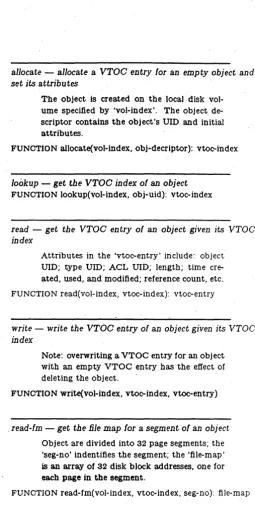
Integrated System Object orientation
Managers as Model for Data Abstraction OVERVIEW of AEGIS CONCEPTS
Processes
Object-Based File System Naming ,
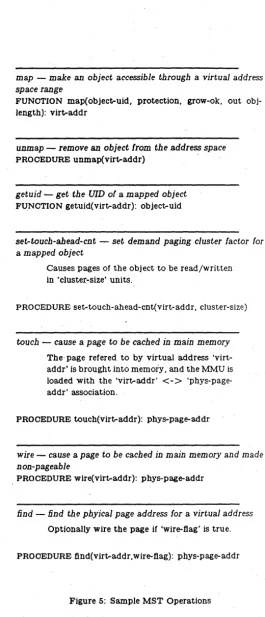
Mapping I Address Space Management Memory Management
Networking Protection OBJECTS
. Storage and Disk Structures pvol, lvol, bat, vtoc
important bootstrapping information in the Iv label
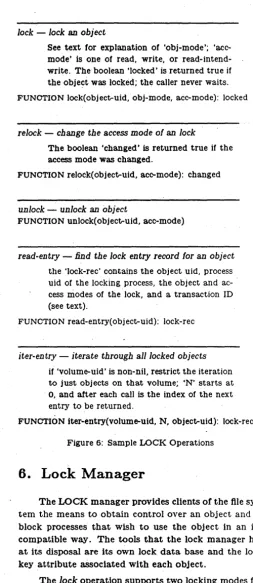
UIDs, Attributes, Segmentation, Locating Locking (local)
NAMING
. -_ .. _ .•.. - - _ ... _ .
Directories
<J
iC)
'0/--'
.. . ~
\
ACCESSING OBJECTS
Address Spaces (asids, global) Mapping Objects· (mst)
Active Objects (ast) PaginglPurifier
NETWORK FILE SYSTEM Remote vs. Local
Paging Server, Remote File Server Asknode
INTERPROCESS COMMUNICATION The Ring
Packets and Sockets
Major Clients of Sockets MBX
SECURITY
Acls, Registry, Protected Subsystems Login, SIDs
PROCESS MANAGEMENT (Supervisor Mode) Process Switching (dispatching)
Interrupt Handling Processor Scheduling
Synchronization (event counts) Mutual Exclusion
Special CPU B Handling
-o
CJ
Process Creation and Deletion Clocks and Time-Driven Events PROCESS MANAGEMENT (User Mode)
Program Management Parsing
Program Levels, Procceses and Fork Mapped Segment Manager (ms)
Storage Allocator (rws) The Loader, KGT
Libraries; Global and Private PROCESS MANAGEMENT
(Error and Fault Handling) Kinds of Faults
Supervisor Mode Fault Handling/Generation . User Mode Fault Generation
Fault Handlers
Dynamic Cleanup Handlers Static Cleanup .Handlers Mark/Release Handlers STREAMS
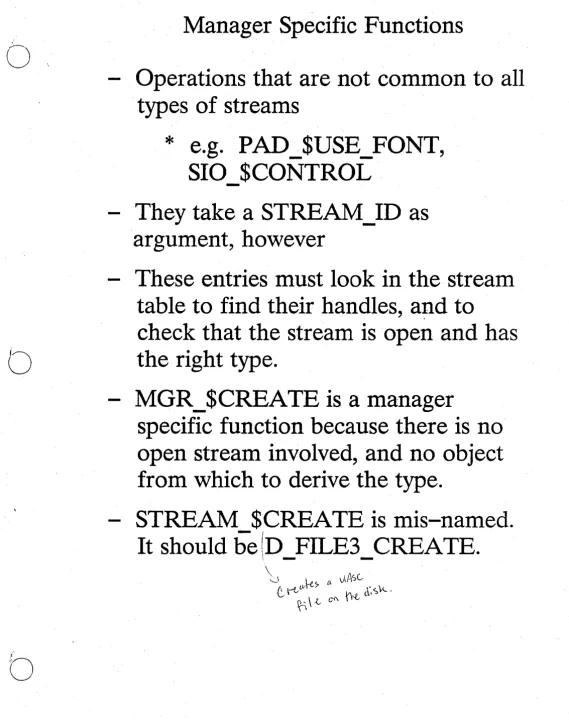
The Stream Table Opening Streams
The Generic Switch Call Some Special Switch Calls The D_File Manager
Other Managers
-FROM POWER-UP TO LOGIN
o
Physical/Virtual Address Space LayoutMD
o
o
SIO vs. Display KBD Service / N annal
Boot Device Selection
Commands : Internal vs. External _ (LD, LO, EX)
SYSBOOT / NETBOOT Aegis initialization
required directories and files creating the first level 2 process THE BOOT SHELL
ENV / Libraries
the basic idea (SH, DM, SPM) firmware (PEB and COLOR) global libraries
startup-files (where and why) . DISKLESS NODES
NETWORK SERVERS SPM / CRP
SIOLOGIN SF HELPER
ALARM SERVER
4
u
()
o
-~ ..
~.--.----THE APPLICATION LEVEL PST
GPIO
NETSTAT HPC
NETLOG DB
FST TB
COMPILER/BINDER.
MULTIBUS Limits
Device Driver Considerations
-o
o
o
Philosophy & Overview of AEGIS
Philosphy: 3 perspectives market
hardware technology
system architecture technology
Overview: textbook OS taxonomy processor management
address space management memory management
file system network
management-o
- - - _ .. _--_ ... _ ... _-_ .. .
Apollo Computer
The premier supplier of workstations
for the technical professional
Maximize the productivity of the technical professional via:
o
1. ability to run large, mainframe class applicationprograms tailored to his profession
2. high user <-> computer bandwidth
3. network for cooperation and sharing with others
-,/
0
-o
o
Implications:
1. a. Fast, 32 bit CPU
b. Virtual memory
2. a. Bit-mapped display
b. Window-oriented user environment
3. a. Distributed system
b. Net-wide access to files
AEGIS is the operating system that
resulted to support these objectives.
-o
o
o
- _ . --.----... -...
-Hardware Technology
1. VLSI CPU's
2. 64k RAM
3. Winchester disks
Pioneered by the Alto at Xerox PARe, started
to see other systems: Nu Machine (MIT)
SUN Machine (Stanford)
This new, cheaper computing power was changing the focus on how computing was done ....
-o
o
o
TIME SHARING
CAPABILITY
COMPUTING
NETWORKS
OF
PEOPLE
GRAPHICS
o
o
o
System Architecture Technology
Operating systems, 8
• . {)~\\ \ Q,Jeska.
Multlcs (Min 1)(C~',e StU{)\rf
original implementation restructuring studies Hydra, Medusa (eMU) System/3S (IBM)
Distributed systems Pilot (Xerox PARe) WFS (Xerox PARe)
Languages
Mesa (Xerox PARC) CLU (MIT)
Alphard (eMU)
Smalltalk (Xerox PARe) Ada (000)
-- ---
-Key attributes of AEGIS
AEGIS is
a
- distributed - integrated
- local area network - object-oriented
- personal workstation
o
operating system.-o
o
o
Distributed Systems
. Advantages:
robustness, reliability
when one node fails, system still runs
incremental expansion of computing power
just keep on adding nodes
potential for higher periormance
run computations in parallel
Problems:
partial failures
if you need the node that failed ...
"richer" set of errors
not just "up" or "down"
replication needed for reliability
hard to do automatically
parallelism needs to be explicitly programmed
no automatic decomposition today
sharing & cooperation
can be hard to get back to timesharing level
-Where does Aegis fit?
o
Lots of different kinds of distributed systems.
-- VAXcluster: a distributed multi-computer - meant to act exactly like one big VAX
- good sharing & cooperation - all the problems of timesharing
- ARPAnet: communicating, autonomous hosts - seperately owned and administered
- limited sharing & cooperation
o
-
remote login, file transfer, mailAegis falls somewhere in between.
o
9~-Q
o
o
---~-... __ .. _ .• ----_ •.. __ ....
-Structural Implications
- distributed systems are naturally structured differently. than centralized ones
- Aegis was built from the ground up to be distributed
"Local access is the special case" - PHL·
u ••. but it still has to be fast" - PJL
10-o
o
o
- - ---_ ... _ .. -_ ... _ .. -.... _---
-Contrast to Post-Hoc Distributed Systems
Application.
Remote ~,
OS
~, Local
OS
A complete remote OS is layered on top of a complete local OS; applications determine which is being requested at each use.
-o
o
Aegis Structure I
In Aegis, each component has a local and remote
part within it.
Application
Remote MBX Local MBX
Remote Name Local Name
Remote File Local File
Remote Paging Local Paging
Disk Net
12-o
o
o
To Datagram IPC
Rle System Structure
User
Supervisor
Pageable Wired,
Location Dependent
Datagram
IPC
To Net Hardware
Legend:
~ocal ~ss_.
Cached oss B""'! ~i Location Independent t=1
OSSc::=::J
. RemoteossK<,<.j
Single Level Store It f i I . Lock Managerb<.~;,;:1
o
o
o
Aegis Structure II: Net-Wide Caching
Another example of "ground up" distribution: .
Network-wide caching of objects would probably not have been feasible without having designed it in from the start.
The file locking' operations were specifically designed to allow cache control in addition to concurrency control.
14-- 14-- 14-- 14-- 14-- . 14-- 14-- . 14--... --. . . ---~---Personal Workstation Implications
o
With a network of .personal workstations:
- (potentially) can share what's important
- information, programs - expensive peripherals
- don't share what's not important
- CPU cycles: they're cheap
- you can decide how to use your node
- autonomy
o
Potential advantages:- cooperation & sharing
- use network
- dedicated, controllable performance
- you allocate your node
- high user <-> computer bandwidth
- CPU is close to the display
- highly interactive user environment
.... simpler OS if only run one user
-o
Simpler OS
Protection
- all computation on a node is on behalf of a single person
- don't worry about maliciousness - just worry about accidents
Fairness of resource allocation - just do what the owner says Accounting
o
-
Is in terms of the whole nodeo
Structure
- can put software in user space
- easier to modify, debug, replace Openness
- more facilities can be made accessible if needn't worry about above items
16-o
o
o
- - -
-Problems with Personal Workstation Model
How to manage tension between autonomy and cooperation.
- autonomy means independence - cooperation means dependence
Solution: make cooperation voluntary; but how? - need mechanisms
- usually, cooperation & autonomy go along
machine boundaries
- on same machine: cooperate - on different machine: autonomy
- not good enough for personal workstations
17-o
o
Problems II
How to provide traditional system services: - identifying users to the system
- printing - backup - mail
- storage of community information
- at project, department, organization and corporate levels
- data integrity - data privacy
- communication gateways
- background computation (batch)
Partial solution: use "servers" to provide them - dedicated nodes running trusted applications
-o
o
o
Cooperation vs. Autonomy
Why are both needed? .
Cooperation:
- need to cooperate with colleagues to get your job done
- personal workstation didn't change that!
Autonomy:
- need to control resources of own node
- in order to get controllable response·
- need to control sharing
- to protect privacy of data
- need to manage own data files .- to guarantee data integrity
- need to operate when network is down
- need enough independence to do so
-o
o
o
Server Issues
Protection:
- all programs on same server node trust each other
Fairness of resource allocation:
- they also trust each other to be reasonable
in their resource use
Accounting:
- is up to each server to do in an application
specific way
20-o
o
o
Local" Area Network Implications
Local area networks are sufficiently different from other kinds of networks that different techniques need to be used to take advantage of them.
Bandwidth:
- typical networks are orders of magnitude slower than the memory bus
- LAN's are faster: ours has 2/3 the bandwidth
of the memory bus of a DN400.
Error rates:
so:
- typical network error rates: 1 0 * * -4 or so.
- LAN error rates much lower
- minimize CPU time to "get on and off the wire"
don't spend it trying to optimally utilize network bandwidth
- don't worry as much about errors
use simple retransmission techniques
-o
o
o
Problem Oriented Protocols
Don't use the traditional OSI "layered" architecture
- make a very cheap datagram service.
- don't use virtual circuits, sessions, presentation layer.
- take advantage of operation semantics to
cheaply do what those layers normally do.
- use "end-to-end" argument. ovoid (;ttK{\Owl.eJse,Vlel)ts.
Examples:
- idempotent operations - transaction IDs
- "natural" state
-
-o
p-o-p ExamplesIdempotent operations
- has same effect if done twice in a row as if done once.
- example: read page N of a file - use simple two message protocol
- RR: request/response - retransmit on time out
- duplicate requests no problem
- saves an acknowledge message (RRA)
o
Transaction IDso
- eliminate duplicate replies
- tag each request with a unique number - discard replies with duplicate TIDs
Natural state
- for non-idempotent operations
- save request TID in a database that was needed anyway
- discard requests with duplicate TIDs; resend old response
- example: lock database
23-o
o
--- ---_ .. __ .. ---_ .. -._ ... __ . _ - - _ .
Integrated· Distributed System
System provided, user selectable mechanisms that:
- Preserve - Permit
autonomy.
cooperation & sharing (when
desired).
Provide the user with a unified system:-- name files, not hosts
- system wide user identification
24-o
o
o
Integrated Implications
Network wide file system: - to make sharing easy . Network transparency:
- location transparency:
- all resources accessed in same way, regardless of their location
- easier software development
- supports incremental changes to system - easier to realize increased reliability
- simpler user model'
- name transparency:
- name doesn't imply location
- allows relocation, substitution
Control mechanisms: - access control
- network wide user identification
-o
o
o
Integrated Implications II
Reliability criterion:
- must always be able to access information on own node, even if network down
- if two nodes are up and want to cooperate, then no single failure will stop them
- so, third parties must be replicated
Functional integration: .
-each node has a complete set of OS facilities
- so can run when network down
- a/so for performance reasons .
-
-o
o
o
._.-.. _ ... __ ._ . . .
-CPU
MEM t - - - - {
NET
CPU MEM NET
CPU MEM NET
CPU
MEM t - - - - t
NET
CPU MEM NET
FULL USER WORKSTATION
COMPUTATION or
110 SERVER
FILE SERVER
DISKLESS USER NODE
o
o
o
-_ .. __ .- _ . _ - - - -... --~-... - - - - -...
Object Orientation
Object:
- user. level: soine sealed data plus operations
- as level: a storage container for
uninter-preted data, plus a type tag that - identifies the object's manager - tells how to interpret the data.
Managers:
- each module is manager of some object.
- object is some meaningful (OS) e.ntity
- disk block, process, file, directory, etc.
- manager handles all details of "its" objects - interface to manager gives all permissable
operations; completely defines object to clients
-- clients only manipulate object through the interface
- manage_r is solely responsible for the integrity of its objects
- knowledge of representation (data structures) confined to manager
- managers correctness depends. on/yon itself, managers of components
27-Objects II
o
Why?o
o
- understandable semantics for modules; a principle for OS decomposition into modules
- managers are orthogonal and independent - can isolate bugs to one manager
- can find manager to change to make an enhancement
28-o
0-o
Protection
Need access control to allow you to choose with whom to share and cooperate.
Can't protect data on a node from the node owner: - has physical access
so:
- allow each node to protect own -data against access from the network
- don't try to protect data from deliberate efforts of node owner
- try to make accidents improbable
29
-o
o
o
Aegis Interface
Single Level Store
Object Storage System
Low Level IPC
Naming Server
Processes
ill d ,v A 6 [(( S .-: ... -... -.-..
-~--MST
FILE
MSG
NAME
PROC2, EC2
---~~~~~~---Faults FAULT, FIM .~ ... 'f"
Display
1/0
. COLOR, 'SMD, SMDU
MT, LPR, PBU"
DISK, VOLX,TERM
Protection ACL
r-S~, k . ' ",Ii-'"
Jj SIlQ(.<;.. ,\,;.(.1 "'\\,,~ .~\t c, \ 'D tv
Info AS, BAT, ASKNODE,
PROC1, VTOC, CAL, NETWORK,
':;~fOS, PEB, TPAD, NETLOG, GET _BUILD _ TIME, OSINFO
Mise TIME, UID, VFMT
o
o
o
- - - - _ . - _ ... _-_ .... _ .... _ ...
-Processes
- independent, asynchronously executing - 33 total g pro(,,z5ses r<se.rveJ for O.S.
- one is the Display Manager ("We,oteSOJ
- Shell windows are processes, edit pad windows are not
- Serarate address space per process
* for protection
* because the address space is too
small (less than 10 MB min.)
- Address Space
* 256 (or 16) Megabyte * objects mapped into it
. *. R/W with ordinary instructions
- Object Type,s
* programs, libraries,. data
o
o
o
Processes 2
- Synchronization and Communication
* Shared Objects (communication)
same object in AS of > 1 proc.
both observe changes
restricted to 1 machine
* Eventcounts (synchronization)
processes can wait on an EC processes can "advance" EC to wake up waiters
also restricted to 1 machine
* IPC (MBX)
both comm. and synch.
sends data, wakes up receiver
network wide!
. local, too; exactly the same
o
Processes 3Dispatching Sclted~ (/',) ~
- dynamic (recalculates)
- priority based
- priority is inversely proportional to the
amount of CPU time used
* attempts to give interactivity priority
* paging is currently a problem
o
-
Priority boost 1-.o
* delta added to the priority
computed above
* Dispaly Manager gets it 1.
* It is not user settable
Process Layering
PM
PROC2 PROC1
-o
PROC1- A finite number of them (33)
- Wired state
- State = registers
PSW ASID
locks
Runs only in global space
o
-
Needed to implement Virtual Memoryo
* purifier
* paging server
* file server
•••
(' ,'vll j'" s c>~ t..-uiclve ss Sf a. ct: ) GJ r'-oc~ s s e~ . n e. eJuJ. -tv ~'t\~rlt""'-th+- I<-e f V1 c, I ( u.s~ s ... ~ cial-a. b~~~
r; \,t\" IA S u)
C)
o
o
PROC2
-. Synchronized with EC2
- Runs in its own address space
. - Can use Virtual Memory
- Potentially unwired state
* eventually bind and unbind
ML
o
- Mutex Lock
- Uses EC1
- Deadlock detection
o
o
-o
1 6. SUPERVISOR
(II () ') e l J ; _,1-0 .. 1; I i\JctrCS~
G\-G~J~""
GLOBAL
-e. \/eJ j C'l'Its ., sr"'~"'" ~256
4
SUPERVISOR PRIVATE XI/VI, ~k
1
\
\\
\
\
"
USER PRIVATE
o
ADDRESS SPACE
2 \ 5
)
2
t;
/
USER GLOBAL
~---f'. ~O~)f\\..
L1
o
oo
o
o
16 ~---, SUPERVISOR GLOBAL 256
/ and /COM directories
14 SUPERVISOR PRIVATE , l~\V)
WD and ND directories huo;~o 1: ere"
USER PRIVATE
ADDRESS SPACE
MAPPED OBJECTS
RWS
SHELL
DM MBX
STACK GUARD
. STATIC DATA for GLOBAL LIBRARIES GUARD
2~---~
USER GLOBAL
GLOBAL LIBRARIES and DATA
0
• \bkJo"l ~ 0rV\!.Ci" "j
d&~~·~ 5e.e., ~iJ.,~v ,
VA Range ObJ Start Pathname
8000 FFFF 0 /sys/node_data/global_data
10000·- lFFFF 0 /lib/pmlib
20000 - 37FFF 0 /lib/syslib.460
38000 - 3FFFF 0 /lib/vfmt_streams
40000 - 47FFF 8000 Isys/node_data/global_data
48000 - 67FFF 0 Ilib/streams
68000 7FFFF 0 Ilib/error·
80000' - 9FFFF 0 /lib/swtlib
AOOOO - A7FFF 0 /lib/pbulib
A8000 - AFFFF 10000 Isys/node_data/global_data
BOOOO - BFFFF 0 /lib/rtnlib
COOOO - E7FFF 0 / 1 i b / 9 P l' 1 fb
E8000 - FFFFF O' /lib/elib.
100000 117FFF 0 Ilib/shlib
118000 llFFFF 0 Ilib/auxlib
120000 - 127FFF 18000 /sys/node_data/global_data
0
138000 -128000 137FFF 13FFFF 0 0 Ilib/x251ib /lib/tfp140000 147FFF 20000 /sys/node_data/global_data
148000 - 14FFFF 0 Isys/node data/st~eam $sfebs
800000 - 897FFF 0 -- temporary file -- StztCk..
898000 - 89FFFF 0 /sys/node_ data/dm_mbx
8AOOOO - 8A7FFF 0 /com/sh
8ASOOO 8AFFFF 0 -- temporary file stz:.c.i' __
8BOOOO - 8B7FFF 0 leom/las
BBSOOO - 8DFFFF 98000 -- temporary file 5+o.(,k
BEOOOO - BE7FFF ·0 If/las. big
F788000 - F797FFF 0 If
F798000 - F7A7FFF 0 Ilnode_28f4
2368 KB mapped.
o
-o
Single Level Store- Direct access to objects via machine instructions
- " Map" an object into a portion of a process' address space
- Only page in the needed pieces
- Similar to Multics, IBM System/38, and
o
Xerox Pilot- Distributed over the whole network
o
o
o
OPERATING S.YSTEM MAPPING
GLOBAL
PER
PROCESS SUPERVISOR
PER PROCESS
USER
o ... ---~
. SINGLE NODE . PROCESS
VIRTUAL ADDRESS· SPACE
ADDRESS SPACE MAPPING
'0 .... _ _ _ __
NETWORK GLOBAL
o
o
o
I I \'::,~'
11
... /,/
:? e: ,., I !-! . ,
-! I ~ s! ~'~! 11/' 'fJ
I I i ;1 ~~
! ! . ~: .. , I ':I~.
1-~·---·...1 .... j' r::c. l...-,-I I ... i i
___ . ..u~ ?dllif : "',.1
r--t----.;... _-.-;.1-1,-; --.5-t h. I I
t V !~ ... ~. "'. • I
I-I ! i i I ·1.L~--4_--'-_-.--'
I, ', ....
" I " I, \. '. 11 • ...
, I, ...
I, 'j \,
", j ...
• I ...
) ~ \
\ 'I ....
I I \ 'I I '\
I, \ .•...
\ 1 ...
I I '.
~ I \ ~~
L~ ~ I 1 r,.!
"'J \. I' I
.--_-.J.-_~-~. ! i
\ __ ... I i
t%i---]
r--J
V;1
v
/1' i i! I ! I
!VI I
________________ ~ ________ .L___ I
~"n
• ... t.::-·
r=rlOlt
t. ~ ;; ~ ~t~"J F. ~i ttW!!~~ 1rtiitU..;:;tii L
G)
eH9.~;!:~ E lJ~:t'
:;~~
tt =P"!::
..
~P.-.,.-
o
o
Libraries
- the environment for programs
* all callable entry points not bound
with the program dj.\tt"',all'l. bc~~<\ •
tl~ projlGllM I S (,(AI'). f)c~d 5~,'>\6bll
r-e..fe-ot'\CC ;'S I~ * most of the system services are j., 1~ piC~VU.~
made available through libraries (nucleus calls are in a library)
- . dynamic linking to libraries
* symbolic references left in program
( the name of the proc/subr/func)
* resolved by the 19ade~ when the
program is invoked
* uses the KGT (known global table)
- loading vs. installing
* programs are loaded _
{5PJO
'.* libraries are installed, entries are kept in the KGT
- - - - _ . - - _.
-o
Global vs. Private Libraries- Global
- in the Address Space of all processes
- automatic'
- don't need to be loaded when each process is created
- more efficeint, sharing (hardware)
- installed when the system comes up
o
(ENV)Private
- in the AS of processes that load it
- installed after the system comes up
- not enough global space for all libraries
eah P'0f-U5 r,ltJts ["'LIf? - _
- still sharable, but more costly (bw~><- 6f v;rtu-G-I 5j..Jt ...
fw 0 fVlS7 po:.\ k.r5 to reso!.;e)
- INLIB command
C
"--"" ..
)PM
PGM
PFM
o
KGT
RWS
MS
o
-Programs
o .
-
a file system object- a kind of procedure (or set of ... )
- special convention for invocation
* args are an array of strings
* redirection upon invocation
* not normally in AS, must be
mapped
- resource management unit
o
* . all resources a program acquireso
are released when program exits
open streams are closed
mapped objects are unmapped scratch space is released
database areas are cleaned up
* extensible
mark/release handlers
new managers install their own
--0
o
o
Memory Management
Demand Paged Virtual Memory - LRU replacement
_ purifier (write-behind) ~vtv'j 10 ~eGC()&\~) ~at} 'lh\'(;~jh Yt; c~ {~ef~j
ASTE's
- hold disk addresses for "active" objects
- also object attributes
~-~
- ~ASTE's per megabyte _ ~ k h -, ~; d;s ",i->o,k odd<.
" d eM Jot ~ fl\.{" + -6 b k -e vdr. ,e ~ (c O@j e.s 6+ V! 0 C ~y t 0 :J I.! c- k(
"
Sequential access'
_ touch~ead (rto.d ClII.La61)
- allocate tor disk locality
Random access to ~very large files
- large: more than@ meg/meg of main memory
- causes 2 disk 1/0 per page
~--- one for file map - one for the page
b~~'t;;ttP ~
3t)
e-d.. r-£J q :: 2
~ I to l.ll'\dDC .... ~,' ted 6()h~ 1-0
/{\ V6 1
~,,1I0 {fhoJ le-J-s ~O\( set fle
5AJ G+ep
-
-File System Management
File system
=
Object storage
system-+ Naming server
+ Streams
o
o
31o
o
o
Streams
Traditional device independent sequential I/O, plus -seek
- record structure - locate mode
Operations:
- Open, Close, Read, Write - a.k.a. get_rec, put_rec
- "handle" is a stream 10 (small integer) .
Implementation: - "switch"
- uses type UIO
- calls type dependent manager - Files:
- map into the address space (window) - slide the window over file
- access via "load/store"
j'\ll6vt ,~olk - copies data into caller's buffer
- no nucleus intervention
-!oueh ahead automatically set depc;vlcl.h.~ O'fl. access
re.o..c,l
-
-o
- - - . . . _ ...
-Object Storage System
~.
L!SS
- network transparent data access- access files anywhere in the network
. as if they were local
- port Fortran, C, Pascal programs without change
- preserve investment
- only a 90% solution
o
* * * BUT a very important one ! * * *Totally distributed systems are not built in a day!
- object orientation
- all operations are operations on some object
- a 'natural' way to distribute
o
o
o
Software Environment
Aegis Operating System
-Objects
* named byUID
- Object attributes
* UID of ACL
* UID of type descriptor
* physical storage descriptor
* misc. (DTM,DTU, etc.)
-o
Supported Object Types- alphanumerictext
- record structured data
- IPC " mailboxes"
- IPC " pipes"
- executable procedure
- directories
- ACLs
o
-
serial I/O ports- magnetic tape drives
- display bit maps
•••
t r-e 0, k,; CIW /\ 6 b~ e (/~ :~ pe-.s .r l'V\ c(" II c\je-r -5 QA-0 S fZ q ~
t xJeV\ 6 <~ b k SfreCL rV\ S.
Q
o
o
Internal/External Names
- External Name
* user visible, human usable
* text string
- Internal name
* computer convenient "handle" . for an object
- Choices for form of internal name
* UIO
* "structured name" Y)4~ ~·he If ·Jelis jG~ W l\tre.- ~ l ~ S'. sl-ured .
* just like a bit string that uniquely identifies an object
o
o
- - - . _ . -
-- Structured name
* multiple components
* gives location of, or route to,
object
* mayor may not be reused
* mayor may not be one-to-one
o
o
o
...
I
4 WORDS
UIDs
*. 64 BIT UNIQUE NAME
* NEVER (EVER) REUSED
* CONCRETE REPRESENTATION
... - - - 16 BITS - - - ~
CREATION TIME
AVAILABLE
NODE ID
* OBJECTS ARE ACCESSED BY MAPPING INTO THE VIRTUAL MEMORY
* OBJECT ACCESS IS NETWORK TRANSPARENT
C ey-.f'a~ U\ l D 5 w~( II A\?,,('lIJ-t t rt: ~,f-&l : I' (4"'\ ne-A L,u D ') II
u s-e.d ·~b r-"\t'S ~ 0~ rh\; A CC'M P ~ e., 13 of tl~ 0 IS,
Jt~ ~re 11) .0 ~ I-Ct IY\ ,~d 'I ,,\ b th.L ex,of- p j'""Cnt-~ •
o
WHY UIDs?- location independence
- absolute names with respect to processes, nodes
- simple nucleus interface
- uniform naming for all objects, by most
o
levels- composite objects
- typed objects
o
-o
o
o
--- :
-. Locating Objects·
- Make the task easier by restricting locations
* d on e 't I t b· t Ctv"" 'J IlU,"-t.
0 ~ec s move ~GV(Lb~ vol~,s
* require objects to be on the same
volume as the directory in which it is cataloged
* establish. equivalence classes
among volumes
* no restrictions; broadcast c~;~r,:~~"'rb:I:~
- -Requirements
* removable volumes
* internet environment compatibility
n, \." I 0 C ['{ H. c u.l L
-- _ . . _---"._._--_ ...
~~---o
-
Use" hints"o
o
. * from node 10 in UIO
. * from" hint manager": takes hints
from anywhere: directory manager, . user ...
- Improve algorithm over time
1. look local, then the node on which
the object was created.
2. local; hint manager; then the node of creation
3. modify 2. to try' remote first if the
C)
Concurrency Control(a.k.a. the stale cache problem)
lQ., . \
-s .. ~ l~Je, s~
- SLS makes no consistency guarantee . (property: purely local use is OK)
- Locking and timestamp techniques
* lock before use; unlock after
* timestamp detects stale data
'7 k1fw..
Iv-- Lock (an object) /~1 8>,
* send message to home node
o
(acts asa
coordinator)* get back version number
(timestamp)
* discard stale pages
. (ones with older timestamps)
- Unlock
* send modified pages back to
home node
· _ . _ - - - - _ .. _. __ .... - ._--- -
-o
-
Page Ino
o
* returns page's. version number
* check version number against
current one
* return error if no match
- Page Out
* bumps version number, returns it * checks, rejects if not owner
requesting'
- Client Protocols
* Possible because cache flushing
o
o
o
Uniform Name Space
Same "absolute " file name refers to the same object, anywhere in the
network·
- Allows file names to be exchanged
without changing meaning
o
o
o
USER NAME SPACE
NETWORK
LOCAL ROOT----~
DIRECTORY
SYNTAX
IIENG/JONES/PROG ••• NETWDRK WIDE
IJONES/PROG/SORT ••• LOCAL ROOT RELATIVE SORT/V4 ••• WORKING DIRECTORY ~ELATIVE
DIRECTORY OBJECT
NAME· . OR
POINTS TO NEXT
DIRECTORY OR
TARGET OBJECT
·UID
L
PATHNAME PATHNAME
. . SUBSTITUTED
0
NamingText string names
- hierarchical tree structure
* ·"path name"
* made up of "component names"
* for example, /x/y/z
directory objects
0
* component name => UIO .* component name =>. path name /i/l ks
- absolute path name
* starts at "root" directory
* leads to UIO of an object
* valid network wide, like UIO
o
-Network Management
o
Sockets:
- datagram service
- 10$ are small integers
- services are at "well known" sockets - reply sockets allocated as needed
J'hr Ms~r. .lee ~
9DC k+ 'i ~S .fk
~l5;1A 5 5cL~,+
MBX: "'f" p\er~e,,+ed' CM 1-z>9 of j - virtual circuit service - IDs areUIOs, names
- "advertise" service in name space
o .
-
is not in the nucleus33-o
o
o
1/0. Management
Barely any; all special cased - disk
- serial 110 - network - magtape-- line printer
(\ II cl~ h') _ l c."'~
at t~r{vA-
Sre(,\O-r'\o,l\().,ctrs .
34-o
o
o
Protection
User identification - registry
Access Control Lists (ACLs)
Protected Subsystems d u'·h, pre kL,·Ie(j f~ 6"1"\ LA.
~W-)
-bu;t- 1\£1+ f\eCeSSo.,,;;tj .~6M a
prvgro."" 1\-a+ f\-t u~ j l)V6id ) ..
-Registry
- system wide registry of people, projects, and accounts
- identifies a user to the system, not just a node
- replicated for reliability,availability
o
-
each node owner doesn't have to be a system administrator.CtV\I+ h~v-e, ott IS
~'d'~ow~ C-tcc,ov-n ~ (rej ;shj)
- - - ---- --- - - - _ .. _----_ .. _. -. , ,
-o
Why not justass
and SLS ?- good if data «computing
* user pays computing cost
* automatic caching
- not so good if computing «data
* cost of moving data high
- not so good: exposes representation of data 0t the whole network'
-tv
o
-
good when one process is computingo
on distributed data
- not so good when many , distributed processes are working on distributed data
* more processes =>
more reliability
* more processes =>
more performance
.
-II
General Distributed Computing Tools- Remote procedure calls
- Concurrent programming
- Replicated objects
- Consistency control
"Yellow Pages"
o
-
Remote process invocationand migration
- Debugging
o
o
o
Basic AEGIS Vocabulary
UID
*
Unique IdentifierObject
*
Anything where existence is associated with a UID (e.g. Files, Volumes, Processes)File
*
Disk Resident Object.- Page
*
Smallest spearable unit of Memory, Disk, Object (1024 bytes for us)Segment
*
32-page grouping of Virtual Memory ofobject-~smallest MAP-ABLE unit
Mapping
o
o
o
_ .... -... _._ ... _ .. _ ... :
-Disk Glossary
- Physical Volume
*
A diskDisk Block
* .
1056 byte section on a disk(32 byte header/1024 byte data)
Logical Volume
*
A section of a physical volume that is completely self-describing and contained(Usually one L. V. per P. V.)
- Physical-Volume Label
*
Single di~k block that describes the Physical VolumeLogical-Volume Label
*
Single disk block that describes the Logical VolumeDisk Address (DADDR)
o
o
- - - _._ ...
""---~---Disk Block HEADER
- Reliability
- Recoverability
32 bytes in addition to 1024 data bytes
1056 total
UID of object to which. block belongs
Pagel in file Time written
(
)
-)
(
~\
U
o
o
Anatomy of a DID
Time Since 1/1/1980
MBZ Node ID
16 millisecond units
.
36 bIts 8 20
34.8 Years worth of Uniqueness
(2014 I!)
1 million nodes
, · d et" ,. We're not worrle y ..
o
o
o
"Canned" UID's
Hand constructed by R&D
- To identify "SPECIAL" objects
*
Examples:"Canned"
ACLs--.%.%.%.%
FNDWRX
0001800F,0 .;'9 /
• n .,\Q.
-¥\t... '" or
*
Disk StructuresPHYS - VOL LABEL
00000200,0
*
"Canned" People ( ! )o
o
o
I", , I
IF :' Ii
lID. vi:
10""<1 il
I@ ".I i
1Ei9~ I !II
rr-;---I' i
I fJJ ,I !
i~<i j , 'I " I
i I... ' CtJ, 'I .
t "
i i !
I ffJ I i
I --< I i "
I tit i
, til I I I
10 1
16 1 i
I ~ I I
~!_~,_I I
I I i ' I I
i I, i
I
;i
II I ,;l i I
I i I
I 'I r
! I j
! 'i i
! I I
i J t
1 i
! '
1
(t]
'~f i"
~~-.r:;
.L.t":;:\,
F "
;;;;iOJ::-,.~
f~~~~fJ
~~.:"Zi~7iZn!
i::' a',. __ .... _
t;E:.. ... ;so;
t ~ -:;, .. ~~~
:=-~-.. ~
~~f~}:
Fr,?~
o
o
PHYSICAL VOLUME LABEL
VERSION NUMBER "APOLLO"
PHYSICAL VOLUME NAME
PHYSICAL VOLUME UID
BLOCK COUNT BLOCKS PER TRACK TRACKS PER CYLINDEF~
DISK ADDRESS (DADDR: OF LOGICAL VOLUME 1 DISK ADDRESS (DADDR: OF LOGICAL VOLUME 2
• • •
Describes the DISK
Locates Logical Volumes
(up to 10 per Physical Volume)
plus Alternate Logical Volume Labels
-o
o
- - - -..
_---LOGICAL VOLUME LABEL
VERSION #
LV NAME
LVUID
BAT HEADER
VTOCHEADER
TIME MOUNTED TIME DISMOUNTED
TIME SALVAGED NODE MOUNTED ON
TIME ZONE
BAD SPOT LIST
FREE BLOCK MANAGEMENT
. VOLUME TABLE OF CONTENTS
VOLUME
o
o
o
BAT HEADER
NUMBER OF BLOCKS REPRESENTED
NUMBER OF FREE BLOCKS Ivo/Fs.
DISK ADDRESS OF FIRST BAT BLOCK
BLOCK NUMBER REPRESENTED BY THE FIRST BIT IN THE BAT
o
VTOCHEADERNUMBER OF HASH BUCKETS
NUMBER OF BLOCKS USED
, e.) VTOCX OF NETWORK ROOT
DIRECTORY
VTOCX OF LOGICAL VOLUME ENTRY DIRECTORY
VTOCX OF OS PAGING FILE
VTOCX OF SYSBOOT BOOT FILE
VTOCMAP
o
1k Po.3 ;i1
5 -Rk
i ~ {I;~w(l.:j 5 COVlioS \;I.e;,
LA s(,l CL + bee + n.V'{..,
C;~ PVjjl,,~ P~k is
ik b,-, (, k-j {\ S & 4-crC.-Jrr
3 ~j IIAt,v'ts; oS fl.-c
o ~ s ~ (~1.ll Q -{ t(dJ ,-ess
b~"l fwu ()J 1'k."'-cl\.(
o.{wc'j> Ii..f;red
I
\j
los -los
-'-'-'-o
0
o
VOLUME TABLE OF CONTENTS VTOC
LOGICAL
VOLUME LABEL
\ /
VTOC
0 0 1 2
BLOCK
VTOC
1
BLOCK 0 1 2
VTOC
2 0 1 2
BLOCK
VTOC
3
BLOCK -0 1 2
VTOC
4
BLOCK 0 1 2
3 4
~11213141
VTOC EXTENSION
3 4
BLOCK
3 4
3 4 5 (0-4) VTOCEs per VTOC BLOCK
3 4
V\"s\~(;~
Q Viot'A. (V1DL i()(..\t~)
,
\
V'IO e. f (C'oV"lfa:hS ~\~ /I\ap ~,obJccf)
~
o
o
o
...•... _ ... - - . _ ----_ .. _ .. __ .. _ _ . _
-USING THE VTOC
VTOCHEADER
HASH FUNCTION
a . . - -_ _ - - - ' HASH
RESULTS
FIND START OF HASH
THREAD
VTOC BLOCK DISK ADDRESS
USE "THREAD" TO VTOC
EXTENSION
BLOCK SEARCHVTOC
" ' - - - I BLOCK ENTRIES
FAIL
FOR MATCH
WIN!
I (J
I I
\
\
I
o
o
- -
---~---- ---~---- ---~---- ---~---- ---~---- ---~---- ---~---- ---~---- ---~---- ---~---- ---~---- ---~---- ---~---- ---~---- ---~---- ---~---- ---~---- ---~---- ---~---- ---~---- ---~---- _ . . .
_
... _ ... _ .-VTOCENTRY
VTCOE (vee-toe-chee)
DATA BLOCK POINTERS
FOR SEGMENT #0 Ll L2 -L3
t{\\" \t~ - 1J,'rt-\Jlt-D (Clnne.J
SYS ~r t. ,\.,v" (;J," ,~ ~\.Q, Lr\i.;~ \'""'~ \'(\~ \~ ... w TYPE CURR BLKS
TYPE PERM IMM UID DID LEN USED
\ b~, \
\ 'o~ \ (9 ~ '0\ \: ~L\ \;l \:
~~\\\\{I
ACL DIR 11J~-\- REF
UID UID?' DTU DTM CNT
J~Ie. \Jeg~<S1\ h&".,.1 .... t:.-Ajkks
L<.r;",Cj /t.,j$
cqfec..f-LOCK \
KEYR'~ 6f ; bII jek.s c{s ) o.r{n ~
.
VTOCHEADER
clc/5 U~(
o
o
o
VTOCENTRY
VTCOE (vee-toe-chee)
DATA BLOCK POINTERS
HDR . FOR SEGMENT #0
LEVEL 1 FILE MAP
256 Disk Addresses
L2 L3
- 256 data blocks (32-287) - segments #1 - #8
32
o
o
o
HDR
VTOCENTRY
VTCOE . (vee-toe-chee)
DATA BLOCK POINTERS
FOR SEGMENT #0 Ll L3
LEVEL 2 FILE MAP 256 DISK ADDRESSES
- 256 LEVEL 1 FILE MAPS
- SUPPORTS 2048 SEGMENTS
t----~>
B
t----~>
B
t----~> ~
•
•
•
o
HDR
VTOCENTRY
. VTCOE (vee-toe-chee)
DATA BLOCK POINTERS
o
[),\- FILE_CREATE (LOC_DID, DID, ST)
1.
Find the volume that holdsLOC
-
DID2. Call DID _ $GEN to get a DID
3. Build a VTOCE-hea~er for the
new file.
0
4. Add the VTOCE to the VTOCDONE!
o
-o
()
Allocating Blocks on Disk - Strategy
* Nearest available block to last allocated block
.-j-a/<..;"f\j )h1-o CI\CCOUI1i- i1~
*
"BAT" step- Mechanism
*
Read the appropriate part ofthe "BAT" into memory
*
Find FREE blocks and change inmemory copy of BAT (Write it
b kl ) \.. Y1
ac ater... If' jll\e.Y\~ i~ 6St of -'I--e.
f,'I'l''-<-Note: SAL VOL's biggest job is to fix . the BAT, since the ON-DISK
copy is almost always
- - - - -...
-.-o
Apollo Virtual Memory- The Idea
o
o
*
Lots of processes withindependent address spaces (256MB or 16 MB)
* Some stuff GLOBAL to all processes
*
Divide A.S. into 32 Kbytesegments
*
Divide objects into 32 Kbytesegments
*
Some processes will Jive only inthe nucleus and won't need
o
o
o
---
-PROCESS ADDRESS SPACE
FFFFFF FOOOOO EOOOOO cooooo Beoooo (PROTECTION BOUNDARY) 200000 000000 I/O AEGIS UNUSED
,\T TPFRVTW)R _PRTV A TF
PER PROCESS PRIVATE ADDRESS SPACE GLOBAL LIBRARIES FFFFFFF F800000 F788000 0800000
~ , 0000000
\
en \J r\f\s··b\.\ S
o
Virtual Memory Glossary- ASID: Address Space Identifier
c ; s AetJ', S
i ; ~ ~i).M c • .sPI'A - MAPPING
* Binding V.A. Segments with
OBJECT Segments
- MST: Mapped Segment Table (6"Y\e per Pyoce5~)
Active Segments
o
*
Object segments whoseinformation and data are cached in physical memory.
- AST: Active Segment Table
- PMAP
*
Disk Address & Physical Addresso
o
o
VIRTUAL MEMORY
The Main Players·
MST
Virtual Address to
Object Address
to
Physical Address
(1'1(,:." r-'li')(j~j)
MMU
AST
Obj ect Address
;:r----to
r---""
U
o
o
96 Bit Address
System Global Name UID Object Address.
Space. Names ~nique~~~~~~~~~~~~~~~~~~~
for all Time
Object Address Space
OBJECT ADDRESS VIRTUAL ADDRESS N~ ~ =SID A
MST indexed by Virtual Address and Current AS
Segment# ID
64 bits
Segment#
j.7··bits
a
I '.rv-1",Y)
S\'-)l-J
Segment#
(Virtual)
17 bits
I
-I
MST
Page#
I
Byte#5 10
f ~ .. \
1 01. ~ b}-€> f?"':)Q..
')-2. ~iY1<' ~~1
Page# Byte#
5
\
10Byte#,
Pagel / ' Object UID ,
"- /
Object Segment#/
1\
1 Per ASID
C)
o
o
TERN (DNX60) Virtual Addressing
-> Virtual Addressing differs slightly
Region# Segment# Page# Byte#
5 12 5 10
Why: 1) Simplifies table organization for big address space
2) Simplifies hardware/microcode
it's transparent to everyone but BUT: AEGIS memory management
o
o
o
Finding the RIGHT MST
CURRENT
ASID
VIRTUAL
ADDRESS
IN NO IN
GLOBAL A GLOBAL B
YES YES
GLOBAL A
PRIVATE
UNUSED
GLOBAL B
IT'S
PRIVATE!
S =VA132 KB
USE SPECIAL
PART OF
MST MSTE MST [ASID, S]
C)
u
MAPPED SEGMENT TABLE ENTRY
(MSTE)
OBJECT UID OBJECT SEGMENT NUMBER EXTEND OK
FLAG ACCESS GUARD HINT ASTE
~ED
LOCATION VIOt'/...
UID of the Object
Segment within the ODject
Can the File be Extended?
Access Rigt$ Is this a Guard . Segment?
Performance Enhancement Disk or Network
- Now improved with "Touch Ahead
o
o
o
THE ACTIVE SEGMENT TABLE
- An Array of AST Entries (ASTEs)
- Each ASTE is a cache entry over the VTOC
ASTE
HEADER OBJECT SEGMENT PAGE MAP (PMAP)
- ASTE Header
* Object UID
* Object Segment Number * ACL UID
* Location *DTM
- Object Segment Page Map
*
32 PMAP Entries.(pMAPEs);one per page in the segment * Current PPN P\\'lS'\cC\l to.~9.- f\\!.M)yv
o
o
o
Object Address
->
Physical Address(OlD, SEG#, PAGE#, BYTE#)
1. Find ASTE for (UID, SEG#). If not
in AST, read VTOC and-fill in an ASTE.
2. Look in -PMAP for the ASTEto get the disk address for page "P AGE#" .
3. Find a free physical memory page.
4. Read the disk.
-5. Update the PMAP.
o
o
o
Memory Management Unit (MMU)
(Virtual Address, ASI]), Operation)
Physical Address, _. (MMUHit)
MMU
Not Found (MMU Miss)
/
On to the MST
Protection Violation .
[.
operations Are:] Read, Write,
o
o
o
VIRTUAL ADDRESS TO
OBJECT ADDRESS
Any Object Segment may be:
- MAPPED BUT NOT ACTIVE
- ACTIVE BUT NOT MAPPED
- MAPPED TO MORE THAN
ONE ADDRESS SPACE
SEGMENT WITHIN A SINGLE ADDRESS SPACE
- MAPPED TO DIFFERENT
o
Virtual Address UID segment # location access300000 Ua 0 Node - 2 rw
308000 Ua 1 Node - 2 rw
301000 Ub 0 Node - 2 r
300000 Vb 0 Node - 2 r
308000
o
301000 Vb 0 Node - 2 rI
A S TI
UID segment # attribs page map
Va 1 ••••••• (32 daddrs & ppns)
Vb 0 ••••••• (32daddrs & ppns)
Va 0 ••••••• (32 daddrs & ppns)
EXAMPLE: MST & AST in a running system
o
_ . -. . _ ... __ ... _ ... _ .. _ ... _ .... -. __ .... _ .. -_. __ .
-ASID
1
ASID
o
~ 1\ ---+----+---+ NAME +--+--+--+( user space )
+---+ +-+----+--+ FILE +-:-+-+-+-+-+ ---+---+---+ MSr +-+-+-+-+ .+---+ +---+ ++-+-++
: ACL :
+---+ +---+ +---+ +---:----+ +---+ +:-+---+-+ ASr +-+---+-+ +-+-+-+
: I1MU :
+---+ +---+ +--+ +---+ +-+----+-+ VTae +-+----+-+ +---+----+ PMAP +-+--+--++ +---+ +----+ +---+---+ BAT +---+-+ +---+ : +-+-+--+
: DBUF :
+---+--+ +---+ .. t
+--+---+
: MMAP :
+--...;.---+
+----+
+----+----+
: REMFILE :
+----+----+ +-+---+----++ DISK +--+---l--+--+ +--+---+ +---+---+ MSG +---+---+ NETWOUK +-_._--+---+
+---+ f·---+
+-+-+-+-+
PKT
+-+---+-+ +----+ +---+
+--+--+ +--+--+
• WIN • • FLP •
t , , t
+---+ +-_._--+
+-+--+
• t SM • ,
+----+
+-+----+
: SOCK :
+-+----+
+--·f--"';'+-+
RING
o
o
o
i I I II 1'1
I I
I
1_/-I I I
I:
II' i
I II
! I
Ii! I
I I i i i i ! i _ _ _
---· .. ---'1
D I
~~r~.
~~ l ~
({)
tTl 'ii, ... ~ 'ih -""'" a~~.: i ----I !'.'-'. '. ---. ---. I
~_~.i~.-_,,··., ~.- 1 .... -. _ •. - -.• _ i
..
~u:
I ... - -~.--.'. iE~
F
--"l,t~~)
C)
!~'~ ~'.- i \ , ,,' _:
1-- .•. -:::-.:.- -:="" I
1;ju,~ :-:7- :
~~:r.::; r _ .. -.. _., ___ -______ . ___ .~
I ....
Q
o
o
I
I
I I I I
I--I
. __ . I
~t1~~---1
.. I
l-I
I
Gr~t.
~t~htt.::· ~;
~~
i,;
~~
p ...
»
;;;;'~':--:i
J.; :;
;:;.l~
u
r - - · - - - · - - - · - - · .. --·':
o
o
. _ - - - _ ... _ .. -. __ . __ . - - - -.... - .. --...
-~~::~~~
Pt.';::,~_.
,...-.~
~4. t)
~.~
.• ) .. ~
i' r:,
r~.:!:.i~-r!. f.~~!rJ! i~'~ -::i
~~
.tt'a.ii:i:iti
r::-:e~
r~.~rr
ifir.~~
~~~
~~;~
m;;:;;;:;~;'-r.;.:;.;;~
\;
u
0
o
r·---·--·-·----· IL
II I
,.
I
i I I
I I
! I I I I I ! ! j i I ! ~:? '~:' 1-1 ... ~ u.' !.Cr ff· -~ -!~ ~?
i~ ~:~.. i
;t; -J ..
;:;:: l\ .~.. t\
Ii§.: i j
I! .... f I
'; ,. l. J
t t ... ~ IrtlM'JIHt:" ~:~:~
r~ ... .::; .. .j' f:ft!.'"!::::t:;':: . ..::. ~_if~.l~:
iD~i~: ~~ ~ t
.u....~:
r' t~·:.; ~i?:r.i·;
e ..,.., ~, J.
.. f"
"'-t.!t.r-eo!':~~-.:
:'
( ... }:
1iLUl!':i~:
" ~G~t-'
~ ... ~
t r. ~! ~-f.~~"
t' ~
l: t\
~~; r""'~~",;l
~:~ .. - .ft;.
'1::"'7;;'. ~:::c,.
I!!i:..~:::':": -..::
I '.'-- - - -.. :... I
-' ---_._ .. _---_._--_. _._--_._-j
.:.rr"'''''' ... ~i; . .r:a".~:
''-«-... Il,;~. t. !
ll.1f".~~~:~:;. -t'i~~~
ifii ... -,.jFltr- ,.#' .... ;,
t· F ~ ~ ,r~t~.~~J· 'i'-q,~.r-.f
l-'" :;"#-::
f.'!~1:':Mr.,!
b "l~ii--,-;"
~~...,.-. a:!·t:~~I:O_ L.
fit ·T"-,::~
'~..'u.:..~! -~.,~.
~~;.i" ...
r-'.cf~7:f"!:~· tF_7Ir.~~
o
NETWORK FILE SYSTEMRemote-file server
handles file level operations
lock, ~ unlock, directory-lookup, get-attributes, create, delete
Arguments are passed from the client to the server, the server
executes the call and passes back
o
the answer.o
Remote paging server
handles paging operations
page-in, page-out, attributes
based on unique object addresses
u
o
o
FILE SERVER
Menu of Services .
File Services
1m LOCK
8] UNLOCK
fill CREATE
lID DELETE
fj TRUNCATE
[ill INFORMATION
lID NAME LOOKUP
•
• •
Node Information Services
Wi] VOLUME FREE SPACE
ACTIVE
§] PROCESS
INFORMATION
!@
~.pATISTICS
Em TIME
mill) HELP WITH LCNODE
• •
•
-o
o
o
USER
FILE SERVER
LOCK REQUEST
Handle It
"Rem file"
NETWORK I/O MANAGER
NETWORK I/O MANAGER
Handle It
remote