FRONTIERS OF
Genetic Algorithms and
Evolutionary Computation
Consulting Editor, David E. Goldberg
University of Illinois at Urbana-ChampaignAdditional titles in the series:
Efficient and Accurate Parallel Genetic Algorithms, Erick Cantú-Paz ISBN: 0-7923-7221-2
Estimation of Distribution Algorithms: A New Tool for Evolutionary
Computation, edited by Pedro Larrañaga, Jose A. Lozano ISBN: 0-7923-7466-5
Evolutionary Optimization in Dynamic Environments, Jürgen Branke ISBN: 0-7923-7631-5
Anticipatory Learning Classifier Systems, Martin V. Butz ISBN: 0-7923-7630-7
Evolutionary Algorithms for Solving Multi-Objective Problems, Carlos A. Coello Coello, David A. Van Veldhuizen, and Gary B. Lamont ISBN: 0-306-46762-3
OmeGA: A Competent Genetic Algorithm for Solving Permutation and Scheduling Problems, Dimitri Knjazew ISBN: 0-7923-7460-6
The Design of Innovation: Lessons from and for Competent Genetic Algorithms, David E. Goldberg ISBN: 1-4020-7098-5
Noisy Optimization with Evolution Strategies, Dirk V. Arnold ISBN: 1 -4020-7105-1
Classical and Evolutionary Algorithms in the Optimization of Optical Systems,
Darko ISBN: 1-4020- 7140-X
Evolutionary Algorithms for Embedded System Design, edited by Rolf Drechsler, Nicole Drechsler: ISBN: 1-4020- 7276-7
Genetic Algorithms and Evolutionary Computation publishes research monographs, edited collections, and graduate-level texts in this rapidly growing field. Primary areas of coverage include the theory, implementation, and application of genetic algorithms (GAs), evolution strategies (ESs), evolutionary programming (EP), learning classifier systems (LCSs) and other variants of genetic and evolutionary computation (GEC). Proposals in related fields
such as artificial life, adaptive behavior, artificial immune
systems, agent-based systems, neural computing, fuzzy GENAGENAGENA systems, and quantum computing will be considered for GENAGENAGENA publication in this series as long as GEC techniques are part of Genetic Algorithms and or inspiration for the system being described. Manuscripts Evolutionary Computation describing GEC applications in all areas of engineering,
FRONTIERS OF
EVOLUTIONARY COMPUTATION
edited by
Anil Menon
ProductSoft, Inc.
Pittsburgh, Pennsylvania, USA
Print ISBN: 1-4020-7524-3
©2004 Kluwer Academic Publishers
New York, Boston, Dordrecht, London, Moscow
Print ©2004 Kluwer Academic Publishers Dordrecht
All rights reserved
No part of this eBook may be reproduced or transmitted in any form or by any means, electronic, mechanical, recording, or otherwise, without written consent from the Publisher
Created in the United States of America
Visit Kluwer Online at: http://kluweronline.com
List of Figures xi
List of Tables xiii
Preface xv
Contributing Authors xvii
1
Towards a Theory of Organisms and Evolving Automata 1
Heinz Mühlenbein
1 Introduction 1
2 Evolutionary computation and theories of evolution 3
3 Darwin’s continental cycle conjecture 5
4 The system view of evolution 7
5 Von Neumann’s self-reproducing automata 9
6 Turing’s intelligent machine 11
7 What can be computed by an artificial neural network? 13
8 Limits of computing and common sense 14
9 A logical theory of adaptive systems 16
10 The for creating artificial intelligence 19
11 Probabilistic logic 20
11.1 Von Neumann’s probabilistic logics 20 11.2 The conditional probability computer 21
11.3 Modern probabilistic logic 22
12 Stochastic analysis of cellular automata 24
12.1 The nonlinear voter model 24
12.2 Stochastic analysis of one dimensional SCA 26 13 Stochastic analysis of evolutionary algorithms 27
13.1 Boltzmann selection 29
13.2 Factorization of the distribution 29 13.3 Holland’s schema analysis and the Boltzmann distribu
tion 31
14 Stochastic analysis and symbolic representations 33
2
Two Grand Challenges for EC 37
Kenneth De Jong
1 Introduction 37
2 Historical Diversity 38
3 The Challenge of Unification 39
3.1 Modeling the Dynamics of Population Evolution 40
3.1.1 Choosing Population Sizes 40
3.1.2 Deletion Strategies 40
3.1.3 Parental Selection 40
3.1.4 Reproduction and Inheritance 41
3.2 Choice of Representation 42
3.3 Characteristics of Fitness Landscapes 42
4 The Challenge of Expansion 44
4.1 Representation and Morphogenesis 44
4.2 Non-random Mating and Speciation 45
4.3 Decentralized, Highly Parallel Models 45
4.4 Self-adapting Systems 45
4.5 Coevolutionary Systems 46
4.6 Inclusion of Lamarckian Properties 46
4.7 Modeling Evolutionary Systems 47
5 Summary and Conclusions 47
3
Evolutionary Computation: Challenges and duties 53
Carlos Cotta and Pablo Moscato
1 Introduction 53
2 Challenge #1: Hard problems for the paradigm – Epistasis and
Parameterized Complexity 55
3 Challenge #2: Systematic design of provably good recombina
tion operators 58
4 Challenge #3: Using Modal Logic and Logic Programming
methods to guide the search 62
4.1 Example 1 63
4.2 Example 2 64
5 Challenge #4: Learning from other metaheuristics and other
open challenges 67
6 Conclusions 69
4
Open Problems in the Spectral Analysis of Evolutionary Dynamics 73
Lee Altenberg
1 Optimal Evolutionary Dynamics for Optimization 76 1.1 Spectral Conditions for Global Attraction 78 1.2 Spectral Conditions for Rapid First Hitting Times 78 1.3 Rapid Mixing and Rapid First Hitting Times 80
1.4 Some Analysis 82
85 1.5 Transmission Matrices Minimizing
1.6 Rapid First Hitting Time and No Free Lunch Theorems 87
2 Spectra for Finite Population Dynamics 87
2.2 Rapid First Hitting Time in a Finite Population 90 3 Karlin’s Spectral Theorem for Genetic Operator Intensity 92
3.1 Karlin’s Theorem illustrated with the Deceptive Trap
Function 93
3.2 Applications for an Extended Karlin Theorem 95
3.3 Extending Karlin’s Theorem 96
3.4 Discussion 98
4 Conclusion 99
5
and Adaptive Memory Metaheuristics
Gary A. Kochenberger, Fred Glover, Bahram Alidaee and Cesar Rego
Solving Combinatorial Optimization Problems via Reformulation 103
1 Introduction 104
2 Transformations 105
3 Examples 106
4 Solution Approaches 108
4.1 Tabu Search Overview 108
5 Computational Experience 109
6 Summary 110
6
Problems in Optimization 115
William G. Macready
1 Introduction 115
2 Foundations 116
3 Connections 120
4 Applications 125
5 Conclusions 127
7
EC Theory - “In Theory” 129
Christopher R. Stephens and Riccardo Poli
8
Asymptotic Convergence of Scaled Genetic Algorithms 157
Lothar M. Schmitt
1 Notation and Preliminaries 162
1.1 Scalars and vectors 162
1.2 Matrices and operator norms 163
1.3 Stochastic matrices 164
1.4 Creatures and populations 167
2 The Genetic Operators 168
2.1 Multiple-spot mutation 169
2.2 Single-cutpoint regular crossover 171 2.3 The fitness function and selection 174 3 Convergence of Scaled Genetic Algorithms to Global Optima 177 3.1 The drive towards uniform populations 177
3.2 Weak ergodicity 179
3.4 Convergence to global optima. 182 3.5 The Vose-Liepins version of mutation-crossover 186
4 Future Extensions of the Theory 187
4.1 Towards finite-length analysis on finite-state machines 187 4.2 Estimates for finite-length genetic algorithms à la Catoni 188
4.3 Adding sampling noise 189
4.4 Further analogy with simulated annealing: parallelism
and sparse mutation 189
4.5 Analysis from inside-out and outside-in 190 4.6 Non-monotone and self-adapting annealing sequences 191 4.7 Discrete vs. continuous alphabets 192 5 Appendix — Proof of some basic or technical results 192 9
of Genetic and Evolutionary Computation
John R. Koza, Matthew J. Streeter and Martin A. Keane
The Challenge of Producing Human-Competitive Results by Means 201
1 Turing’s Prediction Concerning Genetic and Evolutionary Com
putation 202
2 Definition of Human-Competitiveness 202
3 Desirable Attributes of the Pursuit of Human-Competitiveness 203
3.1 Utility 203
3.2 Objectivity 204
3.3 Complexity 204
3.4 Interminability 206
4 Human-Competitiveness as a Compass for Theoretical Work 206 5 Research Areas Supportive of Human-Competitive Results 207 6 Promising Application Areas for Genetic and Evolutionary Com
putation 207
7 Acknowledgements 208
10
Case Based Reasoning 211
Vivek Balaraman
1 Introduction 211
2 Case-Based Reasoning 213
3 Case Memory as an Evolutionary System 216
3.1 A Simple Model of ECM 217
3.1.1 Case-Base 217
3.1.2 Environment 217
3.1.3 Generate Solution 218
3.1.4 Evaluate 219
3.2 Reorganize 219
3.3 Discussion 219
4 Hybrid Systems 224
4.1 Type A - CBR as a memory, EA as the optimizer 225 4.2 Type B - EA as CBR System Parameter Optimizers 226
4.3 Discussion 227
5 Evolving Higher Levels 229
5.1 Schemas 229
5.3 Towards memory based reasoning 232
5.3.1 C-Schemas as Building Blocks 233
6 Conclusions 237
11
The Challenge Of Complexity 243
Wolfgang Banzhaf and Julian Miller
1 GP Basics and State of the Art 245
2 The Situation in Biology 248
3 Nature’s way to deal with complexity 249
4 What we can learn from Nature? 254
5 A possible scenario: Transfer into Genetic Programming 256
6 Conclusion 258
Author Index 261
4.1 The Deceptive Trap fitness landscape for three loci with
two alleles. 94
4.2 There is only one attractor at each value but an ‘error
catastrophe’ is evident for 94
4.3 The mean fitness of the population at the global attractor as a function of mutation rate. It decreases in accord
with Karlin’s theorem. 95
10.1 CBR problem solving process 214
10.2 Simple model of evolutionary case memory at genera
tion 218
10.3 ECM as optimizers 223
10.4 Type A: EA Using CBR 225
10.5 TypeB: CBR Using EA 226
10.6 Experiences lead to schema which in turn index new ex
periences 232
11.1 The variation selection loop of GP and other artificial
evolutionary systems. 246
11.2 The primary operations of GP, mutation and crossover, as applied to programs represented by sequences of in
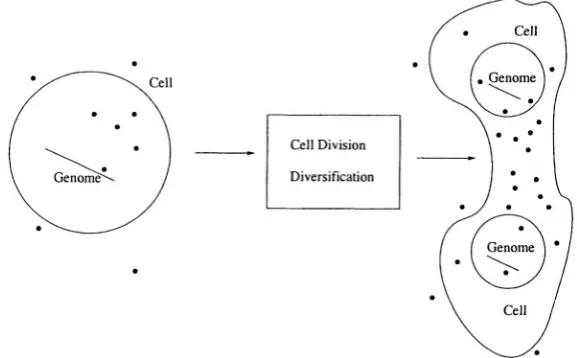
11.3 Single cell and multi-cellular system. The environment of a genome is primarily the cell in which it is residing. Control is exerted both by the cell and its environment via substances (black dots) diffusing around in intra- and extracellular space. The genome in turn tries to influ ence its environment by providing orders to produce cer tain substances. If a multi-cellular being is constructed a division and differentiation process is set into motion which leads to a number of cells with a boundary to the outside environment. The organism is the primary en vironment of a cell, with intra- and extra- organismal
message transfer via molecules (black dots). 250 11.4 Transcription and translation as two important steps in
the process of mapping information from genotype to
phenotype. 252
11.5 The network of data flow on registers as one example of program phenotype. The corresponding program is listed in the text as a linear sequence of instructions.
1.1 Major transitions in evolution; Maynard (Smith and Sza
thmary, 1995) 4
9.1 Eight criteria for saying that an automatically created re
This book is a collection of essays, authored by eminent scholars in evo lutionary computation (EC), artificial intelligence (AI), operations research, complexity theory and mathematics. Each essay revolves around important, interesting and unresolved questions in the field of evolutionary computation.
The book is designed to be a resource to at least three categories of readers. First of all, graduate students will find this book a rich source of open research issues. Imagine participating in an EC research seminar conducted by some of the best scholars in and around the field! The book also gives experts a chance to compare and contrast their understanding of the fundamental issues in EC with the perspectives of their peers. Finally, to the interested scholar it offers a sample of the kind of problems that are considered worth solving in EC.
Much has been written about how great solutions often have a certain aes thetic appeal (symmetry, simplicity, originality, unity and so on). In sharp contrast, characteristics of great problems remain something of a mystery. It is useful to think of a problem as existing in at least one of four states: undiscov ered, unsolved, solved and hibernating. However, truly interesting problems — great problems — manage a simultaneous, contrary existence in all four quadrants. A great problem, to echo Walt Whitman, is often large and con tains multitudes. Every mature field has its great problems. Even fields with a progressive tradition, like Physics and Mathematics, have problems that refuse to stay solved. The problem of explaining the directionality of the thermody namic arrow of time, and the debate over whether mathematical objects are invented or discovered are but two examples that comes to mind. Great prob lems act as co-ordinate systems for the geography of our imaginations and explain why we do what we do.
to model evolutionary processes? What are the characteristics of problems solvable by EC? Some of these problems are discussed at length in this volume. This book grew out of a proposed session for the 2001 International Con ference on Artificial Intelligence in Las Vegas, Nevada. I had thought that a collection of authoritative essays, each devoted to the description of a sub stantially unsolved problem in EC, could help bring coherence to the field, clarify its important issues, and provoke imaginations. The session was jok ingly dubbed the ‘Hilbert session’ in memory of David Hilbert’s outstanding example almost a century ago. Unfortunately, time constraints prevented the session from from going forward. But the highly positive response from the invitees, as well as from others who had heard about the idea, suggested that a book could be an alternate and appropriate forum for implementing the idea. The stray mentions of Hilbert in some of the essays thus hark back to the ori gins of this book. Needless to say, the essays were not written with the aim of being either as definitive or as predictive as Hilbert’s talk turned out to be.
The authors in this collection are wonderfully varied in their backgrounds, writing styles and interests. But their essays are related by several common goals: extensions to EC theories, discussion of various formalisms, summaries of the state of the art, and careful speculation on what could be done to re solve various issues. The essays also leave no doubt that the ferment caused by active trading is producing a watershed event in the marketplace of ideas. Witness for example, the import of ideas from evolutionary theory into Algo rithmics (such as: population thinking, inheritance and recombination), and the export of ideas from mathematics and computer science into evolutionary theory (such as: stochastic models, complexity theory, computability). Ide ally, I would have liked to triple the size of the book, include at least a dozen more authors, and reprint essays from relevant collections. On the other hand, progress is a side-effect of achieving the possible. While the sample of ideas and authors herein is certainly not comprehensive, it is very much representa tive of what is possible in our field.
Bahrain Alidaee is an associate professor of Operations Management at the Business School, the University of Mississippi. His research interests include combinatorial optimization, heuristic programming, and game theory. He has published more than 40 articles in journals such as Management Science, Trans portation science, IEEE Transactions, European Journal of OR, Journal of Operational Research, Computers and Operations Research, Production and Operations Management and other journals. He is a member of INFORMS, DSI, APICS, and POMS.
Lee Altenberg is Associate Professor of Information and Computer Sciences at the University of Hawaii at Manoa. His interest is in systems phenomena, and he has focused on the dynamics of evolutionary processes. Of particular interest is the emergence of the representation problem in evolution, the evolu tion of the genotype-phenotype map, and evolutionary dynamics of modular ity. His publications bridge the fields of mathematical population genetics and evolutionary computation. Recent civic projects include restoration of dryland Hawaiian biodiversity, reduction of light pollution, and control of alien ungu lates on Maui.
Wolfgang Banzhaf is Associate Professor of Applied Computer Science at the University of Dortmund, Germany. He is lead author of the textbook Genetic Programming — An Introduction and editor-in-chief of the Kluwer journal Ge netic Programming and Evolvable Machines. He has published more than 80 refereed conference and journal articles.
Carlos Cotta received the M.Sc. and Ph.D. degrees in 1994 and 1998, respec tively, in Computer Science from the University of Málaga (UMA), Spain. He is currently affiliated to the Department of “Lenguajes y Ciencias de la Com putación” of the UMA, where he holds an Associate Professorship in Program ming Languages and Computer Systems. He has been previously appointed as Lecturer (1995–1999), and Assistant Professor (1999–2001) in this institution. His research interests are primarily in evolutionary algorithms, both from the algorithmic (design techniques, theoretical foundations, parallelism, and hybridization) and the applied (combinatorial optimization, data mining, and bioinformatics) standpoint. He is the author or co-author of over 40 articles on these topics.
He is a member of the European Network of Excellence on Evolution ary Computing (EvoNet), the European Chapter on Metaheuristics (EU/ME), and the ACM Special Interest Group on Applied Computing (ACM SIGAPP) among other research societies and organizations. He has also served in the Programme Committee of the major conferences in the field (GECCO, CEC, and PPSN among others), and has refereed articles for scientific journals such as the Journal of Heuristics, and IEEE Transactions on Evolutionary Compu tation among others.
robot behaviors. This group is also involved in extending current evolution ary computation models to include more complex mechanisms such as speci ation, co-evolution,and spatial extent. These ideas are being developed to im prove both the applicability and scalability of current evolutionary algorithms to more complex problem domains. Funding for the lab comes from a vari ety of sources including DARPA, ONR, NRL, NSF, and local area companies. Further details can are available at www.cs.gmu.edu/ eclab.
Fred Glover is the MediaOne Chaired Professor in Systems Science at the University of Colorado, Boulder, and Distinguished Researcher and co-founder of the Hearin Center for Enterprise Science at the University of Mississippi. He has authored or co-authored more than three hundred published articles and six books in the fields of mathematical optimization, computer science and artifi cial intelligence, with particular emphasis on practical applications in industry and government. In addition to holding editorial and advisory posts for jour nals in the U.S. and abroad, Dr. Glover has been featured as a National Visiting Lecturer by the Institute of Management Science and the Operations Research Society of America and has served as a host and lecturer in the U.S. National Academy of Sciences Program of Scientific Exchange. Professor Glover is the recipient of the distinguished von Neumann Theory Prize, a member of the National Academy of Engineering, and has received numerous other awards and honorary fellowships, including those from the American Association for the Advancement of Science (AAAS), the NATO Division of Scientific Affairs, the Institute of Operations Resarch and Management Science (INFORMS), the Decision Sciences Institute (DSI), the U.S. Defense Communications Agency (DCA), the Energy Research Institute (ERI), the American Assembly of Colle giate Schools of Business (AACSB), Alpha Iota Delta, and the Miller Institute for Basic Research in Science. He serves on the advisory boards of several organizations and is co-founder of OptTek Systems, Inc.
Martin A. Keane received a Ph.D. in Mathematics from Northwestern Uni versity in 1969. He worked for Applied Devices Corporation until 1972, in the Mathematics Department at General Motors Laboratory until 1976, and was Vice-President for Engineering of Bally Manufacturing Corporation until 1986. He is currently chief scientist of Econometrics Inc. of Chicago and a consultant to various computer-related and gaming-related companies.
books and more than 40 refereed articles in top journals in his field includ ing Management Science, Mathematical Programming, Journal of Optimiza tion Theory and Applications, Operation Research, Computers and Operations research, Naval Research Logistics Quarterly, Journal of the Operational Re search Society, Interfaces, Operations Research Letters, and the Journal of the Production and Operations Management Society and Transportation Science. Moreover, he is actively engaged in several major journals including positions as area editors for both INTERFACES and the Journal of the Production and Operations Management Society (POMS).
John R. Koza received his Ph.D. in Computer Science from the University of Michigan in 1972 under the supervision of John Holland. He was co-founder, Chairman, and CEO of Scientific Games Inc. from 1973 through 1987 where he co-invented the rub-off instant lottery ticket used by state lotteries. He has taught a course on genetic algorithms and genetic programming at Stanford University since 1988. He is currently a consulting professor in the Biomedical Informatics Program in the Department of Medicine at Stanford University and a consulting professor in the Department of Electrical Engineering at Stanford University.
William Macready is a senior scientist with the Research Institute for Ad vanced Computer Science at NASA Ames Research Center. William has pub lished on topics including optimization, landscapes, molecular evolution, ma chine learning, economics, and methods of quantifying complexity. He is in terested in both the theoretical and practical aspects of optimization. Before joining RIACS/NASA, William worked in industry solving optimization prob lems in logistics, supply chains, scheduling, and designed efficient optimiza tion approaches for clearing high-dimensional marketplaces.
Distinguished Engineer at Whizbang Research Labs, based in Provo, Utah. He currently consults for ProductSoft, a Pittsburgh based software startup.
Julian Miller is a lecturer in the School of Computer Science, University of Birmingham. He is author of around 75 research publications. He has an in ternational reputation in the research fields of evolvable hardware and genetic programming. He is a regular programme chair and session chair for inter national conferences on evolvable hardware, and Genetic Programming, and evolutionary computation. He is an associate editor of the Journal of Genetic Programming and Evolvable Machines and IEEE Transactions on Evolution ary Computation. He teaches advanced MSc modules on Quantum and Molec ular Computation and a Nature Inspired Design and a first-year undergraduate course on Artificial Intelligence Programming.
Heinz Mühlenbein is research manager of the team ‘Adaptive Sytems’ at the Institut of Autonomous intelligent Systems of the Fraunhofer Gesellschaft in Germany. He has worked in the areas of time-sharing operating systems, com puter networks, parallel computing, and since 1987, soft computing. He is on the editorial board of journals in physics, parallel computing, heuristics, and evolutionary computation. In addition he has published more than 30 refereed journal articles.
to Memetic Algorithms of “New Ideas in Optimization”, McGraw-Hill, UK, 1999.
Riccardo Poli is a Professor of Computer Scince at the University of Essex. He has co-authored the book Foundations of Genetic Programming and around 130 refereed publications (including 10 conference proceedings) on genetic programming, genetic algorithms, image processing and neural networks and other areas. He is an associate editor of Evolutionary Computation and of the
Journal of Genetic Programming and Evolvable Machines. He has been pro gramme committee member of over 40 international events and has presented invited tutorials at 8 international conferences.
César Rego received his Ph.D. in Computer Science from the University of Versailles and INRIA - France, after earning a MSc in Operations Research and Systems Engineering from the Technical School (IST) of the University of Lis bon. His undergraduate degree in Computer Science and Applied Mathematics is from the Portucalense University in Portugal. Part of his academic career was done in the Portucalense University and he also taught at IST and Faculty of Sciences of the University of Lisbon. Dr. Rego received an award from the Portuguese Operational Research Society (APDIO) for his MSc thesis. He also received the IFORS-Lisbon award for the best international paper published by members of APDIO, an investigation over a four-year period. Finally, he received an award as Researcher/Scholar of the year in School of Business, MIS/POM area, University of Mississippi. Professor Rego’s publications have appeared in books on metaheuristics and in leading journals on optimization such as European Journal of Operational Research (EJOR), Journal of Oper ational Research Society (JORS), Parallel Computing, and Management Sci ence. He has developed some of the most efficient algorithms that currently exist for the Traveling Salesman and Vehicle Routing Problems. In the prac tical realm, he has designed and implemented computer software for solving real-world problems for several major companies. His main research interest is the creation and empirical validation of optimization algorithms for solving complex and practical problems. He is a member the APDIO, the INFORMS, a senior researcher of the Hearin Center for Enterprise Science (HCES) and As sociate Professor of Management Information Systems and Operations Man agement in the School of Business of The University of Mississippi.
contributions in functional analysis, operator algebra theory, non-commutative integration, quantum physics, biomechanical modeling, genetic algorithms and optimization, language analysis and UNIX-based interactive teaching systems. Otherwise, he enjoys family life, swimming, playing the piano, the arts and fine dining. In 2003, he is listed in “Who’s Who in the World.”
Chris Stephens is Professor at the Institute for Nuclear Sciences of the UNAM (Universidad Nacional Autonoma de Mexico) - the oldest university in the Americas. He has had visiting positions at various leading academic insti tutions, including the Weizmann Institute, the Joint Institute for Nuclear Re search, Dubna, the University of Birmingham and the University of Essex. He is also a founding partner of Adaptive Technologies Inc. and Adaptive Tech nologies SA de CV - research companies dedicated to the production of agent-based technologies for dynamical optimization in finance and industry. Chris’s research interests are very broad, having published over 70 research articles in a wide array of international journals - ranging from Classical and Quantum Gravity to the Journal of Molecular Evolution.
Matthew J. Streeter received a Masters degree in Computer Science from
TOWARDS A THEORY OF ORGANISMS
AND EVOLVING AUTOMATA
Open Problems and Ways to Explore
Heinz Mühlenbein
FhG-AiS D-53754 Sankt Augustin
Abstract We present 14 challenging problems of evolutionary computation, most of them derived from unfinished research work of outstanding scientists such as Charles Darwin, John von Neumann, Anatol Rapaport, Claude Shannon, and Alan Tur ing. The problems have one common theme: Can we develop a unifying theory or computational model of organisms (natural and artificial) which combines the properties structure, function, development, and evolution? There exist theories for each property separately as well as for some combinations of two. But the combination of all four properties seems necessary for understanding living or ganisms or evolving automata. We discuss promising approaches which aim in this research direction. We propose stochastic methods as a foundation for a unifying theory.
1.
INTRODUCTION
The aim of this book is very ambitious. Its title is not: important problems of evolutionary computation, but Hilbert problems in evolutionary computation. What makes Hilbert’s problems so famous and unique? Hilbert designed his problems with the goal that “they could serve as examples for the kinds of problems the solutions of which would lead to advancements of disciplines in mathematics.” If we have a closer look at Hilbert’s twenty-three problems today, then we observe that some of the problems indeed lead to important research, but a few of them did not. One of the reasons seems to be how the problems have been formulated. Most of them are well defined, but some are more vaguely posed, making a solution difficult.
sub-problem of the general research program Hilbert had in mind: Can math ematics be axiomatized? The general problem was taken on by Russel and Whitehead and lead to three volumes of the Principia Mathematica. Gödel dealt with the more specific problem two and proved that the answer is nega tive. This put an end to the effort of Russel and Whitehead. The implication of Gödel’s result with regard to mathematics and the theory of computation in general is still a subject of hot discussions.
In contrast, problem number six just reads: Can physics be axiomatized? In the explanation of the question Hilbert writes: “to axiomatize those physical disciplines, in which mathematics already plays a dominant role; these are first and foremost probability and mechanics.” To our surprise we see the calculus of probability as a part of physics! A closer inspection reveals that Hilbert’s moderate goal was a mathematically sound application of probability to kinetic gas theory. This research has been carried out by physicists, but without ever referring to a Hilbert problem. It lead to statistical physics as it appears today. My goal is modest. I will propose problems, mainly in evolutionary com putation, and name each after a famous scientist who has formulated or inves tigated the problem. This does not imply that the problem so named is the most important the scientist has worked on. Nor do I claim that the scientist has considered the problem to be the most important one he has worked on. I only want to demonstrate that most of the challenging problems have been identified very early and are with us for quite a time. And my second message is: we have to look much more often into older papers. Older scientific pa pers should not be considered as “fossils”. It is a fundamental misconception that science is continuously accumulating all the important available knowl edge and condensing the knowledge in surveys or textbooks. Many important scientific ideas and papers enter main stream science after 20 or more years.
2.
EVOLUTIONARY COMPUTATION AND
THEORIES OF EVOLUTION
The goal of evolutionary computation is to make the development of pow erful problem solving programs easier. There have been tried at least three approaches to achieve this goal.
1 Use a theory - develop a theory of problem solving and implement it on a computer
2 Copy the brain - analyze the human brain and make a copy of it on a computer
3 Copy natural evolution - analyze natural evolution and implement the most important evolutionary forces on a computer
In the history of artificial intelligence research one of the three approaches was dominant at any one time. Evolutionary computation belongs to the third approach. Today this approach is gaining momentum. It relies on theories of evolution and of computation. The theory of computation is well advanced, so the problems of evolutionary computation lie in theories of evolution. If there existed a convincing constructive theory of evolution, then evolutionary computation would be just a matter of implementation - which of the major evolutionary forces to implement in what detail.
But do we possess a constructive theory of evolution? Here the opinions dif fer extremely. The main stream theory of evolution is called New or Modern Synthesis. Its followers claim that it reconciles Darwin’s idea of continuous small variations with the concept of gene flows derived from population genet ics. The second major force of the Modern Synthesis is still Darwin’s concept of natural selection. But are these two forces sufficient to explain the wonders of evolution at least in some broad terms?
There is no doubt that the modern synthesis is able to explain the change of gene frequencies on a small time scale. If there is enough diversification, then the theory correctly predicts further changes for a short time. But can it explain evolution for a long time? Here the crucial question is: How could it come to such a diversification, starting from a tiny cell? I like to formulate the problem with Darwin’s famous ending sentence of The Origin of Species by Means of Natural Selection ((Darwin, 1859)).
Let me be more specific and cite some major problems which a theory of evolution would have to explain. Maynard (Smith and Szathmary, 1995), have called them the the major transitions in evolution (see table 1.1).
The authors “solve” some of the problems with a very narrow version of the modern synthesis. “We are supporters of the gene centered approach pro posed by Williams and refined by (Dawkins, 1989).” In the gene centered approach, also called the selfish gene concept, the genes are the major actors. They possess an internal force to proliferate as much as possible.
This caricature of a theory of evolution is used by the authors to explain the transition from solitary individuals to colonies, for example. The argument is as follows: If a female produces two offspring, but females can produce 3n offspring, then cooperation between the females pays off. Even if there is a fight between females and one becomes a queen, cooperation is still preferred
of is larger than 2). Thus in the gene centered analysis a colony with a single queen has a selective advantage.
cation done by the selfish gene concept. It is my strong opinion that the selfish gene concept does not enrich Darwin’s theory, but reduces it to a caricature.
The selfish gene concept has been opposed by a small group in biology, most notably by the late Stephen J. Gould. Recently even philosophers of science formulate a basic critic. I just cite (Griffiths, 2002). “The synthetic theory bypassed what were at the time intractable questions of the actual re lationship between stretches of chromosomes and phenotypic traits. Although it was accepted that genes must, in reality, generate phenotypic differences through interaction with other genes and other factors in development, genes were treated as black boxes that could be relied on to produce phenotypic vari ation with which they were known to correlate.”
I will discuss this problem later with my proposal of a system theory of evolution. The major conclusion of this section is: there exists no general the ory of evolution today. The “theory” its proponents call “Modern Synthesis” is an extremely simplified version of Darwin’s theory. It separates organisms and environment. Natural selection is modeled by a fitness function, whereas Darwin used the term only in a metaphoric sense. In fact, Darwin noticed the misinterpretation of his theory even during his life. He wrote in the last (1872) edition of “The Origin of Species”: “As my conclusions have lately been much misrepresented, and it has been stated that I attribute the modifica tion of species exclusively to natural selection, I may be permitted to remark that in the first edition of this work, and subsequently, I placed in a most con spicuous position — namely at the close of the Introduction — the following words: “I am convinced that natural selection has been the main but not the ex clusive means of modification.” This has been of no avail. Great is the power of steady misinterpretation.”
Therefore evolutionary computation has to be largely experimental. This was already pointed out by John (von Neumann, 1954). “Natural organism are, as a rule, much more complicated and subtle, and therefore much less well un derstood in detail, than are artificial automata. Nevertheless, some regularities, which we observe in the organization of the former may be quite instructive in our thinking and planning of the latter; and conversely, a good deal of our experiences and difficulties with our artificial automata can be to some extend projected on our interpretations of natural organisms.”
3.
DARWIN’S CONTINENTAL CYCLE
CONJECTURE
ability in each individual, and is, I believe, an extremely important element of success.”
On the other hand Darwin observes that a large number of individuals in a large continental area will hinder the appearance of new adaptations. This happens more likely in small isolated areas. He writes: “Isolation, also, is an important element in the process of natural selection. In a confined or isolated area, if not large, the organic and inorganic conditions of life will be in a great degree uniform; so that natural selection will tend to modify all individuals of a varying species throughout the area in the same manner in relation to the same conditions. But isolation probably acts more efficiently in checking the immigration of better adapted organisms. Lastly, isolation, by checking immigration and consequently competition, will give time for any new variety to be slowly improved.”
Darwin then continues: “Hence an oceanic island at first sight seems to have been highly favorable for the production of new species.” But Darwin notes a conflict: “to ascertain whether a small isolated area or a large open area like a continent, has been most favorable for the production of new organic forms, we ought to make the comparison within equal times; and this we are incapable of doing. ”
Despite of the above observation Darwin concludes: “I conclude, that for terrestrial productions a large continental area, which will probably undergo many oscillations of level, and which consequently will exist for long periods in a broken condition, will be the most favorable for the production of many new forms of life, likely to endure long and spread widely.” Darwin reasons as follows: “For the area will first have existed as a continent, and the inhabitants, at this period numerous in individuals and kinds, will have been subjected to very severe competition. When converted by subsidence into large separate islands, there will still exist many individuals of the same species on each island;. . . and time will be allowed for the varieties in each to become well modified and perfected. When by renewed elevation, the islands shall be re converted into a continental area, there will be again severe competition: the most favored or improved varieties will be enabled to spread: there will be much extinction of the less improved forms . . .”
I am very impressed about Darwin’s continental cycle conjecture, which he made much earlier than Alfred Wegener in geology. Therefore I dedicate my first problem to Darwin.
Problem 1 [Darwin]: Can we demonstrate or even prove the correctness of Darwin’s Continent-Island cycle conjecture ?
The most profound critique of modern “Darwinism” can be found in Darwin’s book!1
It seems difficult to test Darwin’s conjecture in nature. I propose therefore to use simulations as a first step. I have used the iterated prisoners dilemma game to investigate problem 1 ((Mühlenbein, 1991a)). The results indicate that Darwin’s conjecture might be correct. But the simulation model needs a lot more refinement.
Darwin mentions at many places of the “Origin” that space is as important for evolution as time. This has been shown in the context of genetic algorithms by (Mühlenbein, 1991b). Space is also an important element of the shifting balance theory of evolution proposed by (Wright, 1937). Without referring to Darwin a subset of the problem, that is the difference of the evolution in a large continent and small isolated islands, has been recently investigated by (Parisi and Ugolini, 2002).
4.
THE SYSTEM VIEW OF EVOLUTION
The next set of problems I will derive more abstract. The major weakness of “Darwinism” in the form of the modern synthesis is the separation of the individuals and the environment. In this model each individual (mainly characterized by its genes) is assigned a fitness predicting the performance of this individual within the environment E and given the other individuals. This can be written as:
It seems impossible to obtain numerical values for the fitness. Therefore theoretical biology has made many simplifications. The environment is kept fixed, i.e the influence of other individuals is described by some averages of the population, etc.. The shortcomings of the dichotomy individual-environment in the Modern Synthesis have already been discussed. The problem is still more difficult because each individual is in addition devel oping in a close interaction with its environment. The development problem has been addressed recently by (Oyama, 2000), in her developmental system theory. Unfortunately the theory is very informal, it has been formulated from a philosopher’s point of view. Therefore I will describe the next problem as it has been stated in the final address of Anatol Rapaport, the then retiring presi dent of General System Science Society
((Rapaport, 1970)).
Problem 2 [Rapaport+1]: Can we formulate a theory of organisms, which incorporates being, acting, evolving, and developing?
I have named the problem Rapaport+1 because Rapaport identified only three properties. He combined evolving and developing into a single property becoming. The problem needs an explanation. It goes back to (Whitehead, 1948). In his book “Science and the Modern World” Whitehead warned that the store of fundamental ideas on which the then contemporary science was based was becoming depleted. Whitehead suggested that the concept of or ganism, hitherto neglected in physical science, might be a source of new ideas. Whitehead tried to define what an organism characterizes.
We will describe the definition of Rapaport. “According to a soft definition, a system is a portion of the world that is perceived as a unit and that is able to maintain its identity in spite of changes going on in it. An example of a system par excellence is a living organism. But a city, a nation, a business firm, a university are organisms of a sort. These systems are too complex to be described in terms of succession of states or by mathematical methods. Nevertheless they can be subjected to methodological investigations.”
Rapaport then defines: “Three fundamental properties of an organism ap pear in all organism-like systems. Each has a structure. That is, it consists of inter-related parts. It maintains a short-term steady state. That is to say, it reacts to changes in the environment in whatever way is required to maintain its integrity. It functions. It undergoes slow, long term changes. It grows, develops, or evolves. Or it degenerates, disintegrates, dies.
Organisms, ecological systems, nations, institutions, all have these three attributes: structure, function, and history, or, if you will, being, acting, and becoming.”
Rapaport’s becoming captures both – the development of an organism from the fertilized egg to the grown-up organism, and the evolution of the species in a succession of many generations. There is no doubt that the relationship between the two properties is a very close one. Ernst Haeckel even postulated in 1890 a biogenetic law: Individual development is a shortened recapitulation of the history of the phylum. Subsequent research has shown that there is some truth in the law, but as a general statement it is incorrect. In my opinion it is very important to distinguish between the development of an individual and the evolution of a species.
acting. The developmental system theory mentioned earlier combines being and developing.
The investigation of the above problem leads to another problem: In what language should we frame a theory of organisms? Three approaches can be tried:
The descriptive approach, using natural language
The micro-simulation approach
The mathematical approach
Today the descriptive approach has gained momentum, characterized by the developmental system theory mentioned above (Oyama, 2000). Artificial Life uses micro-simulation. But in micro-simulations it is very difficult to distin guish between the microscopic event and the more general pattern happening in many simulations. Rapaport and, earlier, von Neumann advocated the math ematical approach. I go a step further and propose stochastic system theory as the research foundation. Stochastic analysis has been successfully used in pop ulation genetics for at least 75 years. But population dynamics is still mainly investigated with the help of deterministic differential equations. Thus I parti tion Rapaport’s problem into three problems.
Problem 3a: Can we develop a stochastic system theory, combining the properties being and acting of organisms or automata in a 2-d space?
Problem 3b: Can we develop a stochastic system theory, combining the properties being and developing of organisms or automata in a 2-d space?
Problem 3c: Can we develop a stochastic system theory, combining the as pects being, acting and evolving of organisms or automata in a 2-d space?
The answer to the first question is a definite yes. It is already an active area of research. We will discuss the state of the art in stochastic analysis in the technical sections 11 till 13. Problem 3b was first investigated by von Neumann.
5.
VON NEUMANN’S SELF-REPRODUCING
AUTOMATA
must be expected as one automaton makes another automaton.” But organisms reproduce themselves with no decrease in complexity. Moreover, organisms are indirectly derived from others which had lower complexity.
Problem 4 [von Neumann]: Can we construct automata which are able to produce automata more complex than themselves?
Von Neumann tried several approaches to enable a scientific investigation of the above problem. The main theory was collected by Burns and expended into a theory of self-reproducing automata ((Burns, 1970)). But it is more in structive to look at von Neumann’s own description, summarized in the article “The General and Logical Theory of Automata” ((von Neumann, 1954)). Von Neumann started his research with a result of Turing. Turing wanted to give a precise definition of what is meant by a computing automaton. His solution was the Universal Turing Machine UTM. It consists of an automaton reading and writing symbols on an infinite tape. Von Neumann decided that his au tomaton should have the power to simulate the UTM in a discrete cellular 2-d space. Thus he investigated the problem how to construct an automaton which reproduces itself in 2-d space and has the power of UTM.
Von Neumann’s construction proceeded as follows:
(a) Construct an automaton A, which when furnished the description of any other automaton in terms of appropriate functions, will construct that entity.
(b) Construct an automaton B, which can make a copy of any instruction that is furnished to it. This facility will be used when furnishes a description of another automaton.
(c) Combine the automata A and B with a control mechanism which does the following. will first cause A to construct the automaton which is de scribed by Next will cause B to copy the instruction Finally will separate this construction from the system
(d) Form an instruction which describes this automaton D, and insert into A within D. Call the aggregate which now results E.
E is clearly self-reproducing. But E cannot do anything besides reproduc tion. It needs a program. Therefore von Neumann proposed an extension: Replace the instruction by an instruction which describes automa ton D plus another automaton F. This automaton reproduces itself and then behaves like automaton F. Now if a “mutation” within the F part takes place, it changes into This “mutant” is still self-reproductive.
relevance? The answer is simple: The construction does not solve the most important problem: How do the programs get into the machine? The develop ment of programs is the problem, not their self-reproduction. Von Neumann’s automata can in principle compute anything, but the programs have to be pro vided from the outside! Who provides these descriptions? A single built-in program F is surely not enough, because von Neumann did not introduce se lection. Therefore the value of the mutant program F' for problem solving is not checked. Thus von Neumann solved only part of the problem. Therefore we extend problem 4.
Problem 5: What conditions are required to enable von Neumann’s au tomata to grow in complexity without external interventions?
A worthwhile extension of von Neumann’s approach would be to use a pop ulation of automata which interact with each other and which have to solve a set of problems to survive and produce offspring. Thus I believe that for a solution of problem 5 one needs both, Turing and Darwin. Turing provides the concept of a universal automaton and Darwin provides the concept of a changing environment metaphorically leading to natural selection.
The importance of von Neumann’s construction for today’s research has also been emphasized by (McMullin, 2001).
6.
TURING’S INTELLIGENT MACHINE
Von Neumann’s approach of using self-reproduction and the Universal Tur ing Machine was not the only method proposed to build intelligent machines. In fact, von Neumann discussed the use of artificial neural networks as another possibility. Before I describe this work, it is instructive to discuss how Tur ing himself approached the problem in his article “Computing machinery and intelligence” ((Turing, 1950)). At first Turing defined the concept of intelli gence. A machine is intelligent if it passes a test Turing defined precisely: the Turing test is an “imitation” game, played by three objects A, B and C. C is the interrogator, A or B might be a machine. The machine passes the test if the interrogator is not able to find out that a machine answers to his questions. This gives our next problem.
Problem 6 [Turing]: Is it possible to build machines which pass the Turing test?
the proposal very fascinating. The arguments brought forward by Turing have been used a number of times in artificial intelligence research, but obviously without knowing that Turing already formulated them.
“As I have explained, the problem is mainly one of programming. Estimates of the storage capacity of the brain vary from and I would be sur prised if more than was required to satisfactory playing of the imitation game ... At my present rate I produce about a thousand digits of program a day, so that about sixty workers, working steadily through the fifty years might accomplish the job, if nothing went into the wastepaper basket. Some more expeditious method seems desirable.”
Turing did not try to formalize a possible solution to problem 6. Any pro gram passing the test will do. It is the efficiency problem which leads Turing to consider natural organisms, in this case the human mind. “In the process of trying to imitate an adult mind we are bound to think a good deal about the process which has brought it to the state that it is in. We may notice three components:
(a) The initial state of the mind, say at birth, (b) The education to which it has been subjected, (c) Other experience
Instead of trying to produce a program to simulate the adult mind, why not rather try to produce one which simulates the child’s?. . . . We have thus divided our problem into two parts, the child programme and the education process. These two remain very closely connected. We cannot expect to find a good child machine at the first attempt... There is an obvious connection be tween this process and evolution, by the identifications
One may hope, however that this process will be more expeditious than evolution. The survival of the fittest is a slow method for measuring advan tages... Opinions may vary as to the complexity which is suitable in the child machine. One might try to make it as simple as possible consistently with the general principles. Alternatively one might have a complete system of logical inference programmed in.”
start with?. . . Many people think that a very abstract activity, like the playing of chess, would be the best. It can also be maintained that it is best to provide the machine with the best sense organs that money can buy, and then teach it to understand and speak English.” Today chess playing has been solved by brute force programming. This solution is feasible due to the strict rules of chess that enable fast and efficient game tree search. The progress in games like GO is much slower. But we are still left with the language understanding problem.
Problem 7 [Turing]: Is it possible to create a machine which can be taught to understand English?
Turing’s proposal belongs to the “copy the evolution” approach. In contrast to nature the artificial evolution does not start with a cell, but with a well-designed child. Turing’s approach is very informal, he believed that he could program an intelligent system using about bits. I call this attitude the pro-grammer’s approach. The system is programmed without a theory. One just assumes that anything can be programmed. This attitude seems to be dominant today. For Turing evolution is just a technique to shorten the programming time.
7.
WHAT CAN BE COMPUTED BY AN
ARTIFICIAL NEURAL NETWORK?
We now turn back to von Neumann and his approach to machine intelli gence. In contrast to Turing, von Neumann works more like a natural scientist. He tries to formalize solution strategies. Thus his solutions are not programs, but theories. In 1948 formal neural networks were already very popular in the research community because of the work of McCulloch and Pitts. John (von Neumann, 1954), investigated the power of neural networks in his famous talk “The general and logical theory of automata”. In the section “Formal Neu ral Networks” von Neumann notes: “The McCulloch-Pitts result2 proves that anything that can be exhaustively and unambiguously described, anything that can be completely and unambiguously put into words, is ipso facto realizable by a suitable finite neural network... Thus the remaining problems are these two. First, if ascertain modes of behavior can be effected by a finite neural network, the question still remains whether the network can be realized within a practical size. . . Second, the question arises whether every existing modes of behavior can be put completely and unambiguously into words. . .
There is no doubt that any special phase of any conceivable form of behav ior can be described completely and unambiguously in words. This description
may be lengthy, but it is always possible. . . It is, however, an important limita tion, that this applies only to every element separately, and it is far from clear how it will apply to the entire syndrome of behavior.”
Von Neumann then discusses more specifically the concept of identifica tion of analogous geometrical entities. He takes as example the concept of a triangle.
“There is no difficulty in describing how an organism might be able to iden tify any two rectilinear triangles, which appear on the retina, as belonging to the category “triangle”. There is also no difficulty in adding to this, that numer ous other objects, will also be classified and identified as triangles — triangles whose sides are curved, triangles whose sides are not full drawn . . . This, in turn, however constitutes only a small fragment of the more general concept of analogy. Nobody would attempt to describe and define within any practical amount of space the general concept of analogy which dominates our interpre tation of vision. There is no basis for saying whether such an enterprise would require thousands or millions or altogether impractical numbers of volumes. Now it is perfectly possible that the simplest and only practical way actually to say what constitutes a visual analogy consist in giving a description of the connections of the visual brain.”
This discussion leads to the next problem.
Problem 8 [von Neumann]: Can an artificial neural network of practical size be designed which gives similar results on visual problems as the human brain?
Turing also used an “analysis” of the human brain in order to show that an intelligent machine can be programmed in bits. He wrongly assumed that the performance of the brain can be characterized by its number of neurons, about He did not consider the interconnection structure as relevant. The only problem left to him is to obtain this program of digits. Von Neumann is much more careful. It is not the number of neurons which matters, but their interconnection structure. Today we know that even the interconnection structure is not sufficient to define uniquely how the neurons process the visual input. We need to know the dynamic interaction of all the neurons involved.
8.
LIMITS OF COMPUTING AND COMMON
SENSE
might be that this number is greater than a practical size. The practical size is defined by the real world. Finiteness is not enough, we need practical time and practical space in our real world. The finiteness of our world puts an upper limit to the largest program which can be computed in our world. The actual determination of the practical size turned out to be very difficult. Therefore complexity theory is formulated without an actual limit. The set of problems which can be computed is defined differently. It lead to the distinction of Ptime and NPtime problems: given a problem whose solution can be verified in poly nomial time, is there an algorithm which actually finds such a solution (this means in polynomial time according to the size of the input.)? If both condi tions can be proven, we have a problem from class Ptime or short P, if only the first condition is fulfilled we have an NPtime or short NP problem. Poly
nomial time means exponential time But if is very
large, even can be a very large number, meaning that the problem can not be computed in reasonable time. Nevertheless all problems in class P are considered to be easy computable.
The question if P is equal or not equal to NP is one of the most important open questions in complexity theory. The basic classification has been refined in a number of ways. I just mention the inclusion
There have been several attempts to compute the practical size of space or the limit of time, using the finiteness of the universe and the laws of physics. Bremermann was one of the first to compute explicitly an upper limit.
Bremermann’s bound: No data processing system, whether artificial or liv ing, can process more than bits per second per gram of its mass.
Bremerman used this bound to calculate the total number of bits processed by a hypothetical computer the size of the earth within a time period equal to the estimated age of the earth. He computed bits. Then he calculated the mass of the universe and obtained his bound. The above limit is small by math ematical means. I call any number between and Bremermann’s limit ((Mtihlenbein, 1996)). Programs which are finite, but require more than
steps for solving, do not finish in our universe. This implies that the mathemat ical class of finite programs has to be divided into those below Bremermann’s limit and above the limit.
posal was made by (McCarthy, 1959), in his article “Programs with common sense”3. The most recent effort is due to (Lenat, 1995). With a team of up to 10 people he tried to code “common sense” knowledge into a rule-based database. After almost 10 years of effort, he was still far away from the goal, formulated as the next problem.
Problem 9 [McCarthy,Lenat]: Is it possible to put so much knowledge into a computer, that it is able to read a newspaper and improve itself from thereon ?
Looking back to von Neumann’s discussion, I believe that the answer to this question is negative. I do not recommend to work on this problem, because proving that something is impossible is very difficult. Instead I recommend a sub-problem, formulated in the paper “Computers and Automata” by (Shan non, 1953).
Problem 10 [Shannon]: Can we organize machines into a hierarchy of lev els, as the brain appears to be organized, with the learning of the machine gradually progressing up through the hierarchy?
Hierarchy is used by Shannon very informally. He means levels of abstrac tions. Each level might use a different calculus. The machine should be able to do inference on a lower level after a limited number of examples. This fea ture should then be used for learning at the next level. Up to now there are no convincing theories how to solve this problem.
9.
A LOGICAL THEORY OF ADAPTIVE
SYSTEMS
In the paper “Outline for a Logical Theory of Adaptive Systems” (Holland, 1970b), tried to continue the scientific endeavor initiated by von Neumann. Holland wrote: “The theory should enable to formulate key hypotheses and problems particularly from molecular control and neurophysiology. The work in theoretical genetics should find a natural place in the theory. At the same time, rigorous methods of automata theory, particularly those parts concerned with growing automata should be used.”
Thus Holland’s proposal is a very early attempt to work on the general prob lem 2, a constructive theory of the evolution of automata. It tries to combine being, acting, developing, and evolving. This proposal so important that I will describe it in detail. Holland’s emphasis (like von Neumann‘s) is foremost
on theories and systems, he does not claim to solve grand challenge applica tions with the proposed methods. This can be tried after the theories have been developed.
“Unrestricted adaptability (assuming nothing is known of the environment) requires that the adaptive system be able initially to generate any of the pro grams of some universal computer. . . With each generation procedure we as sociate the population of programs it generates;. . . In the same vein we can treat the environment as a population of problems.” It is especially the last sentence which relates Holland’s ideas to Darwin’s. Now let us have a closer look at Holland’s model. First, there is a finite set of generators (programs)
The generation procedure is defined in terms of this set and a graph called a generation tree. Each permissible combination of generators is represented by a vertex in the generation tree. Holland now distinguishes between auxiliary vertices and main vertices. Each auxiliary vertex will be labeled with two numbers, called the connections and disconnection probabil ities. This technique enables to create new connections or to delete existing connections. Each main vertex is labeled with a variable referred to as density. The interested reader is urged to read the original paper ((Holland, 1970b)).
Holland claims that from the generation tree and the transition equations of any particular generation procedure, one can calculate the expected values of the densities of the main vertices as a function of time. Holland writes: “From the general form of the transition equations one can determine such things as conditions under which the resulting generation procedures are stationary processes.” Thus Holland already tried to formulate a stochastic theory of program generation! This is an idea still waiting to be explored.
Holland’s next extension of the system is similar in spirit to von Neumann’s self-reproducing automata. Holland introduces supervisory programs which can construct templates which alter the probabilities of connections. Tem plates play the role of catalysts or enzymes. Thus program construction is also influenced by some kind of “chemical reactions.” The above process is not yet adaptive. Adaptation needs an environment posing problems. Therefore Holland proposes that the environment is treated as a population of problems. These problems are presented by means of a finite set of initial statements and an algorithm for checking whether a purported solution of the problem is in fact a solution. “When we consider the interaction of an adaptive system with its environment we come very soon to questions of partial solutions, subgoals etc. The simplest cases occur when there is an a priori estimate of the nature of the partial solution and a measure of the closeness of its approach to the final solution.”
study of adaptive systems. . . . An adaptive system could enhance its rate of adaptation by somehow enriching the environment. Such enrichment occurs if the adaptive system can generate subproblems or subgoals whose solution will contribute to the solution of the given problems of the environment.”
It is very interesting to note that Holland distinguished three kinds of pro grams – supervisory programs, templates, and programs for the problem solu tion. The supervisory programs use a probabilistic generation tree to generate programs, the templates are used as catalyst to “skew” the generation process. Holland perceived a hierarchy of programs ((Holland, 1970a)):
1 productive systems – the generator system is able to produce other gen erators
2 autocatalytic systems – the generator system produces generators which are used in the construction
3 self-duplicating systems – the generator system produces duplicates of itself
4 general adaptive systems – has still to be defined
“The beginning of such a definition (of adaptive systems) lies in the fol lowing consideration: with the help of concepts such as autocatalytic and self-duplicating generator systems it is possible to define such concepts as steady-state equilibria and homeostasis for embedded automata… If the generator sys tem for such an automaton has a hierarchical structure, then a small change in structure produces a small change in proportion to the “position” of the change in the hierarchy… By making changes first at the highest level and then at pro gressively lower levels of the hierarchy, it should be possible to narrow down rather quickly to any automaton in this category having some initially pre scribed behavior.”
I believe that Holland’s very first proposal is a very good starting point for future research. It puts forward many ideas not yet contained in current re search. Holland’s proposal to use stochastic systems, their steady-state equi libria and homeostasis is in my opinion still a very promising approach for a constructive evolution theory of automata. Holland itself never implemented his general model. It remained a theoretical design. Therefore the next prob lem is still open.
Problem 11 [Holland]: Try to implement Holland’s model and prove its
usability by a convincing application.