Article
A Comparative Study of Different Al-Based Solid Acid
Catalysts for Catalytic Dehydration of Ethanol
Tanutporn Kamsuwan and Bunjerd Jongsomjit
*Center of Excellence on Catalysis and Catalytic Reaction Engineering, Department of Chemical Engineering, Faculty of Engineering, Chulalongkorn University, Bangkok 10330, Thailand
*E-mail: [email protected] (Corresponding author)
Abstract. In this present study, the catalytic dehydration of ethanol over three different Al-based solid acid catalysts including H-beta zeolite (HBZ), modified H-beta zeolite with γ-Al2O3 (Al-HBZ) and mixed γ- χ
phase of Al2O3 (M-Al) catalysts was investigated. The ethanol dehydration reaction was performed at
temperature range of 200 to 400oC. It revealed that all catalysts exhibited higher ethanol conversion with
increased temperatures. At low temperatures (ca. 200 to 250oC), diethyl ether (DEE) was obtained as a
major product for all catalysts. However, with increased temperatures (ca. 300 to 400oC), ethylene was a
major product. Among all catalysts, HBZ exhibited the highest ethanol conversion giving the ethylene yield of 99.4% at 400oC. This can be attributed to the largest amount of weak acid sites present in HBZ, which is
related to the Brønsted acid. It should be mentioned that HBZ also rendered the highest catalytic activity for every reaction temperature. As the results, HBZ catalyst is promising to produce ethylene and DEE from ethanol, which is considered as cleaner technology.
Keywords: Ethylene, diethyl ether, ethanol dehydration, Al-based catalyst, zeolite.
ENGINEERING JOURNAL Volume 20 Issue 3
1.
Introduction
Ethylene is an important chemical in petrochemical industries, which is the most widely used as feedstock to produce ethylene oxide (EO) and polymers such as polyethylene (PE), polyethylene terephthalate (PET), and polyvinylchloride (PVC) [1–3]. At present, ethylene is mainly produced by thermal cracking of petroleum-based products such as naphtha. This process consumes intensive high energy generating large amounts of CO2 greenhouse gas emissions. Therefore, the catalytic dehydration of ethanol to ethylene is an
alternative promising way to obtain the reduction of CO2 emission, low production cost and energy
consumption [3, 4] since it is cleaner technology than the conventional process. There are many solid acid catalysts used for ethanol dehydration to ethylene, which are efficient in catalyzing the dehydration of ethanol. These catalysts include the supported phosphoric acid, alumina, silica-alumina, heteropolyacid catalysts and zeolites [5, 6]. Furthermore, different transition metal catalysts such as titanium oxides, magnesium oxides, cobalt oxides, chromium oxide and silver salt of tungstophosphoric acid [7, 8] were also investigated for the catalytic dehydration of ethanol. The catalytic activity for dehydration of ethanol could be correlated to the number of strong Brønsted acid sites in catalyst [9].
In recent years, alumina (Al2O3) and zeolites (alumino-silicate materials) have been used as solid acid
catalysts for ethanol dehydration. H-ZSM-5 zeolite has a good performance at lower reaction temperature having higher ethylene yield, but it easily deactivates by coke formation during the reaction due to its smaller pore size and strong acidic properties[5, 10]. Using alumina and/or other types of zeolite or modified H-ZSM-5 as catalysts instead of H-ZSM-5 should be preferred to avoid the coke formation during the process of ethanol dehydration [11–13]. The physicochemical properties of alumina catalysts depend on the methods of preparation and calcination conditions. There are many methods to synthesize alumina catalysts such as solvothermal synthesis, sol-gel synthesis, flame spray pyrolysis, precipitation, emulsion evaporation, microwave synthesis, hydrothermal synthesis and heat treatment of aluminium hydroxides such as boehmite and gibbsite. The solvothermal and sol-gel methods are commonly used for synthesis of alumina [14]. The γ-Al2O3 and mixed γ-χ phase Al2O3 catalysts were also investigated for this
reaction because they exhibit high thermal stability, fine particle size, high surface area, inhibit side reaction and high acidity, which is enough to produce ethylene via ethanol dehydration. It was also found that crystal structures, grain sizes and morphologies can be controlled by process conditions such as solute concentration, reaction temperature, reaction time and the type of solvent [14, 15]. However, there have been no reports of the ethanol dehydration to ethylene over H-beta zeolite (HBZ), which is microporous zeolite having high surface area, high thermal stability and high acidity. Moreover, H-beta zeolite exhibits larger pore size than H-ZSM-5. Hence, it is expected to produce hydrocarbon with less coke deposition due to higher diffusivity in the pore [16].
In this work, we report the characteristics and catalytic properties of different Al-based catalysts including HBZ, modified H-beta zeolite with γ-Al2O3 (Al-HBZ) and mixed γ-χ phase Al2O3 (M-Al)
catalysts over the catalytic ethanol dehydration. The catalysts were characterized using various techniques such as X-ray diffraction (XRD), N2physisorption, scanning electron microscopy (SEM) and energy
dispersive X-ray spectroscopy (EDX), and temperature-programmed desorption of ammonia (NH3-TPD).
The catalytic properties were measure towards the gas-phase ethanol dehydration using a fixed-bed flow microreactor to measure the ethanol conversion and product distribution.
2.
Experimental
2.1. Materials
Scheme 1. Typical structure of H-beta zeolite (HBZ) [17].
2.2. Preparation of Al-based Catalysts
Besides the HBZ catalyst, other two Al-based catalysts were used and prepared from different methods. The mixed γ-χ Al2O3 (M-Al) was prepared by the solvothermal method as reported by Janlamool and
Jongsomjit [18]. The modified H-beta zeolite with γ-Al2O3(Al-HBZ) was prepared by the modified sol-gel
method. First, aluminium isopropoxide precursor was hydrolyzed in solution of ethanol and deionized water with volume ratio of 1:1 by stirring at 80ºC for 1 h and then at 90ºC for 15 minutes. After that, the HBZ was added into the solution with HBZ to Al weight ratio of 1:3.Subsequently, hydrochloric acid was added to the solution, which was stirred at 90ºC for 10 h with the controlled pH of 2.5. After this step, the product became viscous. The formed gel was dried overnight at 110oC and calcined at 550oC under air flow
for 2 h to obtain the Al-HBZ catalyst.
2.3. Catalyst Characterization
All catalysts were characterized by several techniques as follows:
X-ray diffraction (XRD): XRD was performed to determine the bulk crystalline phases of sample. It was conducted using a SIEMENS D-5000 X-ray diffractometer with CuKα ( = 1.54439 Å). The spectra
were scanned at a rate of 2.4o min-1 in the range of 2 theta = 10 to 90o.
N2physisorption: Measurement of BET surface area, average pore diameter and pore size distribution
were determined by N2physisorption using a Micromeritics ASAP 2000 automated system.
Temperature-programmed desorption of ammonia (NH3-TPD): The acid properties of catalysts were
investigated by NH3-TPD using Micromeritics Chemisorb 2750 pulse chemisorption system.
Scanning electron microscopy (SEM) and energy dispersive X-ray spectroscopy (EDX): SEM and EDX were used to investigate the morphology and elemental distribution of catalysts, respectively using Hitashi mode S-3400N. Micrographs were taken at the accelerating voltage of 30 kV and magnification ranging from 1,000 to 10,000 and the resolution of 3 nm. The SEM was operated using the secondary scattering electron (SE) mode. EDX was performed using Apollo X Silicon Drift Detector Series by EDAX. Before the SEM observation, the sample was conductive to prevent charging by coating with platinum particle under the ion sputtering device.
2.4. Reaction Test
The dehydration of ethanol was carried out in a fixed-bed continuous flow microreactor made from a borosilicate glass with an inside diameter of 0.7 cm and length of 33 cm. The reaction system is shown in Scheme 2. In the experiment, 0.01 g of packed quartz wool and 0.05 g of catalyst were loaded into the reactor. Then, the catalyst was pretreated in argon (60ml/min) at 200oC for 1 h under atmospheric pressure.
The liquid ethanol was vaporized in a flowing of argon by controlled injection with a single syringe pump at a constant flow rate of ethanol 1.45 ml/h [WHSV = 22.9 (gethanolgcat-1) h-1].The reaction was carried out at
temperature ranging from 200 to 400oC by feeding the vaporized ethanol into the reactor. The reaction was
2.5. Calculation
In this work, the ethanol conversion (XEtOH), ethylene selectivity (SE), diethyl ether selectivity (SDEE),
ethylene yield (YE) and diethyl ether yield (YDEE) are defined as follows:
t H n t H n - n t H
t H (1)
n
∑ni (2)
n∑ ni (3)
t H
(4)
t H (5)
where nEtOH,0 and nEtOH,1 are defined as the molar flow rate (mmol/min) of ethanol in feed and in products,
respectively; nE,1, nDEE,1 and ∑ni,1 are defined as the molar flow rate of ethylene, diethyl ether and total
products, respectively [4, 19].
Scheme 2. Ethanol reaction system.
3.
Results and Discussion
3.1. Catalyst Characterization
The XRD patterns of different catalysts are shown in Fig. 1. The specific sharp peaks of HBZ catalyst consist of θ at 4.6and .4o [16, 20]. The characteristic peaks of pure γ-Al2O3 are 46 and 67o[18]. When
adding γ-Al2O3 into HBZ to obtain the Al-HBZ catalyst, XRD peaks were appeared at 14.6, 22.4 (HBZ), 46
and 67o (γ-Al2O3). It indicated that the main structure of HBZ did not alter with Al addition. It was
appeared that the intensity of characteristic peak (22.4o) for HBZ decreased with Al addition suggesting
that the lower crystallinity of Al-HBZ was obtained. For the M-Al catalyst, the XRD peaks were appeared at 43, 46and 67o which can be assigned to the presence of γ-Al2O3 (46and 67o) coupled with χ- Al2O3 (43o)
Fig. 1. XRD patterns of all catalysts.
The BET surface area (SBET) of catalysts is listed in Table 1. The HBZ catalyst exhibits the largest
surface area of 522 m2/g. With Al addition, the decreased surface area (306 m2/g) was evident for the
Al-HBZ catalyst due to the pore blockage of Al in Al-HBZ. The surface area of M-Al catalyst was 195 m2/g. The
large surface area helps more opportunities for reactants to contact and react, which would adjust the catalytic activity for ethanol dehydration [4].
Table 1. Properties of catalysts.
Catalyst Pore size diameter (nm)
BET Surface Area SBET (m²/g)
NH3 desorption
(μmol NH3/g) Total acidity
(μmol NH3/g)
Weak Medium to strong
HBZ 2.2 521.6 844.8 672.5 1517.3
Al-HBZ 3.4 305.9 813.3 731.6 1544.9
M-Al 9.0 195.4 268.7 510.0 778.6
The N2 adsorption-desorption isotherms for all catalysts are shown in Fig. 2. The pore structure of
HBZ exhibited the characteristic of microporous structure according to type I classified by IUPAC (International Union of Pure and Applied Chemistry). After the introduction of Al to obtain Al-HBZ, the characteristic of type I was still observed. However, a small hysteresis loop also occurred at P/Po around
[image:5.595.150.439.85.312.2] [image:5.595.63.535.437.533.2]Fig. 2. The N2 adsorption-desorption isotherms for all catalysts.
Figure 3 shows the pore size distribution of catalysts, which are related to the pore structure as discussed from Fig. 2. The average pore size (Table 1) of HBZ was ca.2 nm (micropore). The average pore size of M-Al was ca.9 nm (mesopore), whereas the Al-HBZ exhibited mainly microporous structure with only a small portion of mesoporous structure as also mentioned above. The difference in pore size diameter and SBET affected the observed productivity in this reaction because the small pore size and high SBET may
decrease higher hydrocarbon and byproducts leading to increasing of main product selectivity and ethanol conversion. Moreover, the high SBET would affect to the increased catalytic activity for ethanol dehydration
[4].
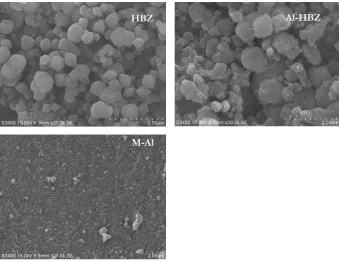
[image:6.595.120.465.88.348.2] [image:6.595.133.456.493.736.2]The morphology of catalysts was determined by SEM as shown in Fig. 4. It can be observed that morphologies of both HBZ and Al-HBZ were similar spheroidal, but Al-HBZ had a rougher surface than HBZ due to Al deposition. The M-Al showed different morphology with more roughness.
Fig. 4. SEM images of all catalysts.
The EDX analysis was used to quantitatively measure the amounts of elemental composition on the catalyst surface. The results are illustrated in Table 2. It revealed the chemical composition of each catalyst. The amounts of Al present at surface were in the range of M-Al > Al-HBZ > HBZ, which were reasonable. In other words, the Si/Al ratio of HBZ was the highest. The decreased Si/Al ratio is perhaps related to the decrease in weak acid sites, but increased strong acid sites as well as increased total acidity [21]. Thus, the acid properties of catalysts were determined using NH3-TPD.
Table 2. Elemental composition obtained from EDX.
Catalyst
Element
% Weight % Atom
Al Si O Si/Al Al Si O
HBZ 3.26 44.95 51.78 13.79 2.44 32.28 65.28
Al-HBZ 32.1 22.59 45.31 0.70 24.55 16.67 58.68
M-Al 61.06 - 38.94 - 48.18 - 51.82
The NH3-TPD profiles (Fig. 5) of all catalysts were similar consisting of two groups of desorption
peaks. The desorption peaks at low temperature below 250oC are assigned to weak acid sites, whereas those
above 400oC are strong acid sites. The number of acid site on catalyst can be calculated by integration of
[image:7.595.127.467.127.389.2] [image:7.595.64.530.534.618.2]lowest among other two catalysts. It was reported that the weak acid site is essential for the catalytic dehydration of ethanol to ethylene [4, 5, 22, 23]. Thus, the presence of large amount of weak acid would be beneficial to enhance the catalytic activity.
Fig. 5. NH3-TPD profiles of all catalysts.
3.2. Catalytic Properties
It is known that ethanol dehydration reaction has two competitive ways occurred [4] as follows:
C2H5OHC2H4 + H2O +44.9 kJ/mol (6)
2C2H5OHC2H5OC2H5 + H2O -25.1 kJ/mol (7)
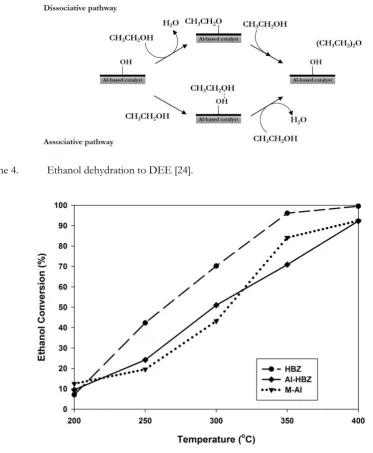
The first reaction (6) is dehydration of ethanol to ethylene (endothermic reaction), while the second one (7) is side reaction to produce DEE (exothermic reaction). DEE is produced in significant quantities at low temperature. However, ethylene is obtained via ethanol dehydration at high temperatures. The Mechanism of dehydration reaction to ethylene and DEE is shown in Schemes 3 and 4, respectively. Figure 6 shows the ethanol conversion at temperature range of 200 to 400oC. Ethanol conversion apparently
increased with increased temperature. It was found that the HBZ exhibited the highest conversion of ethanol among other two catalysts for all reaction temperature. This can be attributed to the large amount of weak acid sites present in HBZ catalyst. The ethanol conversion for Al-HBZ and M-Al was found to have a similar trend with that of HBZ, where the conversion increased with increasing reaction temperature. However, the conversion obtained from HBZ was the highest.
[image:8.595.131.459.125.380.2]Scheme 4. Ethanol dehydration to DEE [24].
Fig. 6. Ethanol conversion for all catalysts.
[image:9.595.93.467.92.546.2]Fig. 7. Ethylene selectivity for all catalysts.
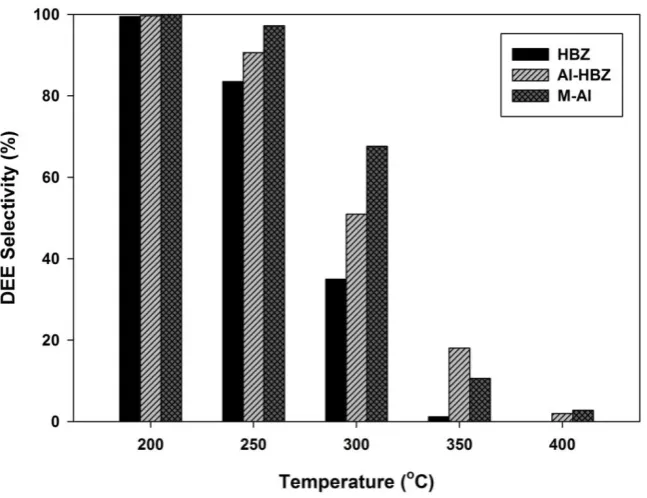
Besides ethylene, DEE is also obtained, especially at low reaction temperature. The DEE selectivity is shown in Fig. 8. It can be observed that at 200oC, all catalysts produced only DEE. However, at this
temperature, the ethanol conversion was extremely low. Hence, the DEE yield (product of ethanol conversion and DEE selectivity) was quite low. It was found that the M-Al catalyst exhibited slightly higher DEE selectivity than other two catalysts.
Fig. 8. DEE selectivity for all catalysts.
[image:10.595.131.454.87.337.2] [image:10.595.131.455.454.703.2]was obtained at 400oC indicating that high catalytic activity as well as ethanol conversion is the highest
when compared with low temperature reaction. The increase in ethanol conversion results in increased product yield. At 400oC, the ethylene yield increased in the range of HBZ > Al-HBZ > M-Al. The DEE
selectivity is also interesting. It can be observed that the highest DEE yield (35.3%) was obtained from the HBZ catalyst at 250oC. The low DEE yield was caused by low conversion. In order to improve the DEE
yield, the chemical promoter is perhaps necessary. Chen et al. studied the addition of some chemical promoters to improve the catalytic dehydration. The chemical promoters used for this reaction such as titania, niobia, molybdenum oxide and silica were investigated [19, 25–27].
Table 3. Product yield of all catalysts
Catalyst Ethylene yield (%) DEE yield (%)
200 oC 250 oC 300 oC 350 oC 400 oC 200 oC 250 oC 300 oC 350 oC 400 oC
HBZ 0.0 7.0 45.7 94.8 99.4 7.1 35.3 24.5 1.1 0.0
Al-HBZ 0.0 2.3 24.9 57.9 90.2 9.5 21.9 26.0 12.8 1.8
M-Al 0.0 0.5 13.8 73.4 88.9 12.5 19.0 29.2 8.9 2.5
Table 4. Comparison of catalysts for ethylene synthesis and their catalytic ability.
Catalyst Surface area (m2/g) temperature (Reaction oC) conversion (%) Ethanol selectivity (%) Ethylene Ref.
HBZ 522 200-400 7-100 1-100 This work
Al-HBZ 306 200-400 9-92 0-98 This work
M-Al 195 200-400 12-92 0-96 This work
H-ZSM-5 366 400 99 10 [13]
20HP-ZSM-5 74 250-450 25-100 3-98 [13]
-Al2O3 204 400-550 70-100 40-95 [19]
TiO2/-Al2O3 187 360-550 70–100 50–99 [19]
SAPO-34 300 500 100 100 [28]
ZS(25)-HS-4 276 500 100 27 [28]
ZS(25)-MM-4 352 500 100 24 [28]
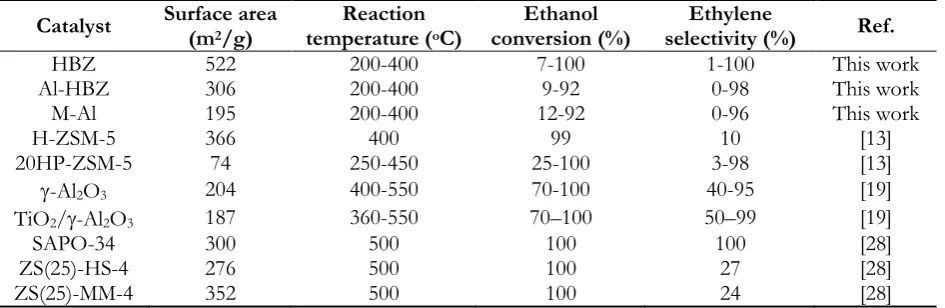
Moreover, there were summarized reports of catalytic ability for ethanol dehydration to ethylene over various catalysts (Table 4). It is shown that HBZ, Al-HBZ and M-Al catalysts in this work are comparable to those of typical and modified catalysts. Ramesh et al. and Duan et al. studied structure and reactivity of modified H-ZSM-5 catalysts for ethanol dehydration. They found that the highest surface area was obtained by unmodified H-ZSM-5 and testing of catalytic activity at 250-500oC. Then, the result showed
that ethanol conversion and ethylene selectivity of modified H-ZSM-5 were lower than that of HBZ for this work. It can be concluded that HBZ exhibited higher catalytic activity than their catalysts [13, 28]. In addition, Chen et al. investigated the modification effects of TiO2-doped on alumina catalysts packed in
microreactor. Their results showed that the catalytic activity of their catalyst was lower than that of Al-HBZ and M-Al catalysts at the same reaction temperature [19]. Thus, the HBZ is practical to be applied for the ethanol dehydration to ethylene.
4.
Conclusion
Among all three Al-based catalysts in this study, the HBZ catalyst is the most effective to convert ethanol into ethylene with ca. 99% of ethylene yield (at high temperature, i.e. 400oC) and DEE with ca. 35.3% of
DEE yield (at low temperature, i.e. 250oC). This is attributed to the high amount of weak acid sites present
in the HBZ catalyst. Although, no deactivation of catalyst was found at 400oC, the stability test towards
[image:11.595.64.536.217.286.2] [image:11.595.64.537.322.476.2]Acknowledgement
The authors thank the Thailand Research Fund (TRF), the National Research Council of Thailand (NRCT) and Ratchadaphiseksomphot Endowment Fund (2015) of Chulalongkorn University (CU-58-027-AM) for financial support of this project.
References
[1] A. P. Kagyrmanova, V. A. Chumachenko, V. N. Korotkikh, V. N. Kashkin, and A. S. Noskov, “Catalytic dehydration of bioethanol to ethylene: Pilot-scale studies and process simulation ” Chemical Engineering Journal, vol. 176-177, pp. 188-194, 2011.
[2] J. Bedia, R. Barrionuevo, J. Rodríguez-Mirasol and T. Cordero “ thanol dehydration to ethylene on acid carbon catalysts ” Applied Catalysis B: Environmental, vol. 103, no. 3-4, pp. 302-310, 2011.
[3] V. V. Bokade and G. . adav “Heteropolyacid supported on montmorillonite catalyst for dehydration of dilute bio-ethanol ” Applied Clay Science, vol. 53, no. 2, pp. 263-271, 2011.
[4] . Chen . Wu L. Tao B. ai M. ang Z. Chen and . Zhu “ ehydration reaction of bio-ethanol to ethylene over modified SAPO catalysts ” Journal of Industrial and Engineering Chemistry, vol. 16, no. 5, pp. 717-722, 2010.
[5] Q. heng K. Ling Z. Li and L. Zhao “ ffect of steam treatment on catalytic performance of HZSM-5 catalyst for ethanol dehydration to ethylene ” Fuel Processing Technology, vol. 110, pp. 73-78, 2013.
[6] L. Matachowski M. Zimowska . Mucha and T. Machej “ cofriendly production of ethylene by dehydration of ethanol over Ag3PW12O40 salt in nitrogen and air atmospheres ” Applied Catalysis B:
Environmental, vol. 123-124, pp. 448-456, 2012.
[7] T. Zaki “Catalytic dehydration of ethanol using transition metal oxide catalysts ” Journal of Colloid and Interface Science, vol. 284, no. 2, pp. 606-613, 2005.
[8] T. K. Phung, R. Radikapratama, G. Garbarino A. Lagazzo P. Riani and G. Busca “Tuning of product selectivity in the conversion of ethanol to hydrocarbons over H-ZSM-5 based zeolite catalysts ” Fuel Processing Technology, vol. 137, pp. 290-297, 2015.
[9] A. Rahmanian and H. . Ghaziaskar “Continuous dehydration of ethanol to diethyl ether over aluminum phosphate–hydroxyapatite catalyst under sub and supercritical condition ” The Journal of Supercritical Fluids, vol. 78, pp. 34-41, 2013.
[10] F. Wang, M. Luo, W. Xiao, X. Cheng, and Y. Long, “Coking behavior of a submicron MFI catalyst during ethanol dehydration to ethylene in a pilot-scale fixed-bed reactor ” Applied Catalysis A: General, vol. 393, no. 1-2, pp. 161-170, 2011.
[11] N. Zhan . Hu H. Li . u . Han and H. Huang “Lanthanum–phosphorous modified HZSM-5 catalysts in dehydration of ethanol to ethylene: A comparative analysis ” Catalysis Communications, vol. 11, no. 7, pp. 633-637, 2010.
[12] J. Bi . Guo M. Liu and . Wang “High effective dehydration of bio-ethanol into ethylene over nanoscale HZSM-5 zeolite catalysts ” Catalysis Today, vol. 149, no. 1-2, pp. 143-147, 2010.
[13] K. Ramesh L. Hui . Han and A. Borgna “ tructure and reactivity of phosphorous modified H-ZSM-5 catalysts for ethanol dehydration ” Catalysis Communications, vol. 10, no. 5, pp. 567-571, 2009. [14] C. Meephoka C. Chaisuk P. amparnpiboon and P. Praserthdam “ ffect of phase composition
between nano γ- and χ-Al2O3 on Pt/Al2O3 catalyst in C oxidation ” Catalysis Communications, vol. 9,
no. 4, pp. 546-550, 2008.
[15] K. Pansanga, J. Panpranot, O. Mekasuwandumrong, C. Satayaprasert, J. G. Goodwin, and P. Praserthdam “ ffect of mixed γ- and χ-crystalline phases in nanocrystalline Al2O3 on the dispersion
of cobalt on Al2O3 ” Catalysis Communications, vol. 9, no. 2, pp. 207-212, 2008.
[16] . ujeerakulkai and . Jitkarnka “Bio-based hydrocarbons and oxygenates from catalytic bio-ethanol dehydration: comparison between gallium and germanium oxides as promoters on HBeta zeolites with various silica to alumina ratios ” Journal of Cleaner Production, vol. 111, pp. 51-61, 2016.
[17] B. K. Marcus and W. . Cormier “Going Green with Zeolites ” Chemical Engineering Progress, vol. 95, no. 6, pp. 47-53. 1999.
[18] J. Janlamool and B. Jongsomjit “ xidative dehydrogenation of ethanol over AgLi–Al2O3 catalysts
[19] G. Chen . Li F. Jiao and Q. uan “Catalytic dehydration of bioethanol to ethylene over Ti 2
/γ-Al2O3 catalysts in microchannel reactors ” Catalysis Today, vol. 125, no. 1-2, pp. 111-119, 2007.
[20] J. Nowicki L. Mokrzycki and B. ulikowski “ ynthesis of novel perfluoroalkylglucosides on zeolite and non-zeolite catalysts ” Molecules, vol. 20, no. 4, pp. 6140-52, 2015.
[21] . Hajimirzaee M. Ainte B. oltani R. M. Behbahani G. A. Leeke and J. Wood “ ehydration of methanol to light olefins upon zeolite/alumina catalysts: Effect of reaction conditions, catalyst support and zeolite modification ” Chemical Engineering Research and Design, vol. 93, pp. 541-553, 2015. [22] H. in . Li . Fang . i W. Hu . Chu F. Zhang A. Zheng H. Zhang and . Li “Catalytic
dehydration of ethanol over post-treated ZSM-5 zeolites ” Journal of Catalysis, vol. 312, pp. 204-215, 2014.
[23] . Zhang R. Wang . ang and F. Zhang “Comparison of four catalysts in the catalytic dehydration of ethanol to ethylene ” Microporous and Mesoporous Materials, vol. 116, no. 1-3, pp. 210-215, 2008. [24] W. Alharbi, E. Brown, . F. Kozhevnikova and I. V. Kozhevnikov “ ehydration of ethanol over
heteropoly acid catalysts in the gas phase ” Journal of Catalysis, vol. 319, pp. 174-181, 2014.
[25] . Han C. Lu . u . Zhang . Hu and H. Huang “Molybdenum oxide modified HZ M-5 catalyst: urface acidity and catalytic performance for the dehydration of aqueous ethanol ” Applied Catalysis A: General, vol. 396, no. 1-2, pp. 8-13, 2011.
[26] T. K. Phung and G. Busca “ thanol dehydration on silica-aluminas: Active sites and ethylene/diethyl ether selectivities ” Catalysis Communications, vol. 68, pp. 110-115, 2015.
[27] . Liu C. ao J. Zhang . Fang and . Chen “Catalytic dehydration of methanol to dimethyl ether over modified γ-Al2O3 catalyst ” Fuel, vol. 90, no. 5, pp. 1738-1742, 2011.