HPC-ABDS High Performance
Computing Enhanced
Apache Big Data Stack
(with a bias to Streaming)
2nd International Workshop on
Scalable Computing For Real-Time Big Data Applications (SCRAMBL'15)
in conjunction with CCGrid'15
May 4, 2015
Geoffrey Fox, Judy Qiu, Shantenu Jha,
Supun Kamburugamuve, Andre Luckow
[email protected] http://www.infomall.org
School of Informatics and Computing
Digital Science Center
HPC-ABDS
4 02/17/2020
NIST Big Data Initiative
NBD-PWG (NIST Big Data Public Working
Group) Subgroups & Co-Chairs
•
There were 5 Subgroups
–
Note mainly industry
•
Requirements and Use Cases Sub Group
–
Geoffrey Fox, Indiana U.; Joe Paiva, VA; Tsegereda Beyene, Cisco
•
Definitions and Taxonomies SG
–
Nancy Grady, SAIC; Natasha Balac, SDSC; Eugene Luster, R2AD
•
Reference Architecture Sub Group
–
Orit Levin, Microsoft; James Ketner, AT&T; Don Krapohl, Augmented
Intelligence
•
Security and Privacy Sub Group
–
Arnab Roy, CSA/Fujitsu Nancy Landreville, U. MD Akhil Manchanda,
GE
•
Technology Roadmap Sub Group
–
Carl Buffington, Vistronix; Dan McClary, Oracle; David Boyd, Data
Tactics
•
See
http://bigdatawg.nist.gov/usecases.php
•
And
http://bigdatawg.nist.gov/V1_output_docs.php
Use Case
Template
•
26 fields completed for 51
areas
•
Government Operation: 4
•
Commercial: 8
•
Defense: 3
•
Healthcare and Life Sciences:
10
•
Deep Learning and Social
Media: 6
•
The Ecosystem for Research:
4
•
Astronomy and Physics: 5
•
Earth, Environmental and
Polar Science: 10
•
Energy: 1
51 Detailed Use Cases:
Contributed July-September 2013
Covers goals, data features such as 3 V’s, software,
hardware
• http://bigdatawg.nist.gov/usecases.php
• https://bigdatacoursespring2014.appspot.com/course (Section 5)
• Government Operation(4): National Archives and Records Administration, Census Bureau
• Commercial(8): Finance in Cloud, Cloud Backup, Mendeley (Citations), Netflix, Web Search, Digital Materials, Cargo shipping (as in UPS)
• Defense(3): Sensors, Image surveillance, Situation Assessment
• Healthcare and Life Sciences(10): Medical records, Graph and Probabilistic analysis, Pathology, Bioimaging, Genomics, Epidemiology, People Activity models, Biodiversity
• Deep Learning and Social Media(6): Driving Car, Geolocate images/cameras, Twitter, Crowd Sourcing, Network Science, NIST benchmark datasets
• The Ecosystem for Research(4): Metadata, Collaboration, Language Translation, Light source experiments
• Astronomy and Physics(5): Sky Surveys including comparison to simulation, Large Hadron Collider at CERN, Belle Accelerator II in Japan
• Earth, Environmental and Polar Science(10): Radar Scattering in Atmosphere, Earthquake, Ocean, Earth Observation, Ice sheet Radar scattering, Earth radar mapping, Climate
simulation datasets, Atmospheric turbulence identification, Subsurface Biogeochemistry (microbes to watersheds), AmeriFlux and FLUXNET gas sensors
• Energy(1): Smart grid
Table 4: Characteristics of 6 Distributed Applications Application
Example Execution Unit Communication Coordination Execution Environment Montage Multiple sequential and
parallel executable Files Dataflow(DAG) Dynamic processcreation, execution
NEKTAR Multiple concurrent
parallel executables Stream based Dataflow Co-scheduling, datastreaming, async. I/O
Replica-Exchange Multiple seq. andparallel executables Pub/sub Dataflow andevents Decoupledcoordination and messaging
Climate Prediction (generation)
Multiple seq. & parallel
executables Files andmessages Master-Worker, events
@Home (BOINC)
Climate Prediction (analysis)
Multiple seq. & parallel
executables messagesFiles and Dataflow Dynamics processcreation, workflow execution
SCOOP Multiple Executable Files and
messages Dataflow Preemptive scheduling,reservations
Coupled
Fusion Multiple executable Stream-based Dataflow Co-scheduling, datastreaming, async I/O
10
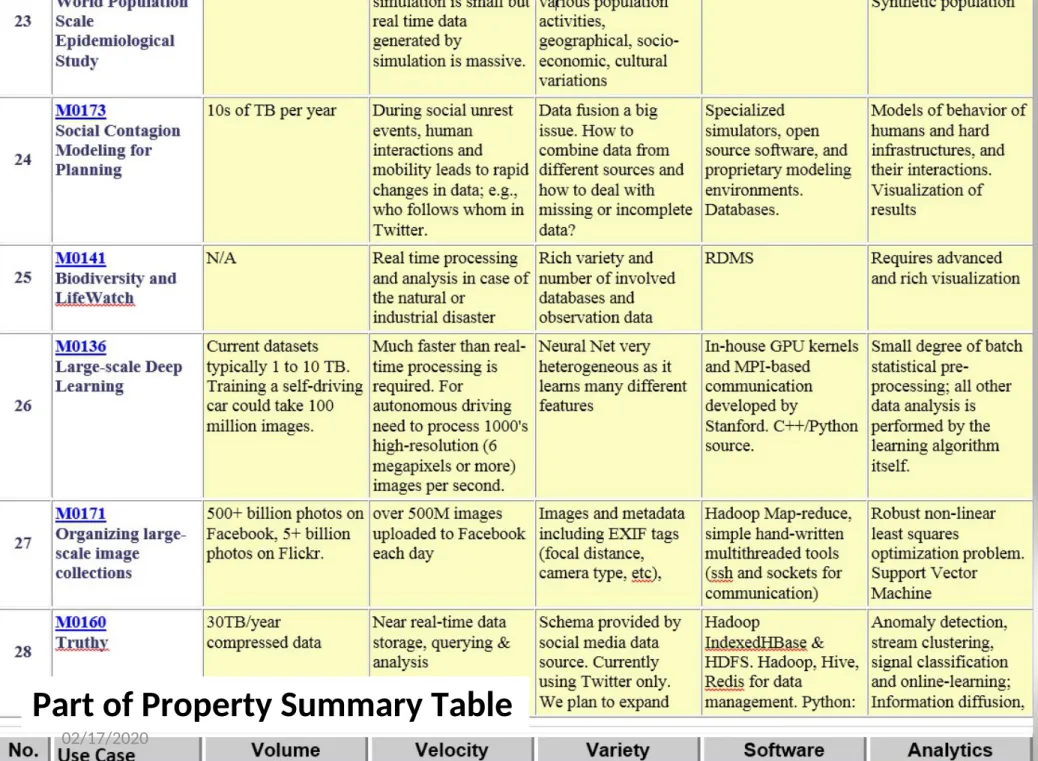
Part of Property Summary Table
51 Use Cases: What is Parallelism Over?
•
People
:
either the users (but see below) or subjects of application and often both
•
Decision makers
like researchers or doctors (users of application)
•
Items
such as Images, EMR, Sequences below; observations or contents of online
store
– Imagesor “Electronic Information nuggets”
– EMR: Electronic Medical Records (often similar to people parallelism)
– Protein or Gene Sequences;
– Material properties, Manufactured Object specifications, etc., in custom dataset
– Modelled entities like vehicles and people
•
Sensors
– Internet of Things
•
Events
such as detected anomalies in telescope or credit card data or atmosphere
•
(Complex)
Nodes
in RDF Graph
•
Simple nodes
as in a learning network
•
Tweets
,
Blogs
,
Documents
,
Web Pages,
etc.
–
And characters/words in them
•
Files
or data to be backed up, moved or assigned metadata
•
Particles
/
cells
/
mesh points
as in parallel simulations
Features of 51 Use Cases I
•
PP (26)
“All”
Pleasingly Parallel or Map Only
•
MR (18)
Classic MapReduce MR (add MRStat below for full count)
•
MRStat (7
) Simple version of MR where key computations are
simple reduction as found in statistical averages such as histograms
and averages
•
MRIter (23
)
Iterative MapReduce or MPI (Spark, Twister)
•
Graph (9)
Complex graph data structure needed in analysis
•
Fusion (11)
Integrate diverse data to aid discovery/decision making;
could involve sophisticated algorithms or could just be a portal
•
Streaming (41)
Some data comes in incrementally and is processed
this way
•
Classify (30)
Classification: divide data into categories
Features of 51 Use Cases II
•
CF (4)
Collaborative Filtering for recommender engines
•
LML (36)
Local Machine Learning (Independent for each parallel
entity) – application could have GML as well
•
GML (23)
Global Machine Learning: Deep Learning, Clustering, LDA,
PLSI, MDS,
–
Large Scale Optimizations as in Variational Bayes, MCMC, Lifted Belief
Propagation, Stochastic Gradient Descent, L-BFGS, Levenberg-Marquardt .
Can call EGO or Exascale Global Optimization with scalable parallel algorithm
•
Workflow (51)
Universal
•
GIS (16)
Geotagged data and often displayed in ESRI, Microsoft
Virtual Earth, Google Earth, GeoServer etc.
•
HPC (5)
Classic large-scale simulation of cosmos, materials, etc.
generating (visualization) data
•
Agent (2)
Simulations of models of data-defined macroscopic
entities represented as agents
Internet of Things and Streaming Apps
•
It is projected that there will be
24 (Mobile Industry Group) to 50 (Cisco)
billion devices
on the Internet by 2020.
•
The
cloud
natural controller of and
resource provider for the Internet of
Things.
•
Smart phones/watches, Wearable devices (Smart People), “Intelligent
River” “Smart Homes and Grid” and “Ubiquitous Cities”, Robotics.
•
Majority of use cases (41/51)
are streaming – experimental science
gathers data in a stream – sometimes batched as in a field trip. Below is
sample
•
10: Cargo Shipping Tracking
as in UPS, Fedex
PP GIS LML
•
13: Large Scale Geospatial Analysis and Visualization
PP GIS LML
•
28: Truthy: Information diffusion research from Twitter Data
PP MR
for
Search,
GML
for community determination
•
39: Particle Physics: Analysis of LHC Large Hadron Collider Data: Discovery
of Higgs particle
PP Local Processing Global statistics
•
50: DOE-BER AmeriFlux and FLUXNET Networks
PP GIS LML
Growth of Internet of Things December 2014
•
Currently Phones etc. but will change to “real things”
Big Data Patterns –
the Big Data present
7 Computational Giants of
NRC Massive Data Analysis Report
1) G1:
Basic Statistics e.g. MRStat
2) G2:
Generalized N-Body Problems
3) G3:
Graph-Theoretic Computations
4) G4:
Linear Algebraic Computations
5) G5:
Optimizations e.g. Linear Programming
6) G6:
Integration e.g. LDA and other GML
7) G7:
Alignment Problems e.g. BLAST
http://www.nap.edu/catalog.php?record_id=18374
HPC Benchmark Classics
•
Linpack
or HPL: Parallel LU factorization
for solution of linear equations
•
NPB
version 1: Mainly classic HPC solver kernels
–
MG: Multigrid
–
CG: Conjugate Gradient
–
FT: Fast Fourier Transform
–
IS: Integer sort
–
EP: Embarrassingly Parallel
–
BT: Block Tridiagonal
–
SP: Scalar Pentadiagonal
13 Berkeley Dwarfs
1) Dense Linear Algebra
2) Sparse Linear Algebra
3) Spectral Methods
4) N-Body Methods
5) Structured Grids
6) Unstructured Grids
7) MapReduce
8) Combinational Logic
9) Graph Traversal
10) Dynamic Programming
11) Backtrack and
Branch-and-Bound
12) Graphical Models
13) Finite State Machines
First 6 of these correspond to
Colella’s original.
Monte Carlo dropped.
N-body methods are a subset of
Particle in Colella.
Note a little inconsistent in that
MapReduce is a programming
model and spectral method is a
numerical method.
Need multiple facets!
What’s after Giants and Dwarfs?
Ogres ……..
Introducing Big Data Ogres and their Facets I
•
Big Data Ogres
provide a systematic approach to understanding
applications, and as such they have
facets
which represent key
characteristics defined both from our experience and from a
bottom-up study of features from several individual applications.
•
The facets capture common characteristics (shared by several
problems)which are inevitably multi-dimensional and often
overlapping.
•
Ogres characteristics are cataloged in four distinct dimensions or
views.
•
Each view consists of facets; when multiple facets are linked
together, they describe classes of big data problems represented
as an Ogre.
•
Instances of Ogres are particular big data problems
•
A set of Ogre instances that cover a rich set of facets could form a
benchmark set
•
Ogres and their instances can be atomic or composite
Introducing Big Data Ogres and their Facets II
•
Ogres characteristics are cataloged in four distinct dimensions or
views.
•
Each view consists of facets; when multiple facets are linked
together, they describe classes of big data problems represented
as an Ogre.
•
One view of an Ogre is the overall
problem architecture
which is
naturally related to the machine architecture needed to support
data intensive application while still being different.
•
Then there is the
execution (computational) features
view,
describing issues such as I/O versus compute rates, iterative
nature of computation and the classic V’s of Big Data: defining
problem size, rate of change, etc.
•
The
data source & style
view includes facets specifying how the
data is collected, stored and accessed.
•
The final
processing
view has facets which describe classes of
processing steps including algorithms and kernels. Ogres are
Problem
Architecture
View
Pleasingly Parallel Classic MapReduce Map-Collective Map Point-to-Point Shared MemorySingle Program Multiple Data Bulk Synchronous Parallel Fusion
Dataflow Agents Workflow
Geospatial Information System HPC Simulations
Internet of Things Metadata/Provenance
Shared / Dedicated / Transient / Permanent Archived/Batched/Streaming
HDFS/Lustre/GPFS Files/Objects
Enterprise Data Model SQL/NoSQL/NewSQL Pe rform anc eMe tri cs Fl ops pe rB yt e; Me m ory I/O Exe cut ion Envi ronm ent ;C ore libra rie s Vol um e Ve loc ity Va rie ty Ve ra
city Comm
uni cati on St ruc ture Da ta Abst ra ction Me tri c= M /Non-Me tri c= N 𝑂 𝑁 2 = NN / 𝑂(𝑁) = N Re gul ar = R /Irre gul ar = I Dyna m ic = D /St atic = S Vi sua liza tion Gra ph Al gori thm s Line ar Al ge bra Ke rne ls Al ignm ent St re am ing Opt im iza tion Me thodol ogy Le arni ng Cla ssi fic ation Se arc h /Que ry /Inde x Ba se St atist ics Gl oba lAna lyt ics Loc al Ana lyt ics Mi cro-be nc hm arks Re com m enda tions
Data Source and Style View
Execution View
Processing View
2 3 4 6 7 8 9 10 11 12 10 9 8 7 6 5 4 3 2 11 2 3 4 5 6 7 8 9 10 12 14 9 8 7 5 4 3 2 1
14 13 12 11 10 6
13
Map Streaming 5
4 Ogre Views and
50 Facets Itera
Facets of the Ogres
Problem Architecture View
of Ogres (Meta or MacroPatterns)
i. Pleasingly Parallel – as in BLAST, Protein docking, some (bio-)imagery including Local Analytics or Machine Learning – ML or filtering pleasingly parallel, as in bio-imagery, radar images (pleasingly parallel but sophisticated local analytics)
ii. Classic MapReduce: Search, Index and Query and Classification algorithms like collaborative filtering (G1 for MRStat in Features, G7)
iii. Map-Collective: Iterative maps + communication dominated by “collective” operations as in reduction, broadcast, gather, scatter. Common datamining pattern
iv. Map-Point to Point:Iterative maps + communication dominated by many small point to point messages as in graph algorithms
v. Map-Streaming: Describes streaming, steering and assimilation problems
vi. Shared Memory:Some problems are asynchronous and are easier to parallelize on shared rather than distributed memory – see some graph algorithms
vii. SPMD: Single Program Multiple Data, common parallel programming feature
viii. BSP or Bulk Synchronous Processing: well-defined compute-communication phases
ix. Fusion: Knowledge discovery often involves fusion of multiple methods.
x. Dataflow: Important application features often occurring in composite Ogres
xi. Use Agents:as in epidemiology (swarm approaches)
xii. Workflow: All applications often involve orchestration (workflow) of multiple components
Note problem and machine architectures are related
Hardware, Software, Applications
•
In my old papers (especially book Parallel Computing
Works!), I discussed computing as multiple complex systems
mapped into each other
Problem
Numerical formulation
Software
Hardware
•
Each of these 4 systems has an architecture that can be
described in similar language
•
One gets an easy programming model if architecture of
problem matches that of Software
•
One gets good performance if architecture of hardware
matches that of software and problem
•
So “MapReduce” can be used as architecture of software
(programming model) or “Numerical formulation of
8 Data Analysis Problem Architectures
§
1) Pleasingly Parallel
PP
or “map-only” in MapReduce
§ BLAST Analysis; Local Machine Learning
§
2A) Classic MapReduce
MR
, Map followed by reduction
§ High Energy Physics (HEP) Histograms; Web search; Recommender Engines
§
2B) Simple version of classic
MapReduce MRStat
§ Final reduction is just simple statistics
§
3) Iterative MapReduce
MRIter
§ Expectation maximization Clustering Linear Algebra, PageRank
§
4A) Map Point to Point Communication
§ Classic MPI; PDE Solvers and Particle Dynamics; Graph processingGraph
§
4B) GPU (Accelerator) enhanced 4A) – especially for deep learning
§
5) Map +
Streaming
+ Communication
§ Images from Synchrotron sources; Telescopes; Internet of Things IoT
§
6)
Shared memory
allowing parallel threads which are tricky to program
but lower latency
§ Difficult to parallelize asynchronous parallel Graph Algorithms
6 Forms of MapReduce
02/17/2020 Graph 29
Iterative MR
Basic Statistics PP
Facets in the Execution Features
Views
One View
of Ogres has Facets that are
micropatterns or
Execution Features
i. Performance Metrics; property found by benchmarking Ogre
ii. Flops per byte; memory or I/O
iii. Execution Environment; Core libraries needed: matrix-matrix/vector algebra, conjugate gradient, reduction, broadcast; Cloud, HPC etc.
iv. Volume: property of an Ogre instance
v. Velocity: qualitative property of Ogre with value associated with instance
vi. Variety: important property especially of composite Ogres
vii. Veracity: important property of “mini-applications” but not kernels
viii. Communication Structure; Interconnect requirements; Is communication BSP, Asynchronous, Pub-Sub, Collective, Point to Point?
ix. Is application (graph) static ordynamic?
x. Most applications consist of a set of interconnected entities; is this regular as a set of
pixels or is it a complicated irregular graph?
xi. Are algorithms Iterative or not?
xii. Data Abstraction: key-value, pixel, graph(G3), vector, bags of words or items
xiii. Are data points in metric or non-metric spaces?
Facets of the Ogres
Data Source and Style Aspects
Data Source and Style View
of Ogres I
i. SQL NewSQL or NoSQL:
NoSQL includes Document,
Column, Key-value, Graph, Triple store; NewSQL is SQL redone to
exploit NoSQL performance
ii. Other
Enterprise data systems:
10 examples from NIST integrate
SQL/NoSQL
iii. Set of Files or Objects:
as managed in iRODS and extremely
common in scientific research
iv. File systems, Object, Blob and Data-parallel
(HDFS) raw storage:
Separated from computing or colocated? HDFS v Lustre v.
Openstack Swift v. GPFS
Data Source and Style View
of Ogres II
vi. Shared/Dedicated/Transient/Permanent:
qualitative property of
data; Other characteristics are needed for permanent
auxiliary/comparison datasets and these could be interdisciplinary,
implying nontrivial data movement/replication
vii. Metadata/Provenance:
Clear qualitative property but not for
kernels as important aspect of data collection process
viii. Internet of Things:
24 to 50 Billion devices on Internet by 2020
ix. HPC simulations:
generate major (visualization) output that often
needs to be mined
x. Using
GIS:
Geographical Information Systems provide attractive
access to geospatial data
Note 10 Bob Marcus (led NIST effort) Use cases
2. Perform real time analytics on data
source streams and notify users when
specified events occur
Streaming Data
Streaming Data
Streaming Data
Posted Data Identified Events
Filter Identifying Events
Repository
Specify filter
Archive
Post Selected Events
Fetch
5. Perform interactive analytics on data in
analytics-optimized database
Hadoop, Spark, Giraph, Pig …
Data Storage: HDFS, Hbase
Data, Streaming, Batch …..
Mahout, R
5A. Perform interactive analytics on
observational scientific data
Grid or Many Task Software, Hadoop, Spark, Giraph, Pig …
Data Storage: HDFS, Hbase, File Collection
Streaming Twitter data for Social Networking
Science Analysis Code, Mahout, R
Transport batch of data to primary analysis data system
Record Scientific Data in “field”
Local Accumulate
and initial Direct Transfer
NIST examples include LHC, Remote Sensing, Astronomy and
Facets of the Ogres Processing
View
Facets in Processing (run time) View
of Ogres I
i. Micro-benchmarks
ogres that exercise simple features of hardware
such as communication, disk I/O, CPU, memory performance
ii. Local Analytics
executed on a single core or perhaps node
iii. Global Analytics
requiring iterative programming models (G5,G6)
across multiple nodes of a parallel system
iv. Optimization Methodology:
overlapping categories
i. Nonlinear Optimization (G6)ii. Machine Learning
iii. Maximum Likelihood or 2 minimizations
iv. Expectation Maximization (often Steepest descent)
v. Combinatorial Optimization
vi. Linear/Quadratic Programming (G5) vii. Dynamic Programming
v. Visualization
is key application capability with algorithms like MDS
useful but it itself part of “mini-app” or composite Ogre
Facets in Processing (run time) View
of Ogres II
vii. Streaming divided into 5 categories depending on event size and
synchronization and integration
– Set of independent events where precise time sequencing unimportant.
– Time series of connected small events where time ordering important.
– Set of independent large events where each event needs parallel processing with time
sequencing not critical
– Set of connected large events where each event needs parallel processing with time
sequencing critical.
– Stream of connected small or large events to be integrated in a complex way.
viii. Basic Statistics (G1):
MRStat in NIST problem features
ix. Search/Query/Index:
Classic database which is well studied (Baru, Rabl tutorial)
x. Recommender Engine:
core to many e-commerce, media businesses;
collaborative filtering key technology
xi. Classification:
assigning items to categories based on many methods
– MapReduce good in Alignment, Basic statistics, S/Q/I, Recommender, Calssification
xii. Deep Learning
of growing importance due to success in speech recognition etc.
xiii. Problem set up as a graph
(G3) as opposed to vector, grid, bag of words etc.
xiv. Using
Linear Algebra Kernels
: much machine learning uses linear algebra kernels
Benchmarks based on Ogres
Analytics
Benchmarks/Mini-apps spanning Facets
•
Look at
NSF SPIDAL Project, NIST 51 use cases, Baru-Rabl review
•
Catalog facets
of benchmarks and choose entries to cover “all facets”
•
Micro Benchmarks:
SPEC, EnhancedDFSIO (HDFS), Terasort, Wordcount,
Grep, MPI, Basic Pub-Sub ….
•
SQL and NoSQL Data systems, Search, Recommenders:
TPC (-C to x–HS for
Hadoop), BigBench, Yahoo Cloud Serving, Berkeley Big Data, HiBench,
BigDataBench, Cloudsuite, Linkbench
– includes MapReduce cases Search, Bayes, Random Forests, Collaborative Filtering
•
Spatial Query:
select from image or earth data
•
Alignment:
Biology as in BLAST
•
Streaming:
Online classifiers, Cluster tweets, Robotics, Industrial Internet of
Things, Astronomy; BGBenchmark; choose to cover all 5 subclasses
•
Pleasingly parallel (Local Analytics):
as in initial steps of LHC, Pathology,
Bioimaging (differ in type of data analysis)
•
Global Analytics:
Outlier, Clustering, LDA, SVM, Deep Learning, MDS,
PageRank, Levenberg-Marquardt, Graph 500 entries
HPC-ABDS Runtime
46 02/17/2020
6 Forms of MapReduce
02/17/2020 Graph 47
Iterative MR
Basic Statistics PP
8 Data Analysis Problem Architectures
§
1) Pleasingly Parallel
PP
or “map-only” in MapReduce
§ BLAST Analysis; Local Machine Learning
§
2A) Classic MapReduce
MR
, Map followed by reduction
§ High Energy Physics (HEP) Histograms; Web search; Recommender Engines
§
2B) Simple version of classic
MapReduce MRStat
§ Final reduction is just simple statistics
§
3) Iterative MapReduce
MRIter
§ Expectation maximization Clustering Linear Algebra, PageRank
§
4A) Map Point to Point Communication
§ Classic MPI; PDE Solvers and Particle Dynamics; Graph processingGraph
§
4B) GPU (Accelerator) enhanced 4A) – especially for deep learning
§
5) Map +
Streaming
+ Communication
§ Images from Synchrotron sources; Telescopes; Internet of Things IoT
§
6)
Shared memory
allowing parallel threads which are tricky to program
but lower latency
§ Difficult to parallelize asynchronous parallel Graph Algorithms
Functionality of 21 HPC-ABDS Layers
1) Message Protocols:
2) Distributed Coordination: 3) Security & Privacy:
4) Monitoring:
5) IaaS Management from HPC to hypervisors: 6) DevOps:
7) Interoperability: 8) File systems:
9) Cluster Resource Management: 10) Data Transport:
11) A) File management B) NoSQL
C) SQL
12) In-memory databases&caches / Object-relational mapping / Extraction Tools 13) Inter process communication Collectives, point-to-point, publish-subscribe, MPI: 14) A) Basic Programming model and runtime, SPMD, MapReduce:
B) Streaming:
15) A) High level Programming: B) Frameworks
16) Application and Analytics:
Here are 21 functionalities.
(including 11, 14, 15 subparts)
Lets discuss how these are used in
particular applications
4 Cross cutting at top
Exemplar Software for a Big Data Initiative
•
Functionality of ABDS and Performance of HPC
•
Workflow:
Apache Crunch, Python or Kepler
•
Data Analytics:
Mahout, R, ImageJ, Scalapack
•
High level Programming:
Hive, Pig
•
Batch Parallel Programming model:
Hadoop, Spark, Giraph, Harp,
MPI;
•
Streaming Programming model:
Storm, Kafka or RabbitMQ
•
In-memory:
Memcached
•
Data Management:
Hbase, MongoDB, MySQL
•
Distributed Coordination:
Zookeeper
•
Cluster Management:
Yarn, Slurm
•
File Systems:
HDFS, Object store (Swift),Lustre
•
DevOps:
Cloudmesh, Chef, Puppet, Docker, Cobbler
•
IaaS:
Amazon, Azure, OpenStack, Docker, SR-IOV
•
Monitoring:
Inca, Ganglia, Nagios
HPC-ABDS Stack Summarized I
•
The
HPC-ABDS software
is broken up into
21 layers
so that one can discuss
software systems in reasonable size groups.
–
The layers where there is especial opportunity to integrate HPC are colored
green in figure
.
•
We note that data systems that we construct from this software can run
interoperably on virtualized or non-virtualized environments aimed at key
scientific data analysis problems.
•
Most of ABDS emphasizes scalability but not performance and one of our
goals is to produce high performance environments. Here there is clear
need for better node performance and support of accelerators like
Xeon-Phi and GPU’s.
•
Figure “ABDS v. HPC Architecture” contrasts modern ABDS and HPC stacks
illustrating most of the 21 layers and labelling on left with layer number
used in HPC-ABDS Figure.
•
The omitted layers in architecture figure are
Interoperability, DevOps,
Monitoring and Security
(layers 7, 6, 4, 3) which are all important and
clearly applicable to both HPC and ABDS.
•
We also add an extra layer “language” not discussed in HPC-ABDS Figure.
HPC-ABDS Stack Summarized II
•
Lower layers where HPC can make a major impact include
scheduling layer
9
where Apache technologies like Yarn and Mesos need to be integrated
with the sophisticated HPC cluster and HTC approaches.
•
Storage layer 8
is another important area where HPC distributed and
parallel storage environments need to be reconciled with the “data
parallel” storage seen in HDFS in many ABDS systems.
•
However the most important issues are probably at the higher layers with
data management(11
),
communication
(13), (high layer or basic)
programming
(15, 14),
analytics
(16) and
orchestration
(17). These are
areas where there is rapid commodity/commercial innovation and we
discuss them in order below.
•
Much science data analysis is centered on
files
(8) but we expect
movement to the common commodity approaches of
Object stores
(8),
SQL
and
NoSQL
(11) where latter has a proliferation of systems with
different characteristics – especially in the
data abstraction
that varies over
row/column, key-value, graph and documents.
•
Note recent developments at the
programming layer
(15A) like Apache
Hive
and
Drill
, which offer high-layer access models like SQL implemented
on scalable NoSQL data systems.
HPC-ABDS Stack Summarized III
•
The
communication layer
(13) includes
Publish-subscribe
technology used in many
approaches to streaming data as well the
HPC communication technologies
(MPI)
which are much faster than most default Apache approaches but can be added to
some systems like
Hadoop
whose modern version is modular and allows plug-ins
for HPC stalwarts like MPI and sophisticated load balancers.
– Need to extend to Giraph and include load-balancing
•
The
programming layer
(14) includes both the
classic batch proce
ssing typified by
Hadoop (14A) and
streaming
by Storm (14B).
•
Investigating
Map-Streaming programming models
seems important. ABDS
Streaming is nice but doesn’t support real-time or parallel processing.
•
The
programming offerings
(14) differ in approaches to data model (key-value,
array, pixel, bags, graph), fault tolerance and communication. The trade-offs here
have major performance issues.
– Too many ~identical programming systems!
– Recent survey of graph databases from Wikidata with 49 features; chose BlazeGraph
•
You also see systems like
Apache Pig (15A)
offering data parallel interfaces.
•
At the high layer we see both
programming models (15A)
and
Platform (15B)
as a
Service toolkits where the Google App Engine is well known but there are many
entries include the recent BlueMix from IBM.
HPC-ABDS Stack Summarized IV
•
The
orchestration or workflow layer 17
has seen an explosion of
activity in the ABDS space although with systems like Pegasus,
Taverna, Kepler, Swift and IPython, HPC has substantial experience.
•
There are commodity orchestration dataflow systems like
Tez
and
projects like Apache
Crunch
with a data parallel emphasis based on
ideas from Google
FlumeJava
.
–
A modern version of the latter presumably underlies Google’s recently
announced
Cloud Dataflow
that unifies support of multiple batch and
streaming components; a capability that we expect to become common.
•
The implementation of the
analytics layer 16
depends on details of
orchestration and especially programming layers but probably most
important are quality parallel algorithms.
–
As many
machine learning algorithms
involve linear algebra, HPC expertise is
directly applicable as is fundamental mathematics needed to develop O(NlogN)
algorithms for analytics that are naively O(N
2).
DevOps, Platforms and Orchestration
•
DevOps Level 6
includes several automation capabilities
including systems like OpenStack Heat, Juju and Kubernetes to
build virtual clusters and a standard TOSCA that has several
good studies from Stuttgart
–
TOSCA specifies system to be instantiated and managed
•
TOSCA is closely related to workflow (orchestration) standard
BPEL
–
BPEL specifies system to be executed
•
In Level 17, should evaluate new
orchestration
systems from
ABDS such as NiFi or Crunch and toolkits like Cascading
–
Ensure streaming and batch supported
•
Level 15B
has
application hosting environments
such as GAE,
Heroku, Dokku (for Docker), Jelastic
–
These platforms bring together a focused set of tools to address a finite
but broad application area
•
Should look at these 3 levels to build HPC and Streaming
systems
Analytics and the DIKW Pipeline
•
Data goes through a pipeline (Big Data is also Big Wisdom etc.)
Raw data
Data
Information
Knowledge
Wisdom
Decisions
•
Each link enabled by a filter which is “business logic” or “analytics”
–
All filters are Analytics
•
However I am most interested in filters that involve “sophisticated
analytics” which require non trivial parallel algorithms
–
Improve state of art in both algorithm quality and (parallel)
performance
•
See Apache Crunch or Google Cloud Dataflow supporting
pipelined analytics
–
And Pegasus, Taverna, Kepler from Grid community
More Analytics
Knowledge
Information
Analytics
Information
Internet of Things
Storm Storm Storm Storm Storm Storm
Archival Storage – NOSQL like Hbase
Streaming Processing (Iterative MapReduce) Batch Processing (Iterative MapReduce)
Raw
Data Data Information Knowledge Wisdom Decisions
Pub-Sub
System Orchestration / Dataflow / Workflow
Cloud DIKW based on HPC-ABDS to integrate
streaming and batch Big Data
5 Classes of Streaming Applications
•
Set of independent small events where precise time sequencing
unimportant.
–
e.g.
Independent search requests or tweets from users
•
Time series of connected small events where time ordering
important.
–
e.g.
Streaming audio or video; robot monitoring
•
Set of independent large events where each event needs parallel
processing with time sequencing not critical
–
e.g.
Processing images from telescopes or light sources with material or
biological sciences.
•
Set of connected large events where each event needs parallel
processing with time sequencing critical.
–
e.g.
Processing high resolution monitoring (including video) information
from robots (self-driving cars) with real time response needed
•
Stream of connected small or large events that need to be
integrated in a complex way.
–
e.g.
Tweets or other online data where we are using them to update old
Science Streaming Examples
Streaming Application Details
1 Data Assimilation Integrate data into simulations to enhance quality.Distributed Data sources
2 Analysis of Simulation Results Climate, Fusion, Molecular Dynamics, Materials.Typically local or in-situ data
3 Steering Experiments Control of simulation or Experiment. Data could belocal or distributed
4 Astronomy, Light Sources Outlier event detection; classification; build model,accumulate data. Distributed Data sources
5 Environmental Sensors, SmartGrid, Transportation systems Environmental sensor data or Internet of Things; manysmall events. Distributed Data sources.
6 Robotics Cloud control of Robots including cars. Needprocessing near robot when decision time < ~1 second
IoT Activities at Indiana University
Parallel Clustering for Tweets:
Judy Qiu, Emilio Ferrara,
Xiaoming Gao
•
IoTCloud uses Zookeeper,
Storm, Hbase, RabbitMQ for
robot cloud control
•
Focus on high performance
(parallel) control functions
•
Guaranteed real time
response
02/17/2020 62
Parallel
simultaneous
localization and
mapping
Latency with RabbitMQ
Different Message sizes in
bytes
Latency with Kafka
Note change in scales
Robot Latency Kafka & RabbitMQ
Kinect with Turtlebot and
RabbitMQ RabbitMQ versus Kafka
Parallel Overheads SLAM Simultaneous Localization
and Mapping: I/O and Garbage Collection
Parallel Overheads SLAM Simultaneous
Localization and Mapping: Load
Imbalance
Parallel Tweet Clustering with Storm
•
Judy Qiu, Emilio Ferrara and Xiaoming Gao
•
Storm Bolts coordinated by ActiveMQ to synchronize parallel cluster
center updates – add loops to Storm
•
2 million streaming tweets processed in 40 minutes; 35,000 clusters
Sequential
Parallel – eventually 10,000 bolts
Parallel Tweet Clustering with Storm
•
Speedup on up to 96 bolts on two clusters Moe and Madrid
•
Red curve is old algorithm;
•
green and blue new algorithm
•
Full Twitter – 1000 way parallelism
Data Science Curriculum
SOIC Data Science Program
•
Cross Disciplinary Faculty
– 31 in School of Informatics and Computing, a
few in statistics and expanding across campus
• Affordable online and traditional residential curricula or mix thereof
• Masters, Certificate, PhD Minor in place; Full PhD being studied
IU Data Science Program
• Program managed by cross disciplinary Faculty in Data Science.
Currently Statistics and Informatics and Computing School but will
expand scope to full campus
• A
purely online
4-course
Certificate in Data Science
has been
running since January 2014
– Fall 2015 expect ~100 students enrolled taking 1-2 classes per
semester/year
– Most students are professionals taking courses in “free time”
• A campus wide
Ph.D. Minor
in Data Science has been approved.
• Exploring PhD in Data Science
• Courses labelled as “
Decision-maker
” and “
Technical
” paths
where McKinsey says an order of magnitude more (1.5 million by
2018) unmet job openings in Decision-maker track
McKinsey Institute on Big Data Jobs
• There will be a shortage of talent necessary for organizations to take
advantage of big data. By 2018, the United States alone could face a
shortage of 140,000 to 190,000 people with deep analytical skills as
well as 1.5 million managers and analysts with the know-how to use
the analysis of big data to make effective decisions.
• IU Data Science
Decision Maker Path
aimed at 1.5 million jobs.
Technical Path
covers the 140,000 to 190,000
IU Data Science Program: Masters
• Masters Fully approved by University and State October 14
2014 and started January 2015
• Blended
online
and
residential
(any combination)
–
Online
offered at in-state rates (~$1100 per course)
•
Informatics
,
Computer Science, Information and Library
Science
in
School of Informatics and Computing
and the
Department of
Statistics
,
College of Arts and Science
, IUB
• 30 credits (10 conventional courses)
• Basic (general) Masters degree plus tracks
– Currently only track is “Computational and Analytic Data
Science ”
– Other tracks expected such as Biomedical Data Science
• Fall 2015,
over 200 applicants to program;
cap enrollment
Some Online Data Science Classes
•
Big Data Applications & Analytics
– ~40 hours of video mainly discussing applications (The X in
X-Informatics or X-Analytics) in context of big data and
clouds
https://bigdatacourse.appspot.com/course
•
Big Data Open Source Software and Projects
http://bigdataopensourceprojects.soic.indiana.edu/
– ~27 Hours of video discussing HPC-ABDS and use on
FutureSystems for Big Data software
• 1 Unit: Organizational Introduction
• 1 Unit: Motivation: Big Data and the Cloud; Centerpieces of the Future Economy • 3 Units: Pedagogical Introduction: What is Big Data, Data Analytics and X-Informatics • SideMOOC: Python for Big Data Applications and Analytics: NumPy, SciPy, MatPlotlib • SideMOOC: Using FutureSystems for Java and Python
• 4 Units: X-Informatics with X= LHC Analysis and Discovery of Higgs particle
– Integrated Technology:Explore Events; histograms and models; basic statistics (Python and some in Java) • 3 Units on a Big Data Use Cases Survey
• SideMOOC: Using Plotviz Software for Displaying Point Distributions in 3D • 3 Units: X-Informatics with X= e-Commerce and Lifestyle
• Technology (Python or Java): Recommender Systems - K-Nearest Neighbors • Technology:Clusteringand heuristic methods
• 1 Unit: Parallel Computing Overview and familiar examples
• 4 Units: Cloud Computing Technology for Big Data Applications & Analytics
• 2 Units: X-Informatics with X = Web Search and Text Mining and their technologies • Technology for Big Data Applications & Analytics : Kmeans (Python/Java)
• Technology for Big Data Applications & Analytics: MapReduce
• Technology for Big Data Applications & Analytics : Kmeans and MapReduce Parallelism (Python/Java) • Technology for Big Data Applications & Analytics : PageRank (Python/Java)
• 3 Units: X-Informatics with X = Sports • 1 Unit: X-Informatics with X = Health
• 1 Unit: X-Informatics with X = Internet of Things & Sensors • 1 Unit: X-Informatics with X = Radar for Remote Sensing
Big Data Applications & Analytics Topics
Red = Software
Example
Course
Builder
MOOC
4 levels
Course
Section
(12)
Units
(29)
Lessons
(~150)
Units
are
roughly
traditional
lecture
Lessons
are
http://x-informatics.appspot.com/course
Example
Course
Builder
MOOC
The Physics
Section
expands to 4
units and 2
Homeworks
Unit 9 expands
to 5 lessons
Lessons played
on YouTube
“talking head
video +
PowerPoint
”
Big Data & Open Source Software Projects Overview
• This course studies
DevOps
and
software
used in many commercial
activities to study Big Data.
• The course of this talk!!
• The backdrop for course is the ~300 software subsystems
HPC-ABDS
(
High Performance Computing enhanced - Apache Big Data Stack)
illustrated at
http://hpc-abds.org/kaleidoscope/
• The cloud computing architecture underlying ABDS and contrast of this with
HPC.
• The main activity of the course is building a significant project using multiple
HPC-ABDS subsystems combined with user code and data.
• Projects will be suggested or students can chose their own
• http://cloudmesh.github.io/introduction_to_cloud_computing/class/lesson/projects.html
• For more information,
see:
http://bigdataopensourceprojects.soic.indiana.edu/
and
• http://cloudmesh.github.io/introduction_to_cloud_computing/class/bdossp_sp15/week_plan.html