VMware
®
Private Cloud
Computing
with vCloud
VMware
®
Private Cloud
Computing
with vCloud
Director
®
Simon Gallagher
Acquisitions Editor: Mariann Barsolo Development Editor: Tom Cirtin Technical Editor: Aidan Dalgleish Production Editor: Dassi Zeidel Copy Editor: Liz Welch
Editorial Manager: Pete Gaughan Production Manager: Tim Tate
Vice President and Executive Group Publisher: Richard Swadley Vice President and Publisher: Neil Edde
Book Designer: Maureen Forys, Happenstance Type-O-Rama Proofreader: Rebecca Rider
Indexer: Jack Lewis
Project Coordinator, Cover: Katherine Crocker Cover Designer: Ryan Sneed
Cover Image: © istockphoto.com/loops7
Copyright © 2013 by John Wiley & Sons, Inc., Indianapolis, Indiana Published simultaneously in Canada
ISBN: 978-1-118-18058-7 ISBN: 978-1-118-22736-7 (ebk.) ISBN: 978-1-118-24030-4 (ebk.)
No part of this publication may be reproduced, stored in a retrieval system or transmitted in any form or by any means, electronic, mechan-ical, photocopying, recording, scanning or otherwise, except as permitted under Sections 107 or 108 of the 1976 United States Copyright Act, without either the prior written permission of the Publisher, or authorization through payment of the appropriate per-copy fee to the Copyright Clearance Center, 222 Rosewood Drive, Danvers, MA 01923, (978) 750-8400, fax (978) 646-8600. Requests to the Publisher for per-mission should be addressed to the Perper-missions Department, John Wiley & Sons, Inc., 111 River Street, Hoboken, NJ 07030, (201) 748-6011, fax (201) 748-6008, or online at http://www.wiley.com/go/permissions.
Limit of Liability/Disclaimer of Warranty: The publisher and the author make no representations or warranties with respect to the accuracy or completeness of the contents of this work and specifi cally disclaim all warranties, including without limitation warranties of fi tness for a particular purpose. No warranty may be created or extended by sales or promotional materials. The advice and strategies contained herein may not be suitable for every situation. This work is sold with the understanding that the publisher is not engaged in rendering legal, accounting, or other professional services. If professional assistance is required, the services of a competent professional person should be sought. Neither the publisher nor the author shall be liable for damages arising herefrom. The fact that an organization or Web site is referred to in this work as a citation and/or a potential source of further information does not mean that the author or the publisher endorses the information the organization or Web site may provide or recommendations it may make. Further, readers should be aware that Internet Web sites listed in this work may have changed or disappeared between when this work was written and when it is read.
For general information on our other products and services or to obtain technical support, please contact our Customer Care Department within the U.S. at (877) 762-2974, outside the U.S. at (317) 572-3993 or fax (317) 572-4002.
Wiley publishes in a variety of print and electronic formats and by print-on-demand. Some material included with standard print versions of this book may not be included in e-books or in print-on-demand. If this book refers to media such as a CD or DVD that is not included in the version you purchased, you may download this material at http://booksupport.wiley.com. For more information about Wiley prod-ucts, visit www.wiley.com.
Library of Congress Control Number: 2012952203
TRADEMARKS: Wiley, the Wiley logo, and the Sybex logo are trademarks or registered trademarks of John Wiley & Sons, Inc. and/or its affi liates, in the United States and other countries, and may not be used without written permission. VMware and vCloud Director are registered trademarks of VMware, Inc. All other trademarks are the property of their respective owners. John Wiley & Sons, Inc. is not asso-ciated with any product or vendor mentioned in this book.
Dear Reader,
Thank you for choosing VMwarePrivateCloudComputingwithvCloudDirector. This book is part of a family of premium-quality Sybex books, all of which are written by outstanding authors who combine practical experience with a gift for teaching.
Sybex was founded in 1976. More than 30 years later, we’re still committed to producing consis-tently exceptional books. With each of our titles, we’re working hard to set a new standard for the industry. From the paper we print on, to the authors we work with, our goal is to bring you the best books available.
I hope you see all that refl ected in these pages. I’d be very interested to hear your comments and get your feedback on how we’re doing. Feel free to let me know what you think about this or any other Sybex book by sending me an email at [email protected]. If you think you’ve found a technical error in this book, please visit http://sybex.custhelp.com. Customer feedback is critical to our efforts at Sybex.
Best regards,
Neil Edde
Vice President and Publisher Sybex, an Imprint of Wiley
This book is dedicated to my wonderful wife Carol; without her continual and selfl ess support this book would not have been possible. Also to our amazing children, Abigail and Rowan, for not asking too many times why Daddy spends all day and night in his offi ce with all those computers.
—Simon
I’d like to thank my VMware colleagues, Alan Renouf, Christope Decanini, Gary Blake, Timo Sugliani, Adrian Roberts, Duncan Epping, and Kamau Wanguhu, for their editorial contributions to some of the chapters in this book. John McGinn, Stephen Beck, and Matt Stepanski from my management team for being supportive of me taking part in this project. And last but not least, my partner, Jane Seabridge, for putting up with me working late evenings and weekends.
Acknowledgments
I’d like to thank Aidan Dalgleish of VMware for his technical editing and for writing two chapters of this book. Thanks also go to Dan Senior, Brian Keats, and Michael Smith of Colt Technology Services for the involvement in real-world vCloud projects; Stuart Thompson, Martyn Storey, Peter Holditch and David Hill. And a special thanks to Servers Plus, for excel-lent service in my hour of hardware need; and the entire London VMware User Group for their continued encouragement in the production of this book.
I’d also like to thank the Sybex & Wiley book teams for their patience and diligent efforts in producing this book.
About the Authors
Simon Gallagher fi rst read about VMware Workstation in a magazine article in 2000. He was instantly hooked and used it to build various complex network and server labs for his studies. Simon built his fi rst ESX server at version 2.5 and, in his work for a managed services provider, built complex test and development environments for customers. Simon saw an opportunity to create a multitenant environment using ESX 3 to deliver customer solutions faster, cheaper, and more fl exibly, so he ended up building a very early implementation of a cloud.
Simon has since gone on to work for some of the largest technology & service providers in the world (including VMware), designing and delivering cloud solutions for customers using VMware technology.
Since his university days, Simon has maintained a large and ever-evolving home lab environ-ment. When he found you could virtualize ESX itself, he spent a lot of his own time and money on the various incarnations of his vTARDIS project (http://vinf.net/vTARDIS).
In late 2007 Simon began attending the London VMware User Group (VMUG) on the advice of a colleague and was impressed at the technical content and approachability of all the attend-ees. In 2011 he joined the steering committee for the London VMUG to assist with fi nding content and helped organize (and presented at) their fi rst ever national UK event, which attracted over 300 attendees. He has been awarded and continues to blog and contribute to the London VMUG and the wider community. You can follow Simon Gallagher's blog at http://vinf.net and follow him on Twitter: @vinf_net.
Aidan Dalgleish is a consulting architect with the VMware Global Center of Excellence. He has more than 12 years of experience working with IT hardware and software solutions. Before joining VMware, he served a fi nancial services company as an infrastructure design consultant. There he architected solutions to support business needs, including a bespoke browser–based virtual desktop infrastructure (VDI) broker solution—prior to the release of VMware View®—to
Contents at a Glance
Foreword. . . .xxiii
Introduction . . . xxv
Part I
•
Private Cloud Foundations . . . 1
Chapter 1 • What Makes a Private Cloud? . . . 3
Chapter 2 • Developing Your Strategy . . . 19
Chapter 3 • Introducing VMware vCloud Director . . . 47
Part
II •
Designing Your Cloud Service . . . 71
Chapter 4 • Defi ning the Service Catalog . . . 73
Chapter 5 • Platform Design for vCloud Director . . . 89
Chapter 6 • Building a Cost Model . . . 117
Part
III •
Building the Cloud . . . 133
Chapter 7 • Installing VMware vCloud Director . . . 135
Chapter 8 • Delivering Services . . . 177
Chapter 9 • Consuming Services . . . 249
Chapter 10 • Integrating Automation. . . 295
Part
IV •
Operating the Cloud . . . 327
Chapter 11 • Managing Your Cloud . . . 329
Chapter 12 • Business Continuity . . . 349
Contents
Foreword. . . .xxiii
Introduction . . . xxv
Part I
•
Private Cloud Foundations . . . 1
Chapter 1 • What Makes a Private Cloud? . . . .3
Understanding the Great Abstraction Layer . . . 3
Abstraction and Cloud Computing . . . 5
Virtualization and Cloud Computing . . . 6
Defi ning Cloud Computing . . . 7
On-Demand Self-Service . . . 7
Broad Network Access . . . 8
Resource Pooling. . . 8
Rapid Elasticity . . . 8
Measured Service . . . 9
Is Virtualization Cloud Computing? . . . 9
Are Traditional Services Cloud Computing?. . . 10
Understanding Services and Delivery Models . . . 11
Infrastructure as a Service (IaaS) . . . 12
Platform as a Service (PaaS) . . . 13
Software as a Service (SaaS) . . . 15
Public Cloud . . . 15
Private Cloud . . . 16
Hybrid Cloud. . . 16
Community Cloud . . . 17
Summary . . . 17
Chapter 2 • Developing Your Strategy . . . .19
Developing Your Strategy. . . 19
Buy or Build?. . . 21
Deciding to Buy. . . 21
Service Level Agreement . . . 21
Service Credits . . . 23
Disaster Recovery . . . 23
Cost Structure . . . 23
Deciding to Build . . . 24
Greenfi eld or Reengineer? . . . 24
XVI
|
CONTENTSDatacenter Facilities . . . 24
Virtual or Physical Servers. . . 24
Application Stack Considerations . . . 25
Design for Failure . . . 27
Scale-Out Elasticity. . . 28
Framework (PaaS) . . . 30
Gathering Requirements. . . 31
Documenting Requirements. . . 31
Defi ne Use Cases. . . 31
Who Are Your Users? . . . 31
What Do They Do? . . . 32
What Would They Like to Do? . . . 32
Executive Sponsorship . . . 32
Dealing with “the Directive” . . . 32
“The Pitch”: Into the Dragon’s Den . . . 33
Explaining the Current State of Your Organization . . . 35
Proposing Your Solution . . . 35
Presenting the Numbers. . . 36
How Long, Who, and When?. . . 37
Case Study . . . 37
Cost Breakdown. . . 37
Logical Diagrams . . . 38
Overcoming Hurdles . . . 38
Cloud? Our Auditors Will Go Nuts! . . . 38
But Amazon Will Sell Me This for Like $1 a Day . . . 39
Life Cycle . . . 39
Inception. . . 41
Feasibility . . . 41
Development . . . 41
Emerging Service . . . 41
Established Service . . . 42
Deprecated Service . . . 42
Decommissioned Service. . . 43
Building the Right Team . . . 43
Product/Portfolio Manager. . . 43
Change Manager. . . 43
Capacity Manager. . . 44
Commercial Manager. . . 45
Operations Manager. . . 45
Relationship Manager . . . 45
Summary . . . 45
Chapter 3 • Introducing VMware vCloud Director . . . .47
Heriarchical Management . . . 47
Understanding How vCloud Director Works . . . 49
CONTENTS
|
XVIIExploring vCloud Director’s Core Components . . . 51
Cell Servers . . . 51
Database . . . 52
vCenter . . . 52
vCloud Networking and Security Services . . . 53
vCNS Manager. . . 53
Chargeback Manager . . . 54
Application Programming Interface . . . 54
Virtual Datacenter Objects . . . 54
Organization . . . 54
Provider Virtual Data Center. . . 56
Organization Virtual Data Center . . . 56
Catalog . . . 58
vApp . . . 58
vCloud Networking . . . 59
vCloud Network Isolation (VCNI) . . . 59
Virtual Extensible Local Area Network (VXLAN) . . . 59
Network Pools . . . 62
vCloud Director Networks . . . 63
Summary . . . 68
Part
II •
Designing Your Cloud Service . . . 71
Chapter 4 • Defi ning the Service Catalog . . . .73
From Stability to Dynamic Change. . . 73
Understanding the Service Catalog . . . 74
Existing Standard Builds. . . 74
Sharing Service Catalogs . . . 76
The vApp . . . 77
Examples of vApp Use Cases . . . 78
Self-Contained LAMP Stack . . . 78
Production SQL Server . . . 79
Test SQL Server . . . 79
Isolated Server Sandbox . . . 80
Clone of Production Application Stack . . . 80
Operating System Templates. . . 81
Media Files. . . 81
What Is Your Current Environment? . . . 82
Active Directory . . . 82
Backup/Restore . . . 84
IP Addressing . . . 84
Management Agents and Firewalling . . . 85
Legacy System Dependencies . . . 85
Security Considerations. . . 85
N-Tier Applications . . . 86
End-to-End Automation . . . 86
XVIII
|
CONTENTSChapter 5 • Platform Design for vCloud Director . . . .89
Identifying Design Goals . . . 89
Provider Design Goals . . . 91
Consumer Design Goals . . . 92
Layered External Services . . . 95
Identifying Design Constraints . . . 95
Common Architecture Decisions . . . 96
Conceptual Design . . . 96
Management Pod . . . 97
Resource Pod(s) . . . 98
Design for Failure . . . 100
Design for Manageability . . . 101
Scaling Approaches . . . 101
Availability/Performance . . . 101
Designing the Management Pod . . . 102
vCloud Databases . . . 102
vCloud Cell Servers . . . 103
Transfer Storage . . . 107
SSL Certifi cates . . . 107
vCNS Manager . . . 109
Resource Pod Design . . . 109
Compute . . . 109
Networking . . . 110
vCNS Gateway . . . 112
Storage . . . 112
Summary . . . 114
Chapter 6 • Building a Cost Model . . . .117
Economics of Cloud . . . 118
[image:19.639.136.481.71.368.2]Building a Cost Matrix . . . 119
Table of Costs. . . 120
Price Breaks . . . 122
Step Changes . . . 123
Cost vs. Price . . . 124
Cost of Operation . . . 124
Standardizing Units of Consumption . . . 125
Custom Confi gurations . . . 126
Software Licensing for the Cloud . . . 126
Service Provider Licensing . . . 128
Microsoft SPLA . . . 129
VMware Service Provider Program. . . 130
CONTENTS
|
XIXPart
III •
Building the Cloud . . . 133
Chapter 7 • Installing VMware vCloud Director . . . 135
Obtaining the Media . . . 135
Preparing the Management Pod . . . 136
DNS Confi guration. . . 138
vCenter Server. . . 138
Deploying vShield Manager . . . 138
vCloud Director Database . . . 143
Preparing the Cell Servers. . . 148
Confi guring the Management Pod . . . 151
Installing vCloud Director . . . 151
Confi guring the Transfer Location . . . 152
Creating SSL Certifi cates . . . 153
Generating a Self-Signed SSL Certifi cate. . . 154
Using a SSL Certifi cate Signed by a Public or Internal Authority . . . 157
Confi guring the First Cell Server . . . 158
Confi guring the RHEL Firewall for vCloud. . . 162
Securing the Confi guration Files . . . 164
Creating Sysprep Packages . . . 165
vCloud Director Setup Wizard. . . 168
Installing Additional Cell Servers . . . 172
Summary . . . 174
Chapter 8 • Delivering Services . . . .177
Laying the Foundation: Building the Resource Pod. . . 177
Building an Example Resource Pod . . . 178
Associating vCNS Manager with Your Resource Pod . . . 182
Licensing vCloud Networking and Security . . . 183
Confi guring LDAP Authentication . . . 185
Setting the SMTP Server . . . 188
Attaching a vCenter Server to Your Resource Pod . . . 188
Creating PvDCs. . . 190
Creating an External Network . . . 197
Creating a Network Pool . . . 201
Creating an Organization . . . 203
Creating an Organization Virtual Datacenter . . . 210
Confi guring the Resource Model . . . 212
Allocating Storage . . . 225
Allocating Networks. . . 225
Connecting an Org vDC to the External Network . . . 228
XX
|
CONTENTSCreating an Initial Service Catalog . . . 236
Creating a Public Catalog . . . 236
Uploading Media to vCloud Director . . . 240
Exporting a VM from vCenter for Use with vCloud Director in OVF Format . . . 244
Handing Over Access to Your Consumers . . . 246
Summary . . . 246
Chapter 9 • Consuming Services . . . 249
Example Confi guration for This Chapter. . . 249
Creating Your First vApp as a Consumer. . . 251
Creating an Organization Catalog . . . 251
Creating a Simple vApp from a Shared Catalog . . . 254
Customizing a vApp. . . 267
Uploading Your vApp to a Catalog . . . 268
Deploying a vApp from a Template . . . 270
Deploying a vApp on a vApp Network. . . 276
Deploying a vApp with IP Load Balancing . . . 282
Summary . . . 293
Chapter 10 • Integrating Automation. . . 295
Working with vCloud APIs . . . 295
Introducing VMware vSphere PowerCLI. . . 297
Microsoft PowerShell Overview. . . 298
Getting Started with PowerCLI . . . 298
PowerCLI and vCloud Director Cmdlets . . . 301
PowerCLI and Combining vCloud Director and vSphere Cmdlets . . . 305
PowerCLI Tools . . . 306
Using VMware vCenter Orchestrator . . . 306
Getting Started with vCenter Orchestrator . . . 307
Plug-in Overview and Selection Considerations . . . 307
Administration of vCenter Orchestrator . . . 309
Locating, Installing, and Confi guring Plug-ins . . . 310
Automating vCloud Director with vCenter Orchestrator . . . 312
vCenter Orchestrator Policies . . . 319
Working with RabbitMQ. . . 319
Getting Started with RabbitMQ . . . 320
Preparing RabbitMQ for Use with vCloud Director . . . 320
Confi guring vCloud Director Notifi cations . . . 322
Integrating vCenter Orchestrator with RabbitMQ. . . 323
CONTENTS
|
XXIPart
IV •
Operating the Cloud . . . 327
Chapter 11 • Managing Your Cloud . . . 329
How Managing vCloud Differs from Managing vSphere . . . 329 Management Pod . . . 330 Resource Pod . . . 330 Org vDCs . . . 331 Understanding Change Management . . . 331 Capacity Planning . . . 333 Team Structure . . . 333 Monitoring Performance and Availability. . . 335 Using Malware Protection . . . 336 Balancing Capacity and Demand . . . 337 Adding More ESX Hosts to a PvDC. . . 337 Removing ESX Hosts from a PvDC . . . 340 Adding Datastores . . . 341 Adding Additional vCenter Servers . . . 343 Troubleshooting vCloud Director . . . 343 Summary . . . 348Chapter 12 • Business Continuity . . . 349
Backing Up Consumer Workloads . . . 349 The New Challenge . . . 350 Assessing Current Backup Options. . . 351 Agent-Based Backups . . . 352 Agent-Based Backups and Backup Networks. . . 356 VADP-Derived Backups . . . 360 Other Backups . . . 362 Understanding Disaster Recovery Strategies . . . 363 VMware vSphere Disaster Recovery . . . 365 vCloud Director Challenges . . . 368 vCloud Director Integration with vSphere . . . 368 VMware Site Recovery Manager. . . 368 Current Options . . . 370 VMware Site Recovery Manager. . . 370 Custom-Built Solutions. . . 371 High-Availability Metro Clusters . . . 373 Non-VMware Solutions . . . 374 Summary . . . 375Foreword
Cloud computing is possibly the most incendiary term of recent years, if not all time, in our industry. Many people have spent a lot of time trying to formulate concrete defi nitions of the aspects as they see them. Others have argued long and hard both publicly and privately about the same and continue to do so.
Cloud computing is the combined result of technical advances in computing, network, stor-age, management, security, application development, and many more areas, which means a lot of people can lay claim to invention and involvement. One thing we know for certain is that change in our industry is continual and accelerating. This certainty of change is a source of challenge for all, and for many it has culminated into the question of “How do I do cloud?”
One thing you can be certain of is that many of the workloads you have today will not be going anywhere, whereas new ones will arrive with “cloudy” characteristics and requirements. Your challenge will be to build a platform that can handle both.
Virtualization is only the fi rst step to the road of abstraction, pooling, and automation that leads you to the agility promised by cloud computing. We have been abstracting, pooling, and automating in computing since we started, whether it was abstracting and pooling disks into arrays or abstracting and pooling computing resources into clusters.
The key difference between a collection of virtualized servers and a private cloud lies in automation and management. This is a step-change involving both technology and process changes. This book will help you take that step.
—Joe Baguley
Introduction
There is a signifi cant shift in the industry: IT, which once served as a one-use tool to help get a specifi c job, is becoming a wide-ranging competitive advantage that enables your business to do things that weren’t possible before and to reach new markets directly.
Delivery of IT within businesses has become a formalized service, and cloud computing is about making that service easier to consume by the business. Modularity and reuse of standard components has been commonplace in software development for years, allowing subsequent generations of developers to build on the work of their predecessors through the use of abstrac-tion. Cloud computing, and specifi cally the implementation of a private cloud, seeks to extend this concept of reusable and easy-to-consume elements to infrastructure that can be delivered and consumed across multiple computers, datacenters, and even continents without the con-sumer having to understand every nuance of its implementation.
VMware is the established market leader in virtualization, a technology borne of the need to do more with less and drive effi ciency through the sharing of physical resources. VMware technology is a core tool in delivering cloud computing and is being extended and expanded to build a layered stack of services and standard interfaces.
In this book we’ll take a look at the end-to-end implementation of a private cloud using VMware vCloud Director. vCloud Director is VMware’s strategic tool in the cloud computing space. It is able to take the well-established enterprise footprint of VMware vSphere and provide a simple roadmap to cloud computing in both the private and public cloud space.
Who Should Read Th
is Book
As the title implies, this book is intended for people who are trying to learn the why, what, and how of building a private cloud on VMware technologies. A good example is an infrastruc-ture architect or systems administrator tasked by the CIO with implementing “cloud” in their organization—yesterday.
The typical reader has spent a number of years administering VMware and Windows/Linux systems (2–5yrs), and they understand the principles of virtualization and know where to look for deep-dive VMware, Microsoft, and Linux materials.
This is an end-to-end guide to implementing private clouds in an enterprise. Smaller organi-zations may need to deliver a more agile platform to support rapidly changing business require-ments and to deliver lower cost of operations through simplifi ed deployment and resource sharing. Larger enterprises will likely be trying to satisfy diverse business-led IT teams with on-demand provisioning but keep everything under cost and management control.
XXVI
|
INTRODUCTIONWhat You Will Learn
In this book you’ll explore the core concepts of cloud computing and how they apply to a pri-vate, public, and hybrid implementation.
You’ll learn about the functionality that vCloud Director delivers and how to design and implement it. You’ll also learn about the services you can deliver to your consumers through real-world examples and how they integrate into your enterprise landscape and can be auto-mated. You’ll explore the challenges that new products like vCloud Director can bring in terms of business continuity.
Additional Resources
At present there are few published materials on vCloud Director outside of offi cial VMware documentation, but the virtualization community has a long tradition of dedicated and passion-ate bloggers, speakers, and contributors producing timely content in easily digestible chunks. Writing a book on a new product like vCloud Director has been something of a moving target. Seeking to capitalize on the emerging cloud computing market. VMware has maintained an aggressive release cadence for the vCloud Director product, which is now in its second major release in three years, and we encourage the reader to use this book in conjunction with these online materials to dive deep where required. Although the core concepts and architecture will remain broadly consistent across future releases, these online resources will prove invaluable in keeping abreast of new functionality, issues, and features. This book points you to the best of them, but the best way to stay informed of breaking news in the virtualization world is to fol-low the VMware Planet v12n RSS feed (www.vmware.com/vmtn/planet/v12n/). For those of you familiar with social media tools like Twitter, the virtualization community is also active there on a daily basis.
Eric Siebert also maintains a painstakingly categorized online directory of links to online blog content called the vLaunchPad at http://vlp.vsphere-land.com/.
In terms of the wider community and outside of offi cial conferences like VMworld, there are a lot of free user groups. User groups are where like-minded professionals meet face to face to discuss the issues of the day, developments in the industry, and real-world experiences.
CloudCamp (www.cloudcamp.com) touts itself as an “unconference” held all around the world several times a year. People share their experiences in an independent manner through fi ve-minute presentations known as lightning talks. CloudCamp is fi ercely vendor-neutral in terms of content and operates a lighthearted red-card process to fl ag participants that get overly “pitchy” in their presentations.
The VMware User Group (VMUG) is an independent organization created to assist with managing, developing, and staging local VMUG meetings. VMUG provides a mix of sponsored and community content and opportunities for face-to-face networking with your peers, ranging from a handful to over a thousand attendees. You can check the VMUG website (http://vmug .com) to locate your local chapter.
INTRODUCTION
|
XXVIIWhat You Need
To get the most from this book, you’ll need to have a reasonable understanding of VMware vSphere and your server platform of choice, be it Windows and/or Linux, and general network-ing and storage concepts like VLANs and storage area networks, ideally gained in a hands-on manner.
In order to actually implement vCloud Director in your organization, you’ll need a number of vSphere environments and shared storage and networking hardware; as you'll see in Chapter 5, the specifi c hardware choices will depend on your design requirements and criteria.
What Is Covered in Th
is Book
VMwarePrivateCloudComputingwithvCloudDirector is organized to provide you with a solid grounding in the concepts of cloud computing, and it explores how and where you can apply those concepts to your organization. The book focuses on well-understood technologies such as VMware virtualization and the vCloud Director suite to build a private cloud.
◆ Part I: Private Cloud Foundations
◆ Chapter 1: What Makes a Private Cloud? This chapter explains what a cloud is (and what it isn’t), and explores many of the services and delivery models of cloud computing. You’ll learn the key concepts of the platform: abstraction, virtualization, and cloud computing, and the NIST defi nition of cloud computing.
◆ Chapter 2: Developing Your Strategy You’ll need commitment and buy-in to embark on a successful private cloud project. Chapter 2 helps you understand what you need in terms of organization and strategy.
◆ Chapter 3: Introducing VMware vCloud Director The technical requirements for vCloud Director are covered in Chapter 3. vCloud Director is a suite of products made up of many moving parts; as such, you’ll need to have a well-planned infra-structure to be successful.
◆ Part II: Designing Your Cloud Service
◆ Chapter 4: Defi ning the Service Catalog A service catalog is a place to store and share the components for building cloud services. It’s the vehicle to deliver applica-tion and operating system instances so that your consumers can deploy, custom-ize, and use them. Chapter 4 explains the elements of the service catalog and key concepts, such as the vApp, OS templates, the role of media fi les, and end-to-end automation.
XXVIII
|
INTRODUCTION◆ Chapter 6: Building a Cost Model You’ll learn about the economics of cloud com-puting, including how to build a cost matrix, the difference between cost and price, how to standardize units of consumption, and the ins and outs of software and ser-vice-providing licensing, including Microsoft’s Service Provider Licensing Agreement and the VMware Service Provider Program.
◆ Part III: Building the Cloud
◆ Chapter 7: Installing VMware vCloud Director This chapter begins by showing you how to obtain the necessary binary fi les—vCloud Director, vShield Manager, and Adobe Flash—and the license key you’ll eventually need. Among the many other topics addressed are DNS confi guration, the dedicated vCenter Server installation, vShield Manager, the vCloud Director database, vCloud Director installation, SSL cer-tifi cates, and additional cell server installation.
◆ Chapter 8: Delivering Services Delivering services is the raisond’être of a private cloud. You’ll learn to build the resource pod; associate vShield Manager with your resource pod; create an organization to map to a business unit, department, or divi-sion; create a service catalog to afford self-service among your consumers; and deliver your private cloud to your consumers.
◆ Chapter 9: Consuming Services This chapter describes the various means by which consumers will build, customize, and deploy vApps. Topics include creating and customizing a vApp, uploading a vApp to the catalog, deploying a vApp on a vApp network, and deploying a vApp with an IP load balancer.
◆ Chapter 10: Integrating Automation Automation is the key to successfully per-forming the day-to-day tasks of maintaining your vCloud. This involves leveraging the vCloud APIs, learning to use the powerful VMware vSphere PowerCLI com-mand-line tool, confi guring VMware vCenter Orchestrator for automating workfl ows, and confi guring a RabbitMQ message broker.
◆ Part IV: Operating the Cloud
◆ Chapter 11: Managing Your Cloud This chapter explores the differences between managing vSphere and vCloud and how enterprise operational frameworks fi t with vCloud. Other topics include managing change; putting together your operations team to serve users; monitoring performance; ensuring that your system is fulfi ll-ing your SLA; protectll-ing the platform from malware; and troubleshootll-ing vCloud Director.
INTRODUCTION
|
XXIXHow to Contact the Authors
We encourage feedback from you about this book, and we’re genuinely interested in how people adopt private cloud principles in their organizations. We welcome your ideas, experiences, and war stories.
Simon maintains a blog on virtualization and cloud technologies at http://vinf.net where he posts as regularly as possible on topics that interest him. His email address is simon@ vinf.net. He is also a semi-regular on Twitter and can be reached as @vinf_net if you can squeeze your message into 140 characters!
Aidan works for VMware and can be contacted on twitter as @aidersD.
VMware
®
Private Cloud
Computing
with vCloud
Part I
Private Cloud
Foundations
◆
Chapter 1: What Makes a Private Cloud?
◆
Chapter 2: Developing Your Strategy
Chapter 1
What Makes a Private Cloud?
Over the last few years, many people have struggled to understand what cloud computing is. Most folks have their own ideas about what it means, and various organizations have tried to formulate offi cial defi nitions. Many niche and mainstream vendors have ridden the cloud com-puting wave, often contributing little more than confusion and marketing hype. “Cloud wash-ing” is a term frequently used to describe vendors sexing up and repackaging existing solutions as “clouds”—often with only the most tenuous links to the concepts of cloud computing. Today, however, the most widely accepted defi nition is that of the National Institute of Standards and Technologies (NIST), which is a federal technology agency that works with industry to develop and apply technology, measurements, and standards.
In this chapter, you will learn to:
◆ Understand the great abstraction layer ◆ Defi ne cloud computing
◆ Understand services and delivery models
Understanding the Great Abstraction Layer
In the early days of the computer, having once assembled systems by hand, people spent endless days debugging problems and trying to reproduce intermittent errors to produce a stable envi-ronment to work with.
Fast-forward 30 years. People still assemble systems by hand, and they still spend endless hours debugging complex problems.
So, does that mean that nothing has changed? No, the fundamental drive of human endeavor to do more still persists, but look what you can do with even the most basic computer in 2013 compared to the 1980s.
In the ’80s, your sole interface to the computing power of your system was a keyboard and an arcane command line. The only way you could exchange information with your peers was by manually copying fi les to a large-format fl oppy disk and physically exchanging that media.
4
|
CHAPTER 1 WHAT MAKES A PRIVATE CLOUD?This increase in expectation has only been possible because each innovation in computing has leap-frogged from the previous one, often driven by pioneering vendors (or left-fi eld inven-tors) rather than by agreed standards. However, as those pioneering technologies established a market share, their innovations became standards (offi cially or not) and were iterated by future innovators adding functionality and further compatibility. In essence, abstraction is making it easier for the next innovator to get further, faster, and cheaper.
The history of computing (and indeed human development) has been possible because each new generation of technology has stood on the shoulders of its predecessors. In practical terms, this has been possible because of an ongoing abstractionofcomplexity. This abstraction has also made it feasible to replace or change the underlying processes, confi gurations, or even hardware without signifi cantly impacting applications that rely on it. This abstraction eventually became known as an application programming interface (API)—an agreed demarcation point between various components of a system.
Here’s an example. Ask the typical 2013 graduate Java developer how a hard disk deter-mines which fi les, sectors, and tracks to read a fi le from over a small computer system interface (SCSI) interface. You’ll probably get a shrug and “I just call java.io.FileReader and it does its thing.” That’s because frankly, they don’t care. And they don’t care because they don’t need to. A diligent design and engineering team has provided them with an API call that masks the underlying complexities of talking to a physical disk—reading 1s and 0s from a magnetic track, decoding them and turning them into usable data, correcting any random errors, and ensuring that any errors are handled gracefully (most of the time). That same application is ignorant of whether the fi le is stored on a SCSI or a SATA (Serial Advanced Technology Attachment) disk, or even over a network connection, because it is abstracted.
If you map this out, your Java application follows steps similar to these through the stack:
1.
The Java developer creates the user code.2.
The developer runs the Java function java.io.FileReader.3.
The framework converts the Java function into the appropriate operating system (OS) API call for the OS the code is running on.4.
The operating system receives the API call.5.
The operating system job scheduler creates a job to accomplish the request.6.
The kernel dispatches the job to the fi lesystem driver.7.
The fi lesystem driver creates pointers, determines metadata, and builds a stream of fi le content data.8.
The disk subsystem driver packages fi le data into a sequence of SCSI bus commands and makes the hardware register manipulations and CPU interrupts.9.
The disk fi rmware responds to commands and receives data issued over a bus.10.
The disk fi rmware calculates the appropriate physical disk platter location.11.
The disk fi rmware manipulates the voltage to microprocessors, motors, and sensors over command wires to move physical disk heads into a predetermined position.UNDERSTANDING THE GREAT ABSTRACTION LAYER
|
513.
The disk microprocessor compares the predetermined pattern against what has been read back from the disk platter.14.
Assuming all that is okay, a Successful command is sent back up the stack.Phew! Most techies or people who have done some low-level coding can probably follow most of the steps down to the microcontroller level before it turns into pure electrical engineer-ing. But most techies can’t master all of this stack, and if they try, they’ll spend so long master-ing it that they won’t get any further than some incomplete Java code that can only read a smaster-ingle fi le but is implemented as an instance of code that doesn’t exist outside of a single machine—let alone become the next social networking sensation or solve the meaning of life.
Abstraction allows people to focus less on the nuts and bolts of building absolutely every-thing from raw materials and get on with doing useful “stuff” using basic building blocks.
Imagine you are building an application that will run across more than one server. You must deal with the complexities of maintaining state of user sessions between multiple servers and applications. If you want to scale this application across multiple datacenters and even continents, doing so adds another layer of complexity related to concurrency, load, latency, and other factors.
So if you have to build and intimately understand the processing from your users’ browser down to the microcontroller on an individual disk, or the conversion of optical or voltage pulses to data fl ows down cables and telecommunications carrier equipment across the world to move data between your servers, you have a lot of work cut out for you.
Abstraction and Cloud Computing
Abstraction is a key feature of cloud computing, and cloud computing is an evolution of com-puter science to date, allowing people to build applications that transcend the traditional dis-ciplines and complexities of computer science and engineering by turning them into abstract constructs that can be manipulated from code by a developer, a user, or even more code. That’s a bold statement, but cloud computing is allowing people with little knowledge (or interest) in how the latest x86 CPU architecture executes UNPCKHPS instructions, or even how operating systems access fi les, to build solutions and services that span the globe overnight because they don’t have to understand all the plumbing.
In technical terms, this is known as “moving up the stack,” and it’s going to be a running theme of this book. We’re not saying that people focusing on low-level engineering and complex microtechnology problems aren’t valuable; indeed, without their diligent efforts things wouldn’t be getting cheaper, faster, or better. And in the real-world trenches of the corporate datacenter, the middle tier still needs people to manage and maintain infrastructure, servers, switches, power, cooling, backup, and so forth. However, this abstraction and continual improvement is commoditizing these elements, as technologies become more mature and start to manage much of this day-to-day maintenance and provisioning themselves “by design.” The typical system administrator will be required to understand the application stack and the business, and focus on delivering a service and innovation.
6
|
CHAPTER 1 WHAT MAKES A PRIVATE CLOUD?diverse datacenters, across many different disk arrays, and across many different physical disks. Technology has evolved to the stage where we trust it to be largely self-managing.
Virtualization and Cloud Computing
In the computer world, the concept of self-management has been brought to the traditional server estate through virtualization. Autonomously-managed virtual servers can move around a physical datacenter and distribute workload automatically across the physical infrastructure.
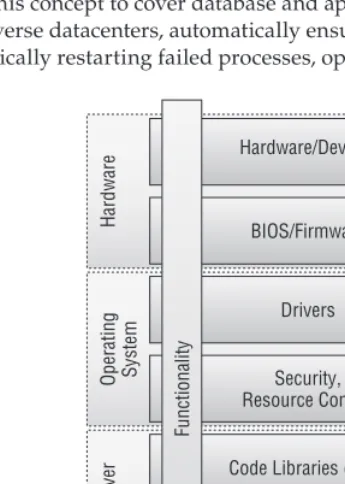
[image:39.639.204.377.239.481.2]As Figure 1.1 shows, application frameworks like the open source Spring Framework and Microsoft’s .NET Framework have been introduced to abstract the growing complexity of the operating system and provide database and web services that developers can work with directly. Expand this concept to cover database and application workloads being moved around geographically diverse datacenters, automatically ensuring resilience by spawning redundant copies, or automatically restarting failed processes, operating systems, and even servers.
Figure 1.1
Th e functionality of the software “stack,” from low-level server compo-nents to the cloud, grows by increas-ing abstraction of functionality.
Hardware/Devices
BIOS/Firmware
Drivers
Security, Resource Control
Code Libraries (DLL)
Web Services Application Code
Cloud
Server
Operating System
Hardware
Functionality Abstraction
We have the foundation of most of this abstraction today in the shape of VMware vSphere and its complementary technologies, but applications have been bound by their tight dependen-cies to a physical server operating system, framework, and services. Tweaking typical applica-tions to run seamlessly on multiple server instances and scale up and down based on demand is a complicated piece of engineering and development work in itself. Cloud computing, and particularly VMware vCloud Director and vFabric, provides a services layer above the infra-structure engineering to enable you to build and maintain cloud solutions.
DEFINING CLOUD COMPUTING
|
7world; there are a number of things that cloud computing can offer to the traditional enterprise to build on the foundations of virtualization to improve business agility and streamline opera-tions. This is what privatecloud is about. To understand what a cloud is, you need to look at the key attributes.
Defi ning Cloud Computing
The National Institute of Standards and Technology (NIST) has a well-accepted defi nition of cloud computing that we will use in this book. NIST has defi ned a list of the key attributes that defi ne cloud computing; they also have a number of working groups and special publications at their website:
http://csrc.nist.gov/publications/PubsSPs.html#800-145
The NIST defi nition of cloud computing is based on the following attributes:
◆ On-demand self-service ◆ Broad network access ◆ Resource pooling ◆ Rapid elasticity ◆ Measured service
In this section, we will discuss each of these attributes and see how they map to the practical tools and processes we have available today.
On-Demand Self-Service
A consumer can unilaterally provision computing capabilities, such as server time and network storage, as needed automatically without requiring human interaction with each service’s provider.
—From the NIST defi nition of cloud computing
On-demand self-service is an abstract concept. It relates to provisioning processing time, such as submitting a batch job, requesting an email account, or requesting an entire server operating system instance from a shared platform. The “without requiring human interaction” phrase relates to the provision of APIs and integrations to allow program code to interact with the platform.
As you know, operating system APIs allow end-user applications to request memory alloca-tions or open fi les within the scope of a single server. In a similar way, cloud services provide a higher-level abstraction that allows an end-user application running in a cloud to program-matically request more resources, more infrastructure like networks or storage, or even more instances of itself to facilitate horizontal scaling, and potentially makes it possible for those additional resources to be brought online anywhere in the world, rather than just inside a single physical server.
8
|
CHAPTER 1 WHAT MAKES A PRIVATE CLOUD?Broad Network Access
Capabilities are available over the network and accessed through standard mechanisms that promote use by heterogeneous thin or thick client platforms (e.g., mobile phones, laptops, and PDAs). —From the NIST defi nition of cloud computing
Broad network access is arguably of less relevance to the private cloud, since it is geared more toward platform as a service/software as a service (PaaS/SaaS) solutions rather than infrastruc-ture and services. However, by defi nition it means that services in cloud computing are more centralized to datacenters and service centers—which has been a key trend in IT for years. A number of the other attributes—particularly resource pooling, discussed next—are not broadly feasible without resources being physically in the same location.
Resource Pooling
The provider’s computing resources are pooled to serve multiple consumers using a multi-tenant model, with different physical and virtual resources dynamically assigned and reassigned according to consumer demand. There is a sense of location independence in that the customer generally has no control or knowledge over the exact location of the provided resources but may be able to specify location at a higher level of abstraction (e.g., country, state, or datacenter). Examples of resources include storage, processing, memory, network bandwidth, and virtual machines.
—From the NIST defi nition of cloud computing
Resource pooling is the gathering of traditionally discrete physical resources like CPU, memory, and disk storage into a singly managed entity. This entity is then shared by a number of consumers. Controls can be placed to grant and limit access by a single consumer so as not to be detrimental to the experience of other consumers.
If a provider chooses to do so, resources can be overcommitted, whereby consumers are allocated more virtual resources than physically exist in the underlying infrastructure. This approach works on the general principle that not all consumers need all of the resources they request all of the time. This model needs to be carefully managed and balanced to ensure that suffi cient resources exist to provide an agreed level of service while maintaining practical head-room for day-to-day operations.
The resource pooling concept is key to the economics of cloud computing, a topic we will cover in detail later in this book. Virtualization is a major technology in delivering this capabil-ity in a cost-effective and fl exible manner.
Within the scope of this book, resource pooling is delivered mainly by vSphere and specifi c functionality of the underlying ESX hypervisor. vCloud Director provides a number of resource and security abstractions to the user to make this concept easy to understand without them having to grasp the underlying physical resources in a multitenant environment.
Rapid Elasticity
IS VIRTUALIZATION CLOUD COMPUTING?
|
9Elasticity describes the ability to add and remove allocated resources to a discrete unit of consumption. In practical terms, this involves adding CPU, memory, and storage resources— either by adding or removing physical resources within a single discrete server (known as vertical scaling) or by adding further discrete virtual server instances (known as horizontal scaling).
Virtualization plays a key role in delivering rapid elasticity, particularly within the scope of a discrete server. This type of elasticity is hard in the physical world as it typically requires high-end “hot-add” hardware and a human engineer to add/remove physical hardware to a single server, a process that is neither rapid nor cheap.
Rapid elasticity in the purely physical world can be achieved in a limited sense if you can deal with adding and removing physical servers for a consumer (horizontal scalability) and you have applications that can support this. This model requires excellent technical orchestration and creative commercial models to be cost-effective and is usually found in the hosting/service-provider space where they have a scale of operation that makes this feasible. Virtualization is rapidly replacing the need for such providers to carry this sort of “ready-to-go” hardware inventory.
Within the scope of this book, rapid elasticity is delivered by vSphere and the underlying ESX hypervisor as well as a layer of orchestration for physical and in-guest provisioning.
Measured Service
Cloud systems automatically control and optimize resource use by leveraging a metering capability at some level of abstraction appropriate to the type of service (e.g., storage,
processing, bandwidth, and active user accounts). Resource usage can be monitored, controlled, and reported, providing transparency for both the provider and consumer of the utilized service.
—From the NIST defi nition of cloud computing
Measured service is key to some of the economic and fi nancial aspirations for cloud comput-ing. Enabling a pay-as-you-go model for consumption of resources ensures that a number of new commercial models are opened up for consumption by organizations. This is often more about the ability to do charge-back or show-back—where you can bill (or report on) the actual or potential cost to provide a set of services to a business unit either to recover cost or to demon-strate usage.
Within the scope of this book, the attribute of measured service is provided by vCenter Chargeback (which is part of VMware vCloud).
Is Virtualization Cloud Computing?
Virtualization is a tool, cloud computing is a business model. —Joe Baguley, Chief CloudTechnologist, VMware
10
|
CHAPTER 1 WHAT MAKES A PRIVATE CLOUD?controlled orchestration engine to move, provision, and de-provision workloads around the globe.
Similarly high-end computer systems like IBM mainframes and the HP Superdome have hardware-level partitioning that can dedicate physical computing resources at a hardware level to individual processes or services. However, such systems come at a signifi cant up-front cost to the would-be cloud service provider or enterprise.
Where virtualization has become critical to cloud computing is in the economic realm: Virtualization makes x86 hardware signifi cantly more fl exible and transparently scalable way beyond its original single-user personal computer design goals.
Innovation in the virtualization space, such as with the VMware Distributed Resource Scheduler, vMotion, and hot-add virtual hardware, has allowed traditional 1:1 workloads to move vertically and horizontally within the boundaries of a single x86 server. This innovation has meant that levels of functionality previously only offered on high-end supercomputers have become available at a lower price point and in a manner that means systems can be built incre-mentally through horizontal scaling.
This horizontal scaling can often be directly tied to a revenue stream within a business model, which reduces start-up risk and makes it easier to demonstrate return on investment (ROI).
Are Traditional Services Cloud Computing?
There is much discussion (usually from vendors of such services) over whether or not traditional services like co-location, managed, or hosted services are cloud computing; they are defi ned and compared with cloud computing as follows:
Co-location, where an organization houses its own servers in a datacenter operated by a ser-vice provider, is technically the furthest from the NIST cloud defi nition. Provisioning of serser-vices is manual, and the compute infrastructure (consisting of the servers, network, storage, etc.) is either purchased or paid for up-front. As a result, infrastructure typically exhibits little elastic-ity from a commercial point of view to the provider and consumer.
Power, cooling, and physical space are pooled resources with the co-location facility, shared by many tenant organizations. They aren’t directly related to providing computer services (although without them, there would be little ability to provide a service!).
Managedservices, where a service provider runs a service like email or an application suite on the behalf of an organization, are akin to traditional outsourcing. The provider brings their domain experience in hosting this type of application, and the organization benefi ts from con-tractual service-level agreements and a scale of economies. Rather than providing entirely dedi-cated support resources, the service provider often pools the human technical support resources responsible for running the service among multiple customers, thus reducing the cost to indi-vidual consumers.
UNDERSTANDING SERVICES AND DELIVERY MODELS
|
11This isn’t to say you can’t run managed services on a cloud provider. In this instance, the managed service provider is a further human service layer between the end-user organization and the cloud provider’s facilities (in some cases, they may even be the cloud provider, mud-dying the waters further). The managed service provider adds experience and can provide a custom end-to-end service with the advantages of cloud infrastructure (such as on-demand self-service, elasticity, and pay-as-you-go fl exibility).
Managed services provided on a cloud platform is a common model. A managed service pro-vider building and managing a solution for an organization on a public cloud is a good halfway point for getting a custom service in an off-the-shelf/do-it-yourself cloud world. As increasing numbers of service providers adopt this approach, the cost of computing resources will become the commodity, whereas the managed services will become the value-added that service provid-ers use to attract customprovid-ers.
Hosting is most often seen in the world of websites and web services. A service provider typi-cally has an infrastructure that they provide to a broad range of customers, making available a limited set of off-the-shelf features such as standard scripts and applications that customers can utilize. There is little fl exibility in traditional hosting. You choose the type of application you want and it is provided in a fi xed confi guration. You are given limited access to the system and typically afforded user rather than root privileges. This arrangement resembles the SaaS model, which we will discuss later in the “Understanding Services and Delivery Models” section of this chapter.
A number of variants exist such as virtual private hosting, where you are given a virtual machine for which you have full control—this is getting into cloud territory. Such services are usually charged on a fi xed rental basis with a minimum contractual term, rather than the mea-sured usage, no-commitment approach you get with most cloud providers—for example, $99 a month for a Windows instance with 4 GB of RAM, a 1 GHz CPU, and 20 GB hard disk from a hosting provider versus $0.40 per hour for individual SQL transactions with a cloud provider.
Understanding Services and Delivery Models
There are a number of ways in which cloud services can be delivered. In this section we review the commonly accepted defi nitions of the various services and their delivery models.
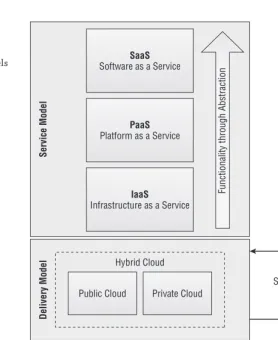
The XasaService (XaaS) models are important concepts to understand and predate the defi nition of cloud services. XaaS defi nes the type of service being delivered; delivery models describe how those services are delivered and to whom (see Figure 1.2).
To understand delivery models, you must grasp the concepts of consumer and provider:
Consumer A consumer is the user—the person or organization that requests, uses, and releases resources and services. This involves the processing of data using the services provided. In some instances, the consumer may be another application or software process rather than a human consumer.
12
|
CHAPTER 1 WHAT MAKES A PRIVATE CLOUD?Figure 1.2
Th e relationship between services
and delivery models Software as a ServiceSaaS
Hybrid Cloud
Service Model
Delivery Model
Public Cloud Private Cloud
Consumers
Measured Service Service Level Agreement
$ IaaS
Infrastructure as a Service PaaS Platform as a Service
Functionality through Abstraction
Infrastructure as a Service (IaaS)
The capability provided to the consumer is to provision processing, storage, networks, and other fundamental computing resources where the consumer is able to deploy and run arbitrary software, which can include operating systems and applications. The consumer does not manage or control the underlying cloud infrastructure but has control over operating systems, storage, and deployed applications; and possibly limited control of select networking components (e.g., host fi rewalls).
—From the NIST defi nition of cloud computing
UNDERSTANDING SERVICES AND DELIVERY MODELS
|
13operating system. Many outsourcing, hosting, and managed service providers have run this type of model for years, whereby a consumer can request a server of a particular specifi cation and confi guration and the provider deals with the complexities of ordering, taking delivery, racking, installing the operating system, and updating inventory and management tools before handing over control to the consumer—as well as managing its overall life cycle of updates, upgrades, and refreshes.
The consumer has a fi xed unit of capacity because it is bounded by a single server (or a resource allocation in the instance of a virtual server) that the consumer owns outright or rents over a fi xed period—typically measured in months or years. However, they pay a fi xed amount regardless of how much of the allocated resource they consume.
When delivering Infrastructure as a Service (IaaS) on a cloud (be it public, private, or hybrid), this resource allocation is provided on a self-service basis. Self-service, speed of delivery, and measured service attributes dictate that infrastructure be delivered in an entirely automated fashion from a shared pool of computing, storage, and network capacity. The consumer only pays for what they consume, rather than a fi xed, contracted allocation over an agreed term.
The provider abstracts the complexity in providing this underlying infrastructure. Examples include the creation of a virtual local area network (VLAN), fi rewalls, storage allocation, server instances, installation of the operating system, applications, management tools, and integra-tion with a billing system or confi guraintegra-tion management tool. To achieve economies of scale in cloud platforms, this is accomplished by calling on a pool of virtualized, multitenant physical resources driven by an automation tool.
IaaS is a foundational layer for other higher-level services like PaaS and SaaS. In basic terms, nothing can be delivered without infrastructure to run it, but the infrastructure is abstracted to allow higher-level services to build on it without having to invest signifi cant time in the com-plexities of building and managing servers, networks, and storage for each tenant service.
Platform as a Service (PaaS)
The capability provided to the consumer is to deploy onto the cloud infrastructure consumer-created or acquired applications consumer-created using programming languages, libraries, services, and tools supported by the provider.
The consumer does not manage or control the underlying cloud infrastructure including network, servers, operating systems, or storage, but has control over the deployed applications and possibly confi guration settings for the application-hosting environment.
—From the NIST defi nition of cloud computing
14
|
CHAPTER 1 WHAT MAKES A PRIVATE CLOUD?Platform as a service (PaaS) seeks to build on the IaaS foundation and abstract discrete blocks of infrastructure into platform services, such as database, message queueing, and caching that can be consumed by application code to deliver services to consumers.
In the traditional model, developers work with infrastructure people to design, deliver, and test various third-party applications like Oracle databases, IBM’s MQSeries, BizTalk, and SQL Server on discrete infrastructure to build services dedicated to the service being delivered. The delivery of more and more services leads to discrete silos of infrastructure and platforms being implemented for each service, which drives up the overall total cost of ownership for the provider and in turn for the consumer as the provider seeks to recoup the cost, or the consumer funds the end-to-end process.
PaaS seeks to simplify this process and deliver services that provide an agreed level of avail-ability and performance that is usually defi ned by a service level agreement (SLA). This goal is often accomplished through multitenancy of software solutions built on an IaaS foundation, whereby the PaaS layer is able to request and adjust resources from the IaaS layer through self-service (typically accomplished programmatically using an API).
PaaS is the fi rst layer where services in the cloud world become self-aware. The PaaS layer is engineered to understand its load and availability requirements (defi ned by the SLA) and has built-in logic to know when it needs more (or fewer) resources. It handles such requests to the IaaS layer and distributes jobs accordingly.
PaaS is characterized by providing a scalable abstraction of application services that develop-ers can consume. Developdevelop-ers and their creations are the primary consumdevelop-ers of PaaS and not users (although users indirectly benefi t from PaaS through the services they consume).
PaaS and the Private Cloud
Today, PaaS is just emerging in the private cloud space whereas a plethora of PaaS services are avail-able in the public cloud space—thanks to Amazon and its Amazon Web Services (AWS), Google and its Google App Engine, and Microsoft and its Azure platforms. Th ese platforms provide a growing stack of PaaS services for databases, message queuing, and caching. But they are all currently limited to public cloud implementations, hosted on Amazon-, Google-, or Microsoft-provided infrastructure that is available to anyone with a credit card and a user account.
Th ere is currently no way to take a solution that you have built on AWS, App Engine, or Azure and run it internally in your enterprise without having to build and maintain an API-compatible clone of the PaaS services that AWS, App Engine, or Azure provide—an expensive and nontrivial task.
PaaS solutions are for green-fi eldapplications—they provide the underlying plumbing for Web 2.0/ cloud-generation applications and require developers to learn a new programming method and framework to deliver a solution (although not necessarily a diff erent programming language as they all support most modern languages or their variants).
VMware has made a number of strategic acquisitions in the PaaS space in the past few years, and the vFabric and Cloud Foundry product lines promise to deliver the ability to seamlessly move an application-level workload between public and private cloud platforms. In part this is accomplished by having a common VMware IaaS layer (vCloud Director and vSphere) that is present and available to both public and private cloud implementations.
UNDERSTANDING SERVICES AND DELIVERY MODELS
|
15Software as a Service (SaaS)
The capability provided to the consumer is to use the provider’s applications running on a cloud infrastructure.
The applications are accessible from various client devices through either a thin client interface, such as a web browser (e.g., web-based email), or a program interface. The consumer does not manage or control the underlying cloud infrastructure including network, servers, operating systems, storage, or even individual application capabilities, with the possible exception of limited user specifi c application confi guration settings.
—From the NIST defi nition of cloud computing
Services provided on a software as a service (SaaS) basis are often multitenant and leverage lower-level services like IaaS and PaaS to deliver services that are directly used by consumers.
Email and collaboration solutions are the most commonly encountered examples of SaaS. Consumers interact directly with services and are typically measured (and charged) on a per-user or per-minute/per-gigabyte basis.
SaaS solutions typically present the least fl exible but ready-to-use solutions for consumers, who use the functionality provided as instructed. Consumers cannot typically modify and extend these services—for example, to integrate with an in-house legacy application.
SaaS is closest to off-the-shelf commercial software but is provided online on an ongoing measured basis rather than a one-off purchase model. That isn’t to say that providers can’t build custom solutions that leverage IaaS and PaaS building blocks to provide a solution on a SaaS basis to consumers; in fact, that is essentially what SaaS vendors like SalesForce.com, Gmail, and Microsoft Business Productivity Online Standard Suite do.
Now that you have a good understanding of the various service models, we’ll look at the var-ious delivery models for those services. Each cloud service can be delivered in a different way depending on where the service is physically housed and to whom it is provided.
Public Cloud
The cloud infrastructure is provisioned for open use by the general public. It may be owned, managed, and operated by a business, academic, or government organization, or some combination of them. It exists on the premises of the cloud provider.
—From the NIST defi nition of cloud computing
Amazon Elastic Compute Cloud (EC2) is the most widely used public cloud service. Both EC2 and AWS provide a set of IaaS and PaaS services for developers to build cloud applications on.
EC2 is open to the public over the Internet, and developers can start using the service with little more than an Amazon account and a credit card. EC2 has a diverse customer base and is deployed in several global locations. EC2 maintains a library of standard operating systems— mainly Linux- and open source–based, although Windows is also available.
Users pay for EC2 on a per-CPU hour basis or per-gigabyte of data stored or transferred in/ out of the cloud. EC2 supports an extensive API to allow users or even applications to provision and adjust computing, network, or storage resources.