This is a repository copy of
Thinking inside the box: a comprehensive spatial
representation for video analysis.
.
White Rose Research Online URL for this paper:
http://eprints.whiterose.ac.uk/81164/
Version: Accepted Version
Proceedings Paper:
Cohn, AG, Renz, J and Sridhar, M (2012) Thinking inside the box: a comprehensive spatial
representation for video analysis. In: Brewka, G, Eiter, T and McIlraith, SA, (eds.)
Principles of Knowledge Representation and Reasoning: Proceedings of the Thirteenth
International Conference, KR 2012. Principles of Knowledge Representation and
Reasoning: Thirteenth International Conference, KR 2012, 10-14 June 2012, Rome, Italy.
AAAI Press . ISBN 978-1-57735-560-1
[email protected] https://eprints.whiterose.ac.uk/ Reuse
Unless indicated otherwise, fulltext items are protected by copyright with all rights reserved. The copyright exception in section 29 of the Copyright, Designs and Patents Act 1988 allows the making of a single copy solely for the purpose of non-commercial research or private study within the limits of fair dealing. The publisher or other rights-holder may allow further reproduction and re-use of this version - refer to the White Rose Research Online record for this item. Where records identify the publisher as the copyright holder, users can verify any specific terms of use on the publisher’s website.
Takedown
If you consider content in White Rose Research Online to be in breach of UK law, please notify us by
Thinking Inside the Box: A Comprehensive Spatial Representation for Video
Analysis
Anthony G. Cohn
School of Computing University of Leeds
Leeds, England [email protected]
Jochen Renz
Research School of Computer Science The Australian National University
Canberra, ACT, Australia [email protected]
Muralikrishna Sridhar
School of Computing University of Leeds
Leeds, England [email protected]
Abstract
Successful analysis of video data requires an integration of techniques from KR, Computer Vision, and Machine Learn-ing. Being able to detect and to track objects as well as extracting their changing spatial relations with other objects is one approach to describing and detecting events. Differ-ent kinds of spatial relations are important, including topol-ogy, direction, size, and distance between objects as well as changes of those relations over time. Typically these kinds of relations are treated separately, which makes it difficult to integrate all the extracted spatial information. We present a uniform and comprehensive spatial representation of moving objects that includes all the above spatial/temporal aspects, analyse different properties of this representation and demon-strate that it is suitable for video analysis.
Introduction
The field of Qualitative Spatial and Temporal Representa-tion (QSTR) is now quite mature, with many calculi hav-ing been defined, and their computational properties havhav-ing been well investigated(Cohn and Renz 2007). Increasingly, these calculi are being used for applications ranging from natural language semantics, robotics, GIS, and of particular concern to us here, high level interpretation of video data, e.g. (Sridhar, Cohn, and Hogg 2010; 2011b). The appli-cation of QSTR in video interpretation has been advocated for a variety of reasons; prime amongst these is that noise, and unimportant variations in occurrences of events can be abstracted away from at a qualitative level, rendering occur-rences of events of the same kind identical, or at least much more similar.
Depending on the behaviour of the objects involved, it can be appropriate to model many different aspects of space. These include mereotopology, in which case one of the RCC calculi have been used (Sridhar, Cohn, and Hogg 2010; Dubba, Cohn, and Hogg 2010), relative trajectories or di-rection (e.g. (Fernyhough, Cohn, and Hogg 2000)). Other aspects of qualitative spatio-temporal information could be relevant, including relative sizes (Gerevini and Renz 2002) and relative speed (Delafontaine, Cohn, and de Weghe 2011). As has been remarked (W¨olfl and Westphal 2009), the task of combining multiple representations is not en-tirely trivial, and a choice has to be made between an
in-Copyright c2012, Association for the Advancement of Artificial Intelligence (www.aaai.org). All rights reserved.
B
X x1 x3
x2 x4
y1 core1,1 core1,2 core1,3 core3,3
core3,2 core3,1
A A 0
A
B B
B
0
y3 y2 y4
X
A
B
sa ea
sb eb
sa’ ea’ sb’ eb’
Y Y
[image:2.612.321.554.217.298.2]A
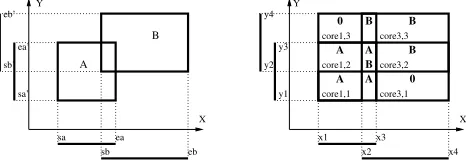
Figure 1: Two rectangles A and B and their projections (left). How the projections define the 9 cores (right).
tegrated calculus, and a loose combination of separate ones; however in the latter case there can be representational in-efficiencies due to overlapping aspects of the calculi, which can also cause issues for inference, in particular detecting inconsistencies (Gerevini and Renz 2002).
Since a common representation of objects in video analy-sis is to use their minimum bounding rectangles (MBR)(de Campos et al. 2011; Thirde et al. 2007), rather than a more precise shape representation (although these are also used), we focus here on an integrated spatio-temporal representa-tion for such rectangular regions. The fact that all regions are one-piece, rectangular, and aligned to the spatial axes, allows a number of representational efficiencies to be made.
A Comprehensive Rectangle Representation
In this section we formally define, motivate and explain our new representation. Our goal is to develop a comprehen-sive rectangle representation that allows us to represent all required spatial information between 2 rectangles. This in-cludes the topology, direction, size, distance, and motion, which refers to the change of the other aspects over time.
Topology and direction between 2 rectangles is captured by the Rectangle Algebra (RA) (Balbiani, Condotta, and del Cerro 1999). The RA projects 2 axis-parallel rectanglesA
andB onto thexandyaxes, which leads to 2 correspond-ing intervals on each axis. It then takes the Interval Algebra (IA) (Balbiani, Condotta, and del Cerro 1999) relation be-tween each pair of intervals and defines an RA relation as a pair of IA relations, one for each axis (see Fig. 1). Since there are 13 IA relations, this leads to13∗13 = 169different RA relations. It is then straightforward to extract topology (e.g. their RCC8 relationship (Cohn and Renz 2007))1 as
1
well as the external direction betweenAandB. To some degree we can also obtain the internal direction betweenA
andB. Representation of motion is very limited in the RA as it is only possible to represent changes of RA relations over time, e.g. if(<, <)changes to(m, <)we know that
Amoved closer toBon thexaxis. That is we only repre-sent qualitative changes in topology or direction, but cannot represent intermediate changes such as “Ais moving closer toB” that do not lead to a change in topology or direction. This requires additional size and distance information.
Consider again Fig. 1. The RA compares the interval re-lations between[sA, eA]and[sB, eB]and between[s′A, e′A] and[s′
B, e′B]. However, in order to represent relative move-ment of rectangles over time, we need to look at other in-tervals. E.g., assume that eA is before sB, then the rela-tive change of the length of interval [eA, sB] corresponds to whetherAmoves closer toB or away fromB in thex -direction. Similarly, if the 2 intervals[sA, eA]and[sB, eB] overlap and if the interval [sB, eA] becomes bigger, then
AandB overlap more. If[sB, eA]becomes smaller, then the area ofB that is not overlapped byBbecomes smaller. These different intervals are also useful in the static case as it allows us to express internal directions: e.g., thatBis inside
Aand that it is in the bottom left corner ofA.
In this way each possible interval between the pointssA,
sB,eA, andeB on each axis carries information and allows us to specify the relationship between 2 rectangles and how it changes over time in a much more expressive way than only considering RA relations.2 For 4 endpoints s
A, sB,
eA, andeB we get up to 6 different intervals between these endpoints, on both axes up to 12.3 It will always be the
case that sA < eA andsB < eB, but depending on the RA relation betweenAandB, it is possible that 2 of these endpoints are identical and we get only 3 different intervals. If 2 pairs are identical, we get only one interval on that axis.
Topology and DirectionWe propose a representation that captures all this information and allows a very detailed and comprehensive representation of the spatial and spatio-temporal relationships between rectangles (see Fig. 1).
Definition 1(region of interest, core). Given a 2D spaceU with 2 reference axesxandy and 2 rectanglesA, B ∈ U that are parallel toxandy. ProjectingAandBtoxandy
gives us 2 intervals[sA, eA]and[sB, eB]onxand 2 intervals [s′
A, e′A]and[s′B, e′B]ony. For each axis, we rename and order the 4 endpoints of the 2 intervals such thatx1≤x2≤
x3≤x4andy1≤y2≤y3≤y4.
The region of interest for rectangles A, B (written
roi(A, B)) is the rectangle bounded by the intervals[x1, x4]
and[y1, y4]. The regions bounded by the intervals[xi, xi+1]
and [yj, yj+1] are the cores of roi(A, B), written as
corei,j(A, B), for 1 ≤ i, j ≤ 3. We call the intervals [xi, xi+1]and[yj, yj+1]for1 ≤i, j ≤2thecore intervals
general, for non aligned rectangles and non-convex regions, it is not possible to infer the RCC8 relationship from an RA relationship.
2
This holds even if we use what could be called RA-INDU, the extension of RA that uses INDU (Pujari, Kumari, and Sattar 1999) for representing relations between the underlying intervals.
3
These are called the implicit intervals of IA in (Renz 2012).
onxory, or thecore widthsandcore heights, respectively. It is clear thatroi(A, B)consists of exactly 9 cores. Since the underlying core intervals can have length 0, each core is either a rectangle, a line segment, or a point. The cores form a3x3grid that divide theroiinto 9 zones. A core is either part ofAor not part ofAand similarly forB. This leads to 4 different states. We introduce a 5th state in order to distinguish cores with a lower dimension.
Definition 2 (core state, region state). Given 2 rectangles
A, B ∈ U, theirroi(A, B)and its 9 cores corei,j(A, B), for1≤i, j≤3, thestate of a core,state(corei,j(A, B)), in shortstatei,j(A, B), is defined as follows:
Ifcorei,j(A, B)is a two dimensional region, then:
statei,j(A, B) =AB, iffcorei,j(A, B)⊆A∩B statei,j(A, B) =A,iffcorei,j(A, B)⊆A−B statei,j(A, B) =B,iffcorei,j(A, B)⊆B−A
statei,j(A, B) =, iffcorei,j(A, B)6⊆A∧corei,j(A, B)6⊆B
If corei,j(A, B) is a line segment or a point, we set its state to ∅. We write the state of roi(A, B) as a 9-tuple state(A, B) = [state1,1(A, B),state1,2(A, B),
state1,3(A, B),state2,1(A, B),state2,2(A, B),state2,3(A, B),
state3,1(A, B),state3,2(A, B),state3,3(A, B)]
SinceAandBare rectangles, it is clear that not all states are possible. In fact the set of all cores that are part of a sin-gle rectansin-gleA, i.e., that have stateAorAB, must always form a rectangle too. Therefore, there are only 36 differ-ent possibilities of howAandBcan be distributed over the cores.
However, not all combinations of the 36x36 assignments are possible states. E.g. if all 9 cores are part of A(and thus have either stateAor AB), then only the centre core (core2,2) can have stateAB, since in all other cases some
cores would have state∅. We can show that only 169 differ-ent states are possible, corresponding exactly to the 169 RA relations (see www.comp.leeds.ac.uk/qsr/cores for a depic-tion and their correspondence with the RA reladepic-tions).
Theorem 1. Given 2 rectanglesA, Band theirroi(A, B), there are 169 different statesstate(A, B); these have a 1-to-1 correspondence to the 169 relations of the RA.
Independent of how the 2 rectangles move, the location of each of the 9 cores with respect to its neighboring cores always stays the same, they always touch each other at the boundary. Since the cores can have zero width, it is possible that non-neighboring cores touch each other as well. This case is clearly determined by the state of the cores, and hap-pens only if a core in the middle of a row or column (i.e.,
i = 2 orj = 2) has state∅. Since location of cores and corresponding RA relation between cores are determined by
state(A, B), which covers the topology and direction be-tween rectangles, the main additional information we can get is the size of cores as well as their width and height. It is clear that all 3 cores in the same row have the same height and that all 3 cores in the same column have the same width. Therefore, the width and height of all cores only depends on the length of the 6 corresponding core intervals[xi, xi+1]
and[yj, yj+1], respectively, for1≤i, j≤3.
exact values of the width, height, and area of cores is gen-erally not important. Instead, we are mainly interested in relative size measures. By comparing which core is larger than which other core, we can infer information such as rel-ative closeness of rectangles. E.g., A is contained in B and is close to the bottom right corner of B. By comparing how the size of a core at one time point compares to its size at the next time point we can infer how objects move relative to each other. Given 6 intervals, we have to keep track of 15 relative size comparisons (6∗5/2 = 15) between these intervals. However, rectangles can consist of multiple cores and in order to accurately compare their sizes, we may have to compare the sizes of combinations of cores together. This gives us 6 possible intervals on each axis, the 3 core inter-vals plus all possible unions of neighboring core interinter-vals, a total of 12 intervals. We call these 12 intervals therectangle intervals(RIs)[Xi, Xj]and[Yi, Yj]for any1≤i < j≤4, which give us12∗11/2 = 66different size comparisons.
A comparison of the relative size of the area of the 9 cores requires keeping track of9∗8/2 = 36different relative size relationships. A relative size comparison of all 36 possible rectangles would lead to36∗35/2 = 630relationships, even though many of them can be inferred from other relations.
Changes over TimeWhen comparing changes over differ-ent time points, we can compare same with same, or we can compare everything with everything. In this paper we re-strict ourselves to the same with same case and we compare each core with itself at different time points to see how the cores change. If we compare the relative height and width of cores, we need 6 comparisons altogether, for the area we need 9 comparisons, one for each core. We can also compare changes over time between sets of cores forming rectangles, in which case we have to compare 12 different intervals over different time points. For comparing changes over time for all possible rectangles formed by cores, we need 36 compar-isons. The changes are recorded using a change function.
Definition 3(change function, changes). Given a setV of
k variables v1, . . . , vk over a domain D and an order re-lationR on D. Vtis the assignment of values from Dto each variable of V at time point t. We define a change functionch(V) : V 7→ {<,=, >} wherech(vt) = ‘=’ if
vt−vt−1= 0,ch(vt) =‘<’ ifvt−1−vt<0, andch(vt) = ‘>’ ifvt−vt−1 < 0. The changes fromVt−1 to Vt for each of thekvariables ofV, written asch(V), is thek-tuple [ch(v1), . . . , ch(vk)].
Building an Integrated RepresentationIn order to obtain qualitative information from video, we have to detect and track the relevant objects and their MBRs. For every pair of MBRsA, Band in every frame, we then record the 4x
and the 4 y coordinates of the 4 lines bounding A andB
in both directions. These coordinates define the 9 cores as described above. We then determine the status of each core with respect toAandB. This is all the information we need to extract. All qualitative relations can be inferred from this information: the RA relations betweenAandBwhich give us topology and direction are derived fromstate(A, B), all relative size information between the cores can be derived from thexandycoordinates of the bounding lines.
Instead of keeping track of 66 different relative size com-parisons between 2 rectanglesAandB, we choose a more compact representation of the relative size of their cores. We take the 12 RIs and determine their total order with respect to their length. Some of these intervals might have the same length and for some, the order is predetermined due to one being contained in the other. We then assign each of the 12 RIs its rank in the total order, with rank 1 being assigned to the smallest interval. Intervals of same size will get the same rank. Ifm intervals have the same rankk, then the next largest interval will get rankk+m. The highest rank is less than 12 if the largest interval has the same length as another interval. It is clear that we can obtain each of the 66 different relative size relations between the 12 RIs by com-paring their rank: if they have equal rank, they have equal size, the one with lower rank is smaller.
Definition 4(rank, ranking). Given a setV ofkvariables
v1, . . . , vk over a domainDand an order relationRonD. For each assignment of values to variables inV, we can sort V with respect toR.rank(v) :V 7→ {1, . . . , k}is therank
ofv ∈ Vwit respect toR, where same value implies same rank. The rankingof V, written asranking(V), is thek -tuple[rank(v1), . . . , rank(vk)].
Integrating all the concepts we defined so far gives us a compact representation of the relevant qualitative informa-tion about 2 rectangles.
Definition 5 (CORE-9, CORE-9+, CORE-9++). Given 2 rectanglesA, B ∈ U, theirroi(A, B), the set C(A,B) of 9
corescorei,j(A, B), for1 ≤ i, j ≤ 3, the setC(+A,B) that
consists of all 36 unions of cores that form rectangles, the set of 6 core intervalsCI(A,B), and the set of 12 rectangle
intervals CI+(A,B). In order to refer to a specific element in CI(A,B) we use as superscript the interval/core we are
referring to, e.g.CI[(x1,x2A,B)], orC([2A,B,3]).
CORE-9(A, B, t) is a qualitative representation of rectan-glesAandBat timetwith the following components:
state(A, B), the state of the 9 different cores;
ranking(C(A,B)), the ranking of the core areas;
ranking(CI(A,B)), the ranking of the core intervals;
ch(C(A,B)), the changes ofC(A,B)compared to timet−1;
ch(CI(A,B)), the changes ofCI(A,B)compared to timet−1
CORE-9+uses the 12 RIsCI+(A,B)instead ofCI(A,B). In
addition, CORE-9++also usesC(+A,B)instead ofC(A,B)
A CORE-9 relation is any valid assignment of
state(A, B), ranking(CI(A,B)), ranking(C(A,B)),
change(C(A,B)), andchange(CI(A,B)).
Note that ch(CI(A,B)) and ch(C(A,B)) are not
com-pletely independent. E.g. if ch(CI[(x2,x3A,B)]) =‘<’ and
ch(CI[(y1,x2A,B)]) =‘<’, thench(C[2(A,B,1]))must be ‘<’ too.
Expressiveness of CORE-9
can straightforwardly define RCC-8 relations from CORE-9 and the relations of a qualitative direction calculus such as the Cardinal Direction Calculus (CDC) (Ligozat 1998). It is fairly straightforward to show that it also covers relative size and relative distance and, what is more, that it integrates these 4 aspects. With this integration, it is possible to further refine the different aspects. E.g., we can refine the topolog-ical overlap relation by direction, i.e., from which direction one rectangle overlaps the other. We can further refine them by relative size, e.g. how much of a rectangle overlaps the other one, and by relative distance. Relative distance in com-bination with the other types of relations is very powerful. It allows us, for example, to specify if a rectangle overlaps an-other one closer to the left or right, the top or bottom. Other relative distance measures can further refine the overlap re-lationship. We can make similar refinements for the other topological relations. In addition, CORE-9 allows us to rep-resent changes of these relations over time. Because of the relative distance relations, we can also express that rectan-gles approach each other or move away from each other, overlap more or overlap less, and in which directions, in effect defining a form of the QTC calculus ((Delafontaine, Cohn, and de Weghe 2011) for rectangles, which could be used, e.g. to model action sequences such as overtaking cars in a qualitative natural way.
CORE-9 encodes much more than just RCC, CDC and QTC. It is clear that relative size information is also explic-itly encoded, via therankingfunction of Definition 5. This allows us, for example, to represent thatAis in the bottom left ofB, or thatAoverlapsBin thexdirection more than in theydirection. CORE-9 can also encode much more di-rectional information than is possible in CDC: it can encode
internal directions, e.g. to represent thatAis in the NE of
B. Also for the case of QTC, it can handle cases whereA
andBare not disjoint, so that it is possible to represent, e.g., thatAis part ofB, and that it is moving west. CORE-9 can also represent that a region is growing or contracting.
There are some things that CORE-9 cannot represent. Relative speed is one such aspect (the third component of most QTC family calculi) – it would require comparisons between arbitrary RIs at different times, not just the same ones (as is the case in the presentrankingfunction). This would be a straightforward extension.
Smoothness of CORE-9
A very important property that any useful qualitative repre-sentation should have issmoothness, i.e., if there are small changes to what is being represented, there should only be small changes in the representation. Ideally, only parts of the representation should change, that correspond to parts that are changing, i.e., changes should be local. Having smooth and local changes is particularly important for repre-senting moving objects in video, where there are often small changes between every frame. It allows us to define a met-ric of similarity between different core representations that captures the degree of change – if only local changes exist, then two representations will be broadly similar.
In the following, we sketch how small continuous changes affect our representation. We begin with changes to the state
of the 9 cores and analyse which changes to the 2 repre-sented rectangles can cause these changes. There are only two kinds of small continuous changes that have this effect: (1) if the two rectangles share a common edge segment at one time point and the change affects the common edge, or (2) if the two rectangles share a common edge segment which they previously did not share. Since the change is continuous, this means that one of the core intervals changes from non-zero length to zero length, or from zero length to non-zero length. It is clear that for cores corresponding to these core intervals the status changes between∅and either
A,B, orAB. We can show in a simple case analysis that all other cores keep their previous states.
Apart from these changes to the state of cores, continuous changes to the rectangles also lead to continuous changes in the sizes of core and RIs. It is clear that these changes lead to smooth and local changes of the sizes relations of the intervals. However, CORE-9 does not represent these relations directly, but only the rank of intervals with respect to their relative size. By analysing how the rank of intervals can change and how this depends on continuous change, we can show that intervals that are not involved in a change do not change their rank, and that intervals that are involved change rank at most to the next higher or lower rank.
Continuous changes of the represented rectangles are also recorded in thech(...)entries of CORE-9. Clearly these en-tries only change locally, and they change as smoothly as the rectangles change. As a consequence of our analysis, we obtain the following theorem.
Theorem 2. CORE-9 is a smooth and local representation, that is, continuous changes to the represented rectangles lead to a smooth and local change in the representation.
An HMM Framework For Smoothed Relations
In this section we briefly report on 2 experiments comparing the efficacy of the proposed uniform representation against the combination of separate representations on actual video data. First we show that an approach that models topology and direction jointly performs better in obtaining smoothed relations, and secondly that this jointly obtained representa-tion is better at event detecrepresenta-tion.
Multi-Observation HMM (MOHMM) whose input is defined in terms of a vector intervals on thexandy axes against the relations produced by a pair of non-integrated HMMs for each of the topological and directional aspects separately (a Parallel HMM architecture – PaHMM(Chen et al. 2009)), so that at any time it is possible to infer a pair of topological and directional respectively. Manually annotated spatial re-lationships are used both for training the parameters of the HMMs and for evaluating them. The evaluation dataset con-sists of 36 videos each of 150200 frames and containing one or more of 6 verbs: approach, bounce, catch, jump, kick and lift (a subset of the videos and verbs at www.visint.org). The evaluation of the HMMs involved determining the extent to which the episodes output by the system temporally align with those of the ground truth. Accuracy was measured in terms of the mean and variance of the percentage of tempo-ral overlap, between the outcome of each of the HMMs and the ground truth in a 10-fold cross validation: the MOHMM had an accuracy of 72.5%, while the PaHMM with the sep-arate representations only had 62%.
In a second experiment, the relationships between pairs of object tracks obtained by each of the HMMs were re-represented in terms of a 3 layered graph structure called interaction graphs(Sridhar, Cohn, and Hogg 2010; 2011b), between which a similarity measure can be defined and used to perform learning tasks such as event detection. We used the event detection framework of the latter paper to learn 2 sets of event models arising from the interaction graphs ob-tained using PaHMM and the MOHMM respectively. An event was regarded as being detected if the detected interval overlapped the ground-truth interval by more than 50%. On a leave-one out cross validation the event models arising out of the PaHMM outputs yielded a mean F1 score of 38.6%, while the MoHMM yielded 44.5%. Thus in both experi-ments the integrated representation outperformed the repre-sentations computed separately, giving supporting evidence for the benefits of the integrated CORE-9 representation. A full set of experiments for CORE-9 remains to be conducted.
Final Comments
Video analysis presents a challenge to the field of KR. It re-quires us not only to detect and track objects in video, but to infer what the objects are doing. QSTR provides an effec-tive representation for this task as the exact location and ex-tent of the objects we track is typically much less important than their qualitative relationships. Many different QSTRs have been proposed. The hypothesis we have started to ex-plore in this paper is that an integrated representation may prove to be more effective, as well as being arguably more elegant. Our representation is suited for representing rectan-gles, which is appropriate when objects are represented by their MBR. Our representation is very compact and can be easily and smoothly extracted from video. This integrated approach appears to give better performance on event detec-tion as demonstrated in a sample dataset.
A variety of future work is possible; some of this has al-ready been alluded to above. A more thorough experimental evaluation is also required. A further avenue is to extend the HMM smoothing to all aspects of the CORE-9 representa-tion, specifically, the relative size information.
Acknowledgements The first and third authors acknowl-edge financial support of the DARPA Mind’s Eye program (project VIGIL, W911NF-10-C-0083). The second author is supported by an ARC Future Fellowship (FT0991917).
References
Balbiani, P.; Condotta, J.-F.; and del Cerro, L. F. 1999. A new tractable subclass of the rectangle algebra. In Proceed-ings of IJCAI’99, 442–447.
Chen, C.; Liang, J.; Zhao, H.; Hu, H.; and Tian, J. 2009. Factorial HMM and parallel HMM for gait recognition.
IEEE Transactions on Systems, Man, and Cybernetics, Part C39(1):114–123.
Cohn, A. G., and Renz, J. 2007. Qualitative spatial reason-ing. In van Harmelen, F.; Lifschitz, V.; and Porter, B., eds.,
Handbook of Knowledge Representation. Elsevier.
de Campos, T.; Barnard, M.; Mikolajczyk, K.; Kittler, J.; Yan, F.; Christmas, W. J.; and Windridge, D. 2011. An evaluation of bags-of-words and spatio-temporal shapes for action recognition. InWACV.
Delafontaine, M.; Cohn, A. G.; and de Weghe, N. V. 2011. Implementing a qualitative calculus to analyse moving point objects. Expert Syst. Appl.38(5):5187–5196.
Dubba, K. S. R.; Cohn, A. G.; and Hogg, D. C. 2010. Event model learning from complex videos using ILP. In Proc. ECAI, 93–98.
Fernyhough, J.; Cohn, A.; and Hogg, D. 2000. Construct-ing qualitative event models automatically from video input.
Image and Vision Computing18:81–103.
Gerevini, A., and Renz, J. 2002. Combining topological and size information for spatial reasoning. Artif. Intell. 137(1-2):1–42.
Ligozat, G. 1998. Reasoning about cardinal directions. J. Vis. Lang. Comput.9(1):23–44.
Pujari, A. K.; Kumari, G. V.; and Sattar, A. 1999. Indu: An interval and duration network. InProc. of Australian Joint Conference on AI, 291–303.
Renz, J. 2012. Implicit constraints for qualitative spatial and temporal reasoning. InProc. KR.
Sridhar, M.; Cohn, A. G.; and Hogg, D. C. 2010. Unsuper-vised learning of event classes from video. InProc. AAAI, 1631–1638. AAAI Press.
Sridhar, M.; Cohn, A. G.; and Hogg, D. C. 2011a. From video to RCC8: Exploiting a distance based semantics to stabilise the interpretation of mereotopological relations. In
COSIT, volume 6899 ofLNCS, 110–125. Springer.
Sridhar, M.; Cohn, A. G.; and Hogg, D. C. 2011b. Bench-marking qualitative spatial calculi for video activity analy-sis. InProc. IJCAI Workshop Benchmarks and Applications of Spatial Reasoning, 15–20.
Thirde, D.; Borg, M.; Aguilera, J.; Wildenauer, H.; Ferry-man, J. M.; and Kampel, M. 2007. Robust real-time tracking for visual surveillance. EURASIP J. Adv. Sig. Proc.2007. W¨olfl, S., and Westphal, M. 2009. On combinations of binary qualitative constraint calculi. In Boutilier, C., ed.,