This is a repository copy of
Efficient and service oriented infrastructure operation: the role
of the Energy Efficiency Directive in driving change towards Multi Utility Service
Companies
.
White Rose Research Online URL for this paper:
http://eprints.whiterose.ac.uk/75861/
Proceedings Paper:
Roelich, KE, Steinberger, JK and Knoeri, C (2013) Efficient and service oriented
infrastructure operation: the role of the Energy Efficiency Directive in driving change
towards Multi Utility Service Companies. In: eceee Summer Study proceedings. European
Council for an Energy Efficient Economy Summer Study, 3 - 8 June 2013, Belambra Les
Criques, Presqu’île de Giens, Toulon/Hyères, France. ECEEE , 185 - 195. ISBN
978-91-980482-2-3
[email protected]
https://eprints.whiterose.ac.uk/
Reuse
Unless indicated otherwise, fulltext items are protected by copyright with all rights reserved. The copyright
exception in section 29 of the Copyright, Designs and Patents Act 1988 allows the making of a single copy
solely for the purpose of non-commercial research or private study within the limits of fair dealing. The
publisher or other rights-holder may allow further reproduction and re-use of this version - refer to the White
Rose Research Online record for this item. Where records identify the publisher as the copyright holder,
users can verify any specific terms of use on the publisher’s website.
Takedown
If you consider content in White Rose Research Online to be in breach of UK law, please notify us by
Eicient and service oriented infrastructure
operation; the role of the Energy Eiciency
Directive in driving change towards multi-utility
service companies
Katy Roelich1, 2, Julia Steinberger1, 3 & Christof Knoeri1
1 Sustainability Research Institute
University of Leeds
Woodhouse Land, Leeds LS2 9JT UK
2 Institute for Resilient Infrastructure
University of Leeds
Woodhouse Land, Leeds LS2 9JT UK
3 Institute of Social Ecology, Vienna
Alpen-Adria University Austria
Keywords
Energy Eiciency Directive (EED), governance, policy imple-mentation, transition management, institutions
Abstract
Infrastructure operation can be described as separate util-ity systems provisioning unconstrained demand, with higher throughput corresponding to higher proits. In contrast, an eiciency perspective would prioritize coordinated infra-structure operation focused on essential service delivery at the lowest possible resource use. We investigate how to accelerate the adoption of alternative infrastructure operation conigura-tions which are: centred on the end-user and their demand for services; concerned with implementing resource eiciency im-provements; and consider multiple infrastructure streams. We call these alternative modes of operation Multi-Utility Service Companies (MUSCos).
Market and system failures that arise in privatised utility sys-tems present barriers to the adoption of MUSCos. his paper categorises these barriers and investigates the extent to which the European Energy Eiciency Directive (EED) overcomes them. he EED is analysed because energy is required to deliver the majority of household infrastructure services and as a result energy policy will have inluence over the related infrastructure systems.
Our research inds that the EED could increase adoption of service-oriented contracts in the public sector, potentially resulting in spillover to the domestic and commercial sector. However, without changes to accounting practices, inancial instruments and standardisation of contracts, investment risks and transaction costs would remain high and it is unlikely that this spillover would occur. In addition, the continued
frag-mentation of policy and cross-sector information asymmetries augments existing barriers to more integrated infrastructure operation.
We describe additional measures that might overcome these weaknesses; including measures to reduce contractual barri-ers and risks in the domestic sector, provide more appropriate inancing and accounting arrangements and more explicitly ad-dress the interconnectivity of infrastructure systems in future policy.
Introduction
Our physical infrastructure – the system of energy, transport, digital information, water, waste and lood protection assets – is a means to an end; it is built, maintained and expanded in order to enable the functioning of society and the economy. In turn, however, the technical building blocks of infrastructure and its geographic layout determine, to quite a large extent, the level and composition of a society’s resource demand, creating lock-in to certain types of resource dependency and uses (Un-ruh, 2000). Perhaps more surprisingly, physical infrastructure also shapes the institutional and social organisation of a society, through a historical process of change and evolution described as “co-evolution” (Foxon, 2011). his implies that changing infrastructure operation necessarily involves larger social and institutional shits as well as technical improvements that are currently considered when scenarios of future infrastructure are described.
1-351-13 ROELICH ET AL
186 ECEEE 2013 SUMMER STUDY – RETHINK, RENEW, RESTART
1. FOUNDATIONS OF FUTURE ENERGY POLICY
for end-user savings, for example in the UK, the majority of water and waste services are unmetered. his is risky and ul-timately unsustainable because unlimited growth in demand means unlimited pressures on ecosystems and natural resourc-es; at a time when we are already well beyond our planetary safe operating space Rockstrom et al., 2009)
.
From the perspective of societal resilience and security of supply, a system which un-derstands and manages demand is much more secure than one of unlimited dependence on external, most oten imported and sometimes scarce, inputs (Foresight, 2011).Technically, a large demand for resources is oten a symp-tom of systemic ineiciencies, since modern technologies in almost every domain enable the same standard of service de-livery at drastically lowered consumption levels (Cullen et al., 2011). For example more than 60 % of UK domestic energy costs result from space heating (DECC 2012a) yet if a build-ing is perfectly sealed and insulated, a constant temperature can be maintained without the addition of heat. Since the 1970s, spurred by the oil crisis, research on energy use has demonstrated huge potential for eicient “win-win” techno-logical improvements or behaviour changes that would result in joint resource and cost saving (Lovins 1985). his type of joint economic and technology analysis is now commonplace when considering carbon mitigation options (abatement cost curves, or MAC curves)(McKinsey, 2010), and has been ap-plied to water (2030 Water Resources Group, 2009) and other resource streams measures such as waste reduction (Beau-mont and Tinch, 2004).
When such studies are conducted, what is surprising is not just the existence of many diverse win-win, or “no regrets,” re-source eicient technologies or behaviours, but the magnitude of the macro-economic costs that their adoption would save. In addition, there is a great deal of potential for resource ef-iciency improvements at the end-user side, which is currently under exploited. his in turn begs the question: if such cost-saving technologies and resource eiciencies exist, why are they not implemented as part of the business-as-usual incentives of market economies? Even if existing actors don’t immediately grasp the beneits of new technologies or behaviours, surely new successful enterprises could be established on the basis of these large cost savings. However, no matter the resource stream, application or bundle of resource eiciency measures under consideration, the adoption of many win-win solutions always lags far behind their estimated potential (Cullen et al., 2011). A new approach is needed to accelerate adoption of re-source eicient technologies and behaviours.
In the last decade, researchers from the ields of Industrial Ecology and Sustainable Consumption & Production have put forward proposals aiming to circumvent or resolve many of the barriers to eiciency described above, gathered under the title of “performance economy” or “functional economy” (Mont and Tukker, 2006; Stahel, 2010; Steinberger et al., 2009). hese ideas require a fundamental shit: away from selling products or metered quantities of utility, and towards selling “services”: which can be deined as the ultimate goal of the product or util-ity purchase. When applied to infrastructure this would mean that the utility company (selling units of utility such as electric-ity, gas or water) is replaced by a utility service company (which sells the ultimate service provided by the infrastructure, such as thermal comfort, illumination or motive power).
Utility service companies have only been studied in the en-ergy sector (Enen-ergy Service Companies (ESCo)). Several stud-ies have investigated the international status (Vine, 2005) and the future potential of ESCos (Hannon et al., in press; Westling, 2003), as well as the European situation, diversity of contract types and economics of service companies (Bertoldi et al., 2006; Marino et al., 2010; Sorrell, 2007). All of the studies agree on the beneicial nature of ESCo operation for the implementation of energy and cost-eicient technologies (including the reduc-tion of initial investment costs and transfer of risk). However, they also agree on the huge obstacles to mainstreaming the ESCo business model, from regulation to lack of information and training to risk sharing. Let to the market, the adoption of these business models has lagged behind expectations, how-ever, there is little work investigating how governance could help to overcome these obstacles or support the transfer of the energy service model to other infrastructures.
In parallel to this, there is increased interest in the risks and opportunities presented by the increasing interconnectivity and interdependence of our infrastructure systems. his in-terconnectivity occurs at the physical, operational and digital level (CST, 2009a; Hall et al, 2012; Rinaldi et al., 2001). Physical interdependence is well illustrated in the water and energy sys-tems: water and wastewater treatment plants place a signiicant burden on the energy system, and are becoming more energy intensive as water quality standards become increasingly strin-gent (CST, 2009a). Conversely, there is a great deal of potential to generate energy within water and wastewater facilities (for, example through anaerobic digestion of sewage sludge and the use of hydro turbines) and support the energy system. Inter-connectivity is also important at the end-user level – for exam-ple the use of hot water, which accounts for 5.5 per cent of UK household energy use (Defra, 2008). A reduction in hot water use would not only contribute to reductions in water consump-tion but also to a reducconsump-tion in energy consumpconsump-tion. he UK government commissioned research to investigate the contri-bution of UK infrastructure interdependencies to economic growth (Frontier Economics, 2012) and the Infrastructure Transition Research Consortium will develop new methods for analysing performance, risks and interdependencies of UK infrastructure (Hall et al., 2012). While most of this work is focussed on analysing challenges and opportunities of physical infrastructure interconnections within the supply system, little emphasis has been placed on integration of infrastructure at the end user or on integration in operation and governance.
he work presented in this paper has been conducted as part of the EPSRC funded project, Land of the Multi-Utility Service Companies (Land of the MUSCos). Land of the MUSCos in-vestigates how we might accelerate the adoption of alternative infrastructure operation conigurations which are: centred on the end-user and their demand for services; concerned with implementing resource eiciency improvements; and take into account multiple utility streams simultaneously. he project considers MUSCo adoption in the UK but many of the inding will be relevant in the EU and beyond.
will have inluence over the infrastructure systems required to deliver these services. We begin by describing in more detail why service and performance contracts and more integration of operation would lead to more resource eicient and resil-ient infrastructure. We then describe key barriers, identiied through a literature review, to a more service and performance-oriented, integrated mode of operation. he role of energy ef-iciency governance in overcoming these barriers and acceler-ating transition to MUSCos is then addressed and exempliied with the EU’s Energy Eiciency Directive. We present a review of the extent to which the EED could overcome the barriers identiied in the literature review. We conclude with a discus-sion of the priority areas for future policy.
Multi-Utility Service Companies
he overarching purpose of seeking to accelerate the adoption of MUSCos is the potential step-change in resource eiciency that could be delivered; the MUSCo itself is a means to an end. We deine a MUSCo as a means of operating infrastructure which displays the characteristics of service and performance-orientation and integrated “multi” utility delivery with the overarching aim to reduce resource consumption. However, we do not suggest this is the only solution to the eiciency gap de-scribed above, but that it is one of a suite of measures required to deliver a more resource eicient and resilient infrastructure system. We deine and describe the two core characteristics of a MUSCo in more detail below.
SERVICE & PERFORMANCE-ORIENTED INFRASTRUCTURE
he notion of service and performance-orientation of infra-structure operation builds on the concept of the performance economy or functional economy, which has been applied in detail to the servitization of products (Stahel, 2010). At the product level, the term “Product Service System” is oten used to describe new commercial arrangements where a service is sold rather than a product (Mont and Tukker, 2006) . A typi-cal example would be a car-sharing service, as opposed to traditional car ownership. Beyond the raw materials saved by sharing one car between several users, the high level of main-tenance and variety of models lead to higher eiciency at each use. Famous examples of companies providing product service
systems are Xerox copy machines, Michelin truck tires, Hilti construction tools and Rolls Royce turbines. Generally, product service systems are based on leasing arrangements, where the user deines the level and type of service they will require, and the seller then proposes technically appropriate solutions. By allowing freedom from traditional ownership models, the life-time of consumer products can be extended, the leased prod-ucts taken back for remanufacturing at the most optimal time, and higher levels of eiciency along the supply and use chain can be achieved (Stahel, 2010.
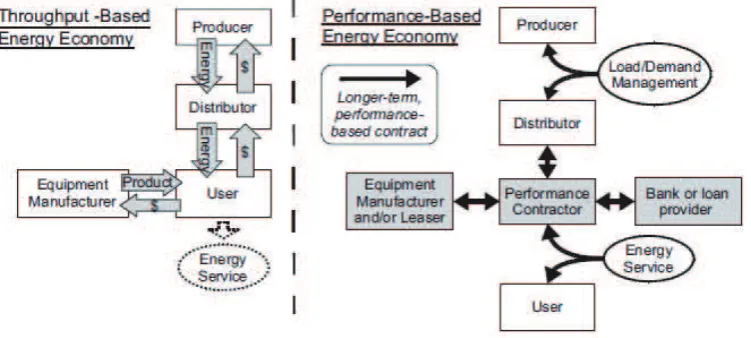
At the infrastructure level, an established example of per-formance contracting is ESCos, which serve their customers by guaranteeing durably lower energy bills whilst maintaining the services provided by energy supplied (Sorrell, 2007). ESCos can take many forms (public, private, part of traditional util-ity companies, or completely separate), but by deinition their proits must be made mostly through the energy savings of their customers. ESCos thus have an incentive structure oppo-site to that of traditional energy supply companies: they beneit from the lowered energy use of their clients, rather than from their increased consumption (see Figure 1 for a schematic com-parison). he ESCo business model thus relies on more than a simple meter for electricity or gas: the basis of the energy con-tract is no longer the volume of consumption, but a guaranteed provision of energy service provided at a lower level of energy consumption. his performance-based relationship could be applied to other infrastructure services, which oten rely on more than one infrastructure system (for example cleanliness depend on energy and water) requiring a more integrated ap-proach to operation.
INTEGRATED INFRASTRUCTURE OPERATION
Infrastructure is becoming more integrated physically (for ex-ample, the relationships between energy and water described above), operationally (for example, infrastructure is owned by one party but under the oversight of other organisations) and digitally (for example, the reliance of managed motorways on ICT to manage traic lows). his leads to risks as one system becomes more vulnerable to cascading failures from other sys-tems (Rinaldi et al., 2001; Zimmerman and Restrepo, 2006). Importantly, operating infrastructure systems in silos leads to “inancial and operational ineiciencies, a poorer service to
[image:4.595.69.445.59.228.2]1-351-13 ROELICH ET AL
188 ECEEE 2013 SUMMER STUDY – RETHINK, RENEW, RESTART
1. FOUNDATIONS OF FUTURE ENERGY POLICY
izens and businesses, and unintended negative consequences” (CST, 2009b).
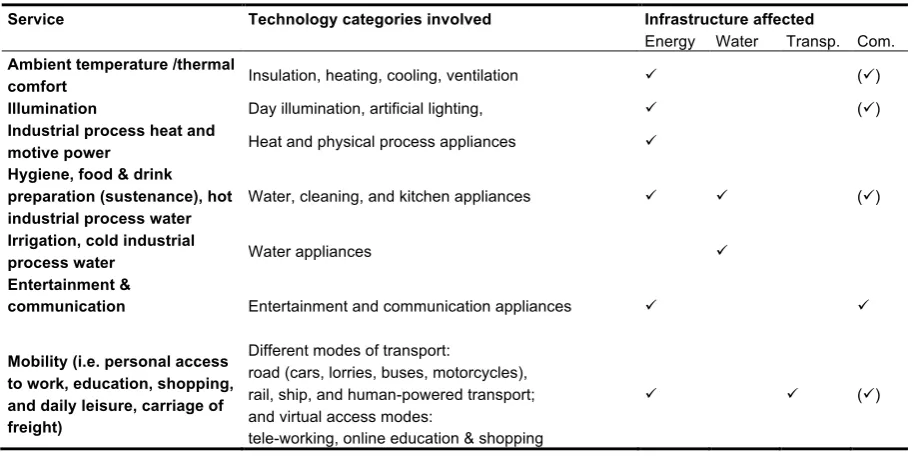
his ineiciency becomes particularly apparent when one considers infrastructure services at the end user; one service may rely on many infrastructure systems. Optimisation be-comes extremely challenging when these systems are operated individually. Table 1 provides an illustration of the interde-pendence of infrastructure systems at the end-user level (i.e. individual households and industry) from a service perspec-tive. he table does not include interconnectivity upstream of the end-user, for example the energy required to produce cold water. At a glance ive diferent service types could be separated regarding the infrastructure streams afected. Ambient tem-perature, illumination and industrial process heat and motive power is solely provided through the energy infrastructure, and irrigation and industrial process water only afect the water sec-tor. In between the two hygiene and food and drink preparation requires a combination of energy and water infrastructures. Entertainment and communication requires energy besides the communication infrastructure. Mobility is provided through the transport and energy infrastructure and additionally might include communication when virtual access modes are consid-ered. his highlights the importance of energy policy for infra-structure operation since energy infrainfra-structure is involved in almost all service provision at the end-user level. Furthermore communication might enhance eiciency gains in other infra-structure stream and therefore serve as an enabling technology.
he individual operation of infrastructure systems is cur-rently ampliied by fractured governance1 systems, which have not evolved uniformly across utility streams and rarely take interconnectedness into account (Hall et al., 2012). he
gov-1.We deine governance as �the use of institutions, structures of authority and even �the use of institutions, structures of authority and even collaboration to allocate resources and coordinate or control activity in society or the economy.” (Bell, 2002). It is not limited to the actions of national governments but includes the policy developed and implemented by a complex network of non-state actors at international and sub-national levels (Smith, Stirling, & Berkhout, 2005).
ernance arrangements have evolved in response to the changes within of the individual utility systems and thus exhibit dra-matic diferences between sectors. Governance continues to be implemented in sector-speciic silos – synergies and interde-pendencies are largely ignored and opportunities for cost and resource savings are missed. For example, schemes designed to reduce end-use of energy, such as building regulations; for ex-ample the Green Deal (DECC 2012b) and the Energy Company Obligation (ECO) (UK Parliament, 2012) don’t address the end use of water. his could actively deter MUSCo proliferation by incentivising action in one infrastructure system and preclud-ing more integrated approaches to eiciency.
Barriers to MUSCos
here are no MUSCos according to our deinition in operation in Europe; therefore, there is no empirical evidence relating to the principal barriers to their adoption. Instead, in this section we investigate the barriers to the two characteristics of MUSCos; service and performance orientation and integrated delivery.
SERVICE AND PERFORMANCE-ORIENTED INFRASTRUCTURE
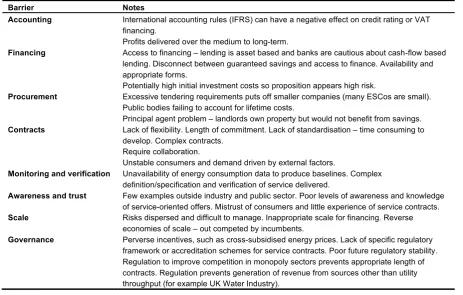
A review of literature related to infrastructure services has been undertaken to identify the principal barriers to adoption of service and performance-oriented operation. his is predomi-nantly drawn from the Energy Service literature, owing to the lack of literature on other infrastructure services. he barriers identiied are summarised in Table 22.
he review identiied a number of factors that increased the risk to investors (high investment costs, high transaction costs,
[image:5.595.56.518.72.300.2]2. International accounting rules: In the case of an operating lease the annual International accounting rules: In the case of an operating lease the annual contracting fee needs to be booked as revenue while the unbilled receivables are reduced. This operation in the balance sheet can have a negative impact on the credit rating. In the case of a inancial lease, the total revenue needs to be booked at the end of the project and therefore annual booking is not allowed. In this case, the ESCO needs to inance the VAT for the whole duration of the project (Marino, Bertoldi and Resezzy, 2010).
Table 1. Overview of services provided, related technology categories involved and infrastructure interdependencies.
Service Technology categories involved Infrastructure affected
Energy Water Transp. Com.
Ambient temperature /thermal
comfort Insulation, heating, cooling, ventilation ()
Illumination Day illumination, artificial lighting, ()
Industrial process heat and
motive power Heat and physical process appliances
Hygiene, food & drink preparation (sustenance), hot industrial process water
Water, cleaning, and kitchen appliances ()
Irrigation, cold industrial
process water Water appliances
Entertainment &
communication Entertainment and communication appliances
Mobility (i.e. personal access to work, education, shopping, and daily leisure, carriage of freight)
Different modes of transport:
road (cars, lorries, buses, motorcycles), rail, ship, and human-powered transport; and virtual access modes:
tele-working, online education & shopping
lack of ability to secure long-term contracts, scale of project, and uncertainty over government incentives); increased risk to end-users (contractual lexibility, veriication of savings, poor awareness and knowledge) and structural barriers (revenue generation, competition regulation).
INTEGRATED INFRASTRUCTURE OPERATION
A separate review of literature related to infrastructure integra-tion was undertaken to identify the principal barriers to inte-grated infrastructure operation. his is predominantly related to integration upstream of the end-user, owing to the lack of literature addressing integration at the end-user. he barriers identiied are summarised in Table 3.
he review identiied that a lack of evidence of risks and op-portunities was contributing to segregation of infrastructure
systems and compounding inefective regulation, decision making and costing of the efects of infrastructure intercon-nectivity.
The contribution of the Energy Eiciency Directive to
overcoming barriers to MUSCos
[image:6.595.63.527.74.369.2]Infrastructure provides a public good; therefore, the services it delivers need to be reliable, at a suicient level of quality and quantity, and ofer value for money. Governance, usually in the form of regulation and policy intervention, is needed to cor-rect the market and system failures that would arise in a purely privatised utility system, many of which contribute to the bar-riers identiied above. For example, the market does not deliver the required investment into infrastructure development as a
Table 2. Principal barriers to service oriented infrastructure operation (based on Hall et al., 2012; Marino et al., 2010; Sorrell, 2007 and Hannon et al., in press).
Table 3. Principal barriers to integrated infrastructure operation (based on CST, 2009a; Frontier Economics, 2012; Hall et al., 2012).
Barrier Notes
Accounting International accounting rules (IFRS) can have a negative effect on credit rating or VAT
financing.
Profits delivered over the medium to long-term.
Financing Access to financing – lending is asset based and banks are cautious about cash-flow based
lending. Disconnect between guaranteed savings and access to finance. Availability and appropriate forms.
Potentially high initial investment costs so proposition appears high risk.
Procurement Excessive tendering requirements puts off smaller companies (many ESCos are small).
Public bodies failing to account for lifetime costs.
Principal agent problem – landlords own property but would not benefit from savings.
Contracts Lack of flexibility. Length of commitment. Lack of standardisation – time consuming to
develop. Complex contracts. Require collaboration.
Unstable consumers and demand driven by external factors.
Monitoring and verification Unavailability of energy consumption data to produce baselines. Complex definition/specification and verification of service delivered.
Awareness and trust Few examples outside industry and public sector. Poor levels of awareness and knowledge of service-oriented offers. Mistrust of consumers and little experience of service contracts.
Scale Risks dispersed and difficult to manage. Inappropriate scale for financing. Reverse
economies of scale – out competed by incumbents.
Governance Perverse incentives, such as cross-subsidised energy prices. Lack of specific regulatory
framework or accreditation schemes for service contracts. Poor future regulatory stability. Regulation to improve competition in monopoly sectors prevents appropriate length of contracts. Regulation prevents generation of revenue from sources other than utility throughput (for example UK Water Industry).
Barrier Notes
Governance Inappropriate incentives. Regulation in silos prevents cross-utility operation, accounting and
investment. Strategic planning in national policy is fragmented.
Decision making processes Decision making processes are locked into consideration of separate infrastructure operation
by business practices, planning process and regulation. Poor information sharing.
Co-ordination Information asymmetries can lead to market failures when one party has more information
about the nature of an activity or risk than another party. Integration between systems requires co-ordination over time and scale, which implies significant changes in business planning and operation.
Cost externalities One infrastructure system may affect another without any need for the cost and benefits of
that impact to be taken into account.
Evidence There is limited quantification of the risks and benefits of infrastructure integration, which
[image:6.595.64.523.411.558.2]1-351-13 ROELICH ET AL
190 ECEEE 2013 SUMMER STUDY – RETHINK, RENEW, RESTART
1. FOUNDATIONS OF FUTURE ENERGY POLICY
result of scale of investment required and the long pay-back periods and most oten indirect beneit to private entities (Hall et al., 2012). Non-traditional technologies and business models (for example ESCOs) are oten under-represented as a result of market imperfections, such as information asymmetries and monopolistic competition (Hall et al., 2012). Governance is re-quired to encourage investment and innovation that would not be delivered by the market alone, therefore it has a key role in accelerating the adoption of MUSCos.
here has been a plethora of recent directives and strategies relating to resource eiciency, which, in efect, seek to achieve the same aim as MUSCos; to reduce absolute resource con-sumption, without reducing the service delivered (for exam-ple, the EU 20-20-20 targets, Roadmap to a Resource Eicient Europe (European Commission 2011), the Energy Eiciency Directive (European Commission 2012)). hese policy instru-ments have the potential to afect the barriers described above both positively and negatively. Energy policy, in particular, has signiicant potential to afect the adoption of MUSCos as a re-sult of its promotion of infrastructure services (ESCo) and the fact that energy is involved in the majority of infrastructure services. As a result, we have undertaken a detailed review of the EU’s Energy Eiciency Directive (EED) (European Com-mission, 2012) to identify the extent to which it addresses and is likely to overcome the barriers identiied above. We present our indings in the sections below for the two characteristics of MUSCos.
SERVICE AND PERFORMANCE-ORIENTATION
he EED has made provision for signiicant advancements on the promotion of service oriented infrastructure operation. It speciically addresses measures to increase the adoption of ‘en-ergy performance contracting3’ and the contribution of ‘energy service providers4’ to energy eiciency. he measures deined to encourage adoption of energy service provision and energy performance contracting have been evaluated to determine the extent to which they could overcome barriers to wider infra-structure service-oriented contracts.
Accounting: he Directive makes explicit reference to remov-ing accountremov-ing barriers to service companies (paragraph 48 of introduction) and Member States will be required to report on progress towards removing regulatory barriers in their Nation-al Energy Eiciency Action Plans. It goes on to state in Arti-cle 15 (8) that “Member states shall ensure that national energy regulatory authorities encourage demand side resources, such as demand response, to participate alongside supply in whole-sale and retail markets”, which implies that barriers to genera-tion of revenue from alternative sources should be removed if this article is implemented efectively. It is not clear to what
3.Deined in the EED as �a contractual arrangement between the beneiciary and the provider of an energy eiciency improvement measure, veriied and monitored during the whole term of the contract, where investments (work, supply or service) in that measure are paid for in relation to a contractually agreed energy perform-ance criterion, such as inancial savings”.
4.Deined in the EED as �a natural or legal person who deliver energy services [the physical beneit, utility or good derived from a combination of energy with energy-eicient technology or with action, which may include the operations, maintenance and control necessary to deliver the service, which is delivered on the basis of a contract and in normal circumstances has proven to result in verii-able and measurverii-able or estimverii-able energy eiciency improvements] or any other energy eiciency measure in the inal customer’s facility or premises”.
extent this will help to overcome international accounting rules that afect credit ratings.
Financing: Loan guarantees to foster energy performance contracting are speciically mentioned in paragraph 52 of the introduction as a means to overcoming barriers to the avail-ability of inancing. Article 12 requires Member States to take appropriate measures to promote and facilitate eicient use of energy generally, which include iscal incentives and access to inance, grants or subsidies. More speciically, Article 18 re-quires Member States to promote the energy services market disseminating information on inancial instruments, incentives, grants and loans to support energy eiciency projects. here is no requirement to support appropriate forms of inancing speciically for service contract.
Procurement: Article 6 (3) Encourages public bodies to “as-sess the possibility of concluding long-term energy perform-ance contracts that provide long term energy savings”. It does not provide any provision for changing procurement processes to assess lifetime costs or address procurement in landlord-tenant arrangements.
Contracts: A major advancement of the EED is its promo-tion of model contracts; paragraph 47 of the introducpromo-tion recognises the vital role they will play in stimulating demand for and the supply of energy services. Article 18 reiterates this point requiring Member States to provide model contracts for the public sector, including a speciic Annex (XIII) outlining the minimum items to be included in energy performance contracts with the public sector. However, this requirement does not extend beyond the public sector to the domestic sec-tor, which is where transaction costs are higher still (Sorrell, 2007).
Monitoring and veriication: Article 8 of the EED requires Member States to promote the availability of energy audits and speciically states that the indings of these audits must be available to energy service providers. his could improve the baseline data making initial requirement description more straightforward. However, there is no reference to measures that might improve the quantiication and veriication of sav-ings.
Awareness and trust: he EED recognises the importance of transparency in developing the market for energy services. Article 12 speciically addresses consumer information and empowering, requiring Member States to “take appropriate measures to promote and facilitate an eicient use of energy”. And in relation to energy services requires them to disseminate information on the energy service contracts, inancial instru-ments, incentives, grants and loans speciically relevant to “en-ergy eiciency service projects”. It also requires Member States to make publicly available lists of available energy service pro-viders. his could go some way towards increasing awareness in and trust of service contracts.
Governance: he EED recognises the need for an integrated approach to energy eiciency (in paragraph 45) and the need to “identify and remove regulatory … barriers to the use of energy performance contracting …”. here are some speciic issues identiied; in Article 7 (7) allows obligated parties to count savings from energy service contracts to count towards Energy Eiciency Obligation schemes; Member States are re-quired to ensure national energy regulatory authorities en-courage demand response; Article 19 requires Member States to “evaluate and if necessary take appropriate measures to remove regulatory and non-regulatory barriers to energy ef-iciency”.
In summary, the EED speciically addresses participation of demand-side management in the wholesale electricity mar-ket, iscal incentives to reduce the risk of investment in energy eiciency technologies, model contracts in the public sector, energy audits to improve monitoring of baseline conditions, dissemination of examples and providers or energy services and removal of regulatory barriers to energy performance con-tracting. However, it does not address international accounting rules, inancing speciic to energy services, lifetime cost assess-ment of energy contracts, veriication of savings or aggregation of small contracts or model contracts for domestic or commer-cial users to reduce transaction costs.
INTEGRATED INFRASTRUCTURE OPERATION
he EED is, of course, focussed on the energy system and ef-iciency improvements therein. However, measures contained within the EED have been assessed to identify the potential to overcome or augment the disconnection in infrastructure operation and regulation by prioritising energy over other in-frastructure systems.
Governance: he EED does consider infrastructure integra-tion, to some extent, through its promotion of cogeneration of electricity, heat and hot water. here are two articles (14 and 15), which aim to encourage new high eiciency cogeneration and reduce the regulatory barriers associated with connection to the grid. Article 9 (3) also provides a mechanism for allo-cating costs for heat and hot water produced by cogeneration, which could provide a demonstrator that could lead the way to overcome the barriers of price regulation and cross-sector accounting. However, the Directive places a great deal of em-phasis on providing and marketing incentives, loans and grants speciically for energy eiciency, which could distract from a more integrated approach to resource eiciency.
Decision making processes: are addressed to some extent in the EED by Article 6 (1), which states that central government should “purchase only products, services and buildings with high energy-eiciency performance, insofar that it is consistent with … wider sustainability …”. And that energy audits might be undertaken as part of a broader environmental audit. How-ever retroitting targets set out in Article 5 are speciically for energy performance, which misses the opportunity to under-take a wider energy eiciency-driven retroit and could drive retroit decisions to focus on individual infrastructure systems.
Co-ordination: is encouraged to some extent in the directive, by Article 6 on procurement, Article 8 on energy audits and Articles 14 and 15 on cogeneration. However, there are some signiicant opportunities for co-ordination missed, in particu-lar, the targets for retroitting, as discussed above.
here are no articles or requirements that would speciically improve the evidence base relating to the risks and beneits of infrastructure integration or address the challenge of unac-counted cost externalities.
In summary, the EED could help overcome barriers to in-tegration by encouraging the cogeneration of electricity, heat and hot water and encouraging consideration of wider sus-tainability in energy audits and energy service procurement. However, it could amplify barriers by focussing on energy incentives, audits and marketing and setting retroitting tar-gets for energy alone, which could detracting from eiciency across systems.
Discussion
Despite its focus on the energy system, the EED goes a long way towards encouraging service-oriented infrastructure op-eration and has the potential to prepare the way for service-based contracts in other infrastructure systems. he EED pro-vides some of the strongest instruments for energy eiciency to date, including a series of quantitative target, energy-eicient retroitting and provision of inancing and grants for energy ef-iciency. It also speciically addresses service contracts through measures to raise awareness of service contracts and service providers. Its requirement to provide model contracts could drastically reduce transaction costs associated with contract establishment in the public sector.
However, some crucial barriers will not be addressed if it is transposed into national policy in its current form. his is par-ticularly the case for barriers associated with inancing and ac-counting; including international accounting rules, accounting by lenders, development and provision of appropriate forms of inance, and proit timescales.
he EED does little to reduce the risks and transaction costs associated with domestic and commercial service and perform-ance-oriented contracts. Some of the instruments with most potential to address contractual barriers, such as long-term contracts and model contracts, are only applied to the public sector. his omits the huge opportunities for eiciency saving in the domestic and commercial sectors where there are per-haps more signiicant barriers to MUSCo adoption (Sorrell, 2007). his is compounded by the fact that there are no speciic instruments that would improve the deinition and speciica-tion of energy services for veriicaspeciica-tion and no instruments de-signed to improve aggregation or ‘bundling’ of contracts with smaller end-users.
here are few provisions to exploit opportunities for ei-ciency from a more integrated approach to infrastructure op-eration. Some of the strongest measures in the Directive (the quantitative targets for reductions in energy consumption and energy-speciic retroitting on central government property) have the potential to discourage integration in infrastructure operation by putting too much focus on one sector.
1-351-13 ROELICH ET AL
192 ECEEE 2013 SUMMER STUDY – RETHINK, RENEW, RESTART
1. FOUNDATIONS OF FUTURE ENERGY POLICY
Some outstanding issues that would help strengthen the role of the EED in accelerating the adoption of MUSCos include:
• Removing regulation to prevent long term contracts in the domestic sector;
• Introducing standard or model contracts in the domestic and commercial sectors;
• Developing inancing arrangements which are appropriate to service contracts and reduce high initial investment re-quirements;
• Provide detailed support on the deinition and speciica-tion of services to support development and veriicaspeciica-tion of contracts;
• Encourage the development of coherent and integrated strategies across infrastructure systems;
• Provide guidance and incentives for aggregation of small-scale contracts to reduce transaction costs in the domestic and commercial sectors;
• Explicitly recognise the interconnectivity of infrastructure during the development of future Directives.
Conclusions
MUSCos have the potential to contribute to improvements in the resource eiciency of infrastructure systems and to over-come the eiciency gap observed in current resource eiciency policy. However, there are numerous barriers to the realisation of service-oriented, integrated infrastructure operation. he widespread adoption of MUSCos is unlikely to come about if let entirely to the market; governance must intervene to over-come the market barriers and remove obstructive policy and regulation.
In this paper we have investigated the extent to which the Energy Eiciency Directive could begin to reduce barriers to MUSCo adoption. he review found that the EED could be very efective at increasing adoption of service-oriented con-tracts in the public sector through measures legislating build-ing retroit and reducbuild-ing contractual barriers. his could in-crease the energy service sector’s capacity to deliver service contracts and reduce mistrust of service contracts, potentially resulting in spillover of service contracts to the domestic and commercial sector. However, without changes to accounting practices and appropriate inancing arrangements investment risks would remain high. In combination with a lack of meas-ures to reduce the risk and costs of administering small-scale contracts it is unlikely that this spillover would occur in reality.
In addition, the continued fragmentation of European and National strategy and cross-sector information asymmetries5 augments the existing governance barriers to more integrated operation of infrastructure which prevents the exploitation of cross-sector eiciency opportunities.
5. For example it is disproportionately harder to justify investment in low carbon For example it is disproportionately harder to justify investment in low carbon For example it is disproportionately harder to justify investment in low carbon technology to the end user in the water sector than in the energy sector. Users of water are generally unaware of the beneits of low carbon technologies in relation to supply of clean water. This can prevent investment in these technologies and constrain opportunities to generate energy on water company property.
We have described a series of additional measures we consid-er to be necessary to ovconsid-ercome these weaknesses. hese include measures to reduce contractual barriers and risks in the domes-tic sector, provide more appropriate inancing and accounting arrangements and more explicitly address the interconnectivity of infrastructure systems in future policy.
References
2030 Water Resources Group. (2009). Charting Our Water Fu-ture. Economic frameworks to inform decision-making. Beaumont, N. J., & Tinch, R. (2004). Abatement cost curves: a
viable management tool for enabling the achievement of win – win waste reduction strategies? Journal of Environ-mental Management, 71, 207–215.
Bell, S. (2002). Economic governance and institutional dy-namics. Melborne: Oxford University Press.
Bertoldi, P., Rezessy, S., & Vine, E. (2006). Energy service companies in European countries : Current status and a strategy to foster their development. Energy, 34, 1818– 1832.
CST. (2009a). A National Infrastructure for the 21st Century. London.
CST. (2009b). Improving innovation in the water industry: 21st century challenges and opportunities. Innovation. London.
Cullen, J. M., Allwood, J. M., & Borgstein, E. H. (2011). Re-ducing Energy Demand: What Are the Practical Limits? Environmental Science & Technology, 1711–1718. DECC (2012a). Energy consumption in the UK. Domestic
data tables. 2012 update.
DECC. (2012b). Drat Green Deal Code of Practice (Version 2). Defra.(2008). Future Water. he Government’s water strategy
for England. London.
European Commission (2011) Communication from the Commission to the European Parliament, the Council, he European Economic and Social Committee and the Committee of the Regions: Roadmap to a Resource Ef-icient Europe. COM/2011/0571 inal.
European Commission. (2012). Directive 2012/27/EU of the European Parliament and of the Council of 25 October 2012 on energy eiciency, amending Directives 2009/125/ EC and 2010/30/EU and repealing Directives 2004/8/EC and 2006/32/EC.
Foresight. (2008). Powering our Lives: Sustainable Energy Management and the Built Environment.
Foresight. (2011). he Future of Food and Farming : Chal-lenges and choices for global sustainability.
Foxon, T. J. (2011). A coevolutionary framework for analysing a transition to a sustainable low carbon economy. Ecologi-cal Economics, 70(12), 2258–2267.
Frontier Economics. (2012). Systemic risks and opportunities in UK infrastructure: A report prepared for HM Treasury and Infrastructure UK.
Hall, J. W., Henriques, J. J., Nicholls, R. J., & (eds). (2012). A Fast Track Analysis of strategies for infrastructure provi-sion in Great Britain: Technical report. Oxford.
Steinberger, J. K., van Niel, J., & Bourg, D. (2009). Proiting from negawatts: Reducing absolute consumption and emissions through a performance-based energy economy. Energy Policy, 37(1), 361–370.
Stenzel, T., & Frenzel, A. (2008).Regulating technological change - he strategic reactions of utility companies towards subsidy policies in the German, Spanish and UK electricity markets. Energy Policy, 36, 2645–2657. UK Parliament. (2012). he Electricity and Gas (Energy
Com-panies Obligation) Order 2012.
Unruh, G. C. (2000). Understanding carbon lock-in. Energy Policy, 28, 817–830.
Vine, E. (2005). An international survey of the energy service company (ESCO) industry. International Finance, 33, 691–704.
Westling, H. (2003). Performance Contracting. Summary report. Task X within the IEA DSM Implementing Agree-ment.
Zimmerman, R., & Restrepo, C. E. (2006). he next step: quantifying infrastructure interdependencies to improve security. International Journal of Critical Infrastructures, 2 (2/3), 215–230
Acknowledgements
he authors gratefully acknowledge the support of the UK En-gineering and Physical Sciences Research Council who funded this work (grant number EP/J00555X/1). hanks also to Cath-erine Bale and an anonymous reviewer for their insightful com-ments on drats of this paper.
and the UK energy system : implications for a low-carbon transition. Energy Policy.
Lovins, A.B., Saving Gigabucks with Negawatts, 1985, Address to Panel “Energy Conservation: A Cornerstone of Na-tional Independence”, 96th Annual Convention, NaNa-tional Association of Regulatory Utility Commissioners: Los Angeles.
Marino, A., Bertoldi, P., & Rezessy, S. (2010). Energy Service Companies Market in Europe. Europe (pp. 1–114). McKinsey. (2010). Impact of the inancial crisis on carbon
economics. Version 2.1 of the Global Greenhouse Gas Abatement Cost Curve (pp. 1–14).
Mont, O., & Tukker, A. (2006). Product-Service Systems: reviewing achievements and reining the research agenda. Journal of Cleaner Production, 14(17), 1451– 1454.
Rinaldi, S. M., Peerenboom, J. P., & Kelly, T. K. (2001). Identi-fying, Understanding, and Analyzing Critical Infrastruc-ture Interdependencies. IEEE Control Systems Magazine, 11–25.
Rockström, J., Stefen, W., Noone, K., Persson, A., Lamin, E. F., Lenton, T. M., Schefer, M., et al. (2009). A safe operat-ing space for humanity. Nature, 461, 472–475.
Smith, A., Stirling, A., & Berkhout, F. (2005). he governance of sustainable socio-technical transitions. Research Policy, 34, 1491–1510
Sorrell, S. (2007). he economics of energy service contracts. Energy Policy, 35(1), 507–521.