This is a repository copy of Asynchronous factorisation of speaker and background with
feature transforms in speech recognition.
White Rose Research Online URL for this paper:
http://eprints.whiterose.ac.uk/101804/
Version: Accepted Version
Proceedings Paper:
Saz, O. and Hain, T. orcid.org/0000-0003-0939-3464 (2013) Asynchronous factorisation of
speaker and background with feature transforms in speech recognition. In:
INTERSPEECH-2013. INTERSPEECH 2013 - 14th Annual Conference of the International
Speech Communication Association, 25-29 Aug 2013, Lyon, France. ISCA , pp.
1238-1242.
[email protected]
https://eprints.whiterose.ac.uk/
Reuse
Unless indicated otherwise, fulltext items are protected by copyright with all rights reserved. The copyright
exception in section 29 of the Copyright, Designs and Patents Act 1988 allows the making of a single copy
solely for the purpose of non-commercial research or private study within the limits of fair dealing. The
publisher or other rights-holder may allow further reproduction and re-use of this version - refer to the White
Rose Research Online record for this item. Where records identify the publisher as the copyright holder,
users can verify any specific terms of use on the publisher’s website.
Takedown
If you consider content in White Rose Research Online to be in breach of UK law, please notify us by
Asynchronous Factorisation of Speaker and Background with Feature
Transforms in Speech Recognition
Oscar Saz, Thomas Hain
Speech and Hearing Group, University of Sheffield, Sheffield UK
[email protected], [email protected]
Abstract
This paper presents a novel approach to separate the effects of speaker and background conditions by application of feature– transform based adaptation for Automatic Speech Recognition (ASR). So far factorisation has been shown to yield improve-ments in the case of utterance-synchronous environimprove-ments. In this paper we show successful separation of conditions asyn-chronous with speech, such as background music. Our work takes account of the asynchronous nature of the background, by estimation of condition-specific Constrained Maximum Like-lihood Linear Regression (CMLLR) transforms. In addition, speaker adaptation is performed, allowing to factorise speaker and background effects. Equally, background transforms are used asynchronously in the decoding process, using a mod-ified Hidden Markov Model (HMM) topology which applies the optimal transform for each frame. Experimental results are presented on the WSJCAM0 corpus of British English speech, modified to contain controlled sections of background music. This addition of music degrades the baseline Word Error Rate (WER) from 10.1% to 26.4%. While synchronous factorisation with CMLLR transforms provides 28% relative improvement in WER over the baseline, our asynchronous approach increases this reduction to 33%.
Index Terms: Speech recognition, adaptation, factorisation, asynchronous decoding
1. Introduction
State–of–the–art Automatic Speech Recognition (ASR) algo-rithms often lack robustness in natural situations. Different and varying acoustic environments are one of the main factors in the degradation of the performance of ASR systems. Systems that perform properly in controlled conditions may become not suitable in the presence of other sound sources. Research has focused mostly on situations where the background is syn-chronous with the utterance, generally background noise. To treat interfering signals as generic noise has its disadvantages, and hence more general adaptation techniques are used in these environments. Solid results have been achieved with techniques operating in the model space, such as Parallel Model Combi-nation (PMC) [1] or Maximum Likelihood Linear Regression (MLLR) [2], or in the feature space, such as Constrained MLLR (CMLLR) [3], Stereo-based Piecewise Linear Compensation for Environment (SPLICE) [4] or Multi-Environment Model-based LInear Normalization (MEMLIN) [5].
In recent works, factorisation was used as a way to further improve the performance of ASR in mixed conditions. Tech-niques based on joint factorisation of sources of variability, for example Joint Factor Analysis (JFA) [6] as used in speaker verification tasks, are now being considered for use in ASR.
Subspace Gaussian Mixture Models (SGMMs) incorporate this joint factorisation idea [7]. Other approaches are based on com-bining transforms for the speakers and the environments in a joint way. This has been done with Vector Taylor Series (VTS) and MLLR transforms in [8], CMLLR transforms in [9] and CMLLR and MLLR transforms in [10]. The joint training of speaker and background transforms has been shown to be more robust to changes in the background conditions.
However, for all methods so far it has been assumed that the environment for any input signal is maintained throughout the utterance. That assumption is true for corpora like Aurora [11], where one single type of noise was added to each speech signal. In a more natural situation however this assumption is often not valid. In media data, beyond the traditional and very controlled broadcast news scenario, one can expect a number of events which are completely independent and hence asyn-chronous with the spoken words. These events can be back-ground music in music shows, special effect sounds in drama shows, applause in live shows or quiz shows. In other tasks as meeting transcription asynchronous events like laughter, door slamming, etc may be present. The common feature of such events is that their occurrence is not tied to the beginning and end of a speech utterance, hence modelling them as a single static environment will be suboptimal.
Work presented in this paper follows up the idea of factoris-ing speaker and background, but generalisfactoris-ing to asynchronous conditions. Environment transforms will be learned from differ-ent sections of the input speech signal, and these will be used to jointly learn a set of speaker transforms. Finally, in the decod-ing stage, the transforms will be applied also asynchronously to compensate for the changing background.
The paper is organised as follows: Section 2 presents a review on adaptation and factorisation methods with CMLLR transforms. Section 3 outlines our proposed method for asyn-chronous factorisation and asynasyn-chronous decoding. Section 4 describes the experimental setup using WSJCAM0, with results discussed in Section 5. Finally, Section 6 provides discussion and conclusions to this work.
2. Adaptation and factorisation
CMLLR is an adaptation technique typically used for adapt-ing Hidden Markov Models (HMMs) to a specific speaker. By employing a linear transform to both mean and covariance CM-LLR can be equally interpreted as a feature transform, which is very useful in many practical situations. A transformation ma-trix (A) and a bias vector (b) are estimated from data from the
desired speaker. Afterwards, given an input feature vectorxit
transforms it to the vectorywhich is used in decoding.
The CMLLR transform for a speaker spk is defined as
the pair of transformation matrix and bias vector Wspk =
{Aspk, bspk} from Equation 1. The transform can also be
trained on all the utterances from different speakers in a
given environmentenv, providing an environment transform:
Wenv = {Aenv, benv}. CMLLR can be used in supervised
adaptation, with manually transcribed data, or in unsupervised adaptation, using the output of a a first pass recognition stage.
2.1. Factorisation with CMLLR transforms
A method for factorising environment and speaker variability was proposed in [9], by means of CMLLR transforms trained in cascade. The method proposed to train an environment
trans-form Wenv = {Aenv, benv}for every possible environment
and across all speakers. These transforms are then used as
parent transforms when training speaker transforms Wspk =
{Aspk, bspk} for each speaker and across all environments.
Thus, given a utterance signalx, spoken by speakerspkin
en-vironmentenv, the observations are transformed toy:
y=Aspk(Aenvx+benv) +bspk (2)
Using both transforms in cascaded fashion was shown to improve results over conventional CMLLR adaptation on envi-ronment and speaker. Also, the speaker transforms, which had been decoupled from the environment, were shown to perform well when used across different environments.
3. Asynchronous factorisation of speaker
and environment
One of the issues with factorisation as outlined above is the ap-plicability of transforms to the complete utterance, as conditions often change within a segment of speech. Describing this situa-tion with a single transform is clearly suboptimal and will lead to imprecise modelling. Here we propose that better results can be obtained by identifying these environments asynchronously within the speech, and then learn different environment trans-forms. Once appropriate environment transforms are found, standard speaker adaptation can be performed in conjunction.
Hence each frame requires classification as belonging to one of the possible environments. Different CMLLR
environ-ment transforms Wenv = {Aenv, benv} are then generated
from each group of frames across all speakers. Then, these transforms are applied to the frames of the input signal ac-cording to their acoustic environment classification and a set of speaker CMLLR transforms are then trained.
In the decoding stage, the input feature vector is
trans-formed according to Equation 3; for each frametthe most likely
environment transformWenv(t) = {Aenv(t), benv(t)}is
ap-plied, and then the corresponding speaker transformWspk =
{Aspk, bspk}is applied on top.
y(t) =Aspk(Aenv(t)x(t) +benv(t)) +bspk (3)
3.1. Asynchronous decoding with CMLLR transforms
A key issue in this approach is the way in which the presence of a specific condition in a frame is determined. A classifier can be built separately trained on supervised data. However, in practice automatic on–line classification will often be required. One option is to include such decisions in the decoding process itself. The advantage of such an approach is consistency with the actual recognition, however it can potentially lead to some undesired effects. In this approach, all environment transforms can be used during the decoding stage, and is the decoder itself
State 0
State 1 State 2 State 3
State 7
State 4 State 5 State 6 1
env
W
2 env
W
spk
[image:3.595.322.539.74.237.2]W
Figure 1: Asynchronous topology with two environment
trans-forms (Wenv1 andWenv2) and a speaker transform (Wspk)
(auto transitions have been removed for clarity).
who can select the most likely label for each frame, by aiming to maximise the overall likelihood.
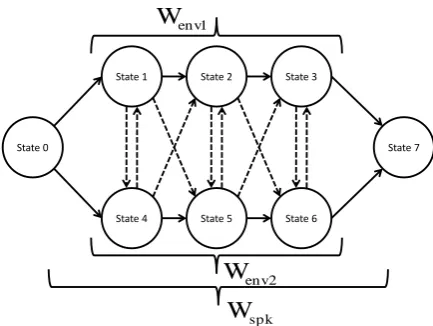
Figure 1 presents how the asynchronous decoding works
when there are two possible environment transforms, Wenv1
andWenv2, with a speaker transformationWspkon top. This
approach naturally generalises to any limited number of envi-ronment transforms. The usual three–state left–to–right topol-ogy with states 0 and 4 as entry and exit states respectively is modified to include 3 extra states. Now state 7 is the exit state and states 4, 5 and 6 are replicas of the states 1, 2 and 3 respec-tively. However, states 1, 2 and 3 are associated to the
environ-ment transformWenv1 and states 4, 5 and 6 to the transform
Wenv2. The same speaker transform is used for all the states.
The topology in Figure 1 isFully asynchronous, since it
al-lows transitions among the two possible transforms from one
frame to the next. This topology could be restricted to be
Phone–synchronousby removing all the dashed transitions. In this case, the environment transform can not be switched in-side a phoneme, but can be switched in the transition to another phoneme. This choice of topologies will be studied in our ex-perimental work.
This frame–by–frame asynchronous decoding is similar to the proposal for on-line Vocal Tract Length Normalization (VTLN) in [12]. In that work, the model space was augmented to consider different VTLN warping values, and the decoder au-tomatically chose the path that maximized the total likelihood through the augmented space.
3.2. Asynchronous training of CMLLR transforms
The same topology presented in Figure 1 can be used when learning transforms from adaptation data. This topology aligns the input speech to the best sequence of states which can change asynchronously among environments. Afterwards, a new set of transforms can be updated from the alignment statistics.
However, it is required to already have an initial set of en-vironment transforms. In our work, which will be based on two possible environments, we will initialise one of the environment
transforms to be the identity (W = {I,0}) and the other to
4. Experimental setup
In this paper, we will evaluate the proposed methods with a modified version of the WSJCAM0 corpus. WSJCAM0 was recorded by CUED in 1994 to provide a resource similar to the original WSJ corpus, but with a British English pronuncia-tion [13]. Equivalently, it defines sets for training, development and evaluation. In our work, we used the original speaker inde-pendent training set (si tr) of 7,861 utterances for model train-ing and the 4 development sets (si dt5a, si dt5b, si dt20a and si dt20b), with 368, 374, 361 and 368 utterances each, for test-ing. The first two test sets are designed as a 5,000-word closed vocabulary task with a bigram language model, the reamining two sets are designed for a 20,000-word open vocabulary task with a trigram language model. The test sets contain the same 20 speakers, and can be used for unsupervised adaptation.
We created equivalent corrupted test sets, where bursts of music were added in the following manner: A group of 25 pieces of instrumental orchestral music was taken as source for the background music. Each speech signal in the original test sets was contaminated with a burst of music randomly chosen from the source music pieces. These bursts had a uniform ran-dom length between 0 and the total length of the clean signal. Any music segment was scaled randomly, but to ensure that its overall energy was between 5 and 15dB below the energy of the overlapping speech signal (to avoid dominance of the music sig-nal). Also, a simple fade effect was used at the very beginning and end of the music burst, to avoid signal discontinuities. In these corrupted test sets, 48.8% of the total frames will contain some level of music in the background. From now on, we will call these different test sets asCleanfor the original set, and Musicfor the set contaminated with music.
The ASR system was based on a Hidden Markov Model Toolkit (HTK) [14] setup. Crossword triphone models were trained using Maximum Likelihood (ML) from the training set, with 16 Gaussian mixtures per state. We used 39-dimension feature vectors with 13 Perceptual Linear Predictive (PLP) fea-tures [15] and their first and second derivatives. Cepstral Mean Normalization (CMN) was applied to the static features.
4.1. Baseline results
The baseline word error rates (WER) of our system on the
WSJ-CAM0 set are shown on Table 1. The results onCleandata
show an average WER of 6.3% on the 5K tasks, and 13.9% on
the 20k tasks. Using theCleanmodels on the sets corrupted by
Music, the results are significantly worse, with an increase of 16.3% in WER. To provide a baseline with properly matched models, additional acoustic models were trained. The training set was modified to include background music in similar ways to the test sets. A different set of 67 music pieces was used to ensure that the music patterns in the training set would not reappear in the test sets. Table 1 shows that, without adaptation,
the best performance is obtained with models trained onMusic
data. While the global WER is 6.5% poorer than for theClean
case, it is 9.8% lower than the mismatched case.
Table 1:Baseline WER on the WSJCAM0 corpus, with models
trained and tested in theCleanandMusicconditions.
Train Test 5K sets 20K sets Total
Clean Clean 6.3% 13.9% 10.1%
Clean Music 21.0% 31.8% 26.4%
Music Music 11.3% 21.7% 16.6%
5. Results
This section presents the results of the use of CMLLR trans-forms, factored CMLLR transforms and asynchronous factored
CMLLR transforms. The models were trained onCleandata
and adaptation was performed in unsupervised fashion.
5.1. CMLLR adaptation
The results when using CMLLR speaker transforms are shown in Table 2. All experiments are based on a regression class tree with 4 classes. Speaker adaptation reduces the error rate by 10%
relative forCleandata and 30% for theMusicdata. The second
part of Table 2 presents results when applying these speaker transforms in mismatched conditions, i.e. transforms derived fromCleanorMusicdata, applied toMusicandCleandata re-spectively. In both cases there is some benefit (compared to results in Table 1), but matched adaptation gives significantly better results. It is this effect what first prompted work on fac-torised transformations.
Table 2: WER with CMLLR speaker transforms trained on the
Musicdata and tested onCleanandMusicdata.
Test Transform 5K sets 20K sets Total
Matched conditions
Clean Clean 5.4% 12.7% 9.1%
Music Music 13.6% 23.2% 18.5%
Mismatched conditions
Clean Music 5.6% 13.2% 9.5%
Music Clean 19.7% 30.4% 25.1%
5.2. Factored CMLLR adaptation
We applied the recipe in [9] to our setup in the following way. We trained an environment transform from all the utterances
in theMusictest sets, and used it as a parent transform when
training the speaker transforms. We used a regression tree of 2 classes for the environment transform and 2 classes for the speaker transforms, which gives the same number of parameters to learn, making results comparable with CMLLR adaptation.
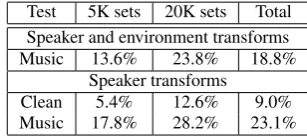
[image:4.595.348.502.662.731.2]The results of the evaluation of the different transforms in the CleanandMusicdata are shown in Table 3. They show that the joint use of both transforms does not improve the re-sults of having a single speaker transform on theMusicset; this can be explained by the fact that having defined a single en-vironment, the two transforms are effectively working as one. When using the speaker transforms alone, which have had the environment influence factored out, we see solid improvement over the baseline. In the case of using these factored speaker transforms trained from theMusicset in theCleanset it reaches the improvement achieved by the CMLLR transforms trained onCleandata. As it was shown in [9] and [10], speaker trans-forms trained in a factored approach achieve good results in mismatched conditions.
Table 3:WER with factored CMLLR transforms trained on the
Musicdata and tested onCleanandMusicdata.
Test 5K sets 20K sets Total
Speaker and environment transforms
Music 13.6% 23.8% 18.8%
Speaker transforms
Clean 5.4% 12.6% 9.0%
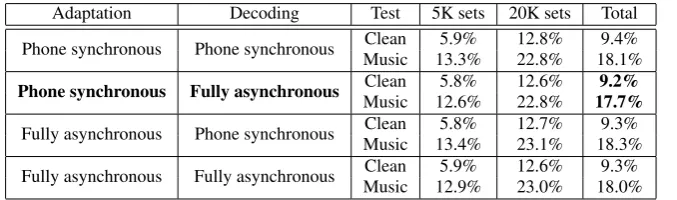
Table 4:WER with asynchronous factored CMLLR speaker and background transforms fromMusicdata used onClean,Musicdata.
Adaptation Decoding Test 5K sets 20K sets Total
Phone synchronous Phone synchronous Clean 5.9% 12.8% 9.4%
Music 13.3% 22.8% 18.1%
Phone synchronous Fully asynchronous Clean 5.8% 12.6% 9.2%
Music 12.6% 22.8% 17.7%
Fully asynchronous Phone synchronous Clean 5.8% 12.7% 9.3%
Music 13.4% 23.1% 18.3%
Fully asynchronous Fully asynchronous Clean 5.9% 12.6% 9.3%
Music 12.9% 23.0% 18.0%
5.3. Asynchronous factored CMLLR adaptation
A set of experiments was conducted to investigate our proposed method for asynchronous factorisation of speaker and back-grounds (Section 3). To keep results comparable, we used a single regression class for each of the two environment trans-forms and two classes for the speakers. Hence the same number of parameters are used when compared to previous situations.
First the effect of the two model topology options is
stud-ied. Both thePhone–synchronousand theFully asynchronous
topologies can be used in either adaptation or decoding, thus leading to four possible configurations The results with speaker and environment transforms are shown in Table 4 for these four
cases. The best result is achieved with thePhone–synchronous
topology in adaptation andFully asynchronoustopology in
de-coding. In theMusicdata, WER reductions of 0.8% compared
to CMLLR and 1.1% compared to factored CMLLR are ob-tained, which represents a 5% in relative WER reduction. In theCleanset, the use of both transforms yields a WER of 9.2%, which shows that the asynchronous decoding works success-fully even in the presence of only one background condition.
Table 5 presents results when using the speaker transforms learned in the asynchronous setup, without application of the environment transforms. This allows to study the influence of speaker adaptation only on the final results. The best results
are obtained with thePhone–synchronousmodel topology
dur-ing adaptation, yielddur-ing 9.0% and 19.5% on theCleanand
Mu-sicdata respectively. This indicates good factorisation of the
speaker, as the WER improvement is only 4% lower than when applying CMLLR adaptation.
Table 5: WER with asynchronous factored CMLLR speaker
transforms fromMusicdata used onClean,Musicdata.
Adaptation Test 5K sets 20K sets Total
Phone synchronous Clean 5.5% 12.5% 9.0%
Music 14.4% 24.5% 19.5%
Fully asynchronous Clean 5.5% 12.6% 9.1%
Music 14.7% 25.0% 19.9%
5.4. Frame classification with the asynchronous topology
To understand how the proposed model topologies are separat-ing speech from speech with background music, one can in-vestigate the effective frame classification performance. We studied the output state sequence provided by the asynchronous topology on the test sets, as the state sequence implicitly holds information on the environment selected for each frame. We can then compare this distribution of environments with ground truth information which is very precise due to the approach tak-ing in defintak-ing the test conditions.
Table 6 shows the results of such comparisons, in the form of the percentage of frames correctly assigned to the class of
being speech or speech with music. The frame accuracy for Phone–synchronoustopology andFully asynchronoustopology are 82% and 76% respectively. Typically classifiers for acoustic events (see e.g. [16]) require constraints on transitions. How-ever despite frame by frame decisions the asynchronous topol-ogy is able to keep track of the correct speech background. This allows for the improvements in recognition detailed above.
Table 6:Accuracy in framewise classification.
Phone-synchronous Fully-asynchronous
Speech 83.6% 76.2%
Speech & music 80.5% 76.9%
Global accuracy 82.1% 76.5%
Table 6 can also explain why the best combination of
topologies isPhone–synchronousin adaptation andFully
asyn-chronousin decoding. ThePhone–synchronoustopology pro-vides a smoother transition between environments and is bet-ter in deciding which is the background condition of a frame. That seems to benefit in the training of the environment
trans-forms. In decoding, theFully asynchronous topology makes
more frame errors, but provides a higher degree of freedom to the decoder, whose goal is not to maximise the classificaton ac-curacy but to maximise the overall likelihood.
6. Conclusions
In this work we have proposed a new method for asynchronous factorisation with CMLLR transforms and have shown that it is helpful in adaptation to dealing with speech corrupted by asyn-chronous bursts of background music. The results presented show a additional significant WER reduction, from 18.5% to 17.7%, in comparison with a standard synchronous approach. The better description of the acoustic environment also helps in more effective factorisation of the speaker variability. Speaker transforms now become usable across different, even unseen, environments.
The paper further investigated a method for asynchronous application of transforms in decoding. The proposed framework can be used for switching of transforms in an asynchronous manner to input speech. The results, presented here for two transforms, will easily generalise to more transforms by an in-crease in the number of branches in topology proposed.
In the future, this framework can be applied in more realis-tic data where asynchronous acousrealis-tic events occur naturally. In media data, for instance, background music is a common fea-ture and the application of asynchronous factorisation can be expected to improve recognition performance.
7. Acknowledgements
8. References
[1] Gales, M. J. F., and Young, S. J., “Robust continuous
speech recognition using parallel model combination”, IEEE Trans. on Speech and Audio Processing, 4(5), pp. 352–359, 1996.
[2] Gales, M. J. F., and Woodland, P. C., “Mean and
Vari-ance Adaptation within the MLLR Framework”,
Com-puter, Speech and Language, 10(4), pp. 249–264, October 1996.
[3] Gales, M. J. F., “Maximum Likelihood Linear
transfor-mations for HMM-based speech recognition”,Computer,
Speech and Language, 12, pp. 75–98, 1998.
[4] Droppo, J., Deng, L. and Acero, A., “Evaluation of the
SPLICE Algorihtm on the AURORA2 Database”, inProc.
of Eurospeech 2001, 217–220, Aalborg, Denmark.
[5] Buera, L., Lleida, E., Miguel, A., Ortega, A. and Saz,
O., “Cepstral Vector Normalization based on Stereo Data
for Robust Speech Recognition”,IEEE Trans. on Audio,
Speech and Language Processing, 15(3), pp. 1098–1113, 2007.
[6] Yin, S. C., Rose, R. C. and Kenny, P., “A Joint
Fac-tor Analysis Approach to Progressive Model Adaptation
in Text-Independent Speaker Verification”, IEEE Trans.
on Audio, Speech and Language Processing, 15(7), pp. 1999–2010, 2007.
[7] Povey, D., Burget, L., Agarwal, M., Akyazi, P., Kai, F.,
Ghoshal, A., Glemberk, O., Goel, N., Karafiat, M., Ras-trow, A., Rose, R. C., Schwarz, P. and Thomas, S., “ The Subspace Gaussian Mixture Model - A Structured
Model for Speech Recognition”, Computer, Speech and
Language, 25(2), pp. 404–439, April 2011.
[8] Wang, Y., and Gales, M. J. F., “Speaker and Noise
Factori-sation on the AURORA4 Task”, inProc. of ICASSP 2011,
Prague, Czech Republic.
[9] Seltzer, M. L. and Acero, A., “Separating Speaker and
Environmental Variability Using Factored Transforms”, in Proc. of Interspeech 2011, pp. 1097–1100, Florence, Italy.
[10] Seltzer, M. L. and Acero, A., “Factored Adaptation using a Combination of Feature-space and Model-space
Trans-forms”, inProc. of Interspeech 2012, Portland OR, USA.
[11] Hirsch, H. G., and Pearce, P., “The AURORA experimen-tal framework for the performance evaluation of speech
recognition systems under noisy conditions”, inProc. of
ISCA ITRW ASR, Paris, France, 2000.
[12] Miguel, A., Lleida, E., Rose., R., Buera, L., Saz, O. and Ortega A.: “Capturing Local Variability for Speaker
Nor-malization in Speech Recognition”, IEEE Trans. on
Au-dio, Speech and Language Processing, 16(3), pp. 578– 593, 2008.
[13] Robinson, T., Fransen, J., Pye, D., Foote, J. and Renals, S., “WSJCAM0: A British English Speech Corpus for Large
Vocabulary Cotniuous Speech Recognition”, inProc. of
ICASSP 1995, pp. 81–84, Detroit MI, USA.
[14] Young, S. J., Evermann, G., Gales, M. J. F., Hain, T., Ker-shaw, D., Moore, G., Odell, J. J., Ollason, D. G., Povey, D., Valtchev, V., and Woodland, P. C., “The HTK Book version 3.4”, Cambridge University Engineering Depart-ment, Cambridge, UK, 2006.
[15] Hermansky, H., “Perceptual linear predictive (PLP)
analy-sis of speech ”,J. Acoust. Soc. Am. 87(4), pp. 1738–1752,
1990.
[16] Castan, D., Ortega, A., Villalba, J., Miguel, A. and Lleida, E., “Segmentation-by-classification system based
on Factor Analysis”, inProc. of ICASSP 2013, Vancouver,