ISSN 0378·3693
Bulletin
OF THE EUROPEAN
COMMUNITIES
Commission
The Bulletin of the European Communities reports on the activities of the Commission and the other Community institutions. lt is edited by the Secretariat-General of the Commission (rue de la Loi 200, B-1 049 Brussels) and published eleven times a year (one issu~_covers July and August) in the official Community languages and Spanish.
Reproduction is .authorized provided the source is acknowledged.
The following reference system is used: the first digit indicates the part number, the second digit the chapter number and the subsequent digit or digits the point number. Citations should therefore read as follows: Bull. EC 1-1979, point 1.1.3 or 2.2.36.
Supplements to the Bulletin are published in a separate series at irregular intervals. They contain official Commission material (e.g. communications to the Council, programmes, reports and proposals). The Supplements do
not appear in Spanish. ·
Bulletin
BELEGEXEMPLAR - DIESE VERCFFENTLICHUNG
c _ ~~d _!:~~·HENEN UND WIRD VOM AMT
~~miss'fMfof't~~<Eftg~~<(j~\rl'~eS'ERTR
I EBEN Secretariat-GeneralBrussels
ANTirPMO l.IEiri,!·Wm: 6H~OL:IEY8~NTOE AnO THN YflHPEEIA Efli;:I-tMQN EK!.IOL.EQN
SPECIMEN CO?Y ··u:.USHED BY THE ·OR OFFICIAL PUBLICATIONS
EXEMPLAIRE TEMO!N DE MISE EN VENTE PAR L'OFFICE DES PUE.LICATIONS
ESEMPLARE MESSO IN VENDITA DALL'UFFICIO DELLE PUBBLICAZIONI
BEWIJSEXEMPLAAR VAN VERKOOP DOOR HET PU8Ll KAT! EBUREAU
No 9
contents
PART ONE
SPECIALFEATURES
1 . An energy strategy for the Community 2. Hunger in the world: an overall approach 3. 1981 budget: the situation clarifies
PART TWO
ACTIVITIESIN SEPTEMBER 1981
1 . Building the Commu.nity
- Restructuring of common policies - May mandate - Economic and monetary policy
- Internal market and industrial affairs - Customs union
- Competition
- Financial institutions and taxation - Employment, education and social policy - Regional policy
- Environment and consumers - Agriculture
-Fisheries -Transport -Energy - Nuclear safety
- Research and development
7
9
12
14 14 14 16 18 19 22 23 25 27
29
32 35 38
39
2. Enlargement and external relations
- Enlargement and bilateral relations with applicant countries - Commercial policy
- Development
- International organizations and conferences - Industrialized countries
- Mediterranean countries - Developing countries - State-trading countries - Diplomatic relations
- European political cooperation
3. Institutional and political matters
- Institutional developments and European policy - Institutions and organs of the Communities
•
Parliament•
Council•
Commission•
Court of Justice•
Court of Auditors•
Economic and Social Committee•
European Investment Bank - Financing Community activitiesPART THREE
DOCUMENTATION1. ECU
2. Addition"al references in the Officiai Journal 3. Infringement procedures
4. The Community at the United Nations
5. Annual Meeting of the IMF and the World Bank Publications of the European Communities
41 41 41 43 45 47 47 48 50 50 50
51 51 51 51 57 59 61 65 65 66 68
72 72
Supplements 1981
1/81 Report from the Commission of the European Communities to the Council pursuant to the mandate of 30 May 1980
~A~T ©~~
Standardized abbreviations for the designation of certain monetary units in the different languages of the Community:
ECU European currency unit
BFR Belgische frank I Franc beige
OKR Oansk krone
OM Oeutsche Mark
OR Greek drachma
FF Franc franc,ais
HFL Nederlandse gulden (Hollandse florijn)
IRL Irish pound I punt
LFR Franc luxembourgeois
LIT Lira italiana
UKL Pound sterling
1 .
An energy strategy for the Community
1.1.1. The pursuit of a coherent energy
policy is an objective which for several years now, and particularly since the second oil crisis, has constantly been emphasized in the
Community. The Maastricht European
Council reaffirmed it in March. 1
Despite the success of efforts to reduce de-mand, the Community is still the world's largest oil importer in an international con-text that is far from comforting, and the Community must be shielded from the risk of further increases in supply prices in order to safeguard the European economy from a repeat of the 1974 and 1979 oil crises.
As part its work concerning the May man-date,2 the Commission undertook to take a detailed look at energy policy, and in a com-munication sent to the Council on 30 Sep-tember it presents a framework for action intended to allow the Community to re-spond more effectively and without delay to the serious challenge which the energy ques-tion presents.
In a communication on the taxation of pet-roleum products transmitted on 9 September the Commission sets out a practical, opera-tional approach designed to speed up the movement away from oil and thus reduce the pressure of the oil bill on Europe's economies.
Developing the energy strategy
1.1.2. The Commission takes the view that,
in order to mitigate the effects of Europe's vulnerability, steps need to be taken both on the demand side (energy-saving and rational use of energy) and on the supply side (diver-sification of sources of supply). The success of action within the Community to bring about the necessary changes will depend to a great extent on what is done externally. The industrialized countries therefore need to wo_r~ogether if they are to reduce their de-pendence on oil.
Finally, the serious problems faced by a large number of developing countries- as a result of their position as oil importers call for vigorous and broad action, and the
Community can and must play an important role in this.
The process of change presents new chal-lenges, but it also offers new hopes since the energy transition will have far-reaching con-sequences for Community industry, offering, as it does, prospects for the development and application of new technologies to help revitalize the industrial base.
1.1.3. The essence of the energy strategy
proposed by the Commission lies in efforts to anticipation developments.
Instead of simply reacting to events, the Community must prepare the way, in the best possible conditions, for the changes that are most likely to be required by future de-velopments on the market, while minimizing the economic and social consequences of these developments.
The energy objectives adopted by the Com-munity must be constantly brought up to date and reflected in national policies in the context of collective discipline. The Commis-sion's primary role will therefore be one of
guidance and monitoring. It will also take
action on its own account in certain fields: those prescribed by the Treaties, those in which there are no other means of attaining common objectives, and those in which it can achieve more than the Member States acting alone.
1.1.4. In some cases, Community action
will require financial resources which must be adequate for the tasks involved. There are five priorities:
(1) Ensuring an adequate level of invest-ment both in alternatives to oil and in the more rational use of energy. Investment in energy-saving and in substitution for oil must be encouraged both as a means of re-ducing the share of oil in total energy con-sumption and because of its favourable ef-fects on the level of economic activity and employment. The Community's responsibil-ity in this field is linked to that in the field of
Energy strategy
medium-term economic policy. The Commis-sion is conducting a detailed survey with the help of governments and industries in the Community. It will be making specific pro-posals concerning investment support later.
(2) Developing a common approach to energy pricing and taxation. This subject is covered in a separate paper on energy-pric-ing policy and transparency. The aim is to bring an improvement in the transparency of energy prices and tariffs and a common ef-fort to adapt oil taxation to the aims of the Community's energy and economic policies. The Commission sets out its point of view in greater detail in the paper on the taxation of
petroleum products. 1
(3) Adopting measures to give practical ex-pression to Community solidarity in order to avoid instability on the market. The aim is to ensure that a very limited reduction in oil supplies does not have a disproportionate ef-fect in terms of fluctuations in the price of oil. The measures proposed by the Commis-sion are intended to strengthen Community solidarity and supplement the arrangements already in existence to deal with serious supply difficulties.
(4) Strengthening the common policies in the fields of research and development and technological demonstration. Innovation is a necessary part of the energy strategy. Finan-cial action and coordination at Community level are vital to the achievement of effective results in the fields of research and develop-ment and technological demonstration in the Community. The potential that the Com-munity already offers in this field must be exploited to the full.
(5) Further developing common approaches and initiatives as regards external relations in the energy field. The Community, which alone .provides the necessary dimension for the expression of the Member States' inter-ests on the world stage, must establish, with the countries which provide its energy sup-plies, a framework of relations which en-sures stable supplies, particularly of coal and natural gas, just as it has already done in the nuclear field in general.
8
Where energy cooperation with the develop-ing countries is concerned, the Commission wishes to exploit to the full the possibilities afforded by the Lome Convention and to step up its efforts to help the developing countries.
Action has already been taken by individual Member States and by the Community as a whole in some of these areas, but what has been done so far is inadequate, incomplete or lacking in consistency. The Commission has made some proposals and will be mak-ing others with a view to achievmak-ing a greater degree of commitment, which would repre-sent a significant step forward in the de-velopment of the common strategy.
1.1.5. The Commission's communication
on the energy strategy is accompanied by papers on measures to limit the effects of an oil shortage, natural gas, problems affecting the oil refining industry in the Community
and energy-pricing policy and transparency.2
Taxation of petroleum products
1.1.6. The Commission's communication
on the taxation of petroleum products pro-poses that certain practical lines of conduct concerning oil taxation should be adopted and pursued by the Member States by mut-ual agreement. The aim is not to achieve the immediate harmonization of all oil taxation, although this is a desirable long-term goal and remains a major objective for the Com-munity, but instead to define a more prac-tical and more operational approach which would make it possible to speed up the movement away from oil and hence reduce the pressure of oil on our economies rather more quickly.
In this respect, this paper follows on from the Commission's communication of 15
Oc-tober 1980 on energy and economic policy3
in which the Commission stressed the need for greater consistency between the objective
1 Points 1.1.6 to 1.1.8.
Points 2.1.122 to 2.1.124.
Bull. EC 10-1980, points 1.2.1 to 1.2.8.
of reducing the dependence on external sources-of oil in particular-and the re-sources and instruments brought into play by the Member States and by the Communi-ty, and the need to highlight the importance of energy taxation in the attainment of a hierarchy of prices and as a deterrent (oil) and an incentive (alternative energy sources).
1.1.7. In the communication on the
taxa-tion of petroleum products, the Commission draws a number of conclusions, on the basis of the main features of oil taxation at pre-sent, with regard to the economic and ener-gy objectives that the Community has set itself:
• the products that are most heavily taxed are not those that offer the greatest oppor-tunities for saving or the use of substitute products;
• the irregular timing of adjustments of ex-cise duties has not generally contributed to smoothing changes in the prices of pet-roleum products which have been marked by sudden sharp movements in pre-tax prices; • the delays in adapting excise duties to general price trends over the period 1973-81 have in many cases produced a substantial loss in potential tax revenue;
• the absence at European level of any con-certed oil tax policy, as regards both the di-rection and the structure of taxation, has made users less aware of the absolute neces-sity of reducing oil consumption;
• lastly, certain differences in rates of taxa-tion have caused distortaxa-tion of competitaxa-tion and have impeded the proper allocation of resources.
Hunger in the world
1.1.8. Although, in practice, it may prove
difficult to make the changes needed in or-der to adapt oil taxation, the Commission hopes that, side by side with the work on the harmonization of the structure of excise duties on mineral oils, progress will be made towards five practical goals:
• agreement that sizes for the tax burden to be applied in target areas should be set for each major category of product (i.e. the minimum and maximum incidence in rela-tion to the prices net of tax for all excise duties and VAT), so as to have a direct im-pact on their price structures and bring them more into line with energy objectives; • a joint decision on the rate of progression of the overall tax burden (excise duties plus VAT) towards the target areas and on the proper balance between excise duties and VAT; a watch must be kept to ensure that changes in the tax burden remain at all times in line with the target area principle; • a joint agreement on the need to adapt
excise duties regularly, withou~ however
re-vising the level more than once a year; • adoption of the principle of the gradual abolition, following a jointly agreed time-table, of exemptions, subsidies and reduc-tions in the rate of taxation for particular uses where there is no longer any valid reason for keeping them;
• a decision that the Council should review the trends in energy taxes and in particular oil taxes (as regards both structures and rates) annually in order to assess to what ex-tent they contribute to attaining economic and energy policy objectives.
2. Hunger in the world: an overall approach
An Italian Initiative bears fruit
1.2.1. ~frica's prospects for the year 2000
are a population twice its present size, an appreciable fall in food self-sufficiency, and 25 million hectares of the continent in the
Hunger in the world.
public opinion, despite the crisis and concern about the future.
This plan of action to combat hunger in the world began as an Italian Government
initia-tive announced at the Ottawa Western
'
.
Economic Summit, 1 to promote
internatiOn-ally a special drive to reactivate efforts to combat hunger in the developing countries. On 14 September, the date on which the Paris Conference adopted a Substantial New Programme of Action for the 1980s designed to assist the least developed countries, 2 Mr Colombo, the Italian Foreign Minister, ex-plained the initiative to the Council, which welcomed it and invited the Commission to present proposals for implementation and a Community position shortly.
Four types of operation
1.2.2. The Commission is anxious for its
proposals to be discussed at the next Coun-cil meeting on foreign affairs - to be held on 26 October, the day following the Can-cun Conference, which it is hoped will signal the revival of the North-South Dialogue. De-pending on the outcome of this Conference, the Commission's proposals will either underpin a consensus already achieved or else express Europe's resolve in this sphere. The plan of action involves short-term mea-sures designed to take effect immediately and longer-term operations aimed at tackling the structural causes of the food problem in the poor countries. The plan gives priority to increasing the shortfall countries' production and food security, and centres on four types of operation.
A special food aid operation
1.2.3. The Commission proposes that 40
million ECU be allocated from budget re-sources made available as a result of savings under the EAGGF Guarantee Section to be used to combat hunger in the least de-veloped countries. These funds will be used partly for special food aid operations and partly as a contribution to the International Emergency Food Reserve, which is due to be replenished. This Reserve is so far the only international instrument acting as a
collec-10
tive guarantee for world food security. It would therefore be necessary to make avail-able to the Reserve 100 000 tonnes of cere-als in order to achieve the objective of 500 000 tonnes that was fixed in 1977 but never realized.
Action to devise
and implement food strategies
1.2.4. Past experience of agricultural and
rural development aid has progressively led many developing countries and virtually all donor countries to the conclusion that all aid, in cash or in kind, has a real chance of producing lasting effects only if it forms an integral part of an overall policy, of a com-prehensive strategy. The problems to be re-solved are not only of a technical nature but involve all aspects of a social system.
Hence, an increasing number of developing countries have been persuaded to adopt an overall approach to the development of food production and to equip themselves with na-tional food strategies. This trend is impor-tant since it reflects both a growing aware-ness and a firm resolve. It is on these found-ations that the Commission wishes to base the second, and doubtless the newest, aspect of the overall operation it is proposing,
namely greater and better-coordinated
mobilization of aid donors and international organizations to back up the countries that are following this path.
1.2.5. The Commission accordingly
pro-poses that action be taken chiefly at Com-munity level and through the Member States. It suggests that a task force be set up grouping together, alongside each country requiring assistance with its food strategy, those Member States that are prepared to help implement such a strategy. The purpose of the task force would be to integrate the various types of intervention more effectively and to act as coordinator and catalyst. In general, it will be advisable for this type of action to be coordinated within a
Corn-Bull. EC 7/8-1981, point 1.1.7. Point 2.2.10.
munity framework in order to facilitate and simplify relations with the developing coun-try concerned. This way of proceeding is particularly necessary since least developed countries with weak administrative struc-tures are involved. The task force would be open to other donor countries having the same objectives and wishing to follow the same approach, and to specialized institu-tions, with a view to acting as a catalyst for aid commitments (financial, technical, food) and to coordinating the operations carried out by the various sources. Initially, the ac-tion concerned would involve the three or four least developed countries that have made the greatest progress in the prepara-tion of their strategies. It would then be progressively extended to other countries.
The Commission proposes that consultations be initiated in the next few weeks in the Community context and in liaison with in-terested developing countries to identify those countries which could be supported in this way and to estimate the Community and bilateral resources that could be mobilized.
This approach should result in improved utilization of the resources available· or the mobilization of fresh resources, and also prompt the various donor countries or bodies to enter their operations in a sort of 'comprehensive rural development and food security contract' to be concluded with the developing countries concerned.
Regional operations
1.2.6. The Commission considers that
reg-ional operations should also be undertaken or intensified. They would involve priorities in the safeguarding and development of the agricultural potential of the developing countries, because the problems to be resol-ved often extend beyond the confines of a particular country, such as the fight against erosion and desertification, more rational utilization of timber as a source of energy and reafforestation schemes, and also the fight against major endemic diseases such as onchocerciasis, the existence of which pre-vents all agricultural development in the areas concerned. The consultations between
Hunger in the world
donor countries suggested by Italy could
provide th~ ~pportunity to throw more light
on the pnonttes and the scope for imple-menting such operations.
Community contribution to international action
1.2.7. The Community must also consider
increasing its participation in the work of
~he international organizations seeking to
lf!lpr~ve the developing countries' supply
sttuatwn, for example by endeavouring to achieve an International Wheat Agreement or by monitoring the implementation of the provision made by the International Monet-ary Fund for the establishment of a 'food window'.
At the same time, the Community must strengthen its own contribution towards at-taining this objective, in particular within the framework of its common agricultural policy; accordingly, it has recently sent a proposal to the Council concerning the negotiation of framework agreements for multiannual supplies of agricultural pro-ducts.1
Increased financial resources
1.2.8. To implement most aspects of this
plan of action implies making better use of the resources available, greater determina-tion in implementing them, and better coor-dination of action both at Community level and between the Community and other countries or organizations working to
a~hieve food security in developing
coun-tnes.
Some of the recommended measures will re-quire increased financial resources if they are to be carried out on a sufficiently large scale. The Commission therefore proposes to the l\;lember States t~at increased funds be pro-vtded for operations coming under the plan for combating hunger in the world. This step, which follows on logically from the
1981 budget
commitments entered into at the Paris Con-ference for transferring official development assistance to the least developed countries, would fall within the context of the efforts
needed to achieve the target of 0.15% of GNP for the LLDCs, which would represent for the Community as a whole an annual in-crease corresponding to 0.01% of its GNP.
3. 1981 budget: the situation clarifies
1
1.3.1. On 17 September Parliament
adopted amending budget No 1 for 1981 at first reading, making no change to the draft established by the Council at its meeting on 22 and 23 July. 1
This puts an effective end to the controversy which arose over the adoption of the 1981 budget and supplementary budget No 2 for
1980 last December.2
On 23 December the President of Parliament had declared the 1981 budget and sup-plementary budget No 2 for 1980 to be fi-nally adopted, since the Council had failed to decide on Parliament's amendments. Bel-gium, the Federal Republic of Germany and France had then contested the validity of the budget, contending that Parliament had ab-used the budgetary procedures. At the same time Parliament, believing that its 'margin of manceuvre' was altered, adopted the 1981 budget on the same day, amending the Council's draft on the basis of the new mar-gin. Germany and France again questioned the validity of the budget. As a result, the Member States in question did not pay the whole sum of VAT own resources called in by the Commission, which held that 'im-plementation of the budget' within the meaning of Article 205 of the Treaty meant not only expenditure of the funds entered therein but also the raising of revenue. The Commission therefore had to commence in-fringement proceedings against the three countries concerned,3 while at the sam~ time
seeking a political solution to the dispute. It was amending budget No 1 for 1981 which provided the political solution. The
12
savings it achieved gave some satisfaction to the Member States concerned, which at the
conciliation meeting4 before the Council's
budget meeting in July enabled them to give assurances that they would regularize their positions if Parliament adopted this amend-ing budget in one readamend-ing.
This political solution safeguards the powers of the two arms of the budgetary authority. It was found precisely when improvements to the concil_iation procedure were emerging4• and is a hopeful sign of easier interinstitu-tional dialogue where the budget is con-cerned.
1.3.2. In a preliminary draft supplementary
and amending budget No 2 for 1981,5
adopted on 23 September for transmittal to the Council, the Commission proposes a further lowering of agricultural expenditure. Combined with reductions or increases in certain items of revenue and with the financ-ing of some additional operations (social me-asures for steel, food aid for the least de-veloped countries), these cuts wll reduce the overall volume of the budget.
Bull. EC 7/8-1981, point 2.3.59.
Bull. EC 12-1980, points 2.3.68 to 2.3.70.
3 Bull. EC 2-1981, point 2.3.7.
4 Bull. EC 7/8-1981, point 2.3.60.
5 Point 2.3.53.
~~~If
TW©
1. . Building the Community
Restructuring of common
policies -
May mandate
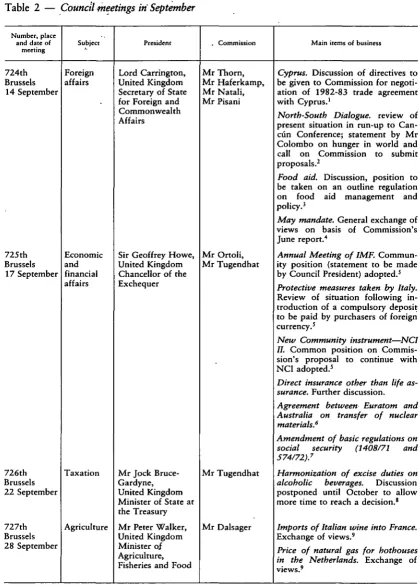
2.1.1. On 14 September the Council held
an initial exchange of views on the problems
raised by the Commission's mandate report.1
Each delegation in turn expressed its general opinion on the paper.
All the Member States were agreed that the
Community had to be got moving again and that new policies were needed.
Most were prepared to undertake a critical review, indeed a reform, of the common ag-ricultural policy to adapt it to present cir-cumstances, the Community now being self-sufficient in most agricultural products. Some were vigorously opposed to the idea that correcting mechanisms should be set up in the Community budget system.
The Council President, Lord Carrington, an-nounced that the special Mandate Group would consider the main facets (agricultural policy, other policies and the budget) in the order in which they appeared in the Com-mission report, and that he would report to the next Council meeting on general matters (26 October).
2.1.2. In September the Commission
furth-er considfurth-ered its procedures, reviewing in particular the priority deadlines and the timetable for its· contributions to the follow-up to its report, on which it reached same general conclusions in
July.
2It agreed that these deadlines were to be re-garded as mandatory; preparations for the 26 October Council meeting would be
speeded up. It sent the Council a set of
com-munications on a new Community energy
strategy3 at the end of September and has
begun discussing its communication concern-ing .agricultural policy.
Economic and monetary policy
IMF and World Bank Annual Meeting
2.1.3. The Annual Meeting of the
Interna-tional Monetary Fund and the World Bank
14
was held in Washington from 29 September to 2 October.
As in previous years, the Annual Meeting was preceded by meetings of the Group of Ten, the Interim Committee and the De-velopment Committee. The Commission was represented on the Interim Committee by Mr Ortoli.
Owing to the difficulties which had arisen over the PLO's participation in the Annual Meeting with observer status-difficulties which have not yet been resolved-the IMF and the World Bank did not address invita-tions to international organizainvita-tions (except the UN).
The Community position was set out by Sir Geoffrey Howe, Chancellor of the Exche-quer of the United Kingdom and President
of the Council. 4 ,
The Annual Meeting heard restatements of the problems facing both the industrialized and the developing countries. In the indus-trialized countries, the adjustment process had progressed appreciably, but the main concern was still inflation. In most of the de-veloping countries, the problem of adjust-ment remained very serious, particularly in the poorest among them.
European Monetary System
Operation of the EMS
Realignment of parities
2.1.4. On 4 October the Ministers and
Central Bank Governors of the Member States agreed, following a common proce-dure in which the Commission took part and after consulting the Monetary Commit-tee, to adjust central rates within the EMS.
Supplement 1/81 - Bull. EC. Bull. EC 7/8-1981, point 2.l.l.
3 Points 1.1.1 to 1.1.8.
4 Point 3.5.1.
This led to the following changes in bilateral central rates:
• the German mark and the Dutch guilder were revalued by 5.5% against the Danish krone, the Belgian franc, the Luxembourg franc and the Irish pound;
• the French franc and the Italian lira were devalued by 3.0% against the Danish krone, the Belgian franc, the Luxembourg franc and the Irish pound.
The bilateral central rates between the Dan-ish krone, the Belgian franc, the Luxem-bourg franc and the Irish pound have re-mained unchanged.
The new ECU central rates resulting from this adjustment are as follows (units of na-tional currency per ECU):
BFR LFR DM HFL DKR FF LIT IRL
40.7572 40.7572
2.40989 2.66382 7.91117 6.17443 1300.67
0.684452
Speaking on behalf of the Commission, Mr Ortoli said:
' ... The Commission played a full part in the work leading up to this decision. We wel-come the fact that the decision entirely ac-cords with the principle of fixed and adjust-able rates which is at the basis of the EMS, and we consider that the parities are realis-tic-that is to say, the changes are neither too great, which might have created artificial distortions, nor too small, which might have undermined their credibility.
The economic divergences between the States participating in the EMS have tended to widen, particularly in the areas of inflation and costs, and this meant that a readjust-ment within the EMS was necessary. The de-cision taken yesterday is an act of good management which demonstrates the flexi-bility and adaptaflexi-bility of the system.
The realigment is intended to ensure greater convergence between the economies of the
Member States. It must of course be
accom-panied by appropriate economic and
monet-Economic and monetary policy
ary policy measures; external adjustment will not have any lasting effects unless it is backed up by internal adjustment ...
The decisions taken yesterday are a logical outcome of the system: but they also have a wider significance, for they are a sign that Europe is capable of taking up the chal-lenges, internal and external, that face it.'
Italian measures
2.1.5. Meeting on 17 September, the
Coun-cil considered the situation created in Italy by the introduction of a system of compul-sory deposits for foreign currency purch-ases1 and in particular the difficulties that an immediate abolition of the deposit require-ment might entail. Following these discus-sions, the Italian representative stated that the Italian Government would proceed as follows:
• the system would be phased out over the period 1 October 1981 to 28 February 1982, ending definitively on the latter date; • the level of the deposits in respect of fore-ign currency purchases would be lowered progressively: 25% on 1 October, 20% on 1 January 1982 and 15% on 1 February 1982;
• CAP products and non-ferrous metal
pro-ducts would be exempted from 1 October
1981.
On this basis, the Commission was able, on 23 September, to authorize Italy to maintain the deposit requirement in respect of foreign currency purchases. 2
Community borrowing
New Community instrument
2.1.6. At its 17 September meeting the
Council agreed a common position on the Commission's proposal for a continuation of
the new Community instrument. 3
1 Bull. EC 6-1981, point 2.1.1. 2 OJ L 296, 15.10.1981.
Internal market and industrial affairs
The draft Decision, which is subject to the conciliation procedure with Parliament, au-thorizes the Commission to contract a new series of loans totalling 1 000 million ECU with a view to re-lending for primarily long-term investments which should contribute to increased convergence and integration of the economic policies of the Member States.
It was also agreed that the Council would re-examine the ceiling, during its discussions on the follow-up to the May mandate, when it tackled the problem of the budget and the financial instruments.
Economic situation
2.1.7. On 16 September Parliament
adopted a resolution on economic trends in the Community during the first half of 1981.1
Monetary Committee
2.1.8. The Monetary Committee held its
273rd meeting in Brussels on 16 September, with Mr Haberer in the chair. It discussed the economic and monetary situation in Italy and Belgium and also looked into the prob-lems raised by indexation.
Having been asked to initiate a prior consul-tation procedure, the Monetary Committee again met on 3 October; in line with . its brief, it made preparations for the meetmg of Ministers on 4 October at which the deci-sion to realign the EMS parities was taken/
2.1.9. The Working Party on the
Harmoni-zation of Monetary Policy Instruments met in Basle on 14 September, with Mr Kjaer in the chair; it continued its examination of the technical problems arising from the coexist-ence of monetary and exchange-rate objec-tives within the EMS.
2.1.10. Finally, the Working Party on
Cap-ital Markets met in Brussels on 28 and 29 September, with Mr Gryson in the chair; it reviewed international bond market trends and capital markets in the member coun-tries.
16
Economic Policy Committee
2.1.11. The Economic Policy Committee
held a further meeting on 21 September in its reduced 'budgets' composition to examine the Commission's three-year financial hy-potheses for 1982, 1983 and 1984.
Internal market
and industrial affairs
Free movement of goods
2.1.12. On 17 September Parliament
adopted a resolution on the free movement
of goods within the Community,3 with
par-ticular regard to wine.
Removal of technical barriers to trade
Industrial products
2.1:13. On 23 September the Economic
and Social Committee adopted an opinion4
on two proposals for Directives, one of which related to methods of testing the biodegradability of anionic surfactants,5 and
the other to the classification, packaging and labelling of paints, varnishes, rrinting inks, adhesives and similar products.
Business law i
Eco.nomic and commercial law
Trade-marks
2.1.14. At its plenary session on 23 and 24
September7 the Economic and Social
Com-mittee gave its opinion on the proposal for a first Council Directive to approximate the
Point 2.3.17; OJ C 260, 12.10.1981. Point 2.1.4.
l Point 2.3.14; 0] C 260, 12.10.1981.
~ Point 2.3.42.
s OJ C 112, 14.5.1981; Bull. EC 3-1981, point 2.1.9.
6 Bull. EC 6-1981, point 2.1.12.
7 Point 2.3.34. ·
laws of the Member States relating to trade-marks and the proposal for a Council Regu-lation on the Community trade-mark.
Free movement of persons and freedom to provide services
Mutual recognition of diplomas and access to occupations
Veterinary surgeons
2.1.15. The Advisory Committee on
Veteri-nary Training, set up by a Council Decision of 18 December 1978,1 held its inaugural meeting in Brussels on 15 and 16 September. The Committee elected its chairman and two deputy chairmen and adopted its rules of procedure. Its initial programme was discus-sed and a working party set up to study var-ious aspects of basic training for veterinary surgeons.
2.1.16. On 17 September the Commission
held a meeting of government representatives to examine the implementation of the Direc-tives concerning veterinary surgeons adopted
by the Council on 18 December 1978.1
Dis-cussions centred on the problems of applying the Directives in the Member States and on the question of keeping the national bodies concerned informed.
Doctors
2.1.17. On 18 September Parliament gave
its opinion2 on a proposal concerning free
movement for doctors, particularly in rela-tion to part-time training of specialists. 3
Par-liament was in favour of retaining the ex-emption relating to part-time training but hoped that there would be a time limit.
Special rights of citizens and passport union
2.1.18. On 18 September Parliament
adopted a resolution4 on the new United
Kingdom Nationality Bill and its implica-tions at Community level.
Internal market and industrial affairs
Industry
Shipbuilding
2.1.19. Transmitted by the Commission to
the Council on 17 September, in accordance with the Council Resolution of 19 Sep-tember 1978,5 the third report on the
ship-building industry6 (situation at 1 January
1981) indicates that the overall market situa-tion shows no sign of improvement, and that the few promising trends that appeared in 1980 have proved to be short-lived and not positive enough to mitigate the crisis.
World shipyard production fell by a further 10% in 1980, with the volume of new or-ders remaining at the very low level of the previous few years. This situation reflects both the general economic depression and the overcapacity of existing fleets, which is patently obvious in the case of vessels such as oil tankers and potentially true in relation to other types of vessel. It is forecast that the shipbuilding market will be further affected by these trends over the next two or three years, so that no significant recovery is to be expected before the end of this period. Since a certain equilibrium between orders and production has been reached in the Com-munity-albeit at a very low level-there should no longer be any marked downturn in production.
Community shipyards have on the whole been more seriously hit than their major competitors. In 1980 Community produc-tion-2.4 million cgrr7-was 18% down on the previous year and 52% lower than in 1976, when it was just over 5 million cgrt; new orders fell by 3.6% to the same level of
OJ L 362, 23.12.1978.
OJ C 260, 12.10.1981.
OJ C 121, 23.5.1981; Bull. EC 2-1981, point 2.1.7. 4 Point 2.3.17; 0] C 260, 12.10.1981.
s OJ C 229, 27.9.1978.
6 For the second report, see Bull. EC 9-1980, point
2.1.12.
7 Compensated gross register tonnage: a measure that
takes into account the work needed to produce one grt,
Customs union
2.4 million cgrt, while employment dropped by about 8% (10000 people), bringfng- the total reduction since the beginning of the in-dustry's crisis to 85 000, i.e. 40% of the workforce (205 000) employed in, the con-struction of new vessels in 1976.
Already made difficult by the crisis, the situ-ation is exacerbated by this further un-favourable trend in the Community . ship-building industry, whereas the position of the Japanese shipyards is improving. Efforts have, however, been made in the Communi-ty to adjust to new market conditions, with capacities being reduced-in terms of either plant or employment-and existing produc-tion plant improved, but the problem of under-utilization-a worldwide phenome-non-is still having a serious impact because order books are so short. For this reason, when it comes to considering what action should be taken, particular attention is now being given to ways and means of boosting the level of activity. Possible ways to im-prove the industry's competitiveness are be-ing studied, as are the possibilities of resus-citating demand for Community output, tak-ing into account the fact that international cooperation does not permit a more even distribution of the burden imposed by the crisis.
Textiles
2.1.20. Following its rejection by
Parlia-ment on 7 ApriP and by the Economic and Social Committee at its 29-30 April session/ the Commission· decided on 16 September to withdraw its proposal for a Directive con-cerning indication of the origin of certain textile and clothing products, which it had transmitted to the Council on 7 October
1980.3 Although aware that origin marking
in itself did not appear to be an adequate means of combating illegal imports, the Commission might still examine the possibil-ity of making a proposal concerning compul-sory marking of textile imports from non-member countries. In the meantime, the Member States were requested not to take any initiative in this field.
18
Telecommunications
2.1.21. On 18 September Parliament
adopted a resolution on Europe's space policy.4
Customs union
2.1.22. On 17 September Parliament
adopted a resolution on the 1981 program-me for the achieveprogram-ment of the customs uni-on,5 which was adopted by the Commission in January.6
Economic tariff matters
Tariff suspensions
2.1.33. On 28 September the Council
adopted two Regulations temporarily sus-pending in full the autonomous Common Customs Tariff duties on certain colour cathode-ray tubes within subheading ex 85.21 A V and on certain catalysts falling within subheading ex 38.19 G.7
Tariff quotas
2.1.24. During September the Council
adopted three regulations opening, allocating and providing for the administration of Community tariff quotas for the following agricultural products:
aubergines originating in Cyprus (1981);8
wines of designated origin originating in Tunisia (1981/82);9
wines of fresh grapes and grape must with fermentation arrested by the addition of
al-cohol, originating entirely in Greece
(1982).10
1 OJ C 101, 4.5.1981; Bull. EC 4-1981, point 1.3.18.
2 Bull. EC 4-1981, point 1.3.46; OJ C 185,
17.7.1981.
3 Oj C 294, 13.11.1980; Bull. EC 10-1980, point
1.1.17.
4 Point 1.3.17; Oj C 260, 11.10.1981. s Oj C 260, 11.10.1981.
6 Oj C 106, 8.3.1981; Bull. EC 1-1981, point 1.1.8.
7 OJ L 177, 1.10.1981.
8 OJ L 163, 17.9.1981.
9
OJ L 184, 6.10.1981. to Oj L 181, 3.10.1981.
General legislation
Classification of goods in the customs nomenclature
2.1.25. On 24 September the Commission
sent to the Council a proposal for a Regula-tion on the informaRegula-tion provided by the cus-toms authorities of the Member States con-cerning the classification of goods in the
cus-toms nomenclature. 1 The purpose of the
proposal is to make it obligatory for the na-tional customs authorities throughout the Community's customs territory to supply legally binding information with regard to the tariff classification of goods. It also sets out to guarantee equal treatment for Com-munity traders as regards the conditions under which such information is obtained and used.
2.1.26. On 18 September Parliament
ap-proved2 two proposals dealing respectively with the definition of the customs territory
of the Community3 and the harmonization
of procedures for the release of goods for free circulation. 4
Competition
General rules
applying to undertakings
Rules on competition and sea transport
2.1.27. On 30 September the Commission
adopted a proposal for a Regulation which should, when adopted by the Council, en-able it to systematically apply the rules on competition to sea transport, with due re-gard for the special structure of the shipping industry.
Although the rul'es on competition, like all the general provisions of the Treaty, apply to both sea and air transport (the Commis-sion bas recently made proposals for the lat-ter too5), these are the only branches of the
economy for which detailed provisions ap-plying those rules have not yet been laid down.
Competition
The Commission's proposal is intended to fill this gap by establishing both substantive and procedural rules.
The substantive rules establish, first of all, that certain technical cooperation agree-ments are not caught by the prohibition of restrictive practices in Article 85 (1) of the EEC Treaty. General exemption is granted to liner conferences operating scheduled ser-vices as long as they fulfil certain conditions and requirements specified in the Regulation. These conferences remain subject to investi-gation to ensure that they do not abuse their position. The Commission's proposal is thus consistent with its policy, which has been ac-cepted by the Council, concerning the United Nations Code of Conduct for Liner Confer-ences. This policy involves recognizing the stabilizing role of conferences, while prevent-ing them from breachprevent-ing the rules of com-petition. While there is no conflict between the proposal for a Regulation and the Code of Conduct, the proposed provisions do not simply reaffirm the principles laid down in the Code: they amplify or clarify a number of points through Community rules. Agree-ments between conferences and shippers (or shippers' associations) relating to the quality, rates or conditions of scheduled services are also exempt. However, bulk transport is, at this stage, excluded from the proposal: the Commission wishes to consider related mat-ters before taking any steps.
The procedural rules in the proposal are in-tended to simplify as far as possible the ad-ministrative formalities resuired of undertak-ings. In the main the proposal therefore re-produces the provisions governing transport
by rail, road and inland waterway.6
In view of the international implications of the sea transport sector, the proposal pro-vides for special procedures to avoid conflict with the legislation of non-member
coun-1 OJ C 256, 8.10.1981.
2 OJ C 260, 12.10.1981.
3 OJ C 305, 22.11.1980; Bull. EC 10-1980, point
2.1.24.
4 Oj C 61, 20.3.1981; Bull. EC 3-1981, point 2.1.23.
5 Bull. EC 7/8-1981, points 1.3.1 to 1.3.8.
Competition
tries. Such conflicts, which could endanger important Community trading and shipping interests, could arise because the Regulation covers all sea transport operations beginning or ending in a Community port, irrespective of the country of registration of the com-pany that owns the vessel.
Restrictive practices, mergers
and dominant positions: specific cases
Distribution
The Commission takes further action against a restrictive agreement on the Italian flat glass market
2.1.28. On 28 September the Commission
adopted a decision which finds that agree-ments made in 1986 and 1977 between Ita-lian flat glass wholesale and processing firms
through their associations - lstituvo
Svilup-po Vetro (ISVE), Associazione Vetro ltalia
Centrale (ASVIC) and Associazione
Meridionale Vetro in Lastre (AMVL)- and agreements between these associations and the major Italian manufacturers of flat glass
- Fabbrica Pisana SpA, Pisa, a member of
the Saint-Gobain group, Societa Italiana Vet-ro, San Salvo, Chieti, a State-controlled com-pany, and Vernante Pennitalia SpA, Cuneo
- are incompatible with the EEC Treaty
competition rules (Article 85).
The three manufacturers concerned account for over 90% of Italian flat glass produc-tion. The three associations include all the largest Italian flat glass wholesale and pro-cessing firms, which together control some 60% of the market.
The agreements, which were not notified, came to the attention of the Commission
fol-lowing investigations into the Italian cast
glass case, which was the subject of a
deci-sion in December 1980.1 The agreements,
which were gradually abandoned towards the end of 1977, included the following par-ticular restrictions:
• Under the agreements between the
wholesale and processing firms through their associations, the participants undertook to buy from Italian manufacturers only through
20
the associatiOns and on the basis of fixed quotas. Purchasing from foreign manufactur-ers was prohibited, save in exceptional cir-cumstances. Products imported from State-trading countries had to be divided among the participants following prior authoriza-tion from the associaauthoriza-tions, and there was a compulsory common price list.
• Under the agreements between the associ-ations and the manufacturers, sales quotas were imposed and the manufacturers were required to grant the members of the associ-ations a differential discount in return for their dealing commitments.
These agreements were likely to cause a seri-ous restriction of competition on the Italian flat glass market, both because of the nature of the proposed restrictions and because of the participants' market share. The Commis-sion has not, however, imposed fines in re-spect of these infringements, since the agree-ments were in fact only partially im-plemented by the firms concerned, which rapidly ceased to apply them.
Mergers
joint venture
2.1.29. On 14 September the Commission,
under the merger control powers conferred on it by Article 66 of the ECSC Treaty, au-thorized the joint formation of Eurocoal SA, Brussels, by Krupp Handel GmbH, Diissel-dorf, and Etmofina SA, Brussels, a subsidi-ary of Petrofina SA, Brussels. 2 Eurocoal is to
handle the coal trade interests of Krupp Handel and Petrofina in the common mar-ket, with the exception of the Federal Re-public of Germany, and in a number of non-member countries. It is intended that Eurocoal will commence operations in Ger-many at an opportune moment. The two groups' solid fuel business in the territory covered by the agreement will in future be carried out by the joint subsidiary alone; Krupp Handel will withdraw from the mar-ket, and Petrofina will refrain from entering
1 OJ L 383, 31.12.1980; Bull. EC 12-1980, point
2.1.30.
2 OJ L 290, 10.10.1981.
it. For the purposes of their joint activity in solid fuels distribution, the two groups pos-sess physical and other assets which are complementary. The latter include the two parent companies' existing sales networks and also their existing and potential custom-ers and their supply contracts.
In view of these factors, the formation of Eurocoal does not constitute an agreement between the parent companies to coordinate their market operations, but the creation of an autonomous business entity. The parent companies will in effect be merged with this joint venture. Given the small market share that Eurocoal is likely to achieve, the Com-mission does not expect the impact of the merger on competition to conflict with the tests for granting authorization laid down in Article 66 (2) of the ECSC Treaty.
2.1.30. On 14 September the Commission
also authorized the Italian firms Lucchini Siderurgica, Brescia, Acciaierie e Ferriere Le-ali Luigi, Odolo, and GEPI (Societa di Ges-tione e Partecipazioni Industriali), Rome, to set up a joint undertaking, Siderpotenza SpA, whose principal object is to take a lease of the installations of Industria Siderur-gica Lucana, which has entered into an ar-rangement with its creditors. These are in-stallations for producing crude steel and for processing it into concrete-reinforcing bars. Their production capacity is 141 000 tonnes per year.
Lucchini and Leali are small-scale steel-works; they produce merchant bars and, particularly in the case of Leali, concrete-reinforcing bars from steel scrap using the electric furnace process. GEPI, on the other land, is a financing company controlled by holding companies and financing institutions governed by public law. Its object is to help maintain employment by acquiring interests in firms experiencing temporary difficulties with a view to their reorganization and sub-sequent sale. GEPI has no holdings in other steel undertakings.
By continuing Lucana's activities, Sider-potenza should be able to maintain in em-ployment some 400 of the 500 manual and non-manual workers employed by Lucana in
Competition
a region, Basilicata, where structural unem-ployment has been supplemented, following the recent earthquake, by appreciable short-term unemployment.
The combined production of the firms con-cerned accounts for 8% of the Italian mar-ket and 4% of the Community marmar-ket in concrete-reinforcing bars, and no increase in production capacity is planned for Sider-potenza. This operation is unlikely to change in any appreciable way the structure of the relevant market, where competition is in-tense: it satisfies the authorization tests laid down in Article 66 of the ECSC Treaty.
State aids
Regional aids
France
2.1.31. On 16 September the Commission
decided not to object to a regional develop-ment premium granted in France outside the assisted areas to a company investing in an extension of its activities in the department of Aisne. The Commission allowed for the fact that unemployment in the area is mounting steadily.
Industry aids
Netherlands
2.1.32. On 9 September the Commission
adopted a decision under Article 93 (2) of the Treaty prohibiting the Netherlands Gov-ernment from granting a premium for major investment projects (GPT) to an electrical and electronics firm. 1 The aid, amounting to
HFL 11.4 million, was intended to help
fi-nance the modernization of administrative buildings, the replacement of a transformer station and the construction of a laboratory. The Commission's objections are similar to those involved in a similar decision taken in 1979 against aid planned by the Netherlands
Government for a cigarette manufacturer.2
The decision is based mainly on the lack of
t OJ L 276, 30.9.1981.
Financial institutions and taxation
evidence that the planned aid is in the gener-al interest.
Belgium
2.1.33. The Commission decided to initiate the Article 93 (2) procedure in respect of aid planned under the Act of 17 July 1959 for an investment designed to increase the pro-duction of polyethylene in Antwerp. The Commission initiated the procedure as part of its policy of examining particularly closely the application of general aid schemes. 1
Financial institutions and taxation
Financial institutions
Insurance
Legal expenses insurance
2.1.34. At its plenary sitting on 17 Sep-tember Parliament gave its opinion on the proposal for a Directive on legal expenses
insurance.2 It agreed with the Commission
on how the twofold objective of this Direc-tive, namely to secure freedom of establish-ment for this class of insurance in the Feder-al Republic of Germany and to prevent as far as possible conflicts of interest between an insured person and his insurer, should be achieved. In particular, it rejected the pro-posed amendments under which the German system of specialization or the Dutch 'claims office' system would have been made gener-ally applicable.
Banks
Supervision of credit institutions on a consolidated basis
2.1.35. On 28 September the Commission sent to the Council a proposal for a Direc-tive on the supervision of credit institutions on a consolidated basis. 3
This proposal follows on logically from the Council Directive of 12 December 1977 re-lating to the taking up and pursuit of the
22
business of credit institutions,4 which
advo-cated among other things elimination of the
most obstructive differences between
Member States' laws governing credit
in-stitutions. It also represents a Community
response to the initiative taken in June 1979 by the Central Bank Governors of the Group
of Ten countries5 plus Switzerland,
whereby the supervisory authorities were re-commended to adopt a system of supervision
on a consolidated basis. ·
The proposed Directive will require Member States to supervise on a consolidated basis all credit institutions which have a majority holding in other credit or financial institu-tions and will give their competent au-thorities the right to require consolidation of certain minority holdings. It also provides for the removal of any legal impediments to the exchange of information, without which consolidation cannot be carried out.
Although the proposal is applicable only to credit institutions located in the Community, it does provide for the conclusion of bilater-al agreements between Member States and other countries in the interests of worldwide consolidation. The Advisory Committee set up by the 1977 Directive and the Commis-sion will be responsible for coordinating such agreements.
Stock exchanges and other institutions in the securities field
Securities offered for subscription or sale to the public
2.1.36. At its September session the Economic and Social Committee endorsed a proposal for a Directive coordinating the re-quirements for the drawing up, scrutiny and distribution of the prospectus to be
pub-1 Bull. EC 7/8-1979, point 2.1.34.
2 OJ C 198, 7.8.1979; Bull. EC 7/8-1979, point
2.1.38.
3 OJ C 258, 9.10.1981.
4 Directive 77/780/EEC: OJ L 322, 17.12.1977.
5 Belgium, Canada, France, Federal Republic of
Ger-many, Italy, Japan, Netherlands, Sweden, United King-dom, United States.
lished when secunt1es are offered for sub-scription or sale to the public. The 'corpmis-sion had sent the proposal to the. Council last December. 1
Taxation
Indirect taxes
Excise duties
Alcoholic beverages
2.1.37. At its meeting on tax questions in
Brussels on 22 September the Council noted that it needed more time to reach a decision on the problem of the harmonization of
ex-cise duties on alcoholic beverages.2 Since
new proposals were tabled at the meeting, the Council decided to hold over its deliber-ations until the meeting scheduled for 21 October.
Employment, education
and social policy
Employment
2.1.38. The discussions held by the
Com-munity's Ministers of Employment and Social Affairs at their informal meeting in London on 24 and 25 September centred on employ-ment problems and the fight against unem-ployment.3
At these discus!>ions, which were a follow-up to the joint meeting of the Ministers of Economic and Financial Affairs and of Em-ployment and Social Affairs in Luxem-bourg,4 the ministers exchanged views on youth unemployment in particular.
2.1.39. At its September part-session
Parli-ament adopted a number of resolutions on employment and the reorganization of
work-ing time,5 on the employment situation in
the Community6 and on the impact of
ener-gy problems and technological progress on
employment. 7
Employment, education and social policy
Free movement of workers
2.1.40. The Advisory Committee on Free
Movement of Workers met on 22 September and discussed the problems of the second generation of migrants living in the Com-munity and certain aspects of frontier work-ers' problems.
The Committee decided to set up a working group to examine priority actions to deal with the problems of second-generation mig-rants. The Committee suggested a conference on the difficulties of frontier workers, which could lead to subsequent proposals for ac-tion to improve the situaac-tion.
European Social Fund
2.1.41. On 18 September the Commission
approved the third batch of applications for assistance from the European Social Fund for 1981. These applications, which had been previously examined by the Fund Com-mittee, involve the following sums :
• under Article 4, i.e. for retraining
ac-tivities for persons leaving agriculture, textile and clothing workers, migrant workers, young workers affected by employment dif-ficulties, and women:
Agriculture Textiles
Operation
Young people - training aids - employment aids Migrant workers
Women
m1llwn ECU
Amount
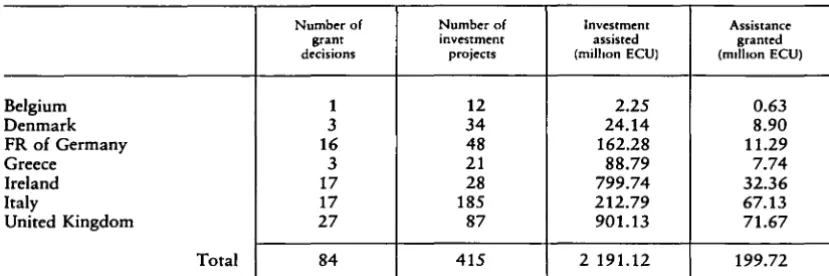
5.87 16.06 213.07 96.21 21.90 13.62
• under Article 5, for the retraining of un-employed or underun-employed workers in the
1 OJ C 355, 31.12.1980; Bull. EC 12-1980, point
2.1.41.
2 Bull. EC 10-1980, point 2.1.31.
3 Point 2.3.5.
4 Bull. EC 6-1981, points 1.3.1 to 1.3.3.
5 Point 2.3.6; Fourteenth General Report, point 232;
Bull. EC 4-1980, point 2.1.34.
6 Point 2.3.4; OJ C 168, 8.7.1980; Bull. EC 3-1981,
~oint .1.1.4. .