This is a repository copy of Public attitudes to compulsory health programmes: generating questions from a focus group to support a willingness to pay study.
White Rose Research Online URL for this paper: http://eprints.whiterose.ac.uk/11037/
Monograph:
Dixon, S. (2010) Public attitudes to compulsory health programmes: generating questions from a focus group to support a willingness to pay study. Discussion Paper. (Unpublished) HEDS Discussion Paper 10/04
Reuse
Unless indicated otherwise, fulltext items are protected by copyright with all rights reserved. The copyright exception in section 29 of the Copyright, Designs and Patents Act 1988 allows the making of a single copy solely for the purpose of non-commercial research or private study within the limits of fair dealing. The publisher or other rights-holder may allow further reproduction and re-use of this version - refer to the White Rose Research Online record for this item. Where records identify the publisher as the copyright holder, users can verify any specific terms of use on the publisher’s website.
Takedown
If you consider content in White Rose Research Online to be in breach of UK law, please notify us by
HEDS Discussion Paper 10/04
Disclaimer:
This is a Discussion Paper produced and published by the Health Economics and Decision Science (HEDS) Section at the School of Health and Related Research (ScHARR), University of Sheffield. HEDS Discussion Papers are intended to provide information and encourage discussion on a topic in advance of formal publication. They represent only the views of the authors, and do not necessarily reflect the views or approval of the sponsors.
White Rose Repository URL for this paper:
Once a version of Discussion Paper content is published in a peer-reviewed journal, this typically supersedes the Discussion Paper and readers are invited to cite the published version in preference to the original version.
Published paper
None.
Public attitudes to compulsory health programmes: generating
questions from a focus group to support a willingness to pay
study
Simon Dixon
Health Economics and Decision Science, School of Health and Related Research (ScHARR), University of Sheffield
E-mail:
Abstract
Background
The willingness to pay approach to valuing goods has been heavily criticised due to perceived biases in their resultant valuations. Recently, attempts have been made to use data relating to respondent attitudes to produce better informed preferences and remove ‘warm glow’. This paper reports a study that uses rigorous methods by which salient attitudes can be identified and measured for use in a subsequent willingness to pay study. The topic area is that of compulsory health programmes (CHPs).
Methods
Six focus groups were undertaken among members of the public using a questioning route designed to highlight different attitudes between CHPs. Framework analysis was used, including thematic and contrast charting, to identify themes that described the issues raised by participants. The resultant coding framework was translated into a set of scales which were then used in a survey of 831 members of the general population. Factor analysis was applied to identify latent themes.
Results
Analysis of the focus group transcripts highlighted seven themes relating to the effects of policy, alternatives, the role of government, uncertainties, coherence of policy, rights and responsibilities, and other issues. These themes were translated into 48 statements that were used as attitude scales. The factor analysis of the general population survey identified 4 latent factors; ‘common sense’, ‘government’, ‘warm glow’ and ‘rights and responsibilities’.
Conclusions
The focus group work described in this paper shows that across individuals, coherent themes relating to public health and compulsion can be identified. It also demonstrates sophisticated thinking by participants about public health issues. This study shows that the work of Nunes (2002) and Pouta (2004) is potentially generalisable to other topic areas and that their methods can be improved upon. This work has been used in a subsequent analysis of WTP responses by using the attitudinal scales in an attempt to elicit better informed preferences and explain responses in terms of underlying attitudes and ‘warm glow’.
Key words
Contingent valuation, willingness to pay, focus groups, qualitative analysis, public health, attitudes.
Acknowledgements
Introduction
Historically, public health interventions have been the most successful way of generating large-scale impacts on the health of populations. Improvements in general sanitation and vaccination continue to have important impacts on health throughout the world. However, many public health programmes such as smoking cessation initiatives have had less dramatic effects partly due to the need for individual behavioural change. This problem can be largely removed when changes to health behaviour are made compulsory by making it illegal, for example, wearing seat belts and banning smoking in public places.
In the UK, the debate over the role of public health and compulsory health programmes (CHPs) was raised by a government report calling on greater investment in public health initiatives (Wanless 2003). This spawned several studies examining public attitudes toward public health programmes (British Broadcasting Corporation 2004a, Jochelson 2005, King’s Fund 2004, TRBI 2003, National Institute for Clinical Excellence 2005). These studies highlighted a complex range of issues that were deemed important to the public. The most prominent issues related to freedom of choice, individual responsibility, harm to others, side-effects, evidence/uncertainties and the method of policy formation.
These views have two implications for possible economic evaluations of such interventions. Firstly, it is clear that there is (dis)utility with the process by which any health gains are ultimately realised. Secondly, if a CHP is implemented, some members of the public will suffer a reduction in utility. Both of these utility changes need to be taken into account if a welfarist approach is to be undertaken to any economic evaluation. Other approaches may exclude these facets of welfare change, for example, within health economics a particular form of extra-welfarism is frequently adopted that rules out non-health welfare from its utility metric - the quality adjusted life year (QALY). However, for many public health interventions (e.g. motor vehicle speed restrictions), a (welfarist) cost-benefit analysis becomes more relevant to a decision maker as they are implemented outside the health care sector, and as such, outside the natural home of the QALY. Consequently, work was undertaken to examine whether it was possible to elicit willingness to pay values for a small set of CHPs.
Despite the attractions of the WTP technique, doubts remain over the validity of the estimates produced. Many potential biases exist when undertaking WTP surveys (Mitchell and Carson 1989, Baron 1997) and these have been shown to result in undesirable measurement properties of the resultant estimates. Whilst some researchers argue that many of these problems are intrinsic to the methods used, a review of methods by the National Oceanographic and Atmospheric Administration (NOAA) felt that these problems could be reduced through better design (Arrow et al 1993). One part of this was the collection of data to assist with explanatory analysis of the resultant estimates.
information as a pre-cursor to WTP elicitation as a way of improving WTP responses. The rationale for this work was that self-rating of attitudes relating to the good under investigation would produce a more deliberative process and more robust preference elicitation. Nunes and Schokkaert (2003) used attitudinal information to identify motivations underlying WTP responses, which in turn were used to strip warm glow from the WTP estimates.
In the study by Pouta (2004) data relating to attitudes and beliefs were collected by asking respondents their level of agreement with a series of statements. A seven point scale from fully agree through to fully disagree was used. The statements were constructed from a series of 50 telephone interviews that asked individuals about the positive and negative aspects of alternative cutting policies. No further details of the interview methods or of the analysis of the interview data are available. Based on the interviews, 42 attitude statements were generated and used in the associated CV study.
The precise method by which Nunes (2002) developed the attitude scales is not fully described; the role of two focus groups in the design of the survey instrument appears to be one of pre-piloting key aspects of the survey instrument rather than the development of the attitude statements. However, 26 statements were generated relating to the value in use and existence value of the protected areas, together with notions of charitable behaviour. These underlying concepts were postulated by Nunes as relating to the motivations that would influence respondent willingness to pay for the good in question. (Nunes, 2002).
Nunes then explored the respondent attitudes further through a factor analysis to identify underlying latent factors. Four factors were identified from the procedure adopted, however only three were adjudged to have any coherent meaning, and so the fourth was removed from the explanatory analysis of WTP data (Nunes, 2002). The three factors were interpreted as relating to use value, existence value and warm glow.
The aim of this study is to generate a series of attitude statements that are grounded in views of members of the general public and that can be used to assist preference elicitation and explanatory analysis in a subsequent CV study.
Methods
The aim of the focus groups was to elicit the views of members of the population relating to public health, and government interventions. There was a particular interest in understanding differences between individuals, and between programmes (for the same individual). This was important as a further purpose of this work generate a set of attitudinal scales that could be used in a subsequent WTP survey.
developed. Thirdly, a population survey was undertaken that included the attitudinal scales and the responses to which were examined using factor analysis.
Focus group methods
Six focus groups were planned, although the possibility of further groups being undertaken was left open if saturation had not been achieved. Four groups were undertaken in Sheffield and two in Bakewell. In order to gather views from the general population, it was decided that the composition of the focus groups would be mixed, and taken from the general population.
It was hoped to have 6-8 participants per group. The sample was drawn from three postcode districts in Sheffield which reflect areas with quite different sociodemographic features, and the single postcode that covers Bakewell and the surrounding areas. Individuals were identified at random from the electoral register.
SD was the moderator in all groups, with assistance from an additional researcher to take notes in all groups. All groups were recorded and transcribed. In addition, the moderator completed a contact summary sheet at the end of each group to encapsulate key issues.
The focus group started with a pre-scripted welcome to the venue, a broad description of the project and the ground rules for the discussion. The rest of the session followed a questioning route that followed a funnel design, whereby the type of question used changed during the course of the focus group (Morgan & Krueger, 1998). Five types of questions were used; ‘opening’ questions aimed to put people at ease and get acquainted; ‘introductory’ questions introduced the general topic of discussion; ‘transition’ questions narrowed the topic down, followed by the ‘key’ questions looking specifically at the topic of interest. Finally, ‘ending’ questions were devised that promoted reflection and brought closure to the discussion. The questioning route is shown in Table 1.
Within the questioning route, participants were asked to consider one possible public health programme, then after discussion another possible programme. Each programme was handed to each participant, and it was also read out by the
moderator. The programme descriptions are given in Boxes 1-4*. Groups 1 and 3
received ‘speed limits’ and ‘fluoridation’, groups 2 and 4 received ‘folic acid’ and ‘smoking’, group 5 received ‘smoking and fluoridation’ and group 6 received ‘speed limits’, ‘folic acid’ and ‘smoking’.
The Flesch Kincaid Grade Level for the descriptions ranged from 8.9 to 9.8. This score rates text on a U.S. grade-school level. For example, a score of 8.0 means that an eighth grader (ages 13-14) can understand the document.
Qualitative analysis
A framework approach was used to manage the data and develop categories. All five stages of the framework approach were used; familiarisation, identification,
* The study was conducted prior to the announcement and implementation of the smoking ban in public
indexing, charting and mapping (Richie & Lewis, 2003). In analytical terms, a full explanatory analysis was not pursued, with the end point being mainly descriptive. However, some explanatory issues related to the study question were pursued, by looking for patterns of response across individuals and assessing reasons for differences by using contrast tables (Miles & Huberman, 1994).
Analysis was based on contact summary sheets, memos written throughout the data collection phase and transcripts. The analysis of transcripts was undertaken after the final focus group had taken place. Each focus group was treated as an individual case, with the analysis initially undertaken on a within-case basis. Following the analysis of all six groups, the thematic framework, indexing and charting were revisited. This cross-case analysis facilitated alternative interpretations to be applied to the data, by using the thematic frameworks of other groups as supplementary contextual data.
Transcripts were initially typed by an independent research organisation, and then checked by SD as part of the familiarisation stage of the framework approach. The transcripts were read in tandem with their associated contact summary sheets and memos.
In the identification stage, a thematic framework was developed. A loosely structured, emergent approach was adopted. Although this would not constitute a full grounded approach, there were few a priori issues and questions. Clearly, the research was based around compulsory public health interventions, and hence the role that freedom of choice plays within individual’s preferences, but no individual issues were specifically raised in the topic guide. Likewise, no specific issues were pre-specified as themes for which all data needed to be extracted. At the end of this stage, a coding framework, together with a list of definitions was produced.
In the indexing stage of the analysis the thematic framework was applied to the transcripts using numerical codes. The validity of the coding scheme was tested by an independent qualitative researcher taking the descriptive codes from one focus group, reviewing them and applying them to the transcript. The development of pattern codes from the descriptive codes were also discussed, with alternative views and interpretations explored. Additionally, the meanings of the themes and sub-themes were discussed in depth at a Study Advisory Group meeting.
The coded data were then synthesised and sorted into a thematic chart in the fourth stage of the analysis. Descriptions of the themes, together with quotes form the focus groups to illustrate the grounding of each theme were combined in a matrix. Whilst the quotes are inevitably selected, care was been taken to ensure that they represent a wide range of groups and individuals.
between schemes. When converted into attitude statements, these will then help differentiate people and play a greater explanatory role in the analysis of the willingness to pay data.
The fifth stage of the analysis – mapping and interpretation – was fairly limited within this study as it was mainly descriptive in nature. However, some interpretation was undertaken based on the charting work described previously. Such interpretation stopped short of trying to identify complex causal patterns or generate hypotheses for future research. All analysis was paper-based, without the use of qualitative research software.
Generation of attitude scales
The themes and sub-themes derived from the focus groups were converted into a series of statements that were designed to be answered on a five point scale; strongly agree, agree, neither, disagree, strongly disagree. Two further sets of questions were added that were relevant to the subsequent WTP study; scales relating to taxation (which was identified as the payment vehicle for the WTP study) and scales relating to charitable behaviour (which were based on those used by Nunes to capture warm glow).
Statements were written in such a way that the number of positive and negative statements were balanced overall, and balanced within the themes as identified in the qualitative analysis of the focus groups. The combined set of scales were then piloted on 13 people identified opportunistically using a self-completed questionnaire together with discussions about content and wording. Additionally, an analysis of the variability of responses was also undertaken to identify questions with relatively high ‘do not know’ rates and low variability in responses.
Population survey methods
A community sample was used. The survey was administered by professional interviewers, following training specific to the questionnaire used in this study and 33 pilot interviews. The attitudinal scales were embedded within a survey instrument developed to elicit WTP estimates relating to CHPs. Each participant was asked to questions relating to one of four CHPs. The survey instrument was based around those used in small studies examining fluoridation of community water supplied and fortification of flour with folic acid (Dixon and Shackley 2003, Shackley and Dixon 2000).
Participants were interviewed in their own homes following prior notification of an interviewer visiting their home. The sample was not based on a random probabilistic sample, but the areas visited by interviewers were selected to represent a wide spread of socio-demographic characteristics. The sample size was based around the numbers needed to identify differences in the subsequent WTP analyses.
Factor analysis
question within the data set to a factor, then the analyst identifies which factors are important, and then interprets the factor in terms that relate to the individual questions. Each factor is described by a factor score which is a normally distributed continuous variable describing the latent construct.
Two tests were used to assess whether factor analysis was appropriate for the resultant data structure. The Kaiser-Meyer-Olkin (KMO) measure of sampling adequacy produces a statistic between 0 and 1, with a value close to one indicating that patterns of correlation should yield distinct and reliable factors. Bartlett's test of sphericity examines whether the overall correlation matrix is not an identity matrix. A significant test indicates that the matrix is not an identity matrix and therefore relationships exist between the variables.
The most widely adopted approach to choose factors is the use of a threshold eigenvalue. Eigenvalues describe the amount of variation explained by a factor, and so the threshold determines which factors are sufficiently important to include in the factor solution. The choice of threshold is largely subjective, however, the most popular value was proposed by Kaiser and is one (Stevens, 2002). The advantage of using an eigenvalue threshold is that it produces a clear number of factors. However, in simulations, the ‘Kaiser criterion’ has been shown to overestimate the number of factors in certain circumstances (Stevens, 2002).
An alternative approach is the scree test, which is based around a plot of ranked eigenvalues. The decision rule associated with the scree test is to choose those factors with eigenvalues to the left of the plateau of plotted values (i.e. before the explanatory power of successive factors become highly similar). This is much more subjective than using thresholds as there are no set criteria for what defines a ‘plateau’.
A decision rule based on Stevens (2002) was adopted a priori. Stevens (2002) states: “Since the Kaiser criterion has been shown to be quite accurate when the number of variables is <30 and the communalities are >.70, or when n>250 and
the mean communality is ≥.60, we would us it under these circumstance. For
other situations use of the scree test with an n>200 will probably not lead us too far astray, provided that most of the communalities are reasonably large”.
Orthogonal rotation is valid when the underlying factors are thought to be independent of one another.
In order that factor scores could be produced for all cases for use in the subsequent explanatory analysis of WTP data, it was decided to impute responses for missing data. This was done by replacing missing and ‘don’t knows’ with mean values. To check whether this altered the factor solution in any tangible way, the factor solutions for the complete case and imputed datasets were compared.
Ontological and epistemological stances
It is becoming increasingly common in qualitative research for the researcher to state their position with respect to their view of the world in ontological and epistemological terms (Richie & Lewis, 2003). This allows the reader to interpret the analysis and findings with contextual information relating to the researcher.
The ontological position taken is that of subtle realism. Whilst I believe that a reality exists independent of beliefs and understanding, that reality can only be accessed via the human interaction and the researcher’s interpretation. Differences in beliefs between respondents does not detract for the notion of an independent reality, but is interpreted as showing the complexity of that reality in a social world.
I adopt a fairly pragmatic epistemological position, believing that different methods should be employed to answer different questions, rather than imposing a single philosophical viewpoint on all research. When answering ‘why’ questions, qualitative research with its inherent interpretivism is best placed to understand the complexity of the social world. When answering ‘how much’ questions, quantitative research with its inherent positivism is best placed to measure magnitudes. Within some (or even most) applied policy studies, both approaches may be necessary to gain a fuller understanding of the phenomena at play.
Ethics
A research protocol for the focus groups was produced and was approved by the ScHARR Research Ethics Committee.
Results
Focus groups
Overall, 522 letters were sent with 37 acceptances (6.9%) with 33 invitees attending. To compensate for the lack of younger participants, students were invited to the first three groups, and 6 agreed to participate. This produced two groups of 5 participants, one of six participants, one of seven participants and two of eight participants. The age of the participants were 49% >60, 21% 46-60, 15% 31-45 and 15% 18-30. 41% were male, 67% had professional qualifications and
54% had children. The groups took place on 10th December 2004, 29th April 2005,
4th and 6th May 2005, and two on the 16th September 2005. The full transcripts
can be found at
Qualitative analysis
person being quoted (e.g. FG21 relates to Focus Group 2, person 1) and the page relating to the page of the transcript. The full set of thematic charts can be found
a
Effects of policy
Participants frequently recognised the size of the health impact, although they did not always consider it to be large enough to be important. Side-effects of the policy were sometimes recognised, with some people trying to balance them against the benefits of treatment to come up with a rationalised opinion. Costs and cost savings, or value for money were also raised as important policy effects.
“Ideally you would mass dose the whole of the population for the whole of everybody’s lifetime. But the types of returns are probably bizarre given that there are other ways of tackling the problem”. FG21, p11
“What I was going to say is if it’s incredibly expensive then it maybe that the money’s better spent elsewhere but if it’s not going to cost very much to do and it’s got lots of positive advantages and no disadvantages I think it would be a good idea”. FG32, p9
“I think it’s the scale of it as well, like you said, its a bit harsh but 180 babies doesn’t seem very many”. FG42, p14
“The point is in any policy, okay in this one we’ve rightly identified the white patches on some teeth, that is a down side for it but there are very few things in life which are totally good for everyone and you have to look, surely, for the best results for the majority”. FG53, p13
“I think you accept anyway that if you’re given a tablet to make something better, it may upset something else. It’s like taking something that upsets your stomach isn’t it, you sort of adjust it by taking it at the right time or you’re given something to help with that, to help with the acidity or something. I think you do accept that”. FG58, p14
“But in order to make the judgement you need to know how many cases of B12 deficiency there are, it’s obviously a balance I would have said. I don’t think you can say anything, you can’t comment on this”. FG62, p7
Alternatives
Whilst the potential benefits of health interventions were widely accepted, many participants did not accept that they were such a good idea. The underlying health problem was often seen as part of a much wider problem, which would not be solved by a specific intervention (e.g. road accidents are caused by poor driving not just speed). Alternatively other problems were seen as more important (e.g. domestic accidents as opposed to road accidents), or other interventions more desirable (e.g. education).
the cars and there’s children running up and down while mum’s stood talking, it’s not, I mean it’s a bit…, the speed limit won’t make any difference. It is extremely slow, there’s just a tailback all the time, of traffic”. FG11, p5
“But it doesn’t do anything about the major part of the problem does it? Anymore than anything else we’ve done. So if we have another forty like this we’ll probably save another four thousand people out of the tens of thousands that are dying every week”. FG21, p14
“Fluoride, yes it’s a good idea yes but so many teeth missing and stuff like decay, if parents are going to carry on giving them sweets, it’s down to parents isn’t it you know”. FG36, p19.
This twenty miles an hour, I think it’s a good idea but I don’t think it will work to be honest. As you said I think bumps might be better in residential areas you know what I mean there’s too much traffic. FG36, p19.
“One of the reasons, the reason they give for trying to get it banned, I’m not saying it is right or wrong but one of the first reasons they give why they try to get it banned is because of the amount of deaths at the moment each year because of smoking. There are other things that in public which cause just as much harm or deaths, they do it in public. How many people die on the roads each year? That’s the public. How many people die from alcohol?” FG46, p11
Role of government
Various roles were suggested. There were different opinions as to the desirability of enabling policies (e.g. subsidies for ‘good’ behaviour) and compulsion/regulation. The ‘nanny state’ was quite frequently mentioned and in several instances there was a clear cynicism of government.
“As far as kind of food and things go, I think government could possibly look at healthier food being cheaper or something, subsidised or something I don’t know, people actually bought better food, I don’t know”. FG13, p4
“I think the governments got a responsibility to analyse the information, and but at the end of the day, people don’t want to be told what to do and that sort of thing, they are going to live the way they want”. FG15, p12
“Well they are doable and that’s one of the things the government likes, whether they are about wanting solutions so therefore you can enforce them”. FG21, p14
“Well I just, I just don’t agree imposing things on people, you know, big brother imposing things on people”. FG37, p10
“I am not suggesting that you have got to exercise but if that was there and more affordable and more accessible and as one of many things that the Government was enabling us to access that might be better rather than telling us”. FG48, p5
“The benefits seem to us all to be so obvious from banning smoking in public place. I mean I don’t have a problem with what’s been termed nanny state, I mean if this is what a nanny state can do, good”. FG43, p14
“What you are showing though is the conflict between the individuality and personality, choice. Have two people, have two things, this is what you get large scale of course, conflict between different viewpoints so that you are never going to have any policy that will please all the people all the time. That’s probably accepted that the best thing the government can do is to be in the interests of most people, most of the time”. FG54, p15
“Well, it’s such a minority at the end of the day that it’s not going to make any difference. I think the whole thing is, Britain’s ruled on political correctness and a load of facts, some of which are highly suspect, especially in the field of passive smoking”. FG63, p11
Uncertainties
Uncertainty over the scale of side-effects was an important issue, which frequently led to calls for more research. One factor in these uncertainties was a distrust of science. Also, despite the research evidence being presented, people would frequently bring in their own opinion as to feasibility and simple say that ‘it won’t work in the real world’. Participants would frequently express concern over possible unintended consequences (e.g. smoking bans will increase smoking at home and therefore impact on children even more), although sometimes these would not be specified, but would be regarded as a spectre hanging over the scheme. Some individuals also raised the possibility of the scheme leading onto further initiatives, which was generally seen as a negative thing.
“But I mean many, lots more examples of unintended consequences which are felt by, for generations, probably a well-meaning attempt to actually improve things but actually has a counter-effect”. FG12, p8
“But the stats and the arguments for this ban, there is absolutely no way that anybody knows that passive smoking increases or decreases health risks”. FG21, p7
there’s a lot of research the juries out on things like that and that it could cause problems we just don’t know”. FG23, p15
“Yeah but when they go down with feelings of numbness in their arms or legs, if they go ahead with this thing, it doesn’t mean to say that’s the only thing that’s the cause, that’s the symptoms of something else”. FG46, p11
“As far as the folic acid is concerned, adding that, what the research carried out so far, they don’t even know if that is doing more harm than good in another generation. That is why there’s so much resistance in some quarters to man made technology, they know the good that can come from it but they don’t know what is liable to be after another generation”. FG46, p15
“I do wonder sometimes, read so much about links between this and that, I wonder whether they are statistically linked rather than….they will do the analysis and find what appears to be a statistical link, but they may not have included all the various factors. Even if they do find a statistical link they can’t explain why it is only a statistical link”. FG53, p14
“As the lady said, there’s no detrimental effect to a speed limit, there’s only advantages and in the second case there’s both pros and cons, and the cons don’t seem to be too well known and that would be my concern”. FG65, p10
Coherence of policy
Desirability of policies tended to get measured in terms of their coherence – is it clear (or underhand), is it consistent with other policies or is it ‘just obvious’. To a certain extent, participants liked (or disliked) the ‘feel’ of the policy.
“We get very crossed messages because then you hear about some drink driver that killed somebody and they hardly get anything, as a penalty, and that seems to be not taken as seriously”. FG13, p6
“The facts are much clearer on this so I find it easier to make decision, you know, speed kills, so it’s really kind of natural”. FG13, p13
“Well the banning of smoking I think is one of the most obvious things that it has been shown to be possible, particularly doing it gradually”. FG41, p14
“At the end of the day it’s going to happen anyway. Why it hasn’t happened already I don’t know. Just come back from Italy and I mean if Italy can do it, for goodness sake, we’re next, and it’s working. I said it wouldn’t work in Dublin when the Irish introduced it, but it did”. FG63, p11
Rights and responsibilities
Freedom of choice, civil liberties and civil rights were frequently identified as something important. Also mentioned was an obligation not to harm others (e.g. passive smoking, or side-effects from the interventions), personal responsibility of one’s own health and related to this, culpability (i.e. if it’s their own problem they should fix it, or others shouldn’t be included in the solution). The degree of restriction was highlighted by some as being important, in other words, restrictions were seen as more desirable than bans.
“People can, people must be allowed to choose their own poison at the end of the day”. FG12, p2
“I think people already know a lot of things about smoking and drinking and I think they know those and I think they have a choice”. FG13, p2
“There have been efforts in public awareness campaigns to actually reduce the speed but they are not working, therefore there has to be an element of compulsion. It makes it easier. If you gave me the choice then the choice would be to just drive faster”. FG12, p6
“But this isn’t making you take responsibility, it’s just giving you water, you just drink it, you’re not doing any of the other things which might make you look after your heart, if you have a choice, if you can afford better things to eat, stop smoking”. FG13, p11
“Shouldn’t I have a choice whether I take that folic acid or not, and I wouldn’t have a choice”. FG23, 16
“This one (folic acid) seems like an infringement of my rights, this one (smoking) seems to me to be something like I would be willing to give up, like stopping murdering people, not that I do but I would be willing to give that up”. FG48, p14.
“There is no secondary obesity, you are not going to a pub on Friday night and coming out fat, because everybody eating fish and chips but you come out with a bad chest because people are smoking”. FG57, p6
“The other thing about this is, you’ve got a population to be taught, you’ve got pregnant women, surely pregnant women are advised to take folic acid. Why should the rest of society have additives put in when you know who to give it to?” FG62, p7
Other issues
Other than freedom of choice, other motivations were mention or inferred; altruism, public good, religious beliefs and pure self interest. These were raised infrequently.
“Well I’d be thinking safety for the twenty miles speed limit and the teeth for the future generations you know children and people that are a lot younger than I am. I have three granddaughters so you know their well being and their children you know my children’s children grandchildren or whatever. That’s what I think, it’s for the future rather than you know, myself”. FG31, p18
“So from a general point of view I think it should go ahead and from a personal, selfish, point of view, I would vote for both of them”. FG57, p16
“I think the overriding thing is that there is a public benefit demonstrable, a public benefit for both of them. Neither would affect me because I don’t smoke directly myself and my teeth are gone already”. FG53, p17
Following on from the thematic charting, contrast charting was used to examine instances where individuals had opposing policy viewpoints for different schemes. This provided 23 instances of where subjects explained apparently contradictory positions. These comparisons ranged from the simple:
“This one (folic acid) seems like an infringement of my rights….” FG48, p14 “…this one (smoking) seems to me to be something like I would be willing to give up, like stopping murdering people, not that I do…” FG48, p14
Through to quite complex reasoning:
“Well the same for both in a way, it’s about looking at the benefits and the costs of doing it, whether or not you understand fully the downside of any of these. So I’m quite clear that there are things that we do not know about mass dosing the population (with folic acid) and I think there are other ways of tackling this problem so I can’t weigh up the equation, I can’t balance that because I think there is going to be a downside. You’re quite clear about the upside - it’s a hundred deaths - but I just don’t know what the downside is and that could be ten times that or a hundred times that, you just don’t know.” FG21, p16
them in anyway and may well help some of them to give up smoking. So that’s fine and you can still smoke at home and you can declare a place not a public place by saying it’s a club and all the rest of it there’s plenty of clubs that you have to be member of in Ireland that you can smoke in, not a public place. And I’m fairly certain that everyone’s clear in their minds. So I can see you could ban smoking in public places.” FG21, p16
Generation of attitude statements
Thirty seven statements relating to the focus group discussions were generated. Together with five statements related to warm glow and five statements relating to taxation, this produced an initial set of 47 statements. Using the comments and analysis from pilot work, a final list of 48 statements was generated.
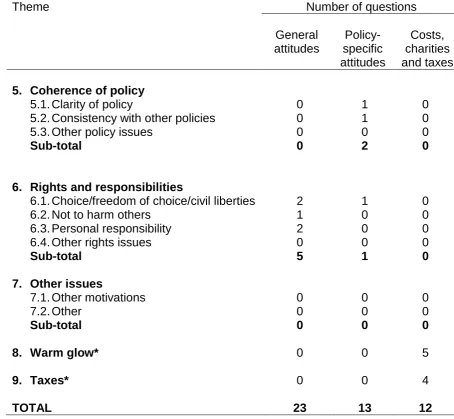
The use of these scales in the subsequent WTP work necessitated their grouping into three sets; 23 general statements, 13 policy specific statements and 12 relating to other issues (i.e. costs, charity and taxes). The precise reason for this is beyond the scope of this paper and does not impact on the interpretation of the results in this paper. A list of statements is given in Tables 3-5, whist a summary of how many statements related to each of the themes identified in the qualitative analysis is given in Table 6.
Population survey
Eight hundred and thirty one people were interviewed, with the sample showing marked differences with the general adult population in Sheffield and England and Wales as described by the 2001 census. The survey sample has a higher proportion of females, people over the age of 65, people holding degrees or equivalent qualifications, and a lower proportion of single people. Across the sample, approximately 200 responses were gathered for each of the four policy questions. The subsequent analyses are based on the full sample of 831, that is, data pooled across the four policy questions.
Factor analysis
The KMO statistic is 0.840 and Bartlett’s test gives a p-value of <0.001, both of which indicate that factor analysis is appropriate for these data (Field, 2005). Twelve factors are identified as having eigenvalues greater than 1, however, the scree plot indicates that a much smaller number can be identified before the values plateau (Figure 1). The mean communalities for the questions is 0.57, which together with the sample size, indicates that the scree test may be more appropriate as a way of identifying the number of factors (Stevens 2002). Examination of the scree plot indicates a four factor solution, with a relatively large fall in eigenvalues after this followed by a plateau.
loading is positive or negative, respectively). To help with interpretation, loadings under |0.45| have been omitted from the table.
Identifying a precise theme for the first factor is difficult, as it seems to reflect a respondent’s view that the named scheme is good or bad across several defining characteristics. It encapsulates notions of the scheme saving money, having no uncertainties, not affecting freedom of choice, being the best way to tackle the problem, etc. The statement with the highest loading on this factor is used to generate its label; “common sense”.
The second factor is defined by general attitudes and beliefs which were not directed toward the specific scheme under consideration. Interpretation of this factor is much clearer, with all statements relating to the role of government; this is labelled henceforth as “government”.
The third factor relates to four of the five questions that made up Nunes’ warm glow factor. The final attitude statement with a loading over |0.45| was not part of Nunes’ factor, but clearly does contain notions of ‘giving’ or ‘contribution’. Consequently, this factor is labelled henceforth as “warm glow”.
The fourth factor is more difficult to interpret, but appears to touch on the notion of rights and responsibilities; information for individuals, liberty and freedom from side-effects. The statements included predominantly reflect general attitudes and beliefs without reference to a specific scheme. This factor is labelled henceforth as “rights and responsibilities”.
The four factor solution did not change when the analysis was repeated without the imputation of missing attitude data. It is also important to consider the explanatory power of each factor as determined by the percentage of total variance explained. The “common sense” factor explains 13.8% of the variance, with “government”, “warm glow” and “rights and responsibilities” accounting for a further 7.7%, 5.2% and 5.0% of variance, respectively. These figures, which are related to the scree plot (Figure 1), highlight two issues. Firstly, “common sense” is clearly the most important factor, and secondly, as only 31.7% of the variance is explained by the four factors in combination, the factor solution leaves much of the variability in the attitude data unexplained.
The orthogonally rotated matrix for the twelve factor solution (i.e. those with
eigenvalues over 1) can be found at
factors relating to ‘common sense’, ‘warm glow’ and ‘government’ are largely unchanged, although the factor relating to ‘rights and responsibilities’ appears to split into factors relating to ‘rights’ (factor 5) and ‘responsibilities’ (factor 9). In total, the twelve factor solution explains 55% of the total variance in the attitude data, however, the explanatory power over and above the four factor solution is gained at the expense of a more complex interpretation of the latent constructs.
Qualitative analysis
The focus groups generated valuable data that were capable of being summarised into seven distinct themes. These themes were generated through a rigorous qualitative analysis based on the framework approach (Richie & Lewis, 2003), and supplemented with contrast charting as suggested by Miles and Huberman (1994). The coding framework was validated by an independent researcher, and through discussions with the Study Advisory Group.
Additionally, a clear audit trial is given linking the interview schedule to the identified themes and their associated attitude scales. Compared to the work of Nunes (2002) and Pouta (2004), the focus of the qualitative work within this study was less narrow, thereby allowing a greater range of issues to be covered by the attitude statements and factor analysis. Whether these improved methods lead to a more productive explanatory analysis of the associated WTP data will be discussed in a subsequent paper.
These methods represent a significant improvement on those used in the studies of Pouta (2004) and Nunes (2002). More specifically, in the work of Pouta the derivation of the attitudinal statements which form the basis of his study, is described in its entirety as:
“A separate systematic sample of 50 individuals selected from the telephone directory answered open-ended questions of the positive and negative outcomes of forest regeneration cuttings and their regulation in Finland. Based on these telephone interviews, belief statements in the main study were constructed for those beliefs that were determined to be the most salient” (Pouta, 2004).
Nunes (2002) only gives limited information on the two focus groups used in the preliminary stages of the survey design; no information relating to their structure and purpose is given. It appears that they were used more as informal testing grounds for ideas and survey materials, rather than as a formal data generating process (Nunes, 2002, p81).
It should also be noted that more widely within health economics the methods used in qualitative studies have been heavily criticised. Baker and Robinson (2005), for example, in a review of the qualitative research used to investigate WTP responses found that the qualitative methods were poorly reported making it difficult to assess the validity of the results.
The themes that are identified also show quite sophisticated thinking about health issues. Clearly the effects of policies were frequently raised, which is to be expected, but other issues are also considered important. Participants considered alternative interventions, uncertainties, the role of government, policy coherence and rights and responsibilities. All of these were used in the deliberations of individuals when asked to ‘vote’ on the policies.
The ‘ending question’ used in the questionnaire route highlighted several instances of complex reasoning that were employed by some participants to explain their stance on the issues. This provides support to the feasibility of respondents processing complex information presented to them in WTP surveys, and providing thoughtful (as opposed to affective) responses. However it needs to be recognised that the time available within a focus group for thought and reflection is likely to be greater than that in WTP surveys.
Several other pieces of work have looked at public health and compulsion using focus group or attitude scales in United Kingdom samples (British Broadcasting Corporation 2004a-d, Jochelson 2005, King’s Fund 2004, TRBI 2003, National Institute for Clinical Excellence 2005). It is not possible to make detailed comparisons of the different conclusions as the objectives, methods and depth of analysis vary between each. However, common issues are apparent relating to freedom of choice, individual responsibility, harm to others and side-effects. The National Institute for Clinical Excellence Citizen Council work (2005), which is perhaps closest in its policy context to the focus groups presented here, had further common elements relating to costs/savings, size of benefit, evidence/uncertainties and policy formation.
Finally, we need to assess whether the focus groups captured the full range of issues considered to be of importance by the population. Certainly, it may be the case that if we had undertaken more focus groups, other issues may have arisen. Saturation was achieved within the six groups therefore we can be reasonably confident that the important issues were captured within the sampling frame. It is, however, possible that the sample may not have been sufficiently representative to capture the range of views seen in the population, especially among the young.
It is also possible that the choice of heterogeneous groups – which in essence is what was used in order to be representative of the general population – may have restricted the range and depth of topics covered. An alternative approach would be to use a series of homogeneous groups (i.e. people from similar social groupings) which in aggregate would be representative. Morgan and Krueger (1998) suggest that this approach may produce a wider range and depth of information as the participants feel less concerned by ‘political correctness’ when among like-minded people.
Factor analysis
(e.g. ‘The government can be trusted with its health policies’), or attitudes toward a specific scheme as in factor 1 (e.g. ‘This policy will improve the health of the public’). This seems to indicate that we can separate out a respondent’s evaluation of the scheme itself into overarching attitudes and attitudes relating to the specific policy.
It is also interesting to note that the ‘common sense’ and ‘rights and responsibilities’ factors do not relate directly to any of the themes identified in the qualitative analysis of the focus group data. This discrepancy could be due to several reasons. Firstly, the translation of the qualitatively derived themes into the statements evaluated in the factor analysis may not have maintained the specificity of the original theme. In other words the statements that were constructed may include nuances that reduce the clarity of the intended construct. Secondly, the four factor solution may not be the best at reflecting the full latent structure of the data. Using the Kaiser criterion for factor selection produces a more complex twelve factor latent structure (Appendix 10). The 12 factor solution is captured by the following set of descriptions: common sense, warm glow, government, taxation, individual rights, no side-effects, bigger problem, benefits, individual responsibilities, individual inertia, civic duty and multifaceted approach.
Examination of the rotated component matrix for this solution
the factors from the preferred solution remain largely unaltered (i.e. ‘common sense’, ‘warm glow’ and ‘government’). However, a clearer structure is evident among the remaining factors that better reflects the results of the focus groups.
Conclusions
The focus group work described in this paper adopts a rigorous qualitative approach. This showed that across individuals, coherent themes relating to public health and compulsion, can be identified. Seven themes were identified from the focus groups relating to the effects of policy, alternatives, the role of government, uncertainties, coherence of policy, rights and responsibilities, and other issues. These themes were then translated into attitudinal scales consisting of 48 statements, which were then surveyed in a general population sample and found to describe 4 latent factors; ‘common sense’, ‘government’, ‘warm glow’ and ‘rights and responsibilities’.
This work has been used in a subsequent analysis of WTP responses by using the attitudinal scales in an attempt to elicit better informed preferences and explain responses in terms of underlying attitudes and ‘warm glow’. The results of this work are reported in separate paper. However, the work reported here is valuable in its own right, as it shows that the work of Nunes (2002) and Pouta (2004) is potentially generalisable to other topic areas and that the methods can be improved upon.
References
Arrow, K., Solow, R., Portney, P., Leamer, E., Radner, R., & Schuman, H. (1993). Report of the NOAA Panel on Contingent Valuation. Federal Register, 58(10), 4601-4614.
Baker, R., Robinson, A., & Smith, R. (2008). How do respondents answer WTP questions? A review of the qualitative evidence. Journal of Socio-Economics, 37(4), 1427-1442.
Baron, J. (1997). Biases in the quantitative measurement of values for public decisions. Psychological Bulletin, 122(1), 72-88.
British Broadcasting Corporation. (2004a). Public in two minds over health, from
British Broadcasting Corporation. (2004b). UK public want a nanny state, from
British Broadcasting Corporation. (2004c). Call for cut-price veg, from
British Broadcasting Corporation. (2004d). Smokers 'should not get NHS care',
from
Dixon, S., & Shackley, P. (2003). The use of willingness to pay to assess public preferences towards the fortification of foodstuffs with folic acid. Health
Expectations, 6, 140-148.
Field, A. (2005). Discovering statistics using SPSS. 2nd edition. London: Sage publications.
Jochelson, K. (2005). Nanny or steward? The role of government in public health. London: King's Fund.
King'sFund. (2004). Public attitudes to public health policy. London: King's Fund.
Miles, M., & Huberman, A. (1994). Qualitative data analysis: an expanded
sourcebook (2nd ed.). London: Sage.
Mitchell, R., & Carson, R. (1989). Using surveys to value public goods: The
contingent valuation method. Washington, DC: Resources for the future.
Morgan, D., & Krueger, R. (1998). The focus group kit. London: Sage publications.
National Institute for Clinical Excellence. (2005). NICE Citizens Council Report.
Mandatory public health measures. London: National Institute for Clinical
Nunes, P. (2002). The contingent valuation of natural parks: assessing the
warmglow propensity factor. Cheltenham: Edward Elgar.
Nunes, P., & Schokkaert, E. (2003). Identifying the warm glow effect in contingent
valuation. Journal of Environmental Economics and Management, 45, 231-245.
Olsen, J., & Smith, R. (2001). Theory versus practice: a review of
'willingness-to-pay' in health and health care. Health Economics, 10, 39-52.
Pouta, E. (2004). Attitude and belief questions as a source of context effect in a contingent valuation survey. Journal of Economic Psychology, 25, 229-242.
Richie, J., & Lewis, J. (Eds.). (2003). Qualitative research practice. London: Sage.
Shackley, P., & Dixon, S. (2000). Using contingent valuation to elicit public preferences for water fluoridation. Applied Economics, 32, 777-787.
Stevens, J. (2002). Applied multivariate statistics for the social sciences. 4th
edition. London: Lawrence Erlbaum Associates Publishers.
TRBI. (2003). Attitudes towards public health issues, from
Tables, Boxes and Figures
Table 1: Questioning route
Question Question types Why?
Tell us your name and where you live Opening
What do you think is the biggest health problem facing everyone today?
Introduction Get them all to talk.
What should the government do to improve the health of the public?
Transition Get them to think
about health, the public, and government
responses. The sheet in front of you shows a
possible public health scheme. Take a minute to read it.
What do you think of this policy? Key Get them to think
about specific policies
Repeat for other public health scheme Key
Do you think that these two schemes are similar in any ways?
Key Get them to think
more deeply about commonalities.
If you had to vote on whether these schemes went ahead, what would be the main two factors that would help you make your mind?
Ending Get them to think
Table 2: Final coding framework
Codes and titles for themes
1. Effects of policy
1.1. Nature of the benefits (size/type) 1.2. Side-effects
1.3. Financial consequences 1.3.1. Costs
1.3.2. Savings
1.4. Balance of benefits and disbenefits 1.5. Other effects
2. Alternatives
2.1. Alternative causes more important (or part of a more complex problem) 2.2. Alternative problems more important
2.3. Alternative interventions better 2.3.1. Health education/information 2.3.2. More targeted approach 2.3.3. Prevention is better than cure
2.4. Other alternatives to the underlying logic of the scheme
3. Role of government
3.1. Enabling policies (e.g. subsidies, public awareness) 3.2. Compulsion/regulation
3.3. Scepticism of government 3.4. Nanny state
3.5. Prevent harm of individuals 3.6. Other roles
4. Uncertainties
4.1. Side-effects/safety 4.2. Distrust of science 4.3. More research needed
4.4. Feasibility in the real world (+/-) 4.5. Unforeseen consequences
4.6. Other issues relating to certainty/uncertainty of effects
Table 2: Final coding framework (cont…)
Codes and titles for themes
5. Coherence of policy 5.1. Clarity of policy
5.2. Consistency with other policies 5.3. Other policy issues
6. Rights and responsibilities
6.1. Choice/freedom of choice/civil liberties 6.1.1. Absolute
6.1.2. Relative, i.e. degree of limitation 6.2. Not to harm others
6.3. Personal responsibility 6.4. Other rights issues
7. Other issues
Table 3: Final list of statements conveying general issues relating to public health
1. The main issue with any health policy is how many people will benefit
2. Saving lives or relieving suffering are the main considerations when assessing any health policy
3. When treating the whole population, there should be no potential side-effects what-so-ever
4. All health interventions require us to balance advantages and disadvantages 5. When treating the population, side-effects are okay as long as the positive
effects outweigh them
6. Poor health is caused by many factors
7. When tackling a health problem, a single approach or policy is not especially useful
8. The best approach to tackling large scale health problems is the provision of more information to promote healthy behaviour
9. The best way the government can improve health is to help people to help themselves
10. Individuals can not be trusted to change, so government intervention is worth considering
11. Legislation can be a good way to change people’s behaviour 12. The government can be trusted with its health policies
13. It’s not the government’s job to tell people what to do 14. The government should stop people harming themselves 15. The government should stop people harming others
16. We need to be absolutely certain about all potential side-effects before implementing any health policy
17. Scientific studies of health problems and possible treatments are generally trustworthy
18. A big problem with treating the whole population are the unintended consequences of the schemes
19. Treating the whole population can be a good idea even if it infringes people’s freedom of choice
20. I have the right to choose whether I participate in any health programme 21. My actions should not harm others in any way
Table 4: Final list of statements conveying issues relating to a specific public health policy
1. This policy will improve the health
2. Overall, the advantages of this policy outweigh the disadvantages
3. This health problem is part of a much larger problem which needs to be tackled 4. This tackles a very important problem
5. Providing more information to people on this health problem would be a better way forward
6. This health problem is a good thing for the government to be getting involved with
7. I think that there are a lot of uncertainties with this policy
8. I have a lot of faith in the figures presented, and the science behind them 9. More research is needed on this before it’s implemented
10. This policy would be easy to introduce 11. This policy is common sense
12. This policy doesn’t fit in with other things that are done
13. This policy will have very little impact on my freedom of choice
Table 5: Final list of cost, charity and tax statements
1. The financial cost of this intervention will be very high
2. The intervention will generate a lot of savings due to improved health 3. This tackles a very important problem
4. There are some charity campaigns to which I feel very close and do not hesitate in making contributions
5. I’m more than happy to contribute to good causes 6. I admire people who are active members of charities
7. I take pride in helping others with even the most trivial things 8. It is difficult for me to refuse to help people who beg for charity
9. Additional taxes are needed if we are to provide more health programmes 10. Tax is the fairest way of funding public services
11. The NHS needs taxes to survive
Table 6: Numbers of statements relating to each theme identified from the qualitative analysis of the focus groups
Theme Number of questions
General attitudes
Policy-specific attitudes
Costs, charities and taxes
1. Effects of policy
1.1. Nature of the benefits (size/type) 2 1 0
1.2. Side-effects 1 0 0
1.3. Financial consequences 0 0 2
1.4. Balance of benefits and disbenefits 2 1 0
1.5. Other effects 0 0 0
Sub-total 5 2 2 2. Alternatives
2.1. Alternative causes more important (or part of a more complex problem)
2 1 0
2.2. Alternative problems more important 0 0 1
2.3. Alternative interventions better 1 2 0
2.4. Other alternatives to the underlying logic of the scheme
0 0 0
Sub-total 3 3 1 3. Role of government
3.1. Enabling policies (e.g. subsidies, public awareness)
1 0 0
3.2. Compulsion/regulation 2 0 0
3.3. Scepticism of government 1 0 0
3.4. Nanny state 2 1 0
3.5. Prevent harm of individuals 1 0 0
3.6. Other roles 0 0 0
Sub-total 7 1 0 4. Uncertainties
4.1. Side-effects/safety 1 1 0
4.2. Distrust of science 1 1 0
4.3. More research needed 0 1 0
4.4. Feasibility in the real world (+/-) 0 1 0
4.5. Unforeseen consequences 1 0 0
4.6. Other issues relating to
certainty/uncertainty of effects
0 0 0
Sub-total 3 4 0
Table 6: Numbers of statements relating to each theme identified from the qualitative analysis of the focus groups (cont…)
Theme Number of questions
General attitudes
Policy-specific attitudes
Costs, charities and taxes
5. Coherence of policy
5.1. Clarity of policy 0 1 0
5.2. Consistency with other policies 0 1 0
5.3. Other policy issues 0 0 0
Sub-total 0 2 0
6. Rights and responsibilities
6.1. Choice/freedom of choice/civil liberties 2 1 0
6.2. Not to harm others 1 0 0
6.3. Personal responsibility 2 0 0
6.4. Other rights issues 0 0 0
Sub-total 5 1 0 7. Other issues
7.1. Other motivations 0 0 0
7.2. Other 0 0 0
Sub-total 0 0 0 8. Warm glow* 0 0 5
9. Taxes* 0 0 4
TOTAL 23 13 12
Table 7: Rotated Component Matrix of the orthogonal rotation of the four factor solution
Component
1 2 3 4
This policy is common sense (S) .818
Overall, the advantages of this policy outweigh the
disadvantages (S) .817
This policy will improve the public health (S) .762
There are better ways of tackling this health problem (S) -.737
I think that there are a lot of uncertainties with this policy (S) -.726 I have a lot of faith in the figures presented, and the science
behind them (S) .701
The policy will generate a lot of savings due to improved
health (S) .593
More research is needed on this before it's implemented (S) -.570 .485
This policy tackles a very important problem (S) .563
This policy will have very little impact on my freedom of
choice (S) .480
This policy would be easy to introduce (S)
Treating the whole population can be a good idea even if it
affects people's freedom of choice (G) .577
The government can be trusted with its health policies (G) .563
New laws can be a good way to change people's behaviour
(G) .556
The government should try to stop lifestyles that cause poor
health (G) .535
Additional taxes are needed if we are to provide more health
programmes (O) .470
The NHS needs taxes to survive (O)
Tax is the fairest way of funding public services (O)
Scientific studies of health issues are generally trustworthy (G)
It's not the government's job to tell people what to do (G)
When treating the whole population, side-effects are okay as long as the positive effects outweigh them (G)
Nobody is totally responsible for their own health (G)
% Total variance explained 13.8 7.7 5.2 5.0
Note:
(S) signifies that the statement relates to the specific policy described to the respondent. (G) signifies that the statement relates to general issues relating to public health.
Table 7 (cont…): Rotated component matrix of the orthogonal rotation of the four factor solution
Component
1 2 3 4
The best way the government can improve health is to help people to help themselves (G)
Individuals can not be trusted to change unhealthy behaviours (G)
When tackling a health problem, a single approach or policy is not especially useful (G)
I'm more than happy to contribute to good causes (O) .746
I admire people who are active members of charities (O) .708
There are some charity campaigns to which I feel very close
and do not hesitate in making contributions (O) .631
I am happy with myself whenever I give a donation to fund
raising campaigns (O) .615
I don't mind paying taxes if the money is well spent (O) .471
It is difficult for me to refuse to help people who beg for charity (O)
Providing more information to people on this health problem
would be a better way forward (G) .575
I have the right to live in any way I wish (G) .521
We need to be absolutely certain about all potential
side-effects before implementing any health policy (G) .488
All that matters about a new health policy is that it improves
people's health (G) .482
When treating the whole population, there should be no
potential side-effects what-so-ever (G) .481
The best approach to promoting healthy behaviour is the provision of more information (G)
The main issue with any health policy is how many people will benefit (G)
Individual responsibility is the key to good health (G)
This health problem is part of a much larger problem which needs to be tackled (S)
The financial cost of this policy will be very high (O)
All health policies require us to balance advantages and disadvantages (G)
% Total variance explained 13.8 7.7 5.2 5.0
Note:
(S) signifies that the statement relates to the specific policy described to the respondent. (G) signifies that the statement relates to general issues relating to public health.
[image:35.595.80.530.106.665.2]Box 1: Policy description of the fluoridation of water
Fluoridation of water
In Sheffield/Bakewell, children typically have 2 or 3 teeth that are decayed, missing or filled. For adults, the number of decayed, missing or filled teeth is around 17.
Adding fluoride to water in Sheffield would halve the number of decayed, missing or filled teeth for children and adults in the future. These improvements will be greater in the poorer areas of Sheffield.
There is a very small chance that, for a few people, adding fluoride to water could cause small white patches to appear on some teeth.
Fluoride is a naturally occurring substance that is already present in very small quantities in water supplies. Adding fluoride to water does not affect its taste. Fluoride also has no effect on household equipment such as kettles and washing machines.
Box 2: Policy description of the fortification of food with folic acid
Fortification of food with folic acid
Every year around 180 babies in the United Kingdom are born with neural tube defects. Many of these babies die within a few days of birth. The others have a range of problems ranging from mild to severe disability.
Adding folic acid to food will reduce the number of babies being born with neural tube defects by about 74 every year.
If this goes ahead, the treatment of another disease - vitamin B12 deficiency –will be made more difficult. This could lead to some elderly people getting feelings of numbness in the arms and legs. Many doctors feel that this is can be avoided. The taste and appearance of food will not be altered in any way by the addition of folic acid.
Box 3: Policy description of banning smoking in public places
Banning smoking in public places
In adults, passive smoking increases the risk of lung cancer by around 25 per cent and the risk of heart disease by 30 per cent. In children, passive smoking increases the risk of chest illnesses, asthma and cot death.
At least one thousand people are estimated to die each year in the UK as the result of exposure to other people's tobacco smoke.
For most people, public places are the main source of exposure to second-hand smoke.
Box 4: Policy description of 20 miles per hour urban speed limits
20 miles an hour urban speed limits
The chance of a pedestrian being seriously injured or killed if struck by a car is 45% if the car is travelling at 30 miles per hour (mph). This is reduced to 5% if the care is travelling at 20 mph.
Figure 1: Scree plot of eigenvalues for all factors identified from the attitude and belief statements
1 3 5 7 9 11 13 15 17 19 21 23 25 27 29 31 33 35 37 39 41
Component Number
0 1 2 3 4 5 6
E
igenval