UNIVERSITI TEKNIKAL MALAYSIA MELAKA
TENSILE BEHAVIOR STUDY OF POLYPROPYLENE AT
DIFFERENT ASH LOADING
This report submitted in accordance with requirement of the University Teknikal Malaysia Melaka (UTeM) for the Bachelor Degree of Engineering Technology
(Process and Technology) (Hons.)
by
SITI NAJIHAH BINTI ROSLI B071410352
950126-04-5546
i
** Jika Laporan PSM ini SULIT atau TERHAD, sila lampirkan surat daripada pihak berkuasa/organisasi berkenaan dengan menyatakan sekali sebab dan tempoh laporan PSM ini perlu dikelaskan sebagai SULIT atau TERHAD.
UNIVERSITI TEKNIKAL MALAYSIA MELAKA
BORANG PENGESAHAN STATUS LAPORAN PROJEK SARJANA MUDA
TAJUK: TENSILE BEHAVIOR STUDY OF POLYPROPYLENE AT DIFFERENT ASH LOADING
SESI PENGAJIAN: 2017/18 Semester 1
Saya SITI NAJIHAH BINTI ROSLI
mengaku membenarkan Laporan PSM ini disimpan di Perpustakaan Universiti Teknikal Malaysia Melaka (UTeM) dengan syarat-syarat kegunaan seperti berikut:
1. Laporan PSM adalah hak milik Universiti Teknikal Malaysia Melaka dan penulis. 2. Perpustakaan Universiti Teknikal Malaysia Melaka dibenarkan membuat salinan
untuk tujuan pengajian sahaja dengan izin penulis.
3. Perpustakaan dibenarkan membuat salinan laporan PSM ini sebagai bahan pertukaran antara institusi pengajian tinggi.
4. **Sila tandakan ( )
(Mengandungi maklumat yang berdarjah keselamatan atau
kepentingan Malaysia sebagaimana yang termaktub dalam AKTA RAHSIA RASMI 1972)
(Mengandungi maklumat TERHAD yang telah ditentukan oleh organisasi/badan di mana penyelidikan dijalankan)
SULIT
TERHAD
TIDAK TERHAD
Alamat Tetap:
507-3, LORONG BUKIT PIATU 5, 75150, MELAKA
Tarikh:
Disahkan oleh:
Cop Rasmi:
ii
DECLARATION
I hereby, declared this report entitled “The tensile behaviour study of polypropylene at different ash loading” is the results of my own research except as cited in
references.
Signature : ……….
Author’s Name : Siti Najihah Binti Rosli
iii
APPROVAL
This report is submitted to the Faculty of Engineering Technology of UTeM as a partial fulfillment of the requirements for the degree of Bachelor of Engineering Technology (Process and Technology) with Honours. The member of the supervisory is as follow:
iv
ABSTRACT
v
ABSTRAK
Hari ini, pengeluaran komposit polimer sering melibatkan pelaburan besar dalam pencapaian bahan. Pengeluaran polimer terkenal kerana berat yang ringan, kelembapan dalam bentuk apa pun, bersifat tidak merosakkan, campuran warna, gantian aplikasi kayu tumbuhan untuk perabot rumah tangga atau boleh diguna semula dan sebagainya. Satu cara untuk mengurangkan kos pengeluaran tetapi masih mengekalkan sifat komposit adalah dengan menggunakan pengisi seperti abu arang batu. Abu arang batu telah dipilih kerana ketersediaan, kos rendah, kepadatan rendah dan kitar semula. Kajian ini memberi tumpuan kepada kesan tegangan untuk polipropilena pada pemuatan pengisi abu yang berbeza. Untuk menghasilkan sebatian bahan, komposisi yang berbeza telah dikaji untuk meningkatkan sifat fizikal dan mekaniknya. Perumusan penggabungan optimum bahan sebatian diperhatikan pada gabungan polipropilena dan abu arang batu berdasarkan 100 wt. % daripada polipropilena (PP) dan sebilangan besar abu arang batu (CA) pada 1, 2, 5, 7 dan 10 wt. %. Bagi meningkatkan interaksi interfacial antara PP dan CA, asid stearik digunakan sebagai agen gandingan pada komposisi 1 wt. %. Komponen bahan tersebut menjalani
proses pengkompaunan menggunakan acuan mampatan panas pada 190 ℃ dan
vi
DEDICATION
Specially dedicated to
vii
ACKNOWLEDGEMENT
Alhamdulillah, I would like to express our thankfulness to Allah S.W.T for giving me all the strength in fulfilling and completely this final year project.
I would like to thank everyone who had contributed to the successful completion of this project. I would like to express my gratitude to my supervisor, Mr. Hairul Effendy bin Ab Maulod for his advice, guidance and his enormous patience throughout the development of the research. I also like to thank to the staffs and lab asisstance of UTeM especially Mr. Azizul Ikhwan bin Mohd and Mr. Mohd Syafiq bin Ismail who had given me a lot of assistance and advice during the course of the project.
viii
TABLE OF CONTENTS
Declaration ... II Approval ...III Abstract ... IV Abstrak ... V Dedication ... VI Acknowledgement ... VII Table of Contents ... VIII List of Table ... XI List of Figures ... XII List of Equation ... XIV List of Abbreviations, Symbols and Nomenclature ... XV
CHAPTER 1 ... 1
INTRODUCTION ... 1
1.0 Introduction ... 1
1.1 Research Background... 1
1.2 Problem Statement ... 2
1.3 Objectives ... 3
1.4 Scopes ... 3
1.5 Organization of research study... 4
CHAPTER 2 ... 5
LITERATURE REVIEW ... 5
2.0 Introduction ... 5
2.1 Polymers ... 5
2.1.1 Historical development of polymer ... 5
2.1.2 Description and concept of polymer ... 6
2.1.3 Classification of polymer ... 8
2.2 Thermoplastics ... 9
ix
2.3.1 Structure of polypropylene ... 11
2.3.2 Properties of polypropylene ... 12
2.3.3 Types of polypropylene... 14
2.3.4 Application of polypropylene ... 15
2.3.5 Reinforcement of polypropylene ... 16
2.4 Fillers ... 17
2.4.1 Organic Filler ... 18
2.4.2 Inorganic Filler ... 19
2.5 Kenaf ... 19
2.6 Rice husk ash ... 22
2.7 Eggshell ... 24
2.8 Fly Ash ... 25
CHAPTER 3 ... 28
METHODOLOGY ... 28
3.0 Introduction ... 28
3.1 Methodology ... 28
3.1.1 Flow Chart of Methodology ... 29
3.2 Gantt Chart ... 31
3.3 Material Preparation ... 32
3.3.1 Preparation of Polypropylene ... 32
3.3.2 Preparation of Coal Ash ... 33
3.3.3 Preparation of Stearic Acid ... 33
3.4 Compounding ... 34
3.4.1 Preparation of Polypropylene with Coal Ash... 34
3.5 Sample Fabrication... 34
3.5.1 Hot Compression Molding ... 34
3.5.2 Crushing the Compound PP/CA ... 36
3.6 Machining Process ... 37
3.7 Mechanical Testing ... 38
3.7.1 Tensile Test ... 38
3.7.2 Density Measurement... 40
3.8 Analysis ... 41
x
CHAPTER 4 ... 42
RESULTS AND DISCUSSIONS ... 42
4.0 Introduction ... 42
4.1 Tensile test analysis... 42
4.1.1 Tensile test analysis for tensile stress versus tensile strain ... 43
4.1.2 Discussion for tensile test ... 50
4.2 Density ... 53
4.2.1 Density test result between different coal ash percent ... 53
4.2.2 Discussion for density ... 54
4.3 Morphological analysis ... 55
CHAPTER 5 ... 59
CONCLUSION AND RECOMMENDATION ... 59
5.1 Summary of research... 59
5.2 Recommendations ... 60
xi
LIST OF TABLE
Table 2.1: Typical properties of polypropylene ... 13
Table 2.2: Chemical families of fillers ... 17
Table 2.3: Particles morphology of fillers... 18
Table 2.4: Tensile and flexural test parameters ... 21
Table 2.5: Mechanical properties derived from tensile and flexural tests ... 21
Table 4.1: Tensile results for control sample ... 44
Table 4.11: Sample 1 tensile results for PP with 1% CA ... 45
Table 4.12: Sample 2 tensile results for PP with 2% CA ... 46
Table 4.13: Sample 3 tensile results for PP with 5% CA ... 47
Table 4.14: Sample 4 tensile results for PP with 7% CA ... 48
Table 4.15: Sample 5 tensile results for PP with 10% CA ... 49
xii
LIST OF FIGURES
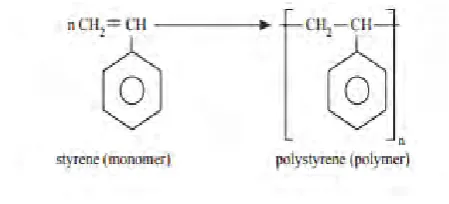
Figure 2.1 : Formation of polymer polystyrene (Ebewele 2000) ... 7
Figure 2.2: Molecular structure of thermoplastics ... 9
Figure 2.3: Schematic illustration of PP (Stern n.d.) ... 11
Figure 2.4: Utilization of isotactic polypropylene (i-PP) due to its applications ... 15
Figure 2.5: Kenaf plants ... 20
Figure 2.6: Rice husk ash ... 22
Figure 2.7: The tensile strengths of the composites at different filler loadings, crosshead speeds and test temperatures ... 23
Figure 2.8: Schematic of different parts of egg structure... 24
Figure 2.9: Tensile strength comparison of different composites ... 25
Figure 2.10: Stress-strain of PP and composites at test temperature ... 27
Figure 3.1: Flow chart ... 30
Figure 3.2: Polypropylene ... 32
Figure 3.3: Coal Ash ... 33
Figure 3.4: Stearic Acid ... 33
Figure 3.5: Hot Press Compressing Machine ... 35
Figure 3.7: Crushing material ... 36
Figure 3.8: Cutting Process using Waterjet Machine ... 37
Figure 3.9: Result after cutting process... 37
Figure 3.11: Standard specification of sample dimension according ASTM D638 .. 38
Figure 3.10: Tensile testing machine ... 39
Figure 3.12: Densimeter (MD-300S) ... 40
Figure 3.13: Optical Microscope... 41
Figure 3.14: Example of microphotograph of coal ash ... 41
Figure 4.1: Tensile Fracture Sample Specimen ... 43
Figure 4.2: Graph of tensile stress versus tensile strain for control sample ... 44
xiii
Figure 4.22: Graph of Sample 2 tensile stress versus tensile strain for PP with 2% CA
... 46
Figure 4.23: Graph of Sample 3 tensile stress versus tensile strain for PP with 5% CA ... 47
Figure 4.24: Graph of Sample 4 tensile stress versus tensile strain for PP with 7% CA ... 48
Figure 4.25: Graph of Sample 5 tensile stress versus tensile strain for PP with ... 49
10% CA ... 49
Figure 4.3: Ultimate tensile strength with different composition of coal ash ... 50
Figure 4.31: Tensile modulus with different composition of coal ash ... 51
Figure 4.32: Maximum load with different composition of coal ash ... 52
Figure 4.4: Graph for density ... 54
Figure 4.5: Control sample ... 55
Figure 4.51: Fracture surface of 1 wt. % CA ... 56
Figure 4.52: Fracture surface of 2 wt. % CA ... 57
Figure 4.54: Fracture surface of 7 wt. % CA ... 58
xiv
LIST OF EQUATION
xv
LIST OF ABBREVIATIONS, SYMBOLS AND
NOMENCLATURE
Al2O3 - Aluminium Oxide
ASTM - American Society for Testing and Materials
BTU - British thermal unit
C - Carbon
CA - Coal Ash
CaCO3 - Calcium Carbonate
CESP - Calcinated Eggshell Powder
ES - Eggshell
ESP - Eggshell Powder
FA - Fly Ash
FeO/Fe2O3 - Iron Oxide Powder Synthetic Ferrous Oxide
g - Grams
kg - Kilograms
MgO - Magnesium Oxide
Mg (OH) 2 - Magnesium Hydroxide
OM - Optical Microscope
PHP - Per Hundred Polypropylene
PP - Polypropylene
PP/ESP - Polypropylene Eggshell Powder Composite
RHA - Rice Husk Ash
Sb2O3 - Antimony Trioxide
SiO2 - Silicon Dioxide
U.S - United State
UTM - Universal Testing Machine
ZnO - Zinc Oxide
$ - Dollar
% - Percentage
xvi
℉ - Fahrenheit
σ - Stress
ϵ - Strain
wt % - Weight Rates
ft - Feet
in - Inch
lb - Pound
kpsi - Kilo pound per square inch
kHz - Kilo Hertz
1
CHAPTER 1
INTRODUCTION
1.0 Introduction
This chapter will explain the overview and the purpose of this study. This chapter includes the background of the study, problem statement, objectives that is expected to be achieved and the scope of the study that is going to be conducted.
1.1 Research Background
During the previous decades, numerous polymer composites have been arranged joined with different sorts of strengthening fillers to enhance the mechanical properties and acquire the qualities requested in actual applications. The employments of characteristic filler for the reinforcement has gotten expanding consideration in industry division. Regular filler have numerous essential points of interest, for example, their low density, low economical costs, and capacity to reduce scratched of machine (Rale, S D, 2012). The expansion of different sorts of filler is known to essentially impact the crystallinity of polymers filling in as the structure materials, hence influencing the mechanical properties of composites.
2
fabric (Oljaric, Steven, 2009). Filler-reinforced polypropylene has been a famous due to versatility of the polypropylene to accept numerous forms of fillers and reinforcements. Fillers which merely growth bulk extent consequently reduce fee, are called extender fillers while the ones enhance mechanical residences specifically tensile strength are termed as reinforcing fillers (Yang, Han-seung, 2004).
This study is focusing on tensile behavior study for polypropylene at different ash filler loading. Productions of polymer composite often involve huge investment in material achievement. One way of reducing the production cost but still maintaining the properties of the composite is by using natural filler such as coal ash. Coal ash had been choose due their availability, low cost, low density, high specific strength and modulus, and recyclability. Polypropylene is mixed with hot press at around 190°C. The compound later crushed by using crusher machine. Afterwards, the samples will undergone tensile behavior using universal tensile machine.
At the end of this project, expected result is to perform tensile results of polypropylene with filler coal ash compound and to present tensile strengths according to the filler coal ash compound.
1.2 Problem Statement
3
Polypropylene require reinforcement or filler with a specific end goal to diminish the creation expenses of formed items and also enhancing the mechanical properties, for example, quality, inflexibility, toughness and hardness. Polypropylene mostly utilize inorganic fillers which is comprising of minerals. Coal ash is extremely appropriate as a filler since it is comprised of 95% of the mineral matter present in coal which is made out of mud, pyrite and calcite. So that, filler from inorganic mineral can be blended with polypropylene as they can diminish consumes from landfills so as to enhance mechanical properties in real applications.
In the current work, the formulation of polypropylene mixing with modified coal ash compound had been studied. Furthermore, the effect of tensile behavior of polypropylene with coal ash compound as a filler will be tested to get the best formulation on the mixing of polypropylene with coal ash compound.
1.3 Objectives
The objectives of this study can be outlined as the following:
i. To study current formulation of Polypropylene (PP) with Coal Ash (CA) compound
ii. To prepare Polypropylene (PP) with filler Coal Ash (CA) compound.
iii. To study the effect of the tensile behavior of Polypropylene (PP) with Coal Ash (CA) compound.
1.4 Scopes
4
1.5 Organization of research study
This study has been composed into 5 sections that represent the methodical and experimental research performed. Chapter 1 is a prologue to the present review that clarify about objectives, problem statement, significant of study and the thesis overview.
Chapter 2 starts on the writing literature background of this study. It talks about importance of polymer composites in Malaysia and the sorts of fillers utilized as a part of polypropylene. The essential component that incorporate into this section is the impact of mechanical properties for polypropylene at different ash filler loading.
5
CHAPTER 2
LITERATURE REVIEW
2.0 Introduction
This chapter describes about all findings gained from many literature review, which may gotten from the internet, journals, articles and books about the topic related with this study. This section involves findings about the overview of polypropylene (PP), and some type of fillers which are utilized in polypropylene (PP).
2.1 Polymers
2.1.1 Historical development of polymer
6
complete tribute to man's inventiveness and creativity. As we should see in following discussions, the utilization of polymeric materials has encompassed each the feature of our lives. It is difficult to imagine the present world with all its magnificence and comfort without man-made polymeric materials.
The 1970s saw the presentation of new plastics which is thermoplastic polyesters (outside car parts, bottles), high-barrier nitrile resins, and the signified of high-temperature plastics, including such materials as polyphenylene, sulphide, polyether sulfone, and so on (Ebewele, Robert O., 2000). The high-temperature plastics were at first created to meet the requests of the aerospace and aircraft industries. Today, in any case, they have moved into business areas that require their capacity to work constantly at high temperatures.
In the years ahead, polymers will keep on growing. The development, from all signs, will be most certainly not just from the advancement of new polymers, yet in addition to the substance and physical adjustment of existing ones. Additionally, enhanced manufacture strategies will bring about minimal effort items. Today the difficulties of reusing postured by natural issues have prompted encourage improvements including alloying and mixing of plastics to distribute a several variety of usable materials from what have up to this point been thought about consumes.
2.1.2 Description and concept of polymer
7
Figure 2.1 : Formation of polymer polystyrene (Ebewele 2000)
According to Figure 2.1, the styrene atom contains a double bond. Scientific experts have conceived techniques for opening this double a bond so that truly a large number of styrene particles end up noticeably connected together (Ebewele 2000). The subsequent structure, polystyrene enclosed in square sections, polystyrene. Styrene itself is stated to as a monomer, which is characterised as any atom that can be changed over to a polymer by joining with different particles of the same or different type. The unit in square sections is known as the repeating unit. So that the structure of the repeating unit is not precisely the same as that of the monomer despite the fact that both have indistinguishable particles possessing comparative relative positions. On behalf of polystyrene, the polymer is developed from a particular monomer (styrene) and, subsequently, the basic unit of the polystyrene chain is the same as its rehashing unit. Different cases of polymers of this type are polyethene, polyacrylonitrile, and polypropylene. At the same time, a few polymers are developed from the common reaction of at least two monomers that are artificially comparable but not indistinguishable. From example in Equation 2.1, formation of poly (hexamethylene adipamide) is made of the reaction of hexamethylenediamine and adipic acid.