Int. J. Electrochem. Sci., 9 (2014) 1139 - 1145
International Journal of
ELECTROCHEMICAL
SCIENCE
www.electrochemsci.org
Short communication
Electrochemical Detection of Nitrite Based on Difference of
Surface Charge of
Self-Assembled Monolayers
Zhiyong Wang*, Xiaoli Liu, Mangxin Yang, Shuqi An, Xiangcao Han, Wenxiang Zhao, Zhixue Ji, Xiaohuang Zhao, Ning Xia*, Xiaohuan Yang, Mengyuan Zhong
College of Chemistry and Chemical Engineering, Anyang Normal University, Anyang, Henan 455000, People's Republic of China
*
E-mail: [email protected] (Z.W.); [email protected] (N.X.)
Received: 26 October 2013 / Accepted: 13 November 2013 / Published: 5 January 2014
In this work, we reported a simple and sensitive electrochemical method for nitrite detection via Griess reaction. Specifically, naphthylethylenediamine (NEA) was immobilized onto the gold electrode to form positively charged self-assembled monolayers (SAMs). The positive charges on electrode facilitated the access of the negatively charged [Fe(CN)6]3−/4− probes to the electrode surface. The
nitrite-mediated Griess reaction between NEA and sulphanilic acid (SA) on the electrode surface leaded to the formation of negatively charged SAMs, which produced a barrier for the electron transfer between the redox probe and the electrode. The results were demonstrated by cyclic voltammetry and electrochemical impedance spectroscopy. The increase in the impedance of NEA-modified electrodes is proportional to the increase of nitrite concentration. A detection limit of 20 nM for nitrite detection was achieved.
Keywords: nitrite; electrochemistry; Griess reaction; self-assembled monolayers
1. INTRODUCTION
Nitrite (NO2−) is important in biochemistry as a source of the potent vasodilator nitric oxide. It
and ion chromatography are usually time-consuming, lack sensitivity and/or require complicated instruments [4,6-8]. Therefore, there remains significant room for the development of a theoretically and technically simple approach for nitrite detection.
In recent years, electrochemical sensor has been shown to be a promising alternative to mass- and fluorescence-based sensors for the specific detection of metal ions, biomolecules and small-molecule organic chemicals in view of its high sensitivity, simplicity, rapid response, and compatibility with miniaturization. Self-assembled monolayers (SAMs) are an inexpensive and versatile surface coating for molecular recognition for sensors. It is well known that the terminal groups of SAMs have a great impact on the redox response and electron-transfer resistance of redox probes in aqueous solutions due to the electrostatic interaction between the terminal groups and ionic redox species [9]. For example, the voltammetric response of [Fe(CN)6]3−/4− at the SAM-modified
electrode is decreased in the order of the terminal group NH2 > OH > COOH, while the response of
[Ru(NH3)6]3+/2+ is increased in the order of NH2 < OH < COOH [10]. Based on these properties, the electrostatic binding of redox-active metal cations (e.g., [Fe(CN)6]3-, [Ru(NH3)6]3+) to surface charge has been widely used to detect nucleic acids, proteins and small molecules [11-15]. In the present work, we reported a simple and sensitive electrochemical method for nitrite detection based on the charge change of SAMs on gold electrode.
2. EXPERIMENTAL
2.1 Chemicals and reagents
6-Mercaptohexanoic acid (MHA), 1-ethyl-3-[3-dimethylaminopropyl]carbodiimide hydrochloride (EDC), sulphanilic acid (SA) and naphthylethylenediamine (NEA) were obtained from Sigma-Aldrich. Calf serum was purchased from Sangon Biotech. Co., Ltd. (Shanghai, China). Other reagents were of analytical grade and obtained from Beijing Chemical Reagent Co. (Beijing, China). All stock solutions were prepared daily with deionized water treated with a water purification system (Simplicity Plus, Millipore Corp.). For the Griess reaction, hydrochloric acid (HCl) was used to adjust the pH of the SA/nitrite mixed solution.
2.2 Electrochemical measurements
2.3 Procedures
Prior to each measurement, the gold disk electrodes were polished with diamond pastes down to 3 μm and alumina pastes down to 0.3 μm and subsequently sonicated in water. The MHA SAMs were formed by immersing the cleaned electrodes in ethanol solutions containing 10 mM MHA for 4 h. Then, the electrodes were rinsed with ethanol/water to rid any non-specifically adsorbed substance. NEA was immobilized onto gold electrodes by cross-linking NEA molecules onto the MHA SAMs surface via the EDC-mediated amine coupling reaction. Briefly, MHA-covered electrodes were soaked in a solution comprised of 0.2 M EDC and 1 mM NEA for 30 min to form the NEA SAMs. For the assay of nitrite, the NEA-modified electrodes were incubated with the SA/nitrite mixed solution (pH 1) for 30 min. After the electrodes had been rinsed with water, electrochemical determination was performed in [Fe(CN)6]3−/4− solution.
To evaluate the accuracy of the electrochemical assay, the nitrite content was further measured by the standard spectrophotometric assay with a Cary 50 spectrophotometer. Briefly, nitrite was mixed with 1 mM SA (pH 1) for 10 min, followed by the addition of 1 mM NEA. After 30 min, 2 mL of the mixed solution was transferred to a 1 cm quartz spectrophotometer cell, and the absorbance at 548 nm was measured [16].
3. RESULTS AND DISCUSSION
3.1 Principle of the method
(A)
(B)
H
N NH2
NH2
HO3S
NO2
NH NH2
N
HO3S N
N2+
HO3S
SA Diazonium salt NEA Azo dye
NO2
NH2
HO3S
S C NH O NH S C NH O NH S C NH O NH S COOH S COOH S C NH O NH S C NH O NH S C NH O NH S COOH S COOH
O3S
O
3S
O
3S
[Fe(CN)6]3/4 [Fe(CN)6]3/4
[Fe(CN)6]3/4 [Fe(CN)6]3/4
e
-NEA/MHA/Au SA/NEA/MHA/Au
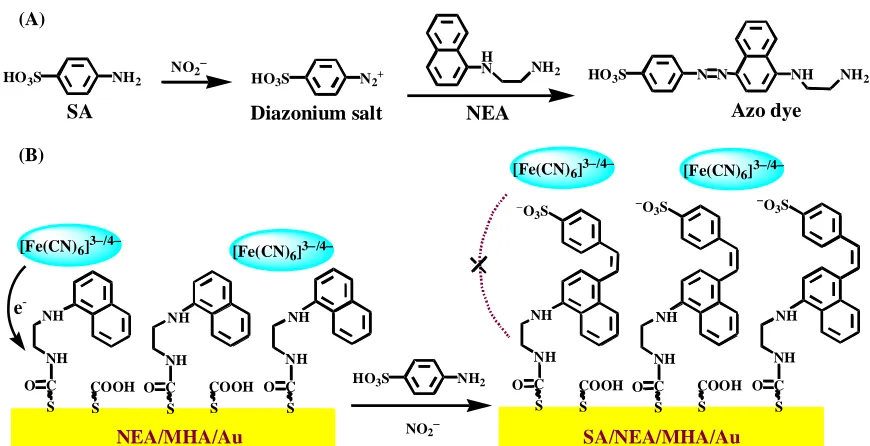
Figure 1. (A) Griess reaction and (B) scheme representation showing the strategy for nitrite detection based on the charge variation on gold electrode.
[image:3.596.80.515.432.655.2]
less sensitive and require complicated spectrophotometric instrumentation for readout and quantification. More importantly, quantitative determination of nitrite with the Griess reaction in whole or diluted blood, plasma or serum requires a series of analytical procedures to eliminate interfering blood constituents, notably hemoglobin and plasma proteins, increasing the operation complexity and assay cost [17]. The analysis principle of our method was shown in Fig. 1B. It is based on measurement of the electrochemical response of NEA/MHA/Au electrodes in the presence of the negatively charged [Fe(CN)6]3−/4− as a redox probe. NEA molecules are first immobilized on a
MHA-modified gold electrode surface by the standard amine coupling reaction. The positively charged NEA SAMs facilitate the access of the redox probe to the electrode surface. Once amine groups react with SA to form the azo dye molecules through the nitrite-mediated Griess reaction, the negatively charged sulfonyl groups on SAMs surface will be excluded from the negatively charged [Fe(CN)6]3−/4− probe
and form a barrier for the electron transfer. The magnitude of the decrease in electron-transfer resistance will be related to the amount of the azo dye molecules. The concentration of nitrite can be therefore determined.
3.2 Feasibility for nitrite detection
-0.2 0.0 0.2 0.4 0.6 -10
-8 -6 -4 -2 0 2 4 6 8
C
u
r
r
e
n
t
/
A
Potential / V vs. Ag/AgCl
MHA/Au NEA/MHA/Au SA/NEA/MHA/Au
0 50 100 150 200 250 300 0
10 20 30 40 50 60 70 80 90 100
Q
Zw Ret
-Z
''/
k
Ω
c
m
2
Z'/kΩ cm2
MHA/Au NEA/MHA/Au SA/NEA/MHA/Au Rs
(A) (B)
Figure 2. CVs (A) and EIS (B) of MHA/Au, NEA/MHA/Au and SA/NEA/MHA/Au electrodes in [Fe(CN)6]3−/4−. The inset in panel B shows the fits with the equivalent circuit. The
concentrations of nitrite and SA were 0.1 and 1 mM, respectively.
To demonstrate the feasibility of the method, we first investigated the voltammetric characteristics of the modified electrodes in [Fe(CN)6]3−/4− solution. As shown in Fig. 2A, CV
collected at the MHA-covered electrode (MHA/Au) shows no apparent redox wave in the [Fe(CN)6]3−/4− solution (black curve), indicating that the negatively charged MHA SAMs hindered
electron transfer between the [Fe(CN)6]3−/4− probe and the electrode surface. Interestingly, after the
electrode was modified with NEA (NEA/MHA/Au), two peaks assigned to the redox waves of [Fe(CN)6]3−/4− were obtained (red curve), indicating that the electrostatic interaction between the
positively charged NEA residues and the negatively charged [Fe(CN)6]3−/4− probes eliminated the
[image:4.596.78.519.357.525.2]
the increase in the peak potential separation (ΔEp) between the cathodic and anodic waves was observed (blue curve). The result demonstrated that the assembly of SA hindered the access of the redox probe to the electrode surface. Furthermore, the results were confirmed by electrochemical impedance analysis in a frequency range from 500 kHz to 0.01 Hz. As shown in Fig. 2B, the charge-transfer impedance at the MHA/Au electrode was much larger (black curve) than that at the NEA/MHA/Au electrode (red curve), illustrating that the introduction of NEA facilitates electron transfer between the redox probe in the electrolyte solution and the electrode. The impedance response at the SA/NEA/MHA/Au electrode (blue curve) was significantly greater than that at the NEA/MHA/Au electrode. The result was understandable since the negatively charged sulfonic groups on SA can resist the access of the [Fe(CN)6]3−/4− redox couple to the electrode surface. Overall, the
proposed method based on the charge change of electrode was feasible for nitrate detection.
3.3 Dependence on nitrate concentration
Among kinds of electrochemical methods, EIS based on the change of the electron transfer resistance (Ret) using a redox couple has received much attention due to its high sensitivity and
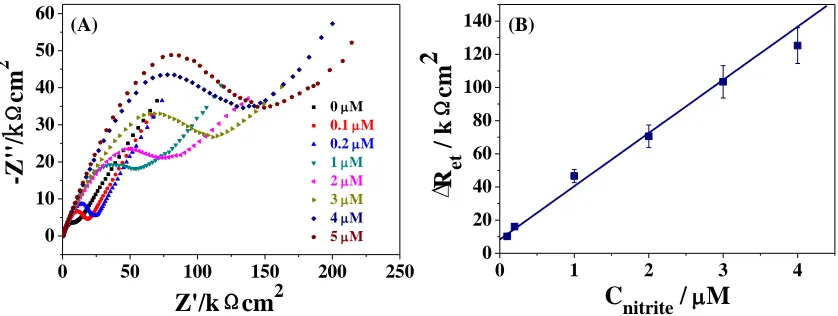
label-free characteristics [11-13]. In this work, a modified Randles equivalent circuit was used to fit the impedance spectra and to determine electrical parameters for each step. As shown in the inset of Fig. 2B, the circuit included the electrolyte resistance between working and reference electrodes (Rs), the Warburg impedance (Zw), a constant phase element (Q) representing the double layer capacitance for an unmodified electrode or the capacitance of the SAMs for the modified electrodes and the electron-transfer resistance (Ret). Fig. 3A shows the impedance spectra of NEA/MHA/Au electrode in the presence of SA and variable concentrations of nitrite. Ret of the electrode increased significantly with
increasing concentration of nitrite. The variation of the impedance is given by ΔRet (ΔRet = Ret – R0et,
where R0et was the blank Ret of NEA/MHA/Au). As shown in Fig. 3B, ΔRet linearly increased with the
increase of the nitrite concentration ranging from 0.1 to 4 μM. The linear regression equation is expressed as ΔRet = 8.3 + 31.9 Cnitrite (μM) (R2 = 0.99). The detection limit was estimated to be 20 nM.
0 50 100 150 200 250
0 10 20 30 40 50 60
-Z
''/
k
Ω
c
m
2
Z'/kΩ cm2
0 M
0.1 M
0.2 M
1M 2 M
3 M
4 M
5 M
0 1 2 3 4
0 20 40 60 80 100 120 140
Δ
R et
/
k
Ω
c
m
2
Cnitrite / M
(A) (B)
Figure 3. (A) EIS of the NEA/MHA/Au electrodes after incubation with SA and different concentrations of nitrite. (B) Dependence of ΔRet on the nitrite concentrations in the range of
[image:5.596.87.506.554.712.2]
3.4 Selectivity to nitrite
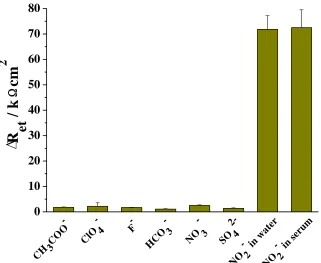
The selectivity of the assay was evaluated by challenging it with other environmentally relevant anions, such as CH3COO-, ClO4-, F-, HCO3-, NO3-and SO42-. We found that no obvious change in the
impedance was observed when incubating the NEA/MHA/Au electrodes with the solution containing each of the anions (Fig. 4), further indicating that the present method is selective for nitrite detection. To compare the method with well-established techniques, we also measured the nitrite content by the standard spectrophotometric assay. The amount of nitrite was found to be 2.3 μM according to the calibration curve, which is comparable with the electrochemical assay data. However, as mentioned above, in the spectrophotometric assay of nitrite with the Griess reaction, blood samples need to be pretreated to eliminate interfering blood constituents. Herein, we also investigated the influence of 2% blood serum on the detection of nitrite, and found that the serum did not interfere in the detection of nitrite (Fig. 4). Thus, our method could reduce the operation complexity and assay cost without sacrificing the exactness.
0 10 20 30 40 50 60 70 80
NO2
- in s
erum
NO2
- in w
ater
SO4
2-HC
O 3 -F
-Δ
R
et
/
k
Ω
c
m
2
NO 3
-CH3
CO
O
-ClO 4
-Figure 4. Selectivity of the nitrite sensing system. The concentrations of nitrite and interfering anions are 2 and 50 μM, respectively.
4. CONCLUSION
In summary, we reported a simple and sensitive electrochemical strategy for the detection of nitrite based on the charge variation of SAMs on gold electrode. The positive charge on NEA-modified electrode facilitate the access of the negatively charged [Fe(CN)6]3−/4− probe to the electrode surface.
[image:6.596.137.458.317.580.2]
of the electrodes in [Fe(CN)6]3−/4− solution. The method was sensitive and selective for nitrite
detection. We believe that this work could be valuable for the design of electrochemical sensors and likely lead to many detection applications in drinking water and biological matrix.
ACKOWLEDGMENTS
Partial support of this work by the National Natural Science Foundation of China (21305004) and the Joint Fund for Fostering Talents of National Natural Science Foundation of China and Henan province (U1304205) is gratefully acknowledged.
References
1. J. G. Sebranek and J. N. Bacus, Meat Sci., 77 (2007) 136.
2. J. D. Brender, J. M. Olive, M. Felkner, L. Suarez, W. Marckwardt and K. A. Hendricks, Epidemiology, 15 (2004) 330.
3. A. Aschengrau, S. Zierler and A. Cohen, Arch. EnViron. Health, 44 (1989) 283.
4. W. L. Daniel, M. S. Han, J.-S. Lee and C. A. Mirkin, J. Am. Chem. Soc., 131 (2009) 6362. 5. P. Jakszyn and C. A. Gonzalez, World J. Gastroenterol., 12 (2006) 4296.
6. L. C. Green, D. A. Wagner, J. Glogowski, P. L. Skipper, J. S. Wishnok and S. R. Tannenbaum, Anal. Biochem. , 126 (1982) 131.
7. A. Buldt and U. Karst, Anal. Chem. , 71 (1999) 3003.
8. J. M. Doyle, M. L. Miller, B. R. McCord, D. A. McCollam and G. W. Mushrush, Anal. Chem., 72 (2000) 2302.
9. L. Liu, D. Deng, Y. Xing, S. Li, B. Yuan, J. Chen and N. Xia, Electrochim. Acta, 89 (2013) 616. 10. L. Zhang, L. Liu and N. Xia, Int. J. Electrochem. Sci., 8 (2013) 8311.
11. M. C. Rodriguez, A. N. Kawde and J. Wang, Chem. Commun.(2005) 4267.
12. A. E. Radi, J. L. A. Sanchez, E. Baldrich and C. K. O’Sullivan, Anal. Chem., 77 (2005) 6320. 13. D. K. Xu, D. W. Xu, X. B. Yu, Z. H. Liu, W. He and Z. Q. Ma, Anal. Chem., 77 (2005) 5107. 14. S. D. Keighley, P. Li, P. Estrela and P. Migliorato, Biosens. Bioelectron., 14 (2008) 1291. 15. F. Le Floch, H. A. Ho and M. Leclerc, Anal. Chem., 78 (2006) 4727.
16. L. J. Ignarro, G. M. Buga, K. S. Wood, R. E. Byrns and G. Chaudhuri, Proc. Natl. Acad. Sci. USA, 84 (1987) 9265.
17. D. Tsikas, J. Chromatogr. B, 851 (2007) 51.
![Figure 2. CVs (A) and EIS (B) of MHA/Au, NEA/MHA/Au and SA/NEA/MHA/Au electrodes in [Fe(CN)6]3−/4−](https://thumb-us.123doks.com/thumbv2/123dok_us/1896208.147442/4.596.78.519.357.525/figure-eis-mha-nea-mha-nea-mha-electrodes.webp)