This is a repository copy of 'But what is the reason why you know such things?' Question and response patterns in the LADO interview.
White Rose Research Online URL for this paper: http://eprints.whiterose.ac.uk/133584/
Version: Accepted Version
Article:
Channon, A., Foulkes, P. and Walker, T. orcid.org/0000-0002-2583-7232 (2018) 'But what is the reason why you know such things?' Question and response patterns in the LADO interview. Journal of Pragmatics, 129. pp. 154-172. ISSN 0378-2166
https://doi.org/10.1016/j.pragma.2018.03.015
[email protected] https://eprints.whiterose.ac.uk/ Reuse
This article is distributed under the terms of the Creative Commons Attribution-NonCommercial-NoDerivs (CC BY-NC-ND) licence. This licence only allows you to download this work and share it with others as long as you credit the authors, but you can’t change the article in any way or use it commercially. More
information and the full terms of the licence here: https://creativecommons.org/licenses/
Takedown
If you consider content in White Rose Research Online to be in breach of UK law, please notify us by
1
‘But what is the reason why you know such things?’
Question and response patterns in the LADO interview
Abstract
This study uses the tools of Conversation Analysis (CA) to investigate problems that occur in LADO (Language Analysis for the Determination of Origin) interviews. We analysed five recorded interviews with female asylum seekers, focusing on question and response pairs. Several problems were identified, associated with directives, echo questions, and challenges. The study also looked at how repair is initiated and carried out. Directives were frequently issued as part of multiple questions from the interviewer, alongside additional questions or modifiers. Interviewees typically provided an answer to the most specific and/or most recent question rather than fulfilling the directive itself. Directives were also used to elicit language samples, and it was found that including a clear topic for talk was the most effective way of accomplishing this goal. Echo questions were predominantly used for requesting
confirmation, and were occasionally interpreted as performing this function even where there was evidence that interviewers were using echo questions to prompt for more information or to initiate repair. Challenges contributed to a hostile atmosphere in interviews. Similarly, repair prefaced by initial but was found to be potentially hostile in some instances. Various modes of accomplishing repair were also investigated, but their effectiveness was variable. In assessing the set of question and response pairs in the recordings, we make a number of practical recommendations for improving interview practice in LADO.
Keywords: LADO, asylum, question – response pairs, Conversation Analysis
1. Introduction
Since the early 1990s claims for asylum have increased rapidly. In the European Union claims have increased from around 200,000 in 2006 to over 1.25 million in 2016 (Eurostat 2017). Claimants often lack documentation to confirm their case, and there may be suspicion that a claim is bogus. Tests have therefore been developed to assist border agencies in
assessing asylum claims. Language analysis is now widely used as part of the testing process (Zwaan, Verrips & Muysken, 2010; Patrick, Schmid & Zwaan, in press). This type of
analysis, and associated research, has come to be known as Language Analysis for the Determination of Origin (LADO), despite reservations over the appropriateness of this label (Eades et al 2003, Reath 2004). In recent years LADO has been employed in around 500 cases annually in the UK alone (Wilson & Foulkes, 2014: 220). As such, LADO is an
important tool for governments around the world, while the outcome of the LADO interview can have life-changing consequences for the claimant.
2
consequences for asylum decisions of the material used as the basis for those decisions. In most cases this material is an interview with the claimant. This is the focus of the research we present here. Little attention has been paid to trends that occur across LADO interviews. We address one such trend, namely question and response structures observed in five interviews with female asylum seekers. We use the methodology of Conversation Analysis (CA), to our knowledge the first time this approach has been applied to LADO interviews. Our aim was to identify problems that arise in the interviews, related to the structure of the discourse or conversation, and to comment on how these problems may be avoided or resolved.
CA is a method that focuses closely on the properties of talk, examining how social actions are accomplished through language (Drew & Heritage, 1992; Wooffitt, 2005; Sidnell, 2010). CA focuses on recurrent and systematic patterns of conversation, which are not related to people’s idiosyncratic styles, personalities or predispositions. All CA findings are directly based on recorded interactions, which are subsequently transcribed in detail to document the exact wording used by all speakers as well as details such as timing and placement of
overlapping talk. As such, CA is ideal for analysing interview data such as recordings and transcripts. Among the facets of talk on which CA focuses are turn-taking, correcting errors or misunderstandings, how actions such as requests and questions are accomplished, and how the topic of conversation is negotiated by participants.
Although CA originated as a method for analysing informal conversation, it has also been applied to institutional talk, such as job interviews (Button, 1992), doctors’ visits (Heritage & Maynard, 2006), and courtroom discourse (Komter, 2012). Institutional talk has several features that distinguish it from everyday conversation (Heritage & Clayman, 2010). For example:
participants have specific goals which are bound to their roles (e.g., interviewers ask questions for an overhearing audience)
institutionally-specific procedures and frameworks apply (e.g., restricted turn-taking in courtrooms)
institutional talk is typically asymmetrical in how turns are distributed, and the form these turns may take for the participants (Thornborrow, 2002).
Questions are often central to institutional talk, as in the case of teaching and various types of interviews, including the LADO interview. Interviews are characterised by questions and answers, where one participant is responsible for asking questions and the other for answering them (Schegloff, 1992a). The questioner is typically the more powerful speaker, as he or she determines the topics and structure of the conversation (Drew & Heritage, 1992). The LADO interview is one form of institutional talk in which the interviewer(s) and the interviewee are clearly defined by their roles and understood to have different permissible turn types.
The structure of the rest of the article is as follows. In section 2 we provide a brief outline of LADO, focusing on discussions of patterns at the discourse level. We then outline the materials and methodology used, including the question types analysed (section 3). The findings are discussed in detail in section 4, and we conclude with a summary of the results and recommendations for good practice in LADO interviews (section 5).
2. LADO in the asylum process
3
between false and genuine asylum claimants. LADO has been developed as one tool within the gatekeeping process, conducted relatively early during screening of claims (Home Office 2017: 9). It has also been claimed that the LADO interview should not be used as the sole basis for an asylum decision (Home Office 2017: 21), although it remains unclear how a language report is integrated into a decision based also on other types of evidence.
It is hard to generalise how widely LADO is used internationally, but there is evidence to suggest it is used only in a minority of cases (ca. 5% of UK cases; Wilson & Foulkes, 2014: 220). It is usually used when an asylum seeker lacks identifying documents and thus there are doubts about the claim (Baltisberger & Hubbuch, 2010). The aim of LADO is to comment on an asylum seeker’s claimed origin through the analysis of language and cultural knowledge, elicited via an interview (Muysken et al., 2010). The interview may be used explicitly as a means to elicit information about linguistic and cultural knowledge. It may also be used after the event, as a sample of the claimant’s language for forensic analysis. It is important to note, however, that LADO cannot make claims about nationality – instead, it can offer insight into linguistic socialisation, which may in turn give clues to national origin (LNOG, 2004). Furthermore, in many cases a legitimate claim for asylum is limited to specific ethnic or regional groups. The linguistic basis for ascertaining a legitimate claim might therefore be subtle, based on specific dialectal or sociolinguistic variants.
LADO practice has traditionally been diverse, although attempts have been made to standardise it through, for example, the Language and National Origin Group’s 2004 Guidelines for the use of language analysis in relation to questions of national origin in refugee cases. The Guidelines attempt to establish standards of practice, although there is still debate surrounding many of the points set forth (see, for instance, Fraser 2011; Cambier-Langeveld, 2014; Wilson & Foulkes, 2014; Patrick, 2016). One potential source of controversy is the use of the interview as a basis for the decision on asylum, particularly given diversity in practice and the inherent limitations of LADO with respect to determining a speaker’s origin. There are several potential sources of variation in the interview, including the structure of the interview, the number of interviewers, the training given to interviewers, whether the interview is specifically for the purpose of language analysis or not, the
language(s) used to conduct the questioning, the speech genre and content of questions, the channel (in person or via telephone), and duration (McNamara, Verrips, & Van den
Hazelkamp, 2010). These sources of variation affect the quantity and quality of material provided by the interview, which may therefore affect the robustness of the analyst’s conclusions, and in turn the final asylum decision.
To our knowledge there have been no previous studies of language in the asylum process that have used the tools of Conversation Analysis. However, there have been other studies at the level of discourse, drawing attention to problems that may occur in the
interview. For example, Maryns (2006) undertook a discourse-analytical study of language in the Belgian asylum process, and found that the written report generated from an interview typically omitted contextualising work done by the interviewee. She argues that the
institutional imbalance of power means that interviewees’ narratives are never entirely their own, as they are controlled and mediated by government officials (cf. Svartvik 1968 and Coulthard 1994 on how institutional transcription norms differ from – and thus potentially misrepresent – ordinary speech, in relation to an apparent confession recorded in police interview transcripts).
4
claimed that he spent his early years in Kenya, spoke mainly English at home, and never attended school in Rwanda. Hence he had knowledge of English but little of Kinyarwanda or French, the institutional languages of Rwanda. He also knew some Kinyankole (widely used in Uganda but also spoken in Rwanda near the Ugandan border). In reviewing his story, however, Blommaert argues that the Home Office adhered to a simplistic one-to-one view of the relationship between languages and nation states, regarding Rwanda at the time as a ‘relatively stable and uniform nation-state characterized by ‘national’ features such as a relatively stable regime of language’ (p. 419). His use of English and Kinyankole, and lack of French and Kinyarwanda, all counted against him. He was therefore denied asylum and ordered for deportation to Uganda. Blommaert argues that Joseph’s life history, coupled with a detailed understanding of growing political tensions, accounts for his unusual linguistic background. He thereby highlights the necessity of a thorough understanding of
sociolinguistic and cultural realities in preference to a simplistic focus on institutional or official languages, if the interview is to achieve its aims.
These studies illustrate some of the problems that may arise with language analysis in the asylum process. They also draw attention to how different cultural norms and
expectations around language may be detrimental to interviewees’ success if these differences are not recognised and accounted for within the interview process. However, these studies do not address the micro-level of conversation, exploring the problems that may occur at a sequential level, although these problems are potentially just as damaging to the interviewee if they hinder her chances to express herself in the interview. The current study therefore analyses trends that occur across interviews, as recurrent problems may indicate areas where improvements can be made to interview procedure. The particular sequence under investigation is that of questions and responses and the problems that can occur, as these are the core elements in the structure of any interview.
3. Materials and methodology
3.1 recordings
We used a sample of LADO interviews as our empirical base. Data was provided by Verified, a company with headquarters in Stockholm and which provides expert assessments in
profiling a speaker’s dialectal background, usually in asylum cases. The company provided twelve interviews conducted between 2008 and 2011. Verified had carried out dialectal analysis on these recordings but had had no involvement in conducting the interviews, which were carried outby a client.
5
The participants in each interview are a female African asylum seeker (IE,
interviewee) and two interviewers. The first interviewer (IR) speaks predominantly English, while the second (IR2) speaks the official language of the country where the interview was conducted. For reasons of confidentiality we are only able to state that this was a country of the European Union, where English is not an official language but is widely used as a foreign language, including in institutional contexts. The first interviewer interprets for the second, but he or she also initiates questions. Note that the role of the interpreter is primarily to facilitate communication between the interviewer’s L1 and English, rather than interpreting to and from one or more African languages. Interpreters are not used by most of the LADO agencies when conducting their own interviews (Bourassa 2013). No further information regarding the identities of the interviewers was provided, although it was clear from general phonetic impression that the data set contains multiple interviews conducted by the same interviewers. Note therefore that inter-interviewer differences have not been examined in this study. Macleod (2010), however, found that individual police officers’ training was the key factor determining the success of interviews with women reporting rape, and this is therefore also a potential factor to take into consideration for future research.
The interviewers ask the applicant questions about her claimed nationality and place of origin. The interview aims to assess both cultural and linguistic knowledge, but the focus in these examples is on cultural knowledge. No African languages are in fact spoken in the recordings we analysed.
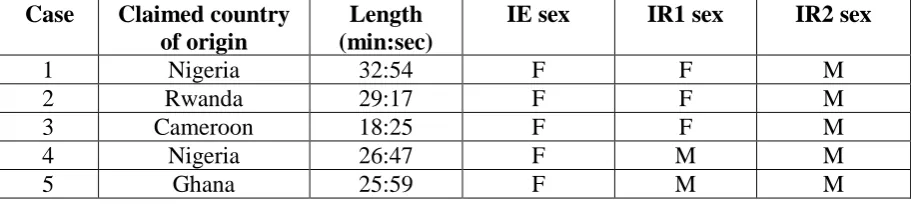
Five face-to-face interviews were selected as the final data set for analysis. Table 1 provides an overview of the selected interviews. The remaining interviews were excluded for various reasons:
three telephone interviews, for consistency of channel and because discourse patterns may differ in telephone versus face-to-face interaction;
two monologues, and one interview with very limited participation from the interviewers, as the study focuses on interaction;
[image:6.595.73.529.517.619.2] one interview in which content suggested the interviewee was in fact male.
Table 1. Overview of selected interviews
Case Claimed country of origin
Length (min:sec)
IE sex IR1 sex IR2 sex
1 Nigeria 32:54 F F M
2 Rwanda 29:17 F F M
3 Cameroon 18:25 F F M
4 Nigeria 26:47 F M M
5 Ghana 25:59 F M M
Personal names, dates, and the names of small towns and villages were changed in the excerpts provided in this article to preserve anonymity. Note that the four countries concerned are all highly multilingual, emphasising the potential complexity of language analysis.
3.2 methodology
The interviews were transcribed using a subset of the standard Conversation Analytic
6
the interlocutors are native speakers of English. Therefore we do not know what role the prosody plays in the interaction, nor can we rely on any published accounts of prosody in interaction since to our knowledge the entire body of that research has been done on native speakers of known languages.
Another important point to note is that it was not possible to take into account sequential conversational norms in the relevant languages and cultures of the interlocutors. There is a dearth of CA literature relating to West and North African Englishes and the other languages of these regions. In the case of the interviewees, the relevant languages and
cultures are, of course, not known for certain. Moreover, from the content of the recordings it was generally not clear what language or languages were claimed by the asylum seeker.
The transcripts were used as the basis to identify question and response patterns, which were classified by type. Various recurrent patterns were observed in the data. Examples are discussed in detail in section 4, using both a qualitative and quantitative approach. We first provide a definition and brief discussion of the main question and response types found in our data.
3.3 question and response types
The term question itself is used broadly to refer to the first pair part in an adjacency pair. Adjacency pairs consist of two utterances (e.g. question/response), where the second is a relevant and expected response to the first (Schegloff & Sacks, 1974). Directives,
declaratives, and canonical interrogatives issued by an interviewer all function to demand a verbal response (a second pair part).
In order to be able to talk about why particular responses may be more likely than others, or produced in a certain way, we refer to the notion of preference. This term does not refer to psychological preference, but rather to how actions are performed. Preferred actions (e.g. accepting a request or agreeing with an assessment) are performed simply, without explanation, delay, or mitigation (Heritage, 1984; Pomerantz, 1984a). By contrast,
dispreferred actions are accountable, in that justifications may be provided (Heritage, 1984; Pomerantz, 1984a; Sidnell, 2010). Delay in the form of pauses, prefaces (e.g. well) or hesitation markers (e.g. uh) may signal a forthcoming dispreferred turn (Heritage, 1984; Levinson, 1983). Preferred turns normally show alignment, or affiliation, with the interlocutor’s perceived stance (Heritage, 1984; Steensig & Drew, 2008).
3.3.1 directives in multiple questions
Directives include commands and requests (Quirk, Greenbaum, Leech, & Svartvik, 1985). In the context of the present study, directives are primarily discussed in relation to their role in multiple questions, as they are often issued together with other questions in the recordings. Kasper and Ross (2007) claim that multiple questions within a single turn are rare in general conversation, but common in some institutional contexts, including oral proficiency interviews. The first utterance in a multiple question may function to introduce a new topic or to request extended action (e.g. providing a description). The question that follows serves to narrow the focus, allowing a relevant answer to be given in response. Weber (1993) identifies similar examples, arguing that the first question functions to establish the interrogative nature of the utterance, and the second invites specific information. This is very similar to the
7
In terms of responding to multiple questions, Sacks (1987) observes a preference for contiguity, with the most recent question in a sequence addressed first. Highly skilled evasive interviewees, such as politicians, often subvert this principle, ‘reaching back’ to answer only the first question in a sequence and thus avoid answering the second (Clayman 1993).
Kasper and Ross’s research is particularly relevant to this study as it examines interaction between native and non-native speakers. Although almost all the participants in our data are non-native English speakers (interviewers and interviewees alike), the
interviewers use English professionally, while the majority of the interviewees do not have the same level of proficiency, and there are thus similarities with native/non-native
interaction.
3.3.2 echo questions
Echo questions involve a full or partial repetition of a previous speaker’s talk (Quirk et al., 1985), and are often used as a means of initiating repair (see e.g., Schegloff, 1997, Benjamin & Walker, 2013, Bolden 2009). Blakemore (1994) points out that echo questions are not used only for confirmation of the words or sounds of an utterance, but may also draw attention to the absurdity of an underlying proposition.
3.3.3 challenges
Challenges are questions or statements where a speaker departs from the stance of unbiased observer and questions the interlocutor in a confrontational manner. There are several ways of accomplishing challenges. In our data, the main strategies include (i) negative questions; (ii) focusing on mental state, including questioning the source of claimed knowledge; (iii) hostile reformulations; and (iv) use of turn-initial "but".
Challenges serve to signal disalignment, expressing disbelief towards a stance taken by the interlocutor, and suggesting that an account is required. Negative questions including sentence tags, e.g., ‘wouldn’t you say...?’ or ‘that’s right, isn’t it?’ can highlight a perceived problem expressed in prior talk, depending on the context. They can therefore challenge the interlocutor to provide an account for a claim (Heritage, 2002; Koshik, 2003; Keisanen, 2007). Recipients may respond to the challenge in various ways, including disagreement, expressing ignorance, offering accounts, or weakening or changing claims.
Heritage (2002) studied negative interrogatives in news interviews, and found them to be treated as assertions rather than requests for information. Interviewers are ostensibly in a position of neutrality, and negative interrogatives may allow the appearance of neutrality to be maintained while nevertheless indexing a particular (usually critical) stance. Heritage shows that responses to negative interrogatives are often prefaced with ‘I disagree’, exposing the stance-taking of the prior talk by treating it not as a question to be answered but a
statement of opinion. Koshik (2002) argues that the preference displayed by reverse-polarity questions (affirmative yes/no questions which prefer negative answers; e.g., “is this relevant to your main point?”; “No, not really”) is evident not in the linguistic structure of the
questions themselves, but in relation to what the hearer knows about the questioner’s state of knowledge. In a context such as a classroom or a news interview, the utterance “is this relevant to your main point?” conveys the assumption that the questioner has greater access to knowledge. Thus, even simple yes/no interrogatives may therefore be treated not only as questions but as expressions of stance.
8
response in which the recipient confirms a previously expressed stance, although doing so will be disaligning. Challenges of this sort may be phrased as questions rather than assertions because the subject under discussion is one about which the recipient can be assumed to know more than the speaker.
Turn-initial but functions to indicate contrasting turn content (Schiffrin, 1987), and as such is often analysed as indicating forthcoming disagreement (Farr, 2003; Gan, Davison & Hamp-Lyons, 2008). But may therefore be used to initiate repair in a manner which overtly indicates a problem with prior talk. Frequent use may indicate ongoing disalignment between the interlocutors (Kuo, 1994), and is a feature of competitive talk (Schiffrin, 1984).
These studies show that there are multiple ways of performing challenges, and that whether a particular type of question functions as a challenge is determined by the context within the conversation, as well as the broader context in which the conversation occurs and what can be assumed about the questioner’s state of knowledge.
3.3.4 repair
How repair is initiated and carried out in an interview is highly important, as the resolution of problems is central to the smooth running of the interview. Repair refers to ways that
speakers deal with problems in speaking, hearing, and/or understanding the talk (Schegloff 2000: 207). Repair may be initiated by any party to a conversation; thus in our data, repairs may be initiated by either the interviewer or the interviewee. However, as we are focusing on interviewer behaviour, we focus here only on repairs initiated by the interviewers.
By initiating a repair, the interviewer indicates that she has some kind of difficulty in understanding or accepting the interviewee's previous turn. Pomerantz (1984b) shows that -- in mundane conversation -- speakers are initially likely to treat problems as
misunderstandings rather than disagreement, as misunderstandings can usually be repaired relatively quickly, with fewer negative implications for the interaction. Similarly, Svennevig (2008) distinguishes between repair initiators that indicate problems with hearing,
understanding, and acceptability. Svennevig finds a hierarchical preference for treating a problem as one of hearing above one of understanding, and this in turn above treating it as a problem of acceptability.
It should be noted, however, that although research into other-initiated repair types and resolutions has been carried out in a variety of languages (see the list in Kitzinger 2013, p.229), to our knowledge no research has been carried out either on African languages, nor on repair sequences produced by participants speaking English as a lingua franca other than in second language acquisition contexts. Additionally, the research cited above was carried out on mundane conversation, in which mutual cooperation is presumed. In our highly
specialised institutional data, we find no evidence of a preference for treating a problem as one of hearing rather than understanding. Instead, we find that interviewers pursue problems in understanding (evidenced by the interviewee's responses to questions) by employing third position repairs (Schegloff 1992b).
In English, third position repairs regularly have the form "No I don't mean X, I mean Y." They are a way for a speaker to show that her original talk, though not treated as problematic by their conversational partner, has nonetheless been misunderstood. The following example is taken from Kitzinger (2013, p.247).
Example 42 from Kitzinger (2013, p.247) [transcript simplified] 1 Mum: what are they then
2 Les: shortbreads
9
Here, Les's response in line 2 seems entirely appropriate; in response to mum's question about what she purchased (line 1) she has named a type of biscuit, “shortbread”. In line 3, however, Mum indicates that this response does not adequately answer her question. She repairs her original turn with “no I mean what make”, clarifying that what she wants to know is the make (brand) of biscuit, not the type.
4. Findings
In this section we present and analyse examples from the interviews. These examples are representative of the broad trends in the data. In order to highlight the most significant issues in the data, we have also attempted to capture the frequency of each type of problem (Table 2). However, we generally employ verbal quantification terms (e.g. “frequently”, “usually”) in the discussion, as quantification in CA studies is generally seen as problematic. Indeed, Schegloff (1993) argues against the use of quantification for CA studies, particularly in the early stages of analysis. He argues that quantification requires not only that the phenomenon under investigation be countable, but that it be countable in relation to some meaningful point of reference, which requires the specification of the environments in which the phenomenon could possibly occur. It is not a simple task to identify what does and does not constitute an example of a phenomenon, much less to identify all possible environments. Nevertheless, given the practical applicability of this study we feel it is useful to comment on the relative frequency of the patterns and problems which arise in the interviews, to give an idea of which are most pervasive.
Table 2 shows the number of questions of each type occurring in the interviews. The number of questions does not correspond exactly to the number of turns belonging to each interviewer, as multiple questions may be asked in one turn, and, conversely, a turn may not include a question (e.g. a minimal response, such as mm or uh huh). ‘Other’ questions include alternative questions, which were very rare in the data, and prompts and topicalisers, such as and? or what about…?. Challenges have not been included as a separate category, as they do not constitute a single question type, but rather are defined by their content and context.
10
Table 2. Summary of question types found in recordings (+ve = positive; −ve = negative; decl. = declarative; rate = average incidence per minute)
Case +ve
wh
+ve yes/no
+ve decl.
directive Echo −ve wh
−ve yes/no
−ve decl.
other total duration
(min:sec)
1 69 23 11 16 6 2 0 5 6 138 32:54
2 71 21 11 15 6 0 0 2 7 133 29:17
3 26 24 5 19 7 0 0 0 3 84 18:25
4 35 36 11 17 12 0 2 2 14 129 26:47
5 45 25 9 12 6 0 3 6 12 118 25:59
total 246 129 47 79 37 2 5 15 42 602 133:22
11 4.1 Questions and responses
4.1.1 Directives in multiple questions
Directives include commands and requests in the imperative form, and those structured as yes/no questions using modal verbs such as can or could. Examples are given in (1) and (2).
(1)
1 IR so explain about this (0.1) which place with
2 whom (1.1) [how old were you]
3 IE [I was in Libya ] in Tripoli
(2)
1 IR can you describe the flag of Libya
2 (1.2)
3 IE green
Verbs used include mention, tell, explain, say, sing, and describe, among others. All these verbs require an action to be performed by the recipient, and different verbs are associated with different response types accordingly – say and sing, for instance, are used to elicit language samples, while other verbs may be used primarily for information gathering.
Directives are frequently combined with additional questions or phrases to form a multiple question, as also shown in (1). This occurs several times in each interview. This is not inherently problematic – a directive within a multiple question may function to introduce a topic (Kasper & Ross, 2007), as in (3), with no follow-up question from the interviewer to indicate that the response is insufficient. However, if the interviewer does hope for the directive itself to be fulfilled in a broad sense (e.g. to initiate a narrative with tell or explain), this may be unsuccessful, as in (4).
(3)
1 IE later to Kribi (.) [with my parents ]
2 IR [Kribi explain about] Kribi
3 (0.2) when you lived there with your parents
4 (0.5) did you go to to primary school
5 IE yeah I went to primary school in Kribi
(4)
1 IR tell me the (0.2) the the notes you have in
2 your currency how (.) what kind of notes do you
3 have do you have a 50 (0.7) a note of 50
4 Faranga
5 (0.4)
6 IE yeah
7 (0.7)
8 IR and what other notes do you have
12
the question as a straightforward yes/no question rather than a request for extended talk. The interviewer then follows up by broadening the question once again to ask what other notes there are, which is in fact successful in eliciting a list of denominations of notes. Note, however, that in this case the interviewer does not provide the opportunity to respond to the initial directive (line 2) before following up with specific questions. This example shows clearly how the interviewer’s behaviour, as evident from the sequential structure of the conversation, creates a problem. The interviewer attempts to elicit information via the
directive – this is, after all, the purpose of the interview – but then fails to wait for an answer. It could therefore appear that the interviewee has not responded to the initial question, but in fact she was given no opportunity to do so. There is clear potential for a LADO analyst to make the interpretation that she is avoiding an answer, especially if the reviewer examines only a transcript of the interview.
This problem may be associated with a tendency for interviewees to answer the
question perceived to be the most specific, or may follow the principle of contiguity, whereby the most recent part of a multiple question is answered first (Sacks, 1987). In many cases, however, as in (4), the first ‘question’, as represented by the directive, is not answered at all, in that an extended response is not given. The interviewer must therefore issue a follow-up question if further information is required. This may then lead to the conclusion, by the IR (or by those reviewing the transcripts/interview after the fact), that the IE did not answer some questions, or even withheld some information. However, an examination of the sequential structure of the conversation shows that there was no room provided for a response - the IR changes the form of the question from open-ended to yes/no with no gap.
4.1.2 Directives to elicit language samples
One important use of directives is eliciting samples of the language(s) that the asylum seeker claims to speak. A directive is used for this purpose at least once in every interview. This may be done more or less effectively, but in no instance in the data is eliciting a language sample wholly unproblematic. One reason for problems may be because it is very unnatural for a participant to speak at length in a language not spoken by the interlocutors. Note also that the request to speak a certain language can be a far more complex issue than may be apparent at first glance: the claimant might not use the same institutional nomenclature for her language(s), she might deny or suppress knowledge of a language in order to protect herself (e.g. if the language is proscribed), or exaggerate it to appear a more useful citizen in the context of the asylum claim (Wilson & Foulkes, 2014).
Example (5) occurs after the interviewer has asked the interviewee to describe a typical Cameroonian dish.
(5)
1 IR and now I would like you to to explain this in
2 (0.1) Pidgin English (0.3) oh sorry in Mukada
3 (0.5)
4 IR2 Mungaka
5 (0.2)
6 IR Mungaka
7 (0.3)
8 IE OK
9 (0.5)
10 IR y- (0.2) yes please (0.6) ((laughs))
13
12 IR2 [((laughs))]
13 IE a dish (0.3) this now I will talk about (0.1) a 14 dish in my (0.3) my own part (0.3)
15 IR2 [[Omitted for reasons of confidentiality]]
16 IE OK [uh ]
17 IR [what’s your f]avourite dish
18 (0.7)
19 IE uhhh yeah ((laughs))(2.2) in my my dialect in
20 Mungaka
21 IR yes please
22 IE OK (1.0) [[Mungaka]]
23 is difficult to just speak a lot like that
24 [((laughs))]
35 IR [((laughs))]
Some negotiation is required for the request for a language sample to be fulfilled. The first problem in the interaction is the interviewer’s error in asking for Pidgin English and then Mukada (line 2), finally pronouncing Mungaka (line 6) after being corrected by the second interviewer (line 4). Even after this confusion is resolved, however, the interviewee does not immediately perform the requested action, but answers OK (line 8) to which the interviewer prompts yes please (line 10). The interviewee then provides a summary of the request with a laugh, perhaps marking the interactionally unusual request, more overtly marked later on by her remark that it is difficult to just speak a lot like that. The interviewer follows up with a more specific wh-question (what’s your favourite dish, line 17), but the interviewee still does not respond with a language sample, instead confirming that she should answer in Mungaka (line 20). The interviewer provides confirmation (line 21), and the interviewee then speaks for some time in Mungaka. This exchange is ultimately successful in eliciting a language sample, but fairly extensive negotiation is required before this goal is achieved.
Problems may further occur where the request for a language sample does not specify what the speaker should say.
(6)
1 IR can you say anything in Fante (1.4) give us
2 some specimens of of of Fante
3 (2.2)
4 IE mm (2.9) [yeah ]
5 IR [you just] say whatever you feel
6 like
7 (0.9)
8 IE like what (1.9) um (…)
9 (1.9)
10 IR mm (1.1) for example you could (0.3) describe 11 the place you come from in Fante (0.8) how it
12 looks like
13 (3.3)
14
In (6), the problem of non-specificity is clearly marked as such by the interviewee, who responds to the request for a language sample with like what (line 8) The interviewer provides a possible topic (lines 10-11), and, after a pause, the interviewee provides a very short language sample of a few seconds in length. The short sample may be the result of a failure to give adequate direction, but this interviewee often produces short answers, and this is not necessarily the case. However, it is nevertheless clear that failing to provide adequate direction may complicate the request for a language sample.
4.1.3 echo questions
Echo questions are used on several occasions in each interview, and are primarily treated as requests for confirmation, as in (7).
(7)
1 IE I was two years old
2 (0.5)
3 IR two years
4 IE yes
In (7), the interviewer echoes part of the interviewee’s response (two years), and the interviewee responds in the affirmative, confirming that the repeated words have been correctly heard and understood.
However, echoes may also be treated as repair initiators indicating a problem with the content of prior talk (Blakemore, 1994; Bolden, 2009; Benjamin & Walker, 2013), although this problem arise relatively rarely in our data. We find echo questions used in this way when the interviewee has initially given a dispreferred response, as in (8, line 3) and (9, line 4).
(8)
1 IR can you try to say the same thing in Yoruba now
2 (0.4)
3 IE Yoruba no
4 IR no
5 IE Yoruba is just small just small I speak
6 IR OK
The interviewer’s echo of no (8, line 4) indicates a problem, and the interviewee orients to it with an account for the negative answer by explaining her lack of proficiency in Yoruba. However, as Benjamin and Walker (2013) also found, problems may arise when an echo is designed to indicate a problem but receives only simple confirmation in response. While in (8) the interviewee treats the echo as a prompt and provides an account, in (9) the interviewee responds to the echo as a straightforward request for confirmation and answers with an affirmative (line 8).
(9)
1 IR what about this man is he still in touch with
2 your family (0.3) with anybody (0.5) from your
family
3 (0.5)
4 IE possibly
15
6 IR possibly
7 (0.2)
8 IE myeah
9 (2.9)
10 IR2 [[Omitted – content not in English]]
11 IR but (0.1) didn’t you want to (0.5) elaborate on this question or find out what he knows
The interviewer’s follow-up question (line 11), prefaced by but, challenges the interviewee’s affirmative response as problematic, suggesting that she has failed to answer the question appropriately. The verb elaborate, whether referring to her previous answer or to her
previous interaction with this man, further indicates the need for additional information. The problem here can be explained in reference to the fact that echo questions can be used for more than one function: either to seek confirmation or to indicate problems. This may explain why attempts to use echo questions to indicate a problem are not always successful; they are treated by recipients as requests for confirmation. This problem occurs in three of the seven instances we found of echo questions functioning to indicate the need for further explanation.
Svennevig (2008) argues that by treating echo questions as requests for confirmation first (or more commonly, which is also what we found in our data), interlocutors display a preference for treating the problem with prior talk as one of hearing. That echo questions can be used for either this function or to prompt an account may, however, be problematic when interviewers employ them as a request for an explanation, as in (9), as resolution is delayed and a follow-up question is required to resolve the problem.
4.2 challenges
4.2.1 negative questions
Negative questions may express a contrast between an old expectation and a new one. They often imply that the speaker initially held an expectation that a positive response would follow, but subsequent information has instead implied a negative response (Quirk et al, 1985). Although not all negative questions are hostile, they allow doubt or disbelief to be expressed in an officially sanctioned manner (Keisanen, 2007). Negative questions function as challenges because they are strongly oriented towards a response which forces the interviewee to acknowledge a problem with a previously established position (Heritage, 2002). They are used in six challenges in our data. In the interview context, therefore, negative questions may function to allow the interviewer to express a presumption about the expected state of affairs (implicitly, as in (10, line 13), or more overtly, as in (11)) and imply that prior talk is problematic. Interviewees frequently respond to negative interrogatives with explanations or accounts. In (10, line 14), the interviewee accounts for not being able to answer a question about Nigerian licence plates, claiming lack of knowledge. Similarly, in (11), the interviewee explains that she does not speak Arabic because she did not go to school.
(10)
1 IR what about uh the registration numbers on cars
2 IE on car?
16
4 front with some letters on or numbers
5 IR2 [Omitted – content not in English]
6 IR you know in [country] the abbreviation of
7 [country] is [xx]
8 IE [xx] yeah
9 IR the back of the car do you know the abbreviation of Nigeria?
10 IE what I know is they used to put green white
11 green in the car
13 IR yeah exactly but don’t they put a number also 14 IE they put number but I don’t (0.2) I don’t know
(11)
1 IR how come you don’t know more Arabic (1.6)
2 considered that you stayed there for so long
3 IE because I don’t go to school (2.4) if I could
4 go to school to learn Arab (1.0) I would know
5 Arab but if you go then when (1.3) people
6 always laughing at you (3.0) can’t do anything
Negative declaratives are employed predominantly for confirmation after the proposition has already been negated, as in (12), where the interviewer confirms that the interviewee does not know how she travelled, after she has communicated her lack of knowledge.
(12)
1 IR you don’t know how you travelled
2 (0.7)
3 IE I don’t know
In (13), the negative declarative (lines 8 and 10) functions as more than a summary or a request for confirmation, as the interviewee has not stated (or strongly implied) that she has never spoken to the man she lived with about how she came to be there.
(13)
1 IR how come your mother or father (1.1) happened
2 to choose exactly him (0.5) for you to stay with
3 (0.3)
4 IE I don’t know (0.3) I don’t know what
5 relationship they have with (1.0)
6 [I cannot tell]
7 IR2 [[Omitted – content not in English]] 8 IR you never (0.1) talk with him about it
9 IE no
10 IR how on earth you ended up there
11 (0.8)
17
The utterance "you never (0.1) talk with him about it how on earth you ended up there" functions here to imply that it would be normal and expected for her to have done so, and therefore in suggesting that she has not, it acts as an implicit criticism of her (assumed) past behaviour. The use of how on earth has the effect of increasing the emotional intensity of the question (Quirk et al., 1985), which further emphasises the inherent criticism by implying that the highly unusual circumstances should have prompted the interviewee to initiate such a conversation.
Questions of this sort are challenging because, rather than collecting information in a neutral manner, they establish propositions which have the potential to be damaging to the interviewee (for example by undermining her credibility), and force her to account for them. Challenges such as this are therefore constructed as ‘unanswerable’ (see Heinemann, 2008), in that answering them in a type-conforming way – e.g. yes or no in response to a yes/no interrogative (Raymond, 2003) – is always accountable.
A type-conforming answer would be highly problematic in challenges like (14).
(14)
1 IR but (0.1) didn’t you want to (0.5) elaborate on
2 this question or find out what he knows
3 (0.2)
4 IE that’s what I’m saying that when I go (0.4)
5 right now that
6 (0.8)
7 IR yes but [before]
8 IE [um ] (0.6) mm before um it didn’t
9 didn’t occur to me (0.8) yeah (0.2) it didn’t
10 occur to me that much
An affirmative answer in this case necessitates an account for why the behaviour in question was not carried out, while a negative answer is also likely to require an account for why the interviewee did not want to elaborate on the question of her origins. A nonconforming
response may be used to suggest that a question is problematic, in that it cannot be adequately answered with the options provided by a type-conforming answer (Raymond, 2003). The yes-preferring question coupled with the verb want rests on the assumption of what a reasonable person would do in the same circumstances, and is therefore challenging to the interviewee as it suggests that she has not behaved in a reasonable manner. The use of want also departs from the neutral interview tone, as it questions the interviewee’s mental state rather than focusing on eliciting information.
4.2.2 focus on mental state
Focus on mental state is important, as it marks a departure from strict information gathering and places the onus on the interviewee to account for her actions and motives. This features in six challenges, as in (15).
(15)
1 IR maybe you don’t (.) care at all (0.3) actually
2 (0.8)
3 IE I do care (0.3) I didn’t care at first but
18
The use of the declarative form for the challenge suggests that this is a conclusion drawn from the data, while in fact the interviewee has not overtly expressed a lack of care in previous talk. Actually in this position appears to suggest that the proposition is contrary to one expected or previously expressed (Clift, 2001). Used here with the declarative form, it also marks the utterance as informative rather than questioning, mitigated only by maybe to suggest that it is not a statement of fact, but an interpretation. This places the interviewee in a situation where providing an account becomes highly important, because failing to do so accepts the interviewer’s proposition, with its negative implications for her case.
Similarly, challenges may be accomplished by questioning the source of the
interviewee’s knowledge. Questioning the source of knowledge is notably different from the more common questions which establish knowledge (e.g. do you know the name of the church?), as these questions do not imply that the knowledge or its source is somehow problematic. Once again, the focus on mental state is salient.
(16)
1 IR but (.) what is the reason why you know such
2 things
3 (0.8)
4 IE what
5 (1.0)
6 IR how come you know such things
7 IE such things like
8 IR [inaudible]
9 IE like
10 IR [inaudible]
11 IE such things like
12 IR what you have said so far 13 IR what you have said so far
14 (0.9)
15 IE you are asking me a question and I’m answering
16 you
17 (0.6)
18 IR yes but where do you know it from
19 (2.0)
20 IE because I’m I’ve been staying there
21 (1.1)
22 IR where
23 (0.5)
24 IE in Ghana
In example (16), turn-initial but in line 1 appears to mark the interviewee’s previous turn as problematic, although the previous sequence has dealt with Ghanaian history and has been concluded. The content of the question in relation to its context is primarily responsible for its being categorised as a ‘challenge’. As in the previous examples, it is not a question that is likely to elicit useful information. Instead, it projects an air of scepticism. It suggests that having knowledge may be as detrimental to the interviewee’s case as lacking it. The
19
interviewee’s follow-up question. Eventually, the interviewer does rephrase the question, and specifies that she wishes to know “where…from” (line 18) the interviewee has gotten her information. Several turns are required to complete this question and answer pair to the satisfaction of the interviewer, concluding only when the interviewee explains that she has been staying there… in Ghana. The assumption that the interviewee would have knowledge of the country she claims to be from as a result of having lived there is the basis of the interview, and the benefit of this sequence is therefore negligible – the interviewer has not elicited any new information which may give an indication of the veracity of the
interviewee’s claims.
4.2.3 turn-initial 'but'
A common method of explicitly challenging a previous turn as problematic is the use of turn-initial but. Questions prefaced with but in the data are generally used to mark an answer as incorrect or irrelevant, suggest that a question has not been fully answered, or draw attention to a perceived conflict, for example where an answer appears to contradict information previously provided. Questions marked with but often prompt accounts or explanations, showing that they are interpreted as challenging something that has (or has not) been said already, as in (17).
(17)
1 IR OK
2 IE yeah
3 IR so you don’t speak French
4 IE no (0.4) I don’t [speak French ]
5 IR [but you said in] school they
6 were teaching you (0.1) in English and French
7 IE no you have to choose
8 IR ah OK
Given the preference in non-institutional talk for favouring repair initiators that treat problems as mishearings or misunderstandings (Pomerantz, 1984b; Svennevig, 2008), frequent use of turn-initial but and the associated implication of problematic prior talk may indicate a confrontational speaking style. While this is permissible, it may not be effective in eliciting information from interviewees who find the interview environment hostile, and consequently become less responsive (De Graaf & Van den Hazelkamp, 2006).
This may be especially true where the previous turn is not obviously problematic, as in (18).
(18)
1 IR so this man what you said he was a farmer what
2 kind of crops did he grow?
3 IE oh corn plantain kassawa maize depend on the
4 season
5 IR so um but you must know a lot about Ghana if
6 you (0.1) if you stayed in Ghana (0.2) all your
7 (0.3) the whole of your life (.) almost
8 (1.0)
9 IE yeah (0.9) before (the other year)
20
Here the use of but followed by a declarative (line 5) appears to indicate a problem with prior talk, although the topic of the previous turn was unrelated – the interviewee responded to a question about the types of crops grown by a farmer by giving the names of several crops. The interviewee gives the preferred aligning response, and this use of but does not engender obvious or immediate problems in the interview. However, frequent use of initial but, particularly in response to turns which are not obviously problematic, may indicate disalignment (Kuo, 1994), and further contribute to a hostile interview.
4.2.4 hostile reformulations
Hostile reformulations are presented as summaries of talk, but contain propositions that are potentially damaging to the interviewee. Although these occur on only a few occasions in the data, they are nevertheless an important means of delivering a challenge.
(19)
1 IR so (0.2) in other words you don’t actually know
2 whether you are (0.3) your nationality is Guinean
3 (0.8)
4 IE I’m sure
In (19), the interviewer indicates that the utterance is a reformulation through the phrase so in other words. The proposition here, however, may be damaging – if the interviewee cannot back up her claim of nationality, she may suffer institutional consequences. As such, this is not an innocent summary that invites agreement, although this is how declaratives are
typically used, but rather a hostile reformulation which prompts the interviewee to respond to the challenge by rebutting the proposition and affirming her own claim (I’m sure).
4.3 Third position repair
In this section, we discuss the use and composition of third position repairs (Schegloff 1992b) produced by the interviewers. Interviewers use third position repairs when their own previous turns are not treated as problematic by the interviewees, but when the response displays a misunderstanding (by the interviewers’ calculation) of their own turn. not satisfied by the response, as in (20). Our collection of third position repairs share in the action accomplished by such repairs as well as the positioning, though interestingly they do not all share the compositional properties of third position repairs in English; that is, they are not all produced with the form “no I don’t mean X, I mean Y”.
(20)
1 IR and the coins
2 (0.8)
3 IE yes and the coins
4 IR what (0.4) coins (0.2) do you have
21
denominations of notes. The interviewee does not explicitly mark that she has any problem responding to or understanding the turn “and the coins”; indeed it may be argued that she is attempting to display understanding by repeating the interviewer’s turn. However, the interviewer’s next turn stays with the topic of coins, and rephrases it in wh-question form, which is successful in eliciting an answer in the form of a list of denominations of coins (data not shown). We argue that this is therefore an example of third position repair because the interviewer seeks a ‘better’ response to her original, incremental turn “and the coins”, even though this turn was not treated as problematic by the interviewee. Some third position repairs seem to treat the problematic responses as instances of mishearing, with the interviewer simply repeating the (ostensibly) misheard part of the question, as in (21).
(21)
1 IR so explain about (0.5) when were you born
2 (0.8)
3 IE I was born in [village]
4 IR when
5 IE OK ((laughs)) uh 28th (0.1) November (0.1) 1980
Although there is a short pause (of 0.8 seconds) before the interviewee’s response (line 3), in itself this response does not indicate any trouble or problem with the preceding turn. It could be interpreted as responsive to the initial part of the turn in line 1, “explain about”. However, the interviewer then repeats the question word "when" (line 4), in effect performing a third position repair. The interviewee then acknowledges her error with OK and laughter, and provides the required information. Problems like this tend to be resolved quickly within a few turns, and are not unduly detrimental to the interview.
Problems of this nature may be minor, as in the above examples, and easily resolved within a few turns. However, they may require multiple turns for parties to arrive at mutual understanding. This is the case in a long sequence, example (22). Here the interviewer asks the interviewee which side of the road vehicles drive on in Nigeria, and her responses suggest that a misunderstanding has occurred (we don’t have one route [lines 11-12], Ojota is like this… if you want to go Oshodi you go straight like this [lines 31-33]).
(22)
1 IR so (0.4) which side of the road (0.4) do the
2 vehicles go
3 (0.5)
4 IE the
5 (0.4)
6 IR left or right
7 (1.5)
8 IE the route
9 IR yes
10 (0.6)
11 IE no you know in Nigeria we don’t (0.6) we don’t have 12 one route everywhere is (0.3) they use everywhere
13 (0.3)
14 IR yeah but (.) no what I mean if you have like a road
15 here
16 (0.2)
17 IE mm
22
19 IR and (.) it is divided in two
20 IE yeah
21 (0.4)
22 IR and (0.3) so if I want to go this if I want to go
23 this [way ]
24 IE [yeah]
25 (0.5)
26 IR will I go
27 IE OK
28 (0.4)
29 IR the [left side] or the right side
30 IE [OK ]
31 IE well Oshodi Ojota (0.9) Ojota is like this (0.2) you 32 go straight like this but (0.4) if you want to go 33 Oshodi (0.3) you go straight (0.4) [like this]
34 IR [OK ] I
35 don’t think you understand what I mean (1.25) we 36 (0.2) what we mean is whether you have to (1.1) go
37 along
38 IE mm
39 IR the right side [if I go] in this direction
40 IE [mm ]
41 (0.7)
42 IR or if I go (0.8) if I stick to the (0.2)
43 [left side]
44 IE [mm mm ] O[K OK ]
45 IR [if I go] this way
46 IE OK maybe the two road you go this way or this way
47 IR yes
48 IE you know in Nigeria there are (0.6) some places they 49 don’t have (.) that road they will just (0.4) motor 50 be going anywhere anywhere you [like]
51 IR [OK ]
52 IE yeah (0.6) but there is some places is like that but
53 not (0.4) not that much
The strategies employed by the interviewer to resolve the situation include use of the "no what I mean" formulation often found in (native) English third position repairs (line 14), and again at lines 34-35, "I don't think you understand what I mean." This fragment provides one of the closest examples of a 'textbook' third position repair that we have. The answer, "we don't have one route everywhere they use everywhere" (lines 11-12) is produced by the interviewee after another repair sequence she herself initiated (see lines 4-9). The interviewee requested clarification that the interviewer was asking about "the route", to which the
response was "yes"; in light of this, her turn at lines 11-12 is well-fitted to the sequence in progress. It is also demonstrably the second turn in the sequence, responsive to the first question posed in lines 1-2 (incremented in line 6). Therefore the interviewer's turn, in lines 14-15, is in the third position relative to these two, related prior turns.
Other clarifications proffered by the interviewer are:
23
rephrasing, and narrowing the focus to an alternative question (the left side… or the right side [line 29]);
apparently using a visual aid (background noise suggests that the interviewer was drawing a diagram).
When these strategies fail to elicit an appropriate response, the interviewer uses an even more explicit formulation, showing that he believes the interviewee is failing to understand (I don’t think you understand what I mean [lines 34-35]), a strategy which overtly assigns
accountability for the miscommunication to the interviewee. Ultimately, the interviewer rephrases the question as an alternative question once again (whether you have to go along… the right side if I go in this direction… or if I… stick to the left side [lines 36-43]), and the interviewee responds that in some places the cars drive anywhere you like [line 50].
It is interesting to note that, although the accountability for the miscommunication has been assigned to the interviewee – which she is not in a position to challenge – her answer suggests that the problem may lie in cross-cultural differences (i.e. the expectation of
normative road rules) which the interviewer has failed to sufficiently acknowledge. A lack of cultural understanding may lead to miscommunications which work against the applicant, and it is possible that this is the case here (Eades and Arends, 2004). There are very few examples of problems in the data set which obviously arise as the result of cross-cultural
misunderstanding, but it is clear that failing to recognise such a problem, and treating it as a simple failure to understand the meaning of the question (rather than its real world referent), may result in significant problems.
This is not to say that any of these strategies in and of themselves are ineffective in resolving problems. Several examples of possible strategies for tackling misunderstandings are shown, and may be useful in other scenarios. In this case, however, their effectiveness is limited, and a substantial amount of time is spent resolving this problem relative to the amount of information ultimately elicited. This is therefore arguably not beneficial to the interview.
There are examples in the data of questions where no satisfactory answer is ultimately given, and the topic is abandoned. In some circumstances, such as the example illustrated in (22), it may be more beneficial to abandon a line of questioning where attempts to resolve the problem are unsuccessful, as the question deals with only one aspect of cultural knowledge among many, and is not central to determining the interviewee’s place of origin. However, if abandonment is required too frequently, it may be symptomatic of a breakdown in
communication and be damaging to the interview.
5. Conclusion and recommendations
This study has investigated problems that occur in the interviews as a consequence of conversational structure. Directives are frequently used as part of multiple questions, and interviewees tend to answer the most specific and/or the most recent question. Whether or not this is a problem depends on the goal – if the interviewer hopes for the directive to be
fulfilled (e.g. to initiate an extended sequence), a directive followed by a wh- or yes/no question is unlikely to be successful. However, a directive in this context may function as a topicaliser to introduce a specific question that follows.
Directives are also used to request language samples. In the data, eliciting a language sample is never totally unproblematic, although we have argued that this is a result of the unusual nature of the task. However, problems can be minimised by providing the speaker with a topic rather than issuing a broad directive to speak in the relevant language.
24
(Tagliamonte, 2006) to stimulate a narrative, and also to preface the directive with an explanation of what is being sought and why.
Problems may occur when echo questions are used in a manner inconsistent with their primary use, and used instead to indicate a problem and prompt for an explanation, rather than for confirmation. To minimise problems, interviewers may wish to avoid the use of echo questions as prompts or repair initiators, using more explicit means to indicate a problem instead.
Challenges undoubtedly contribute to a hostile interview, framing the interview as a confrontation. Negative questions, a focus on mental state, turn-initial but, and hostile reformulations may all contribute to performing a challenge. In terms of information gathering, it appears that there is very little gain to be had from challenges. The ostensible focus of the interview is collecting information and language samples to verify the
interviewee’s place of origin, and challenging the interviewee creates a hostile environment while doing little to advance these goals.
How repair is accomplished is also important. Mishearings and misunderstandings – which are inevitable, especially where interlocutors are using a non-native language – tend to be simple and may require relatively little work to resolve. However, they have been shown to be potentially highly disruptive, if mutual understanding is not reached after several turns, as in (22). They can also be time-consuming and prevent interviewers from obtaining useful data through other questions. Another viable option is to cease attempts at repair by
abandoning a topic. While all topics should be concerned with eliciting information that allows analysts to assess the interviewee’s linguistic and cultural knowledge, it can be argued that some topics are more fundamental to this goal than others, and should therefore be abandoned only with caution.
The data set analysed here is relatively small, and our conclusions therefore need to be offered with a degree of caution. We should not overgeneralise our observations or
interpretations, especially as have analysed a set of interviews from a single source and limited to female interviewees. However, as far as we are aware, these materials are representative of LADO interviews. Based on the findings of this study, the following observations and principles can therefore be offered to inform professionals working with asylum interviews. The points below may also serve as points of reference for future research to explore the conversational structure of LADO interviews.
1. Directives may not elicit extended talk when they are issued as part of multiple
questions. They are likely to be most effective in eliciting a language sample when the interviewee is given specific guidance on topics for discussion.
2. Echo questions are best avoided, especially where they are used in a manner
inconsistent with their primary use in ordinary conversation, i.e. to indicate a problem rather than to request confirmation. This is especially problematic in the LADO interview, where facilitating understanding is of high importance.
25
4. Third position repair may be more beneficial to the interview as it seems less inherently confrontational than the other practices discussed above, and may indeed be necessary to achieve a successful interview. However, interviewers should also use discretion regarding when it is best to cease attempts at repair and abandon a topic, to avoid long and mutually frustrating exchanges that ultimately elicit little useful information.
This study has been an exploratory study of a small number of LADO interviews, and to our knowledge the first to use the tools of conversation analysis. We have attempted to draw attention to recurrent problems, and proposed ways to minimise these problems in future interviews. While it is never possible to avoid all problems in communication, minimising avoidable problems is an important step towards making the LADO interview run as smoothly as possible, thereby benefiting all parties and providing the optimal environment for asylum seekers and interviewers to communicate successfully.
Acknowledgements
We thank Verified for providing the data for this project, and for commenting on a draft of this material. The first author records her thanks to the Skye Foundation and the University of York Scholarship for Overseas Students for funding her studies.
References
Baltisberger, E., & Hubbuch, P. (2010). LADO with specialized linguists – the development of
LINGUA’s working method. In K. Zwaan, M. Verrips & P. Muysken (Eds.), Language and origin: The role of language in European asylum procedures: Linguistic and legal perspectives (pp. 9-19). Nijmegen: Wolf Legal Publishers.
Benjamin, T., & Walker, T. (2013). Managing problems of acceptability through high rise fall repetitions. Discourse Processes, 50(2), 107-138.
Blakemore, D. (1994). Echo questions: A pragmatic account. Lingua, 94, 197-211.
Blommaert, J. (2001). Investigating narrative inequality: ‘Home narratives’ from African asylum
seekers in Belgium. Discourse & Society, 12(4), 413-449.
Blommaert, J. (2009). Language, asylum, and the national order. Current Anthropology, 50(4), 415-441.
Bolden, G. B. (2009). Beyond answering: Repeat-prefaced responses in conversation. Communication Monographs, 76(2), 121-143.
Bourassa, E. (2013) Interpreting in LADO and asylum interviews. MSc dissertation, University of York.
Button, G. Actions as interactional products: two sequential practices used in job interviews. In P. Drew & J. Heritage (Eds.), Talk at work: Interaction in institutional settings (pp. 212-235). Cambridge: Cambridge University Press.
Cambier-Langeveld, T. (2014). State-of-the-art in language analysis: a response to the chapter on LADO in the Oxford Handbook of Language and Law. International Journal of Speech, Language and the Law, 21(2), 371-381.
Clayman, E. (1993). Reformulating the question: A device for answering/not answering questions in news interviews and press conferences. Text, 13(2), 159-188.