Copyright ©1987, American SocietyforMicrobiology
The Intranuclear
Location of Simian Virus 40
Polypeptides
VP2
and
VP3
Depends
on a
Specific
Amino Acid
Sequence
CZESLAW WYCHOWSKI,* DANIELE BENICHOU, ANDMARC GIRARD
Unite de Virologie Moleculaire (CNRS UA 545), Institut Pasteur, 75724 Paris Cedex15, France Received 1 June 1987/Accepted 27August 1987
A cDNAfragment codingforpolioviruscapsid polypeptide VP1wasinserted intoasimian virus 40(SV40)
genomeintheplaceof theSV40VP1geneand fused inphasetothe3' end of the VP2-VP3genes. Simiancells
wereinfected withtheresultinghybridvirus in thepresenceofanearly SV40mutant usedas ahelper.Indirect immunofluorescence analysisof the infected cells usinganti-poliovirus VP1 immuneserumrevealed that the SV40/poliovirusfusionproteinwaslocated inside the cell nucleus.Deletions of variouslengthsweregenerated
intheSV40 VP2-VP3 portionof thehybridgeneusingBAL31 nuclease. Theresultingvirusgenomesexpressed splicedfusionproteinswhose intracellular locationwaseitherintranuclearorintracytoplasmic, dependingon the presence or absence of VP2 amino acid residues 317 to 323 (Pro-Asn-Lys-Lys-Lys-Arg-Lys). This was confirmed bysite-directed mutagenesisof theLysresidue atposition 320. Modification ofLys-320intoeither ThrorAsnabolished the nuclear accumulation of the fusionprotein.It isconcluded that at leastpartofthe
sequenceof VP2 aminoacids 317to323 allows VP2 and VP3toremainstablylocated insidethe cellnucleus. The proteinsaremostprobably transportedfrom the cellcytoplasmtothecell nucleusbyinteraction,withVP1 acting as acarrier.
Simianvirus40(SV40) virionsaremadebytheassembly ofthree structuralproteins, VP1, VP2,andVP3,withMrsof
46,000, 39,000,and27,000,
respectively
(9,23, 26).The threecorresponding
viralgenes areorganized
inapartially
over-lappingmanner on the SV40genome, of whichtheyconsti-tutemostof thelate genesportion (31). Capsid proteinsVP2
andVP3areencoded by nucleotides545 to 1601 and899to 1601,respectively, and bothareread inthesameframe.VP3
isthereforeasubsetof VP2,correspondingtotheC-terminal two-thirds of the molecule. Capsid protein VP1 is encoded by nucleotide residues1488to2574.The endoftheVP2-VP3
openreading frame therefore overlaps by113nucleotidesthe
beginning of theVP1 openreading frame, whichis read inan alternative frame (31).
The threecapsid polypeptidesare synthesized duringthe latephase ofthevirusreplicationcycle and aretransported
rapidly after their synthesis into the nucleus of theinfected
cell (30), in whichthey assemble into SV40particles (22). The molecular mechanisms underlying the transport of
proteins from the cytoplasm to the nucleus in mammalian cells are poorly understood. One approach used to
deter-mine the presence and location of possible migration se-quences in nuclear proteins has involved the construction andexpression ofchimeiicgenescontaining variousregions
ofanuclearprotein fusedtoacytosolic protein. Thus,the 13 NH2-terminal amino acids of the Saccharomyces cerevisiae mata2 protein were found to suffice to transport a matot2 ,-galactosidase fusion protein to the nucleus (11). The
amino-terminal portions of the yeast Gal4 (28) and L3 (19)
proteins were sufficient to target
P-galactosidase
fusionproteins to the cell nucleus. Similarly, fusing the chicken pyruvate kinase molecule to the highly basic stretch of
amino acidsfound in the SV40 T antigen
(Pro-Lys-Lys-Lys-Arg-Lys-Val) resulted in efficient transport of the protein to the cell nucleus (13). Moreover, proteins coupled to a
synthetic peptide with the sequence of these seven amino
acidswerefoundto accumulate in the cell nucleus (16).
*Correspondingauthor.
Wehaverecently inserted intoaSV40 genome the cDNA sequenceof the polioviruscapsid polypeptide VP1,a cyto-solic protein, in such a manner as to generate fusion pro-teins, with poliovirus VP1 at the COOH terminus and various amounts of SV40 VP1 at the NH2 terminus. We observed that all the fusion proteins could be recovered in the cell nucleus as long as they contained the first eight NH2-terminal amino acids of SV40 VP1. This led to the conclusion that a migration signal sufficient to target the fusion protein to the cell nucleus was present within that stretchof amino acids in theSV40 VP1 protein (35).
Whilescreeningthehybrid SV40/poliovirusesthus gener-ated, we noticed that many expressed proteins that were
immunoprecipitated by anti-poliovirus VP1 immune serum showedonsodium dodecylsulfate-polyacrylamide gel
elec-trophoresis a different Mr from thatexpected from a SV40
VP1/poliovirusVP1fusion protein. Aswillbe shown, these
hybrid viruses correspond to SV40 recombinants in which
thepoliovirusVP1 sequencehas beeninserted in phasewith, and downstreamfrom,theSV40VP2andVP3genes.These SV40 VP2-VP3/poliovirus VP1 fusion proteins accumulate
inside the nucleus ofthe infected cell, provided that they contain the domainofVP2covering amino acid residues317 *to 323 and are expressed in the presence ofSV40 polypep-tide VP1. A model is presented to accountfor these data.
MATERIALS ANDMETHODS
Enzymes and reagents. Restriction enzymes were pur-chasedfromBoehringerMannheimBiochemicals,New En-gland BioLabs, Inc., or Amersham Corp.; T4 DNA ligase, Klenow DNApolymerase, and polynucleotide kinase were
purchased from Boehringer Mannheim; BAL 31 nuclease waspurchased from New England BioLabs; andM13mpl8 was purchased from P-L Biochemicals, Inc. All enzymes wereusedaccording to the instructions of the manufacturer.
[_y-32P]ATP
at 3,000 Ci/mmol was purchased from Amer-sham. Oligodeoxynucleotides5'-CCTTTTGTTTTTGTTG-GGG-3' (oligodeoxynucleotide 1), 5'-CCTTTTCGTTTTG-TTGGGG-3' (oligodeoxynucleotide 2), and 5'-CCTTTAC-3862
on November 10, 2019 by guest
http://jvi.asm.org/
TTCTAGGCCTG-3' (oligodeoxynucleotide 3) were synthe-sized by J. Igolen (Institut Pasteur). Oligodeoxynucleotides 1 and 2 were used for site-directed mutagenesis, and oligodeoxynucleotide 3 was used for plasmid sequencing according to the method of Zagursky et al. (37).
Construction of recombinant plasmids. Escherichia coli 1106 (803
rkmk)
(21) was used for the selection and propagation of recombinant plasmids. Plasmid pCW18 has already been described (36). Transformation of bacteria, extraction, and analysis of plasmids were as previously described (1, 17, 18).Protruding 5' ends of restricted DNA (20
,ug/ml)
were filled in by treatment with Klenow DNA polymerase (40U/ml) in the presence of all four deoxynucleoside triphosphates (200puM
each). Ligation reactions were performed for 48 h at4°Corfor 18 h at
15°C
in 60 mM Tris hydrochloride (pH 7.5)-lmM EDTA-10 mM MgCl2-10 mM dithiothreitol-1 mM ATP-20
,ug
of bovine serum albumin per ml, by using 1 U of T4 DNA ligase per,ug
of DNA.Before digestion with BAL 31 nuclease, pCW18 was linearized at the unique AccI site ofSV40. Digestion with BAL 31 nuclease was performed for different periods at30°C
in 120 mM Tris hydrochloride (pH
8.0)-i
mMEDTA-0.6MNaCl-12mM CaCl2-12 mM
MgC92,
by using an enzyme-to-DNA ratio of 0.08U/,ug
(35). The reaction was stopped with EDTA, and the trimmed DNA was extracted with phenol and chloroform and precipitated with 2 volumes of ethanol before ligation. In the case ofpCW18A202, the plasmid DNA was linearized at theAccI site ofSV40, digested withBAL 31 nuclease as described above, ethanol precipitated, and cleaved at the uniqueBglIIsite. The large fragment wasthen ligated with the small pCW18A0 BalI-BgII fragment.Site-directed mutagenesis. Synthetic oligodeoxynucle-otides 1 and 2 (see above) were synthesized on anautomated synthesizer and purified by high-performance liquid chroma-tography and electrophoresis on a 20% polyacrylamide gel containing 7 M urea. Site-directed mutagenesis was per-formed directly on the DNA in the plasmids bythefollowing protocol (20). The supercoiled plasmid DNA was purifiedby cesium chloride gradient centrifugation. Part of it was di-gested withBglIIto linearize the plasmid, and anotherpart was digested with two restriction endonucleases cleavingthe DNA on either side of the region to be mutated (forexample,
BalI and XbaI in the case of pCW18AO). The resulting molecules (0.03 pmol) were mixed together and added to 12.5 pmol of the synthetic oligodeoxynucleotide with the appropriate sequence that had beenphosphorylated atits 5' end by using polynucleotide kinase. The DNA mixture (in 8.6
RI
of0.lx
TE buffer) was mixed with 2RI
of lOx concentrated polymerase-ligase buffer (1 M NaCl; 65 mM Tris hydrochloride [pH 7.5], 80 mM MgCl2, 10 mM ,B-mercaptoethanol), dipped intoaboiling-water bath for 3minto denature the DNA molecule, and thengraduallycooledby incubation for 30 min at 30°C. The tube was further
incu-bated for 30 min at4°C and then in an ice bathfor 10 min. The mixture was then mixed with 4
RI
ofa solution of the four deoxyribonucleoside triphosphates(2.5mMeach): 2 pu1of 10 mM ATP-3,ul of T4 DNA ligase (3 U)-0.4 pI ofthe Klenow fragment of DNA polymerase (2 U). The final mixture (20
pI)
was incubated at 12.5°C overnight. The ligation mixture was then used to transform competent HB101 bacteria. Ampicillin-resistant colonies were selected and transferred to Schleicher & Schuell membrane filters,and those harboring a plasmid with the desired mutation weredetected by colonyhybridization with the
[y-32P]ATP
5' end-labeled oligonucleotide as a hybridization probe.
Hybridizationwasdone as describedby Chesebroet al. (5) for 18 h at10°C below thecalculated
Tm,
using 2 x 10⁶cpm perfilter.Thetemperaturefor the washing of the filters was determined experimentallyby step-by-step increase.DNA sequence analysis. The DNA of the plasmids to be sequenced wastreatedwithStuI (SV40 nucleotide1446) and BglII. The resulting small fragment corresponding to the fused SV40/poliovirus VP1 gene was recovered from low-melting-temperatureagarose gels (34) anddigestedby XbaI (poliovirus nucleotide 2546). The resulting fragments were inserted into M13mpl8 replicative-form DNA molecules cleaved by HincII and XbaI. Sequence determination was performed on the M13 single-stranded DNA by using the four-dideoxynucleotide chaintermination method (27). The
mutation borne by plasmid pCW18A70 or by plasmid pCW18A71 wassequencedby themethodofZagurskyetal. (37).
Preparationof virus stocks. The DNA from the
recombi-nant plasmids was digested with BamHI and BglII, recir-cularized by ligation, and transfected into CV1 cells bythe
method ofSompayracand Danna (29). Briefly, transfection
was done by using 106 CV1 cells, plated onto 60-mm-diameter petri dishes, and0.4ml ofa1-,ug/ml mixture ofthe
recombinant SV40DNA and ofthehelper pDR404DNA, in
Dulbecco minimal essential medium containing 0.05MTris hydrochloride, pH 7.3 and 500 ,ugofDEAE dextran per ml. The cells were incubatedat37°Cin a CO2 incubator for2h,
after which they were washed and fed with medium
supple-mented with 5% fetal calf serum. After 15 days, the cells
were disrupted by freezing and thawing, cell debris was discardedbycentrifugation, and thesupernatant wastitrated
and used as a virus stock.
Preparation and immunoprecipitation of infected-cell ex-tracts. Labelingofinfected cells,preparation ofcellextracts,
andimmunoprecipitation byusingproteinA
Sepharose
were asdescribed previously (36).RESULTS
Construction of recombinant viruses with an SV40
VP2-VP3/poliovirus VP1 hybrid gene. We have
previously
re-ported the construction ofplasmid
pCW18
(Fig. 1),
which carries an SV40 genome into whichthe cDNAcoding
for thepoliovirus capsidpolypeptide VP1
(poliovirus
type 1 nucle-otides 2472 to 3417) has been inserted between theunique
EcoRI and BamHI sites (36). Upon transfection of simian cells withthe DNA of this
plasmid
cleaved at theBgIII
and BamHIsites and recircularized, ahybrid
SV40/poliovirus
isgenerated, inwhich thesequence
encoding
SV40VP1 aminoacids 95 to 361is replaced by that ofthe 302 amino acidsof poliovirusVP1 flankedbyafewadditionalamino acids from
poliovirusVP3andprotein2A.This
hybrid
virusis defective for capsid proteinsynthesis.
It can be grown in a mixed infectious virus stock by cotransfection ofthe simian cells with the DNA of the SV40T-antigenambermutantam404as ahelper (24, 25).To generatehybrid viruses
expressing
poliovirus
polypep-tide VP1 fused inphasewithSV40
polypeptides
VP2orVP3 (or both), the DNA ofplasmid
pCW18
was cleaved at the uniqueAccI site(SV40 nucleotide1611),
digested
with BAL 31 nuclease for variouslengths
oftimebetween 3 and21min,and then treated withEcoRI, filled in with Klenow enzyme, andrecircularized (Fig. 1).
Resulting
deletedplasmids
werecloned, and eachclonewasgrown intoan
independent
virus stock witham404as ahelper.
The fusionprotein
expressed
by each of the truncatedSV40/polio
virushybrids
wason November 10, 2019 by guest
http://jvi.asm.org/
analyzed by SDS-PAGE of [35S]methionine-labeled infected-cellextractsafterimmunoprecipitation withan
anti-poliovi-rus VP1 immune serum (2). When the poliovirus VP1
se-quence was fused in frame with that of the SV40 VP1
polypeptide, the molecular weight (Mr) of the fusion protein
was in the range of 37,000 to 50,000 (35, 36). When fusion occurred between SV40 VP2-VP3 polypeptidesand
poliovi-rus VP1, two bands of material with MrS in the range of 62,000 to 76,000 were detected (Fig. 2; Table 1). Another
band of material with an apparent Mr of 46,000 was also
observed in all the gels. Part of this material could corre-spond to a cellular protein such as actin, as it was also
present after immunoprecipitation of infected-cell extracts with a control non-immune rabbit serum (data not shown). However, anotherpart of this material was probably SV40
VP1, as judged from the similarity of its electrophoretic
migration with that of the material immunoprecipitated with an anti-SV40 immune serum(see below). A few additional minor bands of materialwerealsoobserved, which could be either discretedegradation productsortruncatedtranslation products resulting from the abnormal use of internal
initia-tion sites. Thesequestionswere notaddressed further. The infected-cell extracts were also immunoprecipitated with a
rabbit anti-SV40 immune serum (Fig. 2): two bands were
observed,onewithanapparentMrof46,000, SV40 VP1,and the other with an Mr of 92,000, probably SV40 T antigen. The anti-SV40 immuneserumdidnotimmunoprecipitate the SV40/poliovirus fusion proteins probably because it only poorly recognized SV40 polypeptidesVP2 andVP3.TheMrs of the fusion proteins expressed by some of the defective recombinant viruses selectedare summarized in Table 1.
Identification ofanamino acidsequence responsible forthe nuclear locationofSV40 capsid polypeptidesVP2and VP3.To
determine the intracellular location of the SV40 VP2-VP3/ poliovirus VP1 fusion proteins expressed by these viruses,
OriSV40
pCW18.A55
AccI,Bal31 EcoR Klenow+4dNTP SV40 VP2 VP3
i
T4 ligaseSV4O~~~~~~~.M.IP_BIov,VP2IVP3
FIG. 1. Construction ofSV40genomescontaininganSV40
VP2-VP3/poliovirus VP1 hybridgene. Plasmid pCW18 (36) contains the
poliovirus cDNA fragment (nucleotides 2472to3417)that encodes theCOOHterminus of poliovirus VP3 (_), thewhole of poliovirus
VP1 (M), and the NH2 terminus of poliovirus polypeptide 2A
(VLUI). rzzJ, Theremaining 5' terminal partoftheSV40VP1gene;
a,theSV40 VP2 and VP3genes.The large circlecorrespondsto theSV40genome,and the small circlecorrespondstothat of pML2,
the EcoRI site ofwhich has been destroyed.
A93 A47
A55
QVP1aSV aVP1 aSV uVP1 eSV
92,5-b-69
,m
_* _Pm* _m* *_* _*
46
__
30U
FIG. 2. SDS-PAGEanalysis of immunoprecipitated SV40 VP2-VP3/poliovirusVP1fusion proteins.Extractsfrom [35S]methionine-labeled cells infected with the indicated virus were immunopre-cipitated with anti-poliovirus VP1 rabbit immune serum or with anti-SV40 immune serum.Theimmuneprecipitateswereanalyzed byelectrophoresis ina10to18%polyacrylamide linear gradient gel (36) in thepresenceof SDS.Arrows onthe left refertotheposition (103) of '4C-labeled markers. The asterisks correspond to the positions expected for SV40 VP2- and SV40 VP3/poliovirus VP1 fusionproteins, calculated from the size ofthedeletions generated into thegenomeof thehybrid viruses.
infected cells were assayed by immunofluorescence using anti-poliovirus VP1 immune serum. Strikingly different re-sults were observed, depending onthe hybrid virus studied
[image:3.612.344.554.73.342.2](Fig. 3). The SV40/poliovirus proteins expressed by pCW18A55 and A47 were localized in the cell nucleus (Fig. 3A and B), whereas those expressed by pCW18A93 or A96 werelocated in the perinuclear region and the cytoplasm of theinfected cells (Fig. 3Cand D). The intracellular location TABLE 1. Characterization oftruncated SV40 VP2-VP3 proteins
Deletion ofSV40 Apparent mol wt of
amino acidsa fusionprotein,103"
Plasmid Poliovirus Poliovirus Locationc VP2 VP3 VP1/SV40 VP1/SV40
VP2 VP3
pCW18A55 335-352 217-234 76 65 N
pCW18A47 330-352 212-234 75 64 N
pCW18A93 318-352 200-234 73 62 C
pCW18A96 310-352 192-234 73 62 C
pCW18A232 340-352 222-234 76 65 C
317-323 199-205
aAminoacidnumbering accordingto Tooze (31).
1ApparentMrwasdeterminedbySDS-PAGEanalysis as described in the
legendtoFig.2.
' Intracellularlocation ofthefusion proteinswas determined by
immuno-fluorescencestaining of infectedcells asdescribedin the legends to Fig. 3 and 6.N, Nuclear;C, cytoplasmic.
on November 10, 2019 by guest
http://jvi.asm.org/
[image:3.612.101.289.435.645.2] [image:3.612.324.565.567.678.2]C
D
FIG. 3. Intracellular localization of theSV40/poliovirusfusionproteins. CV1 cellson coverslipswereinfected with 2 PFUof thefollowing virus stocks per cell: A,SV40-A&55-am404; B,SV40-A47-am404;C, SV40-A93-am404;D,SV4O-A96-am404.Coverslips were fixed 40 h after infection and processed for immunofluorescence staining by using anti-poliovirus VP1 rabbit immune serum aspreviously described(36). of the fusion proteins determined by immunofluorescence
staining of infected cells is summarized in Table 1.
The nucleotidesequenceatthe
junction
betweentheSV40VP2 and VP3 genes and the poliovirus cDNA fragment in each ofthehybrid
SV40/poliovirus
genomes wasdetermined (Fig. 4). In the caseofA55 and A47, the BAL 31 deletions extended upstream to SV40 nucleotides 1546 and 1531, respectively. The fusion proteins these viruses expresstherefore lack the 18 and 23 COOH-terminal amino acids fromSV40 VP2-VP3capsidpolypeptides, respectively (Fig. 4). On the other hand, in the case of A93 and A96, the
deletions
generated by
BAL 31 were found to extend toSV40 nucleotides 1495 and 1471, respectively. As aresult, thefusion
proteins
thesetwovirusesexpresslackthe35and 43 COOH-terminal amino acids from SV40 VP2-VP3,re-spectively.
The presence of COOH-terminal amino acid residues -35 to -23(i.e., SV40VP2amino acids 317 to 329 or VP3 amino acids 199 to 211) therefore seems to be required forthefusionproteinstobetargetedtotheinfected cell nucleus. Itshould be noted that inthe case ofA93, the BAL 31deletionhadalso reached further downstream thanthe EcoRI site,removing the first21 nucleotides of
poliovi-ruscDNA.
The SV40VP2-VP3 sequence identified above containsa
stretch of amino acids (Asn-Lys-Lys-Lys-Arg-Lys; NKKKRK),which is reminiscent ofthat (Pro-Lys-Lys-Lys-Arg-Lys-Val) identified by Kalderon et al. (12, 13) in the
SV40Tantigenand shownbythose authors to be involved in the nuclearlocation of the
protein.
Toascertainthat theability to target the VP2-VP3 fusion protein to the cell
nucleus was indeed due to this stretch of amino acids, we
deleted their coding sequence from the SV40 VP2-VP3/ poliovirus VP1 hybridgene(Fig. 5).
This was done by starting from plasmid pCW18A202, which contains thepoliovirus VP1 sequence fused in phase behind the sequence ofSV40 VP1 amino acids9 to 94 (35; Fig. 5). The sequence coding for SV40 VP1 amino acid residues 1 to 8, which has been deleted in pCW18A202, is
LEU LYS ALA TYR GLU ASP GLY PRO ASN LYS LYS LYS ARG LYS LEU SER ARG
..CTAAAAGCTTATGAAGATGGCCCCAACAAAAAGAAAAGGAAGTTGTCCAGG
pCW18.A6I
,9480 1490 SA i50
15A
CW18. 6 _pW18.A93
GLY SER SER GLN LYS THR LYS GLY THR ASN SER VAL
GGCAGCTCCCAAAAAACCAAAGGAACC-AATTCCGTA
1530 14 t PCW18s9%
LaW8.A47 LpCW18..55 pCW18.A471 pCW18A55
ALA GLN GLY LEU GLY GLN MET LEU GLU
GCACAGGGGTTAGGTCAGATGCTTGAA. tPoliovirus VP1
pCW18.&93i
FIG. 4. Locationand extentof theBAL31-generated deletions. PlasmidpCW18wasdigested withBAL31nucleaseatthe AccIsite, cut with EcoRl, treated with Klenow DNA polymerase, and recircularized (see the text). Theextentofsomeof the deletions thus generatedwasdeterminedby nucleotide sequencing(arrows). The beginningof the sequence ofpoliovirusVP1is indicatedby the short arrow.
I
on November 10, 2019 by guest
http://jvi.asm.org/
[image:4.576.44.522.63.379.2] [image:4.576.293.533.518.659.2]also that which codes for the PNKKKRK sequence of VP2-VP3 (see Fig. 8). The DNA ofpCW18A202wascleaved
at AccI with BAL 31 nuclease for 1 min and then cleaved with BglII, and theresulting large fragment (7.02 kilobases)
was ligated to the small BalI-BglII fragment (0.95 kilodal-tons) from pCW18A0 (35), which contains the sequence of the 2 COOH-terminal amino acids of poliovirus VP3, fol-lowed by the 302 amino acids of poliovirus VP1 and the 12 NH2-terminal amino acids of poliovirus protein 2A. A li-brary ofhybrid virus genomes was thusgenerated.
After conversion into individual virus stocks through transfection of CV1 cells in the presence of SV40 am404 helper DNA, extractsfrom cells infectedby each of 20 such virus stocks were immunoprecipitated with anti-poliovirus
VP1 antiserum and the SDS-PAGE pattern of the immuno-precipitates was examined. Six of the extracts analyzed showed adouble band of materialmigratingwiththe
appar-ent Mr expected for SV40 VP2-VP3/poliovirus VP1 fusion proteins. The location of these proteins was intracyto-plasmic, asjudged by immunofluorescence analysis of the
infected cells (Fig. 6A).
The nucleotide sequence at thejunction between the 3' part of the SV40 VP2-VP3 sequence and the 5' part of the poliovirus sequence was determined in four ofthe selected hybrid viruses. One ofthem, pCW18A232, showed a polio-virus VP1 cDNA sequencefused in frame to SV40 DNAat position1561, i.e., 13 codonsupstreamfrom thetermination codon of the VP2 and VP3 genes. Thus, the fusion protein expressed by pCW18A232 lacks the sequence PNKKKRK (amino acids 317 to 323 in VP2) together with the 13 last COOH-terminal amino acids from VP2-VP3 (not shown). Thisprotein is located inside the cell cytoplasm. Comparison of the sequenceofthepCW18A232 fusion protein with that ofpCW18A55,whichlacks the last 17 COOH-terminal amino acids of VP2-VP3 but has kept the internal PNKKKRK
sequence, strongly suggests that the latter is indispensable
FIG. 5. Deletion of the sequence PNKKKRK from the SV40 VP2-VP3/poliovirus VP1 hybrid gene. Plasmid pCW18A232 was
constructedasindicated (see thetextfor details). Thesequence at
thejunction of SV40 VP2-VP3 and ofthe poliovirus cDNA was
determined and is indicatedatthe bottom of the figure. Thesame
symbolsareusedas inFig. 1. kb, Kilobase.
Ball,Bglll isolate0.95kbfragment
FIG. 6. Intracellular localization of the SV40/poliovirus fusion protein. CV1cellson coverslipswereinfected with: (A)
SV40-A232-am404at3PFU percell;(B)SV4O-A55-am404; and (C) SV40-A47-am404at10-4PFUpercell.Cellswerefixedat40hafter infection
and processed for immunofluorescence staining by using anti-poliovirus VP1rabbit immuneserum.
for the location ofSV40 VP2-VP3capsid polypeptides in the cell nucleus. No information is available, however, on the
possible role of the last 13 amino acids of SV40 VP2-VP3. The size of the deletions of SV40 VP2-VP3 in the fusion proteins is summarized in Table 1.
Mutation of SV40 VP2 Lys-320 alters the intracellular location of the polypeptide. Asanadditional proofof the role
played by the PNKKKRK sequence in the migration of
SV40 VP2-VP3 polypeptides to thecell nucleus, we
under-took the site-directed mutagenesis of the SV40 VP-2/poliovirus VP1 gene in pCW18zA55 through the use of
Bal31
Bgl II
isolate 702kbfragment
T4DNALigase^
~~~~~~~
VP2 VP3
GCAAGIGCCCCAGCACAG
SV.O VP21VP3.L.. Pot...,w.*cDNA
on November 10, 2019 by guest
http://jvi.asm.org/
[image:5.612.332.558.73.532.2] [image:5.612.70.304.447.667.2]B
FIG. 7. Intracellular localization of the SV40-poliovirus fusion protein from two hybrid viruses mutated at VP2 Lys-320 in the accumulationsequence.CV1 cellswereinfected (A) with
SV40-A70-am404or(B)withSV4O-A71-am404, andprocessed for
immunoflu-orescencestainingasdescribed inthe legendtoFig. 6.
custom-made oligodeoxynucleotides (see Materials and Methods). The sequence of the oligonucleotides (see Mate-rials and Methods) was such as to generate a mutation of
VP2 amino acid Lys-320 to Thr or Asn. Among several clones ofputative mutantsobtained, two wereselected and sequenced:pCW18A70,in whichthe AAGcodon ofLys-320 was replaced by ACG (Thr), and pCW18A71, in which the sameAAG codon was replaced by AAC(Asn). Both plas-mids weregrown independentlyinto mixed virus stocksby transfection of CV1 cells in the presenceofpDR404 DNA, afterwhich cellswereinfected with theresultingvirusstocks and processed for immunofluorescence by using an anti-poliovirus VP1 immune serum. In both cases, the SV40 VP2-VP3/poliovirus VP1 fusion proteins were found to be located in the cytoplasm and the perinuclear region of the infectedcells (Fig. 7). Therefore,modification ofLys-320to Thr or Asn abolished the nuclear accumulation of SV40 VP2-VP3. The role of the adjacentamino acids ispresently being determined by additional site-directed mutagenesis experiments.
The intranuclear accumulation of the fusion proteins de-pendsonthepresence ofSV40VP1.Successful infection and virus production in the system described above depend on
the am404 helper virus supplying the three SV40 capsid
polypeptides required forpackaging of both its genome and that of the hybridSV40/poliovirus. The question was raised of whether theseproteins could play a role in thetargeting of the SV40/poliovirusfusion proteins into the nucleus.
To examine the possibility that the fusion proteins were transported to the nucleus as a complex in association with the am404 helper virus capsid proteins, cells were infected
with dilutions of the A47 and A55 virus stocks, i.e., at an approximate multiplicity of infection of
10-4
PFU per cell. Under these conditions, the probability for a cell to be simultaneously infected by both a recombinant virus and a helperviruscould be considerednegligible. In each instance, theSV40/poliovirus fusionprotein expressed by the diluted recombinant virus stock was detected inside thecytoplasmof the infectedcell, as judgedby immunofluorescence
stain-ing usstain-ingananti-poliovirus VP1antiserum(Fig. 6B andC).
These results indicate that the accumulation of the SV40 VP2-VP3/poliovirusVP1protein in the cell nucleusdepends
ontheparticipation of a factor provided by the helperSV40
virus, probably SV40 VP1 (14). The PNKKKRK sequence present at the COOH terminus of SV40 VP2-VP3 seems therefore to be necessary, but not sufficient, to ensure the effective transport and accumulation of the fusion proteins inside the cell nucleus.
DISCUSSION
Translocation ofproteins across cellular membranes is a
keystep in theintracellularsortingandsecretion ofproteins. Forproteins targetedforimportintomitochondria or export
throughtheendoplasmic reticulum,thetargetingisgivenby theleader aminoacidsequence atthe amino acid terminus of the polypeptide. Thus, mitochondrial precursor polypep-tides have a leader peptide that is generally highly basic, contains no acidic residues, and has a high percentage of
leucine, serine,andarginine (32),whereas excreted proteins carryattheir NH2terminusasignal peptide that is madeup ofastretch ofhydrophobic residues,often flankedbybasic
residues (33). At present, more than 200 procaryotic and
eucaryotic signal peptides have been sequenced(33). Both leader peptides and signal peptides are cleaved from the precursorpolypeptide at thetime oftranslocationby mem-brane-associatedprocessing proteases (signalases).
Itisstill, however, totallyunclear what targets aproteinto the cell nucleus. The entry of proteins into the nucleus cannotbe entirely explained by diffusion through the pore
complexesbecause someof these proteins areofvery high
Mr(7)andmany
proteins
withlowMrenterthe nucleus withmuchfaster kineticsthanexpected from moleculardiffusion
only
(3, 4). Nuclearproteinsdonotappeartobesynthesizedin the form of precursor proteins, with added sequences
playingthe partofaleaderpeptideor asignal peptide.It has
been
suggested
that thespecificity
ofthe transport to the nucleus can be determined by an amino acid migrationsequence located within the sequence ofthe protein itself (7). This sequence could be involvedin theinteractionwith a nuclear membrane receptor or nuclear membrane
trans-location
machinery.
Nuclearmigration
sequences havein-deed beenidentified in the SV40 Tantigen (12, 13), in the
SV40
capsid polypeptide
VP1 (35),in the estradiolreceptor(10), and in the yeast mata2 protein (11) and ribosomal
protein
L3(19).Severalofthese sequences arecharacterizedby
the fact thatthey
containaproline
residuefollowedby a stretchofseveralbasic amino acid residues.Another typeof sequence has been identified in the estradiol receptor (10)on November 10, 2019 by guest
http://jvi.asm.org/
[image:6.576.44.263.68.415.2]and in the yeast mato2 protein (11). There is some dispute over the actual significance of the yeast mato2 protein migration sequence, because several migration sequences appear toactually exist in the protein.
In the case of the SV40 capsid polypeptides, our data show that the intranuclear location of SV40 VP2 and VP3 dependson thepresenceof VP2 amino acids 317 to 323(VP3 amino acids 199 to 205). Fusion proteins containing this stretchof seven amino acids with thesequence PNKKKRK readily migrated into the nucleus of the infected cell, whereas those in which this sequence had been deleted remained inside thecytoplasmof the infected cell. Different authors have shown that the modification ofLys-128to Thr (6, 12)orAsn(15)abolishesnuclear accumulation ofSV40T
antigen. Our results show that when VP2 Lys-320 was changed to Thror Asn (by analogy with Lys-128 of the T
antigen), the nuclear accumulation of SV40 VP2 and VP3
polypeptides wasabolished.
However, thissituationwasobservedonlyincellsdoubly
infected with both the hybrid SV40/poliovirusand a helper SV40. When the multiplicity of infection was greatly re-duced, to ensure that cells were infected with the hybrid
virus (or the helper virus) alone, all the SV40
VP2-VP3/poliovirus VP1 fusion protein detected was seen to remain intracytoplasmic. It has been suggested that SV40
VP1aloneisactively translocated into the cellnucleus, VP2 and VP3 being passively transported through interaction with VP1 (14). Thisconclusion was basedontheobservation
that mutations within thecodingsequenceofVP1could alter the transport of VP2 and VP3 to the nucleus. The results reported in this reportstrengthen the hypothesisthat SV40
VP2 and VP3 migrate into the cell nucleus onlyin
associa-tion with SV40 VP1. A possible explanation is that SV40 polypeptide VP1, which possesses an endogenous nuclear
migrationsequencewithin the sequence of its firsteightNH2 terminal amino acids (35), is responsible for the active
transportof polypeptidesVP2-VP3 into the cell nucleus. The PNKKKRK sequenceidentified here couldplayaroleeither in theinteraction ofVP2-VP3 with VP1 orin thebindingof thepolypeptidesto areceptoror amatrix in thecell nucleus.
Alternatively, VP2 amino acids 317to 323 could be simply required for the proper folding of the protein in order to correctlyinteract with VP1 beforetransporttothe nucleus. Thefactthat aband of 46kilodaltons, mostprobably SV40 VP1 could be immunoprecipitated from all infected cell extractswith ananti-poliovirus VP1immune serum (Fig. 2) suggeststheexistence inside the infected cell ofapoliovirus
VP1/SV40 VP2-VP3-SV40 VP1protein complex. This com-plex wasobservedindependent of the extent of the deletion
affectingtheSV40VP2-VP3/poliovirusVP1fusionproteins, thus suggesting that the presence orabsence of VP2 amino
acids 317 to 323 was irrelevant to the formation of the complex. This implies that the PNKKKRK sequence in VP2-VP3 is not involved in the interaction with VP1 but ratherplays the roleof a nuclear accumulation signal.
Paradoxically, the sequence PNKKKRK shows a striking
homologywith the nuclear migration sequence identified by Kalderon etal. (12, 13)in the T antigen of SV40. It is rather puzzling that such similar sequences would be involved in twoquitedifferent mechanisms: direct translocation into the cell nucleus in thecaseofTantigen, and accumulation in the nucleus or specific interaction with SV40 VP1 (or both) in the case of VP2-VP3. Indeed, if the nuclear migration sequenceofTantigenwassufficient to target T antigen to the cell nucleus, there should be no reason why a very similar sequence should not be sufficient also to target VP2-VP3.
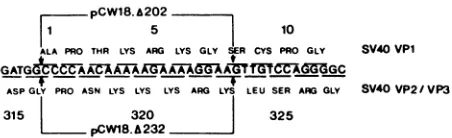
pCW18.,&202
1 5 10
ALA PRO THR LYS ARG LYS GLY SER CYS PRO GLY SV40VP1
GATGkC_rAU AAKn A-AA- 'T f -AGC
ASPGLY PRO ASN LYS LYS LYS ARG LYS LEU SER ARGGLY SV40VP2/VP3
315 320 325
pCW18.A232
FIG. 8. Thesameregion ofthe SV40genomeencodesthe VP1 nuclearmigrationsequence andthe VP2-VP3nuclear accumulation sequence.pCW18A202expressesaSV40VP1-poliovirusVP1 fusion protein in whichthefirsteightVP1 NH2-terminal amino acidsare
deleted(arrows). pCW18A232expressesSV40VP2-VP3/poliovirus VP1fusionproteins deleted for VP2 amino acids 317to323(arrows) and the 13 VP2 COOH-terminal amino acids (340 to 352). The deleted fusion proteins expressed by both plasmids remained lo-cated inside the cell cytoplasm. The reading frames used for the synthesis of SV40VP1 andofSV40VP2-VP3 areindicatedby the bars aboveorbeloweachcodon,respectively.Amino acid number-ingisafterTooze (31).
Perhaps
tertiary
and quaternary structures oftheproteins
are
responsible
forthis difference.In agreement with our
conclusions,
it was reported re-cently that in the absence of its 35 COOH-terminal aminoacids, SV40 VP3 remains limited to a
cytoplasmic
andperinuclear location
(8).
The authors of that report con-cluded that the 35 COOH-terminal amino acids sharedby
VP2and VP3arerequired forthe nuclearlocalization ofboth
proteins
and arelikely
to contain thekaryophilic signal
needed for their nuclear
targeting. They
also showed that nuclear localization of VP3 could be observed in the totalabsence of VP2 or the SV40
agnoprotein. Interestingly,
quasi-normal transport ofVP3 tothe nucleus(and
presum-ably of VP2also) wasobserved when
only
one-third ofthe amino-terminal sequence of VP1 was present. This VP1fragment contains the nuclear migration
signal
(35). The intracellular localization of the truncated VP1protein
was unfortunately notreported by those authors.The sequence
responsible
forthemigration
ofSV40 VP1 andthatresponsible fortheaccumulationofSV40VP2-VP3intothe cell nucleusareencodedbythesame
portion
oftheSV40 genome
(nucleotides
1492 to 1513), which is read in two different frames(Fig.
8). This leads us topredict
that mutations in this region of the genome should profoundlyaffect the
viability
of thevirus,
becausethey
would prevent the nuclear location of all three SV40 capsidpolypeptides
VP1, VP2, andVP3.
ACKNOWLEDGMENTS
Wethank J. Feunteunforthe gift of pDR404 andB. Blondel for thegiftofpolyclonal antipoliovirus antibodies.
Thisworkwassupported inpartby CNRSgrant UA 545 andby ATPgrants 155198 and 955339.
LITERATURE CITED
1. Birnboim,H.C.,andJ. Doly. 1979. Arapid alkalineextraction procedure for screening recombinant plasmid DNA. Nucleic Acids Res. 7:1513-1523.
2. Blondel, B., R. Crainic, and F. Horodniceanu. 1982. Le polypeptide structural VP1 du poliovirus type 1 induit des anticorpsneutralisants. C.R.Acad. Sci. 294:91-93.
3. Bonner, W. M. 1975. Protein migration into nuclei. I. Frog oocytenuclei accumulatemicroinjected histones,allowentry to small proteins, and exclude large proteins. J. Cell. Biol. 64:421-430.
4. Bonner, W. M. 1975. Protein migration into nuclei. II. Frog
on November 10, 2019 by guest
http://jvi.asm.org/
[image:7.612.330.556.72.141.2]oocyte nuclei accumulate aclass ofmicroinjected oocyte nu-clear proteins and exclude aclass ofoocyte cytoplasmic pro-teins. J. Cell. Biol.64:431-437.
5. Chesebro, B., R. Race, K. Wehrly, J. Nishio, M. Bloom, D. Lechner, S.Bergstrom, K. Robbins, L. Mayer, J. M. Keith, C. Garon, and H. Haase. 1985. Identification of scrapie prion protein-specificmRNAinscrapie-infectedanduninfectedbrain. Nature(London) 315:331-333.
6. CoUedge, W. H., W. D. Richardson, M. D. Edge, and A. E. Smith. 1986. Extensive mutagenesis of the nuclear location signal of simian virus 40 large-T antigen. Mol. Cell. Biol. 6: 4136-4139.
7. Dingwall, C., S. V. Sharnick, and R. A. Laskey. 1982. A polypeptide domain that specifies migration of nucleoplasmin into the nucleus. Cell30:449-458.
8. Gharakhanian, E., J.Takahashi, and H. Kasamatsu. 1987. The carboxy 35 amino acids ofSV40 VP3 areessentialfor its nuclear accumulation. Virology 157:440-448.
9. Girard, M., L.Marty, and F. Suarez. 1970.Capsid proteins of simian virus 40.Biochim. Biophys. Res. Commun.40:97-102. 10. Green, S., P. Walter, V. Kumar, A. Krust, J. M. Borneert, P.
Argos, and P. Chambon. 1986. Human oestrogen receptor cDNA:sequence,expression and homologytov.erb.A.Nature (London)320:134-139.
11. Hall, M. N., L. Hereford,andI.Herskowitz. 1984.Targeting of E. coli
0-galactosidase
to the nucleus in yeast. Cell 36:1057-1065.12. Kalderon, D., W. D. Richardson, A. F. Markham, and A. E. Smith. 1984. Sequence requirements for nuclear location of simian virus40largeTantigen. Nature (London) 311:499-509. 13. Kalderon,D., B. L. Roberts, W. D. Richardson, and A. E. Smith. 1984. A short amino acid sequence able to specify nuclear location. Cell 39:499-509.
14. Kasamatsu, H.,and A.Nehorayan. 1979. VP1affects intracellu-lar localization of VP3 polypeptide during simian virus 40 infection. Proc. Natl. Acad.Sci. USA76:2808-2812.
15. Lanford,R.E.,andJ.S. Butel.1984. Construction and charac-terization ofanSV40mutantdefectivein nuclear transportofT antigen. Cell 37:801-813.
16. Lanford, R.E., P. Kanda, and R. C. Kennedy. 1986.Induction of nucleartransportwithasynthetic peptide homologoustothe SV40Tantigen transportsignal. Cell 46:575-582.
17. Mandel, M., and A. Higa. 1970. Calcium dependent bacterio-phage DNA infection. J. Mol. Biol. 53:159-162.
18. Maniatis, T., E. F.Fritsch,andJ. Sambrook. 1982. Molecular cloning: alaboratory manual. ColdSpring HarborLaboratory, ColdSpring Harbor,N.Y.
19. Moreland,R.B.,H.G.Nam,L. M.Hereford,and H. M. Fried. 1985. Identification ofa nuclear localization signal ofayeast ribosomalprotein.Proc. Natl. Acad. Sci. USA82:6561-6565. 20. Morinaga, Y.,T.Franceschini,B.Inouye,and M.Inouye. 1984.
Improvement ofoligonucleotide directed sitespecific mutagen-esis using double-stranded plasmid DNA. Biotechnology 2:636-639.
21. Murray,N. E., W. H. Brammer, and K. Murray. 1976.Lamboid phages thatsimplifythe recoveryof in vitro recombinants. Mol. Gen. Genet. 150:53-61.
22. Pages, J., S. Manteuil, D. Stehelin, M. Fiszman, M. Marx,and M. Girard. 1973. Relationship between replication of simian virus 40 DNA and specific events of the host cell cycle. J. Virol. 12:99-107.
23. Prives, C. L., H. Aviv, B. M. Paterson, B. E. Roberts, S. Rozenblatt, M.Revel,and E. Winocour. 1974. Cell-free transla-tion of messenger RNA ofsimian virus 40: synthesis of the major capsid protein. Proc. Natl. Acad. Sci.USA 71:302-306. 24. Rawlins, D. R., P.Collis, and N. Muzyczka. 1983.
Characteriza-tion of am404, an ambermutation inthe simian40 Tantigen gene. J. Virol. 47:202-216.
25. Rawlins, D. R., and N. Muzyczka. 1980. Construction of a specific ambercodon in the simian virus 40T-antigengeneby site-directedmutagenesis. J. Virol.36:611-616.
26. Rozenblatt, S., R. C. Mulligan, M. Gorecki, B. E. Roberts, and A.Rich. 1976.Directbiochemical mapping of eukaryotic viral DNA by meansofa linked transcription translation cell free system. Proc.Natl. Acad. Sci. USA73:2747-2751.
27. Sanger, F., J. Nicklen, and A. R. Coulson. 1977. DNA sequenc-ing with chain terminatsequenc-ing inhibitors. Proc. Natl. Acad. Sci. USA 74:5463-5467.
28. Silver, P. A., L. P. Keegan, and M. Ptashne. 1984. Amino terminus of theyeastGal4geneproduct issufficient for nuclear localization. Proc.Natl. Acad. Sci. USA 81:5951-5955. 29. Sompayrac,L.M., and K. J. Danna.1981.Efficient infection of
monkey cells withDNAof simian virus40. Proc. Natl.Acad. Sci. USA 78:7575-7578.
30. Tegtmeyer, P., J. A. Robb, C. Widmer, and H. L. Ozer. 1974. Alteredproteinmetabolismin infectionby the latetsBll mutant of simian virus40. J. Virol. 14:997-1007.
31. Tooze, J. 1980. Molecular biology oftumor viruses, 2nded., part2,p. 799-831. ColdSpring Harbor Laboratory, Cold Spring Harbor, N.Y.
32. Von Heijne, G. 1986. Mitochondrial targeting sequences may formamphiphilic helices. EMBOJ. 5:1335-1342.
33. Watson, M. E. E. 1984. Compilation of published signal se-quences.Nucleic AcidsRes. 12:5145-5164.
34. Wieslander, L. 1979. A simple method to recover intact high molecularweight RNAandDNAafterelectrophoretic separa-tion in low gelling temperature agarose gels. Anal. Biochem. 98:305-309.
35. Wychowski, C., D. Benichou, and M. Girard.1986.Adomainof SV40capsidpolypeptide VP1 that specifies migration into the cell nucleus. EMBO J. 5:2569-2576.
36. Wychowski, C., S.vanderWerf,and M.Girard. 1985.Nuclear localization ofpoliovirus capsidpolypeptideVP1expressedas a
fusionprotein with SV40-VP1. Gene37:63-71.
37. Zagursky,R.J., K. Baumeister,N.Lomax,and M. L. Berman. 1985.Rapid andeasysequencing of large linear double-stranded DNAandsupercoiledplasmidDNA.Gene Anal.Tech.2:89-94.